
Lancaster City Zoning Code
CHAPTER 17
08 - RESIDENTIAL ZONES1
Editor's note— Ord. No. 989, § 1, adopted April 9, 2013, repealed ch. 17.08, §§ 17.08.010—17.08.400 and added a new ch. 17.08, §§ 17.08.010—17.08.500. The former chapter pertained to similar subject matter and derived from prior zoning ord. §§ 200.000, 201.010—201.021, 201.023—201.025, 201.027, 201.040, 201.050, 201.060—201.062, 201.070—201.075, 201.080, 201.083, 201.085, 201.086, 201.088, 202.010, 202.015, 202.020, 202.021, 202.024, 202.025, 202.050, 202.052, 202.053, 202.070, 211.000—211.130, 2.12.000—2.12.140, 212.200—212.230, 213.100—213.130, 213.500—213.585, 214.200, 214.300; Ord. 651 §§ 4(part), 5, 1993; Ord. 658, § 1, 1994; Ord. 663 § 2, 1994; Ord. 681 § 3, 1995; Ord. 711 §§ 4—13, 18(part), 19(A), 30(part), 31, 43(part), 1995; Ord. 713 §§ 2, 4, 1995; Ord. 752 § 1, 1999; Ord. 758 § 1(Exh. A §§ 2, 3), 1999; Ord. 812 § 2, 2003; Ord. 815, Exh. A, 2003; Ord. 816, Exh. A(part), 2003; Ord. 837, § 1 Exh. A(part), 2004; Ord. 854, § 1(Exh. A), 2006; Ord. 879 § 1(part), 2007; Ord. 896, § 1(Exh. A §§ 3, 4), 2008; Ord. 900 §§ 2—6, 2008; Ord. No. 907, § 4, adopted October 28, 2008; Ord. No. 921, §§ 2—4, adopted June 9, 2009; Ord. No. 924, § 1, adopted August 25, 2009; Ord. No. 933, §§ 1—3, adopted October 13, 2009; Ord. No. 941, § 3, adopted February 9, 2010; Ord. No. 954, §§ 2—6, adopted December 14, 2010; Ord. No. 956, §§ 1, 2, adopted January 11, 2011; Ord. No. 964, § 1, adopted May 24, 2011; Ord. No. 971, §§ 4—6, adopted October 25, 2011.
17.08.010 - In general.
As used in this title, "residential zones" mean the RR, R, MHP, MDR and HDR zones.
(Ord. No. 989, § 1, 4-9-2013)
17.08.020 - Purpose and intent.
The purpose and intent of the residential zones are to implement the city's general plan, and land use designations as set forth in the text of the general plan and as delineated on the general plan map. The adopted general plan specifies goals, objectives, policies, and specific actions with regard to residential uses and development.
It shall not be the intent of this title to render previously legally created building lots or legally constructed buildings which do not comply with the property development regulations of this title to be nonconforming where these lots or buildings complied with the ordinances in effect at the time of their creation or construction.
(Ord. No. 989, § 1, 4-9-2013)
17.08.030 - Purposes of the Residential zones.
A.
Non-Urban Residential or RR Zones. These zones are intended to provide for single-family dwellings in a non-urban environment with minimal urban services. The primary difference between the zones is the minimum lot size. Only those additional uses that are complementary to and exist in harmony with a rural residential neighborhood are allowed.
1.
The RR-2.5 (rural residential) zone implements the "non-urban residential, rural residential" designation. This zone is intended for rural single-family residential use, allowing one dwelling unit per minimum net area of one hundred thousand (100,000) square feet;
2.
The RR-1 (rural residential) zone implements the "non-urban residential, low density" designation. This zone is intended for low density single-family residential use, allowing one dwelling unit per minimum net area of forty thousand (40,000) square feet; and
3.
The SRR (semi-rural residential) zone implements the "non-urban residential, transitional density" designation. This zone is intended for transitional density between the rural and urban land uses, allowing one dwelling unit per minimum net area of twenty thousand (20,000) square feet.
B.
Urban Residential or R Zones. These zones are intended to provide for single-family dwellings in an urban environment with full urban services. Only those additional uses that are complementary to and exist in harmony with an urban residential neighborhood are allowed.
1.
The R-15,000 zone implements the "urban residential, transitional density" land use designation. This zone is intended for single-family dwellings, allowing one dwelling unit per minimum net area of fifteen thousand (15,000) square feet;
2.
The R-10,000 zone implements the "urban residential, transitional density" land use designation. This zone is intended for single-family dwellings, allowing one dwelling unit per minimum net area of ten thousand (10,000) square feet; and
3.
The R-7,000 zone implements the "urban residential, low density" land use designation. This zone is intended for single-family dwellings, allowing one dwelling unit per minimum net area of seven thousand (7,000) square feet.
C.
Medium and High Density Residential Zones. These zones are intended to provide for medium to high density multiple-family dwellings in an urban environment with full urban services. Only those additional uses that are complementary to and exist in harmony with such residential developments are allowed.
1.
The MDR zone implements the "medium density residential" land use designation. This zone includes lower intensity residential dwelling units, with a density range of 6.6 to fifteen (15) dwelling units per acre; and
2.
The HDR zone implements the "high density residential" land use designation. This zone includes higher density residential dwelling units, with a density range of 15.1 to thirty (30) dwelling units per acre.
(Ord. No. 989, § 1, 4-9-2013)
17.08.040 - Applicability of standards.
A person shall not use any premises in the residential zones, except as hereafter permitted in this title and subject to all regulations and conditions enumerated in this title. Development and new land uses proposed within the residential zones shall comply with the standards in this section for the applicable zones, as follows:
A.
Use. Only the land uses allowed by Section 17.08.050 shall be established in the applicable zone. In the instance when an applicant proposes a use that is not specifically listed in Section 17.08.050, the planning director shall make a determination on whether it is allowed or not, based on the finding that the proposed use would complement and be able to exist in harmony with other permitted uses in the same zone.
B.
Site Specifications and Building Placement. Each proposed structure shall comply with the build-to line, setback, and buildable area requirements in Section 17.08.060 as required for the applicable zone.
C.
Building Size and Massing. Each proposed structure shall adhere to size, massing, and height standards established by Section 17.08.060 for the applicable zone.
D.
Parking. On-site parking shall be provided, located, and designed in compliance with Section 17.08.060 for the applicable zone.
E.
Development and Building Types. All developments shall substantially resemble one of the development and building types listed in Section 17.08.060, or feature primary characteristics of the development and building types. All residential developments which meet the objective development standards in Section 17.08.060 and the objective design standards in Chapter 17.41, Article IV, shall be deemed to meet this requirement.
F.
Other Design Requirements. All other requirements listed in Section 17.08.060, Section 17.08.070, and all applicable guidelines in the city design guidelines shall apply. All residential developments which meet the objective development standards in Section 17.08.060 and the objective design standards in Chapter 17.41, Article IV, shall be deemed to have met the discretionary design standards in Section 17.10.070 and applicable guidelines.
(Ord. No. 989, § 1, 4-9-2013; Ord. No. 1106, § 4(Exh. A), 10-10-2023)
17.08.050 - Uses and permit requirements.
A.
Uses and permit requirements. The uses and permit requirements applicable to the residential zones are identified in the Uses Matrix below. Uses which do not fall into any other category, and are not temporary uses, uses subject to director's review, or uses subject to permit in these zones, shall be subject to interpretation of the director. The requirement for site plan review in Section 17.08.050.B applies to all uses, except permitted (P) uses and uses subject to director's review (D) unless otherwise indicated below.
Notes:
1 R-7,000 and R,10-000 zones only
2 Use, development standards and permit requirements shall be determined by the director when compatible with existing and surrounding areas and adjacent properties
3 RR-1 and RR-2.5 zones only
4 RR-2.5 zones only
5 In conjunction with a non-residential use, such as a church, school, etc.
6 Subject to the provisions of Chapter 9.46
7 In accordance with Section 1250 of the Health and Safety Code
8 In accordance with Section 1502 of the Health and Safety Code
9 In compliance with California Health and Safety Code Section 17021.6, Employee Housing is permitted as an agricultural use.
B.
Site Plan Review. Except as specified in subsection C, a site plan (with vicinity map) and building elevations, drawn to scale and reflecting the accurate dimensions of the buildings and property, shall be required of any person seeking to erect new buildings or structures, make additions to any existing buildings or structures, site temporary commercial coaches, or otherwise grade, improve or develop any lot or portion thereof for a permitted use prior to the issuance of any grading or building permit. The site plan shall be accompanied by an appropriate development application and both shall be filed with the community development department. The director or his designated representative shall review the site plan for conformance with the provisions of this title. The site plan shall demonstrate conformance with height regulations, property development regulations, sign regulations or a sign program required by the city for multiple-tenant projects, off-street parking requirements, the adopted City of Lancaster Design Guidelines, any other requirements established for the adopted zoning designation in which the property(ies) is (are) located, and any other applicable city ordinances, standards, guidelines or policies.
In addition to the conditions and requirements imposed by the ordinance codified in this title and other city ordinances, standards, guidelines and policies, the director may place conditions on the approval of the site plan where the director finds that such action is necessary to protect the public health, safety and welfare. At such time as the site plan complies with the requirements of the ordinance codified in this title and other city ordinances, standards, guidelines or policies, the site plan shall be approved by the director or his designated representative.
The site plan approval shall be valid for 2 years from the date of approval. A site plan shall be considered "used" when the slab of a major building in the project is poured and inspected, although circumstances in each case may vary and the final determination as to "use" of a site plan review shall be made by the director. Three one-year extensions of the approval may be granted by the director provided such written request for an extension is received not less than 60 days prior to expiration, and any significant environmental changes which have occurred since the original approval have been addressed. Any extension granted shall be conditioned to comply with the city's current design guidelines as adopted by the city council, unless the applicant can demonstrate to the director's satisfaction that such compliance will impose an undue hardship on the project. In the event the site plan or an extension thereof is denied, the applicant may appeal the decision in accordance with Section 17.36.030. All projects constructed in accordance with an approved site plan shall be permanently maintained as approved. Any desired subsequent changes shall be submitted for approval as an amendment to the site plan. Prior to occupancy the site shall be inspected for compliance with the site plan. All improvements shall be installed and functioning before occupancy will be allowed.
When the appropriate development application is filed per subsection A of this section it shall be accompanied by the filing fee established by resolution of the city council.
C.
Exempt From Site Plan Review.
1.
Site plan review is not required for permitted (P) uses and uses subject to director's review (D) unless otherwise indicated in the uses matrix above.
2.
Where the director determines that the requirements of site plan review surpass the city's need for project review of a particular development proposal, the director may exercise discretion and apply the provisions of Article VI of Chapter 17.32, Director's Review, in its place.
(Ord. No. 989, § 1, 4-9-2013; Ord. No. 999, § 3, 8-26-2014; Ord. No. 1070, § 4(Exh. A), 1-14-2020; Ord. No. 1106, § 4(Exh. A), 10-10-2023; Ord. No. 1130, § 4(Exh. A), 5-27-2025)
17.08.060 - Development regulations by building types.
A.
Single-Family House on Rural Residential Lot. A single-family house on a rural residential lot is a residence for one household, with its primary entrance accessed through the front yard, on a lot ranging from 20,000 to 100,000 square feet or greater.
1.
Development Standards.
Diagram for Single-family House on Rural Residential Lot — Perspective View
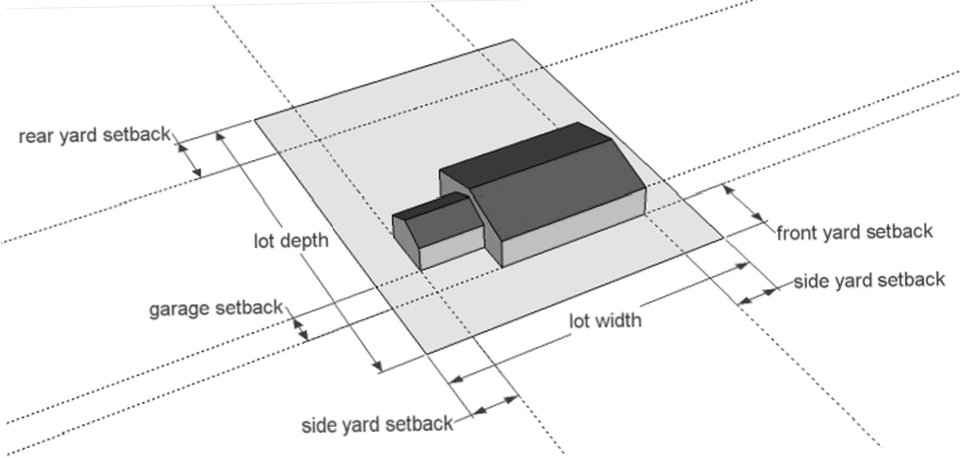
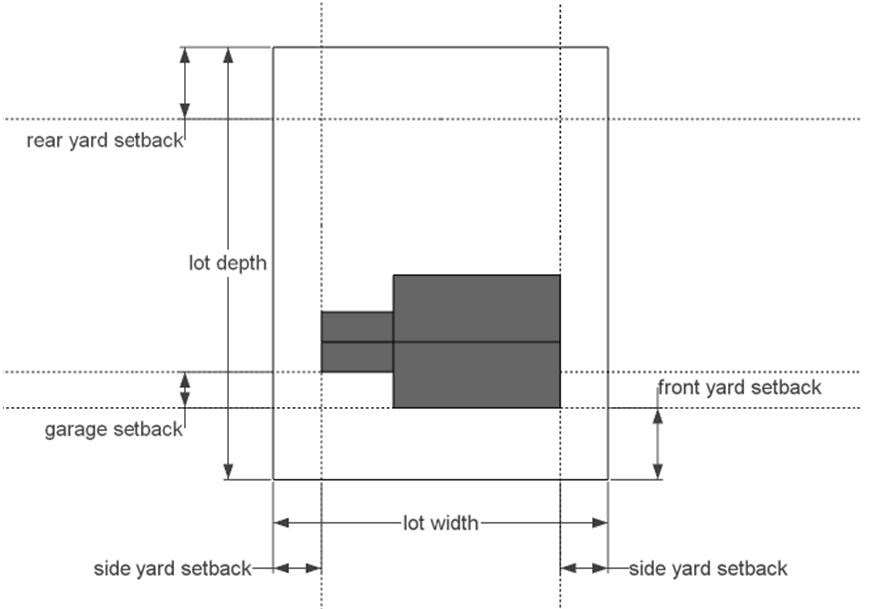
Diagram for Single-Family House on Rural Residential Lot — Site Plan View
B.
Single-Family House or Duplex on Residential Lot.
1.
Development Standards.
Notes:
1 Corner lots featuring side yard driveway access require a minimum 20-foot driveway and street side yard setback.
C.
Small Apartment/Condominium Building/Complex (3 to 15 units).
1.
Development Standards.
a.
On-site management shall be provide for apartments 4 units or greater.
b.
Required amenities for units in a small apartment include in-unit laundry hook-ups.
c.
Other site amenities may include a barbeque area, pool, recreation courts, and shall be centrally located and easily accessible for residents.
d.
Trash enclosures shall meet the following requirements:
1.
Trash enclosures shall be located or screened so that they are not visible from primary entrances drive or streets;
2.
Trash enclosure shall be a minimum of 165 square feet;
3.
Source separation of recyclable materials shall be accommodated in accordance with state requirements;
4.
Trash enclosures shall be constructed with a non-combustible, overhanging, trellis or roof cover; and
5.
Trash enclosures shall be separated from adjacent parking by at least a 6-foot wide planter.
D.
Large Apartment/Condominium Building/Complex (16 or more units).
1.
Development Standards.
a.
On-site management and security shall be provided for all large apartment complexes. at a minimum, specific security provisions shall include cameras and alarms or active security guard surveillance.
b.
Required amenities for units in a large apartment include in-unit laundry hook-ups, and community pool and recreation room.
c.
Other amenities for units in a large multi-family complex may include courts for basketball, tennis or other sports, indoor gym, outdoor dog park, or daycare center.
d.
All amenities shall be centrally located and easily accessible for residents.
e.
Trash enclosures shall meet the following requirements:
1.
Trash enclosures shall be located or screened so that they are not visible from primary entrances drive or streets;
2.
Trash enclosure shall be a minimum of 165 square feet;
3.
Source separation of recyclable materials shall be accommodated in accordance with state requirements;
4.
Trash enclosures shall be constructed with a non-combustible, overhanging, trellis or roof cover; and
5.
Trash enclosures shall be separated from adjacent parking by at least a 6-foot wide minimum planter.
(Ord. No. 989, § 1, 4-9-2013; Ord. No. 1020, § 4, 2-14-2017; Ord. No. 1070, § 4(Exh. A), 1-14-2020; Ord. No. 1106, § 4(Exh. A), 10-10-2023; Ord. No. 1130, § 4(Exh. A), 5-27-2025)
17.08.070 - Design and performance measures.
Developers shall take the following actions in meeting specific design and performance measures in residential zones. Residential development which meets the objective design standards in Chapter 17.41, Article IV shall be deemed to have met these measures.
A.
Site Design. Develop projects that enhance the sense of place and reflect a commitment to functional efficiency, quality, and neighborhood context.
1.
Develop innovative designs for new subdivisions that feature pedestrian connections, open spaces, enhanced landscaping, architecture, and streetscapes.
2.
Develop innovative designs for residential lot layouts, including wide corner lots, varied setbacks, and minimized visual presence of garages.
3.
Design neighborhoods to have distinct entryway features that help define neighborhood character and provide a sense of arrival.
4.
Design neighborhoods using "safe by design" techniques to reduce opportunities for criminal activity.
B.
Pedestrian Connections and Amenities. Develop residential neighborhoods with safe and attractive pedestrian and bicycle connections to trails, parks, schools, public transit, and other daily uses.
1.
Design neighborhoods with street patterns that minimize the walking distance between residential homes and neighborhoods amenities, such as trails, parks and schools.
2.
Design open-ended cul de sacs with paseos for pedestrian and bicycle access.
3.
Design pedestrian and bicycle paths separated from vehicular paths, to ensure safety and ease of use.
4.
Where appropriate, use traffic calming measures to reduce automobile speed within residential developments, including corner bulbouts, tree plantings, enhanced paving at crosswalks, and round-a-bouts.
C.
Building Architecture and Form. Provide enhanced elevations for residential structures that contribute to an attractive neighborhood streetscape.
1.
Articulate building façades by including variation in massing, roof form, and wall planes.
2.
Use multiple colors, materials, textures, and applied finishes to help break up wall massing.
3.
Provide distinctive entries, porches, balconies, and window treatment, oriented toward the street.
4.
Residential buildings shall use high-quality, tile roofing (concrete, ceramic, etc.), providing aesthetic value and appropriate for withstanding the city's varied climate conditions; asphalt shingle or other roofing material shall be permitted when compatible with existing and surrounding areas and adjacent properties.
5.
Garage door shall provide aesthetic value to the home. Roll-up garage door types are permitted, whereas wooden, swing-out garage doors are prohibited.
6.
Builders of new single-family residential subdivisions shall ensure architectural variation by providing a minimum of the following combinations, dependent on the proposed number of residential units in the development:
In no instance should two homes of the same model and floor plan be built adjacent to each other or across the street from each other.
D.
Transitions and Buffering. Encourage transitions between proposed higher intensity developments and adjacent, less intensive uses to keep disturbance to a minimum.
1.
Step down the heights of structures at the edge of developments to match or complement those in adjacent properties.
2.
Enhance buffers with additional width or increased landscaping. Plant trees and shrubs in voids created by wall variations, at an appropriate scale.
3.
Vary building setbacks and wall alignments to soften the edge of the development.
4.
Provide a clear distinction between public and private spaces, through the use of height separation, fencing, berm, or a combination of these elements.
5.
Offset windows from one another between residential units.
E.
Open Space and Common Areas. Provide open space and common areas to enhance quality of life, and to encourage opportunities for social gathering and interaction.
1.
For single-family residential developments, create centralized pocket parks, connected by trails and pedestrian paths, to serve the neighborhood.
2.
For multi-family residential developments, provide centralized open space and community facilities, to serve residents of the development.
3.
Create recognizable focal points by using community amenities in public open spaces and other commonly used community spaces.
F.
Parking and Access. Minimize the dominant appearances of parking areas and structures, while ensuring functional vehicular access.
1.
For multi-family residential developments, locate parking behind residential structures. For developments facing arterial streets, a builder may design a wide, enhanced landscape buffer between the street and parking areas, in circumstances where it is difficult to achieve rear parking placement. Wherever possible, design parking lots by dividing a large parking lot into a series of smaller, connected lots.
2.
Decorate and define parking areas with plants, shrubs, trees, light fixtures, and textured paving to minimize the negative impact of large expanses of asphalt.
3.
Provide defined pedestrian pathways between parking areas and residential building entrances.
4.
Permanent parking for recreation vehicles (RVs), boats and other similar large items shall be located behind the front plane of the house.
5.
In no instance shall flat, paved surfaces, including driveways, cover more than 50% of a single-family front yard.
(Ord. No. 989, § 1, 4-9-2013; Ord. No. 1070, § 4(Exh. A), 1-14-2020; Ord. No. 1106, § 4(Exh. A), 10-10-2023)
17.08.080 - Infill residential development.
A.
Purpose and Intent. The purpose of this section is to implement the city general plan 2030, policy 18.2.1, which encourages appropriate infill development, and specific action 18.2.1(c). Under the guidance of the specific action, a developer may build up to eight residential units per net acre on land zoned R-7,000, provided the developer makes the findings that the proposed infill development would integrate with the surrounding area.
B.
Qualification Criteria for Infill Residential Development. Properties zoned R-7,000 and meeting one of the following criteria qualify for infill residential development of up to eight units per acre:
1.
The project site is located within the area bounded by Avenue I, 20th Street East, Avenue L and 30th Street West; or
2.
The project site is surrounded by existing development (fully improved with paving, landscaping, curb and gutter, etc.) on all adjoining sides; or
3.
The project site is located adjacent to property zoned commercial, office professional, mixed use or light industrial development; or
4.
The project site combines four or more adjoining parcels, combining for a minimum project size of five acres.
C.
Findings for Infill Residential Development. The following findings shall be made when recommending approval for an infill residential development:
1.
The project reduces overall land use fragmentation in the city.
2.
The project uses existing infrastructure and minimizes extension of new services and resources.
3.
The project is compatible with adjacent land uses and would not adversely affect the health, peace, comfort or welfare of persons residing or working at the adjacent properties.
D.
Infill Residential Development Standards. In addition to all other applicable development standards listed in this chapter, infill residential single-family lots shall adhere to the following additional standards specific for small-lot single-family homes:
1.
Site Design.
a.
Maximize usability of property by minimizing "dead spaces," which can often be found in narrow side yards with limited access.
b.
Create privacy by designing windows that minimizes view into an adjacent residential home. Also, design windows of a façade along a zero-lot line facing a neighboring side yard to be small, with a high sill height, typically six feet above the finished floor, or provide windows with translucent glazing.
c.
For alley-access small-lot single-family parcels, the developer shall provide a four-foot-wide pedestrian pathway to connect the building entrance to the street sidewalk.
2.
Building Design.
a.
A proposed small-lot subdivision must have homes that are distinguished from one another, following the minimum number of model and floor plan combinations as listed in subsection 17.08.070.C.6.
b.
Blank, flat wall planes are prohibited. Varied and articulated façades that create visually appealing elevations are required.
c.
Provide at least two different rooflines to provide visual interest to the residential structure.
d.
Roof-mounted equipment is not allowed, with the exception of solar and wind generation systems. Photo-voltaic panels facing the street shall be designed integrated with the house rooftop.
3.
Transitions and Buffering.
a.
In infill situations, new buildings shall be located in a manner that complements the location of existing buildings on adjacent lots; and not in a manner that would diminish their appearance or that would create a streetscape with dramatically uneven building setbacks.
b.
All residential buildings, including detached garages, shall maintain a minimum five-foot separation distance from any other structure to ensure adequate clearance area around the structures.
c.
Adjacent homes shall not vary more than one-story in height.
4.
Patios, Private Yards, Open Space and Common Areas.
a.
Each small-lot single-family home shall have a porch area with minimum dimensions as listed in subsection 17.08.060.B.
b.
Each small-lot single-family parcel shall provide a minimum of four hundred (400) square feet of usable private yard space with no dimensions less than twelve (12) feet.
c.
The City may grant a reduction of usable private yard space to two hundred (200) square feet, with no dimensions less than twelve (12) feet, if the developer provides common open space or park elsewhere in the neighborhood that is no further than ¼ mile from the residence, or if there is an existing park within the same distance.
5.
Parking and Access.
a.
For alley-access small-lot single-family parcels, a garage entrance facing an alley shall ensure a minimum of twenty-six (26) feet from the opposite edge of the alley, for adequate vehicle backup space.
(Ord. No. 989, § 1, 4-9-2013; Ord. No. 1070, § 4(Exh. A), 1-14-2020)
17.08.090 - Density bonus.
Density increases and other incentives to encourage the creation of housing affordable to moderate-, low-, and very low-income households, seniors, and other qualifying households in accordance with Section 65915 et seq. of the California Government Code are subject to Chapter 17.41, Article II.
(Ord. No. 989, § 1, 4-9-2013; Ord. No. 1106, § 4(Exh. A), 10-10-2023)
17.08.100 - Parking and Loading.
The automobile parking facilities required by this section shall be provided and permanently maintained unless and until a substitute has been provided which is in full compliance with the provisions of this title.
A.
General conditions. All buildings shall have permanently maintained off-street parking and shall apply as follows:
1.
No structure or use shall be permitted or constructed unless off-street parking spaces are provided and maintained in accordance with the provisions of this section;
2.
When a building is enlarged the required amount of parking spaces shall be provided for that enlargement portion, in accordance with the provisions of this section;
3.
When there is an increase in the number of bedrooms (to more than one); or
4.
When there is an increase in the number of dwelling units.
B.
Fractions. Fractional space requirements for a parking space shall be rounded up to the next whole space.
C.
Minimum Number of Required Parking Spaces. Except as necessary to comply with requirements to provide electric vehicle supply equipment installed parking spaces or parking spaces that are accessible to persons with disabilities, the following minimum parking standards apply.
1.
For sites located within one-half mile of a major transit stop as defined in Section 21155 of the Public Resources Code, no parking is required, except:
a.
Event centers shall provide parking for employees and other workers.
b.
Development projects where any portion is designated for use as a hotel, motel, bed and breakfast inn, or other transient lodging (except where a portion of a housing development project is designated for use as a residential hotel, as defined in Section 50519 of the Health and Safety Code) shall provide parking in accordance with the minimum parking requirements of subsection C.2 (see "Parking Requirements by Use" Table).
c.
Development projects for which, within 30 days of the receipt of a completed application, the city finds that based on a preponderance of the evidence in the record that not imposing or enforcing minimum automobile parking requirements on the development would have a substantially negative impact on any of the following:
1)
The city's ability to meet its share of the regional housing need in accordance with Section 65584 for low- and very low-income households.
2)
The city's ability to meet any special housing needs for the elderly or persons with disabilities identified in the analysis required pursuant to paragraph (7) of subdivision (a) of Section 65583.
3)
Existing residential or commercial parking within one-half mile of the housing development project.
d.
Subsection (c) above shall not apply for the following projects:
1)
Housing development projects that dedicate a minimum of 20% of the total number of housing units to very low, low-, or moderate-income households, students, the elderly, or persons with disabilities.
2)
Housing development projects that contain fewer than 20 housing units.
3)
Housing development projects subject to parking reductions based on the provisions of any other applicable state law.
2.
For sites located more than one-half mile from a major transit stop as defined in Section 21155 of the Public Resources Code, the following number of parking spaces shall be the minimum provided for each new use:
Notes:
1.
An uncovered parking space shall not include the driveway area for a garage.
2.
Parking lots or areas for 10 or more contiguous uncovered vehicle parking spaces shall comply with the requirements of subsection 17.08.090.D (Parking design and performance standards) for design and development of landscaping and surface parking area.
3.
Parking for uses subject to conditional use permit shall meet the requirements specified in the permit or as otherwise provided in this title.
4.
Requirements for uses not specifically listed herein shall be determined by the director based upon the requirements for comparable uses and upon the particular characteristics of the use.
5.
The number of parking spaces required may be reduced, at the discretion of the director, if the builder can sufficiently demonstrate, through research and analysis that the development warrants fewer parking than is required. Such parking reductions may be granted if the development is located near public transit or if the builder pays in-lieu parking fees for future public parking, transportation, or pedestrian and bicycle trail improvements.
6.
For multi-family uses, a private owner retains the right to assign parking spaces for tenants and visitors, provided there are enough parking spaces per city code.
D.
Accessible Parking. Housing providers shall adhere to the accessible parking regulations of the American Disabilities Act "ADA," Part 20 of the United States Code of Federal Regulations, and the state building code. In accordance to these regulations, housing providers shall establish the following number of accessible parking spaces for multiple-family developments:
E.
Parking Design Standards. The following design and development standards shall be met for development in all residential zones.
1.
Location of Parking Facilities.
a.
Required off-street parking shall be located on the same parcel as the uses served, unless it can be sufficiently demonstrated that parking from another parcel can adequately serve the project, with a recorded parking agreement between the parcels.
b.
Parking facilities other than driveways shall not be located in a required front or street side setback.
2.
Access to Parking Facilities and Parking Spaces.
a.
Access to Parking Lots. Parking facilities shall be designed to prevent vehicle access at any point other than at designated driveway entrances.
b.
Access to Individual Unit Garages. Garages shall be accessed via a minimum 20-foot-length driveway. Garage driveway width shall be minimum 20-foot wide, except for access into tandem garages, or rear-located garages (not alley access), in which the driveway width shall be minimum 12-foot, and shall widen or taper as necessary to allow for adequate vehicle access.
c.
Internal Maneuvering and Queuing. Parking facilities shall provide suitable maneuvering room so that vehicles enter the street in a forward direction, except for lots with 4 or fewer residential units.
3.
Parking Space and Facility Dimensions.
a.
Individual Unit Garages. Parking spaces within garages shall have minimum dimensions of 10 feet in width and 20 feet in length, clear of any obstructions
b.
Carports. Parking spaces within carports shall have minimum dimensions of 9½ feet in width and 19 feet in length, clear of any obstructions.
c.
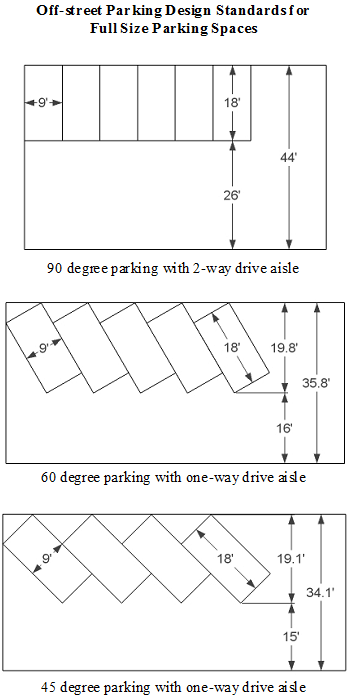
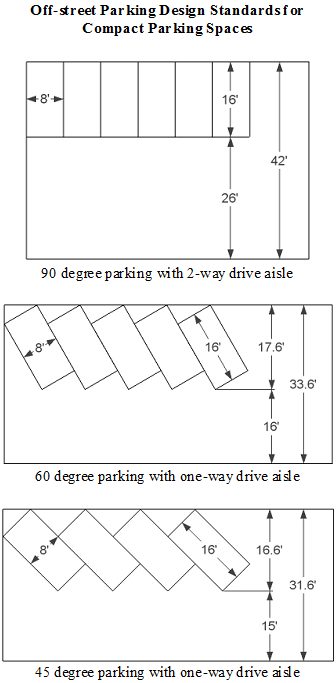
All Other Parking Spaces. Minimum parking space dimensions shall be as follows, except as shown in the following table and figure.
1)
Standard parking spaces shall have a minimum dimension of 9 feet in width by 18 feet in length, except for spaces provided at either a 45 or 30 degree layout, in which the spaces shall have a minimum dimension of 8½ feet in width by 18 feet in length.
2)
Up to 35% of the spaces in a parking lot may be compact spaces, with minimum dimensions of 8 feet in width by 16 feet in length. For multi-residential uses, this shall only apply to guest parking spaces.
3)
Parallel parking spaces shall be 8 feet by 22 feet, except that spaces that are unencumbered at one end may be reduced to 8 feet by 20 feet.
4)
The width of a parking space shall be increased by one foot if either side of the space is adjacent to a wall, fence, support column or other structure, except where the obstruction is limited to the front or rear one-third of the parking space.
4.
Curbing. Continuous concrete curbing at least 6 inches high and 6 inches wide shall be provided along the edges of parking spaces adjacent to fences, walls, sidewalks, other structures, and landscaping.
a.
Alternative barrier designs may be approved by the director.
b.
Parking spaces adjacent along their length to landscaped areas or other similar surfaces shall incorporate a paved extension of the curb measuring 12 inches (for a total of 18 inches) to provide a place to stand while exiting and entering vehicles.
c.
Although discouraged, wheel stops may be installed as determined by the director, in the uncommon circumstance where there is no curbing or landscaping that buffer parking spaces from a fence or other structures. The wheel stop shall be located in a manner that prevents a vehicle from colliding into a fence, or other structures.
d.
Curb design and installation shall comply with national pollution discharge elimination system (NPDES) standards where applicable.
5.
Directional Arrows and Signs (except single-family detached):
a.
Parking spaces, aisles, approach lanes, and maneuvering areas shall be clearly marked with directional arrows and lines to ensure the safe and efficient flow of vehicles.
b.
The director may require the installation of traffic signs in addition to directional arrows to ensure the safe and efficient flow of vehicles in a parking facility.
6.
Access to Public Right-of-Way. Each vehicular passage of any parking or loading facility to or across a public right-of-way shall comply with the following requirements:
a.
No such curb cut may exceed 24 feet in width for single-family residential uses, or 35 feet for multi-family residential uses, unless as approved by a director's review. Curb cut is defined as the flat bottom dimension for the driveway, excluding wings.
b.
Wherever feasible, curb cuts serving adjacent uses shall be combined to minimize the number of entrances onto arterial and collector streets.
c.
Only one curb cut may be installed for any parking or loading facility, provided that additional curb cuts may be allowed if the city engineer determines that each such additional curb cut is necessary for the efficient operation of the facility and will not significantly affect capacity and traffic safety.
d.
Curb cuts for any circular driveway or multiple driveways on the same lot must meet the following requirements:
1)
The curb cuts of circular or multiple driveways must be at least 20 feet apart.
2)
The combined width of the curb cuts shall not exceed 40% of the lot frontage.
e.
Any curb cut on a corner shall be located at the farthest point on the lot from the curb return.
7.
Striping and Identification (except single-family residential). Parking spaces shall be clearly outlined with 4-inch wide lines painted on the surface of the parking facility. Circulation aisles, approach lanes, and turning areas shall be clearly marked with directional arrows and lines to ensure safe traffic movement. Double-striping outlining of parking spaces is also permitted, using the mid-point of the double-striped area as the measurement of the parking space width.
8.
Grade of Parking Facilities. Parking facilities should not exceed a grade of 5%.
9.
Parking Lots as a Transitional Use. Parking lots may be permitted in the residential zones as a transitional use, provided:
a.
In the RR and R zones:
1)
The area used for parking adjoins or is separated only by an alley from property in a multiple-family, commercial, or industrial zone; and
2)
Parking shall be limited to an area within 100 feet from the boundary of the qualifying multiple-family, mixed use, commercial or industrial zone.
b.
In the MDR and HDR zones:
1)
The area used for parking adjoins or is separated only by an alley from property in a commercial or industrial zone; and
2)
Parking shall be limited to an area within 100 feet from the boundary of the qualifying multiple-family, mixed use, commercial or industrial zone.
3)
An area developed with parking shall have direct vehicular access to an improved public street, highway, alley, or to the qualifying multiple-family, mixed use, commercial or industrial zone.
(Ord. No. 989, § 1, 4-9-2013; Ord. No. 1106, § 4(Exh. A), 10-10-2023)
17.08.105 - Two-unit projects.
A.
Two-unit projects proposed in accordance with Government Code Section 65852.21 are subject to Chapter 17.41, Article III.
(Ord. No. 1087, § 3(Exh. A), 12-14-2021; Ord. No. 1106, § 4(Exh. A), 10-10-2023)
Editor's note— Ord. No. 1087, § 3(Exh. A), adopted Dec. 14, 2021, enacted provisions designated as § 17.08.100; however, inasmuch as that section already exists, said provisions have been redesignated as § 17.08.105 at the discretion of the editor.
17.08.110 - Landscaping.
A.
Landscaping in General.
1.
Landscape designs shall be consistent throughout a project site. A combination of landscape materials should be arranged in a harmonious manner as an integral part of project design to enhance building design, public view, and interior spaces and provide buffers and transitions as needed. Unrelated and random choice or placement of plant materials shall be avoided; however, variety may be employed to intensify distinction between spaces or to strengthen a sense of place or movement, or to promote energy and water conservation and mitigate erosion.
2.
The type, scale and proportion of landscape materials shall be appropriate to the site and/or structures to which they relate.
3.
Plant material shall be selected for interest in its structure, texture, color, ultimate growth and water efficiency. Plants that are native or climate adaptive to the high desert area of Lancaster and/or others that will be hardy, harmonious with project design and of good appearance shall be used.
4.
Utilize trees and landscaping wherever possible to shade buildings as a means of enhancing energy conservation.
B.
Objective Landscaping Standards.
1.
Drought-resistant varieties of plants shall be used in accordance with Title 8, Chapter 8.50, Landscaping Installation and Maintenance; Title 8, Chapter 8.30, Residential Landscaping Installation and Maintenance; and Title 15, Chapter 15.48, Specifications for Landscape Development of the Lancaster Municipal Code.
2.
Landscaped areas shall be irrigated by an automatic system with separate stations for each hydrozone. The irrigation system shall be designed and equipped to incorporate water conservation techniques, such as drip systems, moisture sensors and anti-drain valves. Sprinkler systems shall be designed to prevent water from falling onto impervious surfaces. The system shall comply with Title 8, Chapter 8.50, landscaping installation and maintenance; Title 8, Chapter 8.30, residential landscaping installation and maintenance of this code.
3.
All areas which are not utilized for buildings, sidewalks, vehicle access, or parking, shall be permanently landscaped and maintained.
4.
All landscaped planters for interior parking areas shall be completely bordered by a 6-inch concrete curb to prevent runoff.
5.
Required Landscaping. The following basic standards shall be observed:
a.
All interior areas of parking lots shall be landscaped with a minimum of one shade tree plus one shade tree for each 4 parking spaces along with other required plant materials.
b.
The minimum required landscaping for parking lots shall be the percentage shown below of the total area used for vehicle ingress, egress, circulation and parking. Only landscaped areas exclusive of curbs shall qualify toward meeting this requirement and no landscaped area with a dimension of less than 2 feet shall be credited toward meeting the landscape requirement.
c.
Where off-street parking areas abut local or collector public streets, such areas shall be separated from an abutting street by a continuous landscaped planter which extends parallel to the street frontage of the parking area. The planter shall be a minimum of 10 feet in width exclusive of perimeter curbs. Up to one-half of the area of this required landscape planter may be counted toward fulfilling the requirements of the required landscaping for lots under 20,000 square feet.
6.
All landscaped areas shall be continuously and properly maintained in good condition.
7.
At least 25% of all trees installed shall be from a 24-inch box, and no tree shall be less than 15 gallon size. At least 50% of all shrubs shall be of 5-gallon size, and no shrub shall be less than one-gallon size. Ground covers shall be planted at no further apart than 6 inches on center.
8.
Multiple family residential developments shall comply with the provisions of Chapter 8.30.
9.
Single family residential developments shall comply with the provisions of Chapter 8.30.
(Ord. No. 989, § 1, 4-9-2013; Ord. No. 1106, § 4(Exh. A), 10-10-2023)
17.08.120 - Signs.
A person shall not use any sign except as specifically permitted in this section and subject to all regulations and conditions set forth in this title. The following signs are permitted in the residential zones except where specific references limit certain uses to the RR, R, MDR or HDR zone.
A.
Signs in General.
1.
Address. Street numbers of all buildings shall be prominently located and of sufficient size, lighted or illuminated during hours of darkness, to be easily read from the street by public safety personnel in accordance with city standards.
2.
Building Identification Signs. One illuminated wall-mounted sign not to exceed 6 square feet in sign area shall be permitted on a lot which contains 3 dwelling units or more, in the MDR and HDR zones only. No such signs may be illuminated by an exposed incandescent lamp and any continuous or sequential flashing operation is prohibited.
3.
Directory Diagram. A multiple-family residential development consisting of 6 or more dwelling units shall have posted at or near the primary entrance to the building or buildings a brief descriptive directory diagram which clearly indicates the numerical, alphabetical or identification pattern or layout showing the location of each dwelling unit, including floor levels and access patterns. Such diagram shall be of a size to be easily readable by a person with normal vision (text shall be a minimum 12 point font), shall be illuminated during the hours of darkness, and shall be protected from the elements by being placed in a permanent glass or transparent plastic covered device.
4.
Project Identification Signs. One wall or monument sign may be permitted for a multiple-family development or project which contains 10 dwelling units or more. Such sign shall not exceed 20 square feet of total sign area or 8 feet in height measured vertically from the average ground level at the base of the sign. If, in the opinion of the director, the project requires more than one such sign and there are more than 25 dwelling units in the project, the director may then approve a second project identification sign of equal area for a particular project. No such signs may be illuminated by an exposed incandescent lamp and any continuous or sequential flashing operation is prohibited.
5.
Prohibited Signs. The following signs shall be prohibited in the R zones and may not be included in any sign plan.
a.
Any notice, placard, bill, card, poster, sticker, banner, sign, advertising or other device calculated to attention of the public which any person posts, prints, sticks, stamps, tacks or otherwise affixes upon any street, right-of-way, crosswalk, curb, lamppost, hydrant, tree, telephone or lighting system, or upon any fixture in the public right-of-way.
b.
Any strings of pennants, banners or streamers, clusters of flags, strings of twirlers or propellers, flares, balloons, and similar attention-getting devices, including noise-emitting devices, with the exception of the following, not intended for advertising use: holiday decorations in season used for an aggregate period of 60 days in any one calendar year, or national, state, or other governmental or institutional flags properly displayed.
c.
Any off-premises signs constituting a commercial advertisement that is not located on the site of the business or entity indicated or advertised by the sign including temporary, portable, mobile signs affixed to a wall, structure, or vehicle.
6.
Signs for Uses Subject to Conditional Use Permit. The planning commission may approve signs it deems appropriate for the use. In cases where the commission does not specifically approve signs, the maximum dimensions that may be authorized in the residential zones are as follows:
a.
A sign face area of 25 square feet, or a total sign area of 50 square feet; and
b.
A height of 8 feet.
B.
Temporary Signs. Temporary signs, such as real estate "for sale" or "for lease" signs may be permitted in the residential zones subject to the following restrictions:
1.
Area Permitted. Temporary signs that are posted for less than 90 days shall not exceed 16 square feet in sign area (one-sided) or 32 feet in total sign area (2-sided) as defined in Section 17.04.240. An applicant proposing a temporary sign for more than 90 days shall obtain a temporary sign permit, with the requirement that the sign shall not exceed 32 square feet in sign face area or 64 square feet in total sign area.
2.
Height Permitted. Freestanding temporary signs shall not exceed 6 feet in height.
3.
Lighting. Temporary signs shall not be lighted.
4.
Placement. Temporary signs shall not be placed on public property, including all public right-of-ways, or in any manner than would endanger the public.
5.
Prohibited Temporary Signs. All prohibited signs as listed in subsection A.5.
6.
Duration. No temporary sign shall be posted for more than 90 days without obtaining a sign permit pursuant to this section. No sign permit for a temporary sign shall be valid for more than a year. Upon written request for an extension, the director may grant an extension for up to one additional year upon finding that the sign is otherwise in compliance with the requirements of this section et seq. and that the extension is necessary to accomplish the purposes for which the sign has been posted. No additional extensions may be granted. All temporary signs shall be removed within 14 calendar days after the event. The date of the posting shall permanently and legibly marked on the lower right-hand corner of the sign face.
7.
Permit Required. Any person who proposes to post or erect a temporary sign for more than 90 days shall file an application for a sign permit with the planning department. The applicant shall also file a statement of responsibility as required in subsection I.
8.
Standards for Approval.
a.
Within 7 working days, the director or his designated representative shall act upon the application for a temporary sign permit.
b.
The action on the application shall be based on character, location and design, including design elements such as material, letter style, colors, sign type or shape, and the provisions of Section 17.08.110 et seq.
c.
If the action is to disapprove, the notice of disapproval shall specify the reasons for disapproval.
9.
Statement of Responsibility. Each person desiring to post or erect a temporary sign, regardless of duration, shall submit to the planning department, a statement of responsibility in a form approved by the director with a description sufficient to identify the temporary sign, the location of the sign to be posted, and certifying a named individual who is responsible for removing each temporary sign. In the event the responsible individual fails to remove the temporary sign as required by this section, the temporary sign shall be deemed abandoned and may be removed by the city, the cost of which removal shall be payable by the responsible individual.
10.
Removal of Unauthorized, Non-Maintained or Dangerous Signs.
a.
Temporary signs posted for which a statement of responsibility has not been submitted, and a required permit has not been obtained, are subject to immediate removal by the city without compensation. The city may also pursue legal action under Section 17.04.220.
b.
Temporary signs which are deemed by the city to constitute a threat to the public health and safety are subject to immediate removal by the city without compensation or prior notice. (Some examples might include signs which are not secured against the wind or were placed in a manner which would interfere with the vision of drivers or pedestrians.) The city's cost of removal shall be payable by the responsible individual.
c.
Temporary signs for which a statement of responsibility has been submitted, and a required permit has been obtained, and which do not pose a threat to public health and safety are otherwise posted in violation of Section 17.08.110 et seq. shall be subject to removal in accordance with the following procedures:
1)
The city shall provide written notice to the responsible individual for each temporary sign established pursuant to subsection I.
2)
The sign in violation of Section 17.08.110 et seq. shall specify the nature of the violation and shall direct the responsible individual to remove or alter such temporary sign.
3)
If the responsible individual fails to comply with the notice within 3 working days after such notice is mailed, the sign shall be deemed abandoned, and may be removed by the city.
4)
The responsible individual shall pay the city for the cost of the sign removal.
C.
Subdivision Sales Signs. Temporary subdivision sales signs, entry signs and special feature signs shall be accompanied by site plan or other pertinent information and approved by the director in order to be permitted in all zones.
1.
Subdivision Sales Signs.
a.
One freestanding subdivision shall be allowed per street frontage.
b.
Sign Area. The sign face shall not exceed 180 square feet per sign face or 360 square feet in total sign area.
c.
Height Permitted. Twelve feet measured vertically from ground level at the base of the sign.
d.
Location. Each sign shall be located on the subdivision and be oriented to read from the street or highway where the sign is permitted. The distance between subdivision signs shall be a minimum of 500 feet.
e.
Lighting. Subdivision signs may be internally or externally lighted. Continuous or sequential flashing is not allowed.
f.
Time Limit. Subdivision sales signs shall be maintained only until all the property is disposed of, or for a period of 3 years from the date of issuance of the first building permit. The approved sales sign shall be removed at the end of the 3-year period. The director may extend the permitted time beyond 3 years, if needed by the owner of the property. The owner must make the request in writing.
g.
Copy. All copy shall relate exclusively to the subdivision being offered for sale.
2.
Subdivision Entry and Special Feature Signs.
a.
Such signs are permitted and shall be located within a subdivision to facilitate entry and movement.
b.
Sign Area.
1)
Subdivision Entry Signs. The sign face shall not exceed 12 square feet per sign face or 24 feet in total sign area.
2)
Special Feature Signs. The sign face shall not exceed 6 square feet per sign face or 12 feet in total sign area.
c.
Height Permitted.
1)
Subdivision Entry Signs. Shall not exceed a maximum height of 8 feet measured from the base of the sign.
2)
Special Feature Signs. Shall not exceed 6 square feet in sign area or 12 square feet in total sign area.
d.
Lighting. Signs shall be unlighted.
e.
Time Limit. Shall have the same time limit as subdivision sales signs approved for the same tract and shall be removed at the end of such period.
3.
Subdivision Kiosk Signs.
a.
Contents of Application. An application for a subdivision kiosk sign shall be filed as a director's review, and shall contain the following information:
1)
A scale drawing of the proposed sign;
2)
Proposed location of the sign, including distance from adjacent streets and public sidewalks;
3)
The proposed colors of the sign.
b.
Development Standards. All subdivision kiosk signs shall be of a consistent design and shall comply with the following standards:
1)
Height. The overall height of the sign shall not exceed 10 feet, measured form the ground level at the base of the sign.
2)
Width. The overall width of the sign shall not exceed 6 feet.
3)
Individual Sign Panels. Individual sign panels shall not exceed one foot in width and 6 feet in length. Copy on sign panels shall be limited to the name of the subdivision and/or builder, and a directional arrow.
4)
Location. Signs may be located on either public or private property, provided that the appropriate agency or property owner has given their written consent. Signs shall not obscure required line of sight visibility for motorists or pedestrians.
5)
There shall be no additions, tag signs, streamers, flags, banner devices, display boards, or appurtenances added to the signs as originally approved. Further, no other directional signs shall be used, including but not limited to posters or portable outdoor advertising signs.
6)
Subdivision directional signs may advertise tracts either within the city limits or within that portion of the county which is within the city's sphere of influence.
c.
Approval Process.
1)
Approval Authority. Application shall be reviewed and approved by the planning department.
2)
Building Permit. The applicant shall obtain all necessary construction permits from the public works department.
3)
Separate Agreement. The city may, at its discretion, enter into an agreement with a private entity for the purpose of erecting and maintaining subdivision kiosk signs. Such agreement shall be consistent with the provisions of this section, but may also establish other requirements not specifically addressed by this section.
(Ord. No. 989, § 1, 4-9-2013; Ord. No. 1106, § 4(Exh. A), 10-10-2023; Ord. No. 1130, § 4(Exh. A), 5-27-2025)
17.08.130 - Fences, Walls, and Screening.
A.
Purpose. This section provides regulations for the installation, construction and placement of fences on private residential property. For the purpose of this zoning code, the term "fence" includes fences, hedges, walls or other structures with the functions and characteristics of a fence.
B.
Placement of Fences and Walls.
1.
Fences and walls shall be located behind the property line and behind any utilities or shall be located at least 12 feet behind the face of the curb, or as indicated on any recorded property documentation depicting the location of said utilities.
C.
Measurement of Fence and Wall Height.
1.
Fence height shall be measured as the vertical distance between the finished grade from the base of the fence to the top edge of the fence material.
2.
Where the ground elevation within 6 feet of the base of a fence differs from one side of the fence to the other (as when a fence is placed at the top of a slope or on a retaining wall), the height shall be measured from the side with the highest natural grade. (See Section 17.28.030).
D.
Fence Height Limits.
E.
Consideration for Additional Height. A fence or wall may be constructed to a height in excess of the limits established by subsection 17.08.130.D. with a director's review. The director's review may increase the maximum height regulations not to exceed 25% of the amount specified in Section 17.08.130.D. The director's review shall require that the applicant make the following findings, in addition to the findings required for a director's review listed in Chapter 17.32:
1.
The issuance of the permit is reasonably necessary, by reason of unusual or special circumstances or conditions relating to the property, for the preservation of valuable property rights or the full use and enjoyment of the property.
2.
The fence will not create a safety hazard to pedestrians or vehicular traffic.
3.
The appearance of the fence is compatible with the design and appearance of other existing buildings and structures within the neighborhood.
4.
The orientation and location of the fence is in proper relation to the physical characteristics of the site and the surrounding neighborhood.
5.
The fence will be of sound construction.
F.
Fencing for New Production Homes. Fencing for new production homes shall be a masonry wall, adjacent to the rear and side yards, up to 6 feet in height. For the purposes of this standard, "new production homes" means homes that are being, or are proposed to be, constructed as part of a residential subdivision that includes 3 or more lots. The director may approve alternative fencing materials that provide comparable aesthetics and durability.
G.
Fencing for Multifamily Development. Fencing for multifamily developments shall be a masonry wall, tubular steel fence, or comparable material, up to 6 feet in height. For the purposes of this standard, "multifamily development" means properties which contain multiple buildings each comprised of three or more primary units, in the MDR and HDR zones.
H.
Subdivision Perimeter Walls. A masonry wall within a minimum height of 5 feet and a maximum height of 6 feet shall be constructed along the perimeter of a subdivision except where the perimeter coincides with the front lot line of a lot or accessway. Acceptable materials include brick, stone, or decorative concrete masonry unit (CMU) or pre-cast concrete composed of integrally colored concrete that replicates the appearance of brick, stone, stucco and CMU fences. Painted concrete block is not an acceptable material. Design alternatives shall be approved by the Director.
I.
Prohibited Fence Materials. The use of chain link, barbed wire, razor wire, electrical fence, glass and other similar objects of a hazardous characteristic shall not be permitted for residential uses.
J.
Temporary Fencing. A temporary fence may be installed for vacant properties with an approval of a Director's Review subject to time limits, materials, and other conditions of approval. Temporary fencing materials may include chain link.
(Ord. No. 989, § 1, 4-9-2013; Ord. No. 1070, § 4(Exh. A), 1-14-2020; Ord. No. 1106, § 4(Exh. A), 10-10-2023; Ord. No. 1130, § 4(Exh. A), 5-27-2025)
17.08.140 - Outdoor Lighting.
The intent of this requirement is to properly illuminate the site without producing an adverse impact on neighboring property. Exterior lighting of the building and site shall be provided, maintained and utilized during the hours of darkness in accordance with the following requirements:
A.
Outdoor Lighting in General.
1.
Lighting shall be part of the architectural concept. Fixtures, standards, and all exposed accessories shall be compatible with the building design.
2.
Lighting shall be placed to provide adequate illumination for security and safety.
3.
Lighting used to illuminate the premises shall be directed away from adjacent properties.
4.
Lighting shall be designed and located in a manner that prevents glare onto adjacent properties.
(Ord. No. 989, § 1, 4-9-2013)
17.08.150 - Purpose and Applicability.
A.
Purpose. This article provides site planning, development, and/or operating standards for certain land uses that are allowed within the residential zones, and for activities that require special standards to mitigate their potential adverse impacts. The land uses and activities covered by this article shall comply with the provisions of the sections applicable to the specific use, in addition to all other applicable provisions of this zoning code.
B.
Applicability.
1.
Where Allowed. The uses that are subject to the standards in this article shall be located in compliance with the requirements of this chapter.
2.
Land Use Permit Requirements. The uses that are subject to the standards in this article shall be authorized by any required and applicable land use permit.
3.
Development Standards. The standards for specific uses in this article are required in addition to those listed elsewhere in the residential chapter of the zoning ordinance. In the event of any conflict between the requirements of this article and those listed elsewhere in the residential chapter of the zoning ordinance, the specific requirements under this article shall take precedence.
(Ord. No. 989, § 1, 4-9-2013)
17.08.160 - Residential Accessory Uses and Structures.
The development criteria set forth in this section are intended to provide minimum standards for accessory buildings or structures. Accessory buildings and structures may only be constructed on a lot containing a main dwelling unit. Whenever there is a conflict between these standards and the city's building code, the most restrictive requirement shall apply.
A.
Standards for Residential Accessory Uses and Structures.
Other notes:
•
For accessory buildings that are used for living or sleeping space, see Chapter 17.41, Article I for accessory dwelling units and junior accessory dwelling units regulations.
•
No more than 50% of the required rear yard shall be covered by roofed structures. Infill residential lots (smaller than 7,000 square feet) may have up to 60% of the rear yard covered by roofed structures.
•
All accessory structures are subject to the street side and front yard setbacks established by the underlying zoning designation.
B.
Projections Permitted into Yards. The following projections are permitted in a required yard:
1.
Eaves, cantilevered roofs, awnings and similar architectural features may project a maximum distance of 2½ feet into any required front or side yard or 5 feet into a rear yard, provided that such features shall maintain a minimum distance of 3 feet to any property line and are not less than 8 feet in height above grade. Such appendages shall be supported only at or behind the building setback line.
2.
Fireplace structures (meeting all requirements of the current state building code), bay windows (not wider than 8 feet measured in the general direction of the wall of which it is a part), fire escapes, exterior stairs, and landings, buttresses and wing walls may project a maximum distance of 2½ feet into any required yard, provided that such features shall maintain a minimum distance of 3 feet to any property line. Such structures shall not be utilized to provide closets or other usable floor area.
3.
Decks, platforms, covered and uncovered porches, and landing places including access stairs, which exceed an average height of 2½ feet and do not extend above the level of the first floor may project a maximum distance of 2 feet into required interior side yards, and a maximum distance of 5 feet into required front and side yards, provided such features shall maintain a minimum distance of 3 feet to any property line, and that an open-work railing installed shall not exceed 3½ feet in height.
4.
Walls and window-mounted air conditioners, coolers, and fans may be used in any required interior or side yard provided that such equipment shall maintain a minimum distance of 3 feet to any property line.
(Ord. No. 989, § 1, 4-9-2013; Ord. No. 1106, § 4(Exh. A), 10-10-2023; Ord. No. 1130, § 4(Exh. A), 5-27-2025)
17.08.170 - Cargo Container Storage.
All cargo container uses, except those use by a public agency or entity, or by a non-public or private school, shall comply with all pertinent city codes, ordinances and regulations in addition to the following conditions:
A.
Cargo Containers as Accessory Buildings or Structures. Cargo containers may be used as accessory buildings or structures in the RR-2.5 and RR-1 zones, subject to the following:
1.
Containers shall be located only to the rear of the main building, in which a permissible use is occurring;
2.
Containers shall only be used for incidental uses that are permissible in the zone;
3.
Containers shall not be used for commercial purposes or in conjunction with commercial activities;
4.
Containers shall not be closer than 50 feet to any property line;
5.
Containers shall not be stacked on top of each other or on any other structure;
6.
Containers shall not encroach upon, block, obstruct, or reduce in any manner any required exits, windows or vent shafts of structures, or any parking spaces, driveways, private streets, or public rights of way;
7.
Containers shall not be used for human habitation or occupied by individuals for any reason;
8.
Containers shall not have any electrical, plumbing, heating or air conditioning installations or systems, and shall not be connected to a power source;
9.
Containers shall not be unsightly, graffitied, or damaged;
10.
Refuse, garbage, trash and debris, as well as hazardous substances, as defined by state or federal law, shall not be placed or stored in, against, on, or under a cargo container at any time;
11.
Containers shall require a container permit. The number and location of cargo containers used as accessory buildings or structures in the RR-2.5 and RR-1 zones shall be subject to the review and prior written approval of the directors of planning and housing and neighborhood revitalization, or their duly authorized representatives. Upon such approval, compliance with all conditions of approval, and payment of a container permit fee in an amount established by city council, a container permit shall be issued.
B.
Cargo Containers as Temporary Storage. Cargo containers may be used as temporary structures in the R and RR zones, including the following:
1.
Storage of materials for public works and other infrastructure improvements.
a.
Storage of materials and construction equipment used in construction or maintenance of streets and highways, sewers, storm drain, underground conduits, flood control works, pipelines and similar uses, shall not exceed a period of one year.
2.
Storage of building materials for temporary construction.
a.
This includes storage of building materials, machinery and equipment used in conjunction or development project undertaken pursuant to an active building permit. Storage shall be on the lot or parcel which is part of the project, or on property adjoining the construction or development site with the written consent of the property owner. Storage shall not occur until the building permit is obtained. Storage shall be removed within 30 calendar days after the permit is expired, revoked, or finalized.
b.
Cargo containers may be used for the temporary construction storage described in subsection A. A cargo container approved pursuant to this subsection shall not require a separate permit. The number and location of cargo containers used for temporary construction storage shall be subject to the review and prior written approval of the building official and directors of planning and housing and neighborhood revitalization or their duly authorized representatives. Application for approval of cargo containers for temporary construction storage shall be made on a city-approved form and shall indicate the number of the building permit obtained for the construction or development project for which the temporary construction storage is requested, the size of each cargo container, the proposed location of each container on the property, and the date on which each container shall be placed on the property.
c.
The time period for which a cargo container may be used for temporary construction storage is limited to the time when the building permit is active. An active building permit means one that has not expired, been revoked, or been finalized. Cargo containers used for temporary construction storage shall be removed from the property within 30 calendar days of the expiration, revocation or finalization of a building permit.
d.
Cargo containers used for temporary construction storage shall not exceed 8 feet in width, 8 feet 6 inches in height, and 40 feet in length.
e.
Cargo containers used for temporary construction storage shall conform to the following standards:
1)
Cargo containers shall be set back a minimum of 5 feet from any property line and a minimum of 10 feet from any structure.
2)
Cargo containers shall not be stacked on top of each other or on any other structure.
3)
Cargo containers shall not encroach upon, block, obstruct, or reduce in any manner any required exits, windows or vent shafts of structures, or any parking spaces, driveways, private streets, or public rights of way.
4)
Cargo containers shall not be used for human habitation or occupied by individuals for any reason.
5)
Cargo containers shall not have any electrical, plumbing, heating or air conditioning installations or systems, and shall not be connected to a power source.
6)
Refuse, garbage, trash and debris, as well as hazardous substances, as defined by state or federal law, shall not be placed or stored in, against, on, or under a cargo container at any time.
3.
Storage of household materials during remodeling or other construction work.
a.
This includes temporary storage of household materials, including but not limited to furniture, appliances, household electronics, clothing and other items of personal property, when a structure is undergoing rehabilitation, repair, remodeling, alteration or other construction work under an active building permit.
1)
The number and location of cargo containers used for temporary household storage shall be subject to the review and prior written approval of the building official and directors of planning and housing and neighborhood revitalization or their duly authorized representatives. A cargo container approved under this subsection shall not require a separate permit. Application for approval of cargo containers for temporary household storage shall be made on a city-approved form and shall indicate the number of the building permit obtained for the repair, remodeling, alteration or other work for which the temporary household storage is requested, the size of each cargo container, the proposed location of each container on the property, and the date on which each container shall be placed on the property.
2)
The time period for which a cargo container may be used for temporary household storage is limited to the time when the building permit is active. An active building permit means one that has not expired, been revoked, or been finalized. Cargo containers used for temporary construction storage shall be removed from the property within 30 calendar days of the expiration, revocation or finalization of a building permit.
3)
Cargo containers used for temporary household storage shall not exceed 8 feet in width, 8 feet in height, and 16 feet in length.
4)
Cargo containers used for temporary household storage shall conform to the standards set forth in subsection B.2.e.
4.
Emergency storage of household materials due to disaster circumstance.
a.
Cargo containers used for emergency household storage shall require a container permit. The number and location of cargo containers used for emergency household storage shall be subject to the review and prior written approval of the directors of planning and housing and neighborhood revitalization, or their duly authorized representatives. Upon such approval, and payment of a container permit fee in an amount established by city council, a container permit shall be issued.
b.
Cargo containers may be used for emergency household storage for a period not to exceed 15 calendar days. This use may be extended for an additional 10 calendar days upon the prior written approval of the directors of planning and housing and neighborhood revitalization.
c.
Cargo containers used for emergency household storage shall not exceed 8 feet in width, 8 feet in height, and 16 feet in length.
d.
Cargo containers used for emergency household storage shall conform to the standards set forth in subsection B.2.e.
5.
Storage of household materials used for relocation.
a.
Cargo containers used for relocation storage shall require a container permit. The number and location of cargo containers used for relocation storage shall be subject to the review and prior written approval of the Directors of planning and housing and neighborhood revitalization, or their duly authorized representatives. Upon such approval, and payment of a container permit fee in an amount established by city council, a container permit shall be issued.
b.
Cargo containers may be used for relocation storage for a period not to exceed 15 calendar days. This use may be extended for an additional 10 calendar days upon the prior written approval of the directors of planning and housing and neighborhood revitalization.
c.
Cargo containers used for relocation storage shall not exceed 8 feet in width, 8 feet in height, and 16 feet in length.
d.
Cargo containers used for relocation storage shall conform to the standards set forth in subsection B.2.e., except as provided in f. of this subsection.
e.
Cargo containers used for relocation storage may be placed on driveways.
C.
Existing Cargo Containers.
1.
Cargo containers that are present on private real property, for any use or purpose, on the effective date of this section shall be removed within 6 months from the effective date, unless the property owner obtains the requisite approvals and permits in conjunction with temporary uses allowed in subsection B and otherwise complies with all regulations pertaining to cargo containers.
2.
This subsection does not apply to cargo containers that are present on real property located in RR-2.5 and RR-1 zones, provided they are brought into conformance with the requirements of subsection B.2.e.
D.
Exceptions. Except as provided in subsection A, cargo containers shall not be used as accessory buildings or structures, and shall not be placed, maintained or used on private real property at any time except as permitted in conjunction with temporary uses allowed in subsection B. This provision does not apply to the following real property:
1.
Real property owned, leased, rented, occupied or used by a public agency or entity;
2.
Real property owned, leased, rented, occupied or used by a non-public or private school. For purpose of this subsection, "non-public school" means a private, non-sectarian school that enrolls individuals with exceptional needs pursuant to an individualized education program and is certified by the state department of education. For purposes of this subsection, "private school" means a full-time day school that provides instruction in the several branches of study required to be taught in the public schools of the state, by persons capable of teaching, and that files an annual private school affidavit as required by the state department of education. For purposes of this subsection, "private school" does not include a school that provides instruction in building used for residential purposes. A non-public or private school is not exempt unless it is operating in conformity with all pertinent land use and technical code regulations.
3.
Real property utilized for the placement of cargo containers that are used exclusively for the storage of emergency supplies to be used for the benefit of the public by a recognized governmental agency, such as the county fire department, in the event of a disaster or emergency situation. Placement of a cargo container for the storage of private supplies is not included in this exemption. Placement of cargo containers for this purpose shall be approved through a director's review.
(Ord. No. 989, § 1, 4-9-2013)
17.08.180 - Animal Keeping.
A.
Purpose. Regulations governing animals for the personal use of the family residing on the premises are established in order to provide for the keeping of domestic and wild animals where accessory to the residential use of the property as opposed to maintenance for commercial purposes. The following regulations presume a reasonable effort on the part of the animal owner to recognize the rights of surrounding neighbors by maintaining and controlling animals in a safe and healthy manner.
B.
Keeping of Large Animals in Residential zones.
1.
Applicability. The keeping of large animals, such as horses, cows, and similar animals are permitted in Rural Residential zones and the number of animals shall not exceed a total of 8 animals per lot, unless otherwise indicated.
2.
Pigs are permitted as follows:
a.
Pigs shall be permitted on Rural Residential zones with lots or parcels of land greater than one acre in area, at a ratio of one pig per acre.
b.
They shall not be located not less than 150 feet from any highway and not less than 50 feet from the side or rear lot lines of any lot or parcel.
c.
They shall not be fed any market refuse or anything other than table refuse from meals consumed on the same lot or parcel of land or grain.
3.
Roosters shall be permitted on Rural Residential zones with lots or parcels of land greater than one acre in area, at a ratio of one rooster per acre.
C.
Keeping of Small Animals.
1.
The keeping of small animals, such as sheeps, goats, dogs, rabbits, reptiles, aquatic animals, birds and similar animals are permitted as indicated on the table below.
2.
Bee Keeping is permitted as follows:
a.
They shall be located in a single-family residential property in a residential zone that is greater than one acre.
b.
Only the common domestic honey bee, Apis Mellifera species, at any stage of its development, shall be permitted.
c.
No more than 2 hives may be maintained on any single-family residential property.
d.
All bee colonies shall be kept in hives capable of being inspected and consisting of moveable frames and combs.
e.
Hives must be kept in sound and usable condition at all times.
f.
Hives shall be located in the rear or side yard only. No hives shall be permitted in any front yard or in the street side yard of a corner property.
g.
Hives shall be located at least 5 feet from the side and rear property lines.
h.
Hive entrances shall face away from or parallel to the nearest property line(s).
i.
Hives must either be screened so that the bees must fly over a 6-foot barrier, which may be vegetative, before leaving the property, or be placed at least 8 feet above the adjacent ground level.
D.
Keeping of Wild Animals.
1.
Antelopes, armadillos, badgers, beavers, camels, deer, foxes, giraffes, hippopotami, kangaroos, koalas, minks, ostriches, otters, peacocks, platypus, porcupines, prairie dogs, raccoons, seals, wallabies, and zebras and other similar animals are prohibited.
2.
Animals prohibited by the State of California shall not be allowed to be kept within the City (California Code of Regulations, Title 14, Section 671).
E.
Offspring. Young animals born to a permitted animal kept on the site may be kept until such animals are weaned.
F.
Therapy and service animals. In accordance with fair housing law, a housing provider shall accommodate a person with a disability who requests a reasonable and necessary animal. Such animals may include, but are not limited to, guide dogs that assist persons with visual impairment, hearing dogs trained to alert those who are hard of hearing, service dogs trained to assist those with mobility impairment, or other animals intended to provide therapy, including emotional support.
G.
Standards.
1.
Enclosure. All animals shall be properly caged or housed (kept in their corrals, barns, pens, or other enclosures). All such structures shall be fenced or otherwise enclosed to adequately confine the animals. In addition, all such structures or other enclosures shall be classified as an accessory structure and are subject to the development standards of the underlying zone in which it is located.
2.
Maintenance. All buildings used in conjunction with the keeping of small animals including animal enclosures and all other animal keeping areas shall be maintained free from litter, garbage, and the accumulation of animal excrement. All excrement produced by said small animals shall be disposed of on a regular basis so as to control flies and odor.
3.
In addition to Los Angeles County Health Department requirements, all buildings or structures, including, but not limited to barns, corrals, training arenas, etc., used in conjunction with the keeping of small animals shall be located a minimum of 50 feet from any street or highway or any building used for human habitation.
4.
All noise shall be sound attenuated so that the noise level measured at the property line is within the ambient level for the zone in which the site is located.
F.
Exceptions.
1.
Members of Future Farmers of America (FFA), Head, Hand, Heart and Health (4-H), independent livestock growers, and other similar organizations may have additional animals per the discretion of the Director.
(Ord. No. 989, § 1, 4-9-2013; Ord. No. 1070, § 4(Exh. A), 1-14-2020)
17.08.185 - Grazing.
A.
Purpose. Section 17.08.050 permits light agricultural uses as an accessory use, which includes grazing, in the RR-2.5 and RR-1 zones. The following regulations clarify where and in which instances grazing is permitted.
B.
Grazing of animals (e.g., sheep, goats, cattle, etc.) is allowable in the rural zones identified above, in accordance with the following limitations and conditions.
1.
Free range grazing of animal herds is prohibited within the city limits.
2.
All grazing shall occur on property owned by the herder or with express written permission of the property owner.
3.
All grazing animals shall be controlled in a manner that prevents them from straying onto unauthorized property.
4.
The owner of said grazing animals is responsible for ensuring that the animals are moved regularly to prevent the removal of all vegetation. In the event that the over-grazing of animals causes dust control issues, the owner of the animals and/or the property owner shall be responsible for implementing measures to control the dust in accordance with this Code and applicable Antelope Valley Air Quality Management District (AVAQMD) Rules and Regulations.
C.
Alternative energy developments may utilize sheep to control vegetation growth within the fenced boundaries of their facilities, subject to the requirements set forth in subsection B.
(Ord. No. 1022, § 1, 6-13-2017)
17.08.190 - Day care facilities and centers.
A.
Purpose and Intent. The availability and affordability of quality, licensed day care is beneficial to the well-being of parents, children and adults with special needs within this community. The purpose of regulating daycare facilities and centers within the city shall be to:
1.
Facilitate and encourage the establishment of licensed day care, including child care centers and adult day health/social care facilities;
2.
Specify standards to avoid any adverse effects of such facilities upon surrounding properties; and
3.
Avoid the over-concentration of day care facilities and centers in any neighborhood.
[B.
Reserved.]
C.
Application Requirements. The following shall be included in each application for a conditional use permit for daycare facilities and centers in the residential zones):
1.
The application shall indicate the number of individuals to be cared for; the number of employees; hours of operation and outdoor playtime; and state license number. The application and site plan shall clearly show compliance with applicable standards.
2.
A site plan (8½ inches by 11 inches) showing: location and dimensions of existing residence and other structures, including: fencing, outdoor play structures and equipment, distance to property line, parking areas, access and traffic circulation. Additional site plan and/or application information may be requested at the discretion of the planning department.
3.
An accurate traffic circulation plan showing parking, circulation and drop-off areas.
D.
Conditions of Approval. The operation of a day care facility or center, in compliance with a conditional use permit, may be conditioned or limited by the permit, except as may be prohibited by state law applicable to a chartered city, in any manner deemed necessary by the review authority to ensure the preservation of the health, safety and general welfare of the community and the neighborhood where the facility or center is proposed. The scope of permit review and approval shall be limited as required by state law to the following.
1.
Space and Concentration. No proposed day care facility or center shall be located closer than 300 feet in all directions from any other day care facility or center, as measured from any point on the exterior walls of both structures. In no case shall a residential parcel be directly abutted by day care facility or center on 2 or more sides.
2.
Noise. The operation of any day care facility or center shall comply with all provisions of the city noise ordinance. The review authority may conditions of approval to reduce noise impacts including: solid fencing or other sound attenuating devices, restrictions on outside play hours, location of play areas, and placement of outdoor play equipment.
3.
Traffic Circulation. The traffic circulation plan for all day care facilities or centers shall be designed to diminish traffic safety problems. A residence on a primary or secondary arterial street shall provide a drop-off/pickup area designed to prevent vehicles from backing onto the arterial roadway. The care provider may be required to submit a plan of staggered drop-off and pickup time ranges to reduce congestion in neighborhoods already identified as having traffic congestion problems.
E.
Required Findings for Approval. No conditional use permit for a daycare facility or center shall be granted unless the review authority first makes all of the following findings, in addition to those required by Section 17.32.090 (findings and decision for conditional use permits):
1.
The facility or center complies with all applicable requirements of this section; and
2.
The facility or center complies with all applicable building and fire code provisions adopted by the state and administered by the county fire department, and the state department of social services licensing requirements.
F.
Notification of Proposed Action. Not less than 10 working days prior to the date on which the decision will be made on the application, the city shall provide public notice in compliance to the applicant, and all owners of property within a 300-foot radius of the exterior boundaries of the proposed parcel.
(Ord. No. 989, § 1, 4-9-2013; Ord. No. 1106, § 4(Exh. A), 10-10-2023)
17.08.200 - Home Occupations.
A.
Purpose and Intent. The purpose of this article is to provide the guidelines and restrictions for operating a home occupation (home-based business), from a residential dwelling in the city. It is intended that the home occupation functions as an office, and is secondary to the dwelling's main residential use. In addition, the home occupation shall not detract from nor become incompatible with the surrounding residential uses; and thus, will not interfere with the general welfare of the surrounding residential area.
B.
Conditions for Home Occupations. No home occupation shall be approved unless it complies with this section and all pertinent city codes, ordinances and regulations:
1.
Residency. The applicant who holds the home-based business license shall reside at the address location as stated on the home-based business license.
2.
Boundaries. A home occupation shall be conducted only within the enclosed living area of the dwelling unit, accessory building, or the garage, without rendering the garage unusable as the required off-street parking space(s) for the dwelling unit. Home occupation activities shall not be visible or audible beyond the boundaries of the site.
3.
Alterations. There shall be no alteration of any building or structure which would result in a change of the residential occupancy classification under the current the state building code.
4.
Traffic and Parking. The home occupation shall not generate vehicular traffic and/or vehicular parking which degrades or is otherwise detrimental to the residential nature of the neighborhood and thus becomes objectionable to neighboring residents and other affected by such parking or traffic.
5.
Hours of Operation. No customer or client may come to the premises except during the hours of 7:00 a.m. to 10:00 p.m. No deliveries may originate from or be made to the premises except during the hours of 8:00 a.m. to 6:00 p.m.
6.
Commercial Vehicles. No commercial vehicle which has a capacity of more than one-ton shall be parked or stored at the home occupation site other than a recreational vehicle. (The term "commercial vehicle" means as the term as described in the state vehicle code.)
7.
Nuisance. The home occupation shall not create any radio or television interference or create discernible noise, glare, dust, odor, vibrations, or unreasonable disturbance in excess of that which is normal to a residential use of the premises. Nor may the home occupation cause or generate any other condition that interferes with the peace, health, safety or general welfare of people or property in the surrounding area.
8.
Signs and Advertising. There shall be no signs or structures advertising the home occupation business on the residential property. In addition, no other advertisement of the home occupation shall include the address of the residential dwelling where the home occupation is conducted.
9.
Storage. There shall be no exterior storage of materials in the conduct of a home occupation. The storage of materials, equipment, inventory, supplies, and files for home occupation, is only permitted inside the dwelling unit or an entirely closed roofed accessory structure.
10.
Rental Property. No home occupation shall be conducted in a rental unit, without the owner or landlord's permission.
11.
Transferability. Home occupations are valid only for the person and the address approved and are nontransferable. Only persons whose primary residence in the dwelling unit may engage in the home occupation.
12.
Employees. A maximum of one employee is allowed at the home occupation, if located in an apartment or condominium unit; 2 employees is allowed if the home is within an urban residential zone; and 3 employees in rural residential zones.
13.
Sales. No commodity shall be sold or displayed on the premises.
14.
Specific Conditions. The Director may add specific conditions to the approval of a home-based business license in order to address concerns which are not covered by the above conditions and which, in the Director's opinion, are necessary to protect neighboring property from any potential adverse effects of the proposed home occupation.
C.
Prohibited Uses. The following uses shall not be allowed as a home occupation:
1.
Ambulance service;
2.
Animal training;
3.
Body piercing;
4.
Construction, preassembly and similar large woodworking operations;
5.
Contractor and construction yards that cause or require outdoor storage;
6.
Cosmetology services including barber and beauty shops;
7.
Forensic testing;
8.
Limousine, taxi or tow truck services; recreational vehicle rentals or automobile leasing; food or ice cream vending vehicles; or other vehicles not normally incidental to a residential use where such motor vehicles would be parked or stored at the home occupation site. This provision does not preclude limited customer or client parking;
9.
Mechanical and electronic repair utilizing, maintaining, or storing more mechanical or electronic equipment on the premises than is common to a residence;
10.
On-site massage therapists;
11.
Pet grooming (not prohibited in RR-1 and RR-2.5 zones, if on appointment basis only);
12.
Rental establishments as described in Section 17.12.040, the permitted uses section of the C zone;
13.
Repair services related to automobiles, motorcycles, large household appliances, small engines, garden equipment, or other machinery;
14.
Sales or production of drug paraphernalia;
15.
Tattoo studio;
16.
Taxidermy;
17.
The manufacturing, sale, lease, or rental of firearms and/or ammunition;
18.
Welding shop and/or metal fabrication;
19.
Uses which are subject to Director's Review or a conditional use permit in the zone where the applicant's residence is located;
20.
Those uses which the Director determines are similar in nature to the uses listed above.
D.
Home-Based Business License. The home occupation shall be required to obtain a business license through the City of Lancaster. The applicant shall fully disclose on the application form all hazardous materials (as defined in Section 17.04.240) which will be stored on-site or used in conjunction with the home occupation. The city shall accept only those applications which have provided all of the information required on the application form which applies to the proposed home occupation.
E.
Revocation. Home-based business licenses may be immediately revoked by the Director based upon a finding that any one of the following conditions exists:
1.
That the use has changed either in nature or extent to the point that it differs substantially from the use requested in the approved application for the home-based business license.
2.
That the use fails to comply with any condition in subsection B of this section.
3.
That the holder of the home-based business license failed to allow inspections at a reasonable time for the purpose of investigating a complaint or to verify compliance of the home occupation with the required conditions.
4.
That the holder of the home-based business license failed to comply with any applicable city, county, state or federal ordinance, law or regulation including failure to obtain and/or renew a business license.
The Director shall notify in writing the holder of the home-based business license of such revocation and the reasons thereof. The Director's decision may be appealed in accordance with Section 17.36.030.
(Ord. No. 989, § 1, 4-9-2013; Ord. No. 1070, § 4(Exh. A), 1-14-2020)
17.08.210 - Live-work.
A.
Definition. As used in this ordinance: a "live-work" use is a business conducted within a dwelling unit or accessory structure by occupants of the dwelling unit. A live-work use is distinguished from a home occupation primarily in that a live-work use can include employees who are not residents of the home, involve a greater number of customers, be located in a larger percentage of a home or accessory building, and have appropriate on-site signage.
B.
Purposes. The purposes of this ordinance are to:
1.
Provide for the appropriate development of units that incorporate both living and working space;
2.
Provide flexibility for the development of live-work units, particularly within existing buildings;
3.
Allow for the transition of residential uses along primary arterial streets to office and commercial uses due to their proximity and access to higher volume traffic;
4.
Protect existing, surrounding, and potential uses from conflicts with each other; and
5.
Ensure that the exterior design of live-work buildings is compatible with the exterior design of surrounding buildings in the area, while remaining consistent with the predominant workspace character of live-work buildings.
C.
Permitted Locations for Live-Work Units. Live-work units are permitted in urban and rural residential zones where the property faces and has access from a primary arterial street.
D.
Uses permitted with a Director's Review. The following non-residential uses are allowed in live-work units:
1.
Personal and household retail sales and services;
2.
Business support services;
3.
Offices; and
4.
Other similar uses as determined appropriate by the planning director.
E.
Prohibited Uses. The following non-residential uses are prohibited in live-work units:
1.
Restaurants and/or alcohol establishments;
2.
Entertainment uses;
3.
Construction yards;
4.
Any uses involving hazardous materials; and
5.
Any other uses that may result in a negative impact on surrounding uses, including traffic, noise and/or safety, as determined by the planning director.
F.
Development Standards. Construction of the live-work unit as a non-residential structure is permitted within the development standards of the zone that the property is located in, as well as all other applicable building and accessibility regulations.
G.
Conditions of Approval.
1.
Parking.
a.
Two covered or uncovered parking spaces shall be provided for the residential use of the live-work unit.
b.
Required parking for the non-residential use will be based on the applicable parking standard as determined by the planning director.
2.
Signage.
a.
Wall business sign permitted: maximum height 18 inches; maximum length 30 percent of façade width; roof sign prohibited.
b.
Monument sign permitted: maximum 48 inches in height, including base; maximum length 72 inches; for maximum total of 24 square feet per sign face.
3.
Owner or Employee Residency Required. The owner of the property or an employee of the live-work business shall be required to live on the premises.
4.
Employees. Up to 3 persons other than residents of the dwelling may be employed, unless otherwise provided by the use permit.
5.
Hours of Operation. No customer or client may come to the premises except during the hours of 7:00 a.m. to 10:00 p.m. No deliveries may originate from or be made to the premises except during the hours of 8:00 a.m. to 6:00 p.m.
6.
Number of Live-Work Activities. No more than one live-work use is allowed per legal dwelling unit on the property.
7.
Outdoor Storage and Activity. No outdoor storage of materials or equipment related to the business activity shall be permitted. No outdoor activity related to the business activity shall be permitted.
8.
Nuisance. The live-work use shall not create discernible noise, glare, dust, odor, vibrations, or unreasonable disturbance in excess of that which is normal to a residential use, nor shall the live-work use cause or generate any other condition that interferes with the peace, health, safety or general welfare of people or property in the surrounding area.
9.
Specific Conditions. The director may add specific conditions to the approval of a live-work permit in order to address concerns which are not covered by the above conditions and which, in the director's opinion, are necessary to protect neighboring property from any potential adverse effects of the proposed home occupation.
H.
Revocation. Live-work permits may be immediately revoked by the director based upon a finding that any one of the following conditions exists:
1.
The use has changed either in nature or extent to the point that it differs substantially from the use requested in the approved application for the live-work permit.
2.
The use fails to comply with any condition or intended purpose as described in this section.
3.
The holder of the live-work permit failed to allow inspections at a reasonable time for the purpose of investigating a complaint or to verify compliance of the live-work use with the required conditions.
4.
The holder of the live-work permit failed to comply with any applicable city, county, state or federal ordinance, law or regulation including failure to obtain and/or renew a business license.
The director shall notify in writing the holder of the live-work permit of such revocation and the reasons thereof. The director's decision may be appealed in accordance with Section 17.36.030.
(Ord. No. 989, § 1, 4-9-2013)
17.08.220 - Garage conversions.
All garage conversions shall comply with all pertinent city codes, ordinances and regulations in addition to the following conditions:
A.
Garage Conversion to an Accessory Dwelling Unit or Junior Accessory Dwelling Unit. A garage serving an existing dwelling may be converted an accessory dwelling unit or junior accessory dwelling unit subject to the standards in Chapter 17.41, Article I.
B.
Garage Conversions to Other Living Space. Garages serving and attached to existing single-family detached residences may be converted to expand the living area of such residences, provided that:
1.
The property owner, in writing, absolves the city of all liabilities regarding any deed restrictions that may be applicable to the property.
2.
The garage shall be replaced by 2 covered or uncovered, surfaced, off-street parking spaces on the site in a manner consistent with the character of the neighborhood.
3.
Interior access from the garage to the house shall be kept.
4.
There shall be no door access into the garage facing the street.
5.
The conversion is accomplished in full accordance with all pertinent codes and ordinances as verified by obtaining permits and inspections from all appropriate agencies.
6.
The garage conversion shall meet the design guidelines for enhanced architectural quality and compatibility.
C.
Illegal Garage Conversions. Conversion of a garage to expand the living area of a residence or otherwise render the garage unusable for its original purpose without obtaining appropriate permits and inspections shall be deemed an illegal garage conversion. When a property owner is informed that such an illegal garage conversion exists on his property, the property owner shall comply with the following requirements:
1.
Within 30 days of becoming so informed, the property owner shall pay the required fees and request that the conversion be inspected by building and safety division.
2.
Should building code violations be detected during the inspection of the premises, the building and safety division shall prepare a list of the deficiencies which must be corrected to bring the conversion, and if necessary the residence, into compliance with all applicable building codes.
3.
The property owner shall then exercise one of the following options:
a.
If the property owner desires to retain the garage conversion he shall correct the deficiencies cited by the building and safety division prior to the expiration of the building permit. Once the deficiencies are corrected and verified by inspection, the conversion shall be considered legal provided that 2 covered or uncovered, surfaced, off-street parking spaces are furnished on the site in a manner consistent with the character of the neighborhood; or
b.
If the property owner does not desire to correct the conversion deficiencies as cited, he shall remove the conversion and restore the building to function as a garage in accordance with applicable building codes.
(Ord. No. 989, § 1, 4-9-2013; Ord. No. 1106, § 4(Exh. A), 10-10-2023)
17.08.230 - Reserved.
Editor's note— Ord. No. 1130, § 4(Exh. A), adopted May 27, 2025, repealed § 17.08.230, which pertained to guest houses and derived from Ord. No. 989, § 1, adopted April 9, 2013.
17.08.240 - Accessory dwelling units.
Accessory dwelling units and junior accessory dwelling units are subject to the regulations in Chapter 17.41, Article I.
(Ord. No. 989, § 1, 4-9-2013; Ord. No. 1070, § 4(Exh. A), 1-14-2020; Ord. No. 1106, § 4(Exh. A), 10-10-2023)
17.08.245 - Single-room occupancy.
A.
Definition. A single room occupancy (SRO) is a multiple-tenant building that provides permanent residency to one or 2 people in individual rooms, or to the single room itself, with tenants typically sharing kitchen facilities.
B.
Purpose. Provide a form of affordable private housing for lower-income households, seniors, and persons with disabilities.
C.
Standards. The following standards shall apply to all single-room occupancy buildings:
1.
Each SRO housing unit shall have at least 200 square feet of floor area.
2.
Each SRO housing unit shall have its own bathroom, including toilet, sink and shower.
3.
A community kitchen with facilities for cooking, refrigeration, and washing utensils shall be provided on each floor, or each individual SRO housing unit shall have facilities for cooking, refrigeration, and washing utensils.
4.
Facilities for community garbage storage or disposal shall be provided on each floor.
D.
Application. Any property owner seeking a permit to construct an SRO, including the conversion of an existing building (e.g. hotel) shall submit a director's review application. The Director shall approve the application so long as the SRO complies with all provisions of this section. In the event such application is denied, the appeals proceedings set forth in Chapter 2.44 shall be available to the applicant.
E.
Violations. Any property owner with an SRO which does not comply with all the standards established herein for SROs is subject to prosecution for a zoning violation under Section 17.04.220.
(Ord. No. 989, § 1, 4-9-2013)
17.08.250 - Mobilehomes and Manufactured Housing.
A mobilehome/manufactured housing unit located outside of mobilehome park shall comply with the requirements of this section:
A.
Site Requirements. The site, and the placement of the mobile home on the site shall comply with all zoning, subdivision, and development standards applicable to a conventional single-family dwelling on the same parcel.
B.
Mobile Home Design and Construction Standards. A mobile home outside of a mobile home park shall comply with the following design and construction standards.
1.
Roof. The roof of each mobilehome shall exhibit an angle line with an overhang of at least 12 inches on all sides and shall consist of shingles or non-reflective exterior material customarily used on conventionally constructed dwellings.
2.
Exterior Siding. Each mobilehome shall be covered with a non-reflective exterior material customarily used on conventionally constructed dwellings. The exterior covering material shall extend to the ground except when:
a.
The exterior siding, trim, and roof shall be of the same materials and treatment found in conventionally built residential structures in the surrounding area, and shall appear the same as the exterior materials on any garage or other accessory structure on the same site.
b.
A solid concrete or masonry perimeter foundation is used, in which case the covering material shall extend to 6 inches above final grade; or
c.
Wood siding is used, in which case such siding is not permitted closer than 6 inches to final grade, provided that the last 6 inches to final grade is fully enclosed with other building code approved materials.
3.
Foundation Systems. Each mobilehome shall be attached to a foundation system which shall be in accordance with health and safety code requirements as approved by city building and engineering services.
(Ord. No. 989, § 1, 4-9-2013)
17.08.270 - Purpose.
The purpose of the solar, wind, and alternative energy uses section of this Code is to encourage investment in alternative energy uses in the city, while providing regulations and guidelines for the installation of these uses. The regulations and guidelines shall ensure that solar, wind, and alternative energy uses, whether as primary or accessory uses, are functionally effective and efficient, aesthetically pleasing in design, and complements the structures they are attached to, and the surrounding environment that they are located in.
(Ord. No. 989, § 1, 4-9-2013)
17.08.280 - Applicability.
All solar farms (solar photovoltaic electric generation facilities) shall comply with all applicable provisions of the city codes, the state building and utility codes, and the standards of this section.
(Ord. No. 989, § 1, 4-9-2013)
17.08.290 - Solar Farms.
A.
Purpose and Applicability. The purpose of the solar farm (solar photovoltaic electric generation facility) standards is to encourage investment in solar energy on parcels zoned RR-2.5 in the city, while providing guidelines for the installation of solar facilities that complement the surrounding environment. All solar farms shall comply with all applicable provisions of the city codes and the standards of this section.
B.
Approvals Required. As allowed only on properties zoned RR-2.5, the applicant shall submit for and receive approval of a conditional use permit and building permit prior to construction of a solar farm.
C.
Design Requirements.
1.
No unscreened outdoor storage of any kind would be allowed on the site.
2.
Barbed wire is acceptable on the top of the perimeter fence to provide site security, but razor wire is prohibited.
3.
Restroom facilities shall be provided on the project site for use by maintenance staff.
4.
Per the direction of the planning director, the applicant shall install landscaping along the perimeter of the project site for screening purposes.
5.
Per the direction of the director of public works, the applicant shall dedicate right-of-way for all necessary street improvements.
D.
Findings.
1.
The solar farm will be in conformance with the general plan land use designation of non-urban residential and with general plan policy 3.6.6, which states, "consider and promote the use of alternative energy such as wind energy and solar energy."
2.
The requested use at the location proposed will not:
a.
Adversely affect the health, peace, comfort, or welfare of persons living in the surrounding area because the proposed use will be buffered from the surrounding residential zones by vegetation, berms, or other means and the panels and trackers generate minimal amounts of noise.
b.
Be materially detrimental to the use, enjoyment, or valuation of property of other persons located in the vicinity of the site because the proposed panels are within the height regulations of the rural residential zones and are designed with adequate setbacks from the adjacent street.
c.
Jeopardize, endanger or otherwise constitute a menace to the public health, safety, or general welfare because adequate sewer, water, drainage, and improvements will be part of the project.
3.
The solar farm will not adversely affect other nearby uses because all aesthetic, noise, and other environmental concerns will be mitigated through various design features, including landscaping and screening, and the use of silent or low-noise equipment.
4.
The proposed site is adequate in size and shape that accommodate the solar photovoltaic electric generation facility, landscaping, and other development features prescribed in the zoning ordinance or as otherwise required in order to integrate said use with the use in the surrounding areas.
5.
The proposed site is adequately served by the surrounding streets, which are of sufficient width and improved as necessary to carry the anticipated daily vehicle trips such use would generate; and by other public and private service facilities, including sewer, water, fire, and police services as required.
6.
The proposed use will not result in a significant effect on the environment because all potential impacts have been found to be less than significant with the inclusion of mitigation measures, or are determined to be acceptable due to overriding considerations.
(Ord. No. 989, § 1, 4-9-2013)
17.08.300 - Solar Energy Systems.
A.
Purpose and Applicability. The purpose of the solar energy system standards is to encourage investment in solar energy on all parcels in the city, while providing guidelines for the installation of those systems that are consistent with the architectural and building standards of the city. All solar energy systems shall comply with all applicable provisions of the city codes and the standards of this section.
B.
Approvals Required. The applicant shall submit for and receive approval of a building permit prior to installation of any solar energy system.
C.
Ground-Mounted Solar Energy Systems.
1.
All ground-mounted solar energy systems shall not be located within the required front, side, or rear building setbacks, or front yard area, and shall comply with all applicable height restrictions.
2.
To the extent possible, without compromising the solar energy system's access to the sun, ground-mounted solar energy systems shall be screened from view at-grade from all adjacent streets and adjacent properties.
D.
Roof-Mounted Solar Energy Systems.
1.
Solar panels and accessory equipment shall be designed and located on a house in a manner that minimizes the detrimental impact to the aesthetic appearance of a house.
2.
All solar energy system appurtenances such as, but not limited to, water tanks, supports, wiring and plumbing shall be screened to the maximum extent possible without compromising the effectiveness of the solar collectors, and shall be painted a color similar to the color of the surface upon which they are mounted. Solar collectors are exempt from the screening and color provisions of this subsection.
3.
All roof-mounted solar collectors can be mounted at an optimum angle to the sun for maximum energy production.
(Ord. No. 989, § 1, 4-9-2013; Ord. No. 1070, § 4(Exh. A), 1-14-2020)
17.08.305 - Implementation of solar energy systems.
A.
Purpose and Intent. It is the purpose and intent of this section to provide standards and procedures for builders of new homes to install solar energy systems in an effort to achieve greater usage of alternative energy.
B.
Applicability. These specific standards are applicable for all new single-family homes with a building permit issuance date on or after January 1, 2014.
C.
Provision of Solar Energy Systems.
1.
A builder shall provide solar energy systems for new detached single family homes in accordance with the energy generation requirements as listed in Section 17.08.060 of the Lancaster Municipal Code. It is intended that no individual installed system shall produce less than 2 watts per square foot of each home built by the builder. For example a 2,000 square foot home would require builder to install a 4 kW system. A builder may also adjust the amount of solar installed after demonstrating to the building official that the zero net energy requirements can be met with the installation of a smaller system.
2.
Installation of solar energy systems is required for all new single family detached homes within a production subdivision. A builder may also meet the solar requirement by paying a solar mitigation fee based on the square footage of the living space of each home that is built.
3.
Builders shall demonstrate through building plan check their intention to meet the solar zero net energy requirement.
4.
Builders shall build solar energy systems on model homes, reflective of the products that will be offered to homebuyers.
5.
If a tract is built in phases, the solar energy generation requirement shall be fulfilled for each phase, or release of homes.
6.
Solar energy systems shall meet the development standards and guidelines as described in the Lancaster Zoning Code.
7.
Solar energy systems for multi-family developments may be provided on rooftops, or on solar support/shade structures.
8.
Accessory dwelling units (ADU) that are exempt from the zero net energy requirements.
9.
New single family residential units that comply with the zero net energy requirements shall not be required to comply with the landscaping and irrigation requirements of Section 17.08.110.A.12 and Section 8.30.040.B of the Lancaster Municipal Code with respect to the rear yard area."
D.
Alternative Methods of Compliance. If site-specific situations make it impractical for a builder to meet the requirements of this section, the builder may propose an alternative method of compliance with the intent of this section. An alternative method of compliance shall be approved where the building official finds that the proposed alternative is satisfactory and complies with the intent of the provisions of this section.
(Ord. No. 989, § 1, 4-9-2013; Ord. No. 1020, §§ 2, 3, 2-14-2017)
17.08.310 - Vertical-axis Wind Turbine Systems (VAWTS).
A.
Purpose and Intent. It is the purpose and intent of this section to promote the safe, effective and efficient construction and use of VAWTS on residential lots within the city limits of the city. These regulations are intended to assure that VAWTS are designed and located in a manner that minimizes visual, noise, and safety impacts on the surrounding community. Commercial wind turbines in residential zones are subject to a conditional use permit.
B.
Applicability. These specific standards are applicable for all vertical axis wind turbine system in residential zones allowed subject to approval of a director's review in accordance with Article VI of Chapter 17.32.
C.
Definitions. The following are definitions of specialized terms and phrases used in this section. Definitions of general terms and phrases are located in Section 17.04.240 (definitions).
"Director" means the planning director of the city.
"FAA" means Federal Aviation Administration.
"Guy wires" means wires or cables used in tension to support a tower.
"Tower" means the portion of the VAWTS upon which the turbine is mounted.
"Tower height" means the height above grade of the fixed portion of the tower measured from the ground to the top of the tower, excluding the VAWTS, blades and wind-measuring devices.
"USGS" means the United States Geological Survey.
"Vertical axis wind turbine system" ("VAWTS") means a small scale, non-commercial vertical axis wind turbine system, designed with a vertical axis, suitable for residential zones consisting of a wind turbine, tower, blades, associated controls and conversion electronics, which has a rated capacity that does not exceed the allowable rated capacity under the emerging renewables fund of the renewables investment plan administered by the state energy commission and which will be used primarily to reduce on-site consumption of utility power by converting mechanical energy into electricity. For the purposes of this section, "wind turbine" shall mean the same as VAWTS.
D.
Restriction on Use of Electricity Generated by VAWTS. A VAWTS shall be used exclusively to supply electrical power for on-site consumption. Electrical power generated by the VAWTS exceeding on-site consumption may be used by the utility company in exchange for a reduction in the cost of electrical power supplied by that company to the parcel for on-site use, as long as no net revenue is produced by such excess electrical power. VAWTS, as allowed pursuant to this section shall not be used for commercial production or profit.
E.
Type of Device. Vertical axis wind turbines system (VAWTS) shall meet the following guidelines. All other noncommercial and commercial wind energy conversions system shall meet the requirements outlined in article XI, wind energy conversion systems and shall be subject to a conditional use permit.
F.
Property Development Regulations. A VAWTS shall be subject to all applicable regulations of the residential zone in which it is proposed, except that the following standards shall take precedence over the regulations of the residential zones to the extent that they differ. The following shall be deemed to be conditions of approval of every VAWTS unless specifically modified under the director's review and approval process.
1.
No part of a VAWTS shall be located within or over drainage, utility, or any other established easements. Each VAWTS shall be setback from the nearest above-ground public communication or electrical line by a distance which is equivalent to the height of the VAWTS.
2.
Blade Clearance. No part of a VAWTS blade shall extend within 15 feet of the ground, trees, or any other structure.
3.
Only one VAWTS shall be allowed per residence.
4.
Devices mounted on a building may require strengthening of the existing structure to bear the additional weight and stress created by the VAWTS for which a building permit shall be obtained.
G.
Yard Requirements. The following shall apply for building and ground mounted VAWTS in all residential zones:
1.
VAWTS shall be located behind the primary building outside of the front, side and rear yard setbacks (refer to Section 17.08.060).
2.
Tower height shall not exceed the maximum height of the zone in which the VAWTS is located (refer to Section 17.08.060).
Diagram showing allowed location of VAWTS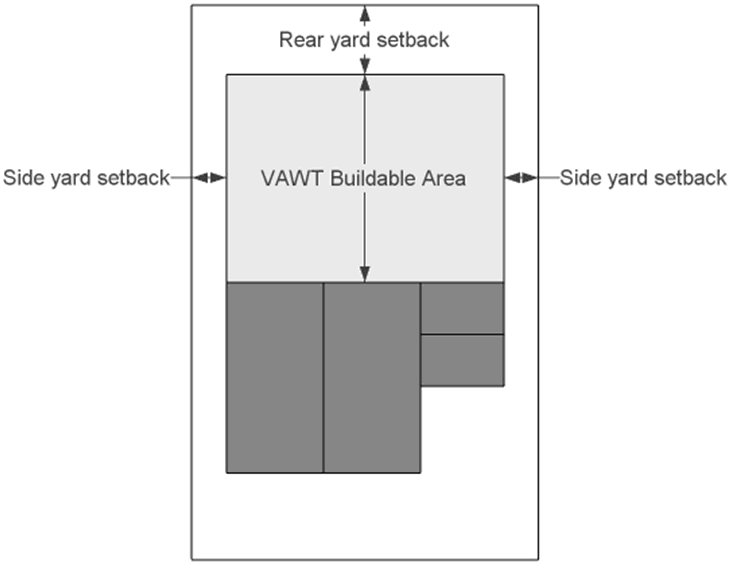
H.
VAWTS Standards.
1.
Cage Width. Maximum 78 inches (6½ feet).
2.
Cage Height. Maximum 84 inches (7 feet).
3.
California Energy Commission Approval. The equipment shall meet the state energy commission standards for approved small wind turbines (VAWTS) [www.consumerenergycenter.org].
4.
Compliance with Aviation Safety Standards. The VAWTS shall comply with all applicable FAA requirements, including any necessary approvals for installations close to airports and other facilities with flight operations in the vicinity such as Fox Field, and Plant 42.
5.
Design. A VAWTS must be designed and constructed in accordance with the following:
a.
Colors. The colors used in the construction materials or finished surface shall be muted and visually compatible with surrounding development.
b.
Lighting. If required by FAA requirements, all required lights shall be shielded from adjacent properties, and no other lights shall be placed upon the tower.
c.
Noise. Noise from a VAWTS shall conform with normally acceptable noise standards of 65 dBA at property line.
d.
Visual Effects. Any VAWTS that is placed within the viewshed of a designated scenic highway or vista shall be assessed for its visual effects, and appropriate conditions relating to setting, buffers, and design of the facility.
e.
Climbing Apparata. All climbing apparatus for ground-mounted VAWTS must be located at least 15 feet above the ground, and the structure must be designed to prevent climbing within the first 15 feet.
f.
Automatic Overspeed Controls. VAWTS shall be equipped with manual and automatic overspeed controls to limit the blade rotation speed to within the design limits of the VAWTS.
g.
Access Doors. If a VAWTS is equipped with access doors, all access doors shall be lockable.
6.
Grid Interconnection. The renewable energy must be permanently interconnected to the electrical distribution grid of the utility serving the customer's electrical load. The VAWTS shall interconnect to the electricity distribution system and must comply with applicable electrical codes and utility interconnection requirements.
7.
Maintenance. VAWTS shall be maintained in an operational condition that poses no potential safety hazards.
8.
Removal. Within 6 months after the VAWTS has ceased to operate the permittee shall remove the VAWTS, clear the site of all equipment, and restore the site as nearly as practicable to its condition prior to the installation of the VAWTS. Failure to remove such VAWTS shall constitute as a public nuisance.
I.
The planning director can require additional design criteria or other information as deemed necessary to integrate the proposed VAWTS with the surrounding area.
(Ord. No. 989, § 1, 4-9-2013)
17.08.320 - Non-commercial Wind Energy Systems (NC-WES).
A.
Purpose and Intent. It is the purpose and intent of this section to promote the safe, effective and efficient construction, and use of NC-WES in the rural residential zones (RR-1 and RR-2.5 only). These regulations are intended to assure that NC-WES are designed and located in a manner that minimizes visual, noise, and safety impacts on the surrounding community.
B.
Applicability. These specific standards are applicable for all non-commercial wind energy systems in the rural residential zones (RR-1 and RR-2.5 only), and subject to approval of a director's review in accordance with Article VI of Chapter 17.32. The definitions contained in Section 17.04.240 regarding wind energy conversion systems shall apply to this section.
C.
Development Standards. An NC-WES shall be subject to all applicable regulations of the rural residential zones (RR-1 and RR-2.5 only) in which it is proposed, except that the following standards shall take precedence over the regulations of the rural residential zones to the extent that they differ.
1.
Accessory Use. A NC-WES is considered to be an ancillary structure and may only be placed on a parcel already developed with a primary use, or placed on a parcel concurrent with the development of a primary use.
2.
Minimum Lot Size. The minimum parcel size shall be 40,000 square feet.
3.
Location of NC-WES. A NC-WES shall be located:
a.
Behind the primary building within the buildable area of the parcel (exclusive of required front, side, and rear yard areas), and located a minimum of 30 feet from any property line. (Note: setback distances shall not apply to guy wires or anchors).
b.
Shall not be located within or over drainage, utility, or other established easements.
c.
Each wind turbine shall be setback from the nearest above-ground public communication or electrical line by a distance which is equivalent to the height of the wind turbine.
4.
Blade Clearance. No part of an NC-WES blade shall extend within 15 feet of the ground, trees, or any other structure.
5.
Maximum Tower Height. Tower height shall not exceed 65 feet above grade on any parcel of 5 acres or less. Parcels greater than 5 acres in size may have a maximum tower height of 80 feet.
6.
Maximum Blade Rotor Area Diameter. The overall diameter of the blade area shall not exceed 24 feet.
7.
Compliance with Aviation Safety Standards. The NC-WES shall comply with all applicable Federal Aviation Administration (FAA) requirements, including any necessary approvals for installations within an adopted airport land use plan, air installation compatibility use zone (AICUZ), or other recognized over-flight area.
8.
Wind Turbine Approval. Wind turbines must be approved under the emerging technologies program of the state energy commission or any other small wind certification program recognized by the AWEA.
9.
Design. An NC-WES must be designed and constructed in accordance with the following:
a.
Colors. The colors used in the construction materials or finished surface shall be muted and visually compatible with surrounding development.
b.
Lighting. Lighting of the tower shall only be permitted if required by, and done in conformance with, the requirements of the FAA.
c.
Noise. Noise from an NC-WES shall not exceed 65 decibels at any property line.
d.
Visual Effects. Any NC-WES that is placed within the view shed of a designated scenic highway or vista shall be assessed for its visual effects, and appropriate conditions relating to setting, buffers, and design of the facility.
e.
Climbing Apparatus. All climbing apparatus must be located at least 15 feet above the ground, and the tower must be designed to prevent climbing within the first 15 feet.
f.
Automatic Overspeed Controls. An NC-WES shall be equipped with both manual and automatic overspeed controls to limit the blade rotation speed to within the design limits of the NC-WES.
g.
Access Doors. If an NC-WES is equipped with access doors, all access doors shall be lockable.
10.
Signs. One sign, limited to 18 inches in length and 12 inches in height, shall be posted at the base of the Tower. The sign shall include a notice of no trespassing, a warning of high voltage, and the phone number of the property owner to call in the event of an emergency.
11.
Maintenance. NC-WES shall be maintained in an operational condition that poses no potential safety hazards.
12.
Removal. Within 6 months after the operation of an NC-WES has ceased the permittee shall remove the NC-WES, clear the site of all equipment, and restore the site as nearly as practicable to its condition prior to the installation of the NC-WES. Failure to remove such NC-WES as required above shall constitute a public nuisance.
Diagram showing allowed location of NC-WES (RR-2.5 and RR-1 only)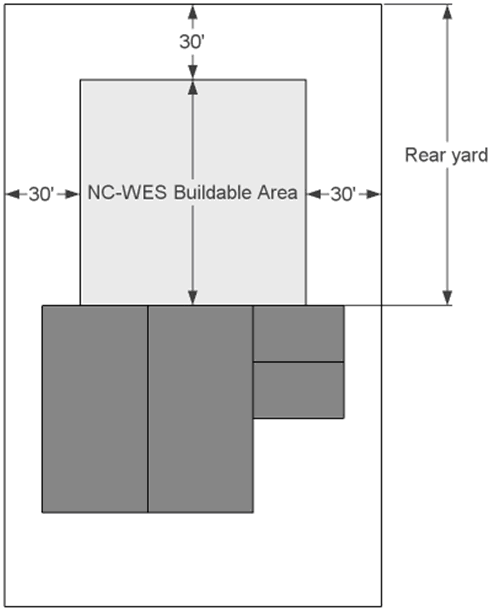
D.
Review and Decision Process.
1.
Application. A director's review application in accordance with Article VI of Chapter 17.32 shall be filed for a NC-WES meeting the requirements of this section.
2.
Notice of Application. The applicant shall submit as part of the director's review, a list of all owners of real property as listed on the latest county assessor's equalized assessment roll, located within 300 feet of the boundaries of the parcel on which the NC-WES is proposed. Written notices shall be given by mail to all such owners of the intent to consider the application for a NC-WES at least 10 days prior to a decision on the application.
3.
Consideration by Planning Director. The planning director shall review the application for conformance with the requirements of this section and consider any comments received prior to making a decision on the request. The planning director shall approve, approve with conditions, or deny the application. Any decision of the planning director may be appealed to the planning commission in accordance with Chapter 2.44.
(Ord. No. 989, § 1, 4-9-2013)
17.08.330 - Electric Vehicle Charging Stations.
Electric Vehicle Charging Stations (EVCS). New residential development shall provide for EVCS in the manner prescribed as follows:
A.
Garages serving each new single-family residence and each unit of a duplex shall be constructed with a gang box (4 inches by 4 inches) connected to a conduit linking the garage to the electrical service, with available "Level 2" plug-in voltage of 240 volt, in a manner approved by the building and safety official, to allow for the future installation of electric vehicle supply equipment to provide an EVCS for use by the resident.
B.
In new multiple-family projects of 10 dwelling units or less, 20% of the total parking spaces required (all of the 20% shall be located within the required covered parking) shall be provided with a gang box (4 inches by 4 inches) connected to a conduit linking the covered parking spaces or garages with the electrical service, in a manner approved by the building and safety official, to allow for the future installation of electric vehicle supply equipment to provide EVCSs at such time as it is needed for use by residents. EVCSs shall be provided in disabled person parking spaces in accordance with state requirements.
C.
In new multiple-family projects of more than 10 dwelling units, 10% of the total parking spaces required (all of the 10% shall be located within the required covered parking) shall be provided with a gang box (4 inches by 4 inches) connected to a conduit linking the covered parking spaces or garages with the electrical service, in a manner approved by the building and safety official. Of the total gang boxes provided, 50% shall have the necessary electric vehicle supply equipment installed to provide active EVCSs ready for use by residents. The remainder shall be installed at such time as they are needed for use by residents. EVCSs shall be provided in disabled person parking spaces in accordance with state requirements.
(Ord. No. 989, § 1, 4-9-2013)
17.08.340 - Residential Planned Development (RPD).
A.
Purpose and Intent. The purpose and intent of the residential planned development (RPD) is to allow for project designs that do not entirely meet the regulatory standards in this chapter, but do meet the design objectives of the general plan and design guidelines. The RPD promotes high-quality, well-planned developments with residential features and amenities beyond those typical of conventional development, including innovative site layout and design, high-quality architecture, enhanced pedestrian connections and provision of trails, parks and open space. The RPD also allows for project design that is sensitive to the unique physical characteristics of the site (such as clustering units to avoid development in flood-prone areas), or other circumstances that warrant special methods of development. The RPD would reduce developmental problems in hillside areas and preserve areas of natural scenic beauty through integrated planning and design, and unified control of development. It is further the purpose of this section to establish development standards for the RPD that will result in a project that is superior to conventional development, in exchange for greater flexibility and intensification of land use.
B.
Applicability. These specific standards are applicable for all residential planned developments in zones in which they are allowed subject to the granting of a conditional use permit.
C.
Standards. The following standards shall apply to all residential planned developments:
1.
Area. The proposed development plan shall encompass a gross area of not less than the acreage specified below by the zone in which the property is located:
2.
The proposed development plan for an area less than specified above may be considered when there is no effective way to develop the property under conventional standards.
3.
Density. In an RPD, the number of dwelling units shall be within the density range for the subject property as specified by the zone.
4.
Type of Structures. Dwelling units may be single-family attached or detached structures, duplexes or multiple-family residential structures depending upon adjacent development and the compensating features of the development plan. The commission may approve places of public assembly, recreational buildings and accessory buildings if such facilities are for the primary use of persons residing within the planned development project and located so as not to be detrimental to adjacent properties.
5.
RPD Development Standards. A builder shall include a custom development standard table as part of the application.
6.
Open Space and Trails. Open space, paseos and trails shall comprise not less than 15% of the net lot or parcel area exclusive of required yards. Subject to the approval of the commission, open space shall include one or more of the following designated uses or facilities for the use and enjoyment of all the occupants of the planned residential development or appropriate phase thereof:
a.
Common open space developed for recreational purposes;
b.
Areas of scenic or natural beauty forming a portion of the proposed development;
c.
Present or future recreational areas of noncommercial nature including parks and playgrounds. Where specifically approved by the commission, green fees or similar charges related to use of a golf course or similar open recreational use may be permitted, provided such charges are incidental to operation of said facilities, are not primarily commercial in nature, and do not alter the character of said recreational facility;
d.
Hiking, equestrian or bicycle trails;
e.
Landscaped portions adjacent to streets or highways which are in excess of minimum required rights-of-way or yards;
f.
Other similar areas determined appropriate by the commission. In approving said open space, the commission shall give consideration to the project to be developed, the characteristics of such open space, the manner in which the open space is to be improved and maintained, and such other information as the commission deems pertinent. Reservation of open space shall be made a condition of approval. Such reservation shall be by public dedication, establishment of a maintenance district, common ownership, or other satisfactory means to insure the permanent reservation of and, where appropriate, perpetual maintenance of required open space.
7.
Distribution of Open Space. Projects developed in phases shall be designed so that each successive phase will contain sufficient open space to independently qualify under the provisions of subsection C.5, provided however, that where the applicant submits development plans indicating to the satisfaction of the commission that the proposed development will provide as well or better for planned residential development within the intent of this section, the commission may approve a division of open space encompassing more than one phase. Where a division of open space will encompass more than one phase, the applicant shall provide the commission with a map indicating cumulative allocation and utilization of open space for each successive phase in each subsequent application.
8.
Landscaping. The RPD shall adhere to the provisions of Section 17.08.110 (landscaping) unless the builder proposes a landscaping plan with the finding that the project will meet or exceed the design goals and objectives of the general plan and design guidelines.
9.
Street circulation and Connections. The RPD shall be designed to integrate with the adjacent and surrounding land uses through the use of enhanced circulation and connections, with complete streets allowing for safe vehicular, pedestrian and bicycle use. Subject to the approval of the commission, street circulation and connections shall include one or more of the following designated features:
a.
Street calming features, including corner bulb-outs, mid-block bump-outs, stamped paving, etc.;
b.
Pedestrian connection features, including cul-de-sac pedestrian access, mid-block pedestrian paseos, pedestrian-only pathways, widened parkways, etc.;
c.
Bicycle pathways and trails;
d.
Other features and mechanism in accordance with the master plan of trails and bikeways.
10.
Utilities. The applicant shall submit to the commission, and it shall be made a condition of approval, satisfactory evidence that the applicant has made arrangements with the serving utilities to install underground all new facilities necessary to provide service in the development.
11.
Development Program. The commission shall consider and may approve an appropriate program indicating the development of open space related to the construction of dwelling units, which shall become a condition of approval. Where development is to be completed in phases, the said development may, with the approval of the commission, be coordinated between phases as approved in subsection C.6. The commission may modify, without a hearing, this condition pertaining to the development program based upon an affirmative showing, in writing, of hardship.
12.
Findings for RPD. In addition to all other consistency and health and safety findings applicable to the project, the following findings shall be made in reviewing and approving a residential planned development application for a conditional use permit:
a.
The residential planned development meets the goals of the city general plan, pertaining to community design, and the objectives to "enhance overall community form, create a vibrant sense of place," and to "improve the city's visual identity by utilizing design standards that instill a sense of pride and well-being in the community."
b.
The residential planned development adheres to the adopted city design guidelines and the design and performance standards listed in this section, and is consistent with the mission statement of "implementing quality design for timeless architecture that enhances the community's image, pride and quality of life."
c.
The residential planned development is comprehensive, covers a logical planning area, and provides the opportunity for unique and creative designs that are not possible under the city's typical development regulations.
(Ord. No. 989, § 1, 4-9-2013; Ord. No. 1070, § 4(Exh. A), 1-14-2020; Ord. No. 1106, § 4(Exh. A), 10-10-2023)
17.08.350 - Purpose and intent.
The purpose and intent of the mobilehome park (MHP) zone is to provide the means necessary to implement the city general plan, specifically the "urban residential, moderate density" land use designation set forth in the text of the general plan and as delineated on the general plan map. The MHP zone is intended for the exclusive development of mobilehome parks. All mobilehome parks shall be developed in accordance with the standards of this section. Mobilehome parks are intended as an alternative mode of affordable housing to the residents of the city.
The MHP zone sets forth standards for mobile-home parks in order to promote a better living environment. Where the city does not have the authority to adopt regulations, the mobile home parks act, Government Code Section 18200 et seq. shall apply. It shall also be the intent of this zone to apply all mobilehome park zone requirements contained herein to all new mobilehome parks created after the effective date of the ordinance codified in this chapter and to apply these same requirements to any additions to existing mobilehome parks created after the effective date of the ordinance codified in this chapter. Existing lots may develop in the MHP zone but no new lots may be created in the MHP zone with a gross area of less than 10 acres.
It shall not be the intent of this chapter to render previously legally created mobilehome parks which do not comply with the new mobilehome park zone requirements of this chapter to be nonconforming where these parks complied with the ordinances in effect at the time of their creation.
(Ord. No. 989, § 1, 4-9-2013)
17.08.360 - Applicability.
Mobilehome parks located in the MHP zone are subject to site plan review. Mobilehome parks located outside the MHP zone in a residential zone are subject to a conditional use permit, as provided in Article I of Chapter 17.32. Mobilehome parks located outside the MHP zone shall comply with the development requirements which would be imposed on a single-family residential development in that particular zone including, without limitation, any density considerations which might be applicable.
(Ord. No. 989, § 1, 4-9-2013)
17.08.370 - Prohibition.
A person shall not use any premises in the MHP zone except as hereafter specifically permitted in this chapter and subject to all regulations and conditions enumerated in this chapter.
(Ord. No. 989, § 1, 4-9-2013)
17.08.380 - Permitted uses.
The following uses are permitted in the MHP zone:
A.
A mobilehome on each designated mobile home space within an approved mobilehome park;
B.
One conventional single-family detached dwelling per mobilehome park. Said dwelling to be for the exclusive use of the caretaker or manager, responsible for operating the park, as a residence and an office. Parking shall be provided in accordance with Section 17.08.140, off-street parking;
C.
Parks, playgrounds, riding and hiking trails, golf courses, lakes, structures, facilities, clubhouses, community centers and similar uses; providing that all such uses are designed for and limited to use by residents of the mobilehome park and their guests, and further provided that such uses are not permitted on the individual mobilehome space;
D.
Public uses (i.e., parks, libraries and fire stations);
E.
Water reservoirs, dams, treatment plants, gauging stations, pumping stations, tanks, wells, and any use normal and appurtenance to the storage and distribution of water. Exception: This use is not subject to site plan review;
F.
Senior mobilehome park in accordance with Section 17.08.305.
(Ord. No. 989, § 1, 4-9-2013)
17.08.390 - Accessory and temporary uses.
A.
The following uses are considered as accessory uses to the permitted uses in mobilehome parks:
1.
Awnings, enclosed or unenclosed; storage sheds or cabinets; fences, walls or windbreaks, carports, porches, ramps, stairways, garages;
2.
Maintenance or storage buildings;
3.
Solar energy systems, whether mounted on or attached to a mobilehome, building, or mounted on the ground;
4.
Swimming pools and associated uses and structures. All heated pools erected or constructed after the adoption of the ordinance codified in this chapter shall be heated primarily by a solar energy system or any other water heating system which has been demonstrated to be equal or superior to solar systems in energy efficiency.
B.
The following uses are considered as temporary uses in the MHP zone:
1.
Building materials, storage of, use in the construction of a building or building project for a permitted use, during the construction and 30 days thereafter, including the contractor's temporary office, provided that any lot or parcel of land so used shall be part of the building project, or on property adjoining the construction site.
(Ord. No. 989, § 1, 4-9-2013)
17.08.400 - Uses subject to director's review and approval.
If site plans or other pertinent information for the proposed use are first submitted to and approved by the director in accordance with Article VI of Chapter 17.32, premises in the MHP zone may be used for the following uses:
A.
Home occupation subject to the requirements of Section 17.08.320;
B.
Public utilities (i.e., gas, electric and telephone facilities);
C.
Limited convenience commercial and retail uses designed to serve residents of the mobilehome park.
(Ord. No. 989, § 1, 4-9-2013)
17.08.410 - Uses subject to conditional use permit.
The following uses may be permitted provided a conditional use permit has first been obtained as provided in article I of Chapter 17.32, and while such permit is in full force and effect in conformity with conditions of such permit:
A.
Uses necessary to the maintenance of the public health, safety and general welfare.
(Ord. No. 989, § 1, 4-9-2013)
17.08.420 - Mobilehome conversions.
Any proposal for conversion of an existing mobilehome park shall comply with the requirements of Chapter 11.12.
(Ord. No. 989, § 1, 4-9-2013)
17.08.430 - Park development standards.
In addition to the development standards established in the mobile home parks act, the following minimum development standards shall apply:
A.
Mobilehome park area: 10 gross acres.
B.
Mobilehome park density:
1.
Mobilehome park zone: Consistent with the MDR zone classification.
2.
Outside mobilehome park zone: Shall not exceed the density specified by residential zone in which the park is located.
C.
Mobilehome park street frontage: 200 feet, continuous frontage on a dedicated public street.
D.
Public street front yard, rear and street side setback for mobilehome park site: 20 feet. Parking is not permitted in these yards.
E.
Interior side yard and rear setback, for mobilehome park site: 10 feet along each boundary line of the mobilehome park.
F.
Maximum building height: 35 feet.
G.
Perimeter public streets and access: Shall be provided in accordance with director's requirements and city standards.
H.
Parking: Each mobilehome space shall be provided with 2 paved parking spaces, both of which must be covered. Each parking space shall not be less than 9 x 20 feet in size and may be tandem.
I.
Guest parking: One guest space for each 4 mobilehome spaces to be located within 200 feet of the spaces they serve.
(Ord. No. 989, § 1, 4-9-2013)
17.08.440 - Perimeter.
The mobilehome park shall be designed and developed in a manner compatible with and complementary to existing and potential residential development in the immediate vicinity of the project site. Site planning on the perimeter shall give consideration to protection of the property from adverse surrounding influences, as well as protection of the surrounding areas from potentially adverse influences within the development.
(Ord. No. 989, § 1, 4-9-2013)
17.08.450 - Landscaping and screening.
All yards and setbacks required for mobile home parks shall be landscaped and shall appear similar to conventional residential developments. A decorative masonry wall 6 feet in height shall screen the mobile home park and shall be located 20 feet from the back of the sidewalk on a street frontage and on the property line elsewhere. The landscaping shall be permanently maintained and shall consist predominantly of drought-resistant trees and vegetation in accordance with Title 8, Chapter 8.50, landscaping installation and maintenance; and Title 8, Chapter 8.30, residential landscaping installation and maintenance.
(Ord. No. 989, § 1, 4-9-2013)
17.08.460 - Signs.
A person shall not use any sign except as specifically permitted in this section and subject to all regulations and conditions set forth in this title. The following signs are permitted or required, as specified, in all mobilehome parks:
A.
There shall be no more than one wall sign or single- or double-faced freestanding sign designating the name of the mobilehome park premises, facing or adjacent to each street from which there is access to the property. The height of a freestanding sign shall not exceed 8 feet, measured vertically from the base at ground level to the apex of the sign. The total sign area of all wall and freestanding signs (excluding directional signs) shall not exceed 1/10 square-foot for each linear-foot of street frontage, and no sign shall exceed a total sign area of 32 square feet. Freestanding signs may be lighted only by continuous internal light.
B.
One directional sign, not to exceed 10 square feet in area, may be placed at each entrance or exit driveway of the mobilehome park. No such sign shall exceed a height of 3 feet measured vertically from the base at ground level to the apex of the sign. Directional signs may be lighted only by continuous internal light.
C.
There shall be a directory diagram readily visible from all entrances to the park on which is posted a map of the park showing the location of all facilities, the layout and names of all interior streets, and the location and lot number of all mobilehome spaces. Such diagram shall be of a size to be easily readable by a person with normal vision, shall be illuminated during the hours of darkness, and shall be protected from the elements by being placed in a permanent glass or plastic device.
D.
Each mobilehome shall be identified by a space number conspicuously posted and of such size and type so as to be clearly readable after dark and in accordance with city standards.
(Ord. No. 989, § 1, 4-9-2013)
17.08.470 - Senior mobilehome park.
The purpose of the senior mobilehome district overlay is to provide various development and preservation incentives to make the development and maintenance of senior mobilehome parks attractive to mobilehome park owners and developers while, at the same time, providing assurances that existing senior mobilehome parks within the overlay district remain available to seniors. Senior mobilehome parks shall comply with the following requirements:
A.
Zoning Map Designation. Adoption of a senior mobilehome park overlay (MHP-S) shall be by a zone change in accordance with chapter 17.24. Such zone change may be initiated by either the mobilehome park owner or the city.
B.
Qualification for Inclusion of Properties within the Senior Mobilehome Park Overlay (MHP-S). Properties that are designated to be within the senior mobilehome park overlay zone shall be those properties operated as or proposed to be developed as a senior mobilehome park in which at least one occupant of each mobilehome is 55 years or older.
C.
Land Use Regulations. At least 80 percent of the spaces in mobilehome parks in the senior mobilehome park overlay district shall be occupied by at least one person 55 years or older. If an existing mobilehome park met this qualification on August 14, 2007, and fell below the 80 percent requirement between that date and the effective date of the ordinance codified in this section, the senior mobilehome park overlay district shall be applied to that mobilehome park, and that park shall be required to operate as a senior mobilehome park by renting spaces and mobilehomes only when at least one occupant of the mobilehome is 55 years or older. The signage, advertising, park rules and regulations, and leases for spaces in mobilehome parks in the senior mobilehome park overlay district shall state the park is a senior park.
D.
Development New or Expansion of Existing Senior Mobilehome Park. A site plan review shall be required for any proposal to develop a new senior mobilehome park or expand an existing senior mobilehome park. A new senior mobilehome park and the expansion area of an existing senior mobilehome park shall comply with the development standards, perimeter treatment, landscaping, screening signage requirement, and use restrictions of this article.
E.
Limitations on Rentals. Spaces and mobilehomes in a mobilehome park in the senior mobilehome overlay district shall be rented only to occupants who meet the age requirement set forth in subsection A. provided, however, that if the occupants of a space or mobilehome who do not meet this requirement rented the space or mobilehome before the adoption of this chapter, they shall be allowed to remain, and provided further that when such occupants cease to occupy a space or mobilehome, the home and space cannot thereafter be rented except to occupants who meet that age requirement.
F.
Exemption from Abatement of Nonconforming Uses. Notwithstanding the provisions of Article VII of Chapter 17.32, senior mobilehome parks that have become nonconforming as to the underlying general plan or zoning designation shall be deemed to be legal and conforming uses.
G.
Expansion of Existing Senior Mobilehome Parks. Notwithstanding the provisions of Article VII of Chapter 17.32, the expansion of an existing senior mobilehome park shall not terminate the legal and conforming status of any previously existing structures or uses in the mobilehome park.
(Ord. No. 989, § 1, 4-9-2013)
17.08.500 - Reasonable accommodation.
A.
Purpose. The reasonable accommodation ordinance provides a procedure to request reasonable accommodation for persons with disabilities seeking equal access to housing under the federal fair housing act and the state fair employment and housing act in the application of zoning laws and other land use regulations, policies and procedures.
B.
Applicability. A request for reasonable accommodation may be made by any person with a disability (or their representative), when the application of zoning law or other land use regulation acts as a barrier to fair housing opportunities. A request for reasonable accommodation may include a modification or exception to the standards for the siting, development and use of housing that would result in the removal of regulatory barriers and provision of equal housing opportunity.
C.
Application Requirements. Requests for reasonable accommodation shall be submitted on an application form provided by the planning department, or in the form of a letter, to the planning director and shall contain the following information:
1.
The applicant's name, address and telephone number.
2.
Address of the property for which the request is being made.
3.
Record owner of property. In the event the nature of the requested accommodation is one that would ordinarily require the consent of the landlord or property owner, such consent shall be submitted, in writing, with the application.
4.
Description of current uses of the property.
5.
A description of the impairment of major life activities for which reasonable accommodation is requested.
6.
Description of the requested accommodation that is being requested.
7.
The reason why the reasonable accommodation is necessary to ensure equal access to specific property.
D.
Review Authority and Procedure. The planning director, or the planning director's designee, shall make a written determination within 45 days and either grant, grant with modifications, or deny a request for reasonable accommodation based on findings listed in this section and in consistency with the fair housing act.
E.
Findings. The written decision to grant or deny the request for reasonable accommodation shall be consistent with the fair housing act and shall be based on consideration of the following findings:
1.
The housing accommodation will be used by an individual disabled under the fair housing act.
2.
The request for reasonable accommodation is necessary to make specific housing available to an individual with a disability under the fair housing act.
3.
The requested reasonable accommodation would not impose an undue financial or administrative burden on the city.
4.
The requested reasonable accommodation would not require a fundamental alteration in the nature of a city program or law, including but not limited to land use and zoning.
5.
The requested reasonable accommodation would not impair the reasonable use of adjacent properties.
F.
Decision. The decision shall be based on the ability to make the findings listed in this section, in consistency with the fair housing act, as well as consideration of the accommodation's physical attributes, and whether there are alternative reasonable accommodations which may provide an equivalent level of benefit.
G.
Appeal of Determination. A determination by the reviewing authority to grant or deny a request for reasonable accommodation may be appealed to the planning commission in compliance with Section 17.32.820.
H.
Confidentiality. All information provided in conjunction with a request for reasonable accommodation shall be kept confidential, and shall only be shared with persons properly designated to make or assess a decision to grant or deny the reasonable accommodation request, or unless disclosure is required by law.
I.
Non-transferability. A reasonable accommodation is personal to the applicant and shall not be transferable to, or inure to the benefit of, subsequent owners, tenants, or occupants.
(Ord. No. 989, § 1, 4-9-2013)

