
Lancaster City Zoning Code
CHAPTER 17
16 - INDUSTRIAL ZONES
Article III. - Reserved[4]
Editor's note— Ord. No. 945, § 5, adopted July 13, 2010, amended the Code by repealing former Art. III, §§ 17.16.230—17.16.430, in its entirety. Former Art. III pertained to the Business Park (BP) zone, and derived from the prior zoning ord., §§ 242.010, 242.020, 242.021, 242.023—242.027, 242.030, 242.031, 242.040, 242.041, 242.050, 242.060, 242.061, 242.063—242.065, 242.067, 242.068, 242.070—242.072, 242.074, 242.075, 242.080; Ord. 651 of 1993; Ord. 676 of 1996; Ords. 711 and 713 of 1995; and Ord. No. 924, adopted August 25, 2009.
17.16.010 - In general.
As used in this title, "industrial zones" means the LI, HI and BP zones.
(Prior zoning ord. § 240.000)
(Ord. No. 1070, § 4(Exh. A), 1-14-2020)
17.16.020 - Purpose and intent.
The purpose and intent of the I zones is to provide the means necessary to implement the city of Lancaster general plan, specifically:
A.
The LI zone implements the "light industry" category;
B.
The HI zone implements the "heavy industry" category; as set forth in the text of the general plan and as delineated on the general plan map. These zones are intended to be in accordance with applicable goals, objectives, policies and actions set forth by the plan. These zones are intended to allow the development of industrial uses thereby providing for the industrial and employment needs of the city and adjoining areas and business in an urban environment with full urban services.
It shall also be the intent of this zone to apply the provisions of this zone including but not limited to the property development regulations required herein to all new building lots created after the effective date of the ordinance codified in this title.
It shall not be the intent of this title to render previously legally created building lots or legally constructed buildings which do not comply with the new property development regulations or other requirements of this title to be nonconforming where these lots or buildings complied with the ordinances in effect at the time of their creation or construction. However, proof of compliance with ordinances in effect at the time of creation or construction shall be the sole burden of the applicant or property owner. Such proof may include building permits, minutes of council or commission action, case files, or other documentation.
(Prior zoning ord. § 241.010)
(Ord. No. 1070, § 4(Exh. A), 1-14-2020)
17.16.030 - Prohibition.
A person shall not use any premises in the LI or HI zones except as hereafter permitted in this title and subject to all regulations and conditions enumerated in this title.
(Prior zoning ord. § 241.020)
(Ord. No. 1070, § 4(Exh. A), 1-14-2020)
17.16.040 - Permitted uses—I zones.
Uses and permit requirements. The uses and permit requirements applicable to the industrial zones are identified in the Uses Matrix below. Extensive examples are given for the purpose of clarifying the types of uses allowed by each category. In addition, specific exceptions and development requirements have been applied to certain categories of uses where concerns may arise as to their impact on neighboring properties and the visual attractiveness of the city as a whole. Uses which do not fall into any other category, and are not temporary uses, uses subject to director's review, or uses subject to permit in these zones, shall be subject to interpretation of the director. All uses are subject to any stated exceptions, development requirements, and approval of a site plan as follows:
(Ord. 896 § 1 (Exh. A § 22), 2008; Ord. 793 § 1 (Exh. A), 2001; Ord. 753 § 1 (Exh. A § 3 (part)), 1999; Ord. 711 §§ 30 (part), 32, 1995; prior zoning ord. § 241.021)
(Ord. No. 1070, § 4(Exh. A), 1-14-2020; Ord. No. 1093, § 4(Exh. A), 10-11-2022; Ord. No. 1106, § 4(Exh. A), 10-10-2023; Ord. No. 1130, § 4(Exh. A), 5-27-2025)
17.16.050 - Accessory and temporary uses.
A.
The following uses are considered as accessory uses to the permitted uses in the I zones:
1.
Accessory buildings and structures customarily used in conjunction therewith.
a.
Cargo containers may be used as accessory buildings and structures in the I zones, subject to the following:
1)
Containers shall meet the applicable front yard, side yard, and rear yard requirements contained in Section 17.16.130.B.2.
2)
Containers shall only be used for incidental uses that are permissible in the zone.
3)
Containers shall not be stacked on top of each other or on any other structure.
4)
Containers shall not encroach upon, block, obstruct, or reduce in any manner any required exits, windows or vent shafts of structures, or any required parking spaces, driveways, private streets, or public rights of way.
5)
Containers shall not be used for human habitation or occupied by individuals for any reason.
6)
Containers shall not have any electrical, plumbing, heating or air conditioning installations or systems, and shall not be connected to a power source.
7)
Refuse, garbage, trash and debris, as well as hazardous substances, as defined by state or federal law, shall not be placed or stored in, against, on, or under a cargo container at any time.
8)
Containers shall require a container permit. The number and location of cargo containers used as accessory buildings or structures in the I zones shall be subject to the review and prior written approval of the Director, or their duly authorized representatives. Upon such approval, compliance with all conditions of approval, and payment of a container permit fee in an amount established by city council, a container permit shall be issued.
B.
The following uses are considered as temporary uses in the I zones:
1.
The placement and use of a temporary office in conjunction with a construction or development project undertaken pursuant to an active building permit. A temporary office shall be placed on the lot or parcel which is part of the project, or on property adjoining the construction or development site with the written consent of the property owner. The placement of a temporary office shall not occur until the building permit is obtained. The temporary office shall be removed within thirty (30) days after the permit is expired, revoked, or finalized.
2.
Commercial coaches used as temporary offices subject to the provisions of Article X of Chapter 17.40 and this zone.
a.
Cargo containers may be used for the temporary construction storage described in (a) of this subsection. A cargo container approved pursuant to this subsection shall not require a separate permit. The number and location of cargo containers used for temporary construction storage shall be subject to the review and prior written approval of the building official and Director or their duly authorized representatives. Application for approval of cargo containers for temporary construction storage shall be made on a city-approved form and shall indicate the number of the building permit obtained for the construction or development project for which the temporary construction storage is requested, the size of each cargo container, the proposed location of each container on the property, and the date on which each container shall be placed on the property.
b.
The time period for which a cargo container may be used for temporary construction storage is limited to the time when the building permit is active. An active building permit means one that has not expired, been revoked, or been finalized. Cargo containers used for temporary construction storage shall be removed from the property within thirty (30) calendar days of the expiration, revocation or finalization of a building permit.
c.
Cargo containers used for temporary construction storage shall not exceed eight feet in width, eight feet six inches in height, and forty (40) feet in length.
d.
Cargo containers used for temporary construction storage shall conform to the following standards:
1)
Cargo containers shall be set back a minimum of five feet from any property line and a minimum of ten (10) feet from any structure.
2)
Cargo containers shall not be stacked on top of each other or on any other structure.
3)
Cargo containers shall not encroach upon, block, obstruct, or reduce in any manner any required exits, windows or vent shafts of structures, or any parking spaces, driveways, private streets, or public rights of way.
4)
Cargo containers shall not be used for human habitation or occupied by individuals for any reason.
5)
Cargo containers shall not have any electrical, plumbing, heating or air conditioning installations or systems, and shall not be connected to a power source.
6)
Refuse, garbage, trash and debris, as well as hazardous substances, as defined by state or federal law, shall not be placed or stored in, against, on, or under a cargo container at any time.
e.
The number and location of cargo containers used for temporary industrial storage shall be subject to the review and prior written approval of the building official and Director or their duly authorized representatives. A cargo container approved under this subsection shall not require a separate permit. Application for approval of cargo containers for temporary industrial storage shall be made on a city-approved form and shall indicate the number of the building permit obtained for the repair, remodeling, alteration or other work for which the temporary industrial storage is requested, the size of each cargo container, the proposed location of each container on the property, and the date on which each container shall be placed on the property.
f.
The time period for which a cargo container may be used for temporary industrial storage is limited to the time when the building permit is active. An active building permit means one that has not expired, been revoked, or been finalized. Cargo containers used for temporary industrial storage shall be removed from the property within thirty (30) calendar days of the expiration, revocation or finalization of a building permit.
g.
Cargo containers used for temporary industrial storage shall not exceed eight feet in width, eight feet six inches in height, and forty (40) feet in length.
h.
Cargo containers used for temporary industrial storage shall conform to the standards set forth in Section 17.16.050.B.3.e.
i.
Cargo containers used for emergency industrial storage shall require a container permit. The number and location of cargo containers used for emergency industrial storage shall be subject to the review and prior written approval of the Director or their duly authorized representatives. Upon such approval, and payment of a container permit fee in an amount established by city council, a container permit shall be issued.
j.
Cargo containers may be used for emergency industrial storage for a period not to exceed fifteen (15) calendar days. This use may be extended for an additional ten (10) calendar days upon the prior written approval of the Director.
k.
Cargo containers used for emergency industrial storage shall not exceed eight feet in width, eight feet six inches in height, and forty (40) feet in length.
l.
Cargo containers used for emergency industrial storage shall conform to the standards set forth in Section 17.16.050.B.3.e.
m.
Cargo containers used for relocation storage shall require a container permit. The number and location of cargo containers used for relocation storage shall be subject to the review and prior written approval of the Director or their duly authorized representatives. Upon such approval, and payment of a container permit fee in an amount established by city council, a container permit shall be issued.
n.
Cargo containers may be used for relocation storage for a period not to exceed fifteen (15) calendar days. This use may be extended for an additional ten (10) calendar days upon the prior written approval of the Director.
o.
Cargo containers used for relocation storage shall not exceed eight feet in width, eight feet six inches in height, and forty (40) feet in length.
p.
Cargo containers used for relocation storage shall conform to the standards set forth in Section 17.16.050.B.3.e., except as provided in f. of this subsection.
q.
Cargo containers used for relocation storage may be placed in parking lots so long as they do not reduce the number of required parking spaces.
C.
Electric Vehicle Charging Station. An electric vehicle charging station (EVCS) shall be permitted as an accessory use within any existing legal single-family or multiple-family residential garage or carport, or within any existing legal commercial parking space in a parking lot or in a parking garage, subject to all applicable city code requirements and the following:
1.
Electric vehicle charging stations (EVCS) for public use shall be subject to the following requirements:
a.
The EVCSs shall be located in a manner which will be easily seen by the public for informational and security purposes and shall be illuminated during evening business hours; and
b.
Be located in desirable and convenient parking locations which will serve as an incentive for the use of electric vehicles; and
c.
The EVCS pedestals shall be protected as necessary to prevent damage by automobiles; and
d.
The EVCS pedestals shall be designed to minimize potential damage by vandalism and to be safe for use in inclement weather; and
e.
Complete instructions and appropriate warnings concerning the use of the EVCS shall be posted on a sign in a prominent location on each station for use by the operator; and
f.
One standard nonilluminated sign, not to exceed 4 square feet in area and 10 feet in height, may be posted for the purpose of identifying the location of each cluster of EVCSs; and
g.
The EVCS may be on a timer that limits the use of the station to the normal business hours of the use(s) which it serves to preclude unauthorized use after business hours.
2.
Electric vehicle charging stations for private use shall:
a.
Be located in a manner which will not allow public access to the charging station; and
b.
Comply with subsections C.1.c., d. and e. of this section.
D.
Mini Wireless Telecommunication Facilities. This category includes all mini wireless telecommunication facilities subject to the requirements of Section 17.40.640.
E.
Cargo containers that are present on private real property, for any use or purpose, on the effective date of this section shall be removed within six months from the effective date, unless the property owner obtains the requisite approvals and permits in conjunction with accessory or temporary uses allowed in Section 17.16.050.B. and otherwise complies with all regulations pertaining to cargo containers.
This subsection does not apply to the following real property:
1.
Real property owned, leased, rented, occupied or used by a public agency or entity;
2.
Real property owned, leased, rented, occupied or used by a nonpublic or private school. For purposes of this subsection, "nonpublic school" means a private, nonsectarian school that enrolls individuals with exceptional needs pursuant to an individualized education program and is certified by the California Department of Education. For purposes of this subsection, "private school" means a full-time day school that provides instruction in the several branches of study required to be taught in the public schools of the state, by persons capable of teaching, and that files an annual private school affidavit as required by the California Department of Education. For purposes of this subsection, "private school" does not include a school that provides instruction in a building used for residential purposes. A nonpublic or private school is not exempt unless it is operating in conformity with all pertinent land use and technical code regulations.
(Ord. 753 § 1 (Exh. A § 2 (part), 1999; Ord. 713 § 3 (part), 1995; prior zoning ord. § 241.023)
(Ord. No. 921, §§ 18—20, 6-9-09; Ord. No. 1070, § 4(Exh. A), 1-14-2020)
17.16.060 - Reserved.
Editor's note— Ord. No. 1130, § 4(Exh. A), adopted May 27, 2025, repealed § uses subject to director's review and approval, which pertained to X and derived from Prior zoning ord. § 241.024; Ord. 758 § 1 (Exh. A § 4 (part)), adopted 1999; Ord. 753 § 1 (Exh. A §§ 7, 8), adopted 1999; Ord. 898 § 2, adopted 2008; Ord. 896 § 1 (Exh. A § 23), adopted 2008; Ord. No. 941, § 1, adopted Feb. 9, 2010; Ord. No. 989, § 6, adopted April 9, 2013; Ord. No. 999, § 6, adopted Aug. 26, 2014; Ord. No. 1070, § 4(Exh. A), adopted Jan. 14, 2020; Ord. No. 1093, § 4(Exh. A), adopted Oct. 11, 2022; Ord. No. 1106, § 4(Exh. A), adopted Oct. 10, 2023.
17.16.070 - Reserved.
Editor's note— Ord. No. 1130, § 4(Exh. A), adopted May 27, 2025, repealed § 17.16.070, which pertained to uses subject to conditional use permits and derived from Prior zoning ord. § 241.025; Ord. 753 § 1 (Exh. A § 9), adopted 1999; Ord. 758 § 1 (Exh. A §§ 5, 6), adopted 1999; Ord. 761 § 1, adopted 1999; Ord. 898 § 3, adopted 2008; Ord. 896 § 1 (Exh. A §§ 24, 25), adopted 2008; Ord. No. 1007, § 5, adopted Oct. 13, 2015; Ord. No. 1070, § 4(Exh. A), adopted Jan. 14, 2020; Ord. No. 1093, § 4(Exh. A), adopted Oct. 11, 2022.
17.16.080 - Interpretation.
Where a conflict in interpretation occurs regarding application of Sections 17.16.030, 17.16.040, or 17.16.050 to any specific case, the Director shall determine the interpretation.
(Prior zoning ord. § 241.026)
(Ord. No. 1070, § 4(Exh. A), 1-14-2020; Ord. No. 1130, § 4(Exh. A), 5-27-2025)
17.16.090 - Adjustments.
Refer to Article III Adjustment Permits.
(Prior zoning ord. § 241.027)
(Ord. No. 1070, § 4(Exh. A), 1-14-2020; Ord. No. 1130, § 4(Exh. A), 5-27-2025)
17.16.100 - Height regulations.
The height of buildings or structures shall be as follows:
A.
No building or structure shall exceed:
1.
In the LI zone: height of 50 feet; and
2.
In the HI zone: a height of 70 feet.
This section does not apply to conditional use permit uses which shall be subject to Article I of Chapter 17.32. (See Article XII of Chapter 17.40 for general exceptions.)
B.
No commercially or industrially used building in the I zones which is within 100 feet of any RR, SRR or R zone shall exceed a height of 2 stories or 35 feet, whichever is less.
C.
No building may be constructed which would shade any existing active solar energy system on adjoining property without the consent of the affected property owner. (See subsection 1 in the definition of solar energy system in Section 17.04.240.)
(Prior zoning ord. § 241.030)
(Ord. No. 1070, § 4(Exh. A), 1-14-2020)
17.16.110 - Exception for solar systems.
Solar collectors may exceed the height limit when mounted on the roof of a legal, conforming building. The right to exceed the height limit shall be exercised only in the event that: there is no other practical means or location for achieving an efficient placement on the building or site in question; such collectors may exceed the height limit only to the extent necessary to achieve efficient placement; in no case shall such solar collectors (or related equipment) encroach more than 5 feet beyond the limit. Also the placement of a solar collector shall not shade or otherwise diminish the efficiency of existing solar collectors on neighboring property, or preclude such property from sufficient solar access to successfully operate a solar energy system sufficient to serve the needs of the business or occupants.
(Prior zoning ord. § 241.031)
(Ord. No. 1070, § 4(Exh. A), 1-14-2020)
17.16.120 - Site plan review required—Fee.
A.
A site plan (with vicinity map) and building elevations, drawn to scale and reflecting the accurate dimensions of the buildings and property, shall be required of any person seeking to erect new buildings or structures, make additions to any existing buildings or structures, site temporary commercial coaches, or otherwise grade, improve or develop any lot or portion thereof for a permitted use prior to the issuance of any grading or building permit. The site plan shall be accompanied by an appropriate development application and both shall be filed with the planning department. The director or his designated representative shall review the site plan for conformance with the provisions of this title. The site plan shall demonstrate conformance with height regulations, property development regulations, sign regulations or a sign program required by the city for multiple-tenant projects, off-street parking requirements, the adopted City of Lancaster Design Guidelines, any other requirements established for the adopted zoning designation in which the property(ies) is (are) located, and any other applicable city ordinances, standards, guidelines or policies. In addition to the conditions and requirements imposed by the ordinance codified in this title and other city ordinances, standards, guidelines and policies, the director may place conditions on the approval of the site plan where the director finds that such action is necessary to protect the public health, safety and welfare. At such time as the site plan complies with the requirements of the ordinance codified in this title and other city ordinances, standards, guidelines or policies, the site plan shall be approved by the director or his designated representative. The site plan approval shall be valid for two (2) years from the date of approval. A site plan shall be considered "used" when the slab of a major building in the project is poured and inspected, although circumstances in each case may vary and the final determination as to "use" of a site plan review shall be made by the director. Three (3) one-year extensions of the approval may be granted by the director provided such written request for an extension is received not less than sixty (60) days prior to expiration, and any significant environmental changes which have occurred since the original approval have been addressed. Any extension granted shall be conditioned to comply with the city's current design guidelines as adopted by the city council, unless the applicant can demonstrate to the director's satisfaction that such compliance will impose an undue hardship on the project. In the event the site plan or an extension thereof is denied, the applicant may appeal the decision in accordance with Section 17.36.030. All projects constructed in accordance with an approved site plan shall be permanently maintained as approved. Any desired subsequent changes shall be submitted for approval as an amendment to the site plan. Prior to occupancy the site shall be inspected for compliance with the site plan. All improvements shall be installed and functioning before occupancy will be allowed.
Where the director determines that the requirements of this section surpass the city's need for project review of a particular development proposal, the director may exercise discretion and apply the provisions of Article VI of Chapter 17.32, Director's Review, in its place.
B.
When the appropriate development application is filed per subsection A of this section it shall be accompanied by the filing fee established by resolution of the city council.
(Ord. 711 § 22 (part), 1995; prior zoning ord. §§ 241.040, 241.041)
(Ord. No. 924, § 1, 8-25-09; Ord. No. 956, § 3, 1-11-2011)
17.16.130 - Property development regulations.
A.
General.
1.
No new building or commercial coach shall be erected, constructed, moved onto, or established on an existing legal lot or parcel of land unless said building or commercial coach shall comply with all of the regulations set forth in city ordinances, standards, guidelines or policies and subsection B of this section, or Article X of Chapter 17.40 which are pertinent to its placement on said lot or parcel.
2.
No existing building or commercial coach located on an existing legal lot or parcel of land shall be converted, enlarged or moved unless said building, or addition thereto, shall comply with all of the regulations set forth in city ordinances, standards, guidelines or policies and subsection B of this section, or Article X of Chapter 17.40 which are pertinent to its placement on said lot or parcel.
3.
No new lot shall be created or any building, or portion thereof, existing on such new lot be used, unless said lot and said building location shall comply with all of the regulations set forth in city ordinances, standards, guidelines or policies and subsection B of this section, which are pertinent to the area and dimensions for new lots and those regulations pertinent to the placement or location of buildings on said lot.
B.
I Zones. Wherever property is designated as an I zone on the zoning map the following regulations, specific or general, shall apply:
1.
Lot Dimensions. The following minimum lot dimensions shall apply to all lots created after the adoption of this section. (Those lots which were legally created, prior to the adoption of this section, in compliance with ordinances in effect at the time of their creation need not comply unless involved in a new subdivision or change in lot configuration other than a lot line adjustment as provided in Title 16 of this code.)
* Also denotes minimum street frontage.
See Section 17.40.070, 17.40.080, 17.40.090 A or 17.40.090B in the event public use or required street dedication would reduce the net lot area, lot width, or lot depth of an existing lot to less than the required minimum.
2.
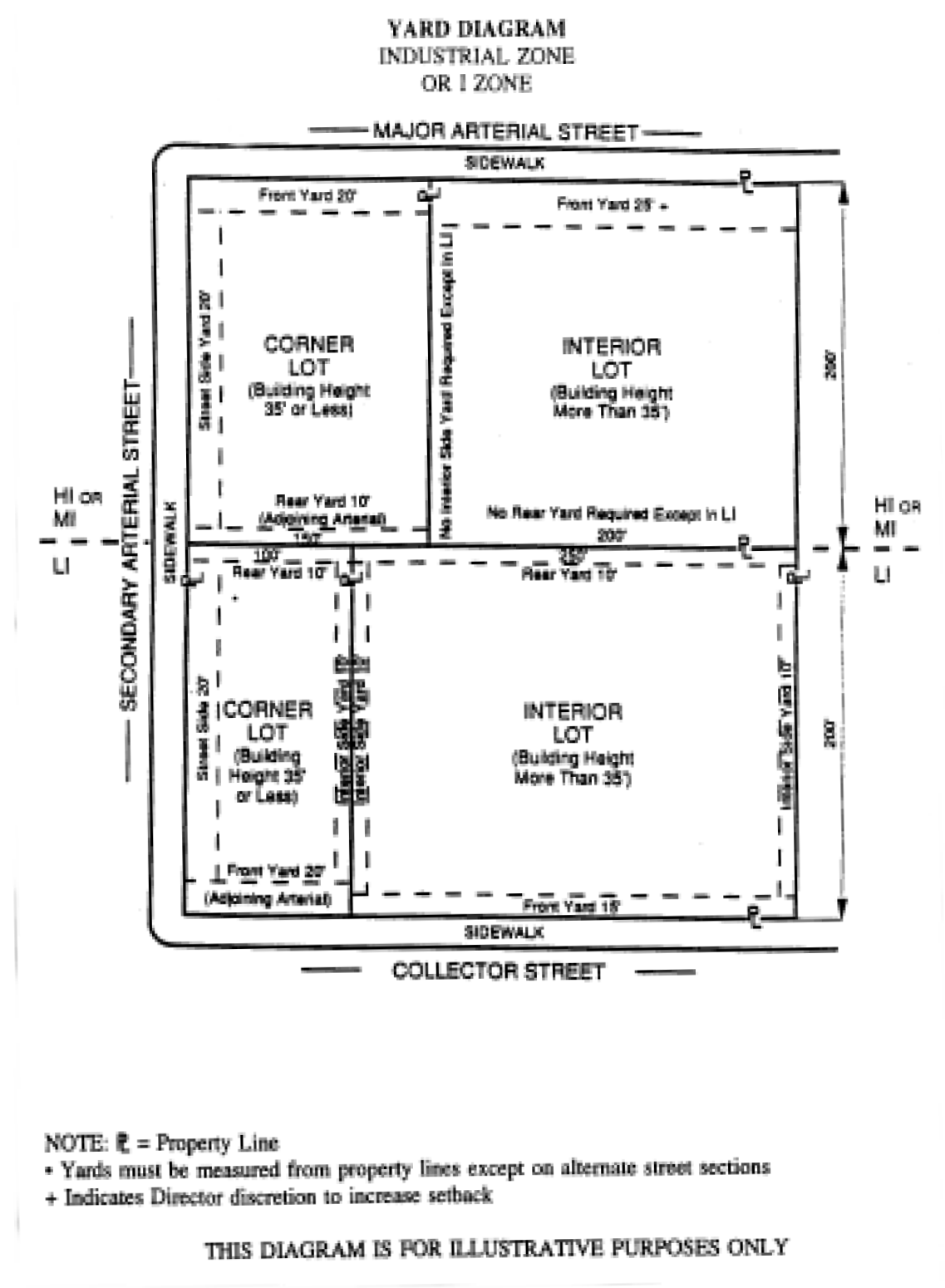
Yard Requirements. Yards shall be provided as follows:
See Sections 17.40.093, 17.40.095 and 17.40.097 in the event yard requirements must be reduced for street widening or transit stops.
a.
Front yard—LI and HI zones:
1)
Adjoining a freeway, expressway, or arterial street: 20 feet where the building is 35 feet or less in height. The front yard for buildings which are more than 35 feet in height shall be established on a case-by-case basis by the Director to mitigate any adverse or potentially adverse impact on neighboring properties, but in no case be less than 25 feet.
2)
All other properties:
a)
LI zone: 15 feet;
b)
HI zone: 10 feet.
b.
Street side yard—LI and HI zones:
1)
Adjoining a freeway, expressway or arterial street: same as subsection B.2.a.1) of this section;
2)
All other properties: equal to the front or street side yard, as appropriate, required in the abutting zone, or 10 feet whichever is greater.
c.
Interior side yard:
1)
LI zone: 10 feet;
2)
HI zone: none.
d.
Rear yard:
1)
LI zone: 10 feet;
2)
HI zone: 10 feet when adjoining freeway, expressway, or arterial streets. Other properties none.
e.
Front and street side yards of properties developed after the adoption of this section shall be landscaped for a minimum depth of 10 feet measured from the back of the sidewalk. Rear yards shall be landscaped only where adjoining a freeway, expressway or arterial street. This requirement may be increased by the Director where he finds it to be necessary to make the proposed development compatible with existing development in the vicinity of the site. Landscaping and irrigation plans shall be submitted to the Director for his approval. Such plans must be approved prior to the issuance of any building permit for the site. Such landscaping and irrigation systems shall have been installed in accordance with the approved plans and verified prior to final inspection approval. The Director determinations on these items may be appealed in accordance with Section 17.36.030. Yards required by this zone are also subject to the general provisions and exceptions contained in Section 17.28.030 which shall apply as specified.
3.
Maximum floor area ratio (FAR) (see definition in Section 17.04.240):
a.
LI zone: 0.5;
b.
HI zone: 0.5.
4.
Landscaping. Plant materials used in landscaping shall include drought-tolerant species and the landscaping shall be designed to minimize water usage and discourage runoff. No landscaping shall be placed in a manner which shades or would ultimately shade any existing solar energy system from the sun on a contiguous lot.
5.
Outside Display. All display shall be located wholly within an enclosed building with the exception of the following:
a.
Amusement rides and devices;
b.
Automobile sales, limited to automobiles, recreational vehicles, tractors and trucks under 2 tons held for sale and rental only;
c.
Automobile service stations, limited to automobile accessories and facilities necessary to the dispensing of petroleum products only;
d.
Boat sales, limited to boats held for sale or rental only;
e.
Carnivals—Commercial;
f.
Christmas trees and wreaths, sale of;
g.
Crops, field, tree, bush and row, including nursery stock, flowers and vines;
h.
Electric distribution substations;
i.
Equipment rental and sales including heavy equipment;
j.
Gas metering and control stations, public utility;
k.
Mobilehome sales, limited to mobilehomes held for sale or rental only;
l.
Parking lots;
m.
Signs, existing outdoor advertising;
n.
Trailer sales, box and utility, limited to trailers held for sale only.
C.
Exceptions to Yard Requirements — Previously Established Uses. Additions or modifications to buildings or uses, either constructed or having received building permit approval, or having been legally established prior to September 2, 1992 may be allowed with respect to yards of lesser dimension than required in this subsection where, in the opinion of the Director, allowing less than full compliance with the yard requirements would impose no substantial detriment to abutting property or improvements thereon. In rendering a decision on whether to allow a reduction of the required yard, the Director shall determine whether (see Sections 17.40.093, 17.40.095, and 17.40.097 in the event yard requirements must be reduced for street widening or transit stops):
1.
There are special circumstances or exceptional characteristics applicable to the property involved which are not generally applicable to other properties in the same vicinity with the same zoning;
2.
An adjustment (if authorized) will not constitute a grant of special privilege inconsistent with the limitations on other properties in the same vicinity with the same zoning; and
3.
The strict application of the yard requirements would result in practical difficulties and unnecessary hardship which is inconsistent with the purpose of the yard requirements.
In no case shall the Director approval of the reduction of a required yard relieve the applicant/property owner from complying with minimum landscape requirements established by this title, unless such relief is specifically approved by the Director.
D.
Exceptions to Yard Requirements — Specified LI Zoned Areas,
1.
Defined Areas: This exception shall only be applicable to properties that are zoned LI and are located within the area bounded by Avenue I, Division Street, Avenue J, and Sierra Highway, or within the area bounded by Avenue L, 12th Street West, Avenue M and SR-14 (hereafter referred to as defined area (A) and (B) respectively).
2.
Purpose and Intent:
a.
Defined Area A. Same language as current ordinance.
b.
Defined Area B. Defined area B is bounded SR-14, 12th Street West, Avenue L and Avenue M and consists of numerous vacant lots and developed properties which exhibit narrow lot depths resulting from right-of-way acquisition at the time of freeway construction. The provisions of the zoning ordinance require minimum 10 foot building set backs for both the rear and interior side yards for properties located in the LI zone. Because of the narrow lot configurations, these requirements often create practical difficulties in developing property within Defined Area B. The result is that the properties within Defined Area B cannot be effectively developed. Therefore, the intent of this section is to allow the Director to modify the LI Zone rear and interior yard requirements within this area under specified circumstances, while still adhering to all other requirements of the LI Zone.
3.
Allowable Exceptions to Yard Requirements — Director's Determination. The Director may reduce or eliminate the yard requirements upon making the findings as noted below. The requirement for front and street side yards shall not be reduced to less than 10 feet of landscaped width except where such requirement would unreasonably interfere with the expansion of an existing building that does not have a setback of at least 10 feet, or where the requirement would preclude the provision of required parking. The Director may grant exceptions where he determines that the following circumstances exist:
a.
Compliance with the normal yard requirements will result in practical difficulties and unnecessary hardships inconsistent with the purpose of the yard requirements because of the size or configuration of the parcel(s) or the location of existing on-site buildings; and
b.
It is not practical for the project proponent to acquire additional property that would allow the yard requirements to be met; and
c.
Granting of the exception will not result in an adverse effect on other properties in the vicinity.
(Ord. 807 (Exh. A), 2002; Ord. 760 § 1 (Exh. A), 1999; Ord. 711 § 43 (part), 1995; Ord. 651 § 4 (part), 1993; prior zoning ord. § 241.050)
(Ord. No. 1070, § 4(Exh. A), 1-14-2020)
17.16.140 - Signs.
A person shall not use, install or construct any sign in the I zones except as specifically permitted in this section and subject to all regulations and conditions, including without limitation submittal of a sign plan, set forth in this title and any other ordinance now existing or hereafter adopted by the city regulating the installation, use and/or construction of signs. A comprehensive sign plan for multiple-tenant projects or an individual sign plan for single-tenant projects, must be submitted to and approved by the Director or his designated representative. Sign plans must be fully dimensioned, including the proposed sign location(s), elevations, colors and materials. A person who has first obtained approval of the sign plan and all required permits and inspection approval shall be permitted to use, install or construct signs as specified in the I zones.
(Prior zoning ord. § 241.060)
(Ord. No. 1070, § 4(Exh. A), 1-14-2020)
17.16.150 - Signs—General provisions.
A.
The provisions of this section regulating signs shall not apply to the following signs except as otherwise indicated herein:
1.
Official notices issued by any court, public body or public officer;
2.
Notices posted by any public officer in performance of a public duty, or for any person in giving legal notice;
3.
Traffic, directional, warning or informational signs required or authorized by the public authority having jurisdiction over such signs;
4.
Official signs used for emergency purposes only;
5.
Permanent memorial or historical signs, plaques or markers;
6.
Public utility signs, provided such signs do not exceed 3 square feet in area.
B.
Prohibited Signs. The following signs shall be prohibited in the I zones:
1.
Signs which contain or utilize:
a.
Any exposed incandescent lamp,
b.
Any revolving beacon light,
c.
Any continuous or sequential flashing operation, except signs displaying time of day, atmospheric temperature or having programmable electronic public service messages only,
d.
Any system for display of time of day, atmospheric temperature or programmable electronic public service messages in which:
1)
The messages are not public service in nature, or
2)
The proposed display has any illumination which is in continuous motion or which appears to be in continuous motion, or
3)
The message is changed at a rate faster than one message every 4 seconds, or
4)
The interval between messages is less than one second, or
5)
The display is located less than 100 feet on the same side of the street or highway or 200 feet across the street from residentially zoned property;
2.
Roof signs (see definition in Section 17.04.240);
3.
Revolving signs of any kind;
4.
Signs advertising or displaying any unlawful act, business or purpose;
5.
Devices dispensing bubbles and free-flowing particles of matter;
6.
Any notice, placard, bill, card, poster, sticker, banner, sign, advertising or other device calculated to attract the attention of the public which any person posts, prints, sticks, stamps, tacks or otherwise affixes, or causes the same to be done to or upon any street, right-of-way, public sidewalk, crosswalk, curb, lamppost, hydrant, tree, telephone pole or lighting system, or upon any fixture of the police or fire alarm system of the city of Lancaster or county of Los Angeles;
7.
Any strings of pennants, banners or streamers, clusters of flags, strings of twirlers or propellers, flares, balloons, and similar attention-getting devices, including noise-emitting devices, with the exception of the following:
a.
Automobile sales uses only may utilize pennants, banners or streamers subject to the following conditions:
1)
All such displays must be positioned horizontally and parallel to the ground and shall maintain a minimum height of 14 feet and a maximum height of 18 feet from grade level.
2)
All lines supporting such devices shall be secured in a taut manner and shall exhibit no more than 5 inches sag or droop at midline. No more than 3 such lines may be placed above one another and such lines shall be located along street frontages only.
3)
All pennants, banners, or streamers shall be maintained in good condition. Such devices which have become torn, tattered, faded or otherwise fallen into disrepair shall be removed or replaced,
b.
National, state, local governmental, institutional or corporate flags properly displayed,
c.
Holiday decorations in season used for an aggregate period of not more than 90 days in any one calendar year;
8.
Devices projecting, or otherwise reproducing the image of a sign or message on any surface or object;
9.
Signs emitting or amplifying sounds for the purpose of attracting attention;
10.
Portable signs;
11.
Sidewalk signs;
12.
New outdoor advertising signs in the HI zone. No new outdoor advertising signs are permitted in the LI zone but existing outdoor advertising signs may be relocated into the LI zone subject to the provisions of Section 17.40.210O.
13.
Pole signs;
14.
Any sign which is placed in a manner which would obstruct a driver's or pedestrian's vision and thus create a hazard, or potential hazard, to the public health, safety or welfare.
15.
Off-premises signs constituting a commercial advertisement that is not located on the site of the business or entity indicated or advertised by the sign including temporary, portable, mobile signs affixed to a wall, structure, or vehicle.
C.
General Sign Regulations. The following regulations shall apply to all signs in the I zones:
1.
In no case shall a lighted sign or lighting device thereof be so placed or directed so as to permit the beams and illumination therefrom to be directed or beamed upon a public street, highway, sidewalk or adjacent premises so as to cause glare or reflection that may constitute a traffic hazard or nuisance.
2.
Existing outdoor advertising signs are subject to Section 17.40.210.
3.
Subdivision signs are subject to Section 17.40.220.
4.
Signs, except outdoor advertising signs, may be single-, double- or multifaced, provided that:
a.
The distance between the faces of any double-faced sign, other than a "V"-shaped projecting sign, shall not exceed 36 inches; and
b.
The separation between the intersecting faces of any multifaced sign shall not exceed 12 inches.
5.
Any sign located on vacant and unoccupied property, and which was erected for an occupant or business unrelated to the present occupant or business, or any sign which pertains to a time, event or purpose which no longer exists shall be removed within 30 days after the purpose for, or use utilizing such sign has been removed from such property.
6.
Any permitted sign may be a changeable copy sign.
7.
All signs shall be designed in the simplest form and be free of any exposed bracing, angle iron, guy wires, cables or similar devices.
8.
The exposed backs of all signs visible to the public shall be suitably covered, finished and properly maintained.
9.
All signs shall be maintained in good repair, including display surfaces which shall be kept neatly painted or posted.
10.
Any sign which does not conform to the provisions of this title shall be made to conform or shall be removed as provided in subsection B.4. of Section 17.32.850 except as provided in Section 17.32.850B.4.c.
11.
Except where otherwise specifically provided by this title, sign regulations established pursuant to this title shall not apply to signs within a building, arcade, court or other similarly enclosed area where such signs are not visible to the public without entering such facilities.
12.
The height of all signs shall be measured from the highest point of the sign.
D.
Computation of Sign Area. The surface area of any sign face shall be computed from the smallest rectangles, circles and/or triangles which will enclose all words, letters, figures, symbols, designs and pictures, together with all framing, background material, colored or illuminated areas, and attention-attracting devices forming an integral part of the overall display, but excluding all support structures, except that:
1.
Superficial ornamentation of a non-message-bearing character which does not exceed 5% of the surface area shall be exempted from computation; and
2.
Wall signs painted on or affixed directly to a building wall, façade or roof, and having no discernible boundary, shall have the areas between letters, words intended to be read together, and any device intended to draw attention to the sign message included in any computation of surface area; and
3.
Signs placed in such a manner, or bearing a text, as to require dependence upon each other in order to convey meaning shall be considered one sign and the intervening areas between signs included in any computation of surface area; and
4.
Spherical, cylindrical or other 3-dimensional signs not having conventional sign faces shall be considered to have 2 faces and the area of each sign face shall be computed from the smallest 3-dimensional geometrical shape or shapes which will best approximate the actual surface area of said faces.
(Ord. 711 § 23, 1995; prior zoning ord. § 241.061)
(Ord. No. 1070, § 4(Exh. A), 1-14-2020; Ord. No. 1130, § 4(Exh. A), 5-27-2025)
17.16.160 - Business signs.
Business signs may be permitted in the I zones subject to Sections 17.16.040, 17.16.220, and the restrictions of this section. For more information concerning specific types of signs see Section 17.04.240, Definitions.
A.
Wall and Freestanding Business Signs. Monument and post signs are the only freestanding business signs permitted in the I zones.
1.
Area and Number Permitted.
a.
A maximum of one square foot of wall or freestanding sign area for each one linear foot of continuous lot frontage up to a maximum of 150 square feet of total sign area.
b.
No more than one freestanding sign per property shall be permitted.
c.
No more than one sign per tenant, except on corner sites where not more than 2 signs per tenant is permitted.
d.
Each tenant shall be entitled to a minimum sign area of 20 square feet up to the maximum square footage allowed for the site.
2.
Height Permitted.
a.
Wall business signs shall not extend above:
1)
Eighteen inches below the top of the wall of a single-story building; or
2)
The lowest point of a sloping roof of a single-story building.
b.
Freestanding business signs shall not exceed a maximum height of 12 feet measured vertically from ground level at the base of the sign, or 3 feet below the roof line, whichever is least.
3.
Projection Permitted. Wall business signs shall not project more than 18 inches from the building wall to which they are attached. Freestanding signs may not project over the public right-of-way.
4.
Lighting. Wall and freestanding business signs may be internally or externally lighted, but any continuous or sequential flashing operation is prohibited.
B.
Window Signs. Each business establishment may be permitted display window signs subject to the following restrictions:
1.
Area permitted: Maximum of 25% of the window area.
2.
Lighting. Window signs may be internally or externally lighted, but any continuous or sequential flashing operation is prohibited.
C.
Incidental Business Signs. Each business establishment may be permitted incidental business signs provided:
1.
That such signs are wall signs or window signs or are attached to an existing freestanding sign structure; and
2.
That such signs do not exceed 3 square feet in sign area or 6 square feet in total sign area; and
3.
That the sum of the sign areas of all such signs does not exceed 10 square feet
4.
Incidental business signs may be internally or externally lighted but any continuous or sequential flashing operation is prohibited.
(Ord. 711 § 25 (part), 1995; prior zoning ord. § 241.063)
(Ord. No. 1130, § 4(Exh. A), 5-27-2025)
17.16.170 - Building identification signs.
Building identification signs may be permitted subject to the following restrictions:
A.
Area Permitted. One wall-mounted sign may be permitted provided:
1.
Such sign does not exceed 6 square feet in sign area where located less than 30 feet above ground level measured at the base of the building below said sign; or
2.
Such sign does not exceed 2% of the exterior wall area of the building wall on which it is mounted, excluding penthouse walls, where located more than 30 feet above ground level measured at the base of the building below said sign.
3.
The area of the building identification sign shall be subtracted from the area submitted for wall signs.
B.
Height Permitted. Such signs shall not extend above a line 18 inches below the highest point of a parapet wall or the lowest point of a sloping roof.
C.
Lighting. Building identification signs may be internally or externally lighted but any continuous or sequential flashing operation is prohibited.
(Prior zoning ord. § 241.064)
17.16.180 - Temporary signs.
Temporary signs may be permitted in the I zones subject to the following restrictions:
A.
Area Permitted. Temporary signs which are posted or erected for 90 days or less shall not exceed 16 square feet in sign area or 32 square feet in total sign area as defined in Section 17.04.240. Temporary signs which have obtained a permit pursuant to subsection G of this section and which are posted or erected for more than 90 days shall not exceed 32 square feet in sign area or 64 square feet in total sign area.
B.
Height Permitted.
1.
Freestanding temporary signs shall not exceed 6 feet in height.
2.
Temporary signs which are posted, attached or affixed to buildings of more than one story shall not be higher than the finished floor line of the second floor of such building.
3.
Temporary signs which are posted, attached or affixed to a single-story building shall not extend above:
a.
Eighteen inches below the top of the wall of the building;
b.
The lowest point of a sloping roof of the building.
C.
Projection Permitted. Where temporary signs are attached to a wall such signs shall not project more than 18 inches from the building wall to which they are attached.
D.
Lighting. Temporary signs shall not be lighted.
E.
Placement. Temporary signs shall not be placed on public property (see Section 17.16.150B.6.), or in any manner that would endanger the public (see Section 17.16.150B.14.).
F.
Duration. No temporary sign shall be posted for more than 90 days without obtaining a sign permit pursuant to subsection G of this section. No sign permit for a temporary sign shall be valid for more than one year. Upon written request for an extension, the director may grant an extension for up to one additional year upon finding that the sign is otherwise in compliance with the requirements of Section 17.16.140 et seq. and that the extension is necessary to accomplish the purposes for which the sign has been posted. No additional extensions may be granted. All temporary signs shall be removed within 14 calendar days after occurrence of the event, if any, which is the subject of the temporary sign. The date of the posting shall be permanently and legibly marked on the lower righthand corner of the sign face.
G.
Permit Required. Any person who proposes to post or erect a temporary sign for more than 90 days shall file an application for a sign permit with the Department of Community Development. The applicant shall also file a statement of responsibility as required in subsection I of this section.
H.
Standards for Approval.
1.
Within 7 working days the director or his designated representative shall act upon the application for a temporary sign permit.
2.
The action on the application shall be based on character, location and design, including design elements such as material, letter style, colors, sign type or shape, and the provisions of Section 17.16.140 et seq.
3.
If the action is to disapprove, the notice of disapproval shall specify the reasons therefor.
I.
Statement of Responsibility. Each person desiring to post or erect a temporary sign(s), regardless of duration, shall submit to the Department of Community Development a statement of responsibility in a form approved by the director with a description sufficient to identify the temporary sign(s), the locations of the sign(s) to be posted, and certifying a named individual who is responsible for removing each temporary sign. In the event the responsible individual fails to remove the temporary sign(s) as required by subsection F of this section, the temporary sign(s) shall be deemed abandoned and may be removed by the city, the cost of which removal shall be payable by the responsible individual.
J.
Removal of Unauthorized, Unmaintained or Dangerous Signs.
1.
Temporary signs posted for which a statement of responsibility has not been submitted and, if required, a permit has not been obtained, are subject to immediate removal by the city without compensation. The city may, at its option, also pursue legal action under Section 17.04.220.
2.
Temporary signs which are deemed by the city to constitute a threat to the public health and safety are subject to immediate removal by the city without compensation. (Some examples might include such signs which are not secured against the wind or were placed in a manner which would interfere with the vision of drivers or pedestrians.) The city's cost of removal shall be payable by the responsible individual.
3.
Temporary signs for which a statement of responsibility has been submitted and, if required, a permit has been obtained, and which do not pose a threat to public health and safety but are otherwise posted in violation of Section 17.16.140 et seq. shall be subject to removal in accordance with the following procedures. The city shall provide written notice to the responsible individual for each temporary sign established pursuant to subsection I of this section, that the sign is in violation of Section 17.16.140 et seq., shall specify the nature of the violation and shall direct the responsible individual therefor to remove or alter such temporary sign. If the responsible individual fails to comply with the notice within 3 working days after such notice is mailed, the sign(s) shall be deemed abandoned, and may be removed by the city, the cost of which shall be payable by the responsible individual to the city.
(Ord. 651 § 6, 1993; prior zoning ord. § 241.065)
17.16.190 - Directional and/or information signs.
Freestanding or wall-mounted directional and/or information signs may be permitted in the I zones subject to the following restrictions:
A.
Area Permitted. Directional and/or informational signs shall not exceed 12 square feet in sign area or 24 square feet in total sign area.
B.
Height Permitted.
1.
Wall-mounted directional and/or information signs shall not extend above a line 18 inches below the highest point of a parapet wall or the lowest point of a sloping roof.
2.
Freestanding directional and/or informational signs shall not exceed 10 feet measured from the base of the sign.
C.
Location of Signs. All such signs shall be located on site.
D.
Lighting. Directional and/or information signs may be internally or externally lighted but any continuous or sequential flashing operation is prohibited.
(Prior zoning ord. § 241.067)
17.16.200 - Special purpose signs.
The following special purpose signs may be permitted as provided herein:
A.
Civic Organization Signs. If a site plan is first submitted to and approved by the director, as provided in Article VI of Chapter 17.32, freestanding civic organizations signs may be permitted at or near the entrance to the city subject to the following restrictions:
1.
Area Permitted. Such signs shall not exceed 50 square feet in sign area or 100 square feet in total sign area.
2.
Height Permitted. Such signs shall not exceed a maximum height of 12 feet measured vertically from the base of the sign.
3.
Lighting. Civic organization signs shall be unlighted.
4.
Design. Such signs shall be architecturally related to the area in which they are located.
B.
Bulletin or Special Event Signs. One freestanding or wall-mounted bulletin or special event sign may be erected and maintained on each lot or parcel of land developed for a publicly owned, charitable, religious or educational institution subject to the following restrictions:
1.
Area Permitted. Such sign shall not exceed 50 square feet in sign area or 100 square feet in total sign area.
2.
Height Permitted.
a.
A wall-mounted sign shall not extend above a line 18 inches below the highest point of a parapet wall or the lowest point of a sloping roof.
b.
A freestanding sign shall not exceed a maximum height of 12 feet measured vertically from the base of the sign.
3.
Location of sign. A freestanding sign shall not be located nearer than 25 feet to any lot line.
4.
Lighting. Bulletin or special event signs may be internally or externally lighted, but any continuous or sequential flashing operation is prohibited.
5.
Design. Such sign shall be architecturally related to the structure to which it is appurtenant.
C.
Fuel Pricing Signs. Fuel pricing signs are permitted for each business offering gasoline or other motor vehicle fuel for sale subject to the following restrictions:
1.
Types of Signs. Such signs shall be monument signs.
2.
Area Permitted.
a.
One sign, not to exceed 30 square feet in sign area or 60 square feet in total sign area, shall be permitted for each street or highway frontage.
b.
If said business is located on a corner, one sign, not to exceed 50 square feet in sign area or 100 square feet in total sign area, shall be permitted at the corner in lieu of separate signs on each of the intersecting frontages.
c.
The area per sign face of a combined freestanding business and fuel pricing sign shall not exceed the sum of the permitted areas per sign face of the 2 merging signs. Nor shall the business portion of said sign exceed the area per sign face that would be permitted a business sign were it erected separately.
3.
Height Permitted.
a.
No separate freestanding sign shall exceed 12 feet in height at a corner or 5 feet in height elsewhere. Such height shall be measured vertically from the base of the sign.
b.
No combined business and fuel pricing sign or no business sign to which fuel pricing panels are mounted shall exceed the maximum permitted height of a freestanding business sign as established in Section 17.16.160.
4.
Location of Sign. No separate freestanding sign shall be located nearer to an existing freestanding sign or to a lot line, other than one adjoining a street or highway, than 25 feet.
5.
Lighting. Fuel pricing signs may be internally or externally lighted, but any continuous or sequential flashing operation is prohibited.
D.
Outdoor Menu Signs for Restaurants with Drive Through or Car Service. Outdoor menu signs may be permitted for each business offering food to drive through or car service customers subject to the following restrictions:
1.
Types of Signs. Such signs shall be separate freestanding signs designed to serve the needs of motorist customers and shall be permanently affixed to the ground.
2.
Area Permitted. Two signs, not to exceed 30 square feet each in total sign area may be permitted for each business.
3.
Height Permitted. No outdoor menu sign shall exceed a height of 6 feet.
4.
Location of Sign. No outdoor menu sign shall be located in any required yard.
5.
Lighting. Outdoor menu signs may be internally or externally lighted but any continuous or sequential flashing operation is prohibited.
E.
Time, Temperature, and Public Service Message Signs. Signs using any system for the display of time of day, atmospheric temperature, or programmable electronic messages may be permitted subject to the prohibitions in Section 17.16.150B and the following restrictions:
1.
Type of Signs. All time, temperature, and public service message signs shall be wall, post or monument signs.
2.
Area Permitted. One sign not to exceed 24 square feet in total sign area may be permitted for each street frontage up to a maximum of 2 for each business.
3.
Height Permitted. No such sign shall exceed a height of:
a.
For monument or post signs — 12 feet;
b.
For wall signs — not less than 18 inches below the top of the wall of a single-story building.
4.
Location of Sign. Such signs shall be placed not closer than 500 feet to any business already using this type of sign.
5.
Other. Such signs must not violate the restrictions imposed by Section 17.16.150 B.1.d.
(Prior zoning ord. § 241.068)
17.16.210 - Off-street parking.
The automobile parking facilities required by this section shall be provided and permanently maintained as such unless and until a substitute has been provided which is in full compliance with the provisions of this title. The following parking requirements shall be complied with in the I zones:
A.
General Conditions. The provisions of this section shall apply at the time that:
1.
A building or structure is erected; or
2.
An existing building or structure is altered to increase the number of bowling alleys, exercise area (i.e., fitness centers), seating capacity (fixed or not fixed) or service bays; or
3.
An existing building or structure is enlarged. EXCEPTION: An existing building or structure which has insufficient lot area upon which to provide the required parking or landscaping may be enlarged by an area not to exceed 20% of the gross floor area including the original building or structure and all legal additions thereto for which required parking and associated landscaping have been provided. This exception applies only when there will be no reduction of existing parking or landscaping on the site; or
4.
The use of a building or structure is changed. EXCEPTION: Buildings or structures legally constructed in accordance with the parking requirements in effect at the time of building permit issuance will not require full compliance with the parking space requirements of this section provided that:
a.
Said change in use creates no greater demand for parking spaces (as defined by this section) than the use which most recently preceded it, and
b.
All available space not used for parking shall be improved for purposes of parking and landscaping in accordance with this section and Section 17.16.220 (not to exceed the parking requirement for said use) prior to the new use occupying said premises.
B.
Ownership, Lease and Joint Usage. Space required by this section for automobile parking shall either:
1.
Be owned by the owner of the premises because of the use of which the automobile parking space is required; or
2.
Subject to director's review and approval the owner of such premises shall have the right to use such space for automobile parking, solely to serve existing buildings or structures, by virtue of a recorded lease for a term of not less than 20 years, which lease requires that if canceled the party canceling such lease, not less than 60 days prior to the effective date of such cancellation, shall notify the Director of Community Development of such cancellation. Such lease shall be approved by the city attorney as to form and content, and once executed shall be recorded in the office of the county recorder and copies thereof filed with the director; or
3.
Subject to director's review and approval the owner or owner-authorized lessee of any property, may authorize joint use of parking facilities solely to serve existing buildings or structures occupied by the following uses or activities, provided that all the requirements of this zone can be complied with:
a.
The parking facilities required for any non-residential use, which is primarily a daytime use may be fulfilled by the parking facilities of a use which is primarily a nighttime and/or Sunday use, and vice versa, provided such parking facilities meet the requirements of subsection B.3.b. of this section.
b.
All of the following conditions shall be met in order for the director to approve joint usage of parking:
1)
The lots or parcels upon which the uses referred to in subsection B.3.a. of this section are proposed shall be adjoining as defined in this title, and
2)
There shall be no substantial conflict in the principal operating hours of the uses for which joint usage of parking is proposed, and
3)
That the joint usage of the off-street parking facilities shall be contingent upon the execution of an agreement, which requires that if canceled the party canceling such agreement, not less than 60 days prior to the effective date of such cancellation, shall notify the director of such cancellation. Such agreement shall meet the approval of the city attorney as to form and content. Once approved, the executed agreement shall be recorded in the office of the county recorder and copies thereof filed with the director.
4.
The owner of such premises shall enter into an agreement with the redevelopment agency for the provision of all, or part, of the required parking off-site in a separate facility, including public parking lots. Such agreement may include provisions for payment of an in lieu parking fee as specified by the Redevelopment Agency. Nothing herein shall require the Agency to approve such an agreement.
See Section 17.16.220 for parking design requirements.
C.
Fractions. When the application of this section requires a fractional part of an automobile parking space or parking place sufficient to accommodate a fractional number of automobiles, any such fraction shall be construed as a whole. This section does not apply to the specification of an area by square feet, or of an area equal to another area.
D.
Parking Requirements by Use.
1.
Automotive Repair Shop. Every automobile repair shop shall provide, on the same lot or parcel, 4 parking spaces for each service bay.
2.
Eating and Drinking Establishments. Every structure used for eating and drinking shall provide on the same lot or parcel one automobile parking space for each 100 gross square feet of floor area.
3.
Financial Institutions and Services. Every bank, savings and loan institution, or similar use shall have on the same lot or parcel of land, one automobile parking space for each 250 square feet of gross floor area.
4.
General Commercial Uses. Except as otherwise provided in this section every lot or parcel of land which is used for a retail commercial use existing or permitted in the LI zone (except an electrical substation or similar public utility in which there are no offices or other places visited by the public) shall have on the same lot or parcel of land one automobile parking space for each 250 square feet of gross floor area of any building or structure so used.
5.
Health Spas, Figure Salons. Every health spa, figure salon, or similar use shall provide, on the same lot or parcel, one parking space for each 45 square feet of exercise floor area plus one parking space for each 200 square feet of remaining gross floor area.
6.
General Industrial Uses. Every industrial use, other than warehouse or wholesale uses, shall provide one automobile parking space for each 400 square feet of the building so used. This may include up to 30% of the floor area as incidental office. Such parking space shall be on the same lot or parcel of land with adequate ingress and egress from the use to a public street or within a distance of 400 feet from any entrance to such use. One truck parking space of sufficient size shall be provided for each truck used in the operation of the establishment. (See subsections D.9., 10. of this section for warehouse and wholesale establishments.)
7.
Offices.
a.
Government and Public Facilities. One automobile parking space for each 250 square feet of gross floor area.
b.
Medical and Dental. Every medical or dental office, clinic, or similar building shall have on the same lot or parcel of land, one automobile parking space for each 150 square feet of gross floor area.
c.
Other Professional Office. Every professional office building (other than in subsection D.7.b. of this section) shall have on the same lot or parcel of land one automobile parking space for each 250 square feet of gross floor area.
8.
Open Retail. Every open retail use, including but not limited to nurseries, automobile sales lots, mobilehome, boat or recreational vehicle sales lots, shall have on the same lot or parcel of land a minimum of 5 automobile parking spaces or one parking space for each 5,000 square feet of lot area used primarily for sale or display purposes, whichever is greater. (Parking for any buildings on the premises shall be calculated independently of this requirement.)
9.
Warehouse. Every warehouse shall provide a minimum of 5 parking spaces for warehouses with a gross floor area up to 25,000 square feet: and for warehouses with a gross floor area in excess of 25,000 square feet, a minimum of 5 parking spaces plus one additional space for each 5,000 square feet or fraction thereof over and above 25,000 square feet.
10.
Wholesale Establishments. Three parking spaces for up to 1,500 square feet of gross floor area plus one space for each additional 1,500 square feet of gross floor area.
11.
Uses Not Specified. Where parking requirements for any use are not specified, parking shall be provided in an amount which the director finds adequate to prevent traffic congestion and excessive on-street parking. Whenever practical, such determination shall be based upon the requirements for the most comparable use specified in this section or other documents as approved by the director.
12.
Disabled Person Spaces. Shall be provided in accordance with federal or state requirements as appropriate.
13.
Bicycle and Motorcycle Spaces. Spaces for bicycles, with the means necessary to secure them against theft, shall be provided as follows:
a.
Bicycles. Minimum of one space per 10 employees.
b.
Motorcycles. Minimum of one space per 20 employees.
14.
Carpool and Vanpool Spaces. Spaces for carpool and vanpool vehicles shall be provided as necessary to accommodate any such vehicle in a number necessary to serve the pool program at the establishment. These spaces may be counted toward the parking requirements for the use.
(Ord. 711 §§ 24 (part), 26 (part), 1995; prior zoning ord. §§ 241.070—241.072, 241.074, 241.075)
17.16.220 - Design and performance standards.
The following design and performance standards shall be met for development in the I zones:
A.
General requirements applicable to all development:
1.
Access.
a.
Driveways providing access to the site may be combined, relocated, or otherwise limited in order to minimize traffic conflicts and improve public safety. All driveways shall be constructed to comply with current city standards. All driveway locations are subject to the approval of the Director.
b.
Entry drives into parking areas shall be of sufficient depth to provide for vehicle stacking appropriate to the size, location and intensity of the project served.
c.
Access to drive-through facilities shall have a sufficient depth to provide vehicle stacking for not less than 7 automobiles at a depth of 24 feet per automobile per drive-through facility. (One bank teller station equals one such facility.) Such stacking space shall be designed in a manner which will not restrict access to or from parking spaces, aisles or driveways.
d.
Public transit opportunities for turnouts, shelters and pedestrian access shall be considered for all sites abutting expressways or arterial streets.
e.
Access and bicycle parking facilities shall be considered for all sites abutting or adjacent to a planned bicycle and/or trail facility.
2.
Paving. Required parking areas, as well as the maneuvering areas and driveways used for access thereto shall be paved with: (NOTE: Permits are required for any work done in the public right-of-way.)
a.
Concrete surfacing to a minimum thickness of 3½ inches with expansion joints as necessary; or
b.
Asphalt surfacing, rolled to a smooth, hard surface having a minimum thickness of 2 inches after compaction, and laid over a base of crushed rock, gravel or other similar material compacted to a minimum thickness of 4 inches.
c.
For commercial and industrial truck parking and drive aisles, asphalt surfacing rolled to a smooth hard surface having a minimum thickness of 3 inches after compaction and, at a minimum, designed to accommodate a traffic index (TI) of 6.5 as calculated in accordance with the latest edition of the CalTrans Highway Design Manual. Large industrial projects may need a greater TI based upon their use.
d.
Other alternative material that will provide at least the equivalent in dust-free service, life and appearance of the materials and standards which would be employed for development pursuant to subsection A.2.a. or b. of this subsection.
e.
The Director shall review and report on the adequacy of paving where modification of base is proposed under subsection A.2.b. of this section, or where alternative materials are proposed under subsection A.2.d. of this section. The Director may approve such modification or such alternative materials if, in his opinion, the evidence indicates compliance with subsection A.2.b. or A.2.d. of this section, as the case may be.
3.
Size and Marking of Spaces.
a.
No less than 75% of the parking spaces shall exhibit minimum dimensions of 9 feet in width by 20 feet in length, with required disabled person spaces at the dimensions as provided by law.
b.
Compact Spaces. No more than 25% of the parking spaces may exhibit minimum dimensions of 8 feet in width by 17 feet in length. Such spaces shall be labelled "compact car only" in a manner acceptable to the Director.
c.
No parking shall occur in the first 10 feet of a required front or street side yard.
d.
Where parking abuts an alley, the improved alley may be used as an aisle subject to approval of the parking lot design.
e.
For parallel parking, minimum aisles are 12 feet and minimum parking space dimensions are 8 feet by 24 feet.
See the following diagrams for parking design options.
4.
Circulation. Mark entrances and exits clearly. Vehicular circulation should be "one-way" in each aisle or "two-way" if the aisle width is a minimum of 20 feet. No aisle shall be less than 12 feet in width.
5.
Loading Spaces. Such spaces shall be required as specified by the Director.
6.
Buffering. A masonry wall of 6 feet in height shall be provided at the property line where the activities of a commercial or industrial use are anticipated to be incompatible with existing commercial, industrial or residential uses. It shall be the burden of the applicant to prove to the satisfaction of the Director or his designated representative that the project will not create or be subject to conditions necessitating a wall at the time of site plan review if a wall is not desired by the applicant.
7.
Building Design.
a.
Building design standards applicable to all I zones:
1)
Roof treatment shall be the same on the periphery of the building, except where a different treatment is required by the city building code.
2)
Solar access and prevailing winds should be considered in building design and orientation.
3)
Additions to existing buildings shall generally conform to the design of the existing building. New building size, materials and color shall be consistent with the scale and design of the building to which it is attached.
b.
Building design standards applicable to the LI zone:
1)
Building components such as windows, doors, eaves and parapets shall have good proportions and relationships to one another.
2)
Utility doors, access panels, fire doors, loading docks and other openings shall be treated as part of the architectural composition of buildings.
c.
Building design standards applicable only to the LI zone:
1)
An exterior color scheme for all buildings or additions thereto shall be submitted with the building elevations for approval. The color scheme for existing neighboring buildings shall be indicated and considered.
8.
Fences and Walls.
a.
Fences and Walls Permitted. Fences and walls may be erected and maintained in required yards subject to the requirements specified herein:
1.
Front Yards. Fences and walls within a required front yard shall be a minimum height of 6 feet.
2.
Corner Side Yards, Interior Side, and Rear Yards. Fences and walls within a required corner side yard, interior side, and rear yards shall be a minimum height of 6 feet and shall not exceed 15 feet in height.
3.
Retaining Walls. Retaining walls not to exceed 6 feet in height are permitted in all yards.
4.
Retaining Walls Topped with Walls or Fences.
a.
Where a retaining wall protects a cut below the natural grade and is located on a front, side or rear lot line, such retaining wall may be topped by a fence or wall of the same height that would otherwise be permitted at the location if no retaining wall existed. Where such retaining wall contains a fill, the height of the retaining wall built to retain the fill shall be considered as contributing to the permissible height of a fence or wall providing, however, that in any event an open-work non-view-obscuring fence of 3½ feet may be erected at the top of the retaining wall for safety protection.
b.
Where a wall or fence is located in the required yard adjacent to a retaining wall containing a fill, such wall or fence shall be set back from said retaining wall a distance of one foot for each one foot in height to a maximum distance of 5 feet, provided, however, that this does not permit a wall or fence in required yards higher than permitted by this section. The area between such wall or fence and said retaining wall shall be landscaped and continuously maintained in good condition.
5.
Fences and Walls Exempted. Where a fence or wall exceeding the heights specified is required by any law or regulation of the state of California, a fence or wall not exceeding such required height is permitted.
6.
Measurement of Fence and Wall Height. The height of a fence or wall shall be measured at the highest average ground level within 3 feet of either side of said wall or fence. In order to allow for variation in topography, the height of a required fence or wall may vary an amount not to exceed 6 inches, provided, however, that in no event shall the average height of such fence or wall exceed the maximum height specified.
7.
Notwithstanding the other provisions of this section, if site plans and/or other pertinent information required by the Director for the proposed use are first submitted to and approved by the Director in accordance with Article VI of Chapter 17.32, the Director may permit fences or walls within any required yard to a height in excess of 15 feet, subject to materials requirements, and other conditions of approval.
8.
Industrial uses adjacent to or across a street or alley from residentially zoned property or property developed with a residential use shall provide a minimum 6-foot high masonry wall along all common lot lines. All walls shall be consistent with the site's architecture and, in instances where visible from the public right-of-way, shall be constructed with decorative materials.
9.
Temporary Fence. If site plans and/or other pertinent information required by the Director for the proposed use are first submitted to and approved by the Director in accordance with Article VI of Chapter 17.32, a temporary fence may be installed on vacant property, subject to time limits, materials, and other conditions of approval. Temporary fencing materials may include chain link.
9.
Landscaping.
a.
Landscape designs shall be consistent throughout a project site. A combination of landscape materials should be arranged in a harmonious manner as an integral part of project design to enhance building design, public view, and interior spaces and provide buffers and transitions as needed. Unrelated and random choice or placement of plant materials shall be avoided; however, variety may be employed to intensify distinction between spaces or to strengthen a sense of place or movement, or to promote energy and water conservation and mitigate erosion.
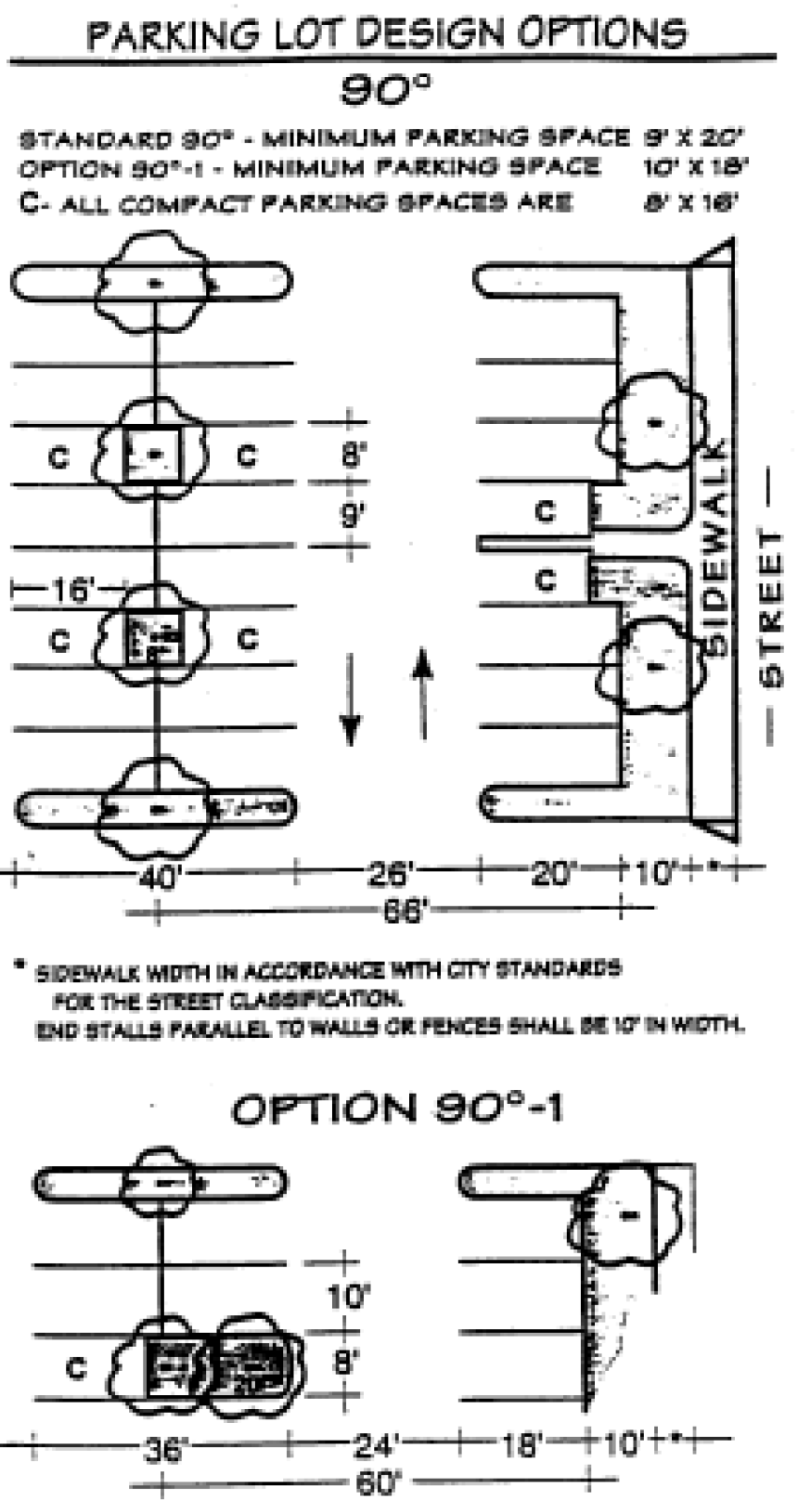
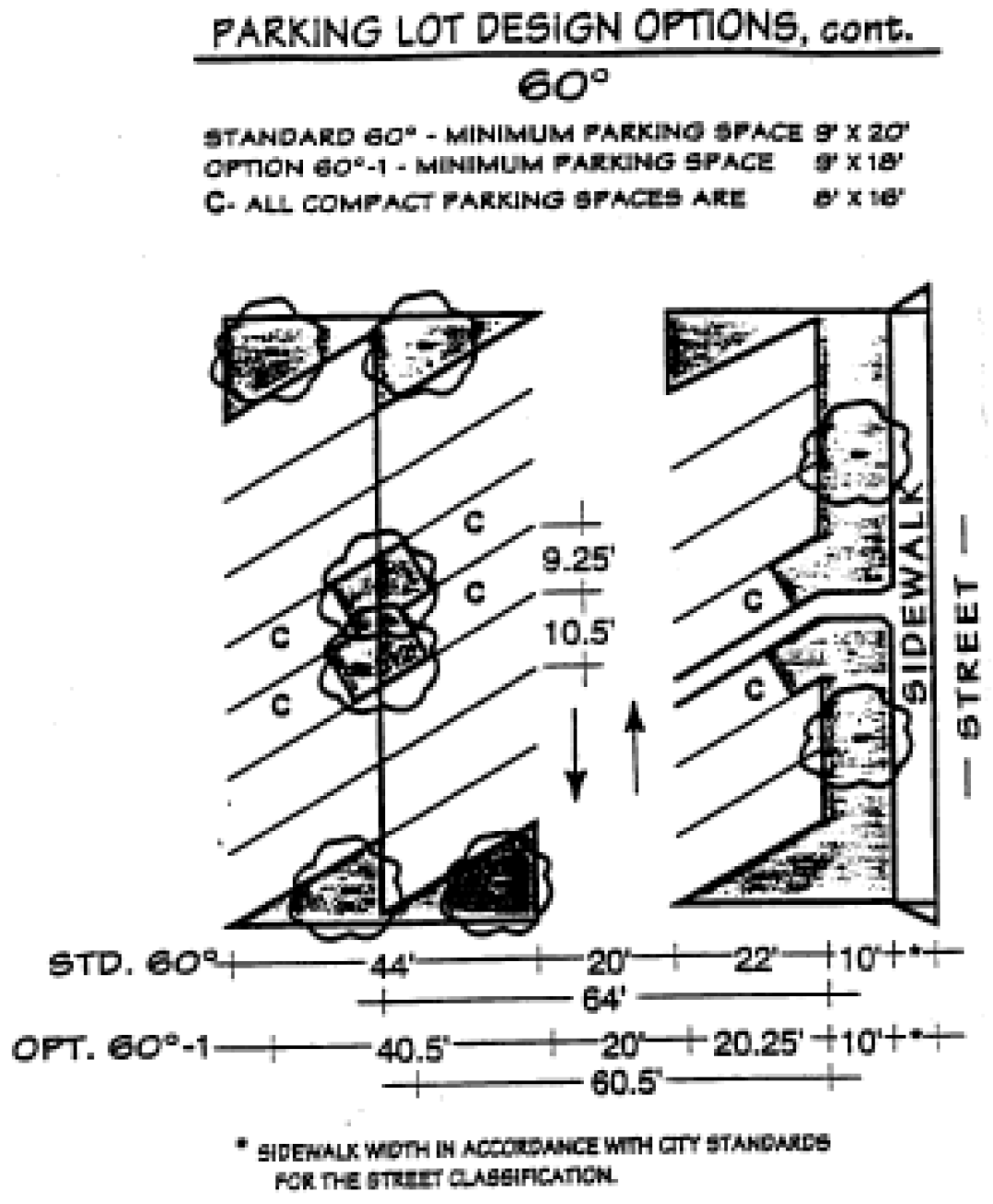
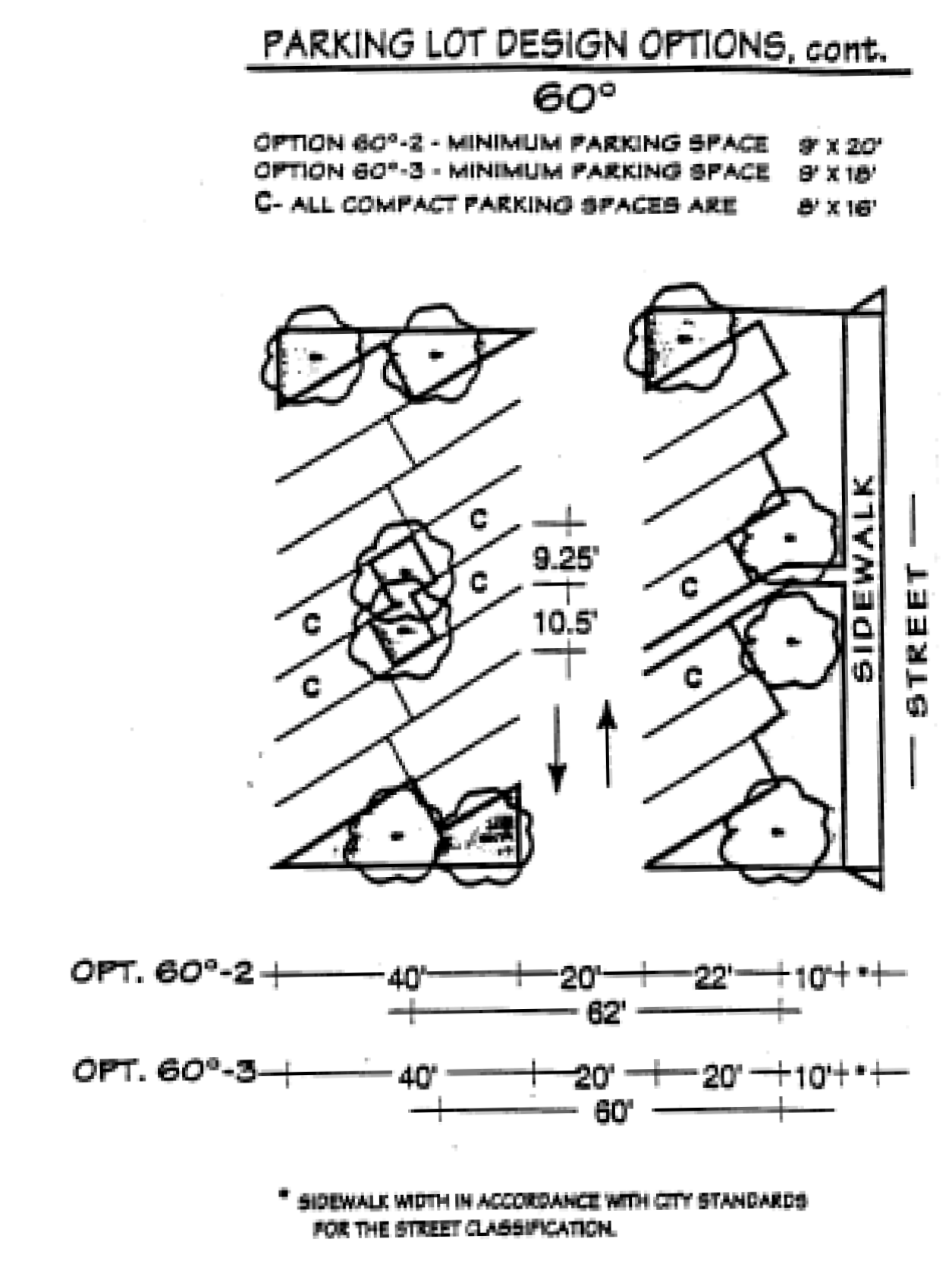
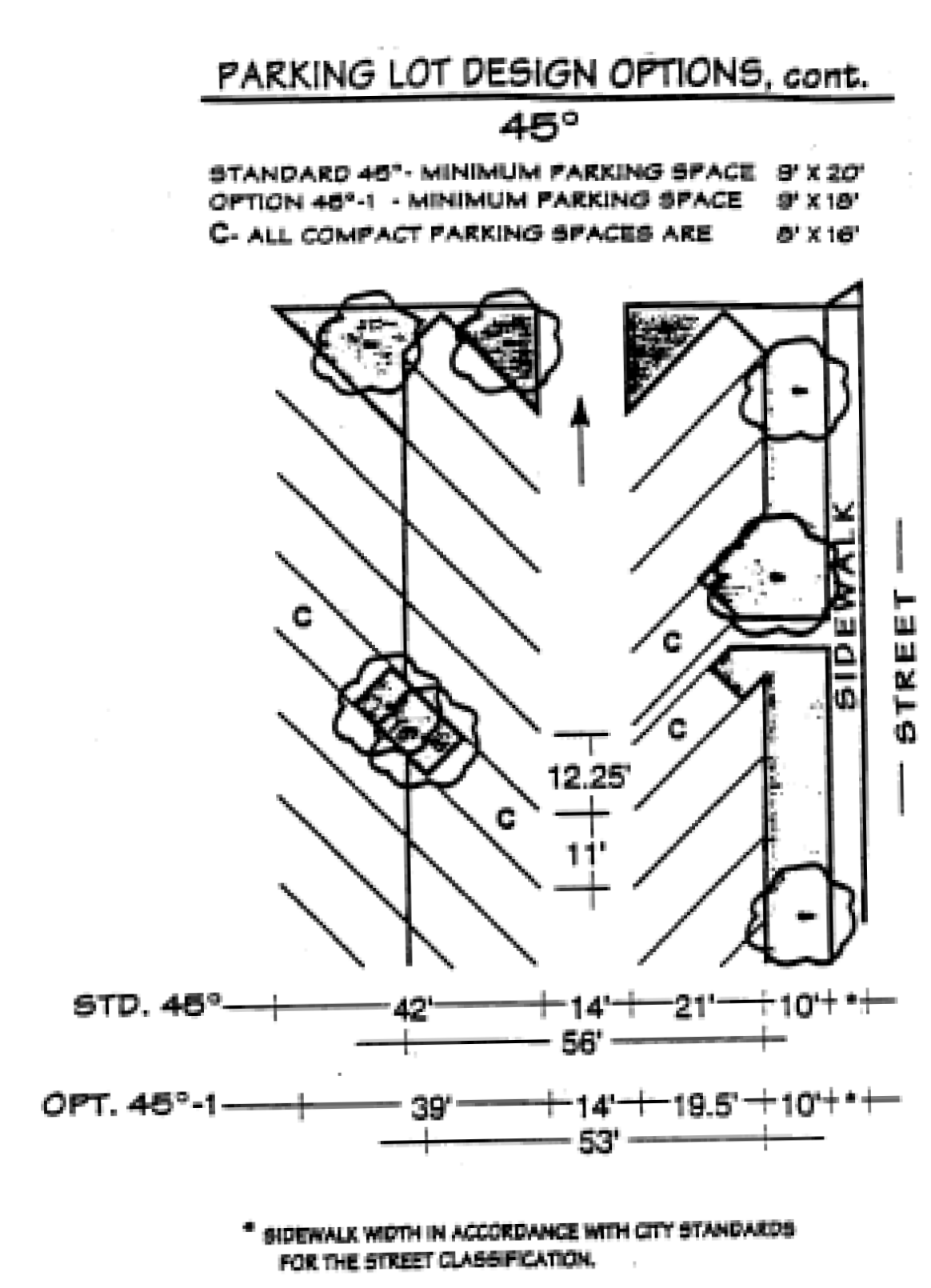
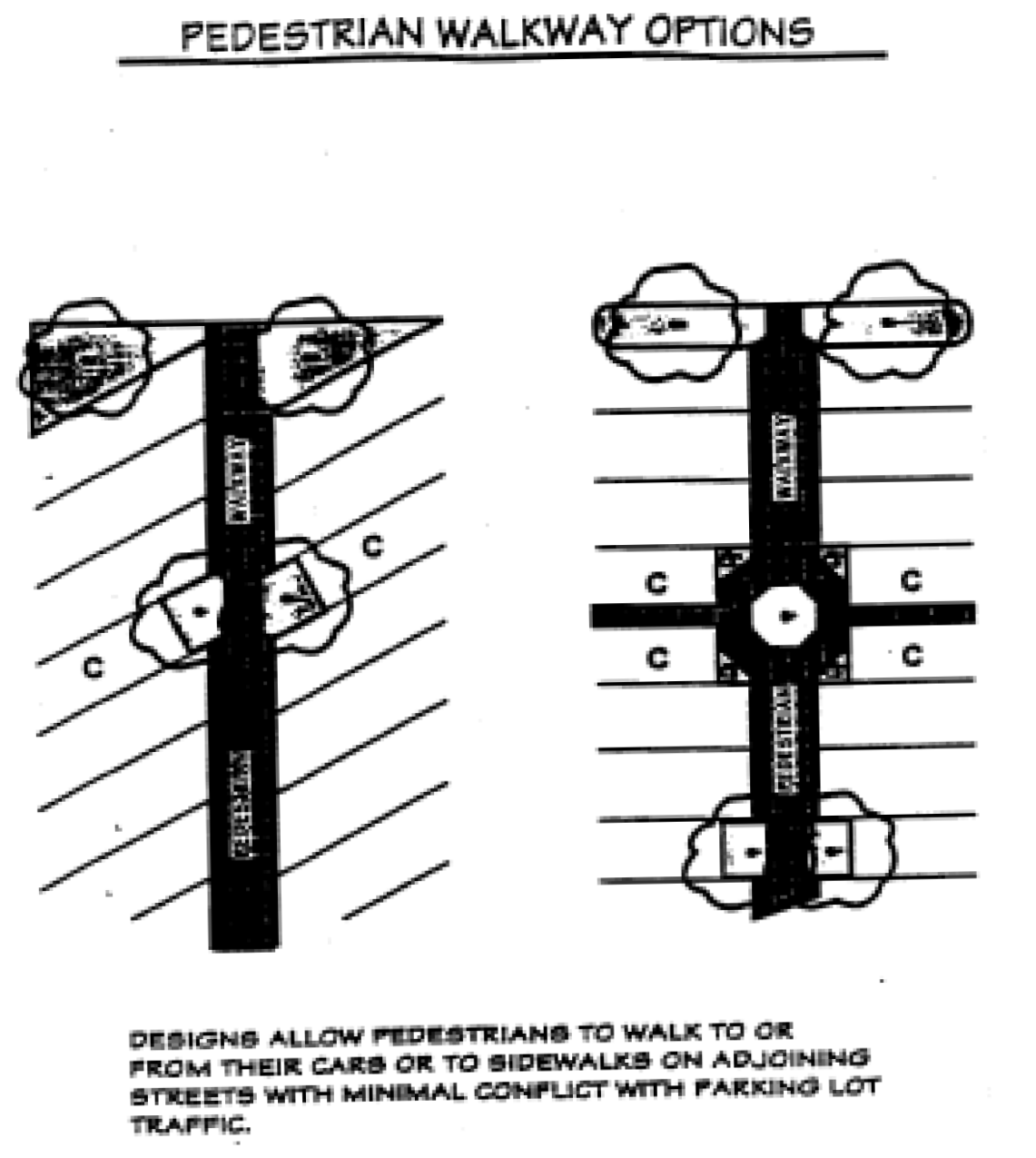
b.
The type, scale and proportion of landscape materials shall be appropriate to the site and/or structures to which they relate.
c.
Plant material shall be selected for interest in its structure, texture, color, ultimate growth and water efficiency. Plants that are native or climate adaptive to the high desert area of Lancaster and/or others that will be hardy, harmonious with project design, and of good appearance, shall be used. Drought-resistant varieties of plants shall be used wherever feasible. Turf shall not be permitted. Drought-resistant varieties of plants shall be used in accordance with Title 8, Chapter 8.50, Landscaping Installation and Maintenance of the Lancaster Municipal Code.
d.
Landscaped areas shall be irrigated by an automatic system with separate stations for each hydrozone. The irrigation system shall be designed and equipped to incorporate water conservation techniques such as drip systems, moisture sensors and anti-drain valves. Sprinkler systems shall be designed to prevent water from falling onto impervious surfaces. The system shall comply with Title 8, Chapter 8.50, Landscaping Installation and Maintenance of the Lancaster Municipal Code.
e.
All areas which are within a site which has been approved by the city for development as a site plan or approved phase thereof, which are not needed for buildings, sidewalks, vehicle access or parking, shall be landscaped.
f.
All landscaped planter areas shall be completely bordered by a 6-inch P.C.C. curbing to prevent irrigation runoff and act as a wheel stop where necessary. Where used as a wheel stop, the 6-inch curb may be counted toward the required length of the parking space.
g.
All interior areas of parking lots shall be landscaped with a minimum of one shade tree plus one shade tree for each 4 parking spaces along with the other plant materials.
h.
Lots of 5,000 square feet or less in area shall have the area used for vehicle ingress, egress, circulation and parking, landscaped in accordance with the following percentages:
Only landscaped areas exclusive of curbs shall qualify toward meeting this requirement and no landscaped area with a dimension of less than 2 feet shall be credited toward meeting the landscape requirement.
i.
Lots of more than 5,000 square feet in area shall have the area used for vehicle ingress, egress, circulation and parking, landscaped in accordance with the following percentages:
Only landscaped areas exclusive of curbs shall qualify toward meeting this requirement and no landscaped area with a dimension of less than 2 feet shall be credited toward meeting this landscape requirement.
j.
Where off-street parking areas abut local or collector public streets, such areas shall be separated from an abutting street by a continuous landscaped planter which extends parallel to the street frontage of the parking area. Said planter shall be a minimum of 10 feet in width exclusive of perimeter curbs. Up to ½ of the area of this required landscaped planter may be counted toward fulfilling the requirements of subsection A.8.h. or i. (See Section 17.16.130.B.2.E and 17.16.130.B.4., regarding landscaping in yards.)
k.
Trees and landscaping shall be utilized wherever possible to shade buildings as a means of enhancing energy conservation.
l.
No tree shall be less than 15 gallon size. At least 50% of all shrubs shall be of 5-gallon size, and no shrub shall be less than one-gallon size. Ground covers shall be planted no further apart than 6 inches on center.
m.
All landscaped areas shall be continuously and properly maintained in good condition. (See definition of landscape maintenance in Section 17.04.240.)
10.
Lighting. The intent of this requirement is to properly illuminate the site without producing an adverse impact on neighboring property. Exterior lighting of the building and site shall be provided, maintained and utilized during the hours of darkness in accordance with the following requirements:
a.
Exterior lighting shall be part of the architectural concept. Fixtures, standards, and all exposed accessories shall be compatible with building design.
b.
Placement of lighting shall be in accordance with recognized crime prevention, and safety principles.
11.
Outside storage or display. All outside storage shall be developed to comply with all standards set forth herein, except for those uses which have been specifically exempted therefrom:
a.
The uses listed in Section 17.16.130 B.5. are exempt from these requirements except for the following uses which shall comply:
1)
Automobile impound yards;
2)
Electric distribution substations;
3)
Equipment rental and sales shall comply in the LI zone only;
4)
Gas metering and control stations, public utility.
b.
All outside storage or display in the LI zone which is open to view from any street or highway abutting the lot or parcel of land upon which it is conducted, or which is open to view from any other lot or parcel shall be screened from view by a solid masonry wall constructed to Los Angeles County D-65 standards or as otherwise specified by the city. Gates, where used, shall also be of solid construction unless another design is approved by the Director. Chain link with slats is not acceptable.
c.
All outside storage or display in the HI zone which is open to view from freeways, expressways or arterial streets abutting the lot or parcel of land upon which it is conducted, or which is open to view from any area zoned or used for residential purposes, or which is open to view from any existing industrial use of a nature which, in the opinion of the Director, is adversely affected by the appearance of the outside storage or display, shall be screened from view by a solid masonry wall constructed to Los Angeles County D-65 standards or as otherwise specified by the city. Gates, where used, shall be of solid construction unless another design is approved by the Director. Chain link with slats is not acceptable.
d.
All outside storage and display or portions thereof which do not fall under the requirements of subsection A.10.c. of this section shall be fenced with chain link or other durable metal material approved by the Director. No wood fence materials will be allowed. All fences shall be of uniform height in relation to the ground upon which they stand and no fence shall be less than 6 feet and shall not exceed 15 feet in height. The actual height shall be based upon the height of materials to be stored and methods of stacking such materials and the need for security.
e.
All portions of outside storage and display areas shall meet the following requirements:
1)
The site shall be graded to drain properly as required by the Director.
2)
Applicants must obtain approval of the Los Angeles County Fire Department prior to obtaining any city permits for any use that includes the manufacture, use or storage of hazardous materials or wastes.
3)
The surface of the site shall be covered with at least 2 inches of crushed rock to prevent dust, or if hazardous materials are used or wastes are stored anywhere in the outdoor storage area, the entire area where such materials are used or stored shall, at a minimum, be paved in accordance with the standards of subsection A.2.a. of this section without expansion joints and with a curb for containment in accordance with city standards. Additional requirements may be imposed by the Los Angeles County Fire Department.
4)
All raw material, equipment, by-product, waste or finished products:
a)
Shall not be stored above the height of the wall or fence enclosing the area; and
b)
Shall not be stored within 300 feet of residentially zoned property, except where such property is separated by an arterial street; and
c)
Shall be stored in a manner that will not allow any material to be blown from the enclosed storage area; and
d)
Shall not be placed or allowed to remain outside the enclosed storage area.
f.
The design requirements for outside storage and display as set forth in this title shall not relieve the proprietors of such uses from complying with all applicable regulations, laws and ordinances of the city of Lancaster, county of Los Angeles, state of California, or the United States.
12.
Screening.
a.
Screening standards applicable to all I zones:
1)
Where mechanical equipment, junction boxes, satellite antennae, meters and similar utility equipment is ground mounted it shall be enclosed or screened from view where necessary to preclude visibility from freeways, expressways and arterial streets and adjacent properties.
2)
Parking areas adjacent to streets shall be screened with landscaping in the required yards and with low decorative walls, berms or combinations thereof. Where walls are used they shall be placed so as not to obscure landscaped areas from the street.
b.
Screening standards applicable to the LI zone:
1)
All rooftop mechanical equipment, ducts, tanks, satellite antennae, etc., shall be enclosed or otherwise screened from view from all sides of the building. (This requirement does not include wind-powered turbines used for ventilation.)
2)
Loading areas shall be screened from view where necessary to preclude visibility from public streets and highways and adjacent properties.
c.
Screening standards applicable to the HI zone:
1)
All rooftop mechanical equipment, ducts, tanks, satellite antennae, etc., shall be enclosed or otherwise screened from view from all sides of the building only where necessary to preclude visibility from freeways, expressways or arterial streets or adjoining residential, commercial or light industrial areas. (This requirement does not include wind-powered turbines used for ventilation.)
2)
Loading areas shall be screened from view only where necessary to preclude visibility from freeways, expressways and arterial streets and adjacent residentially and commercially zoned properties.
13.
Service for Utilities. All on-site utility services shall be underground.
14.
Signs.
a.
Sign design standards applicable to all I zones:
1)
The colors, materials and lighting of every sign shall be restrained and harmonious with the building and site to which it principally relates.
2)
The number of graphic elements on a sign shall be held to the minimum needed to convey the sign's major message and shall be composed in proportion to the area of the sign face.
3)
The light source of externally illuminated signs shall not be visible.
4)
No sign shall be placed in or over any public right-of-way.
5)
Street numbers of all buildings shall be prominently located and not less than 8 inches in height on a contrasting background to be easily read from the street by public safety personnel (i.e., police, fire, ambulance).
b.
Sign design standards applicable only to the LI zone:
1)
Use of individual letters for all signing is preferred and encouraged over "cabinet" signs. Where cabinet signs are utilized, such cabinet must be integrated into the design of the building or structure.
15.
Refuse/Recycling Storage. Commercial, industrial and institutional uses shall have on the same lot or parcel a refuse/recycling storage area at a ratio of 20 square feet of refuse/recycling storage area for each 1,000 square feet or portion thereof of net floor area of the facility but not less than 6 feet in width nor less than 18 in length (exterior dimension). Such storage areas shall include separate containers for waste and for materials to be recycled. Each container shall be clearly marked or color coded for its intended use. Such storage areas shall be enclosed on 3 sides by a minimum 5-foot-high reinforced masonry or concrete wall with a sight-obscuring gate of noncombustible materials which is the same height as the enclosing walls. The floor of the enclosure shall be of concrete construction and the walls shall be protected by a concrete curb not less than 2 inches high by 6 inches wide or conventional concrete wheel stops to preclude damage by dumpsters. Such storage areas shall not be placed in a location which is openly exposed to a fronting street or a neighboring residential area.
16.
Special Standards for Automobile Dismantling, Scrap Metal Processing Yards and Junk and Salvage Yards. No automobile dismantling yard or junk and salvage yard (as defined in Section 17.04.240) shall be permitted or maintained in the HI zone unless it complies with the following requirements:
a.
All operations and storage, including all equipment used in conducting such business, other than parking, shall be conducted within an enclosed building, or within an area fully enclosed by a solid wall. No wrecked or dismantled vehicles, salvage or junk shall be placed or allowed to remain outside of the enclosed yard area.
b.
No wrecked or dismantled vehicles, salvage or junk shall be stored at a height greater than the surrounding wall.
c.
Where walls are required they shall be developed in accordance with the following standards:
1)
All walls shall be of a uniform height in relation to the ground upon which they stand, and shall be a minimum of 8 feet and shall not exceed 15 feet in height. No walls shall be placed in a required front or street side yard established by Section 17.16.130.B.2.
The required setback shall be landscaped in accordance with Sections 17.16.130.B.2.e., 17.16.130.B.4. and 17.16.220. All landscaped areas shall be continuously and properly maintained in good condition as defined in this title.
2)
Walls shall be constructed of masonry to the structural standards specified by the Director.
3)
Gates: shall be of solid construction. (Chain link with slats does not fulfill this requirement.)
4)
Other interior fences or walls not open to view may be constructed of alternative materials as approved by the Director.
5)
All fences and walls shall be constructed in a workmanlike manner and shall consist solely of new materials unless the Director approves the substitution of used materials where, in his opinion, such used materials will provide the equivalent in service, appearance, and useful life.
6)
All walls shall be a uniform neutral color excluding black, which blends with the surrounding terrain and improvements and shall be maintained in a neat, orderly condition at all times. Such wall may contain signs as approved by the Director in lieu of freestanding signs with an area not to exceed the sign area permitted for freestanding signs.
7)
Any structures which are used as part of the yard boundaries and/or are exposed to view from the street frontage shall be painted to conform with the color of the fencing. The Director may approve other appropriate architectural treatment.
d.
Paving.
1)
The entire yard shall be paved with an asphalt surfacing as specified in subsection A.2.b. of this section or the Director may approve other paving materials which provide, in his opinion, the equivalent in service and useful life. The requirement may be waived where the Director finds that no dust or other problem would be aggravated by the absence of surfacing.
2)
If hazardous materials are used or wastes are stored anywhere in an outdoor storage area, the entire storage area and area where the materials are used shall be paved in accordance with subsection A.2.a. of this section without expansion joints and with a curb sufficient for containment in accordance with city standards.
e.
The special standards for automobile dismantling yards and junk and salvage yards set forth in this title shall not relieve the proprietors of such yards from complying with all regulations, laws and ordinances of the city of Lancaster, county of Los Angeles, state of California or the United States.
17.
Hazardous Materials. Applicants must obtain the approval of the Los Angeles County Fire Department prior to obtaining any city permits for any use which includes the manufacture or use, of hazardous materials or the storage of hazardous materials or wastes.
18.
Radioactive Materials. The use of radioactive materials shall be limited to measuring, gauging or calibration equipment.
19.
Noise. Uses which generate noise by the nature of their function and/or processes shall be required to demonstrate that the noise levels emitted from the use shall not exceed 65 dBA at any property line which abuts a commercial or residential zone or use. A detailed noise attenuation study by a qualified acoustical engineer may be required by the Director or his designated representative to determine appropriate mitigation and methods to incorporate same into project design. Site design methods which may be utilized to reduce noise include:
a.
The use of building setbacks and dedication of noise easements to increase the distance between the noise source and receiver;
b.
The location of uses and orientation of buildings which are compatible with higher noise levels adjacent to noise generators or in clusters to shield more noise-sensitive areas and uses;
c.
The placement of noise-tolerant land uses, such as parking areas, between the noise source and receiver;
d.
The placement of noise-tolerant structures, such as garages or carports, to shield noise-sensitive areas;
e.
Clustering of office or commercial structures to reduce interior open space noise levels.
20.
Projections Permitted into Yards. The following projections are permitted in the LI zone only.
a.
Eaves, cantilevered roofs, awnings and similar architectural features may project a maximum distance of 2½ feet into any required front or side yard or 5 feet into a rear yard, provided that such features shall maintain a minimum distance of 3 feet from any property line and is not less than 8 feet in height above grade. Such appendages shall be supported only at or behind the building setback line.
b.
Landing places including access stairs, which exceed an average height of 2½ feet and do not extend above the level of the first floor may project a maximum distance of 2 feet into required interior side yards, and a maximum distance of 5 feet into required front and side yards, provided such features shall maintain a minimum distance of 3 feet from any property line, and that an open-work railing installed shall not exceed 3½ feet in height.
c.
Rain conductors, spouts, utility service risers, shutoff valves, water tables, sills, capitals, bases, cornices and belt courses may project a maximum distance of one foot into any required yard.
d.
Water heaters, water softeners, and gas or electric meters, including service conduits and pipes, enclosed or in the open, may project a maximum distance of 2½ feet into a required interior or rear yard provided that such structures or equipment shall maintain a minimum distance of 3 feet to any property line.
21.
Electric Vehicle Charging Stations (EVCS). New commercial and industrial development shall provide for electric vehicle charging stations in the manner prescribed as follows:
a.
New residential uses shall provide EVCSs in accordance with Section 17.08.150T.
b.
New commercial, industrial and other uses with the building or land area, capacity, or numbers of employees listed herein shall provide the electrical service capacity necessary and all conduits and related equipment necessary to ultimately serve 2% of the total parking spaces with EVCSs in a manner approved by the building and safety official. Of these parking spaces, ½ shall initially be provided with the electric vehicle supply equipment necessary to function as on-line EVCSs upon completion of the project. The remainder shall be installed at such time as they are needed for use by customers, employees or other users. EVCSs shall be provided in disabled person parking spaces in accordance with state requirements.
1)
Construction of a hospital of 500 or more beds, or expansion of a hospital of that size by 20% or more.
2)
Construction of a post-secondary school (college), public or private, for 3,000 or more students, or expansion of an existing facility having a capacity of 3,000 or more students by an addition of at least 20%.
3)
Hotels or motels with 500 or more rooms.
4)
Industrial, manufacturing, or processing plants or industrial parks that employ more than 1,000 persons, occupy more than 40 acres of land, or contain more than 650,000 square feet of gross floor area.
5)
Office buildings or office parks that employ more than 1,000 persons or contain more than 250,000 square feet of gross floor area.
6)
Shopping centers or trade centers that employ 1,000 or more persons or contain 500,000 square feet of gross floor area.
7)
Sports, entertainment, or recreation facilities that accommodate at least 4,000 persons per performance or that contain 1,500 or more fixed seats.
8)
Transit projects (including but not limited to transit stations and park and ride lots).
B.
When abutting or adjacent to residentially zoned property, the following requirements shall also be applied:
1.
Artificial lighting used to illuminate the premises shall be directed away from adjacent residentially zoned properties.
2.
Where multi-story buildings are to be utilized on lots abutting residentially zoned properties, such buildings shall be located or oriented in a manner which will minimize visual intrusion into neighboring residentially zoned property. (This may be accomplished by setting the building back from the abutting property line beyond the distance required for the yard, selective placement or screening of windows, orienting the building in a manner which will not give occupants a direct view into the yards or windows of neighboring residents.)
3.
No signs shall be placed in a manner which visually intrudes into adjoining residentially zoned property.
4.
Trees shall be utilized as a means of improving the interface between commercial and residential uses where appropriate.
5.
When abutting residentially zoned property, a masonry wall of not less than 6 feet in height shall be provided at the property line in accordance with the provisions for walls specified in Section 17.28.030.C to minimize conflicts between commercial and residential uses. This requirement shall be modified, where necessary to preclude interference with line-of-sight of a driver within 10 feet of any street, highway or alley, down to a maximum height of 42 inches. The design of the wall shall be considered as part of the site plan review. The site and any buildings thereon shall be designed to locate noise- and odor-generating equipment and activity in a manner which will have a minimal impact on abutting residentially zoned property. Such techniques may include, but are not limited to, no windows on the building wall(s) facing residentially zoned property, insulating structures housing equipment against noise, limitation of the hours of equipment operation, and other controls designed for specific problems. It shall be the burden of the applicant to prove that his project will not have a detrimental effect on neighboring residential property at the time of site plan review.
C.
All uses shall comply with the air quality standards of the Air Quality Management District (AQMD) or the city of Lancaster, whichever is more restrictive.
(Ord. 790 § 1 (Exh. A), 2001; Ord. 713 § 5 (part), 1995; Ord. 711 §§ 17 (part), 18 (part), 19(C) (part), 29 (part), 34 (part), 35 (part), 1995; prior zoning ord. § 241.080)
(Ord. No. 907, § 6, 10-28-08; Ord. No. 1070, § 4(Exh. A), 1-14-2020; Ord. No. 1130, § 4(Exh. A), 5-27-2025)
17.16.440 - Purpose and intent.
It is the intent of this article to prevent community wide adverse economic impacts, increased crime, increased incidence of communicable disease, decreased property values, and the deterioration of neighborhoods which can be brought about by the concentration of adult-oriented businesses in close proximity to each other or to other incompatible uses such as schools for minors, churches, and residentially zoned districts or uses. The city council finds that it has been demonstrated in various communities that the concentration of adult-oriented businesses causes an increase in the number of transients in the area, and an increase in crime, and in addition to the effects described above can cause other businesses and residents to move elsewhere. It is, therefore, the purpose of this article to establish reasonable and uniform regulations to prevent the concentration of adult-oriented businesses or their close proximity to incompatible uses, while permitting the location of adult-oriented businesses in certain areas.
It is the further purpose of this article to regulate adult-oriented businesses in order to promote the health, safety, morals, and general welfare of the citizens of the city. The provisions of this article have neither the purpose nor effect of imposing a limitation or restriction on the content of any communicative materials, including adult-oriented materials and paraphernalia protected by the First Amendment. Similarly, it is not the intent or effect of this article to restrict or deny access by adults to adult-oriented materials protected by the First Amendment, or to deny access by the distributors and exhibitors and performers of adult-oriented entertainment to their intended market. Neither is it the intent or effect of this article to condone or legitimize the distribution of obscene material.
(Ord. 801 § 2 (part), 2001: Prior zoning ord. § 251.010)
17.16.450 - Definitions.
For the purposes of this article certain terms and words are defined as follows:
"Adult-oriented business" means any one of the following:
1.
"Adult arcade" means an establishment where, for any form of consideration, one or more electrically, electronically, or mechanically controlled still or motion picture machines or projectors, video or laser disc players, or other image producing devices are maintained, for viewing by 5 or fewer persons per machine at any one time, and are used to show films, computer generated images, motion pictures, video cassettes, slides or other photographic reproductions, 30 percent or more of the number of which are distinguished or characterized by an emphasis upon the depiction or description of specified sexual activities or specified anatomical areas.
2.
"Adult bookstore" means a commercial establishment which, as a regular and substantial course of conduct, offers for sale or rental for any form of consideration any one or more of the following:
a.
Books, magazines, periodicals or other printed matter, or photographs, films, motion pictures, video cassettes or video reproductions, any material in digital form (including, but not limited to, compact disc (CD) or digital video disc (DVD), slides, or other visual representations which are distinguished or characterized by an emphasis upon the depiction or description of specified sexual activities or specified anatomical areas, or,
b.
Instruments, devices, or paraphernalia, except for clothing, which are designed for use in connection with specified sexual activities. The phrase "regular and substantial course of conduct" as applied to an adult bookstore shall mean the following:
1)
The business devotes more than 25% of its retail inventory (not measured by the number of items but rather by the cost to the business owner of the inventory) to merchandise distinguished or characterized by an emphasis upon specified sexual activities or specified anatomical areas; or
2)
The business devotes more than 25% of the retail floor area to merchandise that is distinguished or characterized by an emphasis upon specified sexual activities and specified anatomical areas; or
3)
The retail value of merchandise that is distinguished or characterized by an emphasis upon specified sexual activities and specified anatomical areas exceeds 25% of the total retail value of inventory offered in each of the following categories: (a) books, (b) magazines, (c) video tapes or any material in digital format (including, but not limited to, compact disc (CD) or digital video disc (DVD)), for sale or rental, (d) novelties and devices, and (e) on-premises viewing of images, films, and/or videos; or
4)
Gross revenue derived from merchandise in any category set forth in paragraph (c) above exceeds 25% of the total gross revenue for the category.
"Adult cabaret" means a nightclub, restaurant, bar or similar business establishment which regularly features (1) live performances which are distinguished or characterized by an emphasis upon the display of specified anatomical areas or specified sexual activities; and/or (2) persons who appear semi-nude or nude; and/or (3) films, computer generated images, motion pictures, video cassettes, slides, or other photographic reproductions (including without limitation digital images such as compact disc (CD) or digital video disc (DVD) images), which are distinguished or characterized by an emphasis upon the depiction or description of specified sexual activities or specified anatomical areas.
"Adult hotel/motel" means a hotel or motel or similar business establishment offering public accommodations for any form of consideration which, (1) provides patrons with closed-circuit television transmissions, films, computer generated images, motion pictures, video cassettes, slides, or other photographic reproductions 30 percent or more of the number of which are distinguished or characterized by an emphasis upon the depiction or description of specified sexual activities or specified anatomical areas; and (2) either (a) rents, leases, lets or allows the subletting or subrental of any room for less than a 10-hour period, or rents, leases, or lets any single room more than twice in a 24-hour period, or (b) has a sign visible from the public right of way which advertises the availability of the above-described photographic reproductions.
"Adult motion picture theater" means a business establishment where, for any form of consideration, films, computer generated images, motion pictures, video cassettes, slides or similar photographic reproductions are shown for viewing by 5 or more patrons at any one time, 30 percent or more of the number of which, in any month, are distinguished or characterized by an emphasis upon the depiction or description of specified sexual activities or specified anatomical areas.
"Adult theater" means a theater, concert hall, auditorium, or similar business establishment which, for any form of consideration regularly features persons who appear in a state of nudity or semi-nudity and/or features live performances which are distinguished or characterized by an emphasis on the display of specified anatomical areas or specified sexual activities.
"Adult-oriented business operator" (hereinafter "operator") means a person who supervises, manages, inspects, directs, organizes, controls or in any other way is responsible for or in charge of the premises of an adult-oriented business or the conduct or activities occurring on the premises thereof.
"Applicant" means a person who is required to file an application for a permit under this chapter, including an individual owner, managing partner, officer of a corporation, or any other operator, manager, employee, or agent of an adult-oriented business.
"Bar" means any commercial establishment licensed by the State Department of Alcoholic Beverage Control to serve any alcoholic beverages on the premises.
"City manager" means the city manager of the city of Lancaster or the authorized representatives thereof.
"Distinguished or characterized by an emphasis upon" means and refers to the dominant or essential theme of the object described by such phrase. For instance, when the phrase refers to films "which are distinguished or characterized by an emphasis upon" the depiction or description of specified sexual activities or specified anatomical areas, the films so described are those whose dominant or predominant character and theme are the depiction of the enumerated sexual activities or anatomical areas.
"Employee" means a person who performs any service on the premises of an adult-oriented business on a full-time, part-time or contract basis, whether or not the person is denominated an employee, independent contractor, agent or otherwise and whether or not said person is paid a salary, wage or other compensation by the operator of said business. Employee does not include a person exclusively on the premises of the adult-oriented business to render only repair or maintenance services or to deliver equipment or goods to the adult-oriented business as long as such persons are not nude or semi-nude.
"Establishment" of an adult-oriented business. As used herein, to "establish" an adult-oriented business shall mean and include any of the following:
1.
The opening or commencement of any adult-oriented business as a new business;
2.
The conversion of an existing business, whether or not an adult-oriented business, to any adult-oriented business as defined herein;
3.
The addition of any of the adult-oriented businesses defined herein to any other existing adult-oriented business; or
4.
The relocation of any such adult-oriented business.
"Figure model" means any person who, for pecuniary compensation, consideration, hire or reward, poses in a modeling studio to be observed, sketched, painted, drawn, sculptured, photographed or otherwise depicted.
"Health officer" means the health officer of the city or his or her duly authorized representative.
"Modeling studio" means a business which provides, for pecuniary compensation, monetary or other consideration, hire or reward, figure models who, for the purposes of sexual stimulation of patrons, display specified anatomical areas to be observed, sketched, photographed, painted, sculpted or otherwise depicted by persons paying such consideration.
"Nude," "nudity," or a "state of nudity" means the showing of the human male or female genitals, pubic area, or anus with less than a fully opaque covering, the showing of the female breast with less than a fully opaque covering of any part of the nipple, or the showing of completely or opaquely covered male genitals in a discernibly turgid state.
"Operate an adult-oriented business" means the supervising, managing, inspecting, directing, organizing, controlling or in any way being responsible for or in charge of the conduct of activities of an adult-oriented business or activities within an adult-oriented business.
"Permittee" means the person to whom an adult-oriented business permit or adult-oriented business employee permit is issued.
"Person" means any individual, proprietorship, partnership, firm, association, joint stock company, corporation, or other legal entity, or combination of the above in whatever form or character.
"Regularly features" with respect to an adult theater or adult cabaret means a regular and substantial course of conduct. The fact that live performances which are distinguished or characterized by an emphasis upon the display of specified anatomical areas or specified sexual activities occur on 2 or more occasions within a 30 day period; 3 or more occasions within a 60 day period; or 4 or more occasions within a 180 day period, shall to the extent permitted by law be deemed to be a regular and substantial course of conduct.
"Religious institution" means a structure which is used primarily for religious worship and related religious activities.
"School" means any child or day care facility, or an institution of learning for minors, whether public or private, offering instruction in those courses of study required by the California Education Code and maintained pursuant to standards set by the State Board of Education. This definition includes a nursery school, kindergarten, elementary school, middle or junior high school, senior high school, or any special institution of education, but it does not include a vocational or professional institution of higher education, including a community or junior college, college, or university.
"Semi-nude" means a state of dress in which opaque clothing covers no more than the genitals, pubic region, anus and areola of the female breast, as well as portions of the body covered by supporting straps or devices. This definition shall include a state of dress in which the entire lower portion of the human female breast is exposed, but shall not include any state of dress in which the cleavage of the human female breast, exhibited by a dress, blouse, shirt, leotard, bathing suit, or other wearing apparel is exposed, so long as the areola is not exposed in whole or in part.
"Sexual encounter center" means a business enterprise that, as one of its principal purposes, offers for any form of consideration physical contact in the form of wrestling or tumbling between individuals, one or more of whom is in a state of nudity or a semi-nude condition.
"Specified anatomical areas" shall mean and include any of the following:
1.
Less than completely and opaquely covered human (i) genitals or pubic region; (ii) anus or buttocks; and (iii) female breast below a point immediately above the top of the areola;
2.
Human male genitals in a discernibly turgid state, even if completely and opaquely covered;
3.
Any device, costume or covering that simulates any of the body parts included in subsections 1 or 2 above.
"Specified sexual activities" shall mean and include any of the following, whether performed directly or indirectly through clothing or other covering:
1.
The fondling or other erotic touching of human genitals, pubic region, buttocks, anus, or female breast;
2.
Sex acts, including but not limited to intercourse, oral copulation, or sodomy;
3.
Masturbation;
4.
Excretory functions as part of or in connection with any of the other activities described in subdivision 1 through 3 of this subsection.
"Transfer ownership or control of an adult-oriented business" means and includes (i) the sale, lease, or sublease of the business; or (ii) the transfer of securities which constitute a controlling interest in the business whether by sale, exchange or similar means; or (iii) the establishment of a trust, gift or other similar legal device which transfers ownership or control of the business, except for transfer by bequest or other operation of law on the death of a person possessing ownership or control.
(Ord. 801 § 2 (part), 2001: Prior zoning ord. § 251.010)
17.16.460 - Prohibition.
From and after January 10, 2002, no adult-oriented business shall be established, located or operated in any zone in the city other than within the heavy industry (HI) category of the industrial (I) zones, as specified in this article, and subject to all regulations and conditions enumerated in this title. Any business which did not constitute an adult oriented business or a sexually oriented business prior to January 10, 2002, but which would be deemed an adult-oriented business under this article, which was legally established and for which all applicable permits and licenses were issued and remain effective as of January 10, 2002 shall not be deemed to be an adult-oriented business subject to the provisions of this article, except to the extent (i) such business ceases operating in conformity with any permit issued in conjunction with the establishment thereof; or (ii) the floor area of such business utilized for the sale of merchandise distinguished by or characterized by an emphasis upon specified sexual activities or specified anatomical areas increases by more than 15% over the floor area utilized for such purpose and existing as of January 10, 2002; or (iii) the retail inventory (measured by cost to the business owner of the inventory or by the retail value of the merchandise) distinguished or characterized by an emphasis upon specified sexual activities or specified anatomical areas increases by more than 15% over the amount of such inventory being merchandised as of January 10, 2002; or (iv) the number of performances distinguished or characterized by an emphasis upon the display of specified anatomical areas or specified sexual activities increases by 15% in any applicable period of time.
(Ord. 801 § 2 (part), 2001: Prior zoning ord. § 251.020)
17.16.470 - Amortization of nonconforming adult-oriented business uses.
Any use of real property as an adult-oriented business existing on the effective date of this ordinance, which was in conformity with the provisions of Article IV of Chapter 17.16 of Title 17 of the code prior to effective date of this ordinance, and which was constructed, operated, and maintained in compliance with all previous regulations, but which, after the date of this ordinance does not comply with Sections 17.16.460 and 17.16.490 of the code (but does comply with all other provisions of this article), shall be regarded as a nonconforming use which may be continued until 18 months after the effective date of this ordinance. On or before such date, all such nonconforming uses shall be terminated unless an extension of time has been approved by the director in accordance with the provisions of this Section 17.16.470. This section does not authorize a business subject to its terms to expand or materially change the nature of its operation during the period in which such business is allowed under this section to continue its operation.
A.
Abandonment. Notwithstanding the above, any discontinuance or abandonment of the use of any lot or structure as a legal nonconforming adult-oriented business shall result in a loss of the legal nonconforming status of such use.
B.
Amortization — annexed property. Any adult-oriented business which was a legal use at the time of annexation of the property and which is located in the city, but which does not conform to the provisions of Section 17.16.460 and Section 17.16.490 shall be terminated within 18 months of the date of annexation unless an extension of time has been approved by the director in accordance with the provisions of this Section 17.16.490.
(Ord. 801 § 2 (part), 2001: Prior zoning ord. § 251.021)
17.16.480 - Application for extension of amortization period.
The owner or operator of a nonconforming use as described in this section may apply under the provisions of this section to the planning commission for an extension of time within which to terminate the nonconforming use.
A.
Time and manner of application. An application for an extension of time within which to terminate a use made nonconforming by the provisions of this section, may be filed by the owner of the real property upon which such use is operated, or by the operator of the use. Such an application must be filed with the director at least 90 days but no more than 180 days prior to the time established in this Section for termination of such use.
B.
Content of application—Fees. The application shall state the grounds for requesting an extension of time. The filing fee for such application shall be set forth in the schedule of fees established by resolution from time to time by the city council.
C.
Hearing procedure. Within 10 days following receipt of the application, the director shall set the matter for an administrative hearing and notify the applicant of the time and date of such hearing. Such administrative hearing shall be conducted by the director or his designee, and shall be scheduled for a time and date within 30 days after the director's receipt of a completed application accompanied by the requisite filing fee. The applicant shall have the right to offer testimonial, documentary and tangible evidence relevant to the issues, and may be represented by counsel. Any hearing under this section may be continued for a reasonable time not exceeding 10 days upon agreement of all parties, for the convenience of a party or a witness. The decision of the director shall be subject to appeal pursuant to Section 17.16.580 and subject to judicial review pursuant to Code of Civil Procedure section 1094.8.
D.
Approval of extension—Findings. An extension under the provisions of this section shall be for a reasonable period of time commensurate with the investment involved, and shall be approved only if the director finds that:
1.
The applicant has made a substantial investment (including but not limited to lease obligations) in the property or structure on or in which the nonconforming use is conducted; such property or structure cannot be readily converted to another use; and such investment was made prior to the date of this ordinance; and
2.
The applicant will be unable to recoup said investment as of the date established for termination of the use; and
3.
The applicant has made good faith efforts to recoup the investment and to relocate the use to a location in conformance with Section 17.16.460 and Section 17.16.490.
(Ord. 801 § 2 (part), 2001: Prior zoning ord. § 251.022)
17.16.490 - Locational requirements.
No adult-oriented business shall be established, located, or operated within certain distances of certain specified land uses or zones as set forth below:
A.
No such business shall be established or located within 1,500 feet of any other adult-oriented business.
B.
No such business shall be established or located within 1,500 feet of any existing residential zone (to the extent such residential zone may feasibly be used for a residential dwelling unit of a type permitted by the city), residential use, park, public building (which the public is authorized to attend), church, school, boys club, girls club, or similar existing youth organization.
C.
The distances set forth above shall be measured as a radius from the primary entrance of the adult-oriented business to the property lines of the property so zoned or used without regard to intervening structures.
(Ord. 801 § 2 (part), 2001: Prior zoning ord. § 251.026)
17.16.500 - Adult-oriented business permit required.
A.
It shall be unlawful for any person to engage in, conduct or carry on, or to permit to be engaged in, conducted or carried on, in or upon any premises in the city of Lancaster the operation of an adult-oriented business unless the person first obtains and continues to maintain in full force and effect a permit from the city of Lancaster as herein required ("adult-oriented business permit").
B.
It shall be unlawful for any persons to engage in or participate in any live performance depicting specified anatomical areas or involving specified sexual activities in an adult-oriented business unless the person first obtains and continues in full force and effect a permit from the city of Lancaster as herein required ("adult-oriented employee permit")
(Ord. 801 § 2 (part), 2001)
17.16.510 - Adult-oriented business permits.
A.
Every person who proposes to maintain, operate or conduct an adult-oriented business in the city of Lancaster shall file an application with the city manager upon a form provided by the city of Lancaster and shall pay a filing fee, as established by resolution adopted by the city council from time to time, which shall not be refundable.
B.
Adult-oriented business permits are nontransferable, except in accordance with Section 17A6.530. Therefore, all applications shall include the following information:
1.
If the applicant is an individual, the individual shall state his or her legal name, including any aliases, address, and submit satisfactory written proof that he or she is at least 18 years of age.
2.
If the applicant is a partnership, the partners shall state the partnership's complete name, address, the names of all partners, whether the partnership is general or limited, and attach a copy of the partnership agreement, if any.
3.
If the applicant is a corporation, the corporation shall provide its complete name, the date of its incorporation, evidence that the corporation is in good standing under the laws of California, the names and capacity of all officers and directors, the name of the registered corporate agent and the address of the registered office for service of process.
4.
If the applicant is an individual, he or she shall sign the application. If the applicant is other than an individual, an officer of the business entity or an individual with authority to bind the entity shall sign the application.
5.
If the applicant intends to operate the adult-oriented business under a name other than that of the applicant, the applicant shall file the fictitious name of the adult-oriented business and show proof of registration of the fictitious name.
6.
A description of the type of adult-oriented business for which the permit is requested and the address where the adult-oriented business is proposed to operate, plus the names and addresses of the owners and lessors of the adult-oriented business site.
7.
The address to which notice of action on the application is to be mailed.
8.
The names of all employees, independent contractors, and other persons who will perform at the adult-oriented business, who are required by Section 17.16.540 to obtain an adult-oriented business employee permit (for ongoing reporting requirements see Section 17.16.540, subsection A).
9.
A sketch or diagram showing the interior configuration of the premises, including a statement of the total floor area occupied by the adult-oriented business. The sketch or diagram need not be professionally prepared, but must be drawn to a designated scale or drawn with marked dimensions of the interior of the premises to an accuracy of plus or minus 6 inches.
10.
A straight-line drawing prepared within 30 days prior to application accurately depicting the building and the portion thereof to be occupied by the adult-oriented business, and: (1) the property line of any other adult-oriented business within 1500 feet of the primary entrance of the adult-oriented business for which a permit is requested; and (2) the property lines of any church, school, park, public building, boys club, girls club, youth center, recreational area, or residential zone or use within 1500 feet of the primary entrance of the adult-oriented business.
11.
A diagram of the off-street parking areas and premises entries of the adult-oriented business showing the location of the lighting system required by Section 17.16.590(c).
12.
Whether the applicant or principals thereof have been convicted, within the past five years, of a sexual crime against children, sexual abuse, rape, or crimes connected with another adult-oriented business including, but not limited to, distribution of obscenity or material harmful to minors, prostitution or pandering and, if so, the dates of conviction, confinement, and release, or has been convicted of a crime requiring registration under Penal Code Section 290.
13.
Whether the applicant or any of the other individuals identified in the application pursuant to this section has bad a previous permit under this title or other similar ordinances from another city or county denied, suspended or revoked, including the name and location of the adult-oriented business for which the permit was denied, suspended or revoked, as well as the date of the denial, suspension or revocation, and whether the applicant or any other individual identified in the application pursuant to this section has been an owner, partner in a partnership or an officer, director or principal stockholder of a corporation that is permitted under this article whose permit has previously been denied, suspended or revoked, including the name and location of the adult-oriented business for which the permit was denied, suspended or revoked as well as the date of denial, suspension or revocation.
14.
Whether the applicant or any other individual identified in the application pursuant to this section holds any other permits and/or licenses under this article or any other similar adult oriented business ordinance from another city or county and, if so, the names and locations of such other permitted businesses.
B.
The fact that an applicant possesses other types of state or city permits or licenses does not exempt the applicant from the requirement of obtaining an adult-oriented business permit.
(Ord. 801 § 2 (part), 2001)
17.16.520 - Investigation and action on application for adult-oriented business permit.
A.
The city manager shall determine whether the application contains all of the information required by the provisions of this article. If it is determined that the application is not complete, the applicant shall be sent a notice in writing within 10 business days after the date of receipt of the application that the application is not complete and the reasons therefor. The applicant shall have 30 calendar days from the date of the notice to submit additional information to render the application complete. The applicant's failure to submit the additional information within this time period renders the application null and void. Within 5 business days following the receipt of a supplemental or amended application, the city manager shall again determine whether the application is complete. Evaluation and notification shall occur as provided above until such time as the application is found to be complete. Once the application is found to be complete, the applicant shall be notified within 5 business days of that fact. If an applicant submits 2 consecutive incomplete applications, the applicant shall be notified in writing that a new application must be filed with the city manager as set forth herein.
B.
Upon receipt of a completed application and payment of the filing fee, the city manager or his or her designee shall immediately stamp the application as received, and issue a temporary permit to the applicant, which shall be valid for 30 business days after the date of issuance, unless earlier terminated by the denial of the adult business permit. The city manager or his or her designee shall promptly investigate the information contained in the application to determine whether the applicant shall be issued an adult-oriented business permit. As part of this investigation, the city manager or his or her designee shall promptly send photocopies of the completed application to the Los Angeles County sheriff's office and any other city departments or other agencies responsible for enforcement of health, fire and building codes and laws. Each department or agency shall promptly investigate the applicant, application and proposed adult oriented business in accordance with its responsibilities under law and as set forth in this title, which investigation shall be completed prior to the expiration of the 30 day time period set forth in subsection C below. At the conclusion of such investigation, each department or agency shall indicate on the photocopy of the application its approval or disapproval of the application, date it, sign it, and, in the event it disapproves, state the reasons therefor and return the photocopy immediately to the city manager or his or her designee. A department or agency shall only disapprove an application if it finds the proposed adult-oriented business will violate any provision of any statute, code, ordinance, regulation or other law in effect in the city. The Los Angeles County Sheriff's office shall only be required to certify the records request check and shall not be required to approve or disapprove applications. In no event shall the temporary permit issued pursuant hereto constitute or grant a right to the applicant to operate an adult-oriented business in violation of Sections 17.16.460 and 17.16.490 of the code or in violation of any other zoning, building and safety, or business licensing provisions of the code.
C.
Within 30 days of receipt of the completed application, the city manager shall complete the investigation, grant or deny the application in accordance with the provisions of this section, and so notify the applicant as follows:
1.
The city manager shall write or stamp "Granted" or "Denied" on the application and date and sign such notation.
2.
If the application is denied, the city manager shall attach to the application a statement of the reasons for denial.
3.
If the application is granted, the city manager shall attach to the application an adult-oriented business permit.
4.
The application as granted or denied and the permit, if any, shall be placed in the U.S. mail, first class postage prepaid, addressed to the applicant at the address stated in the application. All notices given hereunder shall be deemed given upon the date they are deposited in the U.S. mail or the date upon which personal service is provided.
D.
The city manager shall grant the application and issue the adult-oriented business permit upon findings that the proposed business meets the locational criteria of Section 17.16.460 and Section 17.16.490; and that the applicant has met all of the development and performance standards and requirements of Section 17.16.590 unless the application is denied for one or more of the reasons set forth in subsection F hereof. The permittee shall post the permit conspicuously in the adult-oriented business premises so that it may be easily read at any time by persons entering the adult-oriented business.
E.
If the city manager grants the application or if the city manager neither grants nor denies the application within 30 days after it is stamped as received (except as provided in Section 17.1 6.540A, subsection C), the applicant may begin operating the adult-oriented business for which the permit was sought, subject to strict compliance with the development and performance standards and requirements of Section 17.16.590.
F.
The city manager shall deny the application for any of the following reasons:
1.
The building, structure, equipment, or location used by the business for which an adult-oriented business permit is required do not comply with the requirements and standards of the health, zoning, fire and safety laws of the city, the county, and the state of California, or with the locational or development and performance standards and requirements of these regulations;
2.
The applicant, his or her employee, agent, partner, director, officer, shareholder or manager has knowingly made any false, misleading or fraudulent statement of material fact in the application for an adult business permit, or has failed to provide information reasonably necessary for issuance of the permit on the application form;
3.
An applicant is under 18 years of age;
4.
The required application fee has not been paid;
5.
The adult-oriented business does not comply with the city's zoning ordinance;
6.
The granting of the permit would violate a statute, ordinance, or court order;
7.
The applicant has had a permit issued pursuant to this ordinance which has been suspended or revoked at the time of application;
8.
Applicant has been convicted of a criminal act specified in Section 17.16.510, subsection B, paragraph 12 for which:
a.
Less than 2 years have elapsed since the date of conviction or the date of release from confinement, whichever is the later date, if the conviction is of a misdemeanor offense for the specified criminal act, or
b.
Less than 5 years have elapsed since the date of conviction or the date of release from confinement, whichever is the later date, if the conviction is of a felony offense for the specified criminal act, or
c.
Less than 5 years have elapsed since the date of conviction or the date of release from confinement, whichever is the later date, if the convictions are of 2 or more misdemeanors for the specified criminal acts occurring within any 24-month period.
The fact that a conviction is being appealed shall have no effect on disqualification of the applicant.
G.
If the city manager or his/her designee denies the application, he/she shall notify the applicant of the denial and state the reasons for the denial.
H.
If a person applies for a permit for a particular location within a period of 112 months from the date of denial of a previous application for a permit at the location, and there has not been an intervening change in the circumstances which could reasonably be expected to lead to a different decision regarding the former reasons for denial, the application shall be denied.
(Ord. 801 § 2 (part), 2001)
17.16.530 - Transfer and expiration of adult-oriented business permits.
A.
A permittee shall not operate an adult-oriented business under the authority of an adult-oriented business permit at any place other than the address of the adult-oriented business stated in the application for the permit.
B.
A permittee shall not transfer ownership or control of an adult-oriented business permit to another person unless and until the transferee obtains an amendment to the permit from the city manager stating that the transferee is now the permittee. Such an amendment may be obtained only if the transferee files an application with the city manager in accordance with Sections 17.16.510, accompanies the application with a transfer fee in an amount set by resolution of the city council, and the city manager determines in accordance with Section 17.16.510 and/or 17.16.520 that the transferee would be entitled to the issuance of an original permit under the ordinances and regulations which were in effect as of the time of the initial issuance of the original adult-oriented business permit. Notwithstanding the forgoing, to the extent the adult-oriented business is operating as a legal nonconforming use, an amendment to the permit shall not extend the legal nonconforming status of such business beyond the amortization period, if any, applicable to the adult-oriented business unless such amortization period is extended pursuant to any local ordinance or regulations in effect as of the time of the extension request.
C.
No permit may be transferred when the city manager has notified the permittee that the permit has been or may be suspended or revoked.
D.
Any attempt to transfer a permit either directly or indirectly in violation of this section is hereby declared void, and the permit shall be deemed revoked.
E.
Each adult-oriented business permit shall expire 1 year from the date of issuance, and may be renewed only by filing with the city manager a written request for renewal, accompanied by the filing fee as established from time to time by the city council, and a copy of the permit to be renewed. The request for renewal shall be made at least 30 days before the expiration date of the permit. When made less than 30 days before the expiration date, the expiration of the permit will not be stayed. Applications for renewal shall be acted on as provided herein for action upon applications for permits. If the city manager or his or her designee determines that there has been no change in the configuration or operation of the permitted adult-oriented business which would call into question the continued satisfaction of all requirements of this ordinance, the permit shall be renewed. If the city manager or his or her designee determines that there has been such a change in the configuration or operation of the adult- oriented business, the city manager may require the permittee to submit a complete new permit application pursuant to Section 17.16.510. In such event, and to the extent the request for renewal has been submitted at least 30 days prior to expiration of the permit, the expiration of the existing permit shall be stayed pending a decision on the new permit application.
(Ord. 801 § 2 (part), 2001: Prior zoning ord. § 251.027)
17.16.540 - Adult-oriented business employee permit.
A.
No person shall engage in or participate in any live performance depicting specified anatomical areas or involving specified sexual activities in an adult-oriented business, nor shall any employee as defined in Section 17.16.450, be employed at an adult-oriented business, without a valid adult-oriented business employee permit issued by the city to such person. All persons who have been issued an adult-oriented business permit shall promptly supplement the information provided as part of the application for the permit required by Section 7.16.510, subsection B, with the names of all performers and employees required to obtain an adult-oriented business employee permit, within 30 days of any change in the information originally submitted. Failure to submit such changes shall be grounds for suspension of the adult-oriented business permit.
B.
The city manager shall grant, deny and renew adult-oriented business employee permits.
C.
The application for a permit shall be made on a form provided by the city manager. An original and 2 copies of the completed and sworn permit application shall be filed with the city manager.
D.
The completed application shall contain the following information and be accompanied by the following documents:
1.
The applicant's legal name and any other names (including "stage names" and aliases) used by the applicant;
2.
Age, date and place of birth;
3.
Height, weight, hair and eye color;
4.
Present residence address and telephone number, and business address and telephone number, if any;
5.
Whether the applicant has been convicted in the past 5 years as of the date of the application of:
a.
Any of the offenses set forth in Sections 311 through 313.4, 315, 316, 318, 266a, 266b, 266c, 266e, 266g, 266h, 266i, -647(a), 647(b) and 647(D) of the California Penal Code, or any offense requiring registration under Penal Code section 290 of the California Penal Code, as those sections now exist or may hereafter be amended or renumbered.
b.
The equivalent of the aforesaid offenses outside the state of California.
6.
Whether such person is or has ever been licensed or registered as a prostitute, or otherwise authorized by the laws of any other jurisdiction to engage in prostitution in such other jurisdiction. If any person mentioned in this subsection has ever been licensed or registered as a prostitute, or otherwise authorized by the laws of any other state to engage in prostitution, a statement shall be submitted giving the place of such registration, licensing or legal authorization, and the inclusive dates during which such person was so licensed, registered, or authorized to engage in prostitution.
7.
Date, issuing state and number of state issued driver's license or identification card and social security number;
8.
Satisfactory written proof that the applicant is at least 18 years of age;
9.
The applicant's fingerprints on a form provided by the sheriff's department, and a color photograph clearly showing the applicant's face. Any fees for the photographs and fingerprints shall be paid by the applicant;
10.
If the application is made for the purpose of renewing a license, the applicant shall attach a copy of the license to be renewed.
E.
The completed application shall be accompanied by a non-refundable application fee. The amount of the fee shall be set by resolution of the city council.
F.
Upon receipt of an application and payment of the application fees, the city manager shall immediately stamp the application as received, issue a temporary license to the applicant which shall be valid for 15 days unless earlier terminated by the denial of an adult-oriented business employee permit, and promptly investigate the application.
G.
If the city manager determines that the applicant has completed the application improperly or the application is otherwise incomplete, the city manager shall notify applicant of such fact within 10 business days of the date of receipt of the application, including the reasons the application is not complete. The city manager shall, in such event, grant the applicant an extension of time of 10 days to complete the application properly. In addition, the applicant may request an extension, not to exceed 10 days, of the time for the city manager to act on the application. The time period for granting or denying a permit shall be stayed during the period in which the applicant is granted an extension of time.
(Ord. 801 § 2 (part), 2001: Prior zoning ord. § 251.030)
17.16.550 - Investigation and action on application.
A.
Within 15 days after receipt of the properly completed application, the city manager shall grant or deny the application and so notify the applicant as follows:
1.
The city manager shall write or stamp "Granted" or "Denied" on the application and date and sign such notation.
2.
If the application is denied, the city manager shall attach to the application a statement of the reasons for denial.
3.
If the application is granted, the city manager shall attach to the application an adult-oriented business employee permit.
4.
The application as granted or denied and the permit, if any, shall be placed in the U.S. mail, first class postage prepaid, addressed to the applicant at the residence address stated in the application.
B.
The city manager shall grant the application and issue the permit unless the application is denied for one or more of the reasons set forth in subsection C of this section.
C.
The city manager shall deny the application for any of the following reasons:
1.
The applicant has knowingly made any false, misleading, or fraudulent statement of a material fact in the application for a permit or in any report or document required to be filed with the application or has omitted information reasonably necessary for issuance of the permit;
2.
The applicant is under 18 years of age;
3.
The adult-oriented business employee permit is to be used for employment in a business prohibited by state or local laws, ordinances, or regulations;
4.
The applicant has been registered in any state as a prostitute;
5.
The applicant has been convicted of any criminal act enumerated in Section 17.16.540, subsection D.5., or convicted of an offense outside the state of California that would have constituted any of the described offenses if committed within the state of California, for which:
a.
Less than 2 years have elapsed since the date of conviction or the date of release from confinement, whichever is the later date, if the conviction is of a misdemeanor offense for the specified criminal act, or
b.
Less than 5 years have elapsed since the date of conviction or the date of release from confinement, whichever is the later date, if the conviction is of a felony offense for the specified criminal act, or
c.
Less than 5 years have elapsed since the date of conviction or the date of release from confinement, whichever is the later date, if the convictions are of 2 or more misdemeanors for the specified criminal acts occurring within any 24-month period.
D.
The license, if granted, shall state on its face the name of the person to whom it is granted, and the expiration date. The city manager shall provide each person issued an adult-oriented business employee permit with an identification card containing the name, address, photograph, and permit number of the permittee,
E.
Both the permit and identification card shall be available for inspection at all times during which the permittee is on the premises of the adult-oriented business.
F.
If the city manager neither grants nor denies a completed application for which the filing fees have been paid, within 15 business days after its receipt, the applicant may begin the employment for which the license is sought, subject to strict compliance with the development and performance standards and regulations and other provisions of Article IV of this chapter.
(Ord. 801 § 2 (part), 2001: Prior zoning ord. § 251.031)
17.16.560 - Expiration of adult-oriented business employee permit.
Each adult-oriented business employee permit shall expire one year from the date of issuance, and may be renewed only by filing with the city manager a written request for renewal, accompanied by the filing fee as established from time to time by the city council, and a copy of the permit to be renewed. The request for renewal shall be made at least 30 days before the expiration date of the permit. When made less than 30 days before the expiration date, the expiration of the permit will not be stayed. Applications for renewal shall be acted on as provided herein for action upon applications for permits. If the city manager or his or her designee determines that there has been no change in the facts upon which the permit was issued which would call into question the continued satisfaction of all requirements of this ordinance, as amended from time to time, the permit shall be renewed. If the city manager or his or her designee determines that there has been such a change, the city manager may require the permittee to submit a complete new permit application pursuant to Section 17.16.540. In such event, the expiration of the existing permit shall be stayed pending a decision on the new permit application.
(Ord. 801 § 2 (part), 2001: Prior zoning ord. § 251.032)
17.16.570 - Suspension or revocation of adult-oriented business permits and adult-oriented business employee permits.
A.
An adult-oriented business permit or adult-oriented business employee permit may be suspended or revoked in accordance with the procedures and standards of this section.
1.
On determining that grounds for permit suspension or revocation exist, the city manager shall furnish written notice of the proposed suspension or revocation to the permittee. Such notice shall set forth the time and place of a hearing to be conducted by the city manager or a hearing officer appointed by the city manager, and the ground or grounds upon which the hearing is based, the pertinent code sections, and a brief statement of the factual matters in support thereof. The notice shall be mailed, postage prepaid, addressed to the last known address of the permittee, or shall be delivered to the permittee personally, at least 10 working days prior to the hearing date. Hearings shall be conducted in accordance with procedures established by the city manager, but at a minimum shall adhere to the provisions of subsection 2.
2.
The applicant shall have a right to offer testimonial, documentary, and tangible evidence relevant to the issues; and may be represented by counsel. Any relevant evidence may be admitted that is the sort of evidence upon which reasonable persons are accustomed to rely in the conduct of serious affairs. Any hearing under this section may be continued for a reasonable time for the convenience of a party or a witness upon agreement of all parties. The hearing officer's decision may be appealed in accordance with Section 17.16.580.
3.
The city manager shall suspend a permit for a period not to exceed 30 days if the hearing officer determines, following notice to the permittee and a hearing as set forth above, that the permittee or an employee of a permittee has violated or is not in compliance with any section of this chapter, or has refused to allow an inspection of the adult-oriented business premises as authorized by this chapter.
4.
The city manager shall revoke a permit if the hearing officer determines, following notice to the permittee and a hearing as set forth above, that any of the following conditions arising from the acts or omissions of the permittee, or an employee, agent, partner, director, stockholder, or manager of an adult-oriented business, has occurred:
a.
A cause of suspension as set forth in subsection 3 has occurred and the permit has been previously suspended within the preceding 12 months.
b.
The permittee has knowingly made any false, misleading or fraudulent statement of material facts in the application for a permit, or in any report or record required to be filed with the city.
c.
The permittee, employee, agent, partner, director, stockholder, or manager of an adult-oriented business has knowingly allowed or permitted, and has failed to make a reasonable effort to prevent the occurrence of any of the following activities on the premises of the adult-oriented business, or in the case of an adult-oriented business employee permit holder, the permittee has engaged in one of the activities described below while on the premises of the adult-oriented business:
1.
Any act of sexual intercourse, sodomy, oral copulation, or masturbation, with the exception of an adult hotel/motel, unless the adult-oriented business employee or adult-oriented business operator of such adult hotel/motel knowingly allowed such act to occur in a public place or within public view;
2.
Use of the establishment as a place where unlawful solicitations for sexual intercourse, sodomy, oral copulation, or masturbation occur;
3.
Any conduct constituting a criminal offense which requires registration under Section 290 of the California Penal Code;
4.
The occurrence of acts of lewdness, assignation, or prostitution, including any conduct constituting violations of Sections 315, 316, or 318 or Subdivision b of Section 647 of the California Penal Code;
5.
Any act constituting a violation of provisions in the California Penal Code relating to obscene matter or distribution of harmful matter to minors, including but not limited to Sections 311 through 313.4;
6.
Any conduct prohibited by this chapter.
d.
Failure to abide by any disciplinary action previously imposed by an appropriate city official.
(Ord. 801 § 2, 2001: Prior zoning ord. § 251.040)
17.16.580 - Appeal of denial, suspension or revocation.
All decisions of the hearing officer or city manager to, issue, renew, deny, suspend or revoke a permit issued pursuant to this article are final unless appealed in accordance herewith.
An applicant or permittee may appeal a decision by the city manager or a hearing officer to deny an application for, or to revoke or suspend, an adult-oriented business permit or adult-oriented business employee permit by filing an appeal with the city clerk pursuant to Chapter 2.44 of the code. A hearing by the city council on such appeal shall be scheduled for the first available regular meeting of the city council for which proper notice can be given, but in no event shall such hearing occur more than 30 days after the appeal is filed. The city council shall make a decision on the appeal during the same meeting at which the hearing is held.
After any denial, or a suspension or revocation, the applicant or permittee may seek prompt judicial review of such decision in any court of competent jurisdiction as provided by law, and specifically as provided by California Code of Civil Procedure Section 1094.8. Notwithstanding the applicant's or licensee's right to initiate judicial review, the city shall, upon the written request of an aggrieved applicant or licensee received within 30 calendar days following the decision of the city council, file an action pursuant to Code of Civil Procedure Section 1094.8 with a court of competent jurisdiction seeking declaratory and injunctive relief, including temporary and preliminary relief, as to the propriety of the denial, revocation, or suspension.
If the city denies an initial or renewal application and the aggrieved applicant commences a legal action to determine the validity of the denial or makes a written request in the manner set forth herein that the city commence such action, then the city shall issue a temporary permit. This temporary permit shall remain in effect only until the court in which the action is pending renders a judicial decision on an application for temporary restraining order, a motion for preliminary injunction, etc., as to the propriety of the denial.
If the city revokes, or suspends an existing permit, and the aggrieved applicant or the permittee commences a legal action to determine the validity thereof or makes a written request in the manner set forth herein that the city commence such action, the city's revocation or suspension of the permit will be stayed pending a judicial decision on the propriety of the denial based upon an application for temporary restraining order, a motion for preliminary injunction or other form of judicial review, whichever is earliest.
Any temporary permit issued pursuant to this chapter shall not grant any vested rights on the holder of the temporary permit, nor shall it grant a right to the holder to operate or serve as an employee in an adult-oriented business which is in violation of Sections 17.16.460 or 17.16.490 of this article or in violation of any other zoning, building and safety, or business licensing provisions of the code.
(Ord. 801 § 2 (part), 2001: Prior zoning ord. § 251.041)
17.16.590 - Adult-oriented business development and performance standards.
A.
Maximum occupancy load, fire exits, aisles and fire equipment shall be regulated, designed and provided in accordance with the fire department and building regulations and standards adopted by the city.
B.
No adult-oriented business shall be operated in any manner that permits the observation of any material or activities depicting, describing or relating to specified sexual activities or specified anatomical areas from any public way or from any location outside the building or area of such establishment. This provision shall apply to any display, decoration, sign, show window or other opening.
C.
All off-street parking areas and premise entries of the sexually oriented business shall be illuminated from dusk to closing hours of operation with a lighting system which provides an average maintained horizontal illumination of one foot candle of light on the parking surface and/or walkways. The required lighting level is established in order to provide sufficient illumination of the parking areas and walkways serving the adult-oriented business for the personal safety of patrons and employees and to reduce the incidence of vandalism and criminal conduct. The lighting shall be shown on the required sketch or diagram of the premises.
D.
The premises within which the adult-oriented business is located shall provide sufficient sound-absorbing insulation so that noise generated inside said premises shall not be audible anywhere on any adjacent property or public right-of-way or within any other building or other separate unit within the same building.
E.
Except for those businesses also regulated by the California Department of Alcoholic Beverage Control, an adult-oriented business may be open for business only between the hours of 8:00 a.m. and midnight on any particular day, unless alternative hours are mandated as a condition of approval of a zone change.
F.
The building entrance to an adult-oriented business shall be clearly and legibly posted with a notice indicating that persons under 18 years of age are precluded from entering the premises. Said notice shall be constructed and posted to the satisfaction of the community development director or designee. No person under the age of 18 years shall be permitted within the premises at any time.
G.
All indoor areas of the adult-oriented business within which patrons are permitted, except rest rooms, shall be open to view by the management at all times.
H.
Any adult-oriented business which is also an "adult arcade", shall comply with the following provisions:
1.
The interior of the premises shall be configured in such a manner that there is an unobstructed view from a manager's station of every area of the premises to which any patron is permitted access for any purpose, excluding restrooms. Restrooms may not contain video reproduction equipment. If the premises has two or more manager's stations designated, then the interior of the premises shall be configured in such a manner that there is an unobstructed view of each area of the premises to which any patron is permitted access for any purpose from at least one of the manager's stations. The view required in this subsection must be direct line of sight from the manager's station.
2.
The view area specified above shall remain unobstructed by any doors, walls, merchandise, display racks, or other materials at all times. No patron is permitted access to any area of the premises which has been designated as an area in which patrons will not be permitted.
3.
No viewing room or booth may be occupied by more than one person at any one time.
4.
The walls or partitions between viewing rooms or booths shall be maintained in good repair at all times, with no holes between any two such rooms such as would allow viewing from one booth into another or such as to allow physical contact of any kind between the occupants of any two such booths.
5.
Customers, patrons or visitors who are not actively engaged in shopping for or reviewing the products available on display for purchaser viewing shall not be allowed to stand idly by in the vicinity of any such video booths, or in the common area of such business. Signs prohibiting loitering shall be posted in prominent places in and near the video booths.
6.
The floors, seats, walls and other interior portions of all video booths shall be maintained clean and free from waste and bodily secretions. Presence of human excrement, urine, semen or saliva in any such booths shall be evidence of improper maintenance and inadequate sanitary controls; repeated instances of such conditions may justify suspension or revocation of the owner and operator's license to operate the adult-oriented business.
I.
All areas of the adult-oriented business shall be illuminated at a minimum of the following foot-candles, to be maintained and evenly distributed at ground level:
J.
The adult-oriented business shall provide and maintain separate rest room facilities for male patrons and employees, and female patrons and employees. Male patrons and employees shall be prohibited from using the rest room(s) for females, and female patrons and employees shall be prohibited from using the rest room(s) for males, except to carry out duties of repair, maintenance and cleaning of the rest room facilities. The rest rooms shall be free from any materials depicting specified sexual activities or specified anatomical areas. Rest rooms shall not contain television monitors or other motion picture or video projection, recording or reproduction equipment. The foregoing provisions of this paragraph shall not apply to an adult-oriented business which deals exclusively with sale or rental of materials which are not used or consumed on the premises, such as an adult bookstore, and which does not provide rest room facilities to its patrons or the general public.
K.
The following additional requirements shall pertain to adult-oriented businesses providing live entertainment depicting specified anatomical areas or involving specified sexual activities, except for businesses regulated by the Alcoholic Beverage Control Commission:
1.
No person shall perform live entertainment for patrons of an adult-oriented business except upon a stage at least 18 inches above the level of the floor which is separated by a distance of at least 10 feet from the nearest area occupied by patrons, and no patron shall be permitted within 10 feet of the stage while the stage is occupied by an entertainer. "Entertainer" shall mean any person who is an employee or independent contractor of the adult-oriented business, or any other person who, with or without any compensation or other form of consideration, performs live entertainment for patrons of an adult-oriented business.
2.
The adult-oriented business shall provide separate dressing room facilities for entertainers which are exclusively dedicated to the entertainers' use.
3.
The adult-oriented business shall provide an entrance/exit for entertainers which is separate from the entrance/exit used by patrons.
4.
The adult-oriented business shall provide access for entertainers between the stage and the dressing rooms which is completely separated from the patrons. If such separate access is not physically feasible, the adult-oriented business shall provide a minimum 3 foot wide walk aisle for entertainers between the dressing room area and the stage, with a railing, fence or other barrier separating the patrons and the entertainers capable of (and which actually results in) preventing any physical contact between patrons and entertainers.
5.
No entertainer, either before, during or after performances, shall have physical contact with any patron and no patron shall have physical contact with any entertainer either before, during or after performances by such entertainer. This subsection shall only apply to physical contact on the premises of the adult-oriented business, including without limitation, any parking areas.
6.
Fixed rail(s) at least 30 inches in height shall be maintained establishing the separations between entertainers and patrons required by this subsection.
7.
No patron shall directly pay or give any gratuity to any entertainer and no entertainer shall solicit any pay or gratuity from any patron.
8.
No owner or other person with managerial control over an adult-oriented business shall permit any person on the premises of the adult-oriented business to engage in a live showing of the human male or female genitals, pubic area or anus with less than a fully opaque coverage, and/or the female breast with less than a fully opaque coverage over any part of the nipple or areola and/or covered male genitals in a discernibly turgid state. This provision may not be complied with by applying an opaque covering simulating the appearance of the specified anatomical part required to be covered.
M.
Additional Regulations for Adult Motels.
1.
Evidence that a sleeping room in a hotel, motel, or a similar commercial establishment has been rented and vacated 2 or more times in a period of time that is less than 10 hours creates a rebuttable presumption that the establishment is an adult motel.
2.
It is a violation of this chapter when, as a person in control of a sleeping room in a hotel, motel, or similar commercial establishment that does not have an adult-oriented business permit, the person rents or sub-rents a sleeping room to a person and, within 10 hours from the time the room is rented, rents or sub-rents the same sleeping room again.
3.
For purposes of paragraphs 1 and 2 of this section, the terms "rent" or "sub-rent" mean the act of permitting a room to be occupied for any form of consideration.
N.
Additional Regulations Relating to the Exhibition of Sexually Explicit Films, Videos or Live Entertainment in Viewing Rooms. A person who operates or causes to be operated an adult-oriented business, other than an adult motel, which exhibits on the premises in a viewing room of less than 150 square feet of floor space, a film, video cassette, live entertainment or other video reproduction which depicts specified sexual activities or specified anatomical areas, shall comply with the following requirements:
1.
Upon application for an adult-oriented business permit, the application shall be accompanied by a diagram of the premises showing a plan thereof specifying the location of one or more manager's stations and the location of all overhead lighting fixtures and designating any portion of the premises in which patrons will not be permitted. A manager's station may not exceed 32 square feet of floor area. The diagram shall also designate the place at which the permit will be conspicuously posted, if granted. A professionally prepared diagram in the nature of an engineer's or architect's blueprint shall not be required; however, each diagram should be oriented to the north or to some designated street or object and should be drawn to a designated scale or with marked dimensions sufficient to show the various internal dimensions of all areas The city manager may waive the foregoing diagram for renewal applications if the applicant adopts a diagram that was previously submitted and certifies that the configuration of the premises has not been altered since it was first prepared.
2.
No alteration in the configuration or location of a manager's station may be made without the prior written approval of the city manager based upon the city manager's finding that such alteration complies with this section.
3.
It is the duty of the permittee of the adult-oriented business to ensure that at least one employee is on duty and situated in each manager's station at all times that any patron is present inside the adult-oriented business.
4.
The interior of the adult-oriented business shall be configured in such a manner that there is an unobstructed view from a manager's station of every area of the adult-oriented business to which any patron is permitted access for any purpose, excluding restrooms. Restrooms may not contain video viewing equipment or any materials depicting specified sexual activities or specified anatomical areas. If the adult-oriented business has 2 or more designated manager's stations, then the interior of the premises shall be configured in such a manner that there is an unobstructed view of each area of the adult-oriented business to which any patron is permitted access for any purpose from at least one of the manager's stations. The view required by this section must be by direct line of sight from the manager's station.
5.
It shall be the duty of the permittee to ensure that the view area specified in this section remains unobstructed at all times by any doors, curtains, partitions, walls, merchandise, display racks or other materials.
6.
It shall be the duty of the permittee to ensure that no patron is permitted access to any area of the adult-oriented business which has been designated as an area in which patrons will not be permitted pursuant to paragraph 1 of this subsection.
7.
No viewing room may be occupied by more than one person at any time.
8.
The adult-oriented business shall be equipped with overhead lighting fixtures of sufficient intensity to illuminate every place to which patrons are permitted access at an illumination of not less than 10-foot candles as measured at the floor level.
9.
It shall be the duty of the licensee to ensure that the illumination required by this section is maintained at all times that any patron is present in the premises.
10.
No openings of any kind shall exist between viewing rooms or booths.
11.
No person shall make or attempt to make an opening of any kind between viewing booths or rooms.
12.
The licensee shall, during each business day, regularly inspect the walls between the viewing booths to determine if any openings or holes exist.
13.
The licensee shall cause all floor coverings in viewing booths to be nonporous, easily cleanable surfaces, with no rugs or carpeting.
14.
The licensee shall cause all wall surfaces and ceiling surfaces in viewing booths to be constructed of, or permanently covered by, nonporous, easily cleanable material. No wood, plywood, composition board or other porous material shall be used within 48 inches of the floor.
15.
It is a violation of this chapter for a person having a duty under this section to knowingly fail to fulfill that duty.
P.
Additional Regulations Concerning Public Nudity.
1.
It is a violation of this chapter for a person knowingly and intentionally to appear in a state of nudity in an adult-oriented business or any other public place.
2.
It is a violation of this chapter for a person knowingly or intentionally, in an adult-oriented business, to appear in a semi-nude condition unless the person is an employee who, while semi-nude, is upon a stage at least 18 inches above the level of the floor which is separated by a distance of at least 10 feet from the nearest areas occupied by patrons.
3.
It is a violation of this chapter for an employee or performer while semi-nude in an adult-oriented business, to solicit any pay or gratuity from any patron or customer or for any patron or customer to pay or give any gratuity to any employee.
4.
It is a violation of this chapter for an entertainer, while semi-nude, to touch a patron or the clothing of a patron, or for a patron to touch an entertainer who is semi-nude.
Q.
Adult-oriented businesses shall employ security guards in order to maintain the public peace and safety, based upon the following standards:
1.
Adult-oriented businesses featuring live entertainment shall provide at least one security guard at all times while the business is open. If the occupancy limit of the premises is greater than 35 persons, an additional security guard shall be on duty.
2.
Security guards for other adult-oriented businesses may be required if it is determined by the city manager that their presence is necessary in order to prevent any illegal conduct from occurring on the premises.
3.
Security guard(s) shall be charged with preventing violations of law and enforcing compliance by patrons of the requirements of these regulations. Security guards shall be uniformed in such a manner so as to be readily identifiable as a security guard by the public and shall be duly licensed as a security guard as required by applicable provisions of state law. No security guard required pursuant to this subsection shall act as a door person, ticket seller, ticket taker, admittance person, or sole occupant of the manager's station while acting as a security guard.
The foregoing applicable requirements of this Section shall be deemed conditions of adult-oriented business Permit approvals, and failure to comply with every such requirement shall be grounds for revocation of the Permit issued pursuant to these regulations.
(Ord. 801 § 2 (part), 2001: Prior zoning ord. § 251.042)
17.16.600 - Reserved.
(Ord. 801 § 2 (part), 2001: Prior zoning ord. § 251.043)
17.16.610 - Separate offense for each day.
Any person that violates any provision of this chapter shall be guilty of a separate offense for each and every day during any portion of which any such person commits, continues, permits, or causes a violation hereof, and each offense shall be punishable separately.
(Ord. 801 § 2 (part), 2001: Prior zoning ord. § 251.044)
17.16.620 - Public nuisance.
Any use or condition caused or permitted to exist in violation of any of the provisions of this chapter shall be and is hereby declared a public nuisance and may be summarily abated by the city pursuant to Chapter 8.28 of the code.
(Ord. 801 § 2 (part), 2001: Prior zoning ord. § 251.045)
17.16.630 - Penalties.
Any person who violates, causes, or permits another person to violate any provision of this chapter commits an infraction. Any person convicted of an infraction shall be subject to a civil fine to the maximum amount permitted by state law. Any person twice convicted of an infraction for repeat violations of the same provision within a one year period, may be charged with a misdemeanor upon being issued a citation for the repeated violation of the same provision. Any person convicted of a misdemeanor shall be subject to the maximum punishment permitted by state law.
Pursuant to Government Code Section 3 6900(a), the city attorney may prosecute these violations in the name of the people of the state of California.
(Ord. 801 § 2 (part), 2001: Prior zoning ord. § 251.050)
17.16.640 - Civil injunction.
The violation of any provision of this chapter shall be and is hereby declared to be contrary to the public interest and shall, at the discretion of city, create a cause of action for injunctive relief.
(Ord. 801 § 2 (part), 2001: Prior zoning ord. § 251.060)
17.16.650 - Administrative remedies.
In addition to the civil remedies and criminal penalties set forth above, any person that violates the provisions of this chapter may be subject to administrative remedies, as set forth by city ordinance.
(Ord. 801 § 2 (part), 2001: Prior zoning ord. § 251.061)
17.16.670 - Register and permit number of employees.
Every permittee of an adult-oriented business permit which provides live entertainment depicting specified anatomical areas or involving specified sexual activities must maintain a register of all persons in the past and currently so performing on the premises and their adult-oriented business employee permit numbers. Such register shall be available for inspection during regular business hours by any police officer, sheriff or deputy sheriff, or health officer of the city.
(Ord. 801 § 2 (part), 2001: Prior zoning ord. § 251.063)
17.16.680 - Display of permit and identification cards.
A.
Every adult-oriented business shall display at all times during business hours the permit issued pursuant to the provisions of this chapter for such adult-oriented business in a conspicuous place so that the same may be readily seen by all persons entering the adult-oriented business.
B.
The city manager shall provide each adult-oriented business employee required to have an adult-oriented business employee permit pursuant to this chapter, an identification card containing the name, address, photograph and permit number of such performer.
C.
A permitted adult-oriented business employee shall have such card available for inspection at all times during which such person is on the premises of the adult-oriented business.
(Ord. 801 § 2 (part), 2001: Prior zoning ord. § 251.064)
17.16.690 - Employment of and services rendered to persons under the age of 18 years prohibited.
A.
It shall be unlawful for any permittee, operator, or other person in charge of any adult-oriented business to employ, or provide any service for which it requires an adult-oriented business permit, to any person who is not at least 18 years of age.
B.
It shall be unlawful for any permittee, operator or other person in charge of any adult-oriented business to permit to enter, or remain within the adult-oriented business, any person who is not at least 18 years of age.
(Ord. 801 § 2 (part), 2001: Prior zoning ord. § 251.070)
17.16.700 - Inspection.
Representatives of the police, health, fire, planning or other city departments may inspect the premises of an adult-oriented business in accordance with this Section 17.16.700, which inspections shall be solely for the purpose of insuring compliance with the law and the development and performance standards applicable to adult-oriented businesses. Such inspections may be conducted only (1) after a representative of such department has provided evidence satisfactory to the city manager that there is good reason to believe that one or more code sections within the city's municipal code have been violated by the adult-oriented business within 2 weeks of the inspection; or (2) after advising the owner or operator of the adult-oriented business of the provisions of this section and any other sections codified by this ordinance relevant to the scope of the inspection including any sections for which a violation is anticipated, at any time the adult-oriented business is occupied or opened for business. A person who operates an adult-oriented business or his or her agent or employee is in violation of the provisions of this section if he/she refuses to permit such lawful inspection of the premises at any time it is occupied or open for business, so long as the inspection is in accordance herewith.
(Ord. 801 § 2 (part), 2001: Prior zoning ord. § 251.071)
17.16.710 - Regulations nonexclusive.
The provisions of this article regulating adult-oriented businesses are not intended to be exclusive and compliance therewith shall not excuse noncompliance with any other regulations pertaining to the operation of businesses as adopted by the city council of the city.
(Ord. 801 § 2 (part), 2001: Prior zoning ord. § 25 1.072)
17.16.720 - Employment of persons without permits unlawful.
It shall be unlawful for any owner, operator, manager, or permittee in charge of or in control of an adult-oriented business which provides live entertainment depicting specified anatomical areas or involving specified sexual activities to allow any person to perform such entertainment who is not in possession of a valid, unrevoked adult-oriented business employee permit.
(Ord. 801 § 2 (part), 2001: Prior zoning ord. § 251.073)
17.16.730. - Time-limit for filing application for permit.
Any person who possesses a current business license for a sexually oriented business which is not subject to Section 17.16.470, or who operates a business which was not deemed to be a sexually- oriented business prior to the effective date of this ordinance but which, through an expansion of such business in the manner set forth in Section 17.16.460 is deemed to constitute an adult-oriented business under Section 17.16.450 and who does not have a validly issued adult-oriented business permit issued pursuant to the provisions of this ordinance, and all persons required by this chapter to obtain an adult-oriented business employee permit, must apply for and obtain such a permit within 90 days of the effective date of this ordinance. Failure to do so and continued operation of an adult-oriented business, or continued performances depicting specified anatomical areas or specified sexual activities in an adult-oriented business after such time without a permit shall constitute a violation of this chapter.
(Ord. 801 § 2 (part), 2001)
17.16.740. - Severability.
If any section, subsection, subdivision, paragraph, sentence, clause, or phrase in this chapter or any part thereof is for any reason held to be unconstitutional or invalid or ineffective by any court of competent jurisdiction, such decision shall not affect the validity or effectiveness of the remaining portions of this chapter or any part thereof. The city council hereby declares that it would have passed each section, subsection, subdivision, paragraph, sentence, clause, or phrase thereof irrespective of the fact that any one or more subsections, subdivisions, paragraphs, sentences, clauses, or phrases be declared unconstitutional, or invalid, or ineffective.
(Ord. 801 § 2 (part), 2001)

