
Larkspur City Zoning Code
ARTICLE 11
OFF-STREET PARKING STANDARDS
Sec. 16-11-10.- Intent.
Off-street parking areas shall be required in all districts as an accessory use to newly constructed buildings and uses, changes of uses and substantial extension or expansion of uses or structures (for which a building permit or site plan review is required). Except as provided in other sections of this Chapter, off-street parking areas shall be according to the minimum requirements set forth in this Article.
(Ord. No. 3.43, Art. II, § 14.1, 6-3-1987; Ord. No. 3.118, § 1, 7-21-2016)
Sec. 16-11-20. - General provisions.
(a)
Additions. Nothing in this Article shall prevent the extension of, or addition to, a building, structure or use into an existing parking area, provided that the same amount of parking spaces taken by the extension or addition is provided by an enlargement of the existing parking area, or if additional parking is found elsewhere, in accordance with these regulations herein, and provided that the total number of spaces required for all uses on the lot are met.
(b)
Joint use parking.
(1)
General. No off-street parking required for any use for the purpose of complying with the provisions of this Chapter shall be included as part of an off-street parking area similarly required for another use without an approved joint use parking agreement. Where it is desired to share the use of parking spaces between two or more uses, the use of such parking spaces shall be predicated upon the proven fact that the uses will not require said parking space at simultaneous times. Only where it can be shown that the uses have substantially different operating hours shall shared parking arrangements be approved.
(2)
Mixed occupancy and collective parking. In the case of mixed uses on a single parcel or within a single building, or of collective parking for several buildings or uses on two or more parcels, except for shopping centers over 100,000 square feet, the total requirements for off-street parking facilities shall be the sum of the requirements for each of the various uses separately. Off-street parking facilities for one use shall not be construed as providing required parking facilities for any other use except as provided for under planned developments. Unified shopping centers with over 100,000 square feet of total combined floor area, which may be either in a single structure or several structures within a single unified development, and which may include various kinds of uses, shall be required to provide a minimum parking ratio of four spaces per 1,000 square feet of total combined floor area.
(c)
Phasing of parking. Required off-street parking areas may be phased in with proposed phased development. Areas required for parking but not immediately improved shall be reserved for this purpose.
(d)
Planned developments. The total requirements for off-street parking facilities shall be the sum of the requirements for the various uses computed separately.
(e)
Location.
(1)
Off-street parking facilities for any use shall be provided and located on the same lot as the use they are intended to serve, except as provided for herein.
(2)
If sufficient parking spaces cannot be accommodated on the lot for any use, off-lot parking may be used, provided that said parking area is within 400 feet of the nearest point of the specific use. In situations where off-site parking is required and said site is owned by others, a written agreement between the Town, the owner who shall provide the additional parking and the owner of the property needing the parking shall be entered into. Said agreement shall be a real covenant running with the land, shall be recorded as a deed restriction and shall specify the number and location of the parking spaces. Said agreement may be terminated only if adequate on-site or off-site parking space is provided through other means as approved by the Town Council.
(3)
Each off-street parking area accessory to a principal use in the R-3 - Multiple-Family Residential, B - Business, C - Commercial, I - Industrial or nonresidential Planned Development District shall be located in the same zone district as the principal use.
(4)
Required off-street parking in the B - Business, C - Commercial, I - Industrial and nonresidential areas of the PD Districts shall be located not closer than 15 feet from the face of the curb and, in cases where curbs are not required, 15 feet from the right-of-way line. Parking shall not be permitted closer than ten feet from the side and rear property lines unless the building setback requirement is less than ten feet. In that case, parking shall be allowed in the entire buildable area except as required above.
(5)
Multiple-family parking shall not be within the front yard setback.
(6)
Handicap parking spaces shall be located as near to the entrance of the use as practically possible and shall be so designated (unless it is impossible to do so) that circulation between the vehicle and the building entrance shall not involve crossing any area used for vehicular circulation.
(Ord. No. 3.43, Art. II, § 14.2, 6-3-1987; Ord. No. 3.118, § 1, 7-21-2016)
Sec. 16-11-30. - Parking plan requirements.
All site plans for the construction of parking facilities must be approved by the Town Planner for multiple-family, business, commercial, industrial or planned developments before construction is started. No such land shall be used for parking until approved by the Town Planner. Said plan must contain the following minimum information:
(1)
Number, location and size of parking stalls.
(2)
Widths of aisles and islands.
(3)
Location of landscaping areas and type of landscaping, including size.
(4)
Type of surfacing.
(5)
Scale and North arrow.
(6)
Location of streets, curb cuts and property boundaries.
(7)
Location of traffic directional arrows, signage and markings.
(8)
Location of loading areas.
(9)
Drainage provisions.
(10)
Location and direction of proposed lighting.
(Ord. No. 3.43, Art. II, § 14.3, 6-3-1987; Ord. No. 3.118, § 1, 7-21-2016)
Sec. 16-11-40. - Design standards.
(a)
Usable parking spaces. Any parking stall which, in the judgment of the Town Planner, is unusable due to maneuverability difficulties or which does not have clear access shall not be considered in the total number of available parking spaces on the property.
(b)
Back-out parking. Except for one- and two-family dwellings, or where back-out parking already exists as of June 17, 1987, all parking areas shall be designed so that vehicles exiting from the parking area will not be required to back out across any sidewalk or public right-of-way.
(c)
Off-street loading. Loading spaces shall be provided in an amount necessary by the owner and shall not be used to supply off-street parking spaces. Loading spaces shall not occupy or intrude into any fire lane. Loading spaces shall not be located in setback areas.
(d)
Parking space and aisle dimension.
(1)
Semi-tractor trailer parking. For those uses which cater to the parking of semi-tractor trailers, designated off-street parking spaces shall be required for each such vehicle located on any parcel. The use of regular automobile parking spaces or automobile circulation aisles for semi-tractor trailer parking is prohibited. All parking spaces for semi-tractor trailers shall be at least 12 feet in width and 60 feet in length. All aisles shall be at least 50 feet in width. The Town Planner may require special design provisions based upon the overall site layout and parking area design.
(2)
Table. The following table establishes the minimum parking lot space and aisle dimensions for full size and compact automobiles (Note: off-street parking spaces shall not be situated at an angle less than 40 degrees.):
PARKING STANDARD
* Parallel Parking
(3)
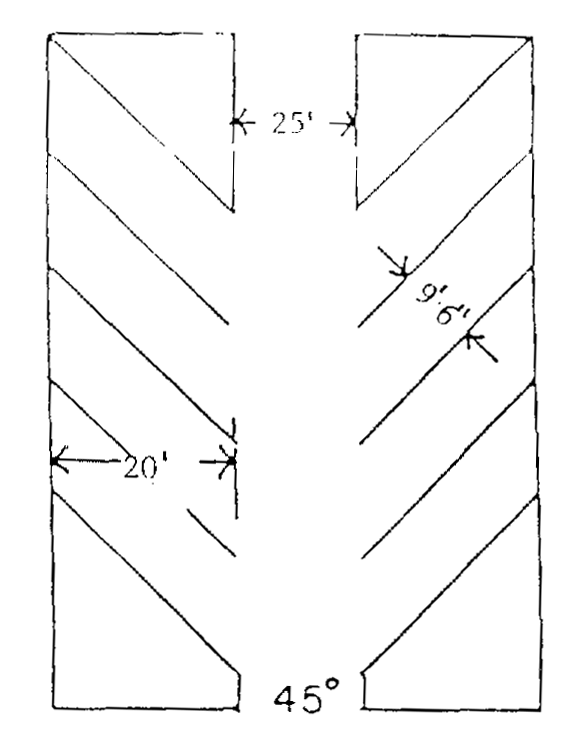
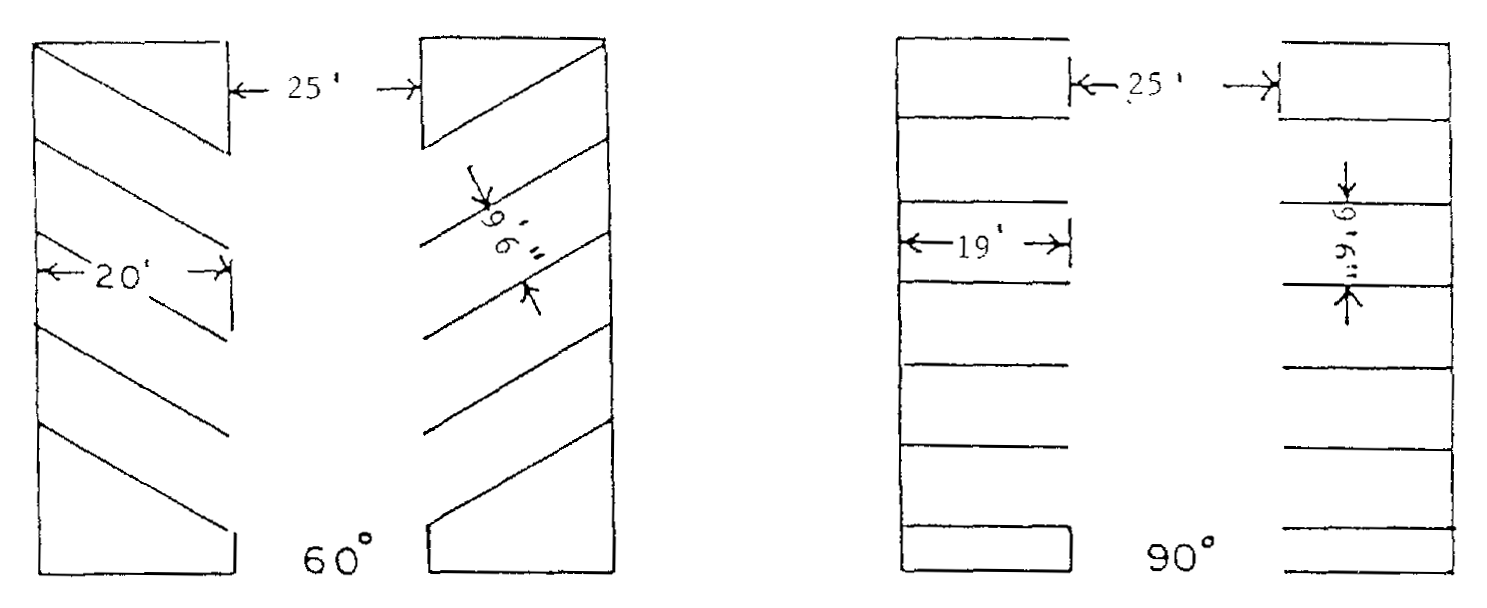
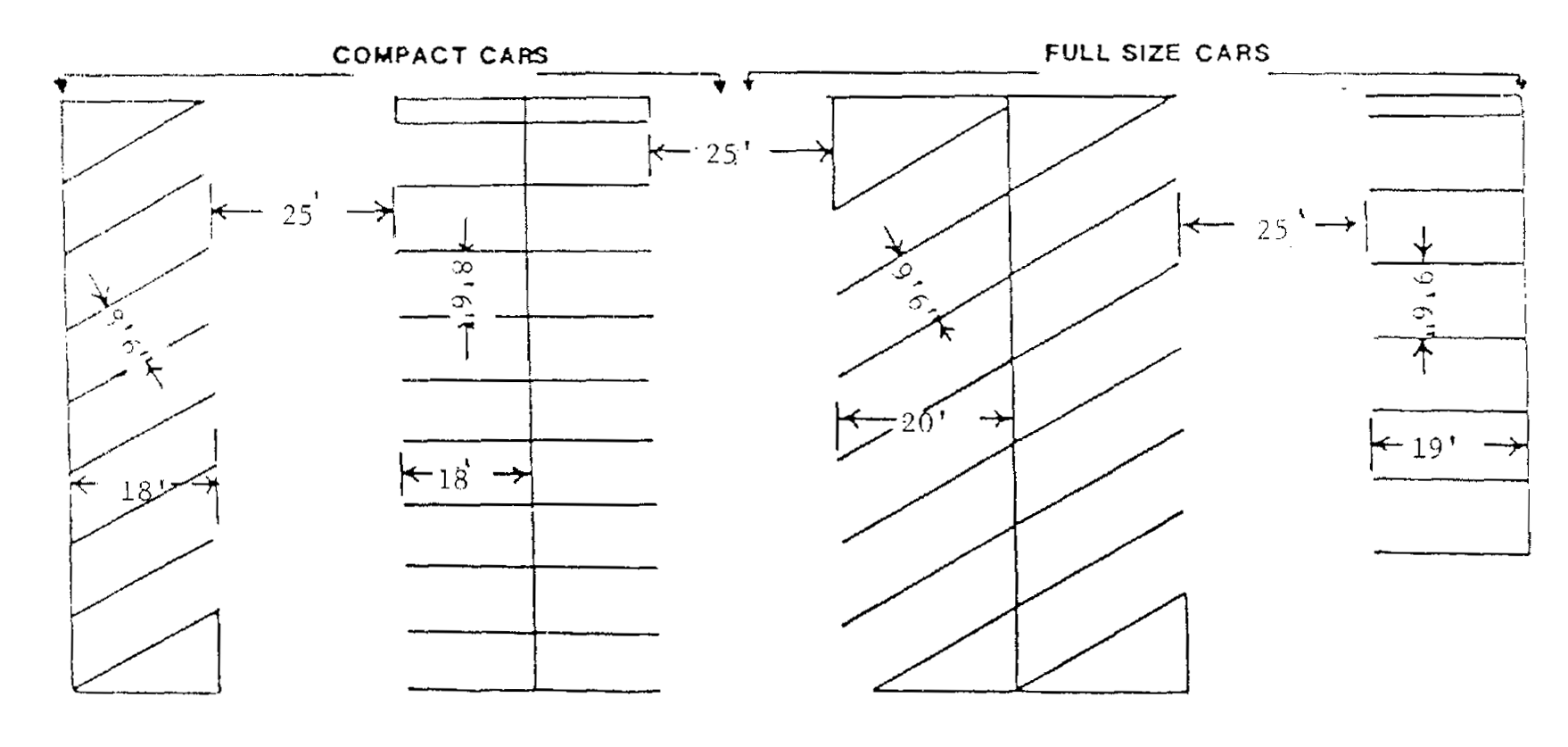
Diagram. The diagrams in Figure 1 illustrate typical parking stall layout for full-sized and compact cars in accordance with the above standards.
(e)
Site plan standards.
(1)
Access. Each required off-street parking lot shall have adequate access to a public street or other thoroughfare. Alleys, where they are utilized, shall only be used as secondary means of access to a lot or parcel.
(2)
Acceleration/deceleration lanes. In all districts, any use providing access to an arterial street (existing or planned), collector street or frontage road on I-25 may be required to provide acceleration and/or deceleration lanes.
(3)
Grading. All off-street parking areas shall be properly graded. The Town Engineer must approve the drainage and stormwater detention design.
(4)
Surfacing. Each off-street parking area which is accessory to any principal use, other than a single-family dwelling, located on a lot in excess of 10,000 square feet in size shall be surfaced with bituminous concrete, Portland cement, concrete or similar material approved by the Town Engineer.
(5)
Marking of parking spaces.
a.
General. Parking spaces shall be marked and maintained on the pavement, and any other directional markings/signs shall be installed and maintained as required by the approved parking plan.
b.
One-way parking. Parking which is designed for one-way traffic should be clearly indicated as such by the use of a sign or arrow designating the direction of traffic flow and by the term "One-way."
c.
Compact car parking. Compact car parking areas or spaces shall be clearly labeled.
d.
Handicap parking. Each handicap parking space shall be marked with a freestanding sign using the standard uniform words and/or symbols that signify the space as parking for the handicapped only. In addition, the handicapped symbol shall be painted on the pavement.
(6)
Landscaping islands. See landscaping regulations, Subsection 16-6-70(f) of this Chapter.
(7)
Lighting. All lighting used to illuminate off-street parking areas shall be arranged as to reflect light glare away from adjoining properties and adjacent streets. Lighting should not exceed ten foot-candles in illumination by use of efficient energy-conserving light fixtures.
Figure 1
TYPICAL PARKING STALL LAYOUT
SAMPLE PARKING LOT CONFIGURATION
FOR COMBINATION FULL SIZE & COMPACT CARS
(Ord. No. 3.43, Art. II, § 14.4, 6-3-1987; Ord. No. 3.118, § 1, 7-21-2016)
Sec. 16-11-50. - Schedule of required off-street parking.
(a)
General.
(1)
Uses not specified. In the case of a use not specifically mentioned, the requirements for off-street parking facilities for a similar use shall apply as determined by the Town Planner. His or her decision may be appealed to the Board of Adjustment. Adequately sized off-street parking shall be provided for all recreational vehicles and campers.
(2)
Fractions. When units of measurements determining the number of required parking spaces result in the requirement of a fractional space, any fraction shall require one parking space.
(3)
Handicap parking. In all Multiple-Family, Commercial, Business and Industrial Districts, parking shall be provided for the handicapped at the minimum rate of one space per use or two percent of the total parking spaces required.
(4)
Nonresidential uses. Required off-street parking for nonresidential land use shall be based on the total floor area of all floors in the principal structure, excluding atriums, restrooms, mechanical areas, stairwells and elevator shafts.
(5)
Compact car parking. In parking lots with 20 spaces or more, a maximum of 30 percent of the required parking spaces may be designated for compact cars.
(b)
Specific uses.
(1)
Amusement and recreational enterprises, such as swimming pools, skating rinks, health clubs, spas, etc.: one per each two persons based on designed use or occupant capacity plus one per each spectator seat.
(2)
Beauty parlor and barber shop: four per operator plus one per employee on maximum shift.
(3)
Boarding room house: one per bedroom plus one per employee on maximum shift.
(4)
Bowling alley: four per lane plus one per each two employees.
(5)
Churches, auditoriums and other places of public assembly: one off-street parking space per three fixed seats, or one off-street parking space per 150 square feet of gross floor area, whichever is greater.
(6)
Drive-in restaurant (excluding drive-up windows): one per 100 square feet of floor area.
(7)
Drive-up windows (food, liquor, bank, etc.): six stacking spaces per window plus standard parking as required for inside uses.
(8)
Eating and drinking establishments or similar places of assembly: one per each three seats plus one per each employee on maximum shift.
(9)
Fleet or business-related parking: one space for each company-related vehicle in addition to employee and customer parking.
(10)
Fraternity and sorority houses: three per bedroom plus one per employee on maximum shift.
(11)
Funeral home or mortuary: one space per 100 feet of floor area open for public use.
(12)
Golf courses (nine-hole or 18-hole): three per hole plus one per employee on maximum shift.
(13)
Hospitals and similar health facilities: one off-street parking space per two employees plus four additional spaces for each 25 beds.
(14)
Hotels and motels: one per guest room plus parking for associated uses, such as restaurants or lounges, based on their requirements, or plus one space per employee on maximum shift, whichever is greater.
(15)
Industrial uses (manufacturing, processing, assembly): one space per 300 square feet of floor area or one space per employee on maximum shift, whichever is greater.
(16)
Industrial uses (laboratory): one space per 300 square feet of floor area or one space per employee on maximum shift, whichever is greater.
(17)
Libraries, museums, gallery: one per each 300 square feet of floor area.
(18)
Lumberyards: one per 200 square feet of floor area in main sales building.
(19)
Major facilities of a public utility: parking requirements shall be determined through the use by special review procedure.
(20)
Miniature golf, driving ranges, skeet or archery ranges: one per hole or platform plus one per employee on maximum shift.
(21)
Mobile home parks: two off-street parking spaces for each mobile home in a mobile home park plus one guest parking space per four dwelling units.
(22)
Motor fueling stations, repair garages, tire store, car wash, etc.: one per employee on maximum shift plus two per bay or stall.
(23)
Multiple-family elderly housing, elderly group home exclusively devoted for persons 60 or older: one space per one-bedroom unit, one and one-quarter spaces per two or more bedrooms.
(24)
Multiple-family residential (duplex and larger): one and one-half spaces per one-bedroom unit, two spaces for two- and three-bedroom units, two and one-half spaces for four-bedroom units.
(25)
Nursing homes, sanitariums and similar establishments: one off-street parking space per two employees plus one off-street parking space per five beds.
(26)
Post office and public buildings: one space per 300 square feet of floor area plus one space for each agency-owned vehicle.
(27)
Office uses: one off-street parking space per 300 square feet of gross floor area.
(28)
Preschool, daycare, nursery: one space per each faculty or staff member plus one spacer per each five students or children.
(29)
Private education institutions:
a.
Elementary schools: one space per each faculty or staff member plus one additional space for each ten faculty or staff members.
b.
Junior high schools: one space per each ten students or one space per each five seats in auditorium or main assembly area, whichever is greater.
c.
Senior high schools: one space per each faculty or staff plus one space per each ten students, or one space per each five seats in an auditorium or main assembly area, whichever is greater.
d.
Colleges, universities, vocational schools: one space per each faculty or staff plus one space per each 100 square feet of classroom area.
(30)
Professional offices (e.g., medical, dental, veterinary offices and clinics, radio and TV studios): one per 250 square feet of floor area.
(31)
Residential group homes for youth (18 years and younger): two per home with street parking, four per home without street parking plus one per each eight beds.
(32)
Retail or wholesale (principally of large items, such as furniture, large appliances, floor coverings, etc.): one per 300 square feet of floor area.
(33)
Sale or rental of new and used cars, mobile homes, portable buildings, recreational vehicles, campers and boats: one per 1,000 square feet of lot area plus one per employee on maximum shift.
(34)
Service and retail establishments: one per 200 square feet of floor area.
(35)
Single-family detached: four spaces per dwelling unit with street parking.
(36)
Tennis and racquetball courts or other court games: two per court plus one per employee on maximum shift.
(37)
Theaters: one per each three seats plus one per employee on maximum shift.
(38)
Unified shopping centers (100,000 square feet or larger): one per each 250 square feet of floor area.
(39)
Warehousing (including mini-storage facilities): one space per 1,000 square feet of floor area plus one per 400 square feet of retail, wholesale or office area.
(b)
Definitions. As used in this Article, the words contained herein are defined as follows:
Seat means, in places of public assembly in which patrons or spectators occupy benches, pews or other seating facilities, each 20 inches of seating facilities shall be counted as one seat for the purpose of determining requirements for off-street parking facilities under this Article.
Unified shopping center means a principally retail facility which may also include service and office type uses wherein a single main structure or several freestanding structures are so related by function, design and ownership or common control elements that the entire development functions as a unit.
(Ord. No. 3.43, Art. II, § 14.5, 6-3-1987; Ord. No. 3.118, § 1, 7-21-2016)

