
Larned City Zoning Code
ARTICLE 12
- RULES AND DEFINITIONS
Sec. 12.10. - Rules and construction and interpretation.
12.11.
Rules.
1.
In the construction of these regulations, the provisions and rules of this section shall be preserved and applied, except when the context clearly requires otherwise:
a.
Words used in the present tense shall include the future.
b.
Words in the singular number include the plural number, and words in the plural number include the singular number.
c.
The phrase "used for" shall include the phrases "arranged for," "designed for," "intended for," "maintained for," and "occupied for."
d.
The word "shall" is mandatory.
e.
The word "may" is permissive.
f.
The word "person" includes individuals, firms, corporations, associations, governmental bodies and agencies, and all other legal entities.
g.
The word "board" means the board of zoning appeals.
h.
Unless otherwise specified, all distances shall be measured horizontally.
i.
The word "city" means City of Larned, Kansas.
j.
The abbreviation "N/A" means not applicable.
2.
Any word or phrase which is defined in this article or elsewhere in these regulations shall have the meaning as so defined whenever the word or phrase is used in these regulations, unless such definition is expressly limited in its meaning or scope.
12.12.
Interpretation.
1.
Minimum requirements. In their interpretation and application, the provision of these regulations shall be held to be the minimum requirements for the promotion of the public health, safety, morals and welfare.
2.
Overlapping or contradictory regulations. Where the conditions imposed by any provision of these regulations upon the use of land or structures are either more restrictive or less restrictive than comparable conditions imposed by any other law, ordinance, resolution, rule or regulations of any kind, the regulations which are more restrictive shall govern.
3.
Private agreements. These regulations are not intended to abrogate, annul or otherwise interfere with any easement, covenant or any other private agreement of legal relationship; provided, however, that where the provisions of these regulations are more restrictive (or impose higher standards or requirements) than such easements, covenants or other private agreements or legal relationships, the provisions of these regulations shall govern.
4.
Unlawful uses. No structure or use which was not lawfully existing at the time of the adoption of these regulations shall become or be made lawful solely by reason of the adoption of these regulations; and to the extent that, and in any respect that, said unlawful structure or use is in conflict with the requirements of these regulations, said structure or use remains unlawful hereunder.
(Ord. No. 1088, exh. A(12.10—12.12), 10-4-1982)
Sec. 12.20. - Separability.
It is hereby declared to be the intention of the city that the several provisions of these regulations are separable, in accordance with the following rules:
1.
If any court of competent jurisdiction shall adjudge any provision of these regulations to be invalid, such judgment shall not affect any other provisions of these regulations.
2.
If any court of competent jurisdiction shall adjudge invalid the application of any provision of these regulations to a particular property or structure, such judgment shall not affect the application of said provisions to any other property or structure.
(Ord. No. 1088, exh. A(12.20), 10-4-1982)
Sec. 12.30. - Definitions.
For the purpose of this zoning regulation, certain terms or words used herein shall be interpreted or defined as follows, unless the context clearly indicates otherwise:
1.
Accessory building. A subordinate building which serves a function customarily incidental to that of the main building. Customary accessory building includes garages, carports, and small storage sheds. Accessory buildings shall also include satellite antennas for the purpose of determining setback requirements; a satellite antenna being defined as a structure or article of equipment designed for the reception of radio or television signals and measuring more than 36 inches in diameter or width.
2.
Accessory use. A subordinate use which serves an incidental function to that of the main use of the premises. Customary accessory uses include tennis courts, swimming pools, air conditioners, barbecue ovens, fireplaces, and wind-power generating systems.
3.
Agriculture use. The use of a tract of land of not less than five acres for the growing of crops, pasturage, nursery, or the raising of poultry, including the structures necessary for carrying out farming operations and the residence or residences of those owning or operating the premises, a member of the family thereof, or persons employed thereon, and the family thereof, but such use shall not include feedlots as defined by state statute.
4.
Alley. A dedicated public right-of-way, other than a street, which provides only secondary means of access to abutting property, the right-of-way of which is 20 feet or less in width.
5.
Alteration. Alteration, as applied to a building or structure, is a change or rearrangement in the structural parts of an existing building or structure. Enlargement, whether by extending a side, increasing in height, or the moving from one location or position to another, shall be considered as an alteration.
6.
Basement. That portion of a building having more than one-half of its height below grade.
7.
Bed and breakfast. A family home, occupied as a permanent dwelling by the proprietor, in which lodging and meals are provided for time-limited durations to not more than four groups of patrons in a 24-hour period.
8.
Board of zoning appeals. The board which has been created by the governing body having jurisdiction and which has the statutory authority to hear and determine appeals, conditional uses and variances to the zoning regulations.
9.
Building. Any structure designed or intended for the enclosure, shelter or protection of persons, animals or property.
10.
Building height. The vertical dimension measured form the average elevation of the finished lot grade at the front of the building to the highest point of ceiling of the top story in the case of a flat roof; to the deck line of a mansard roof; and to the average height between the plate and ridge of a gable, hip or gambrel roof.
11.
Common open space. An area of land or water or combination thereof planned for passive or active recreation, which does not include areas utilized for streets, alleys, driveways or private roads, off-street parking or loading areas. However, the area of recreational activities such as swimming pools, tennis courts, shuffleboard courts, etc., may be included as common open space.
12.
Condominium. A single dwelling unit under individual ownership within a multiple dwelling unit structure. A multiple-family structure with two condominiums shall be considered a two-family dwelling and a condominium with more than two condominiums shall be considered a multiple-family dwelling.
13.
Disability. A physical or mental impairment which substantially limits one or more of such person's major life activities, a record of having such an impairment, or being regarded as having such an impairment. Such term does not include current, illegal use of or addition to a controlled substance, as defined in Section 102 of the controlled Substance Act (21 USC 802); or any person assigned to a community corrections program or diversion program, on parole from a correctional institution or on probation for a felony offense, or in a state mental institution following a finding of not guilty by reason of insanity.
14.
District. A section or sections of the zoning area for which these regulations governing the use of land, the height of buildings, the size of yards and the intensity of use are uniform.
15.
Day care center. A building or place where care, supervision, custody or control is provided for more than ten unrelated children or adults for a period not to exceed 18 hours in a residential district. Day care centers may be permitted to operate for a 24-hour period in commercial districts with more than ten children.
16.
Dog. Any canine specie over 12 months of age.
17.
Dwelling unit. An enclosure containing sleeping, kitchen and bathroom facilities designed for and used or held ready for use as a permanent residence by one family.
18.
Dwelling, single-family. A residential building having accommodations for and occupied exclusively by one family.
19.
Dwelling, single-family attached. A portion of a residential building having accommodations for and occupied exclusively by one family, and which is located on a separate lot of record apart from the remaining portions of the building.
20.
Dwelling, two-family. A residential building having accommodations for and occupied exclusively by two families, independently.
21.
Dwelling, multiple. A residential building having accommodations for and occupied exclusively by more than two families, independently.
22.
Dwelling for the elderly and/or handicapped. A two-family or multiple-family residential building having accommodations for and occupied exclusively by elderly or handicapped residents and necessary maintenance personnel. Elderly residents are those people who are at least 62 years of age. Handicapped persons are those people having an impairment which is expected to be of long, continuous and indefinite duration, is a substantial limitation to their ability to live independently, and is of a nature that such ability could be improved by more suitable housing.
23.
Earth-sheltered residence. A residence designed as a complete structure below or partially below ground level, whose perimeter walls comply with the yard requirements of the district in which it is located.
24.
Family. One or more persons related by blood, marriage, or adoption, living together as a single housekeeping unit; or a group of not more than four unrelated persons living together as a single housekeeping unit; plus in either case, usual domestic servants. A family shall under no circumstances be construed as a boarding house, fraternity, or sorority house, club, lodging house, hotel, motel or commune.
25.
Family day care home. A residence in which care, supervision, custody or control is provided for ten or less unrelated children or adults for any part of a 24-hour day up to 18 hours. Babysitting service for six or less infants shall be considered a day care nursery.
26.
Floor area.
a.
For computing off-street parking requirements: Shall mean the gross floor area of the building measured from the exterior faces of the exterior walls or from the centerline of walls separating two buildings and shall include the following areas:
1.
The basement floor area.
2.
The area of each floor of the structure.
3.
The attic space having headroom of seven feet or more.
27.
Foster home. A residence or building in which more than 12-hour care is provided to no more than five children, two or more of which are unrelated to the foster parents. Foster homes shall be permitted in all residential structures, the same as would a family.
28.
Frontage. The length of the property abutting on one side of a street measured along the dividing line between the property and the street.
29.
Gasoline service station. A service station shall consist of a building or group of buildings and surfaced area where automotive vehicles may be refueled and serviced. Self-service pumps without buildings shall also be included. Such service shall not include tire recapping, body repairs, or major overhaul.
30.
Governing body. The city council of Larned, Kansas.
31.
Group care home. A residence or building in which 12- to 24-hour care is provided to more than five children or adults, any three of which are unrelated.
32.
Group home. Any dwelling occupied by not more than ten persons, including eight or fewer persons with a disability, as defined in this ordinance, who need not be related by blood or marriage and not to exceed two staff residents who need not be related by blood or marriage to each other or to the residents of the home, and which is licensed by the department of social and rehabilitation services or the department of health and environment.
33.
Home occupation. A business, profession, service or trade conducted for gain or support entirely within a residential building.
34.
Hotel. A building or portion thereof, or a group of buildings, used as a transient abiding place which may or may not service meals and whether such establishments are designated as a hotel, inn, automobile court, motel, motor inn, motor lodge, motor court, tourist cabin, tourist court, or other similar designation.
35.
Kennel, boarding. Any place, area, building, or structure where dogs (including those under one year of age) are boarded, housed, cared for, fed, or trained by other than the owner.
36.
Kennel, breeding. Any place, area, building, or structure where more than four dogs are kept for purposes of breeding, raising, or as pets.
37.
Lot, corner. A lot abutting upon two or more streets at their intersection.
38.
Lot, depth of. The mean horizontal distance between the front and the rear lot lines.
39.
Lot, double frontage. A lot having a frontage on two non-intersecting streets, as distinguished from corner lot.
40.
Lot of record. A lot which is a part of a subdivision, the plat of which has been recorded in the office of the register of deeds; or a lot described by metes and bounds, the description of which has been recorded in the office of the register of deeds prior to the adoption of this regulation.
41.
Lot, zoning. A parcel or tract of land used, developed, or built upon as a unit under single ownership or control. Said parcel or tract may consist of one or more lots of record, one or more portions of a lot or lots of record, or any combination thereof.
42.
Manufactured house. A dwelling unit substantially assembled in an off-site manufacturing facility for installation or assembly at the dwelling site, bearing a label certifying it was built in compliance with National Manufactured Home Construction and Safety Standards (24 CFR 3280 et seq.) promulgated by the U.S. Department of Housing and Urban Development.
(a)
Residential design manufactured house: A manufactured house constructed within the last 30 years, that meets or exceeds the construction standards promulgated by the U.S. Department of Housing and Urban Development in effect at the time of construction and compiles with the following additional criteria.
(1)
The manufactured house has minimum dimensions of 24 feet in width and 40 feet in length.
(2)
The roof has a pitch with minimum vertical rise of 2.5 feet for each 12 feet of horizontal run, and is covered with material that is residential in appearance, including but not limited to approved wood, asphalt composition shingles or fiberglass, but excluding conjugated aluminum, corrugated fiberglass or mental.
(3)
Exterior aiding must be residential in appearance, including, but not limited to, clapboard, simulated clapboard such as conventional vinyl or metal siding, wood shingles, shakes, or similar material but excluding smooth, ribbed or corrugated metal or plastic panels.
(4)
A continuous, permanent concrete or masonry foundation wall, unpierced except for required ventilation and access, installed under the perimeter of the manufactured home in accordance with standards set by the city building code, which home is set up in accordance with the recommended installation procedures of the manufacturer and standards set by the National Conference of States on Building Codes and Standards published in "Manufacturer Home installations, 1987" (NCS BCS A225.1).
(5)
Stairs, porches, entrance platforms, ramps and other means of entrance and exit shall be installed or constructed in accordance with standards set by the city building code and attached firmly to the primary structure and anchored securely to the ground.
(6)
The moving hitch, wheels, skies, and transporting lights have been removed.
(7)
It is the purpose of these criteria to ensure a manufactured house, when installed, shall have substantially the appearance of an on-site, convention by built, single-family dwelling in this city.
(b)
Manufactured house, Class A: A manufactured house of less than 24 feet in width constructed within the last 30 years, that meets or exceeds the construction standards promulgated by the U.S. Department of Housing and Urban Development built on a permanent chassis and designed to be used as a dwelling with or without permanent foundation.
(c)
Manufactured house, Class B: A manufactured house constructed within the last 30 years that does not meet the criteria of Class A.
(d)
Modular home, component home, prefabricated home: A transportable structure not built on a permanent chassis but designed to be placed on a permanent foundation, and not subject to the construction standards promulgated by the U.S. Department of Housing and Urban Development, but constructed in accordance with the city building codes and complies with the criteria of subsections (a) (1), (2), (3), and (4) above.
(40)
Manufactured housing. Manufactured housing means all forms of dwelling structures built in whole or in part in a factory, including mobile homes and modular homes, defined as follows:
a)
Mobile home. Mobile home means a factory built movable or portable dwelling more than eight feet in width and more than 36 feet in length, equipped with the necessary service connections and made so as to be readily movable as a unit or units on its or their own running gear and designed to be used as a dwelling unit or units without permanent foundation. Such structures manufactured within the last 30 years, which can meet local building codes and are certified by the manufacturer to be in compliance with the Federal National Manufactured Housing Construction and Safety Standards Act (HUD code) shall be considered modular homes when placed on a permanent foundation and their running gear removed.
b)
Modular home. Modular home means a structure which can meet local building codes, built in whole or in part in a factory and shipped on or by truck or other conveyance to a site to be placed on a permanent foundation and used as a dwelling, including factory manufactured dwelling units certified to have been manufactured in compliance with the Federal National Manufactured Housing Construction and Safety Standards Act (HUD code) and from which unit the running gear has been removed and which unit is erected on a permanent foundation.
43.
Medical clinic. Any building designed for use by one or more persons lawfully engaged in the diagnosis, care and treatment of physical or mental diseases or ailments of human beings; including, but not limited to, doctors of medicine, dentists, chiropractors, osteopaths, optometrists, podiatrists, and in which no patients are lodged overnight, but which may include an apothecary.
44.
Mobile home. Mobile home means a factory-built structure or structures more than eight feet in width and more than 36 feet in length, equipped with the necessary service connections and made so as to be readily movable as a unit or units on its or their own running gear and designed to be used as a dwelling unit or units without a permanent foundation. The phrase "without a permanent foundation" indicates that the support system is constructed with the intent that the mobile home may be moved from time to time at the convenience of the owner. A modular home which can meet local building codes shall not be considered a mobile home.
45.
Mobile home park. Any area, piece, parcel, tract or plot or ground equipped as required for support of mobile homes and used or intended to be used by one or more occupied mobile homes, but under no circumstances shall the mobile home spaces be sold or offered for sale individually. The term "mobile home park" does not include sales lots on which unoccupied mobile homes, whether new or used, are parked for the purposes of storage, inspection, or sale.
46.
Mobile home space. A plot of ground within a mobile home park which can accommodate one mobile home and which provides the necessary utility services for water, sewerage, and electricity.
47.
Nursing homes or convalescent homes. An institution or agency licensed by the State for the reception, board, care, or treatment of three or more unrelated individuals, but not including facilities for the care and treatment of mental illness, alcoholism, or narcotics addition.
48.
Planning commission. The Larned City Planning Commission.
49.
Private club. A non-profit association of persons who are bona fide members paying annual dues, which owns, hires, or leases a building or premises, or portion thereof, the use of such building or premises being restricted to members and their guests. The affairs and management of such private club are conducted by a board of directors, executive committee, or similar body chosen by the members at their annual meeting. It shall be permissible to serve goods and meals on such premises providing adequate dining room space and kitchen facilities are available. The sale of alcoholic beverages to members and their guests shall be allowed, provided it is secondary and incidental to the promotion of some other common objective by the organization, and further provided that such sale of alcoholic beverages is in compliance with the applicable federal, state and municipal laws.
50.
Restaurant. A public eating establishment at which the primary function is the preparation and serving of food.
51.
Restaurant, drive-in. An establishment whose primary purpose is the sale, dispensing or service of food, refreshments or beverage in automobiles, including those establishments where customers may serve themselves, except that this shall not be construed as to include what is commonly called a cafeteria.
52.
Salvage yard. A place where junk, waste, discarded or salvaged materials are bought, sold, exchanged, stored, baled, packed, disassembled, handled or prepared for recycling, which shall include auto wrecking yards, but shall not include retail secondhand furniture stores or the purchase and storage of used or salvaged materials as a part of a manufacturing operation.
53.
Sign. Any device which shall display or include any letter, word, model, banner, flag, pennant, insignia, device, or representation used as, or which is in the nature of, an advertisement or announcement which directs attention to an object, product, place, activity, person, institution, organization, or business, but shall not include any display of official notice or official flag.
54.
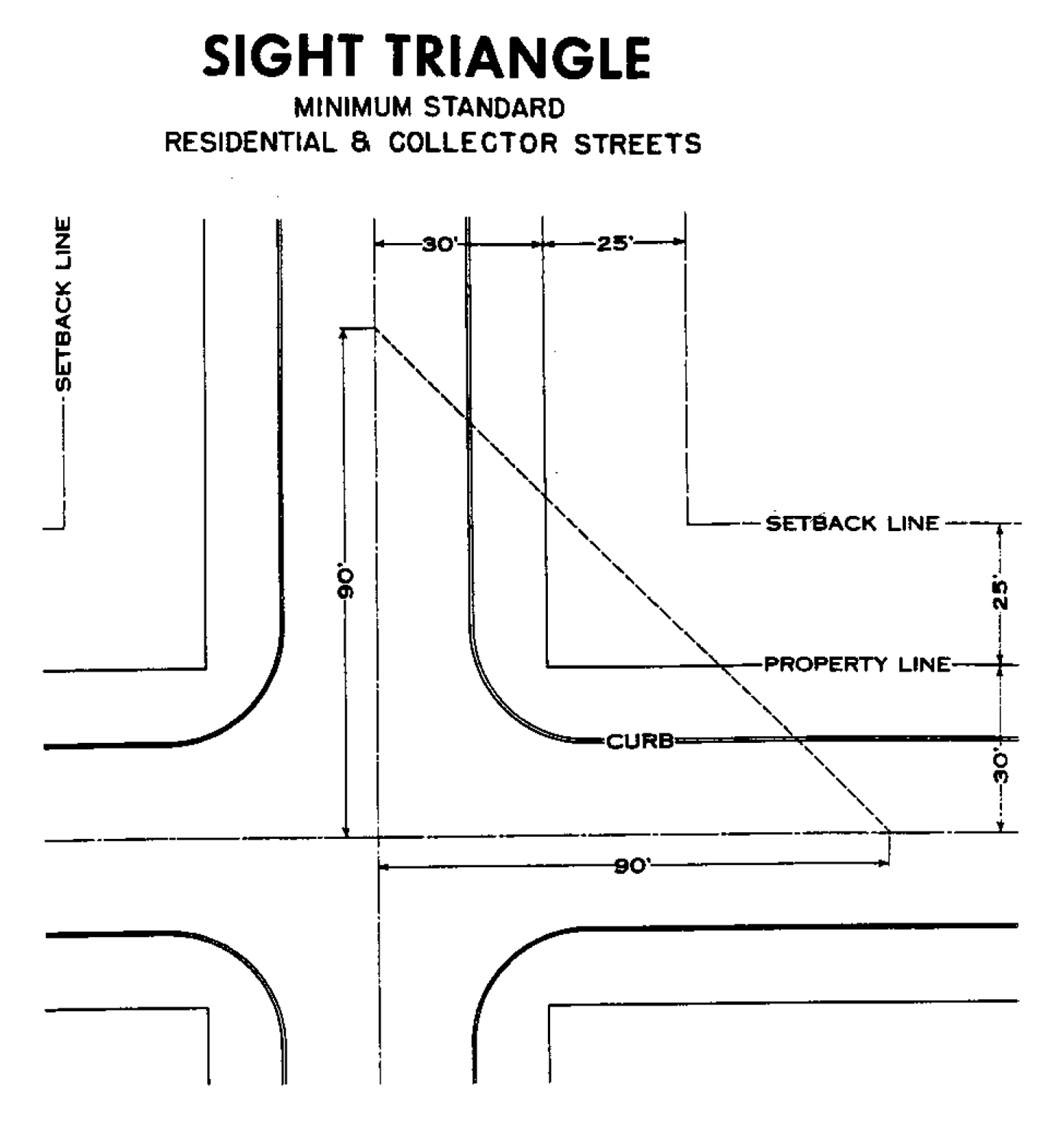
Sight triangle. An area at a street intersection in which nothing shall be erected, placed, planted, or allowed to grow in such a manner as to materially impede vision between a height of 2½ feet and eight feet above the grades of the bottom of the curb of the intersecting streets, measured from the point of intersection of the centerline of the streets, 90 feet in each direction along the centerline of the streets. At the intersection of a major or arterial street, the 90-foot distance shall be increased to 120 feet.
54(a)
Small group catering. A family home occupied as a permanent dwelling by the owner in which the owner provides catering services for small groups.
55.
Street. A right-of-way, dedicated to the public use, which provides vehicular and pedestrian access to adjacent properties.
56.
Street line. A dividing line between a lot, tract, or parcel of land and the contiguous street.
57.
Street network.
a.
Expressway: A street which provides fast and efficient movement of large volumes of traffic between areas and does not provide a land service function.
b.
Arterial: A street which provides for through traffic movement between and around areas with direct access to abutting property, subject to necessary control of entrances, exits, and curb cuts.
c.
Collector: A street which provides for traffic movement between arterials and local streets, with direct access to abutting property.
d.
Local: A street which provides direct access to abutting land and local traffic movement whether in business, industrial, or residential areas.
58.
Structure. Anything constructed or erected, the use of which requires permanent location on the ground or attachment to something having a permanent location on the ground, but not including fences or public items such as utility poles, street light fixtures, and street signs.
59.
Structural alterations. Any change in the supporting members of a building, such as bearing walls or partitions, columns, beams, or girders, or any complete rebuilding of the roof or the exterior walls. For the purpose of this regulation, the following shall not be considered a structural alteration:
a.
Attachment of a new front where structural supports are not changed.
b.
Addition of fire escapes where structural supports are not changes.
c.
New windows where lintels and support walls are not materially changed.
d.
Repair or replacement of non-structural members.
60.
Tavern. An establishment in which the primary function is the public sale and serving of alcoholic and cereal malt beverages for consumption on the premises, including establishments commonly known as key clubs, which are open, and in which alcoholic and cereal malt beverages are served only to members and their guests.
61.
Yard. A space on the same lot with a main building, open, unoccupied and unobstructed by buildings or structures from the ground upward.
62.
Yard, front. A yard extending across the full width of the lot, the depth of which is the least distance between the street right-of-way and the building setback line.
63.
Yard, rear. A yard extending across the full width of the lot, the depth of which is the least distance between the rear lot line and the rear setback line.
64.
Yard, side. A yard extending from the front yard, or front lot line where no front yard is required, to the rear yard.
65.
Zone or district. A section of the zoning area for which uniform regulations governing the use, height, area, size, and intensity of use of buildings, land, and open space are herein established.
66.
Zoning administrator. The person or persons authorized and empowered by the governing body having jurisdiction to administer the requirements of these zoning regulations.
67.
Zoning area. The area to be zoned as set out on the official Zoning Map filed of record.
68.
Zoning regulations. The term "zoning regulations" or "this or these regulations" shall mean the requirements stipulated in the regulations in this Part II.
(Ord. No. 1088, exh. A(12.30), 10-4-1982; Ord. No. 1125, § 3, 10-17-1983; Ord. No. 1185, § 2, 2-2-1987; Ord. No. 1237, §§ 3, 4, 5-4-1992; Ord. No. 1294, § 5, 3-4-1996; Ord. No. 1330, §§ 9, 10, 3-1-1999; Ord. No. 1519, § 6, 10-25-2010; Ord. No. 1643, § 1, 10-6-2025)

