
Lawrenceville City Zoning Code
ARTICLE 7
- SIGNS
Sec. 700. - Purpose and Intent.
This Article is adopted to serve substantial governmental interests of correcting and avoiding multiple problems that would occur without the regulation of signs. The regulations contained herein are no more extensive than necessary to serve the substantial governmental interests defined in this Article. It is not the intent of this Article to regulate the content of signs, but only their composition, type, location, distance from the right-of-way, height, size, illumination, and in some cases, the duration they may be displayed, or other non-content based restrictions implied in this Article. It is not the intent of this Article to foreclose important and distinct mediums of expression for political, religious, or personal messages on any sign permitted to be erected by this Article. These regulations shall not be construed as limiting the message content of any sign.
It is hereby declared that the aesthetic and safety interests of the City of Lawrenceville are reasonably promoted by the provisions of this Article.
Accordingly, it is the intent and purpose of this article to provide for the orderly and harmonious display of signs within the community; to avoid the erection of displays which produce deleterious and injurious effects to adjacent properties and to the natural-beauty of the environment; to provide for: the safety of the traveling public by limiting distractions, hazards, and obstructions; to minimize visual clutter and encourage a positive visual environment within the City; and to promote the mental health, physical health, safety, and welfare of the public.
The regulations and requirements set forth herein shall be the minimum requirements to promote the health, safety, morals, and general welfare of the public, and to protect the character of the City of Lawrenceville.
The purpose and intent of these regulations is to create the legal framework for a comprehensive and balanced system of signage to improve and enhance the aesthetic environment of the City and to avoid the visual clutter that is potentially harmful to traffic and to the appearance of the community. The City Council of the City of Lawrenceville finds that the regulations set forth herein will improve the visual appearance of the City by limiting the number and size of signs within the corporate limits, consistent with constitutional guarantees, while continuing to provide an effective means of communication.
** All figures in this article are examples**
Sec. 701. - Sign Regulations.
All signs must be designed and sited according to the regulations outlined in this section. Applicants proposing signs that require a Special Use Permit or do not conform to these regulations may apply for a Special Use Permit by filing it with a standard sign permit application with the Planning and Development Department, processed and considered in accordance with the procedures required in Article 9, unless otherwise specified.
A.
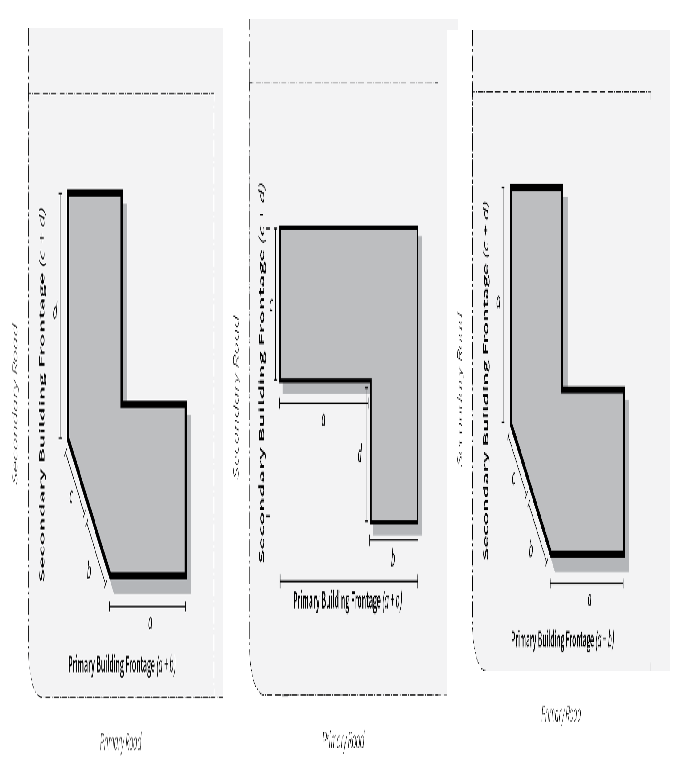
See the illustrations below for examples of building frontages for use in allowable sign area calculations. All definitions may be found in Article 10, Definitions.
B.
Illumination of Signs.
1.
No sign shall give off light which glares, blinds or has any such adverse effect on traffic or adjacent properties. The light from an illuminated sign shall be established in such a way that no direct light is cast upon adjacent properties or roadways.
2.
No sign shall have blinking, flashing, or fluctuating lights or other illuminating devices which have a changing light intensity, brightness or color.
3.
Exposed neon tubing and signs containing words or symbols shaped or formed directly from neon tubes, LED lighting, or similar illuminating devices are prohibited.
4.
Exposed or visible lighting strips mounted on a building or window frame is prohibited.
5.
Signs located within a residential district may only be indirectly illuminated.
Sec. 702. - Types of signs.
702.1
Billboard. A sign, larger than 200 square feet in area.

Permitted Sign Dimensions:
Maximum Height (including structure): 45 feet.
Minimum Setback from Right-of-Way: 25 feet.
Maximum Sign Display Size: 672 square feet—14 feet (H) x 48 feet (W).
Quantity Permitted: Special Use Permit required.
The standards for billboards shall also apply to digital billboards, electronic message centers (EMCs) billboards and multiple-display area billboards, unless otherwise provided in this Section;
A.
Special Use Permit Required. Permitted in an HSB, LM or HM zoning classification with the approval of a Special Use Permit.
B.
Restrictions.
1.
Georgia Highway 316/University Parkway.
a.
Billboards shall be strictly limited to parcels of land adjacent to Georgia Highway 316/University parkway and located between the intersection of Georgia Highway 316/University Parkway and Georgia Highway 20/124 and the intersection of Georgia Highway 316/University Parkway and Hi Hope Road;
b.
Billboards shall be strictly prohibited at any other location;
2.
Height.
a.
Billboards, including base and Sign Surface Display Area, shall not exceed an overall height of forty-five (45) feet, as measured from normal grade to the top of the highest attached component;
b.
The bottom of a Billboard Sign Surface Display Area shall be a minimum of thirty-one (31) feet above normal grade to the lowest attached component;
c.
Billboards below grade and adjacent to an elevated segment of Georgia Highway 316/University Parkway may be granted a variance to increase the overall height requirement to not more than forty-five (45) feet above the centerline elevation of Georgia Highway 316/University Parkway.
d.
Variance requests related to height of a billboard shall be limited to a particular hardship upon the owner relating specifically to the physical surroundings, shape, or topographical condition of the property. A height exceeding seventy-five (75) feet shall be prohibited.
3.
Maximum Sign Surface Display Area. The entire area within a continuous perimeter, enclosing the extreme limits of sign display, including any frame or border but excluding any supports. Curved, spherical, or any other shaped sign face shall be computed based on the actual Sign Surface Display Area. The copy of signs composed of individual letters, numerals, or other devices shall be the sum of the area of the smallest rectangle or other geometric figure encompassing each of said letters or devices as well as spaces between each letter, words, lines or device. The Sign Surface Display Area calculation for a double-faced sign shall be the area of one (1) only where the Sign Surface Display Areas are parallel or whether the interior angle formed by the Sign Surface Display Areas is sixty (60) degrees or less. The area of the larger Sign Surface Display Areas shall be computed in cases in which the two (2) sides do not coincide.
a.
Billboard Sign Surface Display Area shall be limited to a Maximum Display Area of 672 square feet per face or fourteen (14) feet in height and forty-eight (48) feet in width;
b.
Billboard Sign Surface Display Area shall be limited to one (1) display area facing in any one direction. Each sign structure shall have no more than one (1) EMC Sign Surface Display Area per direction with a maximum of three (3) Sign Surface Display Areas per structure;
c.
Any extension, structure or temporary cutout protruding beyond the Sign Surface Display Area of any billboard, excluding aprons, is specifically prohibited;
d.
A display area exceeding 672 square feet per face of a billboard shall be prohibited.
4.
Separation. Sign separation standards are not subject to variation.
a.
Billboards located along the same side of Georgia Highway 316/University Parkway between its intersection with Georgia Highway 20/124 and Hi Hope Road shall be separated a minimum distance of 1,000 feet.
b.
Billboards located on opposite sides of Georgia Highway 316/University Parkway between its intersection with Georgia Highway 20/124 and Hi Hope Road shall be separated a minimum distance of 600 feet.
c.
Billboards (base or sign) shall not be located within 1,500 feet of any property zoned RS-180, RS-150 or RS-60.
5.
Setbacks.
a.
Billboard base shall be setback a minimum of twenty-five (25) feet from any right-of-way, and no further than one-hundred (100) feet from the right-of-way of Georgia Highway 316/University Parkway. (See Article 7 Signs, Section 702, Subsection H. Fall Zone).
b.
Billboard Sign Surface Display Area shall be setback a minimum of ten (10) feet from the right-way. (See Article 7 Signs, Section 702, Subsection H. Fall Zone).
6.
Design Standards.
a.
Billboards shall be designed and constructed to an engineering standard capable of withstanding one-hundred twenty-five (125) mile per hour (mph) wind velocity.
b.
Billboards shall be freestanding and not supported by another structure (i.e. bridges, buildings, chimneys, dams, retaining walls, towers, etc.) or affixed, drawn or painted upon rocks, trees or other natural features.
c.
Billboard (base, display area, supports) shall be constructed from a metal material with no more than two (2) upright support poles. Wood materials shall be prohibited in the construction or design of a billboard.
d.
Billboard base and supports shall be uniformly painted or covered with other protected coatings. Color of base and supports shall be limited to black, dark brown or dark green.
e.
No portion of the supporting structure shall be visible above the top of the Sign Surface Display Area.
f.
A billboard may be constructed so as to provide back-to-back display areas facing opposite directions. (See Article 7 Signs, Section 702, Subsection 3. Maximum Sign Surface Display Area).
g.
Billboards shall not rotate or have any moving parts.
h.
No auditory message or mechanical sounds may be emitted from the sign.
i.
All illuminated billboards other than EMCs must use base mounted LED, florescent or mercury vapor lights and shall be activated by photocells. Any additional lights, including but not limited to, neon, animation or running lights is specifically prohibited by this Ordinance.
C.
EMC Design Standards and Restrictions. Billboard Sign Surface Display Areas may consist of an Electronic Message Center (EMC), which is a computer programmable sign capable of displaying multiple messages figures, images, pictures, symbols or words altered or rearranged on-site or remotely without altering the Sign Surface Display Area;
1.
EMCs shall not interfere with any public safety vehicle or traffic control device.
2.
EMCs shall have light sensors/monitors to control brightness as specified below for all times and all weather conditions; day, night, twilight, overcast skies and dark clouds. Excessive brightness is a distraction to vehicular traffic and as such is a hazard. Failure to control a sign's brightness will result in the sign being turned off until the brightness is within the standards.
3.
Upon the request of the Director of Planning and Development, the agent/applicant/owner of a EMC located within the city limits shall provide a certification of the light intensity indicating compliance with the minimum standards of this Section. If the owner of a sign fails to control brightness within these limits the sign permit will be revoked. Should a permit be revoked the sign must be turned off immediately and remain off unless and until the sign is re-permitted. Re-permitting requires the owner to reapply in accordance with the procedures in place at the time of the new permit application, including paying fees required for a new permit.
4.
EMC light levels shall not increase lighting or brightness levels by more than 0.30 foot-candles above ambient levels as measured using a standard foot-candle meter. The Billboard owner and installer shall provide a letter to the Planning and Development Department certifying that the light sensors are operational and in conformance with this standard.
5.
Text messages shall not scroll or flash. All Text messages shall be static for a minimum of 10 seconds.
6.
The display of video from an EMC is strictly prohibited regardless of applicant. Failure to abide by this ordinance will result in the revocation of an EMC permit.
7.
Types of screens permitted include Color and Monochrome in Light Emitting Diode (LED).
8.
For LED sign display areas no screen may have a density of less than 16 mm (Bulb Cluster Spacing on center).
9.
All EMCs shall have a switch or circuit breaker located on the property that allows electrical power to be turned off. The Owner of each EMC shall provide to the Planning and Development Department contact information for a twenty-four (24) hour, seven (7) day/week contact person who has the authority and is able to turn off the sign promptly if a malfunction occurs. If at any time more than forty (40%) percent of the digital display lights malfunction or are no longer working properly, the owner of said EMC shall turn off the electronic display until repairs are made.
10.
No EMC shall utilize, house or contain any interactive features or components or in any way function as an interactive sign.
11.
In considering the Special Use Permit, the City Council shall consider whether the applicant has agreed to publish public service announcements for the benefit of the citizens of the City of Lawrenceville. Public service announcements shall include, but are not limited to, dates and times of meetings of the Mayor and Council of the City, and the date, time, and place of City elections. These announcements would be published in accordance with an agreement consented to by the applicant and made a part of the Special Use Permit.
12.
All EMC Billboards shall meet all requirements of the Georgia Department of Transportation for construction, placement and operation of such billboards.
D.
Fall Zone. In order to construct a billboard under the standards of this provision, the applicant is required to provide a Fall Zone for the billboard. A Fall Zone shall be defined as an area surrounding the billboard equal to one hundred per cent (100%) of the height of the entire structure in every direction. The Fall Zone may not encroach on any property not owned by the applicant other than public right-of-way. Within the Fall Zone, no buildings or other structures may be constructed and if the Fall Zone encroaches on public right-of-way, the Fall Zone may not include any portion of the public right-of-way that includes improvements such as sidewalks and roadways and shall comply with all rules and regulations related to billboard fall zones that may exist for the government entity controlling the public right-of-way including approval of that government entity if required.
E.
Access. Each billboard site shall have a designated driveway access point which is shown on the site plan presented with the application. The applicant shall have a property interest specifically providing for ingress and egress to the site. The ingress and egress driveway shall be paved and two (2) additional paved parking spaces shall be provided for inspection, maintenance and supervision of the billboard.
F.
Abandoned or Discontinued Sign. Any Billboard or Sign adjacent to a state, county or municipal controlled route that has not contained a message for six (6) consecutive months and which has not had a message displayed within thirty (30) days after receipt of notice by certified mail from the Planning and Development Department shall be considered as an Abandoned or Discontinued Sign.
Billboards and relating base considered by the Planning and Development Department as Abandoned or Discontinued Sign shall be removed at the expense of the sign owner.
G.
Maintenance. Billboards, together with their supports, braces, guy-wires, and anchors shall be kept in good repair. All trash and unused materials shall be removed from the area by the sign owner.
H.
Issuance of the Special Use Permit.
1.
At the time of issuance of a special use permit for a billboard, the applicant shall complete a registration form that contains the name of the owner of the property, the tenants if the site is leased, the billboard company operating the billboard sign, addresses and telephone numbers of all interested parties, as well as, other contact information necessary to communicate with the billboard owners in the event of an emergency. The actual form of the registration shall be devised by the Director of the Planning and Development Department.
2.
Should the City have a reasonable belief that the safety of a billboard may be in question, the Director of Planning and Development may request submission of an inspection report. The inspection report shall certify and guarantee that the billboard is being maintained in a sound and safe condition. It will certify that all the welds and structural components of the sign have been physically inspected within the last two (2) months by a Professional Engineer Registered in the State of Georgia. The certification shall guarantee and certify that there is no structural weakness in the sign and that it will withstand the wind conditions established for a new permit in the existing billboard sign Ordinance. This certification shall be in a form acceptable to the Director of Planning and Development. The form shall contain a provision for the current operator to certify that it will hold harmless the City from any structural defects not disclosed in the report and will indemnify the City, its agents, employees and related parties from any liability resulting from a failure that occurs after the inspection. The certification required by this provision shall be executed by a certified professional engineer.
3.
When property is annexed into the City of Lawrenceville and the property to be annexed already has a billboard constructed on the property at the time the application is filed, the owner shall submit with the annexation petition a registration form pursuant to paragraph 702.1.H.2 above and an inspection report pursuant to paragraph 702.1.H.2 above before the annexation hearing. The Property shall not be annexed unless this inspection report shows the billboard meets all existing regulations and requirements of the City.
702.2
Electronic Message Center (EMC) Sign. A computer programmable sign capable of displaying figures, picture images, symbols or words that can be altered or rearranged on-site or by remote means without altering the face or surface of the sign. If any indoor EMC signs are visible from a public right-of-way, they will be subject to all conditions and standards of this ordinance.
Purpose and Intent; Findings Regarding Electronic Message Center (EMC) Signs
Unless restricted as required by this ordinance Electronic Message Center (EMC) signs, which allow operators to change the content from remote locations in a matter of seconds, have been shown to create possible threats to public safety. Such signs are erected for the purpose of trying to hold the attention of motorists by changing messages and pictures for short durations using a series of bright, colorful images produced mainly via LED (light-emitting diode) technologies. Brightly lit signs that change messages every few seconds compel motorists to notice them, and they lure the attention of motorists away from what is happening on the road and onto the sign. Such signs pose public safety threats because if they attract a motorist's attention, the motorist will look at the sign and not the road. Electronic Message Center (EMC) signs are also a threat to public safety because of their brightness, making them visible from great distances. Due to their nature of brightness and changing displays, Electronic Message Center (EMC) signs are more distracting than signs which do not vary the message. Some such signs could, if unregulated, have the appearance of large, plasma-screen televisions. An electronic LED display contains brightly-lit text and graphics which can be seen from hundreds of feet away, drawing the attention of everyone within view. Unless otherwise regulated, such displays can be extremely bright since they are designed to be visible in bright sunlight and at night. Furthermore, the human eye is drawn to them far more strongly than to traditional illuminated signs. Such electronic LED displays can be seen from as far away as six-tenths of a mile, making them distracting. It takes a minimum of six seconds to comprehend the message on an electronic sign, which is three times the safe period for driver distraction. For these reasons, it is the intent of the City Council to regulate Electronic Message Center (EMC) signs. The City Council relies on the following studies and findings, among others, as empirical and professional justification for imposing this regulation:
1.
Federal Highway Administration (FHWA). September 11, 2001. Research Review of Potential Safety Effects of Electronic Billboards on Driver Attention and Distraction.
2.
University of North Carolina Highway Safety Research Center. May 2001. The Role of Driver Distraction in Traffic Crashes.
3.
University of North Carolina Highway Safety Research Center. May 2003. Distractions in Everyday Driving.
4.
Pettit, M., Burnett, G., Stevens, A. 2005. "Defining Driver Distraction." Paper presented at World Congress on Intelligent Transport Systems, San Francisco, November 2005.
5.
Wallace, B. 2003. "Driver Distraction by Advertising: Genuine Risk or Urban Myth?" Proceedings of the Institution of Civil Engineers. Municipal Engineer 156 September 2003 Issue ME3, Pages 185-190.
6.
Scenic America. "Billboards in the Digital Age: Unsafe (and Unsightly) at any Speed. Scenic America Issue Alert 2 Electronic Signs.
A Wisconsin Department of Transportation study examined crash rates on 1-94 East and West adjacent to the Milwaukee County stadium, after a variable message sign that showed sports scores and ads had been installed and concluded that "it is obvious that the variable message sign has had an effect on traffic, most notably in the increase of the side swipe crash rate." An analysis of the 100-Car Naturalistic Driving Study, conducted by the National Highway Traffic Safety Administration, released in 2006, showed that taking one's eyes off the road for more than two seconds for any reason not directly related to driving (such as checking the rearview mirror) "significantly increased individual near-crash/crash risk." A 1998 FHWA memo noted that digital signs raise "significant highway safety questions because of the potential to be extremely bright, rapidly changing, and distracting to motorists." A 2001 FHWA review of billboard safety studies found that "the safety consequences of distraction from the driving task can be profound."
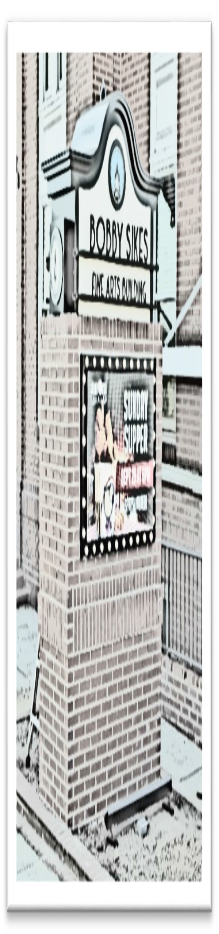
Permitted Sign Dimensions:
Maximum Height (including structure): 12 feet.
Minimum Setback from Right-of-Way: Equal to height of sign.
Maximum Sign Display Area: 54 S.F. per lot.
All EMCs shall require the approval of a Special Use Permit from the Lawrenceville City Council unless such sign meets the requirements of Section 702.4 Ground Sign—Commercial, Industrial or Office herein. All EMCs must satisfy the following requirements:
A.
EMC signs may be permitted as ground signs only.
B.
EMC signs are restricted to properties that are zoned General Business (BG) and Highway Service Business (HSB).
C.
Public Schools and Government Facilities may install EMC's in accordance with the regulations herein but may be exempt from any location requirements.
D.
EMC signs shall not interfere with any public safety vehicle or traffic control device.
E.
Brightness. EMC signs shall have light sensors/monitors to control brightness as specified in G. (below) for all times and all weather conditions; day, night, twilight, overcast skies, and dark clouds. Excessive brightness is a distraction to vehicular traffic and as such is a hazard. Failure to control a sign's brightness will result in the sign being turned off until the brightness is within the standards.
F.
The City will from time to time check the brightness of each EMC to verify the levels specified in G. (below) are met. If the owner of a sign fails to control brightness within these limits, the sign permit shall be revoked. Should a permit be revoked, the sign must be turned off immediately and remain off unless and until the sign is re-permitted. Re-permitting requires the owner to reapply in accordance with the procedures in place at the time of the new permit application, including paying fees required for a new permit.
G.
EMC signs light levels shall not increase lighting or brightness levels by more than 0.30 foot-candles above ambient levels as measured using a standard foot-candle meter.
H.
The sign owner and installer shall provide a letter to the Planning and Development Department certifying that the light sensors are operational and that the sign meets the brightness standards established in G (above).
I.
The EMC portion of the sign may occupy a maximum of 40% of the permitted square footage sign area.
J.
The combined EMC portion or element of any sign where the text will change no more than 4 times in any 24-hour period may be a maximum of 54 square feet, provided the following additional requirements are met:
1.
No lot shall be permitted to have more than 3 display panels on any sign or combination of signs;
2.
No single display panel shall exceed 18 square feet;
3.
There shall be a minimum of one inch of space in between each display panel;
4.
For changeable text the minimum text height shall be six inches;
5.
Text messages shall not scroll or flash, and all text messages shall be static for a minimum of 6 hours; and
6.
The EMC sign must be specifically authorized as a permitted accessory use for the zoning classification of the property upon which the sign is to be located.
K.
The EMC portion or element of any sign where the text may change more than four (4) times in any twenty-four (24) hour period may be a maximum of Seventy Two (72) square feet, provided the following additional requirements are met:
1.
Such signs are restricted to properties with frontage along the following portions of roads:
i.
Scenic Highway—From City Limits to Moon Road.
ii.
Buford Drive/SR 20 North—From City Limits (at SR 124 intersection) to Railroad Bridge.
iii.
W Pike St/SR 120—From SR 316/City Limits to Railroad Bridge.
iv.
Sugarloaf Parkway—From Lawrenceville/Suwanee Road to Five Forks Trickum Road.
v.
Lawrenceville Highway—From the Eastern City Limits to the Scenic Highway/E. Pike Street intersection.
2.
Text messages shall not scroll or flash. All text messages shall be static for a minimum of 6 seconds.
L.
For Changeable Text, the minimum text height shall be six inches.
M.
The display of video from an EMC sign is strictly prohibited regardless of the applicant. Failure to abide by this ordinance will result in the revocation of an EMC permit.
N.
Types of screens permitted include Color and Monochrome in Light Emitting Diode (LED), Liquid Crystal Display (LCD), Plasma and other similar technology.
O.
For LED signs no screen may have a density of less than 19 mm (Bulb Cluster Spacing on center) except for those signs meeting the requirements of subsection J above.
P.
All EMC signs shall have a switch or circuit breaker located on the property that allows electrical power to be turned off. The Owner of each EMC shall provide to the Planning and Development Department contact information for a 24-hour, 7-day/week contact person who has the authority and is able to turn off the sign promptly if a malfunction occurs. If at any time more than 40% of the digital display lights malfunction or are no longer working properly, the owner of said EMC shall turn off the electronic display until repairs are made.
Q.
No EMC shall utilize, house or contain any interaction features or components or in any way function as an interactive sign.
R.
At the direction of the City Manager or designee, all permitted EMC signs shall publish public service announcements for the benefit of the citizens of the City of Lawrenceville. Public service announcements shall include but are not limited to, dates and times of meetings of the City Council, and the date, time, and place of City elections.
S.
Malfunctioning or damaged EMC portions of legal non-conforming and legal conforming EMC signs may be replaced provided that the replacement must be equal to or better than the original display technology and the display area may not be any greater in size. The new EMC portion must be in compliance with current ordinance requirements regarding brightness levels and copy change time limitations.
T.
All other signage located on the property upon which an EMC sign is to be located shall meet the current sign standards, including landscape and color requirements.
702.3
Ground Sign—Commercial, Industrial or Office. An independent permanent structure, attached to the ground with a solid supporting base. The following types of signs are permitted and regulated within the OI, BG, BGC, HSB, LM and HM zoning classifications. The ground shall not be altered for the sole purpose of providing additional sign height.
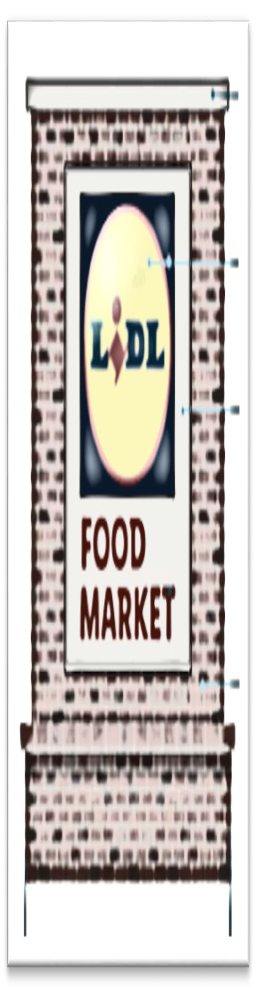
Permitted Sign Dimensions:
Maximum Height (including structure): 12 feet.
Minimum Setback from Right-of-Way: Equal to height of sign.
Maximum Sign Display Area.
A.
The supporting base and structure shall consist of brick, stone or material similar to the primary structure on the parcel. Fiber Cement Siding, Metal or Wood Post shall not be used on the supporting base and structure.
B.
The maximum height of the supporting base and structure shall be 12 feet in height and 16 feet in width. The supporting base shall be a minimum of 18 inches in height and shall be 6 inches wider on each side of the sign display area.
C.
The construction material used for the base of the sign must be used to frame the sign face on both sides with a minimum width of eight inches, and a decorative architectural feature above the sign face that is the full width of the ground sign.
D.
Properties with multiple road frontages may transfer a maximum of 50 percent of the allowable square footage from one road frontage to the other for Ground Signs associated with a properly licensed and permitted Commercial, Industrial or Office development only.
E.
One sign per road frontage, not to exceed maximum allowable square footage.
F.
No air space shall be visible within or between the sign display area and the supporting base.
G.
A ground sign shall not be located within a required buffer, landscape strip, right-of-way, stream buffer, or zoning buffer.
702.4
Ground Sign—Residential Subdivision Sign. A permanent entrance ground sign for residential development of subdivision or planned unit development. The following types of signs are permitted and regulated within the AR, RS-180, RS-150, RS-60, RM-8, RM-12, RM-24, CMU and MH zoning classifications. The ground shall not be altered for the sole purpose of providing additional sign height.

Permitted Sign Dimensions:
Maximum Height (including structure): 6 feet.
Minimum Setback from Right-of-Way: 10 feet.
Maximum Sign Display Area: 32 S.F. per sign (structure not included).
A.
The supporting base and structure shall consist of brickstone or material similar to the primary structures. Fiber Cement Siding, Metal or Wood Post shall not be used on the supporting base and structure.
B.
Two signs are allowed per entrance.
702.5
Sandwich Board or A-Frame Sign. A sign that is portable and self-supporting.
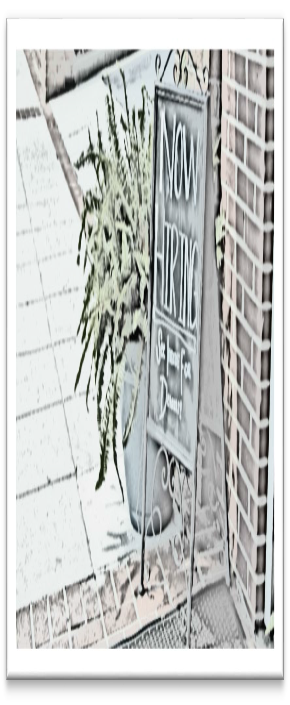
Permitted Sign Dimensions:
Maximum Height (including structure): 3 feet.
Minimum Setback from Right-of-Way: 0 feet.
Minimum Sign Display Area: One sign totaling 6 square fee, 3 feet x 2 feet.
Sandwich Board, A-frame sign signs, sidewalk or curb signs are allowed exclusively in the Downtown Entertainment District area, provided that the sign area does not exceed 6 square feet, the height of the sign does not exceed 3 feet, and the sign does not impede the flow of pedestrian or vehicular traffic. Any a-frame, sandwich board, sidewalk or curb sign which does not meet the criteria listed above shall only be allowed upon approval of a permit by the City. The application shall include a description and/or sketch of the proposed sign and a sketch of the area in which the sign is to be located. The description sketch shall include dimensions and colors to be used on the sign.
702.6
Temporary Sign. A display, sign, banner, or other devices with or without a structural frame, not permanently mounted, and intended to be displayed for only a limited time.
A.
Temporary signs:
1.
A Sign Location Permit is required for all temporary signs.
2.
Unless allowed under Section 704 (Signs Exempt from Permitting), the only temporary signs allowed are a banner or banners, inflatable sign (static), pennants, balloons, or streamers.
3.
The standards for a temporary sign permit are as follows:
a.
A temporary sign may only be displayed with a permit issued by the City of Lawrenceville for the temporary sign pursuant to the requirements of this section.
b.
A permit shall not be valid for longer than a period of 14 days from the date of issuance, after which time the owner of the temporary sign or owner of the premises shall remove the sign from the premises. No two permits shall be issued consecutively. The owner must wait 72 hours before applying for a new permit. The applicant must wait 90 days before placing a sequential permitted sign on the premise.
c.
No more than four permits may be issued to the same premises in any one calendar year. In the event a temporary sign is not removed within five days after the expiration or revocation of the permit, no new permit will be issued for the premises for a period of the remainder of the calendar year.
d.
Temporary signs must be set back at least 10 feet from the property line. The placement of a temporary sign in a parking space that is required to meet the minimum parking requirements for the premises is prohibited. The placement of a temporary sign in the public right-of-way is prohibited and will be cause for revocation of the permit.
e.
A banner shall not exceed a maximum of 32 square feet in area per face.
4.
Pennants, Balloons, and Streamers. Pennants, Balloons and Streamers are allowed one time only for a change in use or change in occupancy of the premises from two weeks prior to the change in use or occupancy until two weeks after the change in use or occupancy (four weeks total).
5.
Banner Sign—The minimum setback from the Right-of-Way is 10 feet, with a maximum display area of 32 square feet.
6.
Inflatable Sign (Static)—Shall be allowed only one time per year per premises, and for not more than seven consecutive days. The inflatable sign shall not exceed a height of 11, 15 feet in width, nor exceed a maximum of 199 square feet of sign area and shall be securely attached to the ground.
702.7
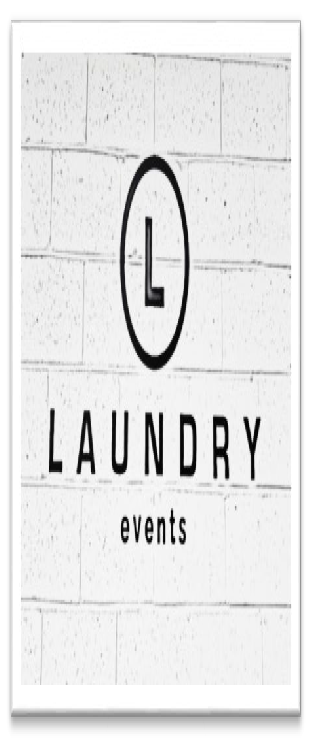
Wall Sign. A sign painted on or attached to the plane of a wall of a building or structure.
Permitted Sign Display Area
• Wall Sign includes any text/images on awnings or canopies.
• The total of all wall signs on all elevations shall not exceed the total square footage listed above.
A.
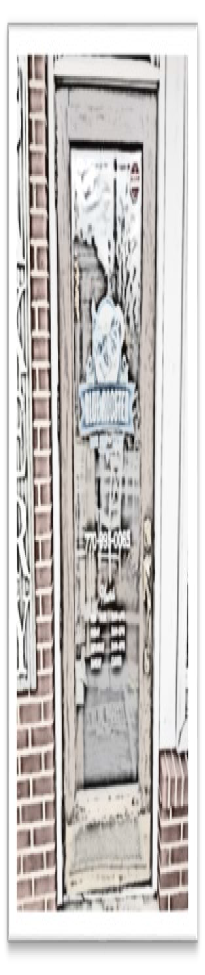
Door Sign. An applicant seeking to cover 20% or more shall apply for a Sign Location Permit along with a Special Use Permit application with the Planning and Development Department.
Permitted Sign Dimensions:
Maximum Height (including structure): N/A.
Maximum Sign Display area: As measured from its outermost points, covers 20% or more of the total door area.
Minimum Setback from Right-of-Way: N/A.
B.
Mural (Public Art). Subject to review and approval by the Art Commission and the City Council.
C.
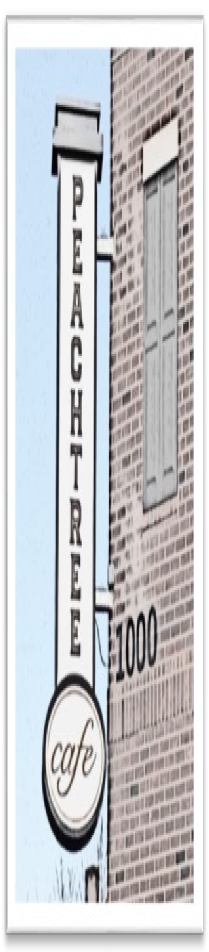
Projecting Sign. A fixed sign that may not project more than 45 inches or 3.75 feet from such structures. Projecting signs shall be located and allow a vertical clearance for a safe, convenient, and unobstructed passage for pedestrians and vehicles.
Permitted Sign Dimensions:
Maximum Sign Display Size: 36 Square Feet.
Maximum Sign Display Height: 12 Feet.
Minimum Setback from Right-of-Way: 2 Feet.
Vertical Clearance—Sidewalk: 10 feet.
Vertical Clearance—Driveways & Parking Areas: 14 feet.
D.
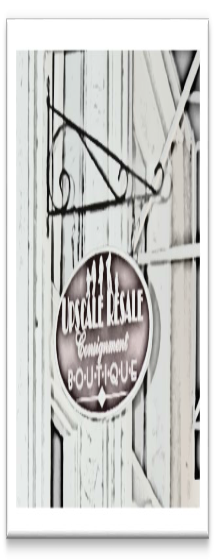
Nine-Block Region Courthouse Square Projecting Sign. A fixed sign that may not project more than 24 inches or 2 feet from such structures. Signs shall be located and allow a vertical clearance for a safe, convenient, and unobstructed passage for pedestrians and vehicles. Limited to the Nine-Block Region Courthouse Square, and subject to the review and approval of the Architectural Review Board.
E.
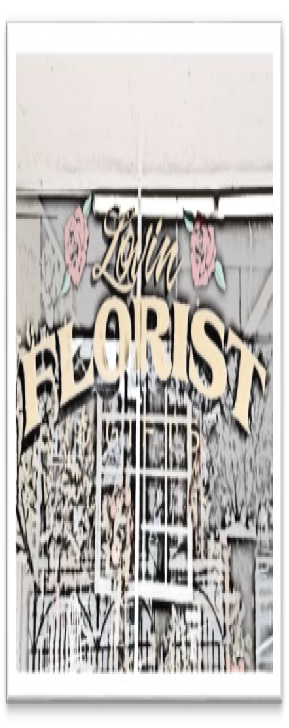
Window Sign. An applicant seeking to cover 20% or more shall apply for a Sign Location Permit along with a Special Use Permit application with the Planning and Development Department.
Permitted Sign Dimensions:
Maximum Height (including structure): N/A.
Maximum Sign Display area: As measured from its outermost points, covering 20% or more of the total window area.
Minimum Setback from Right-of-Way: N/A.
(Ord. No. 2022-7(Zon.), § 1, 5-2-2022)
Sec. 703. - Prohibited Signs.
Signs located on rights-of-way, utility poles, and street signposts are prohibited. These will be picked up and disposed of.
The following types of signs are prohibited in all zoning districts of Lawrenceville:
1.
Any sign containing exposed neon.
2.
Attention-getting devices
3.
Bandit Signs
4.
Flashing Sign
5.
Inflatable Sign (Animated)
6.
Movable Panel Sign
7.
Pole Signs
8.
Roof Sign
9.
Signs greater than 12 feet in height, 16 feet in width, or 200 square feet in size unless permitted as a billboard.
10.
Signs, which emit an odor or visible smoke, vapor or particles.
11.
Signs, which produce noise or sound not generally associated with the normal operations of a sign.
Sec. 704. - Signs Exempt from Permitting.
A.
The following types of signs are exempt from permitting and allowed in all zoning classifications. Unless expressly prohibited under Section 703 Prohibited Signs, however, all exempt signs shall meet the display area, height and setback requirements of this Section:
1.
Campaign/Election Signs. Must be located 15 feet from curb.
2.
Double Post Sign. A sign located at a site during construction or sale, where the primary support is supplied by two wooded posts positioned no more than two inches from the outer edge of the sign display area, and not exceed a maximum sign display area of 32 square feet.
Permitted Sign Dimensions:
Maximum High (including structure): 8 feet.
Maximum Sign Display Area: 32 S.F..
Minimum Setback from Right-of-Way: Equal to height of sign.
3.
Directory Sign. Maximum Sign Display Area shall not exceed 6 square feet, with a Minimum Setback from Right-of-Way of 10 feet. Total Sign Height shall not exceed 8 feet in height. Internal to all commercial or industrial developments and not visible from a public Right-of-Way.
4.
Door Signs provided that each sign, as measured from its outermost points, covers less than 20% of the total door area.
5.
Flags.
6.
Pennants, Balloons and Streamers are allowed one time only for a change in use or change in occupancy of the premises from two weeks prior to the change in use or occupancy until two weeks after the change in use or occupancy.
7.
Signs containing a non-commercial message with a maximum total surface area not to exceed 16 square feet per lot.
8.
Signs located on property which is listed for sale or lease with a maximum total surface area not to exceed 16 square feet per lot.
9.
Signs within a business, office, mall or totally enclosed area except as described in the definition of Electronic Message Centers.
10.
Window Signs provided that each sign, as measured from its outermost points, covers less than 20% of the total window area.
B.
In addition to the requirements in Section A (above), the following regulations shall also apply:
1.
Setbacks. All exempt signs must be located out of the right-of-way or at least 10 feet from the back of the curb or edge of pavement of the adjacent street, whichever is greater. Signs located on a corner lot within 50 feet of the intersection of rights-of-way must be out of right-of-way or at least 15 feet from the back of the curb or edge of pavement of the adjacent streets, whichever is greater.
2.
Height. The topmost portion of an exempt sign, except flags, shall not exceed a maximum height of 8 feet.
3.
Flagpoles in residential districts shall not exceed 25 feet in height or the height of the primary structure on the lot, whichever is less.
Sec. 705. - Nonconforming Signs.
It is the policy of the City to encourage that all signs within the City be brought into compliance with the terms and requirements of this Ordinance.
A.
The City finds that non-conforming signs may adversely affect the public health, safety and welfare. Such signs adversely affect the aesthetic characteristics of the City and may adversely affect public safety due to the visual impact of signs.
B.
The owners of all non-conforming signs must come into compliance when submitting applications to the City for rezoning, permitting and licensing.
C.
Any non-conforming sign located on property that remains vacant for a period of six months or more loses its non-conforming status. The sign shall be removed by the owner of the sign or the owner of the property.
D.
No change in shape, size or design, shall be permitted except to make a nonconforming sign comply with all requirements of this Ordinance.
A nonconforming sign may not be replaced by another nonconforming sign.
Sec. 706. - Procedures.
706.1
Sign Permits Required.
A.
Permits Required. All signs require a Sign Location Permit, excluding signs listed in Section 704, Signs Exempt from Permitting. No person shall erect, alter, repair or relocate any sign, as defined by this Ordinance. No permit shall be issued until the City of Lawrenceville Planning and Development Department determines that such work is in accordance with the requirements contained in this Ordinance, and such work will not violate any building, electrical or other adopted codes of the City of Lawrenceville.
B.
Applications. All required sign permit applications shall be filed on forms supplied by the City of Lawrenceville Planning and Development Department. The contents of the application shall include the following applicable information:
1.
The name, address and telephone number of the property owner.
2.
The name, address, telephone number and registration number of the engineer.
3.
The name, address, telephone number and license number of the sign contractor/manufacturer.
4.
The name, address and parcel identification number (PIN) of the property where the sign is to be erected. The zoning district; and depending on the type of request, the total square footage of the façade and the square footage of the leased space is also required.
5.
The types of sign, square footage, height and location of all signage currently displayed on the site.
6.
The type of sign, square footage, height and location of the sign or signs proposed to be erected on the site. If the sign is to be electrically internally or externally illuminated, additional information is to be provided regarding the Testing Laboratory or the ETL Number, and the name and address of the Electrical Contractor.
7.
A fully dimensioned site plan showing the lot frontage, building frontage, parking areas and location of all existing and proposed signs. For ground signs, the sign plan must show the distance from the right-of-way and edge of pavement, and the street corner. Visibility calculations must be made to ensure that the sign location does not block pedestrian traffic visibility.
8.
Site plan (does not apply to temporary signs). The application shall:
a.
Provide a summary table listing location type and area of any existing and proposed signs.
b.
Provide fully dimensioned elevation drawing of any proposed sign, showing sign type, height and copy area.
c.
For façade signs, provide an elevation of the building, showing placement of any sign.
9.
The type of construction, sign supports, electrical details.
10.
Wind load calculations and footer details as required by the City's adopted building code.
C.
Investigation/Time Limits. Upon the receipt of a completed sign permit application and upon payment of the appropriate sign permit fee by the applicant, the City of Lawrenceville Planning and Development Department shall promptly conduct an investigation of the application, the proposed sign and the premises. The Director shall grant or deny the sign permit application within thirty (30) days from the date the completed application with application fee was filed with the City of Lawrenceville Planning and Development Department.
D.
Issuance or Denial of Permit.
1.
If, after review and investigation as required herein, the Director determines that the application meets the requirements contained in this Ordinance and determines the proposed sign will not violate any building, electrical or other adopted codes of the City of Lawrenceville, the Director shall issue the permit.
2.
If, after review and investigation as required herein, the Director determines that one or more reasons for denial exist, the permit shall be denied. The application for a permit shall be denied if one or more of the following conditions are found to exist:
a.
The application does not comply with the requirements of this Ordinance; or
b.
The application would violate any building, electrical, or other adopted codes of the city of Lawrenceville.
3.
The sign permit application shall be deemed granted in the event the Director fails to take action (approve or deny) within 30 days from the date the completed application and fee was filed with the Planning and Development Department.
4.
Any application for a Special Use Permit required under this Article shall be acted on by the City Council within 60 days of receipt of a completed application with the required fee and supporting documentation. The application for a Special Use Permit shall be deemed granted if the City Council fails to take final action on the application within 60 days of receipt of a completed application and fee and supporting documentation unless the applicant specifically agrees in writing or on the public record of a meeting for action on the application to be tabled to a later date.
E.
Fees. The sign permit fee for signs shall be determined pursuant to the sign permit fee schedule established by separate Ordinance.
706.2
Appeals.
A.
Any person aggrieved by any order, requirement, decision or determination of the Administrative Official in the implementation or enforcement of this Ordinance may file a written appeal to the Board of Appeals within ten (10) calendar days after rendition of the order, requirement, decision or determination by the Administrative Official to which the appeal is directed. The procedures for such an appeal are contained in City of Lawrenceville Zoning Ordinance, Article 9, Administration and Enforcement, Section 902 Board of Appeals.
For purposes of review of appeals from this Sign Ordinance, the Board of Appeals shall have 45 days in which to make a decision regarding the appeal. The Board of Appeals shall have the authority to approve, deny or remand the order, requirement, decision or determination by the administrative official. A remand in this case is an action to send a particular appeal to the Mayor and Council for modification of the Ordinance consistent with appropriate constitutional principles. Any person aggrieved by any order, requirement, decision or determination of the Board of Appeals shall have 30 days in which to appeal such decision to the Superior Court of Gwinnett County by a Writ of Certiorari. Consistent with the decisions of the Supreme Court of the State of Georgia, an appeal from the Board of Appeals shall not be de novo and the records below shall be binding on all parties to the appeal.
B.
Any person denied a sign permit for signs by the Planning and Development Department may file a written appeal to the Board of Appeals within 10 calendar days after rendition of the denial. Any person aggrieved by any order, requirement, decision or determination of the Board of Appeals Any person aggrieved by any order, requirement, decision or determination of the Board of Appeals shall have 30 days in which to appeal such decision to the Superior Court of Gwinnett County by a Writ of Certiorari. Consistent with the decisions of the Supreme Court of the State of Georgia, an appeal from the Board of Appeals shall not be de novo and the records below shall be binding on all parties to the appeal.
Any person denied a Special Use Permit for a sign by the City Council shall have 30 days in which to appeal such decision to the Superior Court of Gwinnett County by a Writ of Certiorari. Consistent with the decisions of the Supreme Court of the State of Georgia, an appeal of the denial by the City Council shall not be de novo and the records below shall be binding on all parties to the appeal.
706.3
Penalties for Violations. Violations of this Ordinance shall be punishable by the issuance of a citation and summons to Municipal Court. Any person found guilty of violating this Ordinance shall be fined an amount not to exceed $1000.00 and/or probation or community service. If the prohibited sign is not removed or corrected within 10 days of the disposition of any citation in Municipal Court, the owner or occupant shall be subject to multiple citations and fines in Municipal Court until the sign is removed or brought into compliance with this Ordinance.
706.4
Interpretation and Severability.
A.
Nothing in this Article shall be construed to regulate the content of the message displayed on any sign. All signs may display a noncommercial message in addition to, or in lieu of, any other message.
B.
In the event any section, subsection, sentence, clause or phrase of this Article shall be declared or adjudged invalid or unconstitutional including but, not limited to, a declaration or adjudication that such section, subsection, sentence, clause or phrase of the Article relates to the content of any sign or in any way violates the constitutional provisions of free speech under the State of Georgia or United States Constitution, such adjudication shall in no manner effect the other sections, subsections, sentences, clauses or phrases of this Article, which shall remain in full force and effect as if the section, subsection, sentence, clause or phrase so declared or adjudged invalid or unconstitutional were not originally a part thereof. The City Council hereby declares it would have adopted the remaining parts of the Article if it had known that such part or parts thereof would be declared or adjudged invalid or unconstitutional. The provisions of this Article are declared severable to the maximum extent allowed by law. It is the policy of the City to encourage that all signs be brought into compliance with the terms and requirements of this Ordinance.
Sec. 707. - Maintenance and Removal.
Every sign, including those specifically exempt from this Code in respect to permits and permit fees, shall be maintained in good structural condition at all times. All signs shall be kept neatly painted, including all metal parts and supports thereof that are not galvanized or of rust-resistant material. The Planning and Development Director shall inspect and shall have the authority to order the painting, repair, alteration, or removal of a sign that shall constitute a hazard to safety, health, or public welfare by reason of inadequate maintenance, dilapidation, or obsolescence.
A.
Abandoned Signs. Any non-conforming sign that is located on a property, which becomes vacant or is unoccupied for a period of six months or more, shall be deemed abandoned. An abandoned sign is prohibited and shall be removed by the owner of the sign or the owner of the property.
B.
Dangerous or Defective Signs. No person shall permit signs in dangerous or defective condition on premises they own or control. Any such sign shall be removed or repaired by the owner of the sign or the owner of the premises. Signs that are lit but are not functioning as designed shall not be illuminated until the defective bulbs are replaced.
C.
Removal of Signs. The Director shall have authority to remove any sign in any road right-of-way, which violates this Ordinance or endangers public safety, such as a dangerous or materially, electrically, or structurally defective sign, for which no permit has been issued.
D.
Change in Tenant. Any change in tenant space which requires a change in signage shall require the replacement of the tenant name panel on the sign structure with an opaque panel of a similar material and background color to the rest of the sign panels on that sign. In no case shall bare bulbs or the interior of the sign structure be visible from any public right-of-way or adjoining property.

