
Layton City City Zoning Code
19.12 Off
Street Parking
19.12.010 Application Of Chapter
- The requirements set forth in this Chapter shall apply to and govern all use of buildings and use of land.
- Diagram A-10, referring to this Chapter and attached to this Title, shall by this reference be made a part hereof as if fully described herein.
HISTORY
Ord. No. 97-19, Enacted, 4/17/1997
Ord. No. 97-35, Recodified, 6/19/1997
Ord. No. 04-69, Recodified, 12/16/2004
Ord. No. 20-29, Amended, 9/17/2020
19.12.020 Off-Street Parking Required
- During the establishment of any land use, or at the time any main building or structure is enlarged or increased in capacity, or upon a change of occupancy, minimum off-street parking space(s) shall be provided with adequate provisions for ingress or egress by standard sized automobiles as provided and described in this Chapter.
HISTORY
Ord. No. 97-19, Enacted, 4/17/1997
Ord. No. 97-35, Recodified, 6/19/1997
Ord. No. 04-69, Recodified, 12/16/2004
Ord. No. 20-29, Amended, 9/17/2020
19.12.030 Preservation Of Parking Facilities
- Space for off-street parking which is accessory to and required for a particular use shall not be utilized for any other purpose, and shall be maintained in perpetuity as long as the requirement for the off-street parking continues.
- It is unlawful for any owner of any building or use to discontinue or dispense with the required vehicle parking facilities without providing some other approved vehicle parking area which meets the requirements of this Chapter.
HISTORY
Ord. No. 97-19, Enacted, 4/17/1997
Ord. No. 97-35, Recodified, 6/19/1997
Ord. No. 04-69, Recodified, 12/16/2004
Ord. No. 20-29, Amended, 9/17/2020
19.12.040 General Parking Requirements
- All off-street parking area(s) shall be paved with a hard surface (i.e. asphalt, concrete, masonry, pavers, or similar materials) and shall be graded to dispose of all surface water. All parking and grading plans shall be reviewed and approved by the City Engineer or designee. Outdoor storage areas that are associated with a business that stores equipment for sale or rent may be surfaced with a compacted gravel or road base material. Accessory agricultural uses may also use compacted gravel or road base for required parking area(s). Where gravel or road base is used, a paved surface shall be installed within 10 feet of the public right-of-way where vehicles enter and exit the property, to prevent debris from entering onto the street. All such areas are to be maintained in a dust and weed free condition and shall be capable of supporting the weight of the vehicles utilizing the surface above the soil.
- Parking area(s) shall be designed to provide orderly and safe circulation, loading, unloading, parking and storage of vehicles. All public parking area(s) shall be paved, landscaped, striped, signed, and maintained according to approved plans to prevent deterioration and prevent safety hazards.
- Lighting provided in off-street parking area(s) shall be directed away from adjoining premises and streets to avoid nuisance light pollution complaints. The type and location of lighting fixtures shall be approved by the development review staff.
- Off-street parking area(s) shall allow vehicles to enter and exit from a public street by forward motion only. This regulation does not apply to parking areas serving single-family and two-family residential.
- Tandem parking (one space behind another) may be allowed for conventional single-family dwellings, duplexes, townhouses, apartments, and condominiums, provided that both spaces are assigned to the same dwelling unit and the parking plan is approved by the land use authority.
- Rear-loaded single-family, townhomes, apartments and similar uses shall provide guest parking that is evenly distributed throughout the development.
- Off-street parking spaces shall be located only behind the minimum seven foot landscaped area.
- R-1 and R-2 Zoning Districts. No portion of a required front yard area, other than driveways leading to a garage or approved parking area, shall be paved or improved so as to encourage or make possible the parking of vehicles therein. Paved driveways leading to a garage or approved parking area may be used as parking area for additional vehicles to meet the requirements of this chapter. Single-family and two-family dwellings and duplexes shall not have more than 50% of the front yard area hard surfaced.
- Off-site parking may be allowed for the required parking of any new use, structure, or building in any multi-family, commercial or manufacturing zone that cannot be provided on the premises due to the property's size or location according to the following criteria:
- the off-site parking cannot be more than 500' from the development site’s property boundary measured along the shortest available pedestrian route of access;
- the adjacent site has excess parking that is not required for their use, or the hours parking is needed will not conflict with the hours of use on the adjacent property;
- the applicant shall provide a document to the Community & Economic Development Department, signed by the owners of the off- site parking area and recorded at the Davis County Recorder's Office that stipulates the permanent reservation of use of the site for said parking.
- Electric vehicle charging station. An electric vehicle charging station may count as a parking space to meet minimum off-street parking requirements. When provided, these spaces should be accessible and in close proximity to a building entrance. Signage should be placed at the electric vehicle charging station to notify drivers that the space is only for electric vehicles. At the front of the charging station parking space the word "ELECTRIC" should be painted. Each electric vehicle parking space shall be a standard size parking space to accommodate various vehicle sizes.
HISTORY
Ord. No. 97-19, Enacted, 4/17/1997
Ord. No. 97-35, Recodified, 6/19/1997
Ord. No. 99-12, Amended, 3/18/1999
Ord. No. 00-37, Amended, 8/17/2000
Ord. No. 03-41, Amended, 10/2/2003
Ord. No. 04-69, Recodified, 12/16/2004
Ord. No. 17-13, Amended, 6/15/2017
Ord. No. 20-29, Amended, 9/17/2020
Ord. No. 24-02, Amended 2/1/2024
Ongoing ordinance history can be viewed by clicking the gavel in the top right corner.
19.12.050 Computation Of Parking Requirements
- When the computation of required parking spaces results in a fractional space, any fraction up to one-half shall be disregarded, and fractions including one-half and over shall require one parking space.
- When a structure or parcel contains multiple uses, more than one parking standard may apply.
- Parking ratios in Table 12-1 (see 19.12.060) are based on either square footage of gross floor area (SF of GFA) or square footage of net floor area (SF of NFA). Gross floor area is based on the square footage within the entire building footprint. Net square footage excludes restrooms, stairways, elevator shafts, mechanical and electrical rooms, janitorial closets, lunchrooms and common areas used only for major pedestrian movement and public lobby areas. When public lobby areas contain uses that generate a demand for additional parking, they shall be included in net square footage calculations for determining parking requirements.
- Available public on-street parking spaces shall not be used to meet the minimum off-street parking requirements set forth herein. No development plans shall be approved based on the assumption that excess vehicles can be parked on public streets. Private on-street parking may be used to count towards the total project parking requirement for multi-family residential and commercial uses, except that of the total parking spaces required for multi-family residential uses, a minimum of one off-street parking space is required for each residential dwelling unit.
- When parking regulations are based on the number of employees, parking calculations shall use the largest number of employees who work at any one shift. Where shift changes may cause substantial overcrowding of parking facilities, the land use authority may require additional spaces.
- When parking use intensities vary during the course of the day (i.e. business of hours of operation, peak time usage, etc.) the Land Use Authority may implement shared parking usage based upon reasonable use standards on a case-by-case basis.
HISTORY
Ord. No. 97-19, Enacted, 4/17/1997
Ord. No. 97-35, Recodified, 6/19/1997
Ord. No. 97-75, Amended, 12/2/1997
Ord. No. 13-06, Amended, 8/1/2013
Ord. No. 17-13, Amended, 6/15/2017
Ord. No. 20-29, Amended, 9/17/2020
19.12.060 Parking Spaces Required For Specific Land Uses (Table 12-1) And Bicycle Parking Required For Specific Land Uses (Table 12-2)
TABLE 12-1
PARKING SPACES REQUIRED FOR SPECIFIC LAND USES
Land Use
Spaces Required
Details
RESIDENTIAL
Accessory Dwelling Units
1 per unit
- In addition to the parking requirements of the primary dwelling unit.
Apartments or Stacked Dwelling Units
Studio:
1.25 per unit
1 br:
1.4 per unit
2 br:
1.75 per unit
3 br:
1.9 per unit
- Parking per unit included visitor parking.
- A minimum of one parking space per unit shall be covered (i.e. carport) or enclosed (i.e. garage)
- Garages provided in conjunction with multi-family developments shall be used for vehicles and shall not be used exclusively as storage facilities.
Residential Facility for Elderly
1 per 2 beds
- Eight or fewer elderly persons in a family type arrangement.
Residential Facility for Persons with a Disability - Small
1 per staff + 1 per vehicle to transport + 2 visitors
- Small Facility - 12 or fewer unrelated persons with a disability, exclusive of staff.
- Large Facility - 13 or more unrelated persons with a disability, exclusive of staff. See Residential Facility for Persons with a Disability in the Institutional And Civic Section below for parking requirements.
Single-Family Dwelling, Detached
2 per dwelling unit
- Required spaces shall be made within a carport or an enclosed garage.
Townhouse or Side-by-Side Units
2.25 per unit (may be reduced near mass transit)
- 50% of spaces shall be enclosed (i.e. carport) or covered (i.e. garage).
- Garages shall only be used for parking vehicles and shall not be used exclusively as storage facilities.
- Guest parking shall be evenly distributed throughout the development.
RECREATIONAL AND ENTERTAINMENT
Auditorium, Stadium, Sports Arena or Live Theater, Movie Theater
1 per 4 seats
Commercial Recreation (i.e. Billiard Hall, Bowling Alley, Golf Course, Swimming Pool, Athletic Field, etc.)
1 per 2 persons (participants and spectators)
Alternative Options:
Bowling Alley:
3 per lane
Golf Course:
8 per hole
Billiard Hall:
3 per pool table
Skating Rink:
3 per 1,000 SF of skating arena
Community Recreational Center
2 per 1,000 SF of GFA
Dance Hall, Exhibition Halls, Assembly Halls (Except when associated with a Church/Temple)
3 per 100 SF of dance floor or assembly area
- See also Church/Temple (with Assembly Hall) in the Institutional and Civic Section below).
Fitness Center, Health Clubs and Gyms
3 per 1,000 SF of GFA
Studio - Art, Photo, Dance, Music, Drama
1 per 2 persons (participants and spectators)
INSTITUTIONAL AND CIVIC
Assisted Living Facility
1 per employee at maximum shift + 0.5 per bed
- Living facility with 75 beds or less.
Assisted Living Complex
1 per employee per highest shift + 0.5 per bed + 1 guest space per 8 units
- An assisted living complex is a residential setting that provides either routine general protective oversight or assistance with activities necessary for independent living to mentally or physically limited persons. It commonly has separate living quarters for residents. Its centralized services typically include dining, housekeeping, social and physical activities, medication, administration, and communal transportation.
- Assisted living complex with 75 beds or more.
Churches/Temples (With Assembly Hall), Mosque/Synagogue
1 per 4 seats in auditorium;
1.5 per 4 seats (if two congregations use the facility at the same time)
Commercial Airport
Parking analysis required
- Based on a parking analysis performed and prepared by a licensed, professional engineer.
- Zoning Administrator or designee shall review and approve the proposed parking rates.
Continuing Care Retirement Community (CCRC)
1 per independent living dwelling unit
- A CCRC enables a resident to transition in place from independent living to increased care as the medical needs of the resident change. Housing options may include various combinations of senior adult housing (detached or attached), congregate care, assisted living, and nursing home. Individual parking for assisted living and nursing home components of a CCRC is provided separately as required in this Chapter.
Government Office Building
3 per 1,000 SF of GFA + 1 per employee in a municipal building
- A government office building is an individual building containing either the entire function or simply one agency of a city, county, state, federal, or other governmental unit.
Library
2 per 1,000 SF of GFA
- A library can be either a public or private facility that consists of shelved books and reading room or areas. A library may also provide meeting rooms.
Museum
1 per 1,000 SF of GFA
Public, Quasi-Public, Private School
Kindergarten-9th Grade:
1.5 per classroom
High School or similar:
1 per 4 seats in auditorium or stadium, whichever is greater
Residential Facility for Persons with Disability
1 per staff + 1 per vehicle to transport + 2 for visitors
- Small Facility - 12 or fewer unrelated persons with a disability, exclusive of staff.
- Large Facility - 13 or more unrelated persons with a disability, exclusive of staff.
Schools - Elementary and Junior High
1.5 per classroom
- Elementary: Kindergarten through 5th or 6th grade.
- Middle School or Junior High: Students who have completed elementary and have not entered high school.
Schools - High School
1 per 4 seats in auditorium or stadium, whichever is greater
- A high school serves students who have completed middle or junior high school.
MEDICAL
Free-Standing Emergency Room
1.5 per 1,000 SF GFA
- A free standing emergency room is a facility that specializes in personal medical care and treatment of people. These facilities are structurally separate and distinct from a hospital and provide emergency care for potentially life-threatening conditions. They are typically open 24 hours a day, seven days a week, 365 days a year.
Hospitals, Sanatoriums, Convalescent Hospitals
1 per 2 beds + 1 per employee at highest shift
Medical Clinics (i.e. Doctors, Dentists, Optometrists, Psychiatrists, etc.)
3 spaces per 1,000 SF of GFA or a minimum of 2 per practitioner;
Alternative Options:
Clinic (Urgent Care):
5.3 per 1,000 SF GFA
- A medical-dental office building is a facility that provides diagnoses and outpatient care on a routine basis but is unable to provide prolonged in-house medical and surgical care. One or more private physicians or dentists generally operate this type of facility.
- A minimum of 2 stalls shall be provided per practitioner.
- *A clinic commonly has a lab facility, a supporting pharmacy, and a wide range of services.
Nursing Homes
1 per 4 beds + 1 per employee at highest shift
- Skilled nurses and nursing aides are present 24 hours a day at these sites. A nursing home resident is not capable of operating a vehicle. Parking demand is entirely generated by employees, visitors, and deliveries.
Rehabilitation Treatment Center
1 per 2 beds
Surgery Center
8 per operating room
- A surgery center is a facility where surgeries that do not require hospital admission are performed. Patients arrive on the day of the procedure, have the surgery in an operating room, recover under the care of the nursing staff and are then sent home (on the same day). There are no beds or overnight facilities.
Veterinary Clinic
3 per 1,000 SF of GFA
OFFICE
Professional Office (i.e. Legal, Employment, Insurance, Travel, Photo, Real Estate, etc.)
2.5 per 1,000 SF of GFA
- A small office building typically houses a single tenant and is less than or equal to 5,000 gross square feet in size.
Professional Office Multi-story Building or Buildings or Complexes of More than 100,000 SF, General Office Building
3 per 1,000 SF of NFA main floor, + 2.5 per 1,000 of NFA basement and floors 2 through 5, + 2 per 1,000 SF of NFA floors 6 and above
- See also Subsection 19.12.050(C).
RETAIL
Apparel Store or Clothing Store
2.5 per 1,000 SF of GFA
Discount Club, Retail Stores and Shops, Shopping Center (Regional), Sporting Goods Store
3 per 1,000 SF of GFA
- A discount club is a discount store or warehouse where shoppers pay a membership fee in order to take advantage of discounted prices on a wide variety of items such as food, clothing, tires, and appliances; many items are sold in large quantities or bulk. Some sites may include on-site fueling pumps.
- A shopping center is an integrated group of commercial establishments that is planned, developed, owned, and managed as a unit. Shopping Center parking is based on leasable space.
Carpet Store, Furniture and Appliance Store, Other Stores with Bulky Items for Sale
1.5 per 1,000 SF of GFA
Convenience Store
5 per 1,000 SF of GFA
- This rate applies to stores with less than 5,000 SF of GFA.
Home Improvement Retail (40,000 SF Building or Greater)
2 per 1,000 of GFA + 1 per 1,000 SF for Garden Area
Liquor Store
2 per 1,000 SF of GFA
Supermarket or Grocery Store
4.5 per 1,000 SF of GFA
Pharmacy/Drugstore (includes Drive-through Window)
2.5 per 1,000 SF of GFA + required vehicle stacking (see Table 12-4)
Super Convenience Market with Gas Station
6 per 1,000 SF of GFA
- Gasoline/Service stations with Convenience Markets where there is a significant business related to the sale of convenience items and the fueling of motor vehicles.
- Stores typically also had automated teller machines (ATMs), and public restrooms. This land use category has the following two specific characteristics:
- The gross floor area of the convenience market is at least 5,000 square feet.
- The number of vehicle fueling positions is at least 10.
Superstore/Big Box Stores Including: Electronic Superstore, Toy/Children Superstore/Pets Supply Superstore, Office Supply Superstore, Book Superstore, etc.
Electronic:
2 per 1,000 SF of GFA;
Toy/Children:
2 per 1,000 SF of GFA
Pet/Supply:
2 per 1,000 SF of GFA
Office Supply:
1 per 1,000 SF of GFA
Book Store:
1 per 1,000 SF of GFA
- Super Stores 50,000 SF of GFA or larger Big Box 80,000 SF of GFA or larger.
COMMERCIAL AND SERVICE USES
Animal Daycare and Boarding
2 per 1,000 SF of GFA
- May include animal grooming facility.
Animal Grooming Facility
2 per station
- Animal grooming facility only.
Banks, Credit Unions, Savings and Loans, Finance Companies, Drive-in Banking
3 per 1,000 SF of GFA + required vehicle stacking (see Table 12-4)
Barber Shop/Beautician Shop, Other Personal Services
5 per 1,000 SF of GFA
Car Wash (Full Service)
5 per bay
Car Wash (Self Service and Automatic)
Self-service see stacking requirement (Table 12-4)
Child-Care Center, Day Care Center, Children's Nursery, or Preschool
1 per employee at highest shift + 1 per 5 children
- Does not apply to home daycare and home preschool.
Dry Cleaner
1 per employee + 5 for customers
Hotel or Motel
1 per room
Laundromat
5 per 1,000 SF of GFA
Mixed-Use Structure or Development
Parking for individual uses shall be calculated based on rates in this chapter and any joint-use parking and parking space reduction options (see 19.12.090)
Mortuary or Funeral Home
1 per 40 SF of floor area in assembly area
Post Office
1 per vehicle used by operation + 1 per employee at highest shift + 10 for customers
Reception Center or Wedding Chapels
1 per 40 SF of GFA in the primary meeting room or assembly area
Research and Development Center
2.5 per 1,000 SF of GFA; or 1 per employee
- A research and development center is a facility or group of facilities devoted almost exclusively to research and development activities. The range of specific types of businesses contained in this land use category varies significantly. Research and development centers may contain offices and light fabrication areas.
INDUSTRIAL
Industrial Park, Large Machine Repair, Light Industrial, Manufacturing
1 per 1,000 SF of GFA; or 1 per employee, whichever is greater
- Large Machine Repair: Includes large construction equipment.
- Light Industrial: Printing, Material Testing, Assembly of Data Processing Equipment.
- Manufacturing: A manufacturing facility is an area where the primary activity is the conversion of raw materials or parts into finished products.
Self-Storage Facilities (i.e. Mini Storage)
1 per 1,000 units + 1 per employee
Specialty Trade Contractor (i.e. Contractor Storage Yard)
3 per 4 employees at highest shift + 1 per vehicle used in conducting the business
- A specialty trade contractor is a business primarily involved in providing contract repairs and services the to meet industrial or residential needs. This land use includes businesses that provide the following services: plumbing, heating and cooling, machine repair, electrical and mechanical repair, industrial supply, roofing, locksmith, weed and pest control, and cleaning.
Warehousing
3 per 4 employees at highest shift + 1 per vehicle used in conducting business
- A warehouse is primarily devoted to the storage of materials, but it may also include office and maintenance areas.
Wholesale Business
4 per 1,000 SF of net office space + 1 per 750 SF of NFA; or 1 per person based on the rates of this table employed on the highest employment shift, whichever is greater
- A wholesale market generally includes large storage and distribution areas for receiving goods and shipping these goods to places such as grocery stores and restaurants. Generally, these markets are characterized by little drive-in businesses; truck deliveries and pick-ups take place at all hours of the day. See Subsection 19.12.050(C).
AUTOMOTIVE
Auto Lube Center and Services, Auto Repair or Body Shop
3 per service bay
- Vehicles stored for more than 72 hours onsite shall be parked in an enclosed (screened) storage area.
Automobile Parts Sales
2 per 1,000 SF of GFA
Automobile Dealership
2.3 per 1,000 SF of GFA + 1 per employee at highest shift
Large Truck or RV Repair
1 per 1,000 SF of GFA; or 1 space per employee, whichever is greater
- Required standard parking spaces are for the use of employees and customers. Additional area to store large trucks or RVs is required. At least 1 parking space for each service bay shall be sized to park the serviced large trucks or RVs.
Recreational Vehicle Sales
0.75 per 1,000 SF of GFA + 1 per employee at highest shift
Tire Store
3 per 1,000 SF of GFA
- Additional parking is required for automotive services and/or repair based on the rates of this table.
FOOD INDUSTRY
Coffee/Donut/Bagel Shop
5 per 1,000 SF of GFA (with drive through); or 8 per 1,000 SF of GFA (without drive through)
Cafes, Cafeterias, or Restaurants
1 per 100 SF of GFA; or 1 per 3 seats (outdoor dining is 1 per 200 SF of outdoor dining area, except if it is 25% or less of indoor SF of GFA)
Drive-in, Fast Food Establishments
1 per 100 SF of GFA (no less than 10 spaces); or 1 per 3 seats + stacking for drive through (see Table 12-4)
Fast Casual Restaurant
9 per 1,000 SF of GFA
- A fast casual restaurant is a sit-down restaurant with no (or very limited) wait staff or table service. Customers typically order off a menu board, pay for food before the food is prepared and seat themselves.
High Turnover (Sit-down) Restaurant
10 per 1,000 SF of GFA
- The land use consists of sit-down, full-service eating establishments with a typical duration of stay of 60 minutes or less. They are commonly referred to as casual dining. Generally, these restaurants serve lunch and dinner; they may also be open for breakfast and are sometimes open 24 hours per day. A patron commonly waits to be seated, is served by wait staff, orders from a menu, and pays after the meal.
Lounge, Night Club, Private Club or Tavern
1 per 75 SF of GFA (outdoor dining is 1 per 200 SF of GFA of outdoor dining area, except if it is 25% or less of indoor SF of GFA)
Alternative Option:
Club w/dance floor requires an additional 3 per 100 SF of dance floor assembly area
Uses not listed above, or commercial units with undetermined occupants at the time of construction: to be determined by the Zoning Administrator as set forth herein, for uses which are similar to the proposed use.
TABLE 12-2
BICYCLE PARKING REQUIRED FOR SPECIFIC LAND USES
Land Use
Bicycle Spaces Required
Details
Apartments or Stacked Units
1 per 10 bedrooms
- A clear area of 2'x6' shall be provided for each space, or uninterrupted access to a bike rack.
Institutional and Civicl/Industrial
2 per 10,000 SF GFA
Retail/Commercial and Services/Office
1 per 3,000 SF GFA
Bicycle parking shall be located on-site and dispersed throughout the project to provide convenient access to building entrances. Bicycle parking shall include single or multiple spaces contained in bike racks, bike shelters, bike corrals, bike lockers or similar facilities.
Non-residential bicycle parking may be located within the public right-of-way subject to site plan review and approval of the Zoning Administrator and City Engineer or designee.
HISTORY
Ord. No. 97-19, Enacted, 4/17/1997
Ord. No. 97-35, Recodified, 6/19/1997
Ord. No. 04-69, Recodified, 12/16/2004
Ord. No. 20-29, Amended, 9/17/2020
19.12.070 ADA Accessible Parking Standards (Table 12-3)
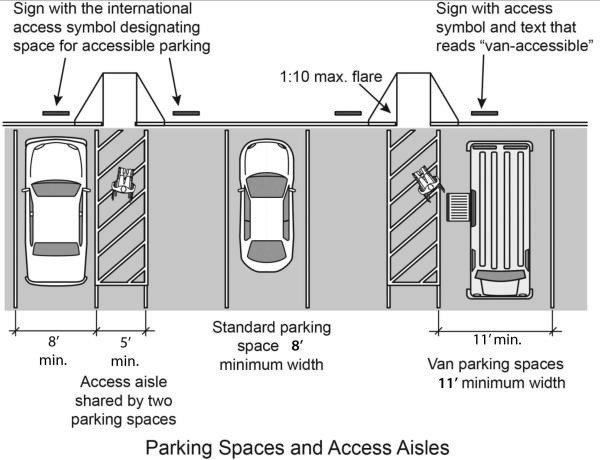
- Accessible parking spaces required by this section may be counted towards the fulfillment of the general on-site parking requirements of this chapter (see Table 12-2).
- Accessible parking spaces are 8 feet wide and van-accessible spaces are 11 feet wide.
- The access aisle for either type of space is five feet wide. The access aisle can be shared by two accessible parking stalls. The van-accessible parking space can be reduced to eight feet wide, if the access aisle is eight feet wide.
- ADA parking stalls and access aisles shall be designed and constructed to be accessible in accordance with the current International Code Council (ICC) A117.1.
TABLE 12-3
ADA ACCESSIBLE PARKING STANDARDS
Total Number Of Parking Spaces Provided in Parking Facility (Per Facility)
(Column A) Minimum Number of Accessible Parking Spaces (Car and Van)
Minimum Number of Van Accessible Parking Spaces (1 of Six Accessible Spaces)
1 - 25
1
1
26 - 50
2
1
51 - 75
3
1
76 - 100
4
1
101 - 150
5
1
151 - 200
6
1
201 - 300
7
2
301 - 400
8
2
401 - 500
9
2
501 - 1,000
2% of total parking provided in each lot or structure
1/6 of Column A*
1,001 and Over
20 plus 1 for each 100 over 1,000
1/6 of Column A*
HISTORY
Ord. No. 20-29, Enacted, 9/17/2020
Ord. No. 23-02, Amended 1/5/2023
19.12.080 Stacking (Queuing) Spaces For Specific Uses (Table 12-4)
Uses which have drive-up or drive-through service windows, devices or uses that require areas for queuing of vehicles shall provide on-site space for stacking of vehicles waiting to reach the drive-up window or device in accordance with the following:
- Drive-through facilities shall be located in side or rear locations that do not interrupt direct pedestrian access along connecting pedestrian frontage. Stacking vehicles shall not prohibit required parking spaces from being used.
- The length of stacking spaces shall be 20', measured from behind the vehicle being served.
- The minimum interior turning radius of a drive through lane shall be 18'.
TABLE 12-4
STACKING (QUEUING) SPACES FOR SPECIFIC USES
Use
Minimum Number Of Stacking Spaces
Measured From
Attended Parking Lot or Structure
2
Attendant
Automated Pay for Parking Lot or Structure
2
Ticket Disbursement Machine
Automated Teller Machine
2
Teller
Bank Teller Lane Or Pharmacy
3
Teller or Window
Car Wash Stall, Automatic
3
Entrance
Car Wash Stall, Self-Service
1
Entrance
Gasoline Pump
1
Each End of Pump Island
Restaurant Drive-through
Soda/Drink Shop
7 (may be split between multiple order boxes)
Pick-up Windows
Other
Determined by Zoning Adminstrator
The applicant's site plan shall show the location, size and dimensions of all such facilities. The plans shall follow the stacking space schedule and shall demonstrate that such facilities will not result in the stacking of vehicles on public rights of way.
HISTORY
Ord. No. 97-19, Enacted, 4/17/1997
Ord. No. 97-35, Recodified, 6/19/1997
Ord. No. 04-69, Recodified, 12/16/2004
Ord. No. 20-29, Amended, 9/17/2020
19.12.090 Authorization For Shared Parking, Joint-Use Parking And Parking Space Reduction Options
This section provides for shared parking and joint-use options including:
- Travel Demand/Parking Reduction Analysis
- Historic Downtown Parking Exemption
- Performance Parking
No combination of parking reductions 1, 2, and 3 shall reduce the minimum required parking by more than 25% based on a parking demand analysis to be reviewed and approved by the land use authority.
Joint-use parking shall not be used in combination with parking reduction options 1, 2 and 3.
Shared (off-site) parking is not considered a parking reduction and may be allowed through a recorded agreement.
- The provisions of this chapter shall not be combined with any other parking reductions allowed in other chapters of this title.
- Application of permitted adjustments shall not apply to single-family detached or attached dwelling units (i.e. townhomes), products or developments.
- Application of permitted adjustments to required parking as contained in this section may preclude the potential for temporary uses in parking areas as outlined in Chapter 19.21 Temporary and Seasonal Uses of Layton Municipal Code, given that temporary uses are intended for underutilized parking areas.
- For additional parking criteria within the Mixed-Use (MU), and Mixed-Use Transient Oriented Development (MU-TOD) zoning districts refer to Chapters 19.25 and 19.26 of Layton Municipal Code.
- Shared Parking: shared parking in any multi-family, commercial, or manufacturing zoning district is allowed if it can be established that the on-site use(s) characteristically result in peak demand for parked vehicles at different hours, days or seasons than the off-site use(s). The Land Use Authority may authorize the use of such combined facilities requiring the maximum number of parking spaces for the larger use.
- Shared Parking Proposal. Notwithstanding any other parking requirements provided in this Chapter, when land uses occupy the same lot or adjacent lots, the total number of off-street parking spaces required for each use may be shared. A proposal for sharing off-street parking shall be submitted to the Zoning Administrator.
- Requirements. In order to qualify for approval for shared parking, applicants shall present the following:
- the location and identity of each use that will share the facility;
- the total parking requirement for each use;
- the projected hours of operation of each use and the hours during which the peak parking demand will be experienced;
- the number of existing and/or proposed parking spaces;
- a site plan that provides for a distance of not more than 500 feet from the development site’s property boundary measured along the shortest available pedestrian route of access to the shared parking facility;
- a site plan that demonstrates that the proposed shared parking facility will comply with all standards required by this Title for parking lot development.
- Recorded Agreement. If shared parking is approved, the applicant shall provide the Zoning Administrator with a legal agreement that is signed by both parties sharing the parking. After the City Attorney or designee has reviewed and approved the agreement, the Zoning Administrator shall record it at the Davis County Recorder’s Office at the applicant’s expense and a copy of the recorded parking agreement shall be kept in the development file.
- Joint-Use Parking: Joint-Use Parking in any multi-family, commercial, or manufacturing zoning district may be allowed if it can be established that the onsite use(s) characteristically result in peak demand for parked vehicles at different hours, days or seasons. Joint use parking applies to cohesive master planned developments that include a variety of uses with differing hours of peak parking demand. The Zoning Administrator shall review applications for joint use parking and recommend approval or denial based on the following criteria:
- Nighttime Uses. Up to 50% of the off-street parking required by this chapter for primarily nighttime uses such as theaters, bowling alleys, and bars may be supplied by parking serving primarily daytime uses such as banks, offices, retail stores, personal service shops, and manufacturing/wholesale uses. For purposes of this section, “primarily nighttime” means opening at or about 5:00 p.m., or doing the majority of business after 5:00 p.m. and before 8:00 a.m.
- Daytime Uses. Up to 50% of the off-street parking required by this Chapter for primarily daytime uses may be supplied by parking serving primarily nighttime uses. For purposes of this section, “primarily daytime” uses means opening at or about 8:00 a.m. and closing at or about 6:00 p.m., or doing the majority of business during that period.
- Churches and Schools. Up to 100% of the off-street parking required by this Chapter for a church or an auditorium incidental to a public or private school may be supplied by parking serving primarily daytime uses.
- No Conflict. There may be no substantial conflict between the operating hours of the uses for which joint use of parking is proposed. “Substantial,” for purposes of this provision, means more than a total of four hours of overlapping peak demand during which both activities are conducted at the same time.
- Commitment. Establishments contributing parking to another use through participation in a joint use parking agreement shall not commit more than 25% of their own required off-street parking to the other use.
- Distance. The joint-use parking spaces cannot be more than 500 feet from the public entrance of the establishment utilizing the parking as measured along the shortest available pedestrian route of access.
- Recorded Agreement. Prior to approval of joint-use parking, the applicant shall provide the Zoning Administrator with evidence of a recorded legal agreement or easement providing for joint use of parking facilities.
- Adjustments for Joint-Use Parking:
- Permitted Parking Adjustments. Parking adjustments for joint-use off-street parking areas are allowed according to the following percentages listed in Table 12-5 by time of day.
TABLE 12-5
PARKING ADJUSTMENT FOR JOINT-USE OFF-STREET PARKING USE
TIME OF DAY
OFFICE
RETAIL
RESTAURANT
THEATER
HOTEL
MULTI-FAMILY RESIDENTIAL
6:00 a.m. - 8:00 a.m.
0.15
0.05
0.10
0.00
0.95
0.90
8:00 a.m. - 12:00 Noon
1.00
0.60
0.85
0.00
0.90
0.50
12:00 p.m. - 1:00 p.m.
0.85
1.00
1.00
0.45
0.60
0.40
1:00 p.m. - 4:00 p.m.
0.95
0.85
0.85
0.55
0.0
0.40
4:00 p.m. - 6:00 p.m.
0.60
0.85
0.60
0.60
0.70
0.50
6:00 p.m. - 8:00 p.m.
0.15
0.80
0.80
0.80
0.75
0.70
8:00 p.m. - 12:00 a.m.
0.01
0.15
0.40
1.00
0.90
0.95
12:00 a.m. - 6:00 a.m.
0.00
0.00
0.05
0.40
1.00
1.00
- The Zoning Administrator may consider parking adjustment factors for uses not specifically listed if the applicant provides evidence from a licensed traffic engineer justifying an alternative rate.
TABLE 12-6
EXAMPLE OF JOINT-USE PARKING CALCULATIONFN
- A Sample Mixed-Use Development Comprised of:
3-Story Office: 50,000 sq. ft. (20% storage)
Retail: 20,000 sq. ft.
Restaurant: 8,000 sq. ft.
- Individual Parking Requirements:
3-Story Office at 1 space per 377.67 sq. ft. NFA = 40,000/377.67 = 106
Retail at 1 space per 333 sq. ft. GFA = 20,000/333 = 60
Restaurant at 1 space per 100 sq. ft. GFA = 8,000/100 = 80
Total Spaces Required = 482 (Before Applying Allowance for Joint Parking)
- Joint Parking Adjustment:
TIME OF DAY
OFFICE RETAIL
RETAIL
RESTAURANT
MULTI-FAMILY RESIDENTIAL
TOTAL
6:00 a.m. - 8:00 a.m.
0.15 x 106 = 16
0.05 X 60 = 3
0.10 x 80 = 8
0.90 x 236 = 212
239
8:00 a.m. - 12:00 Noon
1.0 x 106 = 106
0.6 X 60 = 36
0.85 x 80 = 68
0.50 x 236 = 118
328
12:00 p.m. - 1:00 p.m.
0.85 X 106 = 90
1.0 X 60 = 60
1.0 x 80 = 80
0.40 x 236 = 94
324
1:00 p.m. - 4:00 p.m.
0.95 X 106 = 101
0.85 X 60 = 51
0.85 x 80 = 68
0.40 x 236 = 94
314
4:00 p.m. - 6:00 p.m.
0.50 X 106 = 64
0.85 X 60 = 51
0.60 x 80 = 48
0.70 x 236 = 165
328
6:00 p.m. - 8:00 p.m.
0.15 X 106 = 16
0.80 X 60 = 48
0.80 x 80 = 64
0.75 x 236 = 177
305
8:00 p.m. - 12:00 a.m.
0.10 X 106 = 11
0.15 X 60 = 9
0.40 x 80 = 32
0.95 x 236 = 224
276
12:00 a.m. - 6:00 a.m.
0.00 X 106 = 0
0.00 X 60 = 0
0.05 x 80 = 4
1.0 x 236 = 236
240
- Minimum Amount Of Parking Required = 328 spaces (highest total for any time period). This is a reduction of 154 spaces (32%) over the individual parking requirements).
*FN: This example is for illustration purposes only and is not intended to have binding effect.
- Parking Reduction: The Zoning Administrator may authorize a reduction of offstreet parking and loading spaces as follows:
A reduction in the number of parking spaces required in this Chapter may be authorized, if it is determined that in the particular case, the unique nature of the buildings or premises, or the exceptional situation or a condition would reduce the need for the parking spaces. Developments are required to provide a certain number of parking spaces based on the land uses associated with the site. In some cases, it may be appropriate to allow for less than the required amount of parking. At the time of site plan review, a Parking Plan shall be submitted showing all proposed parking spaces, the overall circulation system, and justification for requesting reductions in parking space requirements as specified below.
- Reduction up to 10%. The Zoning Administrator may approve a reduction of up to 10% of the amount of required parking based upon satisfactory review of and findings that either option (i) or (ii) are met (see criteria / options for parking reduction below).
- Reduction up to 15%. The Land Use Authority may approve a reduction of up to 15% of the amount of required parking based upon satisfactory review that either option (i) or (ii) are met (see criteria / options for parking reduction below) plus one of the other criteria options listed as (iii) and (iv).
- Reduction up to 20%. The Land Use Authority may approve a reduction of up to 20% of the amount required based upon satisfactory review of three of the criteria options listed below (see criteria / options for parking reduction).
- Reduction up to 25%. The Land Use Authority may approve a reduction of up to 25% of the amount required based upon satisfactory review of all four of the criteria listed below (see criteria / options for parking reduction).
- Criteria / Options for Parking Reduction:
- Parking Demand Analysis. A study provided by a licensed transportation engineer that demonstrates projected usage of residents, employees, and customers of the proposed land uses or similarly situated land uses in other locations.
- Proximity to Transit. A site that is within a quarter-mile (1/4 mile) walking distance of an existing fixed guideway transit station (rail or bus rapid transit). Walking distance shall be measured along the shortest route between the site and the station using existing or planned/funded public sidewalks or walkways or private sidewalks where public access is allowed by recorded easement or agreement.
- Walkability and Multi-Modal Design. Provide a site plan design and traffic study that demonstrates walkable elements and promotes multiple modes of transportation. Along with a study by a licensed transportation engineer that provides a quantitative analysis of the anticipated parking demand and automobile trips based on the proposed design. The analysis shall demonstrate walkable elements related to pedestrian-friendly design, including all of the following: a) land use diversity; b) land use density; c) walking distance to transit; d) walking distance and demand to nearby destinations; and e) access to other transportation alternatives.
- Low to Moderate Income Housing. A housing development that provides at least 20% of the units for residents with incomes at or below 80% of the median gross income for households of the same size in the county in which the city is located.
- Residential Parking Reduction. If a reduction to any parking requirement is granted for a residential development, it shall be required of the developer/owner to provide a minimum of one off-street space to each residential unit.
- Amendments. Any amendments to the approved site plan or change in land use will cause any previously approved parking reductions for the site to be reviewed again by the appropriate authority to ensure that the required justification requirements have been met.
- Parking Exemption - Historic Downtown Urban District:
- New Land Use in an Existing Building. No additional motor vehicle parking spaces are required for a new land use which does not expand the existing structure; provided, the owner or operator can accommodate the parking needs of customers and employees.
- Expansions of Existing Development. Relief from additional required parking, as provided below in subsections i and ii of this section, may be granted one time for each parcel. Application for such relief shall be made on forms provided by the Community and Economic Development Department.
Approval of the relief granted shall be evidenced on the application form by the signature of the Community and Economic Development Director or designee, a copy of which shall be kept permanently on file at the Community and Economic Development Department.
- no additional motor vehicle parking spaces are required for the following:
- expansions that do not involve construction of new structures or the elimination of existing parking spaces;
- expansions that involve the construction of new structures of less than one thousand (1,000) square feet of gross floor area or less than 25% of the existing gross floor area, whichever is less;
- expansions that involve construction of a new structure(s) of one thousand (1000) square feet or more of gross floor area or 25% or more of the gross floor area of the existing structure must provide motor vehicle parking spaces only for the area of expansion;
- expansions that involve the removal of existing motor vehicle parking spaces must relocate the removed spaces either on-site or within 500 feet of the main entrance of the building.
- Multiple-Family Dwellings, Number of Parking Spaces Required: Of the total parking spaces required, a minimum of one paved off-street parking space is required for each dwelling unit in multiple-family dwelling developments.
- Performance Parking:
- Purpose. The purpose of this section is to provide a procedure whereby business proprietors and property owners have the option to determine parking needs based upon a performance evaluation. This section is intended to apply to unique or special uses where the parking standard contained in Table 12-1 appears unrepresentative of actual parking needs and, therefore, creates a hardship on the property owner. It is not the intent of this section to circumvent the normal requirements of this Code, nor create substandard parking conditions.
- Concept. The performance parking concept recognizes the need for flexibility in determining parking requirements for those uses which do not fit the standards contained in Table 12-1 of this Chapter. The concept provides the property owner with an opportunity to determine parking needs based upon a submitted plan and the owner's ability to perform in accordance with the plan.
- the parking plan, as approved with the Site Plan Review, is constructed and placed on probation for an 18 month period. During this period, the parking conditions are monitored to determine impact to surrounding property owners and streets. If it is determined that no impact has been created, the probationary period terminates and the use is declared in compliance with the ordinance. If an impact has been created, the remaining parking requirements must be constructed. To guarantee construction, security must be posted prior to issuance of the building permit.
- Procedure. A performance parking application shall be processed according to the procedures described below. The procedure for submission, review and approval is designed to insure the general health, safety and welfare of the community while providing flexibility and minimizing time delays to the applicant.
- Application for Performance Parking Permit. A property owner or his designee may submit an application for a Performance Parking Permit to the Zoning Administrator. The application will be accepted and processed when all of the required information has been submitted.
- Information Required:
- Application for Performance Parking and non- refundable fee.
- Off-Street Parking Plan. A Parking Lot Plan shall be prepared and submitted in accordance with Sections 19.12.100 and 19.12.110 of this Code. If the proposed use involves the preparation of a Site Plan, the Parking Lot Plan may then be part of the Site Plan. The Parking Lot Plan shall show both the total off-street parking spaces as required in Table 12-1, and the location and number of the proposed spaces. The difference between the total and proposed spaces is the amount of relief requested from the zoning ordinance, and is hereby referred to as 'deferred parking'.
- Evidence of Off-Site Parking Facilities. If any of the total spaces are to be located on a separate parcel, the applicant shall submit evidence as to the ownership of the parcel, availability of parking, and an agreement, lease, deed in escrow, option to buy, or other mechanism guaranteeing the parking with the other owner. Off-site spaces shall conform with the requirements of Table 12-1 of this Code. The use of the off-site parking facilities shall not reduce the number of spaces below the required number for the use occupying the site.
- Undeveloped Facilities. If any of the deferred parking is located on property which does not contain parking facilities developed to the standards contained in Sections 19.12.100 and 19.12.110 of this Code, a security guarantee shall be provided for the cost of the facilities and shall be guaranteed for the duration of the probationary period.
- Application Review. Upon receipt of all required information, the Development Review Committee shall review the request as to compliance with the purposes, intent and standards of this section, and shall report their findings to the Zoning Administrator.
- Decision on Permit Request. Based upon the submitted evidence and the findings of the Development Review Committee, the Zoning Administrator shall approve, approve with conditions, or deny the request.
- Issuance of Permit. The permit is issued for the duration of the probationary period. If future facilities are involved, the applicant shall sign a binding agreement and shall post security guaranteeing to construct all required parking in accordance with the approved parking plan. The permit is issued for the use as described on the application. Any enlargement, expansion or change of use of the building shall subject the property to the parking requirements contained in Sections 19.12.100 and 19.12.110 of this Code.
- Probationary Review. The probationary period shall begin at time of issuance of Use and Occupancy Permit, or Business License, and run for a period not to exceed 18 months. At the beginning of the probationary period, property owners within 500 feet of the use or building, shall be notified of the request. During the probation period, site visits shall be conducted by staff to determine impacts, if any. At the end of probation period, property owners are notified again and asked to comment on the parking condition. Based upon the evidence gathered during the probationary period, the Zoning Administrator shall determine if the applicant has performed to his stated need.
- Decision on Performance Evaluation. Upon completion of the probationary period, the Zoning Administrator shall decide:
- whether the applicant has performed to his stated need, and therefore, complies with this Code. The permit, agreement and securities, if any, shall become null and void, or
- whether the use consistently generates greater parking demand than the applicant's stated need, and that the applicant has failed to perform to his/her stated need and must comply with the prescriptive standards contained in the Ordinance. The deferred parking facilities must now be constructed.
- Appeal. Any aggrieved citizen may appeal the Zoning Administrator's decision to the Appeal Authority provided in Section 19.01.135 of the Zoning Ordinance.
- Standards. Applicant must conform to the normal requirements of this Code including lot design and materials, number of spaces and landscaping.
- Parcel Size. Each affected parcel must be of minimum size to physically accommodate the total required parking and landscaping requirements as prescribed in Sections 19.12.100 and 19.12.110.
- Off-Site Parking. If any of the total required parking is proposed offsite, the applicant must comply with Section 19.12.090(5) (Shared Parking). Evidence must be provided that:
- the off-site facilities are exclusively available to the applicant for the duration of his use and a binding agreement can be secured;
- the facilities are developed to the standards contained in Sections 19.12.100 and 19.12.110 and use of the facilities will not reduce the amount of required parking available for any other uses.
- evidence of proof must be in the form of a lease, deed, contract or any other written evidence acceptable to the Zoning Administrator.
- Deferred Parking on Undeveloped Property. If any of the deferred parking is proposed on undeveloped property, the applicant must demonstrate:
- The development rights of the property are controlled by the applicant for the duration of the probationary period. Proof may take the form of a deed, deed in escrow, deed restriction, or any other instrument acceptable to the Zoning Administrator.
- The ability to install and cover all costs of the deferred parking. Prior to the issuance of the Performance Parking Permit, the Development Review Committee shall determine all associated costs of the parking and shall receive a security guarantee from the applicant to be held by the appropriate jurisdiction for the duration of the probationary period.
- Binding Agreement. Applicant shall sign an agreement with Layton City, binding him to the terms of the Performance Parking Permit. The agreement commits the applicant to make all improvements as required and pertains to both the land and the parking facilities.
- Excessive Parking. Developments shall not have off-street parking in excess of 10% over the minimum ratios provided by this Chapter without prior approval of the Zoning Administrator, upon written justification of the specific need for more parking spaces than the provisions of this Chapter allows. Developers are encouraged to work out shared parking agreements with adjacent users wherever possible according to the provisions for shared parking contained within this Chapter.
HISTORY
Ord. No. 97-19, Enacted, 4/17/1997
Ord. No. 97-35, Recodified, 6/19/1997
Ord. No. 04-69, Recodified, 12/16/2004
Ord. No. 20-29, Amended, 9/17/2020
Ord. No. 23-06, Amended 5/4/2023
19.12.100 Parking Area Location, Dimension And Design
- Parking spaces as listed in Table 12-1 shall be on the same lot with the main building, except that the required off-street parking for any multi-family residential, commercial, or manufacturing use, structure or building which, due to the size or location of the parcel, cannot be provided on the premises, may be provided on other property not more than a distance of 500 feet from the development site’s property boundary measured along the shortest available pedestrian route of access.
- Hard Surfaces Delineated: all commercial, manufacturing, and residential developments with more than two parking spaces (not inclusive of garages and driveways) shall delineate the parking spaces on the hard surface according to the Table 12-7.
- Streets and Alleys: public streets or alleys shall not be used for vehicle storage or for providing required off-street parking spaces.
- Design: the parking area for all uses except single-family residential or duplexes shall be designed so those vehicles do not back out into the public right-of-way or use the public right-of-way for their parking maneuvers. The parking area shall be designed so that vehicle backing and turning movements will not conflict or obstruct public sidewalks or public streets.
- Orientation of Drive Aisles: potential conflicts with on-site pedestrian circulation shall be minimized by orienting drive aisles perpendicular to the destination use.
- Parking area locations for Condominium/Townhouse (C-TH), Mixed-Use (MU), and Mixed-Use, Transient Oriented Development (MU-TOD) zoning districts are described in their individual Chapters. See Chapter 19.24, 19.25, and 19.26 of Layton Municipal Code.
HISTORY
Ord. No. 97-19, Enacted, 4/17/1997
Ord. No. 97-35, Recodified, 6/19/1997
Ord No. 04-69, Recodified, 12/16/2004
Ord. No. 17-13, Amended, 6/15/2017
Ord. No. 20-29, Amended, 9/17/2020
19.12.110 Size Of Parking, Spaces, Garages For Residential Developments, And Drive Aisles (Table 12-7)
- Size Of Parking Spaces And Drive Aisles. Each off-street parking space and drive aisle shall be at least:
TABLE 12-7
SIZE OF PARKING SPACES AND DRIVE AISLES
Angle or Style of Parking
Space Width (A)
Space Depth (B)1
Space Length (C)2
One-Way Aisle Width (D)
Two-Way Aisle Width (E)
Standard Size
Parallel3
8'4
8'
22'
12'
22'
45 Degree
9'
20.5'
18'
13'
20'
60 Degree
9'
22'
18'
16'
22'
90 Degree5
9'
18'
18'
24'
24'
Motorcycle6
4'
8'
8'
ADA Accessible (see 12.12.070)
8', Van 11' with 5' unloading/loading area
18'
Semi-Compact
45 Degree
8.5'
20.5'
17.5'
13'
20'
60 Degree
8.5'
22'
17.5'
16'
22'
90 Degree
8.5'
18'
17.5'
24'
24'
Compact Size7
45 Degree
8'
19.5'
17'
11.5' *
20' *
60 Degree
8'
21'
17'
13.5' *
20' *
90 Degree
8'
18'
17'
22' *
24' *
Fire Lane
26'
See Figure 12.2 - Illustrative example of parking space and drive aisles measurements.
1 Measured perpendicular to aisle.
2 The paved parking space length may be reduced by 2' if the vehicle can overhang landscaping that has a minimum width of 4' or a paved walkway that is 6' or wider.
3 End spaces may be reduced to 18' in length.
4 Measured from the face of the curb.
5 Parking spaces for grocery, supermarket or convenience stores shall not be less than 9' wide.
6 Motorcycle parking spaces can count for up to 5% of required off-street parking spaces.
7 Compact stalls spaces shall be clearly marked "compact only".
* If compact stalls spaces are on both sides of aisle.
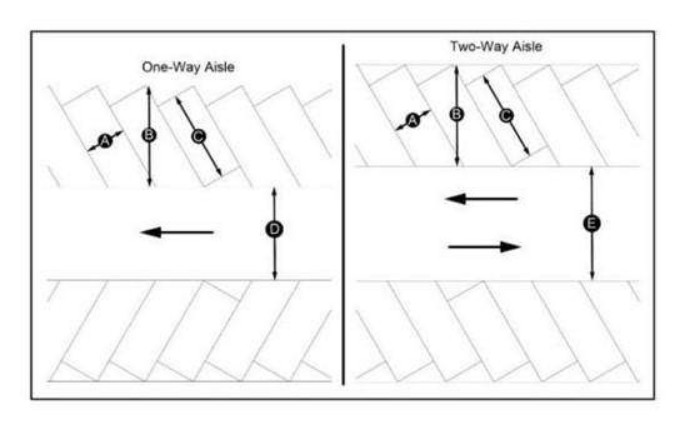
Figure 12.2 Illustrative Example Of 60 Degree One-Way And Two-Way Aisle Parking
- Parking Space Width Reduction.
- Low to Moderate Turnover Spaces: Low turnover spaces may include parking for employees, students, etc. These parking spaces are typically occupied for several hours at a time. These low turnover spaces can be as narrow as 8’ wide given that there is less frequent use. Low to moderate turnover spaces can be as narrow as 8.5’ (Offices, regional retail centers, long term parking, etc.)
- Moderate turnover spaces can be as narrow as 8.75’ wide (community retail, medical facilities, etc.)
- Minimum Garage Size for Residential. The minimum garage size for residential development shall be as follows:
TABLE 12.8
MINIMUM GARAGE SIZE FOR RESIDENTIAL DEVELOPMENTS
Type of Garage
Minimum Width
Minimum Depth
Minimum Square Footage
Single (Single-Family Detached, Duplexes, and Townhomes)
11 ft.
20 ft.
220 sq. ft.
Single (Multi-Family Residential)
10 ft.
18 ft.
180 sq. ft.
Double
20 ft.
20 ft.
400 sq. ft.
Triple
30 ft.
20 ft.
600 sq. ft.
- Note: These dimensions are to be measured from the interior of the garage.
- no encroachments (i.e. stairs, doors, etc.) are allowed within these minimum areas, except that the depth of one parking space in a double garage and triple garage may be reduced to a minimum of 18' to accommodate mechanical equipment for single-family detached, duplexes and townhomes.
- Location-Specific Parking Space Size Reduction.
- Location-Specific Parking Defined. The General Plan Future Land Use Map consists of areas that are planned for higher density, intensity and a greater mix of uses. These areas include Mixed-Use Corridors, MixedUse Areas, Business Park/Mixed-Use, Town Centers, Urban Districts and other non-residential uses. The properties shown within these areas may be eligible for reduced parking space sizes (See Table 12-9).
- parking space dimensions may be reduced in the following locations as described in the General Plan (Note: Areas outlined below are indicated on the Future Land Use Map.)
TABLE 12-9
LOCATION-SPECIFIC PARKING SPACE SIZE REDUCTION
Parking Space Dimensions
Standard
Semi-Compact
Compact
Mixed-Use Corridor
Mixed-Use Areas
Business Park/Mixed-Use
70%
20%
10%
Town Center
60%
30%
10%
Urban District
50%
40%
10%
Other Non-Residential Uses
80%
20%
-
HISTORY
Ord. No. 97-19, Enacted, 4/17/1997
Ord. No. 97-35, Recodified, 6/19/1997
Ord. No. 04-69, Recodified, 12/16/2004
Ord. No. 20-29, Amended, 9/17/2020
19.12.120 Access To Primary Building Entrances And Parking Areas
For commercial, industrial, mixed-use, public, and institutional buildings, at least one pedestrian pathway is required to connect from the public sidewalk to the primary entrance. A primary entrance is the main public building entrance. In the case where no public entrance exists, pathway connections shall be provided to the main employee entrance. A minimum 3' landscape buffer shall be provided along one side of the pathway between the building and the pathway.
- Design and Construction Standards for Pathways and Access Ways. At a minimum, all pathways and access ways shall conform to the following standards:
- Pathway and Access Way Minimum Width. The pathway or access way shall be a minimum of 5'wide.
- Vehicle Separation from Pathways and Access Ways. Pathways and access ways adjacent to a driveway, street (public or private), or parking spaces are to be raised 6"and curbed, and be separated from the parking lot by a buffer strip with a minimum width of 5'on each side of the pathway, utilizing bollards, lighting, landscape berming, or other physical barriers. The ends of the raised portions must be constructed with accessible curb ramps.
- Crosswalks. Where pathways and access ways cross parking areas, driveways, or private streets, they shall be clearly marked in accordance with ADA standards. Continuous pedestrian pavement materials are encouraged across such areas.
- Surface Materials. Pathway and access way surfaces shall be concrete and have a minimum width of 5' Pavers, brick, and other ornamental paving may be used if it has a smooth finish. Multi-use paths (e.g., bicycles and pedestrians), shall be concrete or asphalt and have a minimum width of 6'.
HISTORY
Ord. No. 97-19, Enacted, 4/17/1997
Ord. No. 97-35, Recodified, 6/19/1997
Ord. No. 04-69, Recodified, 12/16/2004
Ord. No. 17-13, Amended, 6/15/2017
Ord. No. 20-29, Amended, 9/17/2020
19.12.130 Parking Lot Improvement Requirements
Every parcel of land hereafter used as a public or private parking area, including commercial parking lots and automobile, equipment, or other open-air sales lots shall be developed and maintained in accordance with the following requirements:
- Lots shall be properly graded for drainage, surfaced with concrete, asphaltic concrete, asphalt, bricks or pavers, and other similar hard surfacing and maintained in good condition, free of weeds, dust, trash, and debris.
- The sides and rear of any off-street parking area for more than five vehicles which adjoins a residential or institutional building, or is contiguous to a residential zone, shall adhere to the landscape buffer screening requirements for adjacent uses as required in the underlying zone district. Where the zone district does not specify standards, the buffer shall be as required in Table 16-1 of Chapter 19.16 Landscaping and Fencing of Layton Municipal Code.
- Lots shall be provided with entrances and exits so located as to minimize traffic congestion in compliance with Sections 19.12.160 and 19.12.170 of Layton Municipal Code.
- Where parking spaces abut a building, parking spaces shall be provided with wheel or bumper guards at least 18" from a lot line or building, located so that no part of a parked vehicle will extend beyond the parking space.
- Lighting facilities shall be so arranged that they neither disturb occupants or adjacent residential properties or interfere with traffic.
- Lots shall be striped to indicate the number of parking spaces and the pattern of parking and circulation.
- All applications for a building or occupancy permit shall be accompanied by a plot plan showing the required parking spaces, with ingress and egress with a list of proposed uses and required parking spaces for each use based on building area, employees projections or other indicators. Said plan shall be reviewed and approved as outlined in Chapter 19.13 of Layton Municipal Code.
HISTORY
Ord. No. 97-19, Enacted, 4/17/1997
Ord. No. 97-35, Recodified, 6/19/1997
Ord. No. 04-69, Recodified, 12/16/2004
Ord. No. 20-29, Amended, 9/17/2020
19.12.140 Parking Structure Design Standards
- Setbacks. The parking structure shall comply with the minimum setback requirements, including all height adjustments for stepped buildings.
- Maximum Height. The parking structure shall comply with all height requirements, including the stepping back of the additional stories above grade.
- Parking Space Size Signage Requirements.
- signage shall be installed on reduced parking spaces to identify compact spaces for compact vehicles and over-sized spaces for over-sized vehicles.
- Parking Structure Appearance Requirements. Parking structures shall be designed to complement adjacent non-parking structures and blend in with the local man-made or natural environment. If the parking structure is adjacent to an existing or future building and it is adjacent to a right-of-way, the street-facing parking structure shall be designed with similar building materials with simulated window openings and a distinct base, middle and top. Parking structures shall meet the minimum design criteria:
- buildings must meet the ground with some form of base element or detailing to visually connect the building to the landscape. The base element or ground level story may be smooth concrete (architectural grade), masonry or stone;
- materials shall be applied to provide variation and break up large expanses of uninterrupted building surfaces. Exterior elevations shall incorporate design features such as vertical and horizontal relief elements along each face of the building facing a public right-of-way or public plaza;
- all buildings shall provide ground floor windows on the building facade and adjacent to a public or private street. Darkly tinted windows and mirrored windows are prohibited as ground floor windows;
- buildings with parking located on the ground floor within the footprint of the structure shall incorporate design features into street facing facades that are consistent with the remainder of the building design and that are pedestrian oriented. Features shall include elements typical of a front façade, including doors, false windows, planters, and/or architectural details providing articulation. False windows shall be integrated into the framing of the building and shall not consist of surface mounted features such as tacked on display cases. Required venting for parking areas, including louvered openings, shall not be located along a street facing façade.
- Smart Monitoring Systems. Smart monitoring systems are encouraged for public parking structures, to help motorists easily identify available parking. The system monitors the number of vehicles that enter and exit the parking structure and displays the number of occupied and vacant parking spaces.
- Way-finding and Lighting. Pedestrian access to parking structure entrances and circulation throughout the structure shall be clearly marked and sufficiently illuminated to provide for convenient and safe access.
HISTORY
Ord. No. 97-19, Enacted, 4/17/1997
Ord. No. 97-35, Recodified, 6/19/1997
Ord. No. 04-69, Recodified, 12/16/2004
Ord. No. 20-29, Amended, 9/17/2020
19.12.150 Loading Area Requirements
- No building shall be designed, erected, altered, increased in capacity, used, or occupied, and no land shall be used or occupied for manufacturing, storage, warehouse, goods display, department store, grocery, hotel, hospital, mortuary, laundry, dry cleaning, or other uses similarly involving the receipt or distribution, by vehicle, of materials or merchandise, unless adequate off-street loading space is provided therefore, excepting that off-street loading space need not be provided for buildings or uses actually occupied, operated, or used on the effective date of the ordinance codified herein, where no such space has been provided, unless such buildings are thereafter enlarged, increased in capacity, expanded, or have change of occupancy.
- Loading Space Berth Requirements. Each use for which off-street loading space is required shall provide the number of loading berths necessary to properly service that use, plus an area or means for adequate ingress and egress to each berth. Where any required or permitted loading dock or area is to be constructed in conjunction with a proposed use which is adjoining a residential zoning district, said loading dock or area shall be screened from the adjoining property by constructing a light-tight masonry wall or solid fence at least six feet tall. A landscape buffer may also be required which shall be maintained in perpetuity by the commercial/industrial use.
- Loading Space Location. Off-street loading space shall be located on the same site or lot as the use for which it is provided. No loading space shall be designed, arranged, or used where all or part of the space would permit loading, unloading, or service from a public street or sidewalk unless approved by Layton City in designated on-street parking areas.
- Loading Space Maintenance. Off-street loading facilities, either existing or hereafter provided, shall not thereafter be decreased, but shall be maintained in order to provide continuous use, if necessary.
HISTORY
Ord. No. 97-19, Enacted, 4/17/1997
Ord. No. 97-35, Recodified, 6/19/1997
Ord. No. 04-69, Recodified, 12/16/2004
Ord. No. 17-13, Amended, 6/15/2017
Ord. No. 20-29, Amended, 9/17/2020
19.12.160 Clear View Area For Driveways
The clear view area for the intersection of a drive approach and a public street or private street shall be located in the triangular areas bounded by lines drawn from a point on the driveway edge and the street right-of-way, measured as follows:
From the point of intersection of the driveway edge and the street right-of-way, measuring 20' along the property line away from the driveway (or 30' feet when intersecting with a collector or arterial street), and 10'along the edge of the driveway in toward the property. A line is then drawn from the termini of the two lines that extends along the same angle to the back of street curb, forming a triangle. This is required on both sides of the driveway. Within the triangles and the area between them, the following shall apply:
- No view obstructing fence, wall, hedge, or planting exceeding 2'in height above the level of the sidewalk.
- Shade trees may be located or maintained in clear view areas in excess of the maximum planting height provided the same are pruned clear of all branches from the ground to a height of seven feet. Trees overhanging public sidewalks or streets shall comply with all requirements of 19.16.110.
- Non-view obstructing fences (75% open) not exceeding 6'in height may also be allowed in this area.
- The City Engineer and Zoning Administrator or their designees may require additional clear view area based on sight distance visibility associated with the horizontal or vertical curves of the intersecting street.
HISTORY
Ord. No. 97-19, Enacted, 4/17/1997
Ord. No. 97-35, Recodified, 6/19/1997
Ord. No. 01-36, Amended, 8/2/2001
Ord. No. 01-47, Amended, 10/4/2001
Ord. No. 04-69, Recodified, 12/16/2004
Ord. No. 09-09, Amended, 7/16/2009
Ord. No. 12-33, Amended, 12/20/2012
Ord. No. 17-13, Amended, 6/15/2017
Ord. No. 20-29, Amended, 9/17/2020
19.12.170 Access To Residential Property Including Four Or Less Dwellings
- Access to parking spaces and private garages used in conjunction with dwellings shall be limited as follows: (See Diagram A-9)
- driveways shall be located a minimum of 50' from any street intersection. Said measurement shall be taken from the point of intersection of the two converging curbs (top back of curb) lying tangent to and in the same direction as the front lot lines, to the edge of the driveway.
- A driveway on private property may be constructed up to the side or rear property line so long as the driveway does not interfere with the surface drainage of the lot or adjacent lots where drainage easements are provided. The drainage from the driveway must be kept within the property.
- Hammerhead turnarounds on driveways shall be a minimum width of 10' and a minimum depth of 20' with a minimum 18' radius to allow a vehicle to exit the property forward-facing.
- Driveways shall be paved with a hard surfaced material such as concrete, asphalt, masonry, pavers or similar materials.
- Lots with less than 100' of frontage shall be limited to a maximum of two driveway approaches under the following criteria:
- the front yard area including driveways shall not exceed 50% hard surface in total;
- the total width of driveway approaches shall not exceed 35' and shall be separated by 30' measured from the two inside edges of the driveway approaches;
- both approaches must meet all separation requirements between driveway approaches and from side property lines;
- combined driveway approaches shall not exceed 35'or 35% of the property frontage whichever is more (see Table 12-10).
- corner lots are allowed one driveway approach per frontage with a maximum of two approaches, the sum of which shall not exceed a maximum combined total of 1.5 times the allowed driveway width as provided in Table 12-10.
- Lots with more than 100 feet of frontage may have up to two driveway approaches along one street frontage, with an additional driveway approach that may be allowed under the following circumstances:
- corner lots may be allowed an additional driveway approach on either street frontage for a maximum of three approaches, the sum of which shall not exceed a maximum combined total of 1.5 times the allowed driveway width as provided in Table 12-10;
- corner lots having a frontage of at least 100 feet on a local or collector street may have two driveway approaches on a single frontage, the total width of which shall not exceed 35 feet and shall be separated by 30; measured from the two inside edges of the driveway approaches;
- inside lots having a frontage of at least 100', but less than 200', may have two driveway approaches with a total width of not more than 35'. The two approaches shall be separated by a minimum of 30' measured from the two inside edges of the drive approaches;
- lots having a frontage of 200' or more may have two drive approaches each of which may have a width of not more than 35 feet. The two drive approaches shall be separated by a minimum of 50' measured from the two inside edges of the drive approaches.
- Lots that are double fronted with one frontage on an arterial street, or corner lots with frontage on an arterial street, shall not be allowed to have a drive approach on the arterial street.
- Circular Driveways shall be regulated as follows:
- the front yard area including driveways shall not exceed 50% hard surface in total;
- both approaches must meet all separation requirements between driveway approaches based on length of frontage and from side property lines based on width of park strip;
- the interior area created by the circular drive shall be landscaped and shall not be paved with hard surface;
- circular driveways shall have an inside radius of 18'.
- The width of a residential property driveway approach is regulated as follows:
TABLE 12-10
RESIDENTIAL PROPERTY DRIVEWAY APPROACH
Zoning District
Minimum Width
Percentage Of Frontage Allowed In Approach
Maximum Width
A
10'
40%
40'
R-S
10'
35%
35'
R-1-6
10'
35%
35'
R-1-8
10'
35%
35'
R-1-10
10'
35%
35'
R-MH
10'
33%
32'
R-2
10'
33%
32'
R-M1
10'
33%
32'
R-M2
10'
33%
32'
R-H
10'
33%
32'
- The percentage of frontage indicated in Subsection 7 above shall be inclusive of all drive approaches allowed on any one frontage of a lot. In the R-S, R-1-6, R-18 and R-1-10 zoning districts, the primary frontage may have a drive approach of at least 20'. In no case shall said drive approach be less than 10' wide as indicated in Subsection 7 above.
- A drive approach shall be measured from a point where the driveway intersects with the street property line (or inside edge of sidewalk) at a distance of no closer than 4.5' from the side property line. The driveway taper section shall be no wider than 3.5' measured along the back of the street curb, as required in Engineering Street Standard 06 ‘Typical Drive Approach.
HISTORY
Ord. No. 97-19, Enacted, 4/17/1997
Ord. No. 97-35, Recodified, 6/19/1997
Ord. No. 99-55, Amended, 11/4/1999
Ord. No. 04-69, Recodified, 12/16/2004
Ord. No. 06-07, Amended, 2/16/2006
Ord. No. 17-13, Amended, 6/15/2017
Ord. No. 20-29, Amended, 9/17/2020
19.12.180 Access To All Other Uses
Access to all uses not listed herein above, including parking lots, mobile home developments, business, and industrial uses, shall be limited as follows:
- Location of driveway. Location of driveway where access is provided by one driveway or two or more connecting driveways shall be as follows: (See Diagram A-10 Update.)
- access shall be by not more than one driveway for the first 100' of frontage and one additional driveway for each additional 150' of frontage. For lots with more than 175' and less than 250' of frontage, two driveways may be allowed by the Zoning Administrator;
- no two of these driveways shall be closer to each other than 50' and no driveway shall be closer than 20' to a side lot line, except as granted by the Zoning Administrator;
- driveways are to be located as approved by the City Staff.
- driveways on an arterial or collector street shall be located no closer than 80' the point of intersection, unless an exception is approved by the City Engineer and Zoning Administrator or their designees;
- for any local street intersecting a collector or arterial street, driveways on a local street shall be a minimum of 50' from the point of intersection unless an exception is approved by the City Engineer and Zoning Administrator or their designees;
- for all local streets, the minimum distance for a driveway from any intersection of such streets shall be 50' measured from the top back of curb;
- where a traffic signal either exists, or is anticipated at any street intersection, the setback for any driveway from that intersection shall be a minimum of 200' unless an exception is granted by the Zoning Administrator and City Engineer or their designees. The distance shall be measured from the point of intersection of the two converging curbs (top back of curb) of two lines lying tangent to and in the same direction as the front lot lines. No driveway shall be located across any curved section of frontage lying between the point of intersection and the point of tangency.
- lots with frontages of 150' or less are encouraged to share access to streets with adjacent lots. Where this is feasible, the Zoning Administrator may require joint access on any width lot(s). Where it is determined to be infeasible an exception may be granted by the Zoning Administrator;
- the design, location, and width of all driveways entering a state highway shall be done as required by the Utah Department of Transportation. Approval of the driveway(s) shall be provided to the City in writing prior to the issuance of any building permit;
- Width of driveway approach. Each driveway shall have a width of not less than 20' nor greater than 35'in width on local and collector streets. On City arterial streets the width shall not be less than 28', nor exceed 40' in width. The measurement of a driveway approach shall be taken at right angles to the centerline of the driveway at the front lot line and shall be from face to face of the curb radii, or at a point a flared approach meets the typical location of the side.
HISTORY
Ord. No. 97-19, Enacted, 4/17/1997
Ord. No. 97-35, Recodified, 6/19/1997
Ord. No. 04-69, Recodified, 12/16/2004
Ord. No. 20-29, Amended, 9/17/2020
19.12.190 Parking And Storage Of Recreational Vehicles On Property Zoned Residential
- Parking Location Restrictions. Recreational vehicles parked or stored at a residence shall be accessed from and located next to an approved driveway leading to a garage or carport, and shall be located at least 10' from the public right-of-way. Such vehicles shall be placed on a hard surface, which may include compacted gravel or road base that is adjacent to a paved driveway. Only one such vehicle may be parked within the appropriate front yard setback area. All recreational vehicles parked or stored on a residential lot must be owned by the property owner or by an occupant who resides at the residence as their primary residence. Refer to Title 10.62.010 Parking During Winter Months.
HISTORY
Ord. No. 20-29, Enacted, 9/17/2020
19.12.200 Parking Of Commercial Vehicles On Property Zones Residential
- Parking Location Restrictions. Commercial vehicles, such as utility, service, or delivery vehicles parked or stored at a residence must be located within the rear or side yard of the home. Such vehicles may only park within the front yard of a home if it is physically impossible due to natural topography or property boundaries to locate a commercial vehicle within the rear or side yard of the home.
- Restricted Parking Area. No commercial vehicle shall park or extend within the restricted parking area. The restricted parking area is defined as follows:
- Interior Lots (Non-Corner Lots).
- any area in which parking or storing of the commercial vehicle would create a traffic visibility hazard;
- commercial vehicles complying with adopted home occupation standards (19.06.030) shall be accessed from and located next to an approved driveway leading to a garage or carport, and shall be located at least 10' from the public right-of-way. Such vehicles shall be placed on a hard surface, which may include compacted gravel or road base that is adjacent to a paved driveway. Only one such vehicle may be parked within the appropriate front yard setback area. All commercial vehicles parked or stored on a residential lot must be owned by an occupant who resides at the residence;
- semi-tractors and/or semi-trailers shall not be parked on a residential lot;
- Corner Lots. Both frontages shall comply with those standards outlined for parking or storage of commercial vehicles on interior lots and nothing shall intrude into the corner site visibility triangle (clear view area) as defined by this Title.
- Prohibited Parking Locations. Commercial vehicles shall not be parked or stored within the street right-of-way.
- Number of Commercial Vehicles Permitted. Only one such vehicle may be parked on a residential lot. A commercial vehicle parked or stored on a residential lot must be owned or apportioned by an occupant who resides at the residence.
- Enforcement. The authority to enforce the provisions of this section shall be vested in the Layton City Police Department and with the Community and Economic Development Department.
HISTORY
Ord. No. 20-29, Enacted, 9/17/2020
19.12.210 Permits And Certificates Of Occupancy
No permit for any contemplated use or building shall be issued unless the location of the driveways for vehicular access to the property is shown on the plot plan and no certificate of occupancy shall be issued or approved unless and until the requirements of this chapter have been complied with in full.
HISTORY
Ord. No. 20-29, Enacted, 9/17/2020

