
Layton City City Zoning Code
19.25 Mixed-Use
MU Zoning District
19.25.010 Purpose And Intent
The purpose of the Mixed-Use (MU) zoning district is to provide locations for developments that either combine commercial or retail uses with multi-family residential uses in a building, or provide mixed-uses in separate buildings within close proximity to other uses along a corridor or within a walkable district. By allowing a mix of uses, residential uses can be located within close proximity to jobs, shopping, and entertainment opportunities to increase pedestrian activity and neighborhood vitality.
HISTORY
Ord. No. 08-40, Enacted, 8/7/2008
Ord. No. 19-07, Amended, 1/17/2019
19.25.020 Permitted And Conditional Uses
- See Chapter 19.06, Table 6-2 of this Title.
- The following land uses may not be located on individual pad sites or parcels. They must be part of a larger building or physically connected and integrated into the complex or project.
- General retail/commercial – 40,000 square feet per tenant or floor.
- Grocery store.
- Indoor amusement.
- Fast food.
- Theater – indoor.
- Upon approval of the development plan by the Land Use Authority as defined in Section 19.01.135, all uses allowed in the development plan shall be processed as if they are permitted uses.
HISTORY
Ord. No. 08-40, Enacted, 8/7/2008
Ord. No. 17-13, Amended, 6/15/2017
Ord. No. 19-07, Amended, 1/17/2019
19.25.030 Dimensional Standards
See Chapters 19.05 and 19.06 of this Title for development regulations specific to professional, commercial, and manufacturing zoning districts and the regulations found in Table 5-2 and Table 6-2. Where these provisions are in conflict with the requirements of this Chapter, the requirements of this Chapter shall apply.
HISTORY
Ord. No. 08-40, Enacted, 8/7/2008
19.25.040 Density And Intensity
- The appropriate density and intensity of a Mixed-Use site shall be defined by the uses contained within the building(s) on a site, based on the following bulk plane (building height and setback) limitations:
- The maximum building height shall be three stories and 35', except where the zoning map identifies the Mixed-Use Design Overlay District (DO-1) where, the maximum building height shall be six stories and 72' (see Table 25-1).
Table 25-1
Height and Separation Standards
Height
Distance from Single-Family
Residential
DO-1 Overlay Zone
Required?
Minimum Front Setback
from Street
Maximum Front Setback
from Street
2 stories & 28'
20'
No
7'
12'
3 stories & 35'
40'
No
7'
12'
4 stories & 48'
85'
Yes
7'
12'
5 stories & 60'
300'
Yes
7'
12'
6 stories & 72'
300'
Yes
7'
12'
- To buffer potential sound impacts from the Mixed-Use site onto an adjacent single family residential use, either of the following buffer options shall apply:
- a minimum eight-foot high solid masonry fence shall be installed and maintained along the property boundary shared with off-site single family residential uses. A ten foot landscape buffer shall be installed along the fence, and shall include trees spaced every 25', with shrubs that provide coverage of at least 60% of the landscape surface area at mature growth, or
- a minimum six-foot high solid fence shall be installed and maintained along the property boundary shared with off-site single family residential uses; garages containing a solid roof and rear wall, or covered parking canopies with a solid canopy and slatted rear walls shall be installed no closer than two feet from the fence. Access to the area between the garage/carport wall and the fence shall be gated and locked to restrict access for maintenance purposes only.
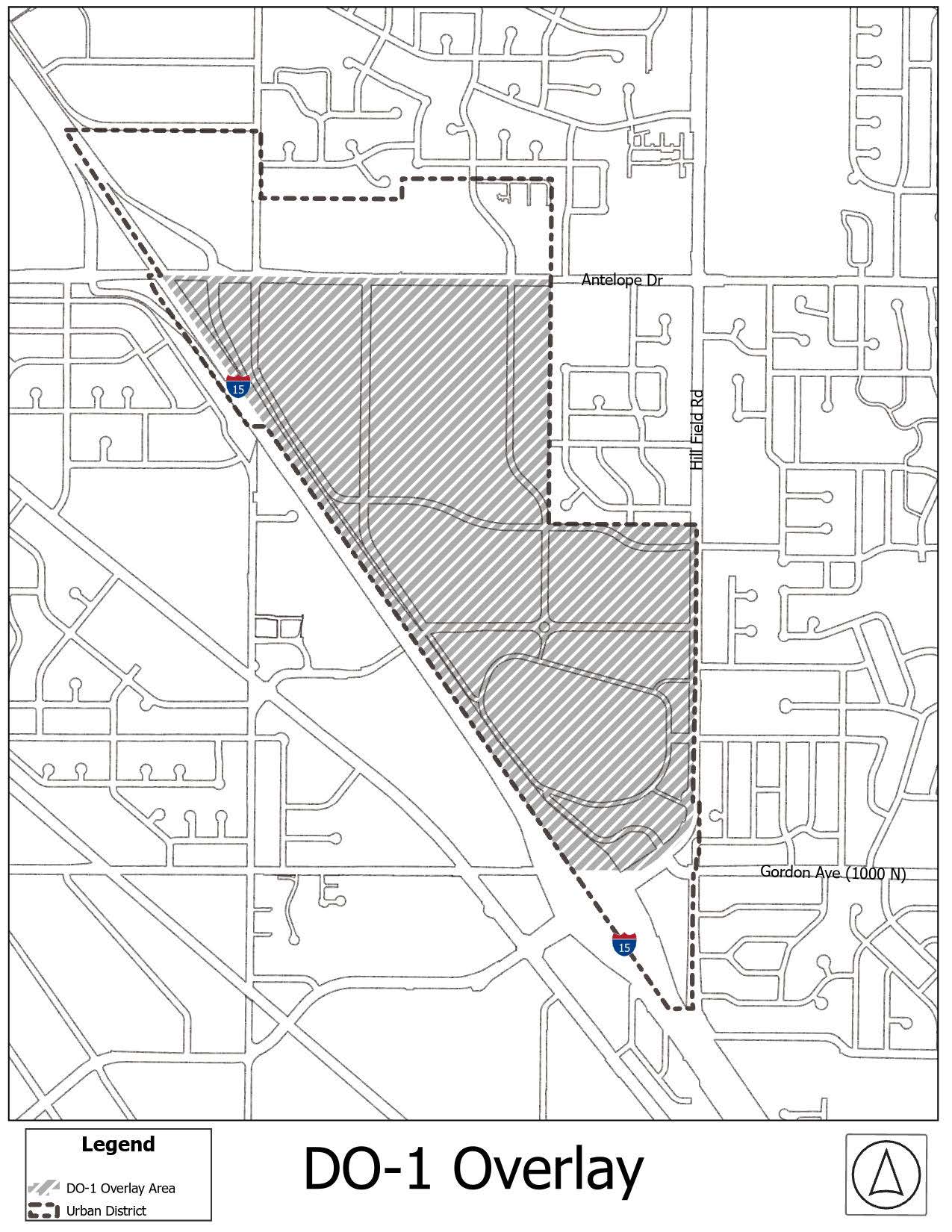
- DO-1 overlay shall only be permitted in areas east of Interstate 15, south of Antelope Drive, west of North Hill Field Road, north of 1000 North coordinate, and identified as an Urban District in the General Plan Future Land Use Map (see Map 25-1).
Map 25-1
HISTORY
Ord. No. 08-40, Enacted, 8/7/2008
Ord. No. 19-07, Amended, 1/17/2019
Ord. No. 20-38, Amended, 11/19/2020
Ord. No. 23-06, Amended 5/4/2023
19.25.050 Development Plan
- The property owner shall prepare and submit a proposed development plan for the subject property for review and approval by the Land Use Authority. The Development Staff review of a development plan shall comply with the process and criteria outlined in 19.03 of the Layton City Municipal Code as well as the requirements listed herein.
- A Design Review Committee for mixed-use development plans shall be established by Layton City. The Committee shall be responsible for providing support and recommendations to the staff regarding basic design elements as presented in the mixed-use development plan.
- The Land Use Authority shall select a group of at least five members who are professionals from among the fields of architectural design, landscape architecture, urban design, architectural history, planning, and engineering.
- The Committee shall receive copies of the development plan and design elements and together with staff, shall review all design aspects of the preliminary plan, landscaping plans, and building elevations. The Committee may provide written input to staff or a formal meeting may be scheduled to review the proposed project.
- The development plan guides all development within a particular project and at a minimum shall include a site plan, a pedestrian connection/trail plan, conceptual building elevations and design schemes, streetscape, and setback diagrams, an accurate legal description or survey, plus any other information typically required for site plan review.
- The general categories and land uses proposed within a mixed-use project shall be specified in the development plan. The approved development plan shall be considered an integral part of the zoning regulations for the subject area. Substantial variation between the development plan and the final site plan requires approval by the Land Use Authority. A substantial variation is any addition, modification, or alteration to a building or site plan that exceeds 20% of the gross floor area, site acreage, or exterior building surface or any change in use greater than five percent of the total project floor area. All modifications must meet the minimum standards required by this ordinance.
HISTORY
Ord. No. 08-40, Enacted, 8/7/2008
Ord. No. 17-13, Amended, 6/15/2017
Ord. No. 24-03, Amended 1/18/2024
Ongoing ordinance history can be viewed by clicking the gavel in the top right corner.
19.25.060 Specific Design Standards
- General requirements. The following design standards shall be required of all development in the mixed-use zoning district in order to create a cohesive appearance that is pedestrian friendly and which encourages travel by public transportation, bicycling, van pooling, and car pooling.
- Wherever practical, buildings shall incorporate arcades, roofs, alcoves, porticos, and awnings that protect pedestrians from the rain and sun.
- Trash storage areas, mechanical equipment, transformers, air conditioning units, meters, and similar devices are not permitted to be visible from the street, or to be located on patios/balconies associated with a residential unit. Where site constraints would otherwise force these uses into visible locations, they shall be screened by decorative walls, earthen berms, landscaping, or architectural treatments capable of screening views from streets and sidewalks. If in rooftop locations, mechanical equipment shall be screened by roof components, parapets, cornices, or other architectural features.
- All uses located in the zoning district shall be conducted entirely within a fully enclosed building. There shall be no outside storage of materials or equipment, other than motor vehicles licensed for street use except as specifically approved by the Land Use Authority in conjunction with a conditional use application.
- Primary building orientation shall be toward the street. Buildings that are open to the public and are within 30' of the street shall have an entrance for pedestrians from the street to the building interior. This entrance shall be designed to be attractive and functional, be a distinctive and prominent element of the architectural design, and shall be open to the public during all business hours.
- Buildings shall incorporate exterior lighting and changes in mass, surface, or finish to give emphasis to entrances.
- Buildings shall provide a clear visual division between all floors. The top floor of any building shall contain a distinctive finish, consisting of a roof, cornice, or other architectural termination.
- The façade of every residential floor greater than 30' lineal feet with street frontage shall incorporate features designed to provide human scale and visual interest. Compliance can be achieved through balconies, alcoves, or wall segments that create at least a two foot variation in plane for at least ten lineal feet within each 30' segment of façade.
- In paseos, plazas, and courtyards, lighting shall incorporate fixtures and standards designed for pedestrian areas.
- All new utility transmission lines shall be placed underground.
- At least 75% of the lineal frontage of any ground floor, non-residential wall with street frontage shall incorporate windows, doors, or display windows.
- First floor requirements. Multi-story buildings with non-residential uses on the ground floor shall have a first floor minimum height of 12' to the second floor, except that live/work units not fronting onto Main Street that may be used for residential and/or commercial uses shall have a minimum floor to ceiling height of nine feet. Non-residential uses on the first floor shall have walls, partitions, and floor/ceiling assemblies separating dwelling units from other spaces. When operated, any equipment, machines and instruments shall not emit a noise level greater than 85 decibels (dB), and shall not emit detectable vibration, dust, odor, fumes or gas beyond the boundary of the property or noise above ambient level (size limit). Interior noise levels associated with business operations and machines may be increased above 85 dB if interior building sound attenuation is applied to mitigate any sound increase that would otherwise transmit into attached commercial or residential units.
- For development sites greater than 20,000 square feet, primary uses shall be incorporated into a project where at least 80% of the floor plate area of new buildings is constructed at a minimum of two stories in height.
- No drive-through shall be allowed between the building and the public street right-of-way.
- All truck loading and pick-up shall be provided at the rear, or side of a building. Pick-up and deliveries are limited between the hours of 7:00 a.m. and 10:00 p.m. for all non-residential uses except for restaurant, fast food eating establishment, and grocery retail.
- Light Commercial Flex Manufacturing uses shall provide a front retail/showroom area to provide products for sale to the general public.
- Pole signs and/or box panel cabinet signs are not permitted.
- DO-1 Overlay Design Criteria.
- Residential units shall incorporate an outdoor living space with a minimum depth of five feet and a minimum square footage of 50 square feet. When considered to be the primary entrance to a residential unit, the area directly in front of the door measuring three feet wide and running the depth of the entry feature shall not be counted towards the minimum depth or square footage. Utilities shall not be placed in the patio/balcony areas.
- Ground floor residential units adjacent to a sidewalk shall incorporate a primary entrance to each residential unit including a walkway connecting the residential unit to the sidewalk.
- To preclude large expanses of uninterrupted building surfaces, exterior elevations shall incorporate design features such as offsets, balconies, projections, or similar elements along each face of the building facing and visibly parallel to a public right-of-way or public plaza. Along the vertical face of the structure, offsets shall occur at a minimum of every 30 linear feet by providing any two of the following:
- recesses (elevated decks, patios, entrances, etc.) with a minimum depth of four feet, or
- extensions (elevated decks, patios, entrances, floor area, etc.) with a minimum depth of four feet, or
- offsets or breaks in roof elevations of three or more feet in height.
HISTORY
Ord. No. 08-40, Enacted, 9/3/2008
Ord. No. 17-13, Amended, 6/15/2017
Ord. No. 19-07, Amended, 1/17/2019
Ord. No. 20-38, Amended, 11/19/2020
Ord. No. 23-02, Amended 1/3/2023
Ord. No. 23-06, Amended 5/4/2023
19.25.070 Pedestrian And Vehicle Circulation
The following site design standards shall apply to all development within the Mixed-Use zoning district:
- Public right-of-way shall be wide enough to incorporate bike lanes and sidewalks at least eight feet in width along buildings containing non-residential uses.
- Public seating and bicycle racks shall be provided near entrances to buildings or groups of buildings.
HISTORY
Ord. No. 08-40, Enacted, 8/7/2008
Ord. No. 19-07, Amended, 1/17/2019
19.25.080 Landscaping
The following site landscaping standards shall apply to all new development in the mixed-use zoning district. Species shall be selected from the approved plant list provided herein.
- Street trees shall be provided on all street frontages at a maximum spacing of 30' on center.
- Street trees shall be planted within a landscape strip of at least six feet in width, between the roadway and sidewalk where feasible.
- Street trees shall be planted no closer than 20' to light standards.
- All areas of a developed site not occupied by buildings, required parking, driveways, walkways, or service areas shall be landscaped according to an approved landscaping plan. These areas may also incorporate hardscape for patios, plazas, and courtyards.
- Parking areas shall be shaded by large broadleaf canopied trees placed at a rate of one tree for each 12 parking spaces. Parking shall be adequately screened and buffered from adjacent uses.
HISTORY
Ord. No. 08-40, Enacted, 8/7/2008
19.25.090 Parking
Parking shall be provided in accordance with Chapter 19.12 of this ordinance. In addition, the following provisions shall apply:
- Parking areas shall be located behind or on either side of the building(s). Parking may not be located between a building and the street.
- Where feasible, pedestrian walkways shall be incorporated into parking lots of any size. Parking lots with more than 100 spaces shall be divided by landscaped areas including a walkway at least ten feet in width.
HISTORY
Ord. No. 08-40, Enacted, 8/7/2008
Ord. No. 19-07, Amended, 1/17/2019
Ord. No. 23-06, Amended 5/4/2023
19.25.100 General Design Guidelines
- Integrate building setback areas and setback design with adjacent streets to support pedestrian emphasis by:
- Integrating building setback areas that function as extensions of the sidewalk along main streets.
- Incorporating landscape plantings and/or trees along streets.
- Developing a strong street orientation along residential and commercial streets.
- Minimizing or restricting vehicle access to residential areas from high volume streets.
- Enhance connection between buildings, sidewalks, and pedestrian pathways by:
- Incorporating large ground floor windows facing the sidewalk.
- Expanding the "sidewalk level" of the building.
- Emphasizing the visual connection at the ground level.
- Incorporating a coherent design theme for lighting fixtures and directional signs.
- Orienting main entrances and/or lobbies to the sidewalk.
- Integrate building mechanical equipment and service areas by:
- Consolidating and/or sharing motor vehicle access points.
- Placing mechanical and utility equipment where it will not impact the pedestrian environment.
- Convey design quality and building permanence by:
- Developing residential buildings that provide foundations for new communities.
- Using a palette of building materials that conveys a high level of craftsmanship and attention to detail.
- Making design decisions involving the building's exterior that increase the building's "visual texture."
- Designing buildings to be flexible.
- Integrate the different sidewalk-level building elements with the building's architecture to enhance pedestrian experience by:
- Integrating signage systems that are consistent with the building's overall design.
- Using integrated systems of building elements to provide a human scale at the ground level.
- Utilizing building elements to help transition pedestrian space.
- Designing landscaping into the building.
- Integrating works of art into a building or site design.
- Integrate the different parts of a building to achieve a coherent design by:
- Accentuating the different programmatic functions in a building.
- Expressing the base, middle, and top of a building.
- Design encroachments to enhance the pedestrian environment by:
- Integrating works of art.
- Developing larger scale encroachments that are expressive of the community.
- Integrating building elements that project into the public right-of-way.
- Developing encroachments that emphasize transitions.
- Integrate rooftop components and screening elements with the building's architecture, integrate exterior lighting, signs, sign lighting, and any elated structural equipment at or near the roof with the building's architecture by:
- Developing rooftop terraces or gardens.
- Integrating rooftop screening with the building's overall design.
- Using signs and sign lighting that is integrated with the building architecture.
- Using lighting to reveal the buildings architectural systems.
- Using lighting to highlight special features of the building.
- Ecological and sustainable features or concepts to be integrated with site and development designs by:
- Adaptively reusing buildings or building materials, where appropriate.
- Developing multifunctional storm water management areas.
- Integrating eco-roofs, or similar permeable building roofing systems.
- Incorporating storm water management systems into surface parking areas.
- Integrate pedestrian-oriented space opportunities at building corners facing street intersections and locate entrances to the upper floors of these buildings toward the middle of the block by:
- Developing a design that enhances opportunities for retail.
- Emphasizing the higher visibility of the corner location.
- Enhance transitions at gateway locations by:
- Using formal gateways to emphasize transitions.
- Developing gateway buildings.
- Incorporating works of art and/or fountains as gateways.
- Integrating sidewalk markers and directional signage.
- Incorporating special landscape plantings and/or arrangements at gateway locations.
- Incorporate building designs with adjacent open spaces by:
- Orienting the main entrances of buildings to face adjacent parks or open spaces.
- Considering the open space's purpose in the design and functions of proposed adjacent buildings.
- Developing small plazas along pedestrian routes.
- Integrating elements within pocket parks to serve adjacent uses.
- Developing new buildings that are oriented to adjacent open spaces without dominating them.
- Developing privately-owned open spaces that are supportive of adjacent uses, streets, and buildings.
- Develop, orient, and careen parking areas to be compatible with adjacent buildings and the pedestrian environment by:
- Incorporating complementary above-grade structured parking.
- Developing integrated screening systems for surface parking areas that are adjacent to the sidewalk.
- Creating on-grade plus one suspended parking level incorporating exterior streets as parking access to minimize ramping.
- Promoting sub-grade level parking, where appropriate.
- Promoting pedestrian-friendly surface parking areas.
- Design buildings to emphasize pedestrian views to focal points, wayfinding markers, public amenities, and the surrounding mountains by:
- Developing building elements that offer new wayfinding markers.
- Emphasizing pedestrian views to focal points or wayfinding markers.
- Using landscape plantings to embellish views down streets or from building spaces.
- Emphasizing local wayfinding markers with new development.
HISTORY
Ord. No. 08-40, Enacted, 8/7/2008

