
Leeds City Zoning Code
ARTICLE A
X - SIGN REGULATIONS1
Editor's note— Ord. No. 2019-03-03, § 1, adopted March 18, 2019, repealed the former Art. X, §§ 1.00—26.00, and enacted a new Art. X as set out herein. The former Art. X pertained to similar subject matter and derived from Ord. No. 2015-06-06, 6-15-2015.
10.01 - Purposes and intent
It is the purpose of this Article X to promote the public health, safety and general welfare through reasonable, consistent and non-discriminatory sign standards. The sign regulations in this Article are not intended to censor speech or to regulate viewpoints, but instead are intended to regulate the adverse secondary effects of signs. The sign regulations are especially intended to address the secondary effects that may adversely impact aesthetics and traffic and pedestrian safety. The sign regulations are designed to serve substantial governmental interests and, in some cases, compelling governmental interests such as traffic safety and warning signs of threats to bodily injury or death. This Article is not intended to extend its regulatory regime to objects that are not traditionally considered signs for purpose of government regulation.
In order to preserve and promote the City of Leeds as a desirable community in which to live, visit, work, play and do business, a pleasing, visually attractive and safe environment is of foremost importance. The regulation of signs within the City is a highly contributive means by which to achieve this desired end. Further it continues to be the purpose of this Article X to promote optimum conditions for serving sign owners' needs and respecting their rights to identification while balancing the aesthetic and safety interests of the community. The regulation of signs within the City of Leeds is necessary and in the public interest, and these regulations have been prepared with the intent of enhancing the visual environment of the City and promoting its continued well-being, and are intended more specifically to:
A.
Aesthetics. To maintain and enhance the beauty, unique character, aesthetic environment, and quality of the City of Leeds, that will attract commerce, businesses, economic development, residents and visitors; to preserve, conserve, protect, and enhance the aesthetic quality and scenic beauty of all zoning districts of the City; to regulate the appearance and design of signs in a manner that promotes and enhances the beautification of the City and that complements the natural surroundings in recognition of the City's reliance on its natural surroundings and beautification efforts in retaining economic advantage for its community; and to assure that the benefits derived from the expenditure of public funds for the improvement and beautification of streets, sidewalks, public parks, public rights-of-way, and other public places and spaces, are protected by exercising reasonable controls over the physical characteristics and structural design of signs.
B.
Traffic and Pedestrian Safety. To maintain and improve traffic and pedestrian safety through properly located signs; to regulate signs in a manner so as to not interfere with, obstruct the vision of, or distract motorists, bicyclists or pedestrians; to allow for traffic control devices consistent with national standards and whose purpose is to promote roadway safety and efficiency by providing for the orderly movement of road users on streets and roadways, and that notify users of regulations and provide warning and guidance necessary for the safe, uniform and efficient operation of all elements of the traffic stream;
C.
Economic Development. To promote economic development and the value of non-residential properties, through sensitivity to surrounding land uses and maintaining an attractive community appearance.
D.
Effective Communication. To encourage signs which are clear and legible; to encourage the effective use of signs as a means of communication;
E.
Historical Character. To emphasize small City historical character by promoting pedestrian oriented and appropriately scaled signage in the Historic Zoning District;
F.
Identification of Goods and Services. To aid the public and private sectors in identifying the location of goods and services.
G.
Compatibility with Surroundings. To allow signs that are compatible with their surroundings and aid orientation, while precluding the placement of signs that contribute to sign clutter or that conceal or obstruct adjacent land uses or signs; to preclude signs from conflicting with the principal permitted use of the site and adjoining sites; and to minimize the possible adverse effect of signs on nearby public and private property;
H.
Reduction of Visual Clutter. To reduce visual clutter that may otherwise be caused by the proliferation, improper placement, illumination, animation, excessive height, and excessive size (area) of signs which compete for the attention of pedestrian and vehicular traffic;
I.
Zoning District Considerations. To encourage and allow signs that are appropriate to the zoning district in which they are located;
J.
Scale, Integration and Design. To establish sign size in relationship to the scale of the lot and building on which the sign is to be placed or to which it pertains; to foster the integration of signage with architectural and landscape designs; to provide flexibility and encourage variety in signage, and to relate signage to the basic principles of good design; and to promote the use of signs that positively contribute to the aesthetics of the community, are appropriate in scale to the surrounding buildings and landscape, and advance the City's goals of quality development;
K.
Maintenance and Safety. Except to the extent expressly preempted by state or federal law, to ensure that signs are constructed, installed and maintained in a safe and satisfactory manner, and to protect the public from unsafe signs;
L.
Property Values. To protect property values by precluding, to the maximum extent possible, sign types that create a nuisance to the occupancy or use of other properties as a result of their physical characteristics such as their size (area), height, number, illumination and movement; and to protect property values by ensuring that the number of signs are in harmony with buildings, neighborhoods, and conforming signs in the area;
M.
Enforcement. To enable the fair and consistent enforcement of these sign regulations; and to provide standards regarding the non-communicative aspects of signs, which are consistent with local, county, state and federal law.
(Ord. No. 2019-03-03, § 1(Exh. A), 3-18-2019)
10.02 - Title and authority
A.
This Article may be known as the Sign Code of the City of Leeds, Alabama.
B.
This Article is adopted pursuant to the police power of the City and State law (Volume 10, Title 11, Chapter 52, Code of Alabama), and the Development Services Zoning Administrator, or his designee is authorized and directed to administer and enforce this chapter.
(Ord. No. 2019-03-03, § 1(Exh. A), 3-18-2019)
10.03 - Exempt signs
The following signs are exempt from regulation under this Article X:
A.
Government Signs, including signs erected by the City for government purposes.
B.
Signs located entirely inside the premises of a building or enclosed space, other than Window Signs.
C.
Signs on a vehicle, other than an Unlawful Vehicle Sign.
D.
Signs protected by state statute.
E.
Traffic Control Device Signs.
(Ord. No. 2019-03-03, § 1(Exh. A), 3-18-2019)
10.04 - Prohibited signs
The following signs are prohibited in the City of Leeds unless protected by state statute, or otherwise allowed in this Article X Sign Regulations.
A.
Abandoned Signs.
B.
Animated Signs.
C.
Balloon Signs.
D.
Billboards.
E.
Blinking Signs.
F.
Flashing Signs.
G.
Inflatable Signs.
H.
Intermittent Signs.
I.
Moving Signs.
J.
Offsite Commercial Signs.
K.
Pole Signs.
L.
Reflective Signs.
M.
Rotating Signs.
N.
Scrolling Signs.
O.
Signs attached or painted on trees, rocks or natural features.
P.
Signs in the right-of-way.
Q.
Signs installed, attached or painted on fences.
R.
Signs or sign support structures that obstruct means of egress, including any fire escape, any window, any door opening, any stairway, any opening, any exit, any walkway, any utility access or Fire Department connection.
S.
Signs that interfere with any opening required for ventilation.
T.
Signs resembling Traffic Control Device Signs.
U.
Signs with exposed raceways.
V.
Snipe or Bandit Signs.
W.
Unlawful Vehicle Signs.
(Ord. No. 2019-03-03, § 1(Exh. A), 3-18-2019)
10.05 - Sign plans and sign program
A.
Historic Sign Plans. A Historic Sign Plan shall be required for a sign proposed within the Historic Zoning District for single or multiple-tenant commercial or office uses, or for a multiple-building complex for a single commercial use. The Redevelopment Commission may approve a Historic Sign Plan as an alternative to the requirements set forth Section 10.009.B for the Historic Zoning District. If requested by an applicant, a Historic Sign Plan may be administratively approved when the proposed plan complies with all of the requirements set forth in Article X Sign Regulations. In no event shall consideration for approval be based upon the message content of a sign.
1.
Conditions. The Planning Manager may attach conditions, requirements, or standards necessary to assure that the sign structure covered by the Historic Sign Plan will not be materially detrimental to persons or property.
2.
Evaluation Criteria. Historic Sign Plans shall be evaluated based on the following criteria:
a.
Placement. All sign structures shall be placed where they are visible and legible. Factors to be considered include the location relative to pedestrian movement, traffic movement and access points, site features, other structures, and orientation relative to viewing distances and viewing angles.
b.
Size. All signs shall be no larger than necessary for visibility and legibility. Factors to be considered in determining appropriate size include topography, volume and speed of traffic, viewing distances and angles, proximity to adjacent uses, and placement of display. In the event that the total business Sign Area otherwise allowed in this Article X does not provide sufficient area for visibility and legibility for a sign, then the maximum size of Sign Area may be increased but only as necessary to allow for visibility and legibility; however, in no event shall the foregoing allow a total business Sign Area to exceed by more than twenty-five (25) percent any maximum area standard otherwise allowed in this Article X.
c.
Design Features and Materials. Design features and materials shall be compatible with the architecture, colors, and materials of the structures.
d.
Amendments. The Planning Manager may administratively approve minor amendments to a Historic Sign Plan, where such changes are determined to have little or no visual impact and are consistent with the intent of the original approval. In approving a minor amendment, the Planning Manager shall not base any determination on the message content of a sign.
B.
Comprehensive Sign Programs. A Comprehensive Sign Program shall be required for all projects not located within the Historic Zoning District and consisting of multi-tenant buildings, nonresidential complexes with multiple buildings, or large-scale mixed-use developments.
A Comprehensive Sign Program provides design compatibility for all signs and integrates sign design with the architecture of the buildings.
The Comprehensive Sign Program shall set forth design standards including, but not limited to sign types, placement, size, design, colors, materials, textures, and method of illumination, as well as provides for vehicle and pedestrian safety through directions and way-finding orientation.
If a sign subject to the Comprehensive Sign Program complies with all the requirements of this Article X, it may be approved administratively by the Zoning Administrator, as set forth in the Administrative Design Review Guidelines. In determining approval, the Zoning Administrator shall not base any approval on the message content of a sign.
C.
Master Sign Plans. A Master Sign Plan may be approved as an alternative to the requirements set forth in Section 10.009.B for the uses and developments listed below:
1.
Applicability. The Design Review Board may approve a Master Sign Plan for properties not located within the Historic Zoning District for the following uses and developments:
a.
Multiple-tenant commercial, office, or employment uses.
b.
A multiple-building complex for a single commercial or employment use in a project exceeding 40 net acres.
c.
Stand-alone office/employment buildings exceeding 100,000 square feet.
d.
Indoor or Outdoor Entertainment and Recreation uses.
e.
Auto malls.
f.
Hospitals.
g.
Hotels and Commercial Lodging having at least 150 guest rooms and a Full-Service Restaurant or conference and meeting rooms.
h.
Regional retail shopping malls.
2.
Conditions. The Design Review Board may attach conditions, requirements, or standards necessary to assure that the signs covered by the Master Sign Plan will not be materially detrimental to persons or property in the vicinity. In making its determination, the Design Review Board shall not base any condition on the message content of a sign.
3.
Evaluation Criteria. Master Sign Plans shall be evaluated based on the following criteria:
a.
Placement. All signs shall be placed where they are visible and legible. Factors to be considered include its location relative to traffic movement and access points, site features, other structures, and orientation relative to viewing distances and viewing angles. Wall Signs may be approved on building walls other than the wall of the space occupied by the tenant in commercial centers in which some tenants have little or no visibility from the street.
b.
Quantity. The number of signs that may be approved within any development shall be sufficient to provide necessary facilitation of internal circulation of vehicular and pedestrian traffic and way finding for safety of the occupants of vehicles and pedestrians. Factors to be considered shall be those that impact safety considerations such as the size of the development and the number of development sub-areas.
c.
Size. All signs shall be no larger than necessary for visibility and legibility. Factors to be considered in determining appropriate size include topography, volume and speed of traffic, viewing distances and angles, proximity to adjacent uses, and placement of display. In no event shall a Master Sign Plan contain a freestanding sign that exceeds by more than fifty (50) percent any maximum height standard permitted by this Article. Consistent with the exemptions set forth in this Article, there shall be no limit on the amount by which a Master Sign Plan may allow a freestanding sign to exceed the height restrictions permitted on the site when the freestanding sign is placed or oriented so as to be visible only internally to the development. In no event shall a Master Sign Plan contain a wall sign that exceeds by more than twenty-five (25) percent any maximum size (area) standard permitted by this Article. Consistent with the exemptions set forth in this Article, there shall be no limit on the amount by which a Master Sign Plan may allow a wall sign to exceed the size (area) restrictions permitted on the site when the wall sign is placed or oriented so as to be visible only internally to the development itself.
d.
Design Features and Materials. Sign design themes and materials shall be compatible with the architecture, colors, and materials of the project.
e.
Development Standards. The Design Review Board may not reduce any sign development standard to less than 50 percent of any minimum standard, nor increase any sign development standard by more than one hundred (100) percent of the maximum standard. Notwithstanding the foregoing, the Design Review Board shall not base any decision on the message content of a sign.
f.
Amendments. The Planning Manager may administratively approve minor amendments to a Master Sign Plan involving non-communicative activity, where such changes are determined to have little or no visual impact and are consistent with the intent of the original approval.
(Ord. No. 2019-03-03, § 1(Exh. A), 3-18-2019)
10.06 - Review of sign applications for permanent signs
All applications for Permanent Signs, except for those applications subject to administrative approval by the Zoning Administrator as set forth in the Administrative Design Review Guidelines, shall be considered by the Design Review Board or, in the Historic District Zoning District, by the Historic Preservation Commission. Approval for a Permanent Sign may be by:
A.
A Comprehensive Sign Program; or
B.
A Master Sign Plan; or
C.
A Historic Sign Plan; or
D.
A separate Administrative Design Review application approved by the Planning Manager.
(Ord. No. 2019-03-03, § 1(Exh. A), 3-18-2019)
10.07 - General provisions for signs
The following general provisions for signs shall apply to this Article and to all lawful conforming and nonconforming signs, unless otherwise indicated in this article.
A.
Viewpoint Neutrality.
1.
Notwithstanding anything in this Article to the contrary, no sign or sign structure shall be subject to any limitation based upon the viewpoint of the message contained on such sign or displayed on such sign structure.
2.
Notwithstanding anything in this Article to the contrary, it is the policy of the City to regulate signs in a manner that does not favor commercial speech over noncommercial speech and does not regulate protected noncommercial speech by message content.
3.
Within this Article, any distinction between onsite signs and offsite signs applies only to commercial messages. It does not apply to noncommercial messages.
B.
Substitution of Noncommercial Speech for Commercial Speech. Notwithstanding anything contained in this Article to the contrary, any sign erected pursuant to the provisions of this Article may, at the option of the owner, contain a noncommercial message in lieu of a commercial message and the noncommercial copy may be substituted in whole or in part at any time in place of the commercial copy. The noncommercial message (copy) may occupy the entire Sign Face or any portion thereof. The Sign Face may be changed from a commercial message to a noncommercial message or from one noncommercial message to another non-commercial message; provided, however, that there is no change in the size, height, setback or spacing criteria contained in this Article.
C.
Administrative Interpretation and Discretionary Approval.
1.
Interpretations of this Article may be made by the zoning administrator pursuant to Section C. All interpretations of this Article are to be exercised in light of the policies, purposes and intent set forth herein.
2.
Whenever a sign permit or other approval is subject to discretion, such discretion shall not be exercised as to message content, but instead shall be directed to structural and location factors, including, as applicable:
a.
Whether the location and placement of the sign will endanger motorists;
b.
Whether the sign will cover, blanket or interfere with any prominent view of a structure or façade of historical or architectural significance;
c.
Whether the sign will obstruct views of users or adjacent buildings to side yards, front yards or open space;
d.
Whether the sign will negatively impact the visual quality of a public open space, such as a public recreation facility, square, plaza, park, courtyard and the like.
e.
Whether the sign is compatible with building heights of the existing neighborhood;
f.
Whether the sign's lighting or illumination system will cause hazardous or unsafe driving conditions for motorists;
D.
Consent of Legal Owner of Property. Except as required by state law, no sign may be displayed without the consent of the legal owner of the property on which the sign is mounted or displayed. For purposes of this policy, "owner" means the holder of the legal title to the property and any party and person holding a present legal right to possession, control, or use of the property.
E.
Signs on Public Property. Except as required by state law or otherwise permitted by this Article, any sign installed or placed on public property shall be deemed illegal and shall be forfeited to the public and subject to confiscation. In addition to other remedies hereunder, the City shall have the right to recover from the owner or person placing such sign the cost of removal and disposal of such sign.
F.
Placement of Signs.
1.
Permanent Signs shall not project into or over the public right-of-way without first obtaining a license or encroachment permit from the City.
2.
The lowest portion of any sign which extends over an area intended for pedestrian use shall not be less than eight (8) feet above finished grade.
3.
The lowest portion of any sign which extends over an area intended for vehicular use shall not be less than fourteen (14) feet above the finished grade.
4.
Any sign placed on a sidewalk or other public right-of-way must comply with this Article and applicable provisions of the Americans with Disability Act.
5.
Except for appropriately-placed Traffic Control Device Signs, no sign shall be placed in the sight visibility triangle.
G.
Flagpoles. Unless otherwise required by state law, for each parcel and development site in residential use with at least one principal structure, one flagpole may be installed and there shall be no limit to the number of flags that may be displayed per flagpole. For each parcel and development site that is over one-half (1/2) acre in size and is in nonresidential use, up to three Flagpoles may be installed. For each additional acre, up to two (2) additional flagpoles may be installed. Up to two (2) flags may be displayed per flagpole. Flagpoles shall be depicted on Final Design Review plans or approved administratively as part of a sign plan. Flagpoles shall not exceed one and one-half (1.5) times the allowed building height for the district in which it is located, but in no event shall a flagpole exceed a height of fifty (50) feet. A building permit shall be required for Flagpoles on nonresidential properties, and for Flagpoles exceeding a height of thirty (30) feet on residential properties.
H.
Flag Brackets and Stanchions. For each principal structure on a parcel, up to two flag brackets or stanchions may be attached or placed for the display of flags.
I.
Measurement of Sign Size and Height.
1.
Sign Size (Sign Area). The area of a sign ("Sign Area") is measured or calculated as follows (See Appendix, Figures S-5 for graphic illustrations):
a.
Background panel signs. Sign copy that is mounted, affixed, or painted on a background panel or area distinctively painted, textured or constructed as a background for the sign copy, is measured as that area contained within the sum of the smallest rectangles, squares, triangles, parallelograms, circles or ellipses that will enclose both the sign copy and the background.
b.
Background surface signs. The area of a sign consisting of copy mounted as individual letters or graphics against a wall, fascia, or parapet of a building surface or another surface, that has not been painted, textured, or otherwise altered to provide a distinctive background for the sign copy, is measured as the sum of the smallest rectangles, squares, triangles, parallelograms, circles or ellipses that will enclose each word, graphic or discrete visual element in the total sign.
c.
Illuminated background signs. The area of a sign with copy mounted, affixed, or painted on an illuminated surface or illuminated element or a building or structure, is measured as the entire illuminated surface or illuminated element which contains sign copy.
d.
Double-faced signs. If a sign has two (2) display faces, and the interior angle between the two (2) faces is thirty (30) degrees or less, then the Sign Area is one (1) Sign Face only; however, if the two (2) faces are of different sizes or shapes, then the larger is used. If the sign has two (2) display faces, and the interior angle between the two faces is greater than thirty (30) degrees, then the Sign Area is the sum of the areas of the two (2) faces.
e.
Multi-faced signs. If a sign has three (3) or more faces, then the Sign Area is equal to fifty (50) percent of the aggregate area of all Sign Faces. The area of each face shall be determined according to subsection (a) or (b) of this section, as applicable.
f.
Sculptural and nonplanar signs. The area of a spherical, free-form, sculptural or other nonplanar sign is fifty (50) percent of the sum of the areas, using only the four (4) vertical sides of the smallest four-sided polyhedron which will completely enclose the entire sign structure.
2.
Measurement of Sign Height. The height of a freestanding sign shall be measured as the vertical distance from the average finished grade of the ground below the sign excluding any filling, berming, mounding or excavating solely for the purposes of increasing the height of the sign, to the top edge of the highest portion of the sign. See Appendix, Figures S-6, for graphic illustrations. The maximum height allowed for a freestanding sign, however, shall not include any architectural embellishment provided the embellishment does not exceed thirty-six (36) inches at the base of the sign and eighteen (18) inches at the top of the sign. For the purposes of this section, average finished grade shall be considered the lower of (a) the lowest elevation where the base of the sign meets ground level; or (b) the top of the curb of the nearest public street adjoining the property upon which the sign is erected; or (c) the grade of the land at the principal entrance to the lot on which the sign is located.
J.
Signs Must Maintain Clearance from Utilities and Shall Not Interfere with Surface and Underground Water or with Drainage. Signs shall maintain a minimum distance of six (6) feet horizontal clearance and twelve (12) feet overhead clearance from electrical conductors and from all communications equipment or lines. Signs and their supporting structures shall maintain clearance from and noninterference with all surface and underground facilities and conduits for water, sewage, electricity, or communications equipment or lines. Sign placement shall not interfere with surface or underground water or with natural or artificial drainage.
K.
Signs Declared a Nuisance and Repair; Signs Presenting Immediate Peril to Public Health or Safety. The building official may order the repair of signs declared a nuisance, and with or without notice may cause any structurally unsafe or structurally insecure sign to be immediately removed if the sign presents an immediate peril to the public health or safety.
L.
Tenant Sign Panel and Wall Sign Band Replacement. Replacement of a tenant sign panel containing the same color, size, design, and style as the original on an approved sign structure with removable panels shall not require a permit. Any tenant panel that is vacant or missing shall be replaced within thirty (30) days.
M.
Wall Sign Fascia Repair. Where a tenant has vacated a tenant or user suite, the fascia of the accessory wall sign band shall be repaired to its surrounding texture and color within forty-five (45) days of the panel or sign being removed.
N.
Signs Shall Not Be Attached to Certain Property and Shall Not Impair Roof Access. Signs shall not be attached to standpipes, gutters, drains or fire escapes. Signs shall not be installed so as to impair access to a roof.
(Ord. No. 2019-03-03, § 1(Exh. A), 3-18-2019)
10.08 - Temporary signs
Other than as provided below and in subsections 10.08.B through 10.08.H, Temporary Signs shall meet the criteria set forth in Section 10.08.A Temporary Signs: General Criteria and Limitations by Zoning District. A Temporary Sign may be displayed as a ground sign or a wall sign, inclusive of a Window Sign.
A.
General Criteria for Temporary Signs. A Temporary Sign is unlawful if it does not meet the criteria established for the zoning district in which the Temporary Sign is located, as set forth and described below in Table 10.08.A, Temporary Signs: General Criteria and Limitations by Zoning District. However, except as otherwise provided below, the general criteria and limitations in this Section 10.08.A do not apply to A-Frame and T-Frame Signs, Banner Signs, Flying Banner Signs, Flags and Umbrella Signs.
Note—
1 In single-family residential zoning districts, each single-family residential use with at least one principal structure may place up to 6 offsite Temporary Signs on private property for the purpose of directing the public to a residential activity (e.g. real estate open house, garage/yard sale, estate sale). Said signs shall be displayed only during the hours that the single-family residence is open for public inspection and shall not exceed 6 sq. ft. in area per sign.
2 The aggregate maximum sign area was deleted from this table for clarity but there was no effect on how the total square footage is calculated. Multiply the maximum sign area by the maximum number of signs to calculate the aggregate maximum sign area. There is no limit to the number of separate messages that may appear on the allowable surface(s) of any Temporary Sign.
3 Not applicable to signs displayed on Flagpoles.
4 Window Signs shall not cover more than 25% of the first-floor window area. See Appendix, Figures S-4, for graphic illustrations.
5 Minimum Sign Setbacks are measured from the edge of the property line. Setbacks do not apply to wall signs or signs affixed to a temporary construction fence.
6 Government Signs displaying government speech are exempt from regulation under this Article X.
B.
A-Frame Signs and T-Frame Signs. 7 A-Frame Signs and T-Frame Signs are unlawful if they do not meet the criteria and limitations set forth in the following Table 10.08 A-Frame and T-Frame Signs: Criteria and Limitations.
1.
A-Frame Signs and T-Frame Signs are permitted in all zoning districts but may be placed in single-family residential zoning districts only in conjunction with non-residential uses.
2.
A-Frame Signs and T-Frame Signs must be located adjacent to the parcel or business advertised thereon, supported by a base of sufficient weight and durability to withstand wind gusts, and maintained in a professional manner free from fading, tearing, and tattering.
3.
A-Frame Signs and T-Frame Signs shall not be placed in raised or painted medians, with stakes fastened to or driven into concrete, across the street from the business being advertised, on equestrian or multi-use trails, and must be placed at grade level. See Appendix, Figures S-1, for graphic illustrations.
Note—
7 The provisions of 10.08.B allowing for A-Frame Signs and T-Frame Signs shall be reviewed by the Board of Zoning Adjustments as soon as reasonably practicable after June 1, 2023, for the purpose of evaluating the effectiveness of A-Frame Signs and T-Frame Signs and to determine whether changes to 10.08.B should be made.
8 The combined total number of A-Frame, T-Frame, and Flying Banner Signs shall not exceed four (4) per business.
9 Signs may be allowed at the perimeter of a multiple-tenant commercial/office complex or employment park, but only pursuant to an approved sign plan.
The purchase and placement of A-Frame Signs and T-Frame Signs is not a substantial capital investment in the business being advertised. Upon repeal or modification of the regulations pertaining to these types of Temporary Signs that results in further restricting or prohibiting the same, then such signs shall not be legal non-conforming signs and such signs shall comply with all new regulations.
C.
Banner Signs. Banner Signs are permitted in all zoning districts, but may be placed in single-family residential zoning districts only in conjunction with non-residential uses. Banner Signs are unlawful if they do not meet the criteria and limitations set forth below in Table 10.08.C, Banner Signs: Criteria and Limitations.
Note—
10 The square footage limitation is per side for a double-sided Banner Sign or Flying Banner Sign. For example, a 40 square foot limitation means there is a limit of 40 square feet of surface area per side of the double-sided Banner Sign or Flying Banner.
11 Minimum Sign Setbacks are measured from the edge of the property line. Setbacks do not apply to a Banner Sign displayed on walls.
12 Not applicable to signs displayed on Flagpoles.
13 Government Signs displaying government speech are exempt from regulation under this Article X.
14 Movement is allowed for a Flying Banner Sign but is not allowed for a Banner Sign.
D.
Flying Banner Signs. 15 Flying Banner Signs are unlawful if they do not meet the criteria and limitations set forth below in Table 10.08.D, Flying Banner Signs: Criteria and Limitations.
1.
Flying Banner Signs are permitted in all zoning districts but may be placed in single-family residential zoning districts only in conjunction with non-residential uses.
2.
Flying Banner Signs must be located adjacent to the parcel or business advertised thereon, supported by a base of sufficient weight and durability to withstand wind gusts, and maintained in a professional manner free from fading, tearing, and tattering.
3.
Flying Banner Signs shall not be placed in raised or painted medians, with stakes fastened to or driven into concrete, across the street from the business being advertised, on equestrian or multi-use trails, and must be placed at grade level.
Note—
15 The provisions of 10.08.D allowing for Flying Banner Signs shall be reviewed by the Board of Zoning Adjustments as soon as reasonably practicable after June 1, 2023, for the purpose of evaluating the effectiveness of Flying Banner Signs and to determine whether changes to 10.08.D should be made.
16 The combined total number of Flying Banner Signs, A-Frame Signs, and T-Frame Signs shall not exceed four (4) per business.
17 Government Signs displaying government speech are not subject to Article X.
E.
Sign Walkers. Sign Walkers are permitted in all zoning districts. Sign Walkers must comply with State law and meet the following criteria and limitations:
1.
Location. Sign Walkers shall be only located:
a.
30 feet from a street or driveway intersection measured from the back of the curb or edge of pavement if no curb exists.
b.
5 feet from the street measured from the back of curb or edge of pavement if no curb exists.
c.
Sign walkers shall yield right-of-way to pedestrians, bicycles and all others traveling or located on the sidewalks.
d.
At grade level.
2.
Prohibited locations. Sign walkers shall not be located:
a.
In raised or painted medians.
b.
In parking aisles or stalls.
c.
In driving lanes or driveways.
d.
On equestrian or multi-use trails.
e.
So that less than a minimum of 4 feet is clear for pedestrian passage on all sidewalks and walkways, or so as to cause a hazard to pedestrian traffic.
f.
On fences, boulders, planters, other signs, vehicles, utility facilities, or any structure.
g.
Within a minimum distance of 20 feet from any other sign walker.
h.
In a manner that results in sign walkers physically interacting with motorists, pedestrians, or bicyclists.
3.
Display. Sign shall be:
a.
Displayed only when the business is open to conduct business.
b.
Held, worn or balanced at all times.
4.
Elements prohibited. The following shall be prohibited:
a.
Any form of illumination, including flashing, blinking, or rotating;
b.
Animation on the sign itself;
c.
Mirrors or other reflective materials;
d.
Attachments, including, but not limited to, balloons, ribbons, speakers.
F.
Flags. Unless otherwise required by state law or specified in this Article, no more than two (2) flags may be displayed on a flagpole, from a flag bracket or on a flag stanchion. The Sign Area of a flag displaying a commercial message shall not exceed twenty-four (24) square feet. For the purpose of determining the Sign Area of a flag, only one side of the flag shall be counted. Flags on residential or nonresidential parcels may be externally illuminated. A sign permit is not required for a flag.
G.
Umbrella Signs. For each table in an outside seating area for a licensed business establishment, one (1) Umbrella Sign per umbrella is allowed. An Umbrella Sign shall not exceed eight (8) feet in height. An umbrella having an Umbrella Sign shall be mounted on or in the table or secured within an umbrella holder adjacent to the table. A sign permit is not required for an Umbrella Sign. Umbrella Signs shall not be counted as part of a Maximum Sign Area for any use.
H.
Temporary Residential Subdivision Signs. Temporary Residential Subdivision Signs are permitted in single-family residential zoning districts for each builder in a recorded subdivision plat only in conjunction with a valid building permit for a model home complex. Temporary Residential Subdivision Signs are unlawful if they do not meet the criteria and limitations set forth below in Table 10.08.H, Temporary Residential Subdivision Signs: Criteria and Limitations.
Note—
18 Minimum Sign Setbacks are measured from the edge of the property line. Setbacks do not apply to Wall Signs or signs affixed to a temporary construction fence.
I.
Offsite Temporary Signs on Private Property. Offsite Temporary Signs are permitted in all zoning districts on unimproved lots or parcels of 10 acres or more subject to criteria and limitations set forth below in Table 10.08.I, Offsite Temporary Signs on Private Property: Criteria and Limitations.
Note—
19 Minimum Sign Setbacks are measured from the edge of the property line.
(Ord. No. 2019-03-03, § 1(Exh. A), 3-18-2019)
10.09 - Permanent signs
A.
General Criteria for Lighting and Changing Message Displays Utilized with Permanent Signs. The following general criteria and limitations for lighting and changing message displays shall apply to Permanent Signs, where indicated.
1.
Lighting. The illumination of signs shall meet all regulations as set forth in the Leeds Municipal Code.
a.
Except for Changing Message Displays and Marquee Signs, any flashing, blinking, reflective, animated, or rotating lights, or signs with an intermittent or varying intensity of artificial illumination, whether deliberate or as a consequence of a defect in the sign or the illumination source, shall be prohibited for any and all signs.
b.
Exposed incandescent, light-emitting diode (LED), fluorescent, metal halide, high- or low-sodium bulbs, or mercury vapor light sources shall not be used as a source of illumination except for Marquee Signs. All light sources shall be shielded to prevent illumination trespass onto properties other than where the light source is located.
c.
Exposed neon tube-type illumination may only be used for commercial uses in Commercial and the Historic Zoning Districts, subject to administrative approval of a Comprehensive Sign Program, Master Sign Plan or Historic Sign Plan, which must be based upon content-neutral objective criteria and as set forth in the Administrative Design Review Guidelines. Exposed neon tubing shall be appropriately sized. Exposed neon tube-type illumination is prohibited in all other zoning districts.
d.
Sign Illumination.
(1)
Permanent Sign on a parcel in residential use: With the exception of an identification sign at the entrance of a residential subdivision, a Permanent Sign located on a parcel in a residential district may not be separately or specially illuminated, unless otherwise specified in this Article.
(2)
Permanent Sign on a parcel in nonresidential use: A Permanent Sign on a parcel in a nonresidential use may be illuminated by internal illumination, internal indirect (halo) illumination, or lit by external indirect illumination, unless otherwise specified in this Article; however, a Permanent Sign may not be illuminated in a manner that leaves the illumination device exposed to public view except with the use of neon tubing as provided in this Article.
(3)
Internal illumination: Any outdoor internally illuminated sign permitted under Article 10 shall be constructed with an opaque background and translucent letters or other graphical elements, or with a colored background and lighter letters or graphics.
(4)
External indirect illumination: Externally lit signs are permitted to be illuminated only with steady, stationary, directed, and shielded light sources directed solely onto the sign. Light bulbs or tubes (excluding neon) used for illuminating a sign shall not be visible from the adjacent public rights-of-way and residential properties.
(5)
Illumination of signs adjacent to single-family residential uses: No sign located within fifty (50) feet of a single-family zoning district shall be internally illuminated.
2.
Manual Changing Message Displays. One-half (1/2) of the area of the face of a Freestanding Monument or Marquee Sign may be a manual Changing Message Display, subject to the criteria and limitations of this Article.
3.
Electronic Changing Message Displays. The entire Sign Face of a Freestanding Monument, Tower Sign, and Freeway Sign may be an electronic Changing Message Display if said sign is located within a zoning district where Freestanding Signs are allowed except for residential zoning districts and subject to the following operational limitations. For non-residential uses in residential zoning districts, one-half (1/2) of the Sign Face of a Freestanding Monument Sign may be an electronic Changing Message Display, subject to the following operation limitations:
a.
Display: An electronic Changing Message Display may be in full color.
b.
Minimum Display Time: An electronic Changing Message Display shall not change more than once every eight (8) seconds.
c.
Transition Method: An electronic Changing Message Display shall change by an instant change method.
d.
Illumination Levels: An electronic Changing Message Display shall incorporate photocell/ light sensors, with automatic dimming technology that appropriately adjusts to ambient light conditions. Displays shall have a brightness level of no greater than 0.3-foot candles above ambient light conditions as measured by foot candle meter.
e.
Maintenance: Any allowed electronic Changing Message Display that malfunctions, fails, or ceases to operate in its usual or normal programmed manner shall be repaired or disconnected within forty-eight (48) hours by the owner or operator of such sign.
f.
Static messages: When visible from public streets or public rights-of-way, an electronic Changing Message Display shall be by way of static messages.
B.
Type of Permanent Signs. The following types of permanent signs are allowed in one or more of the City of Leeds's zoning districts, as more specifically set forth in 10.09. B.1. through B.25. below.
1.
Street Address Signs.
a.
Street Address Signs for single-family dwellings. Each single-family dwelling unit shall be clearly identified by or associated with a street address for first responders to locate the residential unit as necessary to respond to any fire or public safety issue. The sign shall serve as a visible street address and identifier for delivery of mail and official governmental notification. The Street Address Sign shall not exceed three (3) square feet in Sign Area.
b.
Street Address Signs for multi-family dwellings. Each multi-family dwelling unit shall be clearly identified by or associated with a Street Address Sign for first responders to locate the multi-family dwelling unit as necessary to respond to any fire or public safety issue. The sign shall serve as a visible street address and identifier for delivery of mail and official governmental notification. The Street Address Sign may be externally illuminated. The Street Address Sign or Unit and Building Identification Signs shall not exceed six (6) square feet in Sign Area.
c.
Street Address Signs for establishments or other non-residential uses. Each location of a business or non-residential use shall be clearly identified by or associated with a street address for first responders to locate the same as necessary to respond to any fire or public safety issue. The sign shall serve as visible street address and identifier for delivery of mail and official governmental notification. The Street Address Sign may be externally or internally illuminated. The Street Address Sign shall not exceed six (6) square feet in Sign Area.
2.
Unit and Building Identification Signs.
a.
Unit and building Identification Sign for multi-family dwellings. Each multi-family dwelling unit shall be clearly identified by a Unit and Building Identification Sign for first responders to locate the same as necessary to respond to any fire or public safety issue, unless the unit or building has a Street Address Sign that is specific to that unit or building as opposed to any other unit or building or grouping of same. The Unit and Building Identification Sign shall serve as a visible identifier for delivery of mail and official governmental notification. The Unit and Building Identification Sign may be externally illuminated. The Sign Area of a Unit and Building Identification Sign shall not exceed six (6) square feet.
b.
Unit and Building Identification Sign for businesses and other non-residential uses. Each location of a business or non-residential use shall be identified by a Unit and Building Identification Sign for first responders to locate the same as necessary to respond to any fire or public safety issue, unless the unit or building has a Street Address Sign that is specific to that unit or building as opposed to any other unit or building or grouping of same. The Unit and Building Identification Sign shall serve as a visible identifier for delivery of mail and official governmental notification. The Unit and Building Identification Sign may be externally illuminated. The Sign Area of a Unit and Building Identification Sign shall not exceed six (6) square feet.
3.
Wall Signs.
a.
Dwelling Unit Wall Signs.
(1)
Each single-family dwelling unit shall be clearly identified by a Street Address Sign for first responders to locate the residential unit as necessary to respond to any fire or public safety issue.
(2)
Each single-family dwelling unit may have one (1) permanent wall or ground sign not to exceed three (3) square feet in size and not to exceed two (2) feet in height if placed as a ground sign. This allowed sign is in addition to the required Street Address Sign for a single-family dwelling unit.
(3)
Each multi-family dwelling unit shall be clearly identified by a Street Address Sign and Unit and Building Identification Sign as applicable for first responders to locate the multi-family dwelling unit or building number as necessary to respond to any fire or public safety issue.
(4)
Each individual dwelling unit in a multi-family dwelling unit may have one (1) permanent wall or ground sign not to exceed three (3) square feet in size and not to exceed two (2) feet in height if placed as a ground sign.
b.
Wall Signs in Commercial, Office, Employment, and Public Facility/Institutional Zoning Districts.
(1)
Design. Wall Signs shall fit proportionally with building massing and architectural features of the elevation.
(2)
Length. The length of a Wall Sign shall not exceed eighty (80) percent of the horizontal length of the exterior building elevation of a tenant suite.
(3)
Height. The height of a Wall Sign shall not exceed eighty (80) percent of the vertical dimension of the sign band or wall space on which the sign is placed.
(4)
Placement. Wall Signs shall not be located closer to the top of a parapet wall than one-half the vertical dimension of the largest letter or character. Top-floor signage located on multi-story buildings may span floor plates.
(5)
Wall Signs on building elevations abutting property designated for residential use in the General Plan shall:
(A)
Not be illuminated;
(B)
Not exceed sixteen (16) square feet in Sign Area; and
(C)
Be installed no higher than fourteen (14) feet above grade.
(6)
Wall Sign Area. The Minimum and Maximum Sign Areas for a Wall Sign shall be determined as set forth below. See Appendix, Figures S-2 and S-3, for graphic illustrations.
(A)
Wall Sign Area: Buildings One-Story in Height.
(a)
Minimum Wall Sign Area. Each tenant or user suite shall be permitted a Wall Sign with a Minimum Sign Area of 32 square feet, and such Wall Sign shall be permitted on any exterior wall of the tenant or user suite on the first floor of the building.
(b)
Maximum Wall Sign Area. Each tenant or user suite shall be limited to Wall Sign with a Sign Area no greater than the total Sign Allowance Area defined below for (a) the longest building elevation of the tenant or user suite facing the street, or (b) the length of the building elevation of the tenant or user suite where its principal entrance is located.
(c)
Sign Allowance Area. Sign Allowance Area under this subsection shall mean "for buildings setback seventy-five (75) feet or less from the right-of-way, one (1) square foot of Sign Area for each one (1) lineal foot of the building elevation adjacent to the suite," and "for buildings setback more than seventy-five (75) feet from the right-of-way, one and one-half (1.5) square feet of Sign Area for each one (1) lineal foot of building elevation adjacent to the suite."
(d)
Double Sign Allowance Area for Certain Buildings. Buildings with at least two building elevations facing streets and/or main private circulation drives shall be permitted double (2X) the Sign Allowance Area. Signs may be located on more than two elevations so long as the maximum allowance is not exceeded. In no event shall the Double Sign Allowance Area be used on a single elevation.
(e)
Approval. Approval is required through a Comprehensive Sign Program and/or a Master Sign Plan if the building is a multi-tenant building or otherwise meets the criteria for review and approval set forth in this Article X. under such a program or plan.
(B)
Wall Sign Area: Buildings Two Stories in Height. Wall Signs on multiple floors of a building two (2) stories in height shall conform to the following criteria.
(a)
First Floor. Individual tenant signs located on the first floor of a building two (2) stories in height shall be subject to the same criteria as tenant signs for a building one story in height, as set forth above.
(b)
Second Floor. Individual tenant signs and building signs located on the second floor of a building two (2) stories in height shall not exceed seventy-five (75) square feet in Sign Area. Individual tenant signs and any building signs may be placed on any approved sign band or wall space on the second floor. The maximum wall Sign Area, including all tenant signs and building signs, shall not exceed fifty (50) percent of the lineal building elevation on the second floor.
(c)
Double Sign Allowance Area for Certain Buildings. Buildings with at least two building elevations facing streets and/or main private circulation drives shall be permitted double (2X) the Sign Allowance Area. Signs may be located on more than two elevations if the maximum allowance is not exceeded. In no event shall the Double Sign Allowance Area be used on a single elevation.
(d)
Approval. Approval is required through either a Comprehensive Sign Program or a Master Sign Plan.
(C)
Wall Sign Area: Buildings Three or More Stories in Height. Wall Signs located on buildings three (3) or more stories in height shall be limited to the first floor and the top-floor and shall conform to the following criteria.
(a)
First Floor. Individual tenant signs located on the first floor shall be subject to the same criteria as tenant signs for a building one story in height, as set forth above
(b)
Top-Floor. The Sign Area for a Wall Sign on the top-floor shall not be counted against the Sign Allowance Area of a Wall Sign on the first floor. Wall Sign located on the top-floor are limited to either (i) one (1) building sign and one (1) tenant sign, or (ii) two (2) tenant signs. A Wall Sign located on the top-floor shall adhere to the criteria contained in Table 10.09.B.3: Top-Floor Sign Area and Height Standards for On-Premise Wall Signs. The Maximum Sign Area for a Wall Sign on the top-floor shall not be increased through a Comprehensive Sign Program or Master Sign Plan.
(c)
Double Sign Allowance Area for Certain Buildings. Buildings with at least two building elevations facing streets and/or main private circulation drives shall be permitted double (2X) the Sign Allowance Area. Signs may be located on more than two elevations if the maximum allowance is not exceeded. In no event shall the Double Sign Allowance Area be used on a single elevation.
(d)
Approval. Approval is required through either a Comprehensive Sign Program or a Master Sign Plan.
c.
Wall Signs in Historic Zoning Districts.
(1)
Design. Wall Signs shall fit proportionally with building massing and architectural features of the elevation.
(2)
Length. The length of a Wall Sign shall not exceed eighty (80) percent of the horizontal length of the exterior building elevation of a tenant suite.
(3)
Height. The height of a Wall Sign shall not exceed eighty (80) percent of the vertical dimension of the sign band or wall space on which the sign is placed.
(4)
Placement. Wall Signs shall not be located closer to the top of a parapet wall than one-half the vertical dimension of the largest letter or character. Top-floor signage located on multi-story buildings may span floor plates.
(5)
Wall Signs on building elevations abutting property designated for residential use in the General Plan shall:
(A)
Not be illuminated;
(B)
Not exceed sixteen (6) square feet in area; and
(C)
Be installed no higher than fourteen (14) feet above grade.
(6)
Wall Sign Area. The Minimum and Maximum Sign Areas for a Wall Sign shall be as set forth below.
(A)
Wall Sign Area: One-Story Buildings.
(a)
Minimum Sign Area for a Wall Sign. Wall Signs are permitted on any exterior wall of the tenant or user suite on the first floor of the one-story building.
(b)
Maximum Sign Area for a Wall Sign. Each tenant or user suite shall be limited to a Wall Sign with a Sign Area no greater than the total sign allowance area defined below for (i) the longest building elevation of the tenant/user suite facing the street, or (ii) the length of the building elevation of the tenant or user suite in which its principal entrance is located.
(c)
Sign Allowance Area. Sign Allowance Area as used in this subsection, Wall Sign Area, shall mean "one and one-half (1.5) square feet in Sign Area for each lineal foot of building elevation adjacent to the suite."
(d)
Double Sign Allowance Area for Certain Buildings. Buildings with at least two building elevations facing streets and/or main private circulation drives shall be permitted twice the Sign Allowance Area. Signs may be located on more than two elevations so long as the Double Sign Allowance Area is not exceeded. In no event shall the Double Sign Allowance Area be used on a single elevation.
(B)
Wall Sign Area: Buildings Two Stories in Height. Wall Signs on the floors of a building two (2) stories in height shall conform to the following criteria.
(a)
First Floor. Individual tenant signs located on the first floor of a building two (2) stories in height shall be subject to the same criteria as tenant signs for a building one story in height, as set forth above.
(b)
Second Floor. Individual tenant signs may only be placed on the building walls of the space occupied by the tenant. The individual tenant Wall Sign shall not exceed six (6) square feet in area per tenant/user suit. The sign area shall be included in the maximum Wall Sign area set forth above. Wall Signs may be indirectly illuminated or internally illuminated. Lighting fixtures shall be decorative and architecturally compatible with the building. See Guidelines for fixtures in the Historic District Redevelopment Plan.
(c)
Double Sign Allowance Area for Certain Buildings. Buildings with at least two building elevations facing streets and/or main private circulation drives shall be permitted double (2X) sign area allowance. Signs may be located on more than two elevations as long as the maximum allowance is not exceeded. In no event shall the Double Sign Allowance Area be used on a single elevation.
(d)
Approval. Approval is required through a Historic Sign Plan.
d.
Wall Signs for Non-Residential Uses in Residential Zoning Districts
(1)
Design. Wall Signs shall fit proportionally with building massing and architectural features of the elevation.
(2)
Length. The length of a Wall Sign shall not exceed eighty (80) percent of the horizontal length of the exterior building elevation of a tenant suite.
(3)
Height. The height of a Wall Sign shall not exceed eighty (80) percent of the vertical dimension of the sign band or wall space on which the sign is placed.
(4)
Placement. Wall Signs shall be placed on an area that is free of architectural details. Wall Signs shall not be located closer to the top of a parapet wall than one-half the vertical dimension of the largest letter or character. Top-floor signage located on multi-story buildings may span floor plates.
(5)
Wall Signs on building elevations abutting property designated for residential use in the General Plan shall:
(A)
Not be illuminated;
(B)
Not exceed sixteen (16) square feet in area; and
(C)
Be installed no higher than fourteen (14) feet above grade.
(6)
Wall Sign Area. The minimum and maximum Wall Sign area shall be determined as set forth below. See Appendix, Figures S-2 and S-3, for graphic illustrations.
(A)
Wall Sign Area: Buildings One or More Stories in Height. Wall Signs shall only be located on one (1) floor of a single-story or multi-story building and shall meet the following criteria.
(a)
Minimum Wall Sign area. Each tenant or user suite shall be permitted a Wall Sign with a Minimum Sign Area of thirty-two (32) square feet, and such Wall Sign shall be permitted on any exterior wall of the tenant or user suite on the first floor of the one-story building.
(b)
Maximum Wall Sign area. Each tenant or user suite shall be limited to a total Wall Sign area no greater than the total Sign Allowance Area, defined below for (a) the longest building elevation of the tenant/user suite facing the street, or (b) the length of the building elevation of the tenant/user suite in which the principal entrance to the business is located.
(c)
Sign Allowance Area. Sign Allowance Area as used in this subsection shall mean:
A.
For buildings setback seventy-five (75) feet or less from the right-of-way, one (1) square foot of Sign Area for each lineal foot of the building elevation adjacent to the suite; and
B.
For buildings setback more than seventy-five (75) feet from the right-of-way, one and one-half (1.5) square feet of Sign Area for each lineal foot of building elevation adjacent to the suite.
(d)
Double Sign Allowance Area for Certain Buildings. A tenant or user suite with at least two building elevations facing streets and/or main private circulation drives shall be permitted twice the Sign Allowance Area ("Double Sign Allowance"). In no event shall the Double Sign Allowance be used on a single elevation.
(e)
Top-Floor. If the top-floor of a multi-story building is chosen for the allowable Wall Signs, the top-floor Wall Signs are limited to either (i) one (1) building sign and one (1) tenant sign, or (ii) two (2) tenant signs. A Wall Sign on the top-floor shall adhere to the criteria contained in Table 10.09.B: Top-Floor Sign Area and Height Standards for On-Premise Wall Signs. This Sign Area shall not be increased through a Comprehensive Sign Program or Master Sign Plan.
(f)
Approval. Approval is required through a Comprehensive Sign Program or Master Sign Plan as set forth in this Article X.
* Unless approved signage spans floor plates
C.
Painted Wall Signs. In Commercial and the Historic Zoning Districts, Painted Wall Signs are permitted on any exterior building wall of the tenant/user suite to which they are appurtenant and shall be limited to an onsite sign. The Sign Area of a Painted Sign shall be included in the Sign Allowance Area for signs in Section 10.09.B. Painted Wall Signs may be indirectly illuminated. Lighting fixtures shall be decorative and architecturally compatible with the building. Recommended Guidelines for appropriate design, materials, and color of fixtures within the Historic Village Zoning District are set forth in the Historic District Redevelopment Plan.
1.
Wall Signs at Entrances to Non-Residential Tenant Offices or Suites. Each non-residential tenant or user suite may have one (1) permanent Wall Sign not to exceed three (3) square feet in area. This allowed sign is in addition to any required Street Address Sign and Unit and Building Identification Sign.
2.
Wall Signs at Entrances to Restaurants. In addition to any other Wall Sign allowance, a restaurant shall be allowed one (1) Wall Sign installed within ten (10) feet of its main entrance. The Wall Sign shall not exceed six (6) square feet in area and shall not exceed six (6) feet in height. The Wall Sign may be internally or externally illuminated.
3.
Wall Signs at Service and Delivery Entrances. In addition to any other Wall Sign allowance, a service or delivery entrance shall be allowed one (1) permanent Wall Sign installed within ten (10) feet of its entrance. The Wall Sign shall not exceed six (6) square feet in area and shall not exceed six (6) feet in height. The Wall Sign may be internally or externally illuminated.
4.
Window Signs. Window Signs are permitted in all zoning districts but may be placed in single-family residential zoning districts only in conjunction with non-residential uses as a permanent Wall Sign, provided that the Window Sign does not cover more than twenty-five percent (25%) of the area of any window. Window Signs may be internally illuminated. A sign permit is not required for a Window Sign as allowed herein. See Appendix, Figures S-4, for graphic illustrations.
5.
Door Signs. Door Signs are permitted provided that the Door Sign does not cover more than twenty-five percent (25%) of the area of any door. Door Signs shall not be illuminated. A sign permit is not required for a Door Sign as allowed herein.
6.
Wall-Mounted Cabinet Signs. Permanent Wall-Mounted Cabinet Signs are allowed in non-residential zoning districts and shall be stylized in shape, rather than rectangular, to reflect the shape of the image printed on the Sign Face or the molded Sign Face, with embossed copy or sign copy or sign copy in relief. This provision does not apply to Canopy Signs for Service Islands regulated in Section 10.09.B.25, but this provision does apply to Projecting Signs and Projecting Roof Signs.
7.
Projecting Signs. In Commercial and the Historic Zoning Districts, permanent Projecting Signs are allowed when affixed to the exterior building wall of the tenant/user suite to which they are appurtenant. Projecting Signs shall be located at the customer entry area of the tenant/user suite if blinking, flashing or illumination elements are incorporated. The allowable sign area for a Projecting Sign shall be included in the Maximum Sign Area allowed in Section 10.09.B.3, and when combined with any other Sign Area, shall not exceed the Maximum Sign Area. Projecting Signs may be internally or indirectly illuminated and may incorporate flashing or blinking elements within the allowable Sign Area. Lighting fixtures shall be decorative and architecturally compatible with the building. Projecting Signs shall be stylized in shape, rather than rectangular, to reflect the shape of the image printed on the Sign Face. Fixtures used to affix the Projecting Sign to building walls shall be decorative and architecturally compatible with the building. Recommended Guidelines for appropriate design, materials, and color of fixtures within the Historic Zoning District are set forth in the Historic District Redevelopment Plan.
8.
Projecting Roof Signs. In Commercial and the Historic Zoning Districts, permanent Projecting Roof Signs are allowed subject to the same criteria set forth above for Projecting Signs. However, the height of a Projecting Roof Signs shall not exceed the height of a roofline or parapet by more than twenty-five (25) percent of the overall height of the sign. The Planning Commission or the Redevelopment Commission as applicable may approve heights greater than the foregoing twenty-five (25) percent through a Comprehensive Sign Program, Master Sign Plan, Historic Sign Plan or a Design Review application, only when the proposed plan or application demonstrates that the Projecting Roof Sign is incorporated into the building's architecture. In no event shall a Projecting Roof Sign incorporated into the building's architecture exceed the height of the building's roofline or parapet by more than thirty (30) percent of the overall height of the sign.
9.
Suspended Signs. In Commercial and the Historic Zoning Districts, one (1) permanent Suspended Sign is allowed for each permitted tenant/user building elevation. The sign shall be suspended from a roof overhang of a covered porch or walkway, which is adjacent to the exterior building wall of the tenant/user suite to which the sign is appurtenant. The Sign Area shall not exceed six (6) square feet. The size of the Suspended Signs shall not be included in the Maximum Sign Area set forth in Section 10.09.B. Suspended Signs may be indirectly illuminated. Lighting fixtures shall be decorative and architecturally compatible with the building. Recommended Guidelines for appropriate design, materials, and color of fixtures within the Historic Zoning District are set forth in the Historic District Redevelopment Plan.
10.
Drive-Through Lane Signs. No more than two (2) Drive-Through Lane Signs are allowed for each drive-through lane serving a business establishment. The signs may be either a wall-mounted sign or a ground sign. The signs shall be no greater than fifty (50) square feet in area and seven (7) feet in height. A drive-through ground sign shall be constructed with a solid base.
11.
Freestanding Sign: Monument Signs.
a.
For a nonresidential use in a Residential Zoning District, one (1) onsite Monument Sign is permitted for any lot or parcel with a minimum of one hundred (100) feet of street frontage. One (1) additional Monument Sign is permitted for any lot or parcel with street frontage greater than or equal to 250 feet but less than 400 feet. One (1) additional Monument Sign is permitted for each additional three hundred (300) feet of street frontage. The size of a Monument Sign shall not exceed thirty-two (32) square feet in area and eight (8) feet in height. Monument Signs shall be setback a minimum of three (3) feet from the right-of-way.
b.
In Commercial and Public Facility/Institutional Zoning Districts, one (1) onsite Monument Sign is permitted for any lot or parcel with a minimum of 100 feet of street frontage. One (1) additional Monument Sign is permitted for any lot or parcel with street frontage greater than or equal to 250 feet but less than 400 feet. One (1) additional Monument Sign is permitted for each additional three hundred (300) feet of street frontage. The height of a Monument Sign shall be no greater than twelve (12) feet to the top of design embellishments, and the Sign Face shall be located between two (2) feet and ten (10) feet above grade with design embellishments added to the top, sides or bottom of the sign. The size of a Monument Sign shall not exceed sixty (60) square feet in area. Monument Signs shall be setback a minimum of three (3) feet from the right-of-way. Monument Signs shall maintain a minimum spacing of one hundred (100) feet from any other Monument Sign on the same street frontage.
c.
In Office and Employment Zoning Districts, one (1) onsite Monument Sign is permitted for any lot or parcel with a minimum of 100 feet of street frontage. One (1) additional Monument Sign is permitted for any lot or parcel with street frontage greater than or equal to 250 feet but less than 400 feet. One (1) additional Monument Sign is permitted for each additional three hundred (300) feet of street frontage. The height of a Monument Sign shall be no greater than twelve (12) feet to the top of design embellishments, and the Sign Face shall be located between two (2) feet and ten (10) feet above grade with design embellishments added to the top, sides or bottom of the sign. The size of Monument Sign shall not exceed sixty (60) square feet in area. Monument Signs shall be setback a minimum of three (3) feet from the right-of-way. Monument Signs shall maintain a minimum spacing of one hundred (100) feet from any other Monument Sign on the same street frontage.
d.
In the Historic Zoning District, one (1) onsite Monument Sign is permitted for any lot or parcel. A Monument Sign is permitted to assist in the safe movement of vehicular traffic on a property containing an existing building that exceeds the required build-to lines, as set forth in Section 10.03C: Build-To Lines. The height of a Monument Sign shall be no greater than six (6) feet, and the height measurement includes structural supports, monument base, architectural features of the structure, and nonstructural or decorative trim. The size of a Monument Sign shall not exceed thirty-two (32) square feet in area. Monument Signs shall be setback a minimum of three (3) feet from the right-of-way. Monument Signs shall maintain a minimum spacing of one hundred (100) feet from any other Monument Sign on the same street frontage.
12.
Freestanding Sign: Tower Signs. In the Regional Commercial and General Commercial Zoning Districts for retail centers exceeding forty (40) net acres, and in the Office, Employment and Public Facility/Institutional Zoning Districts for sites that both abut a freeway and exceed forty (40) net acres, one (1) onsite Tower Sign is permitted for each five hundred (500) feet of street frontage, provided the total number of all Freestanding Signs, including Monument Signs, shall not exceed one (1) sign per three hundred (300) feet of street frontage. The maximum height of a Tower Sign shall not exceed fifteen (15) feet. The Sign Area of a Tower Sign shall not exceed eighty (80) square feet. The Maximum Sign Area of a Tower Sign may be increased by an additional twenty (20) square feet for the identification of tenants or occupants of suites five thousand (5,000) square feet or less in area. Tower Signs shall be setback a minimum of three (3) feet from the right-of-way. Tower Signs shall maintain a minimum spacing of three hundred (300) feet from any other Freestanding Sign on the same street frontage.
13.
Freestanding Sign: Freeway Signs. In the Commercial, Office, Employment and Public Facility/Institutional Zoning Districts for properties that both exceed fifteen (15) acres and abut a freeway identified in the circulation element of the General Plan, one (1) onsite Freeway Sign shall be permitted for each four hundred (400) feet of freeway frontage. The height of the Freeway Sign shall not exceed sixty (60) feet above grade or thirty (30) feet above the grade of the nearest lanes of the adjacent freeway main travel surface, whichever is greater. The maximum size (area) for a Freeway Sign shall not exceed five hundred (500) square feet. The maximum size (area) of a Freeway Sign may be increased by an additional twenty (20) square feet for the identification of the center. Freeway signs shall be setback a minimum of one hundred fifty (150) feet from (i) the right-of-way other than a freeway and (ii) a property line adjacent to property designated for retail or residential use in the General Plan. Freeway Signs shall be located within one hundred (100) feet of the freeway right-of-way and shall be oriented to the freeway. A Freeway Sign shall be considered oriented to a freeway where the Sign Face makes an interior angle of more than thirty (30) degrees to the freeway. Freeway Signs shall maintain a minimum spacing of four hundred (400) feet from any other Freeway Sign on the same property.
14.
Freestanding Sign: Onsite Traffic Directional Signs. In the Commercial, Historic, Office, Employment, and Public Facility/Institutional Zoning Districts, Onsite Traffic Directional Signs are permitted as necessary to assist in movement of vehicular traffic on a property for the purpose of the safety of both pedestrian and vehicular traffic. The Sign Area of an Onsite Traffic Directional Sign shall not exceed three (3) square feet and the height of Onsite Traffic Directional Sign shall not exceed three (3) feet. An Onsite Traffic Directional Sign shall be setback a minimum of twenty-five (25) feet from the right-of-way and shall not be located within the required perimeter landscape area. Onsite Traffic Directional Signs shall not be counted as part of a maximum or total sign area for any use.
15.
Freestanding Sign: Residential Subdivision Entry Signs. A Residential Subdivision Entry Sign at the principal entry or entries to residential subdivisions may have one (1) entry sign on each side of the street. The Maximum Sign Area of the Residential Subdivision Entry Sign shall not exceed twenty-five (25) square feet and the maximum height shall not exceed eight (8) feet. The Residential Subdivision Entry Sign shall be setback a minimum of three (3) feet behind the right-of-way. A Residential Subdivision Entry Sign may be internally or indirectly illuminated. The Residential Subdivision Entry Sign shall be incorporated into the design of an entry wall, which shall be architecturally compatible with other subdivision improvements. Residential Subdivision Entry Sign structures require approval by the Design Review Board as part of the subdivision open space plan. Residential Subdivision Entry Sign structures that are added following the initial development of the subdivision require Administrative Design Review approval.
16.
Freestanding Sign: Multi-Family Complex Entry Signs. A Multi-Family Complex Entry Sign at the principal entry or entries to a multi-family complex may have one (1) entry sign on each side of the street. The Maximum Sign Area of a Multi-Family Complex Entry Sign shall not exceed thirty-two (32) square feet and the maximum height shall not exceed eight (8) feet. The Multi-Family Complex Entry Sign shall be setback a minimum of three (3) feet behind the right-of-way. A Multi-Family Complex Entry Sign may be internally or indirectly illuminated. A Multi-Family Complex Entry Sign structure shall be architecturally compatible with the complex and shall be approved administratively.
17.
Freestanding Sign: Directory Sign. In the Commercial, Office, Employment and Public Facility/Institutional Zoning Districts, one (1) Directory Sign is permitted for each four (4) commercial tenants or uses. The Maximum Sign Area of the Directory Sign shall not exceed forty (40) square feet and the maximum height of the Directory Sign shall not exceed eight (8) feet. A Directory Sign shall be setback a minimum of seventy-five (75) feet from any perimeter property line, except where such property line abuts other commercial or employment development and there is a cross-access between the commercial or employment properties. A Directory Sign shall only be installed onsite within landscape islands or pedestrian areas.
In the Historic Zoning District, one (1) Directory Sign is permitted for each four (4) commercial tenants or uses. The maximum size (area) of the Directory Sign shall not exceed six (6) square feet and the maximum height of the Directory Sign shall not exceed six (6) feet. A Directory Sign shall be integrated into the building architecture or located within a courtyard or similar feature of a building.
18.
Awning Signs. In Commercial and the Historic District, an Awning Sign may be located on the valance of an awning. The Sign Area of an Awning Sign, together with the Sign Area of any other allowed lawful and permitted signs for the same building, shall not exceed the limitation for the Sign Allowance Area set forth in Section 10.09.B. Graphics shall be permanently affixed to the awning, and may be silkscreen, painted, cutout lettering heat color transfer, pressure sensitive vinyl films, sewn applique signs, or similar to the foregoing. An Awning Sign may be indirectly illuminated or backlit. An Awning Sign shall not obstruct sidewalks, required accessible paths of travel, or the visibility of other signs. Lighting fixtures shall be decorative and architecturally compatible with the building. Recommended Guidelines for appropriate design, materials, and color of fixtures are set forth in the Historic District Redevelopment Plan.
19.
Marquee Signs. In Commercial Zoning Districts and the Historic District, a Marquee Sign may be located on a marquee that is approved by the Planning Commission or the Redevelopment Commission as applicable as part of a Design Review application, a Comprehensive Sign Program, Master Sign Plan or Historic Sign Plan. A Marquee Sign shall only be affixed on a marquee located at the primary entrance of the tenant/user suite to which it is appurtenant. The Sign Area of the Marquee Sign, together with the Sign Area of any other allowed lawful and permitted signs for the same building, shall not exceed the limitation for the Sign Allowance Area set forth in Section XX.B. The colors, materials, and design of a Marquee Sign shall complement the design of the building(s) which it serves. A Marquee Sign may be internally or indirectly illuminated. Marquee Signs shall not be visible from adjacent residential properties. A Marquee Sign may include a manual Changing Message Display and sign copy shall only be changed manually. Electronic or mechanical sign copy change is prohibited. A Marquee Sign shall not obstruct sidewalks, required accessible paths of travel, or the visibility of other signs. Lighting fixtures shall be decorative and architecturally compatible with the building, and a marquee sign may incorporate flashing or blinking elements within the permitted Sign Area. Recommended Guidelines for appropriate design, materials, and color of fixtures and the appropriate flashing and blinking frequency within the Historic District are set forth in the Historic District Redevelopment Plan.
20.
Canopy Signs for Service Islands. Each service island may have up to two (2) Canopy Signs per service island. The Sign Area of a Canopy Sign shall not exceed twelve (12) square feet. No part of the sign shall project from a canopy wall by more than six (6) inches. A Canopy Sign shall be vertically centered on the face of the canopy and the height shall not exceed eighty (80) percent of the vertical dimension of the canopy wall on which the sign is placed. The Sign Area of a Canopy Sign shall not count against the Maximum Sign Area allowed for Wall Signs on the parcel.
21.
Historic Markers. One (1) Historic Marker per parcel is allowed. The Sign Area of a Historic Marker shall not exceed six (6) square feet.
(Ord. No. 2019-03-03, § 1(Exh. A), 3-18-2019)
10.010 - Residential zoning districts
In Residential Zoning Districts, the Permanent Sign types allowed and the applicable permitting plan or program and/or other review process are set forth below in Table 10.010. Refer to each sign type for criteria and limitations as more specifically set forth in Section 10.010.
(Ord. No. 2019-03-03, § 1(Exh. A), 3-18-2019)
10.011 - Nonresidential uses in residential zoning districts
For non-residential uses in Residential Zoning Districts, the Permanent Sign types allowed and the applicable permitting plan or program and/or other review process are set forth below in Table 10.011. Refer to each sign type for criteria and limitations as more specifically set forth in Section 10.011.
(Ord. No. 2019-03-03, § 1(Exh. A), 3-18-2019)
10.012 - Commercial/industrial zoning districts
In Commercial/Industrial Zoning Districts, the Permanent Sign types allowed, and the applicable permitting plan, program or other review process are set forth below in Table 10.012A. Refer to each sign type for criteria and limitations as more specifically set forth in Section 10.012.
(Ord. No. 2019-03-03, § 1(Exh. A), 3-18-2019)
10.013 - Historic zoning district
In the Historic Zoning District, the Permanent Sign types allowed, and the applicable permitting plan, program or review process are set forth below in Table 10.013. Refer to each sign type for criteria and limitations as more specifically set forth in Section 10.013.
(Ord. No. 2019-03-03, § 1(Exh. A), 3-18-2019)
10.014 - Office zoning districts
In the Office Zoning Districts, the Permanent Sign types allowed, and the applicable permitting plan, program or other review process are set forth below in Table 10.014. Refer to each sign type for criteria and limitations as more specifically set forth in Section 10.014.
(Ord. No. 2019-03-03, § 1(Exh. A), 3-18-2019)
10.015 - Employment zoning districts
In Employment Zoning Districts, the Permanent Sign types allowed, and the applicable permitting plan, program or other review process are set forth below in Table 10.015. Refer to each sign type for criteria and limitations as more specifically set forth in Section 10.015.
(Ord. No. 2019-03-03, § 1(Exh. A), 3-18-2019)
10.016 - Public facility/institutional
In Public Facility/Institutional Zoning Districts, the Permanent Sign types allowed, and the applicable permitting plan, program or review processes are set forth below in Table 10.016. Refer to each sign type for criteria and limitations as more specifically set forth in Section 10.016.
(Ord. No. 2019-03-03, § 1(Exh. A), 3-18-2019)
10.017 - Sign maintenance
Maintenance of legal signs is allowed and maintenance of the same shall not require a permit. Sign maintenance is the replacement or repair of a part or portion of a sign required by ordinary wear, tear, or damage, with like material, color, and design. Maintenance of legal signs does not include changing the color, size, design, or style of signs. Any sign or component of a sign which is in a damaged or deteriorated condition and constitutes a danger or hazard to public safety shall be promptly repaired or replaced. Surface materials and components shall be kept free of chipping, peeling, fading, cracks, holes, buckles, warps, splinters, or rusting visible from an adjacent property or street. Illuminated signs shall be maintained in good operating condition including prompt removal and replacement of all defective bulbs, light emitting diodes, fluorescent tubes, neon or other inert gas light segments, damaged or deteriorated electrical wiring, and malfunctioning control devices and related circuitry.
(Ord. No. 2019-03-03, § 1(Exh. A), 3-18-2019)
10.018 - Nonconforming signs
It is the intent of this section to recognize that the eventual elimination of nonconforming signs as expeditiously and fairly as possible is as much a subject of health, safety, and welfare as is the prohibition of new signs that would violate the provisions of this Article. The following provisions shall govern nonconforming signs.
A.
Non-conforming signs may receive reasonable repairs or alterations to the face, letters, and frame.
B.
If a non-conforming sign is structurally changed or is damaged by fire, lack of maintenance, or other causes by more than 50 percent of its reproduction value, or is temporarily or permanently removed by any means, including "acts of God," then such sign shall be rebuilt, repaired, or replaced only in conformance with the provisions of this Article.
C.
If a non-conforming sign becomes an abandoned sign, it shall be removed after notice to the property owner, unless in the case of an abandoned sign the property owner establishes facts sufficient to rebut the presumption of abandonment.
D.
If a property or development is expanded or modified to add new signage, all nonconforming signs shall be removed or rebuilt to comply with the provisions of this Article.
E.
Sign Faces may be replaced on non-conforming signs.
F.
Any change to a property that adds to or changes existing signage shall be prohibited until all non-conforming signs are removed or rebuilt in conformance with this Article. Nothing herein shall prevent the replacement of Sign Faces on a nonconforming sign. Nothing herein shall require that existing signage which does not conform to the restrictions on Cabinet Signs or raceways be brought into conformance where it is demonstrated to the Zoning Administrator that the type of signage permitted by this Article is not structurally feasible.
(Ord. No. 2019-03-03, § 1(Exh. A), 3-18-2019)
10.019 - Sign violations
A.
Requirement of Permit. Unless specifically exempted herein, it shall be unlawful for any person to construct, install, attach, place, paint, alter, relocate, or otherwise maintain any sign in the City without first obtaining a sign permit in accordance with the provisions of this Article.
B.
Requirement of Compliance. Signs shall be installed, placed, or maintained in the City only in compliance with this Article. If provisions of this Article are in conflict with any other City code, the more restrictive requirement(s) shall apply. Signs maintained contrary to the provisions of this Article are declared to be nuisances and may be abated as provided by law. The responsibility for compliance with this chapter rests jointly and severally upon the sign owner, the permit holder, any and all parties holding the present right of possession and control of the property whereon a sign is located, mounted or installed, and the legal owner of the lot or parcel, even if the sign was mounted, installed, erected or displayed without the consent or knowledge of the owner and/or other parties holding the legal right to immediate possession and control.
C.
Permanent Signs.
1.
Notice of Violation. Notice of violation of this Article shall be provided by a Zoning Administrator - or his designee - to one or more of the responsible persons listed in section B above. The time periods provided for correction of the violation shall be:
a.
A ten (10) calendar day written notice shall be provided.
b.
If determined to be in an unsafe condition, a two (2) calendar day written notice shall be provided. If the correction has not been made within forty-eight (48) hours, the building official may have the sign removed if it creates a danger to the public safety or have any necessary repairs or maintenance performed at the expense of the sign owner or owner or lessee of the property upon which the sign is located.
2.
Enforcement.
a.
The Zoning Administrator is authorized to require removal of any sign installed in violation of this Article. In the case of a sign code violation where the offending sign has been removed by the Zoning administrator - or his designee - , the notice shall state the reason for its removal.
b.
The Building Official is authorized to remove or require the immediate removal or repair without written notice of any unsafe sign that creates an immediate hazard to persons or property.
c.
Recovery of Costs. The costs of removal or repair of a sign by the City shall be borne by the person who installed the sign, and, if unknown, the owner or lessee of the sign and of the property on which the sign is located. If the City incurs costs in the removal of repair of a sign, the City may bring an action in Municipal Court or Circuit Court to recover its costs.
D.
Temporary Signs-Generally.
1.
Notice of Violation.
a.
For Temporary Signs, other than A-Frame/T-Frame Signs and Flying Banners which are addressed in Section 10.019.E below, a two (2) calendar day written notice shall be provided.
b.
A notice of violation is not required for a Temporary Sign placed within the right-of-way, and such signs may be removed immediately by the City at any time and without notice.
2.
Enforcement. The Zoning Administrator may remove or cause to be removed any Temporary Sign which is not removed by the owner.
E.
Temporary Signs: A-Frame and T-Frame Signs; Flying Banner Signs.
1.
Notice of Violation, Enforcement and Penalties.
a.
First Offense.
(1)
A two-day written notice of the violation shall be given by the Zoning Administrator to the owner or lessee of the business to which the sign relates, or, if such violation relates to the spacing requirements set forth in Section 10.08 a written notice shall be given to all owners or lessees of businesses to which the signs relate.
(2)
Upon receipt of the notice, the owner or lessee of the business or businesses to which the sign(s) relate shall bring the sign(s) into conformance with this Article.
b.
Second Offense.
(1)
If the Zoning Administrator finds that there is a second violation by the same owner or lessee of a business to which a sign relates within any twenty-four (24) month period, then no notice shall be required. The offending A-Frame/T-Frame Sign or Flying Banner Sign shall be subject to immediate confiscation. For purposes of calculating the twenty-four (24) month period, the date of the commission of the first offense shall be used.
(2)
If the violation relates to the spacing requirements set forth in Section 10.08, then all signs in violation shall be subject to confiscation regardless of which sign was placed first.
(3)
The Zoning Administrator shall give notice to the owner or lessee of the business to which a sign relates that the sign has been confiscated and that if not claimed within five (5) calendar days from the date of the notice, the sign shall be disposed of by the City.
c.
Third Offense.
(1)
If the Zoning Administrator finds that there is a third violation by the same owner or lessee of a business to which a sign relates within any twenty-four (24) month period, such sign shall be confiscated. For purposes of calculating the twenty-four (24) month period, the date of the commission of the first offense shall be used.
(2)
If the Zoning Administrator finds that there is a third violation by the same owner or lessee of a business to which a sign relates within any twenty-four (24) month period, A-Frame Signs, T-Frame Signs, and Flying Banners relating to the business shall not be permitted.
d.
Fourth Offense.
(1)
If the Zoning Administrator finds that there is a fourth violation by the same owner or lessee of a business to which a sign relates within any 24-month period, the owner or lessee of the business shall be guilty of a Class I Misdemeanor but shall be exposed to civil fines only for the conviction. For purposes of calculating the 24-month period, the date of the commission of the first offense shall be used.
(2)
Upon conviction of a violation of this Article, the court shall order a person who has been convicted of a violation of this section to pay a fine of not less than $500.00 for each count upon which a conviction has been obtained.
(Ord. No. 2019-03-03, § 1(Exh. A), 3-18-2019)
10.020 - State preemption
This Article shall be interpreted and enforced consistent with state law.
(Ord. No. 2019-03-03, § 1(Exh. A), 3-18-2019)
10.021 - Severability
A.
Generally. If any part, section, subsection, paragraph, subparagraph, sentence, phrase. clause, term, or word of this Article is declared unconstitutional by the valid judgment or decree of any court of competent jurisdiction, the declaration of such unconstitutionality shall not affect any other part, section, subsection, paragraph, subparagraph, sentence, phrase, clause, term, or word of this Article.
B.
Severability where less speech results. Without diminishing or limiting in any way the declaration of severability set forth in subsection (1), above, or elsewhere in this Article, the CRC, the Leeds Code of Ordinances, or any adopting ordinance, if any part, section, subsection, paragraph, subparagraph, sentence, phrase, clause, term, or word of this division is declared unconstitutional by the valid judgment or decree of any court of competent jurisdiction, the declaration of such unconstitutionality shall not affect any other part, section, subsection, paragraph, subparagraph, sentence, phrase, clause, term, or word of this division, even if such severability would result in a situation where there would be less speech, whether by subjecting previously exempt signs to permitting or otherwise.
C.
Severability of provisions pertaining to prohibited signs. Without diminishing or limiting in any way the declaration of severability set forth in subsection (1), above, or elsewhere in this Article, the LDC, the Leeds Code of Ordinances, or any adopting ordinance, if any part, section, subsection, paragraph, subparagraph, sentence, phrase, clause, term, or word of this division or any other law is declared unconstitutional by the valid judgment or decree of any court of competent jurisdiction, the declaration of such unconstitutionality shall not affect any other part, section, subsection, paragraph, subparagraph, sentence, phrase, clause, term, or word of this Article that pertains to prohibited signs, including specifically those signs and sign types prohibited and not allowed under Section 10.04, Prohibited Signs, of this Article. Furthermore, if any part, section, subsection, paragraph, subparagraph, sentence, phrase, clause, term, or word of Section 10.04 is declared unconstitutional by the valid judgment or decree of any court of competent jurisdiction, the declaration of such unconstitutionality shall not affect any other part, section, subsection, paragraph, subparagraph, sentence, phrase, clause, term, or word of Section 10.04 thereby ensuring that as many prohibited sign types as may be constitutionally prohibited continue to be prohibited.
D.
Severability of prohibition on Billboards. If any part, section, subsection, paragraph, subparagraph, sentence, phrase, clause, term, or word of this division and/or any other code provisions and/or laws are declared invalid or unconstitutional by the valid judgment or decree of any court of competent jurisdiction, the declaration of such unconstitutionality shall not affect the prohibition on Billboards as contained in this Article, the CRC, or the Leeds Code of Ordinances, or any adopting ordinance.
(Ord. No. 2019-03-03, § 1(Exh. A), 3-18-2019)
Appendix
A-Frame Sign Placement
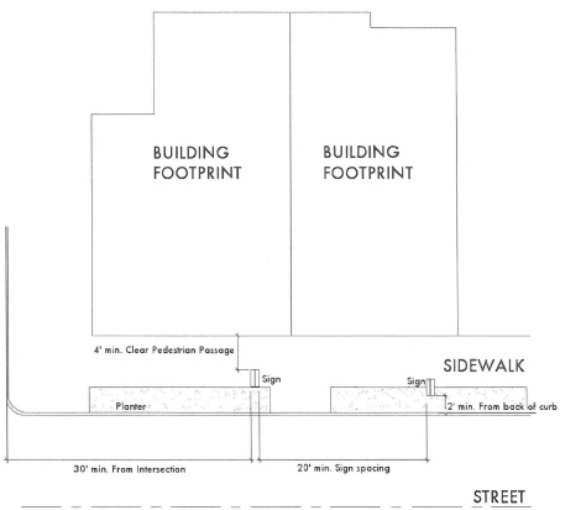
Total Business Wall Sign Area
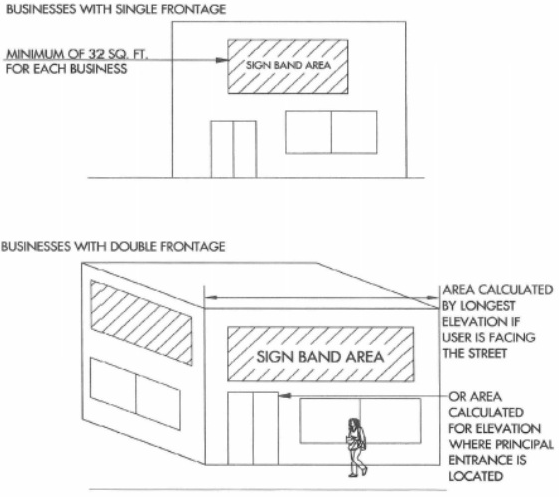
Sign Area Allowances
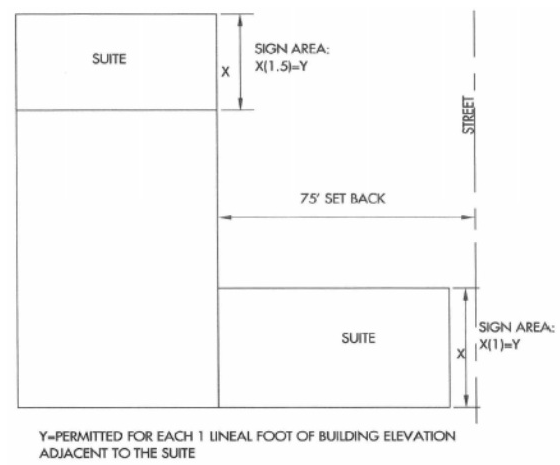
Area
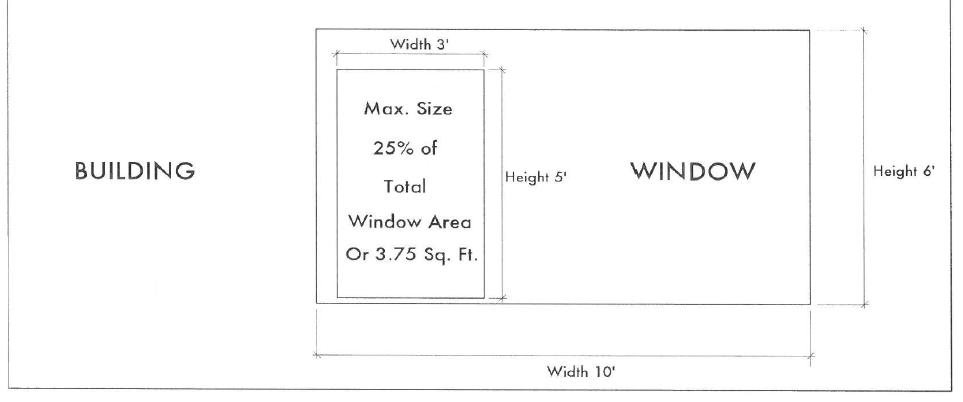
Location Window Signs
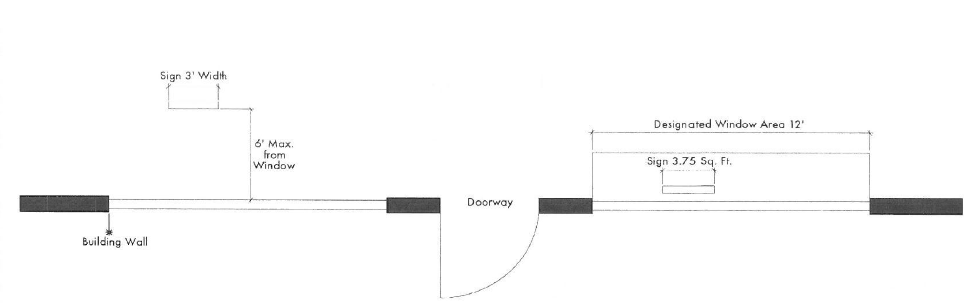
Measurement of Sign Size (Sign Area)
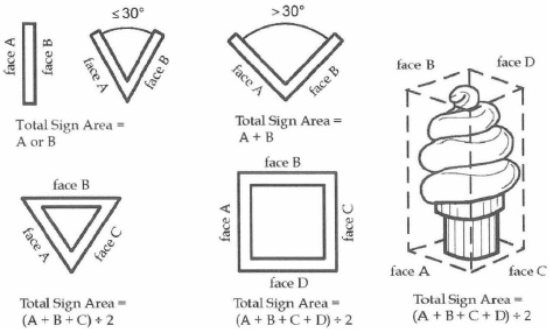
Measurement of Sign Height
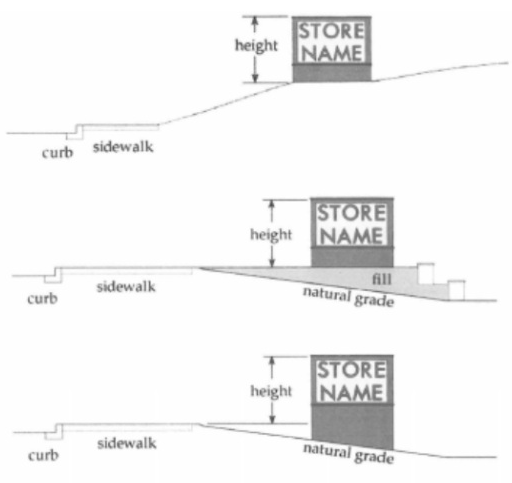
(Ord. No. 2019-03-03, § 1(Exh. A), 3-18-2019)

