
Leesburg City Zoning Code
ARTICLE I
- INTRODUCTION
Sec. 1.01.- Authority for enactment.
The Leesburg City Council enacts this ordinance pursuant to the City of Leesburg's authority to adopt plans and exercise the power of zoning granted by the Constitution of the State of Georgia, article 9, section 2, paragraph 4, Planning and Zoning, and by article 9, section 2, paragraphs 2 and 3; pursuant to chapters 66 and 70 of title 36 of the Official Code of Georgia Annotated; by the Georgia Planning Act of 1989 as amended; by the City of Leesburg's authority to enact regulations and powers granted by its Charter, by local laws and by the city's general police powers; and by other powers and authority provided by federal, state, and local laws applicable hereto.
Sec. 1.02. - Jurisdiction.
This ordinance shall apply to the incorporated areas of the City of Leesburg.
Sec. 1.03. - Purpose.
The purpose of these regulations shall be to promote the proper location, height, bulk, number of stories and size of buildings and other structures; to assure the appropriate sizes of yards, courts, and the use of other open spaces; the density and distribution of population; and the use of buildings, structures, and land for trade, industry, residence, recreation, agriculture, forestry, conservation, sanitation, protection against floods, public activities, and other purposes, so as to lessen congestion in the streets; to secure safety from fire, panic, and other dangers; to promote health and the general welfare; to provide adequate light and air; to prevent the overcrowding of land; to avoid undue concentration of population; to prevent urban sprawl; to facilitate the adequate provision of transportation, water, sewage, schools, parks, and other public requirements; to promote desirable living conditions and the sustained stability of neighborhoods; to encourage better design of the built environment in a manner that improves the aesthetic conditions of the city so as to promote the health, safety and welfare of citizens and visitors; to protect against blight and depreciation; to secure economy in governmental expenditures; to conserve the value of buildings and to encourage the most appropriate use of land, buildings, and structures; and for other purposes.
Sec. 1.04. - Severability of parts of ordinance.
It is declared to be the intention of the Leesburg City Council that the sections, paragraphs, sentences, clauses and phrases of this ordinance are severable; and if any phrase, clause, sentence, paragraph or section of this ordinance shall be declared invalid or unconstitutional by the valid judgment or decree of any court of competent jurisdiction, such invalidity or unconstitutionality shall not affect any of the remaining phrases, clauses, sentences, paragraphs and sections of this ordinance, since they would have been enacted by the city council without incorporation in this ordinance of any such invalid or unconstitutional phrase, clause, sentence, paragraph or section.
Sec. 1.05. - Interpretation, purpose and conflict.
In interpreting and applying the provisions of this ordinance, they shall be held to be the minimum requirements for the promotion of the public safety, health, convenience, comforts, prosperity and general welfare. It is not intended by this ordinance to interfere with, or abrogate or annul any ordinance, rules, regulations or permits previously adopted or issued and not in conflict with any of the provisions of this ordinance, or which shall be adopted or issued pursuant to law relating to the use of buildings or premises, and likewise not in conflict with this ordinance; nor is it intended by this ordinance to interfere with, or abrogate, or annual any easements, covenants or other agreements between parties; provided, however, that where this ordinance imposes a greater restriction or requires larger open spaces, or larger lot areas than are imposed or required by such ordinance or agreements, the provisions of this ordinance shall control.
Sec. 1.06. - Violations and penalties.
Any person violating or neglecting or refusing to comply with any of the provisions of this ordinance shall upon conviction thereof, be deemed guilty of a misdemeanor and shall be punished by imposition of the appropriate fine or by imprisonment in the discretion of the court. Each day that a violation is permitted to exist shall constitute a separate offense.
Sec. 1.07. - Definitions.
For the purposes of these regulations certain words and tenses, used herein, shall be interpreted or defined as follows:
•
Words used in the present tense include the future tense.
•
The singular number includes the plural and the plural, the singular.
•
The word "person" includes a corporation, partnership, or association as well as an individual.
•
The term "shall" is always mandatory and not merely directory.
•
Terms not herein defined shall have the meanings customarily assigned to them.
•
The term "governing body" shall mean the city council of Leesburg, Georgia.
Accessory building: A detached, subordinate structure, the use of which is clearly incidental to, customarily associated with and related to the principal structure or use of land, and which is located on the same lot as the principal structure or use. Accessory buildings shall include storage buildings, tool houses, party houses, bathhouses (used in conjunction with swimming pools) and similar uses.
Accessory use: The use customarily incidental and accessory to the principal use of a building located upon the same building site as the principal use.
Agriculture: Agriculture shall be considered to mean the raising of soil crops and/or livestock in a customary manner on tracts of land 25 acres or more in size and shall include all associated activities. Retail selling of products raised on the premises shall be considered a permissible activity provided that space necessary for the parking of customer's vehicles shall be provided off the public right-of-way.
Alley: Any dedicated public way providing a secondary means of ingress to or egress from land or structure thereon.
Alteration: Any change, addition or modification in construction or type of occupancy; any change in the structural members of the building, such as walls, partitions, columns, beams, girders, or any change which may be referred to herein as "altered" or "reconstructed."
Apartment: A room or suite of rooms used as dwelling for one family which does its cooking therein.
Apartment houses: A residential structure containing three or more apartment units.
Automobile wrecking yard, automobile used parts or auto graveyard: Means anywhere three or more vehicles not in running condition, or the parts thereof, are stored in the open or any building or structure used principally for wrecking or storage of automobiles not in running condition for automobile parts.
Basement: A portion of a building partly below grade and having less than five feet above the finished grade level of the building.
Block: A tract of land bounded by streets, or by a combination of streets and public parks, cemeteries, railroad rights-of-way, shorelines of waterways, drainage ways, or boundary lines of municipalities or counties.
Buffer: That portion of a given lot, not covered by buildings, pavement, parking, access and service areas, established as landscaped open space for the purposes of screening and separating properties with incompatible land uses, the width of which is measured from the common property line and extends the developed portion of the common property line. A buffer consists of trees, shrubs, and other natural vegetation undisturbed by grading or site development and replanted where sparsely vegetated or where disturbed for approved access and utility crossings.
Building: Any structure having a roof, supported by columns or by walls and intended for shelter, housing or enclosure of any person, animal or goods. Where roofed structures are separated from each other by party walls having no opening passage, each portion so separated shall be considered a separate building.
Building height: The vertical distance of a building measured from the average elevation of the finished grade to the highest point on the roof surface.
Building inspector: The highest ranking building official of the governing body, or his representative.
Building setbacks: The distance any part of any structure must be from any front, rear, or side property line. Building setbacks are established in this ordinance.
Caretaker or employee residence: An accessory residence located inside or in addition to the principal structure or use of a parcel of land. Said residence must be occupied by a bona fide caretaker or the owner himself as necessary to the property's orderly operation or safety.
Clerk: The clerk of the governing body.
Clinic: A professional office where the services of more than one practitioner can be obtained and where patients are studied or treated on an outpatient basis and where no overnight accommodations are provided.
Club: An organization of persons for special purposes or for the promulgation of sports, arts, science, literature, politics or the like, but not for profit.
Conditional use: A use which within certain districts specified by this ordinance is not permitted as a matter of right but may be permitted within these districts by the city council after the planning commission has:
(1)
Reviewed the proposed site plans for the use, its arrangement and design, its relationship to neighboring property and other conditions peculiar to the particular proposal which would determine its desirability or undesirability; and
(2)
Has found the proposal not to be contrary to the intent of this ordinance. All conditional use applications will follow the same public notice, public hearing and review process as any application for rezoning.
Day care facility: A day care facility is an individual or jointly owned facility designated to offer care and/or training to children unrelated to the owner or director for any part of a day on a regular basis. Such facility may or may not be operated for profit. Day care is not a baby-sitting service to be used for the convenience of the parents at irregular intervals (drop-ins).
(1)
A group center (day nursery, day care center) is defined as a facility for six or more children, regardless of age, whose primary purpose is the care of the child for part of a day, while his parent or parents are absent from home.
(2)
A nursery school is defined as a school for two-, three-, and four-year-old children which operates for periods not to exceed four hours a day and whose primary purpose is education and guidance for healthy emotional and social development of children.
(3)
Kindergarten is defined as a school for four- or five-year-old children which operates for periods not to exceed four hours a day and whose primary purpose is education and guidance for healthy emotional and social development.
(4)
Family day care is defined as a service in a private home, offering care in a family setting to a maximum of five children, including the foster family's own children during part of the day while the natural parents are absent from their home.
(5)
Adult day care is defined as personal care and supervision in a protective setting for adults outside their own home for less than 24 hours per day. The program may include the provisions of daily medical supervision, nursing and other health care support, psycho-social assistance, or appropriate socialization stimuli or a combination of these. Adult day care is available for those persons who do not require 24-hour-per-day institutional care, but who, because of physical and/or mental disability, are not capable of full-time independent living.
Density: The number of dwelling units developed on an acre of land. As used in this ordinance, all densities are stated in dwelling units per gross acre.
District: A portion of the jurisdiction of the governing body within which, on a uniform basis, certain uses of land and buildings are permitted and within which certain yards, open spaces, lot areas and other requirements are established.
Drive-in restaurant: A restaurant or other establishment serving food and/or drink so developed that its retail or services character is dependent on providing a driveway approach or parking spaces for motor vehicles so as to serve patrons while in the motor vehicle.
Dwelling, multiple: A building or portion thereof used or designed as a residence for three or more families living and cooking independent of each other in said building. This definition includes three-family houses, four-family houses and apartment houses, but does not include hotels, motels, trailer camps or mobile home parks.
Dwelling, single-family: A building used or designed for use as a residence for a single family.
Dwelling, two-family (duplex): A duplex is a building either designed, constructed, altered or used for two adjoining dwelling units that are connected by a common wall and/or if two stories by a common floor.
Erected: Includes built, constructed, reconstructed, moved upon, or any physical operations on the premises required for the building. Excavations, fill, drainage, and the like, shall be considered a part of the erection.
Essential services: The erection, construction, alteration, or maintenance by public utilities, governmental departments or commissions, of underground, surface, or overhead; gas, communication, electrical, steam, fuel or water transmission or distribution systems, sewers, pipes, conduits, cable, fire alarm and police call boxes, traffic signals, hydrant and similar accessories in connection therewith, but not including buildings, which are necessary for the furnishing of adequate service by such utilities or governmental departments for the general public health, safety, convenience or welfare.
Family: No more than six unrelated persons or one or more related persons occupying a housing unit and using common kitchen facilities and entrances, as distinguished from a group occupying a boarding house, or personal care home.
Farm: A platted or unplatted parcel of land 25 acres or more in an area which is used for growing crops, raising livestock or other agricultural purposes.
Farm stand: A booth or stall located on a farm from which produce and farm products are sold to the general public.
Group home: A group home is a residential use (home) of a property for the care of individuals in the home environment which have mental and/or developmental disabilities or individuals who will benefit socially from living in a group environment. All group homes must be licensed by the appropriate state agency and must have a conditional use permit granted by the city council prior to opening.
Halfway house: A group home facility, which is licensed or supervised by any federal, state or county, to be used for health/welfare rehabilitation or similar purposes.
Home occupation: Any use conducted entirely within the dwelling and carried on by the inhabitants thereof, which use is incidental and secondary to the use of the dwelling for dwelling purposes and does not change the character thereof. Provided further, that no article or service is sold or offered for sale on the premises, except such as is produced by such occupation; that such occupation shall not require internal or external alterations or construction, open storage or signs not customary in residential areas. Signs for home occupations are required to meet the requirements of article XVI of this ordinance. Clinics, hospitals, childcare centers, and day nurseries, among others, shall not be deemed to be home occupations.
Hospital: An institution providing health services, primarily for inpatients and medical or surgical care of the sick or injured, including as an integral part of the institution, such related facilities as laboratories, outpatient departments, training facilities, central service facilities and staff offices.
Junk: Any motor vehicle, machine, appliance, scrap material or other items that are in a condition which prevents its use for the purpose for which it was originally manufactured.
Junk yard: Includes automobile wrecking yards and includes any area of more than 200 square feet for the storage, keeping or abandonment of junk, including scrap metals or other scrap materials, or for the dismantling, demolition or abandonment of automobiles, or other vehicles or machinery or parts thereof, but does not include uses established entirely within enclosed buildings.
Kennel: Any lot or premises on which three or more dogs, four months or older, are kept either permanently or temporarily for commercial or breeding purposes.
Landscape strip: That portion of a given lot, not covered by buildings, pavement, parking, access and service areas, established as landscaped open space, the width of which is measured from the common property line and extending the developed portion of the property line. A landscape strip, as distinguished from a buffer, may be disturbed by grading or site development but shall be maintained as landscaped open space. A landscape strip may consist of grass lawns, decorative planting, berms, walls, fences or other approved features designed and arranged to produce an aesthetically pleasing effect within the development.
Loading strip: An off-street space on the same parcel of property with the building or group of buildings, for temporary parking of a commercial vehicle while loading and unloading merchandise or materials.
Lot: A parcel of land occupied or intended to be occupied by a principal building or use and any accessory building and uses customarily incident to it, and including open spaces not less in extent than those required in connection therewith by these regulations.
Lot area: The size of a lot measured within the lot lines as expressed in terms of acres or square feet.
Lot, corner: A lot abutting on two streets at their intersection. The minimum front yard setback shall be observed on both street frontages.
Lot, flag: Lots which have adequate land area for two lots but which do not have adequate street frontage for more than one lot. The standards require access for fire protection and also require screening in the higher density residential areas to protect the privacy of abutting residences. The intent of flag lots is to provide additional housing and commercial opportunities and to promote the efficient use of land.
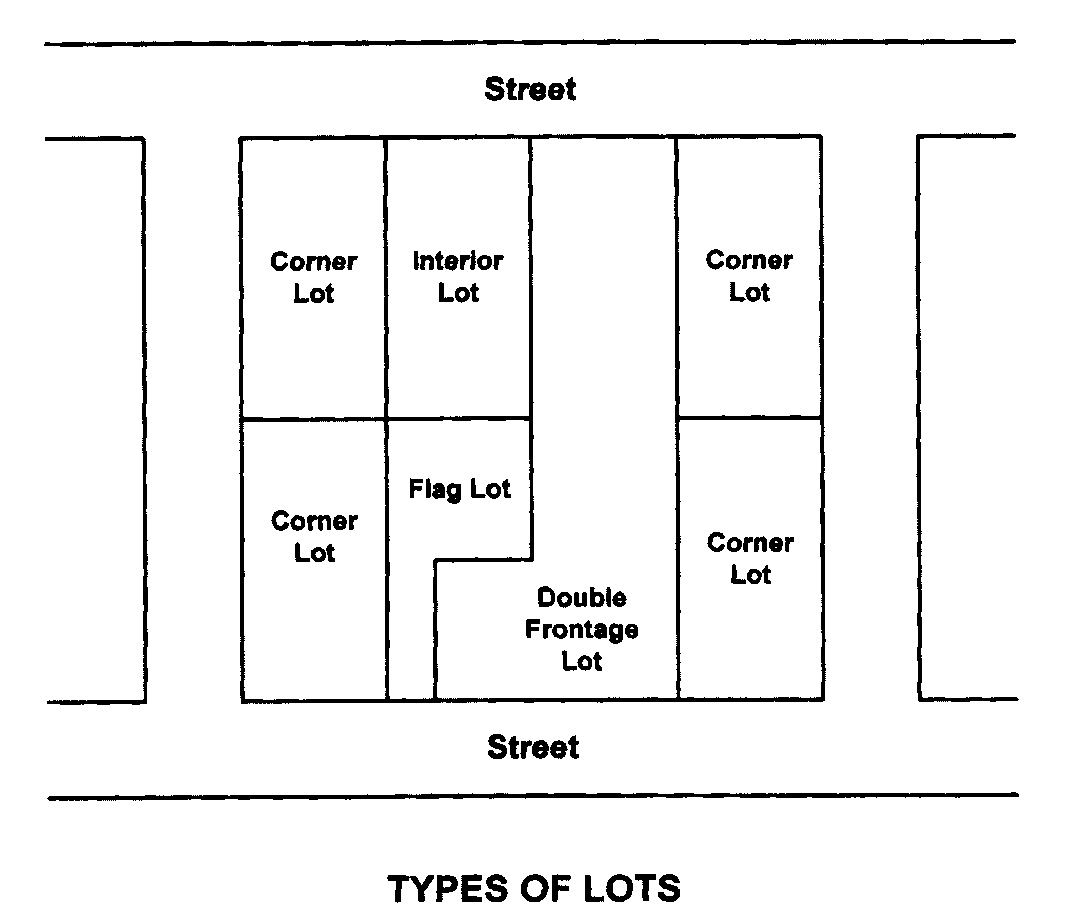
Lot, interior: A lot other than a corner lot.
Lot lines: The property lines bounding the lot.
(1)
Front lot line: On a lot abutting upon a public street, the front lot line shall mean the line separating such lot from such street right-of-way.
(2)
Rear lot line: Ordinarily, the lot line that is opposite and most distant from the front lot line of the lot. In the case of an irregular shaped lot the city planner shall designate the rear lot line.
(3)
Side lot line: Any lot line that is not a front or rear lot line.
Lot of record: A parcel of land, the dimensions of which are shown on a map or plat on file with the clerk of superior court of the county and which actually exists as shown, or any part of such parcel held in a recorded ownership separate from the ownership of the remainder thereof.
Lot width: The distance between the side lot lines, measured along the front building line and parallel to the street right-of-way.
Manufactured home: A factory built structure that is manufactured or constructed under the authority of 42 USC 5401 and is to be used as a place for human habitation, but which is not constructed or equipped with a permanent hitch or other device allowing it to be moved other than for the purpose of moving it to a permanent site, and which does not have permanently attached to its body or frame any wheels or axles. A mobile home is not a manufactured home, except as may be hereafter otherwise provided.
Manufactured home park: A licensed business operation which leases spaces for permanent or for temporary occupancy for periods exceeding 30 days for manufactured homes and, under some conditions, travel trailers.
Maximum lot coverage: The part or percentage of the lot that may be occupied by buildings or structures, including accessory buildings or structures.
Mobile home: A structure transportable in one or more sections which, in the travelling mode, is eight body feet or more in width or 40 body feet or more in length or when erected on the site is 320 or more square feet and which is built on a permanent chassis and designed to be used as a dwelling with or without a permanent foundation when connected to the required utilities and includes the plumbing, heating, air conditioning and electrical systems. Mobile homes were manufactured prior to June 15, 1976, and do not meet current building codes. In order to protect the health, safety and welfare of citizens mobile homes as herein defined are not authorized except as previously existing lawful nonconforming uses and shall not be placed in the incorporated areas of the city. See section 14.02.
Motor vehicle repair: General repair, engine rebuilding, rebuilding or reconditioning of motor vehicles; collision service such as body, frame or fender straightening and repair; overall painting; but not including undercoating of automobiles unless conducted in a completely enclosed spray booth.
Nonconforming use: Any building or land use which lawfully exists at the time of adoption of this ordinance or amendments thereto and which does not now conform with the use regulations of the district in which it is located.
Nursery (tree and shrub): An area or establishment devoted to the raising and care of trees, shrubs, or similar plant materials.
Off-street parking lot: A facility providing vehicular parking spaces, along with adequate drives and aisles for maneuvering, so as to provide access for entrance and exits for the parking of more than two automobiles.
Open space, landscaped: That portion or portions of a given lot, not covered by buildings, pavement, parking access and service areas, set aside and maintained as a buffer, landscape strip or other approved open area.
Outdoor display: The open display of items, outside of any principal or accessory building that does not include walls for enclosure, that is for the primary purpose of attracting attention to the specific item from nearby or adjacent streets or roads.
Outdoor storage: The open storage of any items, whether business related or personal, outside of any principal or accessory building or structure that does not include walls for enclosure.
Overlay district: Overlay districts are supplemental to the underlying zoning district classifications established in the Leesburg Zoning Ordinance that governs all properties within the City of Leesburg. Within areas mapped as overlay zoning districts in this appendix, regulations shall be overlaid upon and shall be imposed in addition to said underlying zoning regulations.
Parking space: An area of not less than nine feet wide and 20 feet long, for each automobile or motor vehicle, such space being exclusive of necessary drives, aisles, entrances or exits and being fully accessible for the storage or parking of permitted vehicles.
Personal care home: A dwelling in which aged or infirm persons are boarded and receive personal care on a 24-hour basis. All such homes shall be licensed by the appropriate state agency.
Place of worship: A lot or building wherein persons assemble for religious worship.
Planned unit development: A planned unit development is a single parcel of land within which a number of buildings (uses) are located or intended to be located in accordance with an overall plan of design and not in relation to a prearranged pattern of land subdivision. Examples of a planned unit development (PUD) include a complex of apartment buildings, offices and a shopping center with a number of stores.
Prime farm land: Land in the city which is best suited for producing feed, forage, fiber, and oil seed crops and also available for these uses. It has the soil quality, growing season, and moisture supply needed to produce sustained good yield of crops economically if treated and managed, including water management, according to modern farming methods.
Screening: Also referred to in the text as "protective screening," screening is a visual and acoustical barrier which, through the use of buffers, natural topography, landscaping, fences, walls, beams or approved combination thereof, is of such nature and density that provides year-round maximum capacity from the ground to a height of at least six feet that screens structures and activities on the lot from view from the normal level of a first story window on an abutting lot.
Service station: A building or structure designed or used for the retail sale or supply of fuels, lubricants, air, water and other operating commodities for motor vehicles, aircraft or boats, and including the customary space and facilities for the installation of such commodities on or in vehicles, and including space for facilities for the temporary storage of vehicles, minor repair or servicing.
Shopping center: Two or more commercial establishments planned and managed as a single unit with off-street parking and loading facilities provided on the property.
Solar energy system (SES): A device or structure that collects, stores and distributes solar energy for electric generation, water heating, space heating or cooling and other purposes.
Solar energy system (SES), ground mounted, site specific: A small, ground mounted SES located on a lot intended to provide electricity used, consumed or metered by the dwelling or structure located on the same or an adjoining lot. For purposes of this definition, an adjoining lot shall include a lot located across a public road or street from the lot on which the dwelling or structure is located.
Story: That portion of a building, other than the cellar or mezzanine, included between the surface of any floor and the floor next above it, or, if there is no floor above it, then the space between the floor and the ceiling next above it. For the purpose of these regulations, a basement or cellar shall be counted as a story if over 50 percent of its height is above the level from which the height of the building is measured, or if it is used for business purposes, or if it is used for dwelling purposes by other than a janitor or domestic servant employed in the same building including the family of the same.
(1)
Ground story: The lowest story of a building, the floor of which is not more than 12 inches below the elevation of the reference level.
(2)
Half-story: The part of a building between a pitched roof and the uppermost full story, said part having a finished floor area which does not exceed one-half of the floor area of said story.
(3)
Mezzanine: Shall be deemed a full story when it covers more than 50 percent of the story underneath said mezzanine, or, if the vertical distance from the floor next below it to the floor above it is 24 feet or more.
Street: A thoroughfare which affords traffic circulation and principal means of access to abutting property, including avenue, place, way, drive, lane, boulevard, highway, road, and any other thoroughfare except an alley. A public street is a street accepted by dedication or otherwise by the governing body. A private street is a street not so accepted.
Structure: Anything constructed or erected with a fixed location on or in the ground, or attached to something having a fixed location on or in the ground. Among other things, structures include buildings, manufactured homes, signs, swimming pools and fallout shelters but do not include walls or fences.
Swimming pool: Any structure or container intended for swimming or bathing located either above or below grade designed to hold water to a depth of greater than 24 inches.
Townhouse: One of a group of two or more attached single-family residences. Each townhouse unit is separated from the adjoining unit or units by an approved firewall or walls. Firewalls shall be located on the lot line. Each townhouse has a front and rear ground level entrance. The townhouse is located on its own approved, recorded, lot.
Use: The purpose for which land, premises, or a building thereon is designed, arranged, or intended, or for which it is occupied, maintained, let, or leased.
Variances: A variance is a relaxation to the terms of this zoning ordinance where such variance will not be contrary to the public interest and where, owing to conditions peculiar to the particular property and not the result of any action of the applicant, a literal enforcement of the ordinance requirements would result in unnecessary and undue hardship.
Water system, community: A public water system which serves at least 15 service connections used by year-round residents or regularly serves at least 25 year-round residents.
Yard, front: A space extending the full width of the lot and situated between the right-of-way line of the abutting street and the front line of the principal building.
Yard, rear: A space extending across the full width of the lot between the rear line of the principal building and the rear line of the lot.
Yard, side: A space situated between the principal building and side line of the lot and extending from the rear line of the front yard to the front line of the rear yard.
Zero-lot-line: The location of a building on a lot in such a manner that one or more of the building sides rest directly on a lot line.
Zoning administrator: The head of the planning and zoning department of Lee County, Georgia, or his designee, acting with authority for the City of Leesburg, Georgia, through an intergovernmental agreement.
(Ord. of 6-5-2018; Ord. of 8-7-2018)

