
Leesburg City Zoning Code
ARTICLE XVI
SIGN REGULATIONS
Sec. 16.01.- Statement of purpose.
In adopting these sign regulations, it is the intent and purpose of the city council of the City of Leesburg not to impose an outright ban on signs, but instead to:
a.
Balance the right of individuals to convey their messages through signs and the right of the public to be protected against the unrestricted proliferation of signs; and
b.
Further the objectives of the city's comprehensive land use planning; and
c.
Protect the public health, safety and welfare; and
d.
Reduce traffic and pedestrian hazards; and
e.
Maintain the historical and cultural heritage and image of the city; and
f.
Protect property values by minimizing the possible adverse effects and visual blight caused by signs; and
g.
Avoid the harmful aspects of the unrestricted proliferation of signs; and
h.
Promote economic development and tourism; and
i.
Protect private property values; and
j.
Ensure the fair consistent enforcement of sign regulations.
In accessing how to go about the above described task, the Leesburg City Council have given considerable weight and find the following to be relevant and useful to the Leesburg City Council concerning how the size, location and quantity of sign structures within the city must be regulated in order to achieve the above-stated intents and purposes: University of Georgia Land Use Clinic (2003, June 26), Sign Control on Rural Corridors: Model Provisions and Guidance; Wisconsin Department of Transportation (1994, December), Milwaukee County Stadium Variable Message Sign Study: Impacts of an Advertising Variable Message Sign on Freeway Traffic; Scenic America (2007), Billboards in the Digital Age: Unsafe (and Unsightly) at Any Speed. Scenic America Issue Alert; Nasar, Jack L. and Hong, Xiadong (1999, September), Visual Preferences in Urban Signscapes, Journal of Environment and Behavior, 31(5), 671-691; Office of Safety Research and Development, Federal Highway Administration (2001, September 11), Research Review of Potential Safety Effects of Electronic Billboards on Driver Attention and distraction, U.S. Department of Transportation; New York State Department of State, Division of Local Government Services (2006, January), Municipal Control of Signs, James A. Coon; Local Advertising in 268 U.S. Jurisdictions, Outdoor Advertising Association of America, Inc.; City Club of Portland (1996, September 6), Billboard Regulation in Portland; City Club of Portland Bulletin, 78(13), 1-40; Smiley, Alison and Persaud, Bhagwant, et al. (2205), Traffic Safety Evaluations of Video Advertising Signs, Transportation Research Record: Journal of the Transportation Research Board, No. 1937, 105-112.
In adopting these sign regulations, the Leesburg City Council have carefully considered and especially recognize the case law coming from Georgia courts, the federal courts, and courts throughout the United States, which recognize that the regulation of the size, location and quantity of sign structures is a valid and lawful means of achieving the above-stated intents and purposes, and that such intents and purposes are valid and lawful governmental interests, which include the following: Granite State Outdoor Advertising, Inc. v. Cobb County, Ga., 193 Fed. Appx. 900 (C.A.11th 2006) (finding that the stated goals within a sign ordinance of protecting against traffic hazards and the adverse impact on the count's aesthetic qualities are substantial government interests); Gregory v. Clive, 2007 WL 2914515 (Ga. S.Ct. 2007) (recognizing as within a local government's police power to enact legislation governing billboards and signs, as such legislation clearly addresses the public health, safety, or general welfare of the community); H & H Operations, Inc. v. City of Peachtree City, Ga., 248 Ga. 500 (1981)(holding that, under its police power, a municipality can enact and enforce reasonable regulations governing the erection and maintenance of signs within its jurisdiction); Harnish v. Manatee County, Florida, 783 F.2d 1535 (C.A. 11th 1986) (finding that aesthetics is a substantial governmental goal which is entitled to and should be according weighty respect, and that the governmental entity charged with the responsibility of protecting the environment must be given discretion in determining how much protection is necessary and the best method of achieving that protection); Lamar Advertising Company v. City of Douglasville, Ga., 254 F.Supp.2d 1321 (N.D.Ga. 2003) (finding that where a sign ordinance asserts the goals of public safety, traffic safety, health, welfare and aesthetics, a municipality has shown an important or substantial governmental interest unrelated to the suppression of free speech); Metromedia, Inc. v. City of San Diego, 453 U.S. 490 (1981) (holding that the goals of traffic safety and aesthetics advanced by a municipality as justification for regulating signs is a substantial governmental interest); St. Louis Poster Advertising Co. v. City of St. Louis, 249 U.S. 269 (1919) (finding that billboards may be prohibited in the residential districts of a city in the interest of the safety, morality, health and decency of the community); Members of the City Council of the City of Los Angeles v. Taxpayers for Vincent, 466 U.S. 789 (1984) (finding that a government entity can regulate signs and billboards when necessary to advance a significant and legitimate state interest, such as the protection of the aesthetics and quality of life within its jurisdiction); City of Doraville v. Turner Communications, Corp., 236 Ga. 385 (1976) (finding that under its police power authority, a municipality can regulate the location and maintenance of outdoor advertising signs within their territorial jurisdiction); Spratlin Outdoor Media, Inc. v. City of Douglasville, 2006 WL 826077 (N.D.Ga. 2006) (upholding sign ordinance where the ordinance's height and setback restrictions were rationally related to its stated goals of promoting the health, safety, morality and general welfare of the community, promoting the orderly and beneficial development of the city, promoting adequate access to natural light and air, improving the aesthetic appearance of the city, and encouraging the most appropriate use of land and buildings in accordance with the city's comprehensive plan).
Sec. 16.02. - General provisions and definitions.
1.
No sign structure shall be placed and/or maintained within the city except in conformity with this article. Violations of this article may be punished in the same manner as other violations of this ordinance. The city reserves the right to take legal action to remove signs erected in violation of this article, or to otherwise enforce the provisions of this article. All signs existing prior to the adoption of this ordinance (with the exception of those falling under the requirements of section 16.08) that were legal at the time of adoption of this ordinance shall be considered "grandfathered in" as existing nonconforming signs and may stay in place until one of the following conditions occurs:
a.
The business advertised ceases at the location;
b.
The deterioration of the sign or damage to the sign makes it a hazard; or
c.
The sign has been damaged to such extent that more than minor repairs are required to restore the sign. No structural repairs, change in shape, or size shall be permitted except to make the sign comply with all requirements of this article.
2.
Notwithstanding any other restrictions in this article, any sign display or device allowed under this article may contain any commercial or non-commercial message, or any political or non-political message; except that such messages cannot depict obscenity, as defined by O.C.G.A. § 16-12-80, nor can they depict sexual conduct or sexually explicit nudity, as defined in O.C.G.A. § 36-60-3, nor advertise any activity illegal under the laws of Georgia or the United States.
3.
Definitions: As used in this article, the following words have the following meanings. The general definitions and interpretative rules of the zoning ordinance shall also be used. To the extent those general rules or definitions conflict with these specific definitions, these definitions control.
Billboard: A type of ground sign which is greater than 100 square feet in sign face area, a maximum 250 square feet per sign face area, and which shall be a maximum of 30 feet in height for arterial roadways and 20 feet for all other roadways if permitted. Due to spacing requirements, only two billboards are permitted in Leesburg under the current zoning.
Ground sign: A sign that is anchored to the ground and is wholly independent of a building for support. Freestanding signs are included in the definition, as are signs on poles, frames, or other mounting structures other than buildings. (Does not include vending machines, newspaper stands, propane gas etc.)
Hanging sign: Any non-fabric sign hanging or suspended from the exterior walls of a building structure, or an awning attached to the building structure, which is directed so as to be plainly visible from a public right-of-way. For the purposes of this article, such hanging signs shall be regulated as wall signs, shall only be permissible in zoning districts where wall signs are permissible, and shall be included in and count towards the amount of wall signage allowed under this article.
Multiple-message sign: A sign which changes the message or copy on the sign face mechanically or electronically by movement or rotation of panels or slats, or by changing electronic display on the sign face.
Sign: Any display of words, shapes or images designed to convey a message to the viewer, located on the exterior of any dwelling, building or structure, or located anywhere on a lot upon a dedicated supporting structure or device, including poles, banners, windows and similar devices.
Sign face: The actual message-carrying portion of the sign that can be used to display content, including any area that can display or does display words, pictures or other communicative elements of the sign, including the background color.
Sign structure: This includes all the elements of the sign, including its supporting structure, sign face, base, lights and every portion of the sign.
Streamer: Narrow strips of material used for decoration.
Temporary signs: A sign of a non-permanent nature, including, but not limited to, banners as herein defined, to be used for a limited period of time solely for the purpose of advertising an upcoming event or occurrence. Any temporary signs shall be displayed for no more than 14 days, and shall be removed within three days after the event or occurrence advertised on the sign has occurred. Temporary signs shall require a permit and may be located in any commercial district. The fee is not to exceed $10.00. A political sign shall not be deemed to be a temporary sign for the purposes of this article.
Wall sign: A sign that is fastened directly to or is placed or painted directly upon the exterior of a building, with the sign face parallel to the wall, and extending from the surface of the exterior no more than 24 inches.
Window sign: A sign mounted inside of a structure, and designed to be seen from the outside of the structure through a window.
4.
Except as provided herein, the provisions of this article shall be administered by the director of planning and engineering. Whenever this article places a duty, obligation, power or authority in the director of planning and engineering, it shall be construed to include that official's authorized designee.
(Res. of 2-4-2025(2), § 1(Exh. A))
Sec. 16.03. - Permits, inspections, etc.
1.
Permit required. Except as otherwise provided herein, it shall be unlawful for any person to erect, construct, enlarge, move, or convert any sign in the city or cause the same to be done without first obtaining a sign permit from the director of planning and engineering, chief building inspector, or their designees. These directive shall not be construed to require any permit for change of copy on any sign, replacement of the sign face, nor for the repainting, cleaning, or other normal maintenance or repair of a sign structure for which a permit has previously been issued, so long as the sign or sign structure is not modified or enlarged in any way.
2.
Application. Sign permits may be applied for by the owner of the property upon which the sign will be located, or by that person or entity's authorized agent. In order to obtain a permit to erect, alter or relocate any sign under the provisions of this article, an applicant therefore shall submit to the director of planning and engineering a sign permit application which shall set forth in writing a complete description of the proposed sign including:
a.
The name, address, and telephone number of the owner of persons entitled to possession of the sign and of the sign contractor or erector.
b.
The name, address and telephone number of the owner or lessee of the lot on which the sign is located if different from those designated above.
c.
The location by street address of the proposed sign structure.
d.
A drawing of the proposed sign showing dimensions and construction specifications. There may be circumstances such that in order to protect public health, safety and welfare the drawing must be prepared and signed by an architect or engineer licensed by the State of Georgia. This will be determined by the director of planning and engineering.
e.
Where the sign construction requires an electrical connection, the electrical contractor shall obtain an electrical permit.
f.
Each applicant shall present to the director of planning and engineering on request a certificate of liability insurance or current occupation tax certificate prior to the issuance of a sign permit.
g.
Where the application is for a multiple-message sign using electronic lighting as part of the display on the sign face, a copy of the sign manufacturer's specifications for luminosity shall be attached to the application.
3.
Issuance of permit if application in order. It shall be the duty of the director of planning and engineering, upon receipt of a completed application for a sign permit, to examine such plans and specifications and other data and, if the proposed structure is in compliance with the requirements of this section and all other applicable provisions of this ordinance to issue, within five working days from date of filing, to the applicant a written permit evidencing the applicant's compliance therewith. Sign permits shall be issued in the name of the property owner upon which the sign is to be located. Issuance of the permit shall in no way prevent the director of planning and engineering from later declaring said sign to be nonconforming if the permit is obtained based on false information submitted by the applicant.
4.
Permit duration. A sign shall become null and void if the construction of the sign for which the permit was issued has not begun within a period of six months after the date of issuance and completed within 12 months after date of issuance.
5.
Work on illegal signs. No person shall erect or assist in the erection, construction, maintenance, alteration, relocation, repair or painting of, or do any work upon any sign for which a permit has not been obtained. Any such sign shall be illegal and the director of planning and engineering shall order the owner to remove the sign immediately. If the owner fails to remove the sign within 30 days, the director of planning and engineering shall proceed in accordance with this article.
6.
Inspection. All signs for which a permit is required by this article are subject to inspection by the director of planning and engineering, chief building inspector, or their designees.
7.
Revocation. The director of planning and engineering is hereby authorized and empowered to revoke any permit issued by him upon failure of the holder thereof to comply with the provisions of this section within ten days after notification in writing.
8.
Permit fees.
a.
Before any permit is issued under the provisions of this section, the applicant shall pay a fee. The fee shall be established by the city council, from time to time, and made available for public examination in the office of the city manager.
b.
A 150 percent permit fee shall be paid in addition to any other penalties levied for violation of this section.
9.
When permit not required. No permit should be required for signs having no electrical connection and a sign face less than 32 square feet in area; however, even signs not requiring a permit under this section shall be required to comply with the other provisions of this article.
Sec. 16.04. - Permitted signs by zoning district.
1.
If not otherwise stated, any sign not specifically permitted in a zoning district as provided under this section shall be prohibited. These regulations apply to sign located on any lot or development, except that any sign not visible from the outside of a structure or to passing members of the public is not restricted or regulated by this article.
a.
Sign height. Sign height is measured from centerline of street grade upon which the sign fronts to the highest portion of the sign structure.
b.
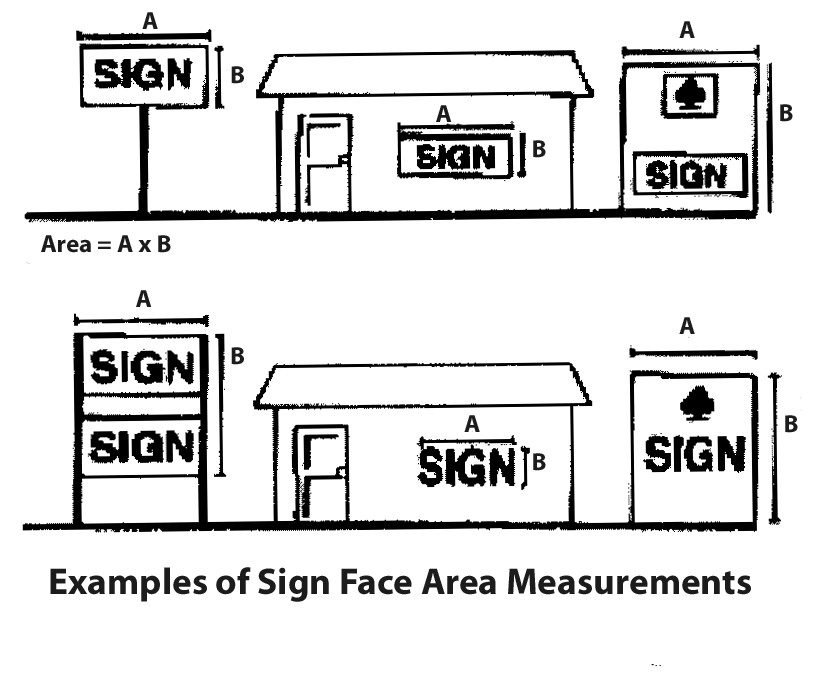
Sign face area. The area of a sign is calculated by determining the area of the smallest square or rectangle which encloses the sign face and the structure surrounding the sign face. For example, the pole or base would not be included, but any frame holding the sign face in place would be counted. See examples below. However, this example is not substantive regulation as to permissible types of signs:
2.
Signs permitted in residential zoning and C-4 districts:
a.
Ground signs.
i.
Total sign face area may not exceed 32 square feet. Height is limited to six feet.
ii.
For C-4 zoning districts, one double-faced sign is permitted that has a maximum of 32 square feet per side.
iii.
Subdivision signs. One permanent subdivision sign may be located at each entrance to a subdivision provided the following requirements are met. Such sign shall contain only the name of the subdivision and motto, if any, and shall not contain promotional or sales material.
(a)
The sign shall not create a physical or visual hazard for motorists entering or leaving the subdivision.
(b)
No part of the sign shall exceed seven feet in height. This height requirement shall include capstones and any other item placed for the embellishment of the sign.
(c)
The sign surface area shall not exceed 25 square feet in area and the sign face area is calculated separate from the sign structure.
(d)
The sign shall not be located in or overhang any public right-of-way or easement including, but not limited to, islands, utility or drainage easements and shall be located on private property, unless approved by the city council. In no case shall the sign obstruct the free and clear vision of any vehicle entering or exiting the subdivision or travelling by the entrance.
(e)
Multiple-family residential development and manufactured home park signs: One wall or ground sign may be located on the site of a multiple-family residential development or manufactured home park provided that it shall not have a sign area larger than 25 square feet. Such sign shall not exceed seven feet in height and shall be located on private property. Where a multiple-family residential development or manufactured home park is located on more than one street, one sign may be displayed on each street.
(f)
One additional sign is allowed during the construction phase of a subdivision not to exceed 32 square feet. This additional sign must be maintained according to the requirements of section 16.09 and must be removed once the subdivision is built out.
b.
Window signs. Window signs are not permitted.
c.
Wall signs. Wall signs are not permitted.
3.
Signs permitted in the C-1, C-2, C-3, AG and I Zoning Districts:
a.
Ground signs. One double-faced ground sign is permitted per street frontage. Maximum square footage for each sign face shall be two square feet for each linear foot of building frontage facing the public right-of-way, or one square foot for each linear foot of street frontage on the public right-of-way, whichever is larger, provided that no sign face may exceed 100 square feet. Maximum height for each sign structure shall be 30 feet for arterial roadways and 20 feet for all other street classifications.
b.
Window signs. Window signs are permitted, but total signage shall not exceed 25 percent of the area of windows facing road frontage.
c.
Wall signs.
i.
Maximum square footage for wall signs shall be two square feet for each linear foot of building frontage on the public right-of-way, or one square foot for each linear foot of street frontage on the public right-of-way, whichever is larger, provided that no sign face my exceed 100 square feet, except as provided in subsection 3.c.ii of this section.
ii.
Where the structure upon which a wall sign is located is greater than 50 feet from the right-of-way of the nearest public street, the maximum square footage shall be as follows:
Distance from wall sign to maximum surface area, as determined in subsection 3.c.i of this section abutting street frontage above, may be multiplied by a factor of:
iii.
Wall signs may be located on multiple walls provided each sign faces a street or parking lot and the total square footage of the signs does not exceed what is set forth above.
d.
Signs on multi-tenant lots.
i.
On all multi-tenant lots having less than 25,000 square feet of gross leasable area, each individual establishment shall be permitted wall signage as though each individual establishment was an individual building with individual street frontage. Where such multi-tenant premises has a frontage of 200 lineal feet or more on either an arterial or collector street, an additional double-faced ground sign shall be permitted, not to exceed 32 square feet per sign face, and no greater than 25 feet in height. Such additional ground sign shall be no closer than 120 feet from the primary ground sign on the lot.
ii.
On multi-tenant lots having 25,000 or more square feet of gross leasable area, one ground sign for the first 500 lineal feet of frontage adjacent to a street and one additional ground sign for each additional 500 lineal feet of street frontage shall be permitted, provided that such ground signs on the lot shall be no closer than 250 feet. Maximum surface area for each such ground sign shall be as follows: for multi-tenant lots having between 25,000 and 100,000 square feet of gross leasable area, the maximum area of sign faces shall be 175 square feet; for multi-tenant lots having between 100,000 and 300,000 square feet of gross leasable area, the maximum area of ground sign faces shall be 200 square feet; for multi-tenant lots having greater than 300,000 square feet of gross leasable area, the maximum square footage for ground sign faces shall be 300 square feet.
4.
Billboards. Only two billboards will be permitted in the City of Leesburg. Billboards are permitted only in C-2 and R-2 zoning districts. In those districts, billboards may be constructed subject to the following conditions:
a.
No billboard shall be constructed or permitted, except as a replacement for an existing billboard. The county shall maintain a list of all billboards in the county, including the location and total sign face of each sign. Any application for a billboard building permit shall identify the billboard or billboards that are being replaced by the new billboard. Replacement shall be performed within six months after it has been determined that an existing sign or signs will be replaced by a new sign.
b.
No billboard which is also a multiple-message sign shall be constructed or permitted, except as a replacement for 2.5 times as much existing billboard sign face area as the multiple-message sign face area of the proposed billboard. The City of Leesburg shall maintain a list of all billboards in the city, including the location and total sign face of each sign. Any application for a billboard building permit shall identify the billboard or billboards that are being replaced by the new billboard. Replacement shall be performed within six months after it has been determined that an existing sign or signs will be replaced by a new sign.
c.
Billboards shall be located at least 1,000 feet from any R-1 residential district, measured from the location of the base of the sign.
d.
New billboards shall be located at least 2,000 feet from any existing billboard, measured from the location of the base of the sign along the same side of the street.
e.
The restriction of 50 percent of sign area generally applicable to multiple-message signs under this article shall not apply to billboards which are also multiple-message signs.
f.
The owner of each billboard shall file on or before January 31, 2025 and each succeeding year a statement from a registered engineer licensed by the State of Georgia, or some other person possessing qualifications acceptable to the director of planning and engineering, certifying that the billboard has been inspected, and that it remains structurally sound and capable of safely carrying the loads placed upon it. If, upon inspection, it is determined that the billboard is not structurally sound, the engineer shall list the structural deficiencies and the actions which must be taken to correct the structural deficiencies. Prior to March 1 of the same year, the sign owner shall be required to take such actions and file a statement with the county certifying that each required repair has been completed.
(Res. of 2-4-2025(2), § 1(Exh. A))
Sec. 16.05. - Regulations for signs.
1.
Location and setback.
a.
The property owner must give permission for all sign structures erected on the owner's property. Sign structures are not permitted in the public right-of-way.
b.
No portion of a sign or sign structure erected on private property shall encroach on or overhang the public right-of-way or any other person's property.
c.
Distances are measured from the closest portion of the sign (whether that be the base, sign face, or the sign structure) to the right-of-way, curb or pavement.
2.
Illumination.
a.
Signs cannot be illuminated in the residential zoning districts with the exception of subdivision entry signs, subject to this section. Signs may be illuminated in all other districts, subject to the following provisions.
b.
Flashing or blinking illumination is not permitted. Except as expressly provided in this article, no sign may use images changing more frequently than once every 20 seconds; except as otherwise provided, no sign may display picture changing more frequently than once per minute. No external or internal illumination that causes confusion with or distraction from any traffic signal or safety device shall be permitted.
c.
All externally illuminated signs shall utilize low wattage luminaries, mounted in fixtures designed to direct the light and eliminate light trespass, such as light shining into residences or other neighboring structures.
d.
All internally illuminated signs shall utilize low wattage luminaries designed to reduce light glow.
e.
No sign shall give off light, which glares, blinds, or has any other adverse effect on traffic or adjacent properties. The light from an illuminated sign shall be established in such a way that adjacent properties and roadways are not adversely affected and that no direct light is cast upon adjacent properties and roadways. This shall be determined by measuring the footcandles (lumens per square foot) that fall on adjacent properties. No sign shall exceed one-half footcandle at any adjacent property line in a residential district and two footcandles at any public right-of-way.
3.
Flags. For the purposes of this article, flags are fabric signs displayed by being attached to a flagpole. Flags are permitted in all zoning districts. Flags in C-1, C-2, C-3, and I zoning districts are subject to the following regulations:
a.
Only three flags permitted per lot;
b.
Such flagpole shall not exceed the height of the tallest structure on the lot by ten feet; and shall in no case be greater than 60 feet in height;
c.
The longest side of the flag shall not be greater than one-fourth the height of the flagpole to which the flag is mounted;
d.
No flag shall exceed 150 square feet in area.
4.
Banners.
a.
For the purposes of this article, banners are paper, plastic or fabric signs, which are not attached to any rigid frame. Banners are limited to 48 square feet; only one banner per property or road frontage; and only permitted in C-1, C-2, C-3, and I zoning classifications, and it must be mounted or attached to a building or attached to a pole, mast, arm or other structure. Banners may only be exhibited 6 times each calendar year for a period of not more than 14 consecutive days during each period. Banners shall be maintained in good repair, and shall be maintained free of defects such as holes, tears, fading, cracks, breaks or missing portions. Upon written notice of any such defects the banner must be repaired or removed. Fabric windsocks driven by air pressure are included as banners.
b.
Streamers and balloons may also be exhibited and are not subject to the six times per calendar year/14 consecutive days set forth above. Flags, streamers and balloons shall be maintained free of defects such as holes, tears, fading, cracks, breaks or missing portions. Upon written notice of any such defects the flags, streamers or balloons must be repaired or removed.
c.
Permits are required for banners. A written application shall be made to the director of planning and engineering ("the director"). The director shall establish an application form and the permit fees.
5.
Portable signs. Portable signs (defined as sign structures which are attached to vehicles, trailers, movable structures, or any sign which may be transported or is designed to be transported) are prohibited in all zoning classifications. Such signs include, but are not limited to, printed banners or billboards attached to vehicles and trailers.
Sec. 16.06. - Safety and construction standards.
1.
Official confusion. Signs which contain or are an imitation of an official traffic sign or signal, or can be confused with an official traffic sign, are prohibited.
2.
Fire safety. No sign or sign structure may be erected or maintained which obstructs any fire escape, ventilation, or door; nor shall any sign or sign structure be attached to a fire escape.
3.
Corner visibility. No sign or sign structure above a height of three feet shall be maintained within 25 feet of the intersection of the right-of-way lines of two streets, or of a street intersection with a railroad right-of-way.
4.
Traffic visibility and safety. No sign or sign structure shall obstruct the traffic sight line, or the view of vehicles entering the roadway (i.e., the view of oncoming traffic by vehicles attempting to enter the road, or vice versa). No sign shall be erected on any traffic island.
Sec. 16.07. - Prohibited signs.
The following types of signs are prohibited in every zoning district:
a.
Moving signs, or signs with moving parts. This includes, but is not limited to, animated signs involving motion or sound; signs with moving words; signs with waiving elements, whether motorized or wind-powered; or similar moving signs.
b.
Multiple-message signs.
c.
Portable signs (sign structures which are attached to vehicles, trailers, movable structures, or any sign which may be transported or is designed to be transported.
d.
Roof signs (which means signs mounted above a roof or projecting above the roofline of a structure).
e.
Rotating signs (excluding barber poles).
Sec. 16.08. - Amortization of excess ground signs.
1.
It is the intent of this article to bring into conformity the permitted/allowed number of ground signs per property in the commercial and industrial zoned areas of Leesburg. It is the intent of the city council to protect the investment-backed expectations of property and sign structure owners, and to accomplish conformity while allowing property and sign structure owners a reasonable return on their investment.
2.
The provisions of this section shall have no application to any sign which is subject to a valid and current permit issued by the Georgia Department of Transportation under O.C.G.A. § 32-6-70 et seq. Nor shall this provision have any effect on any billboard which is existing legally at the time of the adoption of this article. A list of such billboards known to the city is identified as "Billboards Existing in Leesburg, Georgia, as of March 2025," and included as part of this article as Exhibit A, and in the future shall be maintained by the director of planning and engineering.
(Res. of 2-4-2025(2), § 1(Exh. A))
Sec. 16.09. - Sign and sign structure maintenance.
1.
The sign and sign structure shall be maintained in good repair, structurally sound, with proper anchorage capable of supporting the imposed loads, so as not to pose a threat to the public health, safety or welfare. All structural members shall be maintained free from deterioration, and shall be capable of safely supporting the imposed dead and live loads.
2.
All exterior surfaces shall be maintained in good condition. Exterior wood surfaces, other than decay-resistant woods, shall be protected from the elements and decay by painting or other protective covering or treatment. Peeling, flaking and chipped paint shall be eliminated and surface repainted. When required, all exposed surface of metal or wood shall be protected from the elements and against decay or rust by periodic application of weather-coating materials, such as paint or similar surface treatment. Sign faces shall be maintained in good repair, and shall have neatly painted, posted or otherwise maintained display surfaces, free of defects such as holes, tears, crack, breaks or missing portions, which are plainly visible from the public right-of-way.
3.
When a sign or sign structure is found to be in need of maintenance, the code enforcement officer shall issue a notice of violation to the property owner, which shall describe the maintenance issue, and provide a reasonable amount of time to repair the violation.
4.
If, after receiving the notice of violation, the property owner fails to remedy the maintenance issue within the time provided, it shall be a violation of this article, subject to citation. The code enforcement officer may also institute the appropriate proceeding at law or in equity to restrain, correct or abate such violation, or to require the removal of the sign or sign structure. The reasonable cost of any action taken by the city or its agents to remedy the maintenance issue shall be charged against the real estate upon which the structure is located and shall constitute a lien upon such real estate.
Sec. 16.10. - Appeals.
Except for those appeals pertaining to the amortization of signs, appeals of the decisions of the director of planning and engineering under this ordinance shall be to the city council. The aggrieved party shall file such appeal in writing within 30 days of the date of the appealed decision. The city council shall consider the appeal at a public meeting conducted within 35 days of the filing of the appeal. The aggrieved party or its agent and the director of planning and engineering shall be allowed to present testimony and evidence as to whether the decision should be affirmed, reversed or modified. Such testimony and evidence shall constitute the record. The city council shall consider this record in light of the requirements and intent of this ordinance, and shall vote to affirm, reverse or modify the decision at such public meeting. In the event that the city council fails to render a decision on the appeal within 60 days of the filing of the notice of appeal, the decision of the director of planning and engineering shall stand affirmed. Any person aggrieved by the decision of the city council may appeal to the municipal court within 30 days of the city council's decision.
Sec. 16.11. - Legal provision.
1.
Any person or entity violating or refusing to comply with any provision of this ordinance shall be subject to citation to the municipal court, and, upon conviction, may be sentenced to imprisonment for up to 180 days, to pay a fine of up to $1,000.00, or both. Each day a violation exists shall be considered a separate violation for purposes of citation and sentencing. The city may also seek civil remedies including injunctive, declaratory or equitable relief for violations of this ordinance.
2.
Should any section or provision of this ordinance be declared by the courts to be unconstitutional or invalid, such declaration shall not affect the validity of the ordinance as a whole or any part thereof other than the part so declared to be unconstitutional or invalid.
3.
This article replaces the city's prior sign ordinance existing and in effect immediately prior to the adoption of this ordinance. In the event all of this article is struck down as void, unconstitutional or invalid, including therefore this provision, that prior sign ordinance shall be considered to not have been repealed, and shall therefore still be in effect.
4.
This ordinance shall take effect and be in force as of the date of its adoption, the public welfare of Leesburg demanding.
EXHIBIT A -
BILLBOARDS EXISTING IN LEESBURG, GEORGIA, AS OF MARCH 2025
(Res. of 2-4-2025(2), § 1(Exh. A))

