
Leland City Zoning Code
ARTICLE XI
SIGNS
Sec. 66-349.- Definitions.
The following words, terms and phrases, when used in this article, shall have the meanings ascribed to them in this section, except where the context clearly indicates a different meaning:
A-frame sign means a portable sign comprised of two separate panels or faces joined at the top and spread apart at the bottom to form the base on which the sign stands.
Abandoned sign means a sign which no longer identifies or advertises a bona fide business, lesser, service, owner, product, or activity and is no longer maintained.
Animated sign means a sign employing motion or the illusion of motion. Animated signs, which are differentiated from changeable signs as defined and regulated by this Code, include the following types:
(1)
Environmentally activated. Animated signs or devices motivated by wind, thermal changes, or other natural environmental input. This includes spinners, pinwheels, pennant strings, or other devices or displays that respond to naturally occurring external motivation.
(2)
Mechanically activated. Animated signs characterized by repetitive motion or rotation activated by a mechanical system powered by electric motors or other mechanically induced means.
(3)
Electrically activated. Animated signs producing the illusion of movement by means of electronic, electrical, or electromechanical input or illumination capable of simulating movement through employment of the characteristics of one or both of the classifications noted below:
a.
Flashing. Animated signs or animated portions of signs whose illumination is characterized by a repetitive cycle in which the period of illumination is either the same as or less than the period of non-illumination.
b.
Patterned illusionary movement. Animated signs or animated portions of signs whose illumination is characterized by simulated movement through alternate or sequential activation of various illuminated elements for the purpose of producing repetitive light patterns designed to appear in some form of constant motion.
Awning means an architectural projection or shelter projecting from and supported by the exterior wall of a building and composed of a covering of rigid or non-rigid materials and/or fabric on a supporting framework that may be either permanent or retractable.
Awning sign means a sign displayed on or attached flat against the surface or surfaces of an awning. See also Wall sign.
Banner means a flexible substrate on which copy or graphics may be displayed. National, state or municipal flags shall not be considered as banners.
Billboard sign. See Outdoor advertising structure.
Bracket sign means any sign hanging from an arm and post exclusive of traffic signs. These signs can advertise or promote a particular business, service, or product, or contain directional information, but they are not required to do so.
Bracket style ground sign. See Bracket sign.
Building perimeter means, for the purpose of signage, the combined area made up of the outermost walls of the structure. Architectural features and other outcroppings with primarily esthetical purposes shall not be counted as part of the building perimeter.
Canopy (building) means a rigid multisided structure covered with fabric, metal or other material and supported by a building at one or more points or extremities and by columns or posts embedded in the ground at other points or extremities. A building canopy may be illuminated by means of internal or external sources.
Canopy (freestanding) means a rigid multisided structure covered with fabric, metal or other material and supported by columns or posts embedded in the ground. A freestanding canopy may be illuminated by means of internal or external sources.
Canopy sign means a sign affixed or applied to the exterior facing surface or surfaces of a building canopy or freestanding canopy.
Changeable sign means a sign with the capability of content change by means of manual or remote input, includes the following types:
(1)
Manually activated. Changeable sign whose message copy or content can be changed manually on a display surface.
(2)
Electrically activated. Changeable sign whose message copy or content can be changed by means of remote electrically energized on-off switching combinations of alphabetic or pictographic components arranged on a display surface. Illumination may be integral to the components, such as characterized by lamps or other light-emitting devices; or it may be from an external light source designed to reflect off the changeable component display. See also Electronic message sign or center.
Clearance (of a sign) means the smallest vertical distance between the grade of the adjacent street, highway, or street curb and the lowest point of any sign, including framework and embellishments, extending over that grade.
Combined development means a group of two or more uses/entities planned and developed in a joint manner, regardless of whether such uses/entities are located on the same lot or parcel, and follow one of these provisions:
(1)
Covenants or restrictions and physical layout.
a.
The development shares parking, driveways or other common facilities beyond frontage on the same street;
b.
The uses/entities are governed by a common business, tenant, homeowner or other association with covenants and restrictions and by a physical layout of the uses/entities that are developed cohesively to look like the same development; and
c.
The uses/entities did not group together for the primary purpose of creating a combined development sign.
(2)
The uses/entities may occupy a common or adjoining building.
Commercial message means any sign wording, logo or other representation that, directly or indirectly, names, advertises or calls attention to a business, product, service or other commercial activity.
Commercial outdoor advertising sign means a permanent off-premises sign erected, maintained or used in the outdoor environment for the purpose of providing copy area for commercial or noncommercial messages.
Construction sign means a temporary sign giving the name or names of principal contractors, architects, and lending institutions responsible for construction on the site where the sign is placed, together with other information included thereon.
Copy means the graphic content of a sign surface in either permanent or removable letter, pictographic, symbolic, or alphabetic form.
Copy area of sign means the actual area of the sign copy as applied to any background. Copy area on any individual background may be expressed as the sum of the geometrically computed area(s) encompassing separate individual letters, words, or graphic elements on the background.
Directional sign means any sign giving directional information for the convenience and necessity of the public and that is located on or along a driveway, parking area or any road other than a major thoroughfare. Traffic and other mandatory signs are excluded.
Directory sign means a sign on which the names and locations of occupants or the use of a building is given. This shall include office buildings and church directories.
Disrepair means signs that are broken, cracked, vandalized, torn, rotten, faded, faulty, defective, rusty, or otherwise unsightly.
Double-faced sign means a sign with two faces, back-to-back.
Electric sign means a sign or sign structure in which electrical wiring, connections, or fixtures are used.
Electronic message sign or center means an electrically activated changeable sign whose variable message capability can be electronically programmed.
Elevation means the entire side, rear or front of a building or unit including the parapet.
Encroachment agreement means a legal document that defines the responsibilities of a property owner for the design, installation, liability and maintenance of a directional sign located in a town right-of-way. An encroachment agreement is approved on a case-by-case basis by town council after review by the planning board. The encroachment agreement is not a building permit and the holder is responsible for securing all necessary construction or building permits.
Facade means an exterior, vertical surface of a building including wall faces, parapets, fascia, windows, doors, canopies and visible roof structures, of one complete elevation.
Facade, multi-use, means that a complete building elevation, either single or multi-storied, is shared by two or more uses or tenants. Each use or tenant's individual facade shall be determined to be the portion of the exterior, vertical face or wall of the building which would be delineated by the imaginary extension of the centerline of the interior walls defining each use or the tenant's unit of occupancy through the exterior of the vertical face or wall. The imaginary extension of the centerline of the use or tenant's floors, ceilings, and walls shall be the extent of the individual facade within the overall building facade. Each use or tenant facade includes wall faces, parapets, fascia, canopies, and visible roof structures immediately adjacent to or within that use or tenant.
Facade, single use, means an exterior, vertical surface of a building including wall faces, parapets, fascia, windows, doors, canopies and visible roof structures, of one complete elevation with a single use or tenant occupying the entire building.
Face of sign orsign face means the area of a sign on which the copy is placed. This does not include the mounting structure.
Feather flag means a flag that is affixed to a pole which is located outdoors and contains language for advertisement, greeting or similar messaging purposes.
Fence sign means a sign mounted on, attached to or constructed as part of a fence or similar structure.
Festoons means a string of ribbons, tinsel, small flags, balloons or pinwheels.
Flag means any fabric, banner or bunting containing distinctive colors, patterns or symbols used as a symbol of government, political subdivision or other entity.
Freestanding sign means a sign supported permanently upon the ground by poles or braces and not attached to any building.
Frontage (building) means the length of an exterior building wall or structure of a single premise along either a public way or other properties that it faces.
Frontage (property) means the length of the property line(s) of any single premises or combined development along either a public right-of-way or other properties on which it borders.
Gasoline pump sign means signs attached to gasoline and motor vehicle fuel pumps, which display material incidental to the operation of the pumps, such as price, fuel type and self-service instructions.
Government sign means any temporary or permanent sign erected and maintained by the city, county, state, or federal government for traffic direction or for designation of or direction to any school, hospital, historical site, or public service, property, or facility.
Grade means the uppermost surface directly below the sign or immediately adjacent to the support. Where the uppermost surface has been artificially raised for landscaping or other purposes, the grade shall be measured from the level of the nearest town or state street curb or edge of pavement.
Ground sign means a sign with its supports mounted directly to the ground and has a continuous base that is not attached to any building. Such signs may be monument style, bracket style or freestanding where specified as permitted.
Holiday decorations means displays erected on a seasonal basis in observance of religious, national or state holidays, which are not intended to be permanent in nature, and which contain no advertising material or commercial message.
Illegal sign means a sign erected or maintained in violation of a prior sign ordinance or erected, altered or replaced in violation of this article or subsequent amendment hereto. The term "non-conforming sign" is another term meaning illegal sign.
Illumination, indirect or external, means illumination which reflects light from an artificial light source intentionally directed upon a surface, including silhouettes of letters or symbols placed before a background of reflected light.
Illumination, internal, means illumination provided from a source located inside or within the face of the sign.
Incidental sign means any general information sign that has a purpose secondary to the use of the subject property on which it is located. Traffic and other mandatory signs are excluded.
Inflatable sign means a three-dimensional object filled with air or gas and located in such a manner as to attract attention.
Interior sign means any sign placed within a building, but not including window signs as defined by this article. Interior signs, with the exception of window signs as defined, are not regulated by this article.
Legal non-conforming sign means any permanent sign currently in use which does not comply with this article but which was in compliance with the requirements of the sign ordinance in effect immediately prior to the adoption of this article or was characterized as a legal non-conforming sign under a previous ordinance. This definition does not apply to temporary signs, prohibited signs, or abandoned signs.
Logo means a graphic mark, emblem, trademark or symbol used to aid or promote instant public recognition of a company, organization or individual.
Maintenance means cleaning, painting, or minor repair of defective parts of a sign in a manner that does not alter the design, or structure of the sign.
Mansard means a steeply pitched roof, pitched at such an angle as to resemble a building wall.
Marquee means a permanent roof-like structure or canopy of rigid materials supported by and extending from the facade of a building.
Monument sign means a ground sign that is mounted generally flush with the surrounding grade. Such sign may not be attached to a pole or pylon, nor raised by mounting on a manmade berm, wall or similar structure. Support elements may not exceed 24 inches in height and are included in the measurement of the signs height, except as permitted in subsection 66-349(6)f.
Multiple-faced sign means a sign containing three or more faces.
Mural means a picture or graphic illustration applied directly to any surface, which can advertise or promote a particular business, service, or product, but is not required to do so. Only murals and building decorations used or intended to be used for advertising purposes to promote a particular business shall be considered a permanent sign requiring a permit.
Off-premises sign means a sign or display that identifies or communicates a message related to the business, service or establishment conducted, sold or offered at a location other than the property where the sign is erected or affixed. This definition shall include the terms "outdoor advertising sign" or "billboard sign."
On-premises sign means a sign or display that identifies or communicates a message related to the business, service or establishment conducted, sold or offered on the property where the sign is erected or affixed.
Outdoor advertising structure, sign or billboard sign means a permanently installed sign identifying, advertising and/or directing the public to a business, merchandise, service, institution, residential area or entertainment which is located, sold, rented, leased, produced, manufactured and/or furnished at a place other than the real property on which the sign is located.
Parapet means the extension of a building facade above the line of the structural roof.
Pennant means any lightweight plastic, fabric or other material, whether or not containing a message of any kind, suspended from a rope, wire or string, usually in a series, and designed to move in the wind.
Political sign means a temporary sign intended to advance a political statement, cause, or candidate for office.
Portable sign means any sign designed or intended to be readily relocated, whether or not it is permanently attached to a building, structure or on the ground. Such term also includes signs on wheels or on portable structures, such as trailers, tent signs, A-frame or T-shaped signs and normal advertising placed on motor vehicles which are not used regularly and are placed in such a manner as to attract attention.
Post sign means a freestanding sign that directs vehicular or pedestrian traffic to a specified location.
Primary frontage means the principal area of the building wall facing the main point of ingress and egress for the establishment in question and shall be designated as such on the sign application.
Projecting sign means a sign which projects from a structure into a vehicular or pedestrian access way more than one foot from the surface on which it is mounted, and is mounted usually, but not always, at right angles to the building.
Pylon or pole sign means a sign constructed with a base consisting of one or more poles.
Real estate sign means a temporary sign advertising the sale, lease, or rental of the property or premises upon which it is located.
Residential identification sign means a monument or wall sign only identifying a recognized condominium complex, manufactured home park, apartment complex or residential subdivision or development.
Roof sign means any sign erected, constructed and/or painted, wholly or partially, on or above the roof of a building.
Secondary frontage means any secondary walls or architectural features as designated on the sign application.
Sight distance triangle means the area to be clear of obstruction for safe turning movements. Reference the town requirements in section 50-18.
Sign means any device visible from a public place whose essential purpose and design is to convey either commercial or noncommercial messages by means of graphic presentation of alphabetic or pictorial symbols or representations. Such term shall not include the flag or emblem of any nation, organization of nations, state, city or any fraternal, religious or civic organization; works of art which in no way identify a product; or scoreboards located on athletic fields.
Sign structure means any structure designed for the support of a sign.
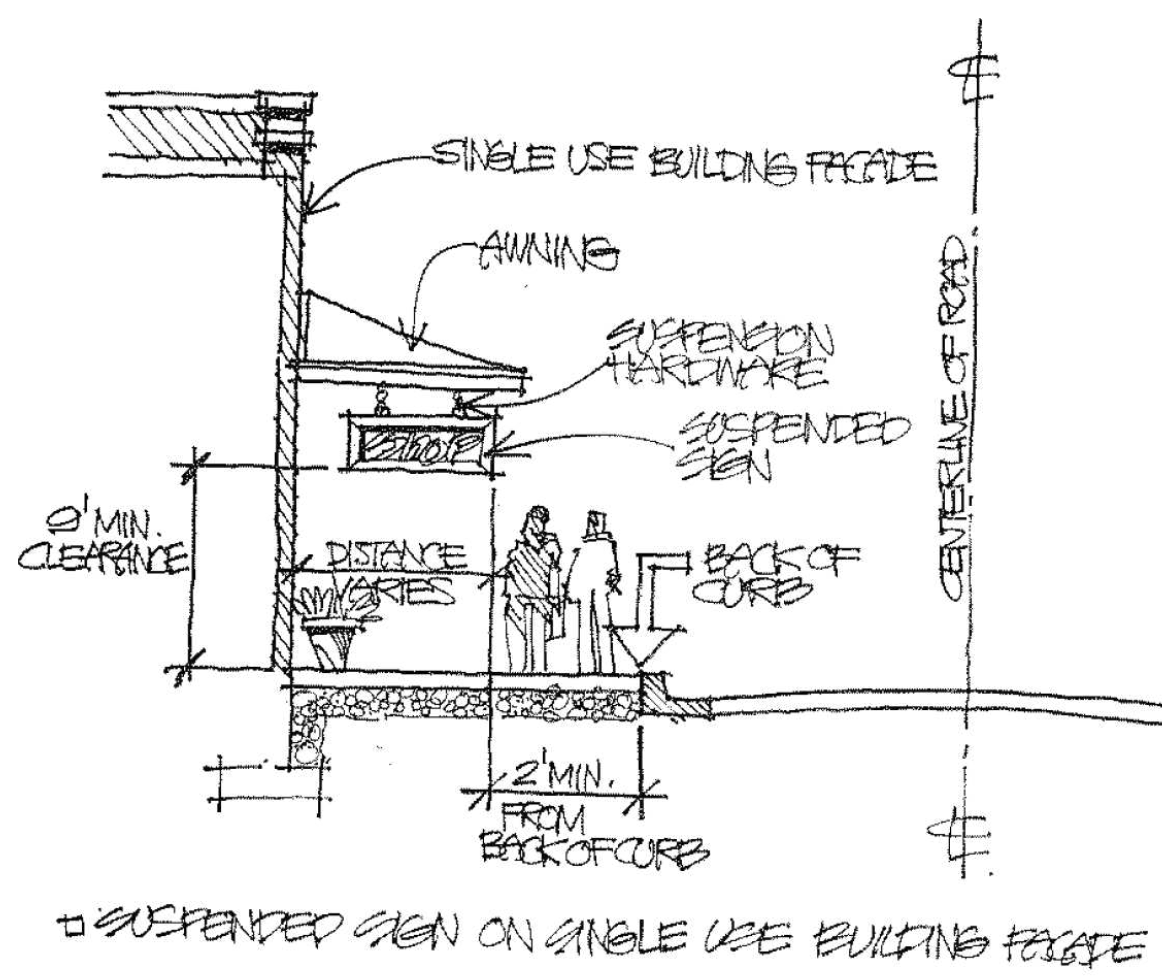
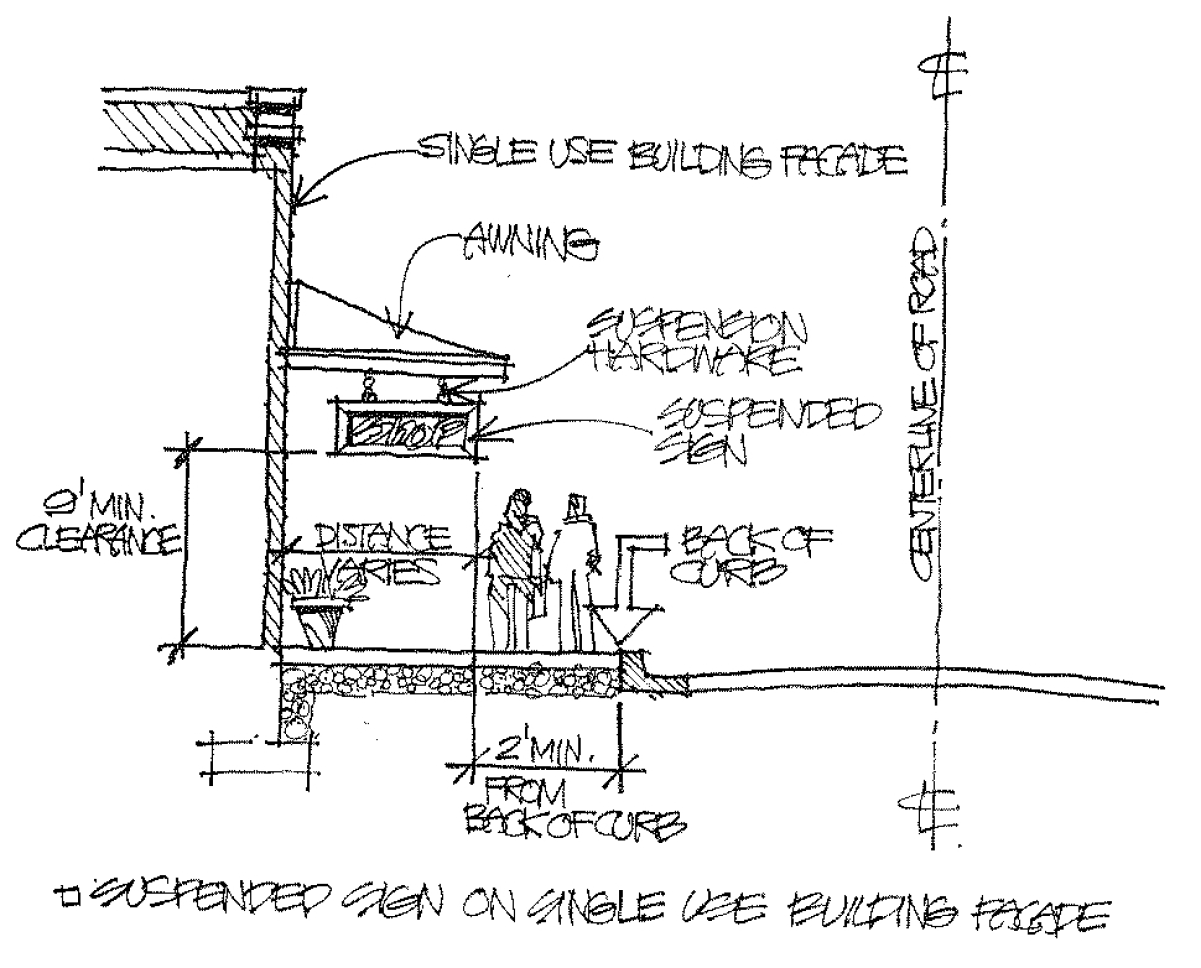
Suspended sign means a sign which is suspended from the underside of a horizontal plane surface and is connected to this surface.
Temporary directional off-premises real estate sign means a sign not intended to be displayed on a permanent basis that identifies or directs the public to a residential area where property is available for sale, rent or lease and which is located at a place other than the real property on which the sign is located.
Temporary sign means a sign intended to display either commercial or noncommercial messages of a transitory or temporary nature. Portable signs or any sign not permanently embedded in the ground, or not permanently affixed to a building or sign structure that is permanently embedded in the ground, are considered temporary signs.
Under-canopy sign means a sign suspended beneath a canopy, ceiling, roof, or marquee.
US Hwy 17 Overlay District means the area as designated by the town and which is delineated upon a map adopted by the town council and on file with the town planning department.
V-shaped sign means a sign constructed in the form of a "V."
Vertical banner means a banner hung or projecting from a banner pole.
Wall sign means a single faced sign affixed on, and parallel to, the exterior wall of any building and projecting not more than 18 inches from the wall. Signs mounted on porticoes shall be considered as wall signs.
Window sign means a sign applied directly onto a window or inside of a window and within ten feet of the window. Window signs include, without limitation, the application of words and logos onto window glass, the use of hanging signs and paper signs. However, the display of merchandise shall be permitted provided the packaging and/or labels are not so extreme as to render it substantially advertising copy. Window signs shall not be animated signs, blinking signs, or electronic message boards.
(Ord. No. O20-017, § 1(Exh. A), 3-19-2020; Ord. No. O22-063, § 1(Exh. B), 8-18-2022)
Sec. 66-350. - Purpose.
The purpose of this article is to:
(1)
Encourage the effective and appropriate use of signs as a means of communication in the town;
(2)
Ensure that the design, construction, installation, repair and maintenance of signs will not interfere with pedestrian or vehicular safety or otherwise endanger public safety;
(3)
Allow for adequately legible sign copy and overall sign visibility;
(4)
Provide regulations that allow reasonable consideration of the visual environment and minimize possible adverse aesthetic effects on surrounding property;
(5)
Enable the fair and consistent enforcement of this article.
(Ord. No. O20-017, § 1(Exh. A), 3-19-2020)
Sec. 66-351. - Sign permits; applicability.
(a)
Except as otherwise provided in this article, a sign permit application shall be submitted to the code enforcement officer and a sign permit shall be required to erect, construct, enlarge, move or replace any sign. A building permit may also be required.
(b)
Combined development signs require a sign permit and a signage plan as outlined in section 66-352.
(Ord. No. O20-017, § 1(Exh. A), 3-19-2020)
Sec. 66-352. - Signage plan.
(a)
Applicability. Combined developments require a signage plan representing all ground signs in a development project. Locations of all existing and proposed ground signs of any type should be shown on a site plan. Understanding that all sign locations may not be known at the time of plan submittal or that locations may need to change after the approval of the plan, signage plans may be amended as development occurs.
(b)
Signage plan requirements.
(1)
The sign permit applicant shall submit a signage plan to the code enforcement officer for review with the first combined development sign permit application for a development.
(2)
Proof of combined development as described in the definition in section 66-359 shall be provided by the applicant with a signage plan and other documentation as required by the code enforcement officer.
(3)
If any non-conforming signs exist on the property or properties included in the signage plan, those signs must be brought into compliance prior to the issuance of a sign permit.
(4)
Additional information may be requested by the code enforcement officer on a case-by-case basis.
(Ord. No. O20-017, § 1(Exh. A), 3-19-2020)
Sec. 66-353. - Sign area and height computations.
The following principles shall control the computation of sign area and height:
(1)
Computation of area of single-faced signs. The area of a sign face shall be computed by means of the smallest square or rectangle that will encompass the extreme limits of the writing, representation, emblem or other display, together with any material or color forming an integral part of the background of the display or used to differentiate the sign from the backdrop or structure against which it is placed, but not including any supporting framework, bracing, or decorative fence or wall when such fence or wall otherwise meets regulations of this article and is clearly incidental to the display itself.
(2)
Computation of area of multi-faced signs. The sign area for a sign with more than one face shall be computed by adding together the area of all sign faces visible from any one point. When two identical sign faces are placed back-to-back so that both faces cannot be viewed from any point at the same time, and when such sign faces are part of the same sign structure and not more than 42 inches apart, the sign area shall be computed by the measurement of one of the faces. If the sides of the sign are not identical the larger sign face will determine the square footage allowed.
(3)
Computation of combined development ground sign area. Logos and/or text on ornamental or support structures of the combined development sign may not exceed one logo and two lines of text and shall not exceed 25 percent of the total allowable sign area of the combined development sign face. This computation is not included in the total allowable sign area for combined development signs.
(4)
Computation of height. The maximum height of a sign shall be measured at the base of the sign from normal grade to the top of the highest part of the sign exclusive of ornamental features. This includes any base construction.
a.
Normal grade shall be construed to be either the existing grade prior to construction or the newly established grade after construction, exclusive of any filling, berming, mounding or excavating solely for the purpose of locating the sign.
b.
In cases in which the normal grade cannot reasonably be determined, sign height shall be computed on the assumption that the elevation of the normal grade at the base of the sign is equal to the elevation of the nearest point of the crown of a public street or the grade of the land at the principal entrance to the principal structure on the lot or parcel, whichever is lowest.
(5)
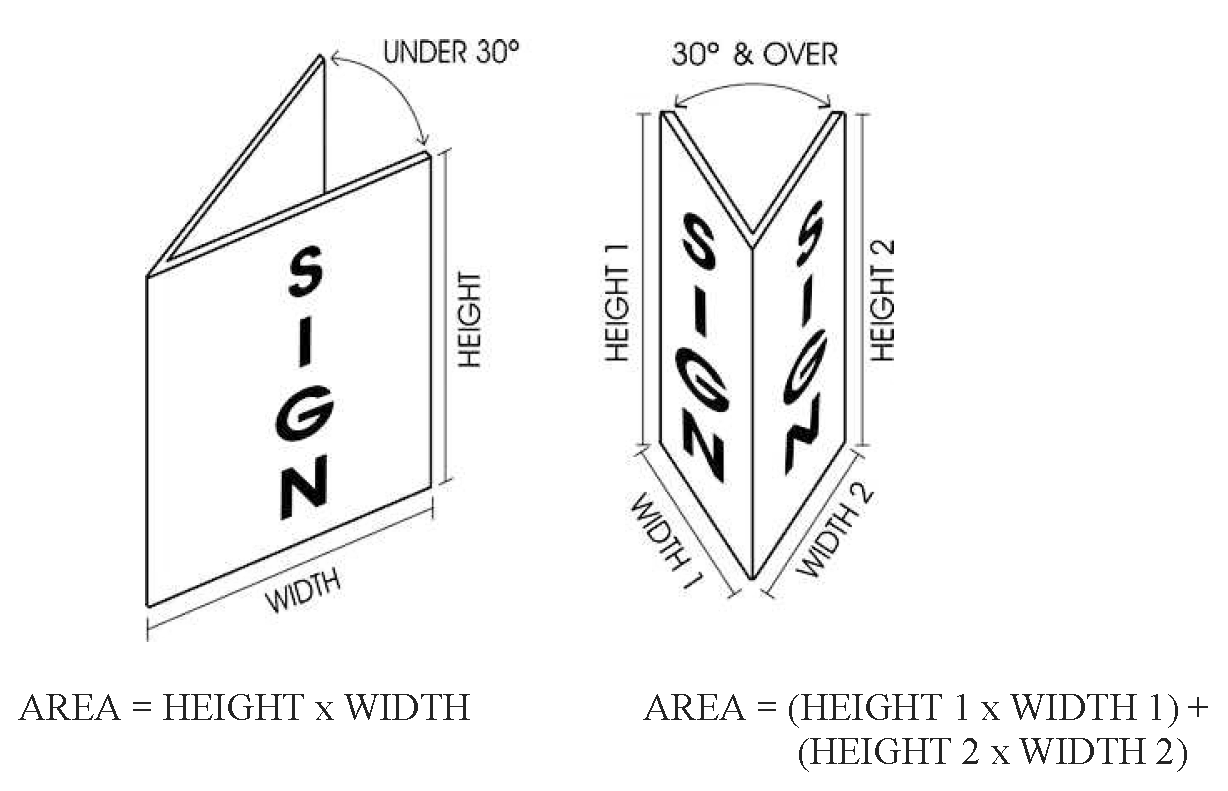
Computation of area of V-shaped signs. When determining the available sign area of a V-shaped sign having an angle between the two sides of the sign of 30 degrees or more, the area of two sides of such sign shall be included. When determining the available sign area of a V-shaped sign having an angle between the two sides of the sign of less than 30 degrees, the area of only one side of such sign shall be included. Area of the sign faces will be regulated by the tables in section 66-362. If the sides of the sign are not identical, the larger sign face will determine the square footage allowed.
(Ord. No. O20-017, § 1(Exh. A), 3-19-2020)
Sec. 66-354. - Construction and maintenance standards.
All signs shall be constructed and maintained in accordance with the following standards and as further specified in this article:
(1)
Construction. All signs shall be constructed of permanent materials and shall be securely attached to the ground, a building, or by direct attachment to a rigid wall, frame, or structure. This provision does not apply to banners, flags, temporary signs, or window signs.
(2)
Maintenance. The sign shall be maintained in substantially similar condition as to when it was originally permitted and erected. Maintenance shall include periodic painting, replacement of defective or missing parts, cleaning, and replacement of any sign face that exhibits damage or deterioration. Refer to section 66-355 for repair and maintenance of legal non-conforming signs.
(Ord. No. O20-017, § 1(Exh. A), 3-19-2020)
Sec. 66-355. - Repair, maintenance and alteration of a sign face on legal non-conforming signs.
(a)
Repairs and maintenance.
(1)
Unless otherwise prohibited or regulated by this article, a legal non-conforming sign may be maintained and repaired without a sign permit even though such repair will not bring the sign into compliance with this article.
(2)
Legal non-conforming signs which have been damaged or destroyed by accident or natural causes beyond normal wear and tear, or which have been required to be removed by a duly constituted governmental body may be reconstructed/repaired if the following criteria are met:
a.
The sign owner shall supply the code enforcement officer with a comparison of cost supplied by a sign manufacturer including:
1.
The cost to reconstruct/repair and install the legal non-conforming sign; and
2.
The cost to construct and install a new conforming sign of the same type.
b.
Reconstruction or repair of a legal non-conforming sign shall be allowed if the cost of this action does not exceed 60 percent of the total cost of a new conforming sign of the same type; and
c.
The permit required for such reconstruction/repair is applied for within six months of the date of damage.
(b)
Alteration of sign face.
(1)
The sign face or copy of a legal non-conforming sign may be changed to reflect a modification in the company or individual marketing policy only if the following criteria are met:
a.
The sign may not be reconstructed or relocated; and
b.
There shall be no increase in the size or height of the sign.
(2)
New tenants, uses, or entities shall bring signs into compliance with this article. Replacement of the sign face of a legal non-conforming sign reflecting a new business name at such location shall not be permitted.
(3)
The alteration of a sign face or copy on a legal non-conforming sign requires a sign permit and payment of the requisite fee.
(Ord. No. O20-017, § 1(Exh. A), 3-19-2020)
Sec. 66-356. - Signs installed or placed on public property and rights-of-way and town-maintained easements.
Any sign installed or placed on public property or within a public right-of-way or town-maintained easement, except in conformance with the requirements of this article, shall be forfeited to the public and is subject to confiscation by the town. In addition to other remedies under this article, the code enforcement officer shall have the right to recover the full costs of removal and disposal of such signs from the owner or person placing such signs.
(Ord. No. O20-017, § 1(Exh. A), 3-19-2020)
Sec. 66-357. - Prohibited signs.
The following signs are prohibited within the town:
(1)
Signs which approximate official highway signs, warning signs or regulatory devices.
(2)
Signs displaying blinking, flashing or intermittent lights, animation and moving parts, except as provided for in section 66-359(1)g. and (5)d.
(3)
Portable signs, except as specifically permitted in this article.
(4)
Wraparound signs or other continuous wall signs that extend around a building corner or radii.
(5)
Off-premises signs, except as specifically permitted in this article.
(6)
Facsimile signs.
(7)
Signs placed within any required sight distance triangle.
(8)
Signs attached to, or painted on telephone poles, trees, parking meters, bridges and overpasses, rocks, other signs, benches and refuse containers, except that the latter two may contain a logotype and donor names. No signs except vertical banner signs are allowed on utility poles.
(9)
Roof signs.
(10)
Pavement markings for purposes other than traffic control.
(11)
Signs placed within or extending into town maintained easements or the right-of-way of town and state-maintained streets and roads, except signs erected by a duly constituted governmental body or as specifically permitted in this article.
(12)
Signs that contain language or pictures obscene to the general public in accordance with G.S. 14-190.1.
(13)
Signs that advertise an activity or business no longer conducted on the property on which the sign is located.
(14)
Indirect illumination, such as floodlights, erected in such a manner as to cause glare that impairs driver vision on streets and roadways, or that causes a nuisance to adjoining property.
(15)
Signs that obstruct fire escapes, windows, doors or other openings used as a means of egress or as required legal ventilation.
(16)
Signs containing or consisting of pennants, ribbons, streamers, festoon lighting, balloons or inflatable signs, feather flags or spinners.
(17)
Off-premises real estate signs, except as specifically permitted in this article.
(18)
Any exterior illuminated tubing or strings of lights, including, but not limited to, those outlining property lines, buildings, structures, open sales areas, rooflines, doors, windows, or the edges of walls except holiday lights.
(19)
New outdoor advertising structures.
(20)
Digital or LED outdoor advertising structures are not allowed except as specifically permitted in this article.
(21)
Signs that do not conform to the provisions of this article.
(Ord. No. O20-017, § 1(Exh. A), 3-19-2020)
Sec. 66-358. - Signs allowed in all zoning districts without a permit.
No permit is required for the following signs, provided such signs are not prohibited pursuant to section 66-357 and provided they comply with the conditions set forth in this article. Signs permissible in this section shall not be considered in determining the total sign area; however, if a sign exceeds the size or in any other way does not comply with these limitations, it shall be considered as a prohibited sign and/or shall be subject to all other provisions of this article.
(1)
Building marker signs. Such signs may include only the building name, date of construction or historical data on historic buildings or sites, and shall be cut or etched into masonry, bronze or similar material.
(2)
Business identification signs. Such signs shall be pedestrian oriented signs attached to a building to identify the tenant(s) within. Such sign shall contain no advertising, other than trade names and a logotype. One sign is permitted per entrance. Maximum size of such sign is six square feet.
(3)
Special event sign for public, quasi-public or nonprofit organizations.
a.
A sign may be erected by public, quasi-public or nonprofit organizations for promoting:
1.
Scheduled sales events, such as rummage and bake sales. Such signs shall remain in place no more than 72 hours. Additionally, such signs shall be limited to one on-premises sign per street frontage.
2.
Public events, such as charity benefits, fairs, fund drives, revivals and sporting events. Such sign shall not be illuminated nor be located within a street right-of-way or sight distance triangle. Such sign may be displayed for a period of 30 days and may be allowed on the premises or off the premises.
3.
Special seasonal events, such as parades, fairs and festivals. Such signs may be erected on the premises or off the premises within 14 days of the event and shall be removed within 72 hours after the end of the event.
b.
Such signs shall not be illuminated and the maximum size is 18 square feet.
(4)
A-frame signs. A business shall be allowed one A-frame sign per building frontage, but the sign shall not be illuminated. An A-frame sign advertising on-premises business sales, special events, daily specials and/or promotions shall be allowed year round provided that total sign area does not exceed ten square feet. The sign may contain changeable copy on a chalk or wet/dry-erase board only. These signs may not be located in the public right-of-way or sight distance triangle. Signs must be located in compliance with this article and all local, state and federal codes.
(5)
Construction/contractor's and subdivision project signs. Such signs shall not be illuminated and may be located in any district to identify future tenants, homebuilders, contractors and designers during the period of construction. Such signs shall be removed no later than seven days after the completion of a project. The maximum size of such signs is 48 square feet each. No more than four of these signs are allowed on a parcel or within a combined development and the total sign area allowed for all of these construction/contractor's and subdivision project signs is 64 square feet.
(6)
Flags. Such flags shall be flags of the United States of America, the state, the county, the town or foreign nations having diplomatic relations with the U.S., and any other flag adopted or sanctioned by an elected legislative body of competent jurisdiction, provided that such flags shall also be flown in accordance with the following provisions:
a.
Flags displaying a logo, message, statement, or expression relating to commercial interests, and banners otherwise not meeting the definition of a flag shall also conform to all sign regulations in this article;
b.
Reference to flagpole height refers to vertical flagpoles;
c.
Reference to flagpole height refers to the distance to the top of the flagpole from the ground;
d.
In all zoning districts, flagpoles shall not exceed 60 feet in height and shall follow the dimensional limitations as outlined in subsection (6)f. of this section;
e.
A vertical flagpole shall be set back from all property boundaries, rights-of-way and electrical easements a distance which is at least equal to the fly width of the allowable flag;
f.
Such flags shall be flown in accordance with protocol established by the Congress of the United States for the Stars and Stripes as well as the Executive Order dated June 24, 1912, establishing proportions for the flag and in accordance with 4 USC 1;
g.
Any flag not meeting these conditions shall be considered a banner sign and shall be subject to regulation as such; and
h.
In conjunction with, and only in conjunction with the flags set forth in this subsection (6), business or corporate logo flags, with a maximum size of three feet by four feet, may be flown. Such corporate and logo flags are to be displayed on a one-to-one relationship with the other flags listed in this subsection (6).
(7)
Governmental signs. Such signs shall be posted by various local, state and federal agencies, such as regulatory signs, welcome signs and traffic control signs.
(8)
Incidental signs.
a.
Such signs shall indicate entrances and exits, parking areas, one-way traffic, no trespassing, dumping, loitering, etc.
b.
Such signs shall not exceed three feet in height or four square feet of sign area.
c.
Such signs may contain general information about the premises but may not contain commercial messages.
d.
Such signs shall not obstruct any vehicular sight distance triangle, and shall be located in the immediate vicinity of the entrance/exit or other item in which it delineates.
e.
No more than two signs per entrance or exit shall be allowed.
f.
Such signs may be illuminated.
g.
Such signs shall not be placed in any public right-of-way or town maintained easements.
(9)
Directional signs located outside of the right-of-way. A directional sign located outside of the right-of-way can be utilized within any development that has an approved master land use plan on file with the town and is in conformance with all of the following regulations:
a.
Such sign may be in the style of a post sign or bracket sign.
b.
Post style directional signs shall not exceed ten square feet in total sign area and six feet in height.
c.
Such signs shall not be located in any required site distance triangle and shall not visually impair drivers or pedestrians.
d.
Bracket style directional signs shall not exceed 24 square feet in total sign area. No more than four panels per sign.
e.
Directional signs located outside of the right-of-way may be illuminated by an indirect source of light.
f.
Such signs may not be located on a road frontage along major thoroughfares such as Highway 17, Highways 74/76 or Village Road.
g.
Such signs shall comply with local, state and federal codes.
(10)
Occupant/street number signs. Such signs shall be not be illuminated signs affixed to structures, mailboxes, decorative light posts, driveway entrances, etc., which serve to identify the address of the structure or occupant. All such signs are required to be placed in a manner so as to be visible from the street.
(11)
Off-premises directional signs for churches.
a.
Such signs shall be permanent freestanding signs. Portable signs shall not be allowed.
b.
No greater than two directional signs shall be allowed at any street corner.
c.
No greater than two directional signs per use shall be allowed.
d.
No two directional signs shall be located within five linear feet of each other.
e.
All directional signs shall be constructed of durable wood or non-reflective metal or plastic material.
f.
Directional signs shall not be illuminated.
g.
More than one sign may be placed on the same sign support. The maximum area of any one sign shall be two square feet; however, the maximum aggregate area of all signs on any sign structure shall be four square feet.
(12)
Political signs. Such signs shall not be illuminated, shall not be located within a public street right-of-way or closer than ten feet from the edge of the street pavement or within a required sight distance triangle, shall not be attached to trees or utility poles, shall not be roof mounted, shall be no taller than four feet, and shall have a maximum size of six square feet, provided that either side of a two-sided sign may be up to six square feet.
(13)
Real estate signs on residential properties. Such signs shall advertise the sale or lease of the property on which the sign is located. Such signs may not be illuminated or located within a sight distance triangle or public right-of-way and shall be removed no later than seven days after the sale or lease of the property. Such signs are limited to one sign per street frontage. The maximum height of such signs is to be ten feet above the adjacent road grade. The maximum size of such signs is four square feet; however, properties which are two acres or larger may have a maximum sign size of 24 square feet.
(14)
Real estate signs for nonresidential properties. Such signs shall advertise the sale or lease of the property on which the sign is located. Such signs may not be illuminated or located within a sight distance triangle or public right-of-way and shall be removed no later than seven days after the sale or lease of the property. Such signs are limited to one sign per street frontage. The maximum size of such signs is 24 square feet and the maximum height is ten feet above the adjacent road grade.
(15)
Window signs. Such signs shall be placed or painted on the interior or exterior of glass windows or doors, provided that such signs cover no more than 30 percent of the entire storefront. Window signs that cover more than 30 percent of the glass shall be considered as wall signs and shall meet the requirements for wall signs within the appropriate zoning districts.
(16)
Yard, garage and moving sale signs, etc. Such signs may be placed on the premises or off the premises, provided such signs are not located in a sight distance triangle or street right-of-way, nor placed on any tree, street sign or utility pole. Such signs may not be illuminated and may remain in place for 72 hours in any 90-day period. The maximum size of such signs is four square feet.
(17)
Murals. Murals not intended for the purpose of advertising or promoting a particular business, service or product shall be allowed. Building names are allowed in murals provided that the names do not specifically advertise or promote any particular business, service or product in the building. All other murals shall comply with section 66-359(1)f.
(18)
Vertical banner signs. Such signs may be placed on streetlight or utility poles owned or maintained by the vertical banner sign owner as long as no advertising for off-premises events or locations occur on poles. The maximum size of one face of these signs is 14 square feet and the signs may be double sided.
a.
An example of this type of sign is a season's greetings or neighborhood events sign attached to streetlight poles in a neighborhood which would be allowable on poles owned or maintained by that neighborhood. Neighborhood event signs may not be displayed on public streetlight or utility poles.
b.
The town may announce events or messages on these signs on public or private streetlights and utility poles provided that the pole owners agree to the display.
c.
All signs must be located in compliance with this article and with local, state and federal codes.
(19)
Civic service club display signs. Such signs shall not be internally illuminated or located in any street right-of-way or site triangle. Such signs are limited to one structure per location and no more than two locations within the town. Location and design of such signs shall be approved by the town council in the form of resolution. Such signs, in total, shall not exceed 32 square feet and shall be no more than six feet tall. Such signs shall contain no changeable copy, are intended for display of club logos only and each logo is limited to a maximum of two and a quarter square feet. Such sign structures are intended to be shared with any club's logo approved for display by the town council. Clubs or service groups wishing to display logos on said structure must maintain an active membership in the town and are subject to review by the town council.
(Ord. No. O20-017, § 1(Exh. A), 3-19-2020)
Sec. 66-359. - Permanent signs requiring a permit.
This section shall govern regulations for signs permanently installed on a site and which are required to obtain a sign permit in accordance with the requirements of this article and the tables in section 66-362.
(1)
Wall signs. The sign area, location characteristics and number of wall signs shall be determined in accordance with the tables in section 66-362 and as outlined in this section. The following additional regulations shall apply to wall-mounted signs:
a.
Signs on building walls which do not face public streets. The permitted wall sign may be placed on a wall that does not face a public street. The maximum allowable size shall be calculated as if the wall faces a public street. The maximum allowable size for a sign on one wall is not transferable to a wall with less frontage.
b.
Additional wall sign or canopy sign permitted on corner or more than one street frontage. Lots with more than one street frontage shall be allowed to erect one additional wall or canopy sign on the secondary street frontage, provided that the secondary frontage is at least 100 feet in width at the street right-of-way. The secondary wall sign may not be placed on the same building wall as the primary sign.
c.
Wall sign or canopy sign permitted to face side or rear parking lot. Lots with parking to the side or rear of a building shall be allowed to erect an additional wall or canopy sign on each side facing the parking lot, provided that at least 25 percent of the required parking for the establishment is located to the side or rear of the building and an entrance to the establishment faces the parking lot. Side or rear parking lot wall signs may not be placed on the same building wall as the primary sign.
d.
Location requirements for wall signs. No wall sign may extend more than 18 inches from the exterior of the wall and no portion of a sign shall extend above the wall or feature on which it is mounted.
e.
Wall signs on historic buildings. Wall signs on historic buildings shall be placed within the sign frieze or a distinct place within which a wall sign was intended to be located if the building was designed for such. No wall sign shall extend beyond such space. If there is no sign frieze, the wall sign shall be placed below the typical second floor window area. The design and coloration of such signs shall be compatible with the character of the building.
f.
Murals as wall signs. Any mural on a building intended to advertise or promote a particular business, service or product within the building shall comply with the requirements of this section and the tables in section 66-362. Sign area of the advertisement, promotion or text in a mural shall be calculated as a wall sign. Any other part of the mural will be considered background and not part of the calculation.
g.
Changeable sign. A sign with changeable copy or a reader board area and electronic message board area are permitted as wall signs, provided that the changeable copy or electronic message board area does not exceed 50 percent of the total area of the sign and has a maximum square footage of four feet. An electronic message board area is included in the calculation of the total sign area unless the board displays only time and temperature information, in which case, the message area is allowed in addition to the maximum area of the sign. Electronic message board signs may only change copy every 30 seconds.
h.
Illumination. Internally and externally illuminated wall signs are allowable only if the sign is illuminated in a manner as to prevent glare that impairs a driver's vision on roads and in a manner that prevents nuisance to the adjoining property or tenants.
i.
Wall signs located within the US Hwy 17 Overlay District.
1.
Building perimeter. The total building perimeter shall be identified by the applicant on the sign permit application along with the amount of existing and proposed signage.
(i)
For the purposes of wall signage, each self-contained business, with direct access to the shared parking facilities or outdoor area, shall adhere to the maximums set forth herein as if said business were not part of a combined development with shared or common walls.
(ii)
Business located within the confines of another business with no definable separation or direct access to the shared parking lot or outdoor area shall share the signage space allotted to the building in which they reside.
(iii)
Wall signage on commercial accessory structures shall only be allowed for those businesses which said structure directly serves; any other signage placement would be considered off premises.
(iv)
Wall signage on commercial accessory structures shall be calculated based on the building perimeter of the primary structure.
2.
Wall signs may be located on any attached architectural feature or outcropping. However, as those portions of the building cannot be counted towards the building perimeter, the signs placed on said features must not exceed the maximum signage allowance identified in Table 6 of this article.
3.
Signs may cover no more than ten percent of any one wall, architectural feature or building outcropping.
4.
Any sign facing a residential zoning district or within sight of a residential zoning district shall not be illuminated.
5.
No wall sign may exceed more than 18 inches from the exterior of the wall and no portion of a sign shall extend above the wall or feature on which it is mounted.
6.
Murals as wall signs. Any mural on a building intended to advertise or promote a particular business; service or product within the building shall comply with the requirements of this section and the tables in section 66-362. Sign area of the advertisement, promotion or text in a mural shall be calculated as a wall sign. Any other part of the mural will be considered background and not part of the calculation.
7.
Changeable sign. A sign with changeable copy or a reader board area and electronic message board area are not permitted as wall signs.
(2)
Canopy/awning signs. The sign area, location, characteristics and number of canopy/awning signs shall be determined in accordance with the tables in section 66-362 and as outlined in the following additional regulations:
a.
Valance and copy size. The valance or apron for any canopy shall in no case exceed 12 inches in height. Individual letters or symbols on the valances shall not exceed nine inches in height. This provision shall apply only to valances to which sign copy is affixed.
b.
Historic buildings. No canopy/awning sign shall be permitted on a historic building unless documentation indicates that such a sign was used on the building when the building was originally constructed and occupied. The design and coloration of such signs shall be compatible with the character of the building.
c.
Clearance requirements. All canopy/awning signs attached to the underside of a canopy/awning shall maintain the minimum clearance above the ground level of any sidewalk or vehicular access area as specified in the most recent edition of the state building code.
d.
Illumination. Canopy/awning signs may not be illuminated.
(3)
Projected/suspended signs. The sign area, location, characteristics and number of projected/suspended signs shall be determined in accordance with the tables in section 66-362 and as outlined in the following additional regulations:
a.
Sign use. No more than one projected or one suspended sign per individual use or tenant shall be permitted.
b.
Historic buildings. No projected/suspended sign shall be permitted on a historic building unless documentation indicates that such a sign was used on the building when the building was originally constructed and occupied. The design and coloration of such signs shall be compatible with the character of the building.
c.
Clearance requirements. All projected/suspended signs attached to a building or canopy/awning shall maintain the minimum clearance above the ground level of any sidewalk or vehicular access area no less than nine feet. No sign may obstruct ingress and egress from a building.
d.
Sign wind loading, working stress, and attachment. All projected/suspended signs shall be attached to the building or canopy/awning in a manner consistent with the most recent edition of the state building code.
e.
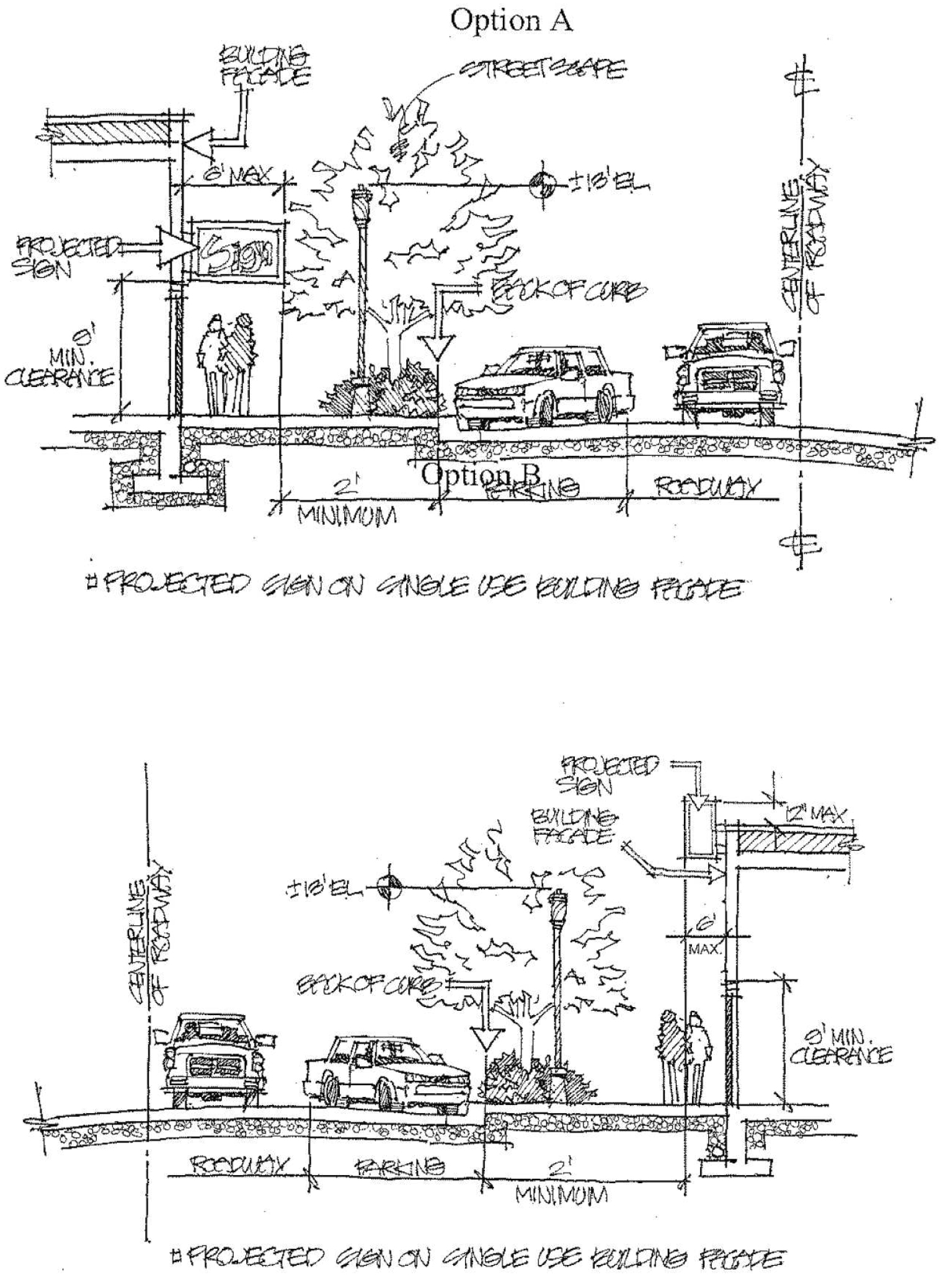
Sign projection and setback. Projected signs shall be projected horizontally a maximum of six feet, but they shall be set back at least two feet from the back face of the curb or outer edge of the pavement where there is no curb.
1.
There is no maximum horizontal projection for suspended signs; however, suspended signs shall be set back at least two feet from the back face of the curb or outer edge of the pavement where there is no curb.
2.
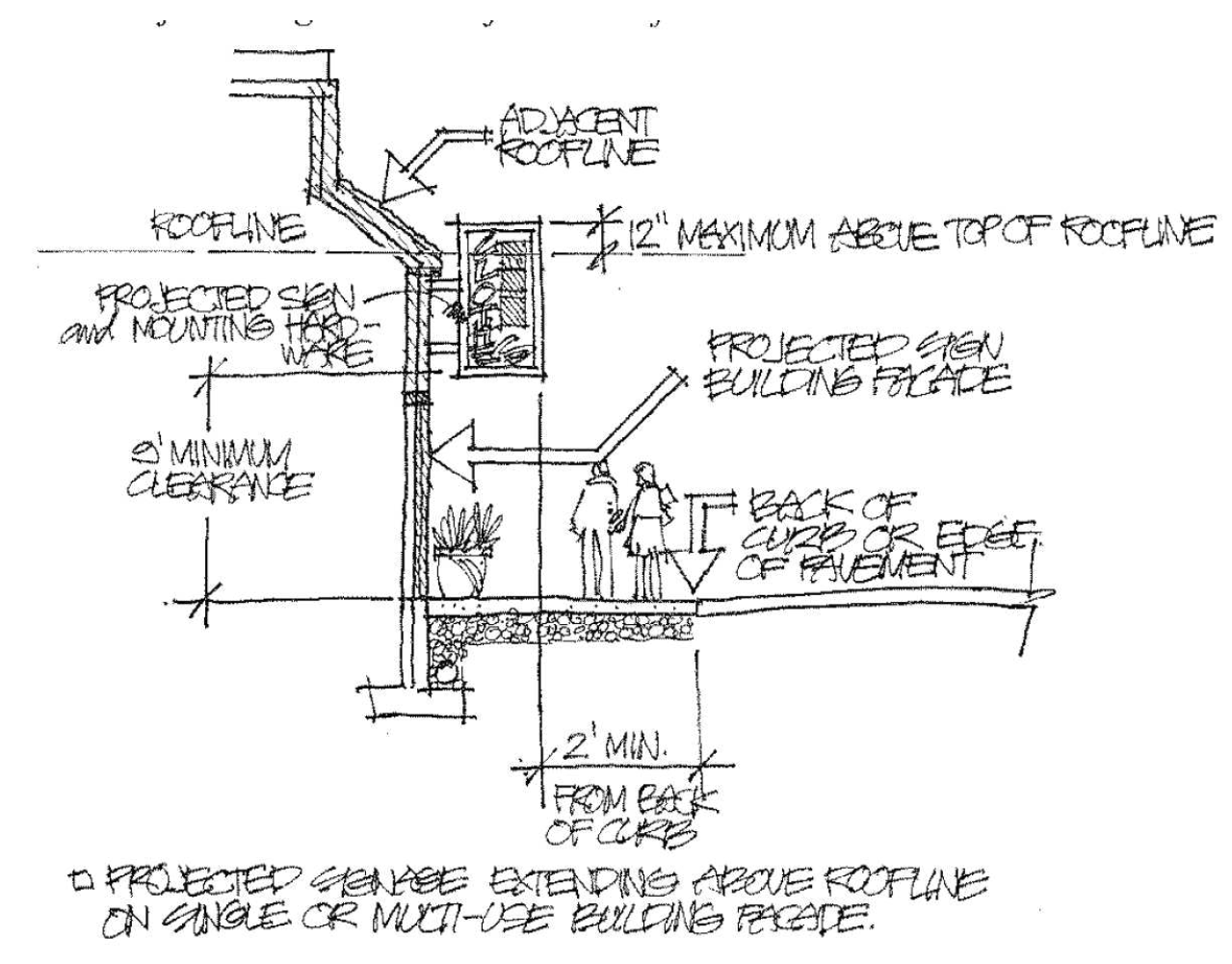
No projected/suspended sign shall extend more than 12 inches above the immediately adjacent roofline of the building facade on which it is attached.
3.
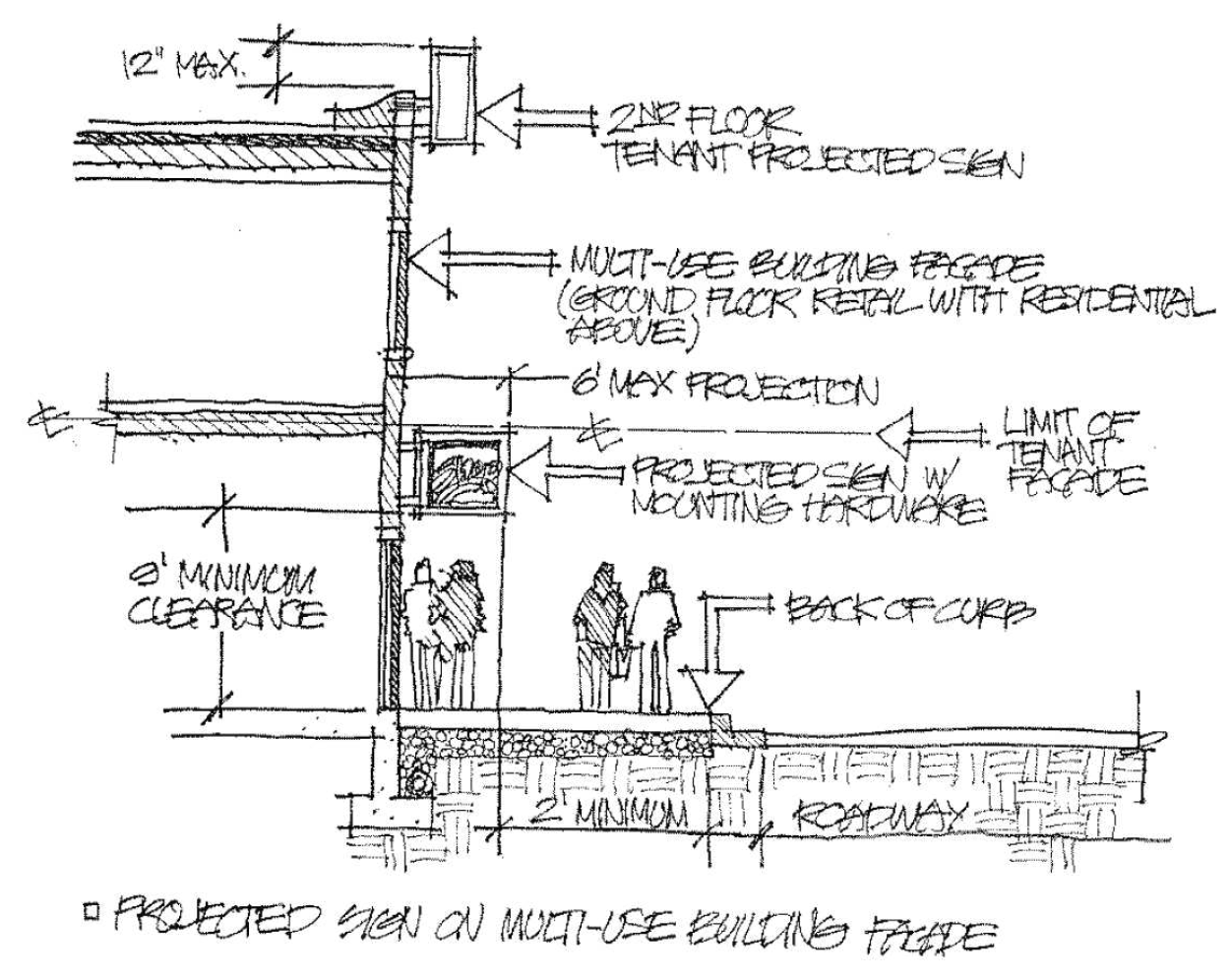
On multi-use facades no projected/suspended sign shall be allowed to project more than 12 inches beyond that tenant/use's facade, as defined in section 66-349, definitions. Facade, multi-use, provided that the tenant/use's signage maintains a minimum distance of 12 inches from any adjacent tenant/use's sign, window, or other architectural accents. (See subsections (3)g.1 through 4 of this section and the tables in section 66-362.)
4.
Projected/suspended signs shall not encroach on sight distance triangles.
5.
Setback distances for projecting signs which front on state roads must be approved by the state department of transportation.
6.
No projected/suspended sign shall be located within any public right-of-way, in a public utility easement, or in any manner that impedes the town's or any utility provider's access to a right-of-way or a utility easement.
7.
Within a private utility easement, the tenant/sign applicant must provide the town with written approval for the projected/suspended sign from the utility providers within that private utility easement.
f.
Multi-tenant sign sharing. Any tenant without a building facade in a multi-tenant building shall be allowed to share projected or suspended signage with the following provisions:
1.
One sign sharing tenant must have a building facade immediately adjacent to the tenant's occupancy.
2.
All sign sharing tenants shall occupy the same building and the interior tenant must share the sign with the closest tenant having a delineated building facade.
3.
All projected/suspended signs shall be in accordance with the tables of section 66-362.
g.
Illustrations.
1.
Projected sign on single-use facade.
2.
Projected sign above adjacent roofline.
3.
Projected sign on multi-use facade.
4.
Suspended sign.
h.
Illumination. Projected/suspended signs may be illuminated by the use of directional light fixtures either surface-mounted or recessed on/into the sign face, on/in sign mounting or suspension hardware, or on/into the building facade. The use of fiber optic string or neon tube lighting as an integral part of the projected/suspended sign shall be allowed. Internally illuminated projected/suspended signs are allowable. Signs shall be illuminated in a manner as to prevent glare that impairs a driver's vision on roads and in a manner that prevents nuisance to the adjoining property or tenants.
(4)
Bracket style ground signs. The sign area, location, characteristics and number of bracket signs shall be determined in accordance with the ground sign regulations in the tables in section 66-362 and as outlined in the following additional regulations:
a.
Bracket sign as a ground sign. A bracket ground sign is allowable instead of a ground sign, not in addition.
b.
Sign base. No ground sign base is required for a bracket sign.
c.
Size. Sign on the post and arm shall not exceed 15 square feet in sign area for each sign face. No more than two signs per post are allowed, and signs may be double sided. In cases when additional ground signs are permissible, a second bracket sign is allowed at the same size of the first.
d.
Overhang. Bracket signs shall not hang over the public sidewalk.
e.
Sign location. Such signs shall not be placed in the public right-of-way, town maintained easement or any required site distance triangle.
f.
Distance requirements from existing ground signs. No proposed ground sign shall be placed within 50 feet of an existing ground sign if such signs are located on separate parcels. When such signs are located on the same parcel, the distance requirement shall be increased to 200 feet.
g.
Illumination. Indirectly illuminated bracket style ground signs are allowable only if the sign is illuminated in a manner as to prevent glare that impairs a driver's vision on roads and in a manner that prevents nuisance to the adjoining property or tenants.
(5)
Ground signs. The sign area, location characteristics and number of ground signs shall be determined in accordance with the tables in section 66-362 and as outlined in this section. The following requirements also apply to all ground signs:
a.
Base landscaping in parking and vehicular use areas.
1.
All ground signs located within parking or vehicular use areas, and not in yard areas, shall stand in a bed of landscaping at least 30 square feet in area. Such area shall contain low growing plant material such as ground covers, perennials and small shrubs.
2.
A ground sign may be located in the landscape median of a vehicular entrance/exit where the median is a minimum of 50 feet long and ten feet wide and provided that the sign is not located within ten feet of either end of the median or within two feet from the sides of the median. A sign in a median shall not visually impair drivers or pedestrians.
b.
Base landscaping in yard areas. Ground signs in yard areas shall be surrounded by low growing plant material that is installed and maintained to avoid the plants covering the sign copy.
c.
Distance requirements from existing ground signs. No proposed ground sign shall be placed within 50 feet of an existing ground sign if such signs are located on separate parcels. When such signs are located on the same parcel, the distance requirement shall be increased to 200 feet.
d.
Changeable sign. A sign with changeable copy or reader board area and exclusive and electronic message board area are permitted as on-premises ground signs, provided that the changeable copy or electronic message board area does not exceed 50 percent of the total area of the sign, up to a maximum of four square feet. Electronic message board area is included in the calculation of the total sign area unless the board displays only time and temperature information, in which case, the message area is allowed in addition to the maximum area of the sign. Messages on a changeable copy or electronic message board area may only change every 30 or more seconds.
e.
Drive-through menu signs. Drive-through menu signs shall be limited to a maximum size of 32 square feet.
f.
Additional ground signs. Businesses or developments with multiple property frontages shall be allowed to erect one ground sign per frontage, provided that each frontage is at least 100 feet in width at the street right-of-way. The additional, or secondary, ground sign is only allowable if the maximum sign area is one-half the square footage of the primary sign.
g.
V-shaped signs. Signs may be placed in a "V" formation. Reference section 66-363(5) for area computations for V-shaped signs.
h.
Sign location. Such signs shall not be placed in the public right-of-way, town maintained easement or any required site distance triangle.
i.
Illumination. Internally and externally illuminated ground signs are allowable only if the sign is illuminated in a manner as to prevent glare that impairs a driver's vision on roads and in a manner that prevents nuisance to the adjoining property or tenants.
(6)
Combined development ground signs. The sign area, location, characteristics and number of combined development ground signs shall be determined in accordance with the tables in section 66-362 and as outlined in the following additional regulations:
a.
Applicable requirements from subsection (5) of this section, ground signs. The same ground sign regulations for base landscape requirements, distance requirements from existing ground signs, changeable sign, V-shaped signs, sign location and illumination all apply to combined development signs.
b.
Combined development name. A combined development ground sign must display the development's publicly recognizable name. It is not required to display the development's tenants on the sign, but it is allowable. For the purpose of this section, a tenant is defined as any use/entity that is part of a combined development as defined in section 66-349.
c.
Tenants on combined development signs. All tenants within a combined development that are represented on the combined development signs shall share the permitted ground mounted signs in accordance with tables in section 66-362.
d.
Tenants not included on a combined development sign. Any tenant that is part of the combined development but not represented on the combined development sign shall be allowed a ground sign in accordance with the tables in section 66-362 and the requirements in subsection (5) of this section. The code enforcement officer shall also review these signs on the signage plan in accordance with section 66-352 and may require additional information on a case-by-case basis.
e.
Additional combined development ground signs. Additional signs shall be allowed as follows:
1.
Properties with multiple property frontages.
(i)
Combined developments are required to declare their main, or primary, property frontage on the signage plan. A combined development sign constructed on the primary frontage is permissible up to the maximum height allowable by the tables in section 66-362.
(ii)
Additional signs are allowed along the other secondary property frontages. Each additional combined development sign area is permissible up to one-half the square feet allowed on the primary frontage sign and in compliance with the tables in section 66-362.
2.
Properties with at least 500 linear feet of property frontage. A combined development with at least 500 linear feet of property frontage along a single street is allowed two combined development ground signs along that frontage. The following provisions apply: These signs shall be placed 50 or more feet apart.
3.
Properties with at least 1,000 linear feet of property frontage. A combined development with at least 1,000 linear feet of property frontage along a single street is allowed up to four combined development signs along that frontage. The following provisions apply:
(i)
The signs are located on that frontage within 100 feet of a full-service vehicular entrance/exit to the project;
(ii)
The signs shall be placed 50 or more feet apart and any sign at a vehicular entrance/exit shall not be closer than 200 feet to a combined development sign at a different entrance/exit;
(iii)
The code enforcement officer may provide additional requirements on a case-by-case basis.
f.
Combined development ground signs located immediately adjacent to the right-of-way of Highway 17. Combined development signs located on property immediately adjacent to Highway 17 shall be permitted subject to the following conditions:
1.
Such signs shall be no taller than 35 feet in height and the maximum allowable sign area shall be 265 square feet to include the combined development's name. Maximum 35 foot height includes a maximum base height of seven feet.
2.
Such signs shall only be permitted in combined developments that are 60 acres or more in size; and
3.
The sign shall be located on a parcel that is immediately adjacent to the right-of-way of Highway 17.
4.
Secondary ground signs as permitted by this article shall be no taller than 14 feet in height and the maximum allowable sign area shall be 105 square feet to include the combined development's name. Maximum height of secondary sign includes a maximum base of two feet.
(7)
Directional signs installed in the public right-of-way or town maintained easement. A directional sign located in the right-of-way of a town maintained roadway or town maintained easement is the only directional sign requiring a permit. These types of directional signs shall follow all provisions as required by section 66-358(9), directional signs, except as follows: Signs may be placed in the right-of-way of a town maintained roadway when the following provisions are met:
a.
The sign owner shall enter into an encroachment agreement outlining the specific provisions for the construction, maintenance, and removal of the sign;
b.
All maintenance of the sign is the responsibility of the sign owner;
c.
Any request by the town to remove such sign within the stated time period is the responsibility of the sign owner;
d.
Should the sign not be removed at such request by the town, all costs incurred by the town shall be billed to the sign owner;
e.
Should removal by the town be required, any damages to the sign and reinstallation of the sign are the responsibility of the sign owner; and
f.
All legal costs incurred by the town for review and update of any legally binding agreement regarding a sign placed in the right-of-way or town maintained easement shall be the responsibility of the sign owner and paid in full within 30 business days from the issuance of a zoning compliance permit for such sign.
(Ord. No. O20-017, § 1(Exh. A), 3-19-2020)
Sec. 66-360. - Off-premises outdoor advertising (billboard) signs.
(a)
New outdoor advertising structures are prohibited. (Reference subsection 66-357(19).)
(b)
Existing outdoor advertising structures. Existing outdoor advertising structures shall be considered a legal non-conforming use and shall be allowed to remain, but shall not be altered in any way other than the sign copy. Digital or LED outdoor advertising structures are not allowed in part or in total on an existing outdoor advertising structure.
(Ord. No. O20-017, § 1(Exh. A), 3-19-2020)
Sec. 66-361. - Temporary signs requiring a permit.
(a)
Special sales, special events and promotions. Businesses advertising special sales, special events and promotions may display one temporary sign per building frontage, in addition to the other permitted signs, provided that such sign is not illuminated.
(1)
Temporary sign permits for banner signs may be granted up to eight times per calendar year for 30 days, with a 15-day separation period between permits. The maximum size of such sign is 18 square feet. Banner signs shall be mounted flush against the building facade.
(2)
All temporary signs must be located in compliance with this article and with local, state and federal codes.
(b)
Itinerant merchants. Itinerant merchants may erect one temporary (banner) sign per establishment for the period of operation, provided, such sign is not located within a street right-of-way or required sight distance triangle and is not illuminated. The maximum size of such sign is 18 square feet.
(c)
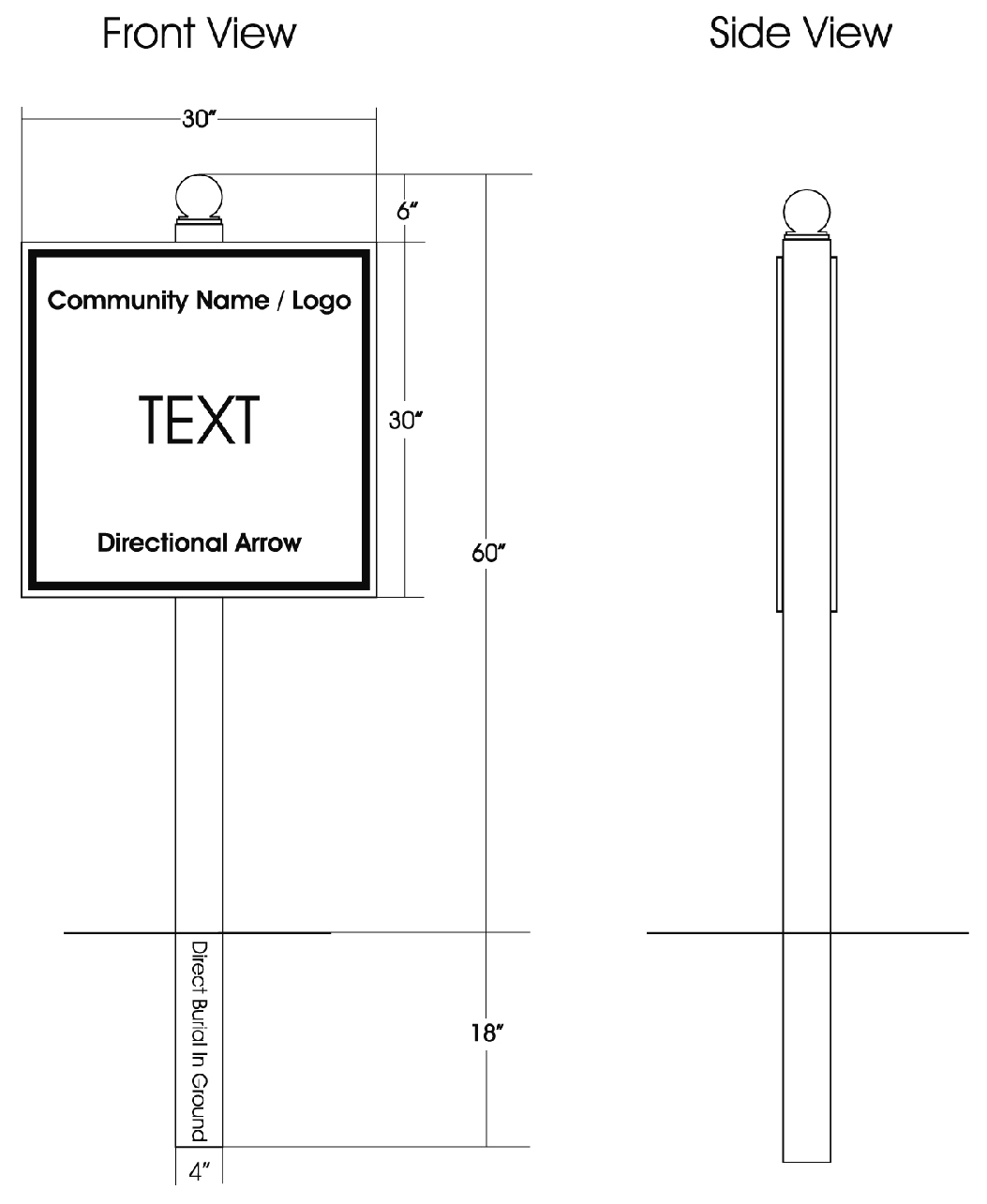
Temporary directional off-premises real estate signs. Residential subdivisions and planned unit developments greater than ten lots in size shall be permitted to erect up to three temporary directional off-premises real estate signs directing the public to the subdivision or planned unit development where property is for sale, rent or lease. Each sign must meet the following criteria:
(1)
Sign area and copy.
a.
The maximum sign area is 6¼ square feet. Each side of the sign shall be 30 inches in length.
b.
The maximum number of sign faces is one per side of the sign, not to exceed two sign faces.
c.
The sign shall include no more than one line of text and a directional arrow. The logo of the subdivision or planned unit development are allowed in addition to the text.
(2)
Sign height. The maximum sign height is five feet.
(3)
Sign location.
a.
The sign shall not be located within a public or private right-of-way.
b.
The sign shall not be located within a sight distance triangle or impede the vision of motorists in any manner.
c.
The sign shall not be located on any property zoned CD.
d.
If a sign is located on a property not owned by the developer of the subdivision or planned unit development, written permission must be obtained from the property owner to locate the sign on the property. Proof of written agreement must be furnished to the town at the time of application. If permission is revoked at any time by the property owner, the permit is considered null and void and the sign must be removed immediately. Such agreement shall include an express grant of permission for the town to enter the property for the purpose of inspecting or removing the sign.
e.
The sign shall be located within one-half mile or 2,640 feet of the subdivision or planned unit development.
f.
No temporary directional off-premises real estate sign shall be placed within 500 feet of an existing temporary off-premises real estate sign or within 50 feet of an existing permanent ground sign.
(4)
Sign construction and maintenance.
a.
The sign shall be constructed of treated lumber or other materials not prone to rot or decay.
b.
The sign shall be supported by a single post with a maximum dimension of four inches × four inches. The post shall be constructed of wood or vinyl and shall be painted with white high-quality exterior grade paint. The post shall be trimmed out at the top and capped with a decorative post cap.
c.
The sign shall be maintained in substantially similar condition as to when it was originally permitted and erected. Maintenance shall include periodic painting, replacement of defective or missing parts, cleaning, and replacement of any sign face that exhibits damage or deterioration.
(5)
Illumination. The sign shall not be internally or externally illuminated.
(6)
Sign removal. All signs shall be removed within seven days after 75 percent of lots within the subdivision or planned unit development have been sold, rented or leased by the developer of the subdivision or planned unit development.
(7)
Permit application. The applicant must apply for a permit from the town for each sign. Once issued, the permit is good for a period not to exceed six months. Upon expiration, the permit may be renewed, provided the applicant reapplies within ten days after expiration and provides staff with a summary of lots sold, rented or leased. If the owner fails to remove the sign or reapply within ten days of expiration, the town is authorized to remove the sign or require the owner's removal of the sign.
(Ord. No. O20-017, § 1(Exh. A), 3-19-2020)
Sec. 66-362. - Tables.
The following standards shall be applicable to signs:
TABLE 1. C-1 and O&I
All signs shall be located outside of the street right-of-way and sight distance triangle unless otherwise noted in these tables or in this article.
* Ground signs may be monument or bracket signs only.
** Multiple property frontages: Maximum secondary ground sign area is one-half the square footage allowed for the primary sign.
*** See section 66-359(3)g.1 through 4.
TABLE 2. C-2 and C-3
All signs shall be located outside of the street right-of-way and sight distance triangle unless otherwise noted in these tables or in this article.
* Ground signs may be monument or bracket signs only.
** Multiple property frontages: Maximum secondary ground sign area is one-half the square footage allowed for the primary sign.
*** See section 66-359(3)g.1 through 4.
TABLE 3. M-F, R-6, R-15, R-20, RMH
All signs shall be located outside of the street right-of-way and sight distance triangle unless otherwise noted in these tables or in this article.
* Ground signs may be monument or bracket signs only.
TABLE 4. PUD
All signs shall be located outside of the street right-of-way and sight distance triangle unless otherwise noted in these tables or in this article.
* Ground signs may be monument or bracket signs only.
** Multiple property frontages: Maximum secondary ground sign area is one-half the square footage allowed for the primary sign.
*** See section 66-359(3)g.1 through 4.
TABLE 5. Standards for Sign Characteristics*
P—Permitted
*—Reference 66-359(1)—(5) for illumination standards for sign styles.
**—Illumination, indirect or external shall be by a steady, stationary light source, shielded and directed solely at the sign. The light source must be static in color.
TABLE 6. US Hwy 17 Overlay District
* Ground signs may be monument style only. Pole and pylon styles are prohibited.
** Second ground sign maximum sign area is one-half the square footage allowed for the first sign on double frontage lots. Maximum height of second sign includes a maximum base of two feet. Secondary ground signs for combined developments shall be in compliance with subsection 66-359(6).
*** See section 66-359(3)g.1 through 4.
(Ord. No. O20-017, § 1(Exh. A), 3-19-2020)
Sec. 66-363. - Amortization of non-conforming signs.
(a)
Except as otherwise specified in this section, any non-conforming sign shall be removed or rendered in compliance with this article within five years of the date of this article.
(b)
The provisions of this section shall not apply to outdoor advertising structure or billboard signs as defined by section 66-349.
(c)
The town manager shall endeavor to notify the owner of any sign deemed to be subject to the provisions of this section within one year of the effective date of the ordinance from which this section is derived. The failure to give notice as provided in this subsection shall not affect any amortization period and shall not be a defense to any action to enforce this section.
(d)
The sign face of a legal non-conforming sign may be changed to reflect a modification in a new company only if the following criteria are met:
(1)
The sign may not be reconstructed or relocated;
(2)
There shall be no increase in the size or height of the sign; and
(3)
Businesses within a combined development are required to meet the definition and requirements as listed in section 66-349 for "combined development."
(e)
Minor repairs and maintenance of non-conforming signs such as repainting, electrical repairs and neon tubing repairs shall be permitted.
(f)
Non-conforming signs which are structurally altered, relocated or replaced shall comply in all respects with the provisions of this article.
(g)
New signs related to legally established non-conforming uses may be erected provided they comply with the sign requirements of the district in which the use is located.
(Ord. No. O20-017, § 1(Exh. A), 3-19-2020)

