
Leland City Zoning Code
ARTICLE VIII
PARKING, LOADING, DRIVEWAY AND SIDEWALK REQUIREMENTS4
State Law reference— Authority to regulate parking, G.S. 160A-301 et seq.
Sec. 66-274.- Intent.
(a)
It is the intent of this article to provide standards for vehicle parking and parking lot design that will lessen the negative impacts of large parking lots on surrounding uses while allowing for the efficient use of land and maintaining pedestrian safety in the highest manner possible.
(b)
It is not the intent of this section to predict the exact parking needs for each land use listed in section 66-162. Therefore, the use categories are listed in a general format and where applicable, the maximum number of parking spaces permitted has been prescribed.
(Code 2003, § 30-272; Ord. No. 11-09, § 4, 11-17-2011)
Sec. 66-275. - Parking requirements.
(a)
All development shall provide parking facilities as specifically set forth in this article.
(b)
All provisions for parking of vehicles shall be made entirely upon the lot or parcel being developed, except when parking may be provided off site as specifically permitted in this article.
(c)
The special or additional parking needs prescribed to specific permitted uses in section 66-162 shall supersede the requirements listed below.
(d)
All required off-street parking facilities shall be permanent and not used for any purpose other than the parking or storage of vehicles. Any areas within a parking facility intended for outside storage or sale of merchandise must be designated on the site plans as such. The outside storage and display of merchandise within a parking facility shall in no case:
(1)
Reduce the number of parking spaces available below the required minimum listed herein.
(2)
Interfere with the circulation of emergency vehicles, automobile traffic, or pedestrian traffic.
(Code 2003, § 30-273; Ord. No. 11-09, § 4, 11-17-2011)
Sec. 66-276. - Number of spaces required.
The number of parking spaces, by land use category, is specified in the following table:
(1)
The classification of uses shall be deemed to include and apply to all uses; however, if the classification of any use for the purpose of determining the quantity of parking spaces required is not readily determinable under this section, then the classification of use shall be fixed by the planning department.
(2)
Any calculation that results in a fractional figure shall be rounded up to the next whole number.
(3)
Developments that wish to exceed the total number of parking spaces permitted or commercial/office or retail uses that wish to provide parking below the noted minimums must first meet the following criteria (as applicable):
a.
Additional parking must be shown as necessary by using the design day parking ratio (DDPR) method with the 85th percentile of peak hour observations as maximum, or other acceptable method detailed in accredited planning or engineering publications. Calculations shall be certified by a professional engineer and submitted to staff for review regardless of method employed for calculating additional spaces needed.
b.
Each additional parking space must be designed to meet the most recent version of NCDENR's Stormwater BMP Manual's standard for permeable pavement or be shown that all stormwater from the additional spaces is treated using NCDENR's Stormwater BMP Manual's standard for bio-retention.
c.
Each additional parking space shall be located to the rear or side of the development.
d.
Any proposed reductions in parking ratios for a development shall be certified by a professional engineer and submitted to the planning and inspections director or their designee for review. Reduction of parking minimums shall use the following methods:
1.
The design day parking ratio (DDPR) method with the 85th percentile of peak hour observations as minimum;
2.
Other acceptable method detailed in accredited planning or engineering publications, which shall include:
i.
Background information on the calculation method.
ii.
References to the method in accredited planning or engineering publications.
iii.
Certification of calculations by a professional engineer.
e.
If a reduced parking ratio is approved by the planning and inspections director or their designee pursuant to subsection 66-375(d) the site shall be designed and developed per the following requirements:
1.
The site shall be configured to provide the minimum number of parking spaces for the given use per table above.
2.
Any parking spaces not to be constructed as part of the proposed development shall be clearly marked as future additional parking spaces.
3.
The site shall be designed, including grading and storm drain infrastructure, to allow for the construction of future additional parking spaces if needed.
4.
Any area of future additional parking spaces shall maintain its natural pervious or natural ground cover. Such area shall not be used to meet any landscaping or buffer requirements.
5.
Site stormwater control measures, stormwater treatment design, and stormwater permitting shall include impervious coverage for the future additional parking spaces.
(4)
Bicycle parking.
a.
All new development or redevelopment of properties with ten or more proposed or existing automobile parking spaces, shall provide bicycle parking subject to the table within this subsection.
b.
Uses such as clubhouses and active open-spaces, or similar uses and propose less than ten automobile parking, shall provide one bicycle rack.
c.
Bicycle racks and parking shall be installed to meet the following:
1.
A bicycle rack shall be permanently affixed to the ground that is paved with asphalt, concrete, or similar material.
2.
Bicycle parking shall not block or interfere with pedestrian travel ways.
3.
Bicycle parking shall not be located in any sight triangle, drainage easement or utility easement.
4.
A bicycle rack shall accommodate a minimum of five bicycles, but no more than 20 bicycles.
5.
Bicycle parking shall be provided within 15 feet from a pedestrian entrance to the building or primary use of the property.
6.
Bicycle parking locations shall be a minimum of 200 feet apart from other bicycle parking locations serving the same use or property.
(5)
The GFA for restaurants shall include outdoor seating areas, but shall not include the kitchen area, food preparation area, restrooms, or storage area.
(6)
Multifamily uses with garage parking may utilize the following requirements to calculate the minimum number of parking spaces required:
a.
Garage parking spaces in multifamily projects may utilize up to 25 percent of the total number of garage spaces to meet up to half of the minimum number of required parking spaces for the project.
b.
When garage spaces are utilized, as outlined in subsection (6)a. of this section, to meet the minimum required number of parking spaces, a ratio of one space for the first bedroom and three-quarters space for each additional bedroom per dwelling unit shall be used to calculate the minimum number of required parking spaces for the total project.
c.
When the ratio as outlined in subsection (6)b. of this section is applied, garage parking spaces shall total at least ten percent of the minimum required parking spaces for the project.
(7)
In the Innovation District, no more than 25 percent of the minimum required parking can be along primary frontage.
(Code 2003, § 30-274; Ord. No. 11-09, § 4, 11-17-2011; Ord. No. O17-002, §§ 2, 3, 2-16-2017; Ord. No. O17-018, §§ 1, 2, 11-30-2017; Ord. No. O20-021, § 1(Exh. A), 6-18-2020; Ord. No. O20-029, § 1(Exh. A), 7-16-2020; Ord. No. O21-007, § 1(Exh. A), 4-15-2021; Ord. No. O24-016, § 1(Exh. A), 10-17-2024)
Sec. 66-277. - Design requirements.
All parking facilities shall meet all of the following criteria:
(1)
Parking lots shall be designed to allow pedestrians to safely move from their vehicles to the building. This shall be achieved by providing a sidewalk at the perimeter of the parking lot or a pedestrian travel way within the parking area that channels pedestrians from the car to the perimeter of the parking lot or through the parking facility. When corridors encroach upon any drive aisle it shall be delineated by a paving material that differs from that of vehicular area or pavement markings. Any such sidewalk access route shall be no less than five feet in width and shielded from automobile traffic by means of vertical curb six inches in height or rows of bollards no more than four feet apart and four feet in height. No parking space shall be further than 120 feet (approximately two aisle and stall widths) from a pedestrian corridor.
(2)
Paved with an asphalt or concrete paving material designed and installed to withstand the anticipated forces of the proposed use. Alternate paving materials may be permissible if they can be shown to withstand the anticipated force exacted on a parking lot. Such alternate paving materials shall not create additional dust or mud and are not prone to the formation of potholes. Parking lots shall be maintained in a manner so as not to create any undue nuisance as specifically prescribed in chapter 34 of this Code.
(3)
Parking facilities shall be marked according to MUTCD standards. If material other than concrete or asphalt is used, then wheel stops must be installed to delineate each space and preserve pedestrian walkways. Said wheel stops must be no less than five inches in height and able to stop the forward motion of a vehicle traveling at low speed.
(4)
Pedestrian access shall be provided from the street to the principal entrance of the development. This shall consist of at least one pedestrian travel way, with a paved travel surface that is a minimum of five feet in width and shielded from automobile traffic by means of vertical curb or bollard.
(5)
Where pedestrian travel ways cross vehicle travel lanes, the surface shall be marked in a manner that clearly designates pedestrian priority.
(6)
All pedestrian travel ways shall be free of barriers to persons with disabilities and in no case be used for anything other than pedestrian travel or ADA accommodations. Where sidewalks terminate in a crosswalk or access to an off-street parking area, the terminus shall be ADA compliant and have detectable warning pads.
(7)
Adjoining parking lots serving residential buildings shall be interconnected subject to the following:
a.
If adjoining property is undeveloped then site plans shall show an area of land reserved for future connection;
b.
Connectivity from residential parking lots to parking lots for multifamily uses is encouraged;
c.
The planning board may waive these connectivity requirements if lot depth, street layout, or other environmental constraints make said connection impractical.
(8)
At least one in every 25 parking spaces shall be designed for handicapped persons and/or drivers, with a minimum of one handicapped space per parking facility, including van accessible spaces.
(9)
At least one in every eight handicap designated parking spaces shall be designed to be van accessible with a minimum of one van accessible space per parking facility.
(10)
All required handicap spaces and adjoining ramps must meet the most current ADA standards as required by the state and federal agencies.
(11)
All off-street parking facilities shall be graded for drainage of stormwater.
(12)
Off-street parking areas shall be designed so that parked vehicles do not encroach upon or extend onto public rights-of-way, sidewalks, or strike against or damage any wall, vegetation, utility, or other structure.
(13)
Lighting and equipment shall not interfere with street traffic and/or residential uses. Exterior light fixtures installed on the site shall not distribute light onto any adjacent property.
(14)
Off-street parking spaces shall not occupy any portion of the required minimum front yard in residential use developments.
(15)
Entrances and exits shall be shared when possible and located so as to minimize traffic congestion on adjoining streets.
(16)
All exits from off-street parking facilities shall be designed for forward vehicular motion.
(17)
Ingress and egress from streets shall be limited to one driveway for the first 300 linear feet of lot and/or parcel street frontage, one driveway for the next 200 linear feet, and one driveway for each 400 linear feet thereafter. Nonresidential driveways greater than 30 linear feet in width shall have a landscape divider/median at least 20 linear feet in width and containing at least 280 square feet of permeable landscaped area. The maximum width of each driveway shall be 80 linear feet. Furthermore, driveways shall be designed in accordance with the most recent version of the town street design manual.
(18)
Any area adjacent to access points or internal intersections shall be kept free from visual obstructions, including parking stalls and signs within the sight triangle.
(19)
All parking facilities shall have an aisle between rows and shall have sufficient maneuvering space for turning, backing and otherwise avoiding collisions.
(20)
Off-street parking areas shall be designed to facilitate adequate movement and access by sanitation, emergency, and other public service vehicles without posing a danger to pedestrians or impeding the function of the parking area.
(21)
Parking facilities with direct access to or from a major thoroughfare, as defined in the most recently adopted version of the town collector street plan, may be required to provide acceleration/deceleration lanes, depending on the current and projected impact of the development on traffic flow.
(22)
Commercial retail developments containing more than 60,000 square feet of gross leasable area shall provide a separate employee parking facility containing no less than ten percent and no more than 25 percent of the required minimum parking spaces. The minimum size requirements prescribed in the following table shall apply to off-street parking only.
a.
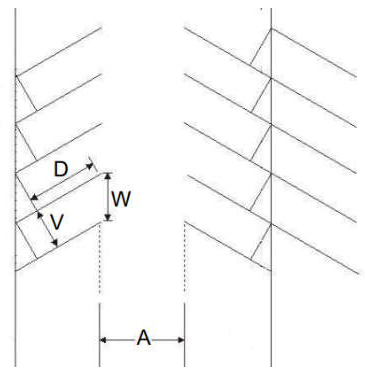
Minimum size requirements.
The following graphic is intended to be a guideline for the table in this note:
b.
No more than 30 percent of the parking spaces approved for a development shall be allocated for the use of compact or small cars. Compact or small car spaces shall conform to the following standards:
1.
Minimum stall size. The minimum stall size shall be 8½ feet in width and 16 feet in length.
2.
Striping and marking. All compact stalls shall be delineated with double striped yellow striping with 18 inches outside dimensions and marked in a manner to indicate the use for compact or small cars only.
(23)
All of the following design requirements shall be met for new apartment or condominium developments:
a.
Town staff must approve the traffic circulation within the apartment or condominium development.
b.
Access and street surfacing shall be adequate to provide for emergency services, deliveries and refuse collection. Pavement designs must have a minimum thickness of six inches of ABC base course and two inches of pavement surface.
c.
Internal driveways and streets must have a minimum width of 22 feet of pavement. A minimum two-foot-six-inch concrete vertical curb and gutter shall be used. A two-foot-six-inch concrete valley curb and gutter may be used only if there is a minimum 48-inch separation between the back of curb and front edge of sidewalk.
d.
Sidewalks, as required, shall be constructed to a minimum width of five feet and shall consist of a minimum thickness of four inches of concrete and a minimum four inches of ABC base course. Sidewalks shall consist of a minimum of six inches of concrete and a minimum four inches of ABC base course at driveway crossings.
(24)
Parking lot landscape standards shall be determined by the requirements prescribed in section 66-281. Once adopted, all parking lot landscaping standards shall meet the minimum design standards found in the town tree preservation ordinance.
(25)
All of the following design requirements shall be met for all new or reconstructed single-family residential homes, excluding those homes located in subdivisions with either a preliminary plat or site specific plan approved on or prior to May 19, 2016:
a.
Single-family residential dwelling parking should be side-by-side in nature on an off-street parking area. The off-street parking area can be part of or connected to a single-family residential lot's driveway with the same material construction.
b.
Off-street parking dimensions for each required parking stall on single-family or townhome lots shall be no less than nine feet wide by 18 feet deep.
(26)
New or reconstructed single-family residential dwellings located in subdivisions with a preliminary plat or site specific plan approved on or prior to May 19, 2016, shall have off-street parking dimensions for all required parking of no less than 18 feet by nine feet.
(27)
Any drive-thru aisles and vehicle stacking shall be clearly marked and shall not encroach upon the following:
a.
Emergency vehicle access.
b.
ADA accessibility and handicap parking requirements.
c.
Parking lot traffic circulation.
d.
Required site distance triangles.
e.
Required driveway stem lengths.
f.
Loading areas.
(28)
Vehicular travel lanes in a parking facility may require a street name and shall comply with the street name policy found in the Administrative Manual.
(Code 2003, § 30-275; Ord. No. 11-09, § 4, 11-17-2011; Ord. No. 16-05 , §§ 1, 2, 3-17-2016; Ord. No. O17-002, § 4, 2-16-2017; Ord. No. O19-029, § 1(Exh. A), 7-18-2019; Ord. No. O19-048, § 1(Exh. A), 1-16-2020; Ord. No. O20-021, § 1(Exh. B), 6-18-2020; Ord. No. O24-011, § 1(Exh. A), 5-16-2024)
Sec. 66-278. - On-street parking requirements.
All on-street parking shall meet design standards as determined by the town TRC as guided by the town engineer and town manager until such time that the town street design manual has been reviewed and adopted.
(Code 2003, § 30-276; Ord. No. 11-09, § 4, 11-17-2011)
Sec. 66-279. - Off-street loading.
(a)
Dedicated off-street loadings areas are optional and shall be sized for the appropriate type of vehicle and usage expected.
(b)
All off-street loading areas shall not encroach upon the following:
(1)
Pedestrian access to the building.
(2)
Emergency vehicle access.
(3)
ADA accessibility and handicap parking requirements.
(4)
Parking lot traffic circulation.
(5)
Required site distance triangles.
(6)
Required driveway stem lengths.
(7)
Required side or rear yards.
(c)
Loading areas shall be clearly marked.
(d)
All provisions for loading and unloading to and from vehicles shall be made entirely upon the lot of the use it serves.
(e)
All off-street parking areas shall be constructed in accordance to subsection 66-277(2).
(f)
Off-street loading areas shall be designed in such manner as to provide entrance to, and exit from, the loading area without backing into a public or private street or access easement.
(g)
No off-street loading areas shall be occupied more than 72 consecutive hours.
(Code 2003, § 30-277; Ord. No. 11-09, § 4, 11-17-2011; Ord. No. O19-048, § 1(Exh. A), 1-16-2020)
Editor's note— Ord. No. O19-048, § 1(Exh. A), adopted January 16, 2020, changed the title of section 66-279 from "Loading requirements" to "Off-street loading." The historical notation has been preserved for reference purposes.
Sec. 66-280. - Exemptions.
(a)
Notwithstanding the forgoing, the TRC may modify the required parking drive/aisle and parking module (the combined dimension of two parked vehicles and the aisle between) dimensions based upon the minimum parking drive/aisle and parking module dimensions recommended by the Urban Land Institute using factors that include, but are not limited to, the acceptable minimum level of comfort for the turning movement; the ease of maneuverability into and out of spaces; site location; site dimensions; site constraints such as trees, power poles, buildings, or other natural or manmade structures; surrounding streets; and traffic flow.
(b)
The required parking set forth in this article for any number of separate uses may be combined in one lot, but the required parking space assigned to one use may not be assigned to another use, except that one-half of the parking spaces required for churches, theaters or other uses the peak attendance of which will be at night or on Sundays may be assigned to a use which will be closed nights or on Sundays.
(c)
Detached single-family residential dwellings located more than 50 linear feet from the nearest public street right-of-way are exempted from the requirements of section 66-275, provided the first 25 linear feet of driveway, a minimum of nine feet in width, is paved contiguous to the street. The requirements for providing a concrete sidewalk shall not apply to remodeling, additions and/or accessory building construction.
(d)
The restoration or rehabilitation of an existing building shall not require the provision of parking spaces in addition to the number of spaces existing. Existing parking requirements that exceed those for this article may be reduced. However, once cessation, as defined in section 66-337(f), has occurred the applicant for any restoration or rehabilitation project shall be required to provide the following documentation, showing that all of the following are met:
(1)
Off-street parking areas shall be designed to facilitate adequate movement and access by sanitation, emergency, and other public service vehicles without posing a danger to pedestrians or impeding the function of the parking area.
(2)
All exits from parking facilities shall be designed for forward vehicular motion.
(Code 2003, § 30-278; Ord. No. 11-09, § 4, 11-17-2011)
Sec. 66-281. - Parking lot tree planting requirements.
All new or expanded parking areas must comply with the following tree planting requirements. In order to meet the parking lot planting requirements, required canopy tree areas shall be located within the parking lots and adjacent to parking spaces, inside medians at the end of parking bays, or tree islands and shall adhere to the following:
(1)
All trees shall be a minimum of 2.5 inches in caliper and at least eight feet in height above ground level at time of installation, and shall have an expected mature height of at least 30 feet.
(2)
All parking lots over 12 parking spaces must provide a minimum of 35 percent canopy cover or one tree per every 15 parking spaces, whichever results in more trees. For example, a parking area of 12,000 square feet × 0.35 = 4,200 square feet. To achieve this 4,200 square feet, the applicant will be given tree canopy credits in the following manner: a planted large maturing tree shall be counted as equivalent to 1,600 square feet of canopy; a medium maturing tree shall be counted as the equivalent of 900 square feet of canopy; a small maturing tree shall be counted as the equivalent of 400 square feet of canopy.
(3)
Parking lots containing over 250 parking spaces shall provide at least half of the required 35 percent canopy cover with large trees.
(4)
A mix of tree species shall be provided for rows of parking spaces over ten and provide a minimum of three types of tree species.
(5)
A minimum size planting island shall be provided for different size of trees.
(6)
Small trees shall have a minimum planting island of 162 square feet with a minimum width of nine feet.
(7)
Medium maturing trees shall have a minimum planting island of 225 square feet with a minimum width of nine feet.
(8)
Large maturing trees shall have a minimum planting island of 288 square feet with a minimum width of nine feet.
(9)
Planting islands that serve to break up every 15 parking spaces shall be a minimum of 162 feet with a minimum width of nine feet.
(10)
Developers shall have the option of small, medium or large canopy trees so long as 25 percent of the trees provided are large trees.
(Code 2003, ch. 30, art. VIII, app. A; Ord. No. 11-09, § 5, 11-17-2011)

