
Lenoir City Zoning Code
ARTICLE VII
- GENERAL PROVISIONS
700 Street Access - No building shall be erected, constructed, moved to or relocated on a lot not having direct vehicular and pedestrian access to a publicly dedicated or publicly maintained street. No dwelling shall be erected on a lot which does not abut one public street for a distance of at least twenty-five (25) feet.
701 Corner Lots - On corner lots, the minimum front yard will depend upon the requirements of the zone in which the lot is located. The front yard will be the street frontage which the structure faces and the other street frontage will be the street side yard.
702 One Principal Building Allowed on a Residential Lot - Every single family residential structure shall be located on an individual lot of record or a combination of two or more lots of records. (For temporary exceptions, see Section 1312.3).
703 Double Frontage Lots - On lots having frontage on two streets, but not located on a corner, the minimum front yard shall be provided on each street in accordance with the provisions of this ordinance. On lots having frontage on more than two streets, the minimum front yard shall be provided in accordance with the regulations set forth in this ordinance on at least two of the street frontage. The minimum front yard on the other frontage or frontages may be reduced along the other streets in accordance with the street side yard requirements of the district.
704 Nonconforming Uses and Structures -
704.1
Nonconforming Structures - Nonconforming buildings or structures are declared by this ordinance to be incompatible with permitted use in the districts involved. However, to avoid undue hardship, the lawful use of any building or structures at the time of the enactment of this ordinance or any applicable amendment thereof may be continued even though such structures does not conform with the provisions of this ordinance except that the nonconforming building or structure shall not be:
704.11 Replaced with the same or a similar building, after physical removal or relocation from the site upon which it was located when it became nonconforming;
704.12 Repaired, rebuilt, or altered after damage exceeding fifty (50%) percent of its tax value at the time of such damage. A permit for construction or repair, when legal, shall be issued no later than four (4) months after such damage occurred. However, existing single-family dwellings (excluding manufactured homes) may be repaired or rebuilt regardless of the extent of damage provided that the square-footage of the structure is not increased and the repaired/rebuilt structure maintains or reduces any encroachments into required building setbacks of the zoning district in which it is located. Permits for repair or reconstruction of a non-conforming single-family dwelling shall be issued no later than one year after damage occurred.
704.13 Enlarge or altered in a way which increases nonconformity.
Nothing in this section shall be deemed to prevent the strengthening or restoring to a safe condition of any building or part thereof declared to be unsafe by any official charged with protecting the public safety, upon order of such official. In addition, nothing in this ordinance shall prevent the owner from lawful occupancy or use of a nonconforming building which existed at the time of the adoption of this ordinance, or any applicable amendment thereof.
704.2
Nonconforming Uses - Nonconforming land uses are declared by this Ordinance to be incompatible with permitted uses in the districts involved. However, to avoid undue hardship, the lawful use of any land at the time of the enactment of this ordinance or any applicable amendment thereof, may be continued even though such use does not conform with the land use of that district. Such nonconforming use shall not be:
704.21 Changed to any other nonconforming use; however, no change of title or right to possession of property shall be construed to prevent continuance of the same nonconforming use;
704.22 Reused after cessation of use for four (4) consecutive months of, in cases of the settlement of an estate, one year;
704.23 Reestablishment or replaced with the same or similar use after relocation from its site at the time of passage of this ordinance or any applicable amendment thereof.
(Ord. of 2-20-2018)
705 Home Occupation - A home occupation shall be permitted in any residential district provided that such operation:
705.1
Is conducted by no persons other than members of the family residing on the premises.
705.2
Is conducted within the principal building or one accessory building. (No outside storage may be used).
705.3
Utilizes no more than twenty-five (25%) percent of the total floor area of the principal building or one accessory building no larger than twenty-five (25%) percent of the total floor area of the principal building.
705.4
Produces no alteration or change in the character or exterior appearance of the principal building from that of a dwelling.
705.5
Shall make no display of products visible from the street and only articles made on the premises may be sold; except that non-durable articles (consumable products) that are incidental to a service, which is the principal use in the home occupation, may be sold on the premises.
705.6
Creates no disturbing or offensive noise vibration, smoke, dust, odor, heat, glare, traffic hazard, and unhealthy or unsightly condition.
705.7
Is not visibly evident from outside the building except for a sign of three (3) square feet or smaller in size, and non-illuminated (See Article XI).
705.8
Shall not include the following:
705.81 Uses which do not meet the provisions listed above;
705.82 Automobile and/or body and fender repair;
705.83 Food processing or packing;
705.84 Manufacturing and processing uses; however, this shall not exclude the home occupation of a dressmaker where goods are not manufactured for stock, sale, or distribution and
705.85 Restaurants
706 Exception to Height Limitation - The height limitations of this ordinance shall not apply to church belfries, cupolas and domes not intended for human occupancy, monuments, water towers, observation towers, transmission towers, silos, and chimneys, smokestacks, conveyors, flag poles, masts and antennas; provided evidence from appropriate authorities is submitted to the effect that such building or structure will not interfere with any airport zones or flight patterns.
707 Reserved.
708 Visibility
708.1
Street Intersections - On a corner lot in all zones except the B-3 Central Business District, within the triangular area formed by joining points (with a straight line) on the center lines of intersecting or intercepting streets eighty (80) feet where the rights-ofway are sixty ( 60) feet or less and one hundred and twenty (120) feet where rights-ofway are sixty (60) feet or greater from their intersections, there shall be no obstruction to vision by structures or signs or grade or foliage between a height of three (3) feet and height of ten (10) feet, measured above the average elevation of the existing surface of each street at the centerlines thereof. In no case shall trees, shrubs, walls, or structures of any type be placed in the public right-of-way except by act of the city.
708.2
Driveways - At the intersection of a driveway and a street, within the triangular area formed by joining points (with a straight line) located on the edge of the driveway and the right-of-way of the street fifteen feet from the intersection; there shall be no obstruction to vision by structures or signs, or grade, or foliage between a height of three feet and a height of ten feet measured above the average elevation of the existing surface of the street and the driveway. In no cases shall trees, shrubs, walls, or structures of any type be placed in the public right-of-way except by act of the city.
709 Accessory Structures
709.1
Number of Accessory Structures - In residential districts, no more than two accessory structures shall be permitted per lot, except for farm enterprises.
709.2
Location of Accessory Structures - Accessory structures must be located behind the front façade, e.g. to the side or the rear of the principal structure. On corner lots, structures must not be located between the principal structure and the street. In non-residential districts, accessory structures that are located between a principal structure and the street shall meet the architectural design standards of the district, if applicable.
709.3
Lot Coverage - Accessory buildings shall not cover more than thirty percent (30%) of the required side or rear yard in residential districts.
Accessory buildings shall not exceed the height of 20 feet.
709.4
Appearance - Within residential zones except R-R and R-20, accessory buildings 144 square feet or greater and accessory buildings that have any exterior dimension 12 feet or greater (including height) shall have exterior wall facades composed of brick, stone, vinyl or wood lap siding, or stucco. Within commercial zones, accessory buildings that are visible from the public right-of-way or any adjoining property must meet the material and design standards of the commercial district, as applicable.
Accessory structures that meet the zoning district and dimensional criteria above, but do not meet the exterior wall facade criteria above, shall be: 1) located on tracts of land 5 acres or larger; 2) screened on the sides and rear in accordance 712.8 of this Ordinance; 3) set back at least 250 feet from any street right-of-way and at least 50 feet from adjoining property lines; 4) have a minimum roof pitch of 3:12 with 12-inch overhangs.
710 Setback Exceptions - A modification of the minimum required yard or setback is permitted under the following specific conditions:
710.1
Special Front Yard Requirements in Developed Areas - The front yard requirements of this ordinance shall not apply to any lot where the average front yard on already built upon lots located wholly or in part within one hundred (100) feet on each side of such lot and within the same block and zoning district and fronting on the same street as such lot, is less than the minimum, but not less than the average of the existing setbacks on the developed lots; provided however, the front yard on such lot shall not be less than one half of the required front yard.
710.2
Rear and Side Yard Encroachments - Lots of record established prior to 1979 that do not meet the minimum lot size may be granted reduced rear and side yard setbacks proportionate to the size of the lot. For example, where a 10,000 square foot lot is required and the lot contains 7,500 square feet, a 25 percent reduction to side and rear setbacks is allowed.
(Ord. of 11-4-2025, § 1)
711 Performance Standards - All uses of land and structures within the jurisdiction of this ordinance shall meet the current performance requirements of the North Carolina Department of Environmental Health and Natural Resources, regarding glare, noise, air, and water pollution.
712 Buffering and Screening - The following requirements for provision of buffering and screening shall be observed where incompatible land uses abut. The requirements shall be imposed upon the more intensive land use and shall be put in at the time of construction or at change of occupancy.
712.1
Non-Residential Uses in Residential Zones - Whenever permitted non-residential uses abut lots established for single-family residences along the side or rear property line with no intervening natural buffer of at least fifteen (15) feet, a fifteen (15) foot wide planted buffer strip shall be established and maintained.
712.2
Multi-family Residential Uses - Whenever a multi-family residential use abuts a single family residential zone along the side or rear property line with no intervening natural buffer of at least fifteen (15) feet, a fifteen (15) foot wide planted buffer strip shall be established and maintained.
712.3
Office and Institutional and Business Uses - Whenever an office and institutional or a business use abuts a residential zone to the side or rear property line with no intervening natural buffer of at least fifteen (15) feet, a fifteen (15) foot planted buffer strip shall be established and maintained.
712.4
Industrial Uses - Whenever an industrial use abuts an office and institutional zone and/or a residential zone to the side or rear property line with no intervening natural buffer of at least fifteen (15) feet, a fifteen (15) foot wide planted buffer strip shall be established and maintained.
712.5
Buildings, Structures, and Parking Prohibited - No buildings, structures, or parking shall be allowed in the required buffer.
712.6
Intervening Streets - When any use abuts to the side or rear yard, a pubic street separating two uses that are required to be buffered from each other, the intervening street shall not be considered a buffer and the proper buffers shall be established.
712.7
Exemptions - When due to normal or topographic conditions it would be inherently impractical and serve no useful purpose to establish buffer or screen, said requirements of this section may be waived by the Board of Adjustment. When the required buffer for a particular use would not allow property utilization of a lot that would otherwise meet all yard requirements of this ordinance, the width of the buffer may be reduced and/or opaque fence at least 6 feet high may be substituted upon the approval of the Board of Adjustment. In granting such a variance, the Board of Adjustment shall determine that the situation meets the conditions set forth in Section 1312 of this ordinance.
712.8
Planting Specifications - All buffer strips required by this Ordinance shall consist of a combination of deciduous and/or evergreen trees and evergreen shrubs approved by the Department of Public Works (Cemetery and Grounds Division).
712.81 Trees and shrubs used in a buffer strip shall be species which reach a height of six (6) feet within two (2) years. A combination of two (2) or more species may be permitted, provided that at least fifty (50%) percent of the trees will reach six (6) feet within two (2) years and such trees will be evenly distributed along the buffer strip.
712.82 Trees and shrubs shall be planted in two (2) staggered rows three (3) feet apart within the buffer strip and shall be no more than ten (10) feet apart within the row. No row shall be planted closer than five (5) feet to the property line. The distance between plants shall be established so that lateral growth will provide a continuous screen to a minimum height of six (6) feet within two years. A single row of plants may be permitted due to topographic conditions only. Any request for a single row buffer shall be made in writing to the Department of Public Works (Cemetery and Grounds Division) along with the plan to show that the row will provide a continuous screen within two (2) years.
712.83 The buffer strip shall be maintained so that a continuous screen is provided to a minimum height of six (6) feet. This may require later replacement of dead plants or additional new plants. Any change of ownership or occupancy does not negate the requirements of this section.
712.9
Grading of Buffer Zone - The grading of a required buffer strip between zones shall be allowed, for preparation purposes, and shall not be reduced to a slope greater than 3:1. Any cut of fill (grading) which occurs adjacent to the buffer zone shall have a slope of not greater than 3:1. A steeper side slope many be used in exceptional cases when: (a) the natural slope is greater than 3:1; (b) the screening objectives of this ordinance are better achieved; (c) physical constraints of the site prevent a flatter slope; and/or (d) it is deemed necessary by the City Council, Planning Director, Building Official, Cemetery and Grounds Superintendent, or their appointees.
712.10
Certificate of Occupancy - The planting of the required buffer strip shall be completed prior to issuance of a Certificate of Occupancy unless a written extension is granted by the Cemetery and Grounds Department and due to availability of plants.
713 Reserved
Editor's note— An ordinance adopted January 19, 2021 deleted section 713 which pertained to stop orders and derived from an ordinance adopted October 19, 2004; an ordinance adopted October 18, 2005; and ordinance adopted September 22, 2009; and § 3 of an ordinance adopted March 19, 2019.
714 Design Standards For Commercial, Office, Institutional And Government Buildings
714.1
Introduction
The City of Lenoir, in a pro-active response to the potential for development of a variety of commercial, office, and institutional land uses, has sought to mitigate the negative impacts of these projects on local traffic patterns, property values, and aesthetics. These guidelines are a measure to limit the dissatisfaction with marketing strategies that dictate designs which are indifferent to local identity and community interests. The main goal is to encourage development that contributes to Lenoir as a unique place by reflecting its physical character and adding to it in appropriate ways.
Commercial developments depend on high visibility from major public streets. In turn, their design determines much of the character and attractiveness of major streetscapes in the City. Marketing strategies that place corporate branding over local character can be detrimental to community aspirations and sense of place. These strategies often result in massive developments that have little sense of human scale and the proliferation of stock cookie-cutter plans that neither contribute to nor integrate with the City in a positive manner. Harsh, uninviting developments also act as a centrifuge by encouraging residential growth to take place further away, thereby exacerbating traffic problems and adding to urban sprawl.
The purpose of these standards and guidelines is to codify specific criteria that will aid in the design of buildings and places and, ultimately, render developments that enhance their surroundings. The following standards and guidelines are intended to be used by designers in the preparation of site and building plans for non-residential developments. They should also be used as a tool by the City staff, Planning Board, and City Council in their review processes.
714.2
Applicability
These standards and guidelines apply to the following types of development:
(a)
All new non-residential, attached single family, and multi-family structures and developments located in the R-R, R-20, R-15, R-12, R-9, R-6, O&I, B-1, B-2, and B-7 zoning districts.
(b)
Expansions of existing projects described in subsection (a) above.
(c)
Where such expansions meet the definitions of subsections (a) and (b) above, and such additions result in a 50% or greater increase in building size, the pre-existing portions of the same commercial, office, institutional, or government building and the development site must be brought into compliance with these design standards.
(d)
When a substantial improvement is made to any existing structure meeting the definition of subsection (a) above, the pre-existing portions of the building and building site must be brought into compliance with these design standards.
(e)
When a structure meeting the definition of subsection (a) above sustains damage exceeding 50% of its tax value at the time of the damage, all repairs, alterations, or reconstruction must be in compliance with these design standards.
(f)
Modifications to designated historic structures are excluded from subsections (c) and (d), when the design standards would require modifications that would compromise the historic character of the structure. Site improvements may still be required.
714.3
Definitions:
Unless otherwise specifically provided, or unless clearly required by the context, the words and phrases defined in this section shall have the meaning indicated when used in this article.
a)
Element of a building - an exterior wall, roof, or site wall which is manmade and constructed.
b)
Public visibility - An element of a building shall be deemed publicly visible when any of the following conditions are met:
1.
At least 50 percent of the element occurs above adjacent grade and is visible from any street adjacent to the property; or
2.
At least 50 percent of the element is, upon staff review, deemed visible from an adjacent residentially zoned property; or
3.
At least 50 percent of the element is taller than the vegetative buffer at the time of planting.
c)
Exterior walls - the vertical or nearly-vertical planes which form the exterior envelope of a building.
d)
Site walls - retaining walls, screen walls or other vertical or nearly- vertical planes which occur on a property, but are not part of the exterior envelope of a building.
e)
Roof area - a single, unbroken, contiguous plane, measured perpendicular to slope.
f)
Flat Roof - The external covering of a building having a vertical to horizontal slope of 2:12 slope or less.
g)
Pitched Roof - The external covering of a building having a vertical to horizontal slope greater than 2:12.
h)
Facade color - a single paint color which is used most extensively in a building's visible facade.
i)
Trim color - a single paint color which is used on a building's trim, lesser in proportion to the Facade Color.
j)
Accent color - paint colors which are used on a building, in the least proportion of all colors used, not to exceed 5% of the facade area.
k)
Full cutoff fixture - a light fixture designed so that no light is projected at or above a 90-degree plane running through the lowest point on the fixture where the light is emitted, and less than ten percent (10%) of the rated lumens are projected between 90-degrees and 80-degrees.
l)
Facade - the face of a building.
m)
Volume - any portion of a building which is offset by a minimum of ten feet (10') in plan or in elevation.
n)
IESNA - The Illuminating Engineering Society of North America
o)
Primary Public Street - The street that adjoins the property that carries the highest volume of vehicular traffic.
714.4
Development Standards and Guidelines:
Items referred to in this Article as "Standards" are mandatory. "Guidelines" are not mandatory, but are provided in order to promote these design objectives to planners, design consultants, developers, engineers and other professionals involved in the preparation of site plans and building plans. These standards and guidelines are to be used in conjunction with all other applicable requirements of the Lenoir Zoning Ordinance.
714.5
Building Design and Orientation
GUIDELINE: The intent of this section is to encourage building design and placement that encourages and supports a safe and attractive pedestrian environment.
STANDARD: The primary facade and main building entry shall face the primary public street unless the majority of off-street parking is located to the sides or rear of the building.
The main building entrance, when not facing the primary public street, shall provide a safe and convenient access for pedestrians from the main building entrances to the primary public street. The pedestrian way must provide additional landscape amenities.
Entrances which are oriented on a diagonal are permitted, provided that they are integrated with the overall architectural design, and not merely angled appendages or alcoves.
Ground floor windows or window display boxes shall be provided along at least 60% of the building's ground floor street-facing elevations. Windows and window display boxes shall be integral to the building design and have include visually prominent sills, shutters, or other such forms of framing. Windows must have vertical dimensions which exceed their horizontal dimensions. Where the interior floor plan and use of the building makes windows technically infeasible, the Planning Director may approve alternative treatments that support street-level pedestrian activity, such as front porches (on residential structures), alcoves with benches or other human-scale features, spandrel glass, or faux window architectural treatments such that intent of this section is realized.
714.6
Smaller Buildings within a Larger Project:
GUIDELINE: The presence of smaller buildings gives a commercial area a friendlier appearance by creating variety, breaking up large expanses, and expanding the range of the site's activities. Windows and window displays of such buildings should be used to contribute to the visual interest of exterior facades.
STANDARD: Where principal buildings contain additional uses with separate, exterior customer entrances:
a.
The street level facade of such stores shall be transparent between the height of three feet and eight feet above the walkway grade for no less than 60 percent of the horizontal length of the building facade of such additional uses.
b.
Windows shall be recessed and should include visually prominent sills, shutters, or other such forms of framing.
714.7
Building Facades
GUIDELINE: Facades should be articulated to reduce the massive scale and uniform, impersonal appearances and provide visual interest that will be consistent with the community's identity, character and scale. The intent is to encourage a more human scale that residents will be able to associate with their community.
STANDARD:
1.
Walls shall be interrupted by architectural features which lend a more human scale to the overall massing of building facades. Architectural features include:
a)
Offsets of the building wall or other elements in plan of four (4) feet;
b)
A colonnade with columns or other vertical elements of sixteen feet (16') or less on center;
c)
A change in building material, with a maximum of two uses of this option being counted toward the schedules below;
d)
Awnings or canopies;
e)
Covered entries or porticos;
f)
Windows with a minimum width of 2'8" and a minimum height of 3'4";
g)
Trellises;
h)
Pilasters, which must be a different material or contrasting color than their background;
i)
A combination of the above; and
j)
Any other type of feature not listed here which is deemed by staff to meet the intent of this ordinance.
2.
Plumbing, mechanical, electrical service components and gutter downspouts are not considered architectural features and may require screening. Such screening is not considered an architectural feature.
3.
Required architectural features must be distributed throughout the building facade and not clustered.
4.
Architectural features shall be provided in accordance with the following feature schedules:
ARCHITECTURAL FEATURE SCHEDULE - PLAN (HORIZONTAL)
ARCHITECTURAL FEATURE SCHEDULE - ELEVATION (VERTICAL)
5.
Architectural features which serve to interrupt the building facade in both plan and elevation shall be credited as such using the above charts. Windows are considered plan and elevation features.
714.8
Roofs:
GUIDELINE: Variations in roof lines should be used to add interest to buildings and to reduce their scale. Roof features should complement the character of adjoining neighborhoods. The purpose of this section is to regulate both pitched and flat roof types. The intent is to interrupt expanses of pitched roofs and minimize or prevent the visibility of flat roofs.
STANDARD:
1.
Walls shall not appear to terminate at flat roofs. Flat roofs shall be concealed from view by using pitched roof features, parapets, or a mixture thereof. Where only one elevation has this condition, the parapet or other feature will continue four feet (4') along the adjacent elevation.
2.
Buildings over two stories above grade may utilize a flat roof, provided the flat portion is not publicly visible. Compliance may not be possible if the adjacent road grade is substantially above the roof in question.
3.
Minimum roof slope for pitched roofs is 4:12.
4.
Publicly visible plumbing vent stacks shall be colored to match the roofing material.
5.
Where a parapet intersects with a pitched roof element, there shall be no apparent breaks in the parapet wall.
6.
Awnings or canopies which are illuminated from within must be covered or finished with fully opaque material.
7.
Publicly visible pitched roofs shall be articulated by features in accordance with the following schedule. Features shall be in proportion to the roof area where they appear. Features include:
a)
Dormers;
b)
Eyebrow dormers;
c)
Intermittent gables or hips;
d)
Vertical offsets in ridge line;
e)
Horizontal offsets in ridge line;
f)
A combination of the above;
g)
Any other type of feature not listed here which is deemed by staff to meet the intent of this ordinance.
ARCHITECTURAL FEATURE SCHEDULE - ROOF AREAS
8.
No part of this ordinance shall be construed to prevent solar panels or any other type of renewable energy collection or storage method, provided the development follows the massing guidelines established herein.
714.9
Materials and Colors:
GUIDELINE: Exterior building materials and colors comprise a significant part of the visual impact of a building and the adjoining streetscape. Therefore, they should be aesthetically pleasing and compatible with materials and colors used in adjoining neighborhoods.
STANDARD:
1.
For any publicly visible elevation, a minimum of 25% of the building finish material must be stone or concrete-simulated stone, wood or fiber cement siding, or brick or concrete-simulated brick.
2.
Architectural concrete masonry such as split face, or ground-face block is acceptable on a maximum of 25 percent of a building's facade.
3.
Stucco and synthetic stone are acceptable finish materials on a maximum of 50 percent of a building's facade.
4.
Architectural concrete (containing a pattern or finish) as a finish material is acceptable. Gray, unfinished concrete is prohibited as a finish material. Concrete architectural detail elements intended to be a decorative enhancement for exterior walls and site walls are acceptable.
5.
Other materials subject to staff review and approval include vinyl siding (which should simulate wood grain) and other manufactured materials. Vinyl siding shall be anchored to the exterior envelope sufficiently to avoid the appearance of deformation or bowing across the facade.
6.
For publicly visible roof surfaces, allowed materials include standing seam metal, asphalt shingles, shakes, tile, or manufactured shingles which give an appearance of shingles, shakes, or other simulated natural material. Sheet materials other than those listed in this section are subject to staff review for use on publicly visible roofs.
7.
Any materials which comprise less than 10 percent of a publicly visible exterior building wall and are components of windows or trim systems are allowed (example: aluminum storefront, metal corner trim, etc.).
8.
FRP, PVC, and other composites formed into architectural detail elements such as columns, cornices, etc., are approved for use as long as such material is intended to be a decorative enhancement for the facade.
9.
Predominant exterior building materials shall not include the following materials:
(1)
Smooth-faced concrete block
(2)
Tilt-up concrete panels
(3)
Steel panels
Although the above materials may be used in the construction of the building, they shall be concealed by the materials listed items 1 through 5, above.
10.
Facade colors shall be low reflectance, subtle, neutral or earth tone colors. The use of high intensity colors, metallic colors, black or fluorescent colors is prohibited except on building trim.
714.10
Customer entrances.
GUIDELINES: Entryway design elements and variations should give orientation and aesthetically pleasing character to the building. The standards identify desirable entryway features.
STANDARD: Each principal building on a site shall have clearly defined, highly visible customer entrances featuring no less than 3 of the following:
(a)
Canopies or porticos
(b)
Overhangs
(c)
Recesses/projections
(d)
Arcades
(e)
Raised corniced parapets over the door
(f)
Peaked roof forms
(g)
Arches
(h)
Outdoor patios
(i)
Display windows
(j)
Architectural details such as tile work and moldings which are integrated into the building structure and design
(k)
Integral planters or wing walls that incorporate landscaped areas and places for sitting
714.11
Back and Side Facades
GUIDELINE: All facades of a building which are visible from adjoining properties and/or public streets should contribute to the pleasing scale and features of the building and encourage community integration by featuring characteristics similar to the front facade.
STANDARD: All building facades which are visible from adjoining properties and/or public streets shall comply with the Design Standards in this Article.
714.12
Parking Lot Orientation
GUIDELINE: Parking areas should provide safe, convenient, and effective access. They should be distributed around large buildings in order to shorten the distance to other buildings and public sidewalks and to reduce the overall scale of the paved surface. If buildings are located closer to the streets, the scale of the complex is reduced, pedestrian traffic is encouraged, and architectural design and details take on added importance.
STANDARD: For new construction, no more than 50 percent of the off-street parking area for building or multi-building project shall be located between the front facade of the principal building and abutting streets.
714.13
Side and Rear Appearance
GUIDELINE: The rear or side of buildings often present an unattractive view of blank walls, loading areas, storage areas, HVAC units, garbage receptacles, and other such features. Architectural and landscaping features should mitigate these impacts.
STANDARD: Where the facade faces adjacent residential uses, an earthen berm no less than 6 feet in height containing two staggered rows of evergreen trees shall be provided. Trees shall be a minimum of 6 feet in height when planted in the berm, and shall be spaced no more than 10 feet on center within rows. Maximum slope of the berm shall be 3:1.
714.14
Outdoor Storage, Garbage Collection, and Loading Areas:
GUIDELINE: Loading areas and outdoor storage areas exert visual and noise impacts on surrounding neighborhoods. These areas, when visible from adjoining properties and/or public streets, should be screened, recessed, or enclosed.
STANDARD:
1.
Areas for outdoor storage, truck parking, garbage collection or compaction, loading, unloading, or similar uses shall not be visible from abutting streets.
2.
Loading docks, truck parking, outdoor storage, utility meters, HVAC equipment, garbage collection or compaction, and other service functions shall be incorporated into the overall design of the building and the landscaping so that the visual and acoustic impacts of these functions are contained and out of view from adjacent properties and public streets, and no attention is attracted to the functions by the use of screening materials that are different from or inferior to the principal materials of the building and landscape.
3.
Non-enclosed areas for storage and sale of seasonal inventory shall be permanently defined and screened with walls and/or fences. Materials, colors, and design of screening walls and/or fences shall conform to those used as predominant materials and colors on the building.
714.15
Pedestrian Flow and Movement:
GUIDELINE: Pedestrian accessibility opens auto-oriented developments to the neighborhood, thereby reducing traffic impacts and enabling the development to project a friendlier, more inviting image. This section sets forth standards for public sidewalks and internal pedestrian circulation systems that can provide user-friendly pedestrian access as well as pedestrian safety, shelter, and convenience.
STANDARD:
1.
Sidewalks at least 8 feet in width shall be provided along all sides of the lot that abut a public street. Sidewalks shall have a safety separation of at least 2 feet from the edge of pavement of the adjoining street.
2.
Continuous internal pedestrian walkways, no less than 6 feet in width, shall be provided from the public sidewalk or right-of-way to the principal customer entrance of all principal buildings on the site. At a minimum, walkways shall connect focal points of pedestrian activity, and shall feature adjoining landscaped areas that include trees, shrubs, benches, flower beds, ground covers, or other such materials for no less than 50 percent of its length.
3.
Individual landscape areas along walkways shall have a minimum width of 5 feet and shall include one tree for each 20 feet of walkway length. Trees shall be at least 8 feet in height when planted and have a trunk circumference of 6 inches measured 6 inches above grade. Tree species may be a mix of deciduous and evergreens, with an expected mature height of at least 35 feet. Shrubs shall be at least 18 inches in height when planted, and should be of species expected to have a mature height of at least 30 inches.
4.
Sidewalks, no less than 6 feet in width, shall be provided along the full length of the building along any facade featuring a customer entrance, and along any facade abutting public parking areas.
5.
All internal pedestrian walkways shall be distinguished from driving surfaces through the use of durable, low maintenance surface materials to enhance pedestrian safety and comfort, and the attractiveness of the walkway.
6.
When site characteristics and/or traffic patterns are such that the construction of the required sidewalks or pedestrian walkways in accordance with this section is infeasible, unpractical, or otherwise would not result in useful pedestrian walkways, the City may allow the applicant to pay the designated cost of constructing such infrastructure into the City sidewalk fund in lieu of requiring construction of the infrastructure. In determining whether to accept a fee in lieu of construction of infrastructure, the City shall refer to any adopted plan or policy of the City for guidance. Such plans or policies include but are not limited to: City of Lenoir Comprehensive Plan, City of Lenoir Pedestrian Plan, City of Lenoir Capital Improvement Plan, other master plans and small area plans, and other plans and policies. The Developer shall provide an easement for a sidewalk even if the fee in lieu option is utilized.
714.16
Parking Garages and Structures
GUIDELINE: The purpose of this section is to regulate aesthetic features on parking structures to prevent a utilitarian appearance, and to provide a safe, secure environment for patrons, employees and vehicles.
STANDARD:
1.
Publicly visible facades must comply with provisions of this article pertaining to exterior walls, materials, and colors.
2.
Ground-level parking facing the street shall be sufficiently screened to a height of 42" above the finished floor through any combination of walls, landscaping, and/or a continuous facade to prevent headlights projecting beyond the buffer.
3.
Landscaping used for screening ground level parking must provide a 10' buffer using large evergreen trees in accordance with the approved plant list in Appendix B. This buffer may serve as the required street yard if located within 35' of the street right-of-way.
4.
Upper parking floors shall be designed using a continuous facade incorporating window-like openings. The sill of any window-like opening must be a minimum of 42" above the finished floor
5.
Elevator and stair shafts shall be topped with gabled roofs or other architectural features and be oriented so that lobbies are visible from the street at each level.
6.
Lighting shall be uniform throughout the structure so that dark hiding places are not created. Lighting levels must conform to IESNA standards.
714.17
Site Walls
GUIDELINE: The purpose of this section is to limit dimensions of site walls. The intent is to prevent walls which appear to dwarf the human scale and to encourage equalizing cut and fill methods of grading.
STANDARD:
1.
No retaining wall may be more than eight feet (8') in height. This height does not include decorative caps that are less than eight inches (8") in height. Screen walls shall not be taller than necessary to conceal the item screened (such as a dumpster, HVAC equipment, etc.)
2.
Buildings located near the top of site retaining walls shall be a minimum of eight feet (8') horizontally from the top of the retaining wall.
3.
Retaining walls, any portion of which are within six feet (6') of a sidewalk or pedestrian way, shall not exceed four feet (4') in height. Subsequent walls must be offset a minimum of four feet (4') in plan. See Figure 1 on page 22-12.
4.
A series of two (2) retaining walls must have a minimum of four feet (4') horizontally from the back of the top of the lower wall face to the toe of the upper wall face in plan.
5.
The space between retaining walls in series shall be landscaped with appropriate grasses, vines or other ground cover in accordance with provisions of Appendix B and may contain shrubs and trees not to exceed thirty-five feet (35') in height at maturity.
6.
Publicly visible site wall material and color shall be architecturally compatible with the principle buildings on site.
714.18
Landscaping
GUIDELINE: The intent of this section is to provide landscaping within and adjacent to parking facilities (lots) by reducing heat and noise, glare of automobile lights, reduce the level of carbon dioxide, prevent soil erosion, provide shade; therefore, creating an attractive and harmonious community and generally preserve a healthful and pleasant environment.
STANDARD:
1.
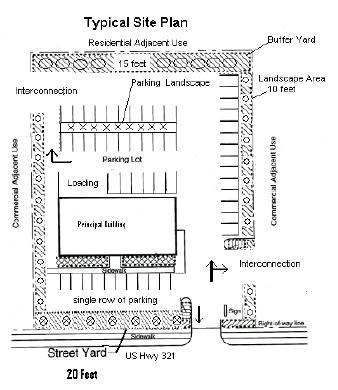
The landscaping requirements of this section shall apply to all multi-family, recreational, institutional and commercial land uses which are required to have 10 or more parking spaces. All industrial land uses and all multi-family, recreational, institutional and commercial land uses required to have fewer than ten (10) parking spaces must comply only with street yard requirements. Parking area landscape plans shall be reviewed through standard site plan procedures.
2.
Credit for utilizing existing trees on site greater than or equal to required standards shall be two trees for every one tree retained.
3.
When utilizing an existing tree, the area under the dripline (maximum extension of branches) of the tree must remain undisturbed. This includes grading, fill, paving, etc.;
4.
If existing or planted vegetation dies, it must be replaced with one or more trees that meet the minimum standards of this Article within a time period specified by the Code Enforcement Officer.
5.
Landscaping shall not obstruct the view of motorists using any street, private driveway parking aisles or the approach to any street intersection so as to constitute a traffic hazard;
6.
Landscaping Requirements for Interior Parking Areas - Interior areas are defined as the area within the property used for vehicular storage, parking and movement. Landscaping requirements for interior areas are as follows:
(a)
Planting areas shall be no less than 162 square feet, with a minimum width of six (6) feet;
(b)
One tree shall be required for every twenty (20) parking spaces;
(c)
No vehicular parking space shall be farther than one hundred (100) feet from a planting area;
Landscaping Requirements for Street Yards of Parking Area - Street yards are defined as the area between the public right-of-way and interior area. Landscaping requirements for street yards are as follows:
(a)
Street yards required to be minimum of six feet in width.
(b)
One (1) tree is required every 100 feet along the frontage.
(c)
Shrub beds (50 square feet minimum and a minimum of ten shrubs per shrub bed) are required every 40 feet along the frontage.
Shrub and Tree Specifications
Trees as used herein means any tree, evergreen or deciduous, whose mature height of its species can be expected to exceed 15 feet, however 75% of required trees must expect to exceed 35 feet (except in cases where this would require the planting of incompatible species with the surrounding environment, such as overhead utility lines, then acceptable species may be used).
Trees, whether existing or planted, shall be at least eight (8) feet in height and six and one quarter measured one-half (½) foot above grade for newly planted trees and measured at four and one-half (4½) feet above grade for existing trees.
Shrubs shall attain a minimum height of thirty (30) inches within three years of planting. All shrubs shall be a minimum of eighteen (18) inches tall when planted.
Appendix B includes a list of approved trees and shrubs.
714.19
Reserved.
714.20
Access Management
All new driveway access shall be permitted in accordance with the current NCDOT "Policy on Street and Driveway Access to North Carolina Highways." Additional access management policies will apply as follows:
The minimum distance between the centerlines of driveways into commercial developments shall be at least 600 feet.
Stub outs will be required for interconnectivity to abutting lots or for future development of the remainder of the parcel.
No property shall have more than two (2) driveway access points per street unless warranted by a Traffic Impact Analysis completed by a professional engineer.
714.21
Submission Requirements
1.
Development site plans shall be provided which graphically illustrate, in both a site plan view and elevation view, each side of the building(s) proposed for construction. The elevations shall have materials and colors rendered in such a way that each is distinct.
2.
Elevation drawings shall be accompanied by the following information for each portion of the building, corresponding to the design requirements set forth in this Article:
a.
Largest distance in plan between required features, and the elevation(s) on which this occurs.
b.
Largest distance in elevation between required features, and the elevation(s) on which this occurs.
c.
Number of features required and number present in each elevation.
d.
Name of each type of feature in elevation.
3.
Material samples shall be provided for all synthetic materials not specifically approved in this Article.
714.22
Appendix - List of Approved Trees and Shrubs for Parking Lot, Street Yard, Screening and Buffers
(Ord. of 3-16-2010; Ord. of 3-3-2015; Ord. of 3-19-2019, § 4; Ord. of 1-19-2021, § 8)
715 Reserved
Editor's note— An ordinance adopted January 19, 2021, deleted section 715 which pertained to performance standards for crematories and derived from an amendment adopted March 19, 2013.
716 Reserved
Editor's note— An ordinance adopted January 19, 2021, deleted section 716 which pertained to performance standards for adult gaming establishments and derived from § 3 of an ordinance adopted November 14, 2017.

