
Lenoir City Zoning Code
ARTICLE VIII
- ZONING DISTRICT REGULATIONS AND DEVELOPMENT STANDARDS
800 Table of Zoning District Regulations. The following table establishes the development standards for each of the zoning districts. For additional regulations for specific uses, see Appendix A, Article VI. Numbers in parentheses refer to footnotes following the table. A blank cell indicates that the specific development standard is not prescribed for that particular zoning district. Some zoning districts have additional design standards, which are presented in the sections of Article VIII that follow the table.
SECTION 800, TABLE A: ZONING DISTRICT REGULATIONS
FOOTNOTES, SECTION 800 TABLE A
A1.
Minimum lot sizes in the R-R and R-20 zoning districts are determined by the availability of community or public utility services, as follows:
A2.
Street frontage must be on a publicly dedicated and maintained street, unless a private road was approved to meet this criteria as a part of a planned development, major subdivision, conditional zoning, or similar approval.
A3.
Depending on the use of the subject property and the adjacent uses, the required bufferyard may be larger than the minimum building setbacks. Nothing in this table shall be interpreted to allow a building to be located within a required bufferyard. See Appendix A, Article VII, Section 712.
A4.
When property abuts a residential district, and is being developed with non-residential uses, the setback shall be 30ft.
A5.
When property abuts a residential or office district the setback shall be 25 feet.
A6.
When property abuts a residential or office district the setback shall be 40 feet.
A7.
The following yard requirements are established for the B-5 District:
A8.
Family subdivisions may be exempt from this standard. See Chapter 19, Article VII. Procedure for Review and Approval of Family Subdivisions.
A9.
Accessory structures must be located behind the front façade of the principal structure. In non-residential districts, accessory structures that are located between a principal structure and the street shall meet the architectural design standards of the district, if applicable.
A10.
Maximum densities do not apply to accessory apartments or any development of 4 or fewer total units (duplex, triplex, or quadplex developments).
A11.
Setbacks are measured from the property line, excluding right-of-way or easements. When a property fronts on a street with no recorded right-of-way, the point of beginning for applying the setback shall be 15 ft. from the center line of the street, or at the edge of pavement, whichever is greater.
801—810 Reserved
Editor's note— An ordinance adopted March 19, 2019, deleted sections 801—811.106 which pertained to R-20 (Single Family Residential), R-15 Residential District (Single Family), R-12 (Single Family Residential), R-9 (Multi-Family Residential), R-6 (Multi-Family Residential), Manufactured Housing, R-R (Rural Residential), O&I (Office and Institutional), B-1 (Neighborhood Business), and B-2 (General Business) and derived from an ordinance adopted May 17, 2005; an ordinance adopted March 24, 2009; an ordinance adopted July 20, 2010, an amendment adopted March 19, 2013 and an ordinance adopted February 28, 2014.
811
Central Business District (B-3) Design Standards
Introduction
The City of Lenoir, in a proactive response to the increase in potential development and redevelopment within the City's urban core, seeks to promote the unique historic and architectural character of the Central Business District through the implementation of design standards for new development. Associated with this goal are the stabilization of property values, improvements on local traffic patterns, and the promotion of a thriving city center. These design standards are intended to encourage development that contributes to Lenoir as a unique place by reflecting its physical character and adding to it in appropriate ways.
Developments within Central Business Districts are dependent upon visibility from adjoining public streets and sidewalks, and this visibility often necessitates diversity in facade design. In turn, these designs determine much of the character and attractiveness of the streetscape within the urban core of the City. These design standards are intended to encourage facade development that contributes to the uniqueness of Lenoir by promoting its unique sense of place and adding to it in appropriate ways.
In addition to all other design and improvement regulations within this Ordinance, sites and buildings within the Central Business District are regulated in accordance with specific standards as listed below.
811.1 Design Criteria
a.
Street Access
All buildings shall have their principal entrance opening to a street, sidewalk or pedestrian space such as a courtyard, square or plaza. The principal entrance shall not open onto an off-street parking lot. Pedestrian access from the public sidewalk, street right-of-way or driveway to the principal structure shall be provided through appropriate pedestrian paving and landscaping where required.
b.
Vacant Lots
Any lot, which becomes vacant through the removal of a structure for any reason must be cleared of rubbish and debris and seeded with grass or other appropriate landscaping material. If the lot is to be used for parking, either as a transitional or permanent use, it must meet all the minimum requirements for that use as established by this ordinance.
c.
Building Use
The first floor (street level) of any multistory building within the National Register Historic District shall devote the first floor area to active uses that are open to the public (retail, service, or office uses). First floor uses that are not open to the public (private offices, residential uses, and similar uses) shall be allowed only with a Special Use Permit.
d.
Accessory Uses
Accessory structures or additions shall be designed and constructed using the same general form and materials of the principal building, provided that the principal building is architecturally consistent with the general character of the Central Business District. If the principal building is not architecturally consistent with the general character of the Central Business District, the accessory structure or addition shall instead be consistent with the principal buildings that characterize the Central Business District.
e.
Facade Appearance
Facades should be designed to provide visual interest that will be consistent with the community's identity, character and scale. The design requirements of this section apply to all building walls that are visible from any public right-of-way:
1.
Facades greater than 50 feet in length, measured horizontally, shall incorporate wall plane projections or recesses having a depth of at least one foot and extending at least 20 percent of the length of the facade. No uninterrupted length of any facade shall exceed 50 feet.
2.
The preferred wall material for structures in the Central Business District is predominantly brick in a color that is complementary to surrounding structures. Brick, stone, and stucco may be used to cover damaged or deteriorated wall facades on existing buildings.
3.
Under no circumstances shall metal siding, unfinished concrete block, precast concrete masonry units (cmu), split faced block, or vinyl siding be allowed; however, painted split-faced block and other painted concrete masonry units (cmu) may be permitted as an accent material on a maximum of 10% of any facade.
4.
The first floors of all buildings shall be designed to encourage and to complement pedestrian-scale activity by the use of windows and doors arranged so that the uses are visible from and/or accessible to the street on not less than fifty percent (50%) of the length of the first floor street frontage. Not less than fifty percent (50%) of the length and twenty-five percent (25%) of the surface of the primary structure(s) shall be in public entrances or windows (including retail display windows). Where windows are used, they shall be transparent. Solid walls shall not exceed twenty (20) feet in length.
5.
Window glass shall be set back from the building face rather than flush. Window glass shall be recessed a minimum of two (2) inches from the building face.
6.
Existing window openings shall not be enclosed so as to create a solid wall. In situations where alterations of original windows have been completed prior to the adoption of this Ordinance, restorative measures to return the opening to its original existence shall be made when additions or alterations are made to the existing structure, unless otherwise prohibited by State Building Code.
f.
Canopies
Canopies, awnings, and similar appurtenances are encouraged to be constructed over the entrance to any building, and/or over windows subject to the following criteria:
1.
Such appurtenances shall be constructed of material designed to complement the streetscape. Awnings shall be made of canvas or treated canvas material. Vinyl or metal awnings are not permitted.
2.
Any such appurtenance may extend from the building to up to eighty percent (80%) of the width of the sidewalk area in front of the building, subject to any encroachment permit which may be required by the North Carolina Department of Transportation, or the City of Lenoir.
3.
Such appurtenances shall be self-supporting. In no case shall supports for such appurtenances extend to the sidewalk and/or ground within the public right-of-way.
4.
In no case shall any such facility extend beyond the curb line of the street, nor shall it interfere with the growth or maintenance of street trees, or maintenance of streetlights or street signs.
5.
A minimum overhead clearance of eight (8) feet from the sidewalk shall be maintained.
g.
Roofs
Roofs shall have at least one of the following features:
1.
Parapets concealing flat roofs and rooftop equipment such as HVAC units from public view. The average height of such parapets shall not exceed 30% of the height of the supporting wall. Parapets shall feature three dimensional cornice treatments.
2.
Overhanging eaves, extending no less than 2 feet past the supporting walls.
3.
Pitched roofs that do not exceed the average height of the supporting walls.
h.
Fences and decorative walls
Decorative fences such as those constructed of brick and wrought iron are allowed within the Central Business District. Screening fences shall be opaque and either painted or stained with the decorative side adjacent to the public right-of-way. In no instance will a chain link or barbed wire fence be acceptable in the Central Business District. Plywood, sheet metal, fiberglass or other such panel fences are also prohibited. Temporary plywood screening fences shall be allowed during construction as long as a valid building permit is secured for the project.
811.2 Parking Criteria
a.
Parking for renovated and rehabilitated buildings is exempt from the following requirements unless new rentable gross floor area is added or created.
b.
No off-street surface parking shall be permitted in front of a Principal Structure.
c.
Not more than two rows of parking may be permitted on the sides of the structure.
d.
Interior parking areas shall be subject to the dimensional and landscaping requirements of Article X of this Ordinance.
e.
Parking Structures
In addition to the applicable Design Criteria listed above, parking structures shall be subject to the following criteria:
1.
Parking structures must be designed so that the only openings at the street level are those to accommodate vehicle entrances and pedestrian access to the structure.
2.
In the event that any openings for ventilation, service or emergency access are located at the first floor level in the building wall then they must be decorative and must be an integral part of the overall building design. These openings as well as pedestrian and vehicular entrances must be designed so that cars parked inside are not visible from the street. The remainder of the street level frontage must either be occupied retail space or an architecturally articulated wall designed to screen the parking areas of the structure.
3.
Cars on all levels of a parking structure must be screened from view from the street utilizing decorative elements such as grillwork or louvers.
4.
The design requirements of this section apply to all building walls that are visible from any public right-of-way.
811.3 Streetscape Protection
a.
Streetscape shall be defined to include any public improvement adjacent to private property.
b.
Any damage to the existing streetscape design, including street trees, by development, use or condition of private property shall be corrected by the property owner at the owner's expense to the satisfaction of the City of Lenoir, prior to the release of a certificate of occupancy.
c.
Any damage not corrected by the owner shall be corrected by the City, the cost of which is to be billed to the owner, including City administrative costs.
(Ord. of 6-15-2004; Ord. of 3-24-2009; Ord. of 3-19-2019, § 5; Ord. of 1-19-2021, § 8)
812—815 Reserved
Editor's note— An ordinance adopted March 19, 2019, deleted sections 812—815 which pertained to B-4 (Limited Business), I-1 (Light Industrial), I-2 (Heavy Industrial), and S-1 (Special Use District) and derived from an ordinance adopted September 19, 2006; an ordinance adopted March 24, 2009; an ordinance adopted May 19, 2009; an ordinance adopted September 22, 2009; an ordinance adopted July 20, 2010, an amendment adopted March 19, 2013; and an ordinance adopted October 17, 2017.
816 B-5 (Neighborhood Mixed Use) Design and Performance Standards
816.1—816.5
Reserved
816.6
Design Requirements.
In a pro-active response to the potential for incompatible development styles in the North Main Street corridor, this zoning district contains development standards related to architecture and site design that are not typically required in conventional zoning ordinances. These standards are adopted to help minimize the impact that new development will have on the North Main Street area. Unless otherwise stated herein, these standards shall apply to new construction as well as exterior additions to existing buildings.
816.6.1 Primary Architecture
While conventional zoning techniques are focused on the separation of land uses rather than building appearance, the requirements and standards of the North Main Street Neighborhood District are intended to promote the value of proper scale and a sense of community as a means of integrating complimentary land uses. Therefore, new structures and additions to existing structures shall have an exterior appearance similar to any of the various residential architectural styles that dominate the North Main Street Neighborhood District. Architectural styles that are determined by the Planning Department to be incompatible with the intent of the North Main Street Neighborhood District shall be prohibited.
816.6.2 Facade design
No single wall facade shall have a length greater than 50 feet. Where wall plane projections or recesses are incorporated to bring a facade into compliance with this section, such offsets shall be a minimum depth of 2 feet. Ground floor facades of non-residential uses that face a street or parking area shall have arcades, awnings, or similar architectural features along no less than 60 percent of their horizontal length. Ground floor facades of residential uses that face a street shall have covered porches or similar architectural features along no less than 60 percent of their horizontal length, with a minimum depth of 6 feet.
Ground floor facades of non-residential uses that face a street or parking area shall have arcades, awnings, or similar architectural features along no less than 60 percent of their horizontal length.
Ground floor facades of residential uses that face a street shall have covered porches or similar architectural features along no less than 60 percent of their horizontal length, with a minimum depth of 6 feet.
816.6.3 Roof design
Variations in roof lines should be used to add interest to large buildings and to reduce their massive scale. Roof features should complement the residential character of the neighborhood. All structures shall have sloping roofs that do not exceed the average height of the exterior supporting walls, with an average slope greater than 1 foot of vertical rise for every 3 feet of horizontal run, but less than 1 foot a vertical rise for every 1 foot of horizontal run. Roof planes shall be offset in such a manner as to follow exterior supporting wall projections and recesses.
All structures shall have sloping roofs that do not exceed the average height of the exterior supporting walls, with an average slope greater than 1 foot of vertical rise for every 3 feet of horizontal run, but less than 1 foot a vertical rise for every 1 foot of horizontal run. Roof planes shall be offset in such a manner as to follow exterior supporting wall projections and recesses.
816.6.4 Building Materials
Exterior building materials are a significant part of the visual impact of a neighborhood, and should be aesthetically pleasing and compatible with materials used within the North Main Street corridor.
Predominant exterior building materials shall consist of brick, wood, stone, textured concrete masonry units (cmu), and stucco. Vinyl siding may be used provided that it does not exceed 30% of the total square-footage of any single facade.
Although other materials such as tilt-up concrete panels, smooth-faced concrete block, and steel panels may be used for structural support, they shall be concealed by the materials listed above.
816.6.5 Parking Facilities
The North Main Street Neighborhood District is intended to cater to pedestrian as well as vehicular traffic. Parking areas shall be situated so as to prevent structures from appearing as an island in a sea of asphalt. Rather, building sites should be designed so that structures are located close to the street so that they, not parking areas, are the focal point of the property.
New structures and existing structures that are converted to accommodate multi-family and/or non-residential uses shall have vehicular parking areas located in the side and rear yards, with no more than 25 percent of the required parking located in the side yard. Only one side yard shall be used for parking, and in no case shall side yard parking extend closer to the street than the principal structure.
Accessory buildings for vehicle parking must be located in rear yards when detached from the main structure. Attached garages shall not have garage doors facing the street.
816.6.6 Parking Landscaping
Landscaping for parking areas that accommodate more than 4 vehicles shall conform to the planting specifications below:
One tree shall be required for every 4 parking spaces, with no parking space located farther than 40 feet from a tree;
Credit for utilizing existing trees on site greater than or equal to required standards shall be two trees for every one tree retained. If existing trees utilized for parking landscaping purposes dies, it shall be replaced by two new trees within the next planting season; Trees used for parking lot landscaping shall include any tree, evergreen or deciduous, whose mature height can be expected to exceed 25 feet.
All trees used for parking lot landscaping shall be at least 6 feet in height at planting with a trunk 2 inches in circumference measured 6 inches above grade.
Parking areas shall be screened from adjoining property with two staggered rows of evergreen trees. Trees used for screening shall be six feet in height at the time of planting, and planted a maximum of 10 feet apart within rows. Rows shall be a maximum of ten feet apart.
Landscaping beds shall extend a minimum of 6 feet around the perimeter of all parking areas, and be planted with shrubs spaced no more than 6 feet apart. Shrubs shall be a minimum height of 18 inches when planted, and should be a species that will reach a mature height of at least 3 feet.
If any vegetation used for parking landscaping dies, it shall be replaced within the next planting season.
816.6.7 Side and Rear Appearance
Areas for garbage collection, utility meters, HVAC equipment, garbage collection, and other service functions shall be incorporated into the overall building design and landscaped so that the visual impacts of these functions are contained and out of view from adjoining property and public streets.
816.7
Reserved
(Ord. of 10-5-2024, § 1)
816.8
Plan Review and Approval
The Lenoir Planning Department shall review plans for new construction and additions to existing buildings. Such plans shall be in compliance with the requirements and standards of the North Main Street Neighborhood District prior to the Department issuing a Notice of Zoning Compliance. Following completion of building and grounds improvements, the Planning Department shall issue a Certificate of Occupancy upon its determination that the project has been executed in compliance with the requirements and standards of the North Main Street Neighborhood District, and occupancy shall not be permitted until the Certificate of Occupancy is issued.
(Amd. of 3-19-2013; Ord. of 4-21-2015, § 5)
817 B-6 (Transitional Business District) Design Standards
817.1—817.4 Reserved
817.5
Design Standards
In a pro-active response to the potential for incompatible development styles in the Transitional Business District, this zoning district contains development standards related to architecture and site design that are not typically required in conventional zoning ordinances. These standards are adopted to help minimize the negative impacts that new development may have on the neighborhoods surrounding the General Business or Highway Business Districts, allowing for the incremental transition of these areas to a mix of commercial and residential uses while eliminating the pressure to expand more intense commercial zoning districts into previously exclusively residential areas.
817.6
Primary Architecture
While conventional zoning techniques are focused on the separation of land uses rather than building appearance, the requirements and standards of the Transitional Business District are intended to promote the value of proper scale and a sense of community as a means integrating land uses. Therefore, new structures shall have an exterior appearance that is complementary to the various residential architectural styles found in the adjoining neighborhoods. While it is not feasible for most commercial buildings to appear exactly as single-family homes, commercial buildings in the Transitional Business District can be designed so that nearby residential areas remain desirable places to live. At a minimum, the following architectural and site design standards shall be complied with on all new structures intended for non-residential use.
817.7
Facade Design
No single wall plane shall have a length greater than 60 feet. Where projections or recesses are incorporated to achieve this goal, such offsets in wall planes shall be a minimum of 2 feet.
Ground floor facades that face a street shall have awnings, arcades, or similar architectural features along no less than 50% of their length, with a minimum depth of 6 feet.
817.8
Roof Design
Variations in rooflines should be used to add interest to large buildings and to reduce their massive scale. Roof features should complement the residential character of the general area, and to the end, all structures shall have pitched roofs.
817.9
Building Materials
Exterior building materials are a significant part of the visual impact of a neighborhood, and should be aesthetically pleasing. Predominant exterior building materials shall consist of brick, wood, stone, textured (split-face) concrete masonry units (cmu), and stucco. Vinyl may be used for trim purposes, but shall not exceed 30% of the total square-footage of any single facade.
817.10
Parking Lots
Parking areas should be situated so as to prevent structures from appearing as an island in a sea of asphalt. Building sites should be designed so that structures are the focal point of the property.
New structures shall have parking areas situated so that no more than 50% of the parking spaces are located in the front yard.
Landscaping for parking areas shall conform to the planting specifications below:
One tree shall be provided for every 5 parking spaces, and no parking space shall be located more than 50 feet from a tree;
All trees used for parking lot landscaping shall be a minimum of 6 feet in height at planting, and shall be a deciduous species that whose mature height can be expected to exceed 25 feet.
Parking areas shall be screened from adjoining residentially zoned property with two staggered rows of evergreen trees. Trees used for parking lot screening shall be a minimum of 6 feet in height at planting, and placed a maximum of 10 feet apart.
Landscaping beds shall extend a minimum of 10 feet around the perimeter of all parking areas, and shall be planted with shrubs spaced no more than 3 feet apart. Shrubs shall be a minimum height of 18 inches when planted, and should be a species that will reach a mature height of at least 3 feet.
All landscaping areas shall be serviced by underground irrigation systems.
817.11
Residential Buffering Standards
New construction shall be screened from adjoining residentially zoned property by a brick wall at least 6 feet in height. The wall shall be landscaped on both sides with shrubs spaced no more than 3 feet apart. Shrubs shall be a minimum height of 24 inches when planted, and should be a species that will reach a mature height of at least 4 feet. All landscaping areas shall be serviced by underground irrigation systems
817.12
Side and Rear Appearance
Areas for garbage collection, HVAC equipment, and other mechanical and service functions shall be incorporated into the overall building design and landscaped or otherwise screened to minimize their view from adjoining property and public streets.
817.13
Reserved
(Ord. of 10-5-2024, § 1)
817.14
Pre-treatment of Sewage
Prior to the issuance of a Certificate of Occupancy, a confirmation in writing from the property owner shall be submitted to the Lenoir Public Works Director and Lenoir Planning Director stating that all sanitary sewage effluent from the property would be acceptable to the Lenoir Sewer System without pre-treatment.
817.15
Pedestrian Flow and Movement
Sidewalks at least 8 feet in width shall be provided along all sides of the lot that abut public streets with 4 or more travel lanes. Sidewalks at least 6 feet in width shall be provided along all sides of the lot that abut public streets with fewer than 4 travel lanes. Continuous internal pedestrian walkways, no less than 6 feet in width, shall be provided from public sidewalks to the principal customer entrance of all principal buildings on the site.
(Ord. of 3-3-2015, § 4; Ord. of 1-19-2021, § 8715)
818 Reserved
Editor's note— An ordinance adopted March 19, 2019, deleted § 818. Former § 818 pertained to B-7 (Planned Highway Business District) and derived from an amendment adopted March 19, 2013.
819 S-2 (North Main Street Special Overlay District)
819.1
Intent
The purpose of this district is to implement the recommended development standards of the North Main Street Small Area Plan, which was adopted by the Lenoir City Council on February 17, 2015. This district is an overlay district, which works in tandem with the underlying zoning districts in the North Main Special Overlay area to promote orderly and compatible development appropriate to the historic character and overall future vision of the area. The specific goals of the Small Area Plan are:
(1)
Enhance the appearance of N. Main Street as an attractive gateway to Historic Downtown Lenoir.
(2)
Encourage appropriate non-residential, neighborhood-serving uses to locate along N. Main Street and Finley Avenue, but limit more intense commercial and industrial uses to protect the area as predominately residential.
(3)
Protect existing residents from displacement while improving the quality of housing available, especially through increased opportunities for home ownership.
(4)
Enhance opportunities for active transportation and recreation, both through streetscape improvements and increased connectivity to Lenoir's Greenway and J.E. Broyhill Park.
The North Main Small Area Plan support document shall provide the basis for clarifying the intent of the regulations contained in this Section.
819.2
Application
The requirements of the overlay district apply in addition to the other requirements of the underlying zoning classifications and any other relevant requirements of the Lenoir Code of Ordinances. However, if there is any conflict between the other requirements of the ordinances, the overlay district standards shall apply.
Properties that have industrial zoning classifications will continue to be governed only by the I-1 zoning district standards, except for substantial improvements to existing buildings located within 25 feet. of the public right-of-way. Any non-industrial development within an industrial district with the S-2 overlay may choose to follow the standards of the S-2 overlay.
819.3
Permitted Uses
In addition to the uses ordinarily permitted within the underlying zoning districts, the following uses are permitted within the S-2 overlay district:
a.
Accessory Apartments (pre-existing and new)
b.
Accessory Cottages (pre-existing and new)
c.
Bungalow Courts (minimum 3 dwelling units)
d.
Dwelling Units, Attached (minimum 3 dwelling units)
e.
Dwelling Units, Zero-Lot-Line (minimum 2 lots)
f.
Neighborhood Business (abutting N. Main Street or Finley Avenue only)
819.4
Reserved
819.5
Area Regulation
819.51 Minimum Lot Area: None
819.52 Minimum Lot Width:
a.
Single Family Residential: 40 feet
b.
All other uses: 50 feet
819.53 Minimum Front Yard
a.
20 feet from right-of-way or the average of structures on adjoining lots if less than 20 feet
b.
Front Porch: An open (roofed, but no walls or screens) front porch on any residential building may encroach into the required front yard setback a maximum of 6 feet
c.
Non-residential uses that abut N. Main Street or Finley Avenue must be setback a minimum of 10 feet from the back-of-curb, in order to provide adequate space for streetscape improvements. No other front setback is required.
819.54 Minimum Side Yard
a.
Residential: 7 feet
b.
Non-residential: 0 feet, except where a larger buffer yard is required adjoining a residential use. See buffering standards in Sec. 712
819.55 Minimum Rear Yard: Underlying zoning district standards apply.
819.56 Maximum Building Height: 40 feet or the height limit of the underlying zoning district, whichever is greater.
819.6
Design Standards
The intent of the following design standards is to ensure that new development is compatible with the existing desirable traditional building patterns found in the overlay district area. All new development will be reviewed prior to the issuance of building permits to ensure that (1) scale is proportionate to the scale of surrounding buildings (or, if a larger building is proposed, that it maintains a similar scale and rhythm); (2) appropriate massing is used to break up boxlike forms into smaller, varied masses; (3) the main directional expression of new buildings matches the predominate orientation of nearby buildings; and (4) existing predominate roof shapes, pitches, and materials are repeated in new construction and additions for portions of the building visible from the public realm.
Specifically, new construction shall meet the following standards:
819.61 All new non-residential buildings, substantial improvements of non-residential buildings, or conversion of a residential building to a non-residential building within the S-2 overlay district must meet all the design standards of the B-5 zoning district.
819.62. All new residential buildings must meet the following minimum standards:
1.
An unscreened, roofed porch that is open on 3 sides (except for supporting columns and architectural features) shall be incorporated into the primary façade design and construction of each dwelling unit. All porches shall meet the following standards:
a.
The porch shall occupy at least 35 percent of the width of the street face of the building. For attached and multi-family dwellings, porches may occupy more or less of the façade of an individual unit provided that they are incorporated into 35 percent of the ground floor of the overall building.
b.
The porch must be a minimum of 6 feet deep and may project up to 6 feet into the required front yard setback. Steps may encroach an additional 4 feet into the required front yard setback, provided that in no instance shall any part of the porch or steps be located closer than 5 feet to the public right of way.
c.
The porch roof must match the roof materials and style of the building. Porch materials (including but not limited to decking, columns, and railings) must be compatible with the materials and style of the building.
d.
Balconies or second story porches are permitted, but do not count towards satisfying the requirements of this section. Second story porches may encroach into the required setback only when a first story porch is directly below the second story porch. If covered, the second story porch or balcony must have a separate roof line with is compatible with the design of the principal structure.
2.
Garages and parking facilities must be less visually dominant than living quarters, which may be accomplished in one of the following ways:
a.
Detached garages or carports must be located behind the front façade of the principal dwelling. Detached garages must meet the sideyard setbacks for principal structures in the overlay district and be setback a minimum of 10 feet from the rear property line.
b.
Attached garages or carports must be recessed from the front façade or have doors that are not visible from the street (rear or side loading garages).
c.
When no garage or covered parking is provided, at least one paved parking space for each dwelling unit must be located behind the principal façade of the principal building. Additional parking is encouraged to be located in the side or rear yards, but parking within residential driveways is permitted provided that the required parking spaces are located behind the façade line and at least 18 feet is provided behind the property line. In no instances shall a vehicle be parked in such a way to block a public sidewalk.
3.
A minimum of 15 percent of all facades facing a public street must be transparent materials (windows and doors that incorporate glass). For the purposes of this section, glass must have a minimum of 80 percent transmittance for clear glass or 60 percent transmittance for low-e glass). Mirrored, tinted, or spandrel glass is not allowed. Vertically-oriented windows (height taller than the width) are strongly encouraged.
4.
All principal structures must have an entrance facing a public street, with a minimum 3 feet pedestrian connection to the adjacent sidewalk.
5.
Roof styles must be consistent with those used on the traditional residential structures that make up the predominate architecture in the overlay district, such as gable, gambrel, hip, jerkinhead, pyramidal, or shed roof styles. Flat roofs are prohibited.
6.
Permitted exterior façade finish materials include wood siding, non-wood siding that is designed to simulate the look of wood siding (vinyl, Masonite, cement fiber, or other similar material as approved by the Planning Director), wood or simulated wood shakes, stone and stone veneer, brick and brick veneer, textured concrete masonry units (CMU), and stucco. Other materials may be utilized for trim and architectural accents. Tilt-up concrete panels, smooth-faced concrete block, and steel panels shall be concealed by the materials listed above.
7.
Facades facing a public street must include a minimum of three of the following architectural elements, appropriate to the architectural style of the building (elements a, b, e, f, g, and i should utilize contrasting colors to contribute to the overall aesthetics of the façade):
a.
Shutters.
b.
Decorative exterior trim at least 4 inches wide around all windows and doors.
c.
Pronounced window sills of contrasting materials to the primary façade material.
d.
A minimum of two exterior façade materials.
e.
Decorative/enhanced molding, brackets, railings, spindles, or other trim details on the front porch.
f.
Rafter tails, brackets, corbels, or other decorative supports on roof overhangs.
g.
Decorative pediment(s) on gable roof elements.
h.
Dormers.
i.
Pedestal-style columns on the front porch (stone, brick, stucco, or wood) at least 10 inches wide.
j.
Projections or recesses in the plane of the building, offset by a minimum of 2 feet, and emphasized by changes in roof elements.
8.
Landscaping/foliage located between the front of the building and the street must be maintained below 3 feet in height or over 7 feet in height in order to allow for visibility into and out of the property. Shrubs, low open fencing (wood picket or wrought-iron style) or low street walls, no taller than 3 feet from the adjacent grade, are encouraged to define the edge of the yard.
819.7
Specific Standards for Certain Residential Developments
819.71 Accessory Dwelling Units (Accessory Apartments and Accessory Cottages)
a.
Single family dwellings that contain accessory apartments must maintain an exterior appearance that is indistinguishable from a single-family dwelling from the public street. Access to second units must be at the side or rear of the structure.
b.
Accessory dwelling units shall not exceed 30% of the square footage of the principal dwelling unit.
c.
Accessory Cottages, whether above a detached garage or as a stand-alone cottage must be located behind the principal façade and be completely detached from the main dwelling unit. One-story cottages must be setback a minimum of 7 feet from the side property lines and 10 feet from the rear property line. Two-story cottages must be setback a minimum of 10 feet from the side property lines and 15 feet from the rear property line.
d.
Accessory Cottages must be constructed of the same materials as the principal building and utilize the same architectural style.
e.
One additional paved parking space must be provided for the accessory dwelling unit, and must be located behind the principal façade line of the principal building.
819.72 Two-Family Dwellings (duplexes)
a.
Two-family dwellings should be oriented with one unit in the front of the building and one unit in the back of the building, such that the appearance of the building is similar to a single family home when viewed from the public street. Alternative orientations may be considered, provided that one unit is visually dominate and the overall appearance as a single family home is maintained.
b.
Only one driveway cut shall be permitted for a two-family development lot.
c.
Two-family dwelling units must meet all of the design standards for Section 819.52.
d.
A minimum on one paved, off-street parking space must be provided for each one bedroom dwelling unit. A minimum of two paved, off-street parking spaces must be provided for units with two or more bedrooms.
819.73 Attached Dwellings/Townhomes/Row Houses
a.
Vehicular access/garage orientation shall be use one of the following options:
i.
Alley-loaded (preferred) - a single row of dwellings oriented towards the street with parking and/or rear-loading or detached garage facilities located behind the row of dwellings.
ii.
Auto-court - two rows of dwellings around an auto court (interior parking lot and/or vehicular access for garages), where one row of dwellings is oriented towards the public street and one row is oriented toward the auto court.
iii.
Front-loaded - front-loading, attached single-car garages may be permitted when the garage is recessed a minimum of 2 feet from the living quarters of the dwelling unit and utilizes vertical and horizontal modulation to contribute to the appearance of the row of dwelling units as separate, detached homes.
b.
All dwelling units with street frontage must be oriented toward the street and meet the design standards of 819.52.
c.
Building facades must be vertically articulated so that no more than two dwelling units have the same setback and the setback variations between units are a minimum of 1 feet
d.
Individual dwelling units shall use varied roof forms or vertical or horizontal changes in rooflines to contribute to the vertical articulation required by (c), above.
e.
Parking requirements:
i.
One off-street, paved parking space is required for each one bedroom townhome unit.
ii.
Two off-street, paved parking spaces are required for each townhome unit with two or more bedrooms.
iii.
Guest parking is recommended for any development of greater than 4 units when no on-street parking is available.
iv.
Parking may be provided in surface lots, individual garages, or driveways, or a combination thereof. Tandem parking is permitted only for the required parking of an individual unit.
819.74 Zero-Lot-Line Developments
a.
Zero-lot-line lots must meet the dimensional requirements for a single-family home in the overlay zoning district, with a minimum of two lots for a zero-lot-line development.
b.
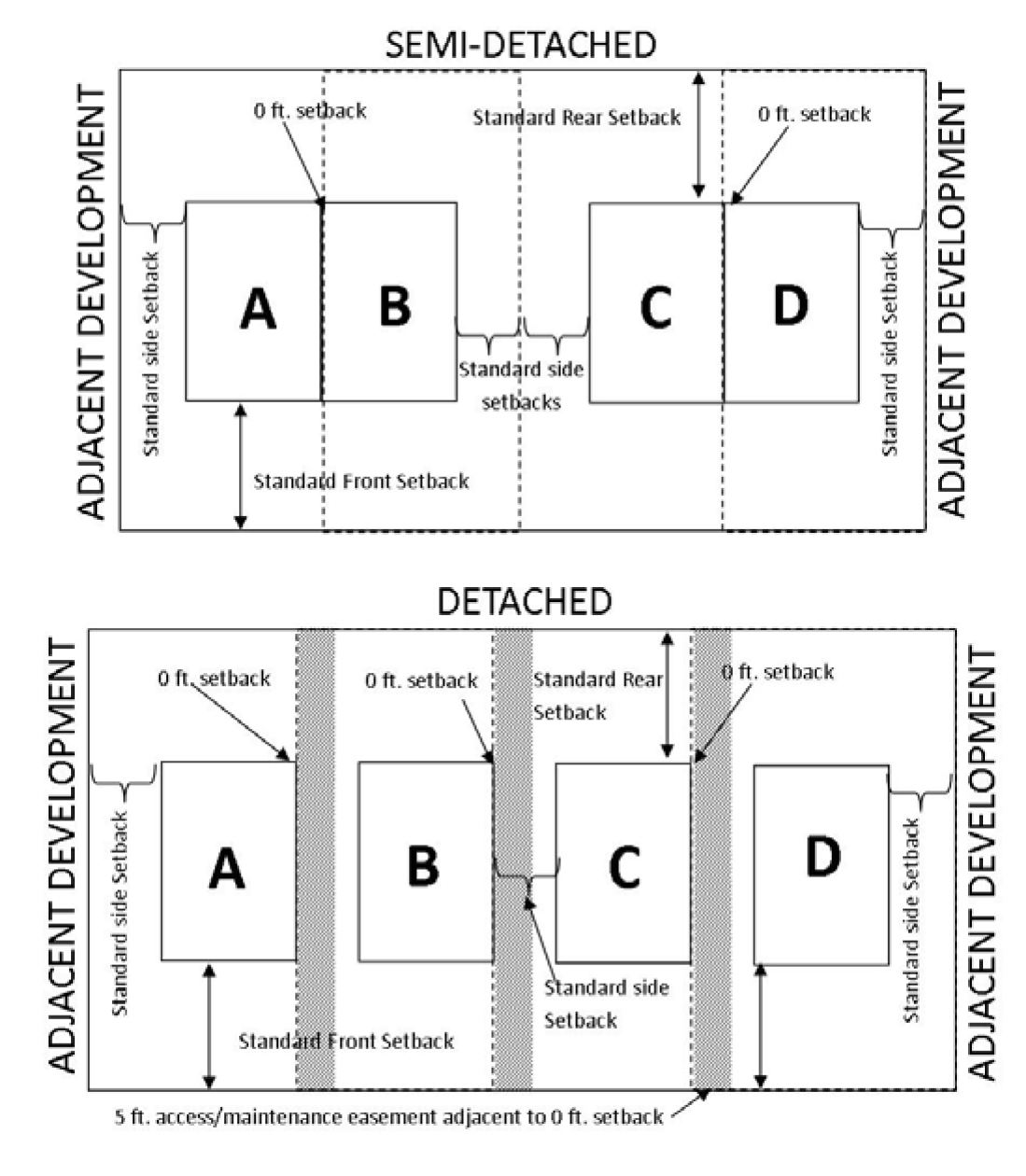
Side yard setbacks shall conform to the overlay zoning district except for the zero lot line setback (see Figure 819A, below).
c.
No more than one zero-lot-line setback may be utilized per lot (a development proposing two zero-lot-line setbacks will be considered an attached dwelling development subject to the provisions of 819.63, above)
d.
The zero-lot-line setback may be utilized on a shared/common property line between two lots to allow the development of semi-detached units, or may be staggered to facilitate the development of completely detached buildings built on the property line (see Figure 819A, below).
e.
Where side-by-side development ("semi-detached") is proposed, each unit should have a separately articulated roofline and front porch, similar to a townhome-style development. All zero-lot-line developments (both detached and semi-detached) must meet the design standards of 819.52.
f.
Where detached development is proposed, each lot should have a 5 feet maintenance/access easement adjacent to the zero-lot-line setback on the adjoining lot (see Figure 819A, below).
g.
In no case shall a setback of zero feet be permitted under this section for a side yard that is not common to development proposed under this provision. Side yard setbacks adjacent to property not common to the zero-lot-line development must meet the minimum side setbacks prescribed by the overlay district (see Figure 819A, below).
FIGURE 819A:
819.75 Bungalow Courts
a.
Area Regulations:
i.
Minimum public street frontage for development site: 100 feet
ii.
Minimum area per bungalow: 2900 sq. feet
iii.
Maximum density: 15 dwellings per acre
iv.
Minimum area required for common space: 15 percent of the overall square footage of the development. The common area must be open to the sky.
v.
Minimum setbacks for perimeter of development site: See overlay district and underlying zoning districts, as applicable. For lots with more than one street frontage, front yard setbacks shall apply adjacent to all streets that have primary facades oriented towards them (see orientation requirements in c, below).
vi.
All bungalows must be separated by a minimum of 10 feet and be setback a minimum of 5 feet from any lot line.
b.
All bungalows must meet the design standards in 819.52, with the primary façade being determined by the hierarchy in c, below.
c.
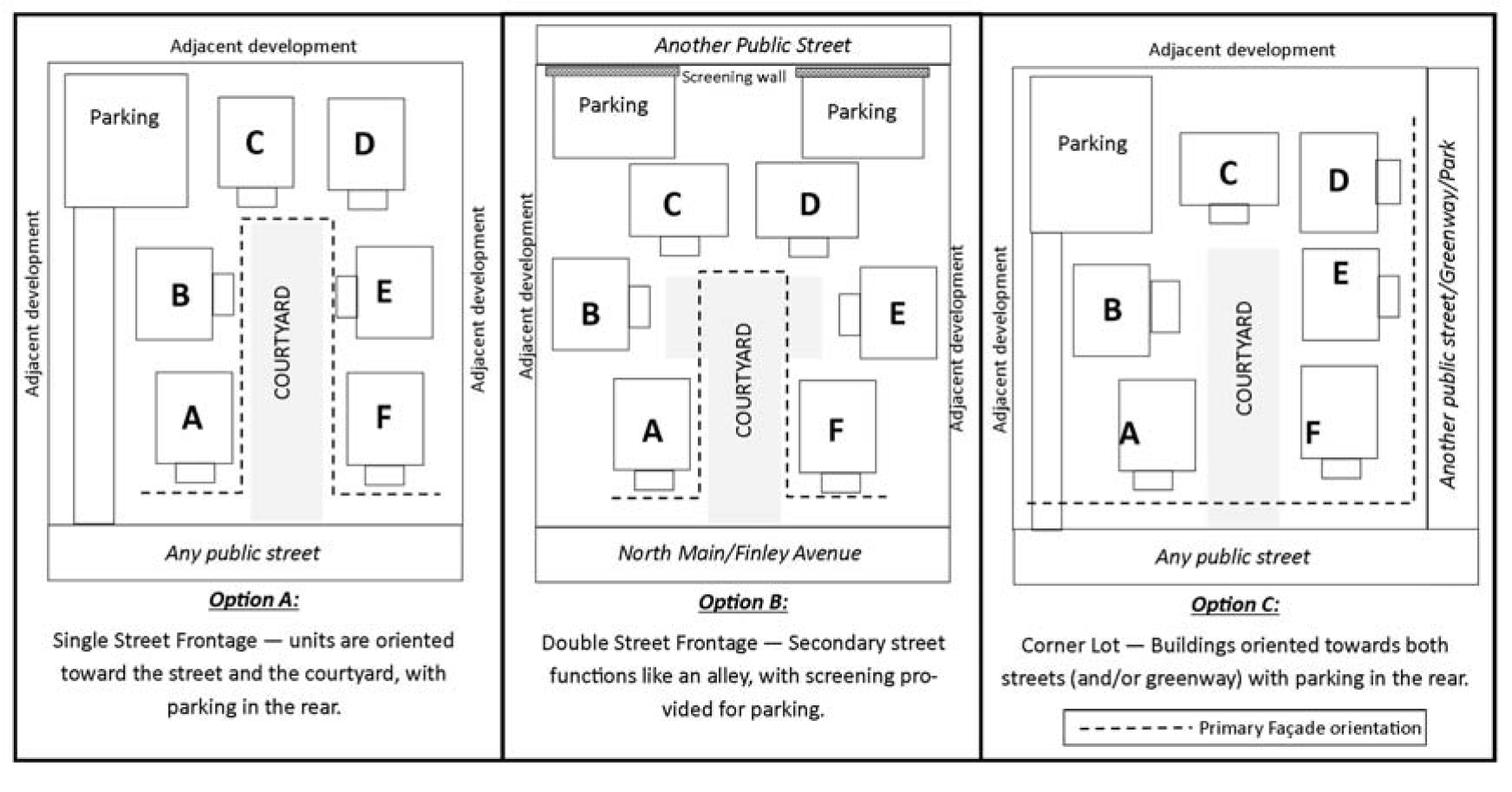
Bungalows shall be oriented according to the follow hierarchy (see Figure 819B for examples of allowed site configurations):
1st - Front facades and front door face N. Main Street or Finley Avenue.
2nd - Front facades and front door face other public streets.
3rd - Front façade and front door face interior courtyard, a greenway, a planned greenway, or a public park.
d.
A minimum of one parking space per one-bedroom unit and two parking spaces for each unit with two or more bedrooms must be provided. Parking may be provided in rear-loading attached garages, detached garages, surface parking, or any combination thereof (see Figure 819C[B] for examples of allowed site configurations).
e.
Vehicular driveways and parking facilities are prohibited within the required courtyard area. All vehicular access shall occur from side streets, alleys, or private driveways located to the rear of the structures in the bungalow court. Garage doors should not be visible from the public street and surface parking should be screened from view from the public street by buildings whenever feasible. In the case of development sites with more than one road frontage, parking facilities located adjacent to a lower hierarchy street frontage (see c, above) must be screened by a masonry wall at least 3 feet but no more than 5 feet tall. The wall shall be setback a minimum of 2 feet to allow for landscaping between the wall and the public sidewalk. See Figure 819B for examples of allowed site configurations.
f.
Accessory dwelling units (apartments or cottages) or accessory structures are not permitted within bungalow courts, except that detached garages may be allowed if included on the site plan submitted for initial development.
g.
Applicants desiring approval of a bungalow court must submit two full sized sets of site and building plans to the Planning Department. Plans will be routed to the Public Works, Public Utilities, and Fire Department for a technical review.
h.
Bungalow courts may be parceled into individual lots for fee simple ownership, held in common ownership, or sold as condos. Lot frontage requirements shall not apply to individual building lots when access easements and deed restrictions ensure adequate pedestrian, vehicular, and emergency access in perpetuity.
FIGURE 819B:
(Ord. of 4-21-2015, § 7; Ord. of 5-1-2018)
820 Additional Procedures for Conditional Zoning District Map Amendments
Where a zoning map amendment has been proposed to rezone property to a Conditional Zoning district, the following procedures shall apply in addition to the requirements for map amendments prescribed by Article XIV of the zoning ordinance.
820.1
Qualified Applications
Applications for Conditional Zoning map amendments may only be considered where such application has been signed by each owner of the property subject to the proposed map amendment.
820.2
Conditions on Use and Development
The applicant shall submit a Concept Plan and written list of all proposed conditions on the use or development of the subject property as part of the application. The Concept Plan shall serve as the basis for future development of the property subject to the approved Conditional Zoning ordinance. Specific conditions may be proposed by the applicant, planning department staff, planning board, or City Council, but only those conditions approved by the City Council and consented to by the applicant in writing may be incorporated into the zoning regulations. Unless consented to by the applicant in writing, the City may not require, enforce, or incorporate into the zoning regulations any condition or requirement not authorized by otherwise applicable law, including, without limitation, taxes, impact fees, building design elements within the scope of G.S. 160D-702(b), driveway-related improvements in excess of those allowed in G.S. 136-18(29) and G.S. 160A-307, or other unauthorized limitations on the development or use of land.
Conditions and site-specific standards imposed in a conditional district shall be limited to those that address the conformance of the development and use of the site to local government ordinances, plans adopted pursuant to G.S. 160D-501, or the impacts reasonably expected to be generated by the development or use of the site.
State Law reference— G.S. 160D-703(b)
820.3
Review and Approval of Conditions
820.31 Planning Board - In its review of the proposed Conditional Zoning map amendment, the Planning Board may propose modifications to the Concept Plan and/or list of conditions, as it may find reasonable and in the public interest. Modifications to the submitted Concept Plan and/or list of proposed conditions shall be reduced to writing and forwarded to the City Council with the Board's recommendation on the proposed amendment.
820.32 City Council - The City Council shall consider the proposed use and development conditions, the Concept Plan and any proposed additions or modifications forwarded by the Planning Board as part of its deliberations following the Public Hearing on the proposed amendment. The City Council may propose modifications to the Concept Plan and/or list of conditions as it finds reasonable and in the public interest. All conditions or modifications to the submitted Concept Plan, whether proposed by the applicant or City Council, shall be reduced to writing and included as part of the ordinance amending the Official Zoning Map.
820.4
Applicability of Conditions
Only those conditions that are mutually agreed to by the City Council and the applicant shall become binding on the applicant and their successors in interest. Any additionally imposed conditions or modifications to the Concept Plan shall be agreed to by the applicant prior to the adoption of the ordinance amending the Official Zoning Map. The ordinance must contain a signature block for the applicant to sign, acknowledging consent to the imposed conditions. The ordinance shall not be considered in full force and effect until it is signed by the Mayor/Mayor Pro Tempore, the City Clerk and the applicant, and recorded with the register of deeds.
820.5
Use and Development Following Approval
All use and development of a property subject to an approved Conditional Zoning district shall be in accordance with the approved conditions and Concept Plan, in addition to the other standards of the City's Code of Ordinances not modified by the Conditional Zoning district. The approval of a Conditional Zoning district does not abrogate the requirement to obtain all other development approvals as required by this Ordinance.
820.6
Modification and Repeal
(1)
Minor Modifications. Subsequent development applications may incorporate minor changes from the adopted Concept Plan, without the need to amend the Special Use Permit, where the Planning Director determines that the changes:
(A)
Continue to comply with written conditions and standards of the Conditional district zoning ordinance and all other applicable development regulations; and
(B)
Are necessary to comply with a development regulation or accommodate a physical site constraint that was not known at the time of adoption of the Concept Plan and would not significantly alter the development's general function, form, intensity, character, demand on public facilities, impact on adjacent properties, or other characteristic from that indicated by the conditional district approval.
(2)
Major Modifications/Permit Amendments. Any requests for changes or modifications to the Concept Plan that do not meet the standards for minor modifications above, and all requested text amendments, are considered to be major modifications and shall follow the same approval process as an initial zoning map amendment to a conditional district (see section 820.3 and section 1402). In any case, the following changes from the Concept Plan approval shall always constitute a major change:
(A)
A change in a condition of approval;
(B)
A change in uses permitted or the density of overall development.
(C)
A change greater than 20 percent in the ratio of gross floor area devoted to residential vs. non-residential uses in a mixed-use development; and
(D)
An increase greater than ten percent in the amount of land devoted to non-residential uses.
(3)
Determination to be made in writing. Requests for minor modifications may be made through a subsequent development application, or the applicant may request a stand-alone determination and approval from the Planning Director on a proposed modification prior to making application for a subsequent development approval (e.g. a plat, a zoning permit). The determination shall be made in writing, and may be provided to the applicant in print or electronic form.
(4)
Repeal. Unless otherwise specified in the conditional district ordinance, a conditional district, once adopted, cannot be repealed except through a zoning map amendment to remove the conditional district overlay and revert to the base zoning, or a different conventional zone, in accordance with the procedures in section 1402 of this ordinance. The map amendment process to repeal a conditional district may be initiated by the property owner, or may be initiated by the city if development activities on the property have been conducted in violation of the provisions of the conditional district.
(Ord. of 7-21-2015; Ord. of 1-19-2021, § 8)

