
Levan City Zoning Code
16.04 DEFINITIONS
16.04.010 EXPLANATION
Adopted by Ord. 2017-01 on 10/4/2017
16.04.020 LAND USES
Accessory Use or Building, Unoccupied. A subordinate use or building customarily incidental to and located upon the same lot as the principal building and that is:
- Clearly incidental to, and customarily found in connection with such principal building;
- Operated and maintained for the benefit of the principal use; and
- Not a dwelling unit. A subordinate use or building customarily incidental to and located upon the same lot occupied by the main use or building.
Accessory Buildings (Large). An accessory building larger than 600 sq. ft., located on the same lot as a residence.
Agricultural Industry or Business. An industry or business involving agricultural production manufacturing, packaging, treatment, sales, intensive feeding, or storage including but not limited to animal feed yards, fur farms, food packaging or processing plants, commercial poultry or egg production, and similar uses as determined by the Planning Commission.
Agriculture. The tilling of soil, raising of crops, horticulture, and gardening, but not including the keeping or raising of domestic animals and fowl, except household pets, and not including any agricultural industry or business, such as food-packing plants, fur farms, animal hospitals, or similar uses.
Alley. A public thoroughfare less than 26 feet wide.
Alterations, Structural. Any change in the supporting members of a building such as bearing walls, columns, beams, or girders.
Animal Waste. The excrement and discharge from an animal, or animal carcasses, tissues, or any other substance or material capable of transmitting disease or disease-carrying agents.
Animal Hospital or Veterinary Offices (Small). An establishment at which up to five dogs, cats, or similar household pets at least three months of age are treated.
Animal Hospital or Veterinary Offices (Large). An establishment at which large animals such as horses are treated.
Animal Hospital or Veterinary Offices. An establishment at which more than five dogs, cats, or similar household pets at least three months of age are lodged, treated, or trained.
Apartment Hotel. Any building which contains dwelling units and also satisfies the definition of a hotel, as defined in this title.
Apartment House. A building which contains four or more dwelling units primarily for rent or lease or a building which contains an apartment or apartments and also contains other approved uses such as office or retail space.
Apartment Motel. Any building or group of buildings which contains dwelling units and also satisfies the definition of a motel, as defined in this title.
Application. A written request for development approval including, but not limited to an alteration or revision to an approved master planned development, conditional use permit, zoning or rezoning, subdivision, or annexation. The term “Application" shall not include any building permits associated with construction within an approved subdivision or on an existing platted lot unless otherwise specified.
Aquifer Recharge Area. The outcropping part of the aquifer through which water enters.
Architectural Projection. Any building or structural projection which is not intended for occupancy and which extends beyond the face of an exterior wall of a structure, but not including signs.
Athletic Tennis, or Racquet Club. An establishment providing facilities for physical development, exercise, sports, or recreation. Facilities may include exercise equipment, indoor and/or outdoor racquet ball or tennis courts, jogging track, swimming pools, ice skating rink, indoor bathing, restaurant or snack bar, and sales of athletic equipment. Facilities may be open to the public for a fee, or available only to persons holding membership.
Auto Wrecking, Salvage Yard. The use of any lot, portion of lot, or tract of land for the storage and keeping of salvage, including scrap metals or other scrap material, or for the dismantling or demolition of obsolete automobiles or equipment, machinery, or parts thereof, provided that this definition shall not be deemed to include such uses which are clearly accessory and incidental to any agricultural use permitted in the zone district.
Auto, Truck, Recreational Vehicle, and Equipment Sales and Rental. Sales of both new and used motor vehicles and equipment stored and displayed both indoors and on outside lots, but not to include non-serviceable or junk vehicles or equipment.
Automotive Repair Establishment. An establishment primarily engaged in the repair or maintenance of motor vehicles, trailer, and similar large mechanical equipment. This definition shall include free-standing car washes, automotive mechanics’ garages, and automotive paint and body shops, and tire businesses. Not included are automotive salvage yards.
Automotive Self -Service Station. An establishment for the retail sale of automobile fuels and lubricants, at which the customer provides the service to his/her own vehicle, and at which no vehicle repair or maintenance service is offered. Such an establishment may offer for sale at retail other convenience items as clearly secondary activity.
Automotive Service Station. An establishment whose primary purpose is the retail sale of gasoline or other motor vehicle and related fuel, oil, or lubricant. Secondary activities may include minor automotive repair, maintenance, or automatic car wash.
Banking or Financial Service. A bank, credit union, savings and loan association, or other establishment with a primary purpose of receiving, lending, exchanging, or safeguarding money, or performing financial advisory service. This definition shall include outside drive-up facilities for service to customers in automobiles.
Bar, Tavern, Lounge, Club. An establishment intended primarily for the on-premises sale and consumption of alcoholic beverages, opened either to the public or operated as a nonprofit private club for members only.
Basement. A story whose floor is more than 12 inches below the average level of the adjoining ground, but where no more than half of its floor-to-ceiling height is below the average contact level of the adjoining ground, as distinguished from a cellar as defined in this ordinance.
Bed and Breakfast. Overnight accommodations and a morning meal in a dwelling unit provided to transients for compensation.
Blighted Area. An area characterized by deteriorating and/or abandoned buildings; inadequate or missing public or community services; and vacant land with debris, litter, lack of sanitation facilities, trash and junk accumulation, and impacted by adverse environmental nuisances, such as noise, heavy traffic, and odors.
Board of Adjustments. A five (5) member board appointed by the Levan Town Council to hear appeals by any person aggrieved by his/her inability to obtain a building permit under this ordinance or by the decision of any administrative officer or agency (except the Town Council) based upon or made in the course of the administration or enforcement of the provisions of this ordinance.
Boarding House. A building where, for compensation, meals and lodging are provided for at least five (5) but not more than fifteen (15) persons.
Bond, Landscape. A financial guarantee to the Town that all landscaping will be installed to Town specifications.
Bond, Public Improvement. One (1) year guarantee to the Town that all public improvements have been installed to Town specifications and will operate properly.
Building. Any structure, whether temporary or permanent, having a roof, and used or built for the shelter or enclosure of persons, animals, possessions, or property of any kind.
Build-to Line.Setback distances that are required maximums, bringing structures adjacent to streets and sidewalks in order to encourage pedestrian activity.
Building Code. The International Building Code.
Building Height. The vertical distance from the average finished grade surface at the building wall to the highest point of the coping of a flat roof or to the deck line of a mansard roof, or the man height level between eaves and ridge for gable, hip, or gambrel roofs.
Building Inspector. See Building Official.
Building Official. The official designated by the Levan Town Council as the Levan Town Building Inspector.
Building, Main. A building in which is conducted the principal use of the site on which it is situated.
Capital Improvement. An acquisition of real property, major construction projects, or acquisition of expensive equipment expected to last a long time.
Capital Improvements Program. A proposed schedule and description of all proposed public works projects, listed in order of construction priority, together with cost estimates and the anticipated means of financing each project.
Carport. A private garage not completely enclosed by walls or doors.
Cellar. A separate room or space wholly under the surface of the ground, or having more than 50 percent of its floor-to-ceiling height under the average level of the adjoining ground.
Cemetery, Columbarium, Crematory, Mausoleum. Land or buildings used or intended to be used for the burial of the dead, cremation, or interment and dedicated for cemetery purposes, including columbarium’s, crematories, mausoleums, and mortuaries when operated in conjunction with and within the boundaries of such cemetery, but not including facilities for embalming.
Chief Executive Officer. The Levan Town Mayor
Child Care. The provision, day or night, of supplemental parental care, instruction and supervision for a non-related child or children, on a regular basis, and for less than twenty-four (24) hours a day. The term does not include babysitting services on a casual, non-recurring nature or in the child's own home or cooperative, reciprocative child care by a group of parents in their respective domiciles.
Child Care, Center. The provision of child care for six (6) or fewer children, including the provider's children who are under the age of eighteen (18), within a dwelling unit.
Child Care, Facility. The provision of child care for seven (7) or more children including the provider's children who are under the age of eighteen (18).
Church. An institution that people regularly attend to participate in or hold religious services, meetings, and other activities. The term “church” shall refer to any building in which the religious services of any denomination are held.
Cinema, Outdoor. An establishment at which motion pictures are projected onto an outdoor screen for viewing by patrons seated in parked motor vehicles.
Cinema, Indoor. An enclosed building used primarily for the presentation of motion pictures.
Civic Club, Fraternal Organization. A building or use, other than a church or school, operated by a nonprofit association or organization for a social, fraternal, political, civic, or philanthropic purpose, which may include a meeting hall and cooking and dining facilities for large groups but shall not provide overnight lodging.
Clear ViewArea. See sight distance triangle.
Coal Yard. The storage of coal in quantities in excess of 10 tons and/or the retail or wholesale sale of coal.
Collector Street. A street, which serves or is designed to serve moderate flows of traffic that collects from local streets and other collector streets and connects with Arterial streets.
Co-location. The location of a telecommunication facility on an existing structure, tower, or building in a manner that precludes the need for that telecommunications facility to be located on a freestanding structure of its own.
Compatible. When the characteristics of new development or a change in use integrate with, relate to, and/or enhance the context of a surrounding area or neighborhood. Elements affecting compatibility include, but are not limited to, Height, scale, mass and bulk of buildings, pedestrian and vehicular circulation, parking, landscaping and architecture, topography, environmentally sensitive areas, and building patterns.
Conditional Use. A land use that because of its unique characteristics or potential impact on the county, surrounding neighbors, or adjacent land uses may not be compatible in some areas or may be compatible only if certain conditions are required that mitigate or eliminate the detrimental impacts.
Condominium. A building, or group of buildings, in which dwelling units, offices, or floor area are owned individually, and the structure, common areas, and facilities are owned by all the owners on a proportional, undivided basis.
Conservation Activity. A process to restore, enhance, protect, and sustain the quality and quantity of ecosystems and natural resources
Constitutional Taking. Final action by the Town to physically take or exact private real property that requires compensation to the owner because of the mandates of the Fifth or Fourteenth Amendments to the Constitution of the United States, or Article I, Section 22, of the Utah Constitution.
Construction Activity. All excavation, construction, mining, or other development activity which disturbs or changes the natural vegetation, grade, or any existing structure, or the act of adding an addition to an existing structure, or the erection of a new principal or accessory structure on a lot or property.
Construction Mitigation Plan. A written description of the method by which an owner will ameliorate the adverse impacts of construction activity to the surrounding area and/or neighborhood.
Construction Plan. The map and drawings showing the specific location and design of the development.
County. The unincorporated area of Juab County.
Convenience Goods Sales and Services. Stores or shops intended for retail sales of convenience goods or performance of convenience services. Goods and services regarded as convenience are those generally needed for daily home consumption and for which locations near residential neighborhoods are considered desirable.
Cottage Industry. A home occupation.
Court. An open, unoccupied space, other than a yard, on the same lot with a building or group of buildings and which is bounded on two or more sides by such building or buildings.
Coverage. The percent of the total site area covered by structures or impervious paving other than those accepted in this ordinance.
Cul-de-sac. A local street, one end of which is closed and consists of a circular turnaround.
Culinary Water. Water suitable for safe consumption by humans.
Cultural, Civic Services. A building primarily used for the public, nonprofit display of art, historic or cultural artifacts, or other inanimate exhibits or a building primarily used as a lending library or reading room.
Dairy. A commercial establishment for the manufacture and retail sale of dairy products.
Day Care, Family. The keeping for care and/or instruction, whether or not for compensation, of six children or less within a dwelling for less than 8 hours per day, not including member of the family residing on the premises.
Day Care, Group. An establishment for the care and/or instruction, whether or not for compensation, of seven or more children. Child nurseries and pre-school facilities are included in this definition.
Dead End Street. A street with a single ingress/egress.
Developer. The successful applicant for any development.
Development. The act, process or result of erecting, placing, constructing, remodeling, converting, altering, relocating, or demolishing any structure or improvement to property including grading, clearing, grubbing, mining, excavating or filling of such property. Includes construction activity.
District. A portion of the area of Levan Town, Utah shown on a zoning map and given a zone classification as set forth in this ordinance.
Dry-Cleaning Establishment. An establishment employing volatile or explosive substances for the cleaning or dyeing of fabrics. Excluded from this definition are traditional laundries employing water and soaps in the cleaning of fabrics and patron-operated dry-cleaning machines associated with Laundromats.
Dwelling. Any building, or portion thereof, which is designed for use for residential purposes, except hotels, boarding houses, lodging houses, and tourist cabins.
Dwelling, Detached. A dwelling that is not attached to any other dwelling by any means.
Dwelling, Four-Family. A building arranged or designed to be occupied by four families, the structure having only four dwelling units.
Dwelling, Multiple-Family. A building arranged or designed to be occupied by more than four families.
Dwelling, Single-Family. A building arranged or designed to be occupied by one family, the structure having only one dwelling unit.
Dwelling, Three-Family. A building arranged or designed to be occupied by three families, the structure having only three dwelling units.
Dwelling, Two-Family. A building arranged or designed to be occupied by two families, the structure having only two dwelling units.
Dwelling Unit. One or more rooms in a structure designed for or occupied by one family for living or sleeping purposes and having one but not more than one kitchen.
Engineer. The engineer employed by or officially representing Levan Town.
Escrow. A deposit of cash with the Town or an approved, alternate security in lieu of cash held to ensure a guarantee.
Facade, Building. The exterior of a building located above ground and generally visible from public points of view.
Farm Animals. Animals other than household pets that may, where permitted, be kept and maintained for education, family food production, or recreation. (supplementary regulations, see animal regulations section)
Fence. A physical barrier to delineate, contain, or designate an area designed for a specific use, such as an enclosure for a dwelling unit, an area of storage, etc.
Frontage. The length of the property line of the lot fronting on one side of a street.
Flood Plain. The channel and the relatively flat area adjoining the channel of a natural stream or river that has been or may be covered by floodwater.
Garage. An accessory building, unoccupied, or part of a primary building, designed for the shelter and storage of a motor vehicle or vehicles and enclosed on three (3) or more sides.
Garage, Commercial. A building other than a private garage used for the temporary parking of automobiles with or without a fee.
Garage, Private (including Carport). A detached accessory building or portion of a main building for the parking or temporary storage of automobiles of the occupants of the premises.
Geologic Hazard. A hazard inherent in the crust of the earth, or artificially created, which is dangerous or potentially dangerous to life, property or improvements, due to the movement, subsidence, or shifting of the earth. The term includes but is not limited to unstable slopes, faulting landslides and rock fall.
General Merchandise Sales and Related Services. Stores, department stores, or shops intended for sale of goods or merchandise, but not including convenience goods, liquor, motor vehicles, campers, trailer, farm equipment, lumber, heavy machinery, or war surplus goods.
Governing Body. The Town Council of Levan.
Grade. The ground surface elevation of a site or parcel of land.
- For buildings adjoining more than one street, the average of the elevations of the sidewalks at the centers of all walls adjoining streets.
- For buildings adjoining one street only, the elevation of the sidewalk at the center of that wall adjoining the street.
- For buildings having no wall adjoining the streets, the average level of the ground (finished surface) adjacent to the exterior walls of the buildings. All walls approximately parallel to and not more than five feet from a street line are to be considered as adjoining a street.
Grade, Existing. The grade of a property prior to any proposed development or construction activity.
Grade, Final. The finished or resulting grade where earth meets the building after completion of the proposed development activity.
Grade, Natural. The Grade of the surface of the land prior to any development activity or any other man-made disturbance or grading. The Building Inspector shall estimate the natural grade, if not readily apparent, by reference elevations at points where the disturbed area appears to meet the undisturbed portions of the property. The estimated natural grade shall tie into the elevation and slopes of adjoining properties without creating a need for new retaining walls, abrupt differences in the visual slope and elevation of the land, or redirecting the flow of run-off water.
Grading. Any earthwork or activity that alters the natural or existing grade, including but not limited to excavating, filling or embanking.
Guarantee. Any form of security including cash, a letter of credit, or an escrow agreement in an amount and form satisfactory to the Town.
Handicapped Person.
- A person who has a severe, chronic disability that is attributable to mental or physical impairments, that is likely to continue indefinitely, and that results in a substantial functional limitation in three or more of the following areas of major life activity:
- capacity for independent living;
- economic self-sufficiency;
- learning;
- mobility;
- receptive and expressive language;
- self-care;
- self-direction; and
- Requires special interdisciplinary or generic care, treatment, or other services that are individually planned and coordinated to allow the person to function in, and contribute to, a residential neighborhood.
Hard-Surfaced. Covered with concrete, brick, asphalt, or other impervious surface
Health Care Center (Convalescent Center). A publicly-or-privately-operated facility, other than a hospital, intended for the long-term, in-patient care of human illness or infirmity, including the elderly and developmentally disabled, normally employing the services of skilled and licensed practitioners.
Health Department. The Utah State Division of Environmental Health or local health agency having jurisdiction.
Home Occupation. Business carried on entirely within a dwelling by persons residing within the dwelling, which business is clearly incidental and secondary to the use of the dwelling for residential purposes.
Hospital. An institution designed for the diagnosis, treatment, and care of human illness or infirmity and providing health services, primarily for in-patients, and including as related faculties, laboratories, out-patient departments, training facilities, and staff offices, but not including clinics or health care centers.
Hotel. A facility offering transient lodging accommodations to the general public and providing additional services, such as restaurants, meeting rooms, entertainment, and recreational facilities.
Household Pets. Animals or birds ordinarily permitted in the house and kept for company or pleasure, such as dogs, cats, and canaries, but not including a sufficient number of dogs to constitute a kennel, as defined in this ordinance.
Impact Fee. A fee imposed on a development to help finance the cost of improvements or services.
Improvement. Any permanent structure that becomes part of, placed upon, or is affixed to real estate.
Industrial (or Research) Park. A tract of land that is subdivided and developed according to a plan for the use of a community of industries and related uses and that is of sufficient size and physical improvements to protect surrounding areas and the general community and to assure a harmonious integration into the neighborhood.
Industry. Those fields of economic activity including forestry, fishing, hunting, and trapping; mining; construction; manufacturing; transportation, communication, electric, gas, and sanitary services; and wholesale trade.
Industry, Light. The manufacturing, compounding, processing, assembling, packaging, or testing of goods or equipment entirely within an enclosed structure, with no outside storage, serviced by small 3/4 ton trucks or van, and imposing a nearly negligible impact upon the surrounding environment by noise, vibration, smoke, dust , or pollutants.
Industry, Medium. The manufacturing, compounding, processing, assembling, packaging, or testing of goods or equipment within an enclosed structure, or an open yard that is capable of being screened from neighboring properties, is serviced by trucks or other vehicles, and whose environmental impact is within the industrial performance standards outlined in this ordinance.
Junk. Any scrap, waste, reclaimable material, or debris, whether or not stored, for sale or in the process of being dismantled, destroyed, processed, salvaged, stored, baled, disposed, or other use or deposition.
Junkyard. Any area, lot, land, parcel, building, or structure, or part thereof, used for the storage, collection, processing, purchase, sale, salvage, or disposal of junk.
Kennel. A shelter for or a place where five (5) and no more than fifteen (15) dogs or cats are bred, boarded, or trained.
Lattice Tower. A self-supporting multiple-sided, open steel frame structure used to support telecommunications equipment.
Laundromat. An establishment in which patrons wash, dry, or dry-clean clothing and other fabrics in coin-operated, self-service machines.
Laundry. An establishment at which clothing and other fabrics are washed and pressed. Excluded from this definition are dry-cleaning establishments and Laundromats.
Legislative Body. The Levan Town Council.
Liquor Store. A retail sales store authorized by the Utah State Liquor Commission to sell packaged alcoholic beverages for off-premise consumption.
Local Government. Any city, town, village, or other legally authorized agency charged with the administration and enforcement of land use regulations in Levan Town.
Local Health Officer. The health officer or department employed by or officially representing Levan Town.
Local Jurisdiction. Levan Town.
Lodging House. A building where lodging only is provided from compensation to five or more, but not exceeding 15 persons, in contradistinction to hotels open to transients.
Lot. A parcel of land occupied or to be occupied by a main building or group of buildings (main and accessory), together with such yards, open spaces. Lot width and lot area as are required by this ordinance and having frontage upon a street. More than one dwelling structure may be built on a lot only in cases where the lots is of such size as to provide such required lot area, yards, and frontage for each dwelling structures as are required for the first dwelling structure on the lot.
LotArea. The area of a horizontal plane within the property lines of a lot.
Lot, Corner. A lot situated at the intersection of two (2) streets, the interior angle of such intersection does not exceed one hundred thirty five degrees (135°).
Lot, Coverage. The maximum area of a lot, which may be occupied by a structure. Lot coverage is expressed as a ratio. Arcades, open porches, decks, terraces, and stoops are excluded from the calculation.
LotDepth. The minimum distance measured from the front property line to the rear property line of same lot.
Lot, Frontage. The length of the front property line measured at the street right-of-way line.
Lot, Width. The minimum distance between the side lot lines at the front yard or front building facade. For three (3)-sided Lots, the minimum distance between the rear and side lot lines at the front yard or front building facade.
LotLine Adjustment. The relocation of the Property Line between two (2) adjoining lots.
LotLine, Front. The Property Line dividing a lot or parcel from the right-of-way of the street from which structure takes access.
LotLine, Rear. The property line opposite the front lot line.
LotLine, Side. Any lot or property line other than a front or rear lot line.
Lot, Pre-existing. A lot, which was created prior to January 1, 1980 through a recorded subdivision plat, deed, sales contract, or survey, and a lot, which met the zoning regulations in effect at the time of its creation.
Low Power Radio Services Facility. An unmanned structure, which consists of equipment used primarily for the transmission, reception or transfer of voice or date through radio wave or wireless transmissions. Such sites typically require the construction of transmission support structures to which antenna equipment is attached.
Lumber Sales and Storage. The sales and display of lumber and building supplies, including the outside storage of lumber and related merchandise.
Manufactured Home. A detached, single-family dwelling unit that is transportable in two or more modules, is manufactured or constructed under authority of 42 United Sates Code, Sec. 5401, and which is built on a permanent chassis and designed to be used as a dwelling with a permanent foundation when connected to the required utilities and includes the plumbing, heating, air conditions, and electrical systems contained therein. The unit must bear a U.S. Department of Housing and Urban Development (HUD) Data Plate and must not have been altered in violation of the above code. Excluded from this definition shall be those permanent dwelling structures that are construed of component parts, that are transported to the building site, which meet structural requirement of the Uniform Building Code, and which are finished with exterior building material that is typical of permanent residential buildings.
Manufactured Home (non-conforming). A detached, single-family dwelling unit that is transportable, is manufactured or constructed under authority of 42 United Sates Code, Sec. 5401, does not meet the definition of a manufactured home above, is built on a permanent chassis and designed to be used as a dwelling with or without a permanent foundation when connected to the required utilities, and include the plumbing, heating air conditioning, and electrical systems contained therein. The unit must bear a U.S. Department of Housing and Urban Development (HUD) Data Plate. Excluded from this definition shall be those permanent dwelling structures that are constructed of component parts that are transported to the building site and which meet structural requirements of the uniform building and which are finished with exterior building material that is typical of permanent residential buildings.
Manufactured Home Subdivision. A parcel of land, which has been legally subdivided, where owners of manufactured homes may purchase lots and attach said manufactured homes to permanent foundations. The subdivision is developed with all of the improvements and amenities found in a traditional, single-family subdivision as outlined in the Levan Town Subdivision Ordinance.
Mental Health Center. A publicly-or privately operated facility, intended for the diagnosis and treatment of mental or emotional disorders.
Mixed Use, Commercial. Development which incorporates a mix of uses, including retail, commercial, and/or offices and residential.
Municipal Facilities. Those improved properties owned by the municipality, or the public.
Mobile Home. A detached dwelling unit designed for long-term occupancy and to be transported on its own wheels, or on a flatbed or other trailers or detachable wheels, to a site for occupancy as a complete dwelling unit except for connections to utilities and other minor work and not affixed with a U.S. Department of Housing and Urban Development (HUD) Data Plate. Removal of such wheels or placing such dwelling on a foundation shall not remove such unit from classification as a mobile.
Mobile Home Park. A residential development in which owners of mobile homes or manufactured housing may rent or lease a lot on which to place their home. Such developments may provide all of the amenities and improvements typical of subdivisions.
Moderate-Income Housing. Housing that is economically feasible for families whose income level is categorized as moderate within the standards promulgated by HUD or the appropriate state housing agency.
Modular Home. A permanent dwelling structure built of prefabricated units which are assembled and erected on the site, and which meets the Uniform Building Code.
Monopole. A single cylindrical steel or wood pole that acts as the support structure for antennas.
Mortuary, Funeral Home. An establishment in which the dead are prepared for burial or cremation. The facility may include a chapel for the conduct of funeral services, spaced for informal gatherings, and related accessory uses.
Motel. An establishment providing sleeping accommodations with a majority of all rooms having direct access to the outside without the necessity of passing through the main lobby of the building.
Natural Waterways.Those areas, varying in width, along streams, creeks, springs, gullies, or washes which are natural drainage channels as determined by the building inspector.
New Development. Any new construction activity.
Nonconforming Structure or Building. A structure that legally existed before its current zoning designation and because of a zoning change does not conform to the zoning district’s development standards.
Nonconforming Use. A use or activity that was lawful prior to the adoption, revision or amendment of the zoning ordinance but that fails by reason of such adoption, revision, or amendment to conform to the present requirements of the zoning district.
Nuisance. An interference with the enjoyment and use of property (any environmental pollutant such as: smoke, odors, liquid wastes, solid wastes, radiation, noise, vibration, glare, or heat).
Office, Business or Government. A place intended for the conduct of administration or services by a business enterprise or unit of government and in which no goods or merchandise are stored, displayed, or sold.
Office, Professional. A place intended for the conduct of a recognized learned profession. Such uses include offices or clinics devoted to treatment and care of human illness or injury (medical, dental, chiropractic offices, and similar uses). Other professions so defined would include, but not be limited to, accountants, architects, engineers, and lawyers. Definition does not allow for in-patient care facilities.
Official Zoning Map. The map adopted by the Town Council pursuant to law showing the streets, zoning districts, and Town boundaries; and any amendments or additions thereto resulting from the approval of rezones, subdivision or annexation plats and the subsequent filing of such approved plats.
Open Space. Any parcel or area of land or water essentially unimproved and set aside, dedicated, designated, or reserved for public or private use or enjoyment or for the use and enjoyment of owners, occupants, and their guests of land adjoining or neighboring such open space.
Ordinance. A municipally adopted law or regulation.
Ordinary High Water Mark. The line on the bank to which the high water ordinarily rises annually in season as indicated by changes in the characteristics of soil, vegetation or other appropriate means, which consider the characteristics of the surrounding areas. Where the ordinary high water mark cannot be found, the top of the channel bank shall be substituted. In braided channels, the ordinary high water mark or substitute shall be measured so as to include the entire stream feature.
Ordinary Repairs and Maintenance. Work done on a structure to correct deterioration, decay of, or damage to all or part of the structure generally to restore the same to its condition prior to such deterioration, decay or damage.
Outdoor Recreation, Park or Playground (Public or Private). An area free of buildings except for restrooms, dressing rooms, equipment storage and maintenance buildings, and open-air pavilions and used primarily for recreation activities not involving motor vehicles or overnight use.
Owner. An individual, firm, association, syndicate, partnership or corporation having sufficient proprietary interest to seek development of land.
Parcel. An un-platted unit of land described by metes and bounds and designated by the County Recorder's Office with a unique tax identification number.
Parking Area, Private. An open area, other than a street, used for the parking of the automobiles of occupants of a dwelling, hotel, or apartment hotel.
Parking Lot, Public. An open area, other than a private parking area or street, available for public or quasi-public use.
Parking Space, Automobile. Space within a building or a private or public parking area, exclusive of driveways, ramps, columns, and office and work areas, for the parking of one automobile.
Person. An individual, corporation, partnership, or incorporated association of individuals such as a club.
Personal Services. Establishments primarily involved in providing personal grooming and related services. This definition shall include barber shops, beauty parlors, tailors, message services, but not laundries or dry-cleaners.
Pet Grooming. The grooming of small pets such as dogs and cats, provided that no more than three (3) animals may be on the premises at one time and that no lodging of animals is allowed.
Planned Unit Development (PUD). A residential development guided by a total design plan in which one or more of the zoning or subdivision regulations, other than use regulations, may be waived or varied to allow flexibility and creativity in site and building design and location.
Planning Commission. The Levan Town Planning Commission.
Plat, Concept. A sketch preparatory to the preliminary plat, or subdivision plat in the case of minor subdivisions, to enable the owner to save time and expense in reaching general agreement with the Planning Commission as to the form of the plat.
Plat. A map or other graphical representation of lands being laid out and prepared in accordance with the Utah Code §10-9-804.
Pollution. The presence of matter or energy whose nature, location or quantity produces undesired environmental effects.
Porous Paving. A substantial surfacing material designed and intended to support light vehicular movement. Porous paving includes paving systems such as modular pavers which provide at least fifty percent (50%) surface exposure suitable for the establishment of plant materials and which substantially abates surface water runoff. Gravel and/or compacted soil are not porous paving.
Preliminary Plat. The preliminary drawings of a proposed subdivision specifying the layout, uses, and restrictions.
Preschool. The education or teaching of children within a home including kindergarten preparation, music lessons, etc.
Property. Any parcel, lot, or tract of land, including improvements thereon, in the possession of or owned by, or recorded as the real property of the same person or persons.
Property Line. The boundary line of a parcel or lot.
Property Line, Front. That part of a parcel or lot, which abuts a street.
Public Improvement. Any building, water system drainage ditch, roadway, parkway, sidewalk, pedestrian way, tree, lawn, off-street parking lot, space or structure, lot improvement, or other facility for which the Town may ultimately assume responsibility, or which may affect a Town improvement.
Public Service. Uses, which may be housed in separate buildings, or which may occupy a space within a building, that are operated by a unit of government to serve public needs such as police (with jail), fire service, ambulance, post office, or judicial court, but not including public utility stations or maintenance facilities.
Public Street. A street, including the entire right of way, which has been dedicated to and accepted by the Town of Levan or other governmental agency or which has been devoted to public use by legal mapping, use or other means.
Public Use. A use operated exclusively by a public body, to serve the public health, safety, or general welfare.
Public Utility. An organization and/or operation authorized to provide to the community, water, gas, electric, power, telephone and other like services.
Public Utility Stations. A structure or facility used by a public or quasi-public agency to store, distribute, generate, or chemically teat water, power, gas, sewage, equipment, or other service elements. In any residential zone public utility stations shall meet the following requirements:
- Each station shall be located on a lot not less than 2,000 square feet in area.
- Each station shall be located on a lot which has adequate access from a street, alley, or easement.
- Each station shall be proved with a yard on each of the four sides of the building or structures not less than five feet (5’) in width, except that for such stations located on lots fronting on a street and abutted by one or more residential lots, the front, side, and rear yards-should equal those required for a single family residence in the same district.
- The location of public utility stations in a residential zone shall be subject to approval by the Planning & Zoning Board.
Public Utilities. Major. Structures that house operations for public utilities like but not limited to power generation plants, electrical switching stations, primary substations, refuse collection and disposal facilities and water and wastewater treatment facilities and similar facilities.
Public Utilities, Minor. Local utility structures that are necessary for a specific development or service like but not limited to poles and lines.
Qualified Professional. A professionally trained person with the required academic degree, experience, and professional certification or license in the field or fields specified.
Quasi-Public Facilities. A facility operated by a private nonprofit educational, religious, recreational, charitable, or philanthropic institution, serving the general public.
Reasonable Notice. The requirement of reasonable notice are met if notice of hearing or meeting is posted in at least three public places within the jurisdiction and notice of the hearing or meeting is published in a newspaper of general circulation in the jurisdiction or if actual legal notice of the hearing or meeting is given.
Record of Survey Map. A graphic illustration of a survey of land prepared in accordance with State laws.
Recreational Vehicle. A vehicular unit, other than a mobile home, primarily designed as a temporary dwelling for travel, recreational, and vacation use, which is either self-propelled or is mounted on or pulled by another vehicle, including but not limited to a travel trailer, a camping trailer, a truck camper, a motor home, a fifth-wheel trailer, and a van.
Recreational Vehicle Park (Travel Trailer Park). Any area or tract of land or separately designated section within a mobile home park where lots are rented to one or more owners or users of recreational vehicles for a temporary time not to exceed thirty (30) consecutive days and not to exceed thirty (30) cumulative days in any ninety (90) day period.
Repair Services, Small Appliance or Equipment. An establishment for the repair of household or other small appliances or equipment and at which no such appliance or their parts are stored out-of-doors.
Restaurant, Fast Food, Drive-In. An establishment distinguished from a traditional sit-down restaurant in that service is provided from a counter or window for consumption either off or on the premises; on-premise consumption normally requires considerably less time than consumption in a traditional restaurants. Service may also be proved to customers in automobiles by use of an outside drive-up window; parking is provided immediately adjacent to the building. This definition includes also specialty food stores such as ice cream parlors or delicatessens, having counter or window service.
Restaurant, Café, Confectionery (Traditional Service). An establishment at which food is prepared and served to customers for consumption on the premises.
Re-subdivision. A change in a map of an approved or recorded subdivision plat if such change affects any right-of-way, or lot line; or any change in a map or plan legally recorded prior to the adoption of regulations controlling subdivisions.
Right-of-Way. A strip of land, dedicated to public use that is occupied, or reserved to be occupied, by a street, crosswalk, trail, stairway, railroad, road, utilities, or for another special use.
Road Classification. The streets, highways, roads, and rights-of-way designated on the streets master plan.
Road, Right-of-Way Width. The distance between property lines measured at right angles to the centerline of the street.
Riparian Land. Land that is traversed or bounded by a natural watercourse or adjoining tidal lands.
Riparian Rights. Rights of a landowner to the water on or bordering his or her property, including the right to make use of such waters and to prevent diversion or misuse of upstream water.
Satellite Receiving Station. Any apparatus or device designed for the purpose of transmitting and/or receiving radio, television, satellite microwave, or other electromagnetic energy signals between terrestrially and/or orbital based uses. This definition includes but is not limited to, what are commonly referred to as satellite earth stations, satellite microwave antennas, TVRO's or dish antennas. This definition does not include conventional television antennae.
Schools, Private or Quasi-Public. A school operated by a private or quasi-public organization or individual, which has a program similar to that provided in any public school in the State of Utah, except that such curriculum may include religious instruction. A private school may be a profit-making or nonprofit organization. This definition shall not include commercial schools.
Schools, Public. An educational facility operated by a school district or other public agency of the State of Utah.
Screen or Screened. The act, process, or result of visually and/or audibly shielding or obscuring a structure or use from adjacent property by fencing, walls, berms, densely planted vegetation or other features.
Senior Citizen Center. A building other than a church or school serving the social and recreational needs of the elderly. Such a center may include a meeting hall and cooking and dining facilities for large groups by shall not provide overnight lodging.
Septic Tank. A water-tight receptacle that receives the discharge of sewage from a building, sewer, or part thereof and is designed and constructed so as to permit settling of solids from this liquid, digestion of the organic matter, and discharge of the liquid portion into a disposal area.
Septic Tank Drain Field. A field or area demarcated as a septic tank drainage area.
Setback. The required minimum distance between a building or structure and the closest of the following:
- Property line;
- Platted street; or
- Existing curb or edge of a street.
Shopping Center, Neighborhood. A planned commercial development providing primarily for the sale of convenience goods and services. The center is designed to serve a residential neighborhood.
Shopping Center, Regional. A completely planned and designed commercial development providing for the sale of general merchandise, apparel, furniture, home furnishings, and other retail sales and services, in full depth and variety. The center includes at least one full-line department store as the principal tenant and often includes two or three major department stores. The center is designed to serve a trading area that draws from beyond the Town of Levan.
Shopping Center, Community. A completely planned and designed commercial development providing for the sale of general merchandise and convenience goods and including a variety store, discount store, or supermarket. The center is designed to serve a trading area that extends beyond an immediate neighborhood, but serves a smaller area than a regional center.
Sign. Any device for visual communication to the general public to be viewed from out of doors but not including any flag, badge or ensign of any government or governmental agency.
Sign, Animated. A sign that involves motion or rotation of any part by mechanical or artificial means, or display flashing or intermittent lights.
Sign, Area. The area of a sign that is used for display purposes including the minimum frame and supports. In computing sign area, only one side of back-to-back signs covering the same subject shall be computed, when signs are parallel or diverge from a common edge by an angle of not more than forty-five degrees (45°). In relation to signs that do not have a frame or separate background, sign area shall be computed on the basis of the least rectangle, triangle or circle large enough to frame the display.
Sign, Flat. A sign erected parallel to and attached to the outside wall of a building and extending not more than eighteen inches from such wall with messages or copy on the face side only.
Signs, Lighted Type. A categorical rating given to a sign according to the type of illumination that is permitted to have as follows:
- Direct Lighted. An illuminated sign, the light source of which is a visible part of the sign, or which projects light upon the sign.
- Indirect Lighted. An illuminated sign, the light source of which is not visible from any angle but which is incorporated in the structure of the sign.
- Floodlighted. A sign made legible in the absence of daylight by devices which reflect or project light upon it.
Sign, Maintenance. Sign maintenance shall mean that signs shall be maintained in a safe, presentable, and good condition including replacing defective parts, repainting, cleaning, and other acts required for eh care, good appearance, and safety of said sign.
Sign, Type. A categorical rating given to a sign according to its type of written message as follows:
- Sign, Advertising. A sign which directs attention to a use, product, commodity or service, not related to the premises.
- Sign, Business. A sign that directs attention to a use conducted, commodity sold or service performed upon the premises.
- Sign, Free-Standing (pole sign). A sign supported by a fixed, permanent frame or support in the ground.
- Sign, Ground (monument sign). “On premise” or identification signs having a maximum height of four feet (4’), incorporated into some form of landscape design scheme or planter box.
- Sign, Identification. A sign displayed to indicate the name or nature of buildings or use including home occupations but not commercial or industrial uses located upon the premises.
- Sign, Illuminated. A sign which has characters. letters, figures, designs, or outlines illuminated by electric lights or luminous tubes as a part of the sign proper.
- Sign, Interior. A sign located within a building so as to be visible only from within the building in which the sign is located.
- Sign, Moveable. Any sign that is not attached to the ground or building and which can be moved or transported by hand.
- Sign, Name Plate. A sign indicating the name and/or occupation of a person or persons residing on the premises or legally occupying the premises, or indicating a home occupation legally existing on the premises.
- Sign, Nonconforming. A sign or sign structure or portion thereof lawfully existing at the time this ordinance became effective, which does not conform to all height, area, and yard regulations prescribed in the district in which it is located.
- Sign, Off-Premise. An identification sign which directs attention to a use or service not related to the premises on which the sign is located.
- Sign, Outdoor Advertising (billboard). A sign which advertises a business, activity, products, services, or facilities which are not on the premises on which the sign is located.
- Sign, Political. A sign displayed to inform the public of a candidate running for public office or an issue to be decided in a legal election by public vote.
- Sign, Projecting. A sign attached to a building and extending in whole or in part more than eighteen inches beyond any wall of the building.
- Sign, Property. A sign related to the property upon which it is located, and offering such property for sale or lease or advertising completed improvement or announcing the name of the builder, owner, designer or developer of the project or warning against trespassing.
- Sign, Public Necessity. A sign informing the public of any danger or hazard existing on or adjacent to the premises.
- Sign, Real Estate. A temporary sign related to the property on which it is located an offering such property for sale, rent, or lease.
- Sign, Roof. A sign erected, constructed, and maintained upon the roof of any building, and/or supported by the roof of a building, and projecting completely or partially above the highest point of the roof of the building.
- Sign, Seasonal Produce. A sign that directs attention to produce or other agricultural products grown and sold on the premises, which is displayed only during the season of the produce sold.
- Sign, Service. A sign which is incidental to a use lawfully occupying the property upon which the sign is located, and which sign is necessary to provide information to the public, such as direction to parking lot, location of rest rooms, sale of agriculture products produced upon the premises, and which may bear as an incidental part of the sign the name, address or trade mark of persons furnishing such sign to the owner of the premises or such other pertinent facts.
- Sign, Snipe. A sign for which no permit has been issued and which is attached to a utility pole, sign pole, or to other outdoor structures.
- Sign, Temporary. Any sign intended to be displayed out-of-doors for a short period of time. This would include signs advertising for sale household items or products produced on the premises.
- Sign, Temporary Subdivision. A sign advertising lots in a subdivision displayed for a specific period of time as indicated by permit, not to exceed two (2) years or the time when all lots or units are sold, or whichever comes first.
- Sign, Wall. A sign that is either painted on a wall or its facing, or it painted in such a way that it has the visual appearance of being painted on a wall or facing by not having a frame or separation from the wall or facing.
- Sign, Window. A sign erected in, attached to, painted on or pasted on a window.
Site Distance Triangle. A triangular area at the intersection of two (2) streets bounded by top back of curb and a line connecting them at points thirty feet (30’) from the intersection of the two (2) curb lines.
Diagram - typical sight triangle area guide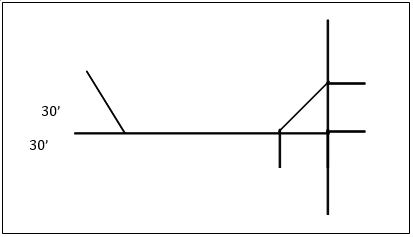
Skating Rink.A place, indoors or outdoors, designed and used for roller skating and/or ice skating. Such an establishment may sell food as a secondary activity.
Stable, Private. A detached accessory building for the keeping of horses owned by the occupants of the premises and not kept for remuneration, hire, or sale.
Stable, Public. A stable other than a private stable.
Slope. The level of inclination of land from the horizontal plane determined by dividing the horizontal run, or distance, of the land into the vertical rise, or distance, of the same land and converting the resulting figure to a percentage value.
Story. That portion of a building other than a cellar, included between the surface of any floor and the surface of the floor or ceiling next above.
Story, Half. A story with at least two of its opposite sides situated in a sloping roof, the floor area of which does not exceed two-thirds of the floor immediately below it.
Structural Type. A categorical rating given to a sign according to its structure as follows:
- Sign, Billboard. Any sign designated or used for the posting of bills or temporary messages and is over one hundred (100) square feet in area.
- Sign, Flat. A sign erected parallel to and attached to, or painted on, or pasted on the outside wall or roof of a building and projecting not more than eighteen inches (18”) from such wall or roof.
- Sign, Ground. A sign placed upon the ground or supported by a frame or multiple supports placed in or upon the ground, and which has less than four feet (4') clearance between the sign and the ground.
- Sign, Pole. A sign which is attached to or supported by one or more poles, or a pilaster or similar structure which is supported by the ground including any such sign which also rests on or overlaps the roof of a building twelve inches (12”) or less.
- Sign, Projecting. A sign attached to a building and extending in whole or in part more than eighteen inches (18”) beyond any wall of the building without the aid of any other vertical supports, including any such sign that also rests on or overlaps the roof twelve inches (12”) or more.
- Sign, Roof. A sign erected partially or wholly on or over the roof of a building, but not including pole or projecting signs that rest on or overlap a roof twelve inches (12”) or less or signs that are painted on or designed as a part of the roofing materials.
- Sign, Temporary. A temporary sign as regulated by this ordinance shall include any sign, banner, pennant, valance or advertising display constructed of cloth, canvas, light fabric, cardboard, wall board or any other light materials, with or without frames, intended to be displayed for a short period of time only.
Special District. All entities established under the authority of Title 12A, Special Districts of the Utah Code and any other governmental or quasi-governmental entity that is not a county, municipality, school district, or unit of the state.
Stealth Telecommunications Facility. A telecommunications facility, which is disguised as another object or otherwise concealed from public view.
Stream. A naturally fed watercourse, that flows year-round or intermittently during years of normal rainfall. This definition excludes ditches and canals constructed for irrigation and drainage purposes.
Stream Corridor. The corridor defined by the stream's ordinary high water mark.
Street. A private or public right-of-way, highway, avenue, boulevard, parkway, road, lane, walk, alley, viaduct, subway, tunnel, bridge, public easements, and other way.
Street, Arterial. A street which provides for through traffic movement between areas and across the Town with moderate access to abutting property subject to necessary control of entrances, exits, and curb use.
Street, Collector. A street that provides for traffic movement between major arterials and local streets, and direct access to abutting property.
Street, Dead-End. A street with a single common ingress and egress.
Street, Local.
Street, Private. A right-of-way or easement in private ownership not dedicated or maintained as a public street, which affords the principal means of access to two or more lots.
Structural Alterations. Any change in supporting members of a building, such as bearing walls columns, beams, or girders.
Structure. Anything constructed or erected, the use of which requires location on the ground or attachment to something having location on the ground. A building is included in this definition.
Subdivision. Any land, vacant or improved, which is divided or proposed to be divided into two (2), or more Lots, Parcels, Site, Units, plots, or other division of land for the purpose, whether immediate or future, for offer, sale, lease, or development, either on the installment plan or upon any and all other plans, terms, and conditions, including re-subdivision. subdivision includes the division or development of residential and nonresidential zoned land, whether by deed, metes and bounds description, devise and testacy, lease, map, plat, or other recorded instrument. "Subdivision" does not include: A bona fide division or partition of agricultural land for the purpose of joining one of the resulting separate parcels to a contiguous parcel of un-subdivided agricultural land, if neither the resulting combined parcel nor the parcel remaining from the division or partition violates an applicable zoning ordinance; A recorded agreement between owners of adjoining properties adjusting their mutual boundary if:
- No new lot is created; and
- The adjustment does not result in a violation of applicable zoning ordinances.
- A recorded document, executed by the owner of record, revising the legal description of more than one contiguous parcel of property into one legal description encompassing all such parcels of property.
- The joining of a subdivided parcel of property to another parcel of property that has not been subdivided does not constitute a "subdivision" under State law as to the un-subdivided parcel of property or subject the un-subdivided parcel to the subdivision ordinance.
Subdivision, Major. All subdivisions of four or more lots or any size subdivision requiring any new street or extension of municipal facilities, or the creation of any public improvements.
Subdivision, Minor. Any subdivision containing less than four lots fronting on an existing street, not involving any new street, or the extension of municipal facilities, or the creation of any public improvement, and not adversely affecting the remainder of the parcel or adjoining property, and not in conflict with any provision or portion of the master plan, official zoning map, streets master plan, or these regulations.
Subdivision Plat. The final map or drawing, on which the applicant's plan of subdivision is presented to the Town Council for approval and which, if approved, may be submitted to the Juab County recorder for filing.
Surplus, Second Hand Store. An establishment which sells surplus items, used furniture, appliances, clothing, and miscellaneous small items. Excluded from this definition are establishments selling used motor vehicles, their parts, and other heavy equipment.
Technical Necessity. A particular design, placement, construction or location of a telecommunications facility that is technically necessary for telecommunications consistent with the federal telecommunications Act of 1996, as amended.
Telecommunications. The transmission between or among points specified by a user, of information of the user’s choosing, without change in the form or content of the information as sent or received.
Telecommunications Facility. A telecommunications facility consists of antenna, equipment shelters, and related structures used for transmitting and/or receiving telecommunications and/or radio stations.
Theater, Concert Hall.A building used primarily for the presentation of live stage production or performances.
Trailer, Travel. See recreational vehicle.
Transfer Station. A facility designed for the transfer and transport of solid waste.
Transportation Terminal.A building or part of a building which serves as a centralized point of transfer between passenger surface-transportation modes, or for the frequent movement of passenger transportation equipment. Not included in this definition are street-side bus stomps or taxicab stands.
Townhouse. An attached or semi-attached multiple-unit building containing single dwelling units and located on a lot with a single ownership and having any yard or court in common with other units.
Unincorporated.The area outside the incorporated boundaries of cities and towns.
Use. The activities occurring on a lot or parcel of land for which land or a building is arranged, designed, or intended or for which land or a building is or may be occupied, inkling all accessory uses.
Use, Accessory. A subordinate use customarily incidental to and located upon the same lot occupied by the main use.
Vacancy. Any unoccupied land, structure, or part thereof that is available and suitable for occupancy.
Variance. Permission to depart from the literal requirements of the zoning ordinance.
Watercourse. Any natural or artificial stream, river, creek, ditch, channel, canal, conduit, culvert, drain, waterway, gully, ravine, or wash in which water flows in definite direction or course, either continuously or intermittently, and has a definite channel, bed, and banks and includes any area adjacent thereto subject to inundation by reason of overflow or floodwater.
Wholesale, Warehouse, Storage. A building in which goods, merchandise, or equipment are stored for eventual distribution, or for which storage space is rented.
Yard. An open, unoccupied space on a lot, which is unobstructed from the ground upward by buildings or structures.
Yard, Front. The area between the front of the closest building and the front lot line or closer right-of-way, extending the full width of the lot. The "depth" of the front yard is the minimum distance between the front lot line and the front line of the closest structure.
Yard, Rear. The area between the rear line of the closest building and the rear lot line, or closer right-of-way, and extending the full width of the lot. The "depth" of the rear yard is the minimum distance between the rear lot line and the rear line of the primary structure.
Yard, Side. The area between the sideline of the building and the side lot line and extending from the front yard to the rear yard. The "width" of the side yard shall be the minimum distance between the side lot line and the sideline of the closest structure.
Zero Lot Line. The location of a building on a lot in such a manner that one or more of the building’s sides rests directly on the lot line.
Zone. A specifically delineated area or district in a municipality within which uniform regulations and requirements govern the use, placement, spacing, and size of land and buildings.
Zoning Map, Official. The map adopted by the Town Council depicting the geographic scope of the Town's land use designations.
Zoning Ordinance. The Levan Town Zoning Ordinance.
Adopted by Ord. 2017-01 on 10/4/2017
Amended by Ord. 2017-02 on 11/15/2017

