
Levan City Zoning Code
16.10 RESIDENTIAL
ZONING R-1
16.10.010 PURPOSE
Residential District R-1 is established to provide for low-density, single-family residential uses to create an attractive residential environment in appropriate areas of Levan Town, and to:
- Allow Neighborhood Commercial and recreational activities that are Compatible with residential Neighborhoods;
- Provide opportunities for variations in architectural design and housing types;
- Provide opportunities for commercial uses in specific commercial overlay districts;
- Provide opportunities for historic uses in discrete historic overlay districts; and
- Promote pedestrian connections within Developments and between adjacent Neighborhoods.
Adopted by Ord. 2017-01 on 10/4/2017
16.10.020 USE REGULATIONS
In Residential District R-I no building or land shall be used, and no building shall be erected which is arranged, intended, or designed to be used for other than one or more of the following uses, if a use is not specifically designated then it is prohibited:
USE
| Type | Allowed | Administrative | Conditional | Business License |
| Accessory Apartment | X | X | ||
| Accessory Structure, occupied | X | |||
| Accessory Structure, unoccupied | X | |||
| Animal Rights | X | |||
| Agricultural | X | |||
| Historic Uses (HO Zone only) | X | |||
| Assisted Living Facility Group Home | X | X | ||
Child Care
| X | X | X X | |
| Commercial (COD Zone only) | X | |||
| Cultural, Civic Services | X | |||
| Fence | X | |||
| Flag Lot | X | |||
| Gated Development | X | X | ||
| Home Occupation | X | X | ||
| Kennel, Private | X | X | ||
| Manufactured Home | X | |||
Municipal Facilities:
| X X X X X | X X | ||
| Personal Athletic Facility | X | |||
| Pre-existing Lot | X | |||
| Pre-existing Structure | X | |||
| Preschools | X | X | ||
Quasi-Public Facilities:
| X X | X X | ||
| Radio Station | X | X | ||
Religious/Educational Institute:
| X | X | X X | |
| Single Family | X | |||
| Swimming Pool | X | |||
| Telecommunications Facility <35’ in height | X |
Adopted by Ord. 2017-01 on 10/4/2017
16.10.030 AREA AND DENSITY REGULATIONS
- LOT AREA. The minimum lot area shall be not less than one-half (1/2) acre (21,780 sq. ft.).
- LOT WIDTH. The minimum lot width is measured at the front setback line.
- LOT FRONTAGE. The minimum lot frontage shall be eighty feet (80’), unless the lot is on a cul-de-sac, in which case, the minimum lot frontage is one hundred twenty feet (120’).
Adopted by Ord. 2017-01 on 10/4/2017
16.10.040 DEVELOPMENT STANDARDS
The following development standards apply to all New Development in the Zone:
- SETBACKS. The minimum Setbacks in the Zone are as follows:
- Front: The minimum Front Yard Setback is seventy-nine and one-half feet (79½’) from centerline of the street and all setbacks on sixty-six foot (66’) streets shall be thirty feet (30’) from property line. If fifty percent (50%) or more of the lots on the block are developed with a front yard setback of seventy-nine and one-half feet (79 ½’) or less, the front yard setback shall be seventy-nine and one-half feet (79 ½’) from centerline of the street and all setbacks on sixty-six foot (66’) streets shall be thirty feet (30’) from property line.
- Corner Lot Rule: Corner lots have two (2) front yards.
- Exceptions: The following exceptions apply to all front yard setbacks in the zone:
- Front Porch: An open, front entry porch may encroach ten feet (10’) into the front yard setback.
- Projections: Skylights, sills, cornices, chimneys, flues, eaves and ornamental features, may project into the front yard up to two and one-half feet (2½’).
- Exceptions: The following exceptions apply to all front yard setbacks in the zone:
- Side: The minimum side yard setback is eight feet (8’), subject to the following exceptions:
- Projection: Skylights, sills, cornices, chimneys, flues, eaves and ornamental features may project into the side yard up to two and one-half feet (2 ½’).
- Stairs and Balconies: Outside stairways and balconies may project into the side yard up to three feet (3’).
- Rear: The minimum rear yard setback is twenty-five feet (25’), subject to the following exceptions:
- Corner Lot Rule: On corner lots there is no rear yard
- Projection: Skylights, sills, cornices, chimneys, flues, eaves and ornamental features may project into the rear yard up to two and one-half feet (2 ½’).
- Stairs and Balconies: Outside stairways and balconies may project into the rear yard up to three feet (3’).
- BUILD-TO-LINE. The front yard setback is the build-to-line. At least fifty percent (50%) of the front elevation must be built within three feet (3’) of the build-to-line. This provision does not apply to the development of cul-de-sac Lot.
- ACCESS. Each lot shall provide access to a designated town road.
- UTILITIES. Each dwelling must be serviced by a public water and septic system.
- LIGHTING STANDARDS. All exterior lights shall be shielded or down directed as to minimize light trespass onto neighboring residential structures.Minimum Lot and Development Standards
Area Width Depth Frontage Setbacks Build-to-Line Height LOT Standard Front: 79 ½’ from centerline of the street and all setbacks on sixty-six foot (66’) streets shall be thirty feet (30’) from property line Side: 8’ Rear: 25' Accessory Structure 5’ Rear & Side Yard 30’ > 50% of front elevation must be < 3’ from Build-to-line None LOT Exceptions No No 80’ if width > 82’ 45’ on
cul-de-sacProjections: < 2 ½’
Front: 20’ paved drive, + add 10’ behind sidewalk 5’ paved walk, porch < 8’
Side/Rear: Stairs and Balconies < 3’
Corner Lot: 2 Front, 2 Side, 0 RearN/A for cul-de-sac lot None
Adopted by Ord. 2017-01 on 10/4/2017
Amended by Ord. 2017-02 on 11/15/2017
16.10.050 NEIGHBORHOOD COMPATIBILITY
Adopted by Ord. 2017-01 on 10/4/2017
16.10.060 FENCES, HEDGES, AND WALLS
- The term “fence” shall include any tangible barrier, lattice work, screen, wall, hedge or continuous growth of shrubs or continuous growth of trees with the with the purpose of, or having the effect of, preventing passage or view across the fence line.
- No fence shall be constructed, erected, or installed without first obtaining a fence permit from Levan Town. The fee for a fence permit shall be established by the legislative body.
- No person shall construct, alter, or maintain a fence, hedge, wall or similar structure or any combination of such structures except in conformance with all of the requirements of this section.
- The following provisions shall govern the location and height of fences, hedges or walls:
- PROPERTY LINES. All property lines must be located in order to determine that no fence, Hedge or wall extends beyond or across a property line. A fence, hedge or wall may cross a property line if an agreement with the abutting property owner is obtained in writing and is submitted with the Fence Permit Application.
- SIDEWALKS. No fence, hedge or wall shall be placed nearer than six inches (6”) to any public sidewalk.
- FIRE HYDRANTS. There shall be no fence, hedge or wall within three feet (3’) from any fire hydrant.
- FRONT YARD SETBACK AREA.
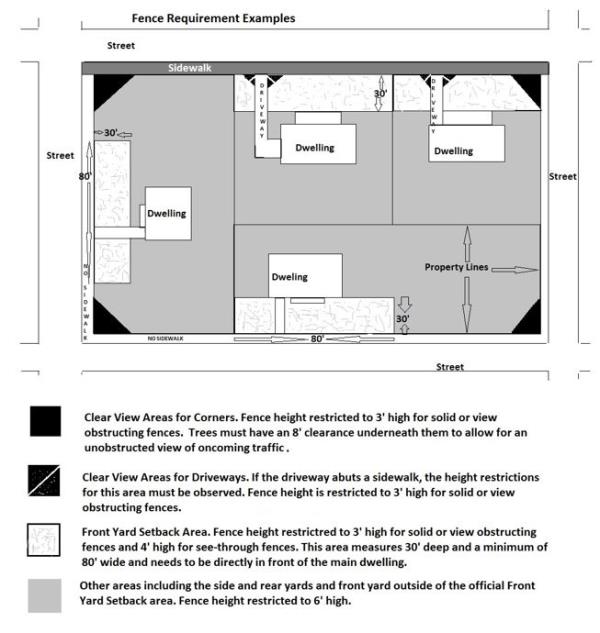
- DEFINITION. For the purposes of this requirement, the FRONT YARD SETBACK AREA shall be defined as the open, unoccupied space, in front of a building on a lot, and is measured as follows: The depth of the Front Yard Setback Area begins at the front property line and extends thirty feet (30’) back from that property line. The Width of the Front Yard Setback Area is a minimum of eighty feet (80’) or the entire width of the lot, whichever is smaller, and this area must be directly in front of the main building on the lot. The Front Yard Setback Area is illustrated at the end of this section.
- HEIGHT RESTRICTIONS. In any front yard setback area, chain link or similar fences which do not block vision shall not exceed four feet (4’) in height. Any solid type fences, hedges, thick growth of shrubs or continuous growth of trees are not to exceed three feet (3’) in height, except that a continuous growth of trees may be allowed in this area if they are pruned clear of all branches between the ground below the tree OR the crown of the road, whichever is higher, and a height of eight feet (8’), and are maintained and kept pruned as described. Fences in the Front Yard Setback area must comply with the Clear View area requirements set forth in section 6.
- SIDE AND REAR YARD FENCES.
- DEFINITION. For the purposes of this requirement, the Side Yard Area shall be defined as the area from a side property line to the side of the main building that faces that property line, and extending from the back of the Front Yard Setback Area to the front of the Rear Yard Area. The Rear Yard Area shall be defined as the area extending across the full width of the lot between the back of the main building and the rear property line. The Side and Rear Yard Areas are illustrated at the end of this section.
- HEIGHT RESTRICTIONS. In side and rear yard areas, including the side and rear yard areas of corner lots, a fence shall not exceed six feet (6’) in height. Fences in the Side and Rear Yard Areas must comply with the Clear View Area requirements set forth in section 6.
- CLEAR VIEW AREA REQUIREMENTS.
- DEFINITION. For the purposes of this requirement, the Clear View Areas shall be defined as follows:
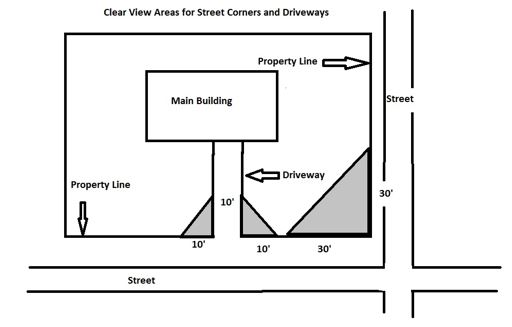
- THE CLEAR VIEW AREA FOR STREET CORNERS is defined as the area at the corner of a street that must be regulated in order to ensure that vehicles have an unobstructed clear viewing area. This area is measured by first determining the intersecting point of a front and side property line that faces a street corner. This is point A. From point A, measure thirty feet (30’) along the front and side property lines in either direction. These are points B and C. The resulting triangle is the Clear View Area for Street Corners as shown in the diagram at the end of this section.
- THE CLEAR VIEW AREA FOR DRIVEWAYS is required if a driveway abuts a sidewalk. For the purpose of this requirement, the Clear View Area for Driveways is defined as the two triangular areas on either side of a driveway created by connecting three points. The first point, Point A, is where the driveway meets the property line. Measure ten feet (10’) from point A along the property line. This is point B. Measure ten feet back from point A along the edge of the driveway. This is point C. Connect points A, B and C on either side of the driveway. This is the Clear View Area for Driveways as shown in the diagram at the end of this section.
- HEIGHT RESTRICTIONS. In all Clear View Areas, solid or view obstructing fences, hedges or thick growths of shrubs or trees may not exceed three feet (3’) in height. Trees will be permitted in the Clear View Areas if, when they are large enough to obstruct the view, they are pruned clear of all branches between the ground below the tree OR the crown of the road, whichever is higher, and a height of eight feet (8’), and are maintained and kept pruned as described.
- DEFINITION. For the purposes of this requirement, the Clear View Areas shall be defined as follows:
- ATHLETIC FACILITIES. Fencing around athletic facilities, including tennis courts, may be fourteen (14’) in height so long as all portions above six feet (6’) in height are constructed with at least fifty percent (50%) non-opaque materials.
- TEMPORARY FENCES ON A CONSTRUCTION SITE. Temporary fences on a construction site may be as high as required to protect the property during the period of construction.
- HEIGHT MEASUREMENTS. Height measurements shall be made from the finished grade. Where there is a difference in the grade of the properties on either side of a fence, wall or similar structure, the height of the fence shall be measured from the natural grade of the property upon which it is located. A fence may not be berm for the purpose of increasing height.
- OBSTRUCTION OF VIEW. Any fence, grading, planting or construction that interferes with the traffic. Visibility of those using streets, sidewalks, driveways etc., is prohibited.
Adopted by Ord. 2017-01 on 10/4/2017
16.10.070 LANDSCAPING
Applicants for new development shall comply with the following landscaping standards:
- REQUIRED LANDSCAPING. The applicant shall landscape the front and side yards of the lot.
- VEGETATION PROTECTION. Development plans must show all significant vegetation within twenty feet (20') of any proposed new development. The applicant must protect all significant vegetation during any new development activity.
Adopted by Ord. 2017-01 on 10/4/2017
16.10.080 PARKING
An Applicant shall propose on-site parking as follows.
Parking
| USES | PARKING REQUIREMENTS |
| Accessory Apartment | 1 space |
| Accessory Structure-Occupied | 1 spaces in addition to requirement for primary structure |
| Child Care Facility/Center | 1 space per on-duty employee and 1 per 6 children |
| Group Home | The greater of: 1 space per 2 bedrooms plus 1 pace per employee per shift, or 2 per 3 employees per shift |
| Neighborhood Commercial | 2 spaces per 1,000 sq. ft of leaseable area |
| Public and Quasi-Public Institution, Church and School; Public Utility; Municipal Facility | The greater of: 1 space per 5 seats, or 2 spaces per 3 employees, or 1 space per 1,000 sq. ft |
| Single Family/Duplex | 2 spaces per dwelling unit |
Adopted by Ord. 2017-01 on 10/4/2017
16.10.090 ACCESSORY STRUCTURES (UNOCCUPIED)
New development of an accessory structure intended for storage and not for human occupancy is an allowed use and shall meet the following development standards:
- PROXIMITY. A small accessory structure must be located at least six (6’) from the main building. There shall be a minimum of sixteen feet (16’) between the main building and a large accessory building.
- SETBACKS. The accessory structure must be located in either the rear or side yard with a five-foot (5') setback from the rear and side lot lines, unless the accessory structure is located at the front yard setback of an adjacent corner lot then the side yard setback to the nearest side lot line must be at least fifteen feet (15').
Adopted by Ord. 2017-01 on 10/4/2017

