
Libertyville City Zoning Code
ARTICLE 10
- PARKING AND LOADING
Sec. 26-10-1. - Off-street parking.
26-10-1.1.
Authorization. Subject to the limitations of section 26-10-1, off-street parking is permitted as an accessory use in all districts. Off-street parking as a principal use is permitted only when expressly authorized by the regulations applicable to the district in question. Nothing in this section shall be construed to limit the right of any person to provide off-street parking in excess of the requirements herein established but all such parking shall comply with the standards of this section.
26-10-1.2.
Required spaces.
(a)
Specified uses. For the following uses, the following minimum number of parking spaces or stacking spaces shall be provided:
(b)
Unlisted uses. When a use is not listed in subsection 26-10-1.2(a), the village administrator shall determine the number of parking spaces required, based upon the requirements of this chapter for similar uses.
(c)
Indeterminate uses. When the ultimate use of a structure is not known, the maximum number of spaces that might be required for any use to which the structure might reasonably be devoted as determined by the village administrator shall be provided.
(d)
Exception for the C-1 Downtown Core Commercial District. Notwithstanding any other provision of this Part A, and except as limited herein, the first one thousand five hundred (1,500) square feet of floor area within any new building and the first one thousand five hundred (1,500) square feet of any new floor area added to any separately owned portion of any existing building in the C-1 Downtown Core Commercial District, are exempt from the requirements for parking spaces and stacking spaces, unless otherwise specifically required by the board of trustees as a condition to the issuance of a special use permit. Only one (1) such exemption will be allowed, within any five (5) calendar years, with respect to any new building under a single ownership or with respect to new floor area added to any separately owned portion of any existing building.
(e)
Computation of required spaces.
(1)
Basis for computation. The total number of required parking spaces or stacking spaces shall be based upon the parking requirement stated for the principal use or uses of the zoning lot, and for all accessory uses, on the zoning lot in question. Where more than one (1) principal or accessory use occupies the same zoning lot, the number of parking spaces or stacking spaces for each use shall be calculated separately from, and in addition to, the parking requirements for every other use.
(2)
Fractional spaces. When determination of the number of required parking spaces or stacking spaces results in the requirement of a fractional space, any fraction shall require one (1) additional parking space or stacking space.
(3)
Capacity calculations. When parking spaces or stacking spaces are required on the basis of capacity, capacity shall be determined based on the occupancy standards established by the building code, except that when the structure has no design capacity the maximum number present at any one (1) time shall govern.
(4)
Bench seating. In places of assembly in which patrons or spectators occupy benches or other similar seating facilities, each twenty-two (22) inches of such seating facility shall be counted as one (1) seat for the purpose of determining the requirement for off-street parking facilities under this chapter.
(f)
Payment in lieu of required parking spaces. The owner of property within the C-1 Downtown Core Commercial District may apply for a permit for payment in lieu of required parking spaces in connection with such property, provided that each of the following apply:
(1)
The owner is constructing a new building or adding additional floor area to an existing building.
(2)
The minimum number of required parking spaces for the use proposed by the owner for such property are not available to the owner and cannot be acquired by the owner.
The required payment for each parking space for which such a permit is sought shall be in the amount set forth in the Annual Fee Ordinance required by section 1-19 of this Code. No such permit shall be issued except upon payment by the owner of the required fee and the issuance of a special use permit pursuant to subsection 26-5-2.3(f).
26-10-1.3.
General requirements.
(a)
Applicability to existing, new, and expanded uses.
(1)
Existing uses. Except as otherwise provided in subsection 26-10-1.3, the provisions of section 26-10-1 shall not be applied to require the addition of any parking spaces accessory to uses or structures existing on the effective date of this chapter, but no parking space in existence on the effective date of this chapter shall be removed or otherwise made unavailable for use accessory to such existing use or structure, or any successor use or structure, in violation of the requirements of subsection 26-10-1-3. For purpose of this section, a structure or a portion of a structure shall be considered to be existing only if at the time of application for a building permit, the structure or portion of a structure is fully enclosed by pre-existing exterior walls and further provided that no additional floor area will be added to the structure in connection with such building permit. Except in connection with the installation of windows, doors, stairwells or similar openings, the partial or complete removal of any exterior wall in connection with construction or demolition shall require that parking for such structure or portion of a structure or replacement structure be provided in accordance with section 26-10-1.
(2)
New uses. Except as provided otherwise in subsection 26-10-1.3, the provisions of section 26-10-1 shall apply to, and parking spaces sufficient to satisfy the requirements of section 26-10-1 shall be provided for, all uses and structures first established or constructed after the effective date of this chapter.
(3)
Change in existing use. Whenever a use existing on the effective date of this chapter is changed thereafter to a new use, parking facilities shall be provided as required herein for such new use; provided, however, that when any such existing use was deficient in required parking spaces on such effective date, such new use may be established with a deficiency in required parking spaces equal in number to not more than such pre-existing deficiency.
(4)
Increase in use intensity. Whenever the intensity of use of any structure or use is increased through the addition of dwelling units, floor area, seating capacity or other units of measurement specified in section 26-10-1 for required parking spaces, parking spaces as required by section 26-10-1 shall be provided for such increase in intensity of use.
(5)
Exceptions.
a.
Minor additions. Notwithstanding the foregoing provisions of subsection 26-10-1.3, no building or use lawfully existing on the effective date of this chapter shall be required to provide any additional parking spaces pursuant to subsection 26-10-1.3 unless and until the aggregate increase in units of measurement shall equal ten (10) percent or more of the units of measurement existing upon such effective date, in which event parking spaces as required by section 26-10-1 shall be provided for the total aggregate increase.
b.
Exception from off-street parking requirements for existing buildings and uses in the C-1 Downtown Core Commercial District. Changes in the use, or intensity of use, of a building or lot existing in the C-1 Downtown Core Commercial District on the effective date of this chapter, which do not increase the floor area located on such lot, shall be exempt from the parking requirements of section 26-10-1.
1.
Except as may otherwise be provided herein, changes in the use, or intensity of use of a building or lot existing in the C-1 Downtown Core Commercial District on the effective date of this chapter, which do not increase the floor area located on such lot, shall be exempt from the parking requirements of section 26-10-1.
2.
To the extent that all or a portion of the use of a lot changes from non-residential to residential and such change results in an increase in floor area, one and one-half (1½) parking spaces shall be provided for each portion of such increased floor area containing at least the lesser of one thousand (1,000) square feet or the total floor area of the smallest dwelling unit located within such lot.
3.
To the extent that all or a portion of the use of a lot changes from any use to a different non-residential use, parking shall be provided in such amounts as are required pursuant to section 26-10-1 based upon the type of use and the number of square feet of additional floor area.
c.
Nonconforming locations and designs. Nothing in subsection 26-10-1.3 shall be construed to prohibit the continued utilization of any parking space as an accessory use to any structure or use for parking of a vehicle that may lawfully be parked in such space solely because such space does not satisfy the location or design requirements of chapter 26, article 10 if such space was validly in use as an accessory use to such structure or use on the effective date of this chapter.
(b)
Location of required parking spaces.
(1)
General rule. Except as provided in subsections 26-10-1.3(b)(2), 26-10-1.3(b)(3), and 26-10-1.3(b)(4), parking spaces required by subsection 26-10-1.3 shall be located on the same zoning lot as the use to which they are accessory. Space allocated for off-street loading shall not be used as parking spaces to satisfy the requirements of subsection 26-10-1.2.
(2)
Deficiency spaces. When proposed to provide spaces to eliminate a parking deficiency existing on the effective date of this chapter or when necessary to provide spaces required pursuant to subsection 26-10-1.3(a)(3), parking spaces required by section 26-10-1 may be located at any location within five hundred (500) feet of the zoning lot in question and within either the same district as said lot or any adjacent district in which the principal use in question is a permitted use, but only when such remote site is in common ownership with said zoning lot and is covenanted to remain so for so long as said parking spaces are required to meet the standards of this chapter.
(3)
Special provisions in commercial, industrial and special districts. In the C-1 Downtown Core Commercial District, and in any IB Institutional Buildings District abutting a C-1 Downtown Core Commercial District, required parking spaces may be located on the same lot as the use they serve or within one thousand (1,000) feet of such use, as measured from lot line to lot line, provided that such lot is located within the C-1 Downtown Core Commercial District, C-2 Downtown Community Commercial District, or abutting IB Institutional Buildings District. In the C-1 Downtown Core Commercial District, C-2 Downtown Community Commercial District, C-3, General Commercial District, C-4, Shopping Center Commercial District, and Industrial Districts, required parking spaces may be located on the same lot as the use they serve or within five hundred (500) feet of such lots, measured from lot line to lot line, provided such parking lot is located in one (1) of the above districts; except that no parking spaces for any use located in a C-2 Downtown Community Commercial District or Industrial District shall be located in any C-1 Downtown Core Commercial District.
(4)
Collective use. In any non-residential district, parking spaces for separate uses may be provided collectively if the total number of spaces provided is not less than the sum of the separate requirements for each use and provided that all regulations governing location of parking spaces in relation to the use served are adhered to.
(5)
Shared parking spaces. In any IB Institutional Buildings District abutting a C-1 Downtown Core Commercial District or a C-2 Downtown Community Commercial District, parking spaces may be shared for separate principal uses provided, however, that the shared parking spaces shall only be available for a single principal use at any one (1) time and further provided that all regulations governing location of parking spaces in relation to the use served are adhered to. Prior to utilizing shared parking spaces to fulfill parking requirements, written documentation must be submitted to the zoning administrator which evidences that the owner of the property on which the shared parking spaces are located has agreed to provide the party seeking to utilize the shared parking spaces with the exclusive use of such shared parking spaces on designated days and/or dates and during designated hours.
26-10-1.4.
Design and maintenance requirements.
(a)
General requirement. All parking areas, lots, and structures shall be designed, constructed, and maintained in accordance with the standards and requirements set forth in subsection 26-10-1.4.
(b)
Location on lot. Parking spaces may be provided on surface lots, under ground, under a building, or in parking structures. Parking areas, lots, and structures shall comply with the yard requirements made applicable to them by the regulations of the district in which they are located. See subsection 26-10-1.5 for additional regulations concerning the storage of vehicles in residential districts.
(c)
Screening and landscaping. All parking lots and structures shall comply with the screening and landscaping requirements set forth in section 26-13-3.
(d)
Design.
(1)
Access to street. All parking areas, lots, and structures shall be so located and designed as to provide access to adjacent streets with the least interference with through traffic movements. Driveways shall have a return radii of twenty (20) feet at the point of access to the street, unless a different return radius is approved by the village administrator in writing. No curb cut across public property shall exceed thirty (30) feet in width without the written approval of the village administrator. Notwithstanding any other provision of this chapter, driveways serving single-family dwellings and driveways providing direct access from a parking area or lot to a street, and not serving as a circulation aisle in connection with any parking space, may traverse any required yard; provided, however, that the surface area of any such driveway giving access from a parking area or lot through any such yard shall not exceed an area calculated by multiplying the width of the driveway times the depth of the required yard times a factor of 1.5. No such access shall be provided through a zoning district other than the district in which the parking area or lot is located. No such access shall be provided through a zoning lot other than the zoning lot served by such access except across a permanent, recorded access easement in form and substance satisfactory to the village administrator. In satisfying the requirements set forth above additional reference may be made to standard and guideline promulgated by the Illinois Department of Transportation Design Manual, current edition.
(2)
Turn-around area. All parking lots and structures shall be provided with a turn-around area or other means to permit cars to exit the parking lot or structure without backing onto any street or sidewalk.
(3)
Back-up area. Each parking space, except spaces accessory to a single-family dwelling, shall be provided with a sufficient back-up area to permit egress in one (1) maneuver, consisting of one (1) backward and one (1) forward movement.
(4)
Off-street parking dimensions. Each parking space, except spaces accessory to a single-family or two-family dwelling, shall have stall dimensions and shall be accessed by a circulation aisle of a width, in feet and inches, as specified in table 10-1.
(5)
Surface; drainage; markings. All off-street parking areas, lots and structures shall be surfaced with a dustless paver, bituminous, or Portland cement concrete pavement providing an all-weather, durable, and dustless surface. Except in residential districts, pavement design for off-street parking areas and lots shall have a structural number of not less than 2.00; driveways or aisleways that are main thruways, pavements with high traffic volumes, and pavements used by heavy vehicles shall be designed to accommodate such use. All pavement design shall be based on a twenty (20) year design life and shall be subject to review and approval by the village engineer. Unless otherwise approved by the Village Engineer, design shall be in accordance with the Illinois Department of Transportation Design Manual, current edition.
All parking lot surfaces shall be graded and drained to dispose of surface water accumulation by means of a positive storm water drainage system connected to a public storm sewer system. Storm water runoff from parking lots shall be detained on-site in accordance with applicable village standards.
Individual stalls shall be clearly identified by painted markings four (4) inches to six (6) inches in width.
Gravel driveways are allowed in R-1, R-2, and R-3 zoning districts subject to the following conditions:
a.
That the edge of the gravel driveway not be any closer than three (3) feet to a property line or fifteen (15) feet from the edge of a public right-of-way.
b.
That all parking areas be surfaced with an all-weather, dustless, bituminous, or Portland cement concrete pavement providing an all-weather, durable, and dustless surface.
c.
That areas to be graveled be limited to a minimum of two (2) inches of decorative gravel to include Merrimac, degenerated granite, bluestone chips, pea gravel, Wisconsin Flint, and/or other similar decorative stone as approved by the village engineer.
d.
Gravel driveways must include an edging to retain the gravel in place. Materials shall be limited to steel, poured in place concrete, or precast concrete pavers.
e.
That owners of decorative gravel driveways be responsible for maintaining the gravel so as to retain it entirely on private property. Any person who shall violate, disobey, omit, neglect or refuse to comply with this provision shall be subject to section 26-17-13.
(6)
Car stops. Every parking lot and structure shall be bordered by a six (6) inch high concrete curb and shall be provided with curbs, car wheel stops, guard rails, barrier fences, or other suitable devices designed and located to protect required screening devices, landscaping, structures, and other vehicles from damage by vehicles using such lot or structure. This provision shall not be construed to require car wheel stops for every parking space, but only in those cases where the village administrator determines that such stops are necessary or desirable to achieve the purposes of subsection 26-10-1.4(d)(6).
(7)
Slope. No area of any parking lot or structure, excluding access ramps, shall have a slope in excess of five (5) percent. No ramp shall have a slope in excess of eight (8) percent.
(8)
Lighting. Fixed lighting shall be provided for all parking lots and structures accommodating more than ten (10) vehicles. Such lighting shall be so arranged as to prevent direct glare of beams onto any public or private property or street by the use of luminaire cutoffs. All lighting shall be reduced to security levels at all times of nonuse. Parking lot lighting shall not exceed two (2) foot candles, measured at any non-residential property line, and one-half (½) footcandle, measured at any residential lot line.
The maximum height of a light standard shall not exceed twenty-five (25) feet; provided, however, that in the rear one-third (⅓) of a lot abutting a Residential District, the maximum height of a light standard shall not exceed ten (10) feet and height of building-mounted light fixtures shall not exceed ten (10) feet.
(9)
Tree planting islands. In addition to the requirements of subsection 13-3.2, tree planting islands in paved areas shall have a depth sufficient to allow the bottom of the tree ball to be planted with a washed gravel layer at the bottom of the tree planting area to allow proper watering and drainage. If the soil is impervious, then a P.V.C. drainage pipe shall connect the tree planting island to a drainage structure.
(10)
Bicycle racks. Every parking lot or structure containing more than twenty (20) parking spaces shall provide one (1) bicycle rack space for each five (5) parking spaces, up to a maximum of twenty-five (25) bicycle rack spaces.
(11)
Maintenance. All parking areas, lots, and structures shall be properly maintained at all times so as to be free of pot holes, broken curbs, and other damaged or neglected features.
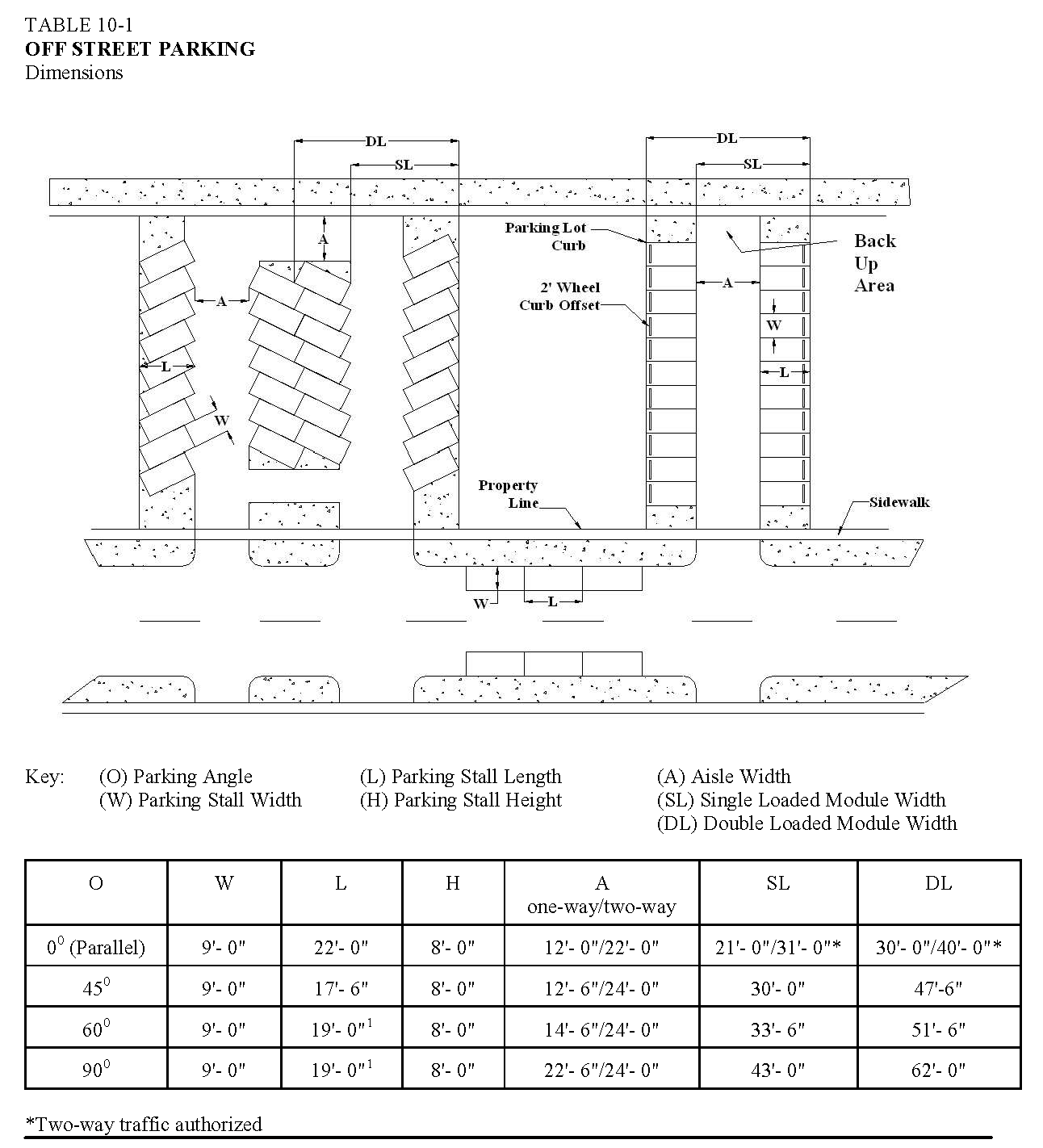
Notes:
1.
For parking spaces located along the perimeter of a parking area or lot and abutting landscaped open space, the required parking stall length shall be seventeen (17) feet zero (0) inches.
2.
When one (1) row of parking spaces is located along the perimeter of a parking area or lot and abuts landscaped open space, the single loaded module width for sixty (60) degree parking angle shall be thirty-ne (1) feet six (6) inches and for ninety (90) degree parking angle shall be forty-one (41) feet zero (0) inches.
3.
When one (1) row of parking spaces (but not both) is located along the perimeter of a parking area or lot and abuts landscaped open space, the double loaded module width for sixty (60) degree parking angle shall be forty-nine (49) feet six (6) inches and for ninety (90) degree parking angle shall be sixty (60) feet zero (0) inches. When both rows of parking spaces are located along the perimeter of a parking area or lot and both rows abut landscaped open space, the double loaded module width for sixty (60) degree parking angle shall be forty-seven (47) feet six (6) inches and for ninety (90) degree parking angle shall be fifty-eight (58) feet zero (0) inches.
Required parking for stall angles other than those contained in the above table may be interpolated from the said table.
The above stated stall width dimensions shall be increased to sixteen (16) feet for required handicapped parking spaces or to the width required under applicable state law, whichever is greater.
Except for parallel parking spaces, the above stated stall dimensions may be reduced one-half (½) foot in length and one-half (½) foot in width in parking areas, lots and structures accessory to office, institutional, and industrial uses when the village administrator finds, pursuant to the procedures of subsection 26-10-1.6, that the typical parking space in such area, lot or structure will be occupied by no more than one (1) or two (2) different vehicles during the course of the business day.
Parking lot screening and interior parking lot landscaping are required, refer to section 26-13-3.
26-10-1.5.
Use limitations.
(a)
General use limitations.
(1)
Vehicle storage only.. No required parking space shall be used for any purpose other than the temporary storage of an operable motor vehicle related to the premises to which such space is accessory. The storage of merchandise and the sale or commercial repair of vehicles in such spaces are prohibited.
(2)
Inoperable vehicles. No vehicle incapable of being driven or used for the purpose or use for which it was designed, other than a vehicle awaiting timely repair at an automobile repair shop, gasoline service station, or new or used motor vehicle dealer, shall be stored outside as any accessory use to any other use.
(b)
Special use limitation in single-family residential districts. Parking lots shall not be permitted as an accessory use in any single-family or single-family attached residential district.
(c)
Limitations on off-street storage of vehicles in residential districts.
(1)
Storage defined. For purposes of subsection 26-10-1.5(c), the term storage shall mean the parking of a vehicle for a continuous period of longer than eight (8) hours.
(2)
Classification of vehicles. For purposes of subsection 26-10-1.5(c), vehicles shall be classified as follows according to size, regardless of the use to which the vehicle is put or for which it is intended or designed and regardless of any other classification system made applicable to vehicles by any other governmental body:
a.
Class I vehicle. Any vehicle, other than a recreational vehicle, that does not exceed twenty (20) feet in length, seven (7) feet in width, or eight (8) feet in height.
b.
Class II vehicle. Any recreational vehicle and any other vehicle that is not a Class I vehicle and that does not exceed twenty-three (23) feet in length, eight (8) feet in width, or ten (10) feet in height and that, if used in commerce, does not exceed eight thousand (8,000) pounds in gross weight, including vehicle and maximum load.
c.
Class III vehicle. A vehicle that is neither a Class I vehicle nor a Class II vehicle.
(3)
Storage of vehicles in single-family and single-family attached residential parking areas.
a.
Maximum number permitted. The maximum number of vehicles permitted to be stored in all parking areas on any lot in any single-family or single-family attached residential district at any one (1) time shall be as follows:
Total vehicles: Five (5)
Class I vehicles: Five (5)
Class II vehicles: One (1)
Class III vehicles: None
b.
Storage regulations. Vehicles may be stored in parking areas in single-family or single-family attached residential districts only in compliance with the provisions of subsection 26-10-1.5(c)(6) and only in the following locations on such a lot:
1.
Class I vehicle: Anywhere on the lot.
2.
Class II vehicle: Anywhere on the lot except in any required front or corner side yards.
3.
Class III vehicle: Nowhere on the lot.
(4)
Storage of vehicles in multiple-family residential parking lots.
a.
Maximum number permitted. The maximum number of vehicles permitted to be stored in parking lots on any lot in a multiple-family residential district at any one (1) time shall be as follows:
Total vehicles: No limit
Class I vehicles: No limit
Class II vehicles: No limit
Class III vehicles: None
b.
Storage regulations. Vehicles may be stored in parking lots in a multiple-family residential district only in compliance with the provisions of subsection 26-10-1.5(c)(6); provided, however, that no vehicle shall be stored so as to reduce the availability of parking spaces below the minimum number of spaces required pursuant to subsection 26-10-1.2.
(5)
Storage of vehicles in residential garages—single-family and single-family attached residential districts.
a.
Residential garage stall. A residential garage stall shall be defined as any ten (10) foot by twenty (20) foot floor area within a residential garage directly accessible by any permitted vehicle.
b.
Maximum number permitted. Up to three (3) Class I, Class II or Class III vehicles may be stored in a permitted, completely enclosed garage in any single-family or single-family attached residential district; provided, however, that more than three (3), but not more than five (5) vehicle stalls may be permitted if the following conditions are met:
1.
The lot on which such garage is located shall have the following minimum square footage:
Twenty thousand (20,000) to forty thousand (40,000) square feet four (4) garage stalls
Over forty thousand (40,000) square feet five (5) garage stalls
2.
The garage shall be either built into or attached to the principal structure, or located on the rear half of the lot, and have its vehicle stall doors turned ninety (90) degrees so that such doors do not face a street.
c.
Multiple garages prohibited. No more than one (1) garage structure, whether attached to the principal building or provided as a detached free-standing building, shall be permitted on any lot in a single-family or single-family attached residential district.
(6)
Storage of vehicles in residential garages—multiple-family residential districts.
a.
Maximum number permitted. For single-family detached, two-family, and single-family attached dwellings, the regulations specified in subsection 26-10-1.5(c)(5) shall apply. Up to twelve (12) Class I, Class II or Class III vehicles may be stored in a detached free-standing building(s). No maximum limit shall be applied to a below grade, built-in, or attached garage structure. Access to and design of such structure shall be constructed in accordance with subsection 26-10-1.4.
b.
Multiple garages permitted. Multiple garage structures shall be permitted on any lot containing multiple-family dwellings in a multiple-family residential district.
(7)
General regulations and standards. The following standards and regulations shall apply to the storage of vehicles in parking lots and parking areas in residential districts:
a.
Distance from lot line, public sidewalk. No Class II vehicle shall be stored within three (3) feet of any lot line or any vehicular or pedestrian right-of-way.
b.
Surface. No motorized vehicle shall be stored except on an all weather, durable dustless pavers, asphaltic, or cement pavement surface.
c.
Screening. Class II vehicles stored in residential districts shall be screened with a densely planted evergreen hedge of minimum height at planting of six (6) feet and designed such that the vehicle is completely screened from view from all adjoining properties and all streets.
d.
Permanent location prohibited. No vehicle shall have its wheels removed or be affixed to the ground so as to prevent its ready removal.
e.
Residential use prohibited. No vehicle shall be used for living, sleeping, or housekeeping purposes.
f.
Utility hookups. No vehicle shall be connected to any public utility except for required servicing.
g.
Unsafe conditions. No vehicle shall be parked or stored so as to create a dangerous or unsafe condition. The ground under or surrounding the location wherein a vehicle is stored shall be free of noxious weeds, debris, and combustible material.
h.
Commercial vehicles in residential districts. No commercial vehicle shall be parked or stored in any parking area or lot in any residential district.
i.
Temporary storage. Notwithstanding any other provision of subsection 26-10-1.5(c)(6), any vehicle may be stored at any location on a lot in a residential district, except any required front yard, for a temporary period not to exceed forty-eight (48) hours; provided, however, that, unless authorized by the village administrator based on special circumstances, no more than one (1) such temporary period shall occur in any thirty (30) day period. No zoning certificate of occupancy shall be required for such temporary storage.
(d)
Limitation on storage of commercial vehicles in non-residential districts. Vehicles with exterior markings of any size, identifying or advertising a commercial enterprise shall not be parked or stored for any continuous period of longer than eight (8) hours in any front or corner side yard or, in the case of districts with no front or corner side yard requirements, in front of the front building line in any non-residential district.
(e)
Limitations on the off-site storage of new vehicles. The temporary storage of new vehicles offered for retail sale or lease by a vehicle dealership otherwise permitted or specially permitted by this chapter may be allowed on any site containing an existing parking lot, but only in accordance with the following provisions:
(1)
All sites proposed to accommodate temporary storage of new vehicles shall have parking spaces in excess of the amount required for the principal use or uses on that site, provided, however that the number of new vehicles to be stored on such site shall not exceed the number of parking spaces that are in excess of the amount required for the principal use or uses.
(2)
No retail sales or public viewing of new vehicles being stored shall be permitted from the parking lot accommodating the temporary storage of new vehicles.
(3)
In accordance with the provisions of section 26-16-4, a zoning certificate of compliance shall be obtained; provided, however, that authorization from the property owner shall be obtained and adequate proof of such authorization shall accompany an application for a zoning certificate.
26-10-1.6.
Landbanking of required parking.
(a)
Landbanking authorized. Notwithstanding any other provision of section 26-10-1, the village administrator may issue a permit authorizing a reduction in the stall width or length dimension required pursuant to subsection 26-10-1.4 or a reduction in the total number of parking spaces required to be provided pursuant to subsection 26-10-1.2, subject to acceptance by the property owner of the conditions set forth in this subsection 26-10-1.6.
(b)
Open space covenant. As a condition of granting any permit for landbanking of required parking, the village administrator shall require the applicant to file his or her unconditional agreement and covenant in form and substance satisfactory to the village administrator that areas reserved for future parking shall be maintained as landscaped open space until and unless required to be used for parking pursuant to subsection 26-10-1.6(c). The permit authorizing landbanking, together with such agreement and covenant, shall be recorded with the Recorder of Deeds of Lake County, Illinois.
(c)
Termination of landbanking. The village administrator shall have the right, in his or her sole and absolute discretion, to direct and require the property owner or his or her successor at any time to increase the stall width or length to the dimension required by subsection 26-10-1.4 or to increase the number of parking spaces provided to serve said development up to the maximum required by subsection 26-10-1.2 for the property in question as if no authorization for landbanking had been granted.
(Ord. No. 13-O-05, § 2(Exh. A), 1-22-13; Ord. No. 13-O-45, § 3, 8-27-13; Ord. No. 14-O-63, §§ 4, 5, 9-23-14; Ord. No. 16-O-57, § 3, 6-28-16; Ord. No. 19-O-46, § 3, 6-11-19; Ord. No. 22-O-33, § 11, 12, 5-10-22; Ord. No. 23-O-27, § 10, 5-23-23)
Sec. 26-10-2. - Off-street loading.
26-10-2.1.
Authorization. Subject to the limitations of section 26-10-2, loading is permitted as an accessory use in all districts other than single-family and single-family attached residential districts. Nothing herein shall be construed to limit the right of any person to provide necessary loading spaces in excess of the requirements herein established, but all such loading spaces shall comply with the standards of section 26-10-2.
26-10-2.2.
Required spaces.
(a)
General requirement. Loading spaces shall be provided in sufficient number, of sufficient size, and so located that no loading and unloading operations infringe upon any street or sidewalk.
(b)
Minimum requirements. The following minimum number of loading spaces shall be provided:
(1)
Measurement of square footage. Square footage shall be measured as a combined total of all uses in a single structure, so that, for example, multiple commercial uses in a single structure totaling more than ten thousand (10,000) but less than forty thousand (40,000) square feet in area shall require one (1) loading space.
(2)
Sizes of required spaces. Unless waived by the village administrator, the first loading space required shall be sized to accommodate a tractor trailer and, unless otherwise required by the village administrator, all additional loading spaces may be standard size, as set forth in subsection 26-10-2.4(d)(5). The decision of the village administrator shall be based upon the anticipated needs of the particular space being served by the required loading space.
26-10-2.3.
General requirements.
(a)
Applicability to existing, new, and expanded uses.
(1)
Existing uses. Except as otherwise provided in subsection 26-10-2.3, the provisions of section 26-10-2 shall not be applied to require the addition of any loading spaces accessory to uses or structures existing on the effective date of this chapter, but no loading space in existence on the effective date of this chapter shall be removed or otherwise made unavailable for use accessory to such existing use or structure, or any successor use or structure, in violation of the requirements of section 26-10-2.
(2)
New uses. Except as otherwise provided in subsection 26-10-2.3, the provisions of section 26-10-2 shall apply to, and loading spaces sufficient to satisfy the requirements of section 26-10-2 shall be provided for, all uses and structures first established or constructed after the effective date of this chapter.
(3)
Change in existing use. Whenever a use existing on the effective date of this chapter is changed thereafter to a new use, loading spaces shall be provided as required herein for such new use; provided, however, that when any such existing use was deficient in required loading spaces on such effective date, such new use may be established with a deficiency in required loading spaces equal in number and size to not more than such pre-existing deficiency.
(4)
Increase in use intensity. Whenever the intensity of use of any structure or use is increased through the addition of floor area, loading spaces as required by section 26-10-2 shall be provided.
(5)
Exception. Notwithstanding the foregoing provisions of subsection 26-10-2.3, no building or use lawfully existing on the effective date of this chapter shall be required to provide any additional loading spaces pursuant to section 26-10-2 unless and until the aggregate increase in floor area shall equal the full number of units for which one (1) additional loading space would be required pursuant to subsection 26-10-2.2, in which event loading spaces as required by section 26-10-2 shall be provided for the total aggregate increase.
(b)
Location of required loading spaces. Loading spaces shall be located on the same zoning lot as the use they serve.
26-10-2.4.
Design and maintenance requirements.
(a)
General requirement. Every loading space shall be designed, constructed, and maintained in accordance with the standards and requirements set forth in subsection 26-10-2.4.
(b)
Location on lot. All loading spaces shall comply with the yard requirements applicable to principal uses in the district in which they are located, except that open loading spaces may be located in a required rear yard; provided, however, that:
(1)
A loading space shall not be located within fifty (50) feet of the nearest point of intersection of any two (2) public or private streets.
(2)
A loading space shall not be located closer to any public right-of-way than the facade of the building facing such right-of-way.
(3)
A loading space shall not be located in a front or corner side yard, except as provided herein:
a.
In the O-2 Office, Manufacturing and Distribution Park, I-1 Limited Industrial, and I-2 East Downtown Transitional Districts, loading spaces located on a side of a building facing a street shall be enclosed by the building. Not more than thirty-two (32) percent of the width of a wall of a building facing a street shall contain loading docks or loading dock doors.
b.
In the I-3 General Industrial District, loading spaces may be allowed in a front or corner side yard.
(4)
Every loading space shall be located and arranged to provide logical and convenient access thereto from the use it serves.
(5)
Businesses engaged in vehicle sales/leasing of new vehicles shall have no loading space located or arranged within fifty (50) feet of a residential district.
(c)
Screening. All loading spaces shall comply with the screening requirements set forth in chapter 26, article 13.
(d)
Design.
(1)
Access to street. Loading spaces shall be designed and arranged to provide access to a street or alley in a manner that will create the least possible interference with through traffic movements. No curb cut across public property shall exceed thirty (30) feet in width without the written approval of the village administrator.
(2)
Maneuvering space. Every loading space shall be provided with sufficient maneuvering space on the zoning lot where it is located to allow vehicles to access and exit the space without having to make any backing movement on, or into, any public or private street.
(3)
Surface; drainage; markings. Every loading space shall be surfaced with a bituminous or Portland cement concrete pavement providing an all-weather, durable, and dustless surface. All loading space surfaces shall be graded and drained to dispose of surface water accumulation by means of a positive storm water drainage system connected to a public sewer system. Individual stalls shall be clearly identified by markings four (4) inches to six (6) inches in width.
(4)
Lighting. Fixed lighting shall be so arranged as to prevent direct glare of beams onto any public or private property or street by the use of luminaire cutoffs. All lighting shall be reduced to security levels at all times of nonuse.
(5)
Size requirements. Each loading space, excluding required maneuvering areas, shall have the following minimum dimensions, in feet:
a.
Tractor-trailer: 12W x 60L x 15H
b.
Standard: 10W x 25L x 14H
(e)
Loading and unloading limitation. For open loading spaces adjacent to a residential district, no loading or unloading shall occur between 9:00 p.m. and 7:00 a.m.
(Ord. No. 13-O-05, § 2(Exh. A), 1-22-13)

