
Libertyville City Zoning Code
ARTICLE 13
- LANDSCAPING, SCREENING, AND FENCES
Sec. 26-13-1. - General landscaping and maintenance requirements.
All lots and parcels shall be mowed and kept free of accumulations of garbage, trash, refuse, debris, and other unsightly or nuisance creating materials until developed. Except for accessory uses expressly permitted to be located in required yards, all yards and open spaces between and about structures shall be landscaped, and all such yards and open spaces, as well as all off-street parking areas and lots, and loading areas, shall be kept free of accumulations of garbage, trash, refuse, debris, and other unsightly or nuisance creating materials.
All landscaping required by this chapter shall be guaranteed for a period of one (1) year from installation of such landscaping. Plant material which becomes diseased or dies within this period shall be replaced at the expense of the developer or property owner.
All landscaping shall be continually maintained by the owner or other person responsible for maintenance of the premises. All plant material installed to meet the requirements of this chapter, or installed as required by the board of trustees in an approved landscape plan, that dies shall be replaced within forty-five (45) days or during the next available planting season to ensure that this chapter and approved landscape plan are continuously adhered to. All planting areas shall be kept free of weeds and debris.
At no time shall any landscaping element be designed, located or allowed to grow so that vehicular and pedestrian site lines (sight distance triangle), as illustrated in appendix A, are obstructed.
(Ord. No. 13-O-05, § 2(Exh. A), 1-22-13)
Sec. 26-13-2. - Perimeter landscaped open space.
26-13-2.1.
General requirements. Perimeter landscaped open space shall be required in the following Zoning Districts in accordance with the standards provided in this section and in subsections 26-13-2.2 through 26-13-2.3:
(a)
Public utility stations in residential districts. For every public utility station located in a Residential District not designed to look like a residential dwelling of the type permitted in the district in which it is located, there shall be provided a perimeter landscaped open space along every lot line on the lot on which such public utility station is located with a minimum width of no less than twenty-five (25) feet in the R-1, R-2, R-3, R-4, R-5, and R-6 Single-Family Residential Districts and no less than fifteen (15) feet in the R-7 Single-Family Attached Residential District and the R-8 Multiple-Family Residential District.
(b)
R-8 District. For all multiple-family structures within the R-8 Multiple-Family Residential District, there shall be provided a perimeter landscaped open space with a minimum width of no less than ten (10) feet along every lot line.
(c)
C-2, C-3, C-4, O-1, I-1 and I-2 Districts. For all uses in the C-2 Downtown Community Commercial District, the C-3 General Commercial District, the C-4 Shopping Center Commercial District, the O-1 Professional Services Office District, the I-1 Limited Industrial District, and the I-2 East Downtown Industrial District, there shall be provided a perimeter landscaped open space with a minimum width of no less than ten (10) feet along every lot line.
(d)
C-5 District. For all uses in the C-5 Vehicle Dealer Commercial District, there shall be provided a perimeter landscaped open space with a minimum width of no less than twenty-five (25) feet along the front lot line and along every lot line that abuts any residential district and with a minimum width of no less than fifteen (15) feet along every other lot line.
(e)
O-2 District. For all uses in the O-2 Office, Manufacturing and Distribution Park District, there shall be provided a perimeter landscaped open space with a minimum width of no less than ten (10) feet along every lot line, except any lot line abutting a residential district, Route 45 or Winchester Road, for which there shall be provided a perimeter landscaped open space with a minimum width of no less than twenty (20) feet.
(f)
IB District. For all uses in the IB Institutional Buildings District, there shall be provided a perimeter landscaped open space with a minimum width of no less than twenty-five (25) feet along every lot line, except any lot line abutting any residential district, for which there shall be provided a perimeter landscaped open space with a minimum width of no less than fifty (50) feet. On every lot with structure exceeding forty (40) feet in height, the minimum width of all required perimeter landscaped open space shall be increased by three (3) feet for each one (1) foot of height of the structure above forty (40) feet.
(g)
Applicability.
(1)
Expansion or enlargement of existing uses or structures. For every use or structure established or constructed prior to the effective date of this chapter that is thereafter expanded or enlarged, perimeter landscaped open space shall be provided as required pursuant to section 26-13-2 to the extent that there exists, at the time said expansion or enlargement, unobstructed and unpaved open area abutting such use or structure in which landscaping and screening may be installed. No such use or structure shall be expanded or enlarged to encroach in any area in which perimeter landscaped open space is required pursuant to section 26-13-2.
(2)
New uses. The regulations of section 26-13-2 shall apply to all uses and structures in every district established or constructed after the effective date of this chapter.
(h)
Location in required setbacks or yards. Required perimeter landscaped open space may be located in any required setback or yard.
26-13-2.2.
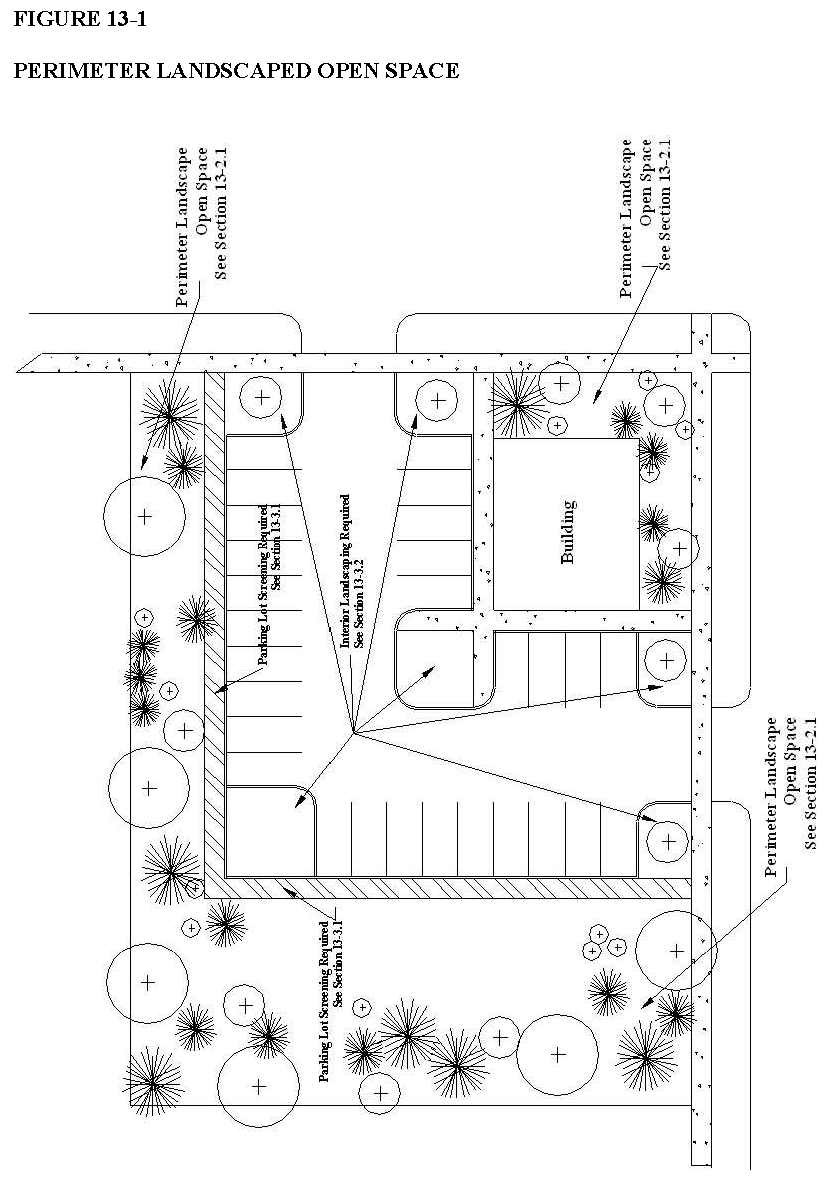
Landscaping materials. Every required perimeter landscaped open space shall consist of a combination of shade and ornamental trees, evergreen trees and shrubs (see figure 26-13-1). Areas not planted with trees or shrubs shall be maintained as a combination of groundcover and decorative paving material.
(a)
Quantity. The minimum number of shade and ornamental trees, evergreen trees and shrubs required in a perimeter landscaped open space shall be based on the total linear length of the subject open space, as measured along the relevant lot line, as specified in the following table:
NOTE: The above information is not intended to serve as minimum spacing requirements or to prohibit clustering of plant material, but shall only be used to determine the number of trees and shrubs required on a lot or parcel.
(b)
Size and distribution of trees and shrubs. The minimum number of shade or ornamental trees and evergreen trees and shrubs required for a perimeter landscaped open space, as determined by subsection 26-13-2.2(a), shall be provided in the following sizes:
(c)
Quality; species; specifications. All planting materials shall be of good quality, of species normally grown in Northeastern Illinois and capable of withstanding the extremes of individual site microclimates. All specifications for measurement, quality, and installation of trees and shrubs shall be in accordance with the American Standards for Nursery Stock published by the American Association of Nurserymen.
(d)
Substitution. When unique natural features such as topography, soil, geological characteristics, water features and existing vegetation; or space limitations such as an unusually shaped lot; or the location of existing structures and other built features make it impractical to comply with the requirements of subsection 26-13-2.2, the board of trustees may approve in writing, substitutions to the quantity, size and distribution of required plant materials, but only if it is determined that:
(1)
There is no reduction in the quality of plant materials;
(2)
There is no significant change in size or location of plant materials; and
(3)
The plant materials proposed for substitution have similar general design characteristics (mature height, crown spread) as the materials being replaced.
(e)
Credit for tree preservation. Preservation of existing healthy trees and natural landscape features on a site is encouraged. The number of new plant materials, as specified in subsection 26-13-2.2(a), may be reduced when existing trees of a desirable species in a healthy and growing condition are preserved within the area of the perimeter landscaped open space. Credit for the preservation of existing trees six (6) inches in caliper or greater (deciduous) or six (6) feet in height or greater (evergreen), shall be as follows, but in no instance shall a developer or property owner receive greater than a maximum of fifty (50) percent credit towards the number of required trees:
26-13-2.3.
Design. The scale and nature of landscape material should be appropriate to the site and structures. Larger scaled buildings, for example, should be complimented by larger scaled plants. Plant material should be selected for its form, texture, color and concern for its ultimate growth. Perimeter landscaped open space shall be broken only by required access drives and sidewalks. Every perimeter landscaped open space shall be so designed and maintained as to preserve unobstructed vision of the street and sidewalk at points of access and as not to interfere with, or be damaged by, work within any public or utility easement unless the village administrator shall determine that no other location is reasonably feasible.
(Ord. No. 13-O-05, § 2(Exh. A), 1-22-13)
Sec. 26-13-3. - Parking lots and structures.
26-13-3.1.
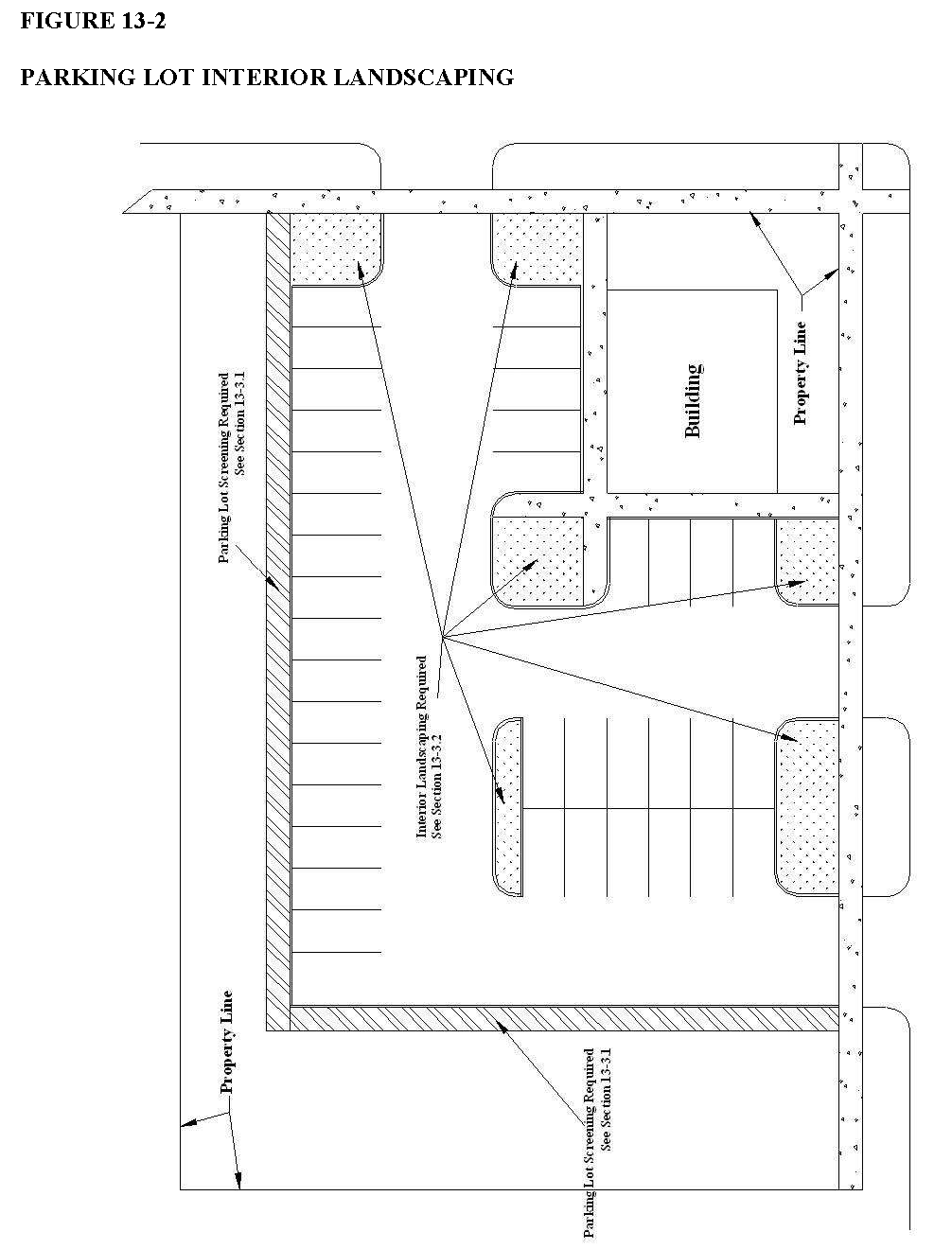
Parking lot screening. In addition to the requirements of section 26-13-2 for perimeter landscaped open space, every parking lot shall, to the extent hereinafter specified, be buffered and screened with appropriate screening devices such as decorative walls, fences, or berms. The landscaping and screening treatment shall be designed and maintained to a height of at least six (6) feet along every lot line abutting a residential district and to a height of at least three (3) feet along every other lot line (see figure 26-13-2). For parking lot screening installed along lot lines abutting a residential district, the landscaping and screening treatment shall have a minimum height of three (3) feet at time of planting. The height of screening shall be measured from the surface of the parking lot. For parking lots developed prior to the effective date of this chapter, the required level of compliance with the standards of subsection 26-13-3.1 shall be determined upon the review and evaluation of the village administrator in light of the condition of the lot on that date as it relates to the feasibility of meeting such standards without undue disruption of existing conditions.
26-13-3.2.
Parking lot interior landscaping. Interior landscaping shall be provided for parking lots in accordance with the following provisions (see figure 26-13-2):
(a)
Required interior landscaping. Interior landscaping shall be provided for all parking lots constructed after the effective date of this chapter containing fifteen (15) or more spaces. The village administrator may, in his or her sole discretion, and as part of site plan review pursuant to section 26-16-10, require interior landscaping for any parking lot containing fewer than fifteen (15) parking spaces.
(b)
Area. Interior landscaping shall constitute at least ten (10) percent of the area of the parking lot. Area devoted to perimeter landscaped open space, pursuant to subsection 26-13-3.1, shall not be considered interior landscaping.
(c)
Tree planting islands. Interior landscaping shall consist of tree planting islands with a minimum area of one hundred seventy-one (171) square feet and a minimum width of nine (9) feet, measured from back of curb to back of curb. One (1) shade tree having a minimum trunk size of three (3) inches in diameter shall be included for every one hundred seventy-one (171) square feet of tree planting islands. However, at no time shall a shade tree be planted closer than twenty (20) feet to any other shade tree. The remaining area of such islands shall consist of groundcover or decorative paving material.
(d)
Dispersal. When more than one (1) tree planting island is provided pursuant to subsection 26-13-3.2, such islands shall be spaced throughout the parking lot.
26-13-3.3.
Parking structure design and screening. Every parking structure constructed after the effective date of this chapter shall comply with the following design standards:
(a)
The exterior walls of the structure shall be designed and constructed so as to shield all parked vehicles from view from any adjacent property or street; and
(b)
Every parking structure shall be designed and constructed so that the exterior facing of the structure is architecturally compatible with the existing character of the buildings it is intended to serve or, in the case of a principal use parking structure, with the district in which it is located.
(c)
Parking structure design shall replicate the regular window pattern and other architectural elements of adjacent buildings. Exterior walls of accessory parking structures shall be finished with a material having a common architectural character with the principal building.
(d)
In addition to the requirements of section 26-13-2 for perimeter landscaped open space, every parking structure located that abuts any single-family residential district or a single-family attached residential district, shall be screened along the entire length of each side of such parking structure that abuts such district by shade or ornamental trees and evergreen trees with a minimum height of ten (10) feet at the time of planting.
(Ord. No. 13-O-05, § 2(Exh. A), 1-22-13)
Sec. 26-13-4. - Loading spaces.
Every loading space visible from any lot zoned for a residential use, whether or not such residential use is within the village, shall be screened on all sides visible from any such lot by an opaque fence, wall, landscaped berm or densely planted evergreen hedge of not less than six (6) feet in height, except as necessary for access.
(Ord. No. 13-O-05, § 2(Exh. A), 1-22-13)
Sec. 26-13-5. - Refuse containers; outdoor storage.
26-13-5.1.
Screening. All refuse containers and all areas of permitted outdoor storage shall be fully enclosed by an opaque fence, wall, or densely planted evergreen hedge of a height sufficient to completely screen such containers or storage areas from view from all adjoining properties and all streets.
26-13-5.2.
Location. No refuse containers shall be located between any principal structure and either its front or corner side lot line. When the district regulations allow outdoor storage areas, such outdoor storage areas shall comply with the use regulations for the district in which they are located.
26-13-5.3.
Exemptions. Subsections 26-13-5.1 and 26-13-5.2 shall not apply to standard receptacles permitted for use by single-family dwellings and to receptacles placed and maintained for use by the general public to avoid littering.
(Ord. No. 13-O-05, § 2(Exh. A), 1-22-13)
Sec. 26-13-6. - Residential recreational facilities and swimming pools.
Except as provided herein, outdoor residential recreational facilities and swimming pools accessory to any dwelling located in any residential district shall be buffered and screened by a solid fence or a densely planted evergreen hedge of not less than six (6) feet in height in combination along with any other landscaping materials as may be needed. Such screening shall be provided on all sides of such facility or swimming pool which are visible from any property or street which is adjacent to the zoning lot on which such residential recreational facility or swimming pool is located. If the owner of a residential recreational facility or swimming pool desires to obtain a waiver from this screening requirement, the owner shall identify the side or sides of the residential recreational facility or swimming pool for which the owner is seeking a waiver from the screening requirements and must obtain consent to such waiver by written agreement from the owners of all adjacent residentially zoned lots that are both within the village and within one hundred (100) feet of the lot on which the recreational facility or swimming pool is located. Upon receipt of an agreement executed by all such adjacent property owners, the portion of the screening for which a waiver is being sought shall not be required. The waiver shall remain in effect during such time as the adjacent property owners continue to hold the legal or beneficial interest in the title to such adjacent properties. The written agreement shall provide that upon written demand of any of the adjacent property owners or upon the sale or transfer of the legal or beneficial interest in any of the adjacent properties, all otherwise required screening shall be installed, in compliance with this section, within ninety (90) days of either such written demand or the sale or transfer of the legal or beneficial interest in any of the adjacent properties. Failure to install the required screening within such ninety (90) day period shall be deemed a violation of this chapter. In the event that the new owner of the legal or beneficial interest of an adjacent property executes the agreement required by this section, the waiver with respect to screening shall remain in force. The written agreement shall be recorded with the Lake County Recorder of Deeds against the property upon which the residential recreational facility or swimming pool is located and each of the adjacent properties.
(Ord. No. 13-O-05, § 2(Exh. A), 1-22-13; Ord. No. 13-O-36, § 3, 7-9-13; Ord. No. 16-O-61, § 14, 7-12-16)
Sec. 26-13-7. - Antennas and antenna support structures.
Ground-mounted antennas and antenna support structures, except such antennas and antenna support structures as are permitted pursuant to subsection 26-12-12.3, shall be buffered and screened by a fence and a densely planted evergreen hedge of not less than six (6) feet in height, in combination with any other landscaping materials as may be needed. Such screening shall be provided between any such ground-mounted antenna or antenna support structure and each lot line of the property on which such antenna or antenna support structure is located so as to provide the maximum reasonably achievable screening, as determined by the village administrator, of such antenna and antenna support structure from view from adjacent properties and streets.
(Ord. No. 13-O-05, § 2(Exh. A), 1-22-13)
Sec. 26-13-8. - Mechanical equipment.
Except for antennas mounted on roofs pursuant to the provisions of this chapter, all mechanical equipment installed after the effective date of this chapter shall be screened in accordance with the following provisions:
26-13-8.1.
Roof top mechanical equipment. Except as otherwise provided below with respect to vent stacks, all roof top mechanical equipment shall be screened to the full height of such equipment by a parapet wall or other screening structure constructed of the same or compatible materials as the principal building facade. To the extent that an existing building contains roof top mechanical equipment which is not screened and which is permitted to continue pursuant to chapter 26, article 14, any replacement rooftop mechanical equipment may be installed without screening, provided, however, that such replacement rooftop mechanical equipment shall be the same color as the principal building facade. Vent stacks located on sloped roofs need not be screened. Vent stacks located on flat roofs and exceeding three (3) feet in height and having a diameter of twelve (12) inches or more shall be screened to a minimum height of three (3) feet. The required level of compliance with the standards set forth in subsection 26-13-8.1 for screening of all other vent stacks located on a flat roof shall be determined by review and evaluation of the village administrator, which review and evaluation shall take into account the condition of the subject lot, the setbacks and yards existing on the subject lot, the feasibility of compliance with such standards, the impact of such compliance on the ability to develop the use on the subject lot in a manner consistent with the intent and the purposes of this chapter, the impact on surrounding uses and lots of compliance or noncompliance with such standards, and any other factor determined by the village administrator to be relevant, appropriate, and consistent with the intent and purposes of this chapter. All vent stacks and all appurtenances thereto shall be painted or otherwise disguised to blend in with the principal building facade.
26-13-8.2.
Ground-mounted mechanical equipment. All ground-mounted mechanical equipment shall be screened by an opaque fence, wall, or densely planted landscaping material of a height sufficient to completely screen such equipment from view from all adjoining properties and all streets; provided, however, that ground-mounted mechanical equipment in residential districts need not be screened except when otherwise expressly required by this chapter.
(Ord. No. 13-O-05, § 2(Exh. A), 1-22-13)
Sec. 26-13-9. - General requirements.
No fence shall be erected, enlarged, expanded, altered, relocated, maintained, or repaired unless it first meets the requirements of this section.
26-13-9.1.
Construction and maintenance.
(a)
Prohibited materials. No fence shall be constructed of any electrically charged element or barbed wire, except that in the industrial districts, or in other districts upon approval by the village administrator, barbed wire may be used above a height of seven (7) feet when incorporated with a permitted fence.
(b)
Wind pressure. Every fence shall be designed and constructed to resist a horizontal wind pressure of not less than thirty (30) pounds per square foot.
(c)
Maintenance. Every fence shall be maintained in a good and safe condition at all times. Every damaged or missing element of any fence shall be removed, repaired or replaced immediately.
(d)
Appearance. Every fence shall be constructed so that all supports are facing the interior of the lot on which the fence is located, and so that the finished side is facing the exterior of the lot on which the fence is located.
26-13-9.2.
Location.
(a)
Every fence shall be designed and located so that vehicular and pedestrian sight lines (sight distance triangle), as illustrated in appendix A, are not obstructed.
(b)
A fence shall not be constructed or maintained in the Residential, O-1 Professional Services Office and OS Open Space Districts except as follows:
(1)
Front yards. Fences may be installed in front yards, provided the fence is no more than one-third (⅓) opaque, and further, provided that the total length of fence in a front yard shall not exceed one-third (⅓) the length of the frontage of the front yard (see "fence length in a front yard" in appendix A).
(2)
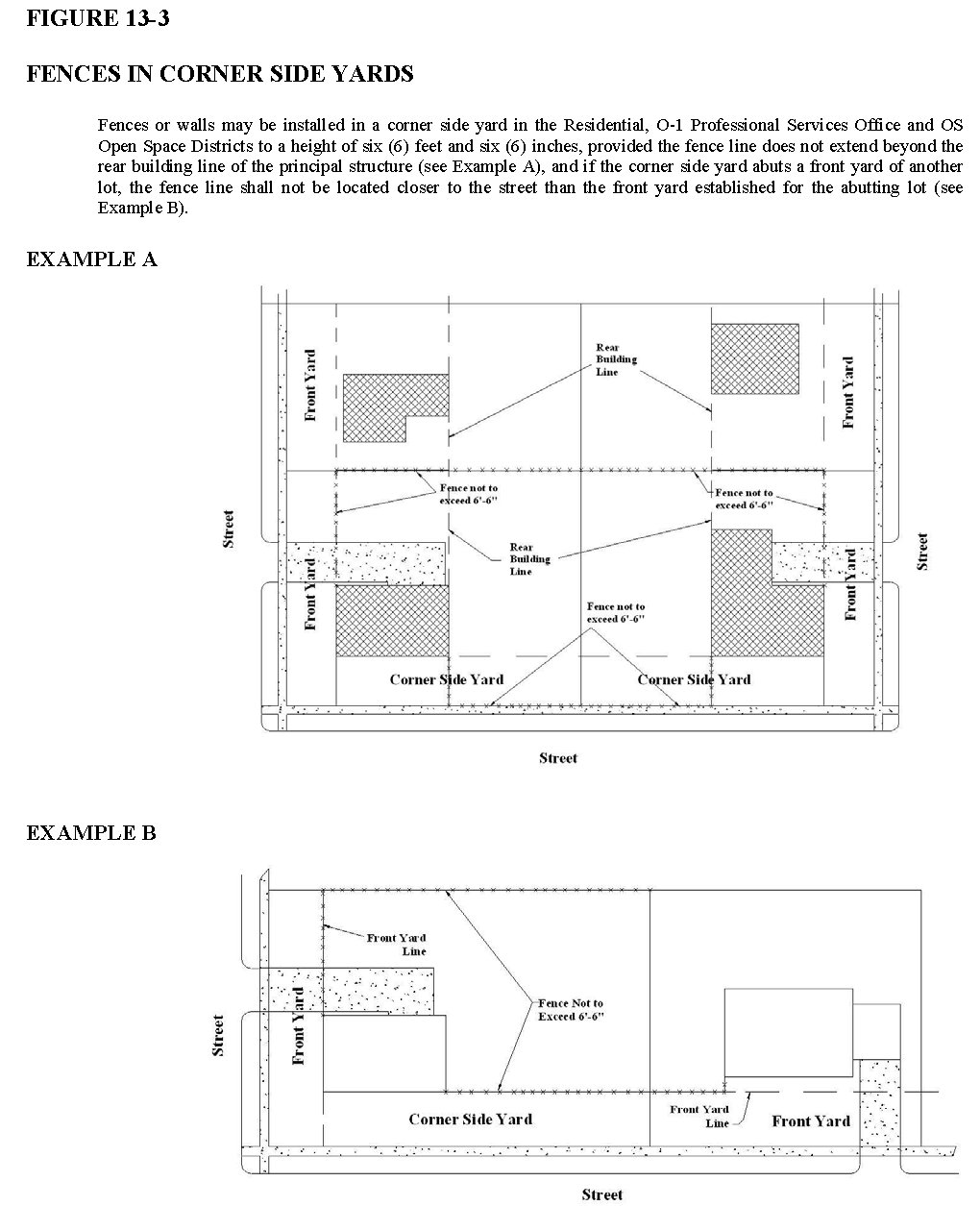
Corner side yards. Fences may be installed in a corner side yard, provided that the fence line does not extend beyond the rear building line of the principal structure and, if the corner side yard abuts a front yard of another lot, the fence line shall not be located closer to the street than the front yard established for the abutting lot (see figure 26-13-3).
(3)
Rear and interior side yards. Fences may be installed in the rear or interior side yards. For reverse frontage lots with rear yards fronting on an arterial street, a fence may be installed in such rear yard, provided the fence shall provide no access to the major arterial.
(c)
Except as provided herein, fences may be installed and maintained in the commercial, industrial, O-2, Office, Manufacturing and Distribution Park, and IB, Institutional Buildings District, except that no fence shall extend beyond the front building line of the principle structure located on the lot. Within the C-1 District, no fence may be installed upon or maintained within any portion of any lot which is intended for use by pedestrians or vehicles if such fence will impede or otherwise restrict pedestrian or vehicular access from such lot to abutting lots.
26-13-9.3.
Height limitations. Except as expressly provided elsewhere in this chapter, all fences shall adhere to the following height limitations:
(a)
In the residential, O-1 Professional Services Office and OS Open Space Districts, no fence shall exceed a height of four (4) feet in any front yard, and six (6) feet and six (6) inches in any corner side, rear or interior side yard.
(b)
In the commercial, industrial, O-2 Office, Manufacturing and Distribution Park and IB Institutional Buildings Districts, no fence shall exceed a height of ten (10) feet. In the residential district, no fence shall exceed a height of ten (10) feet in any rear or interior side yard that abuts a commercial, industrial, or O-2 Office, Manufacturing and Distribution Park District.
(c)
On properties located in the I-3 General Industrial District which are abutting a residential zoning district, a fence, erected upon a berm which runs parallel to a public right-of-way, shall be subject to the following restrictions:
(1)
The fence shall not exceed a height of ten (10) feet, as measured from the lowest point of the fence exposed above ground to the highest point of the fence.
(2)
The highest point of the fence, as installed upon the berm, shall not exceed a total height of fifteen (15) feet above grade, as defined by this chapter.
(3)
The berm shall be landscaped and maintained on the finished side of the fence facing the exterior of the lot in accordance with the requirements of subsections 26-13-2.2(a) and 26-13-2.2(b), notwithstanding the fact that such requirements may not otherwise be applicable to the zoning lot upon which the fence and berm are erected.
(4)
No fence may be erected pursuant to this section without a site plan permit having first been approved by the board of trustees pursuant to subsection 26-16-10.5(d). Full public hearing review and recommendation of the plan commission with public notice to all property owners within two hundred fifty (250) feet of the site is required.
26-13-9.4.
Nonconforming fences. The regulations concerning the use, enlargement, expansion, alteration, relocation, maintenance, repair and termination of nonconforming fences are set forth in chapter 26, article 14.
(Ord. No. 13-O-05, § 2(Exh. A), 1-22-13; Ord. No. 16-O-32, § 3, 5-10-16)

