
Libertyville City Zoning Code
ARTICLE 11
- SIGNS
Sec. 26-11-1. - Purpose.
The purpose of chapter 26, article 11 is to comprehensively regulate signs of all types. The regulations included in chapter 26, article 11 are intended to protect and promote economic vitality, and the public health, safety and welfare by:
(a)
Promoting and preserving the scale and character of the existing residential, business, commercial, industrial and office development areas of the village from intrusion by incompatible elements;
(b)
Enhancing and protecting the overall physical appearance of the Village;
(c)
Creating an attractive economic and business climate within the office, commercial and industrial areas of the village;
(d)
Reducing the distractions, obstructions and hazards to pedestrian and vehicular traffic caused by the indiscriminate placement and use of signs;
(e)
Reducing the depreciation of property values caused by signs that are incompatible with surrounding land uses; and
(f)
Protecting signs from obstruction by other signs.
(Ord. No. 13-O-05, § 2(Exh. A), 1-22-13; Ord. No. 15-O-40, § 3(Exh. A), 5-26-15)
Sec. 26-11-2. - Scope.
The regulations of chapter 26, article 11 shall govern and control the erection, alteration, operation, maintenance, relocation and removal of all exterior signs within the village and those interior signs placed within twelve (12) inches of any window, doorway, or transom visible from any street, sidewalk or public or private open space. Any sign not expressly permitted by chapter 26, article 11 is prohibited. The regulations of chapter 26, article 11 shall be in addition to all other regulations and codes adopted by the village. Regulations concerning the use and termination of nonconforming signs appear in section 26-14-5.
(Ord. No. 13-O-05, § 2(Exh. A), 1-22-13; Ord. No. 15-O-40, § 3(Exh. A), 5-26-15)
Sec. 26-11-3. - General standards.
The following general standards shall apply to all signs:
26-11-3.1.
Permit required. A sign permit shall be required in accordance with the requirements of section 26-16-12.
26-11-3.2.
Compliance with applicable codes. No sign shall be designed, constructed, altered or maintained except in accordance with all applicable codes, ordinances and regulations of the village.
(a)
Signs shall be unified and consistent in design with the buildings and property to which they are constructed. Signs shall be designed to be compatible with the materials of the building or buildings on the property and shall be consistent with the area surrounding the building or property.
26-11-3.3.
Number of sign faces. No sign shall have more than one (1) sign face except only a freestanding sign, a projecting sign or a marquee sign, which may have not more than two (2) sign faces. Freestanding signs with more than one (1) sign face must be designed to have the sign faces attached back to back to the support structure. No V-shape freestanding sign shall be permitted within the village.
26-11-3.4.
Illumination. No sign shall be illuminated except in compliance with all applicable village codes, ordinances and regulations and with the following standards:
(a)
Except as otherwise specified in chapter 26, article 11, a permanent business sign may be illuminated with internal or external lighting sources as follows:
(1)
Internal illumination. Signs may be illuminated internally, but only the copy and logo of cabinet signs shall be of translucent materials, the background of such signs shall be of opaque material; provided, however, that within the C-1 Downtown Core Commercial District internally illuminated signs shall have a dark, opaque, matte background with light colored letters such that the light is visible only through the letters; and provided, further, that no projecting sign in the C-1 Downtown Core Commercial District shall be internally illuminated.
(2)
External illumination. Whenever an external artificial light source is used for a sign, such source shall be located, shielded, and directed so as not to be directly visible from any public street or any adjacent property. Every external artificial light source shall be directed solely to, and concentrated sharply on, the sign. External illumination shall be colorless.
(b)
The illumination of a sign shall be constant in intensity and color and shall not consist of blinking, flashing, fluttering or other illumination conveying the sense of movement.
(c)
The illumination of every sign within one hundred (100) feet of and visible from any property zoned in any residential district shall be extinguished between the hours of 11:00 p.m. and 7:00 a.m. every day; provided, however, that if the business to which the sign relates is in operation between such hours, then the sign may be illuminated during actual hours of operation, but only if such illumination does not create a public or private nuisance. In special districts, freestanding signs within one hundred (100) feet of and visible from any property zoned in any residential district shall not be internally illuminated.
(d)
Temporary signs may be illuminated by an external light source for the duration of the approved temporary sign permit with the issuance of a temporary electric permit. Such illumination shall be arranged as to prevent direct glare of beams onto any public or private property or streets and shall be extinguished between the hours of 11:00 p.m. and 7:00 a.m., provided, however, that if the business to which the sign relates is in operation between such hours, then the sign may be illuminated during actual hours of operation, but only if such illumination does not create a public or private nuisance.
26-11-3.5.
Time and temperature display. Time and temperature displays shall be permitted only on business signs and quasi-public signs, and shall be subject to the following conditions: (i) only clear or white light shall be used; (ii) the displayed message may be changed by intermittent lighting changes, but such changes shall not exceed twelve (12) per minute; and (iii) the area devoted to time and temperature display shall not exceed fifty (50) percent of the total square foot area of the sign.
26-11-3.6.
Changeable copy. Changeable copy shall be permitted only on business signs and quasi-public signs. Except as otherwise specifically provided, the gross surface area of that portion of the sign face designed for changeable copy shall not exceed fifty (50) percent of the total permissible gross surface area of that sign face for a business sign, and seventy-five (75) percent of the total permissible gross surface area of that sign for a quasi-public sign.
26-11-3.7.
Wall sign limitations. Wall signs attached to a building shall be erected parallel to the vertical wall surface and shall not project more than twelve (12) inches from the wall upon which such sign is attached. No wall sign shall project beyond the end or top of the wall or sloping roof to which such sign is attached.
26-11-3.8.
Minimum ground clearance. A minimum clearance of eight (8) feet shall be provided between the ground and the bottom of any sign located over a pedestrian way; provided, however, that no sign shall obstruct vehicular and pedestrian sight lines (sight distance triangle), as illustrated in appendix A. No sign shall be installed upon or project over a public thoroughfare or right-of-way.
26-11-3.9.
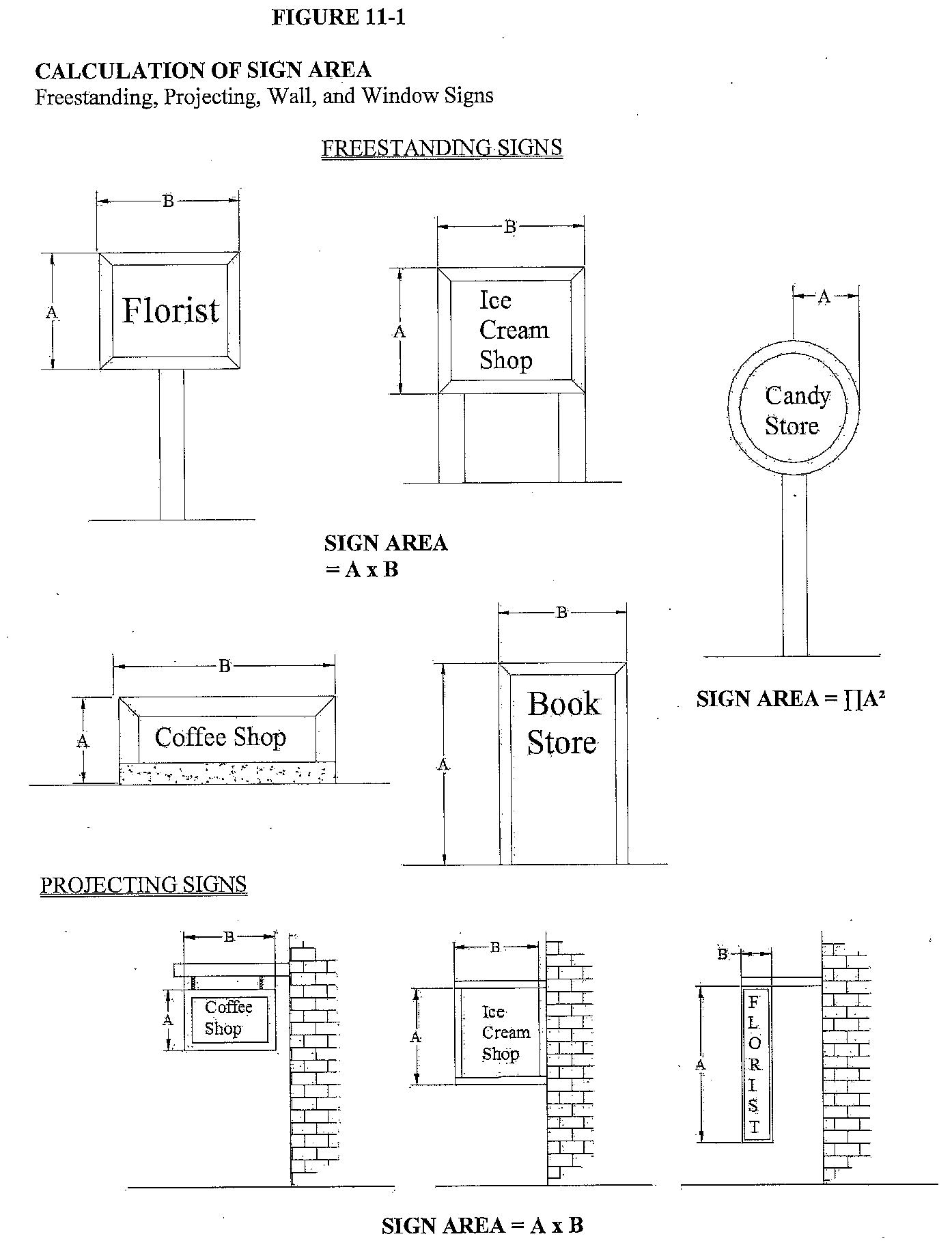
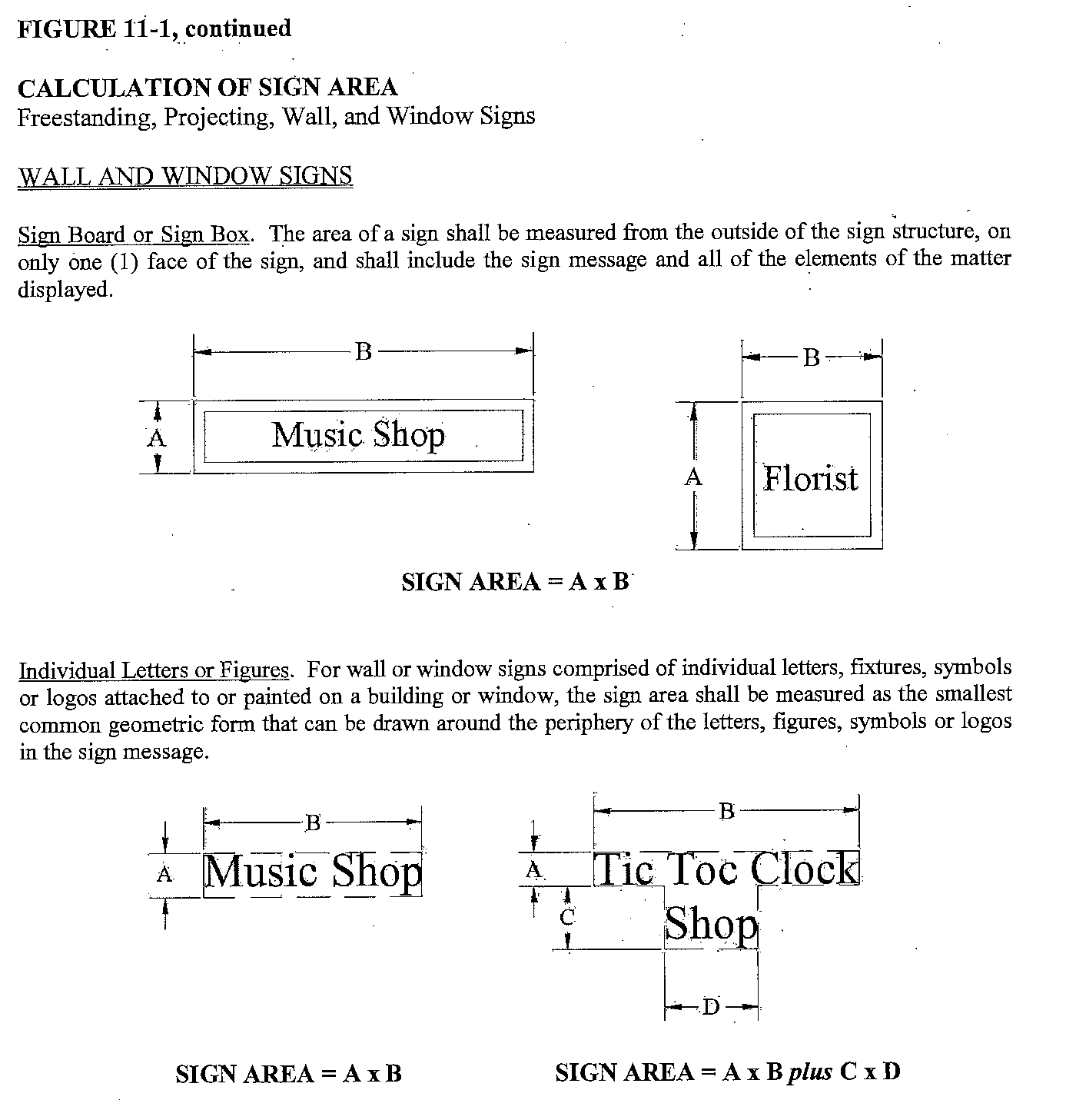
Sign area. The area of a sign shall be measured in square feet, as follows (see figure 26-11-1):
(a)
The area of a sign shall be measured from the outside of the sign structure, on only one (1) face of the sign, and shall include the sign message and all of the elements of the matter displayed. Sign supports that do not form an integral part of the sign message or display shall be excluded from the sign area calculation.
(b)
For wall or window signs comprised of individual letters, figures, symbols or logos attached to or painted on a building or window, the sign area shall be measured as the smallest common geometric form that can be drawn around the periphery of the letters, figures, symbols or logos in the sign message. In lieu of using a single geometric form, the sign area may be calculated by combining the areas of the smallest geometric forms that can be drawn around each letter, figure, symbol or logo in the sign message, together with all the space between all letters, figures, symbols, and logos.
(c)
When the sign background for the individual letters is made of a color different from the color of the building, the entire area of contrasting color shall be measured and shall constitute the sign area if such area is larger than the geometric forms encompassing the sign message.
26-11-3.10.
Uniform sign criteria. When more than one (1) wall sign is proposed on any building with multiple tenants, the applicant shall submit a uniform sign criteria for review by the appearance review commission in accordance with subsection 26-16-12.7. A uniform sign criteria shall provide for a uniform style for all wall signs on such building and shall include, at a minimum, criteria and specifications for general appearance, format of messages, lighting, location, and construction materials. Any uniform sign criteria lawfully approved prior to the effective date of these regulations shall be deemed to be and continue valid after such effective date to the extent that it complies with the regulations of chapter 26, article 11. No sign shall be constructed pursuant to any such uniform sign criteria except in compliance with said regulations.
26-11-3.11.
Required landscaping. All freestanding signs for which a sign permit is required shall have a landscaped area in accordance with the following provisions, except as otherwise noted:
(a)
For every one (1) square foot of gross sign surface area, there shall be provided one (1) square foot of landscaped area immediately adjacent to the sign base.
(b)
The required landscaped area shall consist of plantings such as, but not limited to, hedges, conifers, flowering plants, evergreens and ground cover plants. Sodded or seeded areas without such plantings shall not be considered in calculating the required square footage of a landscaped area.
(c)
The landscaped area shall contain ground protection such as, but not limited to, cover plants, landscaping bark or timbers or decorative stones.
(d)
The landscaped area shall be maintained in a healthy, neat and proper condition at all times.
(e)
If the area around the base of the sign is insufficient in area for all of the required landscaping, then all such landscaping as may properly be installed shall be placed around the base of the sign and the remainder of the required landscaping shall be provided on the same zoning lot as the subject sign at a location review by the appearance review commission and approved by the village board of trustees.
(f)
The provisions of subsection 26-11-3.11 shall apply to all signs for which a sign permit is issued after the adoption of the sign regulations; provided, however, that the required level of compliance with the provisions of subsection 26-11-3.11 shall be determined by review and evaluation of the village administrator, which review and evaluation shall take into account the condition of the subject lot, the area available on the subject lot for required landscaping, the feasibility of compliance with such standards, the impact of such compliance on the ability to install a sign on the subject lot in a manner consistent with the intent and purposes of this chapter, the impact on surrounding uses and lots of compliance or noncompliance with such standards, and any other factor determined by the village administrator to be relevant, appropriate, and consistent with the intent and purposes of this chapter.
26-11-3.12.
Maintenance. The owner of a sign and the owner of the premises on which such sign is located shall be jointly and severally responsible for the proper maintenance and repair of such sign, including without limitation its illumination and all required landscaping, in compliance with chapter 26, article 11 and all other applicable village codes, ordinances, and regulations. Such sign shall be maintained in good working order and in a safe, secure, neat, and orderly condition at all times. Further, such sign shall be maintained to prevent the development of any rust, corrosion, rotting or other deterioration of the physical condition of such sign, and any rust, corrosion, rotting or other deterioration shall be repaired promptly. The premises around every freestanding sign shall be kept clean and free of all rubbish and weeds at all times.
(Ord. No. 13-O-05, § 2(Exh. A), 1-22-13; Ord. No. 15-O-40, § 3(Exh. A), 5-26-15)
Sec. 26-11-4. - Removal of signs.
The village administrator may order removal of any sign listed in section 26-11-6 or of any sign that is erected or maintained in violation of this article. Notice of a removal order shall be sent by the village administrator to the owner, agent or person having beneficial interest in the building or property on which such sign is located. Such notice shall be by certified letter, return receipt requested, and shall describe the sign, its location and the violation. The offending sign shall be removed by the village, at the expense of the owner of the building or property on which the offending sign is located, if the violation has not been cured within thirty (30) days after receipt of the notice from the village administrator. Notwithstanding any other provision of this chapter, the village administrator may order, without notice, the immediate removal by the village of any sign determined by the village administrator to pose an imminent threat to the public health or safety.
(Ord. No. 13-O-05, § 2(Exh. A), 1-22-13; Ord. No. 15-O-40, § 3(Exh. A), 5-26-15)
Sec. 26-11-5. - Classification of signs.
26-11-5.1.
Functional types. For purposes of this chapter, signs shall be classified as follows according to function:
Banner. A temporary sign made of cloth or similar material, bearing a design, emblem, motto, slogan or advertisement.
Business sign. A sign that directs attention to or identifies a business or profession conducted, or a commodity or service sold, offered or manufactured, or an entertainment offered on the premises where the sign is located.
Construction sign. A temporary sign on a lot on which construction is actively being performed, indicating the name of the project and the address of the premises. Such a sign may include the names of architects, engineers and similar persons or firms having a role or interest in the construction activity, but no such sign shall include any advertisement of any product, service or sale or any leasing information.
Electronic message board sign. A sign with a fixed or changing display/message composed of a series of lights that may be changed through electronic means. Signs whose alphabetic, pictographic, or symbolic informational content can be changed or altered on a fixed display screen composed of electronically illuminated segments.
Feather flag. A tall, narrow sign that on one (1) side uses a poll for support, allowing the sign to move in the wind.
Flag. A flag or emblem of a governmental or of a political, professional, educational, religious or corporate organization, not containing any advertisement.
Flashing sign. A sign that uses any type of flashing light, running light or other light creating the illusion of movement. This classification shall also include the use of search lights and strobe lights.
Governmental sign. A sign erected and maintained pursuant to and in discharge of any governmental function or as required by any law, ordinance, or governmental regulation.
Holiday decorations. Temporary signs in the nature of decorations, clearly incidental to and customarily and commonly associated with a national, local or religious holiday.
Incidental informational sign. A sign, emblem or decal limited in content to informing the public of facilities available on the premises.
Inflatable balloon sign. An inflatable, three-dimensional balloon, often made of thick PVC or vinyl and nylon, used for the purpose of advertising special events, promotions, or sales.
Memorial sign. A plaque or tablet, grave marker, statuary or other remembrance of a person, place, event or structure that is non-commercial in nature.
Multi-tenant sign. A sign, typically located at or near a principal entrance of a planned development or other multi-tenant development, identifying that development by the name and address of the development.
Nameplate sign. A sign limited in content to the name and address of the owners or occupants of a building or premises on which it is located.
Off-premises advertising sign. A sign other than a governmental sign that directs attention to or identifies a business or profession conducted, or a commodity or service sold, offered or manufactured, or an entertainment offered, at a building or development, which sign is located off the lot on which such building or development is located.
Pennant. A triangular cloth or material, with or without writings or markings.
Political sign.
Election sign. A temporary sign announcing or supporting political candidates or issues in connection with any national, state, or local election.
Political message sign. A sign other than an election sign expressing a noncommercial message regarding an issue of political or public concern.
Portable sidewalk sign. A temporary portable sign, with one (1) or two (2) sign faces in the shape of an "A," "T," or "I," intended for daily-display or one-day display on the ground, not permanently attached to any structure and easily movable.
Private sale sign. A temporary sign advertising a private sale of personal property such as a "house sale," "garage sale," "rummage sale" and the like.
Private traffic direction sign. A sign that provides private traffic control and direction to direct traffic movement onto a premises or within a premises.
Private warning sign. A sign limited in content to messages of warning, caution or danger.
Professional directory sign. A sign listing only the names, occupations and addresses of commercial or office tenants occupying the premises.
Quasi-public sign.
Community welcome sign. A sign located near the corporate limits of the village that includes a "Welcome to Libertyville" message and other village-related information.
Institutional sign. A sign identifying a public, government, civic or religious institution or organization located on the same zoning lot, which sign is limited in content to the name of such institution or organization and a message relating to the function of such institution or organization.
Real estate sign. A temporary sign pertaining to the sale or lease of the premises, or a portion of the premises, on which the sign is located.
Residential development sign. A sign located at or near the principal entrance of a single-family or multiple-family residential subdivision or use limited in content to the name and address of that subdivision or use.
Service club sign. A sign located in a specifically identified area near the corporate limits of the village which includes only the names of service clubs having a chapter or organized membership within the village. for the purposes of this article, the term "service club" shall mean a legally chartered, not-for-profit civic organization of individuals engaged in work for the general welfare of the community and devoted to the betterment of the community and its facilities.
Streamer. A long, narrow, ribbon-like strip of material, with or without writings or markings.
Time and temperature display. A portion not greater than fifty (50) percent of a sign area displaying only the time and temperature, by means of a lamp bank.
Wind waver. A tall, narrow promotional object, similar to a feather flag, but three-dimensional, that utilizes air to allow for movement.
Window promotional sign. A temporary sign, emblem or decal in the window of a commercial use that informs the public of goods or services available on the premises, but not including any signs accessory to a private parking area.
26-11-5.2.
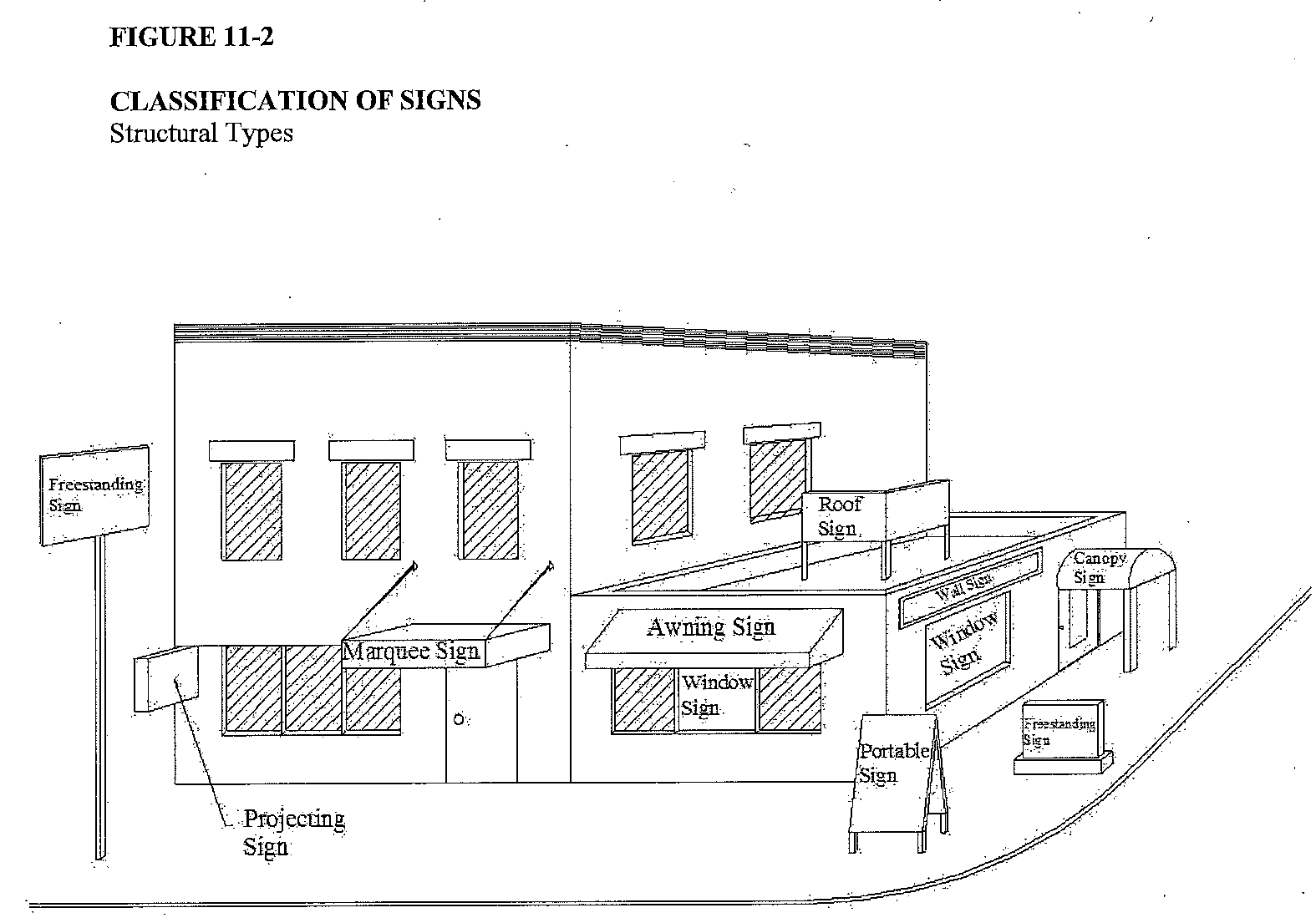
Structural types. For purposes of this chapter, signs shall be classified as follows according to structure (see figure 26-11-2):
Awning/canopy sign. A sign affixed to or painted on the slant of an awning or canopy, which awning or canopy is otherwise permitted by village regulations.
Blade sign. A sign attached to the wall or underside of a projecting façade or roofline over a pedestrian walkway on the first floor. Such signs shall not project beyond the front façade of the building or beyond the furthest edge of the projecting roof line to which the sign is attached.
Freestanding sign.
Monument style. A sign in which the entire bottom is in contact with the ground and not attached to, or dependent for support on, any building.
Pole style. A sign supported by an exposed freestanding pole or other support so that the base of the sign is above grade not attached to, or dependent for support on, any building.
Marquee sign. A sign attached to or a part of the permanent, roof-like structure extending from a building facade, which sign is not supported by the ground.
Moving or animated sign. Any sign or part of a sign that changes physical position by any movement or rotation or that gives the visual impression, by such movement or rotation, of a change of physical position.
Portable sign. A sign that is not permanently affixed to a building, structure or the ground, but not including customary identification lettering on vehicles or advertising posters on buses and taxicabs.
Projecting sign. A sign that is wholly or partly dependent upon a building for support which projects more than twelve (12) inches from such building and hangs with the sign board structure perpendicular to building.
Roof sign. A sign mounted to or painted on the roof of a building, or that is wholly dependent on a building for support and that projects above the highest point of a building with a flat roof, the eave line of a building with a gambrel, gable or hip roof, or the deck line of a building with a mansard roof.
Temporary sign. A sign or advertising display intended to be displayed for a short period of time.
Wall sign. A sign on a wall or fastened to the wall of a building or structure in such a manner that the wall becomes the supporting structure of, or forms the background surface of, the sign, or any sign located in a transom opening, or any window sign exceeding thirty-five (35) percent of the total window area on any street frontage.
Window sign. A sign that is applied or attached to the exterior or interior of a window or that is located within the interior of a structure so that its message is intended to be read from the exterior of the structure. A sign located in a transom opening shall not be considered as a window sign.
(Ord. No. 13-O-05, § 2(Exh. A), 1-22-13; Ord. No. 15-O-40, § 3(Exh. A), 5-26-15)
Sec. 26-11-6. - Signs prohibited in all zoning districts.
The following signs, as well as all other signs not expressly permitted by chapter 26, article 11, are expressly prohibited within the village and shall not be erected, maintained or, except as provided in section 26-14-5, permitted to continue within the village:
Flashing signs.
Moving or animated signs. Including feather flags and wind wavers.
Obstructive signs. Any sign that is erected, relocated or maintained so as to prevent free access to, or egress from, any driveway, door, window or fire escape.
Off-premises advertising signs.
Roof signs.
Signs affixed to standpipe or fire escape. Any sign attached or affixed to any standpipe or fire escape.
Signs affixed to utility poles or trees.
Signs creating traffic hazards. Any sign erected, relocated or maintained that:
(a)
By reason of its size, location, content, coloring or manner of illumination, will obstruct the vision of drivers, or obstruct or detract from the visibility or effectiveness of any traffic sign or control device on streets and roads in the village.
(b)
Makes use of words, phrases, symbols, lights, devices or characters that interfere with, mislead or confuse traffic.
Signs erected without proper permits. Any sign erected without the required permit first having been issued therefor.
Signs used to identify a home occupation.
Signs in the public right-of-way, except as otherwise specifically provided in chapter 26, article 11.
Signs related to abandoned uses or activities. Any sign that advertises an activity, business, product or service no longer conducted, sold, or provided on the premises where such sign is located. Any such sign face or lettering shall be removed or entirely covered within thirty (30) days after cessation of the relevant activity. An activity, business, product or service shall be deemed abandoned thirty (30) days after the date the activity, business, product or service is no longer conducted, sold, or provided on the premises where such sign is located.
Unsafe signs. Any sign that, in the determination of the village administrator, is unsafe, unsecured or a menace to the public.
(Ord. No. 13-O-05, § 2(Exh. A), 1-22-13; Ord. No. 15-O-40, § 3(Exh. A), 5-26-15)
Sec. 26-11-7. - Signs permitted without sign permit.
Except as regulated in section 26-11-3 and as expressly prohibited in section 26-11-6, the following signs are permitted in any district without a sign permit when constructed and maintained in accordance with the provisions set forth below, with all other provisions of this article, and with every other applicable village code, ordinance, and regulation. Except as specifically provided otherwise in this article, no such sign shall be illuminated and no such sign shall be placed or maintained in any public right-of-way. No such signs shall obstruct vehicular or pedestrian sight lines (sight distance triangle), as illustrated in appendix A.
Signs on accessory vehicles and trailers. Any sign on a vehicle or trailer that is accessory to the principal use of the premises on which such vehicle or trailer is located, so long as such sign relates only to a business, activity or service conducted on such premises.
Flags. Such signs shall be limited to not more than three (3) per zoning lot and shall not be affixed to any type of light pole or standard.
Governmental signs. Such signs shall be of a size, number, content and setback so as to comply with the requirements of the code, ordinance, or regulation pursuant to which the sign is erected. Such signs may be placed in the public right-of-way.
Holiday decorations. No such sign shall be displayed for more than forty five (45) days and every such sign shall be removed within fifteen (15) days after the holiday. Such signs may be illuminated, but only in accordance with the provisions of subsection 26-11-3.4 and so as not to create a safety hazard, nuisance or any adverse impact on adjacent properties.
Lettering on the valence of an awning. No such lettering shall exceed eight (8) inches in height.
Memorial signs.
Nameplate signs. Only one (1) such sign shall be permitted per occupant, not to exceed two (2) square feet per sign.
Political signs.
Election signs. Election signs shall be located entirely on private property pursuant to the owner's consent, and shall not exceed (16) square feet in area per sign.
Political message signs. Political message signs shall be located entirely on private property pursuant to owner's consent, and shall not exceed four (4) square feet in area per sign.
Private sale signs. No such sign shall exceed four (4) square feet per sign face, and every such sign shall be posted no earlier than twenty-four (24) hours before the private sale and shall be removed within twenty-four (24) hours after the private sale.
Private warning signs. No such sign shall exceed eight (8) square feet per sign face. Such signs shall be limited in number to the minimum necessary to accomplish the intended purpose. Such signs may be illuminated only as required to accomplish their intended purpose.
Professional directory signs, but only when located within the interior of an office/industrial park or plaza and only when not visible from any public right-of-way. Such signs shall not exceed fifteen (15) square feet per building or six (6) feet in height (when a freestanding sign).
Real estate signs. For residential uses, every such sign shall be removed within seven (7) days after a sale has closed or a lease is signed on the last vacancy. One (1) sign shall be permitted per street frontage, not to exceed three (3) square feet per sign face and six (6) feet in height. No such open house sign shall exceed four (4) square feet per sign face and every such open house sign shall be posted for the duration of the event only.
Window signs.
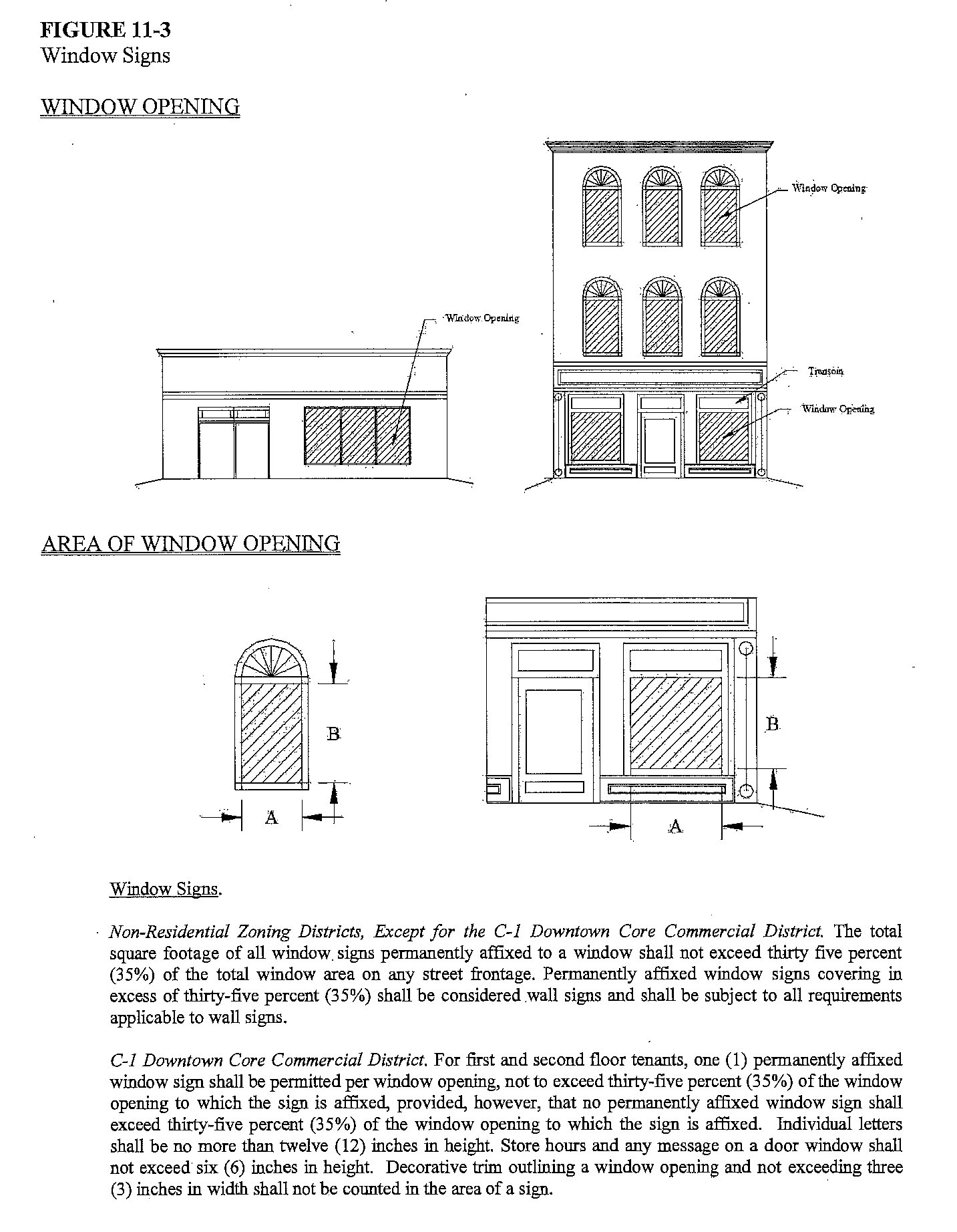
Non-residential zoning districts, except for the C-1 Downtown Core Commercial District. The total square footage of all window signs permanently affixed to a window shall not exceed thirty-five (35) percent of the total window area on any street frontage. Permanently affixed window signs covering in excess of thirty-five (35) percent shall be considered wall signs and shall be subject to all requirements applicable to wall signs.
C-1 Downtown Core Commercial District. For first and second floor tenants, one (1) permanently affixed window sign shall be permitted per window opening, not to exceed thirty-five (35) percent of the window opening to which the sign is affixed, provided, however, that no permanently affixed window sign shall exceed thirty-five (35) percent of the window opening to which the sign is affixed. Individual letters shall be no more than twelve (12) inches in height. Store hours and any message on a door window shall not exceed six (6) inches in height. Decorative trim outlining a window opening and not exceeding three (3) inches in width shall not be counted in the area of a sign (see figure 26-11-3).
Window promotional signs. The total square footage of all such signs shall not exceed thirty five (35) percent of the total window area on any street frontage. Window signs covering in excess of thirty-five (35) percent shall be considered wall signs and shall be subject to all requirements applicable to wall signs; provided, however that in the C-1 Downtown Core Commercial District, no window sign shall exceed thirty-five (35) percent of the window opening to which the sign is affixed.
(Ord. No. 13-O-05, § 2(Exh. A), 1-22-13; Ord. No. 15-O-40, § 3(Exh. A), 5-26-15)
Sec. 26-11-8. - Special exception signs.
The following signs may be permitted in any zoning district, but only after the issuance of a sign permit. All such signs shall be constructed and maintained in accordance with the provisions set forth below, with all other provisions of this article, and with every other applicable village code, ordinance, and regulation.
26-11-8.1.
Temporary banners and inflatable balloons. The display of banners and inflatable balloons on properties devoted to commercial, office or industrial uses. Such signs shall be displayed only under the following conditions and only subject to the following limitations:
(a)
Replacement signage. When construction activities or exterior facade renovations to an existing building require the temporary removal of existing permanent signage advertising the goods, products or services available on the property. Such signs shall be removed immediately after restoration of the permanent signage or within five (5) days after completion of such construction activities or exterior facade renovations, whichever is less.
(b)
Temporary new businesses. When a certificate of occupancy has been applied for or issued for a new business and all applications required for installation of permanent signage advertising goods, products, or services available from the new business have been filed with the village, but have not been finally acted upon by the village. Such signs shall be removed immediately after installation of the Village-approved permanent signage or within sixty (60) days after approval of the final application required for the installation of the permanent sign, whichever is less; provided, however, that if any application required for the installation of the permanent signage is denied by final action of the Village, such signs shall be removed immediately after such final action.
(c)
Special events, sales, and promotions. For special events, sales, and promotions. Such signs shall be removed immediately after termination of the event, sale or promotion or within thirty (30) days after the issuance of the permit therefore by the village administrator, whichever is less.
(1)
Maximum displays; intervals. Only three (3) display periods shall be allowed for one business or organization in any calendar year, and a fifteen (15) day interval shall be required between displays at the same location; provided, however, that these limitations shall not apply to such signs displayed by the village.
(2)
Maximum number and sign area. Not more than one (1) wall or one (1) freestanding sign for the purpose of advertising for a special event, sale, or promotion shall be permitted per business occupancy. No such sign shall exceed eighteen (18) square feet per sign face.
(3)
Type permitted. Banners and inflatable balloons shall be the only temporary sign type permitted. Wind wavers, feather flags, or any type of moving sign are not permitted.
26-11-8.2.
Construction signs. A construction sign, but only when such sign relates to an approved development for which a building permit has been issued and in accordance with the following provisions:
(a)
Number. Not more than one (1) freestanding sign or one (1) wall sign shall be permitted in Residential Districts, and not more than one (1) freestanding sign or one (1) wall sign per street frontage in non-residential districts.
(b)
Size. No such sign shall exceed ten (10) square feet per sign face in residential districts, and thirty-two (32) square feet in non-residential districts.
(c)
Height. No freestanding sign shall exceed six (6) feet in height.
(d)
Location. Each such sign shall be confined to the construction site in a location acceptable to the village administrator.
(e)
Time. No such sign shall be erected more than thirty (30) days prior to the beginning of construction or be permitted to remain longer than seven (7) days after issuance of an occupancy permit.
26-11-8.3.
Non-residential real estate signs. Real estate signs for non-residential uses, subject to the following limitations:
(a)
Number; size; height. One (1) sign shall be permitted per street frontage. No such sign shall exceed sixteen (16) square feet per sign face in the C-1 Downtown Core Business District and C-2 Downtown Community Commercial District and twenty-four (24) square feet per sign face in any other district. No such freestanding sign shall exceed six (6) feet above grade in height.
(b)
Removal. Every such sign shall be removed within twelve (12) months of issuance of the approved sign permit or within seven (7) days after a sale has closed or a lease is signed on the last vacancy, whichever comes sooner. The approved time period may be extended for additional twelve (12) month periods by the village administrator upon showing of necessity by the owner and upon review of the physical condition of the sign to ensure that it is in good repair.
26-11-8.4.
New development announcement signs. For new multiple unit developments such as residential subdivisions, business centers, or industrial centers, one (1) sign may be erected, not exceeding sixteen (16) square feet in the C-1 Downtown Core Business District and C-2 Downtown Community Commercial District and thirty-two (32) square feet in all other Zoning Districts, for the purpose of announcing the sale or rental of any lot or group of lots or buildings or spaces within buildings, for a period not to exceed six (6) months; provided, however, that such signs shall not be erected or maintained without having first been referred to the appearance review commission and approved by the board of trustees in accordance with the provisions of chapter 7, article II of this Code. The approved time period may be extended for an additional six (6) month period by the village administrator upon showing of necessity by the owner and upon review of the physical condition of the sign to ensure that it is in good repair.
26-11-8.5
Community welcome signs, owned and maintained by the village, but only after referral to the appearance review commission and approval by the village board in accordance with the provisions of chapter 7, article II of this Code. Every community welcome sign shall comply with the following provisions:
(a)
Bulk regulations. Each such sign shall be of a size, height and location as approved by the Village Board.
(b)
Sight lines. No such sign shall obstruct vehicular or pedestrian sight lines (sight distance triangle), as illustrated in appendix A.
(c)
Design. The design of all community welcome signs shall be of a uniform size and style as approved by the Village Board.
(d)
Location. A community welcome sign shall be located only at or near the corporate limits of the village and only along the following streets: Milwaukee Avenue, Peterson Road, Park Avenue, US Route 45, and Butterfield Roads.
26-11-8.6.
Service club signs. A service club sign, but only after referral to the appearance review commission and approval by the village board in accordance with the provisions of chapter 7, article II of this Code. Every service club sign shall comply with the following provisions:
(a)
Bulk regulations. Each such sign shall be of a size, height and location as approved by the village board.
(b)
Sight lines. No such sign shall obstruct vehicular or pedestrian sight lines (sight distance triangle), as illustrated in appendix A.
(c)
Design. The logo and copy for all service clubs depicted on any such sign shall be of a similar size, style and design, as approved by the village board.
(d)
Location. A service club sign shall be located only at a location having a community welcome sign. The placement of such signs shall be as approved by the village board.
(e)
Maintenance; liability. Prior to the construction of a service club sign, provisions for maintenance and liability of such sign shall be stated in an agreement between the ser-vice club(s) and the village, which agreement shall be approved by the village board.
26-11-8.7.
Menu board signs. A menu board sign, but only after referral to the appearance review commission, plan commission and approval by the village board in accordance with an approved special use permit for such drive through use. Every menu board sign shall comply with the following provisions:
(a)
Number, size and height.
(1)
One (1) primary menu board not to exceed thirty (30) square feet in sign area and not to exceed six (6) feet in height is allowed per order station, up to a maximum of two (2) primary menu boards per zoning lot.
(2)
One (1) secondary menu board not to exceed fifteen (15) square feet in sign area and not to exceed six (6) feet in height per zoning lot.
(3)
Primary and secondary menu boards are allowed in addition to other permitted business signs on the property. No additional advertising is permitted other than the products or services sold.
(b)
Location. No menu board sign shall be located within the front yard of any property or in front of the front building line of any principal structure, and not closer than ten (10) feet to any other lot line.
(c)
Sight lines. No such sign shall obstruct vehicular or pedestrian sight lines (sight distance triangle), as illustrated in appendix A.
(d)
Design. The design of all menu board signs shall be of a uniform size and style as approved by the appearance review commission and village board.
26-11-8.8.
Menu Box Signs. Menu boxes, for the sole purpose of displaying restaurant menus only, may be permitted after the issuance of a sign permit. Menu boxes may be no larger than two (2) square feet.
26-11-8.9.
Portable sidewalk signs. A portable sidewalk sign may be permitted in accordance with the following provisions after issuance of a temporary sign permit for a period not to exceed one (1) calendar year. The issuance of a temporary sign permit for a portable sidewalk sign replaces the three (3) temporary sign permits allowed per business per year, as stated in subsection 26-11-8.1(c)(1).
(a)
C-1 Downtown Core Commercial District and C-2 Downtown Community Commercial District. One (1) sign shall be permitted per business entrance per ground-floor business occupancy. The sign may be located in the public right-of-way, if the tenant or landlord has a current Certificate of Insurance on record with the Village of Libertyville, listing the village as additionally insured. The sign must be placed within ten (10) feet of the business entrance and cannot reduce a pedestrian walkway width to less than four (4) feet, block private driveways or alleys, or inhibit foot, bicycle or automobile traffic in any way. The sign must be removed and stored entirely within the tenant space after hours of operation. The sign shall not exceed six (6) square feet in area and shall not exceed forty-two (42) inches in height. The frame may not be comprised of white plastic.
(b)
C-3 General Commercial District and C-4 Shopping Center Commercial District. One (1) sign shall be permitted per business entrance per ground-floor business occupancy. The sign must be located entirely on private property and must be located abutting the principal structure and tenant space to which the sign refers. The placement of the sign cannot reduce a pedestrian walkway width to less than four (4) feet, block private driveways or alleys, or inhibit foot, bicycle or automobile traffic in any way. The sign must be removed and stored entirely within the tenant space after hours of operation. The sign shall not exceed six (6) square feet in area and shall not exceed forty-two (42) inches in height. The frame may not be comprised of white plastic.
26-11-8.10.
Private traffic direction signs. No such sign shall exceed two (2) square feet per sign face or six (6) feet in height when freestanding. Such signs shall be limited to the location and minimum number to convey such direction. No more than twenty (20) percent of the sign face may be dedicated to business name or logo. Such signs may be illuminated, but only in accordance with the provisions of subsection 26-11-3.4.
(Ord. No. 13-O-05, § 2(Exh. A), 1-22-13; Ord. No. 15-O-40, § 3(Exh. A), 5-26-15)
Sec. 26-11-9. - Residential districts.
The following signs shall be permitted in all residential districts:
(a)
Signs permitted without sign permit, but only as provided in section 26-11-7.
(b)
Residential development signs, subject to the following requirements:
(1)
Structural types permitted.
a.
Freestanding signs.
b.
Wall signs.
(2)
Number permitted. One (1) or two (2) signs, including a total of not more than two (2) sign faces, shall be permitted for each principal entrance to a single-family subdivision, residential planned unit development or multiple-family residential use.
(3)
Maximum gross surface area. Not to exceed twelve (12) square feet per sign face; provided, however, that signs designed either as an integral part of the architecture of a building or as part of a landscaped architectural feature, such as a masonry wall, shall be permitted without limitation as to size if, but only if, approved by the appearance review commission.
(4)
Maximum height. The maximum height of a freestanding sign shall not exceed six (6) feet above grade.
(5)
Minimum required setback. Freestanding signs shall be set back a minimum distance of fifteen (15) feet from all lot lines or from the public right-of-way, whichever is greater, and shall be located only at a principal entrance to such single-family subdivision, residential planned unit development or multiple-family residential use; provided, however, that no sign shall obstruct vehicular and pedestrian sight lines (sight distance triangle), as illustrated in appendix A.
(6)
Additional standards.
a.
The sign shall not create any traffic hazard.
b.
The sign is aesthetically in keeping with the character of the neighborhood.
c.
The sign will not cause a depreciation of property values in the adjoining area.
(Ord. No. 13-O-05, § 2(Exh. A), 1-22-13; Ord. No. 15-O-40, § 3(Exh. A), 5-26-15)
Sec. 26-11-10. - C-1 Downtown Core Commercial District.
The following signs shall be permitted in the C-1 Downtown Core Commercial District:
(a)
Signs permitted without sign permit, but only as provided in section 26-11-7.
(b)
Special exception signs, but only as provided in section 26-11-8.
(c)
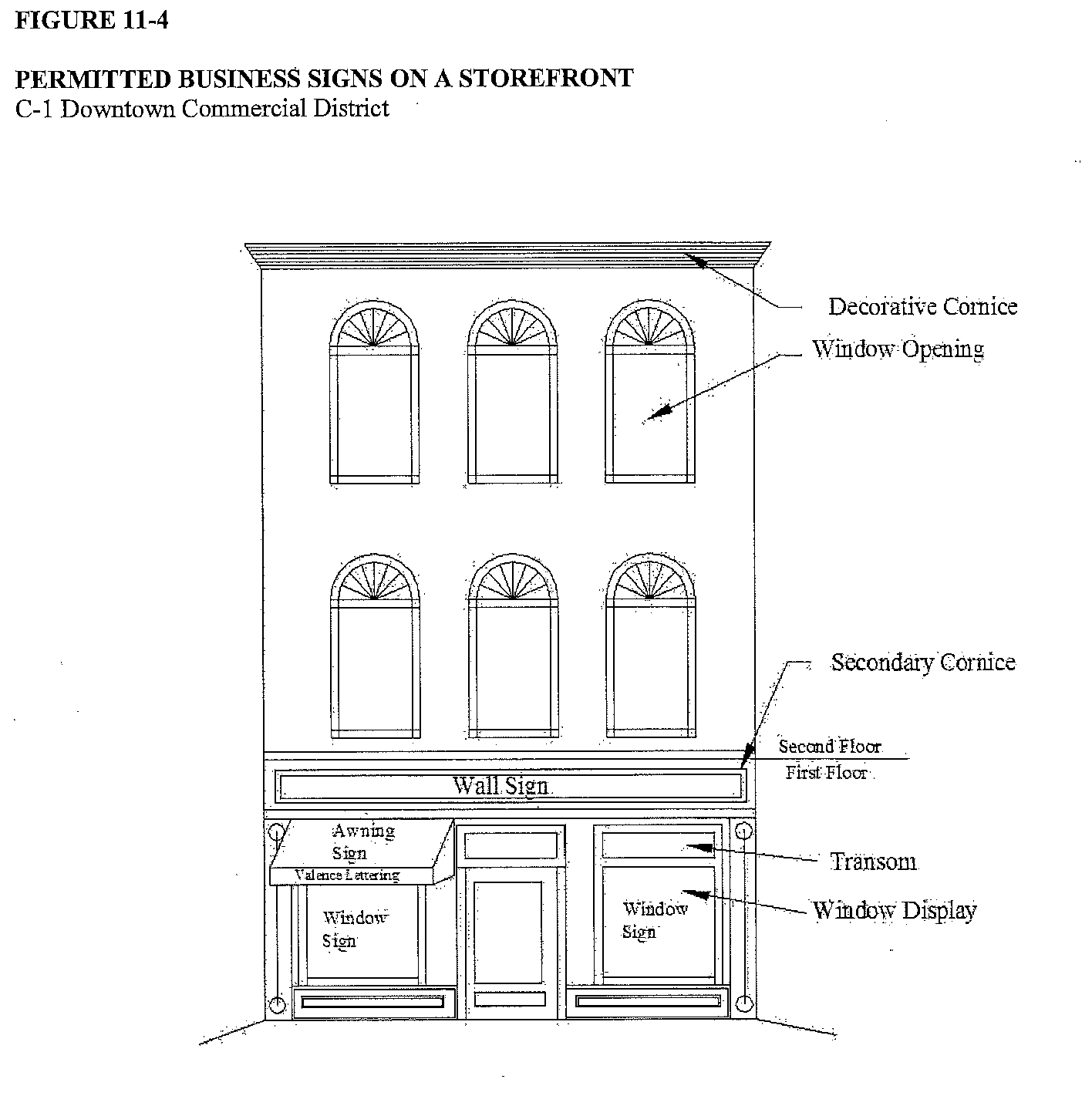
Business signs, subject to the following requirements (see figure 26-11-4):
(1)
Structural types permitted.
a.
Freestanding signs.
b.
Wall signs.
c.
Awning/canopy signs.
d.
Projecting signs.
e.
Marquee signs.
(2)
Number permitted. Each business occupancy shall be permitted to have signage in accordance with the following limitations:
a.
Freestanding signs. One (1) per zoning lot, but only for those zoning lots that do not have frontage on Milwaukee Avenue.
b.
Walls signs, awning/canopy signs. Subject to the limitation that any building façade may not contain, alone or in combination, more than one (1) wall sign and/or awning/canopy sign, the following shall be permitted:
1.
Wall signs. One (1) for each storefront on the first floor, plus one (1) for each rear building facade, plus one (1) for each such building façade abutting a dedicated street, alley or walkway other than the storefront or rear facade, or
2.
Awning/canopy signs. One (1) for each awning or canopy on the first floor.
c.
Projecting signs. One (1) projecting sign shall be permitted for each storefront, rear facade, or building facade abutting a dedicated street, alley, or walkway, up to a maximum of two (2) such signs.
d.
Marquee signs. One (1) for each zoning lot, but only when used with a motion picture theater.
(3)
Maximum gross surface area. The maximum gross surface area for all permitted business signs shall not exceed two and one-half (2½) percent of the first five thousand (5,000) square feet of ground floor area of a business occupancy plus one (1) percent of the next twenty thousand (20,000) square feet of ground floor area, but not less than twenty-five (25) square feet per business occupancy, subject to the following limitations:
a.
For a building containing two (2) or more individual business occupancies, each of which is under separate ownership and control, the total sign area shall be computed separately for each business occupancy.
b.
A freestanding sign shall not exceed one (1) square foot for each one (1) foot of frontage, up to a maximum of twenty-four (24) square feet.
c.
A projecting sign shall not exceed three (3) square feet per sign face; provided, however, that a projecting sign shall not extend more than thirty-six (36) inches from a building, or 50% of the sidewalk width, whichever is less.
d.
A marquee sign shall not exceed one hundred thirty-five (135) square feet per sign face. Changeable copy on a marquee sign shall not exceed seventy-five (75) percent of the total gross surface area of the sign face.
(4)
Maximum height.
a.
Freestanding signs. A freestanding sign shall not exceed six (6) feet in height.
b.
Wall signs. A wall sign shall not cover any window, window sill, transom sill or significant architectural feature and may not be placed higher than the first floor. Businesses located above the first floor may not have wall signs, but are permitted window signs per section 26-11-7.
c.
Projecting signs. Shall have a minimum ground clearance of ninety-six (96) inches above grade, but shall not be taller than one hundred thirty-two (132) inches, project above the roof line of the building, nor cover any window, window sill or significant architectural feature.
d.
Marquee signs. Not to exceed eighteen (18) feet.
(d)
Multi-tenant signs, but only on commercial or office developments that do no front Milwaukee Avenue and that contain two (2) or more current commercial or office lots or uses under separate ownership and control, subject to the following requirements:
(1)
Structural type permitted. Freestanding signs.
(2)
Number permitted. One (1) for each development; provided, however, that no multi-tenant sign shall be permitted on a zoning lot containing a freestanding business sign.
(3)
Maximum gross surface area. Not to exceed twenty-four (24) square feet. Such sign shall contain not more than six (6) tenant panels to identify six (6) current tenants within the development.
(4)
Maximum height. Six (6) feet above grade.
(5)
Minimum required setback. Freestanding signs shall be set back a minimum distance of five (5) feet from every lot line or from the public right-of-way, whichever is greater, provided that vehicular and pedestrian sight lines (sight distance triangle), as illustrated in appendix A, are not obstructed.
(e)
Professional directory signs, when visible from the public right-of-way, but only on buildings with multiple commercial or office entity tenants and subject to the following requirements:
(1)
Structural type permitted. Wall signs.
(2)
Number permitted. One (1) per building entrance.
(3)
Maximum gross surface area. Not to exceed four (4) square feet per sign face.
(4)
Maximum height. Not to exceed six (6) feet and shall not cover any window, window sill or significant architectural feature.
(Ord. No. 13-O-05, § 2(Exh. A), 1-22-13; Ord. No. 15-O-40, § 3(Exh. A), 5-26-15)
Sec. 26-11-11. - C-2 Downtown Community Commercial District.
The following signs shall be permitted in the C-2 Downtown Community Commercial District:
(a)
Signs permitted without sign permit, but only as provided in section 26-11-7.
(b)
Special exception signs, but only as provided in section 26-11-8.
(c)
Business signs, subject to the following requirements (see figure 26-11-4):
(1)
Structural types permitted.
a.
Freestanding signs.
b.
Wall signs.
c.
Awning/Canopy signs.
d.
Marquee signs.
(2)
Number permitted. Each business occupancy shall be permitted to have signage in accordance with the following limitations:
a.
Freestanding signs. One (1) per zoning lot.
b.
Walls signs, awning/canopy signs. Subject to the limitation that any building facade may not contain, alone or in combination, more than one (1) wall sign and/or awning/canopy sign, the following shall be permitted:
1.
Wall signs. One (1) for each storefront on the first floor, plus one (1) for each rear building facade, plus one (1) for each such building facade abutting a dedicated street, alley or walkway other than the storefront or rear facade; or
2.
Awning/canopy signs. One (1) for each awning or canopy on the first floor.
c.
Marquee signs. One (1) for each zoning lot, but only when used with a motion picture theater.
(3)
Maximum gross surface area. The maximum gross surface area for all permitted business signs shall not exceed two and one-half (2½) percent of the first five thousand (5,000) square feet of ground floor area of a business occupancy plus one (1) percent of the next twenty thousand (20,000) square feet of ground floor area, but not less than twenty-five (25) square feet per business occupancy, subject to the following limitations:
a.
For a building containing two (2) or more individual business occupancies, each of which is under separate ownership and control, the total sign area shall be computed separately for each business occupancy.
b.
A freestanding sign shall not exceed one (1) square foot for each one (1) foot of frontage, up to a maximum of twenty-four (24) square feet.
c.
A marquee sign shall not exceed one hundred (100) square feet per sign face. Changeable copy on a marquee sign shall not exceed seventy-five (75) percent of the total gross surface area of the sign face.
(4)
Maximum height.
a.
Freestanding signs. A freestanding sign shall not exceed six (6) feet.
b.
Wall signs. A wall sign shall not cover any window, window sill, transom sill or significant architectural feature and may not be placed higher than the first floor. Businesses located above the first floor may not have wall signs, but are permitted window signs per section 26-11-7.
c.
Marquee signs. Not to exceed eighteen (18) feet.
(d)
Multi-tenant signs, but only on commercial or office developments that contain two (2) or more current commercial or office lots or uses under separate ownership and control, subject to the following requirements:
(1)
Structural type permitted. Freestanding signs.
(2)
Number permitted. One (1) for each development; provided, however, that no multi-tenant sign shall be permitted on a zoning lot containing a freestanding business sign.
(3)
Maximum gross surface area. Not to exceed twenty-four (24) square feet. Such sign shall contain not more than ten (10) tenant panels to identify ten (10) current tenants within the development.
(4)
Maximum height. Six (6) feet above grade.
(5)
Minimum Required Setback. Freestanding signs shall be set back a minimum distance of five (5) feet from every lot line or from the public right-of-way, whichever is greater, provided that vehicular and pedestrian sight lines (sight distance triangle), as illustrated in appendix A, are not obstructed.
(e)
Fuel station signage, but only on an approved permitted or special permitted gasoline station use. Such signage shall be in addition to the allowed business signage for the approved use.
(1)
Pump canopy logo signs, shall be permitted as a graphic logo only, no text will be permitted on the pump canopy.
a.
Number permitted. Two (2) signs per pump canopy to be located on vertical edge of canopy only.
b.
Maximum gross surface area. Not to exceed four (4) square feet per sign.
c.
Maximum height. Logo height shall not exceed the overall dimension of the canopy edge and shall not extend above or below the vertical edge of the canopy.
(2)
Pump island topper signs, shall be located only on top of the pump islands and shall only advertise promotions for the property on which the signs are located.
a.
Number permitted. One (1) sign per pump.
b.
Maximum gross surface area. Not to exceed one and one-half (1½) square feet per sign.
(Ord. No. 13-O-05, § 2(Exh. A), 1-22-13; Ord. No. 15-O-40, § 3(Exh. A), 5-26-15)
Sec. 26-11-12. - C-3 General Commercial District and C-4 Shopping Center Commercial District
The following signs shall be permitted in the C-3 General Commercial District and the C-4 Shopping Center Commercial District:
(a)
Signs permitted without sign permit, but only as provided in section 26-11-7.
(b)
Special exception signs, but only as provided in section 26-11-8.
(c)
Business signs, subject to the following requirements:
(1)
Structural types permitted.
a.
Freestanding signs.
b.
Wall signs.
c.
Awning/canopy signs.
d.
Marque signs.
(2)
Number permitted. Each business occupancy shall be permitted to have signage in accordance with the following limitations. Not more than one (1) business sign, except for blade signs, shall be permitted to be attached to a façade or storefront. Not more than two (2) business signs are permitted per business occupancy.
a.
Freestanding signs. One (1) per zoning lot.
b.
Walls signs, awning/canopy signs. Subject to the limitation that any building façade may not contain, alone or in combination, more than one (1) wall sign and/or awning/canopy sign, the following shall be permitted:
1.
Wall signs. One (1) for each storefront on the first floor, plus one (1) for each rear building facade, plus one (1) for each such building façade abutting a dedicated street, alley or walkway other than the storefront or rear facade, or
2.
Awning/canopy signs. One (1) for each awning or canopy on the first floor.
(3)
Maximum gross surface area. The maximum gross surface area for all permitted business signs shall not exceed eight (8) percent of the area of the principal business facade, but not less than twenty-five (25) square feet per business occupancy. The principal business facade is that which has the main business entrance.
a.
For a building containing two (2) or more individual business occupancies, each of which is under separate ownership and control, the total sign area shall be computed separately for each business occupancy.
b.
A freestanding sign shall not exceed one (1) square foot for each one (1) foot of frontage, up to a maximum of twenty-four (24) square feet.
(4)
Maximum height.
a.
Freestanding signs. Twenty (20) feet above grade in the C-3 General Commercial District and C-4 Shopping Center Commercial District.
b.
Marquee signs. Not to exceed eighteen (18) feet.
(5)
Minimum required setback. Freestanding signs shall be set back a minimum distance of five (5) feet from every lot line or from the public right-of-way, whichever is greater; provided, however, that freestanding signs in the C-4 Shopping Center Commercial District shall have the following setbacks:
a.
Seventy-five (75) feet from the centerline of every federal, state, or county numbered highway.
b.
Seventy (70) feet from the centerline of every village collector street.
c.
Sixty (60) feet from the centerline of every village minor street.
d.
Fifty-five (55) feet from every other lot line.
except that a freestanding sign located at the intersection of two (2) streets on a corner lot may be setback a minimum of five (5) feet provided that vehicular and pedestrian sight lines (sight distance triangle), as illustrated in appendix A, are not obstructed.
(d)
Multi-tenant signs, but only on commercial or office developments including two (2) or more current commercial or office lots or uses under separate ownership and control, subject to the following requirements:
(1)
Structural type permitted. Freestanding signs.
(2)
Number permitted. One (1) for each development; provided, however, that no multi-tenant sign shall be permitted on a zoning lot containing a freestanding business sign.
(3)
Maximum gross surface area. For those developments with forty-nine thousand nine hundred ninety-nine (49,999) square feet or less of leasable space, sign may be no larger than 40 square feet. For those developments between fifty thousand (50,000) and ninety-nine thousand nine hundred ninety-nine (99,999) square feet of leasable space, sign may be no larger than eighty (80) square feet. For those developments between one hundred thousand (100,000) and one hundred ninety-nine thousand nine hundred ninety-nine (199,999) square feet of leasable space, sign may be no larger than one hundred (100) square feet. For those developments with two hundred thousand (200,000) square feet or more of leasable space, sign may be no larger than one hundred twenty (120) square feet. Such sign shall contain not more than ten (10) tenant panels to identify ten (10) current tenants within the development.
(4)
Maximum height. Twenty (20) feet above grade in the C-3 General Commercial District and C-4 Shopping Center Commercial District.
(5)
Minimum required setback. Freestanding signs shall be set back a minimum distance of five (5) feet from every lot line or from the public right-of-way, whichever is greater; provided, however, that freestanding signs in the C-4 Shopping Center Commercial District shall have the following setbacks:
a.
Seventy-five (75) feet from the centerline of every federal, state, or county numbered highway.
b.
Seventy (70) feet from the centerline of every village collector street.
c.
Sixty (60) feet from the centerline of every village minor street.
d.
Fifty-five (55) feet from every other lot line.
except that a freestanding sign located at the intersection of two (2) streets on a corner lot may be setback a minimum of five (5) feet provided that vehicular and pedestrian sight lines (sight distance triangle), as illustrated in appendix A, are not obstructed.
(e)
Blade signs, but only attached to the wall or underside of a projecting facade or roofline and mounted to ensure that the sign is located perpendicular over a pedestrian walkway on the first floor. Such signs shall not project beyond the front facade of the building or beyond the furthest edge of the projecting roof line to which the sign is attached.
(1)
Number permitted. One (1) sign for each business occupancy.
(2)
Maximum gross surface area. Not to exceed two (2) square feet per sign.
(3)
Maximum height. Shall have a minimum ground clearance of ninety-six (96) inches above grade, but shall not project above the roof line of the building, nor cover any window, window sill or significant architectural feature.
(f)
Fuel station signage, but only on an approved permitted or special permitted gasoline station use. Such signage shall be in addition to the allowed business signage for the approved use.
(1)
Pump canopy logo signs, shall be permitted as a graphic logo only, no text will be permitted on the pump canopy.
a.
Number permitted. Two (2) signs per pump canopy to be located on vertical edge of canopy only.
b.
Maximum gross surface area. Not to exceed four (4) square feet per sign.
c.
Maximum height. Logo height shall not exceed the overall dimension of the canopy edge and shall not extend above or below the vertical edge of the canopy.
(2)
Pump island topper signs, shall be located only on top of the pump islands and shall only advertise promotions for the property on which the signs are located.
a.
Number permitted. One (1) sign per pump.
b.
Maximum gross surface area. Not to exceed one and one-half (1½) square feet per sign.
(Ord. No. 13-O-05, § 2(Exh. A), 1-22-13; Ord. No. 15-O-40, § 3(Exh. A), 5-26-15)
Sec. 26-11-13. - C-5 Vehicle Dealer Commercial District.
The following signs shall be permitted in the C-5 Vehicle Dealer Commercial District:
(a)
Signs permitted without sign permit, but only as provided in section 26-11-7.
(b)
Special exception signs, but only as provided in section 26-11-8.
(c)
Business signs. Subject to the following requirements:
(1)
Structural types permitted.
a.
Freestanding signs.
b.
Wall signs.
(2)
Number permitted.
a.
Freestanding signs. One (1) for each vehicle manufacturer and one (1) for each accessory used vehicle sales/leasing, up to a maximum of three (3) per zoning lot; provided, however, that a zoning lot containing a multi-tenant sign shall be permitted only one (1) freestanding business sign and provided further, however, that no freestanding sign shall be closer than one hundred ten (110) feet to any other such sign.
b.
Wall signs. One (1) for each vehicle manufacturer and one (1) for accessory service.
(3)
Maximum gross surface area.
a.
Freestanding signs. Not to exceed one hundred forty (140) square feet per sign face nor two hundred eighty (280) square feet per zoning lot.
b.
Wall signs. Not to exceed a total for all wall signs of twenty-five (25) percent of the square foot area of the facade to which the signs are attached or painted nor one hundred (100) square feet for any individual sign.
(4)
Maximum height. Not to exceed twenty-seven (27) feet above grade.
(5)
Minimum required setback. Freestanding signs shall have the following setbacks:
a.
Seventy-five (75) feet from the centerline of every federal, state, or county numbered highway.
b.
Seventy (70) feet from the centerline of every village collector street.
c.
Sixty (60) feet from the centerline of every village minor street.
d.
Fifty-five (55) feet from every other lot line.
except that a freestanding sign located at the intersection of two (2) streets on a corner lot may be setback a minimum of five (5) feet provided that vehicular and pedestrian sight lines (sight distance triangle), as illustrated in appendix A, are not obstructed.
(d)
Multi-tenant signs. Subject to the following requirements:
(1)
Structural type permitted. Freestanding signs.
(2)
Number permitted. One (1) per zoning lot with multiple business occupancies; provided, however, that no multi-tenant sign shall be permitted on any zoning lot containing two (2) or more freestanding business signs; and provided further, however, that no such sign shall be closer than one hundred ten (110) feet to any other such sign.
(3)
Maximum gross surface area. Not to exceed one hundred forty (140) square feet per sign face, and subject to the following limitations:
a.
Not more than seventy-five (75) percent of the allowable gross surface area shall be devoted to the names of individual business occupancies (new vehicles only); and
b.
The minimum letter size shall be twelve (12) inches.
(4)
Maximum height. Not to exceed twenty-seven (27) feet above grade.
(5)
Minimum required setback. Freestanding signs shall have the following setbacks:
a.
Seventy-five (75) feet from the centerline of every federal, state, or county numbered highway.
b.
Seventy (70) feet from the centerline of every village collector street.
c.
Sixty (60) feet from the centerline of every village minor street.
d.
Fifty-five (55) feet from every other lot line.
except that a freestanding sign located at the intersection of two (2) streets on a corner lot may be setback a minimum of five (5) feet provided that vehicular and pedestrian sight lines (sight distance triangle), as illustrated in appendix A, are not obstructed.
(Ord. No. 13-O-05, § 2(Exh. A), 1-22-13; Ord. No. 15-O-40, § 3(Exh. A), 5-26-15)
Sec. 26-11-14. - Office and industrial districts.
The following signs shall be permitted in the office and industrial district[s]:
(a)
Signs permitted without sign permit, but only as provided in section 26-11-7.
(b)
Special exception signs, but only as provided in section 26-11-8.
(c)
Business signs, subject to the following requirements:
(1)
Structural types permitted.
a.
Freestanding sign.
b.
Wall sign.
c.
Awning/canopy sign.
(2)
Number permitted. One (1) wall and one (1) freestanding sign for each business occupancy; provided, however, that no free-standing business sign shall be permitted on any zoning lot containing a professional directory sign or a multi-tenant sign and provided, further, only one (1) freestanding business sign shall be permitted per zoning lot.
(3)
Maximum gross surface area. The maximum gross surface area shall not exceed thirty-two (32) square feet.
(4)
Maximum height. A freestanding sign shall not exceed six (6) feet above grade.
(5)
Minimum required setback. Freestanding signs shall be set back five (5) feet from every lot line or from the public right-of-way, whichever is greater.
(d)
Professional directory signs, when visible from the public right-of-way, but only for buildings with two (2) or more current office entity tenants and subject to the following requirements:
(1)
Structural type permitted. Freestanding signs.
(2)
Number permitted. One (1) per zoning lot; provided, however, that no professional directory sign shall be permitted on any zoning lot containing a freestanding business sign or a multi-tenant sign.
(3)
Maximum gross surface area. Not to exceed two (2) square feet per office entity to a maximum of thirty-two (32) square feet per sign face.
(4)
Maximum height. Not to exceed six (6) feet.
(5)
Minimum required setback. Freestanding signs shall be set back five (5) feet from every lot line or from the public right-of-way, whichever is greater; provided, however, that no sign shall obstruct vehicular and pedestrian sight lines (sight distance triangle), as illustrated in appendix A.
(e)
Multi-tenant signs, but only on commercial or office developments including two (2) or more retail or office lots or uses under separate ownership and control, subject to the following requirements:
(1)
Structural type permitted. Freestanding signs.
(2)
Number permitted. One (1); provided, however, that no multi-tenant sign shall be permitted on any zoning lot containing a freestanding business sign or professional directory sign.
(3)
Maximum gross surface area. Not to exceed twenty (20) square feet per acre of land within the development or two hundred fifty (250) square feet, whichever is less.
(4)
Maximum height. Twenty (20) feet above grade.
(5)
Minimum required setback. Five (5) feet from every lot line or from the public right-of-way, whichever is greater; provided, however, that no sign shall obstruct vehicular and pedestrian sight lines (sight distance triangle), as illustrated in appendix A.
(Ord. No. 13-O-05, § 2(Exh. A), 1-22-13; Ord. No. 15-O-40, § 3(Exh. A), 5-26-15)
Sec. 26-11-15. - Special districts.
The following signs shall be permitted in the special districts:
(a)
Signs permitted without sign permit, but only as provided in section 26-11-7.
(b)
Special exception signs, but only as provided in section 26-11-8.
(c)
Quasi-public signs, but limited to institutional signs for places of worship, public, government, or civic uses, and subject to the following requirements:
(1)
Structural type permitted.
a.
Freestanding signs.
b.
Wall signs.
(2)
Number permitted.
a.
Freestanding signs. One (1) per zoning lot.
b.
Wall signs. One (1) per zoning lot.
(3)
Maximum gross surface area. The maximum total sign area for all quasi-public signs on a zoning lot shall not exceed ten (10) square feet per acre of land or one-half (½) percent of the ground floor area of the building occupied by the use, whichever is greater, but not less than twenty-five (25) square feet, provided, however, that no individual freestanding or wall sign shall exceed one hundred (100) square feet.
(4)
Maximum height. Free-standing signs shall not exceed six (6) feet above grade.
(5)
Minimum required setback. Five (5) feet from every lot line or from the public right-of-way, whichever is greater; provided, however, that no sign shall obstruct vehicular and pedestrian sight lines (sight distance triangle), as illustrated in appendix A.
(d)
Business signs, subject to the following requirements:
(1)
Structural types permitted.
a.
Freestanding signs.
b.
Wall signs.
(2)
Number permitted. One (1) wall and one (1) freestanding sign for each business occupancy; provided, however, that no freestanding business sign shall be permitted on any zoning lot containing a professional directory sign or a multi-tenant sign and provided, further, only one (1) freestanding business sign shall be permitted per zoning lot.
(3)
Maximum gross surface area. The maximum gross surface area shall not exceed thirty-two (32) square feet.
(4)
Maximum height. The maximum height of a freestanding sign shall not exceed six (6) feet above grade.
(5)
Minimum required setback. Freestanding signs shall be set back a minimum of twenty-five (25) feet from every front and corner side lot line or from the public right-of-way, whichever is greater, and fifteen (15) feet from every other lot line.
(e)
Professional directory signs, when visible from the public right-of-way, but only for buildings with six (6) or more current commercial, office or industrial tenants and subject to the following requirements:
(1)
Structural type permitted. Freestanding signs.
(2)
Number permitted. One (1) per zoning lot; provided, however, that no professional directory sign shall be located on any zoning lot containing a freestanding business sign or a multi-tenant sign.
(3)
Maximum gross surface area. Not to exceed two (2) square feet per professional name nor thirty (30) square feet per sign face.
(4)
Maximum height. Not to exceed six (6) feet above grade.
(5)
Minimum required setback. Twenty-five (25) feet from every front or corner side lot line or from the public right-of-way, whichever is greater, and fifteen (15) feet from all other lot line.
(f)
Multi-tenant signs, but only on commercial, office or industrial developments including six (6) or more retail, office or industrial lots or uses under separate ownership and control, subject to the following requirements:
(1)
Structural type permitted. Freestanding signs.
(2)
Number permitted. One (1) per zoning lot; provided, however, that no multi-tenant sign shall be located on any zoning lot containing a professional directory sign or freestanding business sign.
(3)
Maximum gross surface area. The maximum total sign area for all freestanding multi-tenant signs shall not exceed twenty (20) square feet per acre of land or two hundred fifty (250) square feet, whichever is less.
(4)
Maximum height. The maximum height shall not exceed six (6) feet above grade.
(5)
Minimum required setback. Twenty-five (25) feet from every front and corner side lot line or from the public right-of-way, whichever is greater, and fifteen (15) feet from every other lot line.
(Ord. No. 13-O-05, § 2(Exh. A), 1-22-13; Ord. No. 15-O-40, § 3(Exh. A), 5-26-15)
Sec. 26-11-16. - Overlay district; electronic message board signs.
The following signs shall be permitted in the overlay district. The limits of the districts are outlined in figure 26-11-5:
(a)
Business signs, subject to the following requirements:
(1)
Structural types. The followings sign types may be permitted subject to the issuance of a special use permit pursuant to section 26-16-9:
a.
Electronic message board signs (EMB).
(2)
Number permitted. One (1) electronic message board (EMB) sign may be permitted for zoning lots within the overlay district meeting the following criteria:
a.
Minimum width. The property to which an EMB may be permitted must have a minimum of two hundred (200) lineal feet of property fronting on Peterson Road, Highway 137, Highway 45 right-of-way, or Highway 176.
b.
Minimum area. The property to which an EMB may be permitted must have a minimum of two (2) acres of total lot area.
(3)
Maximum gross surface area. The maximum gross surface area shall not exceed twenty-four (24) square feet.
(4)
Maximum height. The EMB sign shall meet the maximum height permitted for any business sign based on the underlying zoning district to which the property is located.
(5)
Minimum required setback. The EMB signs shall meet the minimum setback required for business signs based on the underlying zoning district to which the property is located.
(6)
Minimum design standards. The EMB sign shall meet all the following design conditions:
a.
The EMB unit must be equipped with both a programmed dimming sequence as well as an additional overriding mechanical photocell that adjusts the brightness of the display to the ambient light at all times of day. Such programming and mechanical equipment shall be set so that the EMB, at night or in overcast conditions, will be no more than forty (40) percent of the daytime brightness level.
b.
The EMB unit must be extinguished at the close of business to which the EMB relates, or for any business to which business hours extend beyond, the EMB unit must be extinguished by 11:00 p.m. This restriction shall apply regardless of the location of the EMB on the property.
c.
The EMB unit must have the "flash" feature disabled and messages shall have a ten-second "hold" time except for time and temperature messaging which may have a shorter duration, but no less than four (4) seconds. No single message may be repeated more than once every forty (40) seconds.
d.
The images/and or messages displayed on the EMB may only transition from one (1) message and/or image to another by either fading or dissolving to black with another message or image appearing immediately thereafter, without movement or other transition effects between images and/or messages.
e.
Except as otherwise provided herein, all images and or messages displayed on the EMB must be static and may not reflect movement, flashing, scrolling or changes in shape or size of images or portions of images. Streaming and/or live-time video may not be displayed and this function of the EMB must be disabled.
f.
The EMB unit must be equipped to override commercial messages for emergency situations such as an "Amber Alert" or other such acute public emergencies, but such "override" authority for public emergencies shall not exceed forty-eight (48) total hours within any two-week period. The owner of the EMB unit shall cooperate with the Village of Libertyville in order to allow the Village of Libertyville to exercise its override authority.
g.
No sign shall have more than one (1) sign face except only a freestanding sign or a marquee sign, which may have not more than two (2) sign faces. Freestanding signs with more than one (1) sign face must be designed to have the sign faces attached back to back to the support structure. No V-shape freestanding signs shall be permitted within the Village of Libertyville.
h.
The EMB unit shall otherwise comply with all other provisions of this article, including, but not limited to, the prohibition against off-premises advertising signs (see section 26-11-5.1).
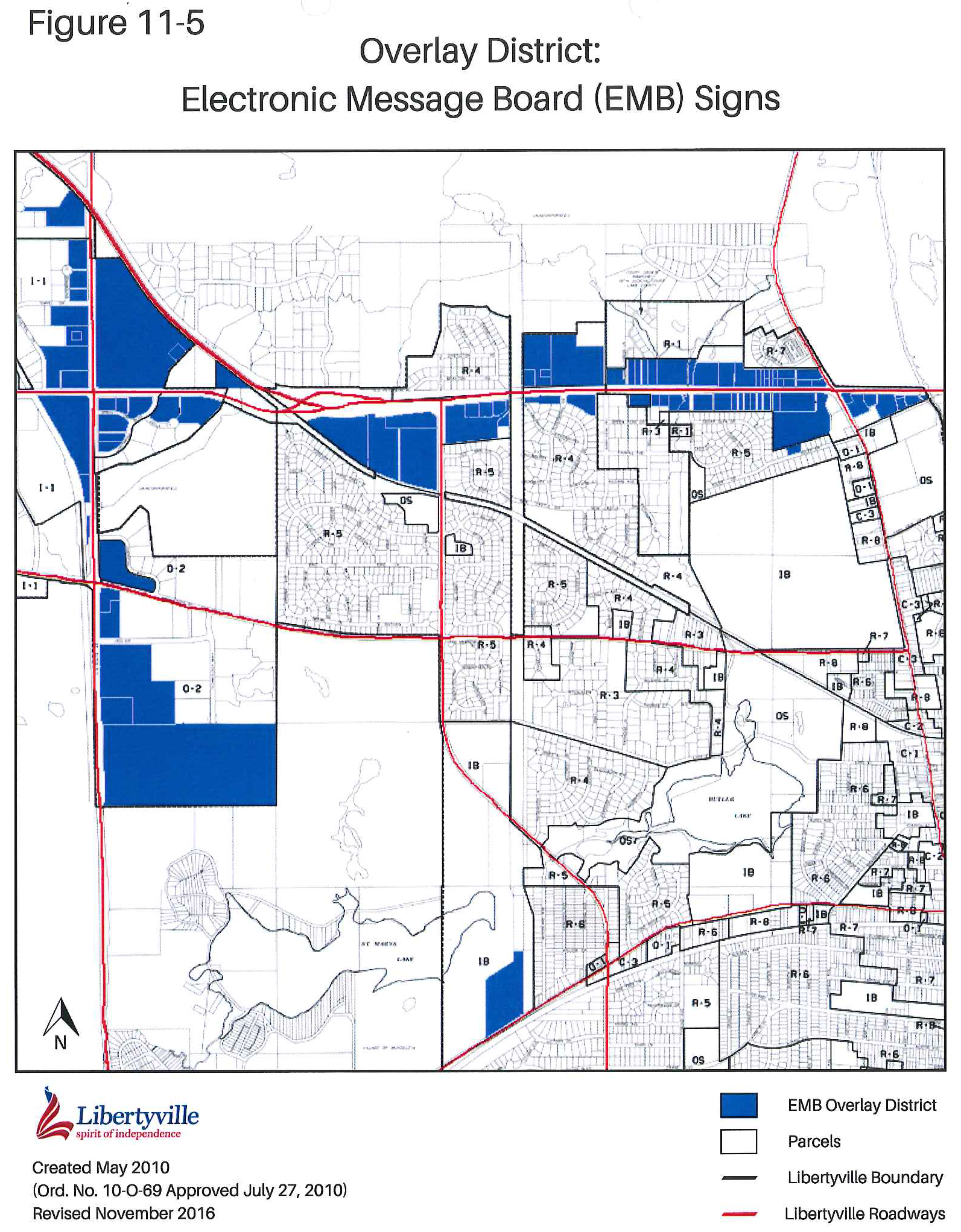
(Ord. No. 13-O-05, § 2(Exh. A), 1-22-13; Ord. No. 15-O-40, § 3(Exh. A), 5-26-15; Ord. No. 16-O-101, § 3(Exh. A), 11-8-16)

