
Lilburn City Zoning Code
ARTICLE 14
- DEFINITIONS
For the purposes of this resolution [ordinance], certain words or terms used herein shall be defined as follows:
• Words used in the singular include the plural and words used in the plural include the singular.
• Words used in the present tense include future tense.
• The word "erected" includes the words "constructed", "moved", "located", or "relocated".
• The word "lot" includes the word "plot" or "parcel".
• The word "person" includes the words "individuals", "firms", "partnerships", "corporation", "association", "governmental bodies" and other legal entities.
• The word "shall" is always mandatory and never discretionary.
• The words "used" or "occupied" as applied to any land or building shall be construed to include the words "intended, arranged or designed to be used or occupied."
Abandon: To stop the use of property or the occupancy of a building intentionally. Abandonment is presumed when the use of a property or building has ceased and the property or building has been vacant for 12 months or more.
Abutting: Having property lines in common, or having property separated by only an alley. Separation by a street right-of-way is not considered abutting.
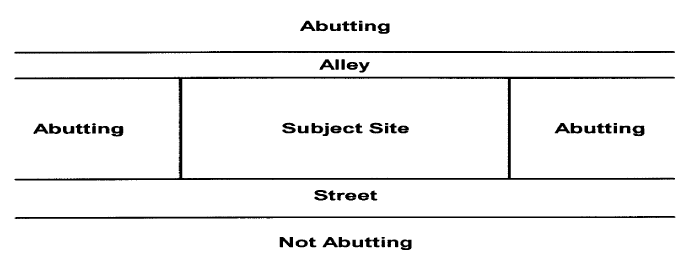
Abutting
Accessory dwelling unit, attached: A second dwelling unit that is added to the structure of an existing site-built single-family dwelling, for use as a complete, independent living facility for a single household, with provision within the accessory apartment for cooking, eating, sanitation and sleeping. Such a dwelling is considered an accessory use to the principal dwelling.
Accessory dwelling unit, detached: A second dwelling unit that is added to an existing accessory structure (e.g., residential space above a detached garage), or as a new freestanding accessory building, for use as a complete, independent living facility for a single household, with provision within the accessory apartment for cooking, eating, sanitation and sleeping. Such a dwelling is considered an accessory use to the principal dwelling. Includes the term garage apartment.
Adaptive reuse: Rehabilitation or renovation and occupancy of an existing building(s) or structures for use(s) other than the present use(s).
Alley: A public or private thoroughfare which affords only a secondary means of access to abutting property.
Alteration: Any change in the supporting members of a building or structure such as bearing walls columns, and girders, except such emergency change as may be required for safety purposes; any addition to a building; any change in use; or, any movement of a building from one location to another.
Amenity: Aesthetic or other characteristics that increase a development's desirability to a community or its marketability to the public. Amenities may differ from development to development but may include such things as recreational facilities, pedestrian plazas, views, streetscape improvements, special landscaping, or attractive site design.
Amusement Game Room: Any location, as provided in O.C.G.A. § 16-12-35(b), (c) or (d), where one or more bona fide coin-operated amusement machines are operated that permit non-cash redemption, as provided in O.C.G.A. § 16-12-35(d)(1)(A), (B), (C), or a combination thereof.
Animal hospital: An establishment designed or used for the care, observation, or treatment of domestic animals, which may include in-patient and out-patient treatment, indoor or outdoor boarding, ancillary outdoor dog runs or play areas, and emergency 24 hour medical services.
Animal quarters: Any structure which surrounds or is used to raise, breed (husbandry), house, shelter, care for, feed, exercise, train, exhibit, display, or show any animals or livestock other than domestic pets. This is not intended to apply to non-structural, fenced land for grazing. This includes the term "barn" when used to shelter livestock or other animals.
Annexation: The process by which a parcel of land is transferred from the jurisdiction of unincorporated Gwinnett County to the jurisdiction of the City of Lilburn.
Apartment: A building, distinguished from a "duplex" or "two-family" dwelling, designed for or occupied exclusively by more than two families or households with separate housekeeping facilities for each family for rent or lease. The term "apartment" shall include "triplex" and "quadruplex."
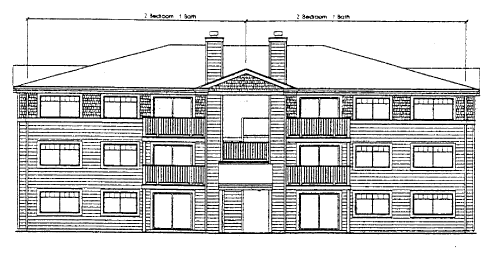
Apartment
Appeal: A request for a review of an administrative official's interpretation of any provision of this Zoning Ordinance, or a request for a review of an action taken by an administrative official in the application or enforcement of this Zoning Ordinance.
Applicant: A property owner or their authorized representative who has petitioned the city for approval of an application under the terms of this Zoning Ordinance.
Architectural appearance, exterior: The architectural character and general composition of the exterior of a structure, including but not limited to the kind, color, and texture of the building material and the type, design, and character of all windows, doors, light fixtures, signs, and appurtenant elements.
Architectural features: Ornamental or decorative features attached to or protruding from an exterior wall or roof, including cornices, eaves, belt courses, sills, lintels, bay windows, chimneys, and decorative ornaments.
Architectural recesses: Portions of a building wall at street level which are set back from the street line so as to create articulation of the building wall and/or to provide space for windows or doors.
Assisted living facility: Residences for the elderly who are in need of assistance that provide rooms, meals, personal care, and supervision of self-administered medication. They may provide other services incidental to the above, such as transportation, financial services and recreational facilities. Such facilities are also known as institutionalized residential living and care facilities.
Auction house or auction yard: Any building, structure, enclosure, or place where goods or livestock are sold by auction (i.e., through bid in competition with others). This use is a wholesale trade establishment.
Automated teller machine: A mechanized consumer device that is operated by a customer and which performs banking and financial functions. An automated teller machine is an accessory use.
Automobile sales or service establishment: Sale, lease, rental or service of new or used car, truck, tractor, trailer, boat, recreational vehicle, camper, motorcycle, and other motorized vehicles, manufactured home and modular building, agricultural implement or equipment, and similar vehicle or piece of equipment. This definition includes automotive services such as car rental, car sharing, and car wash facilities, vehicle maintenance facilities to include fluid replacements, and tire, glass, top and body, paint, transmission and similar mechanical repair shops.
Awning: A roof-like cover, often made of fabric or metal, designed and intended for protection from the weather or as a decorative embellishment, and which projects from a wall or roof of a structure over a window, walk, or door.
Awning, internally illuminated: A fixed awning covered with a translucent membrane that is, in whole or part, illuminated by light passing through the membrane from within the structure.
Bank or financial establishment: A business that accepts money for deposit into accounts from the general public or other financial institutions, and which may include personal or business loans, wire transfers and safe deposit boxes. Such uses include but are not limited to banks, savings and loan institutions and credit unions, and security and commodity exchanges.
Basement: That portion of a building having its lowest floor subgrade (below ground level) on two or more sides.
Batching plant: A plant for the manufacture or mixing of asphalt, concrete, cement, or concrete or cement products, including any apparatus incidental to such manufacturing and mixing.
Bed and breakfast inn: A facility where overnight accommodations for not more than ten residents are provided to transients for compensation, with or without a morning meal. A bed and breakfast inn does not include retail uses, public bar, conference center, or special event facilities.
Berm: An earthen mound or embankment, usually less than three feet if designed to provide visual interest only, and usually six feet or more in height if intended to screen views or reduce noise.
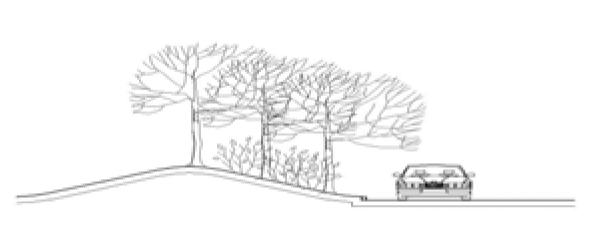
Planted Berm
Big box: A non-residential structure larger than 20,000 square feet of heated space.
Block: A piece or parcel of land entirely surrounded by roads.
Brewery, craft: Any maker, producer, or bottler of an alcoholic beverage, specifically malt beverages.
Broadcasting studio: A room or suite of rooms operated as a radio or television broadcasting studio or station with local broadcast capability or intended for satellite distribution of programs, and usually including satellite dishes, microwave dishes, and/or other communications equipment.
Buffer, natural vegetative: A strip of land of specified width located between a side or rear property line and a building, structure, or use, intended to separate and obstruct the view of the site on which the buffer is located from an abutting property, and which contains a natural area consisting of trees and/or other vegetation, undisturbed except for approved access and utility crossings, and replanted where sparsely vegetated.
Building: The word "building" includes the word "structure."
Building, accessory: A building subordinate to the main building on a lot and used for purposes incidental to the main or principal building and located on the same lot therewith.
Building, principal: A building in which is conducted the principal use of the lot on which said building is situated. In any residential zoning district, any structure containing a dwelling unit shall be defined to be the principal building on the plot on which same is situated, except for detached accessory apartments. When an accessory building is attached to a principal building by a breezeway, passageway, or similar means, the accessory building shall be considered part of the principal building and shall comply with the yard requirements for a principal building.
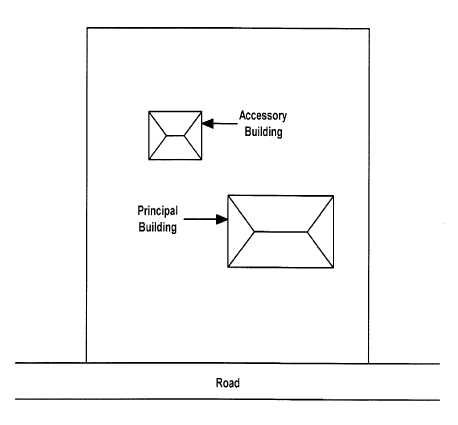
Building, Accessory and Principal
Building coverage: The horizontal area measured within the outside of the exterior walls of the ground floor (i.e., "footprint") of all principal buildings, accessory buildings, and accessory structures on the lot, not including steps, terraces, and uncovered porches.
Building coverage, maximum: The highest percentage of a given lot that may be occupied by all principal and accessory buildings and structures on said lot, measured within the outside of the exterior walls of the ground floor (i.e., "footprint") of all principal and accessory buildings and structures on the lot, not including steps, terraces, and uncovered porches.
Building footprint: The horizontal area of a building as seen in plan view, measured from the outside of all exterior walls and supporting columns.
Building frontage: The width in linear feet of the front exterior wall of a particular building, as measured more or less parallel to the front property line.
Build-to-line: A front building setback line applied to a principal building on a particular property so that a continuous and consistent building setback will be achieved considering the front building setbacks of buildings on abutting and/or adjacent lots on the same side of the street or right-of-way.
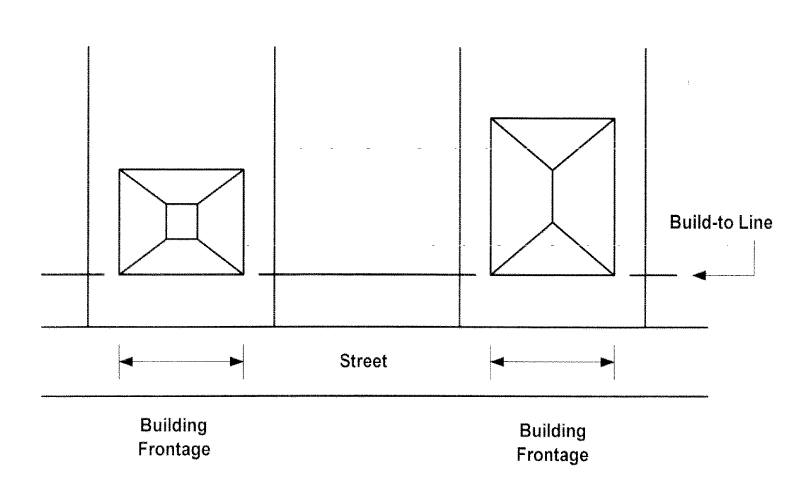
Building Frontage and Build-to-Line
Building, height of: The vertical distance measured from the finished grade to the highest point of the coping of a flat roof; to the deck lines of a mansard roof; or to the mean height level between the eaves and ridge of a gable, hip or gambrel roof. In this context finished grade is determined as the average elevation of the ground on all sides of a building.
Building inspector: The city's official, or designee, responsible for implementing and enforcing building codes applicable in the city.
Building materials sales: An establishment offering lumber or other construction materials used in buildings for sale to contractors or the general public. When operated in whole or part outside the confines of a building, a building materials sales establishment is an open air business.
Building setback line: A line establishing the minimum allowable distance between the front wall of a principal building and the street right-of-way line or another building wall and a side or rear property line when measured perpendicularly thereto. Covered porches, whether enclosed or not, shall be considered as a part of the building and shall not project into beyond a required building setback line. For purposes of this Zoning Ordinance, a minimum required building setback line and minimum required yard shall be considered the same.
Bulk storage: The storage of chemicals, petroleum products, or similar materials in above ground or below-ground storage containers designed for wholesale distribution or mass consumption. This includes fuel oil distributors with storage of products.
Business service establishment: A business activity engaged in support functions to establishments operating for a profit on a fee or contract basis, including but not limited to: advertising agencies, photocopying, blueprinting and duplication services, mailing agencies, commercial art and graphic design; personnel supply services and employment agencies, computer and data processing services, detective, protective, and security system services, accounting, auditing, and bookkeeping services, messenger services and couriers, publications and business consulting firms, food catering, interior decorating, and locksmiths.
Camp or campground: Any place established or maintained for two or more individual spaces or sites for temporary living quarters in cabins, structures, or tents for recreation or vacation purposes for a fee.
Canopy: A roof-like structure, supported by a building and/or columns, poles, or braces extending from the ground, including an awning, that projects from the wall of a building over a sidewalk, driveway, entry, window, or similar area, or which may be freestanding. This term does not include carport as defined.
Car wash: The use of a site for washing and cleaning of passenger vehicles, other vehicles, or other light duty equipment. Car washes consist of self-service, staffed, or mechanically automated facilities. For purposes of this Zoning Ordinance, a car wash is considered an automobile service establishment whether it is a principal use or accessory to another use or building.
Carport: A roofed, accessory building or structure, not necessarily fully enclosed on the sides and usually open on two or more sides, made of canvas, aluminum, wood, or any combination thereof, including such materials on movable frames, for the shade and shelter of private passenger vehicles or other motorized or non-motorized equipment such as tractors and boats.
Catering service: An establishment that serves and supplies food to be consumed off-premises. A catering service is a business service establishment.
Cemetery: The use of property as a burial place.
Certificate of occupancy: A document issued by the director indicating that the building and use or reuse of a particular building or land is in conformity with all applicable codes and regulations, and that such building or land may be occupied for the purpose stated therein.
Character: Those attributes, qualities and features that make up and distinguish a development project or area of the city and give such project or area of the city a sense of purpose, function, definition, and uniqueness.
City: The City of Lilburn, Georgia.
City council: The Mayor and Council of the City of Lilburn. The governing body of the city.
Clinic: An institution or professional office, other than a hospital or nursing home, where persons are counseled, examined, and/or treated by one or more persons providing any form of healing or medical health service. Persons providing these services may offer any combination of counseling, diagnostic, therapeutic or preventative treatment, instruction, or services, and which may include medical, physical, psychological, or mental services and facilities for primarily ambulatory persons.
Club or lodge, nonprofit: A building or premises, used for associations or organizations of an educational, fraternal, or social character, not operated or maintained for profit. Representative organizations include American Legion, Elks, Rotary, Lions, and Veterans of Foreign Wars. The term shall not include casinos, nightclubs, bottle clubs, or other establishments operated or maintained for profit.
Club, private: Buildings and facilities owned or operated by a corporation, association, person, or persons, and used for assembly of members for a social, educational, or recreational purpose, to which membership is required and where use of premises is restricted to members and their guests. The definition "private club" shall also include a "bona fide private club" as that term is defined in Georgia Code Section 3-7-1.
Co-generation facility: An installation that harnesses energy that normally would be wasted to generate electricity, usually through the burning of waste, and which may use, distribute through connection, or sell the energy converted from such process.
College or university: An educational use that provides training beyond and in addition to that training received in the 12th grade (i.e., undergraduate and graduate), and which has students regularly attending classes, and which confers an associate, bachelor, master, professional, and/or doctoral degree(s).
Commercial recreational facility, indoor: A use that takes place within an enclosed building that involves the provision of sports and leisure activities to the general public for a fee, including but not limited to the following: assembly halls, auditoriums, meeting halls, for-profit art galleries, billiard halls and pool rooms, amusement halls, trading card competitions, race carting tracks, whirly ball rinks, skateboard parks, video arcades, ice and roller skating rinks, bowling alleys, fully-enclosed theaters and laser tag or similar ventures.
Commercial recreational facility, outdoor: A use of land and/or buildings that involves the provision of sports and leisure activities to the general public for a fee, and which all or part of the activities occur outside of a building or structure, including but not limited to the following: amusement parks, water parks, stadiums, amphitheaters, fairgrounds, drive-in theaters, golf driving ranges, miniature golf courses, batting cages, skateboard parks, race tracks for animals or motor-driven vehicles, archery ranges, unenclosed firearms shooting ranges and turkey shoots, fish ponds, botanical and zoological gardens, ultra-light flight parks, paintball fields, and bungee jumping. A golf course and private club that is built as part of a single-family residential subdivision and that operates in a quasi-public manner is not considered to be an outdoor commercial recreational facility.
Common area: Land within a development, not individually owned or dedicated to the public, and designed for the common usage of the development. These areas include green open spaces and yards and may include pedestrian walkways and complimentary structures and improvements for the enjoyment of residents of the development. Maintenance of such areas is the responsibility of a private association, not the public.
Community living arrangement: Any residence, whether operated for profit or not, that undertakes through its ownership or management to provide or arrange for the provision of daily personal services, supports, care, or treatment exclusively for two or more adults who are not related to the owner or administrator by blood or marriage and whose residential services are financially supported, in whole or in part, by funds designated through the Georgia Department of Human Resources, Division of Mental Health, Developmental Disabilities, and Addictive Diseases or such similar state agency as may be reorganized. A community living arrangement with four or fewer adults is considered a household for purposes of this Zoning Ordinance and thus allowed the same as a single family. A community living arrangement with more than four adults is considered a group home for purposes of this Zoning Ordinance.
Community recreation: A private recreational facility for use solely by the residents and guests of a particular (usually residential) development, including indoor facilities such as community meeting rooms and outdoor facilities such as swimming pools, tennis courts, and playgrounds. These facilities are usually proposed, planned, and provided in association with a development and are usually located within the boundaries of such development.
Compatibility: With regard to development, the characteristics of different land uses or activities that permit them to be located near each other in harmony and without conflict. With regard to buildings, there is harmony in appearance of architectural features in the same vicinity.
Comprehensive plan: Any plan adopted by the city council, or any plan adopted by a regional development center covering the local jurisdiction, or portion of such plan or plans. This definition shall be construed liberally to include the major thoroughfare plan, master parks and recreation plan, or any other study, document, or written recommendation pertaining to subjects normally within the subject matter of a comprehensive plan as provided by the Georgia Planning Act of 1989, if formally adopted by the city council.
Condition of zoning approval: A requirement adopted by the city council at the time of approval of a rezoning, zoning amendment, or conditional use, placing greater or additional requirements or restrictions on the property than provided in this Zoning Ordinance in order to mitigate or reduce an adverse impact of the request and to further protect the public health, safety, or general welfare. This definition is not intended to be construed as limiting the legislative powers of the city council in any way.
Condominium: A form of ownership as defined by state law in which common elements are jointly owned.
Condominium building: A building containing one or more individually owned units or building spaces situated on jointly owned, common areas as defined by laws of the State of Georgia. When a building on property under condominium ownership contains only one dwelling unit, that building is considered a detached, single-family condominium building. When a building on property under condominium ownership contains two or more dwelling units, that building is considered an attached, multi-family condominium building.
Conservation: The management of natural resources to prevent waste, destruction, or degradation.
Conservation areas, primary: Any property qualifying as conservation use property under O.C.G.A. § 48-5-7.4; and any steep mountain slopes, floodplains, wetlands, water bodies, upland buffers around wetlands and water bodies, critical wildlife habitat, and sites of historic, cultural, or archaeological significance, located outside of building envelopes and lots established for building purposes.
Conservation areas, secondary: Prime farmland, natural meadows, mature woodlands, farm fields, localized aquifer recharge areas, and lands containing scenic views and sites, located outside of building envelopes and lots established for building purposes.
Conservation easement: A nonpossessory interest of a holder in real property imposing limitations or affirmative obligations, the purposes of which include retaining or protecting natural, scenic, or open-space values of real property; assuring its availability for agricultural, forest, recreational, or open-space use; protecting natural resources; maintaining or enhancing air or water quality; or preserving the historical, architectural, archeological, or cultural aspects of real property (O.C.G.A. § 44-10-1); A legally enforceable agreement between a property owner and the holder of the easement, in a form acceptable to the governing body and recorded in the office of the Clerk of Superior Court of Gwinnett County. A conservation easement restricts the existing and future use of the defined tract or lot to conservation use, agriculture, passive recreation, or other use approved by the governing body and prohibits further subdivision or development. Such agreement also provides for the maintenance of open spaces and any improvements on the tract or lot. Such agreement cannot be altered except with the express written permission of the easement holder and any other co-signers. A conservation easement may also establish other provisions and contain standards that safeguard the tract or lot's special resources from negative changes.
Conservation subdivision: A subdivision, as defined by this Code, where open space is the central organizing element of the subdivision design and that identifies and permanently protects all primary and all or some of the secondary conservation areas within the boundaries of the subdivision.
Construction field office: A structure used as an office in conjunction with a project while it is being constructed. A construction field office is a temporary use. It may be an industrial building, as defined herein.
Construction yard: An area on or immediately adjacent to a construction site used on a temporary basis for the parking and storage of equipment used in a construction project, and the storage and preparation of materials and other items used in the construction project. Such yards may include one or more construction field offices.
Continuing care retirement community: A residential facility providing multiple, comprehensive services to older adults. Such facility normally contains a combination of independent living units, assisted living, and skilled nursing care units as defined herein. Such facilities generally provide support services, such as meals, laundry, housekeeping, transportation, and social and recreational activities.
Contractor's establishment: An establishment engaged in the provision of construction activities, including but not limited to, plumbing, electrical work, building, grading, paving, roofing, carpentry, and other such activities, including the storage of material and the overnight parking of commercial vehicles. Also, this definition includes landscaping companies, as defined herein.
Convenience store: A retail store, usually with a floor area usually no more than 5,000 square feet, selling convenience goods, such as prepackaged food items and a limited line of groceries. Convenience stores may or may not sell gasoline, diesel, and kerosene, but do not include automotive services.
Cornice: Any horizontal member, structural or non-structural, of any building, projecting outward from the exterior walls at the roof line.
Crisis center: A facility or portion thereof and premises that are used for the purposes of emergency shelter, crisis intervention, including counseling, referral, hotline response, and similar human social service functions. Said facility may include meal preparation, distribution, or service for residents of the center as well as nonresidents, merchandise distribution, or shelter, including boarding, lodging, or residential care. This term includes domestic violence and centers, homeless shelters, and halfway houses.
Cul-de-sac: A road having one end open to traffic and being permanently terminated at the other end by a vehicular turn-around.
Curb: A boundary, usually constructed of concrete, usually marking the edge of a roadway or paved area, which is designed to channel storm water to drainage inlets and/or prevent or deter access.
Custom order shop: A business establishment that offers merchandise but which maintains no merchandise inventory on site other than display items (which are not visible from the exterior of the building). This use is an enclosed retail trade establishment.
Day care center: Any place operated by a person, society, agency, corporation, institution or group, and licensed or registered by the State of Georgia as a group day care home or day care center, wherein are received for pay for group supervision and care, for fewer than 24 hours per day, seven or more persons.
Density: The quantity of building or dwelling units per unit of area.
Department: The Planning Department of the City of Lilburn.
Detail: A small feature or element that gives character to a building.
Detention: The temporary retaining of storm water on-site.
Detention pond: A pond or pool used for the temporary storage of storm water runoff and which provides for the controlled release of such storm water.
Development: Any man-made change to improved or unimproved real estate, including, but not limited to, buildings or other structures, mining, dredging, filling, grading, paving, excavating, drilling operations, or permanent storage of materials; any activity which alters the elevation of the land, removes or destroys plant life, or causes structures of any kind to be erected or removed.
Developmentally disabled person: A person with a disability resulting in substantial functional limitations in such person's major life activities which disability is attributable to mental retardation, cerebral palsy, epilepsy, or autism or is attributable to any other condition related to mental retardation because such condition results in impairment of general intellectual functioning or adaptive behavior similar to that of mentally retarded persons.
Director: The person, or his designee, responsible for administration, interpretation, and enforcement of this ordinance who shall have the duties and authority with respect to this article as provided in the various articles and sections of this article and those necessarily implied by said provisions.
Distillery: A distillery engages in distilling, rectifying and blending distilled spirits. Distilled spirit is any alcoholic beverage obtained by distillation or containing more than 21 percent alcohol by volume, including but not limited to all fortified wines.
Dormer: A window projecting from a roof.
Dormitory: A building designed for a long-term stay by students of a college, university, or nonprofit organization for the purpose of providing rooms for sleeping purposes, and which may include common kitchen and/or common gathering rooms for social purposes.
Drive through: A retail or service enterprise wherein service is provided or goods are sold to the customer within a motor vehicle and outside of a principal building.
Dry cleaning plant: A building, portion of a building, or premises used or intended to be used for cleaning fabrics, textiles, wearing apparel, or articles of any sort by immersion or agitation, or by immersions only, in volatile solvents included, but not limited to, solvents of the petroleum distillate type, and/or the chlorinated hydrocarbon type, and the processes incidental thereto.
Dumpster: A container designed to hold refuse that has a hooking connection that permits it to be raised and dumped into a sanitation truck for disposal, or a container (excluding temporary placements) designed to hold refuse that is loaded onto a truck.
Dwelling: A building or portion of a building arranged or designed to provide living quarters for one or more families or households on a permanent or long-term basis.
Dwelling, single-family detached: A site-built residential building, or an industrialized building, designed for occupancy by one family or household. This term does not include manufactured homes or mobile homes. Single-family, detached dwellings may be under fee-simple (i.e., individual lot) ownership or on a condominium basis.
Dwelling, single-family detached, fee-simple: A building designed or arranged to be occupied by one family or household only, and where such dwelling is located on its own lot in fee-simple title.
Dwelling, multi-family: A building other than a duplex, designed for or occupied exclusively by three or more families or households with separate housekeeping facilities for each family.
Dwelling unit: A building, or portion thereof, designed, arranged and used for living quarters for one or more persons living as a single housekeeping unit with cooking facilities, but not including units in hotels or other structures designed for transient residence.
Easement: A non-possessory interest in land; a grant by a property owner for the use by the public, a corporation or persons, of a portion of land for a specified purpose or purposes.
Easement, access: An easement devoted to vehicular access which affords a principal means of access to abutting property or properties, but which is not necessarily open to the general public and which is not necessarily improved to standards of the city.
Elevation drawing: An architectural drawing of a building or building façade, intended to illustrate its design, characteristics and major features.
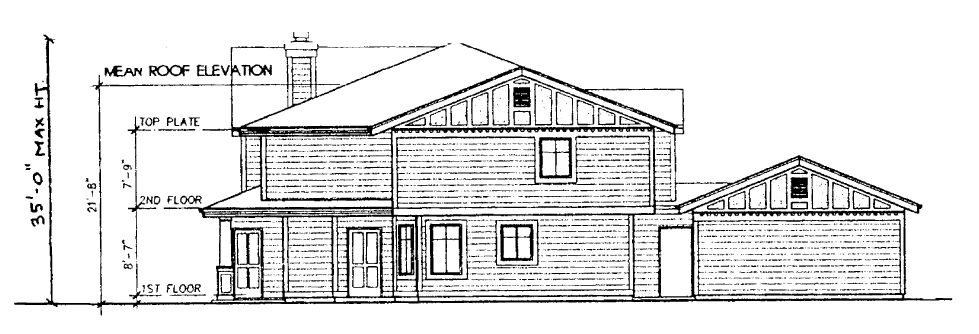
End Elevation - Unit
Esthetician: Defined as any licensed individual who performs any one of the following: massages the face or the neck, massages the arms or the décolletage, trims/tweezes the eyebrows, dyes eyelashes or eyebrows, applies eyelash extensions, or waxes the face, neck, arms, torso, or legs of an individual.
Exterminator: An establishment engaged in pest control for businesses, institutions, residences, or industries. Such a use is a business service establishment.
Extractive industry: Removal or recovery by any means whatsoever of sand, gravel, soil, rock, minerals, mineral substances or organic substances other than vegetation, from water or land on or beneath the surface thereof, exposed or submerged. This term includes gravel pits, mines, quarries, and similar operations.
Façade: The face (exterior elevation) of a building, especially the face parallel to or most nearly parallel to a public street.
Family: One or more persons related by blood, marriage, adoption, or guardianship; or not more than four persons not so related who live together in a dwelling unit as a single housekeeping unit under a common housekeeping management plan based on an intentionally structured relationship providing organization and stability; or not more than two unrelated persons and any minor children related to either of them.
Family day care home: A private residence in which a business, registered by the State of Georgia, is operated by any person who receives therein (for pay) for supervision and care for fewer than 24 hours per day, not more than six persons who are not residents in the same private residence. For purposes of this Zoning Ordinance, a family day care home may be operated as a home occupation, subject to the requirements of this Zoning Ordinance.
Fee simple: A form of ownership where the owner is entitled to the entire property with unconditional power of disposition during his or her life and which descends to his or her heirs and legal representatives upon his or her death intestate.
Fence: An enclosure or barrier, composed of wood, masonry, stone, wire, iron, or other materials or combination of materials used as a boundary, means of protection, privacy screening, or confinement, including brick or concrete walls but not including hedges, shrubs, trees, or other natural growth.
Fence, barbed wire: One or more strands of wire or other material having intermittent sharp points of wire or metal that may puncture, cut, tear, or snag persons, clothing, or animals, including vertical supports.
Fence, chain-link: An open mesh fence made entirely of wire woven in squares of approximately 1.5 inches with vertical supports.
Fence, decorative: An ornamental fence made of materials that are decorative in nature. Decorative materials include, but may not be limited to brick, stone, stucco, wood, picket, split rail, wrought iron, or similar materials.
Fence, solid: A fence, including entrance and exit gates where access openings appear, through which no visual images can be seen.
Finance, insurance, and real estate establishment: Such uses include but are not limited to banks, savings and loan institutions and credit unions, security and commodity exchanges, insurance agents, brokers, and service, real estate brokers, agents, managers, and developers, trusts, and holding and investment companies.
Flea market: The use of land, structures or buildings for the sale of produce or goods, usually second-hand or cut-rate. A flea market is considered an open air business.
Forestry: An operation involved in the growing, conserving, and managing of forests and forest lands. Forestry operations or practices include the raising and harvesting of timber, pulp woods and other forestry products for commercial purposes, the construction of roads, insect and disease control, fire protection, and may include the temporary operation of a sawmill and/or chipper to process the timber cut from the parcel or parcels. This term does not include the cutting of timber associated with approved land development.
Funeral home: A building used for human funeral services. Such building contains a chapel and may include space and facilities for embalming and the performance of other services used in the preparation of the dead for burial or cremation, the performance of autopsies and other surgical procedures, the indoor storage of caskets, funeral urns, and other related funeral supplies, and/or the indoor storage of funeral vehicles.
Gable: The triangular upper portion of an end wall, underneath a peaked roof.
Gas tank sales: The retail sale of bulk storage tanks for flammable and combustible liquids, compressed gases or liquefied petroleum (LP) gas. Gas tank sales are considered open air business uses.
Grade, finished: The final elevation and contour of the ground after cutting or filling and conforming to the proposed design.
Grading: Altering the shape of ground surfaces to a predetermined condition; this includes stripping, cutting, filling, stockpiling and shaping or any combination thereof and shall include the land in its cut or filled condition.
Greenhouse: A building designed or used for growing or propagating plants, with walls or roof usually designed to transmit light.
Group home: A single housekeeping unit of more than six unrelated persons, whether or not they are developmentally disabled. See also community living arrangement.
Guest house: A lodging unit for temporary guests in an accessory building. No guest house shall be rented or otherwise used as a separate dwelling.
Harmony: A quality that represents an attractive arrangement and agreement of parts of a composition, as in architectural elements.
Hazardous waste: Any solid waste which has been defined as a hazardous waste in regulations, promulgated by the government of the United States or the State of Georgia.
Health spa: An establishment which for profit or gain provides as one of its primary purposes, services or facilities which are purported to assist patrons improve their physical condition or appearance through change in weight, weight control, treatment, dieting, or exercise. The term includes establishments designated as "reducing salons," "exercise gyms," "health studios," "health clubs," "fitness studios," and other terms of similar import. Not included within this definition are facilities operated by nonprofit organizations, facilities wholly owned and operated by a licensed physician at which such physician is engaged in the practice of medicine, or any establishment operated by a health care facility, hospital, intermediate care facility, or skilled nursing care facility.
Hedge: A row of closely planted shrubs, bushes, or any kind of plant forming a boundary.
Helicopter landing pad: Any structure or area which is designed or constructed for use, or used, as a helicopter landing area or any structure or area which is used as a helicopter landing area.
Home occupation: Any use, occupation or activity conducted on the same site as a dwelling which is clearly incidental and secondary to the use of the dwelling for residence purposes and does not change the character thereof, as may be lawfully established under the terms of this Zoning Ordinance.
Hospital: An institution licensed by the state and providing primary health services and medical or surgical care to persons, primarily in-patients, suffering from illness, disease, injury, deformity or other abnormal physical or mental conditions, and including as an integral part of the institution, such related facilities as laboratories, outpatient facilities, or training facilities.
Hotel: A commercial lodging service with one or more buildings devoted to the temporary shelter for the traveling public, and where entry to individual guest rooms is via a central lobby. A hotel is a lodging service for purposes of this Zoning Ordinance.
Household: A family, as defined herein, or a group of not more than four persons, including developmentally disabled persons and their caretakers, who need not be related by blood, marriage, or guardianship, living together in a dwelling unit as single housekeeping unit.
Impact: The effect of any direct man-made actions or indirect repercussions of man-made actions on existing physical, social, or economic conditions.
Impervious surface: A man-made structure or surface, which prevents the infiltration of water into the ground below the structure or surface. Examples are buildings, structures, roads, driveways, parking lots, decks, swimming pools, and patios.
Improvements: The physical additions and changes to land that may be necessary to produce usable, desirable and acceptable lots or building sites.
Incinerator: A facility with equipment that uses a thermal combustion process to destroy or alter the character or composition of medical waste, sludge, soil, or municipal solid waste, not including animal or human remains.
Institutional residential living and care facilities: An umbrella term that encompasses the following uses as specifically defined in this ordinance: assisted living facility, intermediate care home, nursing home, skilled nursing care facility, and personal care home.
Intermediate care home: A facility which admits residents on medical referral; it maintains the services and facilities for institutional care and has an agreement with a physician and dentist who will provide continuing supervision including emergencies; it complies with rules and regulations of the Georgia Department of Human Resources or state agency with jurisdiction as may be reorganized. The term "intermediate care" means the provision of food, including special diets when required, shelter, laundry and personal care services, such as help with dressing, getting in and out of bed, bathing, feeding, medications and similar assistance, such services being under appropriate licensed supervision. Intermediate care does not normally include providing care for bed patients except on an emergency or temporary basis.
Janitorial/cleaning service establishments means primarily engaged in cleaning building interiors, windows, carpets, and upholstery, and in cleaning and maintaining factories, offices, apartments, and other business and institutional buildings.
Junk: Scrap or waste material of any kind or nature collected for resale, disposal, or storage, or by accumulation.
Kennel: An establishment in which dogs or domesticated animals are housed, groomed, bred, boarded, trained, or sold, all for a fee or compensation.
Kennel, private: The keeping, breeding, raising, showing, or training of four or more dogs over six months of age for personal enjoyment of the owner or occupant of the property.
Kitchen: Any room or part of a room designed, built, used, or intended to be used for cooking, the preparation of food, or dishwashing. The presence of a range, oven, or dishwasher, or utility connections suitable for serving a range or oven, shall normally be considered as establishing a kitchen.
Land-disturbing activity: Any activity which may result in soil erosion from water or wind and the movement of sediments into state waters or onto lands within the state, including, but not limited to, clearing, dredging, grading, excavating, transporting, and filling of land but not including practices specifically exempt from the city's soil erosion, sedimentation, and pollution control ordinance unless the context clearly indicates otherwise.
Landfill, construction and demolition: A disposal facility accepting waste building materials and rubble resulting from construction, remodeling, repair and demolition operations on pavements, houses, commercial buildings, and other structures. Such wastes include, but are not limited to, asbestos containing waste, wood, bricks, metal, concrete, wall board, paper, cardboard, inert waste landfill material and other inert wastes which have a low potential for groundwater contamination.
Landfill, inert waste: A disposal facility accepting only wastes that will not or are not likely to cause production of leachate of environmental concern. Such wastes are limited to earth and earth-like products, concrete, cured asphalt, rock, bricks, yard trimmings, stumps, limbs, and leaves, and specifically excluding industrial and demolition waste.
Landfill, sanitary: The burial of nonhazardous waste where such waste is covered on a daily basis, as distinguished from a construction and demolition landfill.
Landscape strip: An area of landscaping of specified width.
Landscaping: The modification of the landscape for an aesthetic or functional purpose. The area within the boundaries of an individual lot that includes the preservation of existing vegetation and the continued maintenance thereof, as well as, the installation of trees, shrubs, ground covers, grass, and flowers. Landscaping areas may also include decorative rock, bark, mulch and other similar approved materials in addition to vegetation and live plant material.
Landscaping company: A business engaged in the provision of landscaping services and/or the wholesale or retail sale of landscaping products including but not limited to sod, trees, landscaping timbers, and earth covering materials. The processing of wood into timbers, mulch, and/or chips is considered an incidental use of a landscaping company whose primary purpose is the wholesale or retail sale of landscaping products.
Laundromat: A facility where patrons wash, dry, or dry clean clothing or other fabrics in machines operated by the patron. A laundromat is considered a personal service establishment.
Lighting, neon outline: Outline lighting formed in whole or part with neon.
Live-work unit: Buildings or spaces within buildings that are used jointly for commercial and residential purposes where the two uses are physically connected in one unit and residential use of the space is accessory to the primary use as a place of work. This term is distinguished from a home occupation and from a mixed-use building. Live-work units may have larger work spaces than permitted by home occupation, and live/work units design the floor space for both living and working areas. Live-work units are distinguished from mixed-use buildings in that a mixed-use building has residential and nonresidential uses in the same building, but the residential and nonresidential spaces are not necessarily connected or used by the same person.
Livestock: Cattle, horses, pigs, sheep, goats, llamas, emus, ostriches, donkeys, mules, goats, sheep, chickens, ducks, geese, and other fowl, rabbits, minks, foxes and other fur or hide-bearing animals, customarily bred or raised in captivity, whether owned or board, whether kept for pleasure, utility, or sale.
Lodging service: A facility that offers temporary shelter accommodations, or place for such shelter, open to the public for a fee, including "hotels" and "motels." "Bed and breakfast inn" is defined separately and is not considered a lodging service for purposes of this Zoning Ordinance.
Lot: A parcel of land occupied or capable of being occupied by a use, building or group of buildings devoted to a common use, together with the customary accessories and open spaces belonging to the same. The word "lot" includes the word "plot" or "parcel."
Lot, corner: A lot abutting upon two or more streets at their intersection.
Lot, double frontage: Any lot, other than a corner lot, which has frontage on two streets.
Lot, flag: A tract or lot of land of uneven dimensions in which the portion fronting on a street is less than the required minimum width required for construction of a building or structure on that lot.
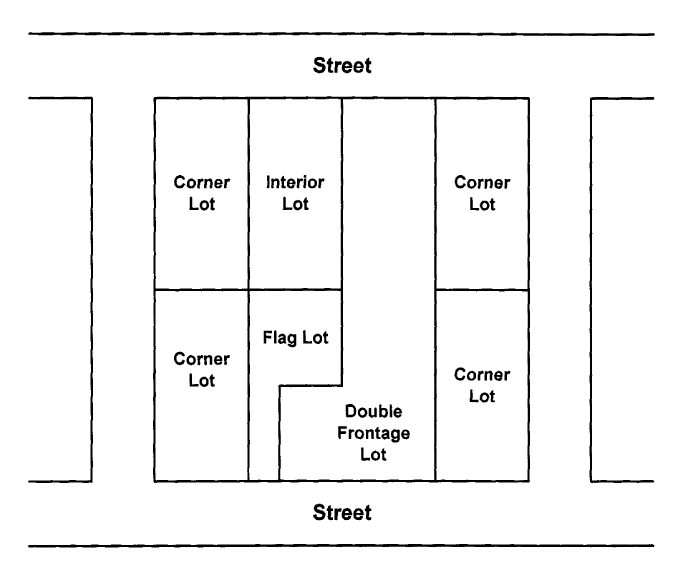
Types of Lots
Lot area, minimum: Minimum lot area means the smallest permitted total horizontal area within the lot lines of a lot, exclusive of street and alley rights-of-way but inclusive of easements.
Lot depth: The mean horizontal distance between front and rear lot lines.
Lot frontage: The width in linear feet of a lot where it abuts the right-of-way of any street.
Lot width: The distance between side lot lines measured at the front building line.
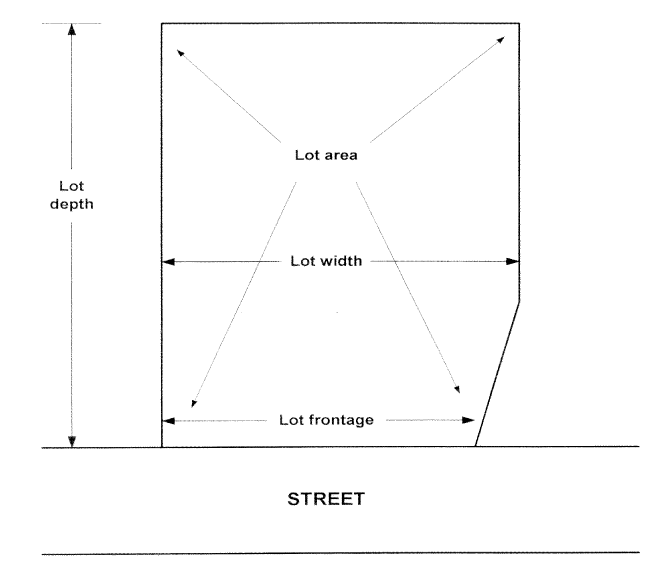
Lot Definitions
Lot of record: A lot which is part of a subdivision, a plat of which has been lawfully recorded in the records of the Clerk of Superior Court of Gwinnett County; or a parcel of land, the deed of which has been lawfully recorded in the same office as of the effective date of this Zoning Ordinance.
Lumber yard: A facility where wood materials such as lumber, plywood, panels or other wood products are processed and sold for retail sale or wholesale. Such use may involve performing millwork, planing, cutting, and/or other customizing processes.
Manufactured home: Any dwelling unit designed and constructed in compliance with the Georgia State Minimum Standard One and Two Family Dwelling Code which is wholly or in substantial part, made, fabricated, formed, or assembled in a manufacturing facility and cannot be inspected at the installation site without disassembly, damage to, or destruction thereof. Any such structure shall not contain a permanent metal chassis and shall be affixed to a permanent load-bearing foundation. The term shall not include manufactured homes as defined by the National Manufactured Housing Construction and Safety Standards Act of 1974, 42 U.S.C. Section 32 5401, et seq.
Manufacturing, processing, assembling: The mechanical or chemical transformation of materials or substances into new products. The land uses engaged in these activities are usually described as plants, factories or mills and characteristically use power-driven machines and materials handling equipment. Establishments engaged in assembling component parts of manufactured products are also considered under this definition if the new product is neither a fixed structure nor other fixed improvement. Also included is the blending of materials such as lubricating oils, plastic resins, or liquors.
Marquee: A roofed structure attached to and supported by a building and projecting over public or private sidewalks or rights-of-way.
Massing: The overall visual impact of a structure's volume; a combination of height and width and the relationship of the heights and widths of the building's components.
Materials recovery facility: A solid waste handling facility that provides for the extraction from solid waste of recoverable material, materials suitable for use as a fuel or soil amendment, or any combination of such materials.
Metes and bounds: A system of describing and identifying land by a series of lines around the perimeter of an area; "metes" means bearings and distances and "bounds" refers to physical monuments.
Microbrewery: A small, usually independently owned brewery that produces limited quantities of specialized beers, predominantly for localized distribution, often serving them on the premises in association with food services.
Mini-warehouse: (see self-service storage facility).
Mobile food vending: To peddle, vend, sell, display, or offer for sale or give away food and/or non-alcoholic beverages from a mobile food vending unit parked or located on a private parcel of property.
Mobile food vending unit: A motor vehicle, cart, trailer, tent, table, or other temporary structure that is readily moveable and that is designed and equipped to prepare and serve food as designed by state law and in accordance with the rules and regulations for food service of the Gwinnett, Newton, and Rockdale County Board of Health. Food trucks may not exceed 26 inches in length, and pushcarts may not exceed a maximum size of five feet by ten feet.
Mobile home: A structure, transportable in one or more sections, which, in the traveling mode, is eight-body feet or more in width or 40-body feet or more in length, when erected on site, is 320 or more square feet in floor area, and which is built on a permanent chassis and designed to be used as a dwelling with or without a permanent foundation when connected to the required utilities, and includes the plumbing, heating, air-conditioning, and electrical systems contained therein; and manufactured prior to June 15, 1976. Mobile homes are not allowable as permanent residences in the city.
Model home: A dwelling temporarily used as a sales office or demonstration home for a residential development under construction, said dwelling being used as an example of a product offered for sale to purchasers (by a realtor, building developer, or contractor). The dwelling may be furnished but is not occupied as a residence while being used as a model home.
Modular building unit: Any building of closed construction, regardless of type of construction or occupancy classification, other than a mobile or manufactured home, constructed off-site in accordance with the current International Building Code Certification and transported to its ultimate site from the factory and assembled on a permanent foundation. Modular homes may consist of one or more stories. A copy of the Current International Building Code Compliance report must be reviewed before installation.
Motel: A commercial lodging service with one or more buildings devoted to the temporary shelter for the traveling public, and where entry to individual guest rooms is via the exterior of the building rather than through a central lobby.
Museum: A building having public significance by reason of its architecture or former use or occupancy, or a building serving as a repository for a collection of natural, scientific, literary curiosities or objects of interest, or works of art, and arranged, intended, and designed to be viewed by members of the public with or without an admission fee, and which may include as an accessory use the sale of snacks and goods to the public as gifts or for their own use.
Natural drainage: Channels formed by the existing surface topography of the earth prior to changes made by unnatural causes.
Nonconforming building or structure: A building or structure, which may be principal or accessory, that does not meet one or more applicable setbacks for the zoning district in which said building or structure is located, or a building or structure that exceeds the maximum height or building coverage for the zoning district in which said building or structure is located, or a building or structure that otherwise does not comply with dimensional requirements established by this Zoning Ordinance for the particular principal building or accessory structure or for the zoning district in which the nonconforming building or structure is located.
Nonconforming lot: A lot which does not conform to the minimum lot frontage requirements of this chapter and/or the minimum lot size and minimum lot width requirements of the zoning district in which the lot is located as established by this chapter but which was a lot of record prior to the effective date of this Zoning Ordinance or its amendment.
Nonconforming situation: Any development, land improvement, or activity, not otherwise included within the definition of nonconforming lot, nonconforming building or structure, nonconforming use, or nonconforming sign which does not meet the provisions of this chapter at the time of its adoption or amendment. Examples of nonconforming situations include but are not limited to, noncompliance with off-street parking regulations or access requirements, failure to adhere to landscape strip requirements, tree protection, and insufficient landscaping requirements.
Nonconforming use: Any building or use of land or building lawfully existing on or before the effective date of this Zoning Ordinance or as a result of subsequent amendments to this Zoning Ordinance, which does not conform to the use provisions of the zoning district in which it is located.
Nursery or kindergarten school: Any building used routinely for the daytime care or education of preschool age children and including all normal accessory and play areas. For purpose of this Zoning Ordinance, a nursery or kindergarten school is considered to be a day care center.
Nursing home: A facility which admits patients on medical referral only and for whom arrangements have been made for continuous medical supervision; it maintains the services and facilities for skilled nursing care, rehabilitative nursing care, and has an agreement with a physician and dentist who will be available for any medical and/or dental emergency and who will be responsible for the general medical and dental supervision of the patients; it complies with rules and regulations of the Georgia Department of Human Resources or state agency with jurisdiction as may be reorganized.
Office: A building or portion thereof wherein services are performed involving predominantly administrative, professional or clerical operations and not involving retail sales or other sales of any kind on the premises.
Office/warehouse: A building that combines office and warehouse or storage functions, where the majority of the area of the building is devoted to warehouse or storage functions, and which does not involve retail sales.
Opaque: Impenetrable to view, or so obscuring to view that features, buildings, structures, and uses become visually indistinguishable.
Open air business: Any commercial establishment with the principal use of displaying products in an area exposed to open air on three or more sides, including but not limited to rock yards, nurseries and garden centers and garden supply stores, lumber and building materials yards, flea markets, statuaries and monument sales establishments, liquid petroleum dealers and tank sales. A roadside stand is not considered to be an open air business.
Open space: Land and water areas retained for use as passive recreation areas or for resource protection or conservation in an essentially undeveloped state.
Open space, landscaped: That portion of a given lot, not covered by buildings, parking, access and service areas, that is designed to enhance privacy and the amenity of the development by providing landscaping features, screening and buffering for the benefit of the occupants or those in neighboring areas, or a general appearance of openness. Landscaped open space may include, but need not be limited to, grass lawns, decorative planting, berms, walls and fences, ornamental objects such as fountains, statues and other similar natural and man-made objects, wooded areas, and water courses, any or all of which are designed and arranged to produce an aesthetically pleasing effect within the development.
Overlay district: A defined geographic area that encompasses one or more underlying zoning districts and that imposes additional requirements above those required by the underlying zoning district. An overlay district can be coterminous with existing zoning districts or contain only parts of one or more such districts.
Outdoor storage: The keeping of any goods, junk, material, merchandise or commercial vehicles in the same outdoor place for more than 24 hours.
Parapet: That portion of a wall which extends above the roof line.
Parking space: An area having dimensions of not less than 300 square feet, including driveway and maneuvering area, to be used as a temporary storage space for a private motor vehicle.
Parking structure: A structure or portion thereof composed of one or more fully or partially enclosed levels or floors used for the parking or storage of motor vehicles. This definition includes parking garages, deck parking, and underground parking areas under buildings.
Pedestrian-scale development: Development designed with an emphasis primarily on the street sidewalk and on pedestrian access to the site and building, rather than auto access and parking areas. The building is generally placed close to the street and the main entrance is oriented to the street sidewalk. In the case of pedestrian retail districts, there are generally windows or display cases along building façades which face the street.
Permit: The authorization necessary to conduct an activity under the provisions of this Zoning Ordinance.
Permit, development: An official authorization issued by the department in accordance with this Zoning Ordinance to proceed with land disturbance and grading and site development, as set forth in this Zoning Ordinance. A development permit is separate from, but coordinated with the land disturbance permit required by Lilburn City Code (soil erosion, sediment, and pollution control). A development permit may be required even when a land disturbance permit is not required.
Person: Includes a firm, association, joint venture, organization, partnership, corporation, trust and company as well as an individual.
Personal care home: Any dwelling, whether operated for profit or not, which undertakes through its ownership or management to provide or arrange for the provision of housing, food service, and one or more personal services for two or more adults who are not related to the owner or administrator by blood or marriage. Personal care tasks include assistance with bathing, toileting, grooming, shaving, dental care, dressing, and eating.
Personal/in-home care: Refers to services provided in a residence, to an adult who needs assistance with essential activities of daily living, such as eating, bathing, grooming, dressing, toileting, ambulation, transferring, and supervision or assistance with self-administered medication. These services are non-medical and do not include medical or nursing care, except as authorized by waivers in state regulations.
Personal service establishment: A facility engaged in the provision of services to persons and their apparel, including but not limited to barber and beauty shops, coin-operated laundromats, full service laundries, dry cleaners, photographic studios, shoe repair and shoeshine shops, travel agencies, massage parlors, escort services, fortune-telling, psychics, clothing or costume rental, dating service, hair removal or replacement, or tanning salon.
Pervious pavers: A range of materials and techniques for paving roads and parking lots that which allow the movement of water and air around the paving material.
Pet, household: Any animal other than livestock or wild animals, which is kept for pleasure and not sale, which is an animal of a species customarily bred and raised to live in the habitat of residential dwellings or on the premises thereof and is dependent upon residents of the dwelling for food and shelter. Household pets include but are not limited to dogs, cats, rodents, common cage birds, aquarium-kept fish, Purebred Vietnamese Pot Bellied pigs, and small amphibians and reptiles.
Plan, concept: A graphic drawn to an engineering scale and submitted with an application for a rezoning, zoning amendment, annexation, or other type of application upon which the applicant has shown the intended development and its design. Approval of such an application containing a concept plan does not constitute approval of the concept plan in terms of authorizing development or building, which is subject to development and building permitting.
Plan, site: A drawing of a residential, institutional, office, commercial, or industrial development, showing the general layout of a proposed development including, among other features, the location of existing streams, existing and proposed roads and driveways, buildings, parking areas, and open spaces or landscaped open spaces. The site plan is the basis for the approval or disapproval of the general layout of a development in the case of a multiple-family residential, institutional, office, commercial, or industrial development. The site plan drawn to an engineering scale and is distinguished from a concept plan which is submitted with zoning and special use applications.
Planning commission: The City of Lilburn Planning Commission.
Planning director: See "Director".
Porch: A projection from a building wall which is covered but enclosed on all sides by a vertical wall.
Portico: An exterior appendage to a building, normally at the entry, usually roofed.
Recreational vehicle: A vehicular type unit primarily designed as temporary living quarters for recreational, camping or travel use, which either has its own motive power or is mounted or drawn by another vehicle. This term includes motorized homes, motorized campers, pick-up campers, travel trailers, camping trailers, and tent trailers, among others.
Recovered materials: Materials which have known use, reuse, or recycling potential; can be feasibly used, reused or recycled; and have been diverted or removed from the solid waste stream for sale, use, reuse, or recycling, whether or not requiring subsequent separation and processing.
Recovered materials processing: Any lot, land, structure, or facility, or part thereof, utilized for the purpose of collecting, sorting, processing for resale, and transport of materials to be recycled or reused, including: plastics, glass, paper, aluminum and scrap metals. Recovered materials processing does not include any operation which includes dismantling, or changes the nature of a material, its chemical composition or its physical qualities.
Relocated residential structure: A detached, single-family dwelling, site-built (i.e., excluding a manufactured home or mobile home) that is moved or disassembled into more than one structure and moved to another site, whether temporarily or permanently.
Religious assemblies: A site or facility maintained by a bona fide religious group for the primary purposes of religious worship, study, prayer, or other religious practices of such religious group. Religious assemblies include but are not limited to churches, temples, mosques, synagogues, and retreat centers.
Research laboratory: A facility for scientific laboratory research in technology-intensive fields, including but not limited to biotechnology, pharmaceuticals, genetics, plastics, polymers, resins, coatings, fibers, fabrics, films, heat transfer, and radiation research facilities, computer software, information systems, communication systems, transportation, geographic information systems, multi-media and video technology. Also included in this definition are facilities devoted to the analysis of natural resources, medical resources, and manufactured materials, including environmental laboratories for the analysis of air, water, and soil; medical or veterinary laboratories for the analysis of blood, tissue, or other human medical or animal products; and forensic laboratories for analysis of evidence in support of law enforcement agencies.
Restaurant: Any establishment in which the principal business is the sale of foods and beverages to customers in a ready-to-consume state, and in which customers are served their food and/or beverages by a restaurant employee at the same table or counter at which the items are consumed, or customers are served their food and/or beverages by means of a cafeteria-type operation where the food or beverages are consumed within the restaurant building. This term includes taverns, bars, pubs, and sidewalk cafes.
Restaurant, drive-through: Any establishment in which the principal business is the sale of foods and beverages to customers in a ready-to-consume state and in which the principal or accessory method of operation of all or any portion of the business is to allow food or beverages to be served directly to the customer in a motor vehicle without the need for the customer to exit the motor vehicle.
Retail trade establishment, enclosed: Any business offering goods and products for sale to the public, which may include the incidental repair of such goods and products, that operates entirely within a structure containing a roof and walls on all sides, except for outdoor display or other use during business hours and accessory storage in enclosed, subordinate buildings. These include but are not limited to the following: convenience stores including the sale of gasoline, hardware, paint, glass and wallpaper stores, grocery and miscellaneous food stores including retail bakeries, apparel, shoe, and accessory clothing stores, furniture, upholstery, floor covering, household appliance and home furnishing stores, musical instrument stores, radio, television, and computer stores, record, tape, and compact disc stores, eating and drinking places not involving drive-in or drive-through facilities, drug stores, apothecaries and proprietary stores, liquor stores and bottle shops, used merchandise stores and pawn shops, sporting goods stores and bicycle shops, art and stationery stores, hobby, toy, and game shops, jewelry, gift, novelty, souvenir and antique shops, camera and photographic supply stores, luggage and leather goods stores, sewing, needlework, and piece goods stores, catalogue and mail order stores, news stands, florists, tobacco shops, automotive parts stores not involving repair, video rental and sales stores, and watch and clock sales and repair shops.
Retaining wall: A wall or similar structure used at a grade change to hold soil on the up-hillside from slumping, sliding, or falling.
Retention: The permanent maintenance of storm water on-site.
Retention pond: A pond or pool used for the permanent storage of storm water runoff.
Rezoning: An amendment to the official zoning map, or an amendment to an overlay zone boundary, that changes the zoning district or overlay zone of one or more properties specified in an application.
Right-of-way, public: That area, distinguished from an easement or private road right-of-way, which is owned in fee-simple title by the city or other government, for the present or future use of alleys, roads and highways, together with any drainage facilities and other improved ancillary structures.
Road: A state highway, a county road, a road adopted as a county-owned right-of-way approved for county maintenance, a street owned and/or maintained by a municipality, a street approved for city maintenance, or where permitted, a private road. Roads afford the principal means of access to abutting property or properties. The term includes "street" but does not include "access easement."
Road, private: An improved road, distinguished from a public road in that the right-of-way which affords a principal means of access to abutting property or properties is privately owned and maintained.
Roadside stand: A use offering either farm-grown, prepared food products such as fruits, vegetables, canned foods, or similar agricultural products for sale on the premises within or without a temporary structure on the premises with no space for customers within the structure itself. Term includes produce stands.
Roof: The cover of a building, including the eaves and similar projections.
Roof, flat: A roof having no pitch or a pitch of not more than 2:12 (one foot of rise for each six feet of horizontal distance.
Roof, pitched: A shed, gabled, or hipped roof having a slope or pitch greater than 2:12.
Salvage yard: A place of business primarily engaged in the storage, sale, dismantling or other processing of uses or waste materials which are not intended for reuse in their original forms. Typical uses include paper and metal salvage yards, used tire storage yards, or retail and/or wholesale sales of used automobile parts and supplies. This term includes junk yards.
Sidewalk: A hard-surfaced pedestrian access area adjacent to or within the right-of-way of a public road or private road.
Sawmill: A facility where logs or partially processed wood are sawn, split, shaved, stripped, chipped, or otherwise processed to produce wood products. This term does not apply to the processing of timber for use on the same lot by the owner or occupant of that lot.
School for the arts: An educational use not operated by the Gwinnett County Board of Education that offers or provides instruction to more than two students at a time in dance, singing, music, painting, sculpting, fine arts, or martial arts.
School, private, elementary, middle, or high: An educational use for students in grades one through 12 or for only certain ranges of grades one through 12, not operated by the Gwinnett County Board of Education, which has a curriculum at least equal to a public school with regard to the branches of learning and study required to be taught in the public schools of the state of Georgia.
School, public: An educational use for students in grades one through 12 or for only certain ranges of grades one through 12, operated by the Gwinnett County Board of Education.
School, special: An educational use not operated by the Gwinnett County Board of Education that provides special education to more than two students at a time, including but not limited to the training of gifted, learning disabled, and mentally or physically handicapped persons.
School, trade: An educational use not operated by the Gwinnett County Board of Education and having a curriculum devoted primarily to business (including barbers and beauticians), industry, trade, or other vocational-technical instruction.
Self-service storage facility: Mini-warehouse; A structure, building or group of buildings divided into separate compartments, spaces, or stalls, which may be of different sizes and which may or may not be climate controlled, and which are leased or rented on an individual basis to businesses and residents for temporary storage needs, but where no commercial transactions or activities take place other than the rental of the storage units for exclusively storage purposes.
Service and fuel filling station: Any building, structure or land use for the retail sale of motor vehicle fuel and oil accessories, and which may include the servicing of motor vehicle, except that major repairs, body repairs and painting of motor vehicles shall not be considered servicing of motor vehicles.
Short-Term Rental: An accommodation for transient guests where, in exchange for compensation, a residential dwelling is rented in whole or in part for lodging for a period of time not to exceed 30 consecutive days. Such use may or may not include an on-site manager. For purposes of this definition, a residential dwelling shall include all housing types and shall not include group living or other lodging uses.
Showroom: A principal or accessory use where wholesale or retail goods are displayed.
Sight visibility triangle: The areas at the corners of an intersection of two streets, or at an intersection of a street and driveway, that must be kept free of shrubs, ground covers, berms, fences, structures, or other materials or items that would obstruct views at heights between 30 inches to 12 feet as measured from the ground.
Slaughterhouse: A facility for the slaughtering and processing of animals and the refinement of their byproducts. This term includes rendering plants.
Skilled nursing care facility: A facility which admits residents on medical referral; it maintains the services and facilities for skilled nursing care and has an agreement with a physician and dentist who will provide continuing supervision including emergencies; it complies with rules and regulations of the Georgia Department of Human Resources or state agency with jurisdiction as may be reorganized. The term "skilled nursing care" means the application of recognized nursing methods, procedures, and actions directed toward implementation of the physician's therapeutic and diagnostic plan, detection of changes in the human body's regulatory system, preservation of such body defenses, prevention of complications and emotional well-being.
Solid waste transfer facility: A fixed facility where solid waste from collection vehicles is consolidated and temporarily stored for subsequent transport to a permanent disposal site.
Special event facility: A facility or assembly hall available for lease by private parties or special events such as weddings. This term includes wedding chapels.
Street furniture: Those features associated with a street that are intended to enhance the street's physical character and use by pedestrians, such as benches, trash receptacles, planting containers, pedestrian lighting, kiosks, etc.
Streetscape: An area that may either abut or be contained within a public or private street right-of-way or access way that may contain sidewalks, street furniture, trees and landscaping, and similar features. Streetscape also includes the visual image of a street, including the combination of buildings, parking, signs, and hardscapes.
Structure: Anything built, constructed or erected, or established or composed of parts joined together in some definite manner, the use of which requires location on the ground or which is attached to something having permanent location on the ground. For purposes of this Zoning Ordinance, swimming pools, and tennis courts, are considered structures. Tents, vehicles, trailers, and play equipment attached to the ground in some permanent or temporary way shall be considered structures. A structure may or may not be easily moved from a given location on the ground. Walls and fences are considered structures.
Subdivision: The division of a tract or parcel of land into two or more lots, building sites, lease lots, or other divisions for the purpose, whether immediate or future, of sale, lease, legacy, or building development. The term shall include the opening of a new road, a change in existing roads, or divisions of land involving the extension of water, sewer, or gas lines. The term includes re-subdivision and, where appropriate to the context, relates to the process of subdivision or to the land or area subdivided.
Substantial accordance: Strong, yet not precise, conformity such that an ordinary person would conclude that all essential elements are met.
Taxi-cab or limousine service: Any place used to dispatch motor vehicles with drivers for hire.
Tow service: An establishment that dispatches towing vehicles and which provides for the temporary storage of vehicles but does not include disposal, disassembly, salvage, or accessory storage of inoperable vehicles. This term is distinguished from "wrecked motor vehicle compound" and "salvage yard" as defined herein.
Townhouse: One of a group of three or more single-family, attached dwelling units under fee simple ownership.
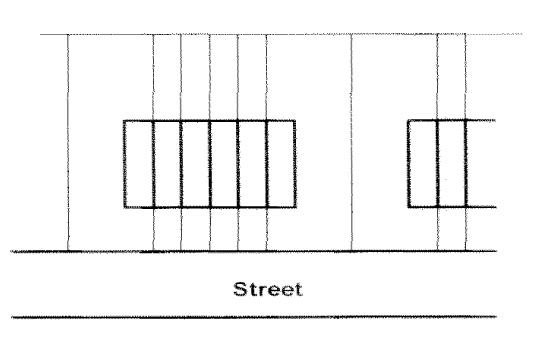
Townhouses (Attached Single-Family Fee Simple)
Trail: A way designed for and used by equestrians, pedestrians, and/or cyclists using non-motorized bicycles.
Trash enclosure: An accessory use of a site where trash and/or recyclable material containers, or any other type of waste or refuse container is stored.
Truck stop: An establishment engaged primarily in the fueling, servicing, repair, or parking of tractor trucks or similar heavy commercial vehicles, including the sale of accessories and equipment for such vehicles. A truck stop may also include overnight accommodations, showers, or restaurant facilities primarily for the use of truck drivers.
Use, accessory: A use of land subordinate to the principal building or use on a lot for purposes incidental and related to the principal building or use and located on the same lot therewith.
Use, conditional: A use that would not be appropriate generally or without restriction throughout a particular zoning district and is not automatically permitted by right within said zoning district, but which, if controlled as to number, area, location, relation to the neighborhood or other pertinent considerations, may be found to be compatible and approved by the Lilburn City Council after review and recommendation by the Lilburn Planning Commission within that particular zoning district as provided in certain instances by this Zoning Ordinance. An approved conditional use runs with the property.
Use, permitted: A use by right which is specifically authorized in a particular zoning district.
Use, public: Any building, structure, or use owned and/or operated by the federal government, state of Georgia, Gwinnett County or other County, a municipality or any authority, agency, board, or commission of the above governments, that is necessary to serve a public purpose, such as but not limited to the following: government administrative buildings, post offices, police and fire stations, libraries and publicly operated museums, public health facilities and public hospitals, public works camps, parks and community centers, public roads and streets, water and sanitary sewerage intake, collection, pumping, treatment, and storage facilities, emergency medical facilities, and jails and correctional facilities.
Use, temporary: A use or structure is in place for only a short period of time.
Used: The word "used" as applied to any land or building shall be construed to include the words "intended, arranged, or designed to be used or occupied."
Variance: A grant of relief from the requirements of this Zoning Ordinance which permits construction or use in a matter otherwise prohibited by this Zoning Ordinance; A minimal relaxation or modification of the strict terms of the height, area, placement, setback, yard, buffer, landscape strip, parking and loading, or other regulations which are dimensional in nature as applied to specific property when, because of particular physical surroundings, shape, or topographical condition of the property, compliance would result in a particular hardship or practical difficulty upon the owner, as distinguished from a mere inconvenience or a desire to make a profit.
Variance, administrative: A variance which is authorized to be approved by the director the terms of this Zoning Ordinance.
Vehicle emission testing facility: A building, structure, or use which is specifically designed to test the vehicle emissions of vehicles for compliance with air quality standards.
Veterinary clinic: A facility for the out-patient treatment of small domestic animals, staffed by at least one doctor of veterinary medicine, with no outdoor dog runs or play areas, and no indoor or outdoor boarding except for indoor boarding directly related to medical treatment and observation. May include ancillary grooming services.
Warehouse: A use involving the storage of products, supplies, and equipment, and which typically involve truck transportation to and from the site.
Wetlands: Those areas that are inundated or saturated by surface or groundwater at a frequency and duration sufficient to support, and that under normal circumstances do support, a prevalence of vegetation typically adapted for life in saturated soil conditions.
Wastewater treatment plant: A facility or group of units used for the treatment of industrial or domestic wastewater for sewer systems and for the reduction and handling of solids and gasses removed from such waste, whether or not such facility is discharging into state waters.
Wholesale trade establishment: An establishment engaged in the selling or distribution of merchandise to retailers, to industrial, commercial, institutional or professional business users, or to other wholesalers.
Wine shop: A licensed location at which a licensee may sell wine by the drink for consumption on-site and also by the package, but which earns a minimum of 70 percent of its annual gross revenue from package sales of wine unless the Wine Shop is an accessory use to a restaurant.
Wireless telecommunication equipment: Any equipment used to provide wireless telecommunication service, but which is not affixed to or contained within a wireless telecommunication facility, but is instead affixed to or mounted on an existing building or structure that is used for some other purpose. Wireless telecommunication equipment also includes a ground mounted base station used as an accessory structure that is connected to an antenna mounted on or affixed to an existing building.
Wireless telecommunication facility: Any freestanding facility, building, pole, tower, or structure used to provide wireless telecommunication services, and which consists of, without limitation, antennae, equipment and storage and other accessory structures used to provide wireless telecommunication services.
Wrecked motor vehicle compound: An area used to store disabled or impounded motor vehicles until such time as their disposition (either by junk, salvage, repair, etc.) has been determined by the insurance company, the owner of the vehicle, or his legal representative.
Xeriscaping: Landscaping characterized by the use of vegetation that is drought-tolerant or a low water use in character.
Yard: A space on the same lot with a principal building, open unoccupied and unobstructed by buildings or structures from ground to sky except where encroachments and accessory buildings are expressly permitted.
Yard, front: An open, unoccupied space on the same lot with a principal building, extending the full width of the lot, and situated between the street right-of-way and the front line of the building projected to the side lines of the lot. For corner and double frontage lots, front yard requirements apply to all road frontages. Where "build to" line requirements are specified in this Zoning Ordinance, they supersede front yard requirements.
Yard, side: An open, unoccupied space on the same lot with the principal building, situated between the building and the side line of the lot and extending from the rear line of the front yard to the front line of the rear yard.
Yard, rear: An open, unoccupied space on the same lot with a principal building, extending the full width of the lot and situated between the rear line of the lot and the rear line of the building projected to the side lines of the lot.
Yard sale: The temporary sale of home furniture, appliances, clothing and/or domestic items owned by an occupant of a residential dwelling and taking place on the premises on which such occupant resides, whether in the yard or in a carport or garage. Yard sales which do not take place on the premises on which such occupant resides are considered open-air businesses, except that this shall not be construed to prevent the sale of such items by another family or household in connection with an event where such items are sold by the occupant of a residence on the premises where the yard sale occurs. This term includes garage sales.
Zoning map: The Official Zoning Map of the City of Lilburn.
Note: Except as specifically defined herein, all words used in this resolution [ordinance] shall be defined in The Latest Illustrated Book of Development Definitions (2004, Rutgers) or its successor. Words not defined herein or in the above book shall be construed to have the meaning given by common and ordinary use, and shall be interpreted within the context of the sentence, section and article in which they occur.
(Ord. No. 2016-503, Exh. A, 6-13-2016; Ord. No. 2020-553, 9-14-2020; Ord. No. 2021-569, Pt. I, 7-12-2021; Ord. No. 2022-587, § III, 6-13-2022; Ord. No. 2023-597, Att. 1, 2-23-2023; Ord. No. 2023-603, Exh. A, 6-12-2023; Ord. No. 2023-618, Exh. A, 10-9-2023; Ord. No. 2024-630, Exh. A, 6-10-2024; Ord. No. 2025-657, Exh. A, 10-13-2025)

