
Lilburn City Zoning Code
ARTICLE 8
- ACCESS, PARKING AND LOADING
Section 801.- Purpose and intent.
The purposes of this article are summarized as follows:
1.
Establish requirements for multi-modal access to development sites, including vehicular, truck service, and pedestrian, as appropriate;
2.
Establish on-site circulation patterns conducive to safe pedestrian as well as vehicular and truck access;
3.
Establish minimum off-street parking and loading areas in proportion to the need created by each use, but considering reductions for the provision of alternative modes of travel;
4.
Reduce congestion in the streets and ensure that uses and functions of public rights-of-ways are not interrupted;
5.
Establish certain maximum as well as minimum requirements for parking spaces to reduce development costs and ensure that excess impervious surfaces are not constructed, while providing for exceeding maximums when a demonstrated need exists.
6.
Promote flexible approaches to the provision of off-street parking, including in some cases, as appropriate, use of on-street parking, shared parking arrangements, and smaller spaces for compact cars;
7.
Establish design and improvement specifications for the development of parking lots, loading areas, access aisles, and connections of parking lots to public streets;
8.
Ensure that parking areas will be compatible with abutting residential zoning districts.
Section 802. - Applicability.
Except within the TC Overlay District and as otherwise specifically provided in this chapter, this article shall apply to:
1.
New commercial, office, industrial, and residential construction; and
2.
For new uses or conversions of existing, conforming buildings; and
3.
For enlargements of existing structures; and
4.
When the occupancy of any building is changed to another use.
This article shall not be construed so as to require additional parking spaces to be furnished for an existing building which is repaired, altered, maintained, or modernized, where no structural alterations are made and the size of the building is not increased.
Section 803. - Access.
1.
The entire parcel, rather than simply a particular project, shall be considered in formulating and approving access plans.
2.
All parking shall be provided with vehicular access to a street. Parking areas shall not thereafter be encroached upon or altered without approval of the director.
3.
Loading areas shall be provided with access to a street or alley. Loading areas shall not thereafter be encroached upon or altered without approval of the director.
4.
Off-street parking and loading spaces shall have access so that their use will not require backing movements or other maneuvering within a street right-of-way.
5.
There shall be no obstruction of a public sidewalk, including that portion of the sidewalk within a driveway apron, due to parking, loading, or other activity. The director may require that construction contractors make special provisions for maintaining safe passage along public sidewalks during construction.
Section 804. - Shared driveways and interparcel access.
1.
Applicability. This section shall apply to all new office, commercial, institutional, and industrial developments and major building renovations and repaving projects of office, commercial, institutional, and industrial developments.
2.
Shared driveways. Shared driveways between two parcels along the common property line may be required during subdivision plat review and/or site and design plan approval. In such cases, the subdivider and/or each property owner shall grant an access easement to facilitate the movement of motor vehicles and pedestrians across the site.
3.
Interparcel access requirements. Interparcel access for vehicles between abutting properties shall be provided as an alternative to forcing all movement onto abutting highways and public roads unless the director determines that it is unnecessary to provide interparcel access due to the unlikelihood of patrons traveling among abutting sites or physical challenges occur. Where opportunities for shared access have been identified by the director, developments must provide shared access with adjoining properties to facilitate frontage roads and/or driveway connections between parcels. The property owner shall grant an access easement to facilitate the movement of motor vehicles and pedestrians from site to site.
4.
Locations. The location of vehicular connections across a property line shall be mutually determined and constructed by both property owners. Connection of parking areas for vehicular access shall be provided in the rear portion of the site, as approved by the director. In cases where it is not possible to provide the connection in the rear, it may be provided in the front portion of the site. In the case of coordination problems or any factors preventing construction of an interparcel connection, the director will determine the location of the interparcel connection to be constructed by property owners.
Section 805. - Visibility at intersections and driveways.
No fence, wall, sign, hedge or planting or any similar improvement will be permitted to obstruct the sight lines or visibility of motorists and/or pedestrians at any intersection of public or private streets or at any driveway intersection with a public or private street. For purposes of this section, obstructions shall be defined in terms of height as elevations between 30 inches and 12 feet above any roadway or driveway, as applicable.
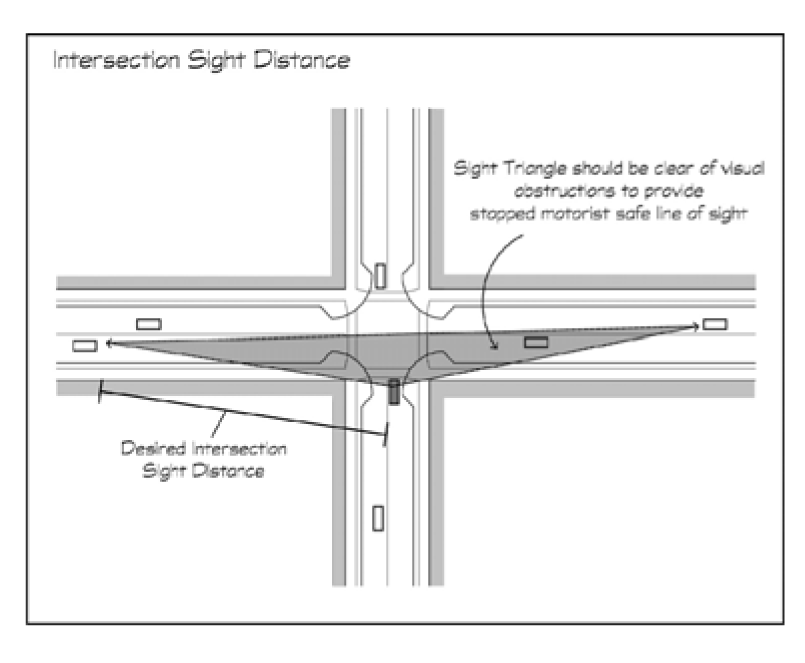
Unless otherwise specified by the director, the area regulated shall be two triangular areas formed by the street right-of-way lines, or such lines extended, and lines connecting such right-of-way lines at points 25 feet from the intersections of the right-of-way lines.
Section 806. - Internal vehicular circulation.
1.
Efficient and easily recognized vehicular circulation routes within a development are vital and shall be provided.
2.
Internal vehicle circulation shall be designed or redesigned in a manner that avoids conflicts between through-traffic (i.e., traffic flowing into and out of the site) and local traffic (i.e., traffic through parking areas).
3.
Interior vehicular circulation shall be provided by: visually orienting the driver with a regular, logical system of interior driveways and roadways; identifying entrance drives with small entry signs; and preventing vehicles from driving across or through designated parking areas by placing raised landscaped dividers or walkways between parking aisles.
Section 807. - Pedestrian facilities internal to site required.
1.
Required. Internal to each building site, any new development unless exempted from this section shall provide safe routes of pedestrian access between points of departure and destinations in the form of an internal sidewalk system. Pedestrian access must be provided to individual developments and each establishment within the development. When multiple buildings are proposed on an individual site, they shall be linked with on-site pedestrian walkways.
2.
Connections. The internal sidewalk system shall connect to the public sidewalk system along streets and highways, where it exists or is planned, or where required by the director via site and design plan approval. The internal sidewalk system shall also connect to any sidewalk systems on abutting private properties or provide for such connections in their absence.
3.
Design. Pedestrian ways shall be well defined and take the most direct path possible. The director through site and design review may require that automobile access ways be separated from pedestrian access ways. Pedestrians shall have the right-of-way over automobile travel within interior portions of development sites.
4.
Crossings. On any particular development site subject to this section where pedestrian circulation crosses vehicular routes, a change in grade, materials, textures, or colors, or appropriate striping or demarcation, shall be provided to emphasize the point of intersection between pedestrians and vehicles and improve its visibility and safety. For instance, brick pavers and other special paving materials can help to distinguish pedestrian walkway surfaces from vehicular access ways.
5.
Width specifications. All walkways internal to the site shall be a minimum of five feet wide, except for walkways serving individual single-family residences which shall be a minimum of four feet wide.
6.
Applicability and exemption. This section shall not apply to construction of any detached, single-family residence on an individual lot, but it shall apply to any lot that is contained within a final subdivision plat approved and to any lots that are a part of a larger development which received site and design plan approval and which required sidewalks internal to each single-family lot.
Section 808. - Off-street parking required.
Off-street automobile parking spaces shall be provided on every lot on which any building, structure, or use is hereafter established in all zoning districts, except for the Old Town Overlay District (where some flexibility is provided; see parking requirements for that specific district). Required parking spaces shall be available for the temporary parking of passenger vehicles for residents, customers, patrons, and employees, as appropriate given the subject use.
(Ord. No. 2022-596, Att. 1, 11-14-2022)
Section 809. - Location of off-street parking areas.
1.
Requirement. All parking spaces required by this article shall be provided on the same lot with the main building or use which it serves, except as specifically provided in this section or as otherwise provided in the Old Town Overlay District.
2.
Exemption. The director may permit some or all of the required parking spaces to be provided on another lot, a substantial portion of which must be within 800 feet of such building, structure, or use. Any applicant proposing to use off-street parking on another site to meet the on-site parking requirements of this article shall submit evidence either of ownership or a valid agreement for use of the parking area off-site. Safe and convenient pedestrian access, such as a sidewalk or path, must exist or be provided from the structure or use to the off-site parking lot.
(Ord. No. 2022-596, Att. 1, 11-14-2022)
Section 810. - Parking plan required.
1.
Before any parking lot or other parking improvement is constructed, or building permit is issued, the parking lot layout and area must be found by the director to be in compliance with all requirements of this article and a parking plan must be approved by the director via the site and design plan approval process.
2.
No permit shall be issued for any parking area until the plans and specifications have been submitted for review by the director and site and design plan approval has been given by the director. Such plans and specifications shall include the number of spaces provided and required, the location of entrances, exits, aisles, curbing where required, landscaping, screening, surface materials, and provisions for drainage.
3.
Occupancy or use of a building shall not be allowed until parking facilities meet the requirements of this article.
Section 811. - Minimum design requirements.
The following minimum design requirements shall be adhered to and demonstrated with the submission of appropriate plans and specifications during the site plan approval process:
1.
Paving surfaces. In any commercial district, parking and loading areas shall be paved with concrete, asphaltic concrete, asphalt, or brick pavers in commercial areas.
In the IA district, parking and storage lots may be on contained gravel surfaces. Containment shall retain the gravel so it is restrained from moving into buffers, sidewalks, streets, and other public areas.
In any residential district, the parking of any vehicle shall be on a concrete, asphalt, brick paver, or decorative stone surface. The use of decorative stone as a parking surface shall be contained within a confining border. In R-1 district, not more than 40 percent of the front yard shall be use for parking under any circumstances.
2.
Pervious surfaces. Pervious pavement parking spaces and grass pavers may be substituted for standard dust free pavements. Aggregate (gravel) surface is not considered a decorative stone, but may be considered appropriate for certain uses at the discretion of the Director. Water quality considerations and the character of the district in which the parking lot is proposed to be constructed may be considered by the Director in modifying parking lot pavement requirements during the required site plan approval process.
3.
Curbing and drainage. Parking and loading areas shall be properly graded, but in all cases drained so as to prevent damage to abutting properties or public streets. Water quality effectiveness and character of the zoning district shall be considerations in determining curbing requirements by the director via the site plan approval process.
4.
Circulation. Dead-end parking areas shall be prohibited unless design conditions prevent a connected design, and they can only be used if 90 degree parking design is used.
5.
Minimum parking space sizes. Off-street parking spaces shall be a minimum of nine feet in width by 18 feet in length. Compact parking spaces shall measure eight feet by 16 feet.
6.
Minimum aisle width. Parking driveway maneuvering aisle width requirements vary according to the width and length of parking spaces and the angle of parking. For a single row of 90 degree head-in parking, the minimum depth for a parking space plus the width of the aisle shall be 42 feet. For two rows of 90 degree head-in parking using the same aisle, the minimum depth for parking spaces plus the width of the aisle shall be 60 feet for nine-foot wide spaces (measured from back of curb to back of curb).
The director may authorize parking lot designs that utilize 75, 60, and 45 degree-angled parking spaces with one-way or two-way aisles. If such angled parking is used, parking lots shall comply with acceptable parking dimensional standards for aisle widths as specified by the Institute of Transportation Engineers or other reputable source approved by the director.
Parking aisle length shall not exceed 500 feet without a break for circulation.
7.
Compact auto parking. Compact parking spaces may be used in parking areas when more than 20 parking spaces are required, provided that the areas for compact parking are clearly marked and not more than 20 percent of the number of parking spaces provided in the entire parking area is designated compact auto parking.
8.
Landscaped divider. One landscaped divider (planted area within in between and separating the vehicle parking spaces fronting one another) with a minimum width of nine feet shall be provided for every fifth parking aisle in a parking lot; provided, however, that the director may vary this requirement via the site plan approval process in cases of short parking aisles or where alternative designs prevent random maneuvers which can endanger pedestrians.
9.
Lighting. Parking areas shall be appropriately lighted unless the director via site and design plan approval determines that lighting would be incompatible with abutting properties. Where lighting of parking lots is required or provided, light poles should be located in landscaped planter strips. Where this cannot be accomplished, light poles must be placed on a reinforced concrete pedestal to protect them from damage or being knocked over.
10.
Landscaping. Parking lots shall meet the requirements for parking lot landscaping as specified in the buffer, landscape and tree ordinance.
11.
Signage. Where needed to promote proper circulation within off-street parking areas, directional signs shall be placed in appropriate locations as specified by the director via site and design plan approval, development permit approval, or parking plan approval.
(Ord. No. 2016-503, Exh. A, 6-13-2016; Ord. No. 2019-542, 10-14-2019; Ord. No. 2023-603, Exh. A, 6-12-2023)
Section 812. - Minimum and maximum on-site parking spaces.
1.
Unless specifically provided otherwise in this article, on each lot where a building, structure, or use exists, each site shall be designed to provide and shall provide for off-street parking in the minimum (and not to exceed the maximum) amounts in Table 8.1.
2.
No existing or future off-street parking area shall be reduced in capacity to less than the minimum required number of spaces, or increased to more than the maximum permitted number of spaces, or altered in design or function to less than the minimum standards, unless specifically provided for in this article.
3.
This section shall not be construed as requiring compliance of parking lots which lawfully existed on the effective date of this article; provided, however, that the director shall ensure parking lots that do not comply with this article meet the requirements of this article or substantially comply when a new development permit is required or a building permit is required to add additional building space on the site. If substantial redesign of the parking lot is required to comply with this article in such cases of new development or building additions, the director may accept substantial rather than complete compliance when the strict application of a requirement of this article would pose substantial practical difficulty.
Unless otherwise noted, the parking requirement shall be based on the gross square footage of the building or buildings devoted to the particular use specified.
(Ord. No. 2016-503, Exh. A, 6-13-2016)
Section 813. - Interpretations.
1.
Fractions. Where a fractional space results during the calculation of required parking, the required number of parking spaces shall be construed to be the next highest whole number.
2.
Parking space requirement not specified. Where the parking requirement for a particular use is not described in Table 8.1, and where no similar use is listed, the director shall determine the number of spaces to be provided based on requirements for similar uses, location of the proposed use, the number of employees on the largest shift, total square footage, potential customer use, and other expected demand and traffic generated by the proposed use. At the discretion of a development applicant, a parking generation study prepared by a qualified professional may be submitted to aid the director in making such a determination; if submitted, it shall be considered by the director prior to making a determination.
3.
Computations for multiple floor uses within a building. In cases where a building contains some combination of residential use, office space, retail or wholesale sales area, and/or bulk storage area, the director may authorize that the building space be divided into such floor space use areas and separate computations of floor areas (e.g., warehousing, retail, and/or office) in determining the off-street parking or loading space requirements of this article.
Section 814. - Number of handicapped parking spaces required.
Regulations and dimensions for handicapped parking spaces shall be per requirements of the Americans with Disabilities Act (ADA) (Public Law 101-136) and the Georgia Accessibility Code.
Section 815. - Reduction for off-site, off-street arrangements.
As provided in this article, off-site, off-street parking may be used in combination to meet minimum parking space requirements; a reduction of required on-site, off-street parking spaces on a given site may be permitted by the director in cases where additional off-street, off-site, parking area in sufficient quantity and availability in conformity with this article compensates for the reduction.
Section 816. - Reduction for mixed or joint use of parking spaces.
When more than one use is provided on a lot, and such uses operate more or less simultaneously, the total requirements for off-street parking spaces shall be the sum of the requirements for the various uses computed separately. The director may authorize a reduction in the total number of required off-street parking spaces for two or more uses jointly providing parking facilities when their respective hours of need of maximum parking do not normally overlap, provided that the developer submits sufficient data to demonstrate that the hours of maximum demand for parking at the respective uses do not normally overlap. The required spaces assigned to one use may not be assigned to another use at the same time, except that one-half of the parking spaces required for churches, theaters or assembly halls whose peak attendance will be at night or on Sundays may be assigned to a use which will be closed at night or on Sundays.
Section 817. - Reduction for on-street parking.
The director may in individual cases administratively authorize a reduction in the minimum number of parking spaces for projects that are served by on-street parking.
Section 818. - Off-street loading required.
On the same lot with every building, structure or part thereof, erected or occupied for manufacturing, storage, warehouse, truck freight terminal, department store, wholesale store, grocery supermarket, hotel, hospital, mortuary, dry cleaning plant, retail business, college, or other uses similarly involving the receipt or distribution of vehicles, materials or merchandise, there shall be provided and maintained adequate space for the standing, loading, and unloading of such materials to avoid undue interference with public use of streets, alleys, and private or public parking areas.
This section shall not apply to uses permitted in the Old Town Overlay District.
(Ord. No. 2022-596, Att. 1, 11-14-2022)
Section 819. - Loading area locations.
Loading areas shall be located to the rear of the building unless the director determined via site and design review that the site design precludes a rear location.
Section 820. - Loading area specifications.
Unless otherwise approved by the director, loading spaces shall be a minimum of 14 feet wide, 40 feet long, with 14 feet of height clearance. When the development requires loading and unloading by full-size tractor-trailers, loading spaces shall be 60 feet long with a 63-foot apron.
_____
Section 821. - Loading docks and spaces required.
Unless otherwise approved by the director, when loading space is required by this article it shall be provided in the quantity according to land use specified in Table 8.2.
;note; Source: National Parking Association, 1992. Recommended Zoning Ordinance Provisions for Parking and Off-Street Loading Space. In Transportation and Land Development, 2 nd Ed. 2002 (Washington, DC, Institute of Transportation Engineers, 2002, p. 10-8, Table 10-3).

