
Lilburn City Zoning Code
ARTICLE 3
- GENERAL PROVISIONS
Section 301.- Use, occupancy and erection.
No building, structure, land, or water shall hereafter be used or occupied, and no building or structure or part thereof shall be erected, constructed, reconstructed, moved, or structurally altered except in conformity with the regulations of this article or amendments thereto, including the use provisions for the zoning district in which it is located, the overlay district provisions if applicable, and any specific use provisions, if applicable.
Section 302. - Use prohibited when not specified.
Any use not specifically permitted as a use by right in any given zoning district as provided in Article 4 shall be prohibited in that zoning district.
(Ord. No. 2023-603, Exh. A, 6-12-2023)
Section 303. - Specific use provisions.
In cases where a use is a permitted use in the zoning district in which said use is located but there are specific use regulations for that use specified in Section 603 or Article 7, such regulations shall also apply and must be complied with. It shall be unlawful to establish a use without conforming to the specific use provisions of this article, when applicable.
(Ord. No. 2023-603, Exh. A, 6-12-2023)
Section 304. - Minimum requirements.
Within each zoning district, the regulations set forth shall be minimum requirements and shall apply uniformly to each class or kind of building, structure or land, except as may be altered through conditions of zoning applied to specific properties.
Section 305. - Every use must be upon a lot of record.
No building or structure shall be erected or use established unless upon a lot of record as defined by this article, except as otherwise specifically provided in this Zoning Ordinance.
Section 306. - One single-family dwelling on a lot.
Except as otherwise specifically provided in this article, only one single-family dwelling and its accessory buildings may be erected on any one lot intended for such use. This provision shall not be construed to prevent the construction of more than one attached single-family condominium, or multiple-family dwelling on a single lot, in districts where permitted, subject to setbacks and separation as provided in this article.
(Ord. No. 2020-551, Exh. A, 7-13-2020)
Section 307. - Height limitations.
Except as otherwise specifically provided in this section or City Code, no building or structure shall hereafter be erected, constructed, reconstructed, or altered, to exceed the maximum height of buildings and structures specified in this article; provided, however, the city council may upon application and approval of a special use permit to allow buildings and structures to exceed these height limitations, subject to procedures for special use permits established in Article 10.
The height limitations established herein shall not apply to chimneys, church spires and steeples, domes, flag poles, public monuments, observation towers, water towers, electricity transmission towers, utility poles, and similar structures.
(Ord. No. 2023-603, Exh. A, 6-12-2023)
Section 308. - Maximum density, minimum lot size, and minimum lot width.
No lot shall hereafter be developed with a number of housing units that exceeds the residential density for the zoning district in which the lot is located. No lot shall hereafter be developed that fails to meet the minimum lot size and minimum lot width for the zoning district in which the lot is located as established by this article, except as otherwise specifically provided. No lot shall be reduced in size, and no principal building shall hereafter be constructed, so that the maximum density, minimum lot size, or minimum lot width of the zoning district in which said lot and building are located are not maintained, except as otherwise specifically provided in this article.
Section 309. - Lot size averaging.
Within an Overlay District or redevelopment Character Area, where unique site specific conditions exist, such as an irregular shape or other unique conditions, an infill developer or subdivider may propose and the city may approve a flexible development incentive called lot size averaging. This incentive allows development applicants to reduce one or more lots below the minimum lot size established for the zoning district in which the residential infill development project is located. In order to apply this variance, the proposed residential infill development project must meet the following requirements:
1.
The average lot area of all lots within the subdivision meets the minimum lot size for the zoning district in which the project is located.
2.
No lot shall be reduced to less than 80 percent of the required minimum lot size for the applicable zoning district.
3.
For purposes of calculating average lot size, abutting undivided and undeveloped property under the ownership of the infill subdivider at the time of infill subdivision shall not be included in such calculation.
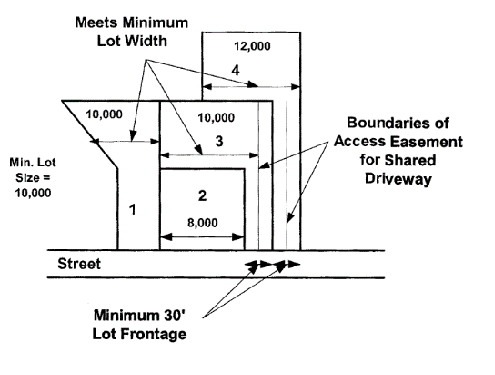
Subdivision of Irregularly Shaped Parcel Using Minimum Road Frontage and Lot Size
Averaging
(Ord. No. 2020-551, Exh. A, 7-13-2020; Ord. No. 2023-603, Exh. A, 6-12-2023)
Section 310. - Lot width reductions.
Within an Overlay District or redevelopment Character Area, where unique site specific conditions exist, such as an irregular shape or other unique conditions, an infill developer or subdivider may propose and the city may approve a flexible development incentive called lot width variations. The variance may apply to a portion of or all lots within a detached residential infill development as follows:
1.
To no less than 50 feet in the R-1 zoning districts;
2.
To no less than 35 feet in the R-2 zoning district; and
3.
To no less than 20 feet in MU zoning district.
(Ord. No. 2014-473, Exh. A, 9-8-2014; Ord. No. 2016-503, Exh. A, 6-13-2016; Ord. No. 2020-551, Exh. A, 7-13-2020)
Section 311. - Minimum floor area per dwelling unit.
No new dwelling shall hereafter be constructed or occupied that fails to meet the minimum floor area for a dwelling unit as established by the zoning district in which the property is located as specified in this article. No existing dwelling shall be reduced in size so that its floor area fails to meet the minimum floor area for a dwelling unit as established by the zoning district in which the property is located as specified in this article.
Section 312. - Build-to lines.
In the case where a build-to line is established by this Zoning Ordinance, no building shall be erected in a manner inconsistent with the established build-to line; provided, however, that the Director may administratively authorize a variance in accordance with the provisions of this ordinance.
(Ord. No. 2020-551, Exh. A, 7-13-2020; Ord. No. 2023-603, Exh. A, 6-12-2023)
Section 313. - Minimum required yards.
1.
No building or structure shall hereafter be erected in a manner to have narrower or smaller front yards, side yards, or rear yards than specified for the zoning district in which the property is located. Buffer requirements established by this article, where applicable, supersede these minimum required yards. In the case where a build-to line is established, the build-to line provisions of this article supersede and replace any front building setback lines, the latter of which shall only be deemed applicable in the absence of an established build-to line.
2.
No lot shall be reduced in size, and no principal building shall hereafter be constructed, so that the front, side, or rear yards of the zoning district in which said lot and building are located are not maintained.
3.
This section shall not apply to portions of lots affected by public acquisition of part of the lot.
4.
No part of a yard shall be included as a part of the yard required for another building.
(Ord. No. 2020-551, Exh. A, 7-13-2020)
Editor's note— Ord. No. 2020-551, Exh. A, adopted July 13, 2020, amended the title of § 313 to read as herein set out. The former § 313 was titled, "Minimum required yards and building setbacks."
Section 314. - Principal building setback adjustments.
Within an Overlay District or redevelopment Character Area, where unique site specific conditions exist, such as an irregular shape or other unique conditions, an infill developer or subdivider may propose and the city may approve a flexible development incentive called building setback adjustments. This variance may apply to a portion of or all lots in the infill development as follows:
1.
Front building setbacks may be reduced by up to 10 feet from the established minimum.
2.
Side building setbacks may be reduced by up to 5 feet from the established minimum.
3.
Rear building setbacks may be reduced by up to 5 feet from the established minimum.
(Ord. No. 2016-503, Exh. A, 6-13-2016; Ord. No. 2020-551, Exh. A, 7-13-2020)
Section 315. - Principal building separation.
All non-residential principal buildings shall provide for adequate building separation to allow for sufficient fire access and traffic flow and all non-residential and residential buildings and accessory buildings shall meet applicable building code requirements.
(Ord. No. 2023-603, Exh. A, 6-12-2023)
Section 316. - Maximum building coverage.
No lot shall hereafter be developed to exceed the maximum building coverage specified for the zoning district in which it is located, if applicable.
Section 317. - Minimum landscaped open space.
No lot shall be developed with less than the minimum landscaped open space specified for the zoning district in which said lot is located, if applicable, or as may be established by any other article or section of this article or Development Regulations, if applicable.
(Ord. No. 2020-551, Exh. A, 7-13-2020)
Section 318. - Minimum required landscape strips and buffers.
No lot shall hereafter be developed, and no building or structure shall hereafter be erected or use established in a manner so that the minimum landscape strips and buffers required by this article for the zoning district in which said building, structure, or use is located, or for the specific use if buffer and landscape strip requirements are established for said use.
Section 319. - Street frontage requirement.
No building or structure shall hereafter be erected on a lot, and no lot shall hereafter be created or subdivided, that does not abut for at least 30 feet on a public street, or an approved private street, unless specifically provided otherwise by this article or by any other article.
(Ord. No. 2020-551, Exh. A, 7-13-2020)
Section 320. - Classification of streets.
All of the streets, roads, and highways in the city are classified as local street, minor or major collector streets, minor, major, residential, or principal arterial streets and freeways. These same streets and roads will also be known as U.S. or state routes, county roads and local streets or roads.
Section 321. - Zoning of annexed lands.
1.
Property annexed or proposed to be annexed into the city limits shall be zoned in accordance with the Zoning Procedures Law, O.C.G.A. § 36-66, and this article. Such property annexed may subsequently be zoned by the city council to any zoning district or districts established in this article according to rezoning procedures outlined herein.
2.
Lands hereafter annexed into the city limits shall, upon the effective date of such annexation, be subject to all applicable procedural and substantive requirements of this ordinance.
(Ord. No. 2023-603, Exh. A, 6-12-2023)
Section 322. - Validity of existing conditions of zoning or use approval.
Notwithstanding the repeal of prior ordinances in conflict with this article upon its adoption, if a property was zoned subject to conditions or use approved subject to certain conditions prior to the adoption of this article by city council, the existing zoning conditions or conditions of use approval shall continue to apply to said property.
Section 323. - Combination of review and approval processes.
The process of site design and architectural review for individual development may be combined with the subdivision platting process required by the city development regulations. At the option of the development applicant, an applicant may submit a conceptual lot platting plan and defer the plat approval process until a later date, but if so, the applicant is still responsible for submitting information required by this article with respect to proposed lot boundaries as a part of the site design and architectural review process, so that subdivision lot design and specific residential development proposals can be considered as a whole.
In considering the compatibility and appropriateness of residential, commercial, and mixed-use development within the city, it is important that the city consider not only the proposed lot lines and lot platting configurations, but also the specific development types proposed on the lots. The process for acting on infill residential development projects is accomplished by filing information required for both site design and architectural review and information required for applications for plat approval with proposed infill variances proposed concurrently to the Director and City Manager.
(Ord. No. 2020-551, Exh. A, 7-13-2020)
Section 324. - Existing dwellings and infill development comparison.
The city shall review residential infill development proposals in the context of the Overlay District or redevelopment Character Area and surrounding neighborhood. An applicant for a development permit or subdivision plat approval shall submit the following information for existing residential dwellings on abutting residential properties and across the street from the lot on which the residential infill development project is proposed. An applicant may exclude lots abutting the proposed residential infill development project which are developed for institutional uses, such as schools and churches, or other nonresidential uses.
1.
Number of stories and approximate height.
2.
Size (gross square feet) in area.
3.
Front, side, and rear setbacks.
4.
Orientation of the dwelling in relation to the street.
5.
Major architectural features (style, materials, etc.).
6.
Driveway placement, width, and materials.
7.
Location of parking (garage, carport, open, yard location, etc.).
8.
Accessory buildings and structures, if any.
The applicant may submit this information in a combination of forms, including an aerial photograph, tax map, survey plats, photographs, and written narrative, provided all required information is submitted.
(Ord. No. 2020-551, Exh. A, 7-13-2020)
Section 325. - Floodplain general provisions.
The Floodplain Management/Flood Damage Prevention Ordinance is found in the City Code, Chapter 109, Article III.
(Ord. No. 2023-603, Exh. A, 6-12-2023)

