
Lillington City Zoning Code
ARTICLE II
ZONING DISTRICT PROVISIONS
Section 2.01 Purpose
It is the purpose of this chapter to establish and adopt zoning districts to govern the use of land in the Town of Lillington.
(Ord. passed 2-14-2017)
Section 2.02 Overview and Applicability
This article of the Lillington UDO establishes base and overlay zoning districts; the official zoning map, as well as the rules for its maintenance, amendments, interpretation and replacement; the use table, which identifies the land uses and the types of approvals required for each authorized land use; and the rules for interpretation of the use table.
(Ord. passed 2-14-2017)
Section 2.03 Establishment of Zoning Districts
The following zoning districts are declared to be in effect upon all land and water areas included within the boundaries of each district as shown on the Official Zoning Map. After adoption of the UDO, amendments to the Zoning Map shall be made by plat, legal description or metes and bounds description, which shall be the best evidence of the boundaries, amended or created, and shall control unless a scriveners or other error in such plat or description is manifestly contrary to the intent of the amended ordinance.
2.03.1 BASE ZONING DISTRICTS
The following base districts are established.
A. RR – Rural Residential
B. RS20 – Residential Single-Family
C. RS10 – Residential Single-Family
D. RMF – Residential Multi-Family
E. RMX – Residential Mixed Use
F. NMX – Neighborhood Mixed Use
G. O/S – Office & Services
H. CB – Central Business
I. NB – Neighborhood Business
J. GB – General Business
K. LI – Light Industrial
L. HI – Heavy Industrial
M. FRO – Facilities, Recreation and Open Space
2.03.2 OVERLAY DISTRICTS
The following overlay districts are established. The uses allowable by the underlying zoning district shall apply, except as limited by the use requirements of the overlay district.
A. DOD – Downtown Overlay District
B. UROD – Urban Residential Overlay District
C. HOD – Highway Overlay District
D. WPOD – Watershed Protection Overlay District
2.03.3 CONDITIONAL DISTRICTS
A. Conditional districts are districts with conditions voluntarily added only in response to a petition by the owner of all the property to be included in such district. In accordance with G.S. § 160A-382, specific conditions applicable to these districts may be proposed by the applicant or town but only those conditions mutually approved by the town and the applicant may be incorporated into the conditional district zoning.
B. Conditional districts provide for orderly and flexible development under the general policies of this ordinance without the constraints of some of the prescribed standards guiding by-right development. Because conditional district developments are constructed in a comprehensive manner, they may establish their own building, street, block, and lot pattern which may be unique from other surrounding blocks or neighborhoods. Conditional districts may be used in any district but is not intended to relieve hardships that would otherwise be handled using a variance procedure.
C. In addition to modification of specific district provisions (except use), the various provisions detailed in this article may be varied if specifically requested by the petitioner as part of a conditional district application with exception to the following:
Article | Title | Exception to modification: |
II | Zoning District Provisions | Uses permitted may not be added unless the use proposed is not currently defined or contemplated by the Code. Permitted uses may be removed from the petition. |
VI | Subdivisions & Infrastructure | May substitute dedication of public open space for payment-in-lieu per Board of Commissioners approval. Except in areas identified on the Land Use Plan map as public greenways and linear parks. Amount required may not be reduced. |
D. Upon the approval of the petition for a conditional district, the subject property shall be identified on the Official Zoning Map by the appropriate district designation. A parallel conditional zoning designation shall be identified with the underlying general district letters "CD" (example CD-RS10).
(Ord. passed 2-14-2017)
Section 2.04 Zoning Map
2.04.1 ESTABLISHMENT, AMENDMENTS AND MAINTENANCE
A. There shall be a map designated as the Official Zoning Map, which shall show the boundaries of all zoning districts within the town's planning jurisdiction. This map shall be stored on the town's geographic information system (GIS) and printed on durable material. Prints shall be dated and kept in Town Hall in the Town Clerk's office.
B. The Official Zoning Map is adopted and incorporated herein by reference. Amendments to this map shall be made and posted in accordance with the provisions of Article VII of this UDO.
C. The Administrator shall update the Official Zoning Map as soon as possible after amendments to it are adopted by the Board of Commissioners. Upon entering any such amendment on the map, the Administrator shall change the date of the map to indicate its latest revision. New prints of the updated map may then be issued. The Administrator shall keep copies of superseded prints of the zoning map for historical reference.
D. No unauthorized person may alter or modify the Official Zoning Map.
E. GIS records shall indicate the zoning designation, the number and date of the ordinance creating the designation and, where a conditional zoning district is established, the conditions of that rezoning. GIS records shall maintain the zoning history.
F. Should the Official Zoning Map be lost, destroyed or damaged, the Administrator may have a new map generated from the most reliable available data. No further Board of Commissioner authorization or action is required so long as no district boundaries are changed in this process.
2.04.2 INTERPRETATION OF BOUNDARIES OF ZONING DISTRICTS
Where uncertainty exists as to the boundaries of districts shown on the Official Zoning Map or any other map incorporated in or referenced by the UDO, the following rules shall apply:
A. Boundaries indicated as approximately following the centerlines of streets, alleys or other public rights-of-way shall be construed to follow such centerlines. Where the street, alley or right-of-way has been vacated through official action of the governing body, the boundary shall be construed to follow the centerline of the vacated right-of-way.
B. Boundaries indicated as approximately following platted lot lines, section lines or tract lines shall be construed to follow such lines.
C. Boundaries indicated as approximately following town corporate limit lines shall be construed to follow such town corporate limit lines.
D. Boundaries indicated as following railroad lines shall be construed to be midway between the main tracks.
E. Boundaries indicated as following shorelines shall be construed to follow such shorelines and in the event of change in the shoreline shall be construed as moving with the actual shoreline.
F. Boundaries indicated as approximately following the centerlines of canals, streams or other bodies of water shall be construed to follow such centerlines.
G. Where interpretation is needed as to the exact location of boundaries of any mapped area, the Administrator shall make the necessary interpretation.
H. When the street or property layout existing on the ground is at odds with that shown on the Official Zoning Map, the Board of Adjustment shall interpret the district boundaries in accordance with Article VII.
(Ord. passed 2-14-2017)
Section 2.05 Base Zoning Districts
2.05.1 RR – RURAL RESIDENTIAL DISTRICT
The RR District is intended to accommodate very low-density, rural residential and agricultural uses; and protect natural vistas and landscape features.
A. To encourage the construction of and continued use of the land for very low density residential and agricultural purposes;
B. To restrict commercial and industrial use of the land and to prohibit any other use which would substantially interfere with the development and continuation of residential dwellings and agriculture in the district;
C. To discourage any use which would generate traffic on minor streets other than normal traffic to serve the residences and farms on those streets; and
D. To ensure that residential development not having access to public water supplies and dependent upon septic tanks for sewage disposal will occur at sufficiently low densities to ensure a healthful environment.
2.05.2 RS20 – RESIDENTIAL SINGLE-FAMILY DISTRICT
The RS20 District is established whereby the principal use of land is for low-density residential purposes. The regulations of this district are intended:
A. To encourage the construction of and continued use of the land for low density residential purposes;
B. To restrict commercial and industrial use of the land and to prohibit any other use which would substantially interfere with the development and continuation of residential dwellings in the district;
C. To discourage the continuance of existing non-conforming uses that would not be permitted as uses under the provisions of this district.
2.05.3 RS10 – RESIDENTIAL SINGLE-FAMILY DISTRICT
The RS10 District is established whereby the principal use of land is for medium single-family density residential purposes. The regulations of this district are intended to:
A. Encourage the construction of and the continued use of the land for residential purposes;
B. Restrict commercial use and prohibit industrial use of the land and to prohibit any other use which would substantially interfere with the development of dwellings in this district;
C. Discourage any use which would generate traffic on minor streets other than normal traffic to serve the residences on those streets;
D. Discourage the continuance of existing non-conforming uses that would not be permitted as uses under the provisions of this district; and
E. Discourage any use which because of its character or size would create requirements and costs for public services substantially in excess of such requirements and costs if the district were developed solely for dwellings.
2.05.4 RMF – RESIDENTIAL MULTI-FAMILY DISTRICT
The RMF District is established as a district in which to allow primarily multi-family developments at a density of 12 dwelling units per acre in areas served by adequate public water and sewer systems. The regulations of this district are intended to encourage quality design of multi-family developments and ensure their compatibility with surrounding neighborhoods and land uses.
2.05.5 RMX – RESIDENTIAL MIXED USE DISTRICT
The RMX District is established to accommodate a variety of housing types in a neighborhood setting and is intended to provide areas for higher density residential development in close proximity (within ¼ to ½ mile) to commercial areas such as the CB, NB, NMX and GB districts. The intent is to create higher density residential areas that compliment commercial districts with physical proximity and pedestrian connectivity. The regulations of this district are intended to encourage quality design of multi-family developments and ensure their compatibility with surrounding neighborhoods and land uses.
2.05.6 NMX – NEIGHBORHOOD MIXED USE DISTRICT
The NMX District is intended to provide pedestrian-scaled, higher density residential housing and mixed with commercial activities. Development in this district should encourage pedestrian activity through construction of mixed-use buildings and connections to adjacent neighborhoods. Buildings in this district are typically small and detached. The regulations of this district are intended to encourage quality design of multi-family developments and ensure their compatibility with surrounding neighborhoods and land uses.
2.05.7 O/S – OFFICE & SERVICE DISTRICT
The O/S District is designed to accommodate offices, services and certain institutional uses. These districts may serve as transitional zones between high- intensity and low-intensity land uses. The regulations of this district are intended to:
A. Encourage land uses that buffer residential districts from intensive non- residential uses and arterial streets;
B. Provide aesthetic controls and dimensional requirements to ensure compatible office and service development with surrounding residential uses;
C. Allow for single-family dwellings in business corridors to be used for business or residential purposes; and
D. Prohibit drive-through and drive-in uses, outside storage and outside display operations.
2.05.8 CB – CENTRAL BUSINESS DISTRICT
The CB District is designed to accommodate a wide variety of commercial activities (particularly those that are pedestrian oriented) in an intensive development pattern in the town's central business district. The regulations of this district are intended to:
A. Preserve the general character and integrity of the current development in the central business district;
B. Encourage land uses that provide for a multi-purpose central business district including retail, offices, services, entertainment and living space;
C. Encourage land uses that do not require large amounts of outdoor use areas; and
D. Encourage common or shared off-street parking.
E. To restrict heavier commercial and industrial use of the land and to prohibit uses which would substantially interfere with the continuation of the uses presently in the district or with the orderly growth of the district to meet the needs of increased population in the market area;
F. To discourage the continuance of existing non-conforming uses that would not be permitted as uses under the provisions of this district; and
G. To permit a concentrated, intensive development of the permitted uses while maintaining a substantial relationship between the intensity of land use and the capacity of utilities and streets.
H. Prohibit drive-through and drive in uses, outside storage and outside display operations.
2.05.9 NB – NEIGHBORHOOD BUSINESS DISTRICT
The NB District is established as a district in which the principal use of land is to provide for the retailing of goods and services to the adjacent residential neighborhoods. The district is intended to provide for those commercial uses which are conducive to the everyday needs of a nearby residential area of a lower intensity than the General Business (GB) District. Such districts are generally located near residential areas and cater to the everyday needs of nearby residential neighborhoods, stressing accessibility by automobiles, bicycles, and pedestrians. The regulations of this district are intended to:
A. Encourage the location of convenience retail establishments, professional services and professional offices that are compatible with surrounding residential uses;
B. To prohibit heavy commercial and industrial use of the land and to prohibit any other use which would substantially interfere with the development or continuation of the nearby residential neighborhoods;
C. To minimize traffic and parking congestion and increase convenience for neighborhood residents and limit major traffic generators to thoroughfares;
D. To discourage the continuance of existing non-conforming uses that would not be permitted as uses under the provisions of this district;
E. Promote safe and convenient pedestrian access from surrounding residences;
F. Prohibit outdoor storage and outdoor display.
2.05.10 GB – GENERAL BUSINESS DISTRICT
The GB District is designed to accommodate highway-oriented retail, commercial service uses and in some cases light manufacturing. The major objectives of this district are to:
A. Encourage the construction of and the continued use of the land for commercial and service uses, particularly those which have a larger land area requirement;
B. Provide for the orderly expansion of such uses within this district, as designated on the zoning map;
C. Discourage the continuance of existing non-conforming uses that would not be permitted as uses under the provision of this district;
D. Discourage small lot development on major highways;
E. Encourage vehicular access from service drives and other local commercial streets rather than directly from arterial streets; and
F. Provide a location for major shopping facilities and land uses requiring large outdoor spaces.
2.05.11 LI – LIGHT INDUSTRIAL DISTRICT
The LI District is intended to accommodate externally benign industrial and office uses that pose little nuisance to adjacent residential areas.
2.05.12 HI – HEAVY INDUSTRIAL DISTRICT
The HI District is established to accommodate those industrial, manufacturing, or large-scale utility operations that are known to pose levels of noise, vibration, odor, or truck traffic that are considered nuisances to surrounding development. This district is customarily located in proximity to railroad sidings and/or major thoroughfares.
2.05.13 FRO – FACILITIES, RECREATION AND OPEN SPACE DISTRICT
The FRO District is intended for open space, public facilities and privately owned and recreation areas. Publicly owned land uses include governmental, recreational, education, natural resource and utility facilities. Privately owned land uses include golf resorts and related facilities, land trusts established to preserve natural resources, schools and recreational facilities that typically include substantial open space. The major objectives of this district are to:
A. Provide land for publicly-owned governmental facilities and privately-owned natural and man-made resource and recreation areas; and
B. Preclude major residential, retail office, institutional, and industrial uses that typically provide limited open space.
(Ord. passed 2-14-2017; Ord. 2022-06, passed 7-13-2021)
Section 2.06 Overlay Districts
Special overlay districts are intended to be superimposed over the underlying general zoning districts and the land within each overlay district may be used in ways that achieve the objectives of each overlay district. Wherever standards of the underlying zoning district differ from the overlay standards, the more restrictive provisions shall apply.
2.06.1 DOWNTOWN OVERLAY DISTRICT
A. Purpose
The DOD District is established as an overlay in the areas located within and abutting the CB zoning district. This district is intended to:
1. Establish an area with greater land use flexibility than the CB and adjoining zoning districts;
2. Foster compatible land use transitions between the CB development and abutting residential neighborhoods;
3. Promote compatible design transitions in blocks facing or adjacent to the DOD; and
4. Provide safe and convenient connectivity between the downtown and nearby neighborhoods for bicyclists, pedestrians and motorists.
B. Area of Applicability
The area affected by the DOD are those lands in the "Main Street-Downtown" area as indicated on the Official Zoning Map.
C. Specific Development Standards
Dimensional and density standards shall comply with the underlying base district and other applicable standards except that:
1. The minimum height of buildings in areas with CB base zoning shall be two stories. The maximum is four stories (may exceed with a conditional use permit).
2. There shall be a minimum of 60% primary street lot frontage build out on properties.
3. For properties fronting on Main Street with CB base zoning, one of the following shall be provided along the frontage to provide and continue the "shop-front" design of downtown Lillington:
a) Shopfront & Awning: The façade is aligned close to the property line with building entrance at sidewalk grade. Substantial glazing on sidewalk level is provided and an awning that may overlap the sidewalk to the maximum extent possible.
b) Gallery: The façade is aligned close to the property line with an attached cantilevered roof or lightweight colonnade overlapping the sidewalk.
c) Arcade: A colonnade supporting habitable space aligned close to the property line, while the façade at sidewalk level is set back to create a sheltered pedestrian area.
2.06.2 URBAN RESIDENTIAL OVERLAY DISTRICT
A. Purpose
To promote development that reflects the town's character and is compatible with established surrounding residential neighborhoods. Infill development in this area is encouraged where infrastructure is readily available and that is designed to be complementary with surrounding established residential neighborhoods.
B. Area of Applicability
1. The following standards are applicable to all structures surrounding the DOD as illustrated on Official Zoning Map.
2. Single-family dwellings, duplexes & townhomes subject to regulation under the North Carolina Residential Code for One and Two Family Dwellings shall be subject to all provisions in this section except "3.c.i - Building Frontages" as listed below.
3. "3.c.i - Building Frontages" and additional residential building design standards may be applied to single-family dwellings, duplexes & townhome structures upon consent by the owner at the time of zoning, preliminary subdivision plat, or site plan approval.
C. Specific Development Standards
1. Infill Lot Standards: The minimum front or street yard required may be reduced for any lot where the average established front yard on developed lots located within 300 feet on each side of such lot, and fronting on the same street as such lot, is less than the minimum required yard. In such cases, the minimum front or street yard may be less than that required but not less than the average of the existing front yards on the developed lots within 300 feet of each side. In addition, for new lots created from existing larger lots, the lot width at the frontage line and the side yard setbacks shall be consistent with the immediately adjacent neighboring parcels on the same side of the street.
2. Lots less than 50 feet in width: One driveway of no more than 12 feet in width may be used to provide access to garages or off-street parking areas. Garages or off-street parking areas shall be located in the side or rear setback area only.
3. Development patterns: All development subject to this overlay district should be compatible with the established architectural character of the town by using a design that is complementary to existing town architectural styles, designs, and forms. As a means to provide guidance for the design of buildings that integrate well into the context of the town, this article has identified five key features necessary to ensure compatibility.
a) Street Frontage: Along residential side streets, limit interruptions to front setback landscaping. A key way of achieving this is by preserving existing front yard landscaping and minimizing the amount of frontage devoted to paved vehicle areas. | 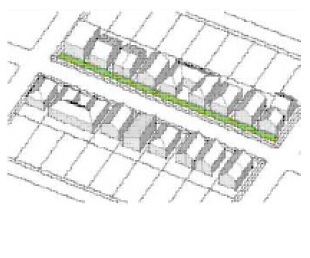 | 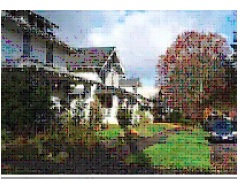 |
b) Rhythm of Development Along Street: Continue established building rhythms along street frontages. Avoid monolithic massing that disrupts fine-grain neighborhood or mixed-use corridor pattern. | 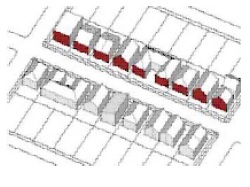 | 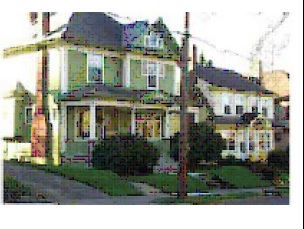 |
c) Building Frontages: i. Along street frontages, orient windows, main entrances, and other primary building façade elements toward the street. ii. Care should be taken to avoid the appearance of buildings turning their backs or sides toward the street. Courtyard buildings can contribute to this by orienting main entrances toward courtyards that serve as a semi-public extension of the public realm of adjacent streets. | 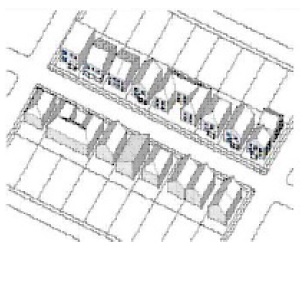 | 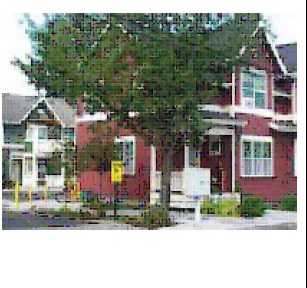 |
d) Front Setback Patterns: Continue established building setback patterns, where this is a neighborhood priority and is practical. | 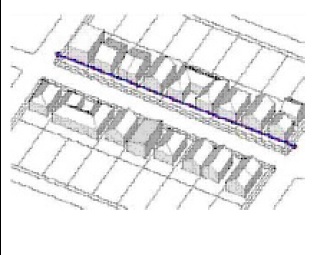 | 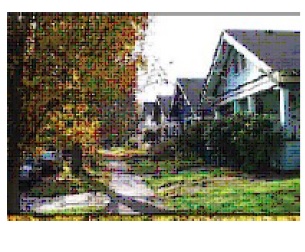 |
e) Use of Landscaping & Trees: Use landscaping and trees to achieve compatibility in areas where these are unifying elements of community character. | 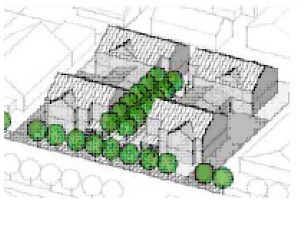 |  |
*Image source: A Guide to Infill Development & Infill Design Toolkit; City of Portland Bureau of Planning
2.06.3 HOD - HIGHWAY OVERLAY DISTRICT
A. Purpose
It is the intent of the Highway Overlay District to protect natural resources, provide landscape improvements, and enhance the overall appearance of the corridors identified. This district has development standards established to regulate development within a corridor. Development standards from the Highway Corridor Overlay District apply to all parcels within 500 feet of the right-of-way on both sides of the streets as shown on the Official Zoning Map. In cases where a portion of a tract of land lies within the Highway Overlay District, the entire tract shall fall into the same regulation. This overlay district is established to:
1. Prevent unsightly conditions that may destroy or detract from the natural character, beauty and condition;
2. Establish standards as may be necessary to accomplish the objective;
3. Minimize potential safety hazards that may exist along the roadways in the town; and
B. Area of Applicability
Major highway corridors affected by the HOD are U.S. 421, U.S. 401, NC 27 and NC 210, the boundaries of which are shown on the Official Zoning Map.
C. Exemptions
For master-planned community projects that are zoned RMX or NMX and over 250 acres in size, the applicant may be exempted from these standards when customized architectural, design and landscaping standards are established through the conditional zoning process.
D. Specific Development Standards
1. Architectural Standards
See Article IV – Design Standards.
2. Parking Lot (off-street parking) Landscaping
a) Parking lots, loading areas, and other vehicle use areas shall be planted with one tree and two shrubs for every ten parking spaces required.
b) At least 65% of the required parking lot trees shall be large shade trees.
c) Trees and shrubs shall be planted within 15 feet of the vehicle use areas.
d) Developments containing 30 or more parking spaces, 50% of the trees and shrubs required shall be planted in islands or medians located within the parking lot.
e) A consecutive strip of parking spaces shall include landscape islands every 20 spaces apart and at the ends of all parking rows.
f) Landscape islands shall be grassed and mowed, covered with organic material (for example, pine mulch), or a combination of the two.
g) In calculating the number of trees and shrubs, standard rounding procedures shall be followed. (For example, one and a half or greater will become two.
3. Driveways:
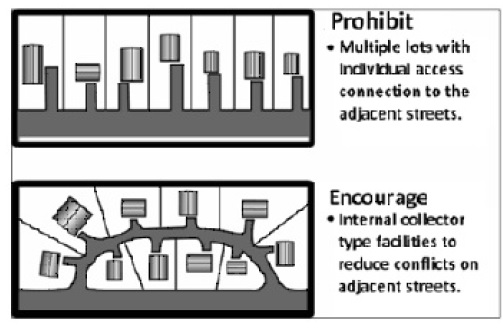
Driveways serving a new development parcel shall be permitted in accordance with the standards of the NCDOT; however, the Board of Commissi oners may require stricter standards as conditions of approval during the site plan review, if it is determined that the additional conditions may improve traffic movement and safety. Developers of nonreside ntial uses are required to share parking areas and driveways with adjoining developm ents. Also, no landscaping or structures shall be allowed near the intersections of driveways and streets that would impede safe vision of traffic. Subdivision of land with multiple smaller parcels having frontage on the roadway along the corridor will not be allowed. NCDOT and the town prohibit this type of development within the corridor. Development will be required to have shared access to the
roadway as approved by the NCDOT and the town.
4. Outdoor Storage: Outdoor storage, when permitted, shall be screened from view so that it is not visible from a right(s)-of-way or adjacent property(s). Any accessory outdoor storage area shall comply with the requirements set forth in this ordinance.
5. Outdoor Advertising Signs: No outdoor advertising signs shall be allowed within the Highway Overlay District or on any property(s) that are partially located within the Highway Overlay District, except in compliance with Article IV.
2.06.4 WPOD - WATERSHED PROTECTION OVERLAY DISTRICT
A. Purpose
Pursuant to requirements of G.S. § 143-214.5, two Watershed Protection Overlay Districts have been established for lands within the Cape Fear River watershed. This watershed is classified as a Water Supply IV which the state classifies as waters used as sources of water supply for drinking, culinary, or food processing purposes. These waters are generally in moderately to highly developed watersheds or protected areas.
B. Area of Applicability
To carry out the above purposes, the town has designated two overlay districts, the boundaries of which are shown on the Official Zoning Map.
1. CF-WPOD-CA – Cape Fear Watershed Protection Overlay District – Critical Area;
2. CF-WPOD-PA – Cape Fear Watershed Protection Overlay District – Protected Area.
C. Specific Development Standards
See Article VI – Environmental and Natural Resource Protection.
(Ord. passed 2-14-2017; Ord. 2022-06, passed 7- 13-2021)
Section 2.07 Dimensional Standards Table
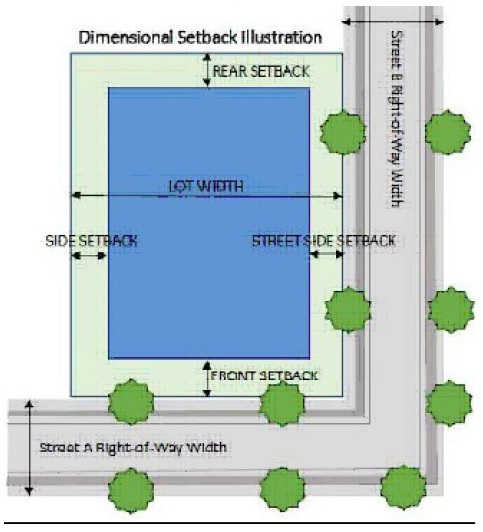
This table and the setback illustration below provides basic design elements for each base zoning district.
Zoning District | Maximum Height | Minimum Lot Size | Minimum Lot Width | Maximum Density | Front Setback | Side Setback | Side Street Setback | Rear Setback |
Zoning District | Maximum Height | Minimum Lot Size | Minimum Lot Width | Maximum Density | Front Setback | Side Setback | Side Street Setback | Rear Setback |
RR | 35 ft. | 40,000 sf | 150 ft. | 1 unit per acre | 40 ft. | 20 ft. | 30 ft. | 30 ft. |
RS20 | 35 ft. | 20,000 sf | 100 ft. | 3 units per acre | 30 ft. | 10 ft. | 20 ft. | 25 ft. |
RS15 | 35 ft. | 15,000 sf | 75 ft. | 4 units per acre | 25 ft. | 10 ft. | 20 ft. | 20 ft. |
RS10 | 35 ft. | *10,000 sf | 50 ft. | 5 units per acre | 20 ft. | 8 ft. | 20 ft. | 25 ft. |
RMF | 3 stories | 10,000 sf plus 3,000 sf for every additional unit | No minimum | 12 units per acre | 0 ft. or 30 ft.1, 2 | 20 ft.; 20 ft. between building s and 50 ft. from land zoned RR, RS20, RS15 or RS10 | 0 ft. or 30 ft.1, 2 | 30 ft. or 50 ft. from land zoned RR, RS20, RS15 or RS10 |
RMX | **4 stories | No minimum | No minimum | 18 units per acre | 20 ft. max. | No minimu m | 6 ft. | 6 ft. |
NMX | **4 stories | No minimum | No minimum | No maximum | 15 ft. max. | No minimum | 12 ft. max. | No minimum |
O/S | **4 stories | 12,000 sf | 80 ft. | N/A | 25 ft. | 10 ft. | 20 ft. | 15 ft. |
CB | 4 stories | No minimum | 25 ft. | No maximum | 6 ft. max. | No minimum | 6 ft. max. | No minimum |
NB | **4 stories | 6,000 sf | 50 ft. | N/A | 30 ft. | 10 ft. | 20 ft. | 20 ft. |
GB | **4 stories | 20,000 sf | 100 ft. | N/A | 30 ft. | 10 ft. | 20 ft. | 20 ft. |
LI | 80 ft. | 30,000 sf | 100 ft. | N/A | 30 ft. | 15 ft. | 30 ft. | 20 ft. |
HI | 80 ft. | 2 acres | 150 ft. | N/A | 40 ft. | 20 ft. | 30 ft. | 30 ft. |
FRO | 35 ft. | No minimum | No minimum | N/A | 50 ft. | 25 ft. | 20 ft. | 25 ft. |
Specific notes to table: *Lots without both public water and sewer must be 20,000 sf. **May exceed with a conditional use permit. 1 Thirty foot minimum setback required from major and arterial streets or thoroughfares. 2 Balconies, stoops, stairs, chimneys, open porches, bay windows, and raised doorways are permitted to encroach into the front setback. Upper story balconies may encroach into the right-of-way (over the sidewalk only) with permission from the Administrator. 3 All single-use multi-family developments are required to meet the setback requirements for the RMF district. General notes to table: a. Accessory structures must be a minimum of 10 feet from the side or rear setback and shall not be located within the front setback. b. Standards may vary if located in an Overlay District. c. All buildings that exceed a building height of 35 feet shall provide an automatic sprinkler system in accordance with the North Carolina State Building Code. The figure to the right should be used to visually illustrate setbacks and measurements as listed in the table above.
|  | |||||||
(Ord. passed 2-14-2017; Ord. 2022-12, passed 9-14-2021)

