
Lillington City Zoning Code
ARTICLE IV
DESIGN STANDARDS
Section 4.01 Generally
The standards in this article are intended to be minimum standards for development. Higher standards or relief from standards may be established through the procedures in Article III and Article VII.
(Ord. passed 2-14-2017; Ord. 2020-05, passed 8-10-2019; Ord. passed 3-15-2022)
Section 4.02 Basic Development Standards
4.02.1 HEIGHT
A. Other than the provisions listed in this section, buildings and structures shall not exceed the maximum heights established in Article II of this ordinance.
B. The height of a building is the vertical distance measured from the mean elevation of finished grade at the front of the building to the highest point of the building.
C. A story includes any floor above the mean elevation of finished grade at the front of the building. Where floor levels are staggered, the number of stories is the number of floors counting vertically from the point of the mean elevation of finished grade at the building front.
D. Roofs with slopes greater than 75% are regarded as walls.
E. Chimneys, church spires, water tanks, elevator shafts, scenery lofts and similar structural appendages not intended as places of occupancy are exempt from the height limitation set forth in this section, provided that not more than one-third of the roof area is covered by such structures.
F. Heating and air conditioning equipment, solar collectors and similar equipment, fixtures and devices are exempt from the height limitation set forth in this section, provided that they are set back from the edge of the roof a minimum distance of one foot for every foot the feature extends above the roof surface. Screen or parapet walls shall be constructed to the height of any fixture taller than three feet in height that would be visible from a street or residential property abutting the property.
G. The height requirements for wireless telecommunications towers & facilities are provided in Article II & III of this ordinance.
H. Light standard heights shall not exceed the limits established in Section 4.07 of this ordinance.
I. Flagpoles and similar devices shall be limited to 35 feet in height.
4.02.2 SETBACKS
A. Setbacks Required. No portion of any building, excluding eaves, decks, patios, steps and uncovered porches may be located on any lot closer to any lot line or to the street right-of-way line than is authorized in Article II of this ordinance. All setbacks are expressed in feet and are minimum setbacks unless otherwise noted. Additional setbacks may be required to meet parking, landscaping, buffers or other standards specified in this article, the specific use standards of Article III of this UDO.
B. Allowed Setback Encroachments. A step, stoop, open porch, awnings or other appurtenances may extend up to five feet into the front setback, provided such features do not impede pedestrian circulation or extend more than 25% into the minimum setback.
C. Setback Measurement
1. Setback distances shall be measured from the property line or street right-of-way line to a point on the lot that is directly below the nearest extension of any part of the building that is substantially a part of the building itself and not a mere appendage to it (such as a flagpole, etc.).
2. If the street right-of-way line is readily determinable (by reference to a recorded map, set irons, or other means), the setback shall be measured at a right angle to such right-of-way line. If the right-of-way line is not so determinable, the setback shall be measured from the street centerline.
D. All setbacks are subject to compliance with adopted applicable fire code provisions.
4.02.3 RELATIONSHIP OF BUILDING TO LOT
In no case shall there be more than one principal building and its customary accessory buildings on a lot except in the case of a designed complex of professional, residential or commercial buildings in an appropriate zoning district.
4.02.4 STREET ACCESS
No building shall be erected on a lot which does not abut a street or have access to a street, provided that in a planned development, a building may be erected adjoining a parking area or dedicated open space which has access to a street used in common with other lots.
4.02.5 INFILL LOT STANDARDS
The minimum front or street yard required may be reduced for any lot where the average established front yard on developed lots located within 300 feet on each side of such lot, and fronting on the same street as such lot, is less than the minimum required yard. In such cases, the minimum front or street yard may be less than that required but not less than the average of the existing front yards on the developed lots within 300 feet of each side. In addition, for new lots created from existing larger lots, the lot width at the frontage line and the side yard setbacks shall be consistent with the immediately adjacent neighboring parcels on the same side of the street.
4.02.6 IRREGULAR LOT SETBACKS
The location of required front, side and rear yards (or setbacks) on irregularly shaped lots shall be determined by the Administrator. The determination will be based on the intent and purpose of this ordinance to achieve an appropriate spacing and location of buildings and buildings on individual lots. Where questions arise as to appropriateness, the subdivider may be requested to provide additional design information.
(Ord. passed 2-14-2017; Ord. 2020-05, passed 8-10-2019; Ord. passed 3-15-2022)
Section 4.03 Accessory Uses and Structures
The purpose of this section is to establish standards for accessory uses and structures. Except as provided elsewhere in this ordinance, it shall be unlawful for any person to erect, construct, enlarge, move or replace any accessory use or structure without first obtaining a certificate of zoning permit from the Administrator.
A. General
1. Accessory uses and structures may only be used for purposes permitted in the district in which they are located.
2. Not for dwelling purposes: Accessory structures shall not be used for dwelling purposes except as an approved accessory dwelling in accordance with this ordinance.
3. Building permits may be required: Depending on the size of the structure and the incorporation of various improvements (e.g., electrical, plumbing) a building permit may also be required.
4. See Article III, Section 3.03.5 for accessory dwelling standards.
B. Location, Setbacks and Height
Standards | Single-family/ Two-family lots - less than 2 acres in size | Single-family/ Two-family lots - 2 acres or larger in size | Lots over 5 acres in size | All other uses |
Permitted location | Side/rear only | Permitted in all yards - may not be closer than 30' of r/w | Permitted in all yards - may not be closer than 30' of r/w | Side/rear yard only |
Side/Rear Yard Setback | See district setbacks in Article II - Zoning District Provisions. | |||
Height | See district height provisions in Article II - Zoning District Provisions. | |||
C. Maximum Number and Area
Standards | Single-family/ Two-family lots - less than 2 acres in size | Single-family/ Two-family lots - 2 to 5 acres in size | Lots over 5 acres in size | All other uses |
Maximum Accessory Structures Permitted | 2 | 2 | No max. | No max. |
Maximum Area (Accessory Dwelling Unit Area is Exempt) | 600 sf per structure 1,000 sf aggregate | 1,000 sf per structure 1,400 sf aggregate | No max. | No max. |
(Ord. passed 3-15-2022)
Section 4.04 Fences & Walls
All fences and walls shall comply with the requirements of this section unless specifically approved as part of a conditional zoning, special use permit or variance.
A. Except as otherwise provided in this section, fences that are no taller than six feet may be built along interior side and rear property lines.
B. Exterior side yard fences that are no taller than six feet shall be at least two feet from the right-of-way and no closer than two feet from the inside edge of the sidewalk.
C. Fences in front yards are discouraged, but must be:
1. Located least two feet from the right-of-way and no closer than two feet from the inside edge of the sidewalk;
2. Less than 60% opaque;
3. Be designed as picket or wrought-iron style fences (chain link and chicken wire are prohibited); and
4. Not exceed four feet in height, except that wrought iron and split rail style fences may be up to five feet tall.
D. No fence shall obstruct any traffic safety visibility zone.
E. Barbed wire, razor wire or other fence materials designed to cut or puncture are prohibited in all districts, except in the LI, HI and FRO districts.
F. Deer fences may be erected around gardens provided that the fences are located at least ten feet from the nearest property line.
(Ord. passed 2-14-2017; Ord. 2020-05, passed 8-10-2019; Ord. passed 3-15-2022)
Section 4.05 Parking, Driveways and Loading
4.05.1 PURPOSE AND INTENT
This section establishes the minimum requirements for the number of spaces and the design of parking areas in the Town of Lillington. This section provides administrative flexibility for the Administrator to adjust the number of required spaces and the design of spaces to provide for adequate parking, accommodate unique site conditions and capitalize on the benefits of parking opportunities on-street or in shared parking areas.
4.05.2 APPLICABILITY
The requirements of this section shall be applicable to all new development and change of use that create the need for parking or increase existing parking demands.
4.05.3 PARKING SPACE REQUIREMENTS
Permanent off-street parking (including on-street parking in accordance with the requirements below) is required subject to the table below. If required, parking shall be provided at the time of erection, alteration, enlargement, establishment or change of use of any building or open use of land which require additional off-street parking.
LAND USE TYPE | MINIMUM REQUIRED AUTO SPACES | MINIMUM REQUIRED BICYCLE PARKING SPACES |
LAND USE TYPE | MINIMUM REQUIRED AUTO SPACES | MINIMUM REQUIRED BICYCLE PARKING SPACES |
RESIDENTIAL: | ||
Dwelling – Single-Family Detached & Two Family (Duplex) | 2 per unit | 1 per 50 lots |
Dwelling – Single-Family Attached (Townhome) | 2 per unit plus 0.25 per unit for guest parking | 1 per 50 lots |
Dwelling – Multifamily | 2 per unit | 1 per 50 auto spaces |
Dwelling – Accessory | 1 per unit | N/A |
Live-Work Units | 1 per 700 sf | N/A |
Residential Care Facilities | 1 per 2 resident rooms | 1 per 40 auto spaces |
All other residential uses | No requirement | No requirement |
LODGING AND ACCOMMODATIONS: | ||
All uses | 1 per room | 1 per 50 auto spaces |
OFFICE AND SERVICES: | ||
Medical Clinic | 1 per examination room | 1 per 50 auto spaces |
All other Office & Service Uses | 1 per 700 sf | 1 per 50 auto spaces |
COMMERCIAL AND ENTERTAINMENT: | ||
Restaurant | 1 per 400 sf | 1 per 50 auto spaces |
Indoor Amusement | No requirement | 1 per 50 auto spaces |
Outdoor Amusement | No requirement | 1 per 50 auto spaces |
Theater (Indoor or Outdoor) | 1 per 8 seats | 1 per 50 auto spaces |
All other Commercial and Entertainment Uses | 1 per 500 sf | 1 per 50 auto spaces |
MANUFACTURING, INDUSTRIAL AND WHOLESALE TRADE: | ||
Storage/Warehouse Uses: | ||
1 to 50,000 sf | 1 per 1,500 sf | No requirement |
Over 50,000 sf | 1 per 2,000 sf | No requirement |
LAND USE TYPE | MINIMUM REQUIRED AUTO SPACES | MINIMUM REQUIRED BICYCLE PARKING SPACES |
LAND USE TYPE | MINIMUM REQUIRED AUTO SPACES | MINIMUM REQUIRED BICYCLE PARKING SPACES |
Other Industrial/Manufacturing Uses: | ||
1 to 3,000 sf | 1 per 250 sf | No requirement |
3,001 to 5,000 sf | 1 per 500 sf | No requirement |
5,001 to 10,000 sf | 1 per 750 sf | No requirement |
10,001 to 50,000 sf | 1 per 1,250 sf | No requirement |
Over 50,000 sf | 1 per 2,000 sf | No requirement |
EDUCATION & INSTITUTIONS: | ||
Child/Adult Day Care Centers (more than 8 persons) | 1 space per classroom | 1 per 50 auto spaces |
Religious Institutions | 1 per 8 seats in main assembly hall | 1 per 50 auto spaces |
Schools (elementary & secondary) | 1 per 8 seats in main assembly hall or gymnasium | 2 per 50 auto spaces |
Studio | 1 per 400 sf | 1 per 20 auto spaces |
All other Education and Institution uses | No requirement | 1 per 50 auto spaces |
AGRICULTURAL AND FORESTRY: | ||
All uses | No requirements | No requirements |
COMMUNICATIONS, TRANSPORTATION AND INFRASTRUCTURE: | ||
All uses | No requirement | No requirements |
4.05.4 EXEMPTIONS AND ADJUSTMENTS
A. Exemptions. Uses in the CB District are exempt from the minimum parking requirements of this section.
B. Tree Preservation. The minimum number of parking spaces required may be adjusted by the Administrator when it has been determined that the reductions are necessary to preserve a healthy tree or trees (with a 12 inch or greater diameter at breast height) from being damaged or removed, and where the site plan provides for the retention of said tree or trees.
4.05.5 SATELLITE PARKING
A. If the off-street parking spaces required by this section cannot be reasonably provided on the same lot on which the principal use is located, such space may be provided on any land within 600 feet. Such measurement shall be taken from the edge of the parking area on the lot to the entryway of the remote parking area.
B. Shared Satellite Parking: Upon approval by the Administrator, satellite parking facilities may be shared by two or more uses which do not share normal operating hours.
C. Parking for Permitted Uses Only: If satellite parking is utilized to fulfill parking requirements, the owner or authorized agent for the land upon which such remote parking is located shall restrict the use of such parking area for parking only in connection with the use(s) or structure(s) for which such remote parking is provided. Such restriction shall be recorded as an easement at the time of final plat approval. If no final plat is required as part of the development approval, a shared parking agreement between uses can be submitted to the Administrator in lieu of recording a such easements on a final plat. Remote parking for a particular use shall not be established in any district that does not allow that use.
4.05.6 VEHICLE DESIGN STANDARDS
A. Parking Area General Design Standards
1. Parking areas shall be maintained to provide for vehicle access and shall be kept free of litter, debris, outdoor display and sales and material storage, including portable containers.
2. Parking for service vehicles shall be designated, located and screened to minimize the view from adjacent properties and rights-of-way, generally at the rear of buildings.
3. Parking areas shall be located and designed to avoid undue interference with the use of public rights-of-way, driveways or pedestrian ways. Parking stalls shall not be located in areas that would require backing into access driveways or streets except where allowed for residences.
4. Parking design and location shall be in accordance with the Lillington Specifications Manual and at minimum shall the following minimum dimensions:
Parking Angle (degrees) | Parking Space Width (feet) | Parking Space Depth (feet) | Min. Aisle Width (feet) |
0 | 9 | 20 | 12 |
30 | 9 | 18 | 11 |
45 | 9 | 20 | 13 |
60 | 9 | 21 | 18 |
90 | 9 | 18 | 24 |
5. Parking stalls shall be located a minimum of ten feet from public rights-of-way and buildings to allow sufficient separation for sidewalks, landscaping and other site features except along the backs of buildings in areas designed for loading and unloading.
6. Parking shall not be located in landscaped, open space or tree save areas.
7. Vehicle storage or display areas shall be identified on a site plan distinct from customer and employee parking areas and shall comply with parking access, location and design requirements, except that striping of the display or storage area shall not be required. Vehicle storage or display areas shall not be located in a manner that interferes with vehicle or pedestrian access aisles or driveways.
8. Tractor trailers, cargo trucks, busses and other large commercial vehicles or heavy equipment parking and storage shall comply with parking access, location and design requirements except for stall size and aisle size which shall be as appropriate for the vehicles to be stored and shall be designated on a site plan.
B. Stacking Spaces
1. Uses with drive-through facilities and other auto-oriented uses where vehicles queue up to access a service shall provide adequate stacking spaces on-site for the uses or buildings in accordance with this section. Such uses include but are not limited to: restaurants with drive-through, convenience store with fuel sales, and other uses with service bays or drive-throughs.
2. Required stacking spaces are subject to the following design and layout standards:
a. Stacking spaces shall be a minimum of nine feet wide and 16 feet long.
b. Stacking spaces shall not impede vehicular traffic movements or movements into or out of parking spaces, whether on-site or off-site.
c. Stacking spaces shall not impede onsite or offsite bicycle or pedestrian traffic movements, whether on-site or off-site.
d. Stacking spaces shall be clearly delineated through such means as striping, landscaping, pavement design, or curbing.
C. Surfacing
Off-street parking areas shall be properly graded, marked and located on improved lots or within parking structures. The material for surface parking spaces and corresponding access drives required by this section, except for single-family detached and duplex residences, shall consist of suitable material as set forth below.
1. Suitable Materials: Suitable paving materials for required parking areas include, but are not limited to, asphalt, porous asphalt, porous paving blocks, and concrete. Compacted stone (road bond) and gravel may be permitted by the Administrator as paving materials in the rear setback area for loading and service areas in areas zoned LI or HI (Industrial Districts).
2. Accessible Spaces: All accessible spaces and corresponding access paths shall consist of concrete or asphalt.
3. Pervious Surfaces: Porous paving blocks and pervious paving materials are permitted and encouraged as material for parking lots. The use of reinforced grass as a parking lot surface is permitted for satellite parking areas.
4. Parking Space Marking: The individual parking spaces in a lot shall be delineated in all parking lots except those utilizing road bond, gravel, grass or other vegetative surfacing.
D. Connectivity
1. Adjoining parking lots serving (or potentially serving) non-residential or multifamily uses shall be interconnected as follows:
a. The parking lot under development has a minimum of 24 parking spaces or equivalent parking area.
b. At least one connection is provided at all lot lines that are coincident for at least 60 feet with another lot zoned for non-residential use.
c. The connection is at least 20 feet wide.
d. If applicable, the connection aligns with a connection that has been previously constructed on an adjacent property.
e. The connection has a slope of no greater than 15%.
f. The connection is not placed where a building on an adjacent property is within 50 feet of the lot line which would hamper traffic movements within the parking lot.
g. The connection is placed in an area which will not require the removal of significant natural features such as wetlands or trees with a caliper of 6 inches or more.
h. In the event these conditions cannot be met without undue hardship, or if such connections would create undesirable traffic flow, the Administrator may waive the connection requirement.
i. Where a parking lot connection is required an easement for ingress and egress to adjacent lots shall be recorded by the property owner with the Harnett County Register of Deeds in the form of an easement plat.
E. Off-street Loading Requirements
1. Off-street loading spaces shall be required for industrial, major institutional, and business uses that can be expected to regularly receive or deliver goods, pursuant to the following schedule (areas within the Downtown Overlay District - Central Business/Main Street Area are exempt from this requirement):
Building Square Footage | Required Number of Spaces |
Under 20,000 | 0 |
20,001 to 40,000 | 1 |
40,001 to 100,000 | 2 |
Over 100,000 | 3 |
2. Required loading spaces shall have the following minimum dimensions: 12-foot minimum width, 25-foot minimum length, and 14-foot minimum vertical clearance.
3. Locations
a. Required off-street loading spaces shall not be located within a building, but shall be on the site of the use served or on an adjoining site.
b. Required off-street loading spaces shall be located to the sides and/or rear of the lot to maximize the street exposure of the primary structure.
c. A loading area shall not be located in a required setback. In addition, street-side loading docks shall be set back at least 70 feet from the street property line or 110 feet from the street center line, whichever is greater.
d. No loading bay may intrude into any portion of a required parking aisle or access dimension.
e. Loading areas visible from a street shall be screened on three sides by a solid, decorative fence, wall, or hedge at least six feet in height.
4. Access
a. A required loading stall shall be accessible without parking a truck across a street property line unless the Administrator determines that provision of turnaround space is infeasible and approves alternate access.
b. An occupied loading space shall not prevent access to a required off-street parking space.
F. Parking Alternatives
The Administrator is authorized to approve an alternative parking plan for agricultural uses, industrial uses and recreational facilities that proposes alternatives to the standards in this section.
G. Driveways
1. No portion of any residential or mixed-use driveway intersection with a town public street shall be closer than 20 feet to the comer of any intersection, measured along the right-of-way line. In commercial and industrial zones, this distance shall be 30 feet. The width of any driveway intersection with the public street shall not exceed 30 feet at its intersection with curb and street line. Driveway connections to NCDOT controlled streets must be requested from and approved by DOT. Driveways that have double lane ingress and egress (four lanes) shall be a minimum 60 feet width at intersection with curb and street line.
2. All driveways shall be paved with either asphalt or concrete, or with alternative paving material (e.g., concrete pavers, brick, "turfstone" or similar material) determined to exhibit equivalent wear resistance and load bearing characteristics as asphalt or concrete.
3. No driveway shall conflict with any town facility such as traffic signal standards, catch basins, fire hydrants, crosswalks, loading zones, bus stops, utility poles, fire-alarm supports, meter boxes, and sewer clean-outs or other necessary structures, except with the express approval of the Administrator. Any adjustments to town facilities to avoid such conflicts shall be at the expense of the driveway applicant.
4. Location of Driveway Access Points
a. Two driveways entering the same street from a single lot shall be permitted only if the minimum distance between the closest edges of the driveways equals or exceeds 50 feet.
b. Three driveways entering the same street from a single lot shall be permitted only if the minimum distance between the closest edges of the driveways equals or exceeds 150 feet
c. Four or more driveways entering the same street from a single lot shall be prohibited.
d. In no case may the total width of all driveways exceed 50% of the total property frontage.
e. No driveway (nearest edge) shall be located within five feet of a side lot property line except in the case of a shared driveway (single curb/access point) utilized by two or more lots.
f. No driveway (nearest edge) shall be located within 25 feet of an intersection on a secondary road and 40 feet on a primary road except in the case where no other lot access to a public street or town-approved private road is available.
(Ord. passed 2-14-2017; Ord. 2020-05, passed 8-10-2019; Ord. 2022-06, passed 7-13-2021; Ord. 2022-12, passed 9-14-2021; Ord. passed 3-15-2022)
Section 4.06 Signs
4.06.1 PURPOSE AND INTENT
The sign regulations of this article are adopted under the zoning authority of the town in furtherance of the general purposes set forth in the Unified Development Ordinance. The purpose of this article is as follows:
A. To encourage the effective use of signs as a means of communications in the town and its extraterritorial jurisdiction;
B. To maintain and enhance the aesthetic environment and the town’s ability to attract sources of economic development and growth;
C. To improve pedestrian and traffic safety;
D. To minimize the possible adverse effect of signs on nearby public and private property; and
E. To enable the fair and consistent enforcement of these sign regulations.
4.06.2 APPLICABILITY
All signs within the town’s jurisdiction shall be covered by these regulations and be erected, constructed or maintained in accordance with the provisions of this section.
4.06.3 PERMITS REQUIRED
A. Except as provided otherwise in this section, it shall be unlawful for any person to erect, construct, enlarge, move or replace any sign without first obtaining a permit, in accordance with this ordinance, from the Administrator to ensure compliance with the provisions of this ordinance.
B. Additional permits may be necessary pursuant to the regulations in the State Building Code or other sections of this ordinance.
4.06.4 ALTERATION OF SIGN FACE
Cleaning, electrical repair, resurfacing and other maintenance of a sign shall not require a permit. The changing of tenant name panels on multiple-tenant development signage and the change of copy on other signs specifically designed for changeable copy shall not require a permit.

A. The area of a sign face shall be deemed to be the entire area within the smallest polygon that will encompass the extreme limits of the writing, representation, emblem or other display on the sign that can be reasonably calculated.
B. The area shall also include any material or color forming an integral part of the background of the display or used to differentiate the sign from the backdrop or structure against which it is placed.
C. Frames or structural members not bearing informational or representational matter shall not be included in computation of the area of a sign face. Computations of sign area shall include only one side of a double-faced sign structure. If a sign has two sides joined at an angle greater than 60 degrees, the surface of both sides shall be included in the computation of area.
4.06.6 COMPUTATION OF HEIGHT
A. Attached signs. The sign height for attached signs shall be computed as the distance from the finished grade at the base of the building to which the sign is attached to the top of the highest component of the sign.
B. Ground (freestanding) signs. As illustrated below, the sign height for ground signs shall be computed as the lesser of:
1. The distance from the base of the sign at the finished grade to the top of the highest component of the sign; or
2. The distance from the nearest adjacent street grade to which the sign is oriented, and on which the lot has frontage, to the top of the highest component of the sign.

4.06.7 LOCATION AND ENCROACHMENT
A. Permitted signs shall be located outside of the street right-of-way, behind sidewalk areas and outside of required site triangles.
B. All attached signs shall be mounted and attached to buildings in a secure manner, shall not include wire or turnbuckle guy and shall be maintained in good repair for safety and appearance.
C. No non-governmental sign shall be attached to or painted on power poles, light poles, telephone poles, traffic signs or other objects not intended to support a sign.
4.06.8 MATERIALS AND STRUCTURAL REQUIREMENTS
A. All attached signs and sign support frames shall be mounted and attached to building or ground in a secure manner, shall not include wire or turnbuckle guy and shall be maintained in good repair for safety and appearance.
B. All permanently installed signs shall be able to resist normal loads from positive and negative wind pressure, snow and other conditions as required by the current edition of the North Carolina version of the International Building Code.
C. The Administrator reserves the right to require sign load calculations and attachment design from a state licensed structural engineer, and to require same engineer to certify the sign installation in writing.
4.06.9 NONCONFORMING SIGNS
See Section 8.07.
4.06.10 SIGNAGE TYPES
Signage types illustrated below are approved for usage in the town:

4.06.11 ATTACHED SIGNAGE STANDARDS
Sign Type | Zoning District | Square Footage | Height | Total Number |
Wall Signs | CB, GB, NB, NMX, O/S, LI, HI | 10% of the gross square footage on any one side of the building. | No sign shall extend above the roofline. | 4 signs per building wall. |
Awning / Canopy / Window / Door Signs | CB, GB, NB, NMX | 25% of the gross glass area on any one side of the building (windows/doors), 50% of area for awnings/ canopies). | No sign shall extend above the roofline. | N/A |
Projecting / Suspended Signs | CB, GB, NB, NMX | 6 square feet | Shall be at least 7 feet from the ground measured from the bottom of the sign. | One per tenant. |
Notes: Wall signs shall have a max. protrusion of 12 inches, may only be placed on walls facing a public right-of-way. No illumination for awning/canopy/window/door signs or projecting/suspended signs is permitted. | ||||
4.06.12 RESIDENTIAL GROUND SIGNAGE STANDARDS
Zoning District | Square Footage | Height | Total Number |
RR, RS-20, RS-15, RS-10, RMF, RMX | 20 square feet | 6 feet | 1 per entrance |
Notes: 1) Signs are permitted on decorative or retaining walls at entrances to residential developments without limitations to the size of the wall. 2) 5-foot minimum setback from all property lines is required for all ground signs. | |||
4.06.13 NONRESIDENTIAL GROUND SIGNAGE STANDARDS
Zoning District | *Square Footage | *Height | Sign Base | Total Number of Signs |
CB | 20 square feet | 6 feet | Monument | 1 sign per site |
O/S | 20 square feet | 6 feet | Monument | 1 sign per site |
NB | 20 square feet | 12 feet | Monument or column | 1 sign per street frontage |
GB, LI, HI | 40 square feet | 12 feet | Monument or column | 1 sign per street frontage |
Notes: 1) Column signs may be single or double mounted and must have a diameter greater than 24 inches. 2) Monument signs must have a base that is at least 75% of the width of the total sign. 3) Monument signs must have a base material of brick, stone or like imitation material. 4) 5-foot min. setback from all property lines is require for all ground signs. *Square footage & height may exceed minimum square footage and height if located in the Highway Overlay District. See Section 4.06.15 for ground sign standards located within the Highway Overlay District. |
4.06.14 PERMITTED SIGNAGE ILLUMINATION BY DISTRICT
Zoning District | External Illumination | Internal Illumination |
RR, RS-15, RS-10, RS-20, RMX, RMF | Permitted | Not Permitted. |
O/S, NMX, CB, NC, GB, LI, HI | Permitted | Permitted |
Notes: 1) Prohibited lighting: no flashing or intermittent illumination shall be permitted on any adverting sign or structure. 2) Shielding required: any indirect lighting or spot lighting shall require complete shielding of all light sources so as to illuminate only the face of the sign and prevent off-site glare. 3) White light only is permitted. 4) See Section 4.06.15 for illumination standards located within the Highway Overlay District. | ||
4.06.15 STANDARDS FOR SIGNAGE IN THE HIGHWAY OVERLAY DISTRICT
A. Signs located within the Highway Overlay District shall meet the following criteria:
Development Type | Maximum Sign Area | Maximum Height |
• Single-family residential developments • Multi-family developments • All other developments with less than 200 feet of road frontage | 40 sq ft | 12 feet |
• All developments with 200 feet or more of road frontage | 72 sq ft | 20 feet |
B. The following regulations shall be met in addition to the guidelines in the chart above:
1. All ground signs shall be placed immediately adjacent to the right-of-way boundary, as long as they do not encroach on sight lines.
2. All monument signs shall be double-sided and internally lit.
3. All ground signs shall be free-standing monuments style.
4.06.16 OTHER SIGNAGE REQUIRING PERMITS
A. Construction project signs:
1. Permitted districts: all districts.
2. Surface area: 32 square feet maximum.
3. Time limit: these signs are intended to be temporary and must be removed after completion of construction.
B. Sales office signs:
1. Permitted districts: all residential districts, only on model home lots used as sales offices for single-family residential subdivisions.
2. Surface area: 32 square feet maximum.
3. Time limit: these signs are intended to be temporary and must be removed after 50% of the lots in the current phase of the development are sold.
C. Electronic message boards:
1. Permitted districts: RMX, NMX, O/S, NB, GB, LI & HI.
2. Surface area: electronic message boards may be incorporated into a permitted wall or ground sign only, and shall not comprise more than 50% of the primary sign area.
3. Message variation: the electronic message shall not change in increments of less than seven seconds and shall not scroll. New messages shall be timed to fade in and out slowly.
D. Drive-thru menu boards:
1. Permitted districts: GB, NB, CB.
2. Location/placement: menu boards shall be allowed only as an accessory use to a restaurant having a drive-through window.
3. Surface area: 35 square feet maximum.
4. Height: six feet maximum.
4.06.17 GROUND SIGNAGE STANDARDS FOR SITES WITH MULTIPLE BUILDINGS
All ground signage for developments with multiple buildings are subject to these provisions:
A. Ground signs may be a maximum of 12 feet in height and 100 square feet in sign area.
B. Planned developments may have one ground sign per road frontage.
C. Outparcels for planned developments may have one ground sign that is a maximum of four feet in height and 35 square feet in sign area.
4.06.18 SIGNS EXEMPT FROM PERMIT REQUIREMENTS
A. Governmental signs. Signs posted by various local, state and federal agencies in the performance of their duties such as regulatory signs, welcome signs, government regulatory and direction information and traffic signs. Signs installed under governmental authority which note the donation of buildings, structures or streetscape materials (such as, but not limited to benches, park facilities and the like).
B. Flags and the like. Flags or insignia of any nation, organization of nations, state, county or municipality provided the height of any pole shall not exceed the maximum building height for the district. Refer also to the United States Flag Code for usage of the United States flag.
C. Temporary holiday decorations. Temporary decorations or displays, when such are clearly incidental to and are customarily and commonly associated with any national, local or religious holiday/celebration.
D. Building marker signs. A sign cut or etched into masonry, bronze or similar material on a building which denotes only the building name, date of erection or street number.
E. Legal and warning signs. Signs erected to warn of danger or hazardous conditions such as signs erected by public utility companies or construction companies.
1. Signs required for or specifically authorized for a public purpose by any law, statute or ordinance.
2. Signs that display information pertinent to the safety or legal responsibilities of the general public with regard to a particular piece of property shall be located on the premises to which the information pertains. No advertising may be affixed to such a sign.
F. Occupant/street number signs. Signs not exceeding two square feet and not illuminated, bearing property numbers, post office box numbers, names of occupants or other identification of premises not having commercial connotations.
1. All such signs must be placed in such a manner as to be visible from the street.
2. Unit identification numbers shall be located on the front wall within 18 inches of the entrance, or if not feasible architecturally, prominently displayed on the building. Unit numbers for residential dwellings only may, in lieu of being located on the front wall, be located on the mail boxes or similar-sized surface attached thereto. Multi-family and other residential facilities which are comprised of courts or units not fronting a public street must be located on identification signs containing the name of the court, street or way and the unit numbers on each private entrance.
G. Vending machine/automatic teller and gasoline pump signs. Signs attached to and made an integral part of a vending machine, automatic teller machine or gasoline pump if advertising or giving information about the products or services dispensed or vended by that machine.
H. Directional signs on private property. Directional signs must be located on the premises to which directions are indicated.
1. Such signs may not exceed three feet in height if freestanding.
2. Directional signs may not exceed four square feet per face.
3. Such signs may contain no copy (such as, company name or logo) other than directional information.
4. Illumination of such signs shall be as permitted for on-premises signs in the land development district where the sign is located.
5. No more than two signs per entrance or exit shall be permitted.
I. Gas pump island signs. Portable signs associated with gasoline stations, specifically those denoting gasoline prices, gas types and other petroleum related signage. Such signs must be located at the pump island.
J. Incidental signs. Signs containing information necessary or convenient for persons coming onto a premises shall be located on the premises to which the information pertains.
1. No advertising may be affixed to such a sign.
2. Such signs must be single-faced only and wholly attached to a building (may be located on windows or doors).
K. Real estate signs. Only one sign is allowed per street frontage.
1. Such signs may not be illuminated.
2. Such signs may be no greater than four square feet in area (all types of signs) and four feet in height (if freestanding) when located on a residential property less than two acres.
3. Such signs may be no greater than 16 square feet in area (all types of signs) and eight feet in height (if freestanding) for non-residential properties or residential properties exceeding two acres.
4. Real estate signs shall be removed within one day after the closing of the sale, rental or lease of the property.
L. Political signs. Political signs shall not be located on any trees, utility poles, publicly-owned property or within a public street right-of-way, except within NCDOT right-of-way according to the standards of G.S. § 136-32.
M. Temporary signs; special event signs. Signs may be erected for promoting special events as follows:
1. Signs for public events may be displayed for a period of 30 days and may be allowed on- or off-premises. Such signs shall be removed within seven days of the end of the special event.
2. Such signs shall not be illuminated.
3. Such signs are limited to 32 square feet in area per display surface and four feet in height.
N. Yard sale signs. Such signs may be located on-premises only and may not be located within a public right-of-way nor placed on a tree, street sign or utility pole.
1. Such signs may not be illuminated.
2. Yard sale signs are limited to four square feet in area and four feet in height.
3. One yard sale sign is allowed per street frontage.
4. Such signs must be removed within seven days of erection.
O. Grand Opening Signs. Temporary or portable grand opening signs may be permitted in the NB, CB, GB and O/S Districts for a period of not over 30 days per calendar year to any person(s) or corporation that has opened a new business. Grand opening signs include pennants, ribbons, streamers, balloons and/or spinners.
P. One “open” sign per tenant.
1. May have a neon light source.
2. Permitted districts: CB, NB & GB.
3. Not exceeding 15 watts and two square feet.
Q. Fence Wrapping. Fence wraps displaying signage when affixed to perimeter fencing on construction sites, as described by G.S. § 160A-381(j), shall be exempt from the requirements of this ordinance and allowed to remain until:
1. A final certificate of occupancy is issued, or
2. 24 months has elapsed from when the signage was installed, whichever is shorter.
4.06.19 PROHIBITED SIGNS
A. Off-premises signs. All off-premises signs unless specifically allowed elsewhere in this ordinance are prohibited.
B. Animated/flashing signs or signs of illusion. Except for otherwise approved time and temperature signs, signs displaying blinking, flashing or intermittent lights, animation, and moving parts or signs giving the illusion of movement are prohibited. Time and temperature signs that rotate or move are not permitted.
C. Signs resembling official signs. Any sign that imitates an official governmental sign, or violates the law of the state relating to outdoor advertising, is prohibited.
D. Signs resembling traffic signals. Any sign which by color, location or nature may be confused with official highway signs, warning signs, traffic signals or other regulatory devices are prohibited.
1. Any sign that uses the word “stop”, “slow”, “caution”, “danger”, or any other word which is likely to be confused with traffic directional and regulatory signs is prohibited.
2. Any sign located in a manner or place which might constitute a traffic hazard is prohibited.
E. Signs on roadside appurtenances. Signs attached to or painted on utility poles, telephone poles, trees, parking meters, bridges and overpasses, rocks, other signs, benches and refuse containers, and the like are prohibited unless specifically allowed elsewhere in this ordinance.
F. Abandoned signs or sign structures. Signs that advertise an activity or business no longer conducted on the property on which the sign is located are prohibited. Conforming signs designed for changeable copy may be covered instead of removed.
1. Sign structures on which no sign is erected are prohibited.
2. Such signs or sign structures must be removed within 30 days of becoming an abandoned sign or sign structure.
G. Signs obstructing access. Any sign that obstructs free ingress or egress from a driveway or a required window, door, fire escape, stairway, ladder or other required opening is prohibited.
H. Signs with exposed electrical wiring. All wiring shall be contained in conduit or enclosed in poles or raceways. In no case shall the wiring be exposed to the public.
I. Signs on public property. Any sign installed or placed on public property or within a public right-of-way, including any sign held by or otherwise displayed upon a person. Such sign shall be forfeited to the public and is subject to confiscation and disposal. In addition to other remedies hereunder, the Administrator shall have the right to recover from the owner or person placing such a sign the full costs of removal and disposal of such sign.
4.06.20 MAINTENANCE OF SIGNS
Signs shall be kept in proper repair. The following maintenance requirements must be observed for all signs visible from any public street or highway within the jurisdiction of the town.
A. Surface appearance. No sign shall have more than 20% of its surface area covered with disfigured, cracked, ripped or peeling paint or poster paper for a period of more than 30 successive days.
B. Broken displays. No sign shall remain with a bent or broken display area, broken supports, loose appendages or struts or stand more than 15 degrees from the perpendicular for a period of more than 30 successive days.
C. Illuminated signs. No indirect or internally illuminated sign shall have only partial illumination for a period of more than 30 successive days.
4.06.21 INSPECTION AND ENFORCEMENT
All signs for which a permit is required shall be subject to inspection by the town. A representative of the town shall be authorized to enter at all reasonable times upon any property or premises to ascertain whether the provisions of the code are being obeyed. The town may order the removal of any sign that is not in accordance with the provisions of the code.
4.06.22 SUBSTANDARD SIGNS
A. The owners of any sign judged substandard by the Administrator shall be notified in writing and the said owner shall have 30 days in which to make repairs. If the said order is not complied with within 30 days, the Administrator shall remove such sign at the expense of the owner or lessee thereof plus all legal and administrative fees.
B. Any sign installed or placed on public property or within a public right-of-way shall be forfeited to the public and is subject to confiscation and disposal. In addition to other remedies hereunder, the Administrator shall have the right to recover from the owner or person placing such a sign the full costs of removal and disposal of such sign.
4.06.23 SIGNS PERMITTED IN ALLOWANCE, REMOVAL, RELOCATION, RECONSTRUCTION OF NONCONFORMING OFF-PREMISE ADVERTISING SIGNS
A. New signs limited. No new outdoor advertising signs shall be permitted in the town except for outdoor advertising signs that are removed, relocated, or reconstructed pursuant to the requirements of this section.
B. Qualified signs. A sign with an existing valid permit from the State Department of Transportation and the town. A sign may also qualify if erected prior to applicable zoning regulations.
C. Removal/replacement/reconstruction. Any relocated and/or reconstructed qualified sign shall comply with the following standards:
1. The total number of relocated and/or reconstructed signs shall not exceed the number of qualified sign structures and sign faces that are registered as qualified signs.
2. No outdoor advertising sign shall exhibit a face panel size greater than 300 square feet per side or the size of the face panel being relocated and/or reconstructed, whichever is smaller.
3. A relocated and/or reconstructed qualified sign shall be set back no less than ten feet from the edge of the right-of-way.
4. A relocated and/or reconstructed qualified sign shall not exceed 40 feet in height or the existing height, whichever is shorter.
5. A relocated and/or reconstructed qualified sign shall be a column sign. Replaced signs shall not be attached to any building. A relocated and/or reconstructed sign is limited to only have one face per side.
6. Light emitted from any reconstructed qualified sign shall be confined to the sign area and in no case shall light emitted from a billboard be allowed to shine directly onto or into a residentially zoned or used property.
(Ord. passed 2-14-2017; Ord. 2020-05, passed 8-10-2019; Ord. 2022-06, passed 7-13-2021; Ord. passed 3-15-2022)
Section 4.07 Lighting
The provisions contained in this section shall be known and may be cited as the Lillington Lighting Code.
4.07.1 PURPOSE
The standards set forth in this section are designed to focus on the actual physical effects of lighting, as well as the effect that lighting may have on the surrounding neighborhood. It is the intent of this section to:
A. Minimize light pollution, such as glare and light trespass.
B. Conserve energy and resources.
C. Maintain night-time safety and utility.
D. Improve the night-time visual environment.
4.07.2 APPLICABILITY
All applications for site plan review, special use, subdivision and/or building permits shall include lighting plans showing location, type, height and lumen output of all proposed and existing fixtures. The applicant shall provide enough information to verify that lighting conforms to the provisions of this lighting code. The Administrator shall have the authority to request additional information in order to achieve the purposes of this Lighting Code.
4.07.3 PROHIBITIONS AND EXEMPTIONS
A. Prohibitions. The following lighting types shall be prohibited:
1. The use of laser source light or any similar high intensity light for outdoor advertising or entertainment is prohibited.
2. The operation of searchlights for advertising purposes is prohibited.
3. Site lighting that may be confused with warning, emergency, or traffic signals is prohibited.
4. Lights that flash, move, revolve, rotate, scintillate, blink, flicker, vary in intensity or color, or use intermittent electrical pulsation are prohibited.
5. Awnings and canopies used for building accents over doors, windows, and etc. shall not be internally lit (i.e., from underneath or behind) so as to visually turn a translucent material into an internally illuminated material. Lighting may be installed under canopies that light the sidewalk, or downlights onto the architectural features of a building.
B. Exemptions. The following exemptions shall be granted from the requirements of this section:
1. Luminaires used for public-roadway illumination may be installed at a maximum height of 37 feet and may be positioned at that height up to the edge of any bordering property;
2. All temporary emergency lighting needed by the Police or Fire Departments or other emergency services, as well as all vehicular luminaires, shall be exempt from the requirements of this ordinance;
3. All hazard warning luminaires required by federal regulatory agencies are exempt from the requirements of this article, except that all luminaires used must be red and must be shown to be as close as possible to the federally required minimum lumen output requirement for the specific task;
4. Individual residential lighting that is not part of a site plan or subdivision plan for street or other common or public area outdoor lighting;
5. Lighting associated with holiday, festival or other temporary uses permitted in this ordinance;
6. Lighting of public art that has been permitted or otherwise approved by the town;
7. Other municipal or state lighting installed for the benefit of public health, safety, and welfare;
8. All fixtures installed or temporarily used by public agencies, their agents, or contractors for the purpose of illuminating public streets;
9. Lighting of U.S. and North Carolina state flags provided the flag standard does not exceed the maximum permitted building height for that district.
4.07.4 GENERAL DESIGN STANDARDS
A. Background spaces such as parking lots and driveways shall be illuminated as unobtrusively as possible to meet the functional needs of safe circulation and of protecting people and property.
B. Foreground spaces, such as building entrances and plaza seating areas, shall utilize lighting that defines, highlights, or enhances the space without glare.
C. The style of light standards and fixtures shall be consistent with the style and character of architecture proposed on the site.
D. Light poles and fixtures shall be of a matte or low-gloss grey, black, dark earthen, or bronze finish, unless permission is granted by the Administrator for a special color scheme or theme.
E. Light sources must be compatible with the light produced by surrounding uses and must produce an unobtrusive degree of brightness in both illumination levels and color temperature.
F. Natural areas and natural features shall be protected from light spillage from off-site sources.
G. All exterior lighting, on or off a building, shall be either amber or white in color with the exception of low-light output (800 lumens or lower) landscaping or other decorative lighting, signage lighting, or customer entrance or service area lights aiming down and installed under a canopy or similar roof structure.
4.07.5 DISTRICT LIGHTING STANDARDS IN FOOTCANDLES
A. Maximum lighting levels shall adhere to the standards in the chart below. All numerical values in the chart below represent measurements in footcandles.
RR, RS-15, RS-20, RS-10 | RMF, RMX | NMX, O/S, CB, NB | GB, LI, HI | |
Light Trespass Off Property | 0.1 | 0.3 | 0.8 | 1 |
Display/Canopy Area | 8 | 12 | 20 | 20 |
Parking Areas | 4 | 4 | 6 | 6 |
All other on-site Lighting | 4 | 6 | 10 | 10 |
1. The values in the preceding chart for "All Other On-Site Lighting" and "Display/Canopy Areas" shall represent the maximum point of illuminance measured at grade in footcandles.
a. Exception: Outdoor display lots for vehicle sales and leasing may exceed 20 foot-candles if outdoor white lighting is cut off, leaving only security lighting that is amber in color (a temperature rating equal to or less than 2,700 Kelvin), after closing or 11:00 p.m., whichever comes earlier.
2. The values of the preceding chart for the "Light Trespass Off Property" shall represent the maximum point of illuminance as measure at the property line in footcandles.
a. Exception: In the case of buildings closer than 10 feet to the property line using only wall packs, light trespass may be greater than one footcandle as long as the wall packs are fully shielded to direct the light downward, have a light output of 1,600 lumens or lower, and the light source (lamp) is not visible from off-site.
3. The values of the preceding chart for "Parking Areas" shall represent the average point of horizontal illuminance measured in footcandles, provided that in all districts the maximum uniformity ratio shall be 4:1 minimum to average.
4.07.6 CONTROL OF GLARE
A. Pole light fixtures shall have a flat lens oriented horizontally or have shields installed on each side of the fixture to hide the lens.
B. Any luminaire shall be a full-cutoff type fixture.
C. Any luminaire shall be mounted at a height equal to or less than 30 feet above finished grade.
D. The maximum mounting height of all outdoor lighting with a 90 or less degree cutoff fixture shall be 30 feet. The maximum mounting height of all outdoor lighting without a full 90 degree or less cut-off fixture shall be 16 feet. Poles may be mounted on a concrete pier of no more than three feet in height.
E. Poles shall be matte or low-gloss finish to minimize glare from the light source.
F. Other than floodlights, flood lamps, and spotlights all outdoor lighting fixtures of more than 2,000 lumens shall be full-cutoff type fixtures. Any fixture that is not full-cut off shall be a directional fixture (such as flood lights) and may be used provided they shall be aimed and fully shielded to prevent light spillage.
G. Exceptions.
1. Non-cutoff decorative post-mounted fixtures equipped with a solid top and mounted 18 feet or less above ground and other non-cutoff dusk to dawn utility type fixtures mounted 25 feet or less may be used. The maximum initial lumens generated by each fixture shall not exceed 9,500 initial lamp lumens.
2. All metal halide, mercury vapor, fluorescent, and other white-colored light source lamps used in non-cutoff fixtures (excluding flood lights) shall be coated with an internal white frosting inside the outer lamp envelope.
4.07.7 SECURITY LIGHTING
A. Unshielded flood lights and spotlights, installed for security and activated by motion sensor, are permitted. These unshielded lights must be mounted and aimed in a manner that minimizes up-lighting and light trespass.
B. All floodlights shall be installed such that the fixture shall be aimed down at least 45 degrees from vertical. All flood or spot lamps emitting 1,000 or more lumens shall be aimed at least 60 degrees down from vertical or shielded such that the main beam from the light source is not visible from adjacent properties or the public street right-of-way.
C. Flood lights and display lights shall be positioned such that any such fixture located within 50 feet of a public street right-of-way is mounted and aimed perpendicular to the right-of-way, with a side-to-side horizontal aiming tolerance not to exceed 15 degrees from perpendicular to the right-of-way.
4.07.8 LANDSCAPE LIGHTING
Landscape and decorative lighting using incandescent lighting with a light output of 800 lumens or less is permitted, provided that the light is installed and aimed to prevent lighting build up and light trespass and shielded to prevent view from the public right of way.
4.07.9 OUTDOOR RECREATIONAL LIGHTING
Because of their unique requirements for nighttime visibility and their limited hours of operation, ball fields, basketball courts, tennis courts, outdoor performance areas and similar recreational uses are exempt from the exterior lighting standards provided above. However, these uses shall adhere to the requirements below.
A. Outdoor recreational lighting shall not exceed a maximum permitted post height of 80 feet. The Administrator may set a shorter maximum pole height if the specific recreational use does not require the taller pole.
B. Lights shall be shielded and positioned so as not to shine onto adjacent roadways or properties.
C. All fixtures shall be fully shielded or be designed or provided with Manufacturer's Glare Control Package, so as to minimize up-light, spill-light, and glare.
D. Fixtures shall be designed and aimed so that their beams fall within the primary playing area and the immediate surroundings, so that off-site direct illumination is significantly restricted. The maximum permitted illumination at the property or right-of-way line shall not exceed two foot-candles and all lights, except for any amber color (a temperature rating equal to or less than 2,700 Kelvin) security lights, shall be cut off after use.
4.07.10 STREET LIGHTING
A. Street lighting shall be placed on all streets to allow for the safe use of streets by both cars and pedestrians. All street lighting shall be placed in accordance with the standards of the Lillington Public Works Department or the standards in the most recent edition of the Illumination Engineering Society of North America, "Lighting Handbook."
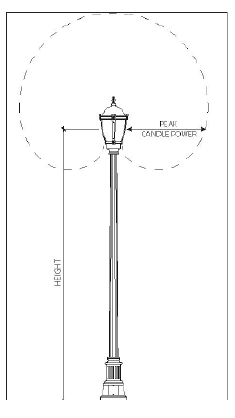
B. Pedestrian scaled lighting (no taller than 18 feet) shall be required in the NMX, CB, O/S, and NB districts using decorative fixtures of a similar character to those existing in these districts (see images at left).
C. Pedestrian-scaled lighting (no taller than 18 feet) shall be prioritized over automobile lighting in all districts. Lighting shall be placed in a manner to limit the casting of shadows on sidewalks.
D. All street lights shall utilize a cutoff fixture. Where buildings are close to the street (less than 15 feet from the right-of-way), full cutoff fixtures are required to limit glare and light spillage on upper levels.
E. Alleys are excluded from the spacing and lighting requirements of this section.
4.07.11 ADDITIONAL LIGHTING USE REGULATIONS FOR SPECIFIC AREAS
A. Building Façade Lighting
1. Floodlights, spotlights, or any other similar lighting shall not be used to illuminate buildings or other site features unless approved as an integral architectural element on the development plan.
2. On-site lighting may be used to accent architectural elements but not used to illuminate entire building(s).
3. Where accent lighting is used, the maximum illumination on any vertical surface or angular roof surface shall not exceed 5.0 average maintained footcandles.
4. Building facade and accent lighting will not be approved unless the light fixtures are selected, located, aimed, and shielded so that light is directed only onto the intended target and spillover light is minimized.
5. Wall packs on buildings may be used at entrances to a building to light unsafe areas, but must be fully shielded to direct the light downward, must have a light output of 1,600 lumens or lower, and the light source shall not be visible from off-site.
B. Outdoor Display Areas. The mounting height of outdoor display area fixtures shall not exceed 30 feet above finished grade.
C. Lighting for Vehicular Canopies. Lighting under vehicular canopies shall be designed so as not to create glare off-site. Acceptable methods include one or more of the following:
1. Recessed fixture incorporating a lens cover that is either recessed or flush with the bottom surface of the vehicular canopy.
2. Surface mounted fixture incorporating a flat lens that provides a cutoff or shielded light distribution.
3. Other methods approved by the Administrator.
4.07.12 COMPLIANCE
A. Lighting plans required as part of a site construction plan shall include, at a minimum, the following information:
1. Point-by-point footcandle arrays in a printout format indicating the location and aiming of illuminating devices. The printout shall indicate compliance with the maximum maintained footcandles required by this ordinance.
2. Description of the illuminating devices, fixtures, lamps, supports, reflectors, poles, raised foundations and other devices (including but not limited to manufacturers or electric utility catalog specification sheets and/or drawings, and photometric report indicating fixture classification (cutoff fixture, wall pack, flood light, etc.)).
3. After installation of on-site lighting, a certification of compliance statement must be submitted to the Administrator prior to the issuance of a certificate of occupancy.
B. Subsequent phases of an entire development shall have a uniform design plan for lighting and fixtures. New phases must meet all requirements in effect at the time of obtaining a permit, but lighting plans must consider preexisting lighting in earlier phases, both in design and intensity of light.
(Ord. passed 2-14-2017; Ord. 2020-05, passed 8-10-2019; Ord. 2022-06, passed 7-13-2021; Ord. passed 3-15-2022)
Section 4.08 Open Space Standards
This section shall be referred to as the Lillington Open Space Standards or open space standards.
4.08.1 USABLE OPEN SPACE (PARK SPACE) REQUIRED
A. Except as provided in paragraph I. of this section, every single-family residential (attached and detached) development shall be developed so that at least 3% of the total area of the development remains permanently as usable open space. Multi-family developments shall provide a minimum of 5% usable open space. See Section 4.10.5 for additional open space and amenity requirements for multi-family developments.
B. For purposes of this section, usable open space means an area that:
1. Is not encumbered with any substantial structure;
2. Is not devoted to use as a roadway, parking area, or sidewalk, provided, however that multi-use trails may be counted towards required open space;
3. Reflects the character of the land as of the date development began. Wooded areas shall be left in their natural or undisturbed state except for the cutting of trails for walking, bicycling or jogging. Areas not wooded shall be landscaped for open play fields, picnic areas or similar facilities, or be properly vegetated and landscaped with the objective of creating a wooded area or other area that is consistent with the objectives of this section;
4. Is capable of being used and enjoyed for purposes of informal and unstructured recreation and relaxation;
5. Is part of an independent lot shown on the plan as being reserved for open space; and
6. Is legally and practicably accessible to the residents of the development from which the required open space subdivided or to the public if the open space is dedicated to the town.
C. Usable Open Space shall include:
Greenway/Park: A natural preserve available for unstructured recreation. Its landscape shall consist of paths and trails, meadows, waterbodies, woodland and open shelters, all naturalistically disposed. Parks may be linear, following the trajectories of natural corridors (greenways). The size shall be .5 - 5 acres (except greenways where there is no minimum). |  |
Green: An open space available for unstructured recreation. A green may be spatially defined by landscaping rather than building frontages. Its landscape shall consist of lawn and trees, naturalistically disposed. For the purposes of this section, standalone dog parks shall be considered a variation of the green park type. The minimum size shall be .5 acres. |  |
Squares: An open space available for unstructured recreation and civic purposes. A square is spatially defined by building frontages. Its landscape shall consist of paths, lawns and trees, formally disposed. Squares shall be located at intersections. The minimum size shall be .25 acre and the maximum shall be 2 acres. |  |
Playgrounds: An open space designed and equipped for the recreation of children. Playgrounds shall be interspersed within residential areas and may be placed within a block. There shall be no minimum or maximum size. |  |
Community Garden: A grouping of garden plots available for small-scale cultivation, generally to residents of apartments and other dwelling types without private gardens. Community gardens should accommodate individual storage sheds. |  |
D. Location and Visibility.
1. Land for usable open space (park space) shall be centrally and internally located as to serve the needs of the residents of the neighborhood.
2. Usable open space (park space) shall serve as focal points for developments.
3. All usable open space (park space) shall be conveniently accessible to all residents of the development and shall have at least 20 feet of frontage on at least one public street within the development.
4. No residential unit within a development shall be further than ¼ mile, as measured along a street or pedestrian path, from usable space (park space) or other publicly accessible park facility.
5. All usable open space (park space) shall be visible from dwelling units that are adjacent to the park area. This includes dwelling units on properties that share a property boundary with the park space or front the park space from directly across a street.
E. Minimum Amenities within Usable Open Space.
1. Required usable open space (park space) shall be planned, improved, and usable by persons living nearby. Improved shall mean cleared of underbrush and debris and shall contain two or more of the following amenities: landscaping, walls or pathways, fences, walks, lighting and electricity, fountains, ball fields, and/or playground equipment.
2. Public Seating: Provide seating areas appropriate to the intended use of the park space (e.g., park benches and durable theft/vandalism-resistant chairs and garden wall seats).
3. Trash Receptacle: At least one garbage receptacle shall be required for each park space.
4. Bicycle Parking: At least two bicycle parking spaces shall be required for every one-quarter acre of park space and every ½ mile of greenway.
5. Minimum Amenities - Playground per 4.08.1.C: Playground equipment shall be equivalent to the standards established by the Consumer Products Safety Commission and ASTM for playgrounds.
6. Minimum Amenities - Greenway per 4.08.1.C: A greenway path is credited toward the minimum park space dedication requirement at a rate equal to the length of the path times 20 feet in width. The minimum width of the paved path shall be 10 feet.
F. Credit for Proximity to Existing Park Space. Developments that are proximate to an existing town-owned, publicly-accessible park space may count all such lands in their park space dedication requirement up to 25% of the required total, subject to the provisions below.
1. The existing park or parks must be within ½ mile of the development, as measured along a road or pedestrian path, to be considered proximate.
G. Credit for Neighborhood Amenities. Developments that provide neighborhood amenity facilities will receive a credit of 25% of the required total, subject to the provisions below.
1. The facilities are open to all residents of the neighborhood and are not subject to a private membership separate from any related POA dues.
2. Such facilities shall, at a minimum, include a clubhouse a minimum of 800 square feet and either tennis courts (minimum of two courts) or a pool (a minimum of 2,000 square feet in water surface area).
H. The following areas shall not count toward common open space set-aside requirements:
1. Private lots, yards, balconies and patios dedicated for use by a specific dwelling unit;
2. Electric or gas transmission line rights-of-way;
3. Public right-of-way or private streets and drives;
4. Open parking areas and driveways for dwellings;
5. Land covered by structures except for ancillary structures associated with the use of the open space such as gazebos and picnic shelters;
6. Designated outdoor storage areas;
7. Land areas between buildings of less than 40 feet;
8. Land areas between buildings and parking lots or driveways of less than 40 feet in width;
9. Required setbacks; and
10. Detention/retention facilities except as permitted by the Administrator.
I. Subdivided residential developments of less than 25 dwelling units are exempt from the requirements of this section unless the town agrees that it will accept an offer of dedication of such open space and in that case the offer of dedication shall be made.
4.08.2 OWNERSHIP AND MAINTENANCE OF RECREATIONAL AREAS AND REQUIRED OPEN SPACE:
A. Open space required to be provided by the applicant in accordance with these open space standards shall not be dedicated to the public but shall remain under the ownership and control of the developer (or his successor) or a property owner’s association or similar organization that satisfies the criteria established in Article V. Open space shall be designated as an independent lot on the plat and shall be noted as being reserved for their intended purposes.
B. The person or entity identified in paragraph A. as having the right of ownership and control over such recreational facilities and open space shall be responsible for the continuing upkeep and proper maintenance of the same.
C. Open space may be dedicated to a registered land trust, if approved by the Board of Commissioners.
4.08.3 DEDICATION OF OPEN SPACE
A. If any portion of any lot proposed for development lies within an area designated on the officially adopted Comprehensive Parks Master Plan as a public park or part of the public greenway system, the area so designated (not exceeding 3% of the total lot area) shall be included as part of the area set aside to satisfy the requirement of this section. This area shall be dedicated to public use.
B. If more than 3% of a lot proposed for development lies within an area designated as provided in paragraph A., the town may attempt to acquire the additional land in the following manner:
1. The applicant may voluntarily dedicate the additional land to the town;
2. The applicant may be encouraged to develop an integrated subdivision, cluster subdivision or some other applicable development pattern and to dedicate the common open space created thereby; or
3. The town may purchase or condemn the land.
4.08.4 FLEXIBILITY IN ADMINISTRATION AUTHORIZED
A. The requirements set forth in this article concerning the amount, size, location and nature of recreational facilities and open space to be provided in connection with residential developments are established by the Board of Commissioners as standards that presumptively will result in the provision of that amount of recreational facilities an open space that is consistent with officially adopted town plans. The Board of Commissioners recognizes, however, that due to the particular nature of a tract of land, or the nature of the facilities proposed for installation, or other factors, the underlying objectives of this article may be achieved even though the standards are not adhered to with mathematical precision. Therefore, the permit issuing authority is authorized to permit minor deviations from these standards whenever it determines that:
1. The objectives underlying these standards can be met without strict adherence to them; and
2. Because of peculiarities in the applicant’s tract of land or the facilities proposed it would be unreasonable to require strict adherence to these standards.
B. Whenever the permit issuing authority approves a deviation from these open space standards pursuant to paragraph A., the official record of action taken on the development application shall contain a statement of the reasons for allowing the deviation.
4.08.5 OPEN SPACE LINKAGES
Where a trail, natural area or public park is dedicated to or acquired by the town, such area may be credited toward the minimum amount of common open space required.
4.08.6 NATURAL OPEN SPACE REQUIRED
A. Every single-family residential development shall be developed so that at least 5% of the total area of the development remains as natural open space.
B. Every multi-family development shall be developed so that a minimum of 10% of the total site remains as natural open space. See Section 4.10.5 for additional open space requirements for multi-family developments.
C. See Section 5.13.3 for regulations related to cluster subdivisions and developments.
4.08.7 NATURAL OPEN SPACE DESIGN CRITERIA
All required open space shall meet the following design criteria, as applicable:
A. Water bodies, retention areas, detention basins and wetlands basins, may constitute up to 40% of required open space, provided that retention facilities are designed to provide safe access to water. Unless otherwise approved by the Board of Commissioners, side slopes to retention facilities shall provide at least six feet of horizontal run for each foot of vertical rise.
B. At least 30% of required open space must be dry land with a slope of less than 10% unless otherwise approved the Board of Commissioners.
C. Unless otherwise approved by the Board of Commissioners, open space shall be continuous, contiguous with open space on abutting properties and accessible to the public.
4.08.8 CONNECTIVITY REQUIRED
To the maximum extent practicable, common open space shall be organized to create integrated systems of open space that connect with the following types of lands located within or adjacent to the development:
A. Dedicated public park or greenway lands;
B. Dedicated school sites;
C. Other dedicated open spaces;
D. Common open space located adjacent to the development;
E. Portions of the regional trail and open space system.
4.08.9 OWNERSHIP & MAINTENANCE
The designated common open space and common facilities are outlined in Section 5.16 of this ordinance.
(Ord. passed 2-14-2017; Ord. 2020-05, passed 8-10-2019; Ord. passed 3-15-2022)
Section 4.09 Landscaping and Buffering
This section shall be known as the Town of Lillington Landscaping Code or Landscaping Code.
4.09.1 FINDINGS AND PURPOSE
The standards established in this ordinance are intended to preserve, protect, restore and enhance the aesthetic appeal and scenic beauty of this town; provide adequate buffering between land uses; reduce noise and air pollution; reduce stormwater run-off; filter and reduce glare from artificial light sources; provide shaded areas along streets, sidewalks and in parking lots; provide a continuity of vegetation throughout the town; encourage the preservation of existing trees and vegetation; safeguard and enhance property values; and protect the public health, safety and general welfare.
4.09.2 APPLICABILITY
The landscaping and buffering standards of this section shall apply to the following:
A. All new developments (except for infill single-family detached) shall be designed in accordance with the requirements of this article.
B. See Section 8.02.1 for all other non-conforming standards.
4.09.3 STREET TREES
A. Street trees are an essential part of the town streetscape. The town seeks to maintain existing trees where possible and to encourage the planting and continuance of the established street tree patterns.
B. To accomplish this objective, the following shall apply:
1. All subdivisions and developments subject to site plan approval shall provide street trees along their frontage with adjacent public streets.
2. Street trees shall be selected from the list of large trees, or, where power lines are located, small trees included in Appendix A.
3. Planting strips shall be a minimum of six feet wide.
4. Planting location shall take into consideration planned roadway widening, public safety, standard drainage requirements and maintenance of sight distances for traffic safety. Street trees may be planted within the right-of-way, within planting strip abutting the right-of-way or other location approved by the permit issuing authority.
C. Street trees, unless subject to overhead power lines, shall be planted at the rate of one three-inch caliper tree per 30 feet of property line abutting a public street, excluding driveways and traffic visibility zones. This rate may be varied based upon existing trees and the crowns of planted trees.
D. Trees used to meet buffer and vehicle use area requirements, may be used to meet the street requirements to the extent that the trees are located within 25 feet of a street.
4.09.4 BUFFER YARD REQUIREMENTS
Buffers provide compatible transitions between differing land uses, reduce the visual impacts of development and retain existing plant materials.
A. Buffers are required along the common property lines between developments in different zoning districts or between developments of different uses as established in this section.
B. Buffer requirements shall not apply when a public street or railroad right-of-way separates applicable zoning districts or uses.
C. The chart below establishes the minimum buffer widths for proposed development.
Adjacent Zoning District | ||||||
District of Proposed Development | RR, RS-20, RS-15, RS-10 | RMX, RMF | O/S, NB | NMX, CB | GB | LI, HI |
Adjacent Zoning District | ||||||
District of Proposed Development | RR, RS-20, RS-15, RS-10 | RMX, RMF | O/S, NB | NMX, CB | GB | LI, HI |
RR, RS-20, RS-15, RS-10 | None | None | B | None | A | A |
RMX, RMF | C | None | None | None | A | A |
O/S, NB | B | C | None | None | None | None |
NMX, CB | C | C | None | None | None | None |
GB | A | A | B | C | None | None |
LI, HI | A | A | A | A | B | None |
A = Type A Buffer B = Type B Buffer C = Type C Buffer | ||||||
4.09.5 BUFFER YARD COMPOSITION
The required buffer yard types may be established using a combination yard widths, evergreen trees, canopy trees, understory trees, shrubs, fences, walls, and berms. The following tables illustrate the required elements for each buffer yard type.
A. Type A Buffer: The intent of the Type A buffer is to create a completely opaque buffer, having no horizontal openings from the ground to a height of eight feet within two years of planting. Type A buffers can be achieved in three ways:
Type A Buffer Yard Options | Min. Depth | Min. Plantings per 100 feet | Required Barrier |
Option 1 | 40' | 4 Evergreen Trees 4 Canopy Trees 4 Understory Trees 48 Shrubs | Not Required |
Option 2 | 30' | 2 Evergreen Trees 1 Canopy Tree 2 Understory Trees 12 Shrubs | Berm |
Option 3 | 20' | 1 Evergreen Tree 1 Canopy Tree 3 Understory Trees 12 Shrubs | Fence or Wall |
B. Type B Buffer: The intent of the Type B buffer is to create a semi-opaque buffer, having only seasonal horizontal openings, not to exceed 10% of the total width, from the ground to a height of eight feet within two years of planting. A Type B buffer can be achieved in two ways as specified below.
Type B Buffer Yard Options | Min. Depth | Min. Plantings per 100 feet | Required Barrier |
Option 1 | 20' | 2 Evergreen Trees 1 Canopy Tree 2 Understory Trees 12 Shrubs | Not Required |
Option 2 | 10' | 1 Evergreen Tree 1 Canopy Tree 3 Understory Trees 24 Shrubs | Berm |
C. Type C Buffer: The intent of the Type C buffer is to create a semi-opaque buffer, having only seasonal horizontal openings, not to exceed 25% of the total width, from the ground to a height of six feet within two years of planting. A Type C buffer can be achieved in two ways as specified below.
Type C Buffer Yard Options | Min. Depth | Min. Plantings per 100 feet | Required Barrier |
Option 1 | 20' | 1 Canopy Tree 2 Understory Trees 8 Shrubs | Not Required |
Option 2 | 10' | 2 Canopy Trees 2 Understory Trees 12 Shrubs | Not Required |
4.09.6 ADDITIONS TO BUFFERS AND SCREENING
When it is determined that the conflict of land use is so great that the public safety is not served adequately by the minimum buffer and screening requirements, or where there is a need to prevent a high degree of visual, audio, or physical disorders, then the Administrator may require the installation of fencing or earthen berms in addition to the minimum required buffers and screening, according to the standards below.
A. Fencing or Walls. Where required as part of a buffer yard, fencing or walls must adhere to the provisions below. Nothing in this section shall prohibit the owner of a single family dwelling from constructing a separate fence along the borders of such property, provided that all required buffer plantings are maintained.
1. In all cases, the finished side of the fence must face the use with the lower intensity.
2. Permitted fence or wall materials include: masonry, stone, architectural block, stucco on masonry, wood or other similar of solid appearance.
3. The design of fencing or walls shall be sufficient to meet the extent of physical screening required by the Administrator.
4. The height of the fence shall be determined by the Administrator based on the following variables: site conditions; topography; use; and/or building height. The minimum height of a fence or wall required by this section shall be six feet.
B. Berms. Earthen berms may be required in combination with plant material and fencing for the purposes of screening. Berms shall be tapered appropriately to allow for practical maintenance.
1. The slope of all berms shall not exceed a 2:1 ratio (horizontal to vertical), shall have a top width at least one-half the berm height, and a maximum height of six feet above the toe of the berm.
2. All berms regardless of size, shall be stabilized. Topsoils brought in for mounds are to be mixed with native soil to avoid interfacing problems.
3. Berms shall be constructed as to provide adequate sight distances at intersections and along all roads.
4. Berms proposed to satisfy the screening requirements of this section shall be vegetated as required by this section. Use of berms as a substitute for existing healthy vegetation is strongly discouraged.
4.09.7 VEHICULAR USE AREA SCREENING & LANDSCAPING
A. All off-street parking, loading areas, and service areas adjacent to and/or visible from a public right-of-way and adjacent properties shall be screened from view by use of one or more of the following:
• A building or buildings;
• A change in topography;
• A planting area a minimum of eight feet wide planted with evergreen shrubbery placed a maximum of five feet on center. All shrubs shall achieve a height of four feet within three years.
• Fencing, walls, or berms.
B. In addition to screening requirements, canopy trees shall be installed in planting areas within parking lots to provide shade coverage for all parking spaces within vehicle service areas. Such planting areas shall meet the following requirements:
1. Planting Area Size: The minimum size of a planting area is dependent upon the number of canopy trees planted within it, as described below:
Number of Canopy Trees in Planting Area | Minimum Size of Planting Area |
1 | 400 square feet |
2 | 700 square feet |
3 or more | 300 square feet per tree |
2. Planting Area Width: A minimum horizontal dimension of nine feet measured from back of curb, pavement, sidewalk or other separating structure is required for all planting areas.
3. Planting Strip Location: A continuous linear planting strip shall be provided between each two parking bays.
4. Minimum Spacing: All parking spaces, or portions thereof, shall be within 60 feet of a planted canopy tree trunk.
5. Groundcover: Each planting area shall be landscaped with mulch, groundcover, or shrubs to protect against soil erosion.
6. Barriers or Wheel Stops: Barriers, such as wheel stops or six-inch standard curbs, must be provided between vehicular use areas and landscaped areas.
7. Conflict with Parking Lot Lighting: Trees shall be located and planted so as not to diminish the effectiveness of required parking lot lighting, and in no instance shall lighting be located closer than 15 feet to canopy trees and eight feet to understory trees.
4.09.8 DUMPSTERS AND MECHANICAL UTILITIES SCREENING
A. All dumpsters, loading docks, outdoor storage areas and utility structures, which are visible from a public street or adjacent property line, shall be screened unless already screened by an intervening buffer yard. Such equipment shall be considered out of view if it is within the 45 degree angles projected from the building edges.
B. Screening shall consist of evergreen shrubs, fencing, walls or berms, and shall comply with all other standards of this section.
C. All screening of utilities shall comply with the requirements of the utility provider.
D. Where possible, enclosures for dumpsters are encouraged to be constructed with materials that are compatible with the design and materials of the principal building. Screening may be created through the use of:
1. Solid-wood fence, or fabricated metal fence, each with shrub plantings placed around the enclosure (they do not need to completely screen the enclosure) that grow as high, or nearly as high, as the fence to provide an attractive separation; or
2. Brick fence, brick/split face block, or decorative block (plantings not required).
4.09.9 GENERAL INSTALLATION AND MAINTENANCE STANDARDS
It shall be the responsibility of the property owner(s) or assigned caretakers to ensure that all regulated landscaped areas, buffers, fencing, and tree save areas are installed, preserved, and maintained in good growing conditions, appearance, and usefulness. Damage and disturbances to these areas shall result in vegetation replacement and/or fines and other penalties. Preservation and maintenance shall include:
A. Any dead, unhealthy, or missing vegetation, shall be replaced with vegetation that conforms to the standards of this section and the approved site and/or subdivision plan.
B. All required buffers, streetyards, vehicular use areas, tree save areas and other landscaped areas shall be free of refuse and debris, shall be treated for pest/diseases in accordance with the approved site and/or subdivision plan, and shall be maintained as to prevent mulch, straw, dirt, or other materials from washing onto streets and sidewalks.
C. The owner(s) shall take actions to protect all plant material from damage during all facility and site maintenance operations. All plant material must be maintained in a way that does not obstruct sight distances at roadways and intersections, obstruct traffic signs or devices, and interfere with the use of sidewalks or pedestrian trails. Plant material, whether located within buffers, tree save areas, or within planted areas (required by the site and/or subdivision plan) shall not be removed, damaged, cut or severely pruned so that their intended form is impaired. Shrubs within vehicular use areas, streetyards, and street fronts may be pruned, but must maintain at least three feet in height.
D. In the event that existing required vegetation located within any buffers, tree save areas, streetyards, vehicular use or other landscape areas poses an immediate or imminent threat to improved structures on private property or public property, excessive pruning or removal of the vegetation may be allowable provided authorization is obtained from the Administrator, and the performance standard of the landscape area is maintained consistent with this section. Replacement vegetation may be required as a condition of the permit.
E. In the event that any vegetation or physical element functioning to meet the standards of this section is severely damaged due to an unusual weather occurrence or natural catastrophe, or other natural occurrence, the owner may be required to replant if the requirements of the section are not being met. Replacement vegetation shall conform to the standards of this section and the approved site and/or subdivision plan.
4.09.10 RECOMMENDED PLANT LIST
See Appendix A for the town’s official plant list. It contains some plant species that are native to the town area or are known to be suitable for the climate of the town area. Applicants seeking landscape approval shall not be required to select materials from the following list, but shall be required to select plant species that are known to be suitable for the climate of the town area.
(Ord. passed 2-14-2017; Ord. 2020-05, passed 8-10-2019; Ord. passed 3-15-2022)
Section 4.10 Building Design Standards
4.10.1 PURPOSE
The purpose of this article is to ensure architectural compatibility, permanence and style; the preservation and enhancement of the town’s aesthetic integrity and architectural character; support tourism and stimulate local economic development, preserve private property values; and maintain a high quality of life throughout the town. The town desires that all development be treated as a lasting contributor to the community and as a good neighbor to its surroundings and the town believes that well-designed and well-maintained developments is in the best interests of all residents and businesses.
4.10.2 APPLICABILITY
A. While this section provides specific standards for development, it cannot, and is not intended to, cover all circumstances. Rather the structure and content of the manual are meant to give developers and reviewers the perspective to address the unique conditions of each project, while giving builders the flexibility to develop their own designs that meet the intent, principles and spirit of the guidelines.
B. The building design review process as outlined in Section 7.05.3 of this ordinance shall apply to the following:
1. New development. All new construction shall conform to the requirements of this section.
2. Renovation and expansions to existing development. If the total repairs and/or renovations to an existing building within a five-year period enlarge the footprint 50% or more or collectively cost more than 50% of the tax value as recorded in the county tax record at the date of application, such development shall be required to meet the minimum requirements set forth to the fullest extent technically feasible.
3. Maintenance and changes. Maintenance and changes to exterior existing building elements and facades for development less than 50% of tax value will apply only to the specific change. Approved site plans may not be further modified before or after construction, installation or occupancy without review and approval of the Administrator. The passage of time shall not remove this requirement for review and approval if changes in design, including color, are proposed for any building, built prior to or after the adoption of this chapter, within the town which is subject to these provisions.
4. Multi-family & residential facilities. All multi-family developments and other residential facilities are subject to these regulations. Single family dwellings (attached & detached) and duplexes subject to regulation under the North Carolina Residential Code for One and Two Family Dwellings shall be exempt from these regulations. Voluntary building design standards may be applied to single family dwellings (attached & detached) and duplexes structures upon consent by the owner at the time of zoning, subdivision, or site plan approval.
5. Overlay Districts. For properties located within an overlay district – see Article II for additional specific development standards.
4.10.3 GENERAL BUILDING DESIGN STANDARDS
A. Applicability. These standards shall apply to all non-residential land uses except multi-family developments (see Article II for additional downtown overlay standards and Section 4.10.5 for multi-family development standards).
B. Frontage. The primary entrance shall be architecturally and functionally designed on the front facade facing a public street. (Exception: buildings that are interior to a site that has buildings that otherwise meet the frontage requirement as approved by the Administrator.)
C. Underground wiring. To reduce the visual impact of overhead wiring, utility services shall be located underground. Wooden poles and/or flood lights are prohibited.
D. Building design
1. Generally. The front facade should be divided into a base, middle and top. When two or more materials are used on a facade, the heavier material (e.g., brick) should be placed below the lighter material (e.g., siding) to give a sense of support and grounding.
a. Manufactured, mobile and metal units are prohibited, except for a temporary construction, sales trailers or storage uses during construction projects.
b. Front facades and exterior walls visible from the public right(s)-of-way shall be at least 60% brick, stucco, stone, wood clapboard siding, cementitious fiber board or other materials similar in appearance and durability. Vinyl siding, painted concrete block, cast concrete and metal may be used on building walls as minority elements or accent materials on walls that are visible from the public right-of-way provided that they do not compose greater than 40% of the facade.
c. At least 25% of walls not visible from the public right(s)-of-way shall meet the same requirements for front facades and exterior walls visible from the public right(s)-of-way.
d. Predominant wall materials shall have the appearance of brick. Predominant wall materials shall cover at least 80% of walls, exclusive of windows and doors. Stucco, stone and cementitious lap siding may be used as accent materials. Materials with the appearance of concrete block, smooth concrete, corrugated or standing seam metal are prohibited.
e. Brick, stone or wood facades shall not be covered or replaced with artificial siding or panels. Pitched roofs shall be clad in wood shingles, standing seam metal, corrugated metal, slate or asphalt shingles. All accessory buildings shall be clad in materials similar in appearance to the principal structure.
2. Wall material maintenance. All exterior surfaces, which require paint or sealing in order to protect the underlying surface from deterioration shall be so painted or sealed.
a. All exterior surfaces, which have or have not been painted, shall be maintained free of peeling and flaking paint or stucco. Rotten or weakened portions shall be removed and/or replaced to match as closely as possible the original patterns.
b. Where 33% or more of the aggregate of any painted or stuccoed wall shall have peeling or flaking paint or stucco worn away, the entire wall shall be scraped and repainted or recovered with stucco.
3. Entries. Building façades shall be designed with entries that are no further than one hundred and fifty (150) feet apart. Building entries should be clearly defined, visible entrances, providing access from the front of the building to the pedestrian zone, and featuring no less than three of the following:
a. Canopies or porticos;
b. Awnings;
c. Overhangs;
d. Recesses/projections;
e. Arcades;
f. Raised corniced parapets over the door;
g. Peaked roof forms or arches;
h. Outdoor patios; or
i. Display windows.
E. Facade colors. Color is an integral element of the overall design.
1. Facade colors shall be of low reflectance earth tone, muted, subtle or neutral colors.
2. Natural tints of materials such as reds, browns, tans, grays and greens shall be used as primary colors.
3. Brick, concrete and stone will have an inherent color, created by nature or during the manufacturing process. Building trim may feature brighter colors, but neon tubing is not allowed as an accent material. The use of high-intensity, metallic, fluorescent or neon colors shall be prohibited.
F. Roof pitch. Roofs with pitches less than 3:12 and flat roofs will require a parapet wall on all sides visible from a public right-of-way. A pitched roof shall be profiled by eaves a minimum of six inches from the building face or with a gutter. Parapet walls shall have decorative cornices/caps. Roof lines shall be varied to reduce the scale of structures and visual interest and shall be articulated every 30 to 60 feet depending on the type of building (see illustration). The parapet shall be constructed so as to conceal all roofing material and equipment such as rooftop venting systems from any adjoining public right-of-way.
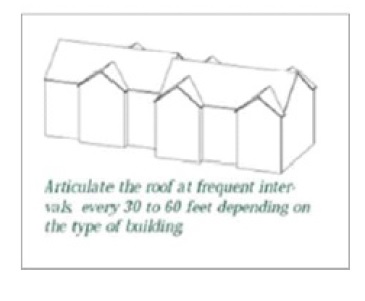
G. Rooflines
1. Rooflines shall be varied in height, or at least every 30 feet along any side of a building facing a street. Hips, gables or changes in parapet elevation shall be used to provide relief in height.
2. Gable and hip roofs are allowed; parapets shall be used to conceal flat roofs and rooftop mechanical equipment from public view.
3. The parapet design shall be a minimum of three feet in height and shall incorporate a three-dimensional cornice treatment.
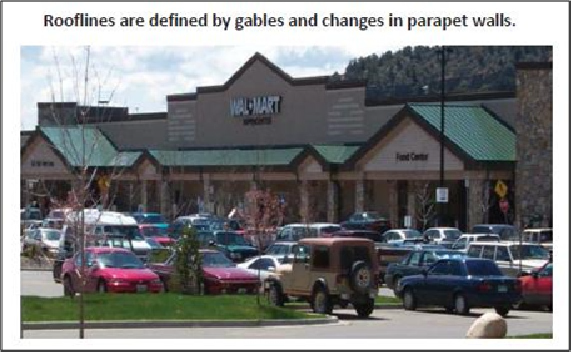
H. Public art. Public art, such as statues, fountains and other works of art are encouraged and may be placed in any required front setback are as well in other appropriate areas.
I. Compatibility. Adjacent buildings within 500 feet should relate in similarity of scale, height, architectural style and/or configuration. Relate setbacks of new construction to setbacks of existing buildings or developments. Limit setback variation to 20% of average setback of existing appropriate development on a street for both residential and nonresidential development.
J. Human scale.
1. Windows, doors, columns, eaves, parapets and other building components shall be proportional to the overall scale of the building. Windows shall be vertically proportioned wherever possible.
2. The primary entrance shall be both architecturally and functionally designed on the front facade of the building facing the primary street. Such entrances shall be designed to convey their prominence on the fronting façade.
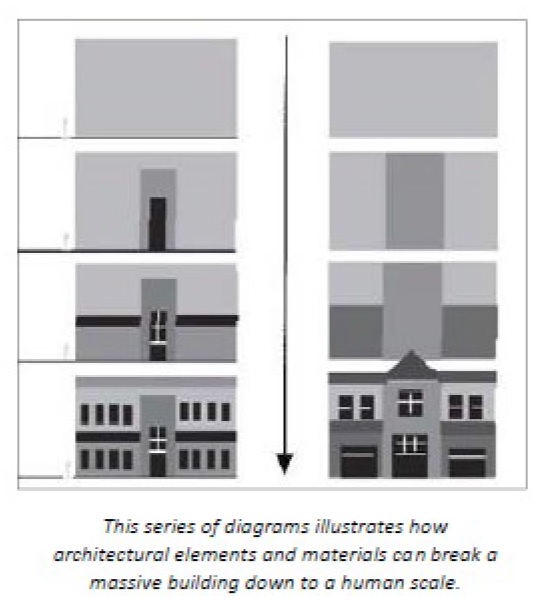
K. Windows. Except for civic and industrial buildings, at least 40% of the length of the first floor on primary street fronting facades shall be in windows or doorways. Street level windows should be visually permeable. For buildings on a corner, the first floor secondary street facade shall be at least 10% windows. A window or functional general access doorway shall be located along the length of the facade at least every 20 feet. A window shall be measured as follows:
Max. sill height (first floor) | 42 inches |
Min. area | 16 square feet |
Min. height | 4 feet |
Min. width | 3 feet |
L. Window maintenance. All windows must be tight fitting and have sashes of proper size and design. Sashes with rotten wood, broken joints or broken or loose mullions shall be replaced. All broken and missing windows shall be replaced with glass or plexi-glass. All exposed wood shall be repaired. All openings originally designed as windows shall be maintained as windows, complete with sills, lintels, frame and glass, unless specifically approved by the Fire Chief for enclosure. Where the Fire Chief approves the enclosure of a window, it must be so enclosed by either bricking the opening, blocking the opening with concrete blocks and stuccoing the exterior to prevent water intrusion and painted or stained to properly conform with the other exterior portions of the building.
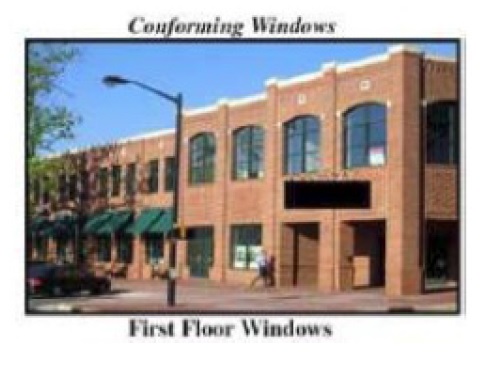
M. Recesses and projections. Facades greater than 30 feet in length, measured horizontally, must incorporate recesses, arcades, awnings and projections along at least 20% of the length of the facade. When used, awnings and canopies shall be placed at the top of window or doorway openings, and shall not extend beyond such openings, unless otherwise approved by the Administrator. No awning shall extend more than the width of the sidewalk or ten feet, whichever is less. Awnings must be self-supporting from the wall. No supports shall rest on or interfere with the use of pedestrian walkways or streets. In no case shall any awning extend beyond the street curb or interfere with street trees or public utilities. Awnings and canopies shall complement the color and material of the building which they are affixed.
N. Awning or marquee maintenance. In the event such awnings or marquee are made of cloth, plastic or of a similar material, such awnings or marquee shall be maintained so as not to show evidence of tearing, ripping or other holes which diminish their function and cause unsightly conditions. Whenever an awning is removed, all supporting members shall be removed within two years of adoption of this code and thereafter, immediately upon removal of any awning
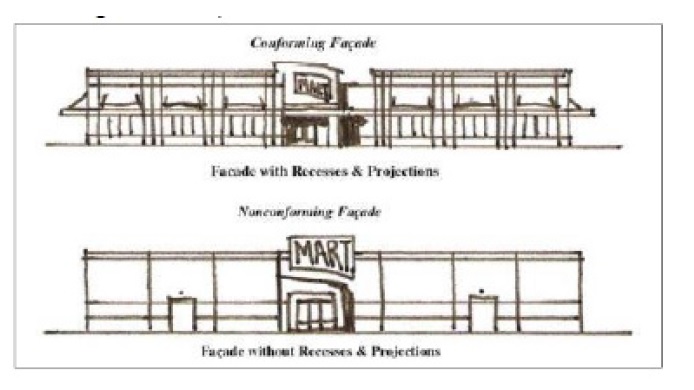
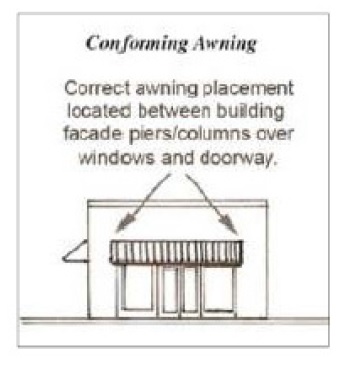
O. Accessory buildings and devices. Building and devices that are ancillary to the primary building such as loading, trash containment, maintenance, storage and mechanical/electrical areas and the devices and equipment associated with these areas shall be incorporated in the overall design, architecture and landscape so that the visual and acoustic impacts of these functions and devices are fully contained and out of view from adjacent properties and public areas. All accessory structures shall be constructed of the same materials and colors as used for the main building.
P. Connectivity.
1. Generally. A community is made up of both social and physical connections. Connecting uses means making clear pedestrian and vehicular pathways between developments. It also means intermingling compatible uses. A strong sense of community, the highly valued “small town atmosphere,” depends on having such convenient and easy access to a variety of activities and uses. This connection of uses is very important to the function of a livable, pedestrian-oriented community such as the town desires. Because many policies of recent decades have resulted in or even required the separation of projects and uses, this all-important design principle perhaps will require the greatest adjustment in how development occurs.
2. Connectivity requirements.
a. Individual developments shall be joined together with roads and continuous sidewalks and paths versus a collection of separate development pods. Within a development, easy-to-use internal circulation is provided not only for cars but for pedestrians and bicyclists between all buildings and spaces.
b. Buildings shall be oriented to roads and sidewalks with orientation to parking areas being secondary. Buildings and whole developments are not isolated from one another with extensive buffers.
c. Pedestrian and vehicular links shall be linked to parks, schools and other public destinations whenever possible.
d. Sidewalks shall be continuous along public streets. Sidewalks shall connect buildings to the public sidewalk and to each other. Safe and frequent crossings shall be provided for pedestrians. Pedestrian connections shall be made to large office developments from a nearby hotel. Design sidewalks appropriately for the site and the expected amount of foot traffic. In commercial areas where foot traffic is expected, sidewalks should be a minimum of ten feet. Sidewalks in residential areas can be four feet. All pathways including but not limited to sidewalks and crosswalks shall meet the minimum American with Disabilities Act (ADA) requirements.
Q. Reducing parking impacts.
1. Generally. A key principle of the town’s design vision is to reduce the visual impact of parking. This goal includes reducing the image of the “sea of parking” one finds along corridors at retail centers and the “garage-scape” in neighborhoods. Parking is necessary at work, at home, and at destinations throughout the town. However, there is no reason why it needs to dominate the view.
2. Parking lot standards.
a. A minimum of 20 to 40% of the required parking is placed to the side or rear of development projects, reducing large expanses of parking in front of developments. This parking is essentially overflow parking for peak usage during the year. Buildings shall be more prominent than parking lots (see below):
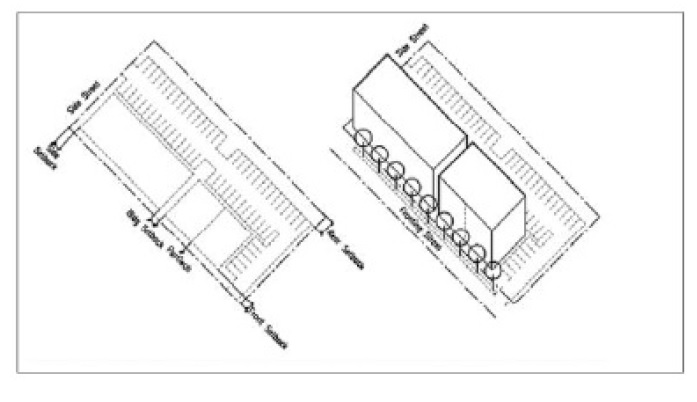
b. Parking areas including drives and accessways shall be surfaced with either asphalt or concrete.
c. Drive-through windows shall be accessed at the building facade facing the rear property line away from the pedestrian street/right-of-way.
d. On-street parking is provided when feasible to reduce the area of parking lots.
R. Use of alternate plan, material or methods.
1. Alternate design plans, building materials or construction techniques may be used when unreasonable or impractical situations would result from the application of architectural design standards. Such situations may result from unique site conditions, innovative design applications and/or unified development design. The application for alternate design shall include which specific standards cannot be met and how the alternative methods will achieve the intent of the standards. The performance building design alternatives shall be evaluated by the Board of Commissioners to determine if the alternate design meets the intent and purpose of this chapter.
2. This determination shall take into account the land use of adjacent property, the orientation of the building to public streets, the building typology, the intended use of the structure, attention to architectural detail, scale and mass.
S. Building articulation. Front and street-facing side façades greater than 30 feet in length, measured horizontally, shall:
1. Incorporate wall plane projections or recesses having a depth of at least 3% of the length of the façade and extending at least 20% of the length of the façade.
2. Have a change in at least three of the following elements every 30 feet along all walls facing a public street or internal street: color change; texture change; material change; or architectural feature, such as an offset, projection, columns, canopies, arcades, or reveal with at least 12 inches in depth.
4.10.4 SINGLE-FAMILY, DUPLEX & MANUFACTURED HOME DESIGN STANDARDS
The following voluntary building design standards may be applied to single family dwellings (attached & detached) and duplexes structures upon consent by the owner at the time of zoning, subdivision, or site plan approval.
A. Exterior materials. Exterior materials shall be durable and residential in character. Exterior wall materials shall be wood, brick, stone, stucco, vinyl or similar materials. Facade colors should be of low reflectance earth tone, muted, subtle or neutral colors, also for repainting of an existing building. The use of high-intensity, metallic, fluorescent or neon colors shall be prohibited.
B. Manufactured home requirements. All manufactured homes shall meet the following requirements.
1. The home has a length not exceeding four times its width.
2. The pitch of the home’s roof has a minimum vertical rise of one foot for each five feet of horizontal run, and the roof is finished with a type of shingle that is commonly used in standard residential construction.
3. The exterior siding consists of wood, hardboard or aluminum (vinyl covered or painted, but in no case exceeding the reflectivity of gloss white paint) comparable in composition, appearance and durability to the exterior siding commonly used in standard residential construction.
4. Facade colors should be of low reflectance earth tone, muted, subtle or neutral colors, also for repainting of an existing building. The use of high-intensity, metallic, fluorescent or neon colors shall be prohibited.
5. A continuous, permanent masonry foundation, un-pierced except for required ventilation and access, is installed under the home.
6. Every manufactured home shall be tied down to ground anchors. Ground anchors and tie downs shall be installed in accordance with the North Carolina Regulations for Mobile Homes.
7. Each manufactured home stand and space shall be graded to provide adequate storm drainage away from the manufactured home and such that there will exist no more than three feet difference between the chassis of the manufactured home and the finished grade of the stand along the entire perimeter of the manufactured home proper.
4.10.5 MULTI-FAMILY DEVELOPMENT STANDARDS
A. Applicability
This section applies to all multi-family developments. These requirements are intended to establish design standards that will create quality design and ensure the compatibility with surrounding neighborhoods and land uses. The desired characteristics of multi-family developments are to:
• Encourage developments that residents can take pride in and have a sense of ownership;
• Provide special attention to structural placement, building orientation and landscaping along streets and parking areas;
• Ensure that common open spaces are provided in locations convenient for residents;
• Ensure that developments are designed with proper setbacks, landscaping and massing to address privacy and compatibility with adjacent single-family residential development or land.
B. Building Placement and Orientation
1. Buildings shall be set back a minimum of 30 feet from major and arterial streets or thoroughfares.
2. The minimum spacing between the sides of buildings shall be 20 feet.
3. Where practical, buildings should be located to face each other across public streets, private drives or common open space areas and amenities.
4. All buildings shall be located a minimum of 50 feet from properties zoned RR, RS-20, R-15 or RS-10.
C. General Building Design
1. Building elevations:
a. Facades shall have usable porches, balconies, stoops, windows and/or other architectural details to form a predominate theme of the building design. A minimum of 60% of front elevations, and a minimum of 30% of side and rear building elevations shall be required to meet this standard.
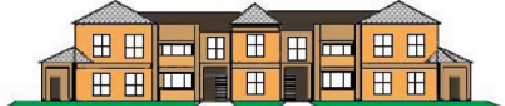
The image depicts street oriented facades with balconies and/or other architectural detailing.
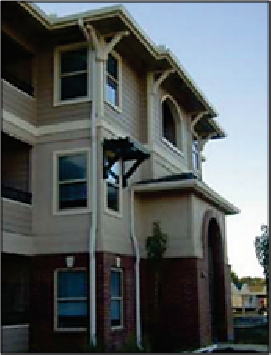
2. Building materials:
a. At a minimum, two different primary building materials shall be used on each building elevation (e.g., stone, wood, masonry, or metal). Vinyl may be uses for accent purpose only.
b. Colors should be of low reflectance earth tone, muted, subtle, or neutral colors. A minimum of two colors per elevation plus a trim and roof color shall be utilized.
c. Color accents shall vary throughout the development.
3. Roofing:
a. Roofs shall be standing seam metal, slate, asphalt shingles or synthetic materials similar and/or superior in appearance and durability.
b. All multi-family buildings shall have sloped roofs. When pitched roofs are used, they shall be symmetrical gables or hips with a pitch between 6:12 and 12:12.
4. Entrances:
a. Each building shall provide clearly defined site and building entries that are in scale with the proposed project and relate directly to the street frontage.
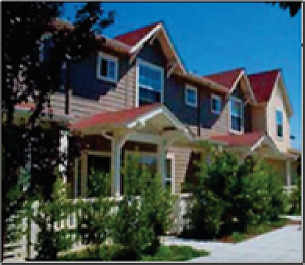
b. Entries to units should be clearly identified, protected from weather by porches or roofed overhangs (as illustrated in the photo to the side) and provided with lighting for nighttime safety and security.
c. The use of distinctive architectural elements and materials to denote prominent entrances is required.
d. All buildings shall face the public street, private drive or common area (e.g., courtyard, plaza, or green) and have a pedestrian pathway connecting the principal entry to these areas.
5. Utilities and equipment:
a. All building attached mechanical equipment and other utility equipment (e.g., heating, cooling, antennas, satellite dishes, air conditioners or similar mechanical devices) shall be screened from view of public streets, private drives, parking lots, and adjacent residential property.
b. Equipment screening shall be integrated into the building and roof design with the use of compatible materials, colors, and forms.
6. Refuse receptacles:
a. All refuse containers shall be placed within screened storage areas or enclosures per this ordinance.
b. Refuse containers should be conveniently located throughout the project, yet sufficiently buffered from project entries, main building entries and main pedestrian paths.
c. Enclosures should be located to provide easy accessibility for users, adequate room for servicing by refuse trucks and should not hinder visibility for vehicle circulation.
d. Enclosure materials and colors should be consistent with, and complimentary to, building materials and finishes.
e. Landscaping should be provided on all non-accessible sides of trash enclosures.
7. Garages:
a. Garages serving multi-family buildings shall be located to the side or rear of such buildings.
b. The exterior materials, design features, and roof form of garages shall be compatible with the building it serves.
D. Open Space & Amenities
Multi-family developments shall be constructed with common open space areas and amenities for the use and enjoyment of future residents. Minimum open space provisions and required project amenities are listed below.
1. All buildings, roofed areas, and parking areas, including drives, shall not cover more than 85% of the site. A minimum of 15% of the gross area shall be designated as common open space comprised of 5% usable open space and 10% of natural open space per Section 4.08 - Open Space Standards.
2. Usable open space shall be incorporated into the development as a primary design feature and not just remnant pieces of land used as open space.
3. Usable open space should be centrally located, easily accessible and positioned within the viewshed of the nearest units such that the residents can watch over the area (see example photo below):
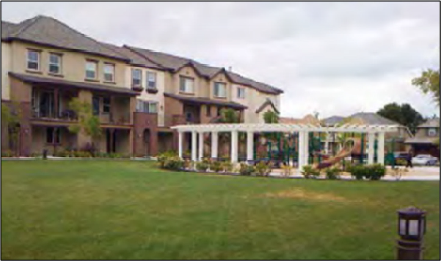
4. Common facilities such as laundries, mailboxes, and management office should be centrally and conveniently located for accessibility and proximity to the majority of the residents.
5. Open space areas should be consolidated in one location to allow for high usability and sustainability.
E. Traffic Control, Circulation & Parking
Multi-family developments with internal streets and driveways should be designed to be easy to navigate through in a logical, common sense manner so that a resident or visitor can easily enter the site, park their car, and find a particular unit.
1. Multi-family projects shall be designed with an internal pedestrian system providing access to individual units, common areas and amenities, parking areas and off-site connectors as appropriate.
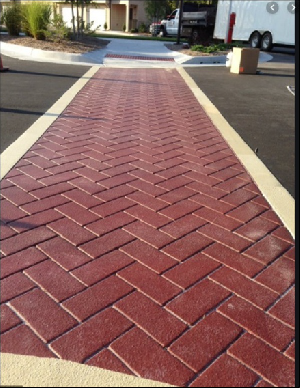
2. Stamped and/or colored concrete or other decorative accent shall be used as an accent along project entryways, pedestrian crosswalks, pedestrian walkways and common open areas.
3. Areas between dwelling units and parking areas on-site shall be improved with landscaping to achieve a minimum three foot wide evergreen screen.
4. No off-street surface parking lot associated with a multi-family development shall be located between the building and the street(s) fronting the development.
5. Off-street surface parking located beside a building shall not occupy more than 25% of the parcel's right-of-way frontage. Associated driveway areas shall be included as part of such off-street surface parking.
6. Parking spaces shall have a minimum separation of five feet from all sidewalks and pedestrian paths.
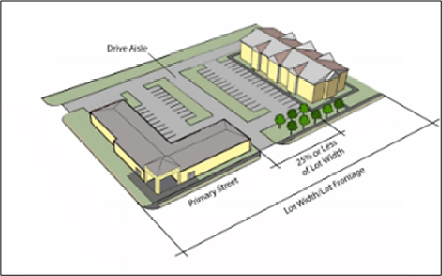
7. Traffic calming elements such as enhanced paving and bulb-outs at intersections should be provided. Other traffic calming measures such as roundabouts, raised pedestrian crossings, etc. should be used where practical.
8. The maximum block length in all multi-family developments shall be 400 feet. Blocks shall be separated by streets, drives or improved pedestrian paths as illustrated below:
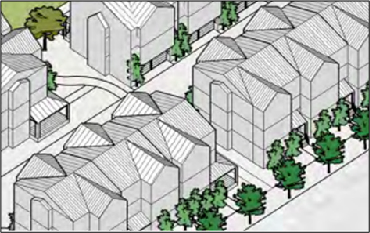
F. Landscaping
Landscaping shall be designed as an integral part of the overall multi-family development with the purpose of enhancing building design, public views and spaces, and providing buffers, transitions and screening. Landscaping may also serve to filter and infiltrate storm water runoff to reduce adverse environmental effects of runoff.
1. A 30-foot Type A buffer shall be required along arterial and major streets and thoroughfares.
2. Street trees shall be planted along all streets, driveways and parking areas in a single row at a maximum spacing of 40 feet.
(Ord. passed 2-14-2017; Ord. 2020-05, passed 8-10-2019; Ord. passed 3-15-2022)

