
Lockhart City Zoning Code
ARTICLE I
- IN GENERAL
Sec. 64-1. - Purpose.
(a)
This chapter is enacted in accordance with the comprehensive master plan to promote the safety, health, and general welfare of the community by regulating development within the city.
(b)
The city has been divided into various zoning districts to provide for an orderly growth pattern, to foster homogeneous land use development, and to ensure availability of adequate public facilities. Zoning districts have been selected to enhance the usage trends indicated by the comprehensive master plan.
(c)
The zoning districts are designed to provide flexibility of use while retaining the limitations necessary to protect existing areas and uses and to avoid undue population concentration and lessen street congestion. Limits have been placed on development which is not conducive to desirable and attractive growth while providing areas for most uses and allowing for utilization of the many smaller tracts that presently exist within the city.
(d)
To provide for new and changing uses, the definitions of allowable and permitted uses within each zoning district are written in a general and generic form. When there is a question concerning the definition or meaning of any such use, the planning and zoning commission is authorized to define such use.
(e)
It is also the intent of this chapter to provide for the integrity of residential neighborhoods and to provide for appropriate commercial, industrial, and public facilities while allowing sufficient flexibility to promote orderly growth and development.
(f)
The zoning regulations are also designed to secure safety from fire, panic, and other dangers; to promote health and the general welfare; to provide adequate light and air; to prevent overcrowding of land; to avoid undue concentration of population; and to facilitate the adequate provision of transportation, water, sewers, schools, parks, and other public requirements.
(Ord. No. 90-03, pt. 2, 3-6-90; Code 1982, § 28-1-1)
Sec. 64-2. - Definitions.
For the purposes of this chapter the following terms, phrases, words, and their derivations shall have the meaning given herein. When consistent with the context, words used in the present tense include the future, words in the plural number include the singular number, and words in the singular number include the plural number. The word "shall" is always mandatory, while the word "may" implies an option. Definitions not expressly prescribed herein are to be determined in accordance with the law. Definitions expressly prescribed herein are to be construed in accordance with the city's subdivision ordinance [chapter 52], or other applicable ordinances of the city, or in the absence of such ordinances, then in accordance with the customary usage in municipal planning, surveying, and engineering practices.
Access: A means of egress and ingress from a tract of land to a dedicated right-of-way or from a city-approved private street.
Accessory building: A structure, the use of which is incidental, appropriate, and subordinate to that of the principal structure on the same lot. See Figure 2 following this section.
Accessory dwelling unit—General: A secondary dwelling unit within or attached to a single-family dwelling (primary dwelling unit), or in a permanent detached accessory structure located on the same lot or parcel as a single-family dwelling, having no more than 1,000 square feet of habitable floor area or one-half the floor area of the primary dwelling unit, whichever is greater, and only on a lot of such size and dimensions where a duplex dwelling is allowed by-right in the applicable zoning classification. The accessory dwelling unit shall be provided with at least two off-street parking spaces in addition to the minimum number of spaces required for the primary dwelling unit. There shall be no more than one accessory dwelling unit on the lot or parcel.
Accessory dwelling unit—Limited: A secondary dwelling unit within or attached to a single-family dwelling (primary dwelling unit), or in a permanent detached accessory structure on the same lot or parcel as a single-family dwelling, having no more than 600 square feet of habitable floor area or one-half the floor area of the primary dwelling unit, whichever is greater, and where the owner of the property resides in either the primary dwelling unit or the accessory dwelling unit. The accessory dwelling unit shall be provided with at least one off-street parking space in addition to the minimum required for the primary dwelling unit, shall be served by the same electric meter as the primary dwelling unit, and shall be occupied by no more than two people who are family members, guests, or caretakers or other domestic employees of the owner/occupant of the primary dwelling unit. There shall be no more than one accessory dwelling unit on the lot or parcel.
Accessory use: A land use, activity, or structure that is customarily incidental, appropriate, and subordinate to the principal use of the land or of the principal structure on the same lot.
Adequately shielded: The attribute of a light source from which no direct glare is visible at normal viewing angles by virtue of its being properly aimed, oriented, and located and properly fitted with such devices as shields, skirts, or visors that permit no light to be emitted at or above a horizontal plane drawn through the lowest light-emitting part of the luminaire.
Agricultural, mechanical, chemical and electronic equipment manufacturing or processing plants: The use of land, buildings, or structures for the purpose of manufacturing, assembly, prototyping, testing, making, preparing, inspecting, finishing, treating, altering, repairing, warehousing or storing or adapting for sale any goods, substance, article, thing or service, of agricultural, mechanical, chemical, or electronic nature.
Agricultural product processing and sales: The use of a site for the processing of tree crops, row crops, or field crops on an agricultural or commercial basis, including packing, processing, and preparation of produce and from which such produce is shipped to a wholesale or retail outlet. Includes the use of a site for the on-premises sale of feed, grain, fertilizers, pesticides and similar goods, or the provision of agricultural services with incidental storage of goods. This use includes hay, feed, and grain stores, plant nurseries, and tree service firms.
Agriculture: The use of land including, but not limited to, farming, dairying, ranching, or animal or poultry husbandry, and the necessary accessory operations for packing, crating, or storing the produce; provided that the operations of any such accessory operations must be secondary to that of the normal agricultural activities.
Airport hazard zone: The area described and regulated by the Lockhart Municipal Airport Joint Airport Zoning Board ordinance adopted December 18, 1991.
Allowed (use): Those land uses which are allowed by-right in the particular zoning district under discussion.
Alternative financial services: An establishment that engages, in whole or in part, in the business of loaning money on the security of pledges, deposits, and/or conditional sales of personal property, paychecks, or vehicles, or which conducts check cashing services. This use includes pawnshops and pay-day loan services.
Apartment: See Multifamily.
Arcade: A building or part of a building containing four or more video, pinball, or similar player-operated amusement devices, in any combination, for commercial use. See "Indoor recreation, entertainment, and amusement facilities".
Art, music, dance, photo and personal and professional studios, salons, and learning centers: Establishments generally providing space where personal improvement, personal grooming, professional, instructional, and/or creative activities are undertaken by the occupant to serve clients. This category excludes body art facilities, defined below.
Assisted living facility: An establishment that meets the elements in V.T.C.A., Health and Safety Code § 247.002(1) and provides personal care services, as defined by V.T.C.A., Health and Safety Code § 247.002(5).
Bail bond agency: An establishment in which a licensed bail bond surety provides bail bond services as regulated by the Texas Occupations Code.
Bar, tavern or lounge: An establishment or business where, in consideration of payment therefor, liquor, beer, or wine or any combination thereof are served for consumption on the premises, with or without food, in which 75 percent or more of the gross revenue is derived from the on-premises sale and consumption of alcoholic beverages.
Barns, stables, pens for livestock: A building or part of a building in which livestock are boarded or kept, which can include keeping for the purposes of remuneration, hire, sale, boarding, riding, or show.
Basement: That part of a building with more than half its height below the average ground level. A basement shall not be counted as a story. This term includes cellar.
Batch mixing: A use consisting of the manufacture or mixing of concrete, cement, and concrete and cement products, including any apparatus and uses incident to such manufacturing and mixing.
Bed and breakfast inn: An owner occupied dwelling that is typically historic or otherwise architecturally unique, where the owner provides, for compensation, sleeping accommodations and breakfast for transient guests. One off-street parking space shall be provided for each guestroom, plus two parking spaces for the portion of the dwelling occupied by the owner.
Bingo parlor: An amusement facility in which the primary activity is the playing of games such as bingo. Incidental uses within a bingo parlor may include domino and card playing as well as electronic video games. A bingo parlor which receives 75 percent or more of its income from alcohol, shall be classed as a bar and not a bingo parlor.
Board: The Board of Adjustment of the City of Lockhart.
Buildable area: That portion of a lot remaining after the required setbacks have been provided. See Figure 2 following this section.
Building height: The vertical distance from the average ground level to the highest point of the roof.
Building line: A line within a lot defined by the minimum permitted horizontal distance from an adjacent property line. See Figure 2 following this section.
Bulk storage: The storage of chemicals, petroleum products, and other materials in above-ground containers for subsequent resale to distributors or retail dealers or outlets.
Business service establishment: Establishments primarily engaged in rendering services to business establishments on a fee or contract basis, such as advertising and mailing, building maintenance, employment service, management and consulting services, protective services, equipment rental and leasing, commercial research, development and testing, and photo finishing.
Cabin resort: A business that provides overnight quarters for transient guests in the form of detached cabins, cottages, or other small permanent structure rented by the day or week, where the primary attraction is generally a natural setting and/or recreational features and activities, and which may include a caretakers quarters and office, recreation hall, one or more meeting rooms, restaurant, or other common facilities for guests.
Cabinet or upholstery shop: A business primarily concerned with the light manufacture, production, and repair of furniture. Includes planing, finishing, and other wood crafting activities. Includes the uses described in "custom/handicraft manufacturing".
Campground: An area of land, managed as a unit, providing short-term accommodation for tents, tent trailers, travel trailers, recreational vehicles, and campers and excluding mobile or manufactured homes. Campgrounds may also provide incidental services for campground customers using the accommodations, such as showers, restrooms, ice/drinks, or other travel necessities.
Cellar: See Basement.
Cemetery: Land that is set apart or used as a place for the permanent interment of the dead or in which human bodies have been buried. May include structures accessory to this use.
Charitable institution: A building or part of a building used as a site for provision of meeting, recreational, or social facilities by a private or nonprofit association, primarily for use by members and guests. This use includes private social clubs and fraternal organizations, as well as administrative offices for all of the above associations.
Child care center: Any place, home, or institution which provides temporary custodial care and is regulated by the State of Texas.
Church or other religious facility: A building wherein persons regularly assemble for religious worship, and which is maintained and controlled by a religious body organized to sustain public worship.
Combined family: A residential development type which provides for not more than four dwelling units within a single principal structure. Separate ownership of one or more units with separate and/or common ownership of portions of accessory buildings or yard areas does not constitute a condominium.
Commercial indoor archery range/firearm shooting range: See "Gun range".
Commercial outdoor archery range/firearm shooting range: See "Gun range".
Commercial outdoor recreation, entertainment, and amusement: A place designed and equipped for the conduct of sports, leisure time activities and other customary and usual recreational activities. This use may include recreational uses conducted in open, partially enclosed, or screened facilities such as driving ranges, golf courses, miniature golf courses, golf courses, swimming pools, tennis courts, and outdoor racquetball courts, or predominantly spectator uses such as sports arenas, racing facilities, entertainment in the form of music, and amusement parks.
Commercial processing or printing: An establishment used for retail or bulk reproduction, printing, cutting, or binding of written or graphic material, including blueprinting, engraving, stereotyping, electro-typing, printing, typesetting, and including duplicating shops and letter-shops.
Commission: The Planning and Zoning Commission of the City of Lockhart.
Community meeting and/or recreation facilities: Facilities provided by the municipality or by another group or organization without profit or gain for such special purposes as a scout house, community meeting rooms, a community center, a drop-in center, an archaeological or fine arts museum, a public library etc. but does not include school facilities, public or private parks, playgrounds, arenas, stadiums, hippodromes, swimming pools, skating rinks, commercial-recreational establishments or any class of group home.
Comprehensive master plan: A statement of public policy containing the goals and objectives of the community which may include:
(1)
Capital improvements programs;
(2)
Land use plan;
(3)
Thoroughfare plan;
(4)
Community facilities plan;
(5)
Subdivision and zoning regulations and other development codes, ordinances, policies, and plans promulgated by the council for the quality and orderly growth of the community.
Condominium: A type of multifamily dwelling in which each dwelling unit is owned by the occupant but in which the halls, entranceways, and underlying land are wholly or in part jointly owned.
Convenience store: An establishment where retail goods required by the inhabitants of a residential district to meet their day-to-day needs are sold, including food, tobacco, drugs, periodicals, or similar items of household convenience. May include gasoline sales and the sale of alcoholic beverages. See restrictions on retail uses in each zoning district.
Corner sight triangle: All of that portion of land lying within a triangular shaped area on each street corner within the City of Lockhart described by metes and bounds as follows: Beginning at the precise corner of intersection point of the curbs of each of the two streets intersecting forming each corner and extending 20 feet along each such curbline from said curb intersection point, the third side being determined by the drawing of a straight line from the ends of each such 20-foot extension, whether such land be privately owned or unpaved or untraveled street right-of-way property, all as more portrayed in Figure 1 immediately below. Where no curbs are in existence at such street intersections, such 20-foot lines shall coincide with the central flow line of the ditches paralleling such uncurbed streets (as such central flow line shall be determined by the engineer of the City of Lockhart).
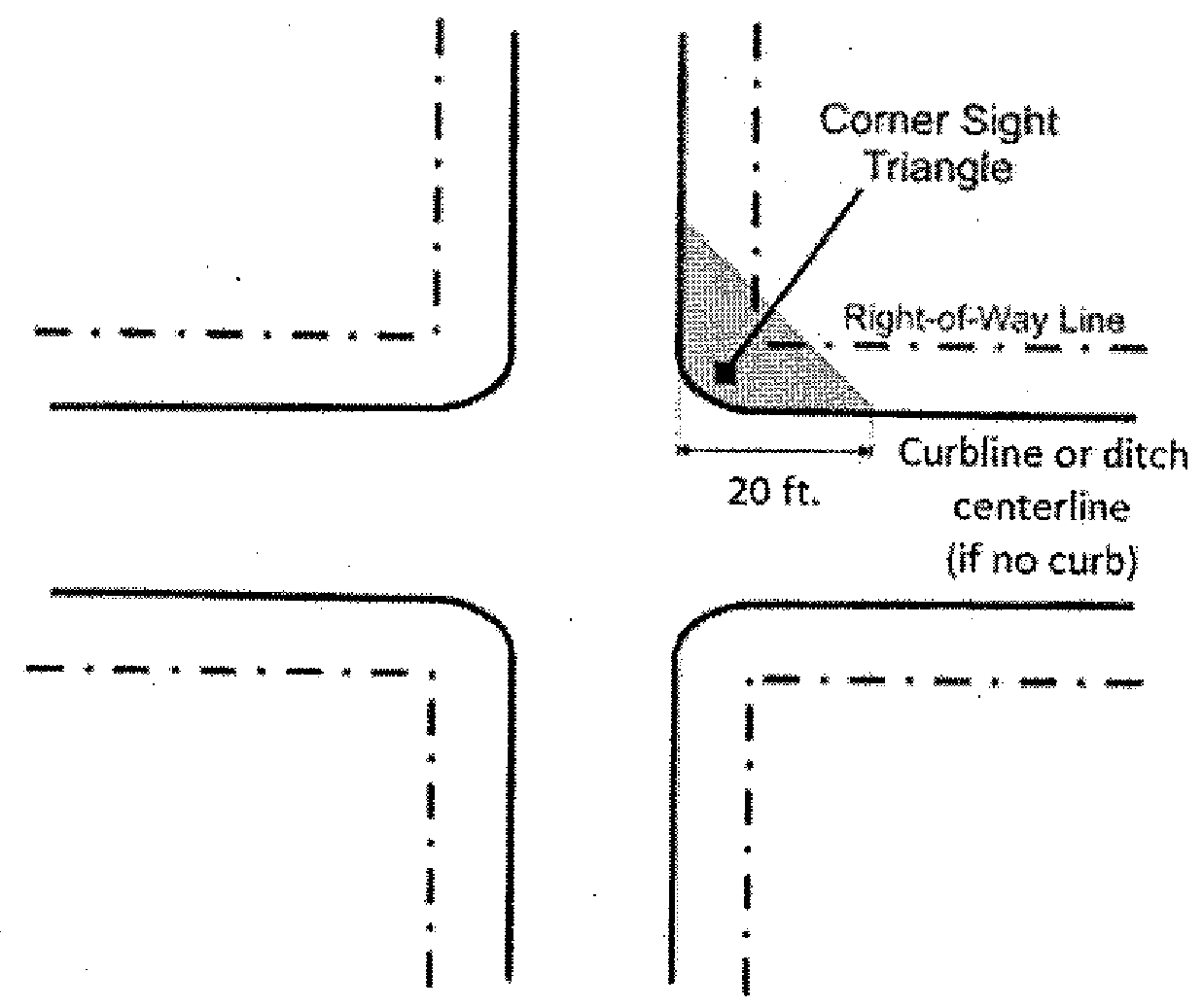
Figure 1
Council: The City Council of the City of Lockhart.
Country club: A private recreational facility serving patrons who are members of the governing organization. This use includes, but is not limited to, golf clubs, sports venues, and meeting/event spaces with incidental food and refreshments.
Crematoria: See "Funeral homes and mortuaries".
Crop production: The use of land or buildings for the raising and harvesting of crops for human food, animal feed, planting seed, or fiber. This definition includes specialty crops as produced through floriculture, viticulture, horticulture, or silviculture on an agricultural or commercial basis.
Custom/handicraft manufacturing: A building or part of a building used by trade, craft, or guild for the manufacture in small quantities of made-to-measure clothes or articles including upholstering, repair, refinishing of antiques and other art objects, where the manufacturing of small quantities of articles is performed by a tradesman requiring manual or mechanical skills, but shall not include metal spinning or the refinishing of antique automobiles.
Dance hall: Any room, place or space in which a public dance or public ball is held, or any room, place or space where dancing is permitted with live entertainment, and having a minimum dancing space required of 15 square feet.
Detention facility/treatment facility: A facility for the detention, confinement, treatment or rehabilitation of persons arrested or convicted for the violation of civil or criminal law. Such facilities include an adult detention center, juvenile delinquency center, jail, and prison. These facilities house prisoners who are in the custody of law enforcement and the facilities are typically government owned.
Development type: The form and use of a residential structure allowed or permitted within the various residential districts within the city.
Drive-in (service): An establishment which by design of physical facilities or by service or packaging procedures encourages or permits customers to receive a service or obtain a product which may be used or consumed in a motor vehicle on the premises or to be entertained while remaining in an automobile.
Drive-up (service): See "Drive-in (service)".
Duplex: A residential development type which provides for two dwelling units within a single principal structure. Separate ownership of units with separate and/or common ownership of portions of accessory building or yard areas does not constitute a condominium.
Dwellings of the development type allowed within this district: See "Allowed (use)".
Dwellings of the development type permitted within this district: See "Permitted (use)".
Dwelling unit: A single unit providing complete independent living facilities for one or more persons; including permanent provisions for living, sleeping, eating, cooking, and sanitation.
Eating establishment: An establishment or business where food is offered for sale or sold to the public for immediate consumption and includes such uses as a restaurant, café, cafeteria, "take-out" counter, ice-cream parlor, tea or lunch room, dairy bar, coffee shop, snack bar or refreshment room or stand; but does not include a lodging or boarding house.
Electronic transmission or telecommunications facility: See "Telecommunications".
Equipment manufacturing or processing plants: Facilities for, relating to, concerning, or arising from the assembling, fabrication, finishing, manufacturing, packaging, or processing of equipment or materials.
Façade: The front part or exterior part of a building that faces the street.
Farm machinery and heavy equipment sales, service, rental and storage: The use of land, buildings or structures for the sale, storage, rental or repair of heavy equipment and farm machinery.
Financial institution (and office): An institution or business providing financial and banking services, such as a bank, trust company, finance company, mortgage company, or investment company.
Fitness center: A facility in which facilities including courts are provided for recreational athletic activities such as individual, group, or team sports, lessons, and similar activities including, but not limited to, body-building, exercise classes, and equipment access on a membership basis, and may include associated facilities such as sauna and solarium.
Food processing and preparation plant: A commercial establishment in which food is processed or otherwise prepared for human or animal consumption and distribution but not consumed on the premises. This use excludes on-site animal slaughter.
Footcandle: Unit of light density incident on a plane (assumed to be horizontal unless otherwise specified), and measurable with an illuminance meter, a.k.a. light meter. Footcandle measurements report the amount of light originating from a specific direction.
Funeral home: A business furnishing funeral supplies and services to the public and includes facilities intended for the preparation of the dead human body for interment and cremation.
Furniture, appliance, and vehicle parts sales: See "Retail (store)".
Glare: Excessive brightness in the field of view that is sufficiently greater than that to which the eyes are adapted, so as to cause annoyance or loss in visual performance and visibility, so as to jeopardize health, safety or welfare.
Golf course: An outdoor recreation use consisting of a large outdoor area in which golf is played. May also include accessory uses such as a clubhouse, food and beverage service, and equipment shop. See "Commercial outdoor recreation, entertainment, and amusement".
Group home: A residential structure that is licensed to provide room, board, and supervised care, but not continuous nursing care, for unrelated adults over the age of 17. The group home houses individuals who are undergoing treatment or rehabilitation and constitutes a single housekeeping unit in which residents share responsibilities, meals, and recreation. Also see "Assisted living facility", "Child care center", or "Residential rehab" as applicable.
Gun range: Any land or structure where there are facilities of any sort for the firing of handguns, rifles, or other firearms or projectile weapons.
Hazardous product storage and manufacture: An establishment providing warehousing or bulk storage facilities for hazardous, toxic, flammable, explosive, or other dangerous materials.
Health care provisions, service, and supply: Establishments primarily engaged in furnishing medical, surgical or other services to individuals, including the offices of physicians, dentists, and other health practitioners, medical and dental laboratories, out-patient care facilities, blood banks, and oxygen and miscellaneous types of medical supplies and services. This use includes the sales and service of medical equipment and supplies to the aforementioned service providers.
Home improvement center with outside display and storage: A retail commercial establishment dealing in merchandise such as wall paneling, wood products, gardening supply, sheet glass products, windows and mirrors, flooring, wall and ceiling tiles, paint and wallpaper, bathroom and kitchen cupboards and fixtures, landscaping materials and similar goods in addition to equipment rentals.
Home occupation: Any occupation or profession carried on by the inhabitants of a dwelling which is clearly incidental and secondary to the use of the structure for dwelling purposes, which does not change the character thereof, and which is conducted entirely within the main or accessory buildings; provided that no trading in merchandise is carried on. No mechanical equipment shall be used nor activity conducted which creates any noise, dust, odor, or-electrical disturbance beyond the confines of the lot on which the occupation is conducted. No home occupation shall employ more than one assistant in such a business. The operation of a restaurant, convalescent facility, or cabinet, carpentry, metal, or auto repair shop is not a home occupation.
Hospital: Any institution, building or other premises or place established for the maintenance, observation, medical and dental care and supervision and skilled nursing care of persons afflicted with or suffering from sickness, disease or injury or for convalescent or chronically ill persons.
Hotel: A building or group of buildings offering transient lodging accommodations to the general public at a daily rate and which provides guestrooms or units with linen and housekeeping service, and may also provide additional services such as restaurants, meeting rooms, entertainment, and recreational facilities. This term includes motels.
Household service establishment: Retail commercial establishments primarily providing household goods and/or services, including, but not limited to, toiletries, pet supplies, cleaners, and linens.
HUD-Code manufactured home: A structure, constructed on or after June 15, 1976, meeting the National Manufactured Home Construction and Safety Standards Act as administered by the United States Department of Housing and Urban Development, transportable in one or more sections, which in the traveling mode is eight body feet or more in width or 40 body feet or more in length, or when erected on site is 320 or more square feet, and which is built on a permanent chassis and designed to be used as a dwelling with or without a permanent foundation when connected to the required utilities, and includes the plumbing, heating, air conditioning, and electrical systems. The term does not include mobile homes or recreational vehicles as defined in this section.
Illuminance: Quantity of incident light, measured in footcandles.
Indoor recreation, entertainment, and amusement facilities: Arcade, billiard/pool hall, bowling alley, skating rink, gymnasium, natatorium, health club, or theater within an entirely enclosed building.
Junkyard: See "Salvage yards and junkyards".
Laboratory or research facilities/centers: See "Research and administrative facilities".
Land use plan: A document adopted by the council which attempts to identify and guide growth within the city, and is a part of the comprehensive master plan.
Lewd merchandise sales: See "Sexually oriented business".
Light assembly/fabrication: The use of a site for manufacture, predominantly from previously prepared materials, of finished products or parts, including processing, fabrication, assembly, treatment, and packaging of the products, and incidental storage, sales, and distribution of the products. This use excludes basic industrial processing. Also see "Custom/handicraft manufacturing".
Light trespass: Light emitted by a luminaire or lighting installation, which is cast beyond the boundaries of the property on which the lighting installation is sited.
Limited industrial manufacturing: A land use consisting of the manufacture of small products in limited amounts within an entirely enclosed building, with no outside storage, and where shipping and receiving is primarily by parcel delivery service step-vans or small box trucks.
Livestock: Domestic animals typically used or raised on a farm or ranch, especially those kept for a profit, including but not limited to, horses, ponies, mules, donkeys, burros, cattle, goats, sheep, swine, hogs, pigs, rabbits, llamas, and emus.
Livestock production: The use of a site for temporary keeping of livestock for slaughter, market, or shipping. This use includes stockyards, animal sales, and auction yards.
Lodging or boarding house: A dwelling, other than a hotel or motel, containing individual sleeping rooms that are rented for compensation, and where meals may be provided by the proprietor. One off-street parking space shall be provided for each sleeping room available for rent, plus one parking space for the proprietor's dwelling unit, if any.
Lot depth: The average of the length of the side lot lines. See Figure 2 following this section.
Lot width: The average of the length of the front lot line and of the rear lot line. See Figure 2 following this section.
Lumber, building and construction materials sales and storage: A use involving construction activities, the incidental storage of materials on sites other than construction sites, and the on-site sale of materials used in the construction of buildings or other structures, other than retail sale of paint, fixtures and hardware. This use includes building materials stores, tool and equipment rental or sales, and building contractor businesses, but excludes automobile sales, automobile rentals, automobile washing, automotive repair services, commercial off-street parking, equipment repair services, equipment sales, service stations, and vehicle storage.
Luminaire: A complete lighting fixture assembly consisting of lamp(s), lamp holders, electrical components, light directing devices, shielding devices and lenses or diffusers.
Major recreational equipment: All boats, travel trailers and tent trailers, motorized or towed coaches, dwellings, or campers (not including manufactured homes), pickup-mounted camping modules, similar devices used for recreational short-term occupancy, and boxes, cases, or trailers used for transporting recreational equipment, whether or not containing or carrying such equipment.
Manufactured home: A HUD-Code manufactured home.
Manufactured home park: A tract of land not less than five acres in size under single ownership, which is designed and improved to contain two or more spaces available for long-term lease or rent to the public for the placement of manufactured homes, and which may include private streets, buildings, and other facilities and services for common use by the residents, in conformance with chapter 34 of this Code.
Manufactured home sales: A use where the sales office and financing operations and display of manufactured homes is conducted.
Manufactured home subdivision: A division of land not less than five acres in size for the purpose of sale of two or more lots intended to be developed with residential units including manufactured homes, and having all necessary public utilities, streets, and other facilities required by chapter 52 of this Code.
Masonry materials: Full thickness kiln fired brick, stone, granite, marble, concrete tilt wall, concrete block, stone, glass block unit, or other masonry material of equal characteristics as determined by the building official or his or her designee. Stucco and plaster shall only be considered as a masonry material when applied to a minimum of seven-eighths of an inch thickness or by other process producing comparable cement stucco finish with equal or greater strength and durability specifications. Synthetic products (exterior insulation and finish systems (EFIS), cementitious fiberboard, or other materials of similar characteristics) shall not be considered a masonry material.
Mixed-use building: A building containing both residential and nonresidential uses, where the nonresidential use occupies at least the front 50 percent of the ground floor area of a single-story building and occupies at least the entire ground floor area of a multi-story building. The nonresidential use(s) may include any that are allowed separately in the same zoning district classification that allows mixed-use buildings. Except for mixed-use buildings in the CCB district, at least one off-street parking space mut be provided for each dwelling unit in addition to parking spaces required for the nonresidential use(s).
Mobile home: A structure that was constructed before June 15, 1976, transportable in one or more sections, which in the traveling mode is eight body feet or more in width or 40 body feet or more in length, or when erected on site is 320 or more square feet, and which is built on a permanent chassis and designed to be used as a dwelling with or without a permanent foundation when connected to the required utilities, and includes the plumbing, heating, air conditioning, and electrical systems. The term does not include recreational vehicles as defined in this section.
Modular dwelling: A prefabricated single-family or duplex dwelling assembled on a permanent foundation that is not a manufactured home, as defined in this section, and has been constructed and inspected so that it complies with the Texas Industrialized Housing and Buildings Act as administered by the Texas Department of Licensing and Regulation, and which complies with the International Residential Code as currently adopted by the City of Lockhart. Modular dwellings shall be considered the same as the corresponding site-built single-family or duplex residential development types for the purpose of regulation under this chapter, subject to the additional requirements of subsection 64-200(c).
Mortuary: See "Funeral homes and mortuaries".
Motel: See Hotel.
Multifamily: A residential development type which provides for five or more dwelling units within a single principal structure. Separate ownership of one or more units shall constitute a condominium. This term includes and is synonymous with apartment.
Nit: A unit of luminance, or brightness, emitted from a luminous surface equal to one candle per square meter, measured perpendicular to the rays of the source. Nits is the only scientific manner for measuring light energy being emitted from an internally illuminated sign.
Nonconforming building: Any building, or part thereof, lawfully existing or occupied at the effective date of this chapter [April 15, 1990] that does not comply, after the passage of this chapter, with the height, yard, or coverage area regulations of the district in which it is located.
Nonconforming lot: Any lot lawfully existing at the effective date of this chapter [April 15, 1990,] that does not comply, after the passage of this chapter, to the width, depth, and area regulations of the zoning district in which it is located.
Nonconforming use: Any use lawfully existing at the effective date of this chapter [April 15, 1990] that does not comply, after the passage of this chapter, with the use, parking, loading, or screening regulations of the district in which it is located.
Nursing home: A use in which the proprietor supplies for hire or gain, lodging with or without meals and, in addition provides nursing, medical, or similar care and treatment, if required, and includes a rest home, or convalescent home, and any other establishment required to operate under the appropriate statute.
Ornamental tree: A flowering tree from a species which the Texas A&M Forest Service recommends for planting in Caldwell County which is typically less than 30 feet in height at maturity.
Outdoor market: A place where individual vendors operating from stalls, booths, or other defined area offer the following for sale: articles for consumption such as fresh fruit and vegetables, uncooked poultry, fish and meat, eggs, honey, or cider, cut flowers, bedding out plants, shrubs and trees, or baked foodstuffs, cheese or cooked meats, as well as second hand furniture, clothing, and custom/handicraft goods.
Outdoor recreation area: See "Commercial outdoor recreation, entertainment, and amusement".
Outdoor vehicle storage facility: The use of a site for long-term storage for vehicles. This use includes storage of vehicles towed from private parking areas and impound yards, but excludes dismantling, salvage, and vehicle sales.
Package sales (of alcoholic beverages): Retail sales of alcoholic beverages not intended for on-site consumption.
Parking lot or garage: An area or areas of land or a building or part thereof which is either a principle use or is provided and maintained upon the same lot or lots upon which the principal use is located for the purpose of storing motor vehicles.
Parts, light equipment, and motor vehicle sales, rental, maintenance, and services: The use of a building or area for the sales, rental, maintenance, and service of light equipment, giving for example, but not limited to, such uses as construction equipment, automobile repair, boat sales, automobile dealerships, or brake shops.
Patio home: A residential single-family detached development type where one side wall of the dwelling abuts the property line and has no doors, windows, or other openings, while the opposite side of the dwelling has a larger than normal side yard that typically contains a patio or courtyard. The exterior wall abutting the common side property line with an adjacent patio home faces the patio or courtyard of the adjacent patio home. This development type is also known as a zero-lot-line home or garden home.
Permitted (use): Those land uses which are permitted subject to the approval of a specific use permit in the particular zoning district under discussion.
Personal service establishment: A business which is associated with the grooming or health of persons or the maintenance and repair of personal wardrobe articles and accessories, and may include a barber shop, beauty parlor, shoe repair shop, self-service laundry or dry cleaning/distribution station.
Planned development district (PDD): A type of master planned development created as a standalone zoning district with a binding site development plan that provides for a flexible combination of various development types in high-quality master planned districts. PDDs may be subject to special conditions and regulations as prescribed by the city council.
Plant nursery, garden, greenhouse: Land used for and associated retail and incidental storage uses for the growing of sod, flowers, bushes, trees or other gardening, landscaping or orchard stock for wholesale or retail sale.
Poultry production facilities: The use of a site for the raising of animals or production of poultry products including eggs on a commercial basis.
Principal structure: The primary building on a lot which by its design defines the use and character of the tract. See Figure 2 following this section.
Private autopsy facility: A facility operated by a private company for the investigation of human remains. See "Funeral homes and mortuaries".
Professional, corporate, and administrative offices: A building or part thereof, designed, intended or used for the practice of a profession, the carrying on of a business, the conduct of public administration, or, where not conducted on the site thereof, the administration of an industry, but shall not include a retail commercial use, any industrial use, clinic, financial institution or place of amusement or place of assembly.
Public or private school or other educational institution: An institution or place for instruction or education, such as kindergarten, elementary, middle or junior high school, high school, college or university, or other public, private, or non-profit educational institutions.
Public transportation facilities and associated commercial activities: Any facility provided by the municipality, the appropriate public authorities or their agencies, or by any transportation company licensed to operate in the municipality by the appropriate authority. May include facilities for the loading, unloading, or interchange of passengers, baggage, or incidental freight or package express between modes of transportation as well as incidental retail sales to travelers.
Recreation facility: See "Commercial outdoor recreation, entertainment, and amusement".
Recreational vehicle: A vehicular-type portable structure without a permanent foundation that can be towed, hauled, or driven which is designed as a temporary living accommodation for recreational, camping, and travel use, and which includes, but is not limited to, travel-trailers, truck-campers, camping trailers, and self-propelled motor homes.
Recreational vehicle park: A campground designed principally for the use of recreational vehicles, motor homes, or other camping vehicles. May include facilities for the dumping of gray or blackwater. See "Campground".
Recyclable material: A nonputrescible, source-separated, nonhazardous material that has been recovered or diverted from the municipal waste stream for purposes of reuse, recycling, or reclamation, a substantial portion of which is consistently used in the manufacture of products that may otherwise be produced using raw or virgin materials.
Recycling facility: A collection point for recyclable materials that is exempt from Texas Commission on Environmental Quality municipal solid waste permitting and registration requirements under the Texas Administrative Code.
Research and administrative facilities: A building or group of buildings in which are located facilities for scientific research, investigation, testing, or experimentation, but not facilities for the manufacture or sale of products, except as incidental to the main purpose of the laboratory. This use includes electronics research laboratories, space research or development firms, and pharmaceutical research labs, and excludes product testing.
Residential rehab: A residential establishment whose primary purpose is the rehabilitation of persons. Such services include drug and alcohol rehabilitation, assistance to emotionally and mentally disturbed persons, and halfway houses for prison parolees and juveniles.
Restaurant: See "Eating establishment".
Retail (store): A building or area where goods, wares, merchandise, substances, articles, things or their incidental services are offered or kept for sale at retail, including storage of limited quantities of such goods, wares, merchandise, substances, articles or things, sufficient only to service such store.
Rodeo and riding facilities: The use of land and/or buildings to house horses and for their exercise and training may include a school for riding, boarding stables, tack shop, rodeo event space, or other related uses. See also "Commercial outdoor recreation, entertainment, and amusement".
Roominghouse: See Boardinghouse.
Row house: See Townhouse.
Salvage yards and junkyards: The use of a site for the storage, sale, dismantling or other processing of used or waste materials that are not intended for re-use in their original forms. This use includes automotive wrecking yards, junk yards, and paper salvage yards.
Screening: Constructions or plantings providing a buffer between land uses or individual features of a land use or building and its surroundings that lessen the impact of light, sound, view, or other factors from the originating property.
Self-storage: A storage enterprise dealing with the reception of goods of residential or commercial orientation that lie dormant over extended periods of time. Separate storage units are rented to individual customers who are entitled to exclusive and independent access to their respective units.
Service facilities and suppliers: See "Warehouses and terminals".
Sexually-oriented business: An adult book store, adult video arcade, adult movie theater, massage parlor (other than a state registered massage or therapy service), sexual encounter center, nude modeling studio, cabaret, gentlemen's' club, or other establishment that either: 1) has any form of live or recorded entertainment that provides sexual stimulation or sexual gratification to patrons; and/or 2) which devotes more than 20 percent of its merchandise display area, or signage or other advertising, to the sale, rental, or exhibition of devices, materials, or other items used for sexual stimulation or gratification or which depict sexual nudity or sexual activities, or which derives more than 20 percent of its gross net revenues from such sales, rental or exhibition.
Shade tree: A tree from a species which the Texas A&M Forest Service recommends for planting in Caldwell County which has a height at maturity of at least 30 feet.
Shopping mall: A group of commercial establishments planned, constructed and managed as a total entity with customer and employee parking provided on-site, provision for goods delivery separated from customer access, aesthetic considerations and protection from the elements.
Single-family home: A residential development type which provides for a single dwelling unit within a single principal structure.
Small engine repair: The use of a building or area for the sales, rental, maintenance, and service of small engines such as those attached to lawnmowers or small boats. This definition excludes uses such as construction equipment, automobile repair, boat sales, automobile dealerships, or brake shops.
Smoke shop/head shop, including drug or vice paraphernalia: The retail sales of all equipment, products, and materials of any kind that are used, intended for use, or designed for use, in planting, propagating, cultivating, growing, harvesting, manufacturing, compounding, converting, producing, processing, preparing, testing, analyzing, packaging, repackaging, storing, containing, concealing, injecting, ingesting, inhaling, or otherwise introducing into the human body tobacco, marijuana, and/or a controlled substance as defined in state law.
Special events center: A private indoor and/or outdoor facility that is available for rental by the public for weddings, receptions, reunions, seminars, parties, and other similar occasions of limited duration.
Storage/shipping yard: The use of a part of a property for the storage or organization of equipment, vehicles, product, building materials, or components used by the owner or occupant of the property as an accessory to the conduct of a trade, craft, or business performed under one of the other allowed or permitted uses in this district.
Structure: Anything constructed or erected on the ground including, but not limited to, buildings, factories, sheds, cabins, manufactured homes, and other similar forms.
Studios, salons, and learning centers: See "Art, music, dance, photo and personal and professional studios, salons and learning centers".
Tattoo parlor and body art facilities: The practice of physical body adornment by establishments and artists using but not limited to the techniques of body piercing and tattooing.
Telecommunications: The electronic, telephonic, or other high-tech transmission, reception, or exchange of data or information between or among points specified by the user of information of the user's choosing, without change in the form or content of the information as sent or received.
Telecommunication center or agency for customer service, technical support, or telemarketing operations: A subset of "Professional, corporate, and administrative offices" where employees principally undertake sales or service by means of telecommunications equipment and no exchange or storage of physical goods occurs.
Terminals (associated with warehousing uses): See "Warehouses and terminals".
Thoroughfare plan: A document adopted by the council which attempts to identify and guide the locations of arterial and collector streets within the city and is a part of the comprehensive master plan.
Townhouse: A residential development type which provides for five or more dwelling units generally separated by common walls within a single structure. Usually each dwelling unit is placed on an individually owned lot and each story of the structure on each lot is under the same ownership. Some areas and yards may be commonly owned. A townhouse where the lot under and immediately adjacent to the structure is individually owned does not constitute a condominium. This term includes row house.
Truck stop or travel center/plaza: Any building, premises or land in which or upon which a business, service or industry involving the maintenance, servicing, storage or repair of commercial vehicles is conducted or rendered including the dispensing of motor fuel or petroleum products directly into motor vehicles and the sale of accessories or equipment for trucks and similar commercial vehicles. A truck stop also may include overnight accommodations and bathing or showering facilities solely for the use of truck crews.
Use: Any activity, function, or purpose to which a parcel of land or building is put and shall include the words "used," "arranged," or "occupied," for any purpose, including all residential, commercial business, industrial, public, or other use.
Accessory use: A use which is wholly incidental to and supportive of the principal use of the same lot.
Principal use: The primary purpose for which land or a building is used as permitted by the applicable zoning district.
Veterinary hospital or clinic, wildlife rehabilitation, kennels: A facility for the prevention, treatment, surgery, cure, or alleviation of disease and/or injury of animals and may include outside runs and paddocks. May include overnight and/or outside boarding for animals.
Warehouses and terminals: A building, land, or part thereof, which is used primarily for the housing, storage, adapting for sale, package or wholesale distribution of goods, wares, merchandise, food stuff substances, articles and the like. Such use may include facilities for truck loading and transfer but does not include a fuel storage tank or truck repair facilities.
Warehouses for local sales and distribution: A building, land, or part thereof, which is used primarily for the housing, storage, adapting for sale, package or wholesale distribution of goods, wares, merchandise, food stuff substances, articles and the like for distribution or service to businesses within the city. Such use may include facilities for truck loading and transfer but does not include a fuel storage tank or truck repair facilities.
Welding or machine shop: The use of land, or building, or structure where pieces of metal are welded or machined to produce finished products or elements for other processes.
Wholesale auto auction: A building or structure or lands used for the storage of automobiles and related materials which are to be sold on the premises by auction to industrial, commercial, institutional, or professional business users, and for the sale of the said goods and materials by auction and on an occasional basis.
Wild game processing: See "Food processing".
Wireless telecommunication facility—High impact: Exterior apparatus designed for telephonic, radio, or television communication through the transmission or reception of electromagnetic waves, and which consists of one or more antennas mounted on a new freestanding tower that exceeds the lesser of 60 feet, or five feet above the maximum permitted building height of the applicable zoning district. This definition does not include an antenna structure used exclusively for dispatch communications by a public emergency agency, which is exempt.
Wireless telecommunication facility—Low impact: Exterior apparatus designed for telephonic, radio, or television communication through the transmission or reception of electromagnetic waves, and which consists of any of the three types of antenna locations listed below. This definition does not include the following, which are exempt: 1) an antenna used exclusively for dispatch communications by a public emergency agency; 2) home use of an accessory antenna or satellite dish which receives television broadcast signals; and 3) an amateur radio antenna not exceeding by more than five feet the maximum permitted building height of the zoning district within which it is located.
(1)
An antenna mounted as an accessory on a building, water tower, lighting standard, electric utility transmission tower, or other tall structure having another primary function allowed in the zoning district within which it is located;
(2)
An antenna mounted on an existing tower that already supports one or more telecommunication antennas; or
(3)
An antenna mounted on a new freestanding tower not exceeding the lesser of 60 feet, or five feet above the maximum building height of the zoning district within which it is located.
Yard: An open space of ground between a structure and the adjoining lot lines, unoccupied and unobstructed by any portion of a structure from the ground upward, except as otherwise provided. In measuring a yard, the least horizontal distance between the lot line and the structure shall be used. See Figure 2 following this section.
Front yard: A yard across the full width of the lot from the front wall of a structure to the front line of the lot.
Rear yard: A yard across the full width of the lot from the rear wall of a structure to the rear line of the lot.
Required yard: The area between a lot line and the adjacent setback line. All areas within a lot which does not constitute buildable area.
Side yard: A yard between the wall of a structure and the adjacent side line of the lot, and extending from the front wall of a structure to the rear wall of a structure.
No vertical structures, other than fences and air conditioner compressors, are allowed in any required yard.
Zoo or other outdoor facility for all types of wildlife: The use of land or building, or structure for keeping live animals for public exhibition or for view/study by the public, often operated as a commercial or nonprofit business.
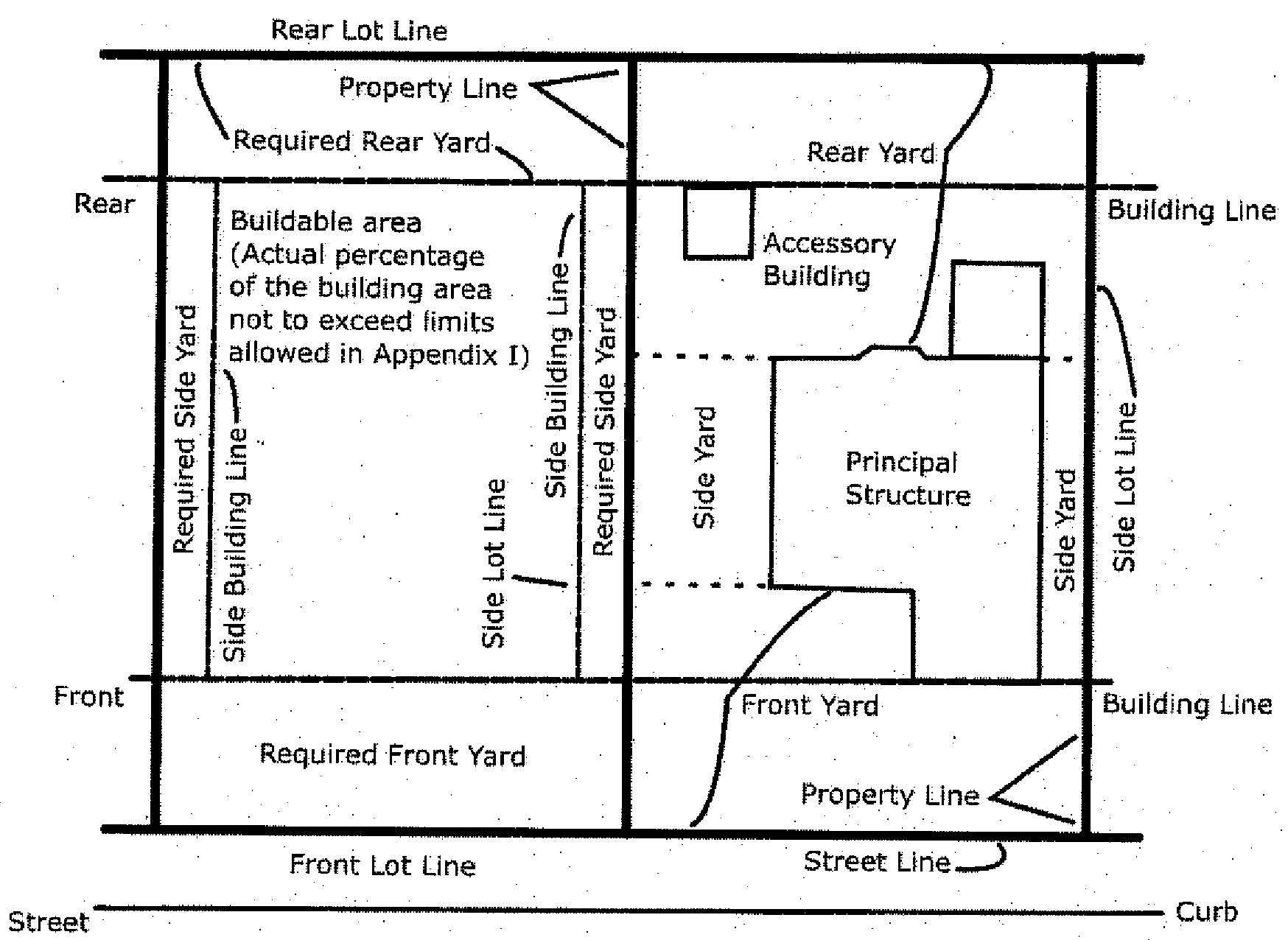
Figure 2
(Code 1982, § 28-1-2; Ord. No. 90-03, pt. 2, 3-6-90; Ord. No. 95-07, pt. 1(A), 11-7-95; Ord. No. 97-21, § I, 10-7-97; Ord. No. 98-08, § I, 4-7-98; Ord. No. 98-20, § I, 9-1-98; Ord. No. 04-23, § I, 9-21-04; Ord. No. 04-34, § I, 12-21-04; Ord. No. 06-27, § I, 6-20-06; Ord. No. 2016-08, § I, 3-15-16; Ord. No. 2021-03, § II, 2-23-21; Ord. No. 2022-46, § II, 9-20-22; Ord. No. 2023-02, § II, 1-17-23; Ord. No. 2023-11, § II, 6-20-23; Ord. No. 2023-23, § II, 11-21-23; Ord. No. 2024-05, § V, 2-20-24; Ord. No. 2024-14, § II, 7-2-24)
Cross reference— Definitions generally, § 1-2.

