
Lombard City Zoning Code
ARTICLE X
- OFF-STREET PARKING AND LOADING REQUIREMENTS
§ 155.601 - Scope and application.
(A)
Scope of regulations. The off-street parking and loading provisions of this Ordinance shall apply as follows:
(1)
For all buildings and structures erected and all uses of land, accessory parking and loading facilities shall be provided as required below. However, where a building permit has been issued prior to the effective date of this Chapter and provided that construction is begun within six months of such effective date and diligently executed to completion, parking and loading facilities in the amounts required for the issuance of said building permit may be provided in lieu of any different amounts required by this Chapter.
(2)
When the intensity of use of any building, structure, or premises shall be increased through the addition of dwelling units, gross floor area, seating capacity, or other units of measurement specified herein for required parking or loading facilities, parking and loading facilities as required herein shall be provided for such increase in intensity of use and for 100 percent of any existing deficiency in parking or loading facilities.
(B)
Existing parking and loading facilities. Accessory off-street parking and loading facilities in existence on the effective date of this Chapter and located on the same lot as the building or use served shall not hereafter be reduced below, or if already less than, shall not be further reduced below, the requirements for a similar new building or use under the provisions of this Chapter.
(C)
Permissive parking and loading facilities. Nothing in this Chapter shall be deemed to prevent the voluntary establishment of off-street parking or loading facilities to serve any existing use of land or buildings, provided that all regulations herein governing the location, design, and operation of such facilities are adhered to.
(D)
Damage or destruction. For any conforming or legally nonconforming building or use which is in existence on the effective date of this Chapter, which subsequently thereto is damaged or destroyed by fire, collapse, explosion, or other cause, and which is reconstructed, reestablished, or repaired, off-street parking or loading facilities need not be provided except that parking or loading facilities equivalent to any maintained at the time of such damage or destruction shall be restored or continued in operation. However, in no case shall it be necessary to restore or maintain parking or loading facilities in excess of those required by this Chapter for equivalent new uses or construction.
(E)
Submission of required plans. Any application for a building permit, shall include therewith a site plan drawn to scale and fully dimensioned showing any off-street parking or loading facilities to be provided in compliance with this Chapter. Other information shall also be provided as required by the Director of Economic Development and Planning to determine compliance including; number of existing parking spaces, seating capacity, number of employees or other information indicating the intensity of the principal use.
(Ord. No. 7826, § 1, passed 6-18-20; Ord. No. 8347, § 1, passed 3-20-25)
§ 155.602 - Off-street parking.
(A)
General requirements.
(1)
Minimum spaces required. In any Business or Industrial District, parking shall be required as provided for in this section and a minimum of three spaces shall be provided for each use.
(2)
Central area parking regulations. In the B5 Central Business District, the village desires to minimize disruptive curb cuts and driveways, and to encourage the consolidation of parking spaces in appropriate locations. Therefore, off-street parking in the B5 Central Business District shall be provided as follows:
(a)
For the construction of new buildings, 50 percent of the number of off-street parking spaces indicated in Table 6.3 below shall be provided for non-residential uses, and 100 percent of the number of off-street parking spaces indicated in Table 6.3 below shall be provided for residential uses, with a minimum of three parking spaces per lot-of-record.
(b)
Parking shall be provided to the side or rear of the building and shall be a minimum of five feet from the right-of-way.
(3)
Location.
(a)
All parking spaces required to serve buildings or uses erected or established after the effective date of this Chapter shall be located on the same zoning lot as the building or use served, except as otherwise provided for in subsections 155.602(A)(3)(b), (c), (d) and (g), below. Existing buildings or uses altered such that additional parking is required shall provide such parking on the same zoning lot, except as otherwise provided for in subsections 155.602(A)(3)(b), (c), (d) and (g), below.
(b)
Off-site parking spaces may be used to serve non-residential uses in the R6, O, B3, B4, B4A, B5A and I Districts. No off-site parking space shall be located further than 300 feet from the main entrance of the principal building to be served. Off-site parking shall be a conditional use in the above districts. Off-site parking facilities shall be subject to subsection 155.602(A)(4), below.
(c)
Off-site parking spaces intended to serve non-residential uses in the B5 District shall be a permitted use, subject to subsection 155.602(A)(4) below.
(d)
Owners of property legally nonconforming as to parking and located in the CR, R0, R1, R2, R3, R4, R5, B1 and B2 Districts shall be allowed to provide parking off-site to become otherwise conforming. In such circumstances, the provision of such off-site parking shall be considered a conditional use and subject to the provisions of subsection 155.103(F) of this Chapter.
(e)
Off-street parking spaces open to the sky, may be located in any yard, except that in the R4, R5, O, and I Districts, off-street parking shall not be located in a required front or corner side yard. However, In the R0, R1 and R2 Districts, not more than two vehicles may be parked overnight in a required front or corner side yard, and not more than three vehicles may be parked overnight in the required rear yard.
(f)
All off-street parking spaces shall be located in a manner which allows for compliance with the provisions in § 155.700 of this Chapter.
(g)
For all property owned by the Lombard Park District and located within the CR Conservation/Recreation District, required parking spaces may include those legal parking spaces within adjacent public rights-of-way that are located on the same side as, and abutting the subject property. The calculation of on-street parking for compliance with the parking requirements of this section shall be subject to the review and approval of the Director of Economic Development and Planning.
(4)
Control of off-site parking facilities. In cases where parking facilities are permitted on land other than the zoning lot on which the building or use served is located, such facilities shall be in the same possession as the zoning lot occupied by the building or use to which the parking facilities are accessory. Such possession may be either by deed or long-term lease, the term of such lease to be determined by the Village Board. The deed or lease shall require such owner or his or her heirs and assigns to maintain the required number of parking facilities for the duration of the use served or of the deed or lease, whichever shall terminate sooner.
For owners and/or operators of uses located within the B5 Districted that intend to satisfy the parking requirements by utilizing parking spaces owned by the Village of Lombard, the owner and/or operator shall enter into a parking agreement with the Village Board. However, this provision shall not be interpreted to automatically grant parking rights to a particular use for spaces owned by the village, but rather should be subject to the Village Board approval on a case-by-case basis.
(5)
Size. Each off-street parking space shall have a standard length of 18 feet, zero inches. For parking stalls adjacent to landscape islands and more than five feet from a property line, the requisite stall width must be at least 16 feet, zero inches. In the case of parallel parking spaces the required length shall be 24 feet, zero inches. The width of parking spaces shall depend on the district in which the parking spaces are located, as established below:
(a)
In the B1, B2, B3, B4, B4A, B5 and B5A Districts the width of parking spaces shall not be less than nine feet, zero inches. For parking lots with parking spaces that exceed the minimum amount of parking spaces as required by Table 6-3 of this section, the width of any excess spaces shall not be less than eight feet, three inches, provided that the reduced spaces are specifically designated for business, employee, and/or compact vehicles.
(b)
In the O Office, I Industrial, all residence districts and publicly owned commuter lots, the width of parking spaces shall not be less than eight feet, three inches.
The requirements for handicapped parking, both in terms of stall size and number of spaces required are established in subsection 155.602(B), below.
(6)
Access. Except on single-family residential lots, each off-street parking space shall open directly upon an aisle or driveway of a width in conformance with the requirements of this Chapter. All off-street parking facilities shall be designed with appropriate means of vehicular access to a street or alley in a manner which will least interfere with traffic movement.
(7)
Collective provision. Off-street parking facilities for separate uses may be provided collectively if the total number of spaces so provided is not less than the sum of the separate requirements of each use and the facilities adhere to all regulations governing location of accessory parking spaces in relation to the use served. Further, no parking space or portion thereof shall serve as a required space for more than one use.
(8)
Computation.
(a)
The calculation of off-street parking based on floor area shall be interpreted to include the following:
(i)
All floor area as defined by § 155.802 of this Chapter;
(ii)
Any floor area devoted to retailing activities;
(iii)
Any floor area devoted to the production, warehousing as the primary use of the space, or processing of goods;
(iv)
Any floor area devoted to the business or professional offices;
(b)
For purposes of measurement of off-street parking spaces, the following spaces shall not be included:
(i)
Floor area devoted primarily to storage purposes (unless specifically listed in subsection a above);
(ii)
Floor area devoted to elevators, toilet rooms, stairways, other shaft enclosures, exit facilities, entrance vestibules, and closets;
(iii)
Floor area devoted to off-street parking or loading facilities, including aisles, ramps, and maneuvering space; or
(iv)
Mechanical or storage floor area (unless specifically listed in subsection a above).
When determination of the number of off-street parking spaces required by this ordinance requires a computation of square footage of gross floor area, any portion of the gross floor area between the 1,000 square foot intervals shall also be included in the computation.
When determination of the number of off-street parking spaces required by this Chapter results in a requirement of a fractional space, any fraction of less than one-half may be disregarded, while a fraction of one-half or more shall be counted as one parking space. Parking spaces required on an employee basis shall be based on the maximum number of employees on duty or residing on the premises at any one time.
(9)
Utilization. Required accessory off-street parking facilities provided for uses listed in subsection 155.602(B), below, shall be solely for the temporary parking of passenger automobiles of patrons, occupants, or employees of such uses.
(10)
Design and maintenance. All off-street parking lots shall be designed and maintained in conformance with the specific requirements established below.
(a)
Plan: The design of parking lots shall be subject to the approval of the Director of Economic Development and Planning in accordance with standards established by this Chapter, and those established by the Plan Commission and the Board of Trustees in the case of variations, conditional uses and planned developments.
(b)
Character: Accessory parking spaces may be opened to the sky, or enclosed in a building or structure.
(c)
Surfacing: All open off-street parking areas and maneuvering areas shall be surfaced with dustless, all weather material of asphalt or concrete. Parking is not permitted within any open space, on grass, or in a landscape area. Proper drainage of parking lots shall be required.
(d)
Lighting:
(i)
Parking lots shall be illuminated according to the standards listed below at all times that the parking lot is open for general use.
(ii)
Parking lot lighting shall be provided at a minimum intensity of 0.5 foot-candles at all points within the parking lot, and at an average intensity of no less than 2.0 foot-candles.
(iii)
Any lighting used to illuminate off-street parking areas shall be directed away from adjacent properties and streets in such a way as not to create a nuisance. In no case shall such lighting exceed 0.5 foot-candles at any property line which is shared by a residentially-zoned property, a property which has residential uses on the first floor, or a residential street. In no case shall such lighting exceed 3.0 foot-candles at any property line.
(iv)
Light poles which are used for parking lot lighting shall not exceed 40 feet in height, except that light poles which are used for parking lot lighting for shared pedestrian access shopping centers (i.e. regional shopping malls), parking lot light poles shall not exceed 45 feet in height.
(e)
Curbing: All parking lots shall be provided with perimeter concrete curbing (six inch barrier curb). Such curbing shall be designed so that no part of any parked vehicle shall encroach into a required yard.
(f)
Shelter building: No parking lot for accessory off-street parking shall have more than one attendant shelter building per entrance which shall conform to all setback requirements for accessory structures established by § 155.210 of this Chapter, and any other applicable requirements of this Chapter.
(g)
Signs: Accessory signs shall be permitted on parking areas in accordance with the provisions specified in the Village of Lombard Sign Ordinance.
(11)
Business vehicle parking spaces. All business vehicles shall be parked in designated business vehicle parking spaces. The Director of Economic Development and Planning shall review and approve the proposed location of business vehicle parking spaces. When site considerations allow, business vehicle parking spaces shall be visually separated from public streets and residential areas.
(B)
Accessible parking requirements. Accessible (handicapped) parking spaces shall be provided in compliance with the Illinois Accessibility Code.
(C)
Specific requirements. All off-street parking spaces hereinafter required by this ordinance, except those required for one- and two-family dwellings, shall be designed in accordance with one of the formulae set forth in Figure 6-1 and Table 6.2, which is attached hereto and made a part hereof. Off-street parking spaces shall be provided in accordance with the specific uses listed in Table 6.3. Stacking spaces shall be provided in accordance with the specific uses listed in Table 6.4. Parking spaces for accessory activities not specifically enumerated within a parking class shall be assumed to be included in the principal (permitted or conditional) use requirement. If a use is not specifically listed on Table 6.3, the Director of Economic Development and Planning shall determine like uses listed in the table for the purposes of determining parking space requirements.
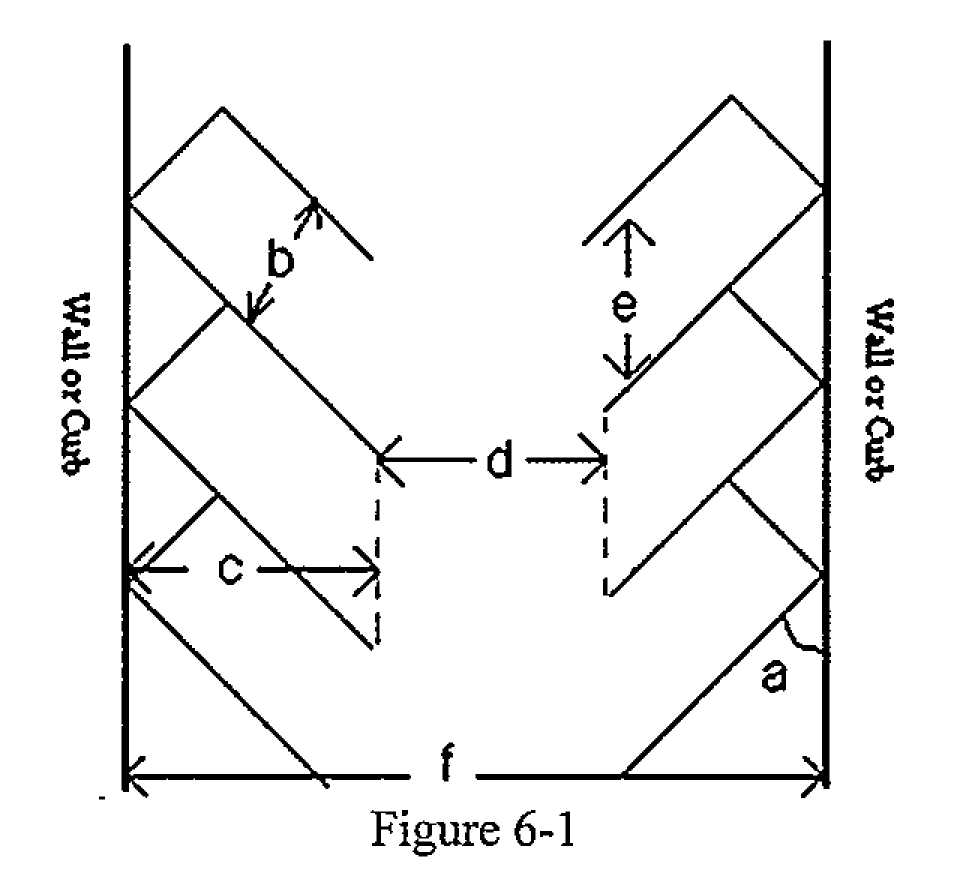
Table 6.2
PARKING SPACE, AISLE AND MODULE DIMENSIONS
1 For parking angles other than those established above, please consult the most recent standards established by the Institute of Transportation Engineers (ITE) for "Large-Size Parking Layout Dimension Guidelines."
Table 6.3
SCHEDULE OF OFF-STREET PARKING REQUIREMENTS
Table 6.4
SCHEDULE OF STACKING REQUIREMENTS FOR DRIVE-THROUGH USES
A. The space at the service window shall be counted as a stacking space.
(Ord. 4119, passed 1/18/96; Ord. 5874, passed 6/1/06; Ord. 4825, passed 6/15/00; Ord. 5751, passed 10/20/05; Ord. No. 6929, § 1, passed 3-6-14; Ord. No. 7291, § 1, passed 11-3-16; Ord. No. 7318, § 1, passed 1-5-17; Ord. No. 7359, § 1, passed 4-20-17; Ord. No. 7471, § 1, passed 2-15-18; Ord. No. 7473, § 1, passed 2-15-18; Ord. No. 7579, §§ 9, 10, passed 9-20-18; Ord. No. 7701, § 1, passed 8-15-19; Ord. No. 7914, § 1, passed 1-21-21; Ord. No. 8123, §§ 1, 2, passed 1-19-23; Ord. No. 8347, § 1, passed 3-20-25)
§ 155.603 - Off-street loading.
(A)
General requirements.
(1)
Location and screening. All required loading berths shall be located on the same zoning lot at the use served. All motor vehicle loading berths in a CR, R0-R6 or O District shall be screened by building walls, or by a uniformly painted solid non-combustible fence, wall, or door or densely planted mature shrubbery or any combination thereof, not less than six feet in height. Loading berths in other districts which abut property in a CR, R0-R6, or O District, or is separated from such district by a public right-of-way, shall likewise be screened from view from such abutting property. In all districts, no loading berths shall be located in a required front corner side or side yard. Loading berths located in a required rear yard may be open to the sky.
(2)
Size. This Chapter provides for two sizes of loading berths, short berths and long berths. The number of loading berths required, whether short or long berths, is identified in Table 6-3. The vertical clearance of all berths shall be not less than 15 feet. The size of short and long loading berths shall conform to the following:
(a)
Short berths. The size of berths, maneuvering aprons, and access aisles shall be as follows:
(i)
Berth size. Short Berths shall have a minimum width of 12 feet and a minimum length of 30 feet.
(ii)
Maneuvering apron. A maneuvering apron of 60 feet shall be provided.
(iii)
Access aisles. A width of at least 12 feet shall be provided for one way aisles and 22 feet for two way aisles.
(b)
Long berths. The size berths, maneuvering aprons, and access aisles shall be as follows:
(i)
Berth size. Long Berths shall have a minimum width of 12 feet and a minimum length of 50 feet.
(ii)
Maneuvering apron. A maneuvering apron of 60 feet shall be provided.
(iii)
Access aisles. A width of at least 14 feet shall be provided for one way aisles and 24 feet for two way aisles.
(3)
Access. Each required off-street loading berth shall be designed with appropriate means of vehicular access to a street or alley in a manner which will least interfere with traffic movement, and shall be subject to approval by the Director of Economic Development and Planning.
(4)
Surfacing. All open off-street loading berths shall be paved with asphalt, concrete or other dustless all-weather material capable of bearing a live load of 200 pounds per square foot.
(5)
Repair and service. No motor vehicle repair work or service of any kind shall be permitted in conjunction with loading facilities provided in any district except that:
(a)
Emergency repair service necessary to start vehicles shall be permitted in all districts, and
(b)
Washing of accessory vehicles shall be permitted in the I District.
(6)
Utilization. Space allocated to any off-street loading use shall not, while so allocated, be used to satisfy the space requirement for any off-street parking facilities or portions thereof.
(7)
Central loading. Central loading facilities may be substituted for loading berths on individual zoning lots provided the following conditions are fulfilled:
(a)
Each zoning lot served shall have direct access to the central loading area without crossing streets or alleys at-grade by means of a ramp or tunnel.
(b)
Total off-street loading berths provided shall meet the minimum requirements herein specified, based on the sum of the several types of uses served. (Areas of types of uses may be totaled before computing number of loading berths).
(c)
No zoning lot served shall be more than 500 feet removed from the central loading area.
(d)
The tunnel or ramp connecting a central loading area with the zoning lot served shall be not less than seven feet in width and have a clearance of not less than seven feet.
(8)
Minimum facilities. Uses for which off-street loading facilities are required herein, but which are located in buildings of less floor area than the minimum prescribed for such required facilities shall be provided with adequate receiving facilities, accessible by motor vehicle off any adjacent alley, service drive, or open space on the same zoning lot.
(B)
Number and type of loading berths required. The number and type of loading berths required shall conform to the requirements set forth in Table 6-5, which follows.
(C)
Cargo container regulations.
(1)
General provisions. Cargo containers, as defined by § 155.802 shall be restricted as follows:
(a)
Properties in residential districts. Excluding the provisions of subsection 155.603(C)(2), the placement of cargo containers on residentially zoned property (R0 through R6) shall be prohibited.
(b)
Properties in commercial or office districts. The placement of cargo containers on commercial and office districts (B1, B2, B3, B4, B4A, B5, B5A and O) shall be restricted to designated loading berth areas meeting the provisions enumerated in subsection 155.603(A). In no instance shall cargo containers be placed in front of the front wall of a principal building.
(c)
Properties in the Limited Industrial District. The placement of cargo containers within the Limited Industrial District shall be restricted to:
(i)
A concrete or asphalt surfaced area meeting the provisions established in subsection 155.603(A)(4) and within the buildable area of the lot; or
(ii)
Designated loading berth areas meeting the provisions enumerated in subsection 155.603(A).
In no instance shall cargo containers be placed in front of the front wall of a principal building.
(2)
Sites under construction. For properties in which there is an active building permit issued by the village for a multiple family or non-residential development, cargo containers may be placed on the property provided that they are placed within the buildable area of the lot and are not placed on requisite parking spaces. Cargo containers used for construction purposes must be immediately removed upon completion of the construction project.
Table 6-5
SCHEDULE OF OFF-STREET LOADING REQUIREMENTS
* Berth (Loading Dock) Dimensions:
Short = 12 ft. wide x 30 ft. deep
Long = 12 ft. wide x 50 ft. deep
** Gross Floor Areas refer to buildings or structures on premises.
(Ord. 5221, passed 12/19/02; Ord. No. 7359, § 1, passed 4-20-17; Ord. No. 7473, § 2, passed 2-15-18; Ord. No. 7579, §§ 7, 8, passed 9-20-18; Ord. No. 8347, § 1, passed 3-20-25)

