
Long Beach City Zoning Code
CHAPTER 21
52 - CONDITIONAL USES
21.52.010 - Purpose.
The City recognizes that certain types of land use, due to the nature of the use, require individual review by the Planning Commission to determine whether the type of use proposed, or the location of that use, is compatible with, or through the imposition of reasonable conditions, can be made compatible with surrounding uses. This Chapter establishes specific conditions which shall apply to uses permitted by a permit.
(Ord. C-6533 § 1 (part), 1988)
21.52.030 - Massage establishments.
The following conditions shall apply to massage establishments indicated in Table 32-1 where massage is the primary use:
A.
For new massage establishments, the proposed location for the massage establishment must not be fewer than seven hundred fifty (750) feet from another massage establishment as measured from the property lines. For existing massage establishments that are located within seven hundred fifty (750) feet of another massage establishment at the time this Section is enacted, those massage establishments are not required to relocate but are subject to the provisions of Chapter 5.58 and Title 21 of the Long Beach Municipal Code, and any other applicable federal, state and local law.
B.
No massage establishment located in a building or structure with exterior windows fronting a public street, highway, walkway, or parking area shall block visibility into the interior reception and waiting area through the use of curtains, closed blinds, tints, or any other material that obstructs or substantially darkens the view into the premises at any time. The interior of the business shall be plainly visible from the exterior of the business by passing vehicles and pedestrians.
C.
A massage establishment shall post, near the public entrance of the establishment or in another conspicuous place in clear view of the public and employees where similar notices are customarily posted, a notice sized at least 8.5 inches by 11 inches with a minimum of 16-point font stating as follows:
If you or someone you know is being forced to engage in any activity and cannot leave —whether it is commercial sex, housework, farm work, construction, factory, retail, or restaurant work, or any other activity — call the National Human Trafficking Resource Center at 1-888-373-7888 or the California Coalition to Abolish Slavery and Trafficking (CAST) at 1-888-KEY-2-FRE(EDOM) or 1-888-539-2373 to access help and services.
(ORD-18-0018 § 8, 2018)
21.52.100 - General provisions.
The uses listed in Chapters 21.31 through 21.36 as conditional uses (C) or administrative uses (AP) or identified as administrative uses in Chapter 21.25, Division IV, shall be required to comply with the conditions listed in Division II of this Chapter. Upon granting a conditional or an administrative use permit, the hearing body shall impose the conditions outlined in this Chapter for the specified use unless those conditions are waived with written findings. The hearing body may impose additional conditions that are deemed reasonable and necessary in granting the permit. If no conditions are contained in this Chapter, the hearing body may impose conditions as necessary to implement the permit.
(Ord. C-7032 § 39, 1992; Ord. C-6533 § 1 (part), 1988)
21.52.200 - Conditional and administrative use development standards.
This Division contains the required conditions for specified conditional and administrative use permits.
(Ord. C-7032 § 41, 1992: Ord. C-6533 § 1 (part), 1988)
21.52.200.1 - Alcohol exemption permit.
The following alcoholic beverage sales may be exempted from the conditional use permit requirement:
A.
Restaurants with alcoholic beverage service only with meals. This generally means any use with a fixed bar is not exempt. A service bar is not considered a fixed bar. A sushi bar, where alcoholic beverages are served at the same bar where meals are served, is considered serving alcoholic beverages only with meal service. A cocktail lounge without a bar, but with primarily service of only hors d'oeuvres and alcoholic beverages is not exempt. Any restaurant with more than thirty percent (30%) of gross sales consisting of alcoholic beverages shall lose its exemption and be required to obtain a conditional use permit to continue to sell alcohol.
B.
Florist with accessory sale of alcoholic beverages.
C.
Existing legal, nonconforming uses.
(ORD-18-0025 § 15, 2018)
21.52.201 - Alcoholic beverage sales uses.
The following conditions shall apply to all alcoholic beverage sales uses requiring a conditional use permit:
A.
The existing number of parking spaces, or the number of parking spaces normally required by Section 21.41.160, whichever is less, shall be maintained, except as provided by Section 21.41.175.
B.
The operator of the use shall provide night lighting and other security measures to the satisfaction of the Chief of Police;
C.
The operator of the use shall prevent loitering or other activity in the parking lot that would be a nuisance to adjacent uses and/or residential neighborhoods;
D.
The use shall not be in a reporting district with more than the recommended maximum concentration of the applicable on or off-premises sales use, as recommended by the State of California Alcoholic Beverage Control Board, nor with a high crime rate as reported by the Long Beach Police Department, except: (1) locations in the greater downtown area; or (2) stores of more than twenty thousand (20,000) square feet floor area, and also providing fresh fruit, vegetables and meat, in addition to canned goods; and
E.
The use shall not be located within five hundred feet (500') of a public school, or public park, except: (1) locations in the greater downtown area; or (2) stores of more than twenty thousand (20,000) square feet of floor area, and also providing fresh fruit, vegetables and meat in addition to canned goods.
(ORD-24-0033 § 26, 2024; Ord. C-7032 § 42, 1992; Ord. C-6533 § 1 (part), 1988)
21.52.203 - Arcade.
The following conditions shall apply to arcades:
A.
The site shall not be located within five hundred feet (500′) of a residential district or a public school; and
B.
The operator shall demonstrate an ability to prevent problems related to potential noise, litter, loitering, crowd control and parking.
(Ord. C-7881 § 3, 2003: Ord. C-6533 § 1 (part), 1988)
21.52.204 - Reserved.
Editor's note— ORD-18-0025 § 1, adopted Oct. 2, 2018, repealed § 21.52.204 entitled "Artist's studio with residence," which derived from: Ord. C-7729 § 9, 2001; and Ord. C-7032 § 51, 1992.
21.52.206 - Automobile related services.
The following conditions shall apply to auto repair shops, service stations, car washes, auto upholstery shops, auto parts and tire sales, camper installation businesses, van conversion businesses and the like:
A.
In the CB district, such uses shall be limited to locations inside parking structures;
B.
In the CR and CO zones, conditional use permits shall be limited to the expansion of existing nonconforming uses;
C.
Automobile service station uses shall be limited to: retail sales of fuel, oil and small vehicle parts;
D.
The proposed use shall not intrude into a concentration of retail uses and shall not impede pedestrian circulation between retail uses;
E.
The proposed use shall not create unreasonable obstructions to traffic circulation around or near the site;
F.
No curb cuts shall be permitted within forty feet (40′) of any public roadway intersection;
G.
No vehicles may be stored at the site for purposes of sale, unless the use is also a vehicle sales lot or for the use as parts for vehicles under repair; and
H.
The site shall comply with all applicable development standards for open storage and repair uses specified in Chapter 21.45, "Special Development Standards".
(Ord. C-6533 § 1 (part), 1988)
21.52.208 - Bank, credit union, savings and loan.
The following conditions shall apply to a bank, credit union, or savings and loan located in the CNP (commercial neighborhood pedestrian oriented) zone:
A.
The project must comply with Section 21.32.230, "Design of Buildings".
B.
Drive-thru windows or drive-thru automated teller machines are prohibited.
C.
No new curb cuts shall be permitted for a new or existing bank, credit union, or savings and loan in local coastal planning area D (Second Street, between Livingston and Bayshore).
D.
Interior and exterior lighting, window displays, and other architectural features shall be included in the building street frontages to provide pedestrian interest during nonoperational hours.
E.
Projects in local coastal planning area D (Second Street, between Livingston and Bayshore) that qualify for the one-half (½) rate parking standard pursuant to Subsection 21.41.226.A shall make their parking facilities available for public parking during nonoperational hours.
(Ord. C-7777 § 1, 2001; Ord. C-7729 § 13, 2001)
21.52.209 - Bed and breakfast inn.
The following conditions shall apply to bed and breakfast inns:
A.
The use shall be allowed only in older residential structures which are recognized as architecturally, historically or culturally significant, and which, through renovation and use as a bed and breakfast inn, will contribute significantly to the ambiance, character or economic revitalization of a neighborhood;
B.
Meals shall be served to registered guests only. No cooking facilities shall be permitted in guestrooms;
C.
The property owners shall live at the inn or on an adjoining property;
D.
Only short-term lodging may be provided. Monthly rentals shall be prohibited;
E.
No receptions, private parties or activities for which a fee is paid shall be permitted;
F.
A City business license shall be obtained as required by law. Two (2) parking spaces shall be provided for the operator plus one (1) space for each guestroom; and
G.
Guest parking may be provided either on-site or along the curb abutting the lot. Tandem parking is permitted provided not more than two (2) cars are parked in a tandem arrangement.
(Ord. C-6533 § 1 (part), 1988)
21.52.209.5 - Caretakers' residence.
The following conditions shall apply to administrative use permits for caretakers' residences:
A.
The living area shall not exceed twenty-five percent (25%) of the total floor area;
B.
Due to the lack of typical residential amenities in nonresidential zones, and potential hazardous materials, no one under the age of eighteen (18) shall be allowed to live in the residence.
(Ord. C-7032 § 52, 1992)
21.52.210 - Reserved.
Editor's note— ORD-11-0011 § 9, adopted June 7, 2011, repealed § 21.52.210, entitled "Cellular and personal communication services (with monopoles)", which derived from: Ord. C-6684 § 7, 1990; Ord. C-7399 § 14, 1996; and Ord. C-7500 § 18, 1997.
21.52.211 - Cemeteries, mortuaries, and crematoriums.
A.
The following conditions shall apply to cemeteries:
1.
The use shall be buffered visually from residential uses and districts; and
2.
The complete master plan, including future expansion, shall be submitted for site plan review, and specific building requests shall be indicated on the master site plan.
B.
The following conditions shall apply to mortuaries:
1.
Parking for viewing, ceremonial and other similar uses within the mortuary shall be calculated using the parking standard contained in Section 21.41, Table 41-1C, Public Assembly; and
2.
Site plan shall provide at least one (1) parking space on-site for loading purposes, either an enclosed parking space or under a porte cochere, regardless of the number of parking spaces required for assembly purposes.
C.
The following conditions shall apply to crematoriums:
1.
Crematoriums can be operated as stand-alone uses only within the IM or IG zone, and can be operated as accessory uses to a permitted mortuary or cemetery use;
2.
In any instance, any new cremation operating unit(s) and emissions control systems shall be located a minimum of six hundred feet (600') from any residential zoning district or existing school.
(ORD-13-0022, § 1, 2013; Ord. C-6533 § 1 (part), 1988)
21.52.212 - Check cashing, pay day loans, car title loans, signature loans, and other financial services.
The following conditions shall apply to check cashing, pay day loans, car title loans, signature loans, and other financial services businesses:
A.
A Conditional Use Permit shall be required for check cashing, pay day loan, car title loan, and signature loan businesses. Alternative or other financial services are also required to obtain a Conditional Use Permit at the discretion of the Zoning Administrator.
B.
Check cashing, pay day loans, car title loans, signature loans and other financial service businesses as defined by the Long Beach Municipal Code shall not be located within:
1.
A one thousand three hundred twenty (1,320) foot radius of an approved check cashing, pay day loan, car title loan, signature loan, or other financial service business.
2.
The CNA, CNP, CNR, PD-6, PD-25, PD-29 or PD-30 or any industrial zoning districts. This includes other financial services and alternative types of lending services at the discretion of the Zoning Administrator.
C.
Windows shall not be obscured by placement of signs, dark window tinting, shelving, racks or similar obstructions.
D.
Exterior phones, security bars and roll up doors shall be prohibited.
E.
All fees and regulations associated with a loan or financial transaction shall be displayed near the cashier/checkstand and provided to the customer upon checkout.
F.
The hours of operation shall be stated in the application and shall be subject to review.
G.
Special Development Standards for check cashing, pay day loan, car title loan, signature loan, and other financial services found in Section 21.45.116 shall also apply.
(ORD-13-0018, § 2, 2013; Ord. C-7663 § 40, 1999)
21.52.213 - Reserved.
Editor's note— ORD-18-0030, § 16, Dec. 11, 2018, repealed § 21.52.213, entitled "Churches and other places designed and intended primarily for religious worship," which derived from: ORD-07-0044 § 2, 2007; and Ord. C-6533 § 1 (part), 1988).
21.52.216 - Collection center for recyclables.
The following conditions shall apply to collection centers for recyclables:
A.
The site shall be kept in a neat, sanitary and orderly condition;
B.
An attendant shall be on the site at all times when the facility is open for collection;
C.
All recyclable materials shall be stored in bins and shall not be visible to the public;
D.
The operator shall establish a charge free, twenty-four (24) hour telephone number for complaints, and shall post that number on each bin in a manner clearly visible to the public;
E.
Truck pick ups of recyclable materials shall be limited to the hours of eight (8:00) a.m. to eight (8:00) p.m.;
F.
The operator shall use state of the art noise abatement technology and procedures and shall at no time violate the City noise ordinance;
G.
The operator shall accept only California redeemable materials;
H.
The operator shall utilize no processing activities including crushing, shredding, grinding, blowing and the like; and
I.
The use shall not block or displace any parking spaces or landscaping that would be required if the site were developed under the regulations in place at the time of the hearing unless a standards variance is also granted.
(Ord. C-7040 § 3, 1992: Ord. C-6533 § 1 (part), 1988)
21.52.219 - Commercial parking lot or structure—Nonresidential districts.
The following conditions shall apply to commercial parking lots or structures in nonresidential zoning districts:
A.
The use shall be permitted only if no other reasonable alternative use of the site exists during the time period covered by the permit;
B.
The use and design of the site shall not disrupt, impede or negatively affect pedestrian circulation, traffic circulation or public transportation;
C.
The use and design of the site shall not disrupt, impede or negatively affect the concentration of high intensity activities; and
D.
Attractive landscape buffering and screening shall be provided.
(Ord. C-6533 § 1 (part), 1988)
21.52.219.5 - Commercial recreation uses.
The following conditions shall apply to commercial recreation uses:
A.
The use is consistent with the intent of the park district, general plan, and any applicable specific plan; and
B.
The use does not permanently remove or encroach upon more than five percent (5%) of any existing park open space which may be developed within the site coverage restrictions, and the use does not impede public access to the park; and
C.
The use provides a needed public recreation service which otherwise would not be available to the public; and
D.
The use cannot reasonably be located to provide comparable public recreation service on private land appropriately zoned for such use.
(Ord. C-7826 § 4, 2002)
21.52.219.7 - Commercial storage/self-storage.
The following conditions shall apply to commercial storage/self-storage:
A.
Commercial storage/self-storage shall not be permitted or located in an existing business or office park.
B.
Commercial storage/self-storage shall only be permitted with a conditional use permit if the development site is impractical for industrial development due to such conditions as the shape or topography of the site, difficult vehicular access or close proximity to residential uses that would preclude industrial development uses.
C.
Storage spaces shall not be used for manufacturing, retail or wholesale selling, office, other business or service use or human habitation.
D.
Prefabricated shipping containers shall not be allowed to be on sites located within one thousand feet (1,000′) from any property zoned for residential use, unless located or screened so as to not be visible from a public street.
E.
Building and roof design. The building and roof shall be designed to be compatible with surrounding development, especially nearby residential uses. Considerations include design elements that break up long, monotonous building and rooflines and elements that are compatible with the desired character of the zone.
F.
Building materials. The materials used for buildings, roofs, fences and other structures shall be compatible with the desired character of the zone and shall be visually pleasing, especially near residential uses.
G.
Street facades. The design and layout of the street side of the site shall provide a varied and interesting facade. Considerations include the use of setbacks, building placement, roof design, variations in building walls, fencing, other structural elements, and landscaping. Access doors to individual storage units shall be located within a building or shall be screened from adjacent property or public rights-of-way.
H.
Landscaping. The landscaping on the site shall be abundant and shall provide an appropriate transition from public to private spaces, separate and buffer the buildings from other uses, and provide visual relief from stark, linear building walls.
I.
Fencing. Any proposed fencing shall be designed to be compatible with the desired character of the area and is especially sensitive to abutting residential uses. Use of rolled razor wire is prohibited adjacent to residential zones.
J.
Lighting. Exterior lighting shall not intrude on surrounding properties.
K.
Noise. The hours of operation and access to the storage units shall be limited to seven (7:00) a.m. to seven (7:00) p.m. Monday through Friday and nine (9:00) a.m. to five (5:00) p.m. on Saturday, Sunday and holidays. To further limit noise impacts, metal roll up doors shall be lubricated and maintained on a regular monthly basis.
L.
Security. Prior to the issuance of building permits, the project shall submit a security plan that will be subject to the review and approval of the Police Department.
M.
Loading. Provide adequate loading and unloading areas outside of fire lanes.
(Ord. C-7904 § 5, 2004)
21.52.219.7.5 - Commissary (standalone).
See Special Development Standards in Section 21.45.125.
(ORD-26-0012 § 13, 2026)
21.52.219.8 - Community assembly uses.
Community assembly uses shall be located, developed, and operated in compliance with the following standards:
A.
In a residential zone:
1.
The proposed use may consist only of an expansion of an existing facility on the site or on the abutting site; and
2.
The site shall be limited to forty thousand (40,000) square feet in size;
3.
A long-range development plan consistent with the requirements of Section 21.34.020 shall be submitted for Planning Commission review and approval for any new or expanded use on any site larger than forty thousand (40,000) square feet. New construction and additions with five thousand (5,000) square feet of floor area or more must be consistent with the long-range plan.
B.
Any proposed addition or new construction shall conform to the development standards required for principal uses within the district.
C.
Any new construction or additions with five thousand (5,000) square feet of floor area or more shall be subject to site plan review pursuant to Chapter 21.25, Division V.
D.
A buffer at least twenty (20) feet in width shall be provided adjacent to the boundary of any residential zone or property line of any residential use. This buffer area may be used for parking or landscaping but shall not be used for structures or outside activities. The minimum buffer requirement may be reduced subject to the review and approval of a Conditional Use Permit pursuant to Chapter 21.25, Division II, as long as the reduced buffer maintains the minimum setback requirement of the district in which the facility is located. Parking areas shall be screened consistent with the requirements of Chapter 21.42.
E.
Outdoor areas used for recreation, meetings, services or other activities involving groups of persons shall be at least fifty (50) feet from the boundary of any residential zone or property line of any residential use.
F.
Parking shall be provided in accordance with Chapter 21.41.
G.
To ensure compliance with the Federal Religious Land Use and Institutionalized Persons Act of 2000 (RLUIPA), the Planning Commission or the Zoning Administrator shall have the authority to grant exceptions and waivers to the requirements of this Code when necessary to accommodate religious assembly uses.
1.
A request for an exception or waiver shall be submitted and processed in the same manner as an application for an Administrative Use Permit consistent with the requirements of Chapter 21.25, Division IV, Administrative Use Permits.
2.
If necessary to reach a determination on the request for exception or waiver, the Zoning Administrator may request further information from the applicant, specifying in detail what information is required.
3.
Findings required. The following findings must be analyzed, made and adopted before any action is taken to approve or deny a request for a modification or waiver and must be incorporated into the record of the proceeding relating to such approval or denial:
a.
The requested exception or waiver will not impose an undue financial or administrative burden on the City.
b.
The requested exception or waiver will not require a fundamental alteration of the zoning or building laws, policies and/or procedures of the City.
c.
There are no alternatives to the requested waiver or modification that could provide an equivalent level of function related to religious worship with less potential detriment to surrounding owners and occupants or to the general public.
d.
That the conditions imposed, if any, are necessary to further a compelling public interest and represent the least restrictive means of furthering that interest.
e.
That denial of the requested exception or waiver would impose a substantial burden on religious worship or would conflict with any State or federal statute.
f.
For religious assembly uses located in the coastal zone, a request for reasonable accommodation under this Section shall be approved by the City if it is consistent with all of the applicable provisions of this Division, and the certified Local Coastal Program. Where a request for a modification or waiver is not consistent with the certified Local Coastal Program, the City may waive compliance with an otherwise applicable provision of the Local Coastal Program and approve the request for reasonable accommodation if the City finds that the request is consistent, to the maximum extent feasible, with the certified Local Coastal Program.
4.
Conditions of approval. In approving an exception or waiver to accommodate religious assembly use, the decision-maker may impose any conditions deemed necessary to:
a.
Ensure that the proposal conforms in all significant respects with the General Plan and with any other applicable plans or policies adopted by the City Council;
b.
Achieve the general purposes of this Section or the specific purposes of the zoning district in which the project is located;
c.
Achieve the findings for an exception or waiver granted; or
d.
Mitigate any potentially significant impacts identified as a result of review conducted in compliance with the California Environmental Quality Act.
5.
Exceptions or waivers approved pursuant to this section may be conditioned to provide for rescission or automatic expiration based on a change of occupancy or other relevant change in circumstance. To ensure this, the property owner shall record a covenant demonstrating that the improvement with which the exception or waiver is associated shall be removed or modified to comply with City regulations at the expense of the property owner when said circumstance or occupancy changes.
6.
Appeals. The applicant or any aggrieved party may appeal decisions pursuant to this section or any conditions or limitations imposed by the Zoning Administrator.
a.
All appeals shall contain a statement of the grounds for the appeal.
b.
Appeals shall be to the Planning Commission, in accordance with Division V of Chapter 21.21 - Administrative Procedures.
(ORD-18-0030 § 14, 2018)
21.52.220 - Community correctional reentry centers.
A.
A complete application for a community correctional reentry center in an industrial zone shall include adequate evidence that the applicant has conducted a preapplication meeting for surrounding property owners and occupants. The applicant shall provide at least ten (10) days' notice of a preapplication meeting to all owners and occupants of real property within one thousand five hundred feet (1,500') of the real property which is the subject of the application, all neighborhood associations adjacent to, or within the vicinity of, the proposed use, any surrounding business association and the City's neighborhood resource center. The applicant shall provide proof of such notice and meeting through the use of certified mail and returned receipts issued by the United States Postal Service.
B.
The following conditions shall apply to community correctional reentry centers in the industrial zoning districts:
1.
Such uses shall provide educational and vocational training primarily focused on industrial employment.
2.
Such uses shall provide short-term lodging not to exceed one hundred twenty (120) days per inmate/trainee.
3.
Counseling and job placement services shall be provided for inmates/trainees of the facility only.
4.
The use shall comply with all general conditions of special group residences, as set forth at Section 21.52.271 of this Chapter; provided, however, no such use, regardless of the size of the parcel housing such uses shall exceed fifty (50) beds and/or fifty (50) inmates/trainees at any given time.
5.
The operator of the use shall only accept inmates/trainees who voluntarily apply for transfer to the community correctional reentry center.
6.
No reentry center operator shall accept any inmate/trainee currently serving a sentence for conviction of any offense described in subdivision (c) of Penal Code Section 667.5 or subdivision (c) of Penal Code Section 1192.7, excluding the offense of burglary.
7.
No reentry center operator shall accept any inmate/trainee who has more than one hundred twenty (120) days left to serve in a correctional facility.
8.
No reentry center operator shall accept any inmate/trainee that has been convicted of an escape pursuant to Section 4532 of the Penal Code.
9.
The facility shall be staffed twenty-four (24) hours a day, seven (7) days a week. A State parole agent shall be assigned to the site to monitor the inmates' activities. No inmate of the facility shall be permitted to utilize a private vehicle unless expressly authorized to do so by the California Department of Corrections pursuant to its rules and procedures governing such use. Any change in operations must be reviewed and approved by both the State and City prior to implementation of such change.
(Ord. C-7392 § 3, 1996)
21.52.220.5 - Computer arcade.
The following conditions shall apply to computer arcades:
A.
Hours of operation shall be limited to between eight (8:00) a.m. to twelve o'clock (12:00) midnight. The Planning Commission may consider extended hours of operation based on proximity to residential uses; and
B.
The operator shall demonstrate an ability to prevent problems related to potential noise, litter, loitering, crowd control and parking, including, but not limited to, the provision of a uniformed security guard at the site to the satisfaction of the Chief of Police if the Chief of Police determines it to be necessary due to increased police activity or calls for service at the site; and
C.
Windows shall not be obscured by placement of signs, dark window tinting, shelving, racks or similar obstructions; and
D.
Maximum number of machines available for public rental shall not exceed one (1) per thirty-five (35) square feet of net floor area; and
E.
Computer games of an adult nature depicting "specified anatomical areas" or "specified sexual activities", as these terms are defined in Chapter 21.15 (Definitions), shall not be installed on computer terminals or played by customers unless the locational restrictions of Section 21.45.110 (Special development standards - adult entertainment) are complied with; and
F.
If access to adult oriented web sites is allowed, a separate area, up to a maximum of twenty percent (20%) of computer terminals available for public rental, shall be set aside for adult viewing with the computers clearly marked as such and screened from view by minors. All other machines shall be marked prohibiting adult viewing;
G.
Provide interior lighting levels similar to commercial office standards during operating hours; and
H.
There shall be at least one (1) adult employee, eighteen (18) years of age or older, for each twenty (20) computer terminals available for public rental, or fraction thereof; and
I.
An interior waiting area for customers, at least five percent (5%) of the gross floor area in size, but not less than fifty (50) square feet, shall be provided near the entrance; and
J.
Headphones shall be provided for each computer terminal, in lieu of open speakers, to control noise at the site; and
K.
The operator shall provide parking at a ratio of one (1) space per 3.3 computer terminals or, when two (2) or more uses share a parking facility, demonstrate through a signed affidavit that the hours of their demand for parking do not overlap, or only partially overlap.
(Ord. C-7881 § 8, 2003)
21.52.221 - Courtesy parking in residential districts.
The following conditions shall apply to courtesy parking in residential districts:
A.
The proposed site shall adjoin, abut or be adjacent to a commercial district;
B.
The parking lot shall extend not more than one hundred feet (100′) into the residential district; and
C.
A six foot six inch (6′6″) solid fence or wall and a five foot (5′) wide landscaping buffer shall be provided along any property line abutting a residential use.
(Ord. C-6533 § 1 (part), 1988)
21.52.222 - Diesel fuel sales.
The following conditions shall apply to diesel fuel sales, whether in conjunction with gasoline sales or not:
A.
Diesel fuel sales shall only be permitted on designated truck routes.
B.
A solid masonry wall not less than eight feet (8′) in height shall be provided where the site abuts, or is across an alley from, a residential district.
C.
An on-site queuing lane no less than one hundred twenty feet (120′) shall be provided on-site for each pump dispensing diesel fuel.
D.
A site circulation and queuing diagram prepared by a traffic engineer shall be submitted with the application demonstrating the feasibility of truck access to and from each pump dispensing diesel fuel.
E.
Local streets may not be used for vehicular access to pumps dispensing diesel fuel.
F.
No on-site idling shall be permitted for vehicles queuing for pumps dispensing diesel fuel.
G.
No overnight parking or on-site maintenance of truck tractors or truck trailers shall be permitted.
H.
No exterior telephones or security bars shall be permitted.
I.
Hours of operation shall be established and shall be appropriate based on adjacent land uses.
(Ord. C-7663 § 41, 1999)
21.52.223 - Electrical distribution station—Residential districts.
The following conditions shall apply to electrical distribution stations in residential districts:
A.
The site shall be located on a major, secondary or minor highway;
B.
The site shall be developed according to the height and yard requirements of the district in which the site is located;
C.
The site shall be surrounded by a fence designed, treated and finished in a manner compatible with the adjacent residential uses. Such fence shall be placed behind the required landscaping along the street frontage. Fences up to twelve feet (12′) in height may be allowed in side and rear yard areas if appropriate and necessary for the individual site;
D.
Landscaping equal to twice the requirement for a multifamily residential zone shall be provided; and
E.
All equipment and operations shall comply with applicable City noise regulations as set forth in Chapter 8.80 (Noise) of the Municipal Code.
(Ord. C-6533 § 1 (part), 1988)
21.52.226 - Electrical distribution substations—Nonresidential districts.
The following conditions shall apply to electrical distribution substations in nonresidential zoning districts:
A.
All facilities shall be screened from public view by an attractive wall or fence.
(Ord. C-6533 § 1 (part), 1988)
21.52.229 - Electronic message center signs.
In addition to the required findings for a conditional use permit (Section 21.25.206), the Planning Commission shall not approve a conditional use permit for an Electronic Message Center sign unless positive findings can be made for the following:
A.
The proposed design of the electronic message center sign is complete and consistent within itself and is compatible in design with the architectural theme or character of the existing or proposed development it will serve and the community in which it will be located.
B.
The establishment of the proposed electronic message center sign will not adversely affect the character, livability, or quality of life of any residential community it will be adjacent to or located in.
C.
The electronic message center sign shall not constitute a hazard to the safe and efficient operation of vehicles upon a street or freeway.
D.
The applicant has demonstrated that the proposed electronic message display surface is factory-certified as capable of complying with the brightness standards in Section 21.44.850.
(ORD-13-0014 § 20, 2013; Ord. C-7500 § 24, 1997)
21.52.231 - Fast-food restaurants.
The following conditions shall apply to fast-food restaurants:
A.
The site shall not adjoin or abut a residential use district;
B.
The proposed site shall not interrupt or intrude into a concentration of retail uses and shall not impede pedestrian circulation between retail uses;
C.
The use shall not constitute a nuisance to the area due to noise, litter, loitering, smoke or odor; and
D.
Order board speakers shall be oriented and directed away from adjacent residential uses.
(Ord. C-6533 § 1 (part), 1988)
21.52.231.5 - Fences in high crime districts.
The following conditions shall apply to fences which exceed three feet (3′) in the front yard of residential lots located in high crime areas:
A.
The site shall be located in a "high crime" area (as defined by Section 21.15.1338);
B.
The fence shall enclose an existing or proposed multifamily (three (3) or more units) residential structure or any residential use located in a multifamily (R-3 or R-4) zone;
C.
The fence shall not exceed six feet six inches (6′6″) in height;
D.
The fence design shall be open wrought iron or other metal pickets;
E.
The fence shall allow emergency egress;
F.
The fence design shall provide visitor, meter reader and emergency personnel access;
G.
The front yard shall have approved landscaping;
H.
The applicant shall restore any missing street trees; and
I.
The fence shall have self-closing, self-locking gates.
(Ord. C-7247 § 34, 1994)
21.52.232 - Fitness or health club, dance or karate studio and the like.
A.
The use shall demonstrate adequate parking for peak demand.
B.
The facility shall be limited to five thousand (5,000) square feet of gross usable floor area in neighborhood commercial zones (CNP, CNA and CNR).
(ORD-20-0025 § 10, 2020; ORD-18-0030 § 15, 2018; Ord. C-7047 § 33, 1992)
21.52.233 - Handicapped and traditional senior citizen housing.
The following conditions shall apply to housing for the handicapped and for senior citizens:
A.
In a residential zone, handicapped and senior citizen housing shall be limited to the density allowed in the underlying zone district multiplied by the number indicated in Table 52-1. In congregate care facilities, each bedroom with two (2) or fewer beds shall count as a dwelling unit in calculating density. In bedrooms with more than two (2) beds, each bed shall count as a unit. This shall be the maximum permitted density. The Planning Commission may require a lower density as the situation requires. In nonresidential zones, densities shall be limited to one (1) dwelling unit per two hundred (200) square feet of lot area;
B.
Consideration of the conditional use permit shall address crime rate, scale and style of the proposed building in relation to other buildings within the immediate vicinity;
C.
The applicant shall provide evidence that the use will remain as senior citizen or handicapped housing through deed restriction or other method suitable to the Planning Commission. In the case of senior citizen housing that is constructed for sale or rental of individual units, apartments or condominiums, the applicant shall provide proof that the proposed project is fully compliant with the provisions of California Civil Code Section 51.3 or otherwise provide proof that the provisions of Civil Code Section 51.3 are not applicable to the project. Failure to provide suitable proof and assurances to the Planning Commission will result in the denial of the density multiples provided for in Table 52-1;
D.
The facility shall be designed with appropriate grab bars in all hallways and bathtubs and/or showers and with nonslip surfaces in bathtubs and/or showers. The designs shall conform to the specifications of the U.S. Department of Housing and Urban Development for the applicable use;
E.
Each unit shall be equipped with an emergency signaling device to the on-site unit manager's office, if applicable, to the satisfaction of the Chief of Police;
F.
Each facility shall provide not less than three hundred (300) square feet of common recreational space;
G.
Each facility shall provide not less than one hundred fifty (150) square feet of usable open space per unit or room. Of the one hundred fifty (150) square feet, not less than fifty (50) square feet shall be private open space, and the remainder may be common open space in addition to the three hundred (300) square feet required above;
H.
The facility shall be located within one thousand feet (1,000′) by legal pedestrian route to a public transit stop; and
I.
Parking and loading shall be provided as required by Chapter 21.41 (Off-Street Parking and Loading Requirements).
(Ord. C-7500 § 19, 1997: Ord. C-6822 § 19, 1990; Ord. C-6595 § 15, 1989; Ord. C-6533 § 1 (part), 1988)
21.52.234 - Heliport or blimp port or helipads.
The following conditions shall apply to heliports or blimp ports and helipads:
A.
The Aeronautics Bureau of Public Works in consultation with the Federal Aeronautics Administration have found that the proposal presents no air space conflicts. Letters of agreement concerning airspace procedures, altitude and flight tracks, shall be submitted if necessary.
B.
The Fire Chief has found the use designed to safely handle any and all flammable and combustible materials to be handled on-site.
C.
The use will not adversely affect any residential neighborhood due to take-off, landing or overflight noise.
D.
The use is reasonably centrally located within an area of need so that no duplication of facilities will occur that could be avoided by use of another site.
E.
Only private, noncommercial heliports, blimp ports or helipads shall be allowed. Ticket sales or any common carrier-type functions are strictly prohibited.
F.
Only helipads, without support services, shall be allowed in the CB zone.
(Ord. C-6595 § 28, 1989)
21.52.235 - Hotels/motels.
A.
Intent. Long Beach strongly encourages the development and expansion of the travel industry for vacation, convention and business travel. Hotels and motels are an integral and desirable part of the travel industry. However, as hotels and motels can also be incompatible with nearby residential communities, and can also become inadequately designed permanent housing, it is necessary to provide site-by-site analysis and decisions of the nature and design of such business facilities. Also, as such uses provide a twenty-four (24) hour business environment, careful review is required to ensure compatibility with residential uses. All proposals for new hotels, motels or inns shall comply with the following conditions.
B.
Intensity. The density of rooms, intensity of facilities, and scale and design of buildings shall be harmonious with surrounding uses and development.
C.
Location. The location of the use shall be reasonably related to destinations of the traveling public, such as proximity to tourist attractions, convention facilities, business centers, the airport or cruise terminals, or medical centers and shall also be adequately buffered from any incompatible adjoining uses.
D.
Crime. The site shall not be associated with a location known to have a high concentration of reported crimes.
E.
Design. The design shall be attractive so as to present a positive image of Long Beach to the traveling public, shall be appropriate to transient occupancy without conversion to long-term occupancy (more than thirty (30) consecutive days), and, where appropriate, shall contribute to an active retail frontage by providing stores, coffee shops or convenience retail on the ground story of major streets. Enriched materials, roof overhangs, windows and doors with jams and sills, architectural protrusions and other detailing and lush landscaping are desirable in making the design attractive. All designs shall also comply with the privacy standards of Section 21.31.240.
F.
Open Space. The use shall provide not less than one hundred twenty-five (125) square feet of usable open space per guestroom, suite or unit. Not less than fifty (50) square feet of such open space shall be private usable open space according to the provisions of Section 21.31.230. For buildings of three (3) stories or more, all open space may be common open space. Areas used for health clubs or recreation rooms may be counted as common usable open space.
G.
Parking. All parking designs shall provide through-flow circulation or maneuvering space in a cul-de-sac or "hammerhead" design to allow exiting in a forward direction when all parking spaces are full. Parking spaces shall be provided in adequate number to serve the use according to the following requirements: for hotels/motels less than sixty (60) rooms, suites or units, the minimum parking shall be not less than 1.25 spaces per guestroom, or per two (2) room suite or unit, and 2.00 spaces per suite or unit of three (3) or more rooms, plus parking figured separately for other facilities.
For hotels/motels of sixty (60) rooms or more, see Table 41-1C.
H.
Security. Project security shall be designed to the satisfaction of the Chief of Police and shall include surveillance of arrivals, departures, and parking areas from the office, and security hardware, alarms and lighting.
(Ord. C-6684 § 8, 1990)
21.52.236 - Institutional and public assembly uses.
The following conditions shall apply to public assembly halls, private clubs and similar uses:
A.
A long-range development plan shall be submitted for the use;
B.
Any new construction shall be consistent with the long-range plan that has been approved by the Planning Commission;
C.
All buildings and uses shall be located and buffered to prevent intrusion upon surrounding uses, especially when the use adjoins, abuts or is adjacent to a residential district; and
D.
Abundant landscaping, ample building spacing, open space and high quality building design shall be provided.
(Ord. C-6533 § 1 (part), 1988)
21.52.238 - Interim housing.
See Special Development Standards 21.45.153 for Interim housing.
(ORD-20-0026 § 21, 2020)
21.52.240 - Legalization of dwelling units.
A.
The unit(s) in question must have been created before 1964 and continually occupied since that time without having been abandoned pursuant to Section 21.15.030;
B.
The unit must meet minimum Housing Code provisions; and
C.
The unit must not exceed six hundred forty (640) square feet.
(Ord. C-7032 § 53, 1992)
21.52.240.5 - Live-work unit.
The following conditions shall apply to administrative use permits for live-work units:
A.
The minimum unit size is seven hundred fifty (750) square feet.
B.
Each unit shall have a separate entrance that is clearly identified to provide for emergency services.
C.
No more than thirty-three percent (33%) of any unit shall be used for exclusive residential purpose such as sleeping area, kitchen, bathroom and closet areas. The unit shall provide as a minimum full cooking and bathing facilities.
D.
All necessary building permits shall be obtained prior to the use of the space for residential occupancy.
E.
No mechanical equipment shall be used which generates noise higher than the noise standards established for residential uses (Chapter 8.80 of the Municipal Code).
F.
There shall be no outside operations, outside storage or outdoor display of materials or products.
G.
No toxic, explosive, flammable, combustible or corrosive materials are to be stored or used on the site in quantities or in a manner that violates any provision of the Uniform Fire Code. No etiologic or radioactive materials shall be used or stored on the site at any time.
H.
No process shall be used which is hazardous to public health, safety or welfare.
I.
The home occupation shall not displace or block the use of parking spaces required for the residential use including any business storage in required garage parking areas.
J.
Not more than two (2) vehicles shall be used in the business. Only one (1) vehicle may be commercially licensed.
K.
The property owner shall record a covenant, prior to the issuance of a building permit, ensuring that the provisions of this Section are continually adhered to and that the Live-Work Unit remains consistent with the definition in Section 21.15.1576.
The Zoning Administrator may require the discontinuance of a work activity in a live-work unit with residence if as operated or maintained there has been a violation of any applicable condition or standard. The Zoning Administrator shall have the authority to prescribe additional conditions and standards of operation for any category of work activity in a live-work unit.
(ORD-18-0025 § 16, 2018)
21.52.241 - Merchandise mall.
The following conditions shall apply to merchandise malls:
A.
Parking shall be provided as required by Chapter 21.41 (Off-Street Parking and Loading Requirements). However, the required number of parking spaces may be reduced if the applicant can demonstrate to the satisfaction of the Planning Commission that a lower standard adequately satisfies the parking demand of a specific business. In no case shall less than five (5) parking spaces per one thousand (1,000) square feet be approved; and
B.
The applicant shall demonstrate to the satisfaction of the Planning Commission that tenants of the merchandise mall will pay applicable business license fees and sales taxes.
(Ord. C-6533 § 1 (part), 1988)
21.52.243 - Mobile home park.
The following conditions shall apply to mobile home parks:
A.
The mobile home park shall not exceed the density of the applicable zone district in which it is located; and
B.
The mobile home park shall comply with the development standards of the applicable subdivision for private streets and lot design.
(Ord. C-6533 § 1 (part), 1988)
21.52.244 - Subdivision of existing mobile home park.
The following special conditions shall apply to subdivision of an existing mobile home park:
A.
The mobile home park shall contain a minimum community area open space of two hundred (200) square feet per lot.
B.
The mobile home park shall have a minimum density of nine (9) units per acre.
C.
The mobile home park shall contain a minimum of one (1) guest parking space for each fifteen (15) lots.
D.
The mobile home park shall contain a minimum of one hundred (100) square feet of recreational vehicle storage per lot.
E.
The mobile home park shall have a minimum project setback of twenty (20) feet from any public street.
F.
RV storage and vehicle parking and storage shall be reserved for use by the owners/tenants of the mobile home park.
(ORD-07-0019 § 6, 2007)
21.52.246 - Motorcycle/jet ski sales and repair.
A.
All sales and repair activities shall comply with the standards of Chapter 21.45 (Special Development Standards).
B.
The applicant shall demonstrate an ability to control noise during engine testing to comply with City noise regulations Chapter 8.80 (Noise) and avoid neighborhood disturbances.
(Ord. C-7047 § 26, 1992: Ord. C-6533 § 1 (part), 1988)
21.52.247 - Building design in the CNP zone.
A.
The use will primarily serve the local community.
B.
The project must comply with Section 21.32.230 Design of buildings, to insure pedestrian orientation.
C.
Drive-thru lanes are prohibited.
D.
Existing curb cuts from the primary pedestrian thoroughfare must be closed and vehicular access taken from alleys and/or secondary streets.
(Ord. C-7729 § 10, 2001: Ord. C-7047 § 34, 1992)
21.52.249 - Nursery schools, day nurseries, preschools, childcare centers, daycare centers and similar uses for daytime care and education of a limited number of persons.
The following conditions shall apply to all nursery schools, day nurseries, preschools, childcare centers, daycare centers and similar uses for daytime care and education of a limited number of persons:
A.
A minimum of seventy-five (75) square feet of outdoor play area per child shall be provided on the site;
B.
In residential districts, no other similar facility may be located and operating within one-half (1/2) mile (2,640 feet) of the proposed site;
C.
The hours of operation shall be limited to the hours between six o'clock (6:00) a.m. and seven-thirty (7:30) p.m.; and
D.
Adequate off-street loading spaces shall be provided to prevent adverse effects upon the neighborhood.
(ORD-18-0025 § 11, 2018; Ord. C-6533 § 1 (part), 1988)
21.52.251 - Office uses in residential districts.
The following conditions shall apply to office uses in residential districts:
A.
The total nonresidential use shall not exceed forty percent (40%) of the square footage of the building.
(Ord. C-6533 § 1 (part), 1988)
21.52.256 - Outdoor sales events.
The following conditions shall apply to flea markets, swap meets, vehicle sales events and the like:
A.
All uses shall be compatible with adjacent uses; and
B.
The sale of used merchandise may be permitted; and
C.
Vehicle sales events may be permitted only in the institutional zone on sites five (5) acres or greater in size and only when sponsored by a church, school, educational institution or public or private nonprofit organization, and shall be conducted on the premises of such an organization; and
D.
The hours of operation shall be nine (9:00) a.m. to five (5:00) p.m. with the exception that setup shall be allowed a early as seven (7:00) a.m. and as late as seven (7:00) p.m. The Planning Commission may grant extended hours of operation based on the proximity to residential land uses; and
E.
The proposed frequency of events shall be stated in the application and subject to review; and
F.
The operator shall demonstrate to the satisfaction of the Planning Commission that applicable business license fees and sales taxes will be paid; and
G.
An event signage plan shall be submitted in the application and subject to review; and
H.
Adequate restroom facilities shall be provided on-site during hours of operation; and
I.
A parking plan shall be submitted in the application and subject to review. The hours of parking demand of the outdoor sales event shall not conflict with the hours of parking demand of the principal use on-site, if any, and shall be provided in accordance with the provisions of Chapter 21.41 (Off-street Parking and Loading Requirements); and
J.
The operator shall demonstrate an ability to control problems related to noise, loitering, and litter; and
K.
The operator shall provide a safety and security plan to the satisfaction of the Chief of Police; and
L.
The operator shall obtain all necessary permits from the Fire Department for the temporary structures for each outdoor sales event.
(Ord. C-7881 § 4, 2003: Ord. C-6533 § 1 (part), 1988)
21.52.257 - Parsonage.
The following conditions shall apply to administrative use permits for a parsonage: The living area shall not exceed twenty-five percent (25%) of the church floor area.
(Ord. C-7032 § 54, 1992)
21.52.259 - Pistol or rifle range.
The following conditions shall apply to pistol and rifle ranges:
A.
The use shall be soundproofed as necessary to avoid adverse impacts on nearby noise sensitive uses; and
B.
The operator shall incorporate safety measures into facility design as required by the Chief of Police.
(Ord. C-6533 § 1 (part), 1988)
21.52.260 - Interim Playgrounds, urban agriculture use, community gardens and recreational parks.
The following shall apply to interim playgrounds, community gardens and recreational parks. Only A, B, and C apply to urban agriculture uses:
A.
Improvements for an interim playground/community garden/recreational park shall be limited to landscaping, irrigation systems, accessory buildings and accessory structures.
B.
The following setbacks shall apply to all accessory buildings and accessory structures:
1.
Front. The front setback shall be the same as a principal structure in the applicable zoning district.
2.
Side. A four-foot (4') side setback is required when abutting a residential district otherwise none is required.
3.
Rear. A ten-foot (10') rear setback is required when abutting a residential district otherwise none is required.
C.
The maximum height of any accessory building shall be thirteen feet (13').
D.
The interim playground/community garden/recreational park hours of operation shall be seven-thirty (7:30) a.m. to dusk.
E.
Off-street parking shall not be required for an interim playground/community garden/recreational park.
F.
Adequate trash receptacles shall be provided and maintained for the life of the use.
(ORD-20-0025 § 11, 2020; ORD-17-0024 § 5, 2017; Ord. C-7378 § 28, 1995)
21.52.261 - Police training academy.
The following conditions shall apply to the police training academy use:
A.
The use shall be isolated from noise sensitive uses; and
B.
A master plan for future facility expansion shall be reviewed and approved with any specific building request.
(Ord. C-6533 § 1 (part), 1988)
21.52.263 - Elementary and secondary schools.
The following conditions shall apply to private elementary and secondary schools:
A.
Such facilities shall be located on a Neighborhood Connector or Local Street as defined by the City of Long Beach Mobility Element;
B.
Such facilities shall conform to the development standards of the district in which they are located including parking;
C.
In a residential zone, the site shall be limited to forty thousand (40,000) square feet in size; and
D.
An applicant seeking to convert an existing commercial building into a school shall file a request with the Building Bureau for a special code compliance inspection. The report shall address all building code issues related to establishing a school in a commercial building. The report must be received by the Planning Bureau before an application for conditional use permit is considered complete.
E.
The Zoning Administrator may approve an exception to the locational requirements in subsection A, based on the following findings:
1.
The total number of students, staff and visitors on the site at any one time shall not exceed 100; and
2.
The applicant has submitted a plan for accommodating all pick-up and drop-off activity on the site; or
3.
The applicant has established other trip reduction measures to ensure that the total number of daily trips to and from the site will not exceed the number of trips the Mobility Element has established for the street classification applicable to the site.
(ORD-19-0011 § 10, 2019; Ord. C-7378 § 20, 1995: Ord. C-6533 § 1 (part), 1988)
21.52.265 - Recycling collection center.
A.
Recycling collection centers located in any industrial district shall be limited to a maximum of five (5) years for any single approval.
B.
The use shall be compatible with surrounding existing uses.
C.
The operator shall take all reasonable steps to mitigate intrusive noise to adjacent residential uses.
D.
The site shall remain clean at all times.
E.
The entire site shall be paved.
F.
The site shall be screened with an eight-foot-high (8′) solid wall.
(Ord. C-7360 § 8, 1995; Ord. C-7247 § 25, 1994: Ord. C-6684 § 9, 1990)
21.52.265.5 - Residential historical landmarks.
The following conditions shall apply to all residential historical landmarks seeking to establish a commercial use:
A.
The following commercial uses listed below may be allowed through the administrative use permit process (where the permitted use table for the applicable zone is more permissive than these provisions, then the applicable zone use table shall apply):
1.
Artist studio with residence pursuant to Section 21.52.204.
2.
Bed and breakfast pursuant to Section 21.52.209.
3.
Daycare center/pre-school pursuant to Section 21.52.249.
4.
Professional school/business school.
5.
Professional services:
a.
Administrative
b.
Attorney
c.
Consultant
d.
Dental
e.
Engineering/architectural
f.
Finance
g.
Insurance
h.
Medical
i.
Real estate
6.
Retail sales:
a.
Antiques
b.
Art gallery
c.
Book dealer
d.
Collectibles
B.
An applicant seeking to establish a commercial use in a residential historical landmark building shall file a request with the Building Bureau for a special code compliance inspection with reference to the State Historical Building Code. The resulting report shall address all building code issues with reference to the State Historical Building Code related to establishing the commercial use in a residential building. This report must be received by the Planning Bureau before an application for an administrative use permit is considered complete for processing.
C.
All required parking, as set forth in Chapter 21.41, Off-Street Parking and Loading Requirements, shall be provided to establish the proposed use.
(Ord. C-7378 § 29, 1995)
21.52.266 - Restaurant with alcoholic beverage sales.
The following conditions shall apply to restaurants selling alcoholic beverages of any kind:
A.
The operator of the use shall prevent loitering in any parking areas serving the use; and
B.
Parking shall be provided as required by Chapter 21.41 (Off-Street Parking and Loading Requirements) regardless of status of the previous use with regard to legal nonconforming parking, except as provided in Sections 21.41.165 and 21.41.175.
(ORD-24-0033 § 27, 2024; Ord. C-6533 § 1 (part), 1988)
21.52.269 - Restaurant in the R-4-H district.
The following conditions shall apply to restaurants in the R-4-H zoning district:
A.
The public entrance shall be from the lobby of the residential building;
B.
No signs shall be placed outside the building; and
C.
Sale of alcoholic beverages in restaurants shall be limited by the following additional conditions:
1.
The operator of the use shall provide not less than ten (10) parking spaces per one thousand (1,000) square feet of dining area plus twenty-five (25) parking spaces per one thousand (1,000) square feet of lounge, bar or waiting area regardless of status of the previous use as to legal nonconforming parking, except as provided in Sections 21.41.165 and 21.41.175.
2.
The operator of the use shall prevent loitering in any parking areas serving the use.
(ORD-24-0033 § 28, 2024; Ord. C-6533 § 1 (part), 1988)
21.52.269.1 - Safe parking site.
See Special Development Standards 21.45.163 for Safe parking site.
(ORD-20-0026 § 22, 2020)
21.52.270 - Sandwiched lot.
The development on the sandwiched lot shall be limited to R-4-R density and development standards.
(Ord. C-6895 § 32, 1991)
21.52.270.1 - Secondhand shops.
The following shall apply to new secondhand/thrift shops and as a requirement for approval of any increase in the floor area of an existing shop:
A.
All sales and display of merchandise shall be permitted only within a building;
B.
Exterior alterations to the premises and all signage must be designed and installed in compliance with all applicable City regulations and guidelines;
C.
The building and site shall be maintained in a neat, clean and orderly condition;
D.
Outside storage shall not be permitted;
E.
The store shall not authorize the donation or drop-off of any goods while the store is closed; and
F.
The operator shall post a notice in a visible location at any public entrance, which states that goods may not be deposited when the store is closed and listing hours when and where donations will be accepted.
(ORD-18-0025 § 17, 2018)
21.52.271 - Special group residence (board and care, convalescent home, half-way house, boardinghouse/lodginghouse, communal housing and the like).
The following conditions shall apply to special group residences including, but not limited to, board and care, convalescent home, half-way house, boardinghouse/lodginghouse and communal housing:
A.
Density. In a residential zone, special group housing shall be limited to the density allowed by the underlying zone district multiplied by the number indicated in Table 52-2. In congregate care facilities, each bedroom with one (1) or two (2) beds shall count as a unit when calculating density. In bedrooms with more than two (2) beds, each bed shall count as a unit. This shall be the maximum permitted density. The Planning Commission may require a lower density as the situation requires. In a nonresidential zone, density shall be limited to one (1) unit per two hundred (200) square feet of lot area;
B.
Location. In a residential district, no other similar facility may be in operation within one-half (1½) mile of the proposed project site. If the use is a fraternity or sorority, the use shall be sufficiently isolated from other residential uses so as not to potentially disturb the neighborhood;
C.
Concerns. Consideration of the conditional use permit shall address crime rate, concentration of similar uses, and the style and scale of the proposed building in relation to other buildings in the immediate vicinity;
D.
Continuation of Use. The applicant shall provide evidence that the use will remain as that use applied for through deed restriction or other method suitable to the Planning Commission;
E.
Open Space. Each facility shall provide not less than three hundred (300) square feet of common open space and one hundred fifty (150) square feet of usable open space per unit or room. Of the one hundred fifty (150) square feet, not less than fifty (50) square feet shall be private open space, and the remainder may be common open space added to the required three hundred (300) square feet of common open space;
F.
Public Transit Stop. The facility shall be located within one thousand feet (1,000′) by legal pedestrian route to a public transit stop; and
G.
Parking. Parking and loading shall be provided as required by Chapter 21.41 (Off-Street Parking and Loading Requirements).
(Ord. C-6595 § 16, 1989; Ord. C-6533 § 1 (part), 1988)
21.52.273 - Tattoo or fortunetelling services.
A.
The following conditions shall apply to fortunetelling services:
1.
No new fortunetelling uses shall be located within one thousand feet (1,000′) of any existing adult entertainment, arcade, fortunetelling, tattoo parlor or tavern use; and
2.
Fortunetelling uses shall operate only between the hours of seven (7:00) a.m. and ten (10:00) p.m.
B.
Prior to approval of an Administrative Use Permit for Tattoo Parlors, if an Administrative Use Permit is required, the Zoning Administrator shall, in addition to findings requested in Section 21.25.407, find that the proposed tattoo parlor does not introduce new light, noise, or traffic near neighboring sensitive land uses, including residences, businesses, schools, childcare, or pre-school facilities, that is beyond normal circumstances in that location.
(ORD-18-0013 § 4, 2018; Ord. C-6533 § 1 (part), 1988)
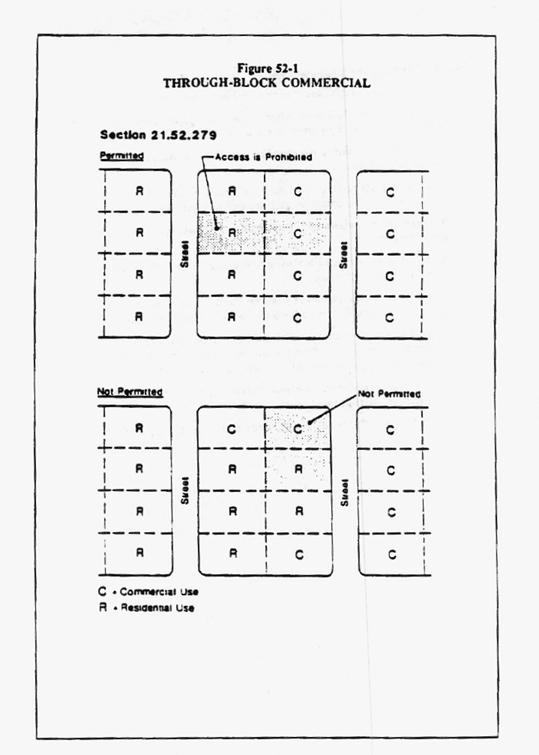
21.52.279 - Through-block commercial.
The following conditions shall apply to through-block commercial:
A.
The proposed site shall abut, adjoin or be adjacent to a commercial district, or a planned development district designated for commercial uses;
B.
The proposed site shall be developed as a unified site with an abutting, adjoining or adjacent commercially zoned site;
C.
Through-block commercial shall only be permitted on a property that has two (2) street frontages but is not a corner lot as illustrated in Figure 52-1;
D.
Vehicular and/or pedestrian access shall not be permitted from or across the residential street frontage;
E.
The site shall be developed according to the height and yard requirements of the residential district in which it is located;
F.
The commercial uses permitted shall be the same as those on the abutting, adjoining or adjacent commercial district with which the site is being developed;
G.
Any portion of the building or buildings visible from a public street, or abutting, adjoining or adjacent to a residential district shall be designed, treated and finished in a manner compatible with adjacent residential areas and with other visible sides of the building; and
H.
The yards facing residential uses shall be landscaped in a manner which protects the privacy and serenity of the residential uses.
(Ord. C-7247 § 26, 1994: Ord. C-7047 § 27, 1992; Ord. C-6684 § 40, 1990; Ord. C-6533 § 1 (part), 1988)
21.52.280 - Tutoring center.
Tutoring centers greater than two thousand five hundred (2,500) square feet shall be subject to the following:
A.
Loading. Two (2) loading spaces shall be provided as per Chapter 21.41;
B.
Impacts on surrounding uses. Hours of operation and business practices shall mitigate impacts to surrounding uses. These include, but are not limited to, appointment-based tutoring sessions, maximum occupants, and hours of operation.
(ORD-19-0028 § 37, 2019)
21.52.281 - Reserved.
Editor's note— ORD-18-0025 § 2, adopted Oct. 2, 2018, repealed § 21.52.281 entitled "Thrift shops," which derived from: Ord. C-7047 § 28, 1992; and Ord. C-6533 § 1 (part), 1988.
21.52.283 - Vehicle rental services.
The following conditions shall apply to vehicle rental service uses:
A.
In the CO and CB zones, only passenger vehicles and bicycle rentals shall be allowed;
B.
Any vehicle repair activities shall comply with the regulations pertaining to outdoor vehicle repair uses as set forth in Chapter 21.45 (Special Development Standards). However, in the CO, CT or CB zones, all repair work shall occur within a fully enclosed building; and
C.
In the CO zone, the project site must be within one-half (½) mile of the CB or CT zone, or five hundred (500) hotel rooms, or a passenger terminal of an airport, cruise ship or rail transit line.
(Ord. C-6533 § 1 (part), 1988)
21.52.286 - Reserved.
Editor's note— ORD-19-0028 § 38, adopted Nov. 5, 2019, repealed § 21.52.286 entitled "Veterinary uses," which derived from Ord. C-6533 § 1 (part), 1988.
21.52.410 - Special conditions—Industrial uses.
Certain industrial uses identified in Chapter 21.33 (Industrial Uses) are subject to conditional use permit review and approval. In addition to the standard considerations and findings required to approve a conditional use permit, the following additional considerations and findings shall be made:
A.
The proposed use, and the siting and arrangement of that use on the property, will not adversely affect surrounding uses nor pose adverse health risks to persons working and living in the surrounding area.
B.
Adequate permitting and site design safeguards will be provided to ensure compliance with the performance standards for industrial uses contained in Section 21.33.090 (Performance Standards) of this Title.
C.
Truck traffic and loading activities associated with the business will not adversely impact surrounding residential neighborhoods.
D.
Businesses involved with hazardous waste treatment, hazardous waste disposal, or hazardous waste transfer shall comply with the following location requirements:
1.
The use shall not be located within two thousand feet (2,000′) of any residential zone or use, any hotel or motel, any school or daycare facility, any hospital or convalescent home, any church or similar facility, or any public assembly use.
2.
The use shall not be located within one hundred feet (100′) of any known earthquake fault, or within a fault hazard or flood hazard zone identified by the State of California.
3.
The use shall not be located on any land subject to liquefaction, as identified in the Seismic Safety Element of the General Plan, unless appropriate soils remediation occurs as required by the City Engineer.
(Ord. C-7360 § 9, 1995: Ord. C-6533 § 1 (part), 1988)
21.52.610 - Uses in the Park (P) district.
Prior to the granting of a conditional use permit for uses in the park district, the following findings shall be made by the appropriate body:
A.
The use is consistent with the intent of the Park District, the General Plan, the local coastal program, and any applicable specific plan;
B.
The use does not permanently remove or impinge upon any significant public open space or impede public access thereto;
C.
For commercial recreation uses, the use provides a needed public recreation service which otherwise would not be available to the public; and
D.
For commercial recreation uses, the use cannot reasonably be located to provide comparable public recreation service on private land appropriately zoned for such use.
(Ord. C-7153 § 3, 1993: Ord. C-7032 § 43, 1992; Ord. C-6533 § 1 (part), 1988)

