
Long Grove City Zoning Code
CHAPTER 9
- DISTRICT REGULATIONS OF GENERAL APPLICABILITY
5-9-1.- Accessory structures and uses.
(A)
Authorization. Subject to the limitations of this section, and except as limited by the regulations of the district where located, accessory structures and uses are permitted in any zoning district in connection with any principal use lawfully existing within such district.
(B)
Definition. An "accessory structure or use" is a structure or use that:
1.
Is subordinate in purpose, use, and floor area to, and serves, a principal structure or use; and
2.
Is customarily incident to such principal structure or use; and
3.
Contributes to the comfort, convenience, or necessity of those occupying, working at, or being served by such principal structure or use; and
4.
Except as otherwise expressly authorized by the provisions of this title, is located on the same zoning lot as such principal structure or use; and
5.
Is used and controlled by the same person who, at the time of such use, is legally occupying and has legal control over such principal structure or use.
(C)
Certificate of Zoning Compliance Required. When required by section 5-11-11 of this title, a certificate of zoning compliance evidencing the compliance of the accessory use or structure with the provisions of this title shall be obtained before any such accessory use or structure is established or constructed.
(D)
Special Regulations Applicable to Particular Accessory Structures and Uses.
1.
Pro Shops. The sale of sports equipment and the serving of food and beverages, including alcoholic beverages if licensed by the Village, shall be permitted as an accessory use to a recreational club.
2.
Guesthouses. A guesthouse shall be a permitted accessory use, provided that it contains no more than 850 square feet of livable area and complies with all the setback requirements of a principal building as set forth in the applicable zoning classification. There shall not be more than one guesthouse for each principal dwelling unit on a lot. A guesthouse shall be considered an accessory use to the principal dwelling unit. A guesthouse may only be located on a lot that includes the principal dwelling unit and that is three acres or larger. A guesthouse may not be owned by anyone other than the owner of the principal dwelling unit.
3.
Residential Recreational Facilities. Residential recreational facilities such as tennis courts, playing courts, and swimming pools shall be permitted accessory uses, provided that no portion of the recreational facility shall be located between the setback line and the lot lines established by the applicable zoning district regulations or any recorded plat of subdivision. No part of a tennis court, playing court, or swimming pool shall be located between the front line of the dwelling located on the same lot as the court or pool and any street abutting said lot. for the purpose of this section, the front line of any dwelling shall be drawn parallel to any road abutting the lot and intersecting the point of the dwelling located the closest to the road. A tennis court or playing court shall not be built over a septic system. A tennis court or playing court shall not be lighted for playing purposes. Swimming pools and tennis courts shall be so designed as to not cause a drainage problem.
4.
Outdoor Storage. Except as otherwise expressly permitted by this title, outdoor storage shall not be allowed as an accessory use.
5.
Horses and Ponies. The keeping of horses and ponies shall be permitted only as accessory to a residential use on the same lot, subject to the provisions of section 10-4-15 of this code.
6.
Off-street Storage of Vehicles in Residential Districts and Within 30 Feet of any Residential District. The following provisions shall govern the off-street storage of all vehicles in all residential districts and within 30 feet of any residential district:
(a)
Storage Defined. for purposes of this subsection, the term "storage" shall mean the parking of a vehicle for a continuous period of longer than eight hours.
(b)
Classification of Vehicles. for purposes of this title, vehicles shall be classified as follows, regardless of the use to which the vehicle is put or intended or designed to serve and regardless of any other classification system made applicable to vehicles by any other governmental body:
(1)
First division vehicle. A vehicle that is designed to carry not more than ten persons.
(2)
Second division vehicle. A vehicle that is designed to carry more than ten persons, is designed or used for living quarters, is designed for pulling or carrying freight, cargo, or implements of husbandry, and those motor vehicles of the first division remodeled for use and used as a motor vehicle of the second division.
(c)
Prohibition. Except for a passenger car or a vehicle registered with the Illinois secretary of state as a vehicle of the first division, outdoor storage of any motor vehicle or other vehicle including, but not limited to, any boat, trailer, camper, or commercial vehicle, within the residential districts, as well as to the parking of said vehicles within any other district, when the vehicle is situated within 30 feet of a residential district, is prohibited.
(d)
Exceptions.
(1)
Any number of first division and second division vehicles may be stored in a garage in a residential district and within 30 feet of any residential district provided that the garage complies with all applicable provisions of this title. Second division vehicles used in commerce shall be stored only in a completely enclosed garage.
(2)
Temporary parking of an otherwise prohibited vehicle for a period not to exceed eight hours solely for the purpose of loading and unloading tangible personal property. This exception does not apply to the loading or unloading of passengers, nor to the entrance into or exit from the vehicle by the driver.
(3)
One otherwise prohibited vehicle may be parked on a residential lot subject to the following conditions:
A.
No prohibited vehicle may be parked in front of a line drawn parallel to the roadway from the closest point of the principal structure or dwelling on the lot.
B.
No prohibited vehicle shall be parked closer than ten feet to the rear or side lot line.
C.
The prohibited vehicle must be parked in such a manner to be properly screened from adjacent lots. for the purpose of this subsection (D)6, proper screening shall be deemed to consist of permanent vegetative screening large enough and dense enough to totally screen the prohibited vehicle from view from adjacent lots.
(4)
Antique vehicles.
(5)
Vehicles of the second division which bear a license plate of the "B" flat weight tax division (van or pickup truck only) only if said vehicle is used as a passenger vehicle and not used as a commercial vehicle. for the purposes of this subsection, it shall be presumed that any such vehicle with a "B" plate is used for commercial purposes and it shall be the burden of the owner thereof to prove by a preponderance of the evidence in any action to enforce this subsection (D)6 that said vehicle is only used as a passenger vehicle and not as a commercial vehicle. If the vehicle has commercial signage displayed upon it, such as identifying a business or service, it shall be considered a commercial vehicle.
(6)
Public utility vehicles and other second division vehicles which are not owned or driven by the occupants of the lot and that are parked at the household in conjunction with the providing of goods or services to the lot or its occupants, such as, but not limited to, delivery of merchandise, maintenance, repairs, and improvements to the lot.
(7)
Authorized emergency vehicles.
(8)
Vehicles used for agricultural purposes.
(e)
Permit. A permit may be obtained from the building superintendent no more frequently than once per year per lot to park an otherwise prohibited vehicle that is owned by a nonresident visitor to the village, who is temporarily residing at the lot where the prohibited vehicle is to be parked. A permit is expressly not available for the occupant of the lot. The permit shall be valid for not more than 14 days in any calendar year.
(f)
Parking Vehicle for Sale Prohibited. No vehicle shall be stored on any lot for the purpose of displaying it for sale unless the vehicle is registered to the owner or an occupant of that lot.
7.
Antennas, other than Amateur Radio Facilities, with Surface Areas Exceeding Ten Square Feet. Antennas and antenna support structures, other than amateur radio facilities, having a combined surface area greater than ten square feet, or having any single dimension exceeding 12 feet, shall be permitted as an accessory structure only in compliance with the following regulations:
(a)
Number Limited. No more than one such antenna and antenna support structure may be located on any zoning lot.
(b)
Height Limited. No such antenna or antenna support structure shall exceed 12 feet in height unless such antenna and antenna support structure is attached to a building pursuant to subsection (D)7(c) of this section.
(c)
Attachment to Buildings Limited. No such antenna or antenna support structure shall be attached to a principal or accessory structure unless all of the following conditions are satisfied:
(1)
Size. The antenna and its support structure shall not exceed 15 square feet in area or 12 feet in any dimension.
(2)
Height. The antenna and its support structure shall not extend more than three feet above the highest point of the building on which it is mounted or the maximum building height of such building, whichever is less.
(3)
Mounting. The antenna and its support structure shall not be attached or mounted upon any building appurtenance, such as a chimney. The antenna and its support structure shall not be mounted or attached to the front of any principal building or to the side of any building facing any street. The antenna and its support structure shall be designed to withstand a wind force of 80 miles per hour without the use of supporting guywires.
(4)
Color. The antenna and its support structure shall be a color that blends with the roof or building side on which it is mounted.
(5)
Grounding. The antenna and its support structure shall be grounded to a grounding rod.
(6)
Other Standards. The antenna and its support structure shall satisfy such other design and construction standards as are required in the building code and other applicable ordinances, codes, and regulations to ensure safe construction and maintenance of the antenna and antenna support structure.
(d)
Setback From Street. No such antenna or its support structure shall be erected or maintained closer to any street than the wall of the principal building to which it is accessory that is nearest to such street.
(e)
Location Restriction. No such antenna or its support structure shall be located in any required yard.
(f)
Guywires Prohibited. No guy or other support wires shall be used in connection with such antenna or its support structure except when used to anchor the antenna or support structure to an existing building to which such antenna or support structure is attached.
(g)
Screening. All ground mounted antennas shall be adequately screened from view of adjacent lot owners.
(h)
Governmental Antennas. The foregoing regulations shall not apply to antennas and antenna support structures owned or maintained by the Village, or to antennas and antenna support structures owned or maintained by other governmental bodies to the extent authorized by a special use permit.
8.
Amateur Radio Facilities. Amateur radio facilities shall be permitted as an accessory structure only in compliance with the following regulations:
(a)
One Facility Per Lot; Special Permit Exception. No more than one antenna support structure with an antenna surface area greater than ten square feet or any single dimension exceeding 12 feet may be located on any zoning lot.
(b)
Height. No amateur radio facility shall, if ground mounted, exceed 65 feet in height, or, if attached to a building pursuant to subsection (D)8(c) of this section, the height therein specified.
(c)
Attachment to Buildings Limited. No amateur radio facility shall be attached to a principal or accessory structure unless all of the following conditions are satisfied:
(1)
Height. The antenna and its support structure shall not extend more than 20 feet above the highest point of the building on which it is mounted.
(2)
Mounting. The antenna and its support structure shall not be attached to or mounted upon any building appurtenance, such as a chimney. The antenna and its support structure shall not be mounted or attached to the front of any principal building or to the side of any building facing a street, including any portion of the building roof facing any street. The antenna and its support structure shall be designed to withstand a wind force of 80 miles per hour without the use of supporting guywires.
(3)
Grounding. The antenna and its support structure shall be grounded to a grounding rod or such other appropriate safety device as may be approved by the Building Superintendent.
(4)
Other Standards. The antenna support structure shall satisfy such other design and construction standards as are required in the Building Code and other applicable ordinances, codes, or regulations to ensure safe construction and maintenance of the antenna and antenna support structure.
(d)
Setback from Street. No amateur radio facility shall be erected or maintained closer to any street than the wall of the principal building to which it is accessory that is nearest to such street.
(e)
Setbacks from Adjacent Buildings. No amateur radio facility shall be located nearer than the height of the antenna and support structure to any habitable building on any adjacent property, or in any required yard.
9.
Fences. Fences shall be subject to the provisions of title 4, chapter 9 of this Code.
10.
Chickens. The keeping of chickens (but no other poultry or fowl) shall be permitted only as accessory to a residential use on the same lot, subject to the provisions of section 10-4-17 of this Code. Notwithstanding section 5-3-12 of this title, chicken enclosures may be located within 20 feet of a principal structure. All chicken enclosures must meet the minimum setback requirements of either: a) 30 feet or b) the setback distance required for the principal structure on the lot as prescribed by the underlying zoning requirements, whichever is greater, for front, side, and rear yards.
(E)
Uses Subject to Special Restrictions. When the district regulations of this title require compliance with any procedures or standards with respect to a specific use, such use shall not be established as an accessory use except in compliance with those procedures and standards.
(F)
Use, Bulk, Space, and Yard Regulations. Except as expressly provided otherwise in this section, every accessory structure and use shall comply with the use, bulk, space, and yard regulations made applicable to them by the regulations of the district in which they are located.
(G)
Use Limitation. No accessory structure or use shall be constructed, established, or maintained on any lot prior to the substantial completion of construction of the principal structure to which it is accessory.
(Ord. No. 2007-O-04, 4-24-2007; Ord. No. 2011-O-29, 10-25-2011; Ord. No. 2011-O-37, 11-22-2011)
5-9-2. - Home occupations.
(A)
Authorization. Subject to the limitations of this section, any home occupation that is customarily incidental to the principal use of a building for residential purposes shall be permitted in any dwelling unit or permitted accessory structure.
(B)
Definition. A "home occupation" is a business, profession, occupation, or trade that:
1.
Is conducted for gain or support by a full time occupant of a dwelling unit; and
2.
Is incidental and secondary to the use of such dwelling unit or permitted accessory structure, as the case may be, for residential purposes; and
3.
Does not change the essential residential character of such dwelling unit, or permitted accessory structure.
(C)
Use Limitations.
1.
Employee Limitations.
(a)
The entrepreneur of every home occupation shall be domiciled in the dwelling unit on the lot where such home occupation is conducted.
(b)
No person who is not domiciled in the dwelling unit on the lot where a home occupation is conducted shall be employed in connection with, or otherwise participate in the operation of, such home occupation.
2.
Structural Limitations.
(a)
No alteration of any kind shall be made to the dwelling unit or accessory structure where a home occupation is conducted that would change its residential character, including the enlargement of public utility services beyond that customarily required for residential use.
(b)
No separate entrance shall be provided in connection with the conduct of any home occupation.
3.
Operational Limitations.
(a)
No mechanical, electrical, or other equipment that produces noise, electrical or magnetic interference, vibration, heat, glare, emissions, odor, or radiation outside the dwelling unit or any permitted accessory structure that is greater or more frequent than that typical of equipment used in connection with residential occupancy shall be used in connection with any home occupation.
(b)
No outdoor storage shall be allowed in connection with any home occupation.
(c)
No refuse in excess of the amount allowable for regular residential pick up shall be generated by any home occupation.
(d)
Not more than one vehicle identified or advertised as a commercial vehicle shall be permitted in connection with any home occupation, and any such vehicle shall be stored in an enclosed garage at all times. Any other vehicles used in connection with any home occupation shall be subject to the requirements of section 5-9-1 of this chapter.
4.
Signage and Visibility. No exterior display or signage shall be permitted except as authorized in the respective residential district pursuant to section 5-9-5 of this chapter.
5.
Traffic Limitations. No home occupation shall generate more vehicular or pedestrian traffic than is typical of dwellings in the area.
6.
Nuisance Causing Activities. in addition to the foregoing specific limitations, no home occupation shall cause or create any nuisance, or be noxious, offensive, or hazardous.
7.
Licensing Requirements. Every home occupation shall be subject to all applicable business licensing and inspection requirements.
8.
Prohibited Home Occupation Uses. The following uses shall not be permitted home occupation uses:
(a)
Any wholesale or retail business unless conducted entirely by mail;
(b)
Any manufacturing business, excluding artists;
(c)
A service establishment of any kind operating on or from the premises;
(d)
A clinic or hospital;
(e)
A public stable or public day kennel; nor
(f)
A restaurant.
(Ord. No. 2007-O-04, 4-24-2007)
5-9-3. - Temporary uses.
(A)
Authorization. Subject to the limitations of this section, temporary uses as hereinafter specified are permitted in the zoning districts hereinafter specified.
(B)
Definition. A "temporary use" is a use that:
1.
Is established for a fixed period of time with the intent to discontinue such use upon the expiration of such time; and
2.
Does not involve the construction or alteration of any permanent structure.
(C)
Certificate of Zoning Compliance Required; Special Standards for Issuance and Revocation.
1.
Certificate Required. Except as provided in subsections (D)1 and (D)2 of this section, no temporary use shall be established or maintained unless a certificate of zoning compliance evidencing the compliance of such use with the provisions of this title shall have first been issued in accordance with section 5-11-11 of this title.
2.
Bases for Certificate Denial. A certificate of zoning compliance may be denied if the building superintendent determines that the owner has failed to comply with the terms or conditions of any previously issued zoning certificate for a temporary use or that the permanent use of the lot fails to comply in all respects with the provisions of this title and all other village ordinances regulating the development, use, and maintenance of such lot. A certificate shall be denied if the building superintendent determines that the public health, safety, or welfare would be, or may reasonably be expected to be, impaired by the issuance thereof.
3.
Conditions on Certificate. A certificate of zoning compliance may be conditioned upon such special requirements as the building superintendent may determine are necessary to achieve the purposes of this title and to protect the public health, safety, and welfare.
4.
Revocation of Certificate. A certificate of zoning compliance shall be revoked if any of the standards and conditions imposed pursuant to this section, or such certificate, are violated.
(D)
Permitted Temporary Uses. Subject to the specific regulations and time limits that follow and to the other applicable regulations of the district in which the use is permitted, the following temporary uses and no others are permitted in the zoning districts herein specified:
1.
Any District.
(a)
Contractors' Offices and Equipment Sheds. in any district when accessory to a construction project. No such use shall be used for residential purposes or contain sleeping or cooking accommodations. Such use shall be limited to a period not to exceed the duration of the active construction phase of such project, and in no event longer than one year unless extended by the building superintendent upon a showing of special circumstances. Such use shall be limited to activities related to the development in which such office is located, and no such office shall be used as the general office or headquarters of any firm.
(b)
Real Estate Offices, Including Model Units. in any district when accessory to a new residential subdivision or nonresidential development. No such use shall be used for residential purposes or contain sleeping or cooking accommodations unless located in a model dwelling unit. Such use shall be limited to the period of the active selling or leasing of units or space in such development, and in no event longer than one year unless extended by the building superintendent upon a showing of special circumstances. Such use shall be limited to activities related to the development in which such office is located, and no such office shall be used as the general office or headquarters of any firm.
(c)
Tents. in any district, in connection with any permitted, accessory, temporary, or special use. No tent shall be allowed to remain for a period of more than three days longer than the period during which the use with which it is associated is allowed to remain but in no event more than ten days. Unless waived in writing by the building superintendent, every tent shall comply with the bulk, yard, and space requirements applicable to accessory uses pursuant to section 5-9-1 of this chapter. No certificate of zoning compliance shall be required for tents located to the rear of the dwelling in the residential districts.
(d)
Civic Uses of Public Property. on publicly owned property, any civic use of any public building or property when authorized by the governmental agency owning or controlling such property; provided, however, that no such use shall impose an undue adverse effect on neighboring streets or lots.
(e)
[Food Trucks.] Food trucks, but only pursuant to a permit or license issued under chapter 10 of title 3 of the village code, and only in conformity with the regulations and requirements of said chapter 10 of title 3 of the village code.
2.
Residential Districts.
(a)
House, Garage, and Yard Sales. in the residential districts, but only when limited to the personal possessions of the owner occupant of the dwelling unit at which such sale is being conducted. Such use shall be limited to a period not to exceed three consecutive days, and no more than two such sales shall be conducted from the same dwelling in any 12-month period. No certificate of zoning compliance shall be required for such use.
3.
B1 District.
(a)
Outdoor Dining. Outdoor dining that is ancillary to a primary restaurant use and that is not conducted within or on a permanent structure that is located higher than grade level, shall be permitted as a temporary use in the business districts, subject to compliance with the license requirements of section 3-7-1 of this code, and the following restrictions and limitations:
(1)
A temporary use permit shall be required for the outdoor dining use. Applications for a temporary use permit shall be submitted to, and reviewed by, the building superintendent. A temporary use permit for an outdoor dining use shall expire one year after its issuance; however, an owner may submit an application to renew the temporary use permit, which shall be reviewed by the building superintendent or the manager's designee.
(2)
No more than six tables with a maximum capacity of 24 patrons shall be permitted for any outdoor dining use.
(3)
The outdoor dining use may only be in use during the hours that the primary restaurant use is in operation, but in no event shall the outdoor dining use be in use between the hours of 11:00 p.m. and 8:00 a.m., except as otherwise approved by the village board.
(4)
The lot upon which the outdoor dining use is to be conducted shall not abut any residential zoning district nor be located within 300 feet of a residentially zoned lot.
(5)
The outdoor dining use shall be confined to the rear of the principal restaurant building; provided, however, that upon good cause shown to the building superintendent, it may be located in the front or side of the restaurant building, provided it is not located in the required front or side yard setback.
(6)
No music or amplified sounds shall be permitted in connection with the outdoor dining use.
(7)
No additional outdoor lighting shall be permitted, except for safety lighting, unless otherwise approved by the building superintendent upon good cause shown.
(8)
No outdoor dining use shall displace required parking on the lot upon which the outdoor dining use is located.
(9)
A temporary use permit for an outdoor dining use may be revoked by the building superintendent upon any failure or refusal to meet all of the requirements of this subsection and this title.
(10)
In the event that a proposed outdoor dining use does not meet the standards set forth in this section, the owner may apply for a special use permit for the outdoor dining use pursuant to subsection 5-4-5(A)3 of this title.
(b)
Indoor and Outdoor Art, Craft, and Plant Shows, Exhibits, and Sales and Other Special Events. Any such use shall require the specific prior approval of the village board on the basis of the adequacy of the lot size, parking provisions, and traffic access and the absence of undue adverse impact on other properties. Every such event shall be limited to a period not to exceed three days.
(c)
Use of Village Parking Facilities. Temporary exclusive use of all or a portion of a village owned parking facility ("village lot") by a governmental or civic organization ("applicant") in connection with a special event intended to promote or otherwise feature the historic character of the B1 district for purposes of providing off-street parking for such special event in the B1 district, subject to the following restrictions and limitations:
(1)
Any such use shall require the specific prior approval of the village board on the basis of the nature of the event and anticipated benefits to the B1 district, anticipated parking demand, other parking provisions, traffic access, and minimization of undue adverse impact on other properties. The Village Board may impose such conditions and restrictions on the applicant's use of the Village lot as it deems necessary and appropriate to protect the public health, safety, and welfare.
(2)
The applicant's use shall be limited to a period not to exceed 12 hours per day for no more than three consecutive days.
(3)
The Village Board may authorize the applicant to impose a reasonable fee for parking in the Village lot during the term of the permitted temporary use to offset expenses that may be incurred by the applicant in connection with the special event, including, without limitation, expenses related to traffic regulation and control or security for parked vehicles. If the Village Board authorizes the applicant to charge a parking fee, the Village Board shall charge the applicant a rental fee of $50.00 per day, per Village lot used.
4.
HR District.
(a)
The uses specified in subsection (D)4(b) of this section shall be permitted on properties comprised of at least ten acres and located within the HR district. Such properties must, at the time of application, have a principal use of open space, which may include the presence of existing but unused structures. Any such use shall require the specific prior approval of the village board by ordinance or resolution on the basis of compliance with the standards and limitations set forth in this section; adequacy of lot size and configuration; adequacy of existing buildings, utilities, and other improvements; parking provisions; traffic access and safety; and absence or minimization of negative impacts on other properties, natural resources, and the public health, safety, and welfare. The board shall specify the maximum duration of the temporary use, not to extend beyond the temporary use authorization expiration date set forth in paragraph 5-9-3(D)4(c), and may impose such conditions as may be reasonably necessary to achieve the purposes of this section and protect the public health, safety, and welfare. Storage of heavy equipment and machinery, gasoline, and hazardous substances shall not be permitted in connection with any temporary use under this subsection (D)4 unless expressly authorized by the village board. Any application for a temporary use permit pursuant to this subsection (D) shall include a proposed site plan and such other information as the board may require in its reasonable discretion.
(b)
The following uses shall be permitted as temporary uses in accordance with this subsection (D)4:
(1)
Seasonal retail sale of landscape nursery plants, flowers, and landscape equipment.
(2)
Self-storage or warehousing within a fully-enclosed structure.
(3)
Contractors' offices and/or material storage in relation to a general contractor's or landscape contractor's operations and not accessory to an on site construction project, which may include outdoor parking and storage of vehicles and equipment associated with such operations.
(4)
Entertainment or recreation facilities, such as batting cages or go-cart driving, within a fully-enclosed structure.
(5)
Equipment rental, storage, and leasing within a fully enclosed structure.
(6)
Seasonal and holiday retail stores.
(7)
Retail sales of alcoholic beverages.
(8)
Dog daycare, overnight boarding, grooming, and training facilities within a fully enclosed structure; provided, however, that such facilities may also include designated outdoor dog training, exercise, and relief areas. Dog kennels in which dogs are bred, sold, or offered for sale or adoption shall not be permitted.
(c)
The temporary use authorizations set forth in this subsection (D)4 shall expire as of June 30, 2025.
(E)
Bulk, Space, and Yard Regulations. Except as expressly provided otherwise in subsection (D) of this section, every temporary use shall comply with the bulk, yard, and space regulations applicable in the district in which such temporary use is located.
(F)
Use Limitations.
1.
General Limitations. Every temporary use shall comply with the limitations made applicable to specified temporary uses by subsection (D) of this section. No temporary use shall be permitted in any district if it would have a significant negative impact, including aesthetic impact, on any adjacent lot or on the area, as a whole, in which it is located.
2.
Hours and Days of Operation. The Building Superintendent may designate the specific hours and days of the week during which a temporary use may operate on the basis of the nature of the temporary use and the character of the surrounding area.
3.
Public Safety. No temporary use shall be permitted that can be expected to create any undue on site or off site threat to public safety. No temporary use shall be operated except in accordance with any restrictions and conditions that may be imposed to eliminate any such threat. If required by the Building Superintendent, the operator of the temporary use shall employ a fire watch team and/or appropriate security personnel.
4.
Traffic. No temporary use shall be permitted if additional vehicular traffic reasonably expected to be generated by such temporary use would have undue detrimental effects on surrounding streets and uses.
5.
Conflicts with Other Temporary Uses. No temporary use shall be permitted if such use would conflict with another previously authorized temporary use.
6.
Temporary Use Sign Limitations. Temporary signs may be permitted in connection with an approved temporary use, provided that such signs shall be located only on the same zoning lot as the temporary use, be limited to no more than one per street frontage, be set back at least six feet from the front lot line, and be no larger than six square feet in area; provided, however, that in the B1 District, such sign may be no larger than 32 square feet in area. Such signs shall be of sturdy construction and not be detrimental to the character of the area, and shall comply with any special conditions specified in the certificate of zoning compliance. Such signs shall not be erected sooner than 14 days before the commencement of the temporary use and shall be removed within 24 hours following the termination of the temporary use.
7.
Parking. Before approving any temporary use, the Building Superintendent shall make an assessment of the total number of off-street parking spaces that will be reasonably required in connection with the proposed temporary use, on the basis of the particular use, its intensity, and the availability of other parking facilities in the area, and shall approve such temporary use only if such off-street parking is provided. No temporary use shall be authorized that would, in the opinion of the Building Superintendent, unreasonably reduce the amount of off-street parking spaces available for use in connection with permanent uses located on the zoning lot in question, except as authorized by prior approval of the Village Board pursuant to subsection (D)3(c) of this section.
8.
Additional Conditions. Every temporary use shall, in addition, comply with, and the Building Superintendent may impose, such other conditions as may be reasonably necessary to achieve the purposes of this title or to protect the public health, safety, and welfare.
(Ord. No. 2007-O-04, 4-24-2007; Ord. No. 2012-O-11, 3-27-2012; Ord. No. 2017-O-02, 2-14-2017; Ord. No. 2020-O-26, § 2, 12-29-2020; Ord. No. 2022-O-09, § 2, 6-28-2022)
5-9-4. - Off-street parking.
(A)
Authorization. Subject to the limitations of this section, off-street parking is permitted as an accessory use in all districts. Off-street parking is not permitted as a principal use in any district. Nothing in this section shall be construed to limit the right of any person to provide off-street parking in excess of the requirements herein established but all such parking shall comply with the standards of this section.
(B)
General Requirements.
1.
Applicability to Existing, New, and Expanded Uses.
(a)
General Applicability. Except as expressly provided otherwise in this title, the provisions of this section shall apply to, and off-street parking spaces sufficient to satisfy the requirements of this section shall be provided for, all existing and new uses, in accordance with the provisions of this title.
(b)
Increase in Use Intensity. Whenever the intensity of use of any structure or use is increased through the addition of floor area, seating capacity, or other units of measurement specified herein for required parking spaces, parking spaces as required herein shall be provided for such increase in intensity of use.
2.
Location of Required Parking Spaces. Parking spaces required by this section shall be located on the same zoning lot as the use to which they are accessory.
(C)
Design and Maintenance. Every parking garage, area, lot, and structure shall be designed, constructed, and maintained in accordance with the applicable standards and requirements herein set forth:
1.
Screening. All parking areas shall be adequately screened, subject to the review and approval of the Architectural Board.
2.
Design.
(a)
Access to Street. All parking garages, areas, lots, and structures shall be so located and designed as to provide access to adjacent streets with the least interference with through traffic movements.
(b)
Ingress/Egress. Except in a Residential District, each parking garage, area, lot, or structure shall be designed to avoid the backing of vehicles over a sidewalk or into a public street, so that ingress and egress to and from a parking area shall be by forward motion of the vehicle.
(c)
Circulation Aisles. Each parking space in a parking lot, except spaces accessory to a single-family dwelling, shall be accessed by a circulation aisle of a width, in feet and inches, as specified below:
(d)
Space Dimensions. Each off-street parking space, excluding its associated circulation aisle, shall have the following minimum dimensions, in feet and inches:
The above stated length dimensions may be reduced by up to one foot six inches for overhang for stalls with curbs or wheel stops adjacent to the outside perimeter of a parking lot. The above stated stall width dimensions shall be increased to 16 feet for required handicapped parking spaces or to the width required under applicable State law, whichever is greater.
(e)
Maintenance. All parking garages, areas, lots, and structures shall be properly maintained at all times.
(f)
Surface. All parking garages, areas, lots, and structures, except parking spaces accessory to a single-family dwelling, shall be surfaced with asphalt or concrete pavement, brick pavers, or a similar hard-surfaced paving material that provides an all-weather, durable, and dustless surface. Parking spaces accessory to a single-family dwelling may be surfaced with asphalt or concrete pavement, brick pavers, gravel, crushed stone, or similar paving material.
(D)
Required Spaces.
1.
B1 District. Five parking spaces shall be provided for every 1,000 square feet of net floor area of any new building or of net floor area added to any existing building; provided, however, that public assembly and bed and breakfast uses in the B1 District shall comply with the parking requirements listed for such uses in subsection (D)3 of this section.
2.
HR-1 District. for the following uses, the following minimum number of off-street parking spaces or stacking spaces shall be provided, unless a lesser number of spaces is expressly approved as part of a planned unit development upon a determination that adequate parking will be provided within such planned unit development:
3.
All other districts. for the following uses, the following minimum number of off-street parking spaces or stacking spaces shall be provided:
(E)
Unspecified Uses. When the ultimate use of a structure is not known, the maximum number of spaces that might be required for any use to which the structure might reasonably be devoted shall be provided.
(F)
Computation of Required Spaces.
1.
Fractional Spaces. When determination of the number of required parking spaces results in the requirement of a fractional space, any fraction of one-half or less may be disregarded and any fraction in excess of one-half shall require one additional parking space.
2.
Capacity Calculations. When parking spaces are required on the basis of capacity, capacity shall be determined based on the occupancy standards established by the Long Grove building code.
3.
Population Calculations. When parking spaces are required on the basis of the number of customers, students, or similar measure, the maximum number for which the structure is designed shall govern, except that when the structure has no design capacity the maximum number present at any one time shall govern.
(G)
Parking Relief. If the village board determines that it is not possible or feasible to install on a lot some or all of the parking spaces required by subsection (D) of this section for that lot, the village board may grant relief from the parking space requirements utilizing one or some combination of the following forms of relief:
1.
Payment in Lieu of Providing Spaces. A reduction in the required off-street parking spaces for a lot in the B1 district may be granted by the village board upon the satisfactory demonstration by the applicant that the provision of the required parking spaces will result in a particular hardship, and that the granting of relief will not be detrimental to the public welfare. The village board may, in its discretion, authorize the requested parking relief conditioned upon payment by the applicant, in lieu of providing the required parking spaces, of a fee, in the amount set forth in an annual resolution adopted by the village board, for each parking space that is required but not provided. The parking fee shall be placed into a village fund to be used for the acquisition and maintenance of public off-street parking facilities.
2.
Landbanking of Required Parking.
(a)
Landbanking Authorized. Notwithstanding any other provision of this section, a reduction in the total number of off-street parking spaces for a lot in a nonresidential district except the B1 district that are required pursuant to subsection (D) of this section or the stall length and width dimension required pursuant to subsection (C)2(d) of this section, may be authorized by a special use permit issued pursuant to section 5-11-17 of this title, subject to the conditions set forth in subsections (G)2(b) through (G)2(d) of this section and such other conditions deemed necessary to protect the public health and safety and ensure compliance with the purposes and intent of this title.
(b)
Termination of Landbanking. The village board shall have the right, in its sole and absolute discretion, to require the owner or his or her successor at any time to increase the stall width or length to the dimensions required by subsection (C)2(d) of this section or to increase the number of parking spaces provided to serve said development up to the maximum required by subsection (D) of this section for the lot in question as if no authorization for landbanking had been granted. No special use permit authorizing landbanking of required parking shall be effective unless and until the applicant and owner shall file with the village a written acceptance of this condition.
(c)
Alternate Plans Required. Every request to allow landbanking of required parking spaces shall be accompanied by alternate detailed parking plans. One plan shall show the full stall width and depth required by subsection (C)2(d) of this section and the full number of parking spaces required pursuant to subsection (D) of this section; the other plan shall show the reduced stall width and/or length or the reduced number of parking spaces or both, as the case may be, proposed to be provided pursuant to the authorization being sought and also shall show the landscaping treatment of areas proposed to be reserved for future parking requirements. Both such plans shall show the location on the site of all parking spaces, the exact number of parking spaces to be provided, and complete details for: 1) wheel stops, 2) markings, 3) curbing, 4) surfacing, 5) screening and landscaping, 6) lighting, 7) signing, and 8) access. Such plans shall be subject to the approval of the village board.
(d)
Open Space Covenant. No special use permit authorizing landbanking of required parking shall be effective unless and until the applicant and owner shall file his or her unconditional agreement and covenant in form and substance satisfactory to the village attorney that areas reserved for future parking shall be maintained as landscaped open space until and unless required to be used for off-street parking pursuant to subsection (G)2(b) of this section. Such agreement and covenant shall be recorded with the recorder of deeds.
3.
Alternative Transportation Reduction for Restaurants. A reduction of all or any portion of the required parking may be granted by the village board for a restaurant in the B1 district that institutes and maintains a continuous, personalized shuttle or valet parking service or contracts with a local agency to provide those services.
(Ord. No. 2007-O-04, 4-24-2007; Ord. No. 2008-O-7, 2-26-2008; Ord. No. 2019-O-01, 1-8-2019)
5-9-5. - Signs.
(A)
Scope of Regulations. The regulations of this section shall govern and control the location, erection, relocation, reconstruction, extension, enlargement, conversion, replacement, alteration, operation, maintenance, and removal of all signs within the village visible from any street, sidewalk, or public or private common open space, excluding only signs owned or maintained by the village. Any sign not expressly permitted by these regulations shall be prohibited. The regulations of this section relate to the location of signs within zoning districts and shall be in addition to the provisions of the building code applicable to the construction and maintenance of signs.
(B)
Statement of Purpose. The regulation of signs by this section is intended to promote and protect the public health, safety, and welfare. The purpose of this section is to:
1.
Regulate signs in such a manner that supports and complements land use objectives that are set forth in the zoning code, village code, and comprehensive plan.
2.
Ensure that all signs are compatible with regards to size, location, color, construction, materials, and the manner of display.
3.
Ensure that signs do not confuse, obstruct traffic vision, nor endanger public health, safety, morals, or general welfare.
4.
Ensure that signs within the village are displayed in a manner that preserves the special qualities inherent in the village that attract tourists and residents alike and that are the basis of the village's economic stability and growth.
(C)
Applicability. No sign shall hereafter be located, erected, moved, reconstructed, extended, enlarged, converted, replaced, or altered except in conformance with the provisions of this section and after issuance of a sign permit by the village, if required, or compliance with subsection (F) of this section permitting signs without the issuance of a permit.
(D)
General Standards. Except as otherwise expressly provided in subsection (F) of this section, the following general standards apply to all signs. Any sign not in compliance with these standards shall be immediately corrected or shall be deemed to be in violation of this chapter.
1.
Illumination. Signs shall only be permitted to be illuminated in accordance with the following regulations:
(a)
No sign can be self-illuminated or internally illuminated; provided, however, that a business shall be permitted one internally illuminated "Open" window sign not to exceed one square foot in area, which sign shall be subject to the review and approval by the architectural commission.
(b)
Neon illumination of signs is not permitted.
(c)
Any illumination of signs shall be constant in intensity and color and there shall be no flashing lights, rotating lights, running lights, or lights that create an illusion of movement.
(d)
No sign shall be illuminated in such a manner so as to cause confusion with traffic signals or lights or which might constitute a traffic hazard.
(e)
Any light source that is used to illuminate a sign must be located, shielded, and directed as to not be visible from any point on any surrounding streets, public property, adjacent private property or adjacent structures. All artificial illumination shall be so designed, located, shielded, and directed so that it illuminates the sign face area only and prevents the casting of glare.
2.
Sign Measurement. Unless otherwise expressly provided to the contrary in these regulations, the term "sign area" shall include the gross surface area of each sign with a single continuous perimeter enclosing the extreme limits of the sign and in no case passing through or between any adjacent elements of the sign. Such a perimeter shall not include any structural or framing elements lying outside the limits of such sign and not forming an integral part of the display.
3.
Traffic Safety. No sign or sign structure shall be permitted or maintained at any location where by reason of its position, size, shape, design, or color it may obstruct, impair, obscure, or interfere with the views of the vehicular driver, pedestrian, or cyclist. No sign will be permitted that could be confused with any traffic control signal or device. No sign will be permitted where it may interfere, confuse, or mislead traffic movement.
4.
Maintenance. The owner of a sign and the owner of the premises on which the sign is located shall be jointly and severally liable to maintain the sign or signs in a clean and sanitary condition, free from rubbish and weeds, and in overall good working order, including illumination sources, at all times.
5.
Setbacks. All signs must maintain a minimum five-foot setback from the street and cannot be located in the vision triangle.
6.
Compliance with All Village Codes. in addition to the requirements contained within this section, all signs shall fully comply with all the other applicable village code provisions, including, without limitation, the village's building and electrical codes.
(E)
Historic Business District Signs. Signs within the B1 historic business district must comply with the regulations of general applicability as set forth throughout this section, except as specifically set forth in this subsection (E). Signs within this area should reflect the historic and eclectic character of the historic business district and be integrated with the landscaping and architecture to the greatest extent possible. The following regulations apply to signs within the B1 historic business district:
1.
Open Signs. A business may display one illuminated open sign, provided that such illuminated "Open" sign: a) is no more than one square foot in area, b) includes lighted white letters on an unlit background, c) does not exceed an illumination level of 840 lumens, and d) otherwise complies with those provisions of subsection (D)1 of this section that are not inconsistent with this subsection (E)1, except that the approval of the architectural commission shall not be required. A business may not display a lighted open sign at times when the business is not open to the public for normal business.
2.
Neon Illumination. Neon illumination of signs is only permitted: a) if neon is used as part of an "Open" sign that meets the requirements of subsection (E)1 of this section, or b) upon application and approval of a variation from the requirements of this code pursuant to subsection 5-11-15(E)1(c) of this title. for purposes of a request for a variation for neon sign illumination, a practical difficulty or particular hardship may be found to exist when the neon illumination of signs would be traditionally appropriate for the nature of the business and if such proposed sign is appropriate to the architectural style or era of construction of the business.
3.
Maintenance. If signs are not properly maintained they must be removed or replaced. Proper maintenance includes: a) repairing of any damage caused by weather or other impact, b) ensuring signs do not pose a hazard, or provide misleading information, to pedestrians or motorists, c) repairing cracks, fading, or general deterioration.
4.
Materials. Signs should be constructed of high quality, long lasting and natural building materials, which may include painted wood, metal, or stone, but may not include particle board, plastic, or highly reflective metallic material unless expressly approved by the Architectural Commission.
5.
Awnings. Businesses having awnings may include the business's name as copy along the lower edge or fringe of an awning, but any awning displaying such copy shall be considered a wall or canopy sign as allowed by subsection (E)7 of this section and included in the maximum sign area calculation for that location.
6.
Flags. Flags, in good condition and totaling not more than 15 square feet per zoning lot or per principal structure, may be displayed.
7.
Number. The limit of signs per business establishment is one ground sign, one nameplate sign, and one wall sign or one canopy sign. Such signs, singularly or in combination, shall not exceed the maximum permitted sign area.
8.
Total Size. Except as otherwise authorized by variation pursuant to subsection 5-11-15(E)1(c) of this title, the cumulative total square footage for all signs shall not exceed the following:
Except as otherwise provided, square footage, for the purpose of this subsection (E), shall be calculated based on single sign face of any double faced sign.
9.
Temporary Banner Signs. The Village Planner may authorize temporary banner signs that conform with subsection (G)2(i) of this section for a period not exceeding 60 days for signs that relate to the business, service, pursuit, or event conducted on or within the premises on which the sign is displayed.
10.
Sandwich Board Signs. The Village Planner may authorize one sandwich board sign, with cumulative total of all sign faces not exceeding 12 square feet in addition to the total number and square footage of signs otherwise authorized, if requested as part of a business's annual business license application. The authorization to display a sandwich board sign must be renewed annually with the business license and include site plan identifying the general placement of the sign as well as a scaled drawing (or "proof") identifying the dimensions, materials and copy of the sign. Sandwich board signs may not obstruct pedestrian or vehicular ingress or egress, and must be placed inside the structure when the business authorized to display such sign is closed to the public. Such signage shall be nonilluminated and may not adversely impact the health, safety, and welfare of the general public. Sandwich board signs may not be located on, or otherwise obstruct, pedestrian walkways, parking lots, and streets and be adjacent to the destination they are intended to serve but may not be displayed in the right-of-way. for purposes of this subsection (E), a "sandwich board sign" shall be a portable and temporary A-frame sign that is designed to be self-supporting by nature, which sign may have two sign faces and should be simple, unique and constructed of high quality materials that complement the landscaping and architecture of the B1 District.
11.
Small Real Estate Signs. Within the B-1 District, one temporary real estate sign shall be permitted per lot or per principal structure. Except as otherwise specifically provided herein, such signs must comply with the regulations for small real estate signs set forth in subsection (F)1 of this section.
12.
Setbacks. Unless otherwise specified, setbacks shall be subject to the review and approval of the Architectural Commission.
(F)
Signs that Do Not Require a Permit. The following permanent and temporary signs may be erected and maintained in any district, unless otherwise provided, without obtaining a sign permit, subject to the following limitations:
1.
Small Real Estate Signs. Except as otherwise provided in subsection (E)11 of this section with respect to the B-1 District, two temporary real estate signs, which shall include "Open House" signs, shall be permitted per lot or per principal structure. The maximum size for each real estate sign shall not exceed six square feet, and no such sign shall be illuminated nor be greater than seven feet in height as measured from grade where the sign (or any structure to which it is affixed) meets the ground to the upper most edge of the sign face. All such signs shall be removed within 48 hours of the closing or lease or sale of the lot.
2.
Residential Nameplates. Two nameplate signs shall be permitted for each dwelling unit in a residential district only. The maximum size for each nameplate sign shall not exceed 144 square inches in area, and no such sign shall be illuminated.
3.
Window Signs. Window signs shall be permitted when located on the interior side of a window. The aggregate area of all such window signs shall not exceed more than ten percent of the total area of the window. Illuminated window signs shall be permitted, subject to the provisions of this section.
4.
Directional and Warning Signs. Directional and warning signs that direct people to restrooms and to parking facilities and signs required by law (entrance, exits, and handicapped accessibility) shall be permitted. No such sign shall exceed two square feet in area. Directional and warning signs shall not be used for any commercial purposes and must be approved by the Village Planner prior to installation.
5.
Seasonal or Noncommercial Decorations/Signs. Seasonal or noncommercial decoration/signs shall be permitted for a period not to exceed 60 days. The maximum size for such decorations/signs shall not exceed ten square feet in area.
6.
Campaign Signs. Two temporary campaign signs per candidate shall be permitted for each lot or per principal structure. The maximum size for each campaign sign shall not exceed six square feet, and no such sign shall be illuminated. No such campaign sign shall project beyond the lot line into the public right-of-way or onto private property that is not owned by the party installing or owning the sign.
7.
Political Message Signs. Political message signs shall be permitted. The maximum size for each political message sign shall not exceed six square feet, and no such sign shall be illuminated. No such political message sign shall project beyond the lot line into the public right-of-way or onto private property that is not owned by the party installing or owning the sign.
8.
Street Signs. Signs giving names of streets shall be erected at all street intersections. Such signs shall meet the minimum requirements as set forth in the "Manual of Uniform Traffic Control Devices for Streets and Highways", as prepared and published by the Department of Public Works and Buildings, State of Illinois, and the Long Grove street sign design standards. The developer shall also promptly install any and all regulatory traffic signs deemed necessary by the Village. The developer shall install temporary street signs during the period of construction as soon as the lot is accessible by vehicles and maintain such signs until permanent signs are installed.
9.
Conservancy/Scenic Corridor Signs. Signs identifying conservancy and/or scenic corridor easements shall be posted on all lots that have been designated a Lowland Conservancy District, a woodland conservancy easement, or a scenic corridor easement. Such signs shall be installed prior to the issuance of a building permit and commencement of any construction on the lot. The signs shall be provided by the Village and installed as designated on the final plat of subdivision or by the Village Planner or his or her designee. The signs shall be located on four-inch by four-inch treated posts three feet in the ground and shall extend three feet above the ground. These signs shall indicate the Conservancy/Scenic Corridor Districts and establish that these areas are not to be disturbed.
10.
Public/Legal Notices. Temporary signs that indicate either a public hearing or are a required legal notice may be installed on the lot; provided, however, that such signs shall not be located within the vision triangle nor constitute a public safety hazard.
11.
Temporary Signs. Temporary use signs shall be permitted in accordance with section 5-9-3 of this chapter.
(G)
Signs that Require a Permit.
1.
Permit Required. Except as otherwise provided in subsection (F) of this section, it shall be unlawful for any person to erect, construct, move, alter, or maintain any sign without first having made application for and obtained a sign permit from the Village in accordance with section 5-11-20 of this title and having paid the applicable permit fee. The Building Commissioner (or his/her designee), in consultation with the Village Planner, shall be responsible for the administration and enforcement of sign permit applications.
2.
Signs Requiring a Permit. The following permanent and temporary signs require a permit pursuant to this subsection:
(a)
Large Real Estate Signs. One temporary real estate sign shall be permitted on a lot that contains at least five acres in area. The maximum size of a real estate sign shall not exceed 18 square feet in area, and no such sign shall be illuminated. All such signs shall be removed within 24 hours of the closing of the lease or sale of the lot or the reduction of the lot to less than the required five acre minimum. No such real estate sign shall be located closer than ten feet (10') from any lot line.
(b)
Construction Signs. One temporary construction sign shall be permitted on a lot that contains at least five acres in area. The maximum size of a temporary construction sign shall not exceed 18 square feet in area, and no such sign shall be illuminated. No such construction sign shall be located closer than ten feet from any lot line. Construction signs shall be removed at the time a permanent sign is installed or a certificate of occupancy is issued, whichever occurs first.
(c)
Subdivision Signs. A sign identifying the location and name of a subdivision may be installed at the entrance of the subdivision, subject to compliance with the following standards:
(1)
Number of Signs. No more than two subdivision identification signs shall be permitted for each subdivision.
(2)
Size. The cumulative total area of the subdivision identification signs permitted by subsection (G)2(c)(1) of this section shall not exceed 40 square feet in dimension.
(3)
Lighting. A subdivision identification sign may be illuminated, subject to compliance with the following standards:
A.
Type of Lighting. A subdivision identification sign may utilize one of the following methods of illumination: sign mounted canopy light or ground mounted spotlight. Only white or clear incandescent illumination sources shall be permitted.
B.
Direction of Illumination. The illumination source shall only be directed onto the face of the subdivision identification sign.
C.
Visibility of Illumination Source. The illumination source or filament shall not be visible from adjacent lots.
D.
Maximum Illumination. The maximum illumination for a subdivision identification sign shall not exceed two foot-candles within a distance of one foot from the surface of the subdivision identification sign and shall not emit any measurable illumination (i.e., 0 foot-candles) at the lot line most proximate to a subdivision identification sign.
E.
General Restrictions. The illumination of the subdivision identification sign shall comply with the provisions of subsection (D)1 of this section.
(d)
Business District Signage. Except as provided for the B1 historic business district in subsection (E) of this section, the cumulative size of all signs permitted by this title shall be governed by the square footage of the associated business as follows:
(1)
Unless otherwise expressly provided to the contrary in these regulations, the limit of signs per business establishment is one ground sign, one nameplate sign, and one wall sign or one canopy sign. Such signs singularly or in combination, shall not exceed the maximum permitted sign area.
(2)
Except as otherwise authorized by variation pursuant to subsection 5-11-15(E)1(c) of this title, the cumulative total square footage for all signs shall not exceed the following:
(e)
Nameplate Signs. These signs are only permitted in business districts. Nameplates shall not exceed 144 square inches per sign area and shall be limited to one for each business establishment.
(f)
Development Identification Signs. These signs are permitted for developments within the B2 district provided that the development has two or more businesses and uses and is located on a lot of a minimum of five acres in size. The sign shall be located at the entrance of a street, can only be a ground sign, and shall be no greater than 15 feet in height. The maximum overall square footage of such a sign is 50 square feet in size. Only one such sign is permitted per roadway easement or street/right-of-way frontage. A maximum of six tenant signs can be included on the development identification sign.
(g)
Gas Station Signage. One wall sign is permitted in association with a gas station use, which shall not exceed 18 square feet in size. One ground sign is permitted in association with a gas station use that shall not exceed 40 square feet in size. Customary identification signs that are integral to the gas station use shall be permitted not to exceed six square feet and can be approved by the village planner, or his/her designee.
(h)
Office Signage. One ground sign is permitted for developments within the office zoning districts. The maximum overall square footage of such a sign is 50 square feet in size. The maximum height of such a sign is 15 feet.
(i)
Temporary Banner Signage. One temporary banner is permitted per lot up to a maximum of 18 square feet in size and can be approved by the village planner, or his/her designee. The minimum required setback from the street shall be ten feet.
(j)
B&B Signage. Only the following signs shall be permitted:
(1)
One identification sign not exceeding six square feet, which shall be located at the entrance to the lot or such other location as approved by the architectural commission.
(2)
One sign not exceeding one square foot to mark each designated parking space.
(k)
Churches, Public Buildings and County Clubs. Signs to be located on churches or public buildings located within a residential zoning district and not addressed as part of any special use permit or PUD, shall conform to the maximum sign area requirements of the B1 historic district. Signs located on county clubs and not addressed as part of any special use permit or PUD, shall be limited to a maximum of two freestanding not to exceed a cumulative total of 40 square feet of sign area.
3.
PUDs, HR and HR-1 Signs. Signage associated with a planned unit development or in the HR or HR-1 district shall be authorized in the manner set forth in the special use permit granting the planned unit development approval. Minor modifications to signage within a planned unit development or in the HR or HR-1 district (such as change of copy) may be considered as "minor PUD amendments" as outlined in subsection 5-11-18(1)2 of this title and subject to applicable review procedures and sign permit fees.
4.
Architectural Commission Review Required. Except for signs that do not require a permit or signs that can be approved by the village planner or building commissioner, all signs shall be subject to the review and approval of the architectural commission prior to the issuance of a sign permit in accordance with section 5-11-20 of this title.
(H)
Prohibited Signs. The following signs and types of signs shall be prohibited:
1.
Flashing or Moving Signs. Any sign that is wholly or partially illuminated by flashing lights or intermittent lights, any raceway sign, or any sign that moves or creates the illusion of moving shall be prohibited.
2.
Portable Signs. Any portable sign shall be prohibited. Examples of such signs are signs that have trailer hitches, signs on wheels, signs that can be transported to and from various locations and portable signs with internally illuminated boards.
3.
Off Site Advertising Signs. Any sign that directs attention to a business, service or commodity that is offered, conducted or sold at another location than the location of the sign shall be prohibited, including any signs advertising a business no longer operating or holding a property interest in the premises on which the sign is displayed.
4.
Painted Wall Signs. Any wall sign that is applied with paint or a similar substance on the face of a wall, building or structure shall be prohibited.
5.
Signs on Trees or Utility Poles. Any sign that is attached to a tree or utility pole whether on public or private property shall be prohibited.
6.
Bench or Seating Signage. Any bench or seating used for any form of advertising shall be prohibited.
7.
Vehicle Signs. Any commercial vehicle used for the sole purpose of advertising a business by parking the vehicle anywhere in the village shall be prohibited.
8.
Roof Signs. Any roof sign shall be prohibited.
9.
Signage on Village Property or Right-of-Way. Any sign on village property or public right-of-way without the village's or respective public body's consent shall be prohibited.
(I)
Violations. Owners and occupants of property in violation of this section shall be subject to enforcement proceedings and fines as identified in chapter 11 of this title.
(Ord. No. 2012-O-04, 2-14-2012; Ord. No. 2016-O-23, 11-22-2016)
5-9-6. - Personal wireless services antennas regulations.
(A)
Purpose. The purpose of this section is to provide specific regulations and standards for the placement and siting of wireless telecommunications antennas and related facilities to provide wireless telecommunications services in the village. The goal of this section is to provide regulations that will facilitate the location of various types of wireless communication facilities in permitted locations so that they are consistent with the countryside and estate character of the village. The sizable areas of open space, the extensive natural landscaping, and the relatively low scale of structures in the village all contribute to this unique and distinctive setting. Minimizing the adverse visual impact of wireless facilities within the village, and especially within the residential core of the village, is one of the primary objectives of this section. This section is intended to allow wireless telecommunication facilities that are sufficient to allow adequate service to citizens, the traveling public, and others within the village, while maintaining the unique character of the village as described in the village comprehensive plan.
(B)
General Standards and Regulations. The general standards set forth in this section shall apply to the location of all personal wireless services antennas in the village, whether allowed as a permitted use or as a special use in the individual zoning district regulations of this title.
1.
Separation From Residential Districts and Properties. Personal wireless services antennas, support structures, and personal wireless services facilities shall not be located within 500 feet from the nearest outside wall of any single-family dwelling in existence prior to the commencement of construction of such personal wireless services antennas, support structures, or personal wireless services facilities, except that: a) the separation distance required by this section may be reduced to not less than 475 feet pursuant to a special use permit if the single-family dwelling and the land on which the antenna is located are under common ownership; and b) the separation requirement may be reduced or waived pursuant to a special use permit for a personal wireless services antenna and facilities located fully within a building.
2.
Height. Unless otherwise authorized and approved as a special use, personal wireless services antennas, support structures, or personal wireless services facilities may extend to the following heights:
(a)
Towers and Monopoles. Personal wireless services antenna support structures of a tower or monopole design may extend to a height of not more than 125 feet.
(b)
Omnidirectional or Whip Antennas. Omnidirectional or whip antennas may extend not more than 12 feet above the highest point of the support structure on which it is mounted.
(c)
Directional or Panel Antennas. Directional or panel antennas may not extend above the highest point of the support structure on which it is mounted.
(d)
Personal Wireless Services Facilities. Personal wireless services facilities located in a separate structure shall be limited by the applicable height limitations for accessory structures in the zoning code. Personal wireless services facilities located in, or mounted on, an antenna support structure shall not exceed the height of such support structure.
3.
Location. Personal wireless services antennas shall be mounted on existing antenna support structures or other lawfully existing buildings, unless otherwise provided in this title. No more than one antenna support structure shall be permitted on any one zoning lot, except that a second antenna support structure may be permitted on a zoning lot if authorized and approved as a special use and provided that the second antenna support structure is located within 600 feet of both a state highway and a village boundary as measured at the time of commencement of the construction of the antenna support structure.
4.
Collocation. Unless otherwise authorized by the village for good cause shown, every newly constructed personal wireless services antenna support structure shall be designed, constructed and installed to be of a sufficient size and capacity to allow the commercially feasible location of antennas for additional personal wireless service providers on such structure in the future.
5.
Design of Antennas Support Structure. Every newly constructed personal wireless services antennas support structure, other than an existing structure that is designed primarily for a purpose other than supporting a personal wireless services antenna, shall:
(a)
Be constructed at the minimum height required to adequately serve the antennas placed thereon;
(b)
Be of monopole rather than tower design, unless otherwise authorized by the village for good cause shown;
(c)
Not be illuminated or have any signs installed thereon (other than private warning signs) unless otherwise required by federal law or regulations or authorized by the village board;
(d)
Be separated from any building on an adjoining lot by a distance that is not less than 110 percent of the height of the antenna support structure and be designed to withstand a wind force of 120 miles per hour without the use of supporting guywires. for the purposes of this requirement, this distance shall be measured horizontally from the center of the base of the antenna support structure to the point where the ground meets a vertical wall of such building; and
(e)
Be adequately screened from view by the natural tree landscaping or otherwise designed in such a manner that the antenna support structure itself is minimally intrusive to the visual landscape.
6.
Color. Every personal wireless services antenna and antenna support structure shall be of neutral colors that are harmonious with, and that blend with, the natural features, buildings and structures surrounding such antenna and antenna support structures; provided, however, that directional or panel antennas and omnidirectional or whip antennas mounted on the exterior of a building serving as an antenna support structure shall be of colors that match, and cause the antenna to blend with, the exterior of the building.
7.
Landscaping and Buffering. in order to minimize the visibility of personal wireless services antennas, support structures, and personal wireless services facilities, a natural screen or fence shall be erected if not already provided, so as to provide the maximum achievable screening as determined by the village. Appropriate landscaping shall be located and maintained between any personal wireless services antenna, support structure, and personal wireless services facilities (other than a roof mounted personal wireless services antenna) and each lot line of the property on which it is located so as to provide the maximum reasonably achievable screening, as determined by the village, of such personal wireless services antennas, support structures, and personal wireless services facilities from view from adjoining properties and public or private streets. Notwithstanding the foregoing, no such screening is required to extend more than ten feet in height. Alternatively, for a roof mounted personal wireless services antenna and antenna support structure, the maximum reasonably achievable screening shall be provided between such personal wireless services antenna and antenna support structure and the view from adjoining properties and public or private streets.
8.
Protection Against Climbing. Every personal wireless services antenna and antenna support structure shall be protected against unauthorized climbing or other access by the public with fencing or by other means approved by the building superintendent.
9.
Equipment Enclosures. All personal wireless services facilities shall, whenever possible, be located within a lawfully preexisting structure or completely below grade. Where the building superintendent determines that the location of personal wireless facilities within an existing structure or below grade cannot be achieved in a reasonably cost effective manner, a new structure having not more than 150 square feet in gross floor area may be constructed to house such equipment, such structure shall be harmonious with, and blend with, the natural features, buildings, and structures surrounding such structure.
10.
Architectural Board Review Required. Any location of a personal wireless services antenna, support structure, or personal wireless services facility shall be subject to architectural review, as provided by section 5-11-19 of this title, to confirm that such antenna, support structure, or personal wireless services facility meets or exceeds the standards and requirements set forth in this section, any other applicable provision of this title, and otherwise complies with the procedures and standards set out in section 5-11-19 of this title. The application for approval of such antenna, support structure, or personal wireless services facility must be approved by the architectural board prior to issuance of any building permit therefor, and the failure of the architectural board to act on the application will be deemed a disapproval of the application.
11.
Licenses and Permits. The operator of every personal wireless services antenna shall submit to the village copies of all licenses and permits required by other agencies and governments with jurisdiction over the design, construction, location, and operation of such antenna and shall maintain such licenses and permits and provide evidence of renewal or extension thereof when granted. in addition, no personal wireless services antenna may be installed, nor may any antenna support structure or personal wireless services facility be constructed or altered, without a building permit issued therefor by the village.
12.
Abandonment and Removal. When any antenna, antenna support structure, or personal wireless services facilities are not operated for the provision of personal wireless services for a continuous period of 12 months or more, such antenna, antenna support structure, or personal wireless services facilities may be deemed to be abandoned by the village. The owner of such antenna, antenna support structure, or personal wireless services facilities shall remove such items within 90 days following the mailing of written notice that removal is required. Such notice shall be sent by certified or registered mail, return receipt requested, by the village to such owner at the last known address of such owner. If two or more providers of personal wireless services use an antenna support structure or personal wireless services facility to provide personal wireless services, then the period of nonuse under this provision for any support structure or personal wireless services facilities shall be measured from the cessation of operation by all such providers of the support structure or personal wireless services facilities.
(C)
Special Standards. The village shall consider the following factors in determining whether to issue a special use permit, although the village may waive or reduce the burden on the applicant of one or more of these criteria if the village concludes that the goals of this chapter are better served thereby:
1.
Height of the proposed tower;
2.
Proximity of the tower to residential structures and residential district boundaries;
3.
Nature of uses on adjacent and nearby properties;
4.
Surrounding topography;
5.
Surrounding tree coverage and foliage;
6.
Design of the tower, with particular reference to design characteristics that have the effect of reducing or eliminating visual obtrusiveness; and
7.
Proposed ingress and egress; and
8.
Availability of suitable existing towers and other structures. No new tower shall be permitted unless the applicant demonstrates to the reasonable satisfaction of the village that no existing tower or structure can accommodate the applicant's proposed antenna. Evidence submitted to demonstrate that no existing tower or structure can accommodate the applicant's proposed antenna may consist of any of the following:
(a)
No existing towers or structures are located within the geographic area required to meet applicant's engineering requirements.
(b)
Existing towers or structures are not of sufficient height to meet applicant's engineering requirements.
(c)
Existing towers or structures do not have sufficient structural strength to support applicant's proposed antenna and related equipment.
(d)
The applicant's proposed antenna would cause electromagnetic interference with the antenna on the existing towers or structures, or the antenna on the existing towers or structures would cause interference with the applicant's proposed antenna.
(e)
The fees, costs, or contractual provisions required by the owner in order to share an existing tower or structure or to adapt an existing tower or structure for sharing are unreasonable. Costs exceeding new tower development are presumed to be unreasonable.
(f)
The applicant demonstrates that there are other limiting factors that render existing towers and structures unsuitable.
(Ord. No. 2007-O-04, 4-24-2007; Ord. No. 2015-O-07, 5-12-2015)
5-9-7. - Screening, landscaping, and buffer yard requirements.
(A)
General Requirements. All landscaping shall meet or exceed the minimums required in this section, unless otherwise approved pursuant to an ordinance granting approval of a planned unit development. Landscaping is required in buffer yards, parking areas, and yards in the B2, O, OR, and HR districts.
(B)
Landscaping Plan. in order to provide a degree of freedom in the selection of plant material, only the general type (such as canopy tree or shrub), quantity, and a minimum size of plantings are designated; the owner may select the variety (as in maple or ash for canopy streets and dogwood or sumac for shrubs) of plant material to be used. A landscape plan shall be submitted to the architectural board for its review and approval, which plan shall depict the location and type of plant materials to be installed.
(C)
Buffer Yards. Buffer yards shall be established along all road frontages and along the boundaries with residential zoning districts.
1.
Location. The buffers shall be installed at a point beginning at the lot line; provided, however, when the lot owner has an ownership interest in the abutting road, the installation of the buffer shall begin at whichever of the following is the point closer to the centerline of the affected road: a) the lot line; b) 60 feet from the centerline of Route 53, Lake Cook Road, Routes 83, 60, 45, or 22 and 50 feet from the centerline of all other major collectors; and c) 40 feet from the centerline of all minor collectors.
2.
Buffer Yard Requirements. The buffer yards required by subsection (C)1 of this section shall conform with the requirements set forth in the following subsections, unless otherwise approved pursuant to an ordinance approving a planned development. If more than one requirement applies, the requirement that will produce the greatest buffer shall apply.
(a)
Collector and Arterial Streets. When the lot abuts a collector or arterial road (shown as a regional highway or collector road in the Long Grove comprehensive plan), then the following buffers shall be used. If the road serves as a zoning boundary between commercial or office districts and residential districts, then the collector zoning boundary buffer shall be used.
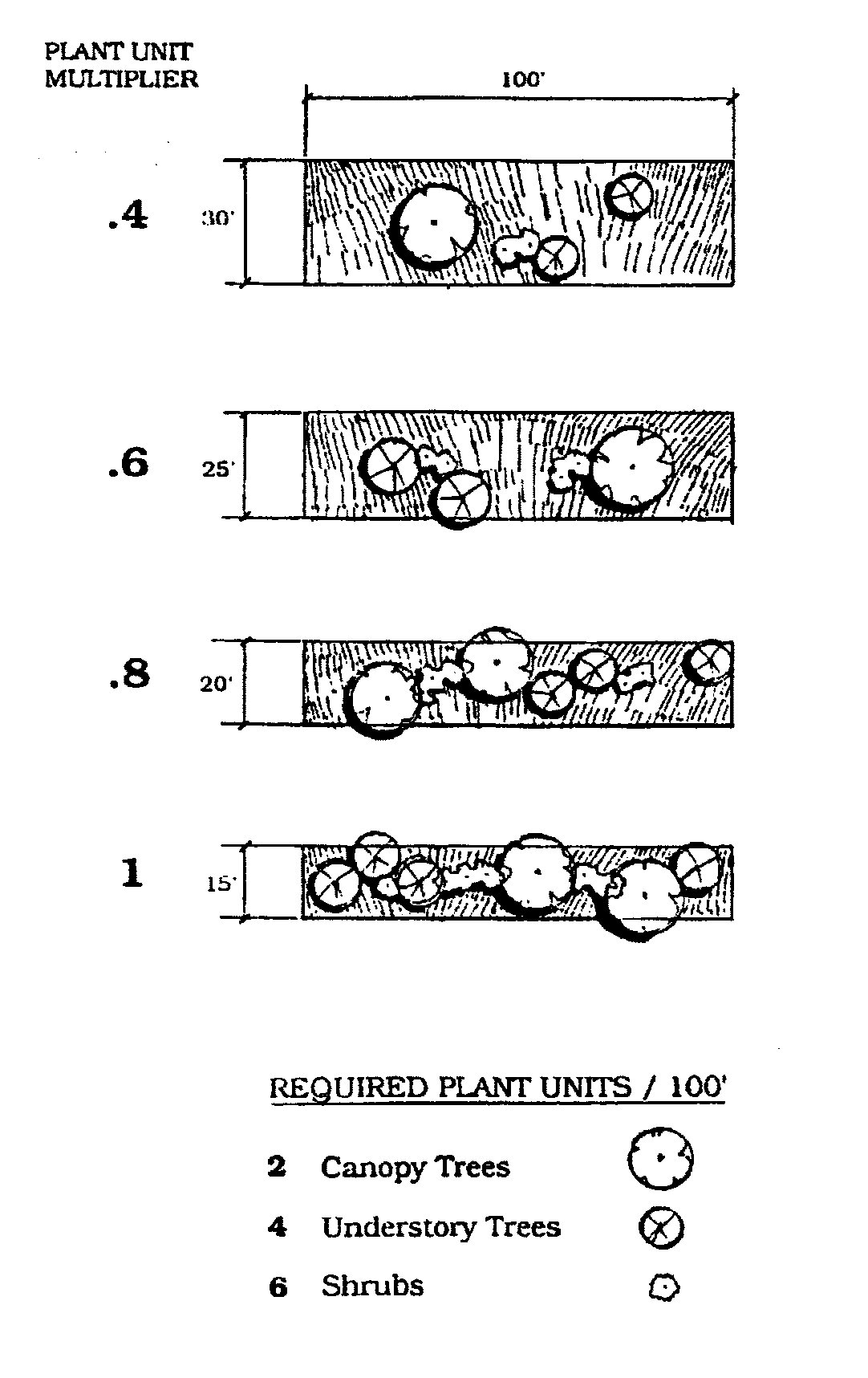
(b)
Minor (Residential). Where a commercial or office use abuts a residential district along a minor residential street, the commercial or office use, as the case may be, shall install the following buffer:
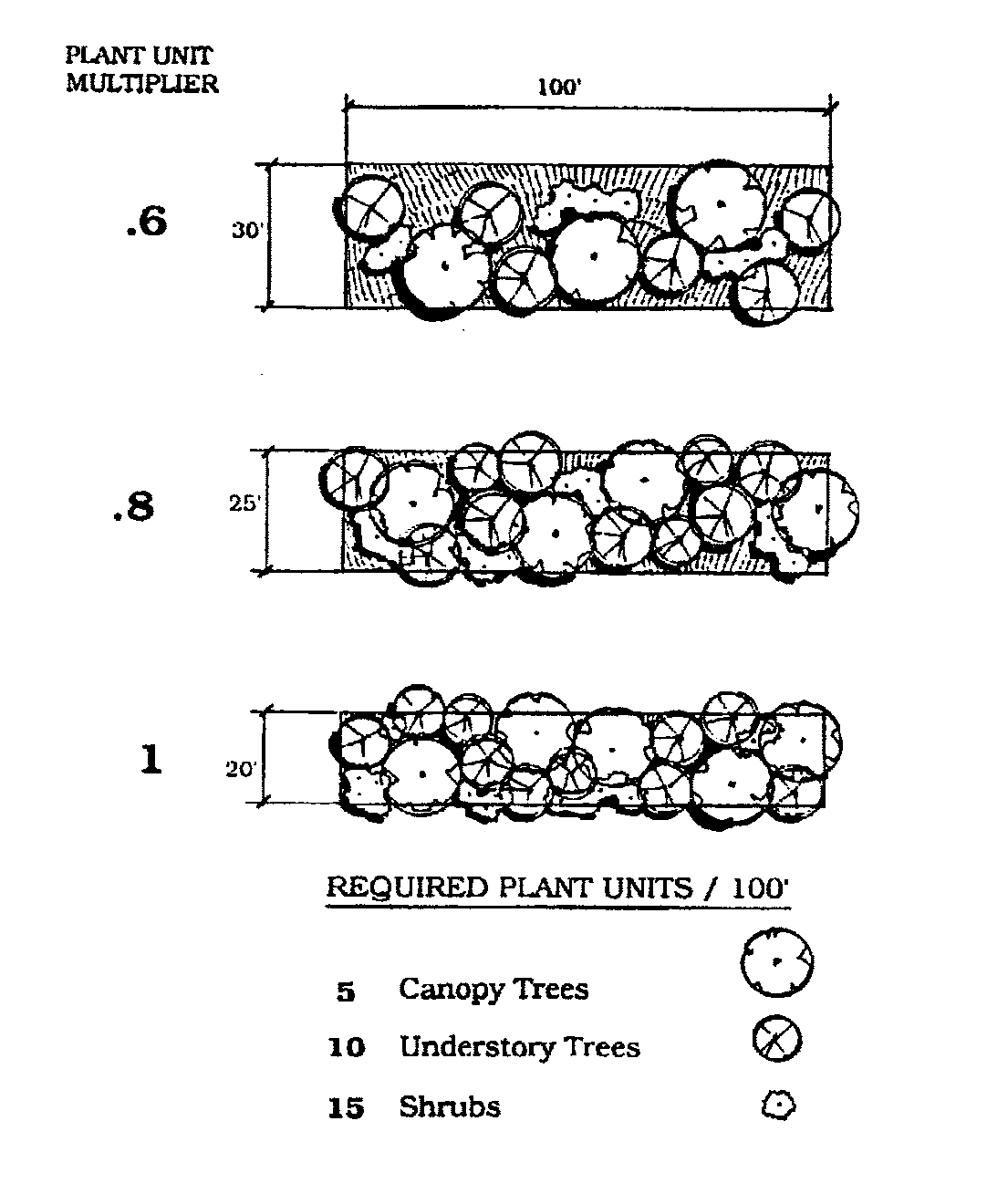
(c)
Minor (Commercial). Minor streets within or between commercial or office developments shall be required to install the following buffer along those streets:
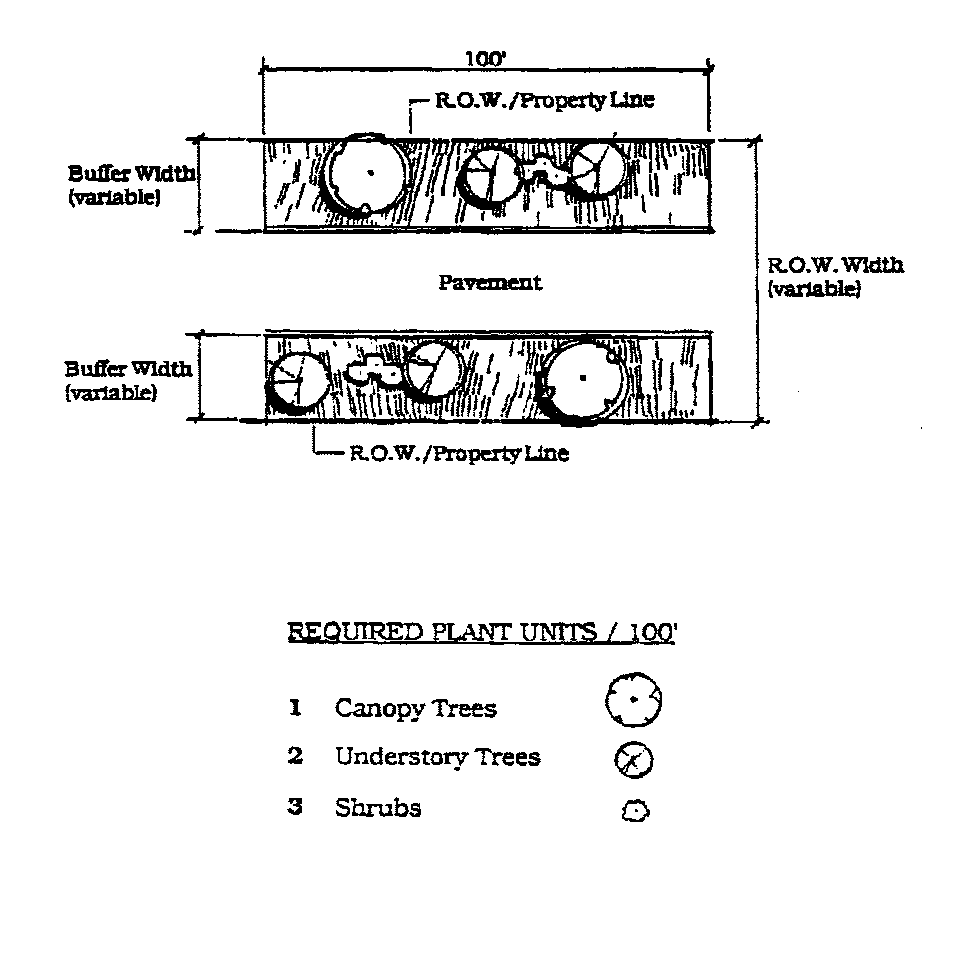
(d)
Zoning Districts. One of the following buffers shall be installed whenever a commercial or office development abuts a residential zoning boundary. A lesser buffer may be approved where the adjoining land is vacant and a zoning change is considered likely.
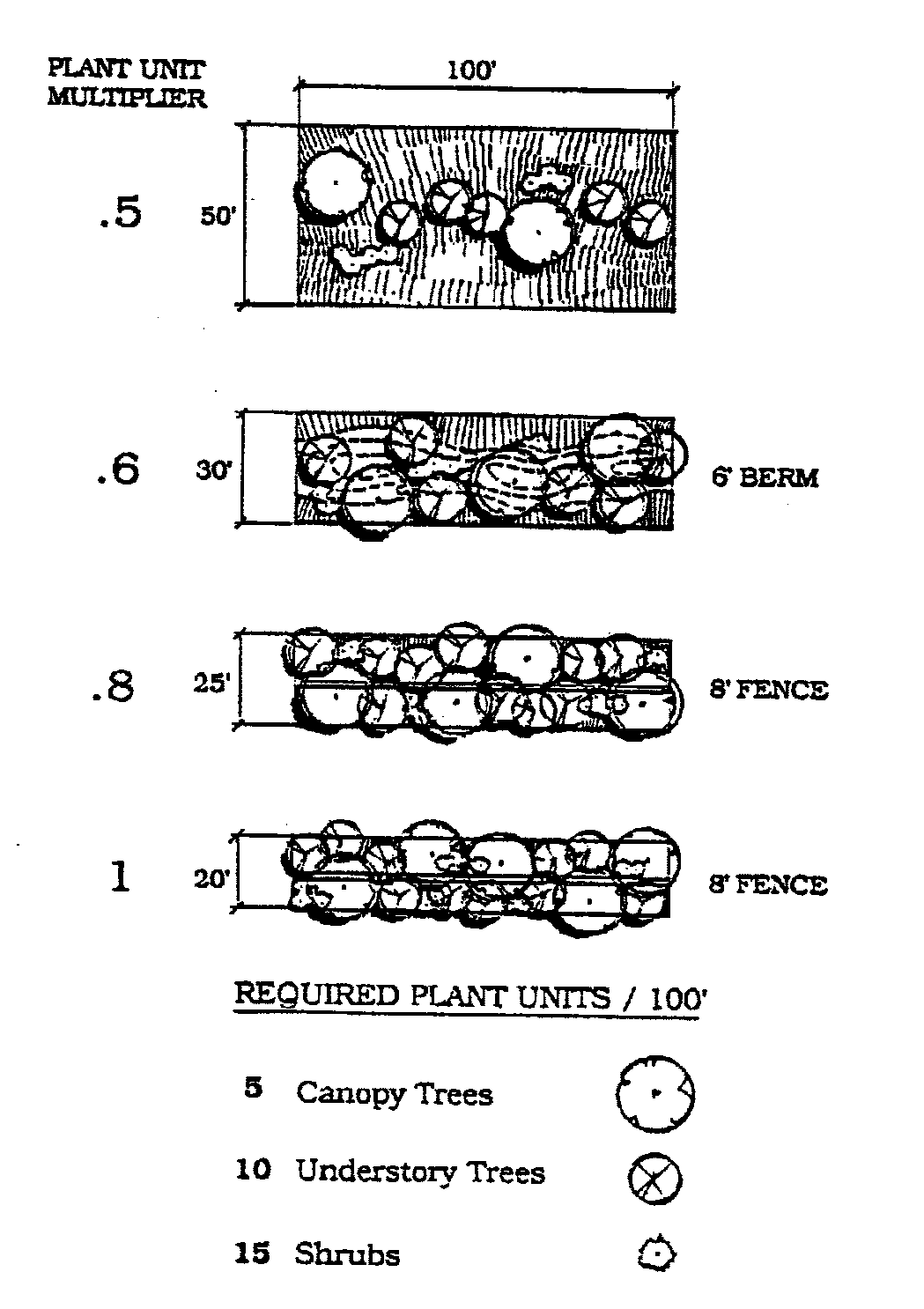
(e)
Collector Zoning Boundary. Where a collector or arterial road is a zoning boundary between residential and commercial or office districts, the following buffer shall be installed on the commercial or office lot, as the case may be:
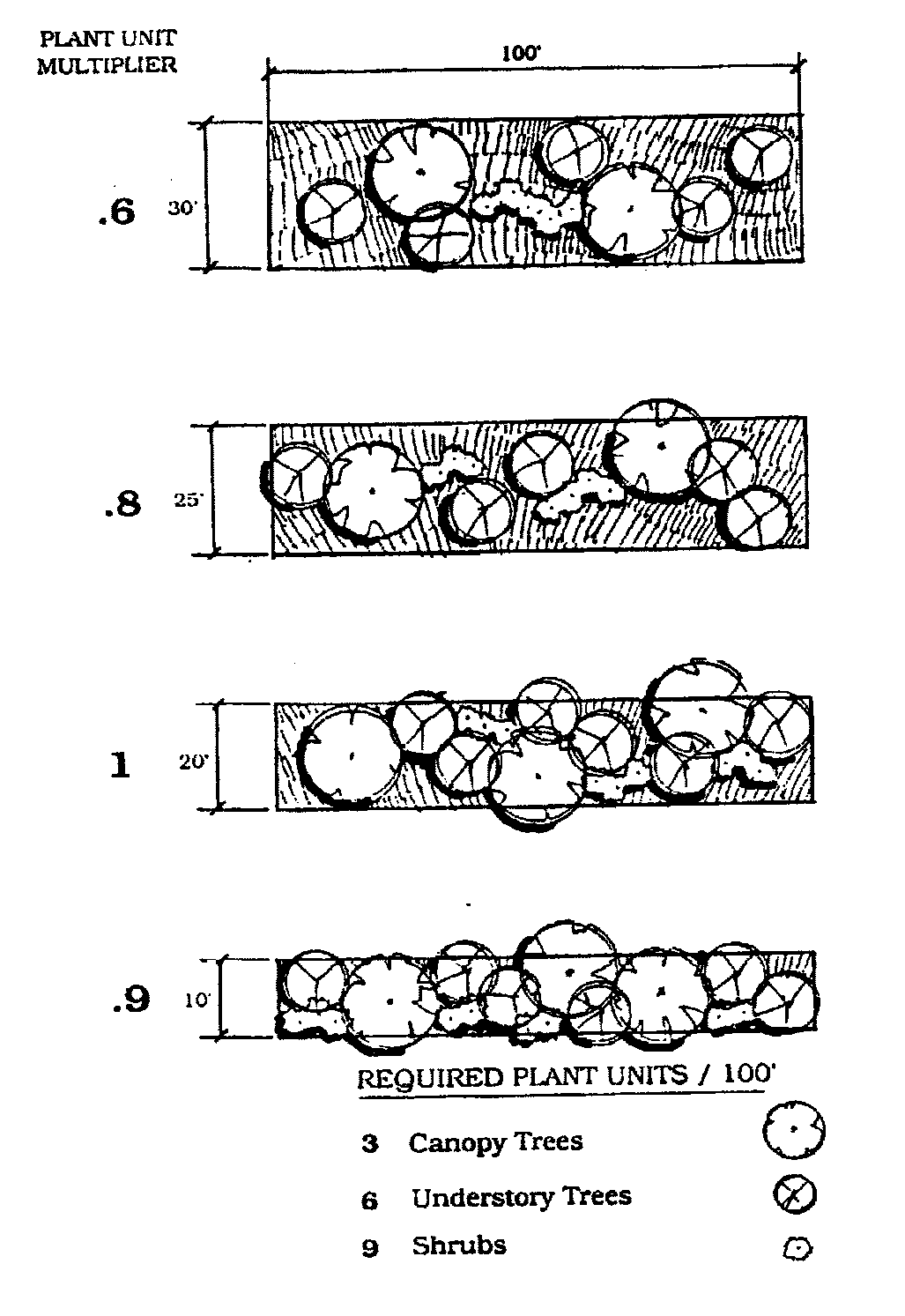
(D)
Parking Lots.
1.
Parking Lot Screening. Every parking lot and structure shall, to the extent hereinafter specified, be screened by a perimeter landscaped buffer yard having a width of at least ten feet or the width of the required yard, whichever is less. The landscaping and screening shall have a minimum height of at least three feet.
2.
Parking Lot Interior Landscaping. in addition to the requirements set forth in subsection (D)1 of this section, every parking lot containing ten or more parking spaces shall contain at least one tree of two inches or greater in diameter for each ten parking spaces. Such trees may be provided by the preservation of existing trees or the planting of new trees. Each tree shall be surrounded by a landscaped area of at least 36 square feet. No existing or new tree located more than five feet outside the perimeter of the paved parking area shall be counted in meeting the requirements of this subsection (D)2. All islands in excess of 50 square feet created by curbs or other traffic flow regulators shall be landscaped. Planting islands located within the interior of a parking lot shall be at least six feet in width.
(E)
Yards. for every 10,000 square feet of lot area not used for parking, buildings, or buffer yards, either of the following set of plant materials shall be provided:
(F)
Refuse Containers; Outdoor Storage.
1.
Screening. All refuse containers and all areas of permitted outdoor storage shall be enclosed on at least three sides by an opaque fence, wall, or densely planted evergreen hedge of a height and in a manner sufficient to completely screen such containers or storage areas from view from adjoining properties and public or private streets.
2.
Location. No refuse containers or storage areas shall be located between any principal structure and either its front or corner side lot line.
3.
Exemptions. The requirements of subsection (F)1 of this section shall not apply to standard receptacles permitted for use by single-family dwellings. None of the requirements of this subsection (F) shall apply to receptacles placed and maintained for use by the general public to avoid littering.
(G)
Antennas and Antenna Support Structures. Appropriate landscaping shall be installed and maintained for antenna and personal wireless antenna facilities. See subsections 5-9-1(D)7 and (D)8 of this chapter for additional requirements applicable to antennas and antenna support structures and amateur radio facilities.
(H)
Rooftop Mechanical Equipment. Except for antennas mounted on roofs pursuant to the provisions of this title, all mechanical equipment located on the roof of any building constructed after the effective date of this title shall be fully screened by a parapet wall or other screening structure constructed of materials compatible with the principal building facade to the height of such equipment.
(I)
General Landscaping and Maintenance Requirements. Except for permitted refuse containers, all areas of every lot shall be kept free of accumulations of garbage, trash, refuse, debris, and other unsightly or nuisance creating materials. All landscaping shall be continually maintained by the owner or other person responsible for maintenance of the premises, and all planting areas shall be kept free of weeds and debris. Undeveloped areas shall be kept free of accumulations of garbage, trash, refuse, debris, and other unsightly or nuisance creating materials until developed.
(Ord. No. 2007-O-04, 4-24-2007)
5-9-8. - Permitted obstructions in required yards.
Subject to the otherwise applicable district accessory use and structure setback regulations, the following shall not be considered to be obstructions when located in the required yards specified:
(A)
Front Yards and Side Yards Abutting a Street. Ornamental light standards and flagpoles. on corner lots, no obstructions of any kind including vegetation higher than 18 inches above curb level shall be located in any portion of a required front or side yard situated within 25 feet of the lot corner formed by the intersection of any two street lines.
(B)
Side Yards, Except those Abutting a Street. Open accessory off-street parking spaces.
(C)
Rear Yards. Private garages, either attached or structurally a part of the principal building; and private garages, detached, open accessory off-street parking spaces, accessory sheds, toolrooms, or other similar accessory buildings; recreational equipment, arbors and trellises.
(Ord. No. 2007-O-04, 4-24-2007)
5-9-9. - Exterior lighting.
(A)
Purpose. The village comprehensive plan refers to certain characteristics of the village which are cherished by its residents.
The village of Long Grove is unique. . . Long Grove has managed to retain much of the pristine rural charm. . . This has not occurred by coincidence but through thoughtful design.
One of the primary thrusts of the planning efforts of the village has been to achieve a consistent and pleasing quality of life.
Excessive amounts of artificial light intruding upon adjacent properties and visible to the public constitutes light pollution which tends to destroy the natural rural charm the village has strived to perpetuate. Light pollution is aesthetically destructive. It is inconsistent with the rural night and diminishes the economic value of properties which are subjected to light pollution. Our village residents moved here and purchased property here to enjoy the rural charm of the village, not to be subjected to needless and aesthetically harmful light pollution. The purpose of this section is to eliminate or reduce as much as possible light pollution.
It is the intent of this section to provide standards for controlled and moderate forms of illumination systems that promote safety and are consistent with the planning efforts of the village.
(B)
Classes of Lighting Areas.
1.
Class 1. Class 1 consists of the B1 zoning district.
2.
Class 2. Class 2 consists of all other nonresidential zoned areas not included in class 1. This classification also includes all property utilized for agricultural, educational or religious purposes. This classification does not include public or private roads, but does include driveways to areas that are otherwise within this classification.
3.
Class 3. Class 3 consists of residential areas of the village, including R1, R2, R3 and all residential portions of properties in a planned unit development.
4.
Class 4. Class 4 consists of all public and private roads, excluding driveways.
(C)
General Regulations. The regulations and standards set forth in table 5-14-A of this section shall regulate and govern the use of, modification of, construction of, installation of, or the erection of any illumination system for the purpose of lighting external areas, including, but not limited to, signs, parking areas, buildings, landscaping, walkways, porches, driveways, and public or private roads. Each illumination system must meet tests 1 through 6, inclusive, of table 5-14-A of this section, before a permit can issue. Table 5-14-A of this section indicates nonpermitted uses (NP symbol), permitted uses (P symbol), or uses subject to review and approval of the architectural board (AB symbol).
(D)
Lighting Permits. A permit shall be required for the construction, installation, modification, erection, or operation of any exterior illumination system except in class 3 areas, in accordance with section 5-11-21 of this title.
(E)
Existing Illumination Systems. All existing illumination systems which do not conform to the requirements of this section shall be brought into conformity with all of the criteria and standards set forth in this section no later than two years subsequent to adoption of this section.
(F)
Variations. The architectural board may, upon good cause shown, grant a variation to an owner from strict compliance with the standards set forth in this section if, in the determination of the architectural board, the variation is necessary to avoid an undue hardship upon the owner, and provided further that the architectural board determines that the illumination system with the variance requested shall not have any adverse effect upon adjacent properties, and provided further that the illumination system with the variation requested shall not result in light pollution subject to public view.
(Ord. No. 2007-O-04, 4-24-2007)
5-9-10. - Expanded agricultural uses.
(A)
Purpose. The purpose of this section is to regulate business uses, business developments, and business activities under the definition of expanded agricultural use contained in section 5-12-13 of this title. These regulations shall apply within any zoning district which permits agricultural uses.
(B)
Procedure. A special use permit must be obtained to operate expanded agricultural uses on a lot. The procedures and requirements for special uses contained in section 5-11-17 of this title shall apply.
(C)
Uses. The following uses are allowed as expanded agricultural uses:
1.
Raising of livestock and poultry, and all activities incidental thereto, except that chickens may also be kept as an accessory use in Residential Zoning Districts subject to the provisions of sections 5-9-1 of this chapter and 10-4-17 of this Code.
2.
Nurseries, including the business of landscape architect and landscape contracting. Permitted nursery uses include the following:
(a)
Office and design facilities.
(b)
Storage facilities for nursery and landscape contracting equipment such as trucks, tractors, hand tools and the like, storage of plant materials, including materials purchased from other nurseries and related materials such as soil, sand, gravel, brick, concrete blocks, peat moss, grass seed, fertilizer, stone, tile, lumber and boulders.
(c)
On site sales of plants grown on the lot.
(d)
On site or off site sale of landscape contracts for the furnishing and installing of plants and related materials and for related services such as tree trimming and maintenance. The burning of waste materials brought onto the premises shall be prohibited.
3.
Experimental farms.
(D)
Property Use Allocation for Expanded Agricultural Uses.
1.
Nonaccessory Use Property. Eighty percent of the total contiguous land must be used for raising of stock or open air nursery plantings. No buildings or other structures shall be permitted on this nonaccessory use property.
2.
Accessory Use Property. Accessory use property is limited to 20 percent of the total contiguous land and shall include property used for storage facilities, office facilities, design facilities, other buildings, and parking. Property not within the Village may not be used in calculating the portion of the property which can be devoted to accessory use. on all property, no building or other structure shall be located within the setback area required by the terms of the zoning classification within which the property is located. Buildings shall be completely enclosed. The following uses shall be permitted on accessory use property:
(a)
Storage of Materials. The on site storage of tools, spare parts and incidental materials. Space required for the on site storage or placement of these materials shall be considered accessory use property. Fencing shall be required to avoid view from roads and adjacent lot owners. Fencing location and description shall be detailed through the expanded agricultural use permit application. Owners shall be encouraged to utilize berms and/or landscaping to achieve the necessary buffer effect.
(b)
Employee, Customer, and Vendor Parking. Property used for employee, customer, and vendor parking as well as roadways is considered accessory use property.
(c)
Storage or Parking of Vehicles. The on site storage or parking of trucks, tractors, and related machinery property used for the above is considered accessory use property whether the storage or parking is in open air or inside facilities, subject to the following limitations:
(1)
The actual number of vehicles in open air storage or in overnight parking is limited in relation to the amount of contiguous property. The maximum number permitted in open air is:
Vehicles stored in inside facilities are not subject to the above calculation.
(2)
For open air storage or parking, fencing shall be required to avoid view from roads and adjacent lot owners. Fencing location and description shall be detailed through an expanded agricultural use permit application which is required.
(d)
Temporary Parking. No temporary parking or storage of trucks, trailers or other vehicles is permitted greater than one hour in duration on nonaccessory use property.
(e)
Office Facilities. The property used for office facilities shall be considered accessory use property. in no event shall permitted land use exceed either of the following:
(1)
Twenty percent of the total contiguous land used for permitted expanded agricultural uses.
(2)
Five thousand square feet.
(f)
Vehicle Maintenance. The maintenance activity or repair of trucks, trailers and related machinery is to be performed off site or inside on site building facilities. Property used for on site vehicle maintenance shall be considered accessory use property. on site maintenance activities are limited to the hours of Monday through Saturday 8:00 a.m. to 5:00 p.m.
(g)
Framed Greenhouses, Warehouses, Other Buildings. The property required for greenhouses, warehouses, temporary growing structures commonly known as cold frames, or other buildings shall be considered accessory use property.
(h)
Bulk Materials Stockpiles. These materials include soil, sand, peat, fertilizer, mulch, stone and related materials. The property required for these uses shall be considered accessory use property and stockpiles shall be screened. Fencing location and description shall be detailed through an expanded agricultural use permit application.
(i)
Plants and Nursery Stock. on the premises selling of living plants and nursery stock grown on the property is permitted. However, the sale of stock or other plants grown off site is prohibited. When plants or nursery stock have been removed from their growing location, any staging, storage or sales area shall be considered accessory use property.
(E)
Business License Required. A business license is required for expanded agricultural uses as set forth in title 3, chapter 1 of this code. A license will only be issued when compliance exists with this section.
(F)
Existing Use. Any existing uses which come within the definition of permitted expanded agricultural uses may continue subject to the provisions hereof. All such existing uses shall either terminate within seven years of adoption of this section, or a special use permit for the expanded agricultural use shall be secured therefor within said seven year period. No existing uses as defined in the expanded agricultural use definition may be expanded or altered without a special use permit for the expanded agricultural use having been secured therefor.
(G)
Other Limitations.
1.
Sales of Material or Stock Prohibited. The on site retail (consumer) sales of materials or stock other than those grown on the site is prohibited.
2.
Minimum Acres Required. Expanded agricultural uses shall require a minimum of ten contiguous acres of lot area within the village.
3.
Location of Buildings or Structures. in all tracts of land devoted to expanded agricultural uses, no building or other structure shall be situated or otherwise located within the setback area required by the terms of the zoning classification within which the lot is located. for example, if the lot is zoned in the R1 district, no buildings or other structures may be situated within 100 feet of the front yard as measured from the lot lines.
(Ord. No. 2007-O-04, 4-24-2007; Ord. No. 2011-O-37, 11-22-2011)
5-9-11. - Bed and breakfast accommodations.
(A)
Purposes. The purpose of this section is to provide for bed and breakfast accommodations (hereinafter referred to as "B&B") as a special use in certain zoning districts to provide temporary, short term accommodations for visitors to the village.
(B)
Procedure and General Standards.
1.
Procedure. A special use permit must be obtained to operate a B&B. The procedures and requirements for special uses as contained in section 5-11-17 of this title shall apply.
2.
General Standards. The following general standards, in addition to those otherwise set forth in this title, shall apply to the issuance of a special use for a B&B. No special use shall be approved unless the owner satisfactorily establishes that the issuance of a special use and the operation of a B&B will not:
(a)
Result in the degradation of the quality of the neighborhood within which the proposed B&B would be located.
(b)
Result in the diminution of property values of properties within the neighborhood within which the proposed B&B would be located.
3.
Supplemental Standards. The following supplemental standards shall apply for any B&B situated in a zoning district other than the B1 or B2 district:
(a)
The building shall be located on a three acre or greater lot, or less than three acres, if it is determined that the lot is uniquely suitable for a B&B use, and provided that such lot is no less than two acres in size and has adequate parking and screening.
(b)
The petitioner shall establish that the building is a high quality example of architecture.
(c)
The petitioner shall establish that the loss of the building and any outbuildings would be inevitable if the lot is limited to single-family residential use.
(d)
The petitioner shall establish that the building and any outbuildings represent a part of the historic and open space heritage of the village, and preserving the buildings is desirable to maintain village character.
(C)
Food Serving Standards. A B&B which serves breakfast shall comply with all applicable state statutes and regulations of the Lake County health department.
(D)
Individual Room Hygiene Standards. Each guest shall be provided individual soap and clean individual bath cloths and towels. Clean bed linen in good repair shall be provided for each guest and shall be changed between guests and as often as necessary. Clean linen shall be stored and handled in a sanitary manner.
(E)
Fire Safety Standards. Each B&B shall conform to the state fire marshal's requirements for one- and two-family dwellings and the following standards:
1.
Manual extinguishing equipment shall be provided on each floor in accordance with NFPA 10 - standards for the installation of portable fire extinguishers.
2.
All combustibles or flammable liquids shall be stored in approved metal containers. No combustible storage in or under stairways.
3.
All trash containers shall be metal.
4.
No cooking facilities shall be permitted in guestrooms. A separate kitchen facility for any cooking shall be required.
5.
All hallways and stairways shall be adequately lighted.
6.
No portable heating devices shall be permitted in guestrooms.
7.
The operator shall submit a floor plan of the B&B to the fire district in which it is located.
8.
Smoke detectors shall be provided in each guestroom.
9.
Each B&B to be situated in a new structure shall be equipped with a fire sprinkler system approved by the village superintendent. If a B&B is to be located in an existing structure which will involve substantial alterations, as determined by the village superintendent, a fire sprinkler system approved by the village superintendent must be installed for the area devoted to the B&B use. in all other B&B uses, which do not have a fire sprinkler system, a fire and smoke detection system shall be installed throughout the structure, which provides an audible and visible alarm signal capable of notifying guests in the guestrooms. This system must include smoke detectors in all rooms and corridors, and heat detectors in kitchens, attics, and garages, all of which must be connected to a fire alarm control panel, which system complies with the National Fire Protection Association standard NFPA 72-1996, or such other fire protection system as is expressly approved in writing by the chief of the fire district in which the lot is located.
(F)
Occupancy Permit. An annual occupancy permit shall be required for each B&B. Occupancy permits shall be issued on a calendar year basis.
(G)
Fee. The operator of the B&B shall pay an annual fee to the village to help defray the cost of administering this section in the amount provided in section 12-1-2 of this code per guestroom or such other amount as is approved from time to time by the village board. The fee shall be paid prior to commencing operations and thereafter on or before January 1 of each calendar year in which the B&B commences or continues operations. No B&B shall commence operations unless and until the requisite fee has been paid and the special use and annual occupancy permits have been issued.
(H)
Liability Insurance. Each B&B shall maintain and provide proof of adequate general liability and premises liability insurance in an amount not less than $1,000,000.00 per occurrence and $3,000,000.00 in the aggregate, or such other amounts of insurance as are approved from time to time by the village board.
(I)
Taxes. Each B&B shall fulfill all applicable requirements of the Illinois department of revenue, including the payment of any applicable taxes.
(J)
State of Illinois Standards. Each B&B shall conform with the applicable state standards for a B&B. in the event of a conflict between said standards and those of this title, the more stringent provision shall govern.
(K)
Minimum Parking Requirements. Each B&B shall comply with the following parking standards:
1.
No parking space shall be located within any required setback.
2.
One nine-foot by 20-foot parking space shall be provided for each guestroom.
3.
All parking spaces shall be adequately screened from adjacent lot owners.
(L)
Illumination Standards. Any proposed illumination system shall comply with the standards set forth for class 3 in section 5-9-9 of this chapter, and shall be subject to the review and approval of the architectural board.
(M)
Signage. The sign regulations applicable to B&Bs are set forth in section 5-9-5 of this chapter.
(N)
Landscape Requirements. as part of the special use application, the owner shall submit and have approved a landscape plan, which shall consist of:
1.
Perimeter plantings to ensure that the B&B operations cause no adverse impact on neighboring properties.
2.
Additional landscaping including native plants, as deemed necessary or desirable by the plan commission, to provide a rural, conservation oriented site consistent with the comprehensive plan.
(O)
Outside Recreational Activities. No outside recreational activities such as, but not limited to, pools, tennis courts, basketball courts, or volleyball courts shall be permitted for or utilized by guests, unless such activities are approved by the village board as part of the special use permit and sufficient additional screening is installed and maintained.
(P)
Seminar, Lecture, Convention Activities. No B&B shall be used to conduct any activities involving a seminar, lecture, or convention, or for a private party, unless prior written permission is obtained from the village board.
(Q)
Quality Standards and Rating Requirements. Each B&B shall be required to submit to quality reviews as administered by the village on a quarterly basis or such other frequency as is determined from time to time by the village board. This review may be done by an organization authorized by the village board.
1.
Each B&B shall permit the reviewing authorized individuals full access during normal business hours sufficient to permit a thorough inspection.
2.
Each B&B shall post in a prominent position readily seen by guests the rating and findings of the two most recent reviews.
3.
Each person seeking accommodations at a B&B shall be provided by the operator with a copy of the two most recent reviews.
(Ord. No. 2007-O-04, 4-24-2007)
5-9-12. - Public assemblies.
A special use permit shall be required for any public assembly use, including any religious facility, library, museum, private school, and other similar use, and shall conform to, in addition to all other applicable village code provisions, the following:
(Ord. No. 2009-O-07, 3-10-2009)
5-9-13. - Wind energy systems (WES) prohibited.
Wind energy systems, whether mounted on the ground or attached to a building or other structure, are a prohibited use in all zoning districts within the Village. For purposes of this section, "wind energy system" means a system or device containing one or more turbines (whether orientated on a horizontal axis or a vertical axis) that are turned by wind to produce electricity.
(Ord. No. 2020-O-10, § 2, 6-23-2020)
Editor's note— Ord. No. 2020-O-10, § 2, adopted June 23, 2020, amended § 5-9-13; in its entirety, in effect repealing and reenacting said § 5-9-13 to read as set out herein. The former 5-9-13, pertained to wind energy systems (WES) and derived from Ord. No. 2013-O-09, adopted May 28, 2013.
5-9-14. - Solar energy systems (SES).
(A)
Purpose. The purpose of this Section 5-9-14 is to:
1.
Establish reasonable and uniform regulations for the location, installation, operation and maintenance of Solar Energy Systems ("SES");
2.
Assure that any development and production of SES is safe and minimizes any potentially adverse effects on the community;
3.
Promote the supply of sustainable and renewable energy resources, in support of national, state and local goals; and
4.
Facilitate energy cost savings and economic opportunities for residents and businesses situated within the Village.
(B)
Solar Energy System (SES) Regulations. SES are only allowed as authorized in this Section 5-9-14, and all SES shall comply with the regulations set forth in this Section 5-9-14.
1.
Compliance with Laws. All SES shall comply with all applicable Village, state, and federal laws and regulations, including, without limitation, the provisions of this Section 5-9-14, this Code, and all applicable Village building ordinances and regulations.
2.
Compliance with Permits. All SES shall obtain and comply with all applicable permits pursuant to this Section 5-9-14, including, without limitation building and electrical permits, all conditions imposed by the Village as a condition of issuance of these permits shall be complied with.
3.
Use and Energy Production Restrictions. The sole purpose of the SES shall be the production of energy for consumption on the property on which the SES is located; provided, however, that excess energy produced by a SES may be sold to a local electric utility company, subject to the limitations of this section. The capacity size of an SES shall be limited to 110 percent of the electricity usage on the property where the SES is located during the 12 months preceding installation of the SES, as determined by the Village Engineer. If such data is unavailable, or if the SES is being installed in connection with a change of use of the subject property, then the capacity size of the SES shall be limited to 110 percent of the property's expected annual electricity usage as determined by the Village Engineer.
4.
Interference with Utilities, Roads, and Neighboring Properties. No SES shall be operated in a manner so as to interfere with any public right-of-way or any utility system in the Village, or so as to interfere with the reasonable use and enjoyment of any other property in the Village.
5.
Engineering Requirements. SES shall conform to all applicable industry standards, including, without limitation, the standards developed by the American National Standards Institute. No SES may utilize concentrated solar thermal technology in any zoning district. "Concentrated solar thermal technology" shall include any solar technology that uses lenses or mirrors, with or without tracking systems, to focus or reflect sunlight from a larger area into a smaller area.
5.1
Lighting. Lighting of SES (including all appurtenant facilities or structures) shall be consistent with local, state, and federal laws, shall be used to the minimum extent necessary, and shall be limited to that required for safety or operational purposes. All lighting shall be shielded from abutting properties, shall be directed downward, and shall incorporate full cut-off fixtures.
5.2
Maintenance.
(a)
SES facilities shall be kept in Operable Condition at all times, except for reasonable maintenance and repair outages. For purposes of this section "operable condition" shall mean the condition of being capable of operating at full capacity while meeting all conditions set forth in this Code.
(b)
Should a SES become inoperable for any reason except reasonable maintenance and repair as noted above, or should any part of the SES become damaged, or should a SES violate a permit condition, the owner of the SES shall cease operations immediately and remedy the condition within 90 days after receipt of a notice from the Village regarding the condition, or such longer time to which the SES owner and the Village may agree; provided, however, that if the condition presents an immediate threat to the public health, safety, or welfare, the owner of the SES shall remedy the condition within such time as may be required by the Village.
6.
Building-Mounted SES.
(a)
Solar Energy System Permit Required. Building-mounted SES are allowed as a permitted use in any zoning district, but only as an accessory use in accordance with Section 5-9-1 of the Village Code (and not as a principal use) on any property, and only upon issuance of a Solar Energy System permit in accordance with the following:
(1)
The owner of the property on which the SES is proposed to be installed shall submit an application for building permits, as applicable, pursuant to Title 4 of the Long Grove Village Code. Such application shall include the Minimum Data Requirements identified in section 5-11-8(E)15 of this Code.
(2)
Upon receipt of a complete application pursuant to Title 4 of this Code, and upon a determination by the Village that the application and the proposed Building-Mounted SES comply with the requirements set forth in this and the other applicable codes the Village shall issue permits for the SES.
(b)
Location.
(1)
SES may be mounted on the roof of a permitted principal or accessory structure; provided, however, that any SES on a detached accessory structure shall serve, at least in part, to provide power to the detached accessory structure on which it is mounted. SES shall not be mounted upon any other portion of any principal or accessory structure.
(2)
SES must either be: (1) an integral part of the structure, rather than a separate mechanical device, replacing or substituting for an architectural or structural part of the building, such as a photovoltaic or hot water system that are contained within roofing materials, windows, skylights, shading devices and similar architectural components; or (2) mounted flush with, and parallel to, a finished surface, at no more than six inches in height above that surface.
(3)
Applications and plans for a Building Mounted SES within the B-1 Historic District shall also be subject to review and approval by the Architectural Commission.
(c)
Horizontal Projection. SES shall not extend beyond the exterior perimeter of the structure on which the SES is mounted.
(d)
Setbacks. All portions of building-mounted SES shall comply with the generally applicable setback restrictions for the Zoning District or building setbacks lines as established in a Planned Unit Development (PUD) in which the SES is located.
(e)
Height. The height of any building-mounted SES shall not exceed the lesser of: (i) the height of the peak of that portion of the roof of the structure on which the SES is mounted; and (ii) the generally applicable height restrictions for the Zoning District in which the SES is located. For purposes of this section, "height" shall be measured vertically from the lowest edge of the panel to the highest edge of the SES.
(f)
Maximum Roof Coverage. No SES shall occupy more than 80 percent of the cumulative area of the face of the structure on which the SES is mounted, unless the SES is incorporated into, and is an integral part of, the structural elements of the face on which it is mounted.
(g)
Color. The frame or skirt of building-mounted SES shall be finished in a neutral color that blends with the building surface on which the SES is mounted, and the panels shall be black or another neutral color that blends with the framing or skirt and mounting surface. A color and finish that is reasonably close in appearance to that of the mounting surface, to the extent feasible without impairing the functionality of the SES, shall be deemed to blend with the mounting surface as required by this paragraph.
7.
Ground-Mounted SES. Ground mounted SES are a prohibited use in all zoning districts within the Village.
8.
Portable SES for Swimming Pools. Portable SES for swimming pools may only be constructed and used within the Village in accordance with the following provisions:
(a)
No portable SES may be constructed or used prior to April 1 or after October 31 of any calendar year.
(b)
No portable SES may be used for any purpose other than the provision of heat for an outdoor swimming pool located within a Residential District.
(c)
Portable SES shall be constructed and used in accordance with the applicable provisions of Chapter 9, Section 5-9-1 (D) (3) of this Code.
9.
Decommissioning.
(a)
A SES, or any material portion or component thereof, that is not in operable condition for a period exceeding 90 consecutive days shall be deemed abandoned unless the owner of the SES is diligently pursuing maintenance, modifications, or repairs to the SES during such time. The owner of an abandoned SES and the owner of the property on which the SES is located shall cause the removal of all abandoned SES structures and facilities within 30 days after receipt of a notice of abandonment from the Village, or such longer time as the Village may specify in the notice. Decommissioning shall include:
(1)
Physical removal of the SES, including all systems, structures (other than a permitted principal or accessory structure to which the SES is mounted), equipment, security barriers, and electrical wiring lines from the site;
(2)
Disposal of all solid and hazardous waste in accordance with local, state, and federal waste disposal regulations; provided, however, that energy system equipment and building materials shall be disposed of by recycling, rather than landfilling, to the maximum extent possible; and
(3)
Stabilizing or re-vegetation of the site as necessary to minimize erosion and restoration of the subject property in accordance with the standards required by the Village's then-current applicable codes.
Notwithstanding the foregoing, the Village may allow the owner to leave landscaping or to abandon-in-place designated below-grade structures, foundations, or wiring in order to minimize disruption to vegetation, natural habitats, or existing structures.
(b)
Any abandoned SES that is not removed within 30 days after receipt of a notice of abandonment, or such other time as the Village and owner may agree, shall be deemed a public nuisance, which nuisance the Village shall have the right, but not the obligation, to summarily abate by removing such SES at the joint and several expense of the owners of the SES and of the property on which the SES is located. As a condition of permit approval for a SES, the applicant shall agree to allow the Village entry upon the subject property to remove an abandoned SES in accordance with this paragraph. In the case of such removal, the Village shall have the right, but not the obligation, to file a lien for reimbursement of any and all expenses incurred by the Village in connection with the removal, including, without limitation, attorney fees and accrued interest.
(c)
Decommissioning Plan. Prior to, and as a condition of, issuance of any permit for a SES that is accessory to a non-residential use, the owner shall prepare a decommissioning plan, which plan shall be subject to Village approval. The plan shall: (i) address all required components of the decommissioning process in accordance with this Section; (ii) show final site conditions after decommissioning is completed; and (iii) include an engineer's opinion of probable cost for decommissioning in accordance with the plan. Unless otherwise approved by the Village Board, the owner shall post a bond or letter of credit in a form acceptable to the Village in the amount of 130 percent of the engineer's estimate. The decommission plan shall be reasonably detailed and specific based on the legal requirements, technology, and technical information available at the time the plan is prepared. In the event of material changes to such requirements or information during the life of the SES, the Village may request that the owner of the SES review and update the plan on file, and the owner shall promptly comply with such request.
(C)
Fees; Costs. Any third-party expenses incurred by the Village in connection with the compliance reviews set forth in Section 5-9-14B3.1 shall be deemed an additional application fee, and the owner of the SES and of the property on which such system is located shall be responsible for such fee in accordance with Section 5-11-8(D) of this Code.
(D)
Indemnification. The owner of each SES, and the owner of the property on which the SES is located, shall jointly and severally defend, indemnify and hold harmless the Village and its officials from and against any and all claims, demands, losses, suits, causes of action, damages, injuries, costs, expenses and liabilities whatsoever including attorney's fees arising out of any permit, approval, inspection, or other act or omission of the Village, or any acts or omissions of the owners concerning the operation of the SES, including, without limitation, whether said liability is premised on contract or on tort.
(Ord. No. 2020-O-10, § 3, 6-23-2020)
Editor's note— Ord. No. 2020-O-10, § 3, adopted June 23, 2020, amended § 5-9-14; in its entirety, in effect repealing and reenacting said § 5-9-14 to read as set out herein. The former 5-9-14, pertained to solar and geothermal energy systems and derived from Ord. No. 2013-O-09, adopted May 28, 2013; Ord. No. 2019-O-03, adopted March 26, 2019.
5-9-15. - Geothermal Energy systems (GES).
(A)
Purpose. The purpose of this Section 5-9-15 is to:
1.
Establish reasonable and uniform regulations for the location, installation, operation, and maintenance of GES;
2.
Assure that any development and production of GES is safe and minimizes any potentially adverse effects on the community;
3.
Promote the supply of sustainable and renewable energy resources, in support of national, state and local goals; and
4.
Facilitate energy cost savings and economic opportunities for residents and businesses situated within the Village.
(B)
Definitions. Notwithstanding Section 5-12-13 of this Code, when used in this Section 5-9-15, the following terms shall have the meanings herein ascribed to them. Any terms not listed in this Subsection B shall have the meanings set forth in Section 5-12-13 of this Code.
Height. When used in reference to a GES, "height" shall mean the vertical distance measured from lowest ground surface (grade) adjacent to any structure, equipment, or facility comprising the GES or any part thereof to the highest point of such structure, equipment, or facility. When used in reference to any other structure, "height" shall have the meaning set forth in Section 5-12-13 of this Code.
Operable Condition. For any GES, the condition of being capable of operating at full capacity while meeting all conditions set forth in this Code.
(C)
General Regulations. All GES shall comply with the regulations set forth in this Section 5-9-15.
1.
Compliance with Laws. All GES shall comply with all applicable Village, county (including, without limitation, applicable regulations of the Lake County Health Department), state, and federal laws and regulations, including, without limitation, the provisions of this Code, and all Village building ordinances and regulations.
2.
Compliance with Permits. All GES shall obtain and comply with all applicable GES permits including, without limitation, all conditions imposed by the Village as a condition of issuance of the permits.
3.
Permitted Locations. GES are allowed as a permitted use in any zoning district, but only as an accessory use (and not as a principal use) on any zoning lot, and only upon issuance of applicable building permits in accordance with the following:
(a)
The owner of the property on which the GES is proposed to be installed shall submit an application for building permits, as applicable, pursuant to Title 4 of the Long Grove Village Code. Such application shall include the Minimum Data Requirements identified in section 5-11-8(E)16 of this Code.
(b)
Upon receipt of a complete application pursuant to Title 4 of this Code, and upon review and determination by the Village that the application and the proposed GES complies with the requirements set forth in this and the other applicable codes, the Village shall issue permits for the GES.
4.
Engineering Requirements. GES shall conform to all applicable industry standards, including, without limitation, the standards developed by the American National Standards Institute.
5.
Setbacks; Height. Any components of a GES that are located above ground shall comply with: (i) the generally applicable height limitations for accessory structures for the Zoning District in which the system is located; and (ii) and the generally applicable setback restrictions for the Zoning District or building setbacks lines as established in a Planned Unit Development (PUD) in which the system is located.
6.
Installation in Rights-of-Way Prohibited. No portion of a GES shall be installed in any right-of-way or in any easement dedicated for roadway purposes.
7.
Lighting. Lighting of GES (including all appurtenant facilities or structures) shall be consistent with local, state, and federal laws, shall be used to the minimum extent necessary, and shall be limited to that required for safety or operational purposes. All lighting shall be shielded from abutting properties, shall be directed downward, and shall incorporate full cut-off fixtures.
8.
Maintenance.
(a)
GES facilities shall be kept in Operable Condition at all times, except for reasonable maintenance and repair outages.
(b)
Should a GES become inoperable for any reason except reasonable maintenance and repair as noted above, or should any part of the GES become damaged, or should a GES violate a permit condition, the owner of the GES shall cease operations immediately and remedy the condition within 90 days after receipt of a notice from the Village regarding the condition, or such longer time to which the GES owner and the Village may agree; provided, however, that if the condition presents an immediate threat to the public health, safety, or welfare, the owner of the GES shall remedy the condition within such time as may be required by the Village.
9.
Use and Energy Production Restrictions. The sole purpose of the GES shall be the production of energy for consumption on the property on which the GES is located.
10.
Reporting to Village. Not less than once every 12 months, the owner of each GES that is accessory to a non-residential use shall submit to the Village a sworn statement that the operation and maintenance of the GES has been performed in compliance with all applicable directions issued by the manufacturer thereof, along with supporting evidence as may be requested by the Village.
(D)
Indemnification. The owner of each GES, and the owner of the property on which the GES is located, shall jointly and severally defend, indemnify and hold harmless the Village and its officials from and against any and all claims, demands, losses, suits, causes of action, damages, injuries, costs, expenses and liabilities whatsoever including attorney's fees arising out of any permit, approval, inspection, or other act or omission of the Village, or any acts or omissions of the owners concerning the operation of the GES, including, without limitation, whether said liability is premised on contract or on tort.
(E)
Decommissioning.
1.
A GES, or any material portion or component thereof, that is not in Operable Condition for a period exceeding 90 consecutive days shall be deemed abandoned unless the owner of the GES is diligently pursuing maintenance, modifications, or repairs to the GES during such time. The owner of an abandoned GES and the owner of the property on which the GES is located shall cause the removal of all abandoned GES structures and facilities within 30 days after receipt of a notice of abandonment from the Village, or such longer time as the Village may specify in the notice. Decommissioning shall include:
(a)
Physical removal of the GES, including all systems, structures, equipment, security barriers, and electrical wiring lines from the site;
(b)
Disposal of all solid and hazardous waste in accordance with local, state, and federal waste disposal regulations; provided, however, that energy system equipment and building materials shall be disposed of by recycling, rather than landfilling, to the maximum extent possible; and
(c)
Stabilizing or re-vegetation of the site as necessary to minimize erosion and restoration of the subject property in accordance with the standards required by the Village's then-current applicable codes.
Notwithstanding the foregoing, the Village may allow the owner to leave landscaping or to abandon-in-place designated below-grade structures, foundations, or wiring in order to minimize disruption to vegetation, natural habitats, or existing structures.
2.
Any abandoned GES that is not removed within 30 days after receipt of a notice of abandonment, or such other time as the Village and owner may agree, shall be deemed a public nuisance, which nuisance the Village shall have the right, but not the obligation, to summarily abate by removing such System at the joint and several expense of the owners of the GES and of the property on which the GES is located. As a condition of permit approval for a GES, the applicant shall agree to allow the Village entry upon the subject property to remove an abandoned GES in accordance with this paragraph. In the case of such removal, the Village shall have the right, but not the obligation, to file a lien for reimbursement of any and all expenses incurred by the Village in connection with the removal, including, without limitation, attorney fees and accrued interest.
3.
Decommissioning Plan. Prior to, and as a condition of, issuance of any permit for a GES that is accessory to a non-residential use, the owner shall prepare a decommissioning plan, which plan shall be subject to Village approval. The plan shall: (i) address all required components of the decommissioning process in accordance with this Section; (ii) show final site conditions after decommissioning is completed; and (iii) include an engineer's opinion of probable cost for decommissioning in accordance with the plan. Unless otherwise approved by the Village Board, the owner shall post a bond or letter of credit in a form acceptable to the Village in the amount of 130 percent of the engineer's estimate. The decommission plan shall be reasonably detailed and specific based on the legal requirements, technology, and technical information available at the time the plan is prepared. In the event of material changes to such requirements or information during the life of the SES, the Village may request that the owner of the SES review and update the plan on file, and the owner shall promptly comply with such request.
(F)
Fees; Costs. Any third-party expenses incurred by the Village in connection with the compliance reviews set forth in Section 5-9-15(C)10. shall be deemed an additional application fee, and the owner of the GES and of the property on which such system is located shall be responsible for such fee in accordance with Section 5-11-8(D) of this Code.
(Ord. No. 2020-O-10, § 4, 6-23-2020)

