
Los Alamos County Unincorporated
City Zoning Code
City Zoning Code
ARTICLE IV
DEVELOPMENT STANDARDS
Sec. 16-20. - Required setback areas.
(a)
A setback is the minimum required distance between the established lot line and any building on the lot or, where the lot line is within a street or access easement, the edge of the street or easement and any building on the lot.
(b)
Front setback refers to the line that defines the depth of the required front setback area. The front setback shall be parallel with the street line or future right-of-way line.
(c)
Side setback refers to the line that defines the width or depth of the required side setback area. The side setback line shall be parallel with the property line or if abutting a street shall be parallel with the street line or future right-of-way line.
(d)
Interior side setback refers to the line that defines the width or depth of a required side setback area that is parallel with an adjacent property line that is not abutting a street or public right-of-way and is not defined as a front or rear setback area.
(e)
Street side setback refers to the line that defines the width or depth of a required side setback area that is parallel with the a-butting street line or future right-of-way line and is not defined as a front or rear setback area.
(f)
Rear setback refers to the line that defines the width or depth of the required rear setback area. The rear setback line shall be parallel with the property line or if abutting the street shall be parallel with the street line or future right-of-way line. The rear setback area is that which is furthest away from the front setback area.
Figure 19: Required Setbacks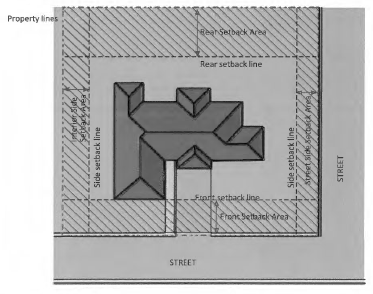
(g)
Required setbacks shall be determined by the underlying base zone district pursuant to the standards in article II, Zone Districts, except if a multi-family, mixed-use or non-residential zone district lot abuts or is adjacent to any low-density residential lot when it shall comply with the standards of division 5, Neighborhood Protection Standards.
(h)
Except as allowed elsewhere in this chapter, no building or accessory structure shall be allowed within a required setback area between a property line and required front, side, or rear setback pursuant to the standard of the underlying base zone district in article II, Zone Districts.
(i)
Except as allowed elsewhere in this chapter, every required setback area shall remain open, unobstructed, and free of ruins, wreckage, rubbish, and debris.
(Ord. No. 02-363, § 3, 11-19-2024)
Sec. 16-21. - Permitted projections into required setback areas.
(a)
Uncovered walkways, driveways, steps, patios, or courtyards may extend any distance into any required setback area.
Figure 20: Non-structural
Projections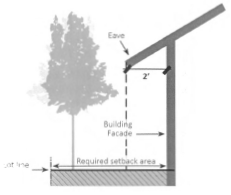
(b)
Non-structural architectural features such as eaves, cornices, sills, chimneys, awnings, or similar features may project a maximum of two feet into any required setback area.
(c)
Fire escapes and fire-resistive outside stairways may project into any required rear or side setbacks as permitted by the latest version of the New Mexico Building Code adopted by the county.
(d)
Uncovered porches or decks may extend a maximum of 40 percent of the required setback area into a required rear setback area but shall not extend any distance into a required side or front setback area.
(e)
Except as otherwise provided in this chapter, structural architectural features including arcades, balconies, bay windows, or similar may project a maximum of two feet into the required front setback area and five feet into any required rear setback area.
(f)
Carports may occupy a maximum of 40 percent of the required front setback area.
Figure 21: Uncovered Projections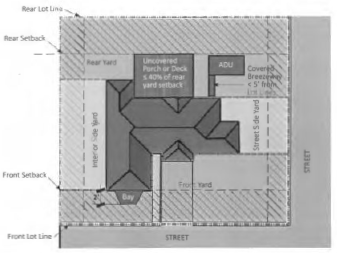
(g)
Covered patios, porches, or decks attached to the primary building may occupy a maximum of 40 percent of the required rear setback area provided that the space under the cover is open on at least three sides and the eave of the patio or porch cover may encroach up to two feet into a required side or rear yard setback, but not closer than three feet from any lot line.
(h)
A roofed breezeway connecting a primary building and an accessory structures may project into the required rear yard in any residential zone district provided that the breezeway is a minimum of five feet from all lot lines and open on all sides except for the supporting posts.
Figure 22: Covered and Structural Projections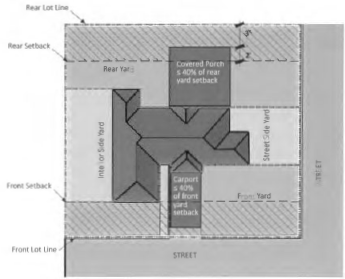
Sec. 16-22. - Yard requirements.
(a)
A yard is the open space between the lot line and a building.
(1)
Front yard refers to the part of a lot from the front lot line to any front façade of the primary building, extended to both side lot lines. If there is no primary building on the lot, the front yard refers to the part of a lot within the minimum setback in the zone district on the side of the lot where the property will be addressed.
(2)
Interior side yard refers to the part of a lot from an interior side lot line to the side façade of the primary building.
(3)
Street side yard refers to the part of a lot from a street side lot line the side façade of the primary building.
(4)
Rear yard refers to the part of a lot from the rear lot line to any rear façade of the primary building, extended to both side lot lines.
Figure 23: Yards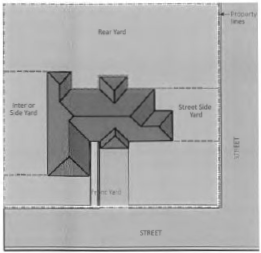
(b)
On a corner lot in any residential zone district, the owner has a choice of which yard is the front yard and to construct the dwelling unit accordingly, unless the front yard is designated on the recorded plat of the subdivision.
(c)
The elected or designated front yard shall conform to the site development requirements for the underlying base zone district pursuant to the standards of article II, Zone Districts.
(d)
The other yard abutting a street is a side yard and shall have a minimum setback of 15 feet or the setback required by the underlying base zone district pursuant to the standards of article II, Zone Districts, whichever is larger.
(e)
On double frontage lots, one yard shall be designated as the front yard, and the other yard abutting a street shall be the rear yard but shall be subject to all site development requirements of a front yard of the underlying base zone district pursuant to the standards of article II, Zone Districts.
(f)
Fences, walls, and hedges in any yard are subject to the height limitations as defined in Table 47: Maximum Height of Walls and Fences.
Sec. 16-23. - Purpose.
The purpose of this section is to improve connectivity in existing and future development areas by:
(a)
Promoting multimodal travel in the county by providing options for automobiles, transit, bicycles, and pedestrians.
(b)
Ensuring convenient and efficient access to current and future neighborhoods.
(c)
Connecting neighborhoods to local destinations such as employment, schools, parks, and shopping centers.
(d)
Mitigating the traffic impacts of new development.
(e)
Reducing vehicle miles traveled and travel times.
(f)
Increasing the effectiveness of local service delivery and reducing emergency response times.
(g)
Avoiding the creation of large, isolated tracts without routes for through traffic or pedestrian and bicycle connections.
Sec. 16-24. - Applicability.
Except as otherwise provided in this section, the provisions of this section shall apply to all development.
Sec. 16-25. - Access and connectivity standards.
(a)
General.
(1)
Every lot shall have sufficient access providing reasonable means of ingress and egress for emergency vehicles and for those requiring access to the property for its intended use.
(2)
All driveway entrances and other openings onto streets shall be constructed so that:
a.
Vehicles may safely enter and exit the property;
b.
Interference with the free and convenient flow of traffic in abutting or surrounding streets is minimized; and
c.
Shared driveways are provided to the maximum extent feasible to minimize the number of access points to streets, except for driveways within residential subdivisions or along private residential streets.
(b)
Residential development access.
(1)
Driveways on residential corner lots shall not be located closer than 20 feet to the radius return.
(2)
Driveways providing direct access from a public street to a garage, carport, or residential structure shall be not less than 20 feet in depth.
(3)
Residential driveways shall be designed and constructed per the county's public works design and construction standards.
(c)
Multi-family, mixed-use and non-residential development access.
(1)
The number, location, and design of driveways shall be reviewed and approved by the county engineer.
(2)
The number of driveways shall be kept to a minimum to reduce potential vehicular, bicyclist, and pedestrian traffic flow conflicts. Driveways along low speed or low volume streets shall be no closer than 100 feet of each other on the same street frontage or within 100 feet of an existing driveway or cross street on the same street frontage, unless otherwise approved by the county engineer as being required to make the lot buildable. The county engineer may require a traffic engineering assessment, study, or impact analysis to evaluate the number, location, and design of proposed driveways including considerations for full or partial access and operational and safety impacts.
(3)
Driveways providing access to a public street shall be a minimum of 16 feet wide for one-way traffic and 30 feet wide for two-way traffic. Driveway width may vary by an applicable design vehicle's turning radius and off-tracking.
(4)
The slope of driveways providing access to public streets shall not exceed eight percent unless otherwise approved by the county engineer as being required to make the lot buildable.
(5)
Turning and maneuvering space shall be located entirely on private property unless otherwise approved by the county engineer as being required to make the lot buildable.
(6)
Ingress to and egress from any off-street parking area shall not be located closer than 20 feet from point of tangent to an intersection or pedestrian crosswalk unless otherwise approved by the county engineer as being required to make the lot buildable.
(7)
The county engineer may require ingress separate from egress for safer flow of traffic.
(8)
Driveways shall be designed and constructed per the county's public works design and construction standards unless otherwise approved by the county engineer.
(9)
All properties that directly or indirectly access a state highway are regulated by the New Mexico Department of Transportation pursuant to New Mexico Administrative Code, 18.1.36 NMAC, and the requirements contained in the State Access Management Manual.
(d)
Sight visibility triangles.
(1)
Site entrances and driveways in all developments shall maintain a sight triangle area formed by joining points measured 30 feet along the property lines or 40 feet along the face of curb from the intersection of two streets, whichever is greater, or by joining points measured ten feet back along a driveway and the face of curb from the point of intersection of the driveway and street for the safety of pedestrians, bicycles, and vehicles, see Figure 24: Sight Visibility Triangles.
Figure 24: Sight Visibility Triangles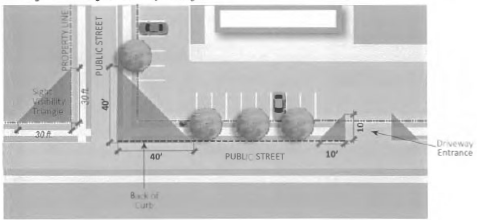
(2)
The area within required sight visibility triangles shall be free of visual obstruction.
(3)
Landscaping, fences and walls, and shrubs shall not exceed three feet within the required sight visibility triangle. Signage and trees between three feet and seven feet tall are prohibited within the required sight visibility triangle. See Figure 25: Restrictions in Sight Visibility Triangles.
Figure 25: Restrictions in Sight Visibility Triangles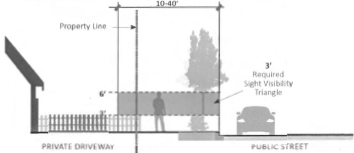
(4)
Vertical measurements shall be made from the top of the travel surface on the street.
(5)
Objects that may be located in the sight visibility triangle, include, but are not limited to, hydrants, utility poles, utility junction boxes, and traffic control devices, provided these objects are located to minimize visual obstruction.
(e)
Cross-access between adjacent uses.
(1)
Mixed-use and non-residential development shall be designed to allow for cross-access to adjacent properties to encourage shared parking, shared access points, and increased connectivity on private development to the maximum extent feasible, see Figure 26: Cross-access Between Adjacent Uses. This may be established by one or more of the following:
a.
Providing shared driveways for two adjacent lots from public rights-of-way to minimize curb cuts;
b.
Connecting private streets and driveway;
c.
Coordinating parking structure and parking lot entrances;
d.
Linkages between parking lots and parking structures; or
e.
Common service/delivery areas.
Figure 26: Cross-access Between Adjacent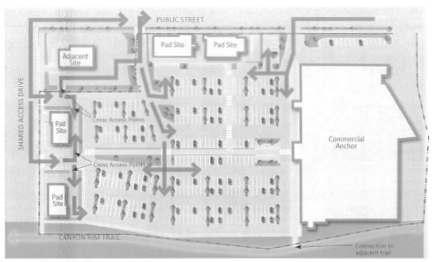
(2)
When cross-access is deemed impractical by the county engineer or undesirable based on topography, the presence of natural features, vehicular or pedestrian safety factors, or unsafe conditions, this requirement may be waived.
(3)
Cross-access and maintenance agreements associated with such interconnections shall be provided, if necessary, with the associated subdivision or site plan.
(f)
Pedestrian and bicycle circulation.
(1)
Sidewalks.
a.
Unless exempted in this section, sidewalks shall be installed on both sides of all arterials, collector streets, and local streets, including cul-de-sacs, and within and along the frontage of all new development or redevelopment.
b.
Unless otherwise stated in this chapter, sidewalks shall be constructed per the county's public works design and construction standards.
c.
Sidewalks are not required on local streets in the RA and RE zone districts or in steep-slope areas where sidewalks on one side of the street may be approved to reduce excessive slope disturbance, adverse impacts on natural resources, and potential soil erosion and drainage problems according to the county engineer.
(2)
On-site pedestrian walkways.
a.
All multi-family, mixed-use and non-residential developments shall provide a network of safe, reasonably direct, and convenient on-site pedestrian walkways with a minimum width of five feet to and between the following areas:
1.
Entrances to each multi-family, mixed-use or non-residential building on the site, parking areas, and open spaces;
2.
Public sidewalks or on-site pedestrian walkways on adjacent properties that extend to the boundaries shared with the subject development;
3.
Adjacent public transit stops and shelters, public parks, trails, schools, and adjacent neighborhoods.
Figure 27: Required On-site Pedestrian Walkways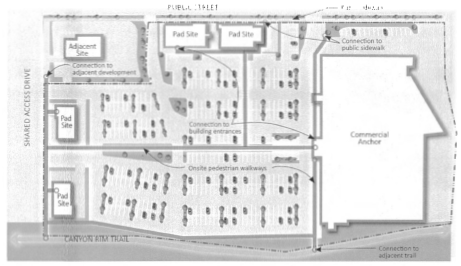
b.
When on-site pedestrian walkways are deemed impractical by the county engineer or undesirable based on topography, the presence of natural features, vehicular or pedestrian safety factors, or unsafe conditions, this requirement may be waived.
(3)
Bicycle connections. New development involving more than one lot or sites over five acres in size adjacent to existing or planned bikeways or multi-use trails shall provide at least one access point to these facilities to provide safe and convenient access for cyclists or pedestrians.
Sec. 16-26. - Purpose.
The purpose of this section is to provide for adequate, convenient, and safe off-street parking and loading areas for various land uses addressed in this chapter.
Sec. 16-27. - Applicability.
Off-street parking and loading spaces shall be provided as an accessory use in all zone districts in accordance with the requirements of this article. The provisions of this section apply to the following:
(a)
Construction of a new primary building;
(b)
Change of use or occupancy of a building(s), including additions, that require more parking;
(c)
Expansion of the gross floor area of an existing building by more than 25 percent. Parking and loading requirements shall apply to the expanded gross floor area of the building(s);
(d)
It shall be unlawful to discontinue, reduce, modify or otherwise dispense with parking and loading facilities that comply with the requirements of this section.
Sec. 16-28. - Off-street parking standards.
(a)
Calculation of off-street parking and loading.
(1)
All square footage based parking and loading requirements shall be computed on the basis of gross floor area of the subject use. Structured parking within a building shall not be counted in such computation.
(2)
Lots containing more than one use shall provide parking and loading in an amount equal to the total of the requirements for all uses.
(3)
In case of fractional results in calculating required parking supply, the required numbers of the sum shall be rounded up to the nearest whole number.
(b)
Unlisted uses. For uses not explicitly listed in Table 27: Minimum Off-Street Parking Requirements, the community development director is authorized to do any of the following:
(1)
Apply the minimum required parking spaces for the use listed in Table 27: Minimum Off-Street Parking Requirements that is most similar to the proposed use;
(2)
Establish the minimum required parking spaces based on standard parking resources or local or national best practice; or
(3)
Establish the minimum required parking spaces based on a parking study submittal conducted by a registered professional engineer.
(c)
Minimum off-street parking requirements. Unless otherwise noted in this chapter, minimum off-street parking spaces shall be provided in accordance with Table 27: Minimum Off-Street Parking Requirements.
(Ord. No. 02-343, § 3, 5-23-2023; Ord. No. 02-370, § 7, 10-7-2025)
Sec. 16-29. - Accessible parking.
(a)
The number and design of accessible parking spaces shall be pursuant to the International Building Code (IBC) as adopted in Los Alamos County, New Mexico State Statutes, and the Americans with Disabilities Act (ADA), as amended.
(b)
Accessible parking spaces shall be required for all non-residential uses and multi-family uses according to Table 28: Accessible Parking Requirements.
(c)
Accessible parking spaces shall be located closest to the accessible building entrances and dispersed among the various types of parking facilities and uses.
(d)
Accessible parking spaces shall be eight feet wide and 18 feet long.
(e)
Accessible parking spaces shall provide an adjacent five feet wide access aisle. If the parking space is van accessible, the adjacent access aisle shall be increased to eight feet.
(f)
The access aisles shall be clearly marked by blue, diagonal striping and shall have the words "NO PARKING" in capital letters, each of which shall be at least one-foot high and at least two inches wide, placed at the rear of the parking space.
(g)
Two parking spaces shall be permitted to share a common access aisle.
(h)
Each access aisle must adjoin a minimum four-foot wide pedestrian access route.
(i)
A parking space identification sign with the international symbol of accessibility complying with the IBC shall be mounted 60 inches minimum above the ground surface measured to the bottom of the sign.
(j)
If the accessible route is in front of the parking space, wheel stops are required to keep vehicles from reducing the clear width of the accessible route below 36 inches.
(k)
Accessible parking spaces shall be identified by the International Symbol of Accessibility (ISA); a clearly visible depiction of the symbol shall be painted in blue on the pavement surface at the rear of the space.
Figure 28: Accessible Parking Design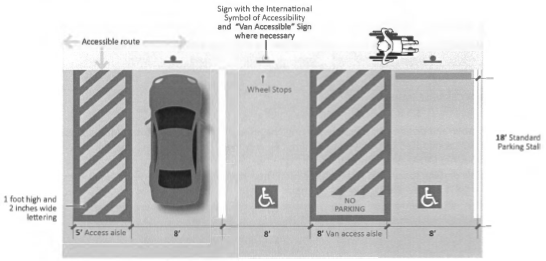
(l)
Van accessible spaces shall be indicated by additional signage stating, "Van Accessible".
(m)
Accessible parking spaces, aisles, and routes must be maintained in good repair and kept clear of snow, ice, or fallen leaf buildup.
Sec. 16-30. - Parking alternatives and reductions.
(a)
Shared parking reduction.
(1)
Within DTLA, WRTC, and all Mixed Use and Non-Residential Zone Districts, two or more listed uses with opposite peak parking demand hours may share parking facilities. Table 29 Shared Parking Reduction indicates the percentage of the total off-street parking requirement that may be reduced by shared parking facilities.
For example, when Multi-family, Retail Sales, and Food & Beverage uses can feasibly share parking facilities per Table 29, the total off-street parking requirement for the site may be reduced by a maximum of 50 percent in the DTLA Zone District and 25 percent in the WRTC and in all Mixed Use and Non-Residential Zone Districts. A sample parking requirement calculation is shown below for a site in DTLA Zone District.
(2)
A parking study outlining with conformance Table 27: Minimum Off-Street Parking Requirements and Table 29: Shared Parking Reduction for the shared parking shall be prepared by a registered professional engineer and approved through the site plan approval process per section 16-74(i). Other shared uses not listed in the Table 29: Shared Parking Reduction may apply for parking reductions by submitting a parking study conducted by a registered professional engineer for approval through the site plan approval process.
(3)
Shared parking lots that are utilized to meet the required off-street parking spaces shall be located within 500 feet of the use to be served.
(4)
The sharing of any required off-street parking shall be guaranteed by a legally binding recordable parking agreement between the owner of the parking area and the owner of the building or use that is located on a different lot and served by the parking area. Such agreement shall address the issue of how parking will be shared if the parties change their business hours and peak business periods. Such agreement shall be submitted and reviewed through the site plan approval process per section 16-74(i).
(b)
Additional parking reductions.
(1)
Within DTLA, WRTC, and all Mixed Use and Non-Residential Zone Districts, additional parking reductions may be granted for items listed in Table 30 Applicable Off-Street Parking Reductions.
(Ord. No. 02-343, §§ 4, 5, 5-23-2023; Ord. No. 02-363, § 4, 11-19-2024)
Sec. 16-31. - Motorcycle parking.
(a)
Up to three percent of the required parking spaces, excluding accessible parking spaces, may be motorcycle parking spaces. All motorcycle parking stalls shall be four feet wide by eight feet long.
(b)
Motorcycle parking spaces shall be located in a well-lit area that is visible from the primary building entrance on the site.
(c)
Motorcycle spaces shall be clearly signed and marked "Motorcycle Only" per the manual on uniform traffic control devices (MUTCD) standards.
Sec. 16-32. - Bicycle parking.
(a)
Bicycle parking requirements shall apply to all multi-family, mixed-use, and non-residential uses.
(b)
Minimum off-street bicycle parking spaces shall be provided in accordance with Table 27: Minimum Off-Street Parking Requirements.
(c)
Bicycle parking spaces shall be in a well-lit area, visible from and, where feasible, located within 50 feet of the primary building entrance on the site measured along the most direct pedestrian access route. Location shall not impede pedestrian access.
(d)
Bicycle parking facilities shall be racks or lockers that are installed and anchored to prevent removal except by authorized personnel.
(e)
All racks must provide two points of contact with a frame at least six inches apart horizontally and accommodate a bicycle frame where at least one wheel can be locked to the rack with a high security U-shaped shackle lock. An inverted U-type rack is the preferred rack design.
(f)
Racks placed parallel (side by side) to each other, including rack units sold as multiple units attached together, must be at least 36 inches apart. Racks aligned end-to-end must be at least 96 inches apart.
(g)
Racks placed perpendicular to a wall, curb, or pedestrian aisle must be at least 48 inches from the wall, curb, or pedestrian walkway to the nearest vertical component of the rack.
(h)
Racks placed parallel to a wall must be at least 36 inches from the wall to the nearest vertical component of the rack.
(i)
Racks placed parallel to a curb must be at least 24 inches from the curb to the nearest vertical component of the rack.
(j)
Each bicycle parking space must be accessible without needing to move another bicycle.
(k)
Bicycle parking spaces should be located adjacent to a clear aisle at least five feet wide to allow for maneuvering of the bicycle. Where bicycle parking is located next to a sidewalk, the maneuvering area may extend into the sidewalk.
(l)
The area devoted to bicycle parking must be hard surfaced.
Figure 29: Bicycle Parking Designs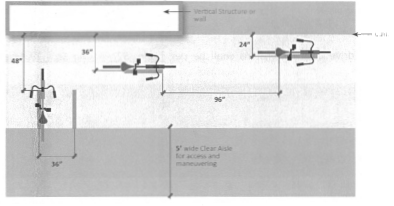
Sec. 16-33. - Parking location and design.
(a)
Use of parking and loading areas.
(1)
No required off-street parking or loading space shall be used for any purpose other than the parking of vehicles, unless otherwise allowed by this chapter.
(2)
Parking shall be prohibited in aisle ways, fire lanes or similar areas not officially designated for parking purposes. These areas shall be posted with "No Parking" signs and/or other means as required by the community development director.
(3)
Required parking spaces and areas shall not be used for the sale, display or repair of motor vehicles or other goods and services unless authorized by a temporary use permit issued in accordance with section 16-6(o).
(4)
Parking lots shall not be used for overnight occupancy and parking of recreational vehicles, campers, trailers, buses, vans, motor homes, moving vans, refrigerator trucks or similar vehicles, except as authorized by the community development director.
(b)
Location of parking areas.
(1)
No portion of an off-street parking facility shall be located in a public street or sidewalk, alley, or other public right-of-way.
(2)
No more than one tandem parking space is permitted.
(3)
Parking in any low-density residential zone district shall be located on the same lot as the residential use they serve and is prohibited on any portion of the front yard or street side yard setback areas other than on a driveway or drive aisle.
(4)
Required parking spaces for any residential use other than those listed in section 16-33(b)(3) above may be located in a designated communal or shared parking area located on a lot adjacent to at least one of the lots served by such parking.
(5)
For all other uses, required off-street parking, loading, and vehicle stacking spaces for mixed-use or non-residential development shall be located on the same lot as the principal use, except as otherwise provided in this subsection or as allowed in section 16-30(a).
(6)
All parking spaces shall be internally accessible to one another without re-entering adjoining public right-of-way unless otherwise approved by the county engineer as being required to make the lot buildable.
(c)
Dimensions.
(1)
Standard parking stalls and drive aisle dimensions shall be per Table 32: Parking Stall and Aisle Dimensions.
Figure 30: Parking Stall and Aisle
Dimensions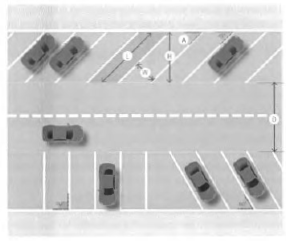
(2)
Compact parking spaces shall not exceed 20 percent of the total required parking spaces. Projects providing parking in excess of the minimum required number of spaces may utilize any combination of compact and standard spaces for excess parking areas.
(3)
The front of the parking space may encroach two feet into a landscape strip or pedestrian walkway; however, any parking spaces protruding over a pedestrian walkway shall maintain at least a four-foot wide clearance for pedestrian access, see Figure 31: Parking Space Design.
Figure 31: Parking Space Design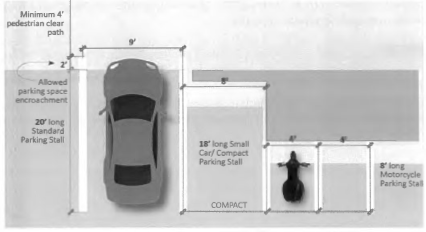
(d)
Pedestrian walkways.
(1)
All parking lots that contain more than 100 parking spaces shall include pedestrian walkways through the parking lot to the primary building entrance or a sidewalk providing access to the primary building entrance.
(2)
At a minimum, walkways shall be provided for every three driving aisles or at a distance of not more than 150-foot intervals, whichever is less.
(e)
Surfacing.
(1)
All required parking lots or parking facilities, except in the RA and RE zone districts and public parks, shall be paved and have grading and drainage as approved by the county engineer.
(2)
Surfacing shall consist of asphalt concrete of Portland cement concrete pavement with an aggregate base of design and depth as recommended by a pavement or geotechnical engineer. Permeable materials such as permeable pavers, gravel, or other porous materials may be used for parking area surfacing where appropriate, with approval by the community development director.
(3)
The maximum grade slope of the parking lot or parking facility shall not be more than five percent unless determined by the community development director to be required to make the lot buildable.
(f)
Wheelstops, striping and signage.
(1)
Except for single-family, duplex and three-family dwelling types, all parking stalls shall be marked with painted lines not less than four inches wide.
(2)
Signage shall comply with MUTCD.
(3)
All traffic-control devices such as parking stripes, designated car stalls, directional arrows for signs, wheel stops, curbs, and other developments shall be installed and completed as shown on the approved site plan or conditional use permit.
(4)
Bumper guards and/or wheel stops shall be required on the periphery of all required parking facilities so that vehicles will not protrude into the public right-of-way or strike a building, fence, or landscaping or protrude over public or private sidewalks.
(g)
Lighting.
(1)
Lighting provided for off-street parking facilities shall meet the standards of division 6, Outdoor Lighting.
(2)
Parking facility lighting may be subject to review and approval by the department of public department for energy efficiency, the traffic and streets division, and by the police department for personal and property security.
Sec. 16-34. - Off-street loading requirements.
(a)
Whenever the normal operation of any development requires that goods, merchandise, or equipment be routinely delivered to or shipped from that development or whenever loading areas are required by the community development director, sufficient off-street loading and unloading areas must be provided to accommodate the delivery or shipment operation in a safe and convenient manner, as laid out in section 16-34.
(b)
The community development director may waive the required loading spaces or require additional loading spaces if a given use or extraordinary site characteristics warrant them.
(c)
Loading spaces shall be located on the same lot as the use and structure they serve.
(d)
Loading areas shall not be permitted in any required front setback area or the public right-of-way.
(e)
Loading areas located within 50 feet of any residential zone district shall be screened by any applicable standards of section 16-40.
(f)
Vehicles parked in the loading areas shall not encroach into required parking spaces, required setbacks, access aisles, or fire lanes.
(g)
Loading areas shall be designed so that delivery vehicles do not have to back into the loading area from a public street or back out of the loading area onto a public street.
Sec. 16-35. - Vehicle queuing requirements.
(a)
Vehicle stacking spaces shall be integrated into the site layout and shall not interfere with site access points, access to parking or loading spaces, internal circulation aisles, pedestrian facilities, and public streets and rights-of-way.
(b)
Vehicle stacking spaces shall be a minimum of nine feet by 20 feet per vehicle.
(c)
All uses with drive-through and drive-up facilities shall provide the minimum number of vehicle stacking spaces per Table 34: Required Vehicle Stacking Spaces.
Sec. 16-36. - Purpose.
This section regulates landscaping to ensure visually attractive and sustainable landscapes that enhance the county's overall appearance and benefit the health, safety, and welfare of the community by:
(a)
Ensuring the use of native and low water-use species, regionally appropriate, and sustainable design and maintenance techniques to conserve water resources.
(b)
Mitigating the urban heat island effect by reducing heat and glare.
(c)
Buffering road and neighborhood noise.
(d)
Contributing to the processes of air purification, oxygen regeneration, groundwater recharge, and stormwater runoff retention through landscaping designed to retain soil moisture, and prevent erosion while aiding in the abatement of air and water pollution.
(e)
Enhancing the appearance of commercial, industrial, and multi-family residential developments, and to protecting public and private investments and property values.
Sec. 16-37. - Applicability.
The provisions of this section apply to the following:
(a)
New construction of multi-family, mixed-use, or non-residential structures; and the
(b)
Expansions of existing multi-family, mixed-use, and non-residential structures of 25 percent or more of building floor area.
Sec. 16-38. - Exceptions.
The provisions of this section do not apply to single-family development in the RA, RE, SFR, RM zone districts.
Sec. 16-39. - General landscape standards.
(a)
Minimum landscape site area.
(1)
A minimum of ten percent of the net site area shall be landscaped in accordance with the requirements of this section. For the purpose of this section, the net site area is defined as the square footage of the entire lot to be developed minus the square footage of any structures.
(2)
The landscaping required within subsequent subsections for items like parking lots, screening may be counted toward the total minimum net site area landscape requirements.
(3)
Landscaping for phased development may be determined based only on the square footage of the portion of the lot that is actually being developed per each phase.
(b)
Type and amount of plant materials.
(1)
Trees and other plant materials selected should emphasize native or regionally adapted materials and water conservation practices, taking into consideration site specific constraints such as:
a.
Water demand, drought tolerance, appropriateness of native and naturalized species, and geological and topographical conditions;
b.
The protection and preservation of native species, appropriate naturalized species, and natural areas; and
c.
Using high maintenance plants only for accents.
(2)
Landscape design should use a variety and mixture of plant materials to avoid destruction of singular species through blight and/or disease.
(3)
All vegetation required shall meet the minimum requirements in Table 35 Minimum Plant Material and Standards.
(4)
Existing healthy trees with a minimum trunk diameter of three inches or more and/or shrubs with a height of at least 4.5 feet may be counted toward the requirements of this section.
(5)
For landscape designs that integrate hardscapes (i.e. plazas, courtyards, trails, etc.), the hardscape areas may be counted toward 25 percent of the overall project site's landscape requirements. Acceptable hardscape materials include but are not limited to concrete, concrete or permeable pavers, and brick. Asphalt is prohibited for integrated hardscapes.
(c)
Irrigation systems.
(1)
The county strongly encourages the use of native or drought tolerant plants without the need for irrigation.
(2)
Watering methods shall be required if the proposed planting materials are not native or drought tolerant plants and trees.
(3)
An irrigation system, consisting of an underground system (automatic or manual), that includes a USC approved reduced principal backflow preventer, pipes, valves, and heads of adequate size to irrigate properly the proposed planting may be required.
(d)
Installation and maintenance.
(1)
All required landscaping and irrigation systems shall be maintained as shown on the approved landscape plan.
(2)
Regular maintenance is required of all landscaping and irrigation improvements in good condition and in a way that presents a healthy, neat, and orderly appearance. All landscaping shall be maintained free from disease, pests, weeds, and litter. This maintenance shall include weeding, watering, fertilizing, pruning, mowing, edging, mulching, or other maintenance as needed and in accordance with acceptable horticultural practices.
(3)
Any plant materials not surviving shall be replaced within 30 days of its demise or in the next appropriate season.
(4)
Failure to maintain the improvements or landscaping required by this section constitutes a violation of this chapter.
(e)
Streetscape landscaping.
(1)
Up to 50 percent of the required landscaping for all projects may be located in the public right-of-way for streetscaping purposes, subject to a joint landscaping agreement between the county and the property owner. The abutting property owner shall maintain landscaped areas within the public right-of-way.
(2)
If street trees are provided as part of the landscaping located in the public right-of-way, street trees shall be provided at a minimum of 25 feet on center on average when mature.
(3)
Plant materials in a sight visibility triangle as defined in section 16-25(d) shall be selected and maintained to ensure there is no appreciable obstruction to vision within the clear zone.
(4)
Where more than four feet of space exists between the back of curb and the sidewalk, street trees shall be planted with their centerline two feet from the sidewalk. Where less than four feet exists, required street trees may be planted within 20 feet of the back of curb of the abutting street.
Figure 32: Streetscape Landscaping Where 4 Feet Exists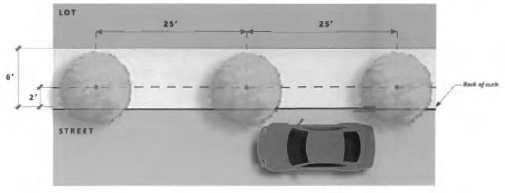
Figure 33: Streetscape Landscaping Where Less than 4 Feet Exists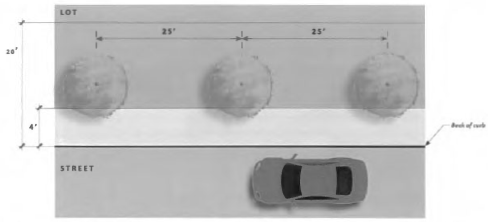
(5)
Alternative streetscape landscaping may be approved by the Community Development Director as part of the site plan review as outlined in section 16-7(i).
(f)
Parking lot landscaping and screening.
(1)
All new surface parking lots containing 25 or mores spaces, or the expansion of an existing parking lot by 25 spaces or more shall provide landscaping that meets the standards of this subsection.
(2)
The minimum number of trees shall be one tree per 12 parking spaces.
(3)
No parking space may be more than 100 feet in any direction from a tree trunk.
Figure 34: Parking Lot Tree Requirements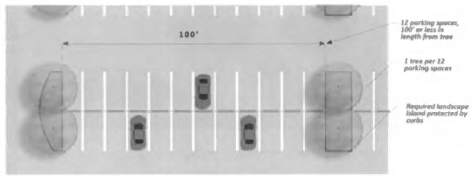
(4)
All trees and plantings within parking lots shall be in planting areas or landscape islands, protected by curbs or wheel stops.
(5)
Required parking lot landscaping may be incorporated with one or more consolidated bioretention areas (e.g. rain gardens).
Figure 35: Parking Lot Bioretention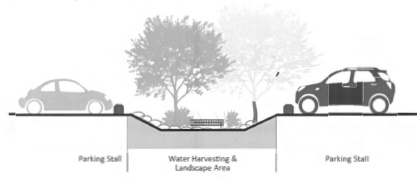
(6)
Within the MFR, MU, DTLA, and WRTC zone districts, surface parking lot located within ten feet of a public street shall be screened from the street by a masonry wall or a landscaped strip at least six feet wide containing at least two trees and six shrubs per 50 feet of the parking lot edge closest to the street, or by other means that the community development director or their designee determines provides equal or better screening of the headlights of parked vehicles.
Figure 36: Parking Lot Screening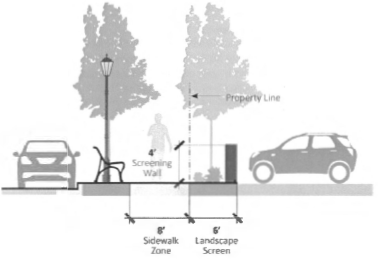
Sec. 16-40. - Screening standards.
(a)
General screening standards.
(1)
Any landscaping provided to meet screening standards will be credited towards the overall landscaping requirement.
(2)
In any case where a wall or fence is required or installed, chain link fencing shall not satisfy this requirement.
(b)
Outdoor storage for vehicles, equipment, and materials.
(1)
Outdoor storage areas shall be screened from public streets and adjacent residential land uses and residential zone districts using one or a combination of fences, walls, berms, or landscaping that is at least six feet in height and provides a permanent opaque, year-round screen.
(2)
Walls, fences, or enclosures used to screen outdoor storage areas shall be visually compatible with the architectural design and materials of the development.
(c)
Screening of refuse containers.
(1)
Refuse containers shall be screened on three sides by a solid six-foot high wall or fence.
(2)
Refuse container enclosures shall be located at the rear or side of buildings, in other inconspicuous locations, where they are generally not noticeable from public streets, pedestrian walkways, other public areas, or residential uses, or residential zone districts.
(3)
Refuse enclosures shall be constructed of materials that are compatible with the overall architectural design of the development.
(d)
Screening of mechanical and utility equipment.
(1)
Roof-mounted mechanical equipment of mixed-use and non-residential developments shall be screened by a parapet wall or similar architectural feature sufficient to screen the equipment from all sides when viewed from the ground level.
Figure 37: Screening of Roof-Mounted Equipment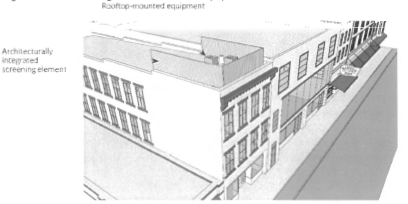
(2)
Ground-mounted mechanical equipment of mixed-use and non-residential development shall be located so that it is not visible from a public right-of-way, customer entrances, pedestrian walkways, or other public areas or from the adjacent properties to the maximum extent possible.
(3)
Ground-mounted mechanical equipment located within the view of the public right-of-way, customer entrances, other public areas and adjacent properties shall be screened from public view using one of the following options:
a.
Decorative wall, fence, or enclosure that is constructed of materials that is compatible with the overall architectural design of the development and of a height that is not less than the height of the equipment to be screened; or
b.
Vegetative screen that is of sufficient height at maturity and of opacity to effectively soften and screen the equipment.
Figure 38: Screening of Ground-Mounted Equipment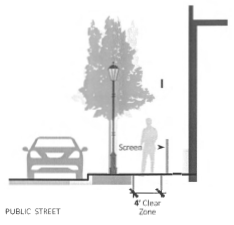
Sec. 16-41. - Purpose.
The purpose of this section is to provide for adequate transitions and preserve the character of established neighborhoods in instances where any mixed-use or non-residential uses are located near low-density residential zone districts and/or historically designated landmarks or districts per the HP-O zone district.
Sec. 16-42. - Applicability.
The provisions of this section apply to multi-family, mixed-use, and non-residential uses abutting or adjacent to protected lots. For the purpose of this subsection, protected lots refer to any lot in the RA, RE, SFR, and RM zone districts and lots within the historic protection overlay zone district.
Sec. 16-43. - Neighborhood protection standards.
(a)
Any portion of a primary building within 50 feet of any lot line that directly abuts a protected lot shall step down to a maximum height of 35 feet.
(b)
Any portion of a primary building within 75 feet of any lot line that is adjacent to a protected lot shall step down to a maximum height of 35 feet.
Figure 39: Neighborhood Protection Standards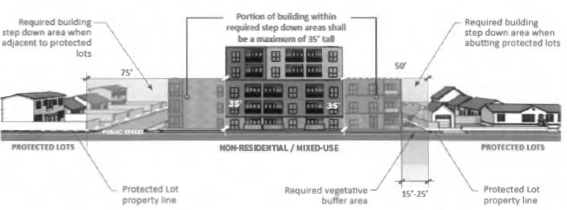
(c)
Landscape buffers shall be required along the shared property line of abutting developments per Table 37: Minimum Landscape Buffer Requirements to mitigate the impacts of significant differences in property use, size, or scale.
(d)
When properties are required to have a landscape buffer per Table 37: Minimum Landscape Buffer Requirements, the requirements of Type C Buffer, shall apply.
Figure 40: Type A Buffer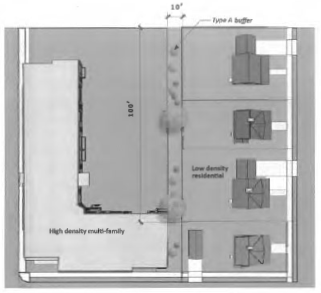
Figure 41: Type B Buffer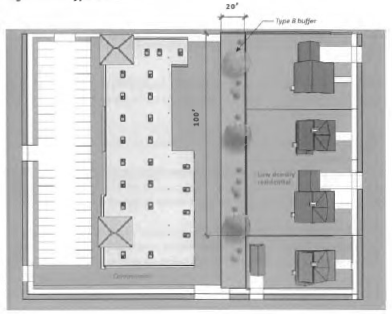
Figure 42: Type C Buffer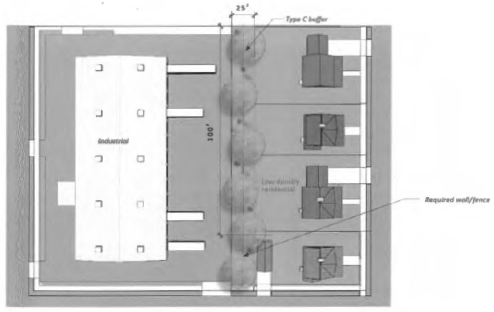
(e)
The community development director may waive the buffer requirements of Table 37: Minimum Landscape Buffer Requirements, provided the uses triggering the buffering requirement are of similar character and scale.
(f)
For the purposes of this subsection "industrial development" refers to any uses indicated under the industrial category of Table 26: Permitted Use Table and "non-industrial" development refers to all other uses.
(g)
If walls or fences are required in Table 37: Minimum Landscape Buffer Requirements, the material(s) of which shall be opaque. A chain link fence or similar is not considered a solid fence for purposes of this section. The side of the wall facing the development being buffered shall maintain a finished appearance.
(h)
All berms, if provided, shall not exceed a slope with maximum rise of one foot to a run of two feet (a ratio of 1:2) and a maximum height of four feet with a compacted flat top of at least 15 inches wide. All berms, regardless of size, shall be stabilized with a ground cover, another suitable vegetation, or a permanent slope retention device. A combination of trees and shrubs are to be installed in an appropriate design scheme along the berm.
(i)
No parking or structures are allowed within required landscape buffer.
(j)
The placement and design of buildings should take into consideration the privacy of adjacent residential properties by avoiding placement of elements like windows or balconies that face directly into the site.
Sec. 16-44. - Purpose.
The following principles for responsible lighting design define the purpose of this section:
(a)
Useful means all lighting at night should have an intended purpose.
(b)
Targeted means light should be directed only where it is needed.
(c)
Low light levels means light should be no brighter than necessary for the task.
(d)
Controlled means lighting should only be used when it is useful.
(e)
Spectrum means limit the amount of harmful short wavelengths (blue-violet).
The results from using the forementioned principles will promote the health, safety, and welfare of people and ecological systems, reduce obtrusive and inappropriate light that inhibit human vision, and curtail light pollution (as measured by Zenith or Bortle sky glow metrics) to improve the nighttime environment for residents and visitors of the region.
Sec. 16-45. - Applicability.
(a)
All new development shall meet the requirements of this section, applicable electrical and energy codes, and applicable sections of the building code.
(b)
Within non-residential zone districts, existing outdoor lighting that does not meet the provisions of this section shall be considered legal nonconforming for ten years from the adoption date of this chapter. After ten years, or unless otherwise specified within this chapter, all outdoor lighting fixtures that do not conform to the requirements of this chapter must be replaced with conforming fixtures, or existing fixtures must be retrofitted to comply. This requirement shall not apply to residential zone districts.
(c)
Whenever there is a new use for a property (e.g. zoning or variance change) all outdoor lighting on the property will meet the requirements of this section before the new use commences.
(d)
Expansion, renovation, and modification to existing property that increases the developed square footage, occupant capacity, or parking spaces by 25 percent or more, shall cause the entire property to meet the requirements of this division.
(e)
In the event an outdoor light fixture is not working or damaged to the extent repair costs equal at least 50 percent of replacement cost, the repair/replacement shall conform with the requirements of this division.
(f)
Unless otherwise noted or exempt, existing outdoor lighting that does not meet the provisions of this section shall be considered legal nonconforming until natural maintenance, modifications, change of use, or complaint enforcement obligate meeting the requirements of this chapter.
(Ord. No. 02-363, § 5, 11-19-2024)
Sec. 16-46. - Prohibitions.
The following types of exterior lighting sources, fixtures, and installations shall be prohibited in Los Alamos County.
(a)
Mercury vapor lighting.
(b)
Inefficient light sources (efficacy less than 45 lm/w).
(c)
Blinking, flashing, moving, revolving, scintillating, flickering, changing intensity, and changing color lights.
(d)
Unshielded floodlights.
(e)
No outdoor lighting may be used in any manner that could interfere with the safe movement of motor vehicles on public thoroughfares, including the following:
(1)
Any fixed light not designed for roadway illumination that produces direct light or glare that could cause the operator of a motor vehicle to lose visual performance or visibility.
(2)
Any light that may be confused with or construed as a traffic control device except as authorized by state, federal, or county government.
(f)
Aerial lasers, beacons, and/or searchlights are prohibited except for emergency use.
Sec. 16-47. - Exemptions.
The following types of lighting installations shall be exempt from the requirements within this section:
(a)
Lighting required by federal, state, or county laws and regulations that conflict with this chapter will supersede and replace the county requirements.
(b)
Lighting associated with the air-side facilities at the airport (runway, taxiway, deice pad, aircraft parking areas and other facilities located inside the security fence) is regulated by the Federal Aviation Administration (FAA) for safety and shall be exempt from the requirements of this chapter. All other exterior lighting at the airport (e.g. entrances, parking, drop-off, and pick-up) shall follow the appropriate lighting zone guidelines within non-residential tasks.
(c)
Flags should be lowered and removed from sunset to sunrise so illumination is not needed when possible. For flags displayed at night, nighttime illumination of the United States of America flag and the New Mexico State flag is allowed. Nighttime illumination of other flags is not allowed. Guidelines are:
(1)
For an even distribution of light on the flag surface when fully extended, use either top of pole downward directed light, a maximum of three in-ground uplights, or three shielded spotlights that are surface mounted at grade. Surface mounted lights should rotate and tilt so they can be aimed to hit the flag.
(2)
In-ground and surface mounted shielded spotlights should be narrow beam (15 degree maximum), no more than 100 lumens per foot of height (e.g. 2,500 lumens per light for a 25-foot tall flag), with point sources of light not be visible outside of a 15-foot radius.
(d)
NMDOT lighting installed within the public right-of-way that is not addressed within section 16-53 shall be exempt from the requirements of this chapter. Lighting installed within the public right-of-way with a purpose of illuminating outside the public right-of-way is not exempt.
(e)
Signage illumination is addressed within of division 8, Signage.
(f)
If a proposed lighting plan or fixtures are proposed that do not meet this section, but that have demonstrable community benefit, an exemption may be considered. The applicant shall submit additional information to adequately assess the community benefit for approval by the community development director or designee.
Sec. 16-48. - Lighting plan.
(a)
Site plan applications for new development and modifications shall include lighting plans, pursuant to section 16-73(f). Lighting required by federal, state, or county laws and regulations that conflict with this chapter will supersede and be exempt.
(b)
Lighting requiring a permit per section 16-55, Lighting plan only must obtain a lighting plan approval, pursuant to section 16-73(f).
(Ord. No. 02-363, § 6, 11-19-2024)
Sec. 16-49. - Lighting zone designations.
(a)
The lighting zone shall determine the limitations for lighting as specified in this section. The lighting zones within Los Alamos County shall be per Table 38: Light Zone Designations.
(b)
Lighting zone designations should not be based on existing conditions, but rather the type of environment the municipality seeks to achieve. Unless otherwise mentioned, Los Alamos County will have no lighting zone 4 applications.
Sec. 16-50. - General, responsible design standards.
(a)
The maximum correlated color temperature (CCT) permissive within Los Alamos County shall be 2700K. The color rendering index (CRI) of light sources in LZ-1 and greater must be greater than 65. Lower CCT (e.g. 2200K) is allowed in all zones provided it meets the CRI requirement, and per ANSI/IES, it is encouraged in LZ-0 applications regardless of CRI.
(b)
LZ-2 lighting shall be dimmed by 50 percent by 10:00 p.m. or one hour after business close (whichever comes latest). [2] This LZ-2 curfew shall remain in effect until 6:00 a.m. The LZ-2 curfew does not apply to the following:
(1)
Street, roadway, and other Department of Transportation lighting.
(2)
Code required lighting for public steps, stairs, walkways, and building entrances.
(3)
Other special use or permitted exceptions listed within this chapter such as flag, seasonal, sports fields, and businesses which operate during these hours.
(c)
Unless otherwise allowed, all light sources shall be fully shielded and possess a UO rating (IES TM-15) for zero uplight. Meaning, luminaires must be constructed in such a manner that all light emitted by the luminaire, either directly from the light source or diffusing element, or indirectly by reflection or refraction from any part of the luminaire, is projected below the horizontal.
(d)
All light sources shall be a maximum G2 rating (IES TM-15), and located or shielded such that the point light source shall not be visible from adjacent property or streets.
(e)
The maximum illumination at the property line (measured at grade with the light meter aiming upward) shall not exceed the requirements listed in Table 39: Property Line Light Trespass Illuminance Limits below. These requirements will likely require mounting locations 2.5 times luminaire height away from property lines with addition distance or shielding required for lighting installed along ridgelines or hillsides.
(f)
Illuminance trespass limits per Table 39: Property Line Light Trespass Illuminance Limits are for a single property. Measured values will be the sum of multiple illuminated properties when the property line is shared. The property line can be considered five feet beyond actual when bordering with public walkways, bikeways, plazas, and parking lots.
(g)
Pole/post mounted lighting taller than 36 inches is prohibited within residential zone districts except multi-family parking and common areas where the maximum height is 12 feet. Pole lighting for non-residential parking lots is limited to 20 feet tall if adjacent to a lot with a residential use, and 25 feet tall thereafter.
(h)
Shielded floodlights are limited to 1,260 lumens.
See section 16-45, Applicability. Within non-residential zone districts, existing outdoor lighting that does not meet the provisions of this section shall be considered legal nonconforming for ten years from the adoption date of this chapter.
Sec. 16-51. - Residential lighting.
(a)
The total allowable site lumens (initial) for any residential zone district or residential use is limited to the values defined in Table 40 below.
(b)
An additional 3,000 lumens per the limits of Table 40 is allowed for each accessory dwelling unit (ADU) is allowed on lots larger than two acres.
(c)
An additional 300 lumens per parking lot space per the limits of Table 40 is allowed for multi-family developments.
(d)
Vertical illuminance of targeted elements (e.g. façades, or landscape elements) is allowed using partially shielded luminaires, provided the total amount of partially shielded light does not exceed 20% of the total site lumen allowance or the individual luminaire limits listed in Table 41 below.
(e)
Façade lighting on multi-family and mixed use lots is prohibited above residential floors to prevent unwanted light.
(f)
Art, monuments, and fountains may be illuminated if they are adjacent (i.e. within ten feet) to the residential structure.
(g)
Tree, garden, and landscape lighting is only allowed within 25 feet of a residence or driveway entrance. Tree and landscape lighting must be turned off during hours of curfew. For this reason, solar powered landscape lights are not recommended.
(h)
Perimeter fence lighting for walls, fences, and perimeter barriers is prohibited within the LZ1 zone.
(i)
Illumination of walls and underneath built in shorter than five feet to help reassurance and egress is allowed within common areas of development within the LZ2 zone, provided they are washed with approved façade or landscape lighting techniques and meet the other requirements of this section.
(j)
Driveway and parking lot lighting is not permitted within the LZ1 zone.
(k)
Porte cochere and covered porch/canopy lighting for entrances and transfers is allowed. Luminaires mounted under canopies shall be aimed downward and installed such that the bottom of the luminaire or lens, whichever is lower, is recessed or fully cutoff and not producing any light above horizontal. All light emitted by an under-canopy fixture shall be substantially confined to the posts, façades and ground surface directly beneath the perimeter of the canopy.
(l)
Pathways, stairs, and steps lighting shall be no taller than 36 inches.
(m)
If local code allows, gas flame and fire pits are allowed. Artificial lighting used to illuminate patios, above grade decks, balconies, or gazebos must be shielded or fully shielded with the point light source not visible beyond the property line in which it is located.
Sec. 16-52. - Non-residential lighting.
(a)
The total allowable site lumens (initial) for all non-residential zone districts shall be based on the lot size (per acre) or hardscape square footage of developed structure, parking lots, and landscape buffer. Individual site lumen limits are outlined in Table 42 below.
(b)
Partially shielded luminaires for the following applications are allowed for this purpose if the light distribution is effectively contained by the targeted element (e.g. façade, sculpture, shrub), and if the total amount of partially shielded light does not exceed 20 percent of the total site lumen allowance or individual luminaire limits listed in Table 43 below.
(c)
Façade lighting shall ensure the following standards:
(1)
The point light source shall not be visible from adjacent properties.
(2)
Façade lighting within mixed use zone district property is prohibited above residential floors.
(3)
Non-residential façade lighting must be turned off no later than curfew or after business hours, whichever comes later.
(d)
Art, monuments, and fountain features shall only be lit in non-residential applications to help people gain understanding of their surroundings and avoid conflict prior to curfew.
(e)
Tree and landscape lighting must be turned off during hours of curfew. For this reason, solar powered landscape lights are not recommended.
(f)
Illumination of walls, fences, and perimeter barriers shorter than eight feet to help reassurance and egress is allowed only within non-residential common areas.
(g)
Outdoor lighting used to illuminate parking spaces, driveways, or maneuvering areas shall meet fully shielded requirements and be designed, arranged, and shielded so that the point light source is not visible from adjoining lot lines or public streets.
(h)
Porte cochere and covered porch/canopy lighting for entrances and transfers is allowed. Luminaires mounted under canopies shall be aimed downward and installed such that the bottom of the luminaire or lens, whichever is lower, is recessed or fully cutoff and not producing any light above horizontal. All light emitted by an under-canopy fixture shall be substantially confined to the posts, façades and ground surface directly beneath the perimeter of the canopy.
(i)
Lighting of pathways, stairs, and steps shall be no taller than 36 inches.
Sec. 16-53. - Right-of-way lighting.
(a)
Local and arterial roadway lighting shall be designed to the ANSI/IES RP-8-21 recommended practice for design and maintenance of roadway lighting for one of the county-designated, roadway lighting design categories (RLDC) listed in Table 44 below.
(b)
The RLDC category for a roadway shall be determined by county council upon advice of the county engineer. The county engineer's RLDC category recommendation for a given roadway, or portion thereof, shall occur only after a study of local conditions and shall take into account the lighting purposes per section 16-44 including minimizing light pollution and light trespass, especially in residential zone districts.
(c)
The study of local conditions for a particular road or segment of road is to be prepared for the county by the roadway lighting designer.
(d)
New roadway lighting systems shall be designed to the lowest RLDC consistent with the lighting goals of the neighborhood or subdivision in which it is to be installed but shall not be a lower light level than the minimum ANSI/IES RP-8-21 recommendation needed for public safety as indicated by a study of local conditions.
(e)
Street lighting must conform to the standards outlined in Table 45: Lighting Standards for Roads.
(f)
Street lighting must conform to the following maximum average illuminance limits in Table 46: Illuminance Limits for Roads. The spacing and lumen outputs of each street lighting luminaire shall be calculated so that these limits are not exceeded. The establishment of these limits shall not be construed to permit increasing existing levels of illuminance in any location.
(g)
The county shall comply with requests supplied to the county traffic and streets division to install, move, or remove a publicly owned streetlight when the request is signed by the majority of property owners within 300 feet of that streetlight and the request is feasible and does not create a public safety hazard. The property owners requesting that change agree to bear the estimated cost of installing, moving, or removing that streetlight, said estimated cost to be provided by the county engineer upon a request for information.
(Ord. No. 02-363, § 7, 11-19-2024)
Sec. 16-54. - Special use.
(a)
Security lights emitting infrared radiation used for security surveillance systems is permitted if they are fully shielded and aimed no higher than 70 degrees from horizon. Special review by the planning and zoning commission may allow lighting of a greater intensity under the following circumstances:
(1)
Multi-family, mixed use, and commercial common areas with increased density and activity may require increased illumination at primary points of entrances or exits. Light intensity shall not exceed five foot-candles average at grade.
(2)
Shielded flood lights controlled by a motion sensor must be limited to motion within the owner's property lines, and turned off five minutes after motion.
(b)
Lights located at historic landmark sites that have illuminance purpose and are consistent with the time period and character of the historic structure or district may be exempt from shielding, uplight, and light trespass requirements upon request and subsequent approval from the community development director or historic preservation advisory board.
(1)
Historically approved fixtures shall be limited to 700 lumens per fixture and 10,000 lumens per acre.
(2)
If new site lighting is needed to meet pedestrian safety requirements (e.g. stairs and egress), or an architectural or historical feature requires greater illumination, modern lighting techniques should not compete with the historic character of the property or convey a false sense of history (e.g. faux historic lights).
(c)
Holiday lighting of a temporary nature is allowed between November 1 and January 30, provided that the lighting is low-wattage (one watt/ft. for string lights or 70 lumens for single bulb), does not exceed 1,000 lumens per site, create dangerous glare on adjacent streets or properties, is maintained in an attractive condition and does not constitute a fire hazard. All other lighting associated with any national, local or religious holiday or celebration may be illuminated two weeks prior to the holiday and extinguished within two days after the holiday.
(d)
Gas station canopies shall not exceed a measured illuminance of 20 footcandles average under the canopy.
Sec. 16-55. - Lighting plan only.
The following lighting types shall require a lighting plan pursuant to section 16-6(f).
(a)
Temporary lighting exemptions may be secured for a maximum of 14 days from the date of signed approval and issuance by the community development director. The director shall have the authority to refer an application for a temporary exemption to the planning and zoning commission or the historic preservation commission if deemed appropriate. A temporary exemption request shall contain at least the following information:
(1)
Specific exemption(s) requested, luminaire locations, mounting heights, and area(s) to be illuminated;
(2)
Data sheets for exact luminaires (including lamp type, lumen output, CCT, CRI, polar distribution plot, and BUG rating);
(3)
Duration of time requested for exemption;
(4)
Other information as may be required by the community development department director.
(b)
Outdoor lighting used for construction or major renovation can be exempt from the requirements of this chapter with an approved lighting plan.
(c)
Sport and recreation lighting shall confine illumination to the field, bleacher, track, or recreational area. Such lighting may need to exceed lighting zone illumination standards and CCT requirements to meet requirements for play and safety per ANSI/IES RP-6. Additional guidelines are as follows:
(1)
Direct light from luminaires must not be visible from adjacent properties.
(2)
Shielding and internal louvers to prevent light trespass, glare, and light emitted above 62 degrees from the horizontal ground plane are required.
(3)
Lighting shall be extinguished no later than one hour after the event ends.
(d)
Underwater pool, spa, and pool deck lighting is allowed pursuant to approval by a lighting plan. Such lighting should follow ANSI/IES, or local municipal lighting recommendations based on residential, hospitality, or public use. This lighting is not part of the total site lumen limit.
(e)
Decorative lighting elements, such as shades with translucent, perforated patterns, and diffusers, may be exempted from the fully-shielded requirement provided they are less than 1,000 lumens and meet all other requirements of this chapter and demonstrate a benefit for the community.
Sec. 16-56. - Purpose.
The purpose of this section is to provide for adequate privacy and security without degrading the aesthetic quality of the county, generating a public nuisance and/or hazards, or obstructing vision at intersections.
Sec. 16-57. - Applicability.
The construction, replacement, and maintenance of all fences, walls, and retaining walls shall comply with the requirements of this section.
Sec. 16-58. - Fence and wall permits.
A fence/wall permit is required prior to commencing construction of any wall or fence, per the provisions of section 16-73(e).
(Ord. No. 02-363, § 8, 11-19-2024)
Sec. 16-59. - Fence and wall standards.
(a)
Location and height.
(1)
The maximum permitted height for a fence or wall depends on the zone district and where the fence or wall is located on the property. All fences and walls shall comply with the height limits shown in Table 47: Maximum Height of Walls and Fences.
Figure 43: Residential Fence Standards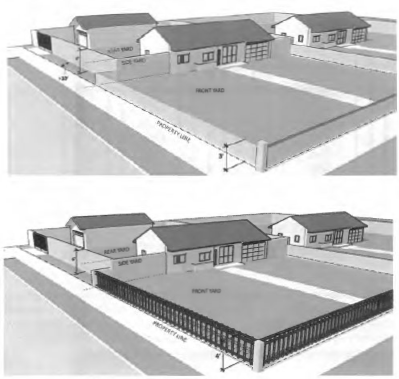
Figure 44: Industrial Fence Standards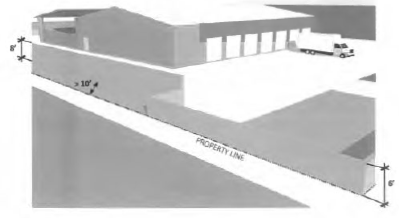
(2)
Where view walls or fencing are specified in Table 47: Maximum Height of Walls and Fences, the wall or fence shall be constructed of materials, such as wrought iron, lattice, or something similar that permits at least 75 percent of the structure surface to be transparent.
Figure 45: View Fencing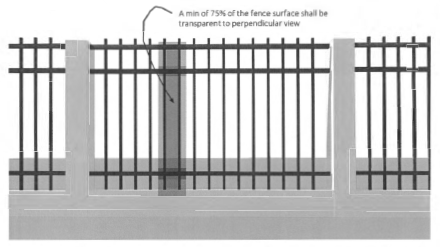
(3)
The maximum height of a fence or wall shall be measured as the vertical distance from the ground elevation or finished grade of the property on which the fence or wall is erected to the highest point of the fence or wall. Where there is a difference in the ground elevation or finished grade between two adjoining parcels, the height of any fence or wall constructed along the common property line shall be determined by using the finished grade of the highest contiguous parcel.
Figure 46: Maximum Fence/Wall Height Measurement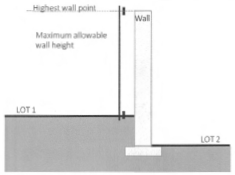
(4)
All fences and walls that restrict visibility shall be subject to section 16-25(d), Sight Visibility Triangles and must be limited to three feet in height.
(5)
Fences six feet in height and taller shall comply with building code requirements.
(6)
Fences shall be located on the applicant's property. Fences shall not be located on shared property lines nor shall footings encroach onto any adjoining property.
(b)
Fence and wall materials.
(1)
Fences and walls shall be constructed of durable materials that are weather and decay resistant.
(2)
The use of barbed wire, razor wire, or barbed tape shall be prohibited, except in GC, IND, and RA zone districts, provided it shall be placed as follows:
a.
Not less than six feet from the ground at the fence line and shall not exceed ten feet in height, and
b.
At least five horizontal feet from any sidewalk.
(3)
Fences and walls visible from a public street shall be compatible with the overall site design and the primary building. The finished side of the fence shall front or face the public right-of-way or adjacent property.
(c)
Gates.
(1)
Gates shall be constructed so as not to obstruct sight visibility triangles as set forth in section 16-25(d), Sight Visibility Triangles.
(2)
Except as otherwise allowed by this chapter, gates shall not exceed one foot above the maximum height specified in Table 47: Maximum Height of Walls and Fences.
(d)
Retaining walls.
(1)
Retaining walls over four feet high having a retained slope of five to one (5:1) or greater shall be designed, signed, and sealed by a professional civil engineer, registered in the State of New Mexico.
(2)
Retaining walls constructed of manufactured materials shall provide the manufacturers' specifications and shall be limited to eight feet in height.
(e)
Maintenance.
(1)
All fences, walls, and retaining walls shall be maintained in good condition, so as not to become a public or private nuisance, and so as not to be dilapidated or a danger to adjoining property owners or the public.
(2)
Fences, walls, and retaining walls which are no longer maintained in a safe manner and/or which create a hazard through neglect, lack of repair, manner of construction, method of placement, or otherwise, shall be repaired, replaced, or removed by the property owner.
Sec. 16-60. - Purpose.
Signs perform an important function in identifying and promoting positive conditions for sign communication. The intent of these regulations is to ensure that signs within the county are appropriate for the adequate identification, communication, and advertising of their respective uses, in keeping with the appearance of the affected property and surrounding environment, and protective of the public health, safety, and welfare by:
(a)
Ensuring that signs are designed, constructed, installed, and maintained according to minimum standards to safeguard life, health, property, and public welfare.
(b)
Setting standards and providing uniform controls that permit reasonable use of signs and preserve the character of Los Alamos County.
(c)
Prohibiting the erection of signs in such numbers, sizes, designs, illumination, and locations as may create a hazard to pedestrians and motorists.
(d)
Avoiding excessive conflicts from large or multiple signs, so that permitted signs provide adequate identification and direction while minimizing clutter, unsightliness, and confusion.
Sec. 16-61. - Applicability.
(a)
Unless specifically exempted, the standards contained in this section shall apply to all signs within the county.
(b)
Any sign legally erected before the effective date of this chapter that is no longer in compliance with the standards in this section may be retained in use, subject to the provisions of article V, division 4, Nonconformities.
(Ord. No. 02-363, § 9, 11-19-2024)
Sec. 16-62. - Exceptions.
The following signs shall be exempted from the rules and regulations of this section:
(a)
Any sign, signal, or legal notice posted or erected by any county, state, federal or other governmental entity in carrying out its responsibility to protect the public health, safety, and welfare.
(b)
Official government notices and notices posted by government officers or employees in the performance of their official duties and government signs to control traffic, provide information, identify streets, warn of danger, or perform other regulatory purposes.
(c)
Traffic control signs and devices, on-site or within the public right-of-way to control or direct traffic.
(d)
Any sign inside a structure not attached to the window.
(e)
Address numbering placed pursuant to the building code.
(f)
Any historic plaques erected or provided by the county, state, or federal entities, designating an area of historical significance.
(g)
Exterior works of art such as, but not limited to, paintings, murals, and sculptures conveying no commercial message.
(h)
Flags conveying no commercial message.
Sec. 16-63. - Permit requirements.
(a)
Except as otherwise expressly provided in this section, the installation or placement of any permanent sign in the county must first obtain a sign permit pursuant to section 16-73(k).
(b)
Temporary signs as allowed by section 16-65(f) do not require a permit but must meet all other applicable requirements of section 16-65(f).
Sec. 16-64. - Prohibited signs.
The following signs are prohibited in all zone districts within the county:
(a)
Any sign or sign structure which is in violation of this section.
(b)
Any sign maintained in conjunction with a use, event, service, or activity that is not lawful.
(c)
Any sign or sign structure which is deemed unsafe by the chief building official or county engineer.
(d)
Off-premises signs, except as specifically authorized in this section.
(e)
A sign located on or that projects over the public right-of-way, except as allowed under this section.
(f)
Any sign located so as to conflict with the clear and open view of public devices controlling public traffic, bicyclists, or pedestrians or to impair the safety of a moving vehicle by distracting the vision of the driver.
(g)
Animated mechanical or moving signs, or electrical appurtenances, such as, but not limited to, revolving beacons or flashing signs.
(h)
Signs with reflective surfaces.
(i)
A sign which obstructs a driver's, bicyclist's, or pedestrian's clear view of an intersecting road, alley, or major driveway.
(j)
Roof-mounted signs.
(k)
Billboards, stationary or mobile.
(l)
Any sign located in a required sight visibility triangle, pursuant to section 16-25(d), Sight Visibility Triangles.
Sec. 16-65. - Sign standards.
(a)
Sign measurements.
(1)
Sign area shall be computed by the area enclosed within a sign border or the sum of the areas of the minimum imaginary rectangles enclosing each word or non-verbal symbol if there is no sign border.
(2)
The sign face area for a multi-faced sign with more than two sides or a sign that is a three-dimensional object shall be computed by adding together the maximum areas of all faces or portions of the object that are simultaneously visible from a single point of view.
Figure 47: Sign Face Measurements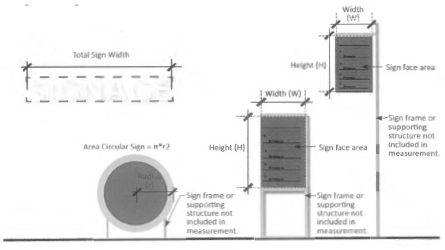
(3)
The sign face area for freestanding and projecting signs shall be computed by the area of the board or surface exclusive of the frame or supporting structure.
(4)
Sign height is measured as the vertical distance from the average elevation of the finished grade to the top of the highest attached component of the sign. If natural grade at the base of a sign is lower than the grade of an adjacent road, the height of the sign may be measured from the top of curb elevation.
Figure 48: Sign Height Measurements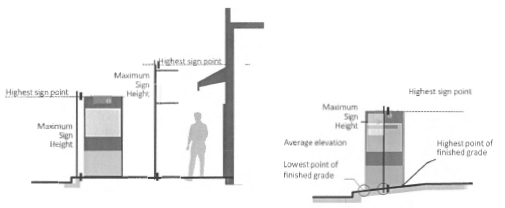
(5)
Clearance for projecting signs shall be measured as the smallest vertical distance between finished grade and the lowest point of the sign, including any framework or other structural elements.
Figure 49: Projecting Sign Clearance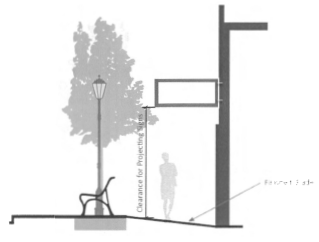
(b)
Authorized signage.
(1)
All signs shall be in accordance with the provisions of Table 48: Authorized Signage and all other regulations set forth in this section.
(2)
Linear feet of building frontage is determined using the following processes:
a.
For single tenant buildings the building frontage is the lineal distance of the building measured along a straight line parallel to the street. Where said building is not parallel to the street, the building frontage shall be measured along the exterior front wall of the building.
b.
For an individual business located within a multi-tenant building, the building frontage shall be the length of the space occupied by said business measured in a straight line along the exterior front wall of the building, except for an individual business with minimal exterior frontage occupying the interior corner space of an "L" shaped multi-tenant building, in which case the building frontage may be determined by the length of the space occupied by the individual business measured in a straight line parallel to the nearest street. For multi-tenant buildings, the building frontage for each tenant shall be measured from the centerline of the party walls defining the occupied space.
(3)
Signs shall be setback a minimum of five feet from any property line, except within the WRTC and DTLA zone districts where signs may be located on the front property line.
(4)
No permanent signs shall be located within a public right-of-way.
(5)
Right-of-way encroachments, including signs that project over the public right-of-way, shall require an encroachment permit pursuant to section 16-6(d).
(6)
Signs that project over a sidewalk or on-site pedestrian walkways shall maintain a minimum clearance of ten feet above finished grade.
(7)
No sign shall be placed within a required sight visibility triangle, pursuant to section 16-25(d), Sight Visibility Triangles.
(8)
Signs allowed to be illuminated per Table 48: Authorized Signage, shall comply with the sign illumination standards of section 16-65(c).
(9)
Any permanent sign on county buildings, structures, or properties shall require the approval of the county manager, or the utilities manager for utility infrastructure.
(10)
Temporary signs shall comply with all standards of section 16-65(f).
(c)
Sign illumination.
(1)
If a parcel is authorized for an illuminated sign in Table 48: Authorized Signage, the illumination shall not exceed three lux above ambient lighting as measured horizontally six feet from the center of the face of the sign, six feet above grade at the edge of the property where the sign is located. Illumination can be measured in footcandles, lux, or luminance.
(2)
All sign lighting shall be designed, directed, and shielded in such a manner that the light source is not visible beyond the property boundaries where the sign is located and shall comply with the requirements of division 6, Outdoor Lighting.
(3)
Internally illuminated signs shall consist of light-colored letters against a dark background and use semi-opaque material for sign text or images such that the light emanating from the sign is diffused.
(4)
Backlit signs shall be designed such that the light source is not visible, and that only diffuse light emanates from the sign.
(5)
Sign lighting may not blink, fluctuate, or otherwise give indication of movement except as permitted for electronic messaging centers pursuant to section 16-65(d).
(6)
All external sign light sources shall be shielded and aimed only at the sign.
(7)
No temporary signs shall be illuminated, unless required for public safety as determined by the community development director.
(d)
Electronic message centers (EMC).
(1)
EMCs are prohibited in all residential zone districts and parks and open space zone districts, except for a public school use, which may provide a maximum of one EMC per section 2 below.
(2)
A maximum of one permanent sign per premises within a non-residential zone district is allowed to be an EMC, provided the EMC shall not exceed 50 percent of the total allowed signage allowances.
(3)
A maximum of one permanent sign per premises within a mixed-use zone district is allowed to be an EMC pursuant to the approval of a conditional use permit per section 16-7(b), provided the EMC shall not exceed 50 percent of the total allowed signage allowances.
(4)
A maximum of one EMC sign is allowed per a public school location, provided the EMC shall not exceed 50 percent of the total allowed signage allowances.
(5)
EMCs shall not be located within 100 feet of a road intersection.
(6)
EMCs shall be set back a minimum of five feet from any abutting non-residential or mixed-use zone district property line and shall be set back a minimum distance that equals the height of the sign when abutting a residential zone district property line.
(7)
EMCs shall be placed so that the message or copy is oriented away from adjacent residential buildings or residential zone districts to the maximum extent possible.
(8)
The EMC message or copy shall not change more than once every eight seconds.
(9)
Transitions between displayed messages shall use fade, dissolve, or similar, but may not use scrolling, travel, or similar transition which creates a sense of motion.
(10)
Dynamic frame effect EMC signs are not permitted.
(11)
No sounds are permitted from EMC signs.
(12)
No EMC shall have the appearance of flashing.
(13)
EMCs shall have automatic dimming capability that adjusts the brightness to the ambient light at all times of the day and night.
(14)
EMCs illumination shall not exceed 0.3 footcandles over ambient lighting conditions when measured at the recommended distance based on the EMC size. The recommended measurement distance is the square root of the area of the sign multiplied by 100.
(15)
EMCs shall be located, designed, and directed to not create light trespass on adjacent properties and shall comply with the intent of division 6, Outdoor Lighting to the maximum extent possible.
(e)
Construction and maintenance of permanent signs.
(1)
Every sign shall be constructed of durable materials and shall be structurally safe and erected or installed in strict accordance with the county building code permitting and approvals requirements.
(2)
All sign supports and elements such as angle irons, chains, wires, and electrical service must be concealed from public view to the maximum extent possible.
(3)
Any freestanding supports and foundations used in construction and placement of all signs and sign structures must be located outside of any public land or rights-of-way.
(4)
All signs and components thereof shall be structurally sound and maintained in good repair and in compliance with all currently adopted building or electrical codes.
(5)
Routine maintenance activities including but not limited to painting, cleaning, or repainting sign copy or sign faces within their existing framework and recladding do not require a permit.
(f)
Temporary signs.
(1)
Temporary signs shall not exceed a sign area of eight square feet and eight feet in height.
(2)
Temporary signs may be in place no longer than 60 consecutive days, after which time they must be removed.
(3)
No temporary sign in the right-of-way shall be placed on a sidewalk or in such a manner to block, impede, or limit the use of Americans with Disabilities Act (ADA) access points, nor shall any temporary sign in the right-of-way extend over or into any street, alley, sidewalk, or other public thoroughfare; nor shall it be erected so as to prevent free ingress to or egress from any door, window, or fire escape.
(4)
Signs in the right-of-way may not be located or posted on streetlights, stop signs, utility poles, or other utility structures located in the right-of-way.
(5)
No temporary sign in the right-of-way shall be illuminated except where required by the community development director for public safety purposes.
(6)
Temporary signs may only be placed on public lands or public rights-of-way in designated temporary signage zones as shown on the official zoning map.
Sec. 16-66. - Building height.
(a)
The maximum building height for buildings is described in article II, Zone Districts for each zone district.
(b)
The height of a building shall be measured as the vertical distance from the lowest finished grade of the structure to the highest point on the building roof. The "highest point" means peak of roof for a building with a sloping roof, the top of the roof coping for a flat roof, or the top of the ridgeline of the highest gable of a pitched roof or hip roof.
Figure 50: Building Height Measurement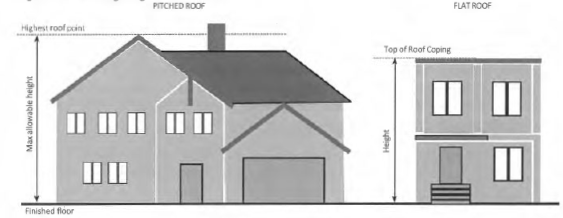
(c)
On a stepped or sloped project site, the maximum height is to be measured as the vertical distance from the highest point of the structure to the average of the highest and lowest points of the finished grade.
Figure 51: Building Height Measurement on Sloped Sites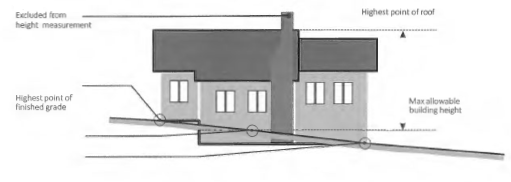
(d)
Rooftop appurtenances such as belfry, church spire or tower, conveyor, cooling tower, elevator housing chimneys, antennas, smoke and ventilation stacks, mechanical equipment and related screening, rooftop solar collectors and flagpoles are exempt from the building height limitations of this chapter. Also see section 16-18(m) and section 16-18(o).
(e)
Rooftop shade structures or trellis or similar shading systems shall also be exempt from the building height limitations of this chapter, provided they shall not exceed 12 feet in height.
(Ord. No. 02-363, § 10, 11-19-2024)
Sec. 16-67. - Building foundations.
That part of the foundation of a residential structure that is exposed shall not exceed 2.5 feet above the natural grade at any point on slopes of less than 15 percent. On slopes of 15 percent or more, that part of the foundation of a residential structure that is exposed shall not exceed five feet above the natural grade at any point.

