
Los Alamos County Unincorporated
City Zoning Code
City Zoning Code
ARTICLE V
- ADMINISTRATION AND ENFORCEMENT
Sec. 16-68. - Community development department/community development director.
(a)
Authority. The planning division of the community development department is responsible for day-to-day administration of this Code, unless this Code specifically states otherwise.
The community development director has overall responsibility to oversee the administration of this Code, including but not limited to: directing day-to-day operations, making administrative decisions on matters related to development on behalf of planning division staff; and delegating authority as necessary to any staff member in furtherance of the purposes and objectives of this Code.
(b)
Responsibilities.
(1)
The community development director, or designee, shall have the review and final decision authority as shown for administrative decisions listed in Table 49: Procedures Summary Table, pursuant to the decision criteria for application-specific procedures outlined in division 3, Specific Development of this Code, including the following development applications:
a.
Accessory structure permits.
b.
Administrative deviations.
c.
Encroachment permits.
d.
Fence/wall permits.
e.
Lighting plans.
f.
Minor development plan amendments.
g.
Minor site plan amendments.
h.
Sign permits.
i.
Special event permits.
j.
Summary plats.
k.
Temporary use permits.
l.
Administrative wireless telecommunications facilities permits.
m.
Small wireless facilities permit.
n.
Minor historic demolition permit.
o.
Minor historic property alteration certificate.
(2)
In performing the duties and activities stated in this section, if the community development director, or designee, determines that an application otherwise subject to administrative decision involves unique conditions or circumstances that warrant review and decision making by the planning and zoning commission, the community development director, or designee, shall refer the application and decision-making authority granted pursuant to 16-68(b)(1) to the planning and zoning commission.
(3)
The community development director, or designee, shall maintain an office for the public to provide information and assistance consistent with, and in furtherance of, the text of this Code, the official zoning map and the comprehensive plan.
(4)
The community development director, or designee, shall interpret the County of Los Alamos Development Code and may take any necessary or appropriate action based on such interpretation of the Code pursuant to the procedures below.
(5)
The community development director, or designee, shall not be required to accept an application or take any other action that cannot, based on the community development director's interpretation of the County of Los Alamos Development Code, be approved or justified as a matter of law.
(6)
The community development director, or designee, shall, upon request, provide the applicant or requestor a written explanation of the director's action.
(7)
The community development director, or designee, shall make a reasonable interpretation of the Code that is not inconsistent with the policies of the county and guidance by the planning and zoning commission and county council.
(8)
The decisions and code interpretations of the community development director, or designee, shall apply to all applications filed and actions taken on or before the time a different interpretation is determined and applied by the planning and zoning commission pursuant to section 16-69.
(9)
If a development application is subject to review and a final decision by the community development director, or designee, the director, or designee, shall make a decision based on the decision criteria applicable to the application type in division 3, Specific Development. Final decision on development applications reviewed by the community development director, or designee, shall be issued in writing and shall clearly state reasons for a denial or any applicable conditions of approval.
(10)
Any final decision of the community development director, or designee, including code interpretations, may be appealed to the planning and zoning commission pursuant to section 16-72(g).
(Ord. No. 02-362, § 1, 11-12-2024)
Sec. 16-69. - Planning and zoning commission.
(a)
Authority. The planning and zoning commission is a nine-member board appointed by county council per the requirements of chapter 8, Boards and Commissions. The planning and zoning commission only has the authority expressly granted by the Los Alamos County Code and state law.
(b)
Responsibilities.
(1)
The planning and zoning commission shall have the review and recommendation authority as shown for discretionary decisions listed in division 3, Specific Development Procedures, pursuant to the application-specific procedures outlined in division 3, Specific Development Procedures this Code, for the following development applications:
a.
Master plan adoption or amendments.
b.
Comprehensive plan adoption or amendments.
c.
Major zone map amendments.
d.
Text amendment.
e.
County landmark or historic district adoption or amendment.
(2)
The planning and zoning commission shall have the review and final decision authority as shown for discretionary decisions listed in Table 49: Procedures Summary Table, including the authority to approve, conditionally approve or deny the following development applications:
a.
Subdivision sketch plats.
b.
Subdivision preliminary plats.
c.
Subdivision final plats.
d.
Conditional use permits.
e.
Site plan adoption or major amendment.
f.
Development plan.
g.
Variances.
h.
Discretionary wireless telecommunication facilities permit.
i.
Minor zone map amendment.
j.
Historic economic hardship waivers.
k.
Major historic demolition permit.
l.
Major historic property alteration certificate.
(3)
Any application or decision-making authority referred to it by the community development director, or designee, pursuant to section 16-68.
(4)
The planning and zoning commission shall have appellate authority to review any administrative decision acted on by the community development director, or designee, as listed in Table 49: Procedures Summary Table and for all decisions or determinations of the county engineer or county utilities manager to require or not require any or all impact reports. The planning and zoning commission shall affirm, overturn, or modify the decision of the community development director, or designee, the county engineer, or the county utilities manager.
(5)
If the application is subject to a recommendation to the county council, the commission shall make a decision based on the decision criteria applicable to the application type in division 3, Specific Development Procedures. The planning and zoning commission shall take any one of the following actions:
a.
Recommendation of approval of the development application as presented;
b.
Recommendation of approval of the development application with conditions. In recommending conditional approval, the planning and zoning commission may only recommend such conditions as are reasonably necessary to meet the approval criteria of specific procedures outlined division 3, Specific Development Procedures, including the granting of variances more restrictive than those originally requested by the applicant;
c.
Recommendation of denial of the application; or
d.
If the planning and zoning commission is unable to arrive at a recommendation, the proposed development application shall be forwarded without recommendation to the county council for consideration.
(6)
If an application is subject to review and a final decision by the planning and zoning commission, the commission shall make a decision based on the decision criteria applicable to the application type in division 3, Specific Development Procedures. The planning and zoning commission shall take any one of the following actions:
a.
Approve the development application as presented;
b.
Approve the development application with conditions. In granting conditional approval, the planning and zoning commission may only impose such conditions as are reasonably necessary to meet the approval criteria of specific procedures outlined in Table 26: Permitted Use Table, including the granting of variances more restrictive than those originally requested by the applicant;
c.
Denial of the application; or
d.
Defer the matter to a date no more than 60 calendar days following its first appearance on the agenda, unless a longer deferral is accepted by the applicant.
(7)
Five members shall be a quorum for the conduct of business of the planning and zoning commission. No final action on any substantive matter, other than recommendations to the county council, shall be taken except on the affirmative vote of a majority of the commission members present, but in no event less than four affirmative votes. No business shall be conducted by the planning and zoning commission in the absence of a quorum. The only actions that may be undertaken in the absence of a quorum are to set the time and date of the next meeting, to attempt to achieve a quorum by contacting absent members, and to adjourn.
(8)
Final decision on development applications reviewed by the planning and zoning commission shall be issued in writing and shall clearly state reasons for an approval, denial, or any applicable conditions of approval.
(9)
Planning and zoning commissioners shall attend planning and zoning commission training conducted by the community development director, or designee, or other county staff.
(Ord. No. 02-362, § 2, 11-12-2024)
Sec. 16-70. - County council.
(a)
Authority. The county council has authority to make decisions on those types of applications as shown as county council responsibilities in Table 49: Procedures Summary Table.
The county council has delegated some of its broad planning and zoning authority to the planning and zoning commission authorized by law, and the effect of those delegations is shown in this Code.
(b)
Responsibilities.
(1)
The county council shall have the review and final decision authority as shown for policy decisions listed in Table 49: Procedures Summary Table, pursuant to the application-specific procedures outlined in division 3, Specific Development Procedures of this Code, for the following development applications:
a.
Master plan approvals.
b.
Comprehensive plan adoption or amendments.
c.
Major zone map amendments.
d.
Text amendments.
e.
County landmark or historic district adoption or amendment.
(2)
The county council shall have appeal authority for all discretionary decisions acted on by the planning and zoning commission as listed in Table 49: Procedures Summary Table, for the following development applications:
a.
Subdivision sketch plats.
b.
Subdivision preliminary plats.
c.
Subdivision final plats.
d.
Conditional use permits.
e.
Site plan adoption or major amendment.
f.
Development plan adoption or major amendment.
g.
Variances.
h.
Discretionary wireless telecommunication facilities permit.
i.
Minor zone map amendments.
j.
Historic economic hardship waivers.
k.
Major historic demolition permit.
l.
Major historic property alteration certificate.
(3)
Four members shall be a quorum. No action of the council shall be valid unless adopted by the affirmative vote of at least four members.
(4)
If an application is subject to review and a final decision by the county council, the council shall make a decision based on the decision criteria applicable to the application type in division 3, Specific Development Procedures. The council shall take any one of the following actions:
a.
Approve the development application as presented;
b.
Approve the development application with conditions. In granting conditional approval, the council may only impose such conditions as are reasonably necessary to meet the approval criteria of specific procedures outlined division 3, Specific Development Procedures, including the granting of variances more restrictive than those originally requested by the applicant;
c.
Denial of the application; or,
d.
Remand the application back to the recommending body for further proceedings in accordance with the instructions of the county council.
(5)
Final decision on development applications reviewed by the county council shall be issued in writing and shall clearly state reasons for an approval, denial, or any applicable conditions of approval.
(Ord. No. 02-362, § 3, 11-12-2024)
Sec. 16-71. - Procedures summary table.
Table 49: Procedures Summary Table lists the type of development applications authorized by this Code. For each type of application, the table indicates what type of notice is required, whether pre-application meetings with staff or neighbor meetings are required, which county bodies review and make a decision on the application, and in which cases a public meeting or hearing is required.
(Ord. No. 02-362, § 4, 11-12-2024)
Sec. 16-72. - Common procedures.
(a)
Code interpretations. The community development director has the authority to interpret this Code and may take any necessary or appropriate action based on such interpretation of the Code.
(1)
Procedures.
a.
Upon written request to the community development department, the community development director, or their designee, shall provide the applicant or requestor a written explanation of the director's action.
b.
The community development director, or their designee, shall not be required to accept an application or take any other action that cannot, based on the community development director's interpretation of the County of Los Alamos Development Code, be approved or justified as a matter of law.
c.
The community development director, or their designee, shall make a reasonable interpretation of the Code that is not inconsistent with the adopted goals and policies of the county and guidance by the planning and zoning commission and county council.
d.
The decisions and code interpretations of the community development director, or their designee, shall apply to all applications filed and actions taken on or before the time a different interpretation is determined and applied by the planning and zoning commission pursuant to section 16-69.
(b)
Meeting requirements.
(1)
Pre-application meeting.
a.
The purpose of a pre-application meeting is to provide an opportunity for an applicant and county staff to discuss applicable submittal requirements and procedures; the scope, features, and potential impacts of the proposed development on surrounding neighborhoods and infrastructure systems; and the consistency with the provisions of this chapter and the county's public works and utilities design and construction standards. The community development director, or their designee, shall define the nature of the pre-application meeting.
b.
Where Table 49: Procedures Summary Table requires a pre-application meeting, a pre-application meeting with the applicant and county staff shall be held.
c.
Where Table 49: Procedures Summary Table requires a pre-application meeting, applications will not be accepted until a pre-application meeting has been held.
(2)
Neighborhood meeting.
a.
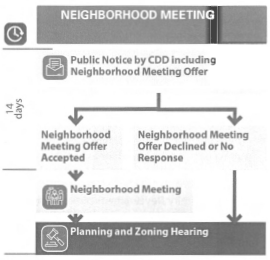
Where Table 49: Procedures Summary Table requires neighborhood meetings, the community development department shall offer at least one meeting to all property owners within 300 feet, excluding public rights-of-way, of the exterior lot lines of the subject property prior to the public hearing on the request.
b.
If property owners choose to meet, they must respond within 14 calendar days of the meeting offer being sent. If all property owners decline the meeting or do not respond, the applicant may proceed pursuant to subsection e. below.
c.
If requested, the neighborhood meeting shall be facilitated by the applicant.
1.
Meetings shall be scheduled prior to the public hearing held at a place that is accessible to neighbors that reside in close proximity to the subject property.
2.
At the neighborhood meeting, the applicant shall provide information about the proposed project, including but not limited to the scope of uses, approximate square footages for different uses, general site layout, design guidelines, architectural style, conceptual elevations, and conceptual landscaping plans.
3.
A summary of the neighborhood meeting shall be prepared and emailed to meeting participants who signed in and provided an email address and to the community development department as part of the development application.
d.
Where Table 49: Procedures Summary Table requires that a neighborhood meeting be offered, and a meeting was held, the applicant shall provide proof that a meeting was offered; proof that the meeting occurred, including a sign-in sheet of attendance; meeting location, date, and time; summary of discussion, including concerns raised, areas of agreement and disagreement, and next steps identified, if any; and identification of any design accommodations that may have been made as a result of the meeting to the community development department. If the concerns raised at the meeting have not been accommodated, the applicant must identify the site or project constraints that limit the ability to address those concerns.
e.
Where Table 49: Procedures Summary Table requires that a neighborhood meeting be held, and a meeting was not requested, the requirement for a neighborhood meeting shall be waived if the community development department can demonstrate that reasonable attempts were made to notify property owners as required above, and either no response was received within 14 calendar days of the notice being sent, or the notified property owners declined the neighborhood meeting.
f.
Where Table 49: Procedures Summary Table requires a neighborhood meeting, applications will not be accepted until a neighborhood meeting has been held, or the requirements for a reasonable attempt to hold a meeting have been met.
(c)
Notifications.
(1)
Purpose. The purpose of this section is to establish minimum public notice requirements in the land use decision making process and to assure that the general public is adequately notified or otherwise made aware of land use regulations, permits, and programs under consideration which may affect, both directly or indirectly, lands within the county.
(2)
Required notice.
a.
Where Table 49: Procedures Summary Table requires notice, notice shall be provided.
b.
A public hearing for which notice has been given may be rescheduled to a later date, on a day not more than 21 days from the original scheduled hearing, without repetition of notice. Notice of the new date, time and place for the rescheduled hearing shall be prominently displayed or otherwise communicated at the originally scheduled hearing.
(3)
Content of notices.
a.
All notices required by Table 49: Procedures Summary Table shall include, at a minimum, all the following information:
1.
The address of the subject property, if available, and a location map indicating the subject property;
2.
The name of the property owner;
3.
The name of the agent (if different from the property owner);
4.
A short summary of the approval being requested, including an explanation of any deviations or variances being requested, if any. If an exhibit such as a plat or site plan is included within the required application materials, a copy of the exhibit should be included in the notice;
5.
The date, time, and place of the public hearing if required;
6.
An address, telephone number, or website where additional information about the application can be obtained.
(4)
Published and posted notice.
a.
Where Table 49: Procedures Summary Table requires published notice, the community development director, or their designee, shall publish a notice in a newspaper of general circulation within the county at least 14 calendar days before the public hearing.
b.
Where Table 49: Procedures Summary Table requires posted notice, the community development department shall post at least one sign on a street abutting the property that is the subject of the application, at a point clearly visible from that street, for at least 14 calendar days before the public meeting or hearing, as applicable.
c.
The posted sign shall at a minimum contain the following information:
1.
Identify the application type and number;
2.
Identify the date, time, and location of the public hearing being noticed; and
3.
Identify a telephone number, website address, and/or email address where additional information about the application can be obtained.
(5)
Mailed notice.
a.
Where Table 49: Procedures Summary Table requires a neighborhood meeting, the community development department shall mail via first-class mail a minimum of 28 days before the public hearing. At a minimum, the meeting offer shall include required items in section 16-72(c)(3) with the exception that information provided in the offer is conceptual and constitutes a draft intended to provide sufficient information for discussion of concerns and opportunities.
b.
Where Table 49: Procedures Summary Table requires mailed notice for administrative decisions, the community development department shall mail notice by first-class mail to all owners of record as identified in the records of the county tax assessor or occupants of properties within 300 feet, excluding public rights-of-way, of exterior lot lines of the subject property.
c.
Where Table 49: Procedures Summary Table requires mailed notice for discretionary decisions, the community development department shall mail notice 14 days prior to the public hearing to all owners of record as identified in the records of the county tax assessor or occupants of properties within 300 feet, excluding public rights-of-way, of exterior lot lines of the subject property.
d.
Where Table 49: Procedures Summary Table requires mailed notice for policy decisions, notice shall be mailed by the community development department in accordance with NMSA 1978 § 3-21-6.
(d)
Application submittal requirements.
(1)
Unless otherwise stated in this Code, all development applications listed in Table 49: Procedures Summary Table shall be submitted by the property owner or an authorized agent to the community development department.
(2)
Application fees shall be paid at the time of submittal according to the type of application on the development fee schedule. Application fee schedules shall be established by council action and maintained on the county website, with copies available from the community development department.
(3)
A pre-application meeting or a neighborhood meeting shall be conducted when required per Table 49: Procedures Summary Table prior to application submittal.
(4)
Each development application shall include all forms and information required by the county for that type of application as set forth in this Code.
(5)
On receiving a development application, the community development director, or their designee, shall determine whether the application is complete within five business days of submittal. A complete application is one that contains all required application materials on the corresponding application form approved by the community development department, requirements outlined in this Code, and a written explanation justifying the application per the applicable decision criteria.
(6)
Incomplete applications shall be rejected. If the community development director, or their designee, determines that an application is incomplete, the community development director, or their designee, shall notify the applicant in writing of the missing or incomplete development application within five business days after receiving the application. The applicant may correct the deficiencies and resubmit the application for a determination of completeness until the community development director, or their designee, determines the application is complete.
(7)
An applicant may withdraw an application at any time, provided that notice of the withdrawal is provided in writing to the community development director, or their designee.
(8)
The fee for filing an application is not refundable, in whole or in part.
(e)
Impact reports.
(1)
The community development director, or their designee, may require impact reports to mitigate and identify any potential adverse effects of a proposed development on public infrastructure and land as well as adjoining properties.
(2)
The following are exempt from the requirements to prepare impact reports:
a.
A single-family or two-family residential dwelling on a legal lot of record;
b.
Any nonresidential development where a site plan is not required.
(3)
The community development director, the county engineer, or their designee, will advise the applicant in writing of required impact studies.
(4)
Within 21 calendar days of the written request by an owner or agent, the county shall complete the necessary surveys to create baseline data for the owner's use in the completion of impact reports. If the county does not have all requested baseline data, the requirement for impact reports shall not be waived by the county.
(5)
Impact reports may be required per Table 50. When required, the minimum report standards of Table 50 below shall serve as a guideline for preparing the report.
(f)
Public hearing procedures.
(1)
Public hearing categories. There are three basic types or categories of decisions authorized in the development code, which are legislative, quasi-judicial, and administrative:
a.
Legislative decisions. Legislative decisions involve a change in land use policy by the decision-making body that does not concern a single tract, parcel, or lot under common ownership or land predominantly owned by a single person or entity under common ownership, including adoption of any change in the development code or adoption of any change to the comprehensive plan; adoption of or any amendment to the text of the development code, the comprehensive plan or the FLUM; and approval of any voluntary development agreements. A public hearing is required but the procedural requirements of a quasi-judicial hearing do not apply.
b.
Quasi-judicial decisions. A quasi-judicial decision involves the use of a discretionary standard, as specified in the development code, to an application for discretionary development approval that is applicable to specific land in common ownership or to an area of land in which the predominant ownership is in a single ownership. Quasi-judicial discretionary proceedings require a public hearing consistent with the standards of procedural due process as established in section 16-72(f)(5). In making quasi-judicial decisions, the decision-making body shall investigate facts or ascertain the existence of facts, hold hearings, weigh evidence, make written findings of fact, conclusions of law and recommendations and exercise discretion of a judicial nature. In the land use context, these quasi-judicial decisions generally involve the application of land-use policies to individual properties in common ownership as opposed to the creation of policy. These decisions require an exercise of discretion in applying the requirements and standards of the development code, state and federal law.
c.
Administrative decisions. Administrative decisions involve interpretation and application of non-discretionary standards of the development code to an application. A public hearing is not required for action on an application for administrative approval.
(2)
Public hearing requirements.
a.
The planning and zoning commission and county council shall conduct public hearings on development applications pursuant to Table 49: Procedures Summary Table as reviewing bodies, decision bodies, and appellate bodies, as necessary.
b.
Development applications indicated as quasi-judicial decisions within Table 49: Procedures Summary Table shall be conducted as quasi-judicial hearings pursuant to section 16-72(f)(5).
c.
Development applications indicated as legislative decisions within Table 49: Procedures Summary Table shall be conducted as legislative hearings pursuant to section 16-72(f)(4).
d.
A full record of council hearings will be made by sound or video recording or transcription; any person shall have the opportunity to listen to, copy, or transcribe the recording during business hours.
e.
A summary of actions taken shall be kept of all planning and zoning commission hearings, and they shall be kept available for public inspection.
(3)
Public hearing officer.
a.
Establishment. The purpose of the hearing officer position is to assist in the adjudication of quasi-judicial applications for discretionary development approval. More than one hearing officer may be appointed, as appropriate.
b.
Referral of matters for hearing. The planning and zoning commission or county council may refer applications or other matters to a hearing officer to conduct public hearings, make written findings of fact, conclusions of law and recommendations, and file written reports with such findings, conclusions of law and recommendations to the planning commission or council for further action.
c.
Term and removal. A hearing officer or hearing officers may be appointed by the council. A hearing officer shall be appointed for a definite term, not to exceed four years, and may be reappointed at the conclusion of any term. A hearing officer may be removed by the council solely for reasonable cause. Reasonable cause for removal of a hearing officer shall include, but not be limited to, violations of the standards set forth in the New Mexico Code of Judicial Conduct, as adopted by the New Mexico Supreme Court.
d.
Qualifications. A hearing officer shall have a J.D. degree from a law school certified by the American Bar Association or Association of American Law Schools, with not less than six years of legal experience, and shall be licensed to practice law in New Mexico. During the term of the hearing officer's appointment and during the three years immediately preceding the hearing officer's appointment, neither the appointed hearing officer nor the hearing officer's law firm shall represent or have represented persons or entities with regard to land use applications submitted to the county or in appeals of or lawsuits regarding county land use decisions. In addition, a hearing officer shall not during the term of the hearing officer's appointment:
1.
Hold elective office;
2.
Be employed by the county;
3.
Be appointed to any county or joint board or commission of the county; or
4.
Be employed by any political subdivision of the State of New Mexico or tribal government the geographic boundaries of which are located either wholly or partly within the geographic boundaries of the county.
e.
Powers and duties. A hearing officer shall have all powers necessary to conduct quasi-judicial hearings assigned to a hearing officer by the planning and zoning commission or county council.
(4)
Legislative hearing requirements.
a.
Rules of procedures for legislative hearings. The applicant shall present their application and advocate for it before the review and decision-making body. Any member of the public, county department, or other affected governmental entities may provide public comment on the application. Presentations and public comment need not be submitted under oath or affirmation. The presiding official may establish a time limit for presentations and public comment and may reasonably limit presentations and public comment where it is repetitive.
b.
Planning and zoning commission recommendation for policy decisions. On any legislative decision application requiring final approval of the county council, the planning and zoning commission shall issue a written statement with a recommendation to the council that an application be approved, approved with conditions, or denied. If an application requiring final approval of the council has been duly submitted to the planning and zoning commission, and the planning and zoning commission has failed to convene a quorum or to make a recommendation approving, approving with conditions or denying such development approval at two meetings on the application, the application shall move to the council without a recommendation unless the applicant waives this requirement and agrees in writing to any additional planning and zoning commission meetings.
c.
Council action. The county council shall hold a public hearing to consider a legislative decision application. The council shall consider the application and presentation, and any public comment, county department recommendation, or recommendation of the planning and zoning commission before taking action.
(5)
Quasi-judicial hearing requirements.
a.
Conduct of quasi-judicial hearings.
1.
All quasi-judicial public hearing shall be conducted in a manner to protect the due process rights of parties and affected parties, as required by New Mexico law.
2.
All parties have a right to be represented by an attorney throughout the proceedings.
3.
The party who files the application has the burden to show that the request meets the criteria of this Code.
4.
The hearing body shall act as an impartial decision-maker.
5.
The hearing body shall act as a fact-finding body and shall approve or deny the application in accordance with the evidence presented which is competent and relevant. Testimony or evidence that does not meet these criteria shall be disregarded.
6.
If the hearing is before the planning and zoning commission or the county council, a quorum of the body must be present.
7.
Before hearing the matter, the members of the review and decision-making authority will disclose any conflicts and ex-parte communications pursuant to section 16-72(f)(5)d. and, if they have a conflict, recuse themselves from the hearing, deliberation, and vote. A party to the hearing shall be afforded an opportunity to present evidence and argument and to question witnesses on all relevant issues, but the hearing body may impose reasonable limitations on the number of witnesses heard, and on the nature and length of their testimony and questioning.
8.
Testimony at the hearing shall be under oath or affirmation and cross-examination of any persons presenting information at the public hearing will be permitted by the applicant, any affected party, and county staff as directed by the presiding official.
9.
Members of the hearing body conducting the hearing may ask questions of the owner/applicant, staff, any party, or of any witness.
10.
Proceedings of the hearing body will be guided by such other rules and procedures as may be adopted by the county council or the hearing body.
b.
Proceedings of quasi-judicial hearings.
1.
All written materials including petitions, legal analyses, and other documents containing substantive arguments, evidence, or analysis shall be submitted to the community development department at least five days prior to the public hearing, in time for full consideration by staff, interested parties or members of the public, and for proper presentation to the applicable hearing body prior to its regular scheduled hearing.
2.
The presiding officer of the review and decision-making body shall call the public hearing to order at the time specified on the public notice. The presiding officer shall announce the nature of the hearing and the process which shall be followed.
3.
The community development department staff shall confirm that public notice requirements were met, briefly describe the applicant's request, present factual information regarding the particular property, other relevant factual information, introduce and review all relevant county code provisions and answer questions from the reviewing body. The hearing body may request the community development department staff to make a recommendation as to whether the request meets the applicable decision criteria.
4.
The applicant shall present the case in support of their application and shall bear the burden of demonstrating that the request meets the applicable decision criteria. The applicant may offer the testimony of expert or lay witnesses and documentary evidence that the applicant deems appropriate, subject to cross-examination and reasonable time limits established by the presiding officer.
5.
The hearing body shall receive testimony, including expert or lay witnesses, and relevant documentary evidence for or against the application from the public, governmental agencies or entities, and interested parties withstanding, subject to cross-examination and reasonable time limits established by the presiding officer.
6.
Any affected party that has standing per section 16-72(g)(4), including the county, shall be afforded an opportunity to present evidence and argument and to examine the applicant or community development department staff on all relevant issues, but the hearing body may impose reasonable limitations on the number of witnesses heard, and on the nature and length of their testimony and questioning. If several affected parties have the same evidence and objections, they may appoint one of their number to present their evidence and objections, and each of them shall acknowledge to the hearing body that the appointee will adequately present their evidence and objections and that they will not be permitted to testify further.
7.
Cross-examination shall be afforded to anyone withstanding pursuant to section 16-72(g)(4).
8.
The hearing body shall close the public portion of the hearing and conduct deliberations. The reviewing body may elect to deliberate in a closed meeting pursuant to the Open Meetings Act, NMSA 1978 § 10-15-1 et seq.
9.
Approval by the hearing body shall require a motion and affirmative vote of a majority of the members present, and no less than four, to approve the application. Failure to issue a final decision or recommendation prior to the close of the hearing shall constitute denial of the application.
10.
The hearing body shall issue a written recommendation or final decision with a findings of fact and conclusion of law explaining the decision within ten days of the conclusion of the hearing, pursuant to section 16-72(f)(5)c.
c.
Public hearing decisions.
1.
The hearing body shall make a recommendation or final decision pursuant to the applicable decision criteria in division 3, Specific Development Procedures.
2.
The hearing body making a recommendation shall take any one of the following actions pursuant to the applicable decision criteria in division 3, Specific Development Procedures and shall issue a written statement with findings of fact and a recommendation and forward it to the hearing body making the final decision:
i.
Recommend approval of the application as presented if the request is in conformity with the criteria.
ii.
Recommend approval of the application with conditions. In recommending conditional approval of the request, the hearing body may only impose such conditions as are reasonably necessary to meet the decision criteria of specific procedures within division 3, Specific Development Procedures.
iii.
Recommend denial of the application if the request is not in conformance with the decision criteria within division 3, Specific Development Procedures.
iv.
If the recommending body is unable to arrive at a recommendation, the request shall be forwarded without recommendation to the final decision body for consideration.
3.
The hearing body making a final decision shall take any one of the following actions pursuant to the applicable decision criteria in division 3, Specific Development Procedures and shall issue a final decision with written findings of fact and conclusions of law within ten business days of the hearing:
i.
Approve the application as presented if the proposal is in conformity with the criteria.
ii.
Approve the application with conditions. In granting conditional approval, the hearing body making the final decision may only impose such conditions as are reasonably necessary to meet the approval criteria of specific procedures within division 3, Specific Development Procedures.
iii.
Deny the application if the proposal is not in conformance with the decision criteria within division 3, Specific Development Procedures. Remand the application back to the recommending body for further proceedings.
4.
The decision shall be announced in writing with notice by mail to all parties and publication. The decision shall include information about the process to appeal the decision and where applications to appeal can be found. No decision shall be announced unless appeal forms are available to interested parties withstanding.
d.
Ex-parte communication. Prior to making a decision at a quasi-judicial public hearing and until a final, unappealable decision on the matter has been reached, members of the hearing body shall not do any of the following:
1.
Communicate, directly or indirectly, with any party or party representative in connection with the merits of any issue involved;
2.
Use nor rely upon any communication, reports, or other materials prepared in connection with the particular case unless made a part of the record; or
3.
Inspect the site with any party or their representative unless all parties are given opportunity to be present.
(g)
Appeals.
(1)
Appealable actions.
a.
Decision or determination of the county engineer or county utilities manager to require or not require any or all of the impact reports.
b.
Final actions of the community development director, or their designee, including code interpretations, permits, development applications, subdivisions, or other authority as provided in section 16-68.
c.
Final actions of a governing body made after a public hearing as provided in section 16-72(f).
(2)
Effect of appeal.
a.
The filing of an appeal shall suspend the final action of the decision-making body until such time as the appeal shall be heard and acted upon by the appellate body having jurisdiction as provided in this Code.
b.
No subdivision, plan, permit, license, or certificate of approval or use of land or structures involved in the application on appeal shall be issued until the appeal has been decided on by the County of Los Alamos.
(3)
Appeal bodies.
a.
The planning and zoning commission shall have appeal authority as shown for administrative decisions decided by the community development director, or their designee, as listed in Table 49: Procedures Summary Table and for any decision or determination of the county engineer or county utilities manager to require or not require any or all of the impact reports.
b.
The county council shall have appeal authority as shown for discretionary decisions decided by the planning and zoning commission as listed in Table 49: Procedures Summary Table.
c.
Appeal of a decision of the planning and zoning commission acting as an appellate body is to the county council.
d.
Appeal of a decision of the county council is to the district court as provided by law.
(4)
Standing required to appeal.
a.
Appeals of final actions may be filed by the following persons:
1.
The owner of the property listed in the application;
2.
All persons that were required to be mailed notice for the application giving rise to the final action being appealed;
3.
Any county official acting in their official capacity whose services, properties, facilities, interest, or operations may be adversely affected by the application; or
4.
Any person who has a recognized legal interest under New Mexico law.
b.
For discretionary decisions and policy decisions, as provided in Table 49: Procedures Summary Table, the appellant must have made an appearance of record to have standing to appeal, except in cases where the appellant alleges improper notice.
c.
An appearance of record can be made through any of the following:
1.
The initial submittal of the application which is the subject of the appeal.
2.
The submittal of written comments by the eventual appellant about the subject case submitted to the relevant decision-making body within the deadline for written comments prior to the decision.
3.
Verbal comments made by the eventual appellant provided at a public hearing about the subject case during the review process before the relevant decision-making body.
(5)
Appeal procedure.
a.
Filing an appeal.
1.
A notice to appeal any administrative decisions must be filed with the community development department within 15 calendar days, including weekend days and excluding county-recognized holidays, after the date of the final written decision.
2.
A notice to appeal any discretionary decisions must be filed with the community development department within 15 calendar days, including weekend days and excluding county-recognized holidays, after the date of the final written decision.
3.
Each appellant is required to submit to the community development department a notice to appeal which states the grounds for the appeal and includes the following:
i.
Brief description of the relevant factual background, previous proceedings, and decision by the decision-making body giving rise to the appeal;
ii.
The names and addresses of each party that participated in the hearing;
iii.
Identification of the specific findings of fact, interpretation of statute, code, regulation, or attached condition being challenged;
iv.
Identification of specific section(s) of this Code, county regulation, or other law which the appellant alleges was incorrectly applied or interpreted;
v.
Demonstration of appellant's standing pursuant to section 16-72(g)(4);
vi.
Certification that appellant understands that they have the burden of proof under the standard of review;
vii.
Certification that appellant has informed each party of the application to appeal.
4.
The notice of appeal must be accompanied by a non-refundable filing fee, as set by county council, per parcel.
5.
Only issues stated in the application for appeal shall be considered during the applicable proceeding.
6.
The community development department shall not accept a notice of appeal filed after the appeal deadline has passed.
7.
Once the community development department accepts the notice of appeal, the community development department shall notify all parties withstanding of the appeal.
8.
All parties are entitled to the opportunity to be represented by an attorney throughout the appeal process.
b.
Record and briefing.
1.
Within 30 days after accepting the notice to appeal, the community development department shall make available a record on review. The record on review shall include a transcript or recording of the hearing, hearing exhibits, notices, and a copy of the application to appeal. The community development department shall provide the record on review to the appellant and other parties on appeal.
2.
Within five business days of the community development department making the record available, if a party believes something is incorrect or omitted from the record on review, then the party may file a statement specifying the error or omission and provide a copy of the material the party believes should be, but is not, included in the record. The community development department shall make any corrections to the record on review within seven calendar days, as necessary, and shall notify the parties that the record on review is complete. Only those records described in [this subsection] shall be made a part of the record on review.
3.
Within 14 calendar days after the community development department completes the record, each appellant may submit a written brief with their arguments to the community development department and the parties. Within 14 calendar days of appellant submitting their brief, appellee may submit a written response with their arguments. Within seven calendar days of appellee submitting their response, appellant may submit a written reply addressing the issues raised in the response.
4.
Briefing shall be limited to the brief in support of the appeal, response, and reply. The appellate body may only consider motions to continue for good cause.
5.
All briefing shall be in compliance with county policy with regards to formatting and length.
6.
Where the appellate body chair determines that the briefing schedule described in this section is unreasonable due to the number of parties or complexity of issues on appeal, then the chair may provide to the parties alternative directions for briefing.
7.
When briefing is complete, the community development department shall provide the record and briefing to the appellate body no later than 14 calendar days before the appeal hearing.
c.
Application withdrawals.
1.
An appellant may withdraw the appeal at any time, provided that notice of the withdrawal is provided in writing to the community development director, or their designee.
2.
The fee for filing an application of appeal is not refundable, in whole or in part.
d.
Hearing procedures.
1.
The community development department shall provide published notice of the appeal hearing per section 16-72(c).
2.
The appellate body assigned pursuant to Table 49: Procedures Summary Table shall hold a public hearing and hear the appeal in accordance with this subsection.
3.
An assigned appellate body pursuant to section 16-72(g)(3) shall hear the appeal at the next available regularly scheduled hearing after the appeal is filed that provides adequate time for notice to be provided pursuant to section 16-72(c).
4.
The appellate body may appoint a hearing facilitator or designate a hearing official pursuant to section 16-72(f)(3).
5.
By the affirmative vote of the majority of its members, the appellate body may, without a full public hearing, remand an appeal to the original decision-making authority for rehearing and decision if it finds that rehearing would be likely to resolve the appeal. If the appellate body remands the appeal without a full hearing, the appellate body shall make findings of fact on which that action is based.
6.
If an appeal is filed by a member of the county council or by a member of the planning and zoning commission, that councilor or commissioner shall be excused from deliberations and voting on the appeal.
7.
The chair of the appellant body shall prescribe the length and manner of the parties' presentation. Each party shall be allowed an oral presentation of no less than five minutes. Appellant shall proceed first, and appellee shall proceed second. Oral presentations shall be limited to matters relevant to the appeal, issues raised in the notice of appeal, and the jurisdiction of the appellate body.
8.
Members of the appellate body may question any party after the party completes their presentation.
9.
At the close of oral presentations, the appellate body conducting the hearing shall close the public portion of the hearing and conduct deliberations. The reviewing body may elect to deliberate in a closed meeting pursuant to the Open Meetings Act, NMSA 1978, section 10-15-1 et seq.
10.
The appellate body shall not accept or consider new evidence outside of the complete record compiled by the community development department.
e.
Final decisions.
1.
The appellate body may remand, reverse, or affirm the appealed decision.
2.
If the appellate body remands the appeal to the original decision body for reconsideration, it shall state specifically the matters to be reheard and the reasons for remand on which that action is based. The matter must be heard and decided by the original decision-making body prior to any further appeal of the matter. A decision to remand the decision appealed will be effective only on motion and affirmative vote of a majority of the membership of the decision-making body, and no less than four affirmative votes.
3.
A decision to reverse the decision appealed will be effective only on motion and affirmative vote of a majority of the members of the appellate body present, and no less than four affirmative votes.
4.
If no affirmative majority vote is taken, or a vote of less than four affirmative votes, or a tie vote occurs, the decision below stands.
5.
Final decision on the appeal shall be issued to the appellant in writing and shall include the factual findings that clearly state reasons for the action taken within 14 days of the public hearing.
(6)
Review and decision criteria. The criteria for review of an appeal shall be whether the decision-making body or the prior appeal body made one of the following mistakes:
a.
The decision-making body or the prior appeal body acted arbitrarily, capriciously, or not according to law.
b.
The decision being appealed is not supported by substantial evidence.
c.
The decision-making body or the prior appeal body erred in applying the requirements of this Code, state statutes, or other applicable rules and regulations governing the decision.
(h)
Calculation of time periods. If the last day for the performance of any act described in this Code falls on a Saturday, Sunday, or legal holiday, such act shall be considered performed timely if performed on the next succeeding day which is not a Saturday, Sunday, or legal holiday.
(i)
Permit and approval expirations. Unless specified otherwise in this Code or the terms attached to a permit or approval, each permit or development application approval shall be valid for the period of time shown in Table 51: Permit and Approval Expirations and shall be invalid after that time has passed, unless any of the following applies:
(1)
The property owner authorized agent has begun construction, use, or occupancy of the property within the time shown in Table 51: Permit and Approval Expirations for the relevant type of permit or approval; or
(2)
The period of validity is extended pursuant to section 16-72(j).
(j)
Extensions of period of validity. For each approval expiration period shown in Table 51, the original decision-making body may approve one extension of validity for good cause shown for a time not to exceed the original period of validity for that permit or approval, provided that all of the following requirements are met:
(1)
The applicant or property owner submits a written request for the time extension before the expiration of the original permit or approval with the community planning director.
(2)
The extension is considered and a decision made by the same decision-making body as the initial approval, except that no public meeting or hearing shall be required, if one would have been required under this Code for the initial approval.
Sec. 16-73. - Administrative decisions.
(a)
Administrative deviations.
(1)
Applicability. This section applies to administrative deviations to standards of this Code that allow relatively minor modification from the dimensional or numeric standards of this Code up to the limits listed in Table 52: Table of Allowable Administrative Deviations where strict application of the Code would result in practical difficulty or undue hardship preventing the use of the land as otherwise allowed by the Code.
(2)
Table of allowable administrative deviations.
a.
An application for a minor modification that is not related to a request for "reasonable accommodation" under the Federal Fair Housing Act or the Religious Land Use and Institutionalized Persons Act may request only the types of adjustments shown in Table 52: Table of Allowable Administrative Deviations.
b.
Administrative deviations shall be prohibited to maximum building heights within the required neighborhood protection area pursuant to division 5, Neighborhood Protection Standards.
c.
For requests for deviations beyond these thresholds or to standards not included in Table 52: Table of Allowable Administrative Deviations, applications will be reviewed and decided as variances pursuant to section 16-74(g).
(3)
Procedures.
a.
Applications for an administrative deviation request may be made by the owner or agent of any parcel or property to be affected.
b.
Administrative deviation applications may be submitted concurrently with other development applications and shall include the application and other documentation that show compliance with the applicable provisions of this Code and other adopted county plans or policies as required by the county's site plan application to the community development department, including:
1.
Proof of property ownership.
2.
A written explanation of how the request conforms to the decision criteria within section 16-73(a)(4).
c.
The community development department shall intake the application pursuant to the requirements of section 16-72(d).
d.
The community development director, or their designee, shall review the administrative deviation request based on its conformity with the decision criteria of section 16-73(a)(4).
e.
Final decisions shall be rendered within 14 days of receipt of a complete application.
f.
The community development director may administratively approve minor dimensional deviations of 12 inches or less from the provisions of this Code or a deviation in the number of required off- street parking spaces amounting to one percent or less of the spaces otherwise required. Such deviations may be granted administratively without public notification or the holding of a public hearing.
g.
The community development director may only grant such deviations upon the subject property owner's written request and the director's written finding that the granting of such a deviation will not result in any negative health or safety impacts on the community or negatively impact a neighboring property. Such powers shall not include deviations to design and construction standards promulgated or administered by the public works department.
(4)
Decision criteria.
a.
The applicant's site is subject to site constraints not generally shared by surrounding properties or the site was platted or developed in an unusual pattern when compared to abutting properties (e.g. the property was developed with orientation or access facing a different street than abutting lots) that would prevent the development of a permissive land use in a type of structure generally found on sites of a similar size in the surrounding area.
b.
The site constraints were not created by the actions of the property owner or another interested party.
c.
The request is for a single site and is not part of a pattern of similar requests for adjacent properties or for nearby sites by the same property owner or within the same subdivision, master plan, or development plan area.
d.
The approval of the requested deviations will not cause material adverse impacts on surrounding properties.
e.
Granting of the approved deviation is the minimum necessary easing of the code requirements making possible the reasonable use of the land, structure, or building.
(b)
Administrative wireless telecommunication facilities permit.
(1)
Applicability. This section applies to applications for any of the following wireless telecommunication facilities:
a.
Collocations on public utility poles.
b.
Collocations on concealed WTFs.
c.
Like-for-like antenna swap outs, back-up generators, and other minor site modifications to existing WTFs.
d.
New towers or antennas in non-residential zone districts.
(2)
Procedures.
a.
Applications for a wireless telecommunication facility may be made by the owner or agent of any parcel of property to be affected.
b.
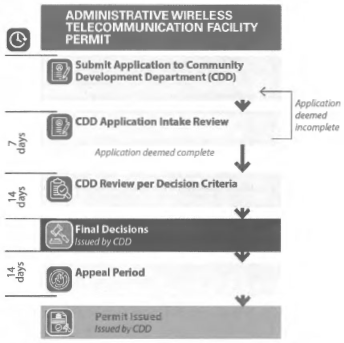
Wireless telecommunication facility applications shall be submitted to the community development department and shall include all information application, including but not limited to:
1.
Proof of property ownership;
2.
A letter of authorization from the property owner if the application is submitted by an agent;
3.
A scaled site plan indicating compliance with section 16-74(i), indicating the location of existing structures, the location of the proposed improvements, existing and proposed easements, setbacks, means of access, and landscaping if required by the county;
4.
Elevations for all four sides of the proposed facility indicating the height about existing grade, materials, color, and lighting;
5.
Information showing that the facility is necessary, and that its denial would constitute a prohibition or effective prohibition under federal law, i.e., propagation studies;
6.
Written evidence demonstrating the technological reason for the WTF location. If the proposed location is not the highest priority listed in section 16-17(j)(2), a detailed explanation shall be provided as to why a location of a higher priority was not selected and why failure to grant a permit for the proposed location would constitute a prohibition or effective prohibition of the applicant's ability to provide service as defined under applicable state or federal law;
7.
A written explanation of how the request conforms to the decision criteria within section 16-73(b)(3).
c.
The community development department shall intake the application pursuant to the requirements of section 16-72(d).
d.
The community development director, or their designee, shall review the wireless telecommunication facility permit application based on its conformity with the decision criteria of section 16-73(b)(3)
e.
If the application complies with the provisions of section 16-73(b), the community development director shall issue an approval.
f.
The final action of the community development director or their designee may be appealed in accordance with section 16-72(g).
(3)
Decision criteria. An application for a wireless telecommunication facility shall be approved if it complies with all applicable standards in this Code and any other adopted county regulations.
(c)
Accessory structure permit.
(1)
Applicability. This section applies to any application for an accessory structure permit to construct structures such as accessory dwelling units (ADUs) or sheds within the county pursuant to the procedures in section 16-73(c)(2).
(2)
Procedures.
a.
Applications for an accessory structure permit may be made by the owner or agent of any parcel of property to be affected.
b.
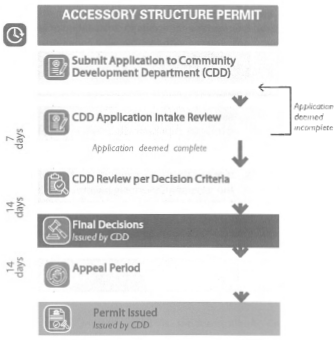
Accessory structure permit applications shall be submitted to the community development department and shall include all information per the county's accessory structure permit application, including:
1.
Proof of property ownership.
2.
A scaled plat or survey which shall indicate and dimension any existing utility lines on the site, existing and proposed easements, existing buildings and structures on the site, and all buildings.
3.
A scaled site plan which shall indicate, label, and dimension all access and parking related to the site, proposed and existing easements, existing utility lines on the site, and existing and proposed buildings and structures. Sufficient documentation of compliance with all applicable development standards of article IV such as required setbacks, building separations, building heights, open space, and parking shall be included.
4.
A written explanation of how the request conforms to the decision criteria within section 16-73(c)(3).
c.
The community development department shall intake the application pursuant to the requirements of section 16-72(d).
d.
The community development director, or their designee, shall review the accessory structure permit application based on its conformity with the decision criteria of section 16-73(c)(3).
e.
If the application complies with the provisions of section 16-73(c)(3), the community development director, or their designee, shall issue an accessory structure permit.
(3)
Decision criteria. An application for a accessory structure permit shall be approved if it complies with all applicable standards in this Code, any other adopted county regulations.
(d)
Encroachment permit.
(1)
Applicability. This section applies to any application for an encroachment permit for construction of structures or site elements to encroach upon a public utility or drainage easement or public right-of-way owned by the county.
(2)
Exemptions.
a.
Encroachment permits for construction or site elements within a private easement.
b.
Encroachment permits for installation of fences on all public easements (utility and drainage) are not required with the following conditions:
1.
Application and approval of a building permit is required.
2.
Applicant shall be fully responsible for utility line locating (Call 811 Before You Dig) prior to excavation/post installation.
3.
Fence placement shall not damage nor interfere with the function of any public utility or stormwater drainage system. The applicant shall be financially responsible for the repair to any damaged public infrastructure in compliance with county standards.
4.
For drainage easements, the applicant shall ensure existing surface drainage patterns are maintained and unimpeded.
5.
If at any time the county deems that a fence placement interferes with the intended purpose of the easement, including maintenance and construction work, the applicant shall be responsible for fence removal and replacement and any associated costs.
c.
Encroachment permits for installation of non-permanent structures with no subsurface foundation or structure are not required on public utility easements that do not include a surface drainage function or infrastructure.
(3)
Procedures.
a.
Applications for an encroachment permit may be made by the owner of any parcel of property containing or adjacent to a public easement and/or right-of-way affected.
b.
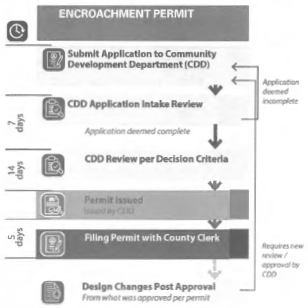
Encroachment permit applications shall be submitted to the community development department and shall include all information per the county's encroachment permit application including a survey which shall indicate and dimension property boundaries, existing easements and right-of-way, any existing utility and stormwater drainage features, and existing and proposed structures. Other documentation that shows compliance with the applicable provisions of this Code and other adopted county plans or policies may be required including:
1.
A scaled site plan indicating any proposed new structures and modifications to the property, easement, right-of-way, or public infrastructure serving the property or surrounding area including but not limited to pedestrian and/or vehicular circulation and street features including sidewalks, driveways, traffic signs and devices, lighting, landscaping and furnishings; grading and stormwater drainage features; and utility services. Sufficient documentation of compliance with all applicable development standards such as required setbacks, building heights, open space, parking, applicable development phasing shall be included.
2.
Construction drawings indicating any proposed new structures and modifications to the easement, right-of-way, or public infrastructure serving the property or surrounding area including streets, stormwater drainage features, and utilities including any necessary provisions required by the county engineer in accordance with the public works design and construction standards and the utilities manager in accordance with the public utility construction standards.
3.
If an application for encroachment is related to a larger site and development plan application pursuant to section 16-74(i) or 16-74(j), as applicable, any applicable impact studies as required by the county engineer or utilities manager may apply.
c.
The community development department shall intake the application pursuant to the requirements of section 16-72(d).
d.
If the application is approved by the county engineer and utilities manager, the community development department shall issue an encroachment permit. The property owner shall have five days from permit issuance to record the encroachment permit with the office of the county clerk and submit the recorded copy to the community development department.
e.
Any changes in the design/construction from what was approved under the original permit due to design modifications, errors or due to the result of unforeseen field conditions shall require re-approval. Any such changes will require immediate cessation of the construction, pending such approval.
f.
Failure to inform the County of Los Alamos of any changes to design, or as-built construction conditions other than shown on the permit may be cause for cancellation of an approved encroachment permit.
g.
The property owner shall be financially responsible for any public infrastructure damaged as a result of any installations made under an encroachment permit.
h.
Permit issuance shall in no way limit or diminish the county's rights to the easement or right-of-way. Should the county require use of the easement or right-of-way at any time, the property owner shall remove all structures or site elements or be subject to removal by the county at the owner's expense within 30 days of a required notice of removal. The county shall not be liable for any damage resulting from removal of such structures or site elements.
(4)
Decision criteria. An application for an encroachment permit shall be approved if it complies with all applicable standards in this Code, any other adopted county regulations, and any requirements deemed necessary by the utilities manager and county engineer. Requests that may result in damage or interference with operation, maintenance, and repair of any public street, stormwater drainage facility, or utility will be denied.
(e)
Fence/wall permit.
(1)
Applicability. This section applies to all applications to build a wall or fence that meets the standards in division 7, Walls, Fence, and Gates.
(2)
Procedures.
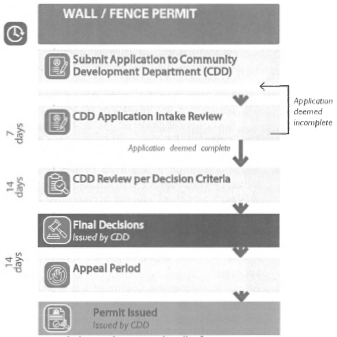
a.
Applications for wall or fence permits may be made by the owner or agent of any parcel of property to be affected.
b.
Wall or fence and permit applications shall be submitted to the community development department and shall include all information per the county's fence and wall permit application, including:
1.
Proof of property ownership.
2.
A scaled plat or survey which shall indicate and dimension any existing utility lines on the site, existing and proposed easements, existing buildings and structures on the site, and all buildings.
3.
A scaled site plan which shall indicate and dimension all access and parking related to the site, proposed and existing easements, existing utility lines on the site, existing buildings and structures, existing and proposed walls, fences, or gates. Show, dimension, and label all existing and proposed easements, and location of all proposed walls, fences, and gates. Sufficient documentation of compliance with the applicable development standards of article IV such as distances from the property lines, lengths and heights of proposed wall, fence, and gate heights must be provided.
4.
New walls and fences in excess of six feet in height or existing walls and fences raised in excess of six feet require construction documents which shall be certified by a New Mexico Registered Structural Engineer or Architect.
5.
A written explanation of how the request conforms to the decision criteria within section 16-73(e)(3).
c.
The community development department shall intake the application pursuant to the requirements of section 16-72(d).
d.
The community development director, or their designee, shall review the wall and fence permit application based on its conformity with the decision criteria of section 16-73(e)(3).
e.
If the application complies with the provisions of section 16-73(e)(3), the community development director shall issue a permit.
(3)
Decision criteria. An application for a wall or fence permit shall be approved if it complies with all applicable standards in this Code, particularly division 7, Walls, Fences and Gate, and any other adopted county regulations.
(f)
Lighting plan.
(1)
Applicability. Whenever a building, subdivision, site plan, or outdoor lighting permit is applied for, an outdoor lighting plan shall be submitted in conjunction with the application.
(2)
Procedures.
a.
Applications for lighting plans may be made by the owner or agent of any parcel of property to be affected.
b.
Lighting plans shall be submitted to the community development department and must follow one of the following methods:
1.
Prescriptive method. A spreadsheet, or chart, containing identification for each luminaire type, quantity, initial lumen output, BUG rating, the total expected site lumens, and the total site lumens allowed based on the property size. A sub-category analysis is also required for the total lumens coming from partially shielded light (e.g. tree, landscape, sculpture, and some wall or façade light) allowed in the requirements below, which can't exceed 20 percent of the allowable lumens.
i.
It is the responsibility of the applicant to submit a signed affidavit that the site lighting plan meets the requirements of the ordinance.
ii.
Supporting data sheets for exact luminaires (model numbers), distribution plots, BUG ratings, luminaire locations, mounting heights, and aiming directions.
2.
Performance method. The entire outdoor lighting design shall be analyzed using industry standard lighting software. This lighting plan shall include:
i.
Luminaire locations, mounting heights, aiming directions, IES photometric data, buildings, and other physical objects within the site.
ii.
The total site lumens should not exceed the requirements listed within this chapter.
iii.
The average illuminance (in footcandles or lux) for any one task should not exceed ANSI/IES standards for the applicable lighting zone, including but not limited to:
•
Façade, building entrance, porte cochere, softscape, perimeter barriers.
•
Walking paths adjacent to architecture, hardscape, exits, landscape, waterfront, stairs, and ramps.
•
Patios, outdoor dining, decks, terraces, pools, and pool decks.
iv.
The analysis shall utilize an enclosure comprised of calculation planes with zero reflectance values around the perimeter of the site including a top plane no less than 33 feet (ten meters) above the tallest luminaire. The illuminance on the calculation planes must not exceed the limits of light trespass defined within this chapter.
v.
A signed affidavit that the site lighting plan meets the requirements of the chapter.
3.
Comparable examples already in the community that demonstrate technique, specification and/or light level should be provided if available to expedite the review process.
c.
The community development department shall intake the application pursuant to the requirements of section 16-72(d).
d.
The community development director, or their designee, shall review the lighting plan based on its conformity with the decision criteria of section 16-73(f)(3).
e.
If the application complies with the provisions of section 16-73(f)(3), the community development director shall issue an approval. The director shall have the authority to refer an application to the planning and zoning commission or the historic preservation advisory board if deemed appropriate.
f.
Any appeals related to decisions regarding outdoor lighting shall be made to the planning and zoning commission using the procedure set forth in section 16-72(g).
(3)
Decision criteria. A lighting plan shall be approved if it complies with all applicable standards in this Code, particularly division 6, Outdoor Lighting, and any other adopted county regulations.
(g)
Minor historic demolition permit.
(1)
Applicability. This section applies to all applications for demolition permits within a historic protection overlay.
(2)
Procedures.
a.
Applications for historic demolition permit may be made by the owner or agent of any parcel of property to be affected.
b.
HP-O demolition permits shall be submitted to the community development department and shall include all information per the county's demolition permit application, including:
1.
Proof of ownership.
2.
Scaled floor plan showing scope of demolition.
3.
A written explanation demonstrating compliance with the decision criteria of section 16-73(g)(3) or 16-73(g)(4).
c.
The community development department shall intake the application pursuant to the requirements of section 16-72(d).
d.
The community development director, or their designee, shall set a committee session with the director and two members of the historic preservation advisory board (HPAB) designated by the historic preservation advisory board chair to review the application within ten days of receipt of a complete application.
e.
The demolition permit application shall be reviewed based on its conformity with the decision criteria of section 16-73(g)(3) or 16-73(g)(4).
f.
If the committee finds the application complies with the provisions of section 16-73(g)(3) or 16-73(g)(4), the community development director shall issue the permit.
g.
If the committee does not issue a demolition permit, then the request shall follow the major historic demolition permit procedures of section 16-74(e).
(3)
Decision criteria for partial demolition. An application for a demolition permit in an HP-O shall be approved if it meets all of the following criteria:
a.
The partial demolition is required for renovation, restoration, or rehabilitation of the structure.
b.
The structure is determined to have historic or architectural significance but, the structure proposed for demolition is not structurally sound despite evidence of the owner's efforts to maintain the structure.
c.
The request has mitigated, to the greatest extent possible, impacts on the historic importance of the structure or structures located on the property and on the architectural integrity of the structure or structures on the property.
(4)
Decision criteria for total demolition. An application for a demolition permit in an HP-O shall be approved if it meets all of the following criteria:
a.
The structure is of minimal historic significance because of its location, condition, modifications or other factors, and its demolition will be inconsequential to historic preservation needs of the area; or
b.
The structure is determined to have historic or architectural significance but:
1.
The structure proposed for demolition is not structurally sound despite evidence of the owner's efforts to maintain the structure; and
2.
The structure cannot be rehabilitated or reused on site to provide for any reasonable beneficial use of the property; and
3.
The structure cannot be practically moved to another site in Los Alamos; and
4.
The request demonstrates that the proposal mitigates the greatest extent practical the following:
i.
Any impacts that occur to the visual character of the neighborhood where demolition is proposed to occur.
ii.
Any impact on the historical importance of the structure or structures located on the property and adjacent properties.
iii.
Any impact to the architectural integrity of the structure or structures located on the property and adjacent properties.
(h)
Minor historic property alteration certificate.
(1)
Applicability.
a.
Any alteration to the exterior appearance of any historically designated structure, new construction or demolition within a designated historic protection overlay of section 16-9 shall require historic property alteration certificate per this section.
b.
Any construction, alteration, relocation or demolition of any fence or other landscape feature including, without limitation, any deck, wall, berm, garden structure, exterior lighting, driveway, or landscaping that has the potential for affecting historic structures or features shall also require an approved historic property alteration certificate per this section.
(2)
Exemptions. A historic property alteration certificate shall not be required for:
a.
Ordinary maintenance and repair where the purpose of the work is to preserve the integrity of the structure and/or materials, correct any aesthetic deterioration to the structure, and restore it to its condition prior to deterioration; or
b.
Construction, alteration or demolition involving only interior features of the structure, unless such work impacts the structure's exterior appearance.
(3)
Procedures.
a.
Applications for a historic property alteration certificate may be made by the owner or agent of any parcel of property to be affected.
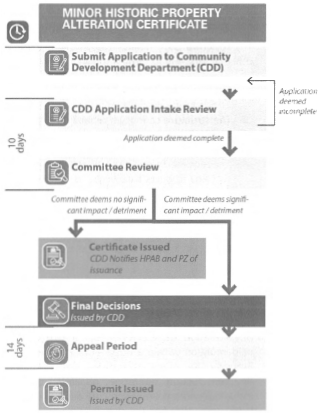
b.
Historic property alteration certificate applications shall include the application, scaled site plan, architectural drawings, and other documentation that show compliance with the applicable provisions of this Code and other adopted county plans or policies as required by the county's historic property alteration certificate application to the community development department, including:
1.
Proof of property ownership or owner's affidavit if property is rented or leased.
2.
Architectural drawings showing proposed alterations, as applicable.
3.
A written explanation of how the request conforms to the decision criteria within section 16-73(h)(4).
4.
Any applicable requirements as required by the community development director.
c.
The community development department shall intake the application pursuant to the requirements of section 16-72(d).
d.
The community development director, or their designee, shall set a historic property alteration certificate review committee session with the director and two members of the historic preservation advisory board designated by the historic preservation advisory board chair to review the application within ten days of receipt of a complete application.
e.
The historic property alteration certificate application shall be reviewed based on its conformity with the decision criteria of section 16-73(h)(4).
f.
If the committee determines there will be no significant impact or potential detriment based on the decision criteria in section 16-73(h)(4), the community development department shall issue the alternation certificate and send written notification to the historic preservation advisory board and the planning and zoning commission of such issuance.
g.
If it has been determined by the majority of the historic property alteration certificate review committee that the proposed work would create a significant impact or potential detriment to the historic property based on the criteria in section 16-73(h)(4), the application shall be referred to a public hearing pursuant to section 16-72(f). The community development department shall notify the applicant of the referral in writing within five days of the decision.
h.
The final action of the committee regarding any minor historic property alteration certificate may be appealed to the planning and zoning commission in accordance with section 16-72(g).
(4)
Decision criteria. An application for a minor historic property alteration certificate shall be approved if it meets all of the following criteria:
a.
The proposed work will preserve, enhance, or restore significant features of the resources as identified in the criteria for designation of the nomination or any specific design guidelines adopted for the historic landmark or district.
b.
The proposed work is compatible with the relevant historic, cultural, or architectural qualities characteristic of the structure, site or district including, but not limited to, elements of size, scale, massing, proportions, orientation, materials, surface textures and patterns, details and embellishments and the relation of these elements to one another.
c.
The proposed work will not significantly destroy, damage, or diminish significant features of the resources as identified in the criteria for designation of the nomination or within any specific design guidelines adopted for the historic landmark or district.
(i)
Minor development plan amendments.
(1)
Applicability. This section applies to any amendment to a previous development plan approval that changes site development standards at a threshold of not more than ten percent.
(2)
Procedures.
a.
Applications for minor development plan amendment applications may be made by the owner or agent of any parcel of property to be affected.
b.
Minor development plan amendment applications shall be submitted to the community development department and shall include all information per the county's minor development plan application, including:
1.
Proof of property ownership.
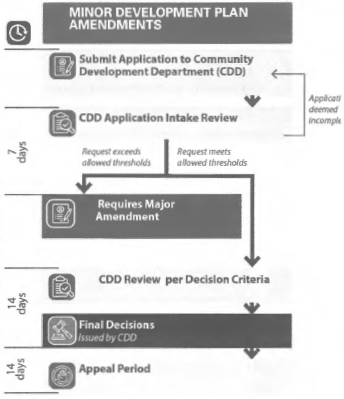
2.
The original, approved development plan.
3.
The proposed amendments to the development plan clearly noting changes.
4.
Any applicable requirements or impact studies as required by the county engineer.
c.
The community development department shall intake the application pursuant to the requirements of section 16-72(d).
d.
The community development director, or their designee, shall review the minor development plan amendment application to determine whether the proposed changes are within the allowed thresholds for a minor amendment and based on its conformity with the decision criteria of section 16-73(i)(3).
e.
If the community development director, or their designee, determines that the proposed amendment exceeds the allowable thresholds for a minor amendment or are not in substantial compliance with this chapter or other ordinances, resolutions or regulations, the requested amendment shall be treated as a new development plan reviewed pursuant to section 16-74(j).
f.
If the application complies with the provisions of section 16-73(i)(3), the community development director, or their designee, shall approve the amendment.
(3)
Decision criteria. An application for a minor development plan amendment shall be approved if it meets all of the following criteria:
a.
The requested change is within the ten percent thresholds for minor amendments.
b.
The development of the property is in conformance with the intent and policies of the comprehensive plan and other adopted county policies and plans.
c.
The amendment is in compliance with the intent of the original development plan and any previous requirements or conditions of approval.
d.
The requested change does not require major public infrastructure or significant changes to access or circulation patterns on the site and does not substantially change the function or appearance of the development, which would warrant additional review by the planning and zoning commission pursuant to section 16-74(j).
e.
No deviations or variances shall be granted for minor amendments.
(j)
Minor site plan amendments.
(1)
Applicability. This section applies to any amendments to a previously approved site plan that does not change the use, function or appearance of the development, or increase the gross floor area of previously approved buildings in excess of 20 percent, not to exceed a maximum of 5,000 square feet of gross floor area.
(2)
Procedures.
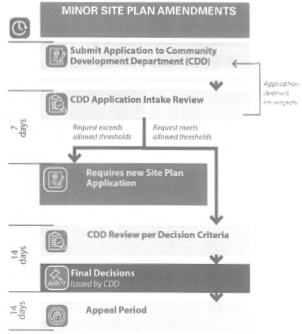
a.
Applications for site development plan amendments may be made by the owner or agent of any parcel of property to be affected.
b.
Minor site plan amendment applications shall be submitted to the community development department and shall include all information per the county's minor development plan application, including:
1.
Proof of property ownership.
2.
A new scaled site plan or the original, approved site plan, if one exists.
3.
The proposed amendments to the site plan clearly noting changes.
4.
A utilities plan indicating any proposed modifications to the infrastructure serving the site, including public and private streets, driveways, and traffic control measures and utilities.
5.
A grading and drainage plan indicating any proposed modifications necessary provisions for controlling stormwater drainage on-site and off-site as required by the county engineer in accordance with the county's storm drainage construction standards or such other ordinances or stormwater management plans as may exist.
6.
A lighting plan indicating compliance with section 16-73(f), demonstrating the total site lumen limit is not exceeded and indicating the location, type, height, color temperature, lumen output and amount of all proposed and existing light fixtures.
7.
A landscape plan indicating compliance with division 4, Landscaping and Screening, demonstrating the minimum landscaped site area requirements and minimum plant materials and standards have been met and showing compliance with all landscaping, streetscape, parking lot landscape, buffering, and screening requirements.
8.
Any applicable requirements or impact studies as required by the county engineer, including on sites that have a slope which is equal to or greater than 1:2 which may require more rigorous grading, erosion control and reclamation plan.
c.
The community development department shall intake the application pursuant to the requirements of section 16-72(d).
d.
The community development director, or their designee, shall review the minor site plan amendment application to determine whether the proposed changes are within the allowed thresholds for a minor amendment. The community development director, or their designee, shall review the application based on its conformity with the decision criteria of section 16-73(j)(3).
e.
If the community development director, or their designee, determines that the proposed amendment exceeds the allowable thresholds for a minor amendment or are not in substantial compliance with this chapter or other ordinances, resolutions or regulations, the requested amendment shall be treated as a new site plan reviewed pursuant to section 16-74(h).
f.
If the application complies with the provisions of section 16-73(j)(3), the community development director, or their designee, shall approve the amendment.
(3)
Decision criteria. An application for a minor site plan amendment shall be approved if it meets all of the following criteria:
a.
The requested change is within the ten percent threshold for minor amendments.
b.
The development of the property is in conformance with the intent and policies of the comprehensive plan and other adopted county policies and plans.
c.
The amendment is in compliance with the intent of the original site plan and any previous requirements or conditions of approval.
d.
The requested change does not require major public infrastructure or significant changes to access or circulation patterns on the site and does not substantially change the function or appearance of the development, which would warrant additional review by the planning and zoning commission pursuant to section 16-74(h).
e.
No deviations or variances shall be granted for minor amendments.
(k)
Sign permit.
(1)
Applicability. This section applies to any sign that requires a sign permit pursuant to section 16-63.
(2)
Procedures.
a.
Applications for sign permits may be made by the owner or agent of any parcel of property to be affected.
b.
Sign permit applications shall be submitted to the community development department and shall include all information per the county's sign permit plan application, including:
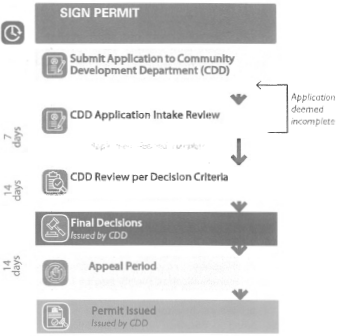
1.
Proof of property ownership.
2.
A scaled and dimensioned color drawing of all proposed signs that indicates how it will be constructed.
3.
A scaled site plan which shall indicate the location of any proposed permanent freestanding signs. Sufficient documentation of compliance with all applicable development standards of division 8, Signage is required as well as documentation from a New Mexico Registered Structural Engineer verifying all proposed permanent freestanding signs are designed to withstand 90 mph wind, 30 psf snow, and seismic design D loads.
4.
Building elevations showing the locations and dimensions of any proposed wall signs.
5.
Electrical plan for any proposed electronic message center, which includes compliance with sign illumination standards of section 16-65(c).
c.
The community development department shall intake the application pursuant to the requirements of section 16-72(d).
d.
The community development director, or their designee, shall review the sign permit application based on its conformity with the decision criteria of section 16-73(k)(3).
e.
If the application complies with the provisions of section 16-73(k)(3), the community development director, or their designee, shall issue a sign permit.
(3)
Decision criteria. An application for a sign permit shall be approved if it complies with all applicable standards in this Code, in particular division 8, Signage, and other adopted county regulations.
(l)
Small wireless facilities permit.
(1)
Applicability.
a.
This section applies to any application for a small wireless facilities permit for placement of a small wireless facility in any right-of-way. An applicant may submit a consolidated application for up to 25 small wireless facilities so long as they are all of substantially the same type, and on substantially the same types of structures, however no more than one such consolidated application may be filed within any five business-day period.
b.
An small wireless facilities permit application is not required for:
1.
Routine maintenance that does not involve the addition of transmission or related equipment; and
2.
The replacement of a small wireless facility with another small wireless facility that is substantially similar to or the same number, size or smaller in size, and weight and height as long as the wireless provider that owns the wireless facility notifies the county and provides details of the proposed replacement demonstrating the substantial similarity of the replacement at least ten days before the replacement is made.
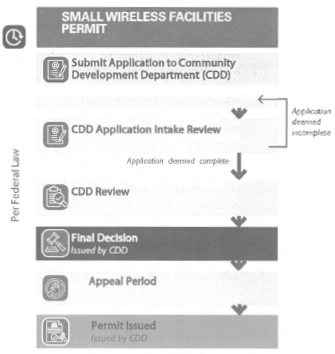
(2)
Procedures.
a.
Applications for small wireless telecommunication facility may be made by the owner or agent of any parcel of property to be affected.
b.
Small wireless telecommunication facility applications shall be submitted to the community development department and shall include all information per the county's small wireless telecommunication facility application form(s) as may be amended by the county from time to time.
c.
The community development director shall be responsible for creating and updating the applicable applications for wireless projects, as well as the intake and processing steps to timely process wireless projects to a decision. Within the applicable time frame, the county shall determine and notify the applicant whether the application is complete. If an application is incomplete, the county shall specifically identify the missing information in writing. For incomplete applications, the time for processing the application shall be tolled as permitted by applicable law.
d.
If the application complies with the provisions of section 16-73(l)(3), the community development director shall issue a small wireless facilities permit.
e.
The community development director or their designee shall make their final decision to approve or deny the application within the time limits established by applicable federal and state laws.
f.
The final action of the community development director or their designee may be appealed in accordance with section 16-72(g).
(3)
Decision criteria. An application for a small wireless facilities permit shall be approved if it complies with all applicable standards in this Code and any other adopted county regulations.
(m)
Special event permit.
(1)
Applicability. This section applies to any special event on public or private property that are open to the public, when the sale of tickets is involved, and/or a private event with 100 people or more in attendance.
(2)
Procedures.
a.
Applications for special event permit applications may be made by the owner or agent of any parcel of property to be affected.
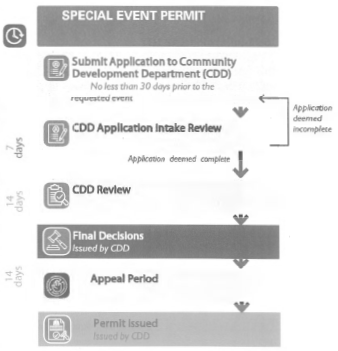
b.
Special event permit applications shall be submitted to the community development department no less than 30 days before the requested event and shall include all information per the county's special event permit application, including:
1.
Proof of property ownership, or written permission from the owner of the subject property if different from the applicant.
2.
A scaled site plan with sufficient detail of the proposed use and site elements regarding access, location of parking, temporary sanitary facilities or other temporary provisions, and the location of any structures or signage may be required if deemed necessary by the community development director, or their designee.
Any additional applicable permits as required by the community development director, including but not limited to: Noise ordinance waiver permit, temporary use permit, alcohol permit, traffic impedance permit, vendor permits, and fire/police permits.
c.
The community development department shall intake the application pursuant to the requirements of section 16-72(d)
d.
The community development director, or their designee, shall review the special event permit application within five days of receipt and transmit it to the appropriate departments for review and approval.
e.
Upon approval from all reviewers, the community development director, or their designee, shall provide a written notice to the applicant and issue a permit.
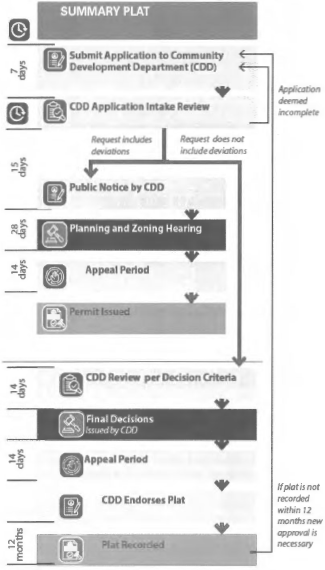
(n)
Summary plat.
(1)
Applicability. This section applies to any summary plat applications which seek a technical surveying correction, a lot line adjustment, consolidate no more than two lots, or subdivide a lot into no more than two lots.
Summary plat applications requesting any associated variances shall be reviewed by the planning and zoning commission pursuant to section 16-74(f).
(2)
Procedures.
a.
Applications for summary plat applications may be made by the owner or agent of any parcel of property to be affected.
b.
Summary plat applications shall be submitted to the community development department and shall include all information per the county's summary plat application, including:
1.
Proof of property ownership;
2.
A scalable proposed plat with metes and bounds prepared by a licensed surveyor which shall indicate and dimension any existing utility lines on the site, existing and proposed easements, provisions of this Code and other adopted county plans or policies may be required including;
3.
Proof of payment of taxes; and
4.
A written explanation of how the request conforms to the decision criteria within section 16-73(n)(3).
c.
The community development department shall intake the application pursuant to the requirements of section 16-72(d).
d.
The community development director, or their designee, shall submit the summary plat to the county engineer and the county utilities manager for review within 28 days of receipt.
e.
The county engineer and county utilities manager shall review the application based on compliance with this Code and other county regulations and provide a recommendation to the community development director, or their designee.
f.
The community development director, or their designee, shall review the summary plat application based on its conformity with the decision criteria of section 16-73(n)(3).
g.
If the application complies with the provisions of section 16-73(n)(3), the community development director, or their designee, shall approve the summary plat.
h.
Written notification of the written final action, listing any conditions imposed if the action was approved, shall be sent to the applicant and to the county manager, with a copy retained in the community development department.
i.
An aggrieved party withstanding pursuant to section 16-72(g)(4) may file an appeal pursuant to section 16-72(g) within 15 days of the effective date of the final action.
j.
After the expiration of the 15-day appeal period with no appeal being filed, the community development director shall endorse their approval on the plat.
k.
The applicant shall record the plats in the office of the county clerk within 12 months of the date of final action on the plat. If the time period for recording the plat with the county clerk expires, any and all applications for summary plats on the same parcel of property shall be treated as a new application.
(3)
Decision criteria.
a.
An application for a summary plat shall be approved if it meets all of the following criteria;
b.
The development of the property shall substantially conform to the comprehensive plan and shall not be materially detrimental to the health, safety, and general welfare of the county;
c.
The request is in conformance with all applicable standards. No deviations or variances shall be granted for summary plats;
d.
For lot splits, both lots shall front on an existing, dedicated, and improved street;
e.
Both lots and uses must meet the minimum site development parking requirements of the applicable district, as set forth in division 3, Off-Street Parking, Loading, and Queuing; and
f.
Necessary easements shall be provided for existing and proposed utilities in an acceptable manner to the county engineer and the utilities manager.
(o)
Temporary use permit.
(1)
Applicability. This section applies to temporary uses within Table 26: Permitted Use Table that require a temporary use permit and shall comply with any applicable use-specific standards pursuant to article III.
(2)
Procedures.
a.
Applications for temporary use permits may be made by the owner or agent of any parcel of property to be affected.
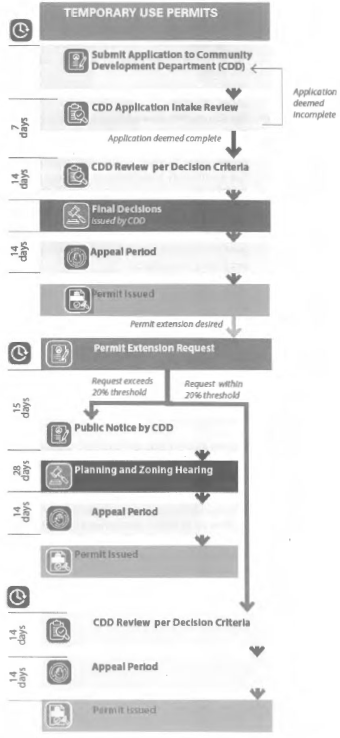
b.
Temporary use permit applications shall be submitted to the community development department and shall include all information per the county's temporary use permit application, including:
1.
Proof of property ownership, or written permission from the owner of the subject property if different from the applicant.
2.
A scaled site plan with sufficient detail of the proposed use and site elements regarding access, location of parking, temporary sanitary facilities or other temporary provisions, and the location of any structures or signage may be required if deemed necessary by the community development director, or their designee.
3.
A cash deposit or letter of credit determined to be adequate to insure the cleaning up of the property covered by the temporary use permit may be required if deemed necessary by the community development director. If the property and the surrounding area in the condition required, then the county may restore it to that condition, in which event the county shall have the right to be reimbursed for the costs incurred from the deposit or other security.
4.
A written explanation of how the request conforms to the decision criteria within section 16-73(o)(3).
c.
The community development department shall intake the application pursuant to the requirements of section 16-72(d).
d.
The community development director, or their designee, shall review the temporary use permit application based on its conformity with the decision criteria of section 16-73(o)(3).
e.
If the application complies with the appropriate provisions section 16-73(o)(3), the community development director, or their designee, shall issue a permit.
f.
The community development director, or their designee, may modify any of the conditions contained in the temporary use permit, if the community development director, or their designee, determines that the modification does not conflict with the purposes of the zoning requirements.
g.
The community development director, or their designee, may extend the time of operation of the temporary use permit no more than 20 percent above the total time allowed for the temporary use involved. Extension of time beyond 20 percent shall be approved by formal action of the planning and zoning commission.
h.
A use requiring a temporary use permit that continues beyond the allowed temporary use period shall constitute an offense under this Code and shall be subject to the general penalties prescribed in division 6, Violations, Enforcement, and Penalties.
(3)
Decision criteria. An application for a temporary use permit shall be approved if it complies with all applicable use-specific standards in article III and adequately mitigates adverse impacts to properties within 300 feet.
(4)
Conditions. The community development director, or their designee, may impose any of the conditions:
a.
Permitted hours of operation.
b.
Any other conditions such as lighting, parking, or protective fences which are deemed necessary to protect adjacent property or the public health, safety, and general welfare.
c.
CDD may require a cash deposit or letter of credit as may be determined to be adequate to insure the cleaning up of the property covered by the temporary use permit.
d.
CDD may modify any of the conditions contained in the temporary use permit, if the community development director, or their designee, determines that the modification does not conflict with the purposes of the zoning requirements.
Sec. 16-74. - Quasi-judicial decisions.
(a)
Subdivision (sketch, preliminary and final plats).
(1)
Applicability.
a.
This section applies to any application for the subdivision of land within the county pursuant to the procedures in section 16-74(a)(2).
b.
A summary plat for lot splits into no more than two lots shall be completed pursuant to section 16-73(n).
(2)
Procedures.
a.
Prior to the submission of any subdivision application, the applicant shall attend a pre-application meeting pursuant to section 16-72(b)(1).
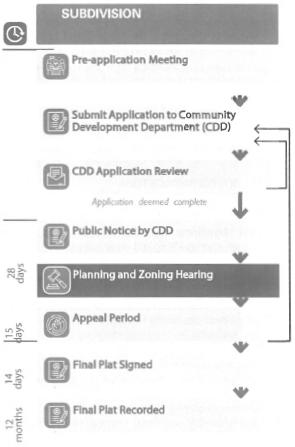
b.
Applications for subdivision may be made by the owner or agent of any parcel of property to be affected.
c.
Subdivision applications shall include the application, a scaled plat or survey, and other documentation that show compliance with the applicable provisions of this Code and other adopted county plans and policies as required by the county's site plan application to the community development department, including:
1.
Proof of property ownership.
2.
A vicinity map showing the boundaries of the property to be subdivided and all adjacent lots within 300 feet.
3.
A scaled plat or survey which shall indicate and dimension any existing utility lines on the site, existing and proposed easements, existing buildings and structures on the site, and all buildings and public rights-of-way within 20 feet of all boundaries of the site.
4.
A written explanation of how the request conforms to the decision criteria within section 16-74(a)(3).
d.
Any variances associated with the subdivision action may be granted by the planning and zoning commission concurrently to the subdivision application provided they are in compliance with the requirements and procedures of section 16-74(f).
e.
The community development department shall intake the application pursuant to the requirements of section 16-72(d).
f.
The community development department shall provide public notice pursuant to the requirements of section 16-72(c)(2).
g.
The community development director, or their designee, shall set a date for public hearing before the planning and zoning commission on the request within 28 days of receipt of a complete application.
h.
The community development department staff shall review the application and forward a recommendation to the planning and zoning commission.
i.
The planning and zoning commission shall conduct a public hearing on the application pursuant to the requirements of section 16-72(f) and chapter 8.
j.
A subdivision application shall be reviewed based on its conformity with the decision criteria of section 16-74(a)(3).
k.
A preliminary plat phase may proceed to the next step in the review and decision-making process only after the 15-day appeal period has passed with no appeal being filed.
l.
There shall be no more than 12 months between final action on a preliminary plat and application for final plat.
m.
After the expiration of the 15-day appeal period with no appeal being filed, the final plat shall be signed by the chair of the planning and zoning commission and shall show such other endorsements as required by NMSA 1978 § 14-8-16.
n.
Final plats shall include a list of any variances and/or deviations granted as an exhibit or note.
o.
The applicant shall record the final plats in the office of the county clerk within 12 months of the date of final action on the plat. If the time period for recording the plat with the county clerk expires, any and all applications for subdividing the same parcel of property shall be treated as a new application.
p.
The county clerk shall not accept any plat for filing that does not show the endorsement or signatures as required by state statute or this section.
(3)
Decision criteria. An application for subdivision shall be approved if it meets all of the following criteria:
a.
The development of the property substantially conforms to the intent and policies of the comprehensive plan and other adopted county policies and plans.
b.
The subdivision action shall not be materially detrimental to public health, safety, and welfare.
c.
The subdivision is in conformance with all applicable provisions of this Code and other adopted county regulations.
d.
The subdivision must be served or be capable of being served by all public utilities, with the exception of subdivisions for the R-E and R-A zone districts where it is determined by the utilities manager that it is economically unfeasible to extend sewer lines.
e.
The county's public infrastructure and services required to serve the proposed development including but not limited to water, sanitary sewer, electricity, gas, storm sewer, streets, etc. have adequate capacity to serve the proposed subdivision or made to be adequate if improvements are required in compliance with the county's construction standards, drainage standards, and adopted utilities department plans and specifications.
f.
Any necessary easements shall be provided for both existing and proposed utilities in an acceptable manner to the county engineer and utilities manager.
g.
The plat retains natural features such as watercourses, natural vegetation, terrain, historic and archaeological sites and structures, and other community assets, which if preserved, will contribute to the overall appearance and quality of life in the county to the maximum extent feasible.
h.
The subdivision does not create a nonconformity or increase the extent or degree of an existing nonconformity with the provisions of this Code unless a variance pursuant to section 16-74(f) is approved concurrently with the plat.
i.
An application for a preliminary plat shall be approved if it complies with all applicable provisions of this Code, any other adopted county regulations, and any conditions specifically applied to development of the property in a prior permit or approval affecting the property.
j.
An application for a final plat shall be approved if it includes all changes, conditions, and requirements contained in the preliminary plat approval.
(b)
Conditional use permit.
(1)
Applicability.
a.
This section applies to all applications for a use listed as conditional in Table 26: Permitted Use Table that are only allowed if approved pursuant to the procedures in section 16-74(b)(2).
b.
Approval of a new conditional use permit is also required for modification or expansion of an existing conditional use.
(2)
Procedures.
a.
Prior to the submission of a conditional use permit application, the applicant shall attend a pre-application meeting pursuant to section 16-72(b)(1).
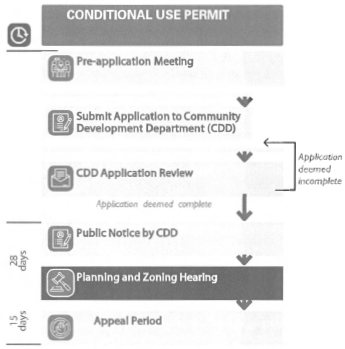
b.
Applications for a conditional use permit may be made by the owner or agent of any parcel of property to be affected.
c.
Conditional use permit applications shall include the application, plan and other documentation that show compliance with the applicable provisions of this Code and other adopted county plans or policies as required by the county's site plan application to the community development department, including:
1.
Proof of property ownership.
2.
A vicinity map showing the boundaries of the subject property and all adjacent lots within 300 feet.
3.
A scaled site plan which shall indicate and dimension all access and parking related to the site, proposed and existing easements, existing utility lines on the site, existing buildings and structures, and all buildings and public rights-of-way within 20 feet of all boundaries of the site. Show, dimension, and label all existing and proposed easements, and any existing and proposed landscaping, fencing, lighting, signage and any other proposed improvements. Sufficient documentation of compliance with all applicable development standards of article IV such as required setbacks, building heights, open space, and parking shall be included.
4.
A written explanation of how the request conforms to the decision criteria within section 16-74(b)(3).
d.
The community development department shall intake the application pursuant to the requirements of section 16-72(d).
e.
The community development department shall provide public notice pursuant to the requirements of section 16-72(c)(2).
f.
The community development director, or their designee, shall set a date for public hearing before the planning and zoning commission on the request within 28 days of receipt of a complete application.
g.
The community development department staff shall review the application and forward a recommendation to the planning and zoning commission.
h.
The planning and zoning commission shall conduct a public hearing on the application pursuant to the requirements of section 16-72(f).
i.
The conditional use permit application shall be reviewed based on its conformity with the decision criteria of section 16-74(b)(3).
(3)
Decision criteria. An application for a conditional use permit shall be approved if it meets all of the following criteria:
a.
The conditional use substantially conforms to the intent and policies of the comprehensive plan and other adopted county policies and plans.
b.
The conditional use is not detrimental to the public safety, health, or welfare.
c.
The conditional use is in conformance with all applicable provisions of this Code and other adopted county regulations.
d.
The special use shall conform to all applicable regulations of the district in which it is located.
e.
The conditional use does not cause significant adverse impacts on properties in the vicinity.
f.
There are adequate utilities, access roads, drainage, and other necessary improvements to allow the land use, or improvements are planned to provide adequate measures.
g.
The location, size, design, and operating characteristics of the conditional use will be compatible with the use and development of properties in the vicinity.
h.
The conditional use is in compliance with the site plan procedures and requirements of section 16-74(h) and demonstrates that the site development will be compatible with properties in the vicinity.
(c)
Discretionary wireless telecommunication facility permit.
(1)
Applicability. A tower or antenna that is not otherwise permitted or administratively approved shall be reviewed by the planning and zoning commission as outlined below.
(2)
Procedures.
a.
Applications for a wireless telecommunication facility may be made by the owner or agent of any parcel of property to be affected.
b.
Wireless telecommunication facility applications shall be submitted to the community development department and shall include all information per the county's wireless telecommunication facility application, including but not limited to:
1.
Proof of property ownership;
2.
A letter of authorization from the property owner if the application is submitted by an agent;
3.
A site plan indicating compliance with section 16-74(i), indicating the location of existing structures, the location of the proposed improvements, existing and proposed easements, setbacks, means of access, and landscaping if the facility is freestanding;
4.
Elevations for all four sides of the proposed facility indicating the height about existing grade, materials, color, and lighting;
5.
Information showing that the facility is necessary, and that its denial would constitute a prohibition or effective prohibition under federal law, i.e., propagation studies;
6.
Written evidence demonstrating the technological reason for the WTF location. If the proposed location is not the highest priority listed in section 16-17(j)(2), a detailed explanation shall be provided as to why a location of a higher priority was not selected and why failure to grant a permit for the proposed location would constitute a prohibition or effective prohibition of the applicant's ability to provide service as defined under applicable state or federal law.
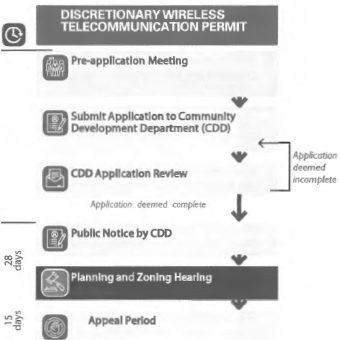
7.
A written explanation of how the request conforms to the decision criteria within section 16-74(c)(3).
8.
The community development department shall intake the application pursuant to the requirements of section 16-72(d).
c.
The community development department shall provide public notice pursuant to the requirements of section 16-72(c)(2).
d.
The community development director, or their designee, shall set a date for public hearing before the planning and zoning commission on the request within 28 days of receipt of a complete application.
e.
The community development department staff shall review the application and forward a recommendation to the planning and zoning commission.
f.
The planning and zoning commission shall conduct a public hearing on the application pursuant to the requirements of section 16-72(f) and chapter 8.
g.
The wireless telecommunication facilities permit shall be reviewed based on its conformity with the decision criteria of section 16-74(c)(3).
h.
The final action of the community development director or their designee may be appealed in accordance with section 16-72(g).
(3)
Decision criteria. An application for a wireless telecommunication facility shall be approved if it complies with all applicable standards in this Code and any other adopted county regulations and if it meets all the following criteria:
a.
The proposed telecommunications facilities are necessary to close a demonstrated significant gap in service coverage of the applicant based on actual signal strength data for the area where the gap is claimed and for the type of gap claimed; and
b.
The applicant has demonstrated that no other less intrusive means or alternative to the proposed telecommunications facilities design is practicable.
c.
The applicant has demonstrated that no higher priority location per section 16-17(j)(2) is practicable.
(d)
Historic economic hardship waivers.
(1)
Applicability. This section applies to applicants who has been denied a historic property alteration certificate and may seek an exemption from all, or portions of, the requirements of the historic protection overlay (HP-O) based on economic hardships.
(2)
Procedures.
a.
Applications for an exemption to the HP-O standards based on economic hardship may be made by the owner or agent of any parcel of property to be affected.
b.
Exemptions based on economic hardship applications shall be submitted to the community development department and shall include all information per the economic hardship exemption form including a demonstration of the following:
1.
In the case of an income-producing property, that a reasonable rate of return cannot be obtained from the property in its present condition or if improved in compliance with this article.
2.
In the case of a non-income-producing property, that the property has no beneficial use as a dwelling or for an institutional use in its present condition or if improved in compliance with this article.
3.
The consideration for economic hardship shall not include willful or negligent acts by the owner, purchase of the property for substantially more than the market value, or failure to perform normal maintenance and repairs.
4.
In addition, the applicant shall demonstrate that it has consulted in with the HPAB, local preservation groups, or interested parties in an effort to seek an alternative that will result in protection of the property.
c.
The community development department shall intake the application pursuant to the requirements of section 5-2(B)(IV).
d.
The community development department shall provide public notice pursuant to the requirements of section 5-2(B)(III). The community development director, or their designee, shall set a date for public hearing before the planning and zoning commission on the request within 30 days of receipt of a complete application.
e.
The planning and zoning commission shall conduct a public hearing on the application pursuant to the requirements of section 5-2(B)(V).
f.
The planning and zoning commission shall approve or deny the request.
g.
The final action of the planning and zoning commission regarding any exemptions based on economic hardship may be appealed to the county council in accordance with section 1-2(B)(VI) Appeals.
(3)
Decision criteria. An application for exemptions based on economic hardship shall be approved if it meets the following criteria:
a.
The hardship does not relate to the applicant's financial status.
b.
The impact of this ordinance is such that it denies the applicant all reasonable or beneficial use of the property.
(e)
Major historic demolition permit.
(1)
Applicability. This section applies to all applications for demolition within a historic protection overlay.
(2)
Procedures.
a.
Applications for historic demolition permits may be made by the owner or agent of any parcel of property to be affected.
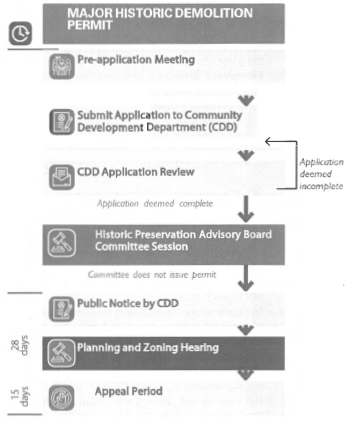
b.
Historic demolition permits shall be submitted to the community development department and shall include all information per the county's demolition permit application, including:
1.
Proof of ownership.
2.
Scaled floor plan showing scope of demolition.
3.
A written explanation demonstrating.
c.
The community development department shall intake the application pursuant to the requirements of section 16-72(d).
d.
The community development director, or their designee, shall set a committee session with the director and two members of the historic preservation advisory board designated by the historic preservation advisory board chair to review the application within ten days of receipt of a complete application.
e.
If the committee does not issue a demolition permit, then the community development director shall set a date for public hearing before the HPAB on the demolition request within 30 days of the demolition denial by the committee.
f.
The HPAB shall conduct a public hearing on the application pursuant to the requirements of section 16-72(f). The HPAB shall make a recommendation to the planning and zoning commission.
g.
Following receipt of the HPAB recommendation for application, the planning and zoning commission shall conduct a public hearing pursuant to section 16-72(f) within 14 days of the HPAB hearing date.
h.
The planning and zoning commission shall approve or deny the demolition request.
i.
The final action of the planning and zoning commission regarding any demolition request may be appealed to the county council in accordance with section 16-72(g), Appeals.
j.
If the request for demolition permit is denied by the planning and zoning commission, then no permit for demolition shall be issued for six months from the date of the planning and zoning commission hearing on the permit.
k.
If historic designation has not been granted for the property, at the expiration of the six-month period, the building official shall grant a demolition permit for the property.
l.
At the time of adoption of historic property designation, the temporary restraint of demolition and any stays of demolition in effect shall expire.
(3)
Decision criteria for partial demolition. An application for a demolition permit in an historic protection overlay shall be approved if it meets all of the following criteria:
a.
The partial demolition is required for renovation, restoration, or rehabilitation of the structure.
b.
The structure is determined to have historic or architectural significance but, the structure proposed for demolition is not structurally sound despite evidence of the owner's efforts to maintain the structure.
c.
The request has mitigated, to the greatest extent possible, impacts on the historic importance of the structure or structures located on the property and on the architectural integrity of the structure or structures on the property.
(4)
Decision criteria for total demolition. An application for a demolition permit in an historic protection overlay shall be approved if it meets all of the following criteria:
a.
The structure is of minimal historic significance because of its location, condition, modifications or other factors, and its demolition will be inconsequential to historic preservation needs of the area; or
b.
The structure is determined to have historic or architectural significance but:
1.
The structure proposed for demolition is not structurally sound despite evidence of the owner's efforts to maintain the structure; and
2.
The structure cannot be rehabilitated or reused on site to provide for any reasonable beneficial use of the property; and
3.
The structure cannot be practically moved to another site in Los Alamos; and
4.
The request demonstrates that the proposal mitigates to the greatest extent practical the following:
i.
Any impacts that occur to the visual character of the neighborhood where demolition is proposed to occur.
ii.
Any impact on the historical importance of the structure or structures located on the property and adjacent properties.
iii.
Any impact to the architectural integrity of the structure or structures located on the property and adjacent properties.
(f)
Major historic property alteration certificate.
(1)
Applicability. New construction over 200 square feet in gross floor area, the relocation or demolition of a historic property within a designated historic protection overlay of section 16-9 shall require major historic property alteration certificate per this section.
(2)
Procedures.
a.
Applications for a historic property alteration certificate may be made by the owner or agent of any parcel of property to be affected.
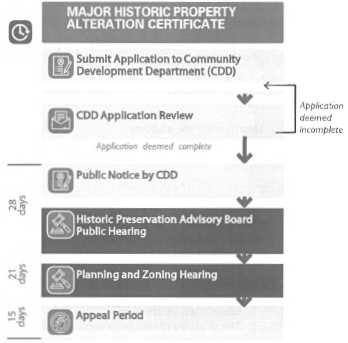
b.
Historic property alteration certificate applications shall include the application, site plan, architectural drawings and other documentation that show compliance with the applicable provisions of this Code and other adopted county plans or policies as required by the county's site plan application to the community development department, including:
1.
Proof of property ownership or owner's affidavit if property is rented or leased.
2.
Architectural drawings showing proposed alterations, as applicable.
3.
A written explanation of how the request conforms to the decision criteria within section 5-1(C)(III).
4.
Any applicable requirements as required by the community development director.
c.
The community development department shall intake the application pursuant to the requirements of section 16-72(d).
d.
The community development department shall provide public notice pursuant to the requirements of section 16-72(c)(2).
e.
The community development department shall set a date for public hearing before the historic preservation advisory board on the request within 40 days of receipt of a complete application.
f.
The historic preservation advisory board shall conduct a public hearing on the application and forward a recommendation to the planning and zoning commission. The historic preservation advisory board recommendation on the application shall take one of three forms: (i) approval as presented; (ii) approval with conditions; or (iii) denial. If the historic preservation advisory board fails to make a recommendation within the 40-day period, the request will be forward to the planning and zoning commission without a recommendation.
g.
The planning and zoning commission shall hold a public hearing pursuant to section 16-72(f) at the next regularly scheduled meeting after receiving the historic preservation advisory board recommendation or, in the event that the historic preservation advisory board isn't able to reach a recommendation, after the 40-day review period has passed.
h.
The historic property alteration certificate application shall be reviewed based on its conformity with the decision criteria of section 16-74(f)(3).
i.
The final action of the planning and zoning commission regarding any historic property alteration certificate may be appealed to the county council in accordance with section 16-72(g).
(3)
Decision criteria. An application for a major historic property alteration certificate shall be approved if it meets all of the following criteria:
a.
The proposed work will preserve, enhance, or restore significant features of the resources as identified in the criteria for designation of the nomination or any specific design guidelines adopted for the historic landmark or district.
b.
The proposed work is compatible with the relevant historic, cultural, or architectural qualities characteristic of the structure, site or district including, but not limited to, elements of size, scale, massing, proportions, orientation, materials, surface textures and patterns, details and embellishments and the relation of these elements to one another.
c.
The proposed work will not significantly destroy, damage, or diminish significant features of the resources as identified in the criteria for designation of the nomination or within any specific design guidelines adopted for the historic landmark or district.
(g)
Variances.
(1)
Applicability.
a.
Any deviation from this Code in excess of the thresholds established in section 16-73(a), Administrative Deviations will require a variance pursuant to the procedures of this section.
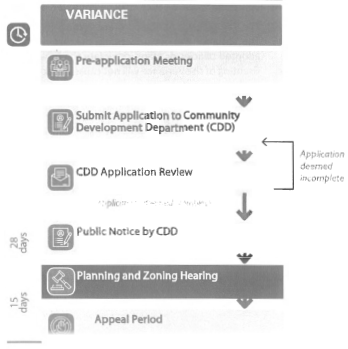
b.
Applications that are below the thresholds in section 16-73(a), Administrative Deviations are considered administrative deviations and may be reviewed/approved administratively without a public hearing.
(2)
Procedures.
a.
Prior to the submission of a site plan application, the applicant shall attend a pre-application meeting pursuant to section 16-72(b)(1).
b.
Applications for variances may be made by the owner or agent of any parcel of property to be affected.
c.
Variance applications shall include the application, plan, and other documentation that show compliance with the applicable provisions of this Code and other adopted county plans or policies as required by the county's site plan application to the community development department, including:
1.
Proof of property ownership.
2.
A scaled site plan which shall indicate and dimension all information pertinent to the variance request, including existing and proposed lot coverages, all existing buildings and structures on the site, existing and proposed easements, existing and proposed setbacks, and building/structure elevations.
3.
A written explanation of how the request conforms to the decision criteria within section 16-74(g)(3).
d.
Applications for variances associated with a subdivision request shall be submitted with the preliminary plat application or with the summary subdivision application pursuant to section 16-73(n), as applicable.
e.
The community development department shall intake the application pursuant to the requirements of section 16-72(d).
f.
The community development department shall provide public notice pursuant to the requirements of section 16-72(c)(2).
g.
The community development director, or their designee, shall set a date for public hearing before the planning and zoning commission on the request within 28 days of receipt of a complete application.
h.
The community development department staff shall review the application and forward a recommendation to the planning and zoning commission.
i.
The planning and zoning commission shall conduct a public hearing on the application pursuant to the requirements of section 16-72(f).
j.
The site plan application shall be reviewed based on its conformity with the decision criteria of section 16-74(g)(3).
(3)
Decision criteria. An application for a variance shall be approved if it meets all of the following criteria:
a.
The variance will not be contrary to the public safety, health, or welfare.
b.
The variance will not undermine the intent of this Code, the applicable zone district, other county adopted policies or plans, or violate the building code.
c.
Granting of the variance will not cause an intrusion into any utility or other easement unless approved by the owner of the easement.
d.
The variance request is caused by unusual physical characteristic or a hardship inherent in the lot or lot improvements and the peculiarity or hardship has not been self-imposed.
e.
The variance will not create any significant adverse impacts on properties within the vicinity.
f.
Granting of the approved variance is the minimum necessary easing of the Code requirements making possible the reasonable use of the land, structure, or building.
(h)
Minor zone map amendment.
(1)
Applicability. This section applies to all applications for a zone map amendment to change a single tract, parcel or lot under common ownership; or the land affected by the map amendment is predominantly owned by a single person or entity under common ownership.
(2)
Procedures.
a.
Prior to the submission of a zone map amendment application, the applicant shall attend a pre-application meeting pursuant to section 16-72(b)(1) and conduct a neighborhood meeting pursuant to section 16-72(b)(2).
b.
Applications for an amendment to the official zoning map may be made by the county council, the planning and zoning commission, the county manager, the community development director, or designee, or the owner or agent of any parcel of property to be affected.
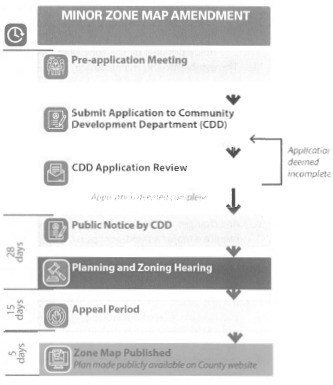
c.
Zone map amendment applications shall be submitted to the community development department. The application shall explain how it conforms to the decision criteria in section 16-74(h)(3).
d.
A request for amendment to the comprehensive plan, if found necessary by the community development director, shall be submitted, processed, heard, and decided upon concurrently with the request for zone map amendment.
e.
The community development department shall intake the application pursuant to the requirements of section 16-72(d).
f.
The community development department shall provide public notice pursuant to the requirements of section 16-72(c)(2).
g.
The community development director, or their designee, shall set a date for public hearing before the planning and zoning commission on the zone map amendment request within 28 days of receipt of a complete application.
h.
The planning and zoning commission shall conduct a public hearing on the application pursuant to the requirements of section 16-72(f).
i.
The planning and zoning commission shall approve or deny the proposed zone map amendment pursuant to the decision criteria within section 16-74(h)(3).
j.
If the planning and zoning commission approves the zone map amendment, the official zoning map shall be amended to note the new zone district designation and posted on the county website.
(3)
Decision criteria. An application for a zone map amendment of the official zoning map shall be approved if it meets all of the following criteria:
a.
The proposed zone map amendment is consistent with the health, safety, and welfare of the county as shown by conformance with the goals and policies of the comprehensive plan and other adopted county plans or policies.
b.
The existing zone district designation is shown to be inappropriate for one or more of the following reasons:
1.
It was established in error;
2.
Changed conditions warrant the rezoning; or
3.
A different zone is more advantageous to the community as articulated by conformance with each applicable goal and policy the comprehensive plan, including the future land use map.
c.
The proposed zoning will not designate a zone district different from surrounding zone districts to one small area, i.e. create a spot zone, unless one or more of the following criteria are met:
1.
Granting such zoning accomplishes the goals and policies of the comprehensive plan;
2.
Unique characteristics specific to the site exist;
3.
The zoning serves as an appropriate transition between land uses of higher and lower intensity; or
4.
The county's existing and proposed infrastructure and public improvements including, but not limited to utilities, streets, sidewalks, or trails have adequate capacity to serve the development made possible by the zone map amendment.
d.
The establishment, maintenance, or operation of uses made possible by the zone map amendment will not be detrimental to the health, safety, or welfare of persons residing or working adjacent to or within the proximity of the subject property.
(i)
Site plan adoption or major amendment.
(1)
Applicability.
a.
Unless specifically exempted in section 16-74(i)(2), all new development within the county requires a site plan pursuant to the requirements of this section. No such development shall be lawful or permitted to proceed without final site plan approval.
b.
Any changes to previous site plan approvals above the thresholds of section 16-73(j)(1) shall require a major amendment pursuant to the procedures of this section.
(2)
Exceptions. A site plan shall not be required for the following developments:
a.
The construction of individual single-family dwellings and all other permitted single-family dwellings and all other permitted, conditional, and accessory uses in the R-A, R-E, SFR, MHC, RM, and PD zone districts.
b.
The construction of individual single-family and two-family dwelling units, and the construction of structures under 120 square feet in area for all other permitted, conditional, and accessory uses in any MFR-L zone district.
c.
Changes to the interior of an existing structure.
d.
Façade changes, as defined by the latest county adopted edition of the uniform building code, either through architectural or material means, except if the building or structure is located in the H (historical site) overlay district.
e.
The construction of a shade structure which complies with the site development requirements of this Code and all other applicable rules and regulations of the county.
(3)
Procedures.
a.
Prior to the submission of a site plan application, the applicant shall attend a pre-application meeting pursuant to section 16-72(b)(1).
b.
Applications for site plans may be made by the owner of any parcel of property to be affected.
c.
Site plan applications shall include the application, plan, and other documentation that show compliance with the applicable provisions of this Code and other adopted county plans or policies as required by the county's site plan application to the community development department, including:
1.
Any proposed modifications to the site, including the types, extent, and intensity of land uses that are proposed, the locations of existing and new structures, pedestrian and vehicular circulation, parking and loading facilities. Sufficient documentation of compliance with all applicable development standards such as required setbacks, building heights, open space, parking, applicable development phasing shall be included.
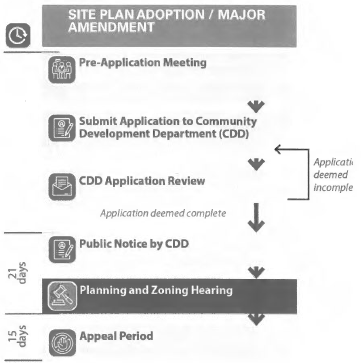
2.
A utilities plan indicating any proposed modifications to the infrastructure serving the site, including public and private streets, driveways, and traffic control measures and utilities.
3.
A grading and drainage plan indicating any proposed modifications necessary for controlling stormwater drainage on-site and off-site as required by the county engineer in accordance with the county's storm drainage construction standards or such other ordinances or storm water management plans as may exist.
4.
A lighting plan indicating compliance with division 6, Outdoor Lighting, demonstrating the total site lumen limit is not exceeded and indicating the location, type, height, color temperature, lumen output and amount of all proposed and existing light fixtures.
5.
A landscape plan indicating compliance with division 4, Landscaping and Screening, demonstrating the minimum landscaped site area requirements and minimum plant materials and standards have been met and showing compliance with all landscaping, streetscape, parking lot landscape, buffering, and screening requirements.
6.
Any applicable requirements or impact studies as required by the county engineer, including a grading, erosion control, and reclamation plan on sites that include slopes that are equal to or greater than 1:2.
7.
A written explanation of how the request conforms to decision criteria in section 16-74(i)(4).
d.
The community development department shall intake the application pursuant to the requirements of section 16-72(d).
e.
The community development department shall provide public notice pursuant to the requirements of section 16-72(c)(2).
f.
The community development director, or their designee, shall set a date for public hearing before the planning and zoning commission on the request within 28 days of receipt of a complete application.
g.
The community development department staff shall review the application and forward a recommendation to the planning recommendation to the planning and zoning commission.
h.
The planning and zoning commission shall conduct a public hearing on the application pursuant to the requirements of section 16-72(f) and chapter 8.
i.
The site plan application shall be reviewed based on its conformity with the decision criteria of section 16-74(i)(4).
(4)
Decision criteria. An application for a site plan shall be approved if it meets all of the following criteria:
a.
The site plan substantially conforms to the intent and policies of the comprehensive plan and other adopted county policies and plans.
b.
If the subject property is within an approved master plan, the site plan is in conformance with any relevant standards in the master plan.
c.
If the subject property is within an approved PD zone district, the site plan is consistent with any applicable terms and conditions in any previously approved PD zoning covering the subject property and any related development agreements and/or regulations.
d.
The site plan is in conformance with all applicable provisions of this Code and other adopted county regulations.
e.
The county's existing public infrastructure and services, including but not limited to water, sanitary sewer, electricity, gas, storm sewer, streets, trail and sidewalks have adequate capacity to serve the proposed development, and any burdens on those systems have been mitigated in compliance with the county's construction standards to the maximum extent practicable.
f.
The site plan mitigates any significant adverse impacts to properties within the vicinity to the maximum extent practicable.
g.
Provisions shall be made to serve the development with tot lots and/or neighborhood parks in accordance with the comprehensive plan. A fee may be paid as approved by county council to accomplish the purpose of the comprehensive plan in lieu of the development of tot lots or neighborhood parks.
(j)
Development plan adoption or major amendment.
(1)
Applicability.
a.
Any application for a development plan associated with a new zone map amendment to a planned development (PD) zone district shall be approved in accordance with the requirements of this section. No such development shall be lawful or permitted to proceed without final development plan approval.
b.
Any changes to previous development plan approval that changes site development standards at a threshold of greater than 20 percent shall require a major amendment pursuant to the procedures of this section.
(2)
Procedures.
a.
Prior to the submission of a development plan application, the applicant shall attend a pre-application meeting pursuant to section 16-72(b)(1).
b.
Prior to the submission of a development plan application, the applicant shall attend a neighborhood meeting pursuant to section 16-72(b)(2).
c.
Applications for a development plan may be made by the county council, the planning and zoning commission, the county manager, the community development director or the owner or agent of any parcel of property to be affected.
d.
Development plan applications shall include the application, plan, and other documentation that show compliance with the applicable provisions of this Code and other adopted county plans or policies as required by the county's development plan application to the community development department, including:
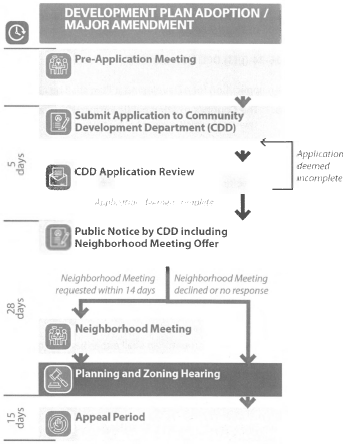
1.
A vicinity map showing the boundaries of the subject property and all adjacent lots within 300 feet.
2.
A site plan pursuant to the requirements of section 16-74(h), which includes sufficient detail on any proposed modifications to the site including the types, extent and intensity of land uses that are proposed, proposed standards for site elements such as building design, parking and loading, landscaping, lighting, and pedestrian and vehicular circulation.
3.
A utility plan indicating any proposed modifications to the infrastructure serving the site, including public and private streets, driveways, and traffic control measures and utilities.
4.
A grading and drainage plan indicating any proposed modifications necessary for controlling stormwater drainage on-site and off-site as required by the county engineer in accordance with the county's storm drainage construction standards or such other ordinances or storm water management plans as may exist.
5.
A lighting plan indicating compliance with division 6, Outdoor Lighting, demonstrating the total site lumen limit is not exceeded and indicating the location, type, height, color temperature, lumen output and amount of all proposed and existing light fixtures.
6.
A landscape plan indicating compliance with division 4, Landscaping and Screening, demonstrating the minimum landscaped site area requirements and minimum plant materials and standards have been met and showing compliance with all landscaping, streetscape, parking lot landscape, buffering, and screening requirements.
7.
Any applicable impact studies as required by the county engineer, including a grading, erosion control, and reclamation plan on sites that include slopes that are equal to or greater than 1:2.
8.
A written explanation of how the request conforms to the decision criteria in section 16-74(j)(3).
e.
The community development department shall intake the application pursuant to the requirements of section 16-72(d).
f.
The community development department shall provide public notice pursuant to the requirements of section 16-72(c)(2).
g.
The community development director, or their designee, shall set a date for public hearing before the planning and zoning commission on the request within 28 days of receipt of a complete application.
h.
The community development department staff shall review the application and forward a recommendation to the planning and zoning commission.
i.
The planning and zoning commission shall conduct a public hearing on the application pursuant to the requirements of section 16-72(f).
j.
The development plan application shall be reviewed based on its conformity with the decision criteria of section 16-74(j)(3).
(3)
Decision criteria. An application for a development plan shall be approved if it meets all of the following criteria:
a.
The county's existing public infrastructure and services, including but not limited to water, sanitary sewer, electricity, gas, storm sewer, streets, trail and sidewalks have adequate capacity to serve the proposed development, and any burdens on those systems have been mitigated in compliance with the county's construction standards to the maximum extent practicable.
b.
The uses and development standards contained in the development plan are sufficiently clear and specific so as to enable the efficient review by the county of all subsequent subdivision, site plan or variance applications for future development within the development plan area.
c.
The development standards contained in the development plan shall either be in conformance with all other county development requirements, or where different, shall represent an equal or higher level of amenity, quality, and design as evidenced by the following considerations.
d.
The degree to which the development plan helps to meet the needs of the county and the people it serves; and
1.
The degree to which the development plan provides for an attractive appearance and suitable balance of buildings and open space; and
2.
The degree to which the development plan provides for the safety and convenience of its occupants and visitors.
e.
The development plan shall either have no negative physical impacts on persons residing or working adjacent to or in the general vicinity of the property; or if the potential for such negative impacts exists, the development plan shall contain specific safeguards so as to substantially mitigate such negative impacts.
(Ord. No. 02-362, § 5, 11-12-2024)
Sec. 16-75. - Legislative decisions.
(a)
Comprehensive plan adoption or amendment.
(1)
Applicability. This section applies to all applications to adopt or amend the Los Alamos County Comprehensive Plan.
(2)
Procedures.
a.
Applications for amendment to the comprehensive plan may be made by the county council, the planning and zoning commission, the county manager, or the community development director, or their designee.
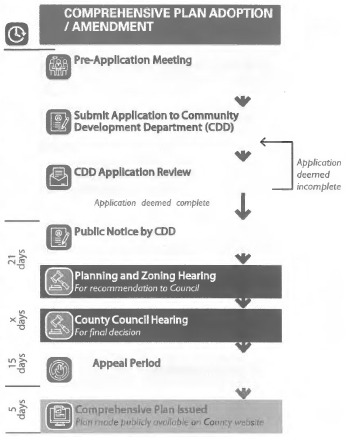
b.
Applications for an amendment to the comprehensive plan shall explain how it conforms to the decision criteria in section 16-75(a)(3), why the amendment is necessary, and cite the sections of the comprehensive plan to be amended. Comprehensive plan amendments may include revisions to specific elements, the addition of new elements including land use maps, and revisions to the vision statement, policy plan, and goals.
c.
The community development department shall intake the application pursuant to the requirements of section 16-72(d).
d.
The community development department staff shall review the application, including any specific regulations applicable to a proposed adoption or amendment of the comprehensive plan, and forward a recommendation to the planning and zoning commission.
e.
The community development department shall provide public notice pursuant to the requirements of section 16-72(c)(2).
f.
The community development director, or their designee, shall set a date for public hearing before the planning and zoning commission on the comprehensive plan amendment request within 28 days of receipt of a complete application.
g.
The planning and zoning commission shall conduct a public hearing on the application pursuant to the requirements of section 16-72(f). The commission shall make a recommendation to the county council pursuant to the decision criteria in section 16-75(a)(3).
h.
Following receipt of the planning and zoning commission recommendation, the county council shall conduct a public hearing pursuant to the requirements of section 16-72(f).
i.
The county council may adopt the comprehensive plan submitted by the planning and zoning commission, as a whole, by a single resolution, or may from time to time approve and adopt a part or parts thereof, any such part to correspond generally with one or more of the functional elements of the plan.
j.
The plan shall only become effective as the comprehensive plan of the county upon approval by resolution of the county council, carried by affirmative votes of not less than a majority of all members of the county council. The resolution shall refer expressly to revisions to specific elements, the addition of elements, maps, descriptive matter, changes to the vision statement, policy plan and goals, or other revisions intended by the planning and zoning commission to form the whole or part of the comprehensive plan.
k.
The community development department shall post the new or amended comprehensive plan on the county's website.
(3)
Decision criteria. An application for adoption or amendment of the comprehensive plan shall be approved if it meets all of the following criteria:
a.
The amendment is consistent with the overall vision, policies and other parts of the comprehensive plan, the strategic leadership plan of the county council, and other adopted county policies and plans.
b.
The amendment replaces outdated information in the comprehensive plan, responds to changed conditions, or provides new information which is not included in the comprehensive plan.
c.
The adoption or amendment will protect the public health, safety, or welfare better than retention of the continued application of the existing comprehensive plan.
d.
The adoption or amendment will result in general benefits to a large portion of the residents or property owners in the county.
(b)
County landmark or historic district adoption.
(1)
Applicability. This section applies to all applications for the adoption of a county landmark or historic district, amendment to the boundaries of a designated historic district, removal of a designated landmark or site, or amending the standards of a historic preservation overlay within this Code.
(2)
Procedures.
a.
Prior to the submission of a county landmark or historic district adoption or amendment application, the applicant shall attend a pre-application meeting pursuant to section 16-72(b)(1) and conduct a neighborhood meeting pursuant to section 16-72(b)(2).
b.
Applications for adoption or amendment to a county landmark or historic district adoption may be made by any person.
c.
Development plan applications shall include the application, plan, and other documentation that show compliance with the applicable provisions of this Code and other adopted county plans or policies as required by the county's development plan application to the community development department, including:
1.
Written consent of the property owner(s) for a nomination of an individual landmark or written consent of the owners of at least 66 percent of the properties within the proposed district.
2.
Written justification explaining how the request meets the historical or architectural significance of the proposed landmark or historic criteria for designation per section 16-75(b)(3).
3.
A description of the particular historic or architectural features that should be preserved. The description shall be based on a study prepared by an architectural or qualified authority on historic preservation surveying the proposed landmark or all properties within the proposed district, as applicable. The features deemed to be significant and worthy of preservation shall be specifically listed and illustrated in the study and shall form the basis for proposed preservation regulations within the district.
d.
A request for amendment to the comprehensive plan, if found necessary by the community planning director, shall be submitted, processed, heard, and decided upon concurrently with the request for county landmark or historic district adoption or amendment.
e.
The community development department shall intake the application pursuant to the requirements of section 5-2(B)(IV).
f.
The community development department shall provide public notice pursuant to the requirements of section 5-2(B)(III).
g.
The community development director, or their designee, shall set a date for public hearing before the planning and zoning commission on the county landmark or historic district adoption or amendment request within 28 days of receipt of a complete application.
h.
The historic preservation advisory board shall conduct a public hearing on the application and make a recommendation to the planning and zoning commission. The HPAB may nominate or sponsor an application for the designation of an individual landmark or an historic district.
i.
The planning and zoning commission shall conduct a public hearing on the application pursuant to the requirements of section 16-72(f). The planning and zoning commission shall make a recommendation to the county council pursuant to the decision criteria in section 16-75(b)(3), as to whether the proposed historic landmark or district shall be officially designated on the official zoning map as an overlay district.
j.
Following receipt of the planning and zoning commission recommendation for the proposed county landmark or historic district adoption or amendment, the county council shall conduct a public hearing pursuant to section 16-72(f) to consider the recommendation of the planning and zoning commission and whether the proposed historic landmark or district shall be officially designated on the county zoning map as an overlay district.
k.
The county council shall approve or deny the proposed zone map amendment pursuant to the decision criteria within section 16-75(b)(3).
l.
The council may also vote to remand the matter back to the planning and zoning commission for further proceedings. If the case is remanded, the county council shall specify the time within which the planning and zoning commission shall report back to the county council its findings and recommendations on the matter(s) referred to it.
m.
Final approval of the county landmark or historic district adoption shall be determined by the county council.
n.
After the county council has approved a county landmark or historic district adoption or amendment, the official zoning map shall be amended to note the change and posted on the county website.
(3)
Decision criteria. An application for a county landmark or historic district adoption or amendment shall be approved if it meets not less than two of the following characteristics all of the following criteria:
a.
Embodies an architectural style or method of construction dating from one or more significant historic periods.
b.
Establishes a sense of time and place unique to Los Alamos County.
c.
Exemplifies or reflects the cultural, social, economic or political history of the nation, state or county.
d.
Is associated with the lives of significant historical persons or events.
e.
Has the potential to preserve, display, or yield significant historic or archaeological information.
f.
Exists on the registry of the state or national register of historic places.
(c)
Adoption or amendment of a master plan.
(1)
Applicability. This section applies to all applications to adopt or amend a master plan.
(2)
Procedures.
a.
Applications for amendment or adoption of a master plan may be made by the county council, the planning and zoning commission, the county manager, or the community development director, or their designee.
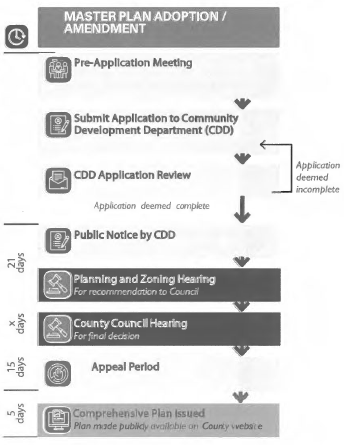
b.
Applications for an amendment to a master plan shall explain how it conforms to the decision criteria in section 16-75(c)(3), why the amendment is necessary, and cite the sections of the master plan to be amended. Master plan amendments may include revisions to specific elements and the addition of new elements.
c.
The community development department shall intake the application pursuant to the requirements of section 16-72(d).
d.
The community development department shall provide public notice pursuant to the requirements of section 16-72(c)(2).
e.
The community development director, or their designee, shall set a date for public hearing before the planning and zoning commission on the master plan amendment request within 28 days of receipt of a complete application.
f.
The community development department staff shall review the application, including any specific regulations applicable to a proposed adoption or amendment of a master plan, and forward a recommendation to the planning and zoning commission.
g.
The planning and zoning commission shall conduct a public hearing on the application pursuant to the requirements of section 16-72(f). The commission shall make a recommendation to the county council pursuant to the decision criteria in section 16-75(c)(3).
h.
Following receipt of the planning and zoning commission recommendation, the county council shall conduct a public hearing pursuant to the requirements of section 16-72(f). The county council shall approve, modify, or disapprove the proposed adoption or amendment, or shall vote to refer the matter back to the planning and zoning commission for further proceedings, in which case the county council shall specify the time within which the planning and zoning commission shall report back to the county council its findings and recommendation on the matter(s).
i.
The county council may adopt a master plan submitted by the planning and zoning commission, as a whole, by a single resolution, or may from time to time approve and adopt a part or parts thereof, any such part to correspond generally with one or more of the functional elements of the plan.
j.
The master plan shall only become effective upon approval by resolution of the county council. The resolution shall refer expressly to revisions to specific elements, the addition of elements, maps, descriptive matter, or other revisions intended by the planning and zoning commission to form the whole or part of the master plan.
(3)
Decision criteria. An application for adoption or amendment of a master plan shall be approved if it meets all of the following criteria:
a.
The proposed master plan or amendment thereto is consistent with the health, safety and welfare of the county as shown by conformance with the goals and policies of the comprehensive plan and other adopted county plans or policies.
b.
The proposed master plan or amendment thereto complies with all applicable provisions of this Code and other adopted county regulations.
c.
The county's existing and proposed infrastructure and public improvements including, but not limited to utilities, streets, sidewalks, or trails have adequate capacity to serve the proposed master plan development or amendment thereto.
d.
The establishment, maintenance, or operation of uses made possible by the master plan adoption or amendment will not be detrimental to the health, safety, or welfare of persons residing or working adjacent to or within the proximity of the subject property or properties.
(d)
Text amendment.
(1)
Applicability. This section applies to all applications to text amendments to this Code.
(2)
Procedures.
a.
Applications for amendment to the text, including uses and addition, deletion, or change in uses allowed in the use index of this Code, may be made by the county council, the planning and zoning commission, the county manager, the community development director, or their designee.
b.
Text amendment applications shall be submitted to the community development department and include all applicable materials per the county website, including a written explanation of how the request conforms to decision criteria in section 16-75(d)(3).
c.
A request for amendment to the comprehensive plan, if found necessary by the community development director, or their designee, shall be submitted concurrently with the request for amendment to the text of this Code.
d.
The community development department shall intake the application pursuant to the requirements of section 16-72(d).
e.
The community development department shall provide public notice pursuant to the requirements of section 16-72(c)(2).
f.
The community development director, or their designee, shall set a date for public hearing before the planning and zoning commission on the text amendment request within 28 days of receipt of a complete application.
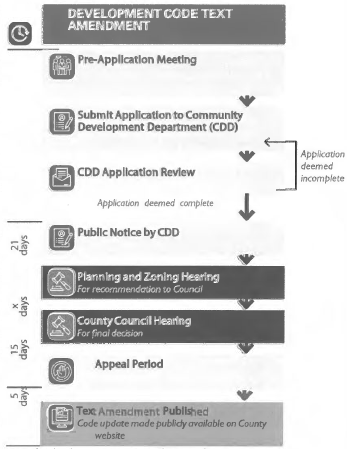
g.
The community development department staff shall review the application and forward a recommendation to the planning and zoning commission.
h.
The planning and zoning commission shall conduct a public hearing on the application pursuant to the requirements of section 16-72(f). The planning and zoning commission shall make a recommendation to the county council pursuant to the requirements of section 16-69(b) and the decision criteria of section 16-75(d)(3).
i.
Following receipt of the planning and zoning commission recommendation for the proposed amendment to the Code, the county council shall conduct a public hearing pursuant to section 16-72(f) to consider the proposed text amendment and the recommendation of the planning and zoning commission. The county council shall make a decision based on applicable decision criteria pursuant to section 16-75(d)(3) about each application at a public hearing:
1.
The county council shall approve, modify, or disapprove the request, or it may vote to remand the matter back to the planning and zoning commission for further proceedings. If remanded, the county council shall specify the time within which the planning and zoning commission shall report back to the county council its findings and recommendation on the matter(s).
2.
The county council shall issue a final decision with findings to the applicant no later than its next scheduled meeting.
(3)
Decision criteria. An application for text amendment to this Code shall be approved if it meets all of the following criteria:
a.
The request substantially conforms to the intent and policies of the comprehensive plan and other adopted county policies and plans.
b.
The proposed change will not result in land use inconsistent with the purpose of the district or incompatible with a use allowed in the underlying zone district.
c.
The proposed change will clarify existing language, remove redundant or inconsistent language, or simplify the understanding and implementation of the Code.
d.
The proposed amendment promotes public health, safety, and welfare.
(e)
Major zone map amendment.
(1)
Applicability. This section applies to all applications for a zone map amendment where the proposed map amendment does not concern a single tract, parcel or lot under common ownership, or the land affected by the map amendment is not predominantly owned by a single person or entity under common ownership.
(2)
Procedures.
a.
Prior to the submission of a zone map amendment application, the applicant shall attend a pre-application meeting pursuant to section 16-72(b)(1) and conduct a neighborhood meeting pursuant to section 16-72(b)(2).
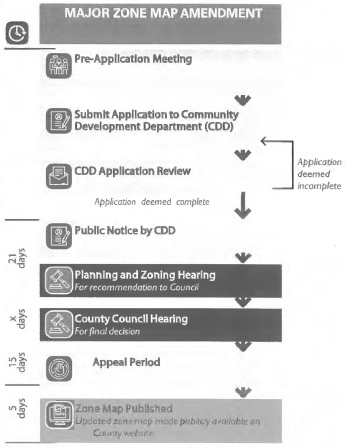
b.
Applications for an amendment to the official zoning map may be made by the county council, the planning and zoning commission, the county manager, the community development director, or their designee, or the owner or agent of any parcel of property to be affected.
c.
Zone map amendment applications shall be submitted to the community development department. The application shall explain how it conforms to the decision criteria in section 16-75(e)(3).
d.
A request for amendment to the comprehensive plan, if found necessary by the community planning director, shall be submitted, processed, heard, and decided upon concurrently with the request for zone map amendment.
e.
The community development department shall intake the application pursuant to the requirements of section 16-72(d).
f.
The community development department shall provide public notice pursuant to the requirements of section 16-72(c)(2).
g.
The community development director, or their designee, shall set a date for public hearing before the planning and zoning commission on the zone map amendment request within 28 days of receipt of a complete application.
h.
The planning and zoning commission shall conduct a public hearing on the application pursuant to the requirements of section 16-72(f). The planning and zoning commission shall make a recommendation to the county council pursuant to the decision criteria in section 16-75(e)(3).
i.
Following receipt of the planning and zoning commission recommendation for the proposed zone map amendment, the county council shall conduct a public hearing pursuant to section 16-72(f) to consider the proposed zone map amendment and the recommendation of the planning and zoning commission.
j.
The county council shall approve or deny the proposed zone map amendment pursuant to the decision criteria within section 16-75(e)(3).
k.
The council may also vote to remand the matter back to the planning and zoning commission for further proceedings. If the case is remanded, the county council shall specify the time within which the planning and zoning commission shall report back to the county council its findings and recommendations on the matter(s) referred to it.
l.
Final approval of the zone map amendment shall be determined by the county council.
m.
After the county council has approved a zone map amendment, the official zoning map shall be amended to note the new zone district designation and posted on the county website.
(3)
Decision criteria. An application for a zone map amendment of the official zoning map shall be approved if it meets all of the following criteria:
a.
The proposed zone map amendment is consistent with the health, safety, and welfare of the county as shown by conformance with the goals and policies of the comprehensive plan and other adopted county plans or policies.
b.
The existing zone district designation is shown to be inappropriate for one or more of the following reasons:
1.
It was established in error;
2.
Changed conditions warrant the rezoning; or
3.
A different zone is more advantageous to the community as articulated by conformance with each applicable goal and policy in the comprehensive plan, including the future land use map.
c.
The proposed zoning will not designate a zone district different from surrounding zone districts to one small area, i.e. create a spot zone, unless one or more of the following criteria are met:
1.
Granting such zoning accomplishes the goals and policies of the comprehensive plan;
2.
Unique characteristics specific to the site exist; or
3.
The zoning serves as an appropriate transition between land uses of higher and lower intensity.
d.
The county's existing and proposed infrastructure and public improvements including, but not limited to utilities, streets, sidewalks, or trails have adequate capacity to serve the development made possible by the zone map amendment.
e.
The establishment, maintenance, or operation of uses made possible by the zone map amendment will not be detrimental to the health, safety, or welfare of persons residing or working adjacent to or within the proximity of the subject property.
Sec. 16-76. - Purpose.
The purpose of this section is to regulate land uses, buildings, structures, lots, site features, or any combination thereof that were lawfully established prior to the effective date of this Code, but that no longer conform to the requirements of this Code. All such situations are collectively referred to in this section as "nonconformities." While nonconformities may continue, the provisions of this section are designed to reduce or eliminate over time any nonconformity that does not meet the regulatory standards of this Code and/or the county's adopted goals.
Sec. 16-77. - Applicability.
The provisions of this section apply to land uses, structures, lots, signs, and site features including:
(a)
Those that were legally established prior to the effective date of this Code but that became nonconforming due to the adoption of this Code.
(b)
Those that were legally established after the effective date of this Code but that became nonconforming due to the adoption of a future amendment to this Code.
Sec. 16-78. - Authority to continue.
(a)
Nonconformities may continue to be used and occupied, subject to regulations regarding the maintenance of premises and conditions of operations set forth in this section, or unless such nonconformity is terminated as provided in this section.
(b)
Nonconformities shall not be modified in any way that increases the degree of nonconformity.
Sec. 16-79. - Maintenance and minor repair.
Minor repairs and maintenance of nonconformities are permitted and encouraged, provided that the repairs and maintenance do not increase the degree of nonconformity. Minor repairs and maintenance include the following:
(a)
Repairs necessary to maintain and to correct any damage or deterioration to the structural soundness of, or the exterior or interior appearance of, a building or structure without expanding the height or footprint of the building or structure, unless compliant with this Code;
(b)
Maintenance of land to protect against and to mitigate health and environmental hazards;
(c)
Repairs that are required to remedy unsafe conditions; and
(d)
Repairs necessary to comply with current building code requirements.
Sec. 16-80. - Nonconforming lots.
(a)
A nonconforming lot that was made nonconforming by virtue of enactment of this Code may be used for construction of a building allowed in the applicable zoning district, provided that all other zoning district and dimensional standards are met.
(b)
Where a conforming or legal nonconforming dwelling, two-family or multiple-family, existed on a lot in the north community districts on May 9, 2000, such lot shall be considered a conforming site for dwellings, single-family, attached and may be subdivided into a number of lots less than or equal to the number of dwelling units located on the lot on May 9, 2000. The resulting dwellings, single-family, attached, the site, and the lots shall be considered conforming as to the lot size and maximum density.
(c)
Permitted uses or structures may be established on a preexisting lot of record, the description of which is on record on the date of adoption of this Code, notwithstanding limitations imposed by other provisions of this division.
Sec. 16-81. - Nonconforming uses.
(a)
Limitations on continuation of nonconforming uses. Unless specified otherwise in this Code, the nonconforming use if land, building, or a structure shall be allowed to continue regardless of any change in ownership or occupancy of the use, until that use is discontinued or another provision of this section requires the termination of the use, subject to the following provisions:
(1)
No such nonconforming use shall be enlarged, increased or extended to occupy a greater are of land than was occupied on the date of adoption of this Code.
(2)
No such nonconforming use of land shall be moved in whole or in part to any portion of the lot or parcel other than occupied by such use on the date of adoption of this Code.
(3)
A structure containing a nonconforming use of land may be maintained, repaired, or altered, with limits on expansion pursuant to section 16-79.
(4)
No additional structure not conforming to the requirements of this Code shall be erected in connection with the nonconforming use of land or structure.
(b)
Discontinuance of nonconforming use.
(1)
When a nonconforming use of land or structure is discontinued for any reason for a period of more than 180 days and no action is taken to continue the use, any subsequent use shall only be an allowable use as indicated in Table 26: Permitted Use Table for the zone district in which the property is located.
(2)
When a nonconforming use is replaced by a use allowed by this Code, the original or any other nonconforming use may not thereafter be resumed.
Sec. 16-82. - Nonconforming structures.
Unless specified otherwise in this Code, a nonconforming structure shall be allowed to continue to be used, regardless of any change in ownership or occupancy of the structure, until the structure is vacant for a period of 180 days or until another provision of this section requires the termination of the use, subject to the following provisions:
(a)
No nonconforming structure may be enlarged or altered in a way that increases its nonconformity.
(b)
A nonconforming structure may be maintained, repaired, or altered pursuant to section 16-79, but no maintenance, repair, or alteration may increase the extent of nonconformance. Nothing in this section shall prevent the strengthening or restoring to a safe condition of any nonconforming building declared to be unsafe by any county official charged with protection of public safety upon order of such official.
(c)
A nonconforming structure that has been damaged or destroyed by fire or other causes may be restored to its original condition, provided that such work is commenced within one year of such event and completed within 18 months of such event. By written request from the property owner, the community development director may grant one extension of wither the work commencement and/or the completion of work time period.
(d)
A nonconforming structure may be moved in whole or in part to another location on or off lot, provided that the moving will make it conform to the regulations for the zone district(s) in which it is located.
(e)
The community development director, or their designee, or the planning and zoning commission may refer to the city council recommendations on abandoned structures for a council resolution requiring repair or demolition in accordance with NMSA 1978 § 3-18-5.
Sec. 16-83. - Nonconforming site features.
(a)
Applicability. For purposes of this subsection, the term "nonconforming site feature" includes, but is not limited to, any driveway, off-street parking or loading area, landscaping, screening, or buffering, outdoor lighting, signage, walls and fences or any other element that lawfully existed per regulations in place prior to the effective date of this Code, as well as the lack of any such feature required by subsequently enacted county regulations.
(b)
Authority to continue.
(1)
A nonconforming site feature may continue to exist even though it does not conform to the current applicable standards of this Code, subject to the requirements of this section.
(2)
No legal nonconforming site feature shall be altered, removed, or otherwise modified in a manner that increases the site feature's nonconformity. Site features may be modified in a manner that maintains or lessens the extent of the nonconformity.
(3)
If building expansions or other changes to the property occur that require corresponding site feature improvements, the affected features shall only be required to be modified to the extent necessary to accommodate the property changes. The required installation of new site features shall not require the entire site to be brought into compliance with this chapter. For example, parking lot landscaping would only be required for new portions of a parking lot that was required to be expanded due to a change in the use of the property, to the extent that the amount of landscaping in the pre-existing parking areas will be unaffected.
(4)
A lot that does not comply with the standards of this Code in article III, division 5, Neighborhood Protection Standards, division 3, Off-Street Parking, Loading, and Queuing, division 4, Landscaping and Screening, division 7, Walls, Fences and Gates, or division 8, Signage may continue to be used and occupied, and uses may be changed or expanded as allowed by other provisions of this section, notwithstanding those nonconformities, unless and until the gross floor area of the primary building on the lot is expanded more than 25 percent of the existing gross floor area, at which time any portion of the lot affected by the expansion shall be brought into compliance with any relevant standards in the sections listed above in this provision.
Sec. 16-84. - Construction phasing plan.
The following development actions shall require a written statement describing the date for commencement and completion of construction, by phase, and a chart indicating the approximate construction period for each of the utilities, and public and private roadway improvements prior to approval of the utilities plan and public and private roadway improvements:
(a)
Subdivisions submitted at final plat;
(b)
Site plans; and,
(c)
Conditional use permits, required only if application is not submitted with site plan review.
Sec. 16-85. - Notification.
The applicants shall notify the county engineer and utilities manager a minimum of one working day prior to starting the construction of improvements or installation of utility facilities on land designated for public use.
Sec. 16-86. - Beginning of construction.
Construction shall not commence for the developments listed in this article until the following has occurred:
(a)
Subdivision, and subdivision by summary procedures: Recording of the plat with the county clerk.
(b)
Site plan: Findings of fact for approval or conditional approval issued.
(c)
Conditional use permit: Findings of fact for approval or conditional approval issued.
(d)
Variance: Findings of fact for approval or conditional approval filed with the county clerk.
(e)
County attorney, county engineer, and utilities manager have signed all construction plans and approved the surety agreement, as appropriate.
Sec. 16-87. - Developments with public improvements.
The applicant shall agree to construct all public improvements in accordance with county engineer and utilities manager approved construction drawings and specifications. Such public improvements shall be constructed within the time period specified on the escrow agreement. Except as otherwise provided in division 2, Access and Connectivity, the applicant shall construct all utility and public improvements in conformance with this Code, and "Los Alamos County Utilities Construction Standards" and "Los Alamos County Public Works Design and Construction Standards", to the extent such standards are not inconsistent with this Code. "Los Alamos County Public Works Design and Construction Standards" shall be those engineering standards adopted by the county engineer. The county engineer and utilities manager shall have review and approval authority over all public improvements.
Sec. 16-88. - Developments with private improvements.
(a)
The applicant shall construct private improvements in accordance with county engineer and utilities manager approved construction drawings and specifications.
(b)
Except as otherwise provided in division 2, Access and Connectivity, private roadways shall be constructed in conformance with "Los Alamos County Public Works Design and Construction Standards".
(c)
Except as otherwise provided in division 2, Access and Connectivity, the applicant shall construct designated private utility improvements in conformance with the "Los Alamos County Utilities Construction Standards" available from the utilities department and subject to the review and approval of the utilities manager.
Sec. 16-89. - Escrow agreement.
(a)
The applicant or their agent shall have a consulting engineer prepare cost estimates for construction of public and private improvements based on normal construction practices and procedures and shall submit the estimates to the utilities manager.
(b)
The public improvements and public utilities shall be ensured by either of the following:
(1)
An escrow letter of credit agreement approved by the county attorney in an amount of money sufficient to pay 100 percent of the costs of construction of all public improvements and public utilities. The utilities manager and county engineer shall certify that the amount is adequate;
(2)
A cash deposit sufficient to cover 100 percent of the cost of gas and electric improvements to be installed by the county shall be reviewed by the utilities manager and county attorney. Upon approval, the utilities manager shall arrange for filing of the cash deposit with the county finance department.
(c)
Additional requirements.
(1)
The escrow agreement shall provide that no funds shall be released until all improvements and utility facilities have been installed and accepted.
(2)
If the applicant intends to have any part of the improvements installed by contractors or subcontractors, copies of the contracts, along with copies of performance and payment bonds naming the subdivider as obligee, shall be submitted to the county engineer or utilities manager, as appropriate, and the county attorney for approval. Approval shall be limited to the terms of performance.
(d)
The county may use all available escrow funds to complete the required public improvements when the following two conditions are met:
(1)
If, in the opinion of the county engineer, no substantial work on the public improvements has been accomplished for a period of 30 days (in the absence of inclement weather conditions, intentional shutdowns, work stoppages, etc.); and
(2)
If, in the opinion of the county engineer, it is necessary to complete the required public improvements.
(e)
Prior to use of available escrow funds, the county engineer shall serve upon the applicant and their agent by certified mail, return receipt requested, a letter requiring the applicant within 30 days to show good cause, in writing, why the work on the required public improvements has ceased. If the applicant fails to respond within 30 days from the date of receipt of the notice by the applicant, the county engineer shall notify the applicant and their agent of the county engineer's decision to begin completion in at least three calendar days of the required public improvements. If the applicant resumes work prior to the county beginning the work and makes substantial progress on the required public improvements within 30 days, the county engineer shall not begin the work using the escrow funds. The county shall use the available escrow funds to complete the required public improvements if the applicant or agent does not respond to the notice to show cause, or if the reasons cited by the applicant or agent for failure to make progress are not deemed by the county engineer to be sufficient, or if the applicant or agent resumes work but does not make substantial progress on the required public improvements in the opinion of the county engineer.
Sec. 16-90. - Responsibility for maintenance.
Any development where public improvements are proposed for dedication to the county must comply with the following requirements:
(a)
To provide for repair of damage resulting from subsequent construction operations of the subdivider or their contractors, the applicant shall be responsible for all maintenance of improvements and utilities for a period of not less than 12 months following acceptance of the development improvements by the county engineer and utilities manager. If the applicant fails to begin maintenance or repair work within three weeks of written notice from the county engineer and utilities manager stating what work needs to be done, the county may complete the necessary work. The applicant shall then be liable for all costs so incurred by the county.
(b)
Upon acceptance by the county engineer and utilities manager of the development, the applicant must furnish either a maintenance bond guaranteeing completion of any maintenance required by the county engineer and the utilities manager for 12 months after acceptance of the development by the county engineer and utilities manager; or, at least ten percent of the original escrow funds, as stipulated in section 16-89, shall be retained by the county as a maintenance deposit. The maintenance bond must be satisfactory in form and content to the county engineer, the utilities manager and the county attorney. The bond will be released or balance of escrow funds returned to the developer at the later date of 12 months after acceptance of the development or completion of maintenance required by the county engineer and utilities manager.
Sec. 16-91. - Acceptance.
(a}
County acceptance of the public improvements and utilities shall be by motion of the county council only. The county council shall accept only upon recommendation by the county engineer and utilities manager. The recommendation by the county engineer and utilities manager shall be contingent upon:
(1}
Fulfillment of the requirements for responsibility for maintenance as outlined under section 16-90;
(2}
An opinion by the county attorney that satisfactory and proper conveyances have been made by the applicant to the county;
(3}
Public improvements that have been completed and are in good repair in accordance with approved plans and specifications;
(4}
Utilities that have been completed and are in good repair with approved plans and specifications reviewed by the utilities department;
(5}
As-built drawings dated, certified, and stamped by a professional engineer having been submitted to and accepted by the county engineer and utilities manager;
(6}
All monuments that have been placed.
(b}
Except when a development is approved by the planning and zoning commission or county council as a phased development, a development shall not be recommended for acceptance by the county engineer or utilities manager or accepted by the county council in part; it shall be accepted only as a whole as indicated in the final plat or site plan, or conditional use permit and approved engineering drawings.
(c}
The developer will be charged an additional fee for reinspection when as-built plans do not conform to field inspection.
Sec. 16-92. - Monuments.
The county surveyor may require replacement of survey monuments or placement of new monuments for any development according to the following standards:
(a}
Two corners of the development boundary shall be marked with permanent survey monuments and tied by course and distance to separate permanent survey monuments approved by the county surveyor. Boundary monuments shall be placed in accordance with specifications of the county surveyor. The location of the boundary monuments and their respective ties shall be approved by the county surveyor and shall be shown on the final plat or site plan.
(b)
Internal control monuments shall be placed at strategic locations within the interior of the development and shall be placed in accordance with specifications of the county surveyor. Each monument shall be intervisible with at least one other monument and shall be placed as required by the county surveyor. The purpose of these monuments is to provide for the establishment or reestablishment of lot corners and improvements within the development. Such monuments may be placed after improvements have been completed, but prior to county acceptance of the public improvements or the issuance of a certificate of completion.
(c}
Boundary monuments and internal control monuments shall be benchmarks. The elevation of benchmarks shall be based on mean sea level datum as established by the National Geodetic Survey and such elevation shall be accurately shown and noted on as-built construction drawings. Benchmarks shall be approved by the county surveyor as required by the standards for land surveys in the state as adopted by the state board of registration for professional engineers and professional surveyors.
(d}
All lot or tract corners, angle points, points of curves and intermediate points shall be monumented as required by the standards for land surveys in New Mexico, as adopted by the state board of registration for professional engineers and professional surveyors.
(e}
Prior to the acceptance of any public improvement in any development or the issuance of a certificate of completion, the developer shall submit to the county surveyor a control diagram of the required monumentation. The diagram shall be prepared by the professional surveyor who placed the monumentation in the development. The control diagram shall show all required monuments and show courses and distances between monuments to link them into a single network. Elevations shall be given for each benchmark.
Sec. 16-93. - General construction standards.
The following construction practices are required:
(a)
All sanitary sewer, gas, electric, telephone, CATV and water mains, including service lines to the property line of each lot, shall be installed before streets are surfaced. Installation shall be in conformance with construction standards adopted by the county utilities board.
(b)
All utilities as shown in the engineering plans shall be installed and approved before occupation of any building within the development or that phase of a development. All work shall be coordinated by the applicant to avoid damaging improvements already installed.
(c)
Drainage structures, such as pipe culverts, box culverts, and storm sewers, as required by the county engineer, shall be installed before street surfacing is begun.
(d)
The width of the street at the portion of the right-of-way to be developed shall be graded, including the subgrade of the areas to be paved.
(e)
The drop curb for driveway aprons on all cul-de-sacs for each residential lot shall be constructed as part of the construction of the curb and gutter, unless otherwise approved by the county engineer.
(f)
Fire hydrants shall be provided as required by the utilities manager and the fire marshal.
(g)
All streets within a subdivision shall be paved up to and including the frontage of all dwelling and/or structures prior to the issuance of any certification of occupancy, temporary or otherwise.
(h)
Sidewalks shall be provided in locations and at dimensions indicated in the public works construction manual.
Sec. 16-94. - Purpose.
This section establishes a county official responsible for executing those duties associated with the administration and enforcement of this Code, and to establish a procedure for taking remedial action on complaints and code violations.
Sec. 16-95. - Authority to enforce.
The community development director, or their designee, shall be responsible for enforcing the provisions of this Code except where the provisions of this Code clearly designate enforcement authority to the county engineer, code compliance officer(s), or other designated official. The community development director, or their designee, shall be authorized to order discontinuance of illegal uses of lands, buildings or structures, removal of illegal buildings or structures or the additions, alterations or structural changes thereto; discontinuance of any illegal work being done; or shall take other actions authorized by this Code to ensure compliance with or to prevent violation of its provisions.
Sec. 16-96. - Review of zoning compliance.
No department official or employee of the county shall issue any building permit or otherwise authorize any type of construction or improvement to land or buildings or a combination thereof until there has been an endorsement of compliance in writing with the applicable regulations of this Code by the community development director, or their designee.
Sec. 16-97. - Enforcement procedures.
(a)
Whenever an alleged violation of this Code occurs, any person may file a written complaint stating the provisions of the Code being violated to the community development department.
(b)
Upon receiving a complaint, the community development department shall promptly investigate and take action as provided in this section.
(c)
If, in response to a complaint or upon the code compliance officer's own initiative, the community development department finds that any of the provisions of Code have been violated, the department shall issue a written notice of violation that:
(1)
Describes the specific violation;
(2)
Orders the action necessary to correct the violation;
(3)
Establishes a specific and reasonable period for the correction of the violation; and
(4)
States that failure to comply with the notice may result in one or more of the penalties provided in section 16-98.
(d)
If the violation is not remedied in the time frame provided in the notice, the county may proceed with penalties per section 16-98 below.
Sec. 16-98. - Penalty for violation of code.
(a)
Violators of the provisions of this Code or persons failing to comply with any of its requirements shall, upon conviction, be punishable as set forth in section 1-8 of this Code. Each calendar day of violation shall constitute a separate offense.
(b)
The owner or tenant of any building, structure, premises or its part or any architect, builder, contractor, agent or any person who commits, participates in, assists in, or maintains a violation may each be found guilty of a separate offense and suffer the penalties provided in this section.
(c)
Nothing contained in this section shall prevent the county from taking other such lawful action as may be necessary to prevent or remedy any violation or to bring an action to enjoin any violation of this Code.

