
Lowell City Zoning Code
CHAPTER 2
- DEFINITIONS
Section 2.01.- Construction of language.
The following rules apply to the text of this ordinance:
A.
The particular shall control the general.
B.
In the case of any difference in meaning or implication between the text of this ordinance and any caption or illustration, the text shall control.
C.
The word "shall" is always mandatory and not discretionary. The word "may" is permissive.
D.
Words used in the present tense shall include the future; and words used in the singular number shall include the plural; and the plural the singular, unless the context clearly indicates the contrary.
E.
A "building" or "structure" includes any part thereof.
F.
The word "person" includes an individual, a corporation, a partnership, an incorporated association, or any other similar entity.
G.
Unless the context clearly indicates the contrary, the conjunctions noted below shall be interpreted as follows.
1.
"And" indicates that all connected items, conditions, provisions, or events shall apply.
2.
"Or," indicates that the connected items, conditions, provisions or events may apply singularly or in any combination.
3.
"Either..or" indicates that the connected items, conditions, provisions or events shall apply singularly but not in combination.
H.
Terms not herein defined shall have the meaning customarily assigned to them. Defined terms are indicated in bold print in this ordinance.
(Ord. No. 95-06, § 1, 12-27-95)
Section 2.02. - Definitions - A.
Abutting. The sharing of a lot line or boundary.
Accessory building. A subordinate building on the same premises with a main building or portion of a main building and occupied or devoted to an accessory use; for example, a private garage.
Accessory use, or accessory. A use of a zoning lot which is clearly incidental to the principal use of the lot and customarily found in connection with the principal use. When "accessory" is used in this text, it shall have the same meaning as accessory use.
Adjacent. Lying near, but not necessarily sharing a lot line or boundary.
Adult arcade. Any place to which the public is permitted or invited wherein coin-operated or slug-operated or electronically, electrically or mechanically controlled still or motion picture machines, projectors, or other image-producing devices are maintained to show images to five (5) or fewer persons per machine at any one time, and where the images so displayed are distinguished or characterized by the depicting or describing of specified sexual activities or specified anatomical areas.
Adult bookstore or adult video store. A commercial establishment which, as one of its principal business purposes, offers for sale or rental for any form of consideration any one or more of the following:
A.
Books, magazines, periodicals or other printed matter, or photographs, films, motion picture, video cassettes or video reproductions, slides, or other visual representations which depict or describe specified sexual activities or specified anatomical areas; or
B.
Instruments, devices, or paraphernalia which are designed for use in connection with specified sexual activities.
A commercial establishment may have other principal business purposes that do not involve the offering for sale or rental of material depicting or describing specified sexual activities or specified anatomical areas and still be categorized as an adult bookstore or adult video store. Such other business purposes will not serve to exempt such commercial establishments from being categorized as an adult bookstore or adult video store so long as one of its principal business purposes is the offering for sale or rental for consideration the specified materials which depict or describe specified sexual activities or specified anatomical areas. A principal business purpose need not be a primary or majority use of an establishment so long as it is a significant use based upon the visible inventory or commercial activity of the establishment.
Adult cabaret. A nightclub, bar, restaurant or similar commercial establishment, whether or not alcoholic beverages are served, which regularly features one or more of the following:
A.
Persons who appear nude or in a state of nudity or semi-nudity;
B.
Live performances which are characterized by the exposure of specified anatomical areas or by specified sexual activities;
C.
Films, motion pictures, video cassettes, slides or other photographic reproductions which are characterized by the depiction or description of specified sexual activities or specified anatomical areas;
D.
Persons who engage in lewd, lascivious or erotic dancing or performances that are intended for the sexual interests or titillation of an audience or customers.
Adult entertainment. Any exhibition, display or dance which involves exposure to view of specified anatomical areas or specified sexual activities.
Adult live entertainment theater. An enclosed building for presenting live entertainment involving the use of strip dancers, naked individuals, individuals who wear see through clothing which permits the view of "specified anatomical areas," individuals who are partially clothed and partially unclothed so as to permit the view of "specified anatomical areas," or individuals conducting "specified sexual activities."
Adult motel. A hotel, motel or similar commercial establishment which:
A.
Offers accommodation to the public for any form of consideration and provides patrons with closed-circuit television transmissions, films, motion pictures, video cassettes, slides, or other photographic reproductions which are characterized by the depiction or description of specified sexual activities or specified anatomical areas; and has a sign visible from the public right-of-way which advertises the availability of this adult type of photographic reproductions;
B.
Offers a sleeping room for rent for a period of time that is less than twenty-four (24) hours; or
C.
Allows a tenant or occupant of a sleeping room to sub-rent the room for a period of time that is less than twenty-four (24) hours.
Adult motion picture theater. An enclosed building used for presenting motion picture films, video cassettes, cable television, or any other such visual media, distinguished or characterized by an emphasis on matter depicting, describing or relating to "specified sexual activities" or "specified anatomical areas," as defined in this ordinance, for observation by patrons therein.
Airport. An area of land designated, used, or intended for use, for the landing and take-off of aircraft, and any areas designated, set aside, used, or intended for use, for airport buildings or other airport facilities, rights-of-way, or approach zones, together with all airport buildings and facilities located thereon.
Alley. Any dedicated public way affording a secondary means of access to abutting property, and not intended for general traffic circulation.
Alterations. Any change, addition, or modification in construction or type of occupancy, or in the structural members of a building, such as walls or partitions, columns, beams or girders.
Arterial. An arterial roadway as designated in the City of Lowell Comprehensive Plan.
Average grade. The average finished ground elevation at the center of all walls of a building established for the purpose of regulating the number of stories and the height of buildings. The building grade shall be the level of the ground adjacent to the walls of the building if the finished grade is level. If the ground is not entirely level, the grade shall be determined by averaging the elevation of the ground for each face of the building or structure being measured.
Awning. A roof-like structure not requiring a foundation attached to a building that serves as a shelter, as over a storefront, window, door, deck or installed equipment.
(Ord. No. 95-06, § 1, 12-27-95; Ord. No. 97-2, § 1, 11-17-97; Ord. No. 06-01, § 1, 2-21-06; Ord. No. 17-04, § 1, 9-18-17)
Section 2.03. - Definitions - B.
Banks, credit unions, savings and loan associations. A financial institution that is generally open to the public and engaged in deposit banking, and that performs closely related functions such as making loans, investments, and similar fiduciary activities.
Basement. That portion of a building which is partly or wholly below grade but so located that the vertical distance from the average grade to the floor is greater than the vertical distance from the average grade to the ceiling. A basement shall not be counted as a story.
Bed and breakfast establishment. A house, or portion thereof, containing the principal residence of the operator, where short-term lodging rooms and meals are provided as a commercial operation, but this definition does not include short-term rentals as defined by this ordinance.
Berm. A mound of earth graded, shaped and improved with landscaping in such a fashion as to be used for visual or audible screening purposes.
Boarding house or lodging house. A dwelling having one (1) or more kitchens and primarily used for the purpose of providing meals or lodging or both meals and lodging for compensation of any kind.
Board of zoning appeals, or board, or board of appeals. The Board of Zoning Appeals of the City of Lowell.
Body shop. Any building, premises, or land in which or upon which the primary use is: collision servicing, including body, frame and fender straightening or repair; vehicle painting; or provision of wrecker service with storage of vehicles included.
Brewery/winery. A facility that engages in the production of beers, meads, wine, ciders, distilled spirits and similar beverages for off-premise consumption. A brewery/winery may include retail sale of beer, wine, spirits, and similar products made on-site and related items, but shall not include a restaurant.
Buffer strip. A strip of land required between certain zoning districts reserved for plant material, berms, walls, or fencing to serve as a visual barrier.
Building. A structure erected on-site, pre-manufactured or precut structure, above or below ground, designed primarily for the shelter, support or enclosure of persons, animals or property of any kind.
Building code. The code or codes governing the erection and maintenance of buildings as currently adopted by the City of Lowell.
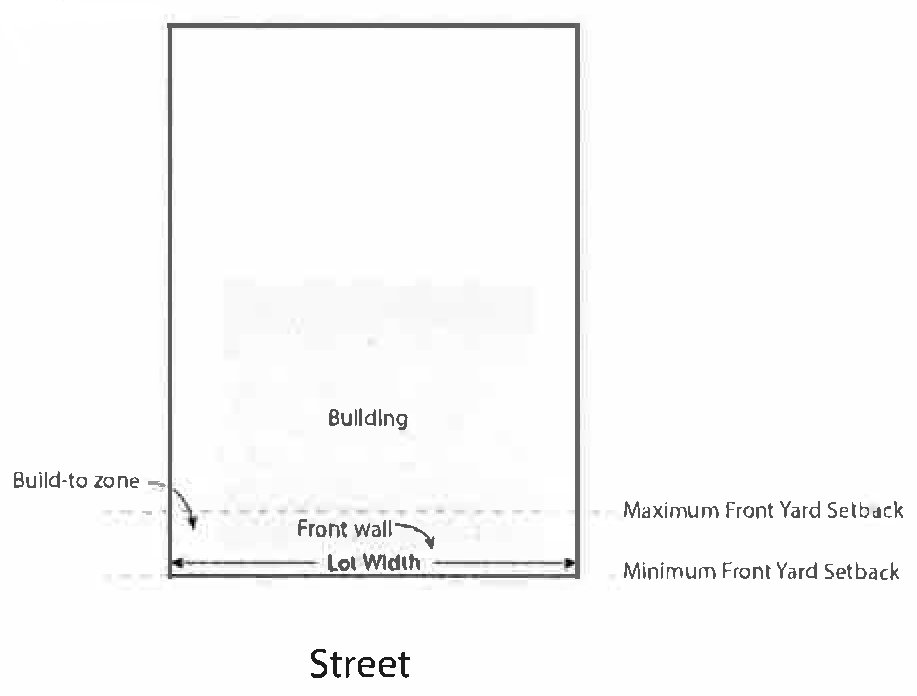
Building frontage. A percentage expressed as the width of that part of a building wall which faces the public street and occupies the build-to zone divided by the total lot width.
Building line. A line formed by the eaves of the building, or the most horizontal appendage of the building, and for the purposes of this section, a minimum building line is the same as the front setback.
Building inspector. The person designated by the city council to administer the provisions of the adopted building codes for the city.
Build-to zone. The area located between the required minimum and maximum front yard setback as illustrated below.
(Ord. No. 95-06, § 1, 12-27-95; Ord. No. 99-11, § 1, 12-20-99; Ord. No. 99-10, § 1, 12-20-99; Ord. No. 15-01, § 1, 2-17-15; Ord. No. 16-01, § 1, 1-19-16; Ord. No. 17-04, § 1, 9-18-17; Ord. No. 18-02, § 1, 2-20-18)
Section 2.04. - Definitions - C.
Campground. An area that is occupied or intended for occupancy by transients using recreational vehicles, motor homes, or tents for temporary dwelling, lodging, and/or sleeping purposes. A manufactured housing community shall not be considered a campground.
Canopy. A protective roof-like covering not requiring a foundation mounted independently on a frame over a walkway, door or installed equipment.
Certificate of occupancy. A document signed by an authorized city official as a condition precedent to the commencement of a use or the construction of a structure or building which acknowledges that such use, structure or building complies with the provisions of the zoning ordinance.
Child care center. A facility other than a private residence, licensed by the Michigan Department of Social Services, in which one (1) or more children are given care and supervision for periods of less than twenty-four (24) hours per day, and where a parent or legal guardian is not immediately available to the child. Child care center includes a facility which provides care for not less than two (2) consecutive weeks, regardless of the number of hours of care per day.
Child care center does not include a sunday school, a vacation Bible school, or a religious class that is conducted by a religious organization where children are in attendance for not greater than four (4) hours per day for an indefinite period, or not greater than eight (8) hours per day for a period not to exceed four (4) weeks, during a twelve (12) month period, or a facility operated by a religious organization where children are cared for not greater than four (4) hours, while persons responsible for the children are attending religious classes or services.
City. City of Lowell, Michigan.
City council, or council. The City Council of the City of Lowell.
City or Village Zoning Act. Act 207 of the Michigan Public Acts of 1921, as amended.
Club. An organization or persons for special purposes such as sports, arts, sciences, literature, politics, or the like, but not operated for profit.
Commercial greenhouse or nursery: A retail business whose principal activity is the selling of plants grown on the site and having outside storage, growing, or display or such plants and related landscape materials or products.
Commercial storage warehouse. A building or buildings used primarily as a commercial business for the storage of goods and materials.
Commercial wireless communication tower. A structure designed and constructed to support one (1) or more antennas used for licensed telecommunication services including cellular, personal communication services (PCS), specialized mobilized radio (SMR), enhanced specialized mobilized radio (ESMR), paging and similar services that are marketed to the general public. The term commercial wireless communication tower does not include amateur radio antennas.
Community center. A facility used for and providing religious, fraternal, social, or recreational programs generally open to the public and designed to accommodate and serve significant segments of the community.
Comprehensive plan. The Comprehensive Community Plan currently adopted by the City of Lowell, including graphic and written proposals, indicating the general location for streets, parks, schools, public buildings, and all physical development of the municipality, and includes any unit or part of such plan and any amendment to such plan.
Convalescent or nursing home. A structure with sleeping rooms, where persons are housed or lodged and are furnished with meals, nursing and medical care.
(Ord. No. 95-06, § 1, 12-27-95; Ord. No. 97-2, § 2, 11-17-97; Ord. No. 00-4, § 1, 9-18-00; Ord. No. 06-01, § 2, 2-21-06; Ord. No. 17-04, § 1, 9-18-17)
Section 2.05. - Definitions - D.
Drive-through. A business establishment so developed that its retail or service character provides a driveway approach or parking spaces for motor vehicles to serve patrons while in the motor vehicle either exclusively or in addition to service within a building or structure, or to provide self-service for patrons and food carry-out.
Dwelling, multiple-family. A dwelling, or a portion of a building, designed exclusively for occupancy by three (3) or more families living independently of each other.
Dwelling, single-family. A dwelling designed exclusively for and occupied exclusively by one (1) family.
Dwelling, two-family. A dwelling designed exclusively for occupancy by two (2) families living independently of each other.
Dwelling unit, accessory (ADU). A separate, complete housekeeping unit with a separate entrance, kitchen, sleeping area, and full bathroom facilities that is an attached or detached extension to, and located on the same property as, an existing single-family dwelling.
(Ord. No. 95-06, § 1, 12-27-95; Ord. No. 26-02, § 1, 2-16-26)
Section 2.06. - Definitions - E.
Employee. For purposes of Chapter 17A hereof, means a person who works or performs in and/or for a sexually oriented business, including the manager, regardless of whether or not said person is paid a salary, wage or other compensation by the manager or owner of said business.
Entertainer. Any person who performs any entertainment, exhibition or dance of any type within an adult cabaret, whether or not such person or anyone else charges or accepts a fee for such entertainment, exhibition, or dance.
Erected. Built, constructed, altered, reconstructed, moved upon, or any physical operations on the premises which are required for construction, excavation, fill, drainage, etc.
Escort. A person who, for consideration, agrees or offers to act as a companion, guide, or date for another person, or who agrees or offers to privately model lingerie, to privately perform a striptease for another person, or to otherwise display specified sexual activities or specified anatomical areas.
Escort agency. A person or business association who furnishes, offers to furnish, or advertises to furnish escorts as one of its primary business purposes for a fee, tip, or other consideration.
Essential public services. The erection, construction, alteration or maintenance by public utilities or municipal departments of underground, surface, or overhead gas, electrical, steam, fuel, or water transmission, distribution, collection, communication, supply or disposal systems, including towers, poles, wires, mains, drains, sewers, pipes, conduits, cables, fire alarm and police call boxes, traffic signals, hydrants and similar equipment, but not including buildings and storage yards, which are necessary for the furnishing of adequate service by such utilities or municipal departments for the general health, safety or welfare. Essential public services shall not include commercial wireless communications towers.
Excavation. Any breaking of ground, except common household gardening and ground care.
(Ord. No. 95-06, § 1, 12-27-95; Ord. No. 97-2, § 3, 11-17-97; Ord. No. 00-4, § 2, 9-18-00)
Section 2.07. - Definitions - F.
Family. One person residing in a household; or two (2) or more persons related by blood, marriage, adoption or legal arrangement, including foster children and servants residing together; or unrelated persons residing together as one housekeeping unit in a dwelling unit.
Family day care home. A private residence in which the operator permanently resides as a member of the household, registered with the Michigan Department of Social Services, in which one (1) but less than seven (7) minor children are given care and supervision for periods of less than twenty-four (24) hours per day, unattended by a parent or legal guardian, except children related to an adult member of the family by blood, marriage, or adoption. Family day care home includes a home that gives care to an unrelated minor child for more than four (4) weeks during a calendar year.
Farm. A contiguous parcel of land of not less than ten (10) acres in area, directly farmed or used for commercial agriculture by the owner-operator, manager, or tenant farmer by his own labor or with assistance of members of his household or hired employees. A farm includes a farm dwelling and accessory buildings necessary for the storage or housing of farm implements, products, or animals, or used for the operation of the farm. Farms may include greenhouses, nurseries, orchards, hatcheries, dairy farms, poultry farms, piggeries, commercial feedlots, apiaries, truck farms, and forestry operations. Fish hatcheries, stockyards, recreation parks, stone quarries, gravel, dirt or sand pits, keeping furbearing animals or game, kennels, stables, riding academies, or mineral extraction, are not considered farm uses.
Floor Area
Fence. A barrier intended to prevent escape or intrusion or to mark a boundary. Such barriers are made typically of posts and wire or boards.
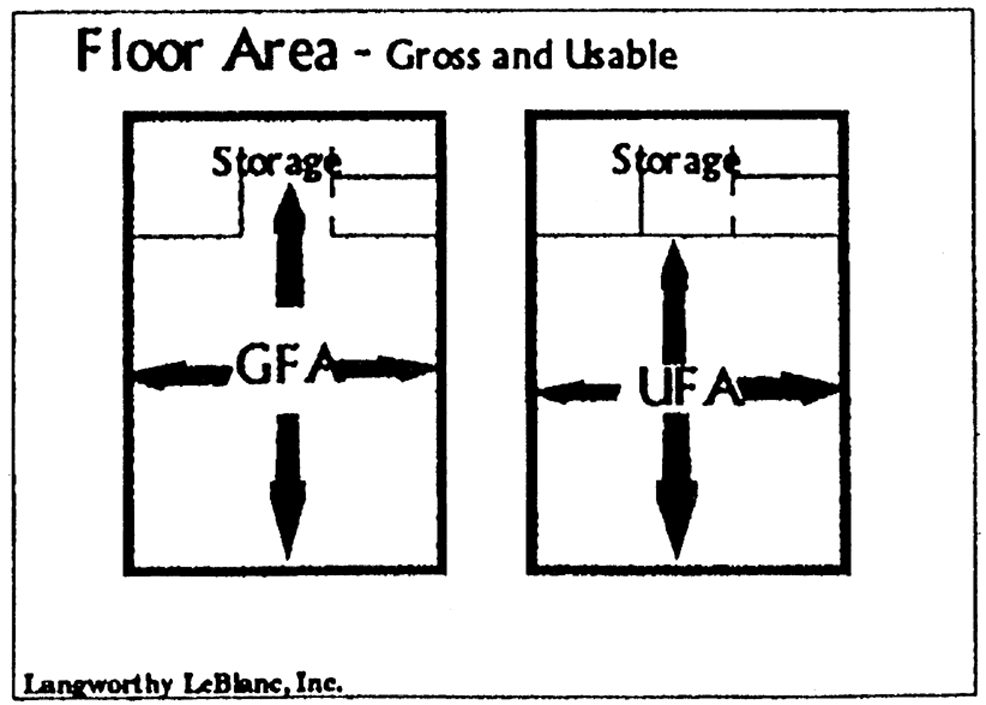
Floor area, dwelling (DFA). That area used for living, sleeping, eating or cooking as measured to the outside surfaces of the exterior walls. DFA does not include a garage, open porch, balcony, terrace, court, deck, storage space and other similar space not used for living, sleeping, eating or cooking.
Foot candle. A measure of illumination on a surface that is everywhere one (1) foot from a uniform point source of light of one (1) candle and equal to one (1) lumen per square foot.
Funeral home or mortuary. A building or part thereof used for human funeral services and related activities such as embalming and the performance of other services used in the preparation of the deceased for burial; the storage of caskets, funeral urns, and other related funeral supplies; the storage of funeral vehicles; and facilities for cremation.
(Ord. No. 95-06, § 1, 12-27-95; Ord. No. 03-5, § 1, 8-18-03; Ord. No. 04-1, § 1, 3-15-04; Ord. No. 11-01, § 1, 1-3-11; Ord. No. 17-04, § 1, 9-18-17)
Section 2.08. - Definitions - G.
Grade. The gradient, the rate of incline or decline expressed as a percent. For example, a rise of twenty-five (25) feet in a horizontal distance of one hundred (100) feet would be expressed as a grade of twenty-five (25) percent.
Greenbelt. A strip of land of definite width and location reserved for the planting of shrubs, trees, or grasses to serve as an obscuring screen or buffer strip in carrying out the requirements of this ordinance.
Group day care home. A private residence in which the operator permanently resides as a member of the household, licensed by the Michigan Department of Social Services, in which more than six (6) but not more than twelve (12) minor children are given care and supervision for periods of less than twenty-four (24) hours per day, unattended by a parent or legal guardian, except children related to an adult member of the family by blood, marriage, or adoption. Group day care home includes a home that gives care to unrelated minor children for more than four (4) weeks during a calendar year.
(Ord. No. 95-06, § 1, 12-27-95)
Section 2.09. - Definitions - H.
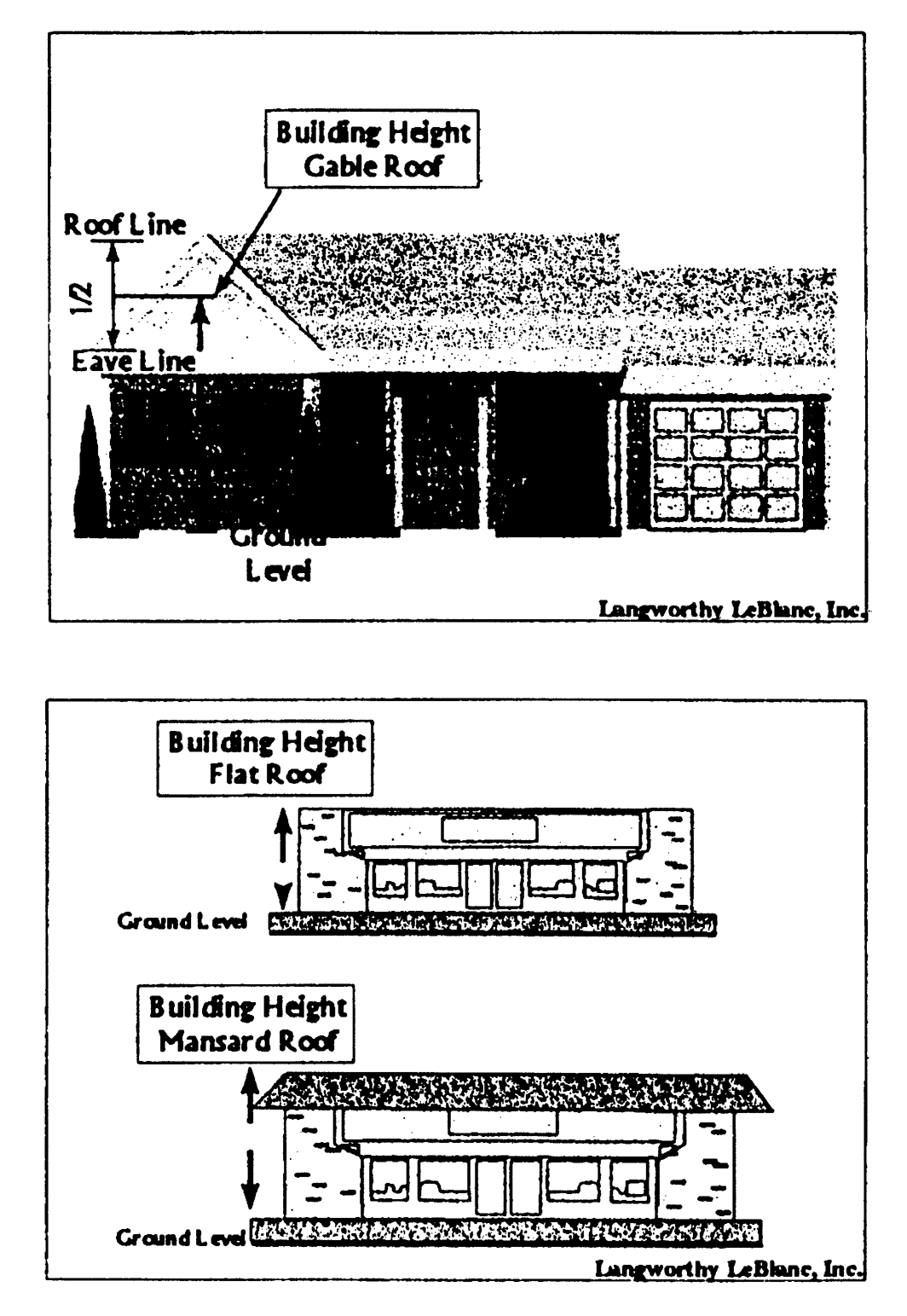
Height. The vertical distance measured from the average grade to the highest point of a structure. In the case of a building, height shall be measured from the average grade to the highest point of the roof surface for a flat roof; to the deck line of mansard roofs; and to the midpoint between the eaves and ridge for gable, hip, and gambrel roofs.
Building Height
Home occupation. An occupation or profession that is clearly a customary, incidental, and secondary use of a residential dwelling unit. Without limiting the foregoing, a single-family residence used by an occupant of that residence to give instruction in a craft or fine art within the residence shall be considered a home occupation.
Hotel/motel. A facility offering lodging accommodations for automobile travelers on a daily rate to the general public and which may or may not provide additional services, such as restaurants, meeting rooms, and recreational facilities.
(Ord. No. 95-06, § 1, 12-27-95)
Section 2.10. - Definitions - I.
Industrial hemp. A plant of the genus cannabis and any part of that plant, whether growing or not, with a delta-9 tetrahydrocannabinol concentration that does not exceed 0.3% on a dry-weight basis, or per volume or weight of marihuana-infused product, or the combined percent of delta-9-tetrahydrocannabinol and tetrahydrocannabinolic acid in any part of the plant of the genus cannabis regardless of moisture content.
Inoperable vehicle. A motor vehicle which can no longer propel itself.
(Ord. No. 95-06, § 1, 12-27-95; Ord. No. 19-06, § 1, 10-21-19)
Section 2.11. - Definitions - J.
Junk. Any worn out or discarded materials including, but not necessarily limited to, scrap metal, inoperable motor vehicles and parts, construction material, household wastes, including garbage and discarded appliances, and yard debris.
Junkyard. An open area where waste, used or secondhand materials are bought and sold, exchanged, stored, baled, packed, disassembled, or handled. These materials include, but are not limited to: scrap iron and other metals, paper, rags, rubber tires, and bottles. A "junk yard" includes automobile wrecking yards and includes any area of more than two hundred (200) square feet for storage, keeping or abandonment of junk, but does not include uses established entirely within enclosed buildings.
(Ord. No. 95-06, § 1, 12-27-95)
Section 2.12. - Definitions - K.
Kennel, commercial. Any lot or premises on which three (3) or more dogs, cats, or other household pets, six (6) months of age or older, are either permanently or temporarily boarded for commercial purposes. A kennel shall also include any lot or premises where household pets are bred or sold for commercial purposes.
(Ord. No. 95-06, § 1, 12-27-95)
Section 2.13. - Definitions - L.
Landing or take-off areas for rotorcraft. An area designed to be used for the landing or takeoff of helicopters including operations facilities, such as maintenance, loading and unloading, storage, fueling, or terminal facilities.
Licensee. A person in whose name a license to operate a sexually oriented business has been issued, as well as the individual listed as an applicant on the application for a license. It also means the general partners of a partnership, the partners of a limited liability partnership and the members of a limited liability company that is a licensee.
Loading space. An off-street space on the same lot with a building, or group of buildings, for the temporary parking of a vehicle while loading and unloading merchandise or materials.
Lot. A parcel, vacant land, occupied land, or land intended to be occupied by a building and accessory buildings, or utilized for the principal accessory use(s) together with yards and open spaces required under the provisions of this ordinance. A lot may or may not be specifically designated as such on public records. A lot may also mean a portion of a condominium project, as regulated by Public Act 59 of the Michigan Public Acts of 1978, as amended, designed and intended for separate ownership and use.
Lot area. The total horizontal area within the lot lines.
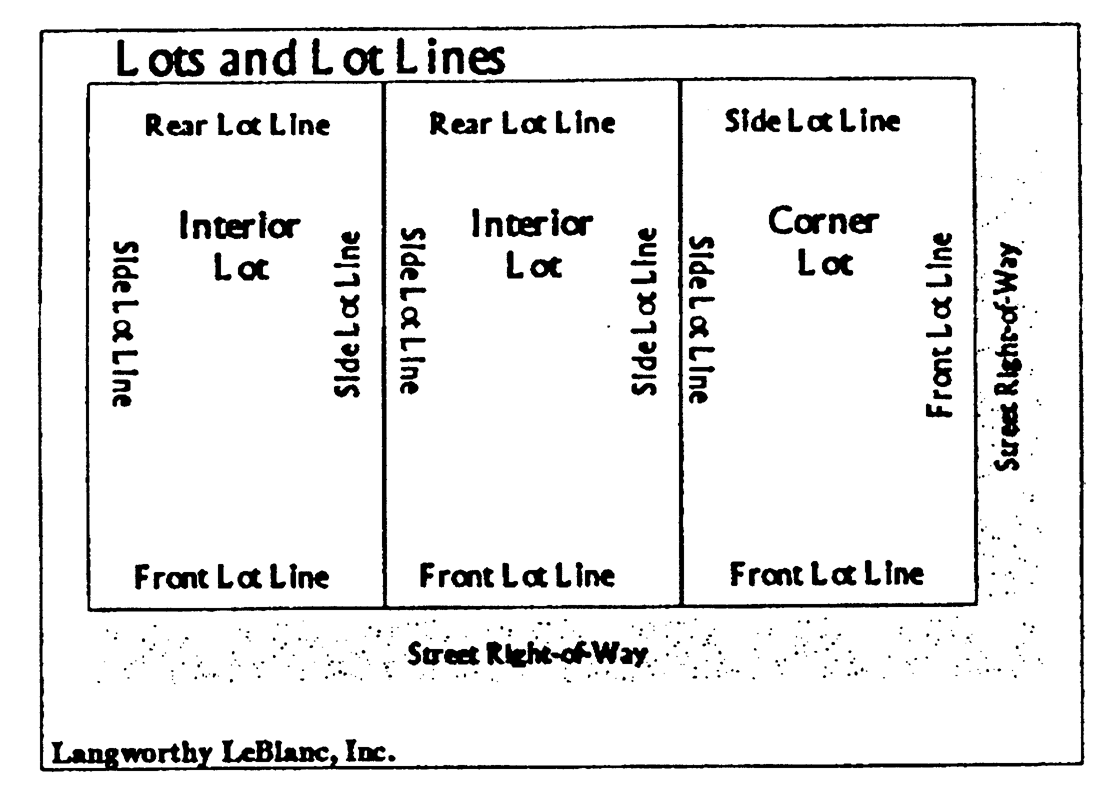
Lot, corner. Any lot having at least two (2) contiguous sides abutting upon a street, provided that the interior angle at the intersection of such two sides is less than one hundred thirty-five (135) degrees. A lot abutting upon a curved street or streets shall be considered a corner lot if the tangents to the curve, at its points of beginning within the lot or at the points of intersection of the side lot lines with the street line, intersect at an interior angle of less than one hundred thirty-five (135) degrees.
Lot coverage. The percentage of the lot occupied by any building or structure, including accessory buildings.
Lot depth. The horizontal distance between the front and rear lot lines, measured along the median between the side lot lines.
Lot, interior. A lot other than a corner lot, flag lot, or through lot.
Lot lines. The lines bounding a lot as defined herein:
A.
Front lot lines. In the case of an interior lot, it is the line separating the lot from the street. In the case of a through lot, it is that line separating said lot from either street.
A corner lot shall have two (2) front lot lines: a principal front lot line and a secondary front lot line. The principal front lot line shall be the shorter of the two (2) lot lines. Where the lot lines are of equal length, and/or the principal front lot line is not evident, then the zoning administrator shall determine the principal front lot line.
General provisions.
1.
The secondary front lot setback shall be one-half (½) of the principal front lot setback.
2.
The required front setback shall be measured from both the principal and secondary front lot lines. For a corner lot with three (3) front setbacks, the remaining setback shall be a rear setback.
3.
The remaining setbacks shall be a rear and a side setback. The rear setback shall be measured from the rear lot line, which in the case of a corner lot, shall be the lot line opposite the principal front lot line.
4.
The width of a corner lot shall be determined by the entire length of that front lot line which is opposite the rear lot line.
Lot of record. A parcel of land, the dimensions of which are shown on a document or map on file with the county register of deeds or in common use by municipal or county officials, which actually exists as shown, or any part of such parcel held in a record ownership separate from that of the remainder thereof.
Lot, through. Any interior lot having frontage on two (2) parallel streets.
Lot width. The horizontal straight line distance between the side lot lines, measured between the two (2) points where the front setback line intersects the side lot lines.
Lots and Lot Lines
(Ord. No. 95-06, § 1, 12-27-95; Ord. No. 97-2, § 4, 11-17-97; Ord. No. 02-1, § 1, 3-18-02; Ord. No. 17-04, § 1, 9-18-17)
Section 2.14. - Definitions - M.
Main building. A building in which is conducted the principal use of the lot upon which it is situated.
Manager. An employee, other than the licensee, who is employed by a sexually oriented business to act as a manager or supervisor of employees or who is otherwise responsible for the operation of, or in charge of, a licensed sexually oriented business.
Manufactured home. A transportable, factory-built home, designed to be used as a year-round residential dwelling.
Manufactured home park. A parcel or tract of land under the control of a person upon which three (3) or more manufactured homes are located on a continual non-recreational basis and which is offered to the public for that purpose regardless of whether a charge is made therefor, together with any building, structure, enclosure, street, equipment, or facility used or intended for use incident to the occupancy of a manufactured home and which is not intended for use as a temporary trailer park.
Marihuana. All parts of the plant of the genus cannabis, growing or not; the seeds of the plant; the resin extracted from any part of the plant; and every compound, manufacture, salt, derivative, mixture, or preparation of the plant or its seeds or resin, including marihuana concentrate and marihuana-infused products. For purposes of this ordinance, marihuana does not include:
A.
The mature stalks of the plant, fiber produced from the stalks, oil or cake made from the seeds of the plant, any other compound, manufacture, salt, derivative, mixture, or preparation of the mature stalks, except the resin extracted from those stalks, fiber, oil, or cake, or any sterilized seed of the plant that is incapable of germination;
B.
Industrial hemp; or
C.
Any other ingredient combined with marihuana to prepare topical or oral administrations, food, drink, or other products.
Marihuana accessories. Any equipment, product, material, or combination of equipment, products, or materials, which is specifically designed for use in planting, propagating, cultivating, growing, harvesting, manufacturing, compounding, converting, producing, processing, preparing, testing, analyzing, packaging, repackaging, storing, containing, ingesting, inhaling, or otherwise introducing marihuana into the human body.
Marihuana concentrate. The resin extracted from any part of the plant of the genus cannabis.
Marihuana establishment or adult use marihuana establishment. A marihuana grower, marihuana safety compliance facility, marihuana processor, marihuana microbusiness, marihuana retailer, marihuana secure transporter, or any other type of marihuana-related business licensed by the city.
Marihuana grower. A person licensed to cultivate marihuana and sell or otherwise transfer marihuana to marihuana establishments.
Marihuana-infused product. A topical formulation, tincture, beverage, edible substance, or similar product containing marihuana and other ingredients and that is intended for human consumption.
Marihuana licensee. A person holding a valid license for an adult use marihuana establishment issued by the State of Michigan.
Marihuana microbusiness. A person licensed to cultivate not more than one hundred fifty (150) marihuana plants; process and package marihuana; and sell or otherwise transfer marihuana to individuals who are twenty-one (21) years of age or older or to a marihuana safety compliance facility, but not to other marihuana establishments.
Marihuana processor. A person licensed to obtain marihuana from marihuana establishments; process and package marihuana; and sell or otherwise transfer marihuana to marihuana establishments.
Marihuana retailer. A person licensed to obtain marihuana from marihuana establishments and to sell or otherwise transfer marihuana to marihuana establishments and to individuals who are twenty-one (21) years of age or older.
Marihuana secure transporter. A person licensed to obtain marihuana from marihuana establishments in order to transport marihuana to marihuana establishments.
Marihuana safety compliance facility. A person licensed to test marihuana, including certification for potency and the presence of contaminants.
Massage parlor. Any establishment having a fixed place of business where massages are administered for pay, including but not limited to massage parlors, sauna baths, and steam baths. This definition shall not be construed to include a hospital, nursing home, medical clinic, or the office of a physician, surgeon, chiropractor, osteopath, or physical therapist duly licensed by the State of Michigan, nor barber shops or beauty salons in which massages are administered only to the scalp, the face, the neck or the shoulder. This definition shall not be construed to include a nonprofit organization operating a community center, swimming pool, tennis court, or other educational, cultural, recreational, and athletic facilities for the welfare of the residents of the area, nor practices of massage therapists who meet one or more of the following criteria:
A.
Proof of graduation from a school of massage licensed by the State of Michigan;
B.
Official transcripts verifying completion of at least three hundred (300) hours of massage training from an American community college or university; plus three references from massage therapists who are professional members of a massage association referred to in this section;
C.
Certificate of professional membership in the American Massage Therapy Association, International Myomassethics Federation, or any other recognized massage association with equivalent professional membership standards; or
D.
A current occupational license from another state.
Mixed use development. A development consisting of one (1) or more buildings that contain a mix of commercial, office, retail, residential, recreational or similar land uses, or any combination of such uses.
(Ord. No. 95-06, § 1, 12-27-95; Ord. No. 97-2, § 5, 11-17-97; Ord. No. 15-01, § 2, 2-17-15; Ord. No. 19-06, § 2, 10-21-19)
Section 2.15. - Definitions - N.
Nonconforming building. A building or portion thereof lawfully existing at the effective date of this ordinance or amendments thereto and not conforming to the provisions of the zoning ordinance in the district in which it is located.
Nonconforming use. A use or activity, which lawfully occupied a building or land at the effective date of this ordinance or amendments thereto and which does not conform to the use regulations of the district in which it is located.
Nonresidential district. The C-1, C-2, C-3, I, and PF Zone Districts.
Nude model studio. Any place where a person who appears nude or in a state of nudity or displays specified anatomical areas or specified sexual activities is provided for money or any form of consideration to be observed, sketched, drawn, painted, sculpted, photographed or similarly depicted by other persons.
Nudity or a state of nudity. The display of any specified anatomical areas.
(Ord. No. 95-06, § 1, 12-27-95; Ord. No. 97-2, § 6, 11-17-97)
Section 2.16. - Definitions - O.
Off-street parking lot. A facility providing parking spaces, along with adequate drives, maneuvering areas, and aisles, for the parking of more than three (3) vehicles.
Open air business. Retail sales establishments operated substantially in the open air, including, but not necessarily limited to:
A.
Bicycle, utility truck or trailer, motor vehicle, boats, or home equipment sales, repair or rental services.
B.
Outdoor display area and sale of garages, motor homes, recreation vehicles, manufactured homes, snowmobiles, swimming pools and similar activities, but not including farm implements or commercial construction equipment.
C.
Retail sales of trees, fruits, vegetables, shrubbery, plants, seeds, topsoil, humus, fertilizer, trellises, lawn furniture, playground equipment and other home garden supplies and equipment, but not including lumberyards.
D.
Tennis courts, archery courts, shuffleboard, horseshoe courts, miniature golf, golf driving range, children's amusement parks or similar recreational uses (transient or permanent).
Operator. All persons who own, operate, direct, oversee, conduct, maintain, or effectively exert management control or authority over a sexually oriented business or its affairs, without regard to whether such person(s) owns the premises in which the sexually oriented business does business. An operator effectively exerts management control or authority when he or she actually does, or is in a position to, participate in the management, direction or oversight of a sexually oriented business or its affairs, whether or not such person's name appears on any public record filed with any government agency in connection with a sexually oriented business or any parent company or affiliate.
Outdoor furnace. Any device, appliance, facility, apparatus or structure that is designed, intended and/or used to provide hot water heat and/or hot water to any associated structure, operates by burning solid fuel and is not located within the structure to be heated.
Owner. A person owning, directly or beneficially, any interest or part interest, however identified, in a sexually oriented business.
(Ord. No. 95-06, § 1, 12-27-95; Ord. No. 97-2, § 7, 11-17-97; Ord. No. 11-05, § 1, 4-18-11)
Section 2.17. - Definitions - P.
Parking facility. Any portion of a parking space, access drives, aisles, or any other land used for the purpose of parking a motor vehicle.
Parking space. An area of definite length and width, exclusive of drives, aisles or entrances giving access thereto, and fully accessible for the parking of permitted motor vehicles.
Peep booth. A viewing room, other than a private room not authorized for admittance by patrons, of less than one hundred fifty (150) square feet of floor space upon the premises of a sexually oriented business where there is exhibited photographs, films, motion pictures, video cassettes, or other video reproductions, slides or other visual representations which depict or describe specified sexual activities or specified anatomical areas.
Person. An individual, proprietorship, partnership, corporation, limited liability company, limited liability partnership, association or other legal entity.
Personal service establishment. A commercial business conducting services that are performed primarily on the premises.
Pet cremation services. A building or portion thereof used for the cremation of pets or other household animals, and related accessory uses such as transport and memorialization services.
Petroleum storage. A building, structure or facility used for the storage of fuels or other volatile products.
Planned unit development (PUD). A development of land that is under unified control and is planned and developed as a whole in a single development operation or programmed series of development stages.
Planning commission, or commission. The City of Lowell Planning Commission.
Premises. All lands, structures, places and also the equipment and appurtenances connected or used therewith in any business, and also any personal property which is either affixed to, or is otherwise used in connection with any such business conducted on such premises.
Primary accessory building. That building which has as its main purpose the housing of the daily driven vehicles of the residents of a premises.
Principal use. The main use to which the premises are devoted.
Privacy screen. A structure designed to serve as a partial barrier to views of or from contact with others.
Private room. A room in an adult motel that is not a peep booth, has a bed in the room, has a bath in the room or adjacent to the room, and is used primarily for lodging.
Public utility. A person, firm, or corporation, municipal department, board or commission duly authorized to furnish to the public under federal, state or municipal regulations, gas, steam, electricity, sewage disposal, communication, telegraph, transportation, or water.
(Ord. No. 95-06, § 1, 12-27-95; Ord. No. 97-2, § 8, 11-17-97; Ord. No. 04-1, § 2, 3-15-04; Ord. No. 17-04, § 1, 9-18-17; Ord. No. 26-01, § 1, 1-20-26)
Section 2.18. - Definitions - R.
Radio and television transmitting buildings or towers. A tower, pole, or similar structure and related buildings or structures that supports a radio and/or television antenna operated for commercial purpose above ground in a fixed location, freestanding, guyed, or on a building or other structures.
Recreational vehicle or equipment. Vehicles or equipment used primarily for recreational purposes. For the purpose of this ordinance, recreational vehicle shall mean: 1) A vehicle primarily designed and used as temporary living quarters for recreational, camping, or travel purposes, including a vehicle having its own motor power or a vehicle mounted on or drawn by another vehicle such as a motor home or camper; 2) Boats and trailers designed to transport boats; 3) Snowmobiles and trailers designed to transport snowmobiles; 4) Off-road vehicles and trailers designed to transport off-road vehicles; 5) Pop-up tent and camper trailers; 6) Other similar vehicles deemed by the zoning enforcement officer to be a recreational vehicle. This term shall not include motorcycles or motorbikes or other similar means of transportation intended primarily for on-street use.
Removal and processing of topsoil, stone, rock, sand, gravel, lime or other soil or mineral resources. The removal, loading, processing and/or transporting of topsoil, stone, rock, sand, gravel, lime or other soil or mineral resources on, to, or from a lot, and including the incidental maintenance of machinery or equipment used in connection with such removal and processing. Minor alterations of the grade elevation by cutting or filling earth for noncommercial purposes, such as preparing a lot for construction, shall not constitute removal and processing of mineral resources for the purposes of this Ordinance.
Residential district. The RS, R-1, R-2, R-3, MPH, and PUD Districts.
Restaurant. A retail establishment selling food and drink primarily for consumption on the premises, and including establishments selling prepared foods and drinks for immediate on-site consumption or for take-out. A restaurant may also include a brewery/winery as an accessory use.
Retail building supplies. A facility where building materials such as lumber, plywood, drywall, paneling, cement blocks and other cement products, and other building and related products are stored and sold at retail. Retail building supplies may also process lumber by performing millwork, planing, cutting, and other customizing processes.
(Ord. No. 95-06, § 1, 12-27-95; Ord. No. 16-01, § 2, 1-19-16; Ord. No. 17-04, § 1, 9-18-17)
Section 2.19. - Definitions - S.
Satellite dish antenna. An apparatus capable of receiving communications from a transmitter or a transmitter relay located in planetary orbit.
Semi-nudity. A state of dress in which clothing covers no more than the human bare buttock, anus, male genitals, female genitals, or female breast without a fully opaque complete covering of the breast below a point immediately above the top of the areola, or human male genitals in a discernible turgid state even if completely and opaquely covered.
Sexual encounter center. A business or commercial establishment that, as one of its primary business purposes, offers, for any form of consideration, a place where two or more persons may congregate, associate or consort for the purpose of specified sexual activities or the exposure of specified anatomical areas or activities when one or more of the persons is in a state of nudity or semi-nudity. This definition does not apply to any actions otherwise authorized by law or the examination of another person for a bona fide medical purpose consistent with reasonable medical practices.
Sexually oriented business. An adult arcade, adult bookstore or adult video store, adult cabaret, adult motel, adult motion picture theater, adult live entertainment theater, escort agency, nude model studio, or sexual encounter center and includes:
A.
The opening or commencement of any sexually oriented business as a new business;
B.
The conversion of an existing business, whether or not a sexually oriented business, to a sexually oriented business;
C.
The addition of any sexually oriented business to any other existing sexually oriented business;
D.
The relocation of any sexually oriented business;
E.
The substantial enlargement of an existing sexually oriented business; or
F.
The continuation of any sexually oriented business in existence on the effective date of this ordinance.
Setback. The distance required to obtain minimum front, side or rear yard open space provisions of this ordinance.
Short-term rental. The rental or subletting of any dwelling for a term of thirty (30) days or less, but the definition does not include the use of campgrounds, hotel rooms, bed and breakfast establishments, transitional housing operated by a non-profit entity, group homes such as nursing homes and adult foster care homes, hospitals, or housing provided by a substance abuse rehabilitation clinic, mental-health facility, or other health-care related clinic.
Sign. A lettered board, or other notice advertising an individual, firm, profession, business or other thing and visible to the general public.
Significant natural feature. A natural area as designated by the planning commission, city council, or the Michigan Department of Natural Resources or Department of Environmental Quality, or other applicable agency which exhibits unique topographic, ecological, hydrological, or historical characteristics such as a wetland, floodplain, water features, or other unique natural features.
Specified anatomical areas. The male genitals in a state of sexual arousal even if completely and opaquely covered, any portion of female breast below the top of the areola, or any portion of the pubic hair, anus, cleft of buttocks, vulva or genitals of any person.
Specified sexual activities. Includes any of the following:
A.
The fondling or other erotic touching of human genitals, pubic region, buttocks, anus, or female breasts;
B.
Sex acts, normal or perverted, actual or simulated, including intercourse, oral copulation, or sodomy;
C.
Masturbation, actual or simulated; or
D.
Excretory functions as part of or in connection with any of the activities set forth in (A) through (B) above.
Story. That part of a building included between the surface of any floor above the average grade or ground at the foundation and the surface of the next floor, or if there is no floor above, then the ceiling next above.
Story, half. An uppermost story lying under a sloping roof having an area of at least two hundred (200) square feet with a clear height of seven (7) feet six (6) inches. For the purpose of this ordinance, the usable floor area is only that area having at least five (5) feet clear height between floor and ceiling.
Street, private. An undedicated, privately controlled and maintained right-of-way or other interest in land which affords the principal means of access to three (3) or more lots or parcels.
Street, public. A public dedicated right-of-way other than an alley, which affords the principal means of access to abutting property.
Structure. Anything constructed or erected, the use of which requires location on the ground or attachment to something on the ground.
Substantial enlargement of a sexually oriented business. The increase in floor areas occupied by the business by more than twenty-five (25) percent, as the floor areas exist on the effective date of this ordinance.
Substantial improvement. Any repair, reconstruction or improvement of a structure, the cost of which equals or exceeds fifty (50) percent of the market value of the structure either, before improvement or repair is started, or if the structure has been damaged and is being restored, before the damage occurred. For the purposes of this definition, "substantial improvement" is considered to occur when the first alteration of any wall, ceiling, floor, or other structural part of the building commences, whether or not that alteration affects the external dimensions of the structure. The term does not, however, include either any project for improvement of a structure to comply with existing state or local health, sanitary or safety code specifications which are solely necessary to assure safe living conditions, or any alteration of a structure listed on the National Register of Historic Places or the Michigan Register of Historic Places.
(Ord. No. 95-06, § 1, 12-27-95; Ord. No. 97-2, § 9, 11-17-97; Ord. No. 18-02, § 2, 2-20-18)
Section 2.19A. - Definitions - T.
Temporary storage unit. A transportable unit, container or structure designed primarily for temporary storage of personal property, household goods and other such materials for use on a temporary basis. Such unit shall not be considered an accessory building as provided in section 4.08 of chapter 4 of this zoning ordinance.
Theater or concert hall. A building or part thereof devoted to showing motion pictures, or for dramatic, dance, musical, or other live performances.
(Ord. No. 07-10, § 1, 11-5-07; Ord. No. 17-04, § 1, 9-18-17)
Section 2.19B. - Definitions - U.
Utility and public service buildings. Public buildings used for the provision of services traditionally provided by local government, such as including water and sewer, roads, parks, schools, and police and fire protection.
(Ord. No. 17-04, § 1, 9-18-17)
Section 2.20. - Definitions - V.
Vehicle repair facilities. Any building, premises or land where the primary use is the repair of motor vehicles, including body shops, provided all work is performed within an enclosed building and the storage of motor vehicles is within a completely secure area.
Vehicle service station. Building and premises where the primary use is the supply and dispensing at retail of motor fuels, lubricants, batteries, tires and other similar motor vehicle accessories.
Vehicle towing service. The dispatching, towing and transporting of motor vehicles for service, repair, salvage and the temporary storage of motor vehicles not more than thirty (30) days on the site of the vehicle towing service within a completely secure area.
Vehicle wash establishment. A building or structure used for washing and cleaning of passenger vehicles, recreational vehicles, or other light duty equipment. A vehicle wash establishment may be considered a principal use, or an accessory use when located on the same lot as a vehicle service station or similar uses.
Veterinary hospital. An establishment where animals or pets are given medical or surgical treatment and are cared for during the time of such treatment. Use as a kennel shall be limited to short-time boarding and shall be only incidental to such hospital use.
(Ord. No. 95-06, § 1, 12-27-95; Ord. No. 99-11, § 2, 12-20-99; Ord. No. 04-5, § 1, 11-15-04; Ord. No. 12-03, § 1, 6-4-12; Ord. No. 17-04, § 1, 9-18-17)
Section 2.21. - Definitions - W.
Wall. A structure designed to serve as a full barrier to views of or from contact with others.
Waste dumpster. A container used for the temporary storage of rubbish and/or materials to be recycled pending collection, having capacity of at least one (1) cubic yard.
(Ord. No. 95-06, § 1, 12-27-95; Ord. No. 04-1, § 3, 3-15-04)
Section 2.23. - Definitions - Y.
Yards. The open spaces on the same lot with a main building that are unoccupied and unobstructed from the ground upward except as otherwise provided in this ordinance, and as defined herein.
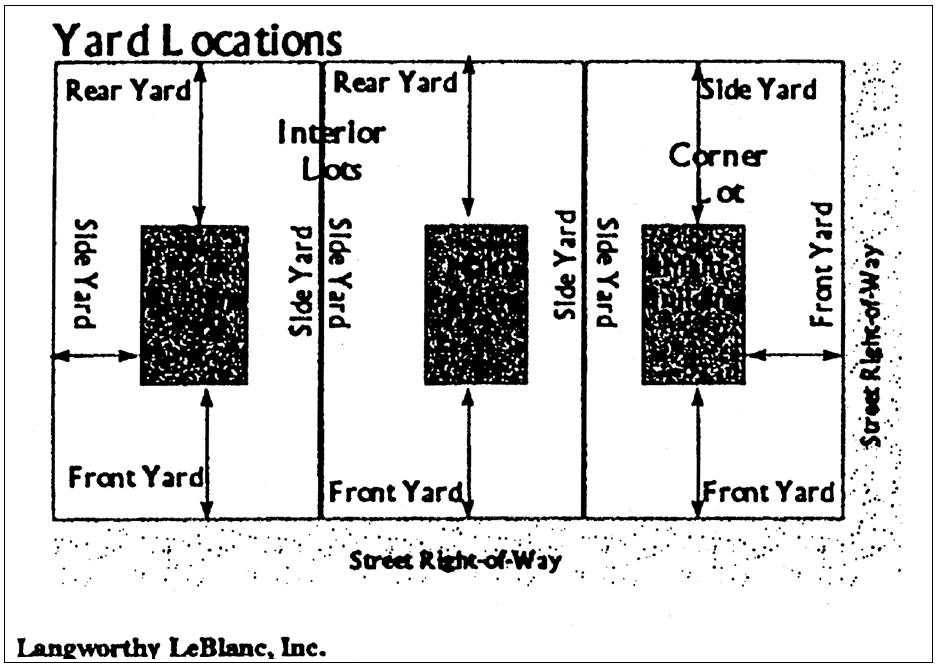
Yard Locations
A.
Frontyard. An open space extending the full width of the lot, the depth of which is the minimum horizontal distance between the front lot line and the building line of the main building.
B.
Rearyard. An open space extending the full width of the lot, the depth of which is the minimum horizontal distance between the rear lot line and the building line of the main building. In the case of a corner lot, the rear yard may be opposite either street frontage.
C.
Side yard. An open space between a main building and the side lot line, extending from the front yard to the rear yard, the width of which is the horizontal distance from the nearest point on the side lot line to the building line of the main building.
Yard, required. The required yard shall be that set forth in the zoning ordinance as the minimum yard requirement for each district.
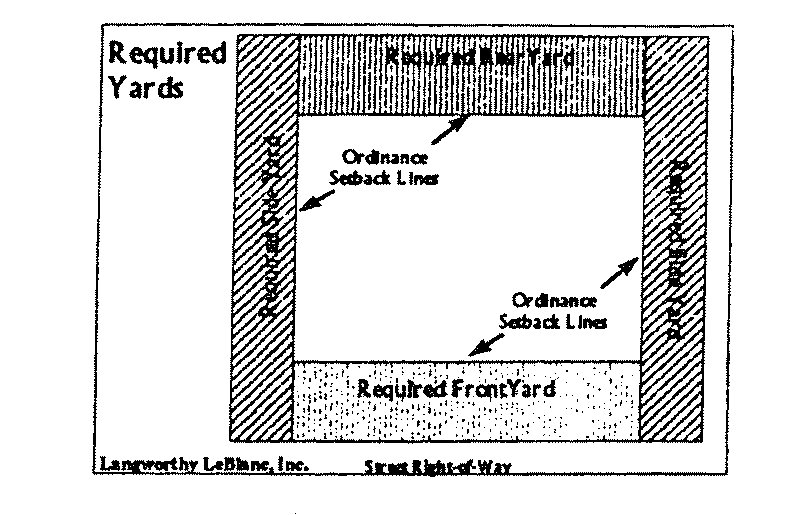
Required Yards
(Ord. No. 95-06, § 1, 12-27-95)
Section 2.24. - Definitions - Z.
Zoning Act. Act 207 of the Michigan Public Acts of 1921, as amended.
Zoning enforcement officer. The person designated by the city council to administer the provisions of this zoning ordinance.
(Ord. No. 95-06, § 1, 12-27-95)

