
Lowell City Zoning Code
CHAPTER 4
- GENERAL PROVISIONS
Section 4.01.- Required area, space, height, and use conditions and exceptions.
A.
No lots or lots in common ownership and no yard, parking area or other space shall be so divided, altered or reduced as to make such area or dimension less than the minimum required under this ordinance. If already less than the minimum required under this ordinance, said area or dimension shall not be further divided or reduced.
B.
A lot which is platted, or otherwise lawfully of record as of the effective date of this ordinance, may be used as specified in the district in which it is located. The side yards of such lots may be reduced by the same percentage the area of such lot bears to its zoning district requirements, provided that no side yard shall be less than five (5) feet. In all cases, the minimum front and rear yard requirements of this ordinance shall be met.
C.
Height exceptions.
1.
The following buildings and structures shall be exempt from height regulations in all districts: parapet walls not exceeding four (4) feet in height, chimneys, cooling towers, elevator bulkheads, fire towers, grain elevators and bins, silos, stacks, elevated water towers, stage towers, scenery lofts, monuments, cupolas, domes, spires, penthouses housing necessary mechanical appurtenances, wind-powered electrical generator, wireless communication antenna, and television and radio reception and transmission antennas and towers which do not exceed one hundred (100) feet in height.
2.
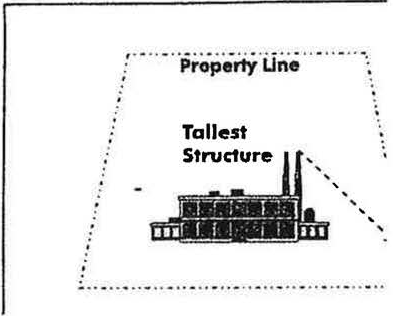
Additions to existing buildings and structures which now exceed the height limitations of their district may be constructed to the height of the existing to which the addition is attached if the lot is large enough to encompass a circular area with a radius at least equal to the height of the tallest structure or building.
3.
In the industrial districts stack chimneys, cooling and fire towers, elevator building and bulkheads, storage tanks and other necessary structures are permitted, provided the lot is large enough to encompass a circular area with a radius at least equal to the height of the tallest structure or building.
(Ord. No. 95-06, § 1, 12-27-95; Ord. No. 17-03, § 1, 9-18-17)
Section 4.02. - Principal use.
A.
No lot or parcel of land shall contain more than one (1) main building or one (1) principal use, except as may be permitted otherwise in this ordinance.
B.
Multiple buildings and/or multiple uses of land on a parcel may be considered a principal building or use collectively if the following conditions are met:
1.
The land and buildings are planned and designed as a single integral development, including joint parking, compatible architecture, shared driveways, shared signs, and other similar features.
2.
All uses, if not the same, shall be similar in function and/or operation.
(Ord. No. 95-06, § 1, 12-27-95; Ord. No. 17-03, § 1, 9-18-17)
Section 4.03. - Street access.
Any lot of record created after the effective date of this ordinance shall front upon a public or private street right-of-way for the minimum lot width required by this ordinance.
(Ord. No. 95-06, § 1, 12-27-95; Ord. No. 17-03, § 1, 9-18-17)
Section 4.04. - Basis of determining yard and lot requirements.
A.
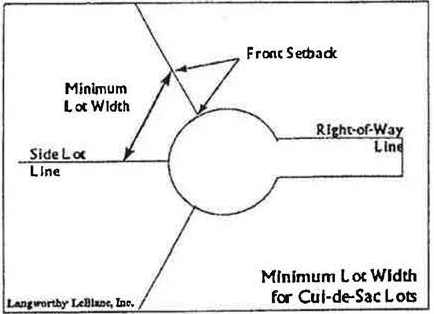
The minimum lot width for a lot on a cul-de-sac or other irregularly shaped lot shall be measured at the required front yard setback line and shall not be diminished throughout the rest of the lot. Such lots shall have a minimum width of forty (40) feet from the front property line to the required front yard setback line.
B.
The required front yard setback line shall be measured from the right-of-way line or property line, to an imaginary line across the width of the lot drawn at the minimum required front setback distance for that district, excepted as noted in C., below.
C.
Where an average setback line which is less than that required by this ordinance has been established by existing buildings located within three hundred (300) feet of the proposed building, such average setback shall apply.
D.
Corner and through lots. On corner and through lots, the front yard requirements shall apply on both streets. In such cases, the remaining yards shall be side yards, with no rear yard. In the case of a row of through lots, all yards of said lots adjacent to streets shall be considered frontage, and through yard setbacks shall be provided as required.
(Ord. No. 95-06, § 1, 12-27-95; Ord. No. 17-03, § 1, 9-18-17)
Section 4.05. - Projections into yards.
A.
Certain architectural features, such as cornices, bay windows (or windows without foundations), gutters, chimneys, pilasters and similar features:
1.
May project a maximum of four (4) feet into a required front or rear yard; and
2.
Shall not project into the required side yard.
B.
Porches, terraces, decks, balconies, window awnings, and similar structures which are open on all sides, unenclosed, and uncovered:
1.
May project a maximum of ten (10) feet into a required front yard;
2.
May project a maximum of fifteen (15) feet into a required rear yard;
3.
Shall not project into a required side yard; and
4.
Shall not be placed closer than ten (10) feet to any front or rear lot line.
5.
If such structures enclosed on any side or covered in any manner they shall be considered part of and subject to the same setbacks as the main building.
(Ord. No. 95-06, § 1, 12-27-95; Ord. No. 17-03, § 1, 9-18-17)
Section 4.06. - Clear vision.
A.
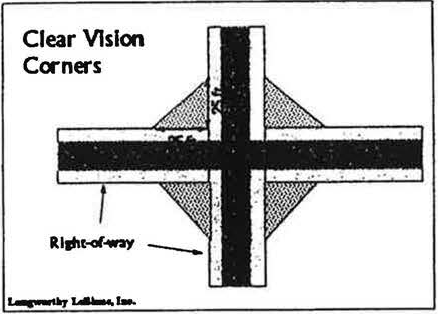
Except for lots within the C-2 or MU districts, no plantings, fencing, or other obstruction shall be established or maintained on any corner lot which will obstruct the view of a vehicle driver approaching the intersection. Such unobstructed corner shall mean a triangular area formed by the street property lines and a line connecting them at points twenty-five (25) feet from the intersection of the street lines or in the case of a rounded property corner from the intersection of the street property lines extended. This shall not prohibit the planting of shrubbery which will not achieve a height at maturity of more than thirty (30) inches.
B.
No plantings shall be established in any required front yard which, in the opinion of the zoning enforcement officer, will obstruct the view from of vehicles entering or leaving the site from driveways or adjacent roadways.
(Ord. No. 95-06, § 1, 12-27-95; Ord. No. 17-03, § 1, 9-18-17)
Section 4.07. - Fences and walls.
A.
Fences or walls shall be located on the same property as the use to which they apply.
B.
No fences or walls may be erected or maintained within the right-of-way of any public street, alley or other public way or in a clear vision area required by section 4.06 hereof.
C.
The height of a fence shall be measured from the average grade elevation within thirty (30) inches of each side of the proposed fence. The artificial raising of the land on which a fence is located in order to increase the height of a fence is prohibited.
D.
Unless specifically provided for elsewhere in this ordinance, a fence or wall or that portion of a fence or wall that is greater than fifty (50) percent solid may not exceed a height of thirty-six (36) inches within any required primary front yard. A fence that is less than fifty (50) percent solid may not exceed a height of forty-eight (48) inches within any required primary front yard.
E.
Fences shall not exceed a height of seventy-two (72) inches in any other area, except as noted in F. below. Fences shall be measured from the finished grade to the top of the fence. Posts will not be considered a part of fence height unless in the opinion of the zoning enforcement officer they obstruct vision.
F.
No fence or wall shall contain any exposed spike, nail, barb, other pointed instrument or electrification unless necessary for security in a nonresidential district, or for the protection of public utility buildings or improvements, or for livestock containment in agricultural areas. The exposed spike, nail, barb or other pointed instrument portion of the fence or wall shall be at least six (6) feet from the finished grade, in which case the height of the fence or wall may extend to a maximum of seven (7) feet above the finished grade.
G.
Fences in residential districts shall be residential in appearance and intent. Farm type fences are allowed on farmland in residential districts.
H.
In an industrial district, an open, wire protective fence may be constructed in the required front yard, where necessary, to enclose secure areas or to prevent access to potentially hazardous areas.
I.
All fences located along a property line shall have exposed posts and/or bracing of the fence located so as to face the interior of the property, and the finished side shall face the outside of the property.
J.
Any fence or wall erected or maintained along or near a lot line or other property boundary line shall be located and maintained so that no part of the fence or wall is located upon or encroaches on or above any other adjacent lot or parcel of property.
K.
All fences and walls shall be kept in good repair and condition: Both sides of a fence or wall, including a fence erected along a property line, shall be maintained in good repair and condition to maintain the original aesthetic of the fence including but not limited to finish, shape and style. If not maintained as prescribed, the city may be require that the fence be repaired or removed.
L.
A zoning permit shall be obtained from the zoning enforcement officer prior to the installation of a fence or wall and the design of all fences and walls, including openings for vehicular traffic or other purpose, shall only be as permitted in this section and the permit issued by the zoning enforcement officer.
(Ord. No. 95-06, § 1, 12-27-95; Ord. No. 04-1, § 4, 3-15-04; Ord. No. 17-03, § 1, 9-18-17)
Section 4.08. - Accessory building and uses.
A.
Accessory buildings attached to dwellings or other main buildings, including enclosed porches and garages, shall be deemed a part of such buildings and must conform to all regulations of this ordinance applicable to such main buildings.
B.
An accessory building or use shall only be permitted on lot which contains a principal use or main building.
C.
No part of an accessory building shall be used as a dwelling for residential purposes unless permitted as an accessory dwelling unit (ADU) pursuant to Section 17.04(GG).
D.
On corner lots, where the side lot line is a continuation of the front lot line of the lot to its rear, the accessory building or use shall be located no nearer than the required front yard setback line on the lot behind the corner lot.
E.
No more than two (2) detached accessory buildings may be permitted on any lot or parcel.
F.
Detached accessory buildings shall be located:
1.
A minimum of ten (10) feet from any main building;
2.
A minimum of three (3) feet to any side or rear lot line, as measured to the eave of the building;
3.
No nearer than the front yard setback required for the main building.
G.
Detached accessory buildings- Maximum total floor areas for all such buildings:
1.
For single- and two-family dwellings, including a garage:
a.
On lots of less than nine thousand (9,000) square feet, nine hundred and sixty (960) square feet; and
b.
On lots of nine thousand (9,000) square feet or more: one thousand two hundred (1,200) square feet.
2.
Other uses:
a.
Multiple-family developments: nine hundred sixty (960) square feet, excluding garages for the use of residents.
b.
Manufactured home parks: as permitted by chapter 9 hereof;
c.
For uses in the C-3 zoning districts: not to exceed the floor area of the main building(s); and
d.
For uses in all other nonresidential zoning districts other than the C-3 zoning districts: not to exceed twenty-five (25) percent the floor area of the main building(s).
H.
No detached accessory building in a residential district shall exceed the height of the main building located on the same lot.
I.
Any accessory building with a floor area greater than six hundred (600) square feet shall be permanently constructed on a concrete foundation and shall conform to all applicable building codes and other similar codes and regulations that apply to such structures.
J.
Accessory buildings with a floor area greater than two hundred (200) square feet shall (i) comply with applicable building codes and other similar codes and regulations that apply to such structures and (ii) be compatible in design and similar to the main building with respect to exterior finish materials, color, overall design and aesthetic quality. The following additional standards shall apply to such accessory buildings:
1.
Accessory buildings covered with vinyl, canvas, nylon or other similar membrane materials shall not exceed two hundred (200) square feet in ground coverage and shall be securely attached or anchored to the ground.
2.
Bright contrasting stripe or patterned covers and orange tarp covers shall not be permitted.
3.
An accessory building shall be well maintained and kept in a clean and safe condition; rips in the cover, hanging cover material, leaning frames and other visual detriments that present an unkept image shall not be permitted.
4.
An accessory building shall not detract from or undermine the character or quality of the surrounding neighborhood.
5.
Gazebos, pergolas or other accessory buildings erected and used by a retail and commercial business for no more than one hundred eighty (180) days during any consecutive 12-month period and accessory buildings erected for no more than three (3) consecutive days during any consecutive three-month period for social events such as weddings, graduations and family reunions shall be exempt from the requirements of this subsection.
K.
Accessory buildings not meeting the requirements of subsection J. of this section may be permitted as a special land use in an I-L Light Industrial District and an I-Industrial District as regulated by chapter 17.
L.
Upon construction of a primary accessory building or the construction of an additional bay(s) to the primary accessory building, a hard surfaced driveway must be constructed from the public street or alley to the primary accessory building. The intent of this section of the ordinance is to create a dustless surface, minimize maintenance and establish an attractive pathway to garages.
M.
A minimum width of ten (10) feet for a driveway and a minimum of twelve (12) feet for a new curb cut shall be established.
(Ord. No. 95-06, § 1, 12-27-95; Ord. No. 99-6, § 1, 8-16-99; Ord. No. 04-1, § 5, 3-15-04; Ord. No. 11-02, §§ 1—4, 1-3-11; Ord. No. 14-02, § 1, 11-17-14; Ord. No. 17-03, § 1, 9-18-17; Ord. No. 26-02, § 2, 2-16-26)
Section 4.08A. - Requirements for placement of temporary storage units.
The following shall apply to the placement of temporary storage units within the city:
A.
Temporary storage units may only be placed upon or within a driveway or parking area, or, if access exists at the side or rear of a lot, the side or rear yard.
B.
No temporary storage unit shall be placed upon or within public property or a public place including without limitation a street, sidewalk or out-lawn between a public street and sidewalk.
C.
A limit of one (1) temporary storage unit may be located upon or within a lot for a maximum of thirty (30) consecutive days, including the day of delivery and removal, within any six-month period.
D.
A temporary storage unit may not exceed eight (8) feet in height, eight (8) feet six (6) inches in width or sixteen (16) feet in length.
E.
A temporary storage unit shall be secured in a manner that does not endanger the safety of persons or property.
F.
A temporary storage unit shall at all times, be maintained in good condition, free from evidence of deterioration, graffiti, rust, ripping, tearing, holes or breaks.
G.
No temporary storage unit shall be used for human occupancy or to store solid waste, construction debris, demolition debris, business inventory, commercial goods, goods for property other than the property where the temporary storage unit is located, or any illegal or hazardous material. Upon reasonable notice, the city may inspect the contents of any temporary storage unit at any reasonable time to confirm that it is not being used to store said materials.
H.
A temporary storage unit which is not removed at the end of the time for which it may lawfully remain in place, may be removed by the city, without notice, and the cost of such removal shall be a lien upon the property on which such unit was located which costs may be collected by the city in the same manner as the city collects delinquent and ad valorem property taxes.
I.
A sign advertising the company or vendor supplying a temporary storage unit located on a temporary storage unit shall not be subject to the provisions of chapter 20 hereof provided the temporary storage unit is in compliance with this section 4.08A.
(Ord. No. 07-10, § 2, 11-5-07; Ord. No. 17-03, § 1, 9-18-17)
Section 4.09. - Regulations applicable to all single-family dwellings.
It is the intent of this section to establish minimum standards of appearance and construction for all single-family dwellings placed in the city, whether constructed on a lot or a manufactured home. Construction and/or placement of a single-family dwelling on any lot or parcel shall be permitted only if the dwelling complies with all of the following standards:
A.
If the dwelling unit is a manufactured home, the manufactured home must either be:
1.
New and certified by the manufacturer and/or appropriate inspection agency as meeting the Mobile Home Construction and Safety Standards of the U.S. Department of Housing and Urban Development, as amended, or any similar successor or replacement standards which may be promulgated; or
2.
Used and certified by the manufacturer and/or appropriate inspection agency as meeting the standards referenced in subsection (1) above, and found, on inspection by the building inspector or his designee, to be in excellent condition and safe and fit for residential occupancy.
B.
The dwelling unit shall comply with all applicable building, electrical, plumbing, fire energy and other similar codes which are or may be adopted by the city, and with applicable federal or state standards or regulations for construction. Appropriate evidence of compliance with such standards or regulations shall be provided to the building inspector.
C.
The dwelling unit shall comply with all restrictions and requirements of this ordinance, including, without limitation, the lot area, lot width, residential floor area, yard, and building height requirements of the district in which it is located.
D.
The dwelling unit shall be firmly attached to a permanent continuous foundation which complies with applicable provisions of the building code adopted by the city.
E.
If the dwelling unit is a manufactured home, the manufactured home shall be installed with the wheels and towing mechanism removed.
F.
The dwelling unit shall have a minimum horizontal dimension across any front, side or rear elevation of twenty (20) feet at time of manufacture, placement or construction.
G.
The dwelling shall be provided with one (1) accessory building or garage, either attached to the dwelling unit or detached on the same lot, having minimum dimensions of ten (10) feet in width by twenty (20) feet in length.
H.
The dwelling unit shall be connected to public sewer and water supply systems approved by the City of Lowell.
I.
The foregoing standards shall not apply to a manufactured home located in a manufactured home park licensed by the Michigan Mobile Home Commission and approved by the city according to the provisions contained in chapter 12 of this ordinance except to the extent required by state or federal law.
(Ord. No. 95-06, § 1, 12-27-95; Ord. No. 17-03, § 1, 9-18-17)
Section 4.10. - Temporary uses or buildings requiring zoning enforcement officer authorization.
A.
Upon application, the zoning enforcement officer may issue a permit for the following temporary buildings or uses. Each permit shall specify a location for such building or use and shall be valid for a period of not more than six (6) calendar months. Permits may be renewed by the zoning enforcement officer for one (1) additional successive period of six (6) calendar months or less at the same location and for the same purpose.
1.
Temporary office building or construction yard incidental and necessary to construction at the site where located.
2.
Temporary sales office or model home incidental and necessary for the sale or rental of real property in a new subdivision or housing project. In any case, such temporary office or model home shall be removed when fifty (50) percent or more of the lots or units have been sold or leased.
B.
Seasonal Merchandise Sales. Upon application, the zoning enforcement officer may issue a permit for the temporary sale of merchandise in the C-3, General Commercial district, related to a seasonal or periodic event, subject to the following standards:
1.
In considering a request for a temporary permit, the zoning enforcement officer must determine that the operation of such a use is seasonal in nature and will not be established as a permanent use.
2.
Each permit shall be valid for not more than one (1) calendar month and may be renewed by the zoning enforcement officer for one successive period of one (1) additional month, provided the season or event to which the use relates is continued.
3.
Merchandise offered for sale shall be limited to small items directly related to the seasonal or periodic event, including but not limited to pumpkins, Christmas trees, fireworks, and similar items. In no case shall the sale of large items or equipment such as cars, trucks, motorcycles, off-road vehicles, boats, RVs, construction equipment, and similar items be permitted. If there is a question or uncertainty related to whether a permit for temporary merchandise may be issued, the Zoning Enforcement Officer may refer the matter to the Planning Commission for a decision.
4.
The provisions of this Section are not intended to regulate peddlers or solicitors as defined and regulated by the provisions of Chapter 15 of the City of Lowell Code of Ordinances.
C.
In considering authorization for all temporary uses or buildings, the zoning enforcement officer shall consider the following standards and may attach reasonable conditions to temporary uses or structures to ensure that the standards of this section are met. The zoning enforcement officer shall determine that:
1.
The use or structure will not have an unreasonable detrimental effect upon adjacent properties;
2.
The use or structure is reasonably necessary for the convenience and safety of the construction proposed;
3.
The use or structure does not adversely impact the character of the surrounding neighborhood;
4.
Access to the use area or structure is located at a safe location.
5.
Access to the area or structure will not constitute a traffic hazard due to ingress or egress;
6.
Adequate off-street parking is available to accommodate the use;
7.
The use or structure shall not create or emit noise, odors, vibration, dust, smoke or glare that is obnoxious, harmful or a nuisance to adjacent properties or the neighborhood;
8.
If the zoning enforcement officer finds that any conditions of the temporary use permit or any requirements of this ordinance or other ordinances of the city have been violated, the temporary use permit may be rescinded.
(Ord. No. 95-06, § 1, 12-27-95; Ord. No. 17-03, § 1, 9-18-17; Ord. No. 24-01, § 1, 6-17-24)
Section 4.11. - Home occupations.
A.
No person other than members of the resident family shall be engaged in the home occupation.
B.
The use of the dwelling unit for the home occupation shall be clearly incidental and subordinate to its use for residential purposes by its occupants, and not more than a total of twenty-five (25) percent of the floor area of the dwelling unit and/or accessory building shall be used in the conduct of the home occupation.
C.
There shall be no change in the outside appearance of the building or premises, or other visible evidence of the conduct of such home occupation other than one (1) sign, not exceeding two (2) square feet in area, non-illuminated, and mounted flat against the wall of the main building.
D.
No traffic shall be generated by such home occupation in greater volumes than would normally be expected in a residential neighborhood. Parking areas for such home occupation shall be located off the street and other than in a required front yard.
E.
No merchandise or articles for sale shall be displayed for advertising purposes and no sign or device relative to the sale of such merchandise shall be displayed on the premises. Only those materials produced on the premises as a result of such home occupation may be submitted for sale.
F.
No equipment or process shall be used in such home occupation which creates noise, vibration, glare, fumes, odors, or electrical interference detectable to the normal senses off the premises, if the occupation is conducted in a single-family dwelling, or outside the dwelling unit if conducted in other than a single-family dwelling. In case of electrical interference, no equipment or process shall be used which creates visual or audible interference in any radio or television receivers off the premises, or cause fluctuation in line voltage off the premises.
G.
Nothing in this section shall be construed to prohibit the instruction of a fine art or craft in a single-family residence in the city pursuant to MCL 125.3204, provided that the provisions of this section are met.
(Ord. No. 95-06, § 1, 12-27-95; Ord. No. 17-03, § 1, 9-18-17)
Section 4.12. - Satellite dish antennas.
A.
In any nonresidential district, the following restrictions shall apply:
1.
The dish antenna shall be permitted in the side and rear yard or mounted on top of a building, and securely anchored.
2.
The nearest part of the antenna shall be at least five (5) feet from any property line.
3.
The height shall not exceed the height restrictions in the district in which the proposed device is to be located.
4.
No portion of the dish antenna shall contain any name, message, symbol, or other graphic representation.
5.
A site plan shall be prepared and submitted to the building inspector for approval prior to issuance of a building permit. The site plan shall include the proposed location and an elevation drawing showing the proposed height and foundation details.
B.
In any residential district, the following restrictions shall apply:
1.
The dish antenna shall be permitted in the rear yard only, unless such location prohibits the antenna from receiving signals in which case the zoning enforcement officer may approve another location on the lot.
2.
The nearest part of the antenna shall be at least five (5) feet from any property line.
3.
The unit shall be securely anchored as determined by the building inspector.
4.
The maximum height measured from the ground to the top edge of the dish shall be fifteen (15) feet.
5.
The antenna shall be an unobtrusive color, as approved by the building inspector. Nor shall any portion of the dish antenna contain any name, message, symbol, or other graphic representation.
6.
A site plan shall be submitted to the building inspector for approval prior to the issuance of a building permit. The site plan shall include the proposed location of the antenna and an elevation drawing showing the proposed height, color, and foundation details.
(Ord. No. 95-06, § 1, 12-27-95; Ord. No. 17-03, § 1, 9-18-17)
Section 4.13. - Nonconformities.
It is recognized that within the zoning districts established by this Ordinance or amendments thereto, there exist uses, buildings, structures and/or parcels and characteristics of use which were lawful before this Ordinance was passed or amended, but which would be prohibited, regulated or restricted under the terms of this Ordinance or an amendment thereto.
A.
General provisions for nonconformities.
1.
Lawful Structures and Uses to Remain Lawful. Except where specifically provided to the contrary, and subject to the provisions of this section, a lawful building or structure, or the lawful use of any building or structure or of any land or premises which is existing and lawful on the effective date of this ordinance, or in the case of an amendment of this ordinance, then on the effective date of such amendment, may be continued even though such use does not conform with the provisions of this ordinance or any amendment thereto.
2.
Uses and Structures in Violation Remain in Violation. Any lot, use of land, building or structure which has been established in violation of the provisions of a previous Zoning Ordinance having jurisdiction at the time the use of land or structure was established, and any lot, use of land, building or structure which has been lawfully established under a previous Zoning Ordinance and subsequently violates the terms of the permit under which it was established, shall continue to be in violation of this Ordinance.
3.
Lawful Nonconformities may be Continued. An existing lot, use of land, building or structure which does not fully comply with the provisions of this Ordinance, as amended, and either was lawfully established under a previous Zoning Ordinance, created or commenced during a period of time when no valid Zoning Ordinance was in effect, or was lawfully established under the jurisdiction of this Ordinance (before amendment), and remains in compliance with the terms of a permit issued at that time, shall be permitted to continue provided that such lot, use of land, building or structure is in compliance with this section.
4.
Structures Under Construction. Any building, structure, or use shall be considered existing and lawful and for purposes of this section if, on the effective date of this ordinance, a building permit has been obtained therefor, if required, or, if no building permit is required, a substantial start has been made toward construction and construction is thereafter pursued diligently to conclusion.
5.
Ordinary Repairs Permitted. On any nonconforming building or structure, or on any building or structure located on a nonconforming lot or devoted in whole or in part to any nonconforming use, work may be done in on ordinary repairs or on repair or replacement of walls, fixtures, wiring or plumbing, provided that the building or structure as it existed on the effective date or amendment of this Ordinance, shall not be altered or increased except in compliance with this section.
6.
Unsafe Buildings. Nothing in this Ordinance shall be deemed to prevent the strengthening or restoring to a safe condition any building or part thereof, or parcel declared to be unsafe by any official charged with protecting the public safety, upon order of such official.
7.
Change of Ownership. The change of tenancy, ownership or management of any existing nonconforming lots, uses of land, buildings or structures, or of lots, uses of land, buildings or structures in combination, shall be permitted.
8.
Enlargements. Nonconforming structures, buildings or uses may be extended, enlarged, altered, remodeled, or modernized, provided that the enlargement does not increase the degree of the nonconformance and that it complies with all other applicable provisions of this ordinance.
B.
Nonconforming uses.
1.
A nonconforming use may be moved, enlarged, or extended if such movement, enlargement or extension does not increase the degree of the nonconformance.
2.
A nonconforming use shall not be:
a.
Changed to any other nonconforming use.
b.
Re-established after it has been changed to a conforming use.
c.
Re-established after abandoned or discontinued for a continuous period of twelve (12) months. A nonconforming use shall be determined to be abandoned if one or more of the following conditions exists, and which shall be deemed to constitute an intent on the part of the property owner to abandon the nonconforming use:
1)
Utilities, such as water, gas and electricity to the property, have been disconnected;
2)
The property, buildings, and grounds, have fallen into disrepair;
3)
Signs or other indications of the existence of the nonconforming use have been removed;
4)
Removal of equipment or fixtures which are necessary for the operation of the nonconforming use;
5)
Other actions, which in the opinion of the zoning enforcement officer, constitute an intention of the part of the property owner or lessee to abandon the nonconforming use.
3.
If a lawful non-residential nonconforming use is damaged by fire, wind, act of God or public enemy such that the cost of restoration or repair would exceed eighty (80) percent of the true cash value of the improvements prior to its damage or destruction, a substantial improvement, rebuilding or restoration of the nonconforming use shall only be permitted if first authorized by the board of zoning appeals. In considering such authorization, the board of zoning appeals shall consider the following standards:
a.
Whether such substantial improvement will significantly extend the probable duration of the nonconforming use.
b.
Whether or not the land previously occupied by the nonconforming use can be reasonably used for a use permitted in the applicable district.
4.
If a lawful nonconforming residential use is damaged by fire, wind, act of God or public enemy, such residential use may be rebuilt or restored to its original nonconforming condition, regardless of the extent of the damage.
5.
Residential nonconforming uses, or portions thereof, that are voluntarily demolished or destroyed such that the cost of restoration or repair would exceed eighty (80) percent of the true cash value prior to such damage or destruction, may only be replaced or restored in conformance with this ordinance, unless a variance is granted by the board of zoning appeals.
6.
Any rebuilding or restoration permitted by this subsection shall comply with all applicable building codes in effect at the time of such rebuilding or restoration.
C.
Nonconforming buildings and structures.
1.
In the event any lawful nonconforming non-residential building or structure is damaged by fire, wind, act of God or public enemy, it may be rebuilt or restored to its original nonconforming condition if the cost thereof does not exceed eighty (80) percent of the true cash value of the nonconforming building or structure prior to its damage or destruction. If its replacement cost would exceed eighty (80) percent of the true cash value of the nonconforming non-residential building or structure prior to its damage or destruction, it may be rebuilt or restored only in compliance with all provisions of this Ordinance, unless a variance is obtained from the board of zoning appeals.
2.
If a lawful nonconforming residential building or structure is damaged by fire, wind, act of God or public enemy, the residential building or structure may be rebuilt or restored to its original nonconforming condition, regardless of the extent of the damage.
3.
Residential nonconforming buildings, structures, or portions thereof, that are voluntarily demolished or destroyed such that the cost of restoration or repair would exceed eighty (80) percent of the true cash value prior to such damage or destruction, may only be replaced or restored in conformance with this ordinance, unless a variance is granted by the board of zoning appeals.
4.
If a building or structure that is considered an historic resource pursuant to Chapter 11.5 of the Code of Ordinances by the historic district commission is damaged by fire, wind, act of God or public enemy, such building or structure may be rebuilt or restored to its original nonconforming condition, regardless of the extent of the damage.
5.
Any rebuilding or restoration permitted by this subsection shall comply with all applicable building codes in effect at the time of such rebuilding or restoration.
D.
Nonconforming lots of record.
1.
In any district in which residential dwellings are permitted, notwithstanding other limitations imposed by the provisions of this zoning ordinance, a residential dwelling and permitted accessory building may be constructed or located on a single lot of record in existence at the effective date of the adoption of or applicable amendment to this zoning ordinance, provided, the lot meets at least eighty (80) percent of the required lot area, lot width and side yard setback required by that district and, further, provided, that any building or structure constructed or located on the lot complies with all other yard setback requirements.
2.
Except as noted in (3) below, if two (2) or more lots of record or combination of lots and portions of lots of record, in existence at the time of the passage of this ordinance, or an amendment thereto, are:
a.
In common ownership;
b.
Abutting each other or have continuous frontage; and
c.
Individually do not meet the lot width or lot area requirements of this ordinance, then the lands involved shall be considered to be an undivided parcel for the purposes of this ordinance. Such parcels shall be combined into such lot or lots meeting the lot width and lot size requirements of this ordinance. No portion of such parcel shall be used or divided in a manner which diminishes compliance with lot width and area requirements of this ordinance.
3.
The planning commission may permit use of abutting nonconforming lots of record in common ownership provided that the commission finds that:
a.
The nonconforming lots of record were not created by the owner of the properties; and
b.
There is not a substantial number of vacant, nonconforming lots of record in a similar situation within the vicinity of the lot(s) proposed for use that, if used, would alter the character of the neighborhood.
(Ord. No. 95-06, § 1, 12-27-95; Ord. No. 01-4, § 1, 10-15-01; Ord. No. 15-01, §§ 4, 5, 2-17-15; Ord. No. 17-03, § 1, 9-18-17; Ord. No. 25-01, § 1, 4-21-25)
Section 4.13A. - Reserved.
Editor's note— Ord. No. 17-03, § 1, adopted September 18, 2017, repealed § 4.13A in its entirety, which pertained to nonconforming lots of record, and derived from Ord. No. 07-03, § 1, adopted April 2, 2007.
Section 4.14. - Essential services.
The erection, construction, alteration or maintenance of essential services, shall be permitted as authorized or regulated by law and other ordinances in any use district, it being the intention hereof to exempt such erection, construction, alteration, and maintenance from the application of this ordinance, except those which may be considered a danger to the community health, safety and welfare.
(Ord. No. 95-06, § 1, 12-27-95; Ord. No. 17-03, § 1, 9-18-17)
Section 4.15. - Excavations or holes.
A.
The construction, maintenance, or existence within the city of any unprotected, unbarricaded, open, or dangerous excavations, holes, pits, or wells, which constitute or are likely to constitute a danger or menace to the public health, safety, or welfare, are hereby prohibited.
B.
This section shall not prevent any excavation under a permit issued by the zoning enforcement officer, planning commission and/or building inspector where such excavations are properly protected and warning signs posted in such manner as approved by the building inspector.
C.
This section shall not apply to streams, natural bodies of water, or to ditches, reservoirs, and other such bodies of water created or existing by authority of governmental units or agencies.
(Ord. No. 95-06, § 1, 12-27-95; Ord. No. 17-03, § 1, 9-18-17)
Section 4.16. - Recreational vehicle storage in residential districts.
Licensed and operable recreational vehicles may be stored or parked in residential districts, provided the following regulations are complied with:
A.
Recreational vehicles may be stored or parked to the rear of the front building line of the primary structure.
B.
Recreational vehicles may be stored or parked in a driveway not less than ten (10) feet from the front lot line.
C.
Recreational vehicles may be used for temporary occupancy for one (1) period not to exceed nine (9) consecutive days during any six (6) consecutive calendar months as long as they are otherwise in compliance with this section.
(Ord. No. 95-06, § 1, 12-27-95; Ord. No. 02-3, § 1, 7-16-02; Ord. No. 17-03, § 1, 9-18-17)
Section 4.17. - Swimming pools.
A.
Pools used for swimming or bathing shall conform with the requirements of this section; provided, however, these regulations shall not be applicable to any such pool less than twenty-four (24) inches deep or having a surface area less than two hundred fifty (250) square feet, except where such pools are permanently equipped with a water recirculating system or involve structural materials.
B.
A swimming pool or appurtenances thereto shall not be constructed, installed, enlarged or altered until a permit has been obtained from the zoning enforcement officer.
C.
The outside edge of the pool wall shall not be located closer than six (6) feet from any rear or side lot line; provided, that if any part of the pool walls are more than two (2) feet above the surrounding grade level, such pool shall be placed or erected not less than ten (10) feet from any lot line. No pool shall be located under any electrical wiring or in a front yard. In the case of a waterfront lot, a pool may be located between the water's edge and the dwelling, but shall not be located within a required yard.
D.
Unless otherwise permitted by the State Construction Code, each pool shall be enclosed by a fence or wall with a height of at least four (4) feet, sufficient to make such body of water inaccessible to small children. Such enclosure, including gates therein, must be not less than four (4) feet above the underlying ground; all gates must be self-latching with latches placed four (4) feet above the underlying ground or otherwise made inaccessible from the outside to small children.
E.
All swimming pool installations shall comply with the State Construction Code and all standard codes referred to therein.
(Ord. No. 95-06, § 1, 12-27-95; Ord. No. 17-03, § 1, 9-18-17)
Section 4.18. - Mechanical work.
A.
Mechanical work on trucks over one (1) ton or more, or race cars, stock cars or otherwise, owned by the occupant of a dwelling, or on any vehicles not owned by an occupant of the premises is prohibited in residential districts. Any permitted work on vehicles must be performed entirely within a building, and no parts or vehicles not in a legally operable condition shall be stored outside.
B.
In all residential districts, motor vehicles not intended for private passenger use shall be garaged at all times.
(Ord. No. 95-06, § 1, 12-27-95; Ord. No. 17-03, § 1, 9-18-17)
Section 4.19. - Keeping of pets and other animals.
A.
No more than three (3) adult dogs or cats in combination shall be kept or housed in one (1) residential unit in any residential district.
B.
One (1) horse may be kept on a lot of not less than one and one-half (1½) acres, providing the structure containing such use is located not less than one hundred (100) feet from all adjoining residential district lot lines or residential use. An additional horse may be permitted for each one-half (½) acre over one and one-half (1½) acres.
C.
As long as applicable public health standards are met, fowl (excluding roosters), rabbits or similar animals may be kept within the living space of a residential unit in all residential zone districts. Fowl (excluding roosters), rabbits or similar animals kept outside or in an outside enclosure in any residential zone districts is (i) permitted by right if the lot is at least an acre in size and (ii) permitted by special use permit if the lot is less than an acre, but at least one-half (½) acre. Two (2) such animals are permitted for each one-half (½) acre in lot size. Roosters may not be kept either inside or outside in any residential zone district. Any outside structure housing such animals shall be located not less than fifty (50) feet from all adjoining lot lines. Setback requirements do not, however, apply to such animals housed within the living space of a residential unit.
(Ord. No. 95-06, § 1, 12-27-95; Ord. No. 07-08, § 1, 6-4-07; Ord. No. 17-03, § 1, 9-18-17)
Section 4.20. - Private streets.
A.
Purpose. The city determines that it is in the best interest of the public health, safety, and welfare to regulate the construction, improvement, extension, relocation, and use of private streets. These provisions have been enacted to assure that private streets:
1.
Will not be detrimental to the public health, safety, or general welfare;
2.
Will not adversely affect the long term development policies of the city;
3.
Will be designed and constructed with width, surface, and grade to assure safe passage and maneuverability of private vehicles, police, fire, ambulance, and other safety vehicles.
4.
Will be constructed so as to protect against or minimize soil erosion and prevent damage to the lakes, streams, wetlands, and natural-environment of the city.
B.
Definitions. As used in this section, "safe and unimpeded route of travel" shall mean a roadway of adequate width to accommodate the safe, two-way passage of vehicles, and of sufficient construction to accommodate any fire, police, rescue, or other emergency vehicle which may be utilized by the city.
C.
Frontage and access.
1.
Any lot not having frontage on a public street shall have frontage upon a private street.
2.
All parcels utilizing a private street shall have frontage on the private street for a distance equal to or greater than the minimum lot width required for the district in which the parcel is located.
3.
All private streets shall have direct access to a public street.
D.
Permits.
1.
No individual, association, corporation, or entity, either public or private, shall construct a private street without first having obtained a private street permit from the city council.
2.
The building inspector shall not issue building permits for construction of any building or structure on lots served by a private street until construction of the private street as approved by the city council has been completed.
3.
A driveway permit shall be obtained from the Michigan Department of Transportation, where applicable, or from the City of Lowell.
4.
A soil erosion and sedimentation control permit shall be obtained, as may be required by the Soil Erosion and Sedimentation Control Act of 1972, as amended.
5.
All other required State of Michigan permits shall be obtained.
6.
The city council may elect to have all design and construction plans reviewed by the city's attorney, fire chief, engineer, or planner prior to consideration of the application for the private street permit.
E.
Application. An application for a private street permit shall contain the following:
1.
A completed private street permit application, provided by the city.
2.
A detailed written description of the development to be served by the private street.
3.
Seven (7) copies of a plan, drawn to scale, prepared by a registered engineer, showing the precise location, grade, route, elevation, dimensions, and design of the private street and any proposed extensions thereto, existing and proposed curb cuts, and the location and distance to any public streets which the private street is to intersect. However, the plan may be prepared by a registered surveyor, rather than a registered engineer, if the proposed private street is to serve five (5) or fewer parcels or main buildings, and if the zoning enforcement officer waives in writing the requirement for the plan to be prepared by a registered engineer.
4.
A survey of the right-of-way by a registered land surveyor, together with surveys for each parcel to be served by the private street.
5.
The location of all public utilities, including, but not limited to, water, sewer, telephone, gas, electricity, and television cable to be located within the private street right-of-way or within twenty (20) feet of either side thereof. Copies of the instruments describing and granting such easements shall be submitted with the application.
6.
The location of any lakes, streams, wetlands, and drains within the proposed right-of-way or within one hundred (100) feet thereof.
7.
The location of any other buildings and structures located, or to be located, within one hundred (100) feet of the private street right-of-way.
F.
Design requirements.
1.
The specifications for width, surface and base materials, curbing, drainage utility locations and method of construction of a private street shall conform to the standards set forth in subsubsections 2. and 3. below based on the number of dwelling units served by such private streets as well as the other provisions of this subsection F.
2.
Private streets serving three (3) to five (5) dwelling units shall:
a.
Have a minimum sixty-six (66) foot right-of-way easement granted to adjacent properties principally served by such private street.
b.
Be constructed in a good and workmanlike manner upon and parallel to the centerline of the right-of-way easement.
c.
Be constructed so as to control storm water runoff and permit effective storm water drainage by such means as ditches and valley gutters constructed parallel to and on either side of the street, sloping the sides of the street from the center thereof or other effective methods.
d.
Have a driving surface of either asphalt or concrete with a firmly compacted base consisting of the following cross sections:
1)
Asphalt:
i.
Six (6) inches of sand in accordance with specifications as established from time to time by the city.
ii.
Six (6) inches of gravel in accordance with specifications as established from time to time by the city.
iii.
Three (3) inches of asphalt placed as two (2) layers in accordance with specifications as established from time to time by the city.
2)
Concrete:
i.
Six (6) inches of sand in accordance with specifications as established from time to time by the city.
ii.
Six (6) inches of concrete in accordance with specifications as established from time to time buy the City.
e.
Have a finished driving surface width of not less than sixteen (16) feet with a six (6) inch thick by two (2) feet wide gravel shoulder on each side of the driving surface.
f.
Be constructed, when and where necessary, over adequate culverts.
g.
If ending with a cul-de-sac, have a minimum turnaround radius of forty-five (45) feet.
h.
Not be expanded to serve more than five (5) dwelling units without meeting the requirements of subsection 3 immediately below.
i.
If in the future a determination is made to convert the private street to a public street, conform to public street specifications.
3.
Private streets serving six (6) or more dwelling units shall:
a.
Have a minimum sixty-six (66) foot right-of-way easement granted to adjacent properties principally served by such private street.
b.
Be constructed in a good and workmanlike manner upon and parallel to the centerline of the right-of-way easement.
c.
Have culverts placed at all natural drainage courses or other waterways; sizes and grades shall be determined using the appropriate stormwater runoff formula calculations and culvert materials shall conform to city engineer specifications.
d.
Receive the approval of the engineer designated by the city of all designs, materials and methods of installation where the placement of underground storm sewers and valley gutters is determined necessary by the city engineer.
e.
Shall receive the approval of the engineer designated by the city of the layout including their location, intersections, cul-de-sacs, vertical street alignment, street grades, street signs, horizontal curves, curb openings at or near intersections and other aspects as determined by the engineer designated by the city.
f.
Have a driving surface of either asphalt or concrete with a firmly compacted base consisting of the following cross sections:
1)
Asphalt:
i.
Twelve (12) inches of sand in accordance with specifications as established from time to time by the city.
ii.
Six (6) inches of gravel in accordance with specifications as established from time to time by the city.
iii.
Three (3) inches of asphalt placed as two (2) layers in accordance with specifications as established from time to time by the city.
2)
Concrete:
i.
Twelve (12) inches of sand in accordance with specifications as established from time to time by the city.
ii.
Six (6) inches of concrete in accordance with specifications as established from time to time by the city.
g.
Have a finished driving surface width of not less than twenty-four (24) feet with a six (6) inch thick by two (2) feet wide gravel shoulder on each side of the driving surface.
h.
If ending with a cul-de-sac, have a minimum turnaround radius of forty-five (45) feet.
i.
If in the future a determination is made to convert the private street to a public street, conform to public street specifications.
4.
Length of private streets.
a.
No private street shall extend for a distance of more than eight hundred (800) feet in length from the nearest public street right-of-way from which access is gained, as measured along the centerline of the private street to the furthest point of any private street, except as otherwise noted, without a private street access complying with this section being provided to another public street.
b.
The maximum length of a proposed private street may be exceeded if the city council, after recommendation of the planning commission, finds that at least one (1) of the following conditions exists:
1)
That topography or other significant natural features preclude access to any other public street or adjoining property on which a public street may be constructed. Such significant natural features shall be clearly identified and marked on the proposed private street plans.
2)
That not allowing a longer private street would result in inefficient use of land. Alternate development plans demonstrating that no other development is feasible shall be submitted by the applicant and reviewed by the city council prior to confirming this finding.
3)
That other methods of access are available such that emergency vehicles are assured a safe and unimpeded route of travel to the properties served by the private street. Such access shall be reviewed by the fire chief and the recommendation forwarded to the planning commission.
c.
The city council, upon a finding that at least one (1) of the above conditions exists, shall establish the maximum length of the proposed private street.
5.
Right-of-way/easement width.
a.
All private streets constructed after the effective date of this ordinance shall have a recorded permanent right-of-way and easement with a minimum width of at least sixty-six (66) feet. The right-of-way shall also expressly permit public or private utilities to be installed within the right-of-way.
b.
Private streets in existence as of the effective date of this ordinance whose right-of-way or easement width is less than sixty-six (66) feet need not provide additional right-of-way or easement width, but such width shall not be subsequently reduced so as to increase its noncompliance with these requirements.
6.
The layout of the private street and the intersections of the private street with either a public or private street shall be such that clear vision, safe turning and travel in all directions at the posted speed limit is assured, as determined by the city engineer. The minimum distance between intersections of public and/or private street rights-of-way shall not be less than one hundred fifty (150) feet, as measured along the right-of-way line thereof.
7.
Existing private streets.
a.
A private street existing on the effective date of this ordinance may continue in existence and be maintained and used, though it may not comply with the provisions of this section. Such private streets shall be continuously maintained so as to provide a safe and unimpeded route of travel for motor vehicle traffic, pedestrians, and emergency vehicles in all weather conditions.
b.
Any private street existing on the effective date of this ordinance to which one (1) or more additional lots or parcels are created or otherwise permitted access, shall have the entire length of the existing private street upgraded to comply with the applicable requirements of this subsection F.
c.
If a private street existing on the effective date of this ordinance is extended by the construction and use of an additional length of private street the entire private street, including the existing portion and the additional portion, shall comply with the applicable requirements of this subsection F.
G.
Review standards; modification of certain requirements.
1.
Prior to approving a private street permit application, the city council shall determine the following:
a.
The proposed private street will not be detrimental to the public health, safety, or general welfare.
b.
The proposed private street will not adversely affect the use of land.
c.
The private street is constructed to assure a safe and unimpeded route of travel for motor vehicle traffic, pedestrians, and emergency vehicles in all weather conditions.
d.
The private street is constructed so as to protect against or minimize soil erosion and prevent damage to the lakes, streams, wetlands, and natural environment of the city.
e.
The construction of the private street will conform to the requirements of this section.
2.
The city council may require that the applicant comply with reasonable conditions relative to the design and construction of the private street.
3.
Upon application the city council may modify any of the private street requirements of this section after finding that all of the following conditions exist:
a.
Topography, soils, and/or other significant natural features physically preclude or prevent compliance with the requirements of this section without substantial alteration of such natural features. Such natural features shall be clearly identified and described in the application for any such modification;
b.
The justification of any modification is not due solely to financial considerations which, upon approval of the requested modification would provide a financial benefit;
c.
That no other reasonable private street design alternatives are available that would comply with the requirements of this section; and
d.
That the request for modification was reviewed by the fire chief and/or city engineer, and/or any other person or official designated by the city council and a recommendation submitted to the council.
H.
Maintenance and repairs.
1.
Private streets shall be maintained in a manner that complies with the provisions of this section.
2.
All private streets shall be continuously maintained in such a way that they will not constitute a danger to the health, safety, and welfare of the inhabitants of the city. All private streets shall be continuously maintained in such a way that they assure a safe and unimpeded route of travel for motor vehicle traffic, pedestrians, and emergency vehicles in all weather conditions.
3.
All costs for maintenance and repair of the private street shall be the responsibility of the property owners or any property owners association served by the private street.
4.
Private street maintenance or restrictive covenant agreements.
a.
The applicant(s)/owner(s) of the proposed private street right-of-way or private street shall provide the city council with a recordable private street maintenance or restrictive covenant agreement between the owner(s) of the private street right-of-way and any other parties having any interest therein, or other documentation satisfactory to the city council which shall provide for and assure that the private street shall be regularly maintained, repaired, and snow plowed so as to assure that the private street is safe for travel at all times and the cost thereof paid.
b.
The applicant(s) agree, by filing an application for and receiving a permit under this ordinance, that they will assure that any building(s) or parcels thereafter created or constructed on the private street shall also be subject to the street maintenance or restrictive covenant agreement and that said agreement shall be recorded and shall run with the land. A copy of said agreement shall be furnished to the city council prior to the issuance of the permit.
I.
Performance guarantee. The city council may, as a condition of the private street construction permit, require that the applicant provide a performance guarantee, in accordance with the provisions of Act 207 of the Public Acts of Michigan of 1921, as amended.
J.
Inspections/certificate of compliance.
1.
Upon completion of construction of the private street, the city engineer shall inspect the completed construction to determine whether it complies with the approved plans, specifications, permit, and this ordinance.
2.
The applicant(s), at the applicant(s)'s expense, shall provide the city with a set of "as built" drawings bearing a certificate and statement from a registered engineer certifying that the private street has been completed in accordance with the requirements of the permit and the City of Lowell.
3.
If the completed private street does not satisfy the requirements of the permit or this ordinance, the applicant(s) shall be notified of the noncompliance in writing and shall be given a reasonable period of time within which to correct the deficiencies. Failure to correct the deficiencies within the time provided shall subject the applicant(s) to the penalties provided for in this ordinance.
K.
Fees for the permits required hereunder shall be set by the city council from time to time by resolution. Additionally, the city council may require that the applicant(s) put sufficient funds in escrow to cover the costs of having the city attorney, engineer, planner, or other professional review the private street plans, specifications, and maintenance agreements, and to do the necessary inspections.
L.
The applicant(s)/owner(s) of the private street agree that by applying for or securing a permit to construct the private street that they shall indemnify and hold the city harmless from any and all claims for personal injury and/or property damage arising out of the use of the private street or of the failure to properly construct, maintain, use, repair, and replace the private street.
(Ord. No. 95-06, § 1, 12-27-95; Ord. No. 04-3, § 1, 7-19-04; Ord. No. 17-03, § 1, 9-18-17)
Section 4.21. - Wireless communication towers.
A.
A different use of an existing structure on the same lot shall not preclude the installation of a commercial wireless communication tower on such lot when such tower is approved in accordance with the provisions hereof.
B.
Commercial wireless communication antennas and related equipment may be permitted within any zone district if mounted on an existing commercial wireless communication tower, publicly-owned tower or other structure and provided the conditions in section 17.04BB have been met, and provided the height of the tower or other structure will not be increased, and provided the footprint of the related buildings, structures and supports will not be increased. If these conditions have not been met, the applicant must obtain site plan review and approval from the planning commission. The planning commission shall have the discretion of holding a public hearing on the review of the site plan.
(Ord. No. 00-4, § 7, 9-18-00; Ord. No. 17-03, § 1, 9-18-17)
Section 4.22. - Amateur radio antennas.
Amateur radio antennas (being antennas operating for the purpose of receiving or transmitting communications by a radio station described in section 153(q) of title 42 of the United States Code and licensed by the federal communications commission) may be approved by the planning commission as a special land use in any zone district if it is reasonably demonstrated that the application of any of the provisions of this article would be to preclude or prevent the operation of such amateur radio antenna. In granting such special land use, the planning commission may impose reasonable conditions upon such approval, but such conditions shall not interfere with the reasonable accommodation of amateur radio communications. Such conditions, if any, shall not be more than the minimum practicable regulations necessary to accomplish the city's legitimate purposes in regulating such amateur radio antennas.
(Ord. No. 00-4, § 8, 9-18-00; Ord. No. 17-03, § 1, 9-18-17)
Section 4.23. - Canopies and awnings.
Canopies and awnings are permitted in C-1, C-2, C-3 and PF Districts to be placed around door or window openings in buildings and structures without limitation as to number. The height of such canopies and awnings from the lowest point on canopies and awnings shall not encroach beyond the public sidewalk into the public street. In addition, canopies and awnings are permitted over installed equipment attached to a building or structure. Such awnings shall be compatible with the building or structure. In addition to the provisions of this section, chapter 11.5 of the Code shall apply to awnings and canopies located in a historic district. Signage located on a canopy or awning shall comply with chapter 20 of this ordinance.
(Ord. No. 06-01, § 3, 2-21-06; Ord. No. 17-03, § 1, 9-18-17)
Section 4.24. - Outdoor lighting requirements and restrictions.
A.
Purpose. The purpose of this section 4.24 is to allow for nighttime use of property through proper illumination while creating and maintaining safety for pedestrians and motorists by minimizing glare directed onto public rights-of-way. In addition, the requirements of this section 4.24 are meant to preserve the restful quality of nighttime by eliminating intrusive, artificial light and illumination that unnecessarily contributes to "sky glow," and to reduce light pollution and light trespass onto adjacent properties.
B.
Exempted lighting. Lighting commonly associated with single-family or two-family dwellings, including porch lights, low-level lawn lights, soffit-mounted facade illumination and special seasonal lights, such as holiday decorations, shall be exempted from the requirements of this section 4.24, provided, however, that flood lights, spot lights or yard lights mounted higher than ten (10) feet above grade shall be subject to the standards of section 4.24E hereof. Lighting associated with temporary or special events, may be exempted from the requirements of this section 4.24 hereof upon prior request and approval of the city manager or his or her designee.
C.
Scope and application.
1.
The requirements of this section 4.24 shall apply to any new development or renovation requiring a site plan pursuant to chapter 18 of this ordinance and to the installation of any new regulated lighting as provided under section 4.24D. New developments shall comply with this section 4.24, as shall existing developments under consideration for an other than minor changes in a site plan as described in section 18.09 hereof.
2.
Any new development or renovation requiring a site plan pursuant to chapter 18 of this ordinance shall include detail on the design and location of all exterior lighting, including light poles, wall-mounted fixtures and illuminated signs. The planning commission or zoning enforcement officer may require submission of additional details, including lighting output, bulb type, planned lighting coverage and other elements to determine the extent of proposed lighting on the site and any potential impacts off the property subject to site plan approval.
D.
Regulated lighting. The following types of outdoor lighting shall be regulated by this section:
1.
Lighting intended to illuminate a site, facade and/or parking area for commercial, industrial, institutional and multiple family residential uses.
2.
Private street lighting and public street lighting, including that installed by a municipality or power company.
3.
All forms of neon lighting.
4.
Lighting of signs.
5.
Lighting not exempted under section 4.24B hereof.
E.
General standards. Outdoor lighting shall be designed, constructed and maintained in compliance with the following standards:
1.
Direct light and directly-reflected light shall be confined to the subject property by screening, shielding, landscaping or other measures such that no lighting in excess of one-half (½) foot candle shall be cast on adjoining private property. This standard shall not apply to internally lit signs meant to be visible from the adjoining public right-of-way.
2.
Lamps or bulbs, fixtures and other physical parts of the fixture assembly shall be shielded or hooded to prevent glare from traveling beyond the subject property and to ensure that the light source is not directly visible from beyond the boundary of the subject property.
3.
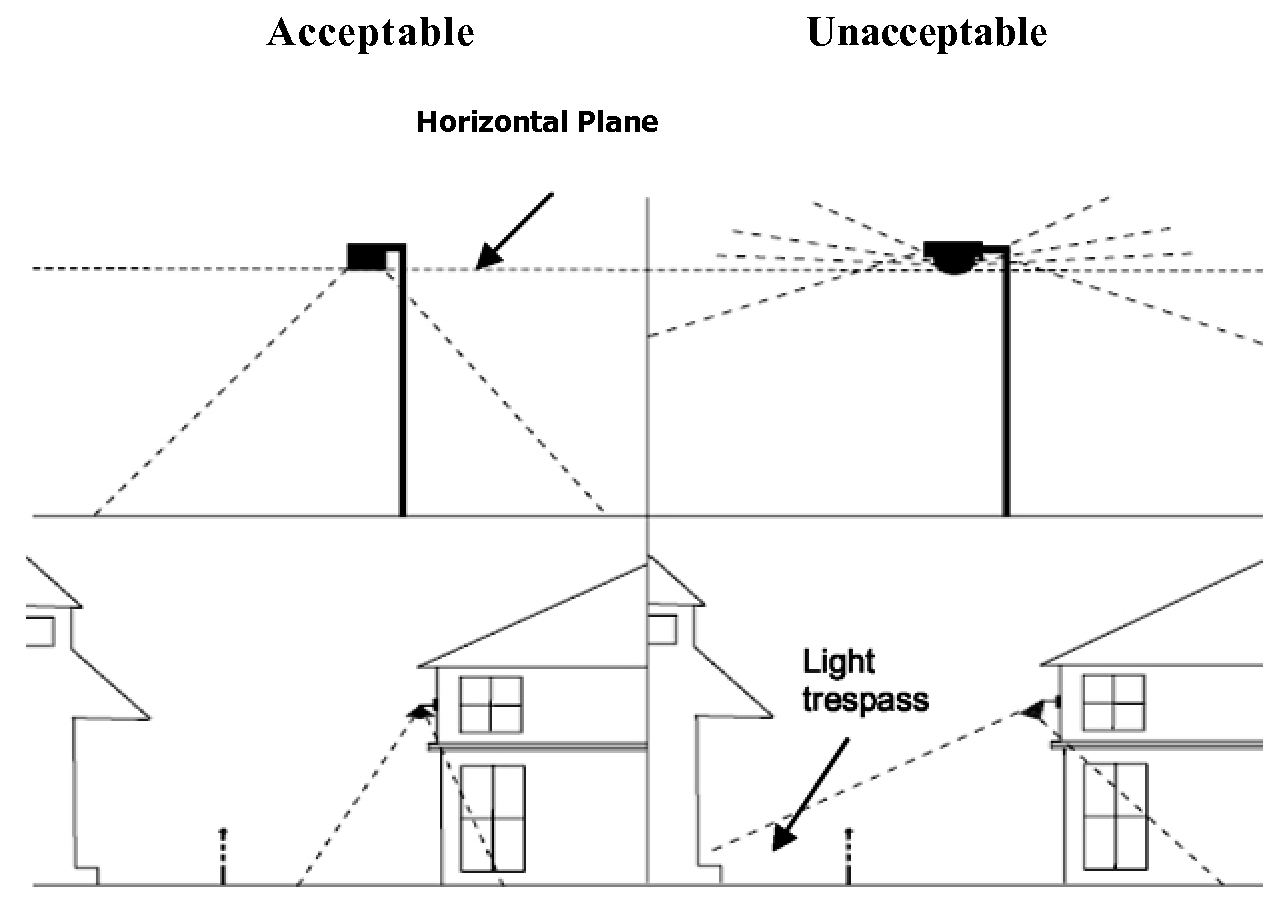
Light fixture assemblies shall have one hundred (100) percent cut-off above the horizontal plane at the lowest part of the light source. The light rays may not be emitted by the installed fixture at angles above the horizontal plane as illustrated by figure 4.24.
Figure 4.24. Fully Cut-off, Downward Facing Fixtures
4.
There shall be no lighting of a blinking, flashing or fluttering nature including changes in light intensity, brightness or color. Beacon, strobe and search lights shall be prohibited. No colored lights shall be used at any location or in any manner which might be confused with or construed as traffic control devices.
5.
In addition to the requirements of this section 4.24, parking area lighting shall comply with the standards of section 19.03C of this ordinance.
6.
The planning commission or zoning enforcement officer may impose additional conditions on site illumination to further the purpose of this section 4.24.
7.
Internally-lit signs, electronic message boards, back-lit changeable copy signs and signs incorporating light emitting diode (LED), liquid crystal, video or other types of internally-lit systems shall be designed, shielded and oriented so as not to interfere with adjacent public rights-of-way or adjacent property and such signs shall not emit light exceeding either ten (10) foot candles measured four (4) feet perpendicular to the sign face or one-half (½) foot candle measured at the property line of adjoining privately-owned property.
F.
Departures. Outdoor lighting shall comply with the requirements of this section 4.24, provided, the planning commission may, upon written application approve departures from the standards of this section 4.24 if the planning commission finds that the following standards are demonstrated by the applicant:
1.
The use is a permitted or special land use in the zoning district.
2.
The applicant will undertake reasonable measures to assure that the public health, safety and welfare would not be undermined by approving the proposed departure.
3.
The proposed plan includes reasonable measures to mitigate any glare, annoyance, intrusion or distraction would be caused by the proposed lighting.
4.
The general public would benefit from the proposed lighting and the proposed lighting and related land use are consistent with the city master plan.
(Ord. No. 11-01, § 2, 1-3-11; Ord. No. 17-03, § 1, 9-18-17)
Section 4.25. - Outdoor furnaces.
A.
Purpose. The city desires to regulate the location and operation of outdoor furnaces to secure and promote the health, safety and welfare of the public. Outdoor furnaces are an alternative to traditional home-heating methods and have increased in popularity because of rising fuel costs. This increased usage has led to the recognition that outdoor furnaces can impact health, safety and welfare if not designed and used properly and these impacts are multiplied when used in densely populated areas. Outdoor furnaces shall only be permitted under certain circumstances and only when specific requirements are met in order to broaden home-heating options for city residents while insuring regulations are in place to protect residents from, health, safety and welfare impacts.
B.
Application. An outdoor furnace shall not be installed on any property unless a certificate of zoning compliance and any required mechanical and building permits have been issued by the city. A mechanical permit application along with the applicable fee shall be submitted to the city with descriptive information that is necessary to determine compliance with the requirements of this section and any applicable building codes. In addition, the applicant shall submit a signed acknowledgement indicating that combustion in the outdoor furnace of material prohibited by this section is grounds for revocation of the certificate of zoning compliance requiring immediate discontinuance of its use.
C.
Eligibility. Outdoor furnaces are permitted in side and rear yards as an accessory use to residential dwellings (i) on parcels in a SR-Suburban Residential District and (ii) on parcels in an R-1 Residential District with a parcel area of at least twenty thousand (20,000) square feet. In a R-1 Residential District the application for a mechanical permit shall include a recorded deed restriction in a form acceptable to the city signed by the property owner prohibiting the subdivision or splitting of the parcel in a manner which would result in the outdoor furnace being located on a parcel of less than twenty thousand (20,000) square feet or with isolation and setback dimensions less than those required by this section.
D.
Isolation and setback. An outdoor furnace shall be located a minimum of eighty (80) feet from any residential dwelling on an adjacent parcel and shall be located a minimum of forty (40) feet from the property line of the parcel where it is located.
E.
Stack height. Stack or chimney height of an outdoor furnace shall extend to an elevation at least two (2) feet above the roof peak of any residential dwelling within three hundred (300) feet of the outdoor furnace.
F.
Combustion materials. Only dry, seasoned wood or pellets manufactured for use in an outdoor furnace may be used in an outdoor furnace. The city may approve an alternative fuel if it is recommended by the outdoor furnace manufacturer and will result in air emissions no greater than that of dry, seasoned wood or pellets manufactured for outdoor furnace use. Combustion of toxic or other materials that generate offensive odors or excessive smoke or that are harmful to human health are prohibited. Such prohibited materials include, but are not limited to, trash, garbage, plastics of any kind, wood that is painted, varnished or treated, gasoline, oil, rubber, naphtha, materials treated with petroleum products, leaves and paper products including cardboard. Any use of prohibited construction materials shall result in the revocation of the zoning compliance certificate requiring the immediate discontinuance of use of the outdoor furnace.
(Ord. No. 11-05, § 2, 4-18-11; Ord. No. 17-03, § 1, 9-18-17)
Section 4.26. - Landscaping.
The intent of this section is to establish minimum standards for the design, installation, and maintenance of landscaping along public streets, between uses, on the interior of sites and within parking lots. Landscaping is viewed as a critical element contributing to the aesthetics and quality of development and redevelopment within the City of Lowell.
The standards of this section are also intended to screen headlights to reduce glare, integrate various elements of a site, help ensure compatibility between land uses, minimize negative impacts of storm-water runoff, minimize noise, air and visual pollution, and promote the preservation of healthy, desirable trees.
The landscape standards of this section are considered the minimum necessary to achieve the intent. In several instances, the standards are intentionally flexible to encourage creative design. Applicants are encouraged to provide additional landscaping to improve the function, appearance, and value of their property.
A.
Exemptions. Individual single-family dwellings, two-family dwellings, home occupations, agricultural uses and other uses not requiring site plan review are not subject to the provisions of this section. When a site plan is required pursuant to article 16, landscaping shall be incorporated into the site and a landscape plan shall be submitted in conjunction with the site plan. The landscape plan shall clearly describe the location, type, size, height, and spacing of plant materials.
B.
Modification of requirements. The city may modify requirements of this section when it finds circumstances that warrant a change in the requirements of this section, or in finding that existing landscaping or screening, or existing conditions on the site, will be preserved and would meet the intent of this section.
C.
Installation. Wherever this ordinance requires landscaping, it shall be planted within six (6) months from the date of issuance of a certificate of occupancy and shall thereafter be reasonably maintained with permanent plant materials which may be supplemented with other plantings. The zoning enforcement officer may allow a postponement of installation of up to six (6) months upon request of an applicant based on seasonal weather conditions, but all landscaping must be installed within one (1) year of issuance of a certificate of occupancy. Whenever possible, selection of plant and tree species and minimum installation sizes should be generally consistent with applicable guidelines and recommendations of the Lowell Arbor Board.
D.
Maintenance. Landscaped areas and plant materials required by this ordinance shall be kept free from refuse and debris. Plant materials, including lawn areas, shall be maintained in a healthy condition and be neat and orderly in appearance. If any plant material required by this ordinance dies or becomes diseased, it shall be replaced within six (6) months of written notice from the zoning enforcement officer, or within an extended time period as specified in said notice.
E.
Specific landscaping requirements.
1.
Buffers between uses. For non-residential uses abutting or adjacent to a residential zoning district and/or a residential use, there shall be provided and maintained on those sides a wall or wooden privacy fence six (6) feet in height, or between six (6) feet and eight (8) feet in height in industrial districts, or a landscaped buffer or berm, at least partially comprised of evergreen trees, sufficient to provide adequate screening between uses for the purpose of protecting the quality and integrity of the residential district and/or use.
2.
Front yard landscaping. In the C-1, C-3, I-L and I districts, front yard landscaping is required as specified below:
a.
Landscaping shall consist of a minimum of one (1) canopy tree and three (3) deciduous shrubs for each thirty (30) feet of lot width.
b.
Additional front yard landscaping is encouraged and may be required by the city where it is found that such additional landscaping would further the intent of this section.
3.
Parking lot landscaping.
a.
Changes to existing parking lots. The zoning enforcement officer shall review landscaping plans for major changes to an existing parking lot. Major changes to parking lots shall comply with the landscaping requirements of this section unless modifications are approved by the planning commission or zoning enforcement officer as permitted by this section. Major changes consist of the following:
1)
Replacement or alteration of existing drainage elevations or structures affecting more than fifty (50) percent of the existing parking lot.
2)
For any expansion or addition of a parking lot equal to or greater than twenty-five (25) percent of the area of the existing parking lot, the expanded area shall comply with the landscaping requirements of this section.
3)
Reconstruction of the parking lot, including the removal of existing pavement and drainage structures, which affects more than twenty-five (25) percent of the existing parking lot. Instances in which a parking lot is to be resurfaced and no other modifications to the parking lot or drainage patterns are proposed shall not constitute "reconstruction" for the purposes of this subsection.
4)
Any other change which, in the opinion of the zoning enforcement officer, constitutes a major change. The phased expansion or replacement of parking lots and/or surfaces in order to circumvent the requirements of this section is prohibited.
5)
The zoning enforcement officer may waive the requirements of this section if it is determined that the parking lot landscaping requirements of this section would unreasonably reduce the number of spaces within the parking lot. The zoning enforcement officer may refer any parking lot replacement or expansion to the planning commission for a decision.
b.
Frontage landscaping. Where any parking area abuts or faces a public street, landscaping shall be required between the parking area and the street right-of-way. Such landscaping shall consist of, at a minimum, one (1) of the following:
1)
A strip of land at least five (5) feet in width as well as a solid screen of a hedge, fence or decorative wall, or any combination thereof, which measures at least three (3) feet in height; or
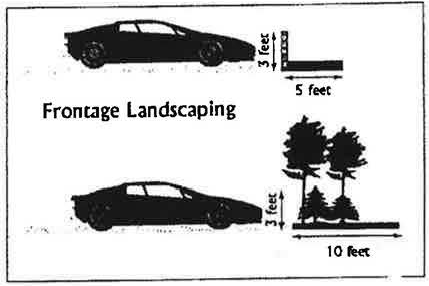
2)
A strip of land at least ten (10) feet in width containing at least one (1) canopy tree for each thirty (30) feet of lot width.
The required strip of land specified in items 1 and 2 above shall also be covered with grass or other approved ground cover.
c.
Interior parking lot landscaping. In addition to frontage landscaping, parking lots shall also contain landscaping within the interior of the parking lots as specified below:
1)
Interior landscaping shall be provided for any parking area containing twenty (20) or more parking spaces.
2)
The interior of the parking lot shall be considered as any point from the outside boundary of the parking area.
3)
The interior area of any parking lot shall incorporate planting islands at a minimum ratio of one (1) island per each twenty (20) parking spaces, or part thereof.
4)
Each planting island shall be at least ninety (90) square feet in area with a minimum horizontal dimension of nine (9) feet.
5)
Landscaped islands shall be dispersed evenly throughout the entire area of the parking lot in order to break up large expanses of pavement and shall be used to separate pedestrian areas, maneuvering areas, and drives whenever possible.
6)
A minimum of one (1) approved canopy tree shall be provided for each planting island, with the balance of the island covered with grass, or approved shrubs or ground cover.
7)
Fifty (50) percent of the required trees shall be installed in the interior of the parking area and fifty (50) percent on the perimeter. The required trees shall be in addition to those which may otherwise be required by this section.
(Ord. No. 17-03, § 1, 9-18-17)

