
Lowell City Zoning Code
CHAPTER 20
- SIGNS5
Editor's note—Ord. No. 23-05, § 1, adopted July 17, 2023, repealed former ch. 20, §§ 20.01—20.11, and enacted a new ch. 20 as set out herein. Former ch. 20, §§ 20.01—20.11, pertained to similar subject matter and derived from Ord. No. 95-06, adopted December 27, 1995; Ord. No. 97-1, adopted October 20, 1997; Ord. No. 02-5, adopted October 21, 2002; Ord. No. 05-3, adopted May 16, 2005; Ord. No. 06-02, adopted May 15, 2006; Ord. No. 07-09, adopted October 1, 2007; Ord. No. 08-02, adopted April 7, 2008; Ord. No. 11-01, adopted January 3, 2011; and Ord. No. 13-03, § 1, adopted August 5, 2013.
Section 20.01.- Intent and purpose.
A.
Purpose. The purpose of this section is to coordinate the type, placement and physical dimensions of signs within the various zoning districts, to recognize the communication requirements of all sectors of the community, to promote both renovation and proper maintenance of signs, and to guarantee equal treatment under the law. In all respects, it is the intent of this section to comply with Reed v. Town of Gilbert, 135 S. Ct. 2218 (2015). The general objectives of these standards are to promote the health, safety, welfare, convenience, and enjoyment of the public, and in part, to achieve the following:
1.
Safety. To promote the safety of persons and property by providing that signs:
a.
Do not create hazards due to collapse, fire, decay, collision or abandonment;
b.
Do not obstruct fire-fighting or security surveillance; and
c.
Do not create traffic hazards by confusing or distracting motorists, or by impairing the driver's ability to see pedestrians, obstacles or other vehicles, or to read traffic signs.
2.
Communications efficiency. To promote the efficient transfer of information in sign messages by providing that:
a.
Businesses and services may identify themselves;
b.
Customers and other persons may effectively locate a business or service;
c.
No person or group is arbitrarily denied the use of the sightlines from the public streets for communication purposes; and
d.
Persons exposed to signs are not overwhelmed by the number or size of messages presented and are able to exercise freedom of choice to observe or ignore messages.
3.
Landscape quality and preservation. To protect the public welfare and enhance the appearance and economic value of the landscape by providing that signs:
a.
Do not interfere with scenic views;
b.
Do not create a nuisance to persons using the public streets;
c.
Do not constitute a nuisance to occupancy of adjacent and contiguous property by their brightness, size, height or movement;
d.
Are not detrimental to land or property values; and
e.
Contribute to the special residential character of particular areas or districts within the city, helping the observer to understand the city and orient oneself within it.
B.
Message substitution. Notwithstanding any other provision of this section, noncommercial copy may be substituted for commercial copy or other noncommercial copy on any sign that is permissible under this section.
C.
Findings. The city finds that:
1.
Content neutrality, viewpoint neutrality and fundamental fairness in regulation and review are essential to ensuring an appropriate balance between the important, substantial, and compelling interests set out in this section and the constitutionally protected right to free expression.
2.
The provisions in this section are unrelated to the suppression of constitutionally protected free expression, do not relate to the content of protected messages that may be displayed on signs, and do not relate to particular viewpoints.
3.
The incidental restriction on the freedom of speech that may result from the regulation of signs pursuant to this section is narrowly tailored, the least restrictive means and no greater than is essential to the furtherance of the important, substantial and compelling public purposes that are set out in this section.
4.
The regulation of the location, number, materials, height, size, form and duration of display of temporary signs is essential to prevent sign clutter and to achieve the intent and purpose of this chapter.
D.
Temporary signs may be degraded, damaged, moved or destroyed by wind, rain, flooding and sun, and after such degradation, damage, movement or destruction, such signs harm the safety and aesthetics of the public on the city's streets or sidewalks if they are not removed.
(Ord. No. 23-05, § 1, 7-17-23)
Section 20.02. - Scope.
A.
Compliance. It shall be unlawful for any person to erect, place, or maintain a sign in the City of Lowell except in accordance with the provisions of this chapter.
B.
Permit required. Unless otherwise provided by this chapter, all signs shall require permits and payment of fees as determined by the City Council. No permit is required for the maintenance of a sign or for a change of copy on painted, printed, or changeable copy signs. A building permit application shall be submitted along with the supplementary material noted below.
C.
Plan required. When a site plan is required pursuant to chapter 18 of the Zoning Ordinance, proposed signage shall be illustrated on the site plan showing the sign area, sign height, clearance between the ground and the bottom of the sign, sign illumination, sign location and setbacks from property lines, and other applicable information to enable the city to determine compliance with the requirements of this chapter. When a site plan is not required, a scaled drawing clearly depicting this information shall accompany the building permit application. The zoning enforcement officer may require that additional information be illustrated on a plan or drawing to determine compliance with this chapter.
D.
Additional provisions. In addition to the provisions of this chapter, provisions of section 11.5-6 of chapter 11.5 of the Code shall apply to signs located in a historic district. Sponsorship signs are permitted and governed by article IV of chapter 14 of the Code of Ordinances.
(Ord. No. 23-05, § 1, 7-17-23)
Section 20.03. - Definitions.
The following words shall have the meanings set forth in this section:
A.
Changeable copy sign: A sign that consists, in whole or in part, of a message or image that can be changed periodically, whether manually or by automatic or technical means.
B.
Freestanding sign: A sign supported by one (1) or more up-rights, poles or braces placed in or upon the ground and not attached to any building and having a clear space of at least eight (8) feet from the ground to the bottom of the sign.
C.
Government sign: A temporary or permanent sign erected by the City of Lowell, Kent County, the State of Michigan, or the federal government for public purposes and as the government's own speech.
D.
Ground sign: A sign supported by a foundation or base which is at least half as wide as the sign which it supports when looking at the sign face, with no more than thirty (30) inches clearance from the bottom of the sign to the ground below.
E.
Feather sign: A freestanding temporary sign typically constructed of a shaft, driven in the ground or standing with supports, with an attached pennant that is vertically elongated and attached to the shaft.
F.
Human sign: A sign which is held by or attached to a human being.
G.
Internal site sign: Smaller signs internal to a parcel not oriented toward the public right-of-way.
H.
Marquee: A permanent structure that projects from the exterior wall of a building.
I.
Marquee sign: A sign attached to a marquee, canopy, or awning projecting from and supported by the building.
J.
Mean grade: A reference plane representing that arithmetic mean of the lowest and highest grade elevations in an area within five (5) feet of the foundation line of a sign structure, or in the area between the sign structure foundation line and the lot line, in the case where the sign structure foundation line is less than five (5) feet from the lot line.
K.
Mural: A graphic displayed on the exterior of a building, generally for the purposes of decoration or artistic expression, including but not limited to painting, fresco, or mosaic.
L.
Off-premise sign or billboard: An outdoor sign advertising services, products, activities, persons, activities or events which are not made, produced, assembled, stored, distributed, leased, sold, or conducted upon the premises upon which the sign is located.
M.
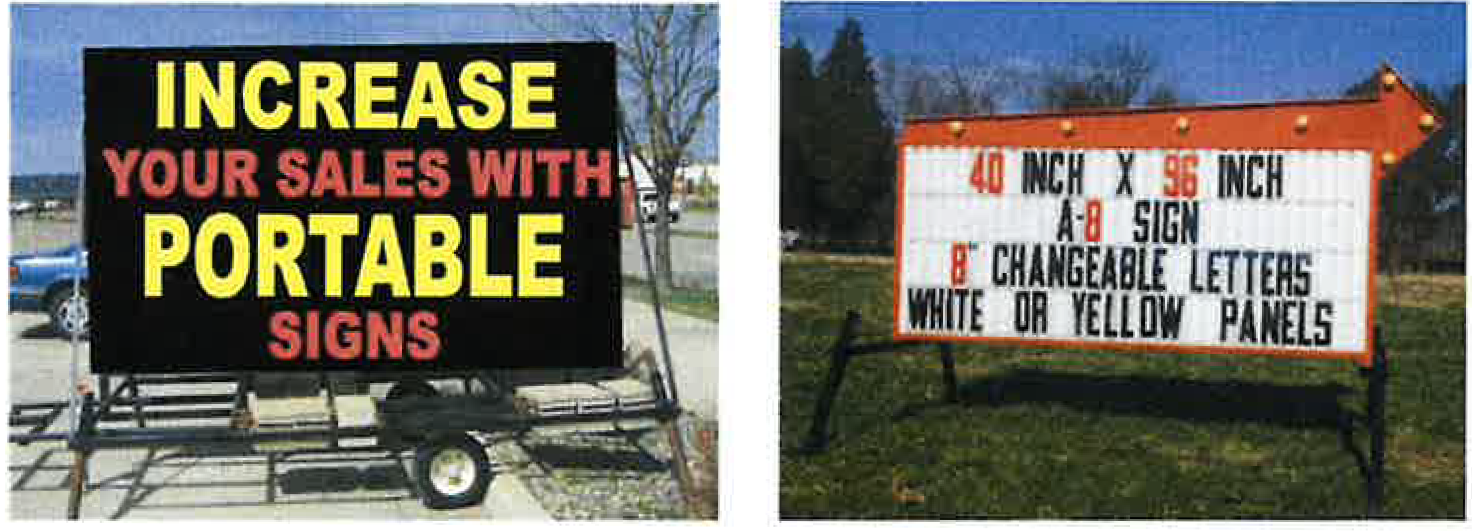
Portable sign: A temporary sign typically containing manually-changeable copy, and which obtains some or all of its structural stability with respect to wind or other normally applied forces by means of its geometry or character. (see images below)
N.
Projecting sign: A sign which projects from and is supported by the wall of a building.
O.
Roof line: That line which represents the highest portion of any part of the roof structure, excepting gables, chimneys or other incidental architectural features.
P.
Roof signs: Any sign erected, constructed, and maintained wholly upon or over the roof of any building with its principal support on the roof structure.
Q.
Sandwich board sign: A temporary sign not secured or attached to the ground surface, constructed in such a manner as to form an "A" or tent-like shape.
R.
Sign: Any device or structure, part thereof, or device attached thereto or painted or represented thereon, or any material or thing which displays numerals, letters, words, trademarks, or any other representational use for direction or designation of any person, firm, organization, place, product, service, business, establishment, activity or industry, which is located upon any land or building, in or upon a window, or indoors in such a manner as to attract attention from outside the building.
S.
Sign area: The entire area within a regular geometric form, or combination of regular geometric forms, comprising all of the display area of the sign and including all of the elements of the matter displayed.
T.
Street frontage: The distance for which the front boundary line of the lot and the street line are coincident.
U.
Temporary sign: A display, banner, or sign affixed to the ground or a building that is capable of being easily moved from place to place.
V.
Vehicle sign: A sign that is painted on or attached to a vehicle or trailer when such vehicle or trailer is parked. Currently licensed commercial vehicles in general daily off-site use are not included as part of this definition.
W.
Wall sign: A sign which is attached directly to or painted upon a building wall and which does not extend more than eighteen (18) inches therefrom with the exposed face of the sign in a plane parallel to the building wall.
X.
Window sign: A sign attached to, or in close proximity to, the window surface so as to be clearly and comprehensively visible from the outside.
(Ord. No. 23-05, § 1, 7-17-23)
Section 20.04. - Signs prohibited.
The following types of signs are prohibited in all zoning districts:
A.
Abandoned signs, or signs in disrepair.
B.
Air-filled or gas-filled balloon signs.
C.
Signs with moving parts, audible signs, and/or flashing signs (except traffic control devices).
D.
Roof signs.
E.
Signs or illumination imitating or resembling official traffic or government signs or signals.
F.
Vehicle signs.
G.
Off-premise signs or billboards.
H.
Other signs not expressly permitted or which do not conform to the provisions of this chapter.
(Ord. No. 23-05, § 1, 7-17-23)
Section 20.05. - General sign provisions.
A.
Sign placement.
1.
Unless otherwise permitted, all signs shall be located on the same parcel for which the sign is intended to serve. The provisions of this article are not intended to conflict with provisions controlling signs regulated under the authority of MCL 252.301 et seq., the Highway Advertising Act, as amended.
2.
No sign shall be located closer than two (2) feet to a public road right-of-way or property line; provided that the zoning enforcement officer or Planning Commission may approve a lesser setback upon finding that the proposed sign will not interfere with motorist or pedestrian visibility and safety. No sign shall overhang a public street right-of-way except as otherwise permitted; and all signs, including wall signs, shall have a minimum ground clearance of eight (8) feet above a sidewalk or walkway.
3.
Signs shall be placed in compliance with section 4.06, Clear Vision; and no sign shall be placed within the clear vision area as defined in that section 4.06. No sign (whether a permit is required or not) shall be located or erected in such a manner as to interfere with traffic visibility.
4.
A wall sign shall not extend beyond the edge of the wall to which it is affixed; nor shall a wall, marquee, or projecting sign extend above the roof line of a building to which it is attached.
5.
No light pole, utility pole, or other supporting member shall be used for the placement of any sign unless specifically designed and approved for such use.
B.
Sign illumination.
1.
Unless otherwise specified by this chapter, all signs may be illuminated, except temporary signs and signs for home occupations.
2.
Illumination shall not be flashing, blinking, intermittent, oscillating, or an on-and-off type of lighting. No sign may utilize a revolving beacon light.
3.
Illumination shall be arranged so that light is deflected away from adjacent properties and that no direct sources of light shall be visible to any motorist or pedestrian located in a public right-of-way or from any adjacent property. Any external lighting of signs shall be downward facing or otherwise directed to illuminate only the sign face.
4.
No illumination or sign shall be so placed or designed to be confused with, or appear similar to, a highway sign or traffic safety device.
5.
All lighting on the underside of a vehicle service station canopy, building overhang, or similar structure shall be fully recessed. A maximum of twenty-five (25) percent of each canopy facade area may be internally illuminated. No portion of any canopy facade may be externally illuminated.
6.
Internally-lit signs, electronic message boards, back-lit changeable copy signs and signs incorporating light emitting diode (LED), liquid crystal, video or other types of internally-lit systems shall be designed, shielded, and oriented so as not to interfere with adjacent public rights-of-way or private property and such signs shall not emit light exceeding either ten (10) foot candles measured four (4) feet perpendicular to the sign face or one-half (½) foot candle measured at the property line of the adjoining privately-owned property.
C.
Sign area and height. Where a sign has two (2) or more faces, the area of all faces shall be included in determining the area of the sign, except that where two (2) such faces are placed back to back and are at no point more than two (2) feet apart from one another, the area of the sign shall be taken as the area of one (1) face if the two (2) faces are of equal area, or the area of the larger face if the two (2) faces are of unequal area. In the case of a circle or sphere, the total area of the circle or sphere is divided by two (2) for purposes of determining the maximum permitted sign area. Framed and structural members not bearing advertising matter shall not be included in computation of surface area; provided, that the base of a ground sign cannot exceed two (2) feet in height and the base and structural members of a freestanding sign cannot exceed fifty (50) percent of the total area of the sign face.
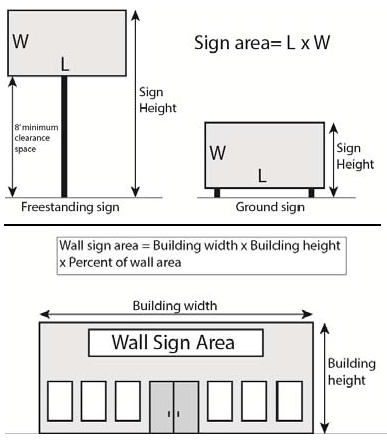
The height of a sign shall be measured as the vertical distance from the highest point of the sign to the grade of the adjacent street or the mean grade of the ground immediately beneath the sign, whichever is less.
D.
Where a proposed sign appears to meet the definition of more than one (1) sign, the most restrictive requirements and limitations of the defined sign types shall apply, as determined by the zoning enforcement officer.
E.
For buildings with multiple tenants, sign areas for wall signs, projecting signs, and marquee signs shall be determined by taking that portion of the front wall of the building applicable to each tenant and computing sign limits for that portion of the total wall. Where a wall sign, projecting sign, or marquee sign is permitted in a multi-tenant building or site, each individual establishment is permitted one such sign subject to standards applying in the zoning district, in which case wall surface applies to the wall surface of the individual establishment.
F.
All signs shall be maintained in a safe condition with proper bracing, anchorage and foundation and be subject to inspection by the Building Inspector or other designated representative. An abandoned sign or a sign not maintained in accordance with applicable regulations of the City of Lowell shall be removed by the owner.
(Ord. No. 23-05, § 1, 7-17-23)
Section 20.06. - Signs not requiring permits.
A.
Signs shall not be erected without the issuance of a building or zoning permit, except for the following signs, provided that such signs comply with the provisions of this chapter and other applicable provisions in this chapter:
1.
Government signs.
2.
Signs erected by an essential public services establishments such as those denoting utility lines, railroad lines, hazards, and precautions, including portable flashing signs.
3.
Signs not larger than twelve (12) square feet in area which are either 1) cut into the face of a masonry surface; or 2) constructed of bronze or other incombustible material when located flat on the face of a building.
4.
Holiday lights, murals, works of art, and decorations with no commercial message.
5.
Placards not exceeding two (2) square feet in area.
6.
Internal signs up to six (6) square feet in area and four (4) feet in height that, by the nature of their design and location, are not intended to be viewed from the street right-of-way.
7.
One two (2) square foot wall sign located on a parcel containing a permitted home occupation.
8.
Window signs, provided that window signs shall not cover more than fifty (50) percent of the windows on any building wall.
9.
Flags no larger than five (5) feet by eight (8) feet; provided that no more than one (1) such flag shall be permitted on each lot or parcel of land for every twenty (20) linear feet of street frontage. The maximum sign height of flagpoles shall be thirty-five (35) feet.
10.
Sandwich boards. Notwithstanding any other conflicting provisions contained in this chapter 20, sandwich board signs shall only be permitted in the C-2 Central Business or MU Mixed Use Districts.
a.
A sandwich board sign shall not exceed:
1)
Twelve (12) square feet per side,
2)
A height of four (4) feet; and,
3)
A width of three (3) feet
b.
A sandwich board sign shall not be permanently moored or anchored to any other object or structure, but shall be designed or weighted to prevent instability or movement by wind or other natural forces.
c.
A sandwich board sign may only be placed in front of the facade of the building front of the business or establishment during the hours the business or establishment is open to customers, patrons or the public.
d.
Only one (1) sandwich board sign shall be permitted for each business or establishment and it shall not be in any way illuminated.
e.
All sandwich board signs shall be placed in alignment with city light poles and tree grates and so as not to block neighboring sandwich board signs or unreasonably interfere with pedestrian traffic.
11.
One (1) human sign is permitted per lot at any given time, provided that the human sign does not block the sidewalk or unreasonably interfere with pedestrian, bicycle, or vehicular movement or circulation.
(Ord. No. 23-05, § 1, 7-17-23)
Section 20.07. - Supplementary signs.
In addition to the signs permitted and regulated in this chapter, the signs listed below shall be permitted in accordance with the following standards.
A.
Temporary signs. Temporary signs shall be permitted in any district subject to the following:
1.
Non-residential lots. Temporary signs shall be permitted on nonresidential lots as follows:
a.
One (1) temporary sign shall be permitted for each separate establishment located on a parcel of land.
b.
A temporary sign shall be displayed for not more than sixty (60) days (whether or not consecutive) in a calendar year.
c.
A temporary sign shall not be larger than thirty-two (32) square feet and shall not be illuminated.
d.
Interim signage. Notwithstanding the foregoing, signs on non-residential lots intended to be utilized only until a permanent sign may be obtained and erected may be approved by the zoning administrator for a period not to exceed 60 days. Such signs shall not exceed sign area permitted within the appropriate zoning district.
2.
Residential Lots. Temporary signs shall be permitted on any lot used as a single-family, two-family, or owner occupied multi-family dwelling, as follows:
a.
Up to four (4) non-permanent signs per street frontage may be generally permitted to be displayed on a pole or stake affixed to the ground.
b.
Such signs shall not exceed 6 square feet in area per side, and the top of such sign shall be no more than 6 feet from ground level.
c.
Such signs may display noncommercial messages or on-premises commercial messages (including, but not limited to, messages conveying that the dwelling is for sale, that work is being performed on the dwelling by a particular individual or business, or that a garage sale will be held).
d.
A temporary sign shall include any other or subsequent temporary sign of generally similar appearance, nature, and purpose, as compared to the temporary sign initially permitted under the terms of this section. Accordingly, an applicant shall not seek to extend the time limitation on the display of a temporary sign by the attempted display of a different, though similar, temporary sign following the maximum permitted period of display of a permitted temporary sign.
5.
Permit required. A permit for a temporary sign on a non-residential lot shall be required. An application for the permit, as well as an application fee as set by City Council, shall be submitted and include the following:
a.
An accurate sketch, indicating the exact dimensions of the sign, its height, the structure upon which it will be placed, its location in relation to buildings, property lines, driveways and off-street parking areas, and such other information as may be required by the zoning enforcement officer in order to assure that the sign shall comply with the applicable requirements of this chapter.
b.
A statement, signed by the applicant, listing specifically the days, or the span of consecutive days, during which the sign will be displayed, and also the date or dates on which the sign shall be removed and, if applicable, the subsequent date or dates on which the sign shall be re-installed and again removed, during the calendar year.
c.
A listing and description of the other temporary signs, if any, located on the property at the time of the application.
7.
Portable signs. In the C-3, I-L, I, and PF Districts, one (1) portable sign may be erected on a lot in lieu of a temporary sign, subject to the provisions in subsection B above, provided that only one (1) is permitted per lot at any given time, and provided that the portable sign shall not exceed thirty-two (32) square feet in area. In addition, notwithstanding the provisions of subsection A(1)(b) above, a portable sign shall not be displayed for more than seven (7) consecutive days and not more than three (3) times in any calendar year.
C.
Changeable copy signs. All or a portion of a ground or freestanding sign may be a changeable copy sign in compliance with all of the following requirements; provided, that a changeable copy sign is not permitted in any residential zoning district except when the changeable copy sign is also a government sign.
1.
The area of a changeable copy sign shall be included in the maximum sign area limitation. The area of a changeable copy sign shall not exceed fifty (50) percent of the maximum permitted sign area, except that portable signs may consist entirely of changeable copy.
2.
A changeable copy sign shall not change its message, image, or other graphic material with such frequency as to be a flashing or oscillating sign, whether in whole or in part. For purposes of this section, a flashing or oscillating sign shall include not only a sign having a message or image that changes with high rapidity, but shall also include a sign having a message or image that changes with a frequency such as to serve as a means of attracting attention to the sign or the land use, rather than for the purpose of providing identification or information. The message, image or other graphic material of a changeable copy sign shall change no more frequently than six (6) seconds and each change shall occur in one (1) second or less.
3.
The message, image or other graphic material of a changeable copy sign shall, when changing, appear only in its entirety or shall appear in successive letters, words or other graphic elements from left to right only. The message, image or other graphic material shall not appear to flash, move from the center of the sign outward, move from the corners of the sign inward or demonstrate any other unusual movement, oscillation or method of appearance.
(Ord. No. 23-05, § 1, 7-17-23)
Section 20.08. - Permitted signs by zoning district.
A.
The following sign types shall be permitted in accord with the following regulations, in the SR, R-1, R-2, R-3, MHP and RE Districts:
1.
The following sign is permitted at the entrance of a permitted residential development or on a parcel containing a non-residential use:
B.
The following sign types shall be permitted in accord with the following regulations, in the C- 1 and PF Districts:
C.
The following sign types shall be permitted in accord with the following regulations in the C-2 - Central Business District and the MU - Mixed Use District.
D.
The following sign types shall be permitted in accord with the following regulations, in the C- 3 District:
1.
Each individual establishment in a multi-tenant commercial building or development is not permitted a separate ground or freestanding sign; one (1) collective ground or freestanding sign may be used subject to the standards above, provided that a collective ground or freestanding sign shall be permitted a maximum sign area of seventy-two (72) square feet.
E.
The following sign types shall be permitted in accord with the following regulations, in the I and I-L Districts:
(Ord. No. 23-05, § 1, 7-17-23)
Section 20.09. - Construction and maintenance.
A.
All signs shall be constructed and maintained in accordance with the BOCA National Building Code adopted by the City of Lowell.
B.
Signs shall be maintained free of peeling paint or paper, fading, staining, rust, or other conditions which impair legibility.
C.
All signs, sign supports, frames, braces, wiring, guys, and anchors shall not be maintained in such a manner which, in the opinion of the zoning enforcement officer, has the potential to create a hazard for pedestrians and vehicles.
D.
Signs shall not be allowed to become unsightly through disrepair or action of the elements. Internal framing, light fixtures and bulbs, and wiring shall not be permitted to be exposed to the elements.
E.
All signs shall be designed to ensure a dead load and wind pressure in any direction of not less than thirty (30) pounds per square foot of area. All signs shall be securely anchored or otherwise made immobile. Temporary signs, portable signs, or signs made of cloth, fabric, lightweight plastic, or other easily combustible material, or which are produced or originally constructed to flutter in the wind, as determined by the zoning enforcement officer, shall not be placed or left as permanent signs.
(Ord. No. 23-05, § 1, 7-17-23)
Section 20.10. - Nonconforming signs.
A.
Signs lawfully erected prior to the adoption of this chapter or applicable amendment thereto which do not meet the standards of this section may be continued, except as hereinafter provided. No nonconforming sign shall:
1.
Have any changes made in the words or symbols used or the message displayed on the sign, unless the sign is specifically designed for periodic change of message;
2.
Be structurally altered so as to change the shape, size, type or design of the sign; or
3.
Be reestablished or continued after the activity, business, or use to which it applied has been discontinued for ninety (90) days or longer.
B.
Signs lawfully erected prior to the adoption of this chapter or applicable amendment thereto which do not meet the size limitations of this section may be changed to another nonconforming sign, provided that the sign replacing the original nonconforming sign is at least thirty-three (33) percent smaller in area than the original nonconforming sign.
C.
No sign shall be required to be removed which was erected in compliance with this section if such sign becomes nonconforming due to a change occurring after the adoption of this chapter or applicable amendment thereto in the location of a building, streets, or other signs, and which change is beyond the control of the owner of the premises on which the sign is located.
D.
If the owner of the premises on which a sign is located changes the use of the building, or changes the location of any property line or sign, so that any sign is rendered nonconforming, such sign must be removed or made to conform to this section.
(Ord. No. 23-05, § 1, 7-17-23)
Section 20.11. - Discontinuance or abandonment.
Whenever the activity, business or use of a primary premises to which a sign is attached or related has been discontinued for a period of ninety (90) days or longer, such discontinuance shall be considered conclusive evidence of an intention to abandon the sign attached or related thereto. At the end of this period of abandonment, the sign shall either be removed or altered to conform with the provisions of this section. All costs of removal shall be at the property owner's expense.
(Ord. No. 23-05, § 1, 7-17-23)
Section 20.12 - Substitution clause.
Signs containing noncommercial speech are permitted anywhere that advertising or business signs are permitted, subject to the same regulations applicable to such signs.
(Ord. No. 23-05, § 1, 7-17-23)
Section 20.13 - Savings and severability.
If any part, section, subsection, paragraph, subparagraph, sentence, phrase, clause, term, or word in this chapter is declared invalid, such invalidity shall not affect the validity or enforceability of the remaining portions of the code.
(Ord. No. 23-05, § 1, 7-17-23)

