
Lynchburg City Zoning Code
ARTICLE II
PROCEDURES
Sec. 35.2-10.1. - Purpose.
The purpose of this article is to establish procedures for filing and processing applications for development approvals required pursuant to this Zoning Ordinance.
Sec. 35.2-10.2. - Approvals required.
No development approval or building permit shall be issued unless all applicable approvals are obtained in accordance with this article. Development approvals are required unless otherwise exempted to ensure substantial compliance with adopted codes, standards, and laws, and to promote substantial compliance with the Comprehensive Plan. This section describes procedural elements common to most applications. The specific procedures followed in reviewing various applications differ and are described in subsequent sections of this article. Generally, the procedures for all applications have the following common elements:
(a)
Submittal of a complete application, including required fee payments and appropriate information and studies;
(b)
Review of the submittal by appropriate staff, agencies, and boards;
(c)
A decision to approve or deny; and
(d)
Options to amend or appeal the decision.
Sec. 35.2-10.3. - Approval body defined.
Zoning Ordinance approval bodies include the City Council, Planning Commission, Board of Zoning Appeals, Historic Preservation Commission and any other committee, board or City staff member assigned responsibility for acting at the final stage of a development approval or building permit.
Sec. 35.2-10.4. - Appeals.
Any person aggrieved by an action on a development application, or any officer, department board or bureau of the City affected by an action on a development application may appeal to the appeals body designated in Exhibit II-1 as provided in this article.
Sec. 35.2-10.5. - Application review procedures, generally.
(a)
Exhibit II-1 summarizes the development approval process for each type of application under this ordinance and references the sections that describe the procedures, review criteria and effects of approval. The table lists the specific type of application, the section establishing the review and approval processes, and the entities responsible for review, recommendations, approval and appeals for each type of development approval.
(b)
Section 35.2-11 establishes the review and approval process for applications requiring action by the City Council, which includes Comprehensive Plan text and map amendments, Zoning Ordinance text and map amendments, conditional zoning map amendments, conditional use permits, planned unit developments, flood plain development and related concept plans.
(c)
Section 35.2-12 establishes the review and approval processes for applications for variances and appeals that require action by the Board of Zoning Appeals.
(d)
Section 35.2-13 establishes the review and approval processes for applications for certificates of appropriateness, which are required for development within the City's historic district.
(e)
Section 35.2-14.1 establishes the requirement to confirm that development applications comply with zoning requirements applicable to the specific application in the zoning district in which the proposed development is located.
(f)
Section 35.2-14.2 establishes the review and approval of site plans by the City Planner.
(g)
Section 35.2-14.3 establishes the review and approval of sign permits by the Zoning Administrator.
(h)
Section 35.2-14.4 establishes the review and approval process for authorized exceptions or modifications to specified Zoning Ordinance requirements.
(i)
Section 35.2-14.5 establishes the review and approval process for temporary uses by the Technical Review Committee (TRC).
(j)
Each of the sections referenced in paragraphs (b) through (i) above includes submittal requirements as well as approval criteria.
(k)
Section 35.2-10.13 establishes digital submittal requirements.
(l)
Section 35.2-10.14 summarizes notification requirements for specific actions established in this Zoning Ordinance.
Exhibit II-1: Summary of Application Review Procedures
Sec. 35.2-10.6. - Burden of persuasion regarding approval.
(a)
The applicant has the burden of producing sufficient evidence for the approval body to conclude that the standards of the applicable ordinance(s) have been met.
(b)
The appeals body is not bound by the interpretation of City staff; it must seek to interpret the ordinance to achieve the City Council's intent when it adopted the ordinance. The appeals body shall not reverse or modify an administrative decision unless it finds that City staff erred in the application or interpretation of the terms of this ordinance or related policies adopted by the City.
(c)
The decisions of the City Council on zoning matters are presumed to be correct and anyone who appeals such a decision has the burden of proving that Council's decision is clearly unreasonable, arbitrary or capricious, and bears no reasonable or substantial relationship to the public health, safety or general welfare.
Sec. 35.2-10.7. - Application requirements.
(a)
Contents. This ordinance lists the minimum submittal requirements for each application listed in this article. Requests for any development approval required by this ordinance shall be made on applications provided by the City, which may include submittal requirements, instructions for completing forms, internal procedures for filing of applications and other information.
(b)
Applicant. Unless otherwise authorized by this Zoning Ordinance, applications for development approvals will be accepted only from the owner, contract purchaser with the owner's written consent, or the owner's agent therefor, of the property that is the subject of the development application. The City shall require evidence of the applicant's authority to submit the application when there is a reasonable basis for questioning this authority.
Sec. 35.2-10.8. - Application processing.
Following the determination that an application is complete, the City shall review the application, forward the application for review to applicable advisory bodies, prepare all required reports, and, when applicable, schedule the matter for public hearing and/or decision within the time and in the manner required by this ordinance.
Sec. 35.2-10.9. - Computation of time.
Unless otherwise specified, time periods shall exclude the first day and include the last day. If the last day is a Saturday, Sunday or legal holiday, that day shall be excluded. When the period of time prescribed is fewer than seven (7) days intermediate Saturdays, Sundays and holidays shall be excluded.
Sec. 35.2-10.10. - Continuance.
(a)
If the approval body receives the written request for a continuance at least seven (7) days prior to the public hearing at which the application is scheduled to be heard, the applicant's request for a continuance will be automatically granted. An applicant is not entitled to more than two automatic continuances.
(b)
If the City receives the written request for a continuance fewer than seven (7) days prior to the public hearing at which the application is scheduled to be heard, the applicant is not entitled to an automatic continuance. The approval body will consider the request for a continuance and shall only grant such request upon a demonstration by the applicant of good cause for a continuance.
(c)
If an applicant receives a continuance, the applicant shall reimburse the City for all advertising costs associated with rescheduling the public hearing for the application. If the applicant does not reimburse the City for such costs by ten (10) days prior to the rescheduled hearing, the hearing will be cancelled and the application will be deemed withdrawn.
Sec. 35.2-10.11. - Withdrawal of pending applications.
(a)
An applicant may withdraw an application at any time prior to issuance or denial of a development approval. The applicant shall provide written notice of the withdrawal to the City.
(b)
If an application is withdrawn, fees and costs will neither be refunded nor credited to any subsequent application.
Sec. 35.2-10.12. - Applications to be complete.
(a)
Applications to Be Complete.
1.
No application is complete unless all of the information required herein is included. An application that includes such information is deemed complete.
2.
Additional information may be required by the approval body if needed to decide whether or not the development will comply with the requirements of this Zoning Ordinance. Failure to provide additional information may result in application denial or delayed action.
3.
Completeness review is solely for the purpose of determining whether preliminary information is sufficient to allow further processing, and shall not constitute a decision as to whether application complies with the provisions of the ordinance.
(b)
Waiver. Any submittal requirement of this article may be waived by the City Planner or Zoning Administrator in a specific case where such requirement is found to be unreasonable or unnecessary to assess compliance with applicable regulations, rules and conditions of prior development approvals.
(c)
Fee Payment Required. Application fees shall be paid in full prior to the provision of initial reviews of the application.
(d)
Applicant to Pay Delinquent Taxes. Neither the City nor any of its boards or commissions will accept, process or issue final approval for any application for a variance, rezoning, conditional use permit or any other land disturbing permits, including building permits and erosion and sediment control permits, until the Applicant produces satisfactory evidence that any delinquent real estate taxes, including penalty, interest and liens, which have been properly assessed against the property which is the subject of the application have been paid.
(e)
Variances Required. Except as specifically authorized by the Planning Commission or City Council, rezoning and conditional use permit applications will be considered incomplete and will not be scheduled to be heard by the Planning Commission or City Council until all necessary variances have been obtained from the Board of Zoning Appeals.
(f)
Historic Preservation Commission Hearing Required. For applications subject to their review, the Historic Preservation Commission hearing shall be conducted prior to providing public notice for a Planning Commission hearing on a rezoning, conditional rezoning or conditional use permit.
Sec. 35.2-10.13. - Digital submittals required.
All plans, building permit applications and drawings shall be submitted in hard copy and digital format specified on the application to assist in public record keeping, facilitate ongoing administration of this Zoning Ordinance and improve delivery of ongoing public facilities and services. The applicant shall bear no liability for the City's subsequent use of digital data and the City reserves the right to modify data to improve the operations of its geographic information system (GIS).
Sec. 35.2-10.14. - Notice.
(a)
Generally.
1.
Notice that is consistent with Section 15.2-2204(A) of the Code of Virginia and this section is required prior to actions requiring hearings of the Planning Commission and City Council (see Exhibit II-6) and actions requiring hearings of the Board of Zoning Appeals (see Exhibit II-10).
2.
Prior to granting a minor exception or modification, the Zoning Administrator shall give, or require the applicant to give, all adjoining property owners written notice of the request for modification and an opportunity to respond to the request within 21 days of the date of the notice.
3.
Required notice takes the form of publications, mail and signs posted on the property subject to a development application. The City may opt to provide additional notice as a courtesy to affected property owners.
4.
Any defective notification of a required City procedure, not otherwise required by Code of Virginia, shall not invalidate the proceedings if the defect is determined to be harmless by the approval body.
5.
In the event that any of the notice provisions of this Zoning Ordinance are inconsistent with the notice provisions required by the Code of Virginia, the provisions of the Code of Virginia shall prevail.
6.
The City Planner shall document the provision of notice.
(b)
Action to be Consistent with Notice. The approval body may take any action on the application that is consistent with the notice given, including approval of the application, conditional approval (if applicable) of the application, or denial of the application. Approval of a less intensive use classification as authorized by Section 15.2-2285(C) of the Code of Virginia shall be considered consistent with the notice.
(c)
Content of Notices.
1.
Prior to a recommendation by the Planning Commission or adoption by the City Council of all plans or ordinances, or amendments, including Zoning Map amendments and conditional use permits, a notice shall be published according to the time and format set forth below in 35.2-10.14(d). Every advertisement shall contain a descriptive summary of the proposed action and a reference to the place or places within the City where copies of the proposed plans, ordinances or amendments may be examined.
2.
In the case of a proposed amendment to the Zoning Map, the public notice shall state the general usage and density range of the proposed amendment and the general usage and density range, if any, set forth in the applicable part of the Comprehensive Plan.
Exhibit II-2: Reserved
(d)
Timing and Format of Notice.
1.
Published Notice. Notice of the time and place of the public hearing shall be published once a week for two successive weeks in a newspaper having general circulation in the City of Lynchburg. The notice shall state the intention of the Planning Commission to consider the proposed action for recommendation or the intention of the Council to consider the proposed action for adoption. The notice for both the local Planning Commission and the City Council may be published concurrently. The notice shall specify the time and place of hearing at which persons affected may appear and present their views, not less than five days nor more than 21 days after the second advertisement appears in such newspaper. The Planning Commission and City Council may hold a joint public hearing after public notice as set forth hereinabove. If a joint hearing is held, then public notice as set forth above need be given only by the City Council. The term "two successive weeks" as used in this paragraph means that notice shall be published at least twice in such newspaper with not less than six days elapsing between the first and second publication.
2.
Mailed Notice.
a.
When a proposed Zoning Map amendment, conditional use permit, variance or appeal before the Board of Zoning Appeals, or Comprehensive Plan amendment involves 25 or fewer parcels of land, written notice shall be given by the approval body, or its representative, at least five days before the hearing of the approval body, to the owner, owners, their agent, or the occupant of each parcel involved; to the owners, their agent or the occupant, of abutting property and property immediately across the street or road from the property affected, including those parcels with lie in other localities; and if any portion of the application property is within a planned unit development notice shall be sent to the incorporated property owners' associations within the planned unit development that have members owning property located within 2,000 feet of the application property. Notice sent by registered or certified mail to the last known address of such owner as shown on the current real estate tax assessment books or current real estate tax assessment records shall be deemed adequate compliance with this requirement. If the hearing is continued, notice shall be remailed. Costs of any notice required under this chapter shall be taxed to the applicant.
b.
When a Zoning Ordinance amendment involves a change in the Zoning Map classification of more than 25 parcels of land or a change to the applicable Zoning Ordinance text that decreases the allowed dwelling unit density of any parcel of land, in addition to the published notice required by 35.2-10.14(c), written notice shall be given at least five days before the hearing to the owner, owners, or their agent of each parcel of land involved, provided, however, that written notice of the Zoning Ordinance amendment shall not have to be mailed to the owner, owners, or their agent of lots shown on a subdivision plat approved and recorded pursuant to the provisions of Article 6, § 15.2-2240 et seq. of the Virginia Code, where such lots are less than 11,500 square feet. One notice sent by first class mail to the last known address of such owner as shown on the current real estate tax assessment books or current real estate tax assessment records shall be deemed adequate compliance with this requirement, provided that a representative of the approval body shall make affidavit that such mailings have been made and file such affidavit with the papers in the case. Nothing in this subsection shall be construed as to invalidate any subsequently adopted Zoning Ordinance amendment or Zoning Map amendment because of the inadvertent failure by the representative of the approval body to give written notice to the owner, owners or their agent of any parcel involved.
c.
In the case of a condominium or a cooperative, the written notice may be mailed to the unit owners' association or proprietary lessees' association, respectively, in lieu of each individual unit owner.
d.
Whenever the notices required hereby are sent by the approval body, or their representative, such notices may be sent by first class mail; however, a representative of the approval body shall make affidavit that such mailings have been made and file such affidavit with the papers in the case.
e.
A party's actual notice of, or active participation in, the proceedings for which the written notice provided by this section is required shall waive the right of that party to challenge the validity of the proceeding due to failure of the party to receive the written notice required by this section.
f.
When a proposed Comprehensive Plan or amendment thereto, a Zoning Map amendment, or conditional use permit for a change in use involves any parcel of land located within 3,000 feet of a boundary of a military base, military installation, military airport, excluding armories operated by the Virginia National Guard, or licensed public-use airport then, in addition to the advertising and written notification as required above, written notice shall also be given, at least 30 days before the hearing to the commander of the military base, military installation, military airport, or owner of such public-use airport, and the notice shall advise the military commander or owner of such public-use airport of the opportunity to submit comments or recommendations.
g.
Cost of Mailed Notice. All required notice shall be mailed by the City at the expense of the applicant for the cost of certified, registered, or first class U.S. Postal Service as appropriate. If the applicable hearing is continued, notice of the continuation date shall be mailed at the expense of the applicant unless the need for the rehearing is due solely to the City's actions.
3.
Posted Signs.
a.
Number and Location of Posted Signs. At least one notification sign shall be posted by the applicant within one foot of the right-of-way of a public street or road upon which the property subject to the proposed zoning decision fronts. For properties with more than 500 feet of frontage, signs shall be placed on the property by the applicant at 500-foot intervals. The City Planner may reduce the required number of signs or approve the relocation of signs in those cases for which the applicant can present sufficient justification to warrant a deviation, provided the spirit and intent of the notice requirements are observed. Grounds for deviation of the requirements may include such items as a parcel of unusual size or shape, a peculiar location, severe topography, or other extraordinary situation or condition of the property that would make the strict application of these requirements unnecessary or impractical. The justification shall document that a reduction in the number or relocation of signs would not reduce the effectiveness of the public notice. Where property does not front on an existing right-of-way, the sign shall be placed within the right-of-way of the nearest street or road.
b.
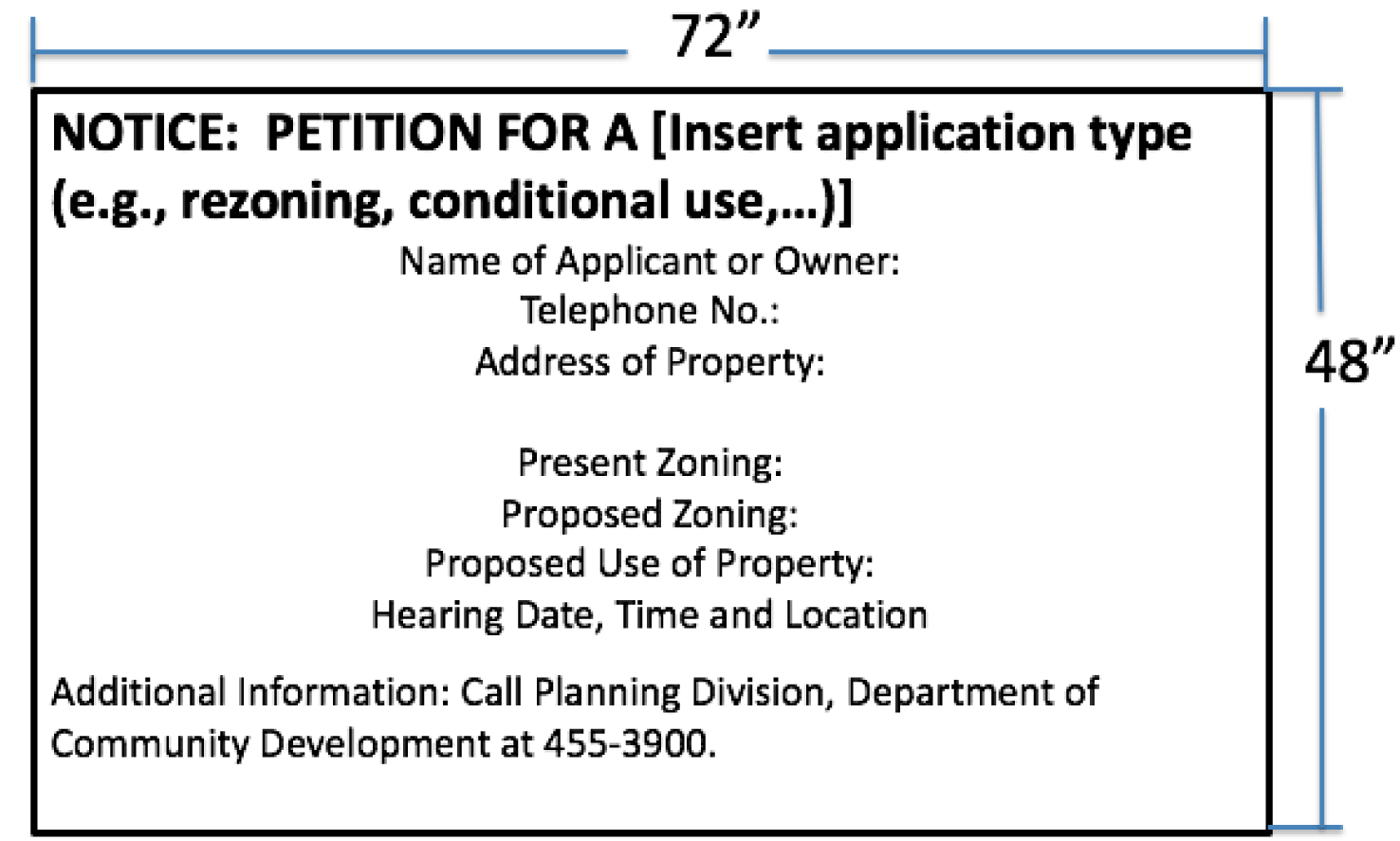
Format of Notification Signs. Signs shall be of wood or metal, at least 48 inches by 72 inches in size and the lettering thereon shall be black letters on a white background measuring at least three inches in height. The applicant shall notify the Division of Planning in writing that the sign has been erected and where located (see sign format in Exhibit II-3).
Exhibit II-3: Posted Sign Format
c.
Posting of Notification Signs. Notification signs shall be posted at least 30 days prior to the initial public hearing and remain posted until final action has been taken by City Council, or the petition has been withdrawn. The applicant shall remove the sign within ten calendar days of final action on the application. If any sign remains posted longer than this ten-day period, the petitioner shall be deemed in violation of this ordinance and subject to the penalties as set forth in section 35.2-102 (Violations) of this ordinance. The applicant shall provide a time and date-stamped photograph of all posted signs.
4.
Notice for Hearings Before Multiple Hearing Bodies. If multiple hearings are required, notice shall be provided for each public hearing. If these regulations specify or permit hearings by the Historic Preservation Commission, Planning Commission or Board of Zoning Appeals and the City Council, both hearings may be held concurrently at the sole discretion of the City. If such a joint hearing is held, public notice as specified above need be given only for the City Council hearing or whichever would be the last body to hear the matter.
5.
Notice When Decision is Appealed by Someone Other Than the Affected Property Owner. When any applicant requesting a written order, requirement, decision, or determination from the zoning administrator, other administrative officer, or a Board of Zoning Appeals, is not the owner or the agent of the owner of the real property subject to the written order, requirement, decision or determination, written notice shall be given to the owner of the property within 10 days of the receipt of such request. The requesting applicant shall be required to give the owner written notice and to provide satisfactory evidence to the Zoning Administrator that the notice has been given. Written notice mailed to the owner at the last known address of the owner as shown on the current real estate tax assessment books or current real estate tax assessment records shall satisfy the notice requirements of this subsection. This paragraph shall not apply to inquiries from the governing body, planning commission, or employees of the locality made in the normal course of business.
Sec. 35.2-10.15. - Property owners' associations.
(a)
When an applicant chooses to establish a residential cluster, planned unit, or traditional neighborhood land use development pattern in accordance with Article VIII of this Zoning Ordinance or chooses to include common open space or common facilities serving multiple owners, a property owners' association or other corporation shall be established pursuant to this section.
(b)
The corporation or property owners' association shall be assigned responsibilities to own and maintain common open space properties and facilities, and the developer shall obtain the approval of the City Attorney as to acceptability of incorporation documents.
(c)
The applicant must establish the property owners' association or corporation prior to the final approval, recording and sale of any lot.
(d)
Membership in the association or corporation shall be mandatory for all residents within the cluster subdivision or other applicable development and the property owners' association or corporation shall not discriminate by race, creed or sex in its members or shareholders.
(e)
The association or corporation documents shall set forth the purposes of the permanent organization under which common ownership is to be established; how it shall be governed and administered; the provisions made for permanent care and maintenance of the common property including necessary bonds when required by the City; and the method of assessing the individual property for its share of the cost of administering and maintaining such common property.
(f)
The incorporation document shall set forth the extent of common interest held by the owner of each individual parcel in the tract held in common with others.
(g)
All common property and facilities shall remain under a single entity ownership of a developer or a group of developers, and shall not be leased or sold unless provision is made which ensures participation by the properties leased or sold in the retention and maintenance of common open space and community facilities. A certificate of compliance, indicating that such arrangements have been made, shall be issued by the agent of the City prior to the sale or lease of the property by the developer.
(h)
All common open space, properties and facilities shall be preserved for their intended purpose as expressed in the approved plat.
(i)
All privately owned common open space designated in the approved plat shall be permanently preserved and maintained as open space. All deeds for property in a residential cluster development shall include appropriate restrictions to ensure that all open space is permanently preserved as open space as shown on the approved plat.
(j)
All common open space as well as public and recreational facilities shall be specifically included in a phasing plan if the project is to be developed in multiple phases and shall be constructed and fully improved by the developer in accordance with the phasing plan.
Sec. 35.2-11.1. - Applicability.
The procedures in this section are applicable to the following types of development applications:
(a)
Amendments to Comprehensive Plan text or maps, which includes the preparation or amendment of the text or maps of an area, neighborhood or corridor plan that is adopted as part of the Comprehensive Plan;
(b)
Amendments to Zoning Ordinance text or maps (rezonings);
(c)
Conditional amendments to Zoning Ordinance maps with proffers (conditional rezonings);
(d)
Conditional use permits (CUPs), which include approvals of planned unit developments (PUDs), traditional neighborhood developments (TNDs), cluster commercial developments (CCDs), corporate campus developments and floodplain development permits; and
Sec. 35.2-11.2. - Process overview.
The approval process for applications requiring public hearings, which include comprehensive plan text and map amendments, zoning ordinance text and map amendments, conditional zonings with proffers, and conditional use permits is summarized in Exhibit II-4.
Exhibit II-4: Public Hearing Approvals Process Summary
Sec. 35.2-11.3. - Applications.
(a)
Initiation. The Planning Commission, the City Council or the owner, contract purchaser with the owner's written consent, or the owner's agent may initiate a request.
(b)
Pre-application conference recommended. Before any application is made, the applicant may schedule a pre-application conference with the City Planner to discuss applicable procedures and requirements.
(c)
Submittal requirements. Applicants shall provide the information listed in Exhibit II-5.
(d)
Conditional zoning proffers.
1.
Purpose. The purpose of conditional zoning is to provide a method for permitting the reasonable and orderly development and use of land in those situations in which peculiar specific circumstances indicate that the existing zone ordinance district regulations are not adequate. In such instances reasonable conditions voluntarily proffered by the owner of the subject property to which such conditions are applicable for the protection of the community (which conditions are not generally applicable to other land similarly zoned) when considered with existing zoning ordinance district regulations should cause the requested rezoning to be compatible with existing zoning and uses in the area.
2.
Application. An applicant seeking conditional rezoning shall voluntarily proffer in writing such conditions as the applicant deems appropriate. The applicant shall generally file such a proffered condition in writing at the time of filing an application to rezone a property. An applicant may file such voluntary proffers in writing prior to the public hearing before the Council. The Council may refer such later filed proffered conditions back to the planning commission for review. City Council may consider additional proffers, deletions, and/or amendments to all such conditions provided same have been voluntarily proffered in writing by the owner of the property which is the subject of the rezoning request.
3.
Applications for conditional rezoning for new residential development and new residential uses.
a.
Defined terms. The terms used in this subsection, shall have the meanings stated for the same terms as defined in Va. Code Ann. § 15.2-2303.4.
b.
The applicant's proffer statement. An applicant seeking a conditional rezoning or a proffer condition amendment for a new residential development or a new residential use shall provide a written proffer statement at the time the applicant proffers any conditions. The applicant's proffer statement shall include the information designated below.
c.
Required contents of proffer statement. An applicant shall include the following information in a proffer statement submitted pursuant to this subsection.
i)
Proffers and proffer condition amendments. A description and explanation of how each proffer or proffer condition amendment, whether onsite or offsite, addresses an impact that is specifically attributable to the proposed new residential development or other new residential use applied for.
ii)
Offsite proffers. A description and explanation of how an offsite proffer addresses an impact to an offsite public facility such that:
a)
The new residential development or new residential use creates a need, or an identifiable portion of a need, for one or more public facility improvements in excess of existing public facility capacity at the time of the rezoning or proffered condition amendment; and
b)
Each new residential development or new residential use applied for will receive a direct and material benefit from the proffer made with respect to any such public facility improvements; and
c)
The projected impacts on public facility capacity specifically attributable to the proposed new residential development or new residential use.
iii)
Certifications. The applicant's proffer statement shall include the following certifications:
a)
A certification by the applicant that all proffers and proffer condition amendments are voluntary.
b)
A certification by the applicant that the information in the proffer statement is true, accurate, and complete to the best of the applicant's knowledge.
c)
The submission of any onsite or offsite proffer at the time of filing an application or during the development review process that has been signed by the applicant or owner shall be conclusive evidence that the proffered condition is reasonable and appropriate.
iv)
Identification of proffers required or requested in writing by the City. The proffer statement shall specifically identify any proffer or proffer condition amendment that was required by the city or requested in writing by the City.
v)
Waiver of required contents. The zoning administrator or the City Planner may waive any element of the required contents of a proffer statement pursuant to Section 35.2-10.12(b) of this Zoning Ordinance.
vi)
Application fee. The City Council may require a specific application fee for a conditional rezoning application for a proposed new residential development or new residential use pursuant to Section 35.2-101 of this Zoning Ordinance.
(e)
Concurrent review allowed. Applications for Comprehensive Plan amendments and other development approvals may be submitted and reviewed concurrently.
(f)
Completeness review. The City Planner shall review the application and shall determine if the application is complete pursuant to the provisions of Section 35.2-10.12 (completeness).
(g)
Staff review and recommendation. Upon finding that the application is complete the City Planner shall consult with the Technical Review Committee (TRC), prepare a report making findings and recommendations on the application, and authorize notice to be provided in accordance with Section 35.2-10.14 (notice) and Exhibit II-6.
(Ord. No. O-17-038, § 1, 5-9-17; Ord. No. O-19-039, § 1, 9-10-19)
Sec. 35.2-11.4. - Phased development.
If an Applicant proposes a development providing public infrastructure in two or more phases, the Applicant shall submit plans that show how the public infrastructure will be provided so that each phase of development is served by adequate public facilities as follows:
(a)
City approval of the phasing plan shall be a condition of concept plan approval.
(b)
The requirements of this ordinance will be satisfied with respect to each phase.
(c)
A phasing plan shall identify the public improvements that must be completed in conjunction with each phase of development.
(d)
Once a schedule has been approved and made part of the approval by the approval body, no land may be used, buildings occupied or lots sold except in accordance with the approved schedule unless it the City Planner and City Engineer determine that the change does not reduce the levels of service available during any phase of the development. Other changes shall require approval by the original approval body.
Sec. 35.2-11.5. - Planning commission hearing.
(a)
The Planning Commission shall hold a public hearing and, after closing the hearing shall render its recommendation in accordance with the applicable approval criteria.
(b)
Recommendations for Comprehensive Plan or zoning map amendments or conditional use permits may include that a lesser area be included within the amendment or that a less intensive designation or use classification be applied to all or a portion of the property upon making findings supporting such change pursuant to Section 15.2-2285(C) of the Code of Virginia.
Sec. 35.2-11.6. - City council hearing and action.
(a)
Hearing and Action. Following the Planning Commission recommendation, the application shall be submitted to the City Council to review at a public hearing. Following the hearing and consideration of the applicable approval criteria, the Council may approve or deny the application by an affirmative vote of at least a majority of a quorum of the City Council.
(b)
Changes to the Area. If, in the judgment of Council, consideration should be given to changing a greater or lesser area than that proposed in an application, Council may refer such change to the Commission for report and recommendation. It shall be the duty of the City Manager, or any official designated by him, to bring to the attention of Council such instances where, in his opinion, a greater or lesser area shall be considered for change than that contained in a specific petition, and the Planning Commission may also recommend to Council that a greater or lesser area be changed, or that the zoning be changed in any other respect differently from what was proposed in the petition.
(c)
Conditions for Conditional Rezoning. City Council may approve reasonable conditions to rezoning, provided that:
1.
The rezoning itself must give rise to the need for the conditions.
2.
Such conditions shall have a reasonable relation to the rezoning.
3.
Such conditions shall not include a cash contribution to the City.
4.
Such conditions shall not include mandatory dedication of real or personal property for open space, parks, schools, fire departments, or other public facilities not otherwise authorized by law.
5.
Such conditions shall not include payment for or construction of off-site improvements except those provided for in section 15.2-2241 of the Code of Virginia.
6.
Such conditions shall not include a requirement that the applicant create a property owners association under Chapter 25 (sec. 55-508 et seq.) of Title 55, which includes an express further condition that members of a property owners association pay an assessment for the maintenance of public facilities owned in fee by a public entity, including open space, parks, schools, fire departments and other public facilities not otherwise provided for in section 15.2-2241 of the Code of Virginia; however, such facilities shall not include sidewalks, special street signs or markers, or special street lighting in public rights-of-way not maintained by the Department of Transportation.
7.
No condition shall be proffered that is not related to the physical development or physical operation of the property.
8.
All such conditions shall be in conformity with the city's comprehensive plan as defined in section 15.2-2223 of the Code of Virginia.
9.
The provisions of this ordinance shall not be used for the purpose of discrimination in housing.
10.
Such conditions shall be voluntary.
11.
In conditional rezonings involving a proposed new residential development or new residential use:
a.
Compliance with Va. Code Ann. § 15.2-2303.4. Such conditions shall comply with Va. Code Ann. § 15.2-2303.4.
b.
Defined Terms. The terms used in this subsection shall have the meanings stated for the same terms as defined in Va. Code Ann. § 15.2-2303.4.
c.
Onsite and Offsite Proffers. Proffers and proffer condition amendments, whether onsite or offsite, shall address an impact that is specifically attributable to the proposed new residential development or other new residential use applied for.
d.
Offsite Proffers. Offsite proffers shall address an impact to an offsite public facility such that:
1.
The new residential development or new residential use creates a need, or an identifiable portion of a need, for one or more public facility improvements in excess of existing public facility capacity at the time of the rezoning or proffer condition amendment; and
2.
The new residential development or new residential use applied for receives a direct and material benefit from a proffer made with respect to any such public facility improvements.
(d)
Changes to Category, District or Use. The Council may approve a change to a less intensive land use category, zoning district or use than listed in the public notice without additional notice.
(e)
Resubmittal of Denied Applications. When the Council has denied an application to amend, supplement or change these regulations, or the boundaries of any district or classification of any property, it shall not be required to consider another petition requesting the same change until at least one year has elapsed, except by the favorable vote of five members of City Council.
Exhibit II-5: Submittal Requirements for Applications Requiring Public Hearings before City Council
✓ = Required
Exhibit II-6: Notice Requirements by Application Type
✓ = Required
O = Optional at Applicant's discretion
(Ord. No. O-17-038, § 1, 5-9-17)
Sec. 35.2-11.7. - Approval criteria.
Development applications may be reviewed for substantial compliance with the approval criteria established in Exhibit II-7. Except for rezoning requests submitted in accordance with the provisions herein for conditional rezonings, the Council shall not consider any representations made by the petitioner that, if the change is granted, the rezoned property will be used for only one of the possible range of uses permitted in the requested classification except as proffered as part of a conditional rezoning. Rather, the Council shall consider whether the entire range of permitted uses in the requested classification is more appropriate than the range of uses in the existing classification.
Exhibit II-7: Development Approval Criteria
✓ = Required
(Ord. No. O-17-038, § 1, 5-9-17)
Sec. 35.2-11.8. - Failure to act.
(a)
If the Planning Commission has failed to make a recommendation on a Zoning Ordinance amendment within 100 days after the first meeting of the Planning Commission on the Zoning Ordinance amendment, the Planning Commission shall be deemed to have approved the Zoning Ordinance amendment, unless the Zoning Ordinance amendment has been withdrawn by the applicant prior to the expiration of the time period. In the event of and upon such withdrawal, processing of the Zoning Ordinance amendment shall cease without further action.
(b)
Plats, site plans, and plans of development shall be reviewed and approved according to the provisions of Va. Code §§ 15.2-2259 and 15.2-2260, as amended.
Sec. 35.2-11.9. - Approvals.
(a)
Effect of Approval. The approval entitles the owner of the property to proceed with development in accordance with applicable rules and regulations; it does not authorize the use, occupancy, or development of property until the applicant receives other required development approvals.
(b)
Final Site Plan Approval Required for Conditional Use Permits. Failure to apply for final site plan and building permit approval or to establish the use within 24 months of concept plan approval pursuant to the conditional use permit or as established in the phasing plan approved by the City Council shall result in expiration of the concept plan and conditional use permit approval.
(c)
Effect on Successors and Assigns. Unless otherwise established in the conditions, development approvals are transferable so long as the use of land or structures or any portion thereof subject to the development approval continues to comply with all applicable terms and requirements.
(d)
Phasing Allowed. If the City Council approves both the concept plan and phasing plan, the developer may submit final site plans to the City Planner for review and approval as described in the approved phasing plan. Any development that is anticipated to require more than 12 months for completion shall show on the concept plan a phasing plan documenting the phasing sequence of the project.
(e)
Institutional Uses. Notwithstanding any other provisions of this section, conditional use permits granted or assigned to any hospital, institution of higher learning, charitable organization, or any public agency or authority shall be valid for a period of 36 months. If a building permit for construction authorized by a conditional use permit granted to such a user has not been applied for within 36 months of the grant of such permit, the conditional use permit shall be void. After issuance of the first building permit for construction of any structure or improvement authorized by the conditional use permit, the conditional use permit shall remain valid as to future stages of the development approved under the permit, as shown on the approved concept plan and phasing plan if applicable, even though further construction does not commence within the time specified in the phasing plan.
(f)
Challenges. Notwithstanding any other provision of this section, a conditional use permit granted by the City Council that is subject to judicial challenge shall not expire while the challenge is pending. [note: existing language suspends all time periods]
Sec. 35.2-11.10. - Minor amendments to applications not requiring re-notification.
The City Council may allow minor amendments to an application without re-submittal of the entire application. For purposes of this article, minor amendments to an application include adjustments to achieve greater compliance with the Zoning Ordinance, technical codes or other applicable rules and regulations, but do not:
(a)
Increase land area, the number of lots, dwelling units, floor area, height, impervious cover, or any additional land-use disturbance;
(b)
Introduce different land uses than those requested in the original application;
(c)
Conflict with adopted technical codes;
(d)
Request greater deviation from standards than requested in the application;
(e)
Allow any diminution in buffer or transition areas, reduction in landscaping, reduction of required yards, or any change in the design characteristics or materials used in construction of the structures; or
(f)
Reduce or eliminate conditions attached to a final development approval unless a new notice is provided.
Sec. 35.2-11.11. - Amendments to approved concept plans.
(a)
The City Planner may authorize the following minor amendments to a concept plan approved during a public hearing:
1.
Deviations arising from limited technical considerations that could not reasonably be anticipated during the approval process;
2.
Amendments required to bring the application into compliance with adopted Building Code and Manual of Specifications and Details.
3.
Any other change that has no material effect on the character of the approved concept plan, as determined by the City Planner, such as:
a.
Interior street realignments and driveway relocations as long as the adjustment does not reduce the gross area of common areas or open spaces, reduce residential lot sizes, eliminate required buffers or create street alignments or driveway configurations that fail to conform with City standards;
b.
Facility design modifications for amenities;
c.
Relocation of landscaping materials that do not impact properties surrounding the proposed development or compatibility within the proposed development;
d.
Adjustments to the boundaries between phases as long as each phase continues to function independently when developed;
e.
Adjustments to the phasing plan that neither the City Planner nor City Engineer find reduce the levels of service available during any phase of the development.
f.
Adjustment to the boundaries between land uses as long as the change does not result in an increase in overall density or intensity of development, and the change does not affect properties abutting the proposed development; and
g.
Expansions of buffers, open spaces and landscape areas.
(b)
All other amendments shall be considered major amendments and shall be processed in the same manner as original applications, including notice and hearings.
Sec. 35.2-11.12. - Records.
(a)
The City Council and Planning Commission shall keep minutes and records of all meetings and proceedings including voting records, attendance, resolutions, findings, determinations, and decisions by any appropriate means as prescribed by rule and consistent with the Code of Virginia.
(b)
All development review decisions and all approved maps, plans and plats shall be maintained in the permanent files of the City Planner and shall be recorded as required by City Code and statute.
(c)
Conditions attached to a property shall be met by the owner, successors, assigns and heirs unless the conditions are modified or eliminated through the process for Zoning Map amendments or conditional use permits as applicable.
(d)
Records of conditional rezoning:
1.
The zoning map shall show by an appropriate symbol the existence of conditions attached to the zoning.
2.
The City Planner shall maintain a conditional zoning index which index shall be available in the planning division office for public inspection during regular office hours. The index shall provide ready access to the ordinance creating such conditions in accordance with the article and shall clearly list all conditions applicable to each.
3.
Before any permits can be issued to begin construction or for the occupancy of an existing structure, the petitioner shall file and record in the office of the clerk of the circuit court of the City of Lynchburg, Virginia, the conditions approved by City Council.
4.
These conditions shall be indexed under the names of the landowners of the property being conditionally zoned. The petitioner shall submit a notarized letter to the Clerk of City Council, the zoning administration and the City Planner certifying that the conditions have been recorded with the Clerk of the Circuit Court.
5.
The City Planner shall maintain the proffer statement provided by the applicant pursuant to Section 35.2-11.3(d)(3) of this Zoning Ordinance.
(Ord. No. O-17-038, § 1, 5-9-17)
Sec. 35.2-11.13. - Enforcement and guarantees for conditional zonings.
To ensure the intent and purpose of conditional zoning approved in accordance with this article, the Zoning Administrator is vested with all necessary authority on behalf of City Council to administer and enforce conditions attached to a conditional zoning, including:
(a)
Ordering in writing, the remedy of noncompliance with the conditions.
(b)
Bringing legal action to ensure compliance with the conditions, including injunction, abatement or other appropriate action or proceeding.
(c)
Requiring a guarantee, satisfactory to the Council, in an amount sufficient for and conditioned upon the construction of any physical improvements required by the conditions where the contract for the construction of improvements and the contractor's guarantee, in like amount and so conditioned, which guarantee shall be reduced or released by the governing body, or agent thereof, upon the submission of satisfactory evidence that construction of the improvements has been completed in whole or in part.
(d)
Denying zoning certification with regard to the issuance of any required development approval, use, occupancy or building permit.
Sec. 35.2-11.14. - Revocation.
If the owner or occupant fails to comply with the development standards or conditions of an approved conditional use permit, or if the authorized use is determined to create a nuisance in the community, City Council may revoke the conditional use permit after conducting a public hearing on the matter.
Sec. 35.2-11.15. - Appeals.
Appeals to actions requiring public hearings shall be filed with the appeals body established in Exhibit II-1 (Summary of Application Review Procedures) within 30 days of the action by the approval body unless otherwise provided by the Code of Virginia.
Sec. 35.2-12.1. - Applicability.
(a)
Variances. The variance process allows for reasonable deviations from those provisions regulating the shape, size, or area of a lot or parcel of land, or the size, height, area, bulk, or location of a building or structure when the strict application of the ordinance unreasonably restrict the utilization of the property, and such need for a variance would not be shared generally by other properties, and provided such variance is not contrary to the purpose of the ordinance. It shall not include a change in use, which change shall be accomplished by a rezoning or by a conditional zoning.
(b)
Appeals. An appeal may be taken to the Board of Zoning Appeals by any person aggrieved or by any officer, department, board or bureau of the City affected by any decision of the Zoning Administrator or other officer in the administration or enforcement of this Zoning Ordinance in accordance with Chapter 22 of Title 15.2 of the Code of Virginia, as amended and this Zoning Ordinance.
Sec. 35.2-12.2. - Variance and appeals processes overview.
(a)
The variance and appeals processes are summarized in Exhibit II-8.
Exhibit II-8: Variance and Appeals Approval Process Summary
(b)
Requirement for Notice of Right to Appeal. Notwithstanding any other provision of law, any written notice of a violation of this Zoning Ordinance or written order of the Zoning Administrator shall include a statement informing the recipient:
1.
Of the right to appeal the notice or order within 30 days in accordance with this section;
2.
That the decision shall be final and unappealable if not appealed within said 30 days;
3.
The written notice or order shall include the applicable appeal fee and a reference to where additional information may be obtained regarding the filing of an appeal; and
4.
That the appeal period shall not commence until the statement is given. A written notice of a zoning violation or a written order of the Zoning Administrator that includes such statement sent by registered or certified mail to, or posted at, the last known address of the property owner as shown on the current real estate tax assessment books or current real estate tax assessment records shall be deemed sufficient notice to the property owner and shall satisfy the notice requirements of this section.
5.
The appeals shall be taken within 30 days after the decision appealed from by filing with the Zoning Administrator, and with the Board of Zoning Appeals, a notice of appeal, specifying the grounds thereof.
(c)
Notice by Administrator or Board of Zoning Appeals in Certain Matters. When an applicant requesting a written order, requirement, decision or determination from the Zoning Administrator or other administrative officer or the Board of Zoning Appeals that is subject to the appeals provisions contained in Virginia Code section 15.2-2311 or 15.2-2314 is not the owner or agent of the owner of the real property subject to the written order, requirement, decision or determination, written notice shall be given by the Zoning Administrator to the owner of the property within ten days of the receipt of such request. The applicant also shall be required to give the owner such notice and to provide satisfactory evidence to the Zoning Administrator that the notice has been given. Written notice mailed to the owner at the last known address of the owner as shown on the current real estate tax assessment books or current real estate tax assessment records shall satisfy the notice requirements of this section. This section shall not apply to inquiries from the City Council, Planning Commission or employees of the City made in the normal course of business.
(d)
Finality of Determinations by the Zoning Administrator or Other Administrative Officer. In no event shall a written order, requirement, decision or determination made by the Zoning Administrator or other administrative officer be subject to change, modification or reversal by the Zoning Administrator or other administrative officer after 60 days have elapsed from the date of the written order, requirement, decision or determination where the person aggrieved has materially changed his or her position in good faith reliance on the action of the Zoning Administrator or other administrative officer unless it is proven that such written order, requirement, decision or determination was obtained through malfeasance of the Zoning Administrator or other administrative officer or through fraud. The 60-day limitation in paragraph (c) shall not apply in any case where, with the concurrence of the attorney for the governing body, modification is required to correct clerical or other nondiscretionary errors.
Sec. 35.2-12.3. - Initiation.
Applications for variances or appeals shall be submitted to the Zoning Administrator a minimum of 30 days prior to the hearing date for the Board of Zoning Appeals at which the application will be heard.
Sec. 35.2-12.4. - Stays of proceedings.
An appeal shall stay action on the matter being appealed unless the Zoning Administrator certifies to the Board of Zoning Appeals that by reason of facts stated in the certificate, the stay would, in his opinion, cause immediate peril to life or property, in which case proceedings shall not be stayed otherwise than by a restraining order granted by the Board of Zoning Appeals or by a court of record, on application and on notice to the Zoning Administrator and for good cause shown.
Sec. 35.2-12.5. - Staff review.
(a)
Completeness Review. The Zoning Administrator shall review the application for completeness pursuant to the provisions of section 35.2-10.12 (Applications to be Complete).
(b)
Submittal Requirements. The applicant shall provide items required by Exhibit II-9.
Exhibit II-9: Variance and Appeals Application Submittal Requirements
✓ = Required
(c)
Staff Recommendation. Upon finding that the application is complete the Zoning Administrator shall consult with the Technical Review Committee (TRC) and prepare a report making findings and recommendations on the application and authorize notice to be provided in accordance with section 35.2-10.14 (Notice) and Exhibit II-10.
Exhibit II-10: Summary of Notice Requirements
✓ = Required
O = Optional at the applicant's discretion
Sec. 35.2-12.6. - Board of Zoning Appeals action on variances.
(a)
The Board of Zoning Appeals shall hold a hearing and following said hearing, shall approve, approve with conditions or deny the requested variance. In making its decision, the Board shall set forth each required finding in section 35.2-12.7 and such other findings as shall be appropriate in each specific grant of a variance, and in each denial thereof, which of the findings have not been satisfied. In any such case, each finding shall be supported by evidence in the record.
(b)
In authorizing a variance, the Board may impose such conditions regarding the location, character and other features of the proposed structure or use as it may deem necessary in the public interest, and may require a guarantee or bond, payable to the City of Lynchburg, in such amount and for such period of time as the Board may designate, to ensure that the conditions imposed are being and will continue to be complied with. Notwithstanding any other provision of law, the property upon which a property owner has been granted a variance shall be treated as conforming for all purposes under state law and local ordinance; however, the structure permitted by the variance may not be expanded unless the expansion is within an area of the site or part of the structure for which no variance is required under the ordinance. Where the expansion is proposed within an area of the site or part of the structure for which a variance is required, the approval of an additional variance shall be required.
(c)
The Board may grant a lesser variance than requested, but it may not grant a greater deviation from the standards than provided in public notices for the hearing.
Sec. 35.2-12.7. - Required findings for variances.
No variances shall be authorized unless the Board of Zoning Appeals makes the findings listed in Exhibit II-11.
Exhibit II-11: Required Findings for Variances
Sec. 35.2-12.8. - Flood hazard considerations.
(a)
Variances shall not be issued within any designated regulatory floodway if any increase in flood levels during the base flood discharge would result;
(b)
Variances may be issued for new construction and substantial improvements to be erected on a lot of one-half acre or less in size contiguous to and surrounded by lots with existing structures constructed below the base flood level, in conformance with the procedures listed herein;
(c)
Variances shall only be issued upon a determination that the granting of a variance will not result in increased flood heights, additional threats to public safety, extraordinary public expense, create nuisances, cause fraud on or victimization of the public or conflict with existing local laws or ordinances;
(d)
Variances shall only be issued upon determination that the variance is the minimum necessary, considering the flood hazard, to afford relief;
(e)
The City shall notify the applicant in writing over the signature of the Zoning Administrator that the issuance of a variance to construct a structure below the base flood level will result in increased premium rates for flood insurance and such construction below the base flood level increases risks to life and property.
Sec. 35.2-12.9. - Lapse of variance.
If a building permit application for construction authorized by the variance has not been submitted within 12 months of the granting of such variance, the variance so granted shall become void.
Sec. 35.2-12.10. - Board of Zoning Appeals actions on appeals.
The Board of Zoning Appeals shall have the authority to hear and decide appeals from any order, requirement, decision, or determination made by the Zoning Administrator or other administrative officer in the administration or enforcement of this Zoning Ordinance. The decision on such appeal shall be based on the Board's judgment of whether the Zoning Administrator or other administrative officer was correct. The determination of the Zoning Administrator or other administrative officer shall be presumed to be correct. At a hearing on an appeal, the Zoning Administrator or other administrative officer shall explain the basis for the determination after which the applicant has the burden of proof to rebut such presumption of correctness by a preponderance of evidence. The Board shall consider any applicable ordinances, laws and regulations in making its decision. For purposes of this section, determination means any order, requirement, decision or determination made by the Zoning Administrator or other administrative officer.
The Board of Zoning Appeals shall hold a hearing and following said hearing, may reverse or affirm, wholly or partly, or may modify, an order, requirement, decision or determination. The concurring vote of three members shall be necessary to reverse any order, requirement, decision or determination of an administrative officer or to decide in favor of the applicant on any matter upon which it is required to pass under this ordinance or to effect any variance from this ordinance.
Sec. 35.2-12.11. - Record keeping.
(a)
The Zoning Administrator shall maintain a record of all variance actions, including justification for their issuance.
(b)
The Zoning Administrator shall maintain a record of all actions on appeals.
Sec. 35.2-12.12. - Appeals to the Circuit Court from actions of the Board of Zoning Appeals.
(a)
Any person or persons jointly or severally aggrieved by a decision of the Board of Zoning Appeals, or any aggrieved taxpayer or any officer, department or board of the City of Lynchburg, may present to the Circuit Court of the City a petition specifying the grounds on which aggrieved within 30 days after the Board's decision.
(b)
Upon the presentation of such petition, the Court shall allow a writ of certiorari to review the decision of the Board of Zoning Appeals and shall prescribe therein the time within which a return thereto must be made and served upon the secretary of the Board of Zoning Appeals or, if no secretary exists, the Chair of the Board of Zoning Appeals, which shall not be less than ten days and may be extended by the Court. The allowance of the writ shall not stay proceedings upon the decision appealed from, but the Court may, on application, on notice to the Board of Zoning Appeals and on due cause shown, grant a restraining order.
(c)
Any review of a decision of the Board of Zoning Appeals shall not be considered an action against the Board and the Board shall not be a party to the proceedings; however the Board shall participate in the proceedings to the extent required by this section. The City Council, the landowner, and the applicant before the Board of Zoning Appeals shall be necessary parties to the proceedings in the Circuit Court. The Court may permit intervention by any other person or persons jointly or severally aggrieved by any decision of the Board of Zoning Appeals.
(d)
The Board of Zoning Appeals shall not be required to return the original papers acted upon by it but it shall be sufficient to return certified or sworn copies thereof or of the portions thereof as may be called for by the writ. The return shall concisely set forth such other facts as may be pertinent and material to show the grounds of the decision appealed from and shall be verified.
(e)
The Court may reverse or affirm, wholly or partly, or may modify the decision brought up for review.
(f)
In the case of an appeal from the Board of Zoning Appeals to the Circuit Court of an order, requirement, decision or determination of the Zoning Administrator or other administrative officer the findings and conclusions of the Board of Zoning Appeals on questions of fact shall be presumed to be correct. The appealing party may rebut that presumption by proving by a preponderance of the evidence, including the record before the Board of Zoning Appeals that the Board of Zoning Appeals erred in its decision. Any party may introduce evidence in the proceedings in the court. The court shall hear any arguments on questions of law de novo.
(g)
In the case of an appeal by a person of any decision of the Board of Zoning Appeals that denied or granted an application for a variance the decision of the Board of Zoning Appeals shall be presumed to be correct. The petitioner may rebut that presumption by proving by a preponderance of the evidence, including the record before the Board of Zoning Appeals that the Board of Zoning Appeals erred in its decision.
(h)
In the case of an appeal by a person of any decision of the Board of Zoning Appeals that denied or granted application for a special exception, the decision of the Board of Zoning Appeals shall be presumed to be correct. The petitioner may rebut that presumption by showing to the satisfaction of the court that the Board of Zoning Appeals applied erroneous principles of law, or where the discretion of the Board of Zoning Appeals is involved, the decision of the Board of Zoning appeals was plainly wrong, was in violation of the purpose and intent of the Zoning Ordinance, and is not fairly debatable.
(i)
In the case of an appeal from the Board of Zoning Appeals to the circuit court of a decision of the Board, any party may introduce evidence in the proceedings in the court in accordance with the Rules of Evidence of the Supreme Court of Virginia.
(j)
Costs shall not be allowed against the City, unless it shall appear to the court that it acted in bad faith or with malice. In the event the decision of the Board is affirmed and the court finds that the appeal was frivolous, the court may order the person or persons who requested the issuance of the writ of certiorari to pay the costs incurred in making the return of the record pursuant to the writ of certiorari. If the petition is withdrawn subsequent to the filing of the return, the locality may request that the court hear the matter on the question of whether the appeal was frivolous.
Sec. 35.2-13.1. - Applicability.
(a)
Within an historic district, no building or structure, including signs, and including non-contributing buildings and structures and signs, shall be erected, reconstructed, restored, demolished, or altered in any way that affects the external appearance of the building or structure, including such items as roofs, chimneys, fences, and color changes, unless the same is approved as being architecturally compatible with historic landmarks, buildings, or structures therein through the issuance of a certificate of appropriateness (COA) by the Historic Preservation Commission (HPC), the City Planner or by City Council.
(b)
A certificate of appropriateness that is granted by the HPC, the City Planner or on appeal by the City Council shall be provided to the Zoning Administrator.
(c)
No building permit or demolition permit to authorize any erection, reconstruction, alteration or demolition that affects the external appearance of any landmark, building or structure, or part thereof in a designated historic district, shall be issued until a certificate of appropriateness is issued by the HPC or City Council. The decision of the HPC shall be final except where an appeal is made to City Council pursuant to section 35.2-13.11. No certificate of appropriateness is required when the demolition of a structure is ordered by the Building Official pursuant to the provisions of the Uniform Statewide Building Code.
Sec. 35.2-13.2. - Minor actions.
Certain minor actions, which are deemed by the City Planner not to permanently affect the character of the historic district, may be exempted from review by the HPC, but the City Planner shall be notified of the proposed actions and may review and approve the alterations administratively or refer the proposed alterations to the HPC. Such actions shall include those that, in the opinion of the City Planner, will have no more effect on the character of the district than those listed as minor works or routine maintenance in Exhibit II-12.
Exhibit II-12: Work Classifications for Certificates of Appropriateness
Sec. 35.2-13.3. - Stop work orders.
The Zoning Administrator shall have the authority to order that work be stopped and that an application for the issuance of a certificate of appropriateness be filed upon determining that the action may exceed the conditions listed in Exhibit II-12. In all cases the decisions may be appealed to the HPC, and a determination shall be made by the HPC on such appeal within 30 days.
Sec. 35.2-13.4. - Initiation.
(a)
Application. Applicants for review involving alterations and/or additions to existing historic structures or the erection of any new structure within a historic district shall provide the submittals required by Exhibit II-13 to the City Planner at least 15 days prior to the HPC meeting at which the application will be heard.
(b)
Staff Recommendation. Upon finding that the application is complete the City Planner shall prepare a report making findings and recommendations on the application and authorize notice to be provided in accordance with section 35.2-13.5 (Notice and HPC Hearing).
(c)
Applications. Applications shall include the items listed in Exhibit II-13.
Exhibit II-13: Certificate of Appropriateness Application Submittal Requirements
(Ord. No. O-18-049, 6-12-18)
Sec. 35.2-13.5. - Notice and HPC hearing.
Whenever the HPC finds that the issuance of a certificate of appropriateness and the exercise of the rights and privileges granted thereby will, or is likely to, materially and adversely affect the property of another within 200 feet of the subject property, the HPC shall mail notice of its intention to do so to the owner of such affected property and afford such owner an opportunity to be heard with respect thereto at a hearing to be held prior to issuance of a certificate of appropriateness. If HPC invokes this provision an additional 45 days shall be granted before the HPC must render a decision.
Sec. 35.2-13.6. - Certificate of appropriateness review standards.
All decisions of the HPC shall be consistent with standards established by the Secretary of the United States Department of the Interior. Determination of consistency shall be based on a comparison with significant, similar structures within the district and the Residential or Commercial Historic Districts Design Guidelines, as adopted by City Council. The HPC shall also consider the economic feasibility and impact of the proposed repairs, alterations, additions, or new construction. In addition to using the Secretary of the United States Department of the Interior's Standards to guide decisions, the HPC, or City Council on appeal, shall consider the following items in considering the appropriateness of architectural features:
(a)
General form and composition of proposed construction (shape of proposed structure in plan, relationship between width and height of elevation);
(b)
Setback and placement on lot;
(c)
Exterior construction materials (textures, patterns, and colors);
(d)
Architectural detailing (molding on cornices, finals, and cresting on roofs, gable ornaments, lintels);
(e)
Roof shapes;
(f)
Windows (relationship of width to height, location) and doors;
(g)
Height;
(h)
Porches (shape, style, size, location) and steps;
(i)
Walls, fences, walkways, pools, fountains, gazebos, gates, sidewalks, streets, signs, and accessory structures;
(j)
Enclosure (materials, location, height), such as outbuildings, roofed enclosures, and similar type structures;
(k)
Other features that have an impact on the historic and/or architectural character of the property;
Sec. 35.2-13.7. - Action of HPC.
(a)
Review and Action. Within 45 days of receipt of an application for a certificate of appropriateness, the HPC shall meet to review such application. The applicant shall be informed of the time and place at which the HPC will consider the application, and the applicant shall have an opportunity to be heard. The HPC shall approve or deny the application and notify the applicant within 60 days after the first meeting.
(b)
Disapproval. If the HPC disapproves such plans, it shall state its reason for so doing and shall transmit a record of the reasons therefore in writing to the applicant. No further action shall be taken by the City Building Official to issue a construction permit. The applicant may modify his/her application in regard to the HPC's recommendations and shall have the right to resubmit his/her application to the HPC for its recommendation.
Sec. 35.2-13.8. - Certificate issuance and action of the applicant.
(a)
Issuance and Posting of Certificate. Within ten business days after the HPC approves a certificate of appropriateness, the City Planner shall issue a certificate of appropriateness for the work authorized. Said certificate shall be posted in a location visible from the street from the commencement of work until the work is completed.
(b)
Any person to whom a certificate of appropriateness has been issued may commence work at his/her own risk during the 15-day appeal period provided for in section 35.2-13.11 provided that a building permit has been issued, if necessary.
Sec. 35.2-13.9. - Validity of certificates of appropriateness.
(a)
Expiration. Certificates of appropriateness issued by the City Planner shall expire:
1.
If work is not commenced within 12 months of issuance of the permit;
2.
If work is suspended or abandoned for 90 days or more after commencement excluding days when the certificate is stayed pursuant to appeal or court action; or
3.
If work is not completed within 24 months of issuance of the permit.
(b)
Extensions. The HPC or the City Planner may grant one or more 90-day extensions of time for completing the work authorized by the certificate of appropriateness when:
1.
The applicant submits a written explanation of the need for additional time;
2.
The HPC or City Planner finds that the explanation justifies the extension; and
3.
The applicant agrees to complete the work within the extended time period or be subject to revocation of the certificate.
Sec. 35.2-13.10. - Demolition or moving.
(a)
Authorization Required. Subject to the provisions of this section, no historic landmark, building or structure within a historic district shall be demolished or moved until a certificate of appropriateness for the razing, demolition or moving thereof is approved by the HPC, or, on appeal (pursuant to section 35.2-13.11), by City Council after consultation with the HPC. Removal of exterior features for any reason, whether due to neglect, deterioration, damage or willful removal is a violation of this Zoning Ordinance and is subject to penalties unless it is ordered by the Building Official pursuant to the provisions of the Uniform Statewide Building Code.
(b)
Review Process. Prior to authorizing the demolition or moving of a historic landmark building or structure within a historic district:
1.
The applicant shall provide evidence of the attempt to sell the property for a price that is reasonably related to its fair market value. Such evidence shall satisfy the criteria listed in Exhibit II-14.
2.
If the HPC determines that a good faith effort has been made to find a suitable buyer in accordance with the criteria in Exhibit II-14, the HPC shall approve the application for a certificate of appropriateness for the demolition or moving of the subject landmark, building or structure.
Exhibit II-14: Evidence Documenting Efforts to Sell Subject Property or Structure
(c)
Appeals to actions of the HPC or City Council shall not affect the right of the owner to sell the property while the appeal is pending.
Sec. 35.2-13.11. - Appeals to City Council.
(a)
Whenever the HPC shall, in a final decision, deny an application for a certificate of appropriateness, the applicant for such certificate of appropriateness shall have the right to appeal to and be heard before the City Council; provided that the appeal is filed with the clerk of the City Council within 15 days after the decision by vote of the HPC, a notice in writing of his/her intention to appeal.
(b)
Upon receipt of such notice, the clerk of the City Council shall promptly schedule a public hearing as soon as reasonably practical after complying with the requirements for published notice established in section 35.2-10.14(d)1 (Published Notice).
(c)
Prior to the scheduled city council public hearing the applicant appealing the decision of the historic preservation commission to deny a certificate of appropriateness shall post a notification sign on the property as provided in section 35.2-10.14(d)3 (posted signs).
(d)
Opponents to the granting of certificates of appropriateness by the HPC shall have the right to appeal to and be heard before the City Council, provided there is filed with the clerk of the City Council within 15 days after the decision by vote of the HPC a written petition, signed by at least 25 registered voters of the City, indicating their intention to appeal. Upon receipt of such notice, the clerk of the City Council shall promptly schedule a public hearing as soon as it is reasonably practical for City Council after complying with notice requirements. Published notice of the hearing shall be given as provided by section 35.2-10.14(d)1 (Published Notice) of this Zoning Ordinance. Costs of advertising appeal hearings requested by said opponents will be paid by the opponents in the amount set forth in the fee schedule adopted by the City Council.
(e)
On any such appeal, the final decision of the HPC appealed from shall be stayed pending the outcome of the appeal to City Council, except that the filing of such appeal shall not stay the decision of the HPC if such decision denies the right to raze or demolish a historic landmark, building or structure. The City Council shall conduct a full and impartial public hearing on the matter and apply the same criteria as the HPC before rendering any decision. The City Council may affirm, reverse or modify the decision of the HPC, in whole or in part. The decision of City Council, subject to the provisions of section 35.2-13.12, shall be final. If approved, a certificate of appropriateness, signed by the clerk of the City Council, shall be issued to the applicant.
(Ord. No. O-18-049, 6-12-18)
Sec. 35.2-13.12. - Appeal to the circuit court.
Within 30 days after any final decision is rendered by City Council pursuant to this section, an aggrieved party may appeal as a matter of right to the circuit court for the City by filing a petition at law setting forth the alleged illegality of the action by City Council. The filing of the said petition shall stay the decision of the City Council pending the outcome of the appeal to circuit court, except that the filing of such petition shall not stay the decision of City Council if such decision denies the right to raze or demolish a historic landmark, building or structure. The court may reverse or modify the decision of the City Council, in whole or in part, if it finds upon review that the decision of the City Council is contrary to law or that its decision is arbitrary and constitutes an abuse of discretion, or it may affirm the decision of the City Council.
Sec. 35.2-14.1. - Zoning compliance determination required.
(a)
To facilitate the development and use of land within the City of Lynchburg, the City empowers the City Planner, Zoning Administrator and other City staff to review and act on a variety of development approvals. Each of the following development approvals may be granted by staff subject to submittal of the complete application that demonstrates compliance with the requirements of this Zoning Ordinance and other applicable policies, rules and regulations.
(b)
Before the City issues a building permit, certificate of occupancy, business license or other development approval, the Zoning Administrator shall confirm that the proposed application complies with applicable zoning district requirements.
Sec. 35.2-14.2. - Site plans.
(a)
Applicability. Site plan review is intended to ensure that the following types of development are designed to enable sites to function well for their intended use while achieving compatibility with surrounding properties, natural resources and the infrastructure that serves the neighborhood:
1.
Applications for zoning map amendments (rezonings);
2.
Applications for conditional use permits;
3.
Applications for development or modifications of commercial and industrial facilities that involve a change in the building footprint or increases in off-street parking;
4.
Applications for development, modification or expansion of parking lots, excluding resurfacing, repainting and other routine maintenance;
5.
Applications for development or modifications of institutional facilities, such as schools, hospitals and clubs that involve a change in the building footprint or increases in off-street parking;
6.
Applications for development or modification of residential developments, involving more than two dwelling units in one building or on one lot;
7.
Applications for development or modifications of planned unit, traditional neighborhood, cluster commercial or corporate campus developments; and
8.
Applications for variances.
(b)
Types of Site Plans. The two types of site plans and the specific circumstances for which they are required are summarized in Exhibit II-15.
Exhibit II-15: Types of Site Plans
(c)
Initiation and Review.
1.
The applicant shall submit a complete site plan application to the City Planner. A pre-application conference is recommended, but not required.
2.
The City Planner shall review site plans for general completeness and compliance with adopted plans, regulations or conditions established through a prior development approval. If the application is incomplete, the City Planner shall notify the applicant in writing of items required to complete the application.
3.
The City Planner shall distribute copies of the completed application to the Technical Review Committee and other agencies as applicable.
4.
Within 30 days of submittal of a complete application, the City Planner shall take one of the following actions:
a.
If the site plan is required for action by the City Council, Planning Commission, Board of Zoning Appeals or other body, the City Planner shall submit the site plan with recommendations to the applicable approval body.
b.
If the City Planner is the approval authority:
1.
Approve the site plan subject to Technical Review Committee comments and based on applicable rules, regulations and conditions of prior development approvals; or
2.
Disapprove the site plan and return a copy to the applicant along with written comments identifying the changes required to comply with applicable rules, regulations or conditions of prior development approvals.
(d)
Site Plan Submittal Requirements. Applications for concept plan and final site plan approvals shall include the items listed in Exhibit II-16.
Exhibit II-16: Concept and Final Site Plan Application Submittal Requirements
✓ = Required
(e)
Building and Certificates of Occupancy. No building permit shall be issued for a building located in an area in which site plan review is required unless the construction proposed by such building permit conforms to the approved final site plan. No certificate of occupancy shall be issued in such an area for a building or use that does not conform to the approved site plan.
(f)
Appeals.
1.
An appeal of any decision made by the City Planner concerning concept plan review may be made to the Planning Commission. The action of the Planning Commission may be appealed to the City Council.
2.
An appeal of any decision made by the City Planner concerning final site plan review may be made to the Planning Commission. The action of the Planning Commission may be appealed to the circuit court.
(Ord. No. O-17-013, § 1, 2-14-17)
Sec. 35.2-14.3. - Sign permits.
(a)
Applicability. A sign permit shall be required prior to the construction, erection, installation, attachment or modification of any permanent or temporary sign that is not specifically exempted from the requirement for a sign permit.
(b)
Procedures. The process for applying for a sign permit and the standards for signs are established in section 35.2-64 of this Zoning Ordinance. The application shall include the information included in Exhibit II-17.
Exhibit II-17: Sign Permit Application Submittal Requirements
Sec. 35.2-14.4. - Minor exceptions.
(a)
Purpose. Minor exceptions, also referred to as modifications in section 15.2.2286(A)(4) of the Code of Virginia, provide administrative relief and expeditious review of minor deviations from the provisions of the Zoning Ordinance under specified circumstances. Minor exceptions do not involve a public hearing unless the Zoning Administrator's or City Planner's decision is appealed by the applicant to the Board of Zoning Appeals.
(b)
Types of Administrative Relief. Administrative relief may be granted by the Zoning Administrator for any of the minor exceptions identified in Exhibit II-18. Administrative relief may be granted by the City Planner for any of the minor exceptions identified in Exhibit II-19.
Exhibit II-18: Minor Exceptions By Zoning Administrator
Exhibit II-19: Minor Exceptions by City Planner
(c)
Initiation and Review. The applicant shall file a completed application with the Zoning Administrator. The application for a minor exception shall include the items listed in Exhibit II-20.
1.
The Zoning Administrator shall provide mailed notice of the request for such an exception to the adjacent property owners.
2.
The adjoining and adjacent property owners shall be given an opportunity to respond to the request within 21 days of the date the notice is mailed.
3.
If any adjoining or adjacent property owner objects to the said request within the time specified above, the request shall be transferred to the Board of Zoning Appeals for a decision.
4.
The cost of this notification shall be charged to the applicant, unless waived by the City, at the standard rate as determined by the City Council's current fee schedule for each written notice.
Exhibit II-20: Minor Exception Application Submittal Requirements
(d)
Criteria. Minor exceptions or modifications may be granted when the City Planner or Zoning Administrator, as applicable, finds in writing that the application meets the following criteria:
1.
The strict application of the ordinance would produce undue hardship;
2.
Such hardship is not shared generally by other properties in the same zoning district and the same vicinity; and
3.
The authorization of the modification will not be of substantial detriment to adjacent property and the character of the zoning district will not be changed by the granting of the modification.
(e)
Action. After a review period of not more than 45 days, the Zoning Administrator shall approve or disapprove any application for administrative relief and provide written documentation justifying the action.
(f)
Appeals. Appeals to the decision of the Zoning Administrator or City Planner on a minor exception or modification shall be made to the Board of Zoning appeals in accordance with section 35.2-12 of this zoning ordinance.
Sec. 35.2-14.5. - Temporary use permits.
(a)
Purpose. Temporary use permits authorize the establishment of authorized uses for a limited time period and subject to conditions that protect the public health, safety and general welfare. Temporary use permits do not involve a public hearing unless the Zoning Administrator's decision is appealed by the applicant to the Board of Zoning Appeals.
(b)
Applicability. A Temporary Use Permit shall be required prior to the establishment of a temporary amusement, carnival, tent revival or any other temporary use authorized by this Zoning Ordinance.
(c)
Initiation and Review. The applicant shall file a completed application with the Zoning Administrator, who, after consulting with the TRC, shall approve the application subject to compliance with the criteria established in paragraph (d) of this section.
(d)
Approval Criteria. The Zoning Administrator shall approve the temporary use permit subject to the following criteria:
1.
The proposed use is authorized in the district in which it is to be established;
2.
The proposed use complies with the conditions established for the applicable district in Articles III and IV, as well as the conditions for the use established in Article VII of this Zoning Ordinance;
3.
The applicant agrees to mitigation measures that the TRC finds necessary to protect the public health, safety and welfare.

