
Machesney Park City Zoning Code
ARTICLE XII
INDUSTRIAL DISTRICTS
Sec. Z-56.- General purposes.
(1)
The IL Light Industrial District is intended to accommodate light industrial, wholesale and research establishments. The IL District may be located in various areas throughout the village and may be in close proximity to residential neighborhoods and not be detrimental to residential uses because of its limited nature. While most often applied to areas where the location of particular industries has no direct relationship to other nearby business or industrial districts, it may also be formed as an adjunct to these established districts.
(2)
The IG General Industrial District is intended to accommodate those industrial uses which may not or cannot meet the standards of the IL district yet do not have the objectionable influences of those uses found in the IH District. The IG district should not, where possible, be located in close proximity to a residential district.
(3)
The IH Heavy Industrial District is to accommodate those heavier industrial uses which have objectionable influences, but which, nevertheless, should be provided for in the community. The IH district is, insofar as possible, applied to locations removed from the residential districts on the basis of linear distance or natural or manmade features.
Sec. Z-57. - Industrial design standards.
1.
Intent. The industrial design standards are intended to elevate the standard of the built environment in the Village of Machesney Park. The standards have been written to attract quality, aesthetic developments that raise and maintain property values in the village. These minimum design standards recognize the utilitarian nature of industrial developments while also recognizing that there are possible design limitations that can occur due to the nature of the varying industrial and manufacturing activities that take place.
2.
Applicability.
a.
New buildings. The industrial design standards shall apply to all new buildings constructed in the IL Light Industrial, IG General Industrial, and IH Heavy Industrial districts as of the effective date of this ordinance.
b.
Existing buildings. These standards also apply to all existing structures in the IL, IG and IH zoning districts that undergo improvements, including, but not limited to, renovation, reconstruction, painting, or exterior façade treatments. Such improvements shall not affect more than:
(i)
25 percent of the surface area of all building elevations in a manner that does not conform with the industrial design standards; or
(ii)
25 percent of the total wall surface area of the primary, front facing elevation in a manner that does not conform with the industrial design standards.
The applicable elements of the standards shall apply only to that portion of the building that is being modified, updated, or improved.
Exterior painting projects are not required to obtain a permit from the village, but shall comply with the building color requirements in [subsection] 4.d.
These standards shall not apply when additions are built onto existing industrial buildings. Rather, the façades of these building additions shall be consistent to the color, material, and appearance of the existing building. (Ord. No. 34-17)
3.
Interpretation of standards. The industrial design standards provide a consistent means to apply design criteria to all new developments. To maintain consistent application of these standards, the community development department staff shall be responsible for administration of the industrial design standards. Refer to review procedures in paragraph 5.
4.
Standards for development.
a.
Design elements required. The design elements in Table A below are required for all industrial properties.
b.
Building form and layout.
(i)
In industrial developments with multiple structures, recurring forms and materials shall be used to create cohesive industrial campus.
(ii)
Any outdoor storage of materials is only permitted by special use permit and shall be effectively screened
(iii)
Rooftop mounted equipment, vents and mechanical shall be screened from view.
(iv)
All service entrances, dumpsters, refuse, loading facilities, salt storage and outdoor storage, where permitted, shall be located at the rear of the buildings.
[Must meet all of the applicable criteria (i)—(iv) to officially meet the building form standard.]
c.
Building materials.
(i)
Traditional masonry building materials, including brick, split face block, stone, and precast concrete are permitted.
(ii)
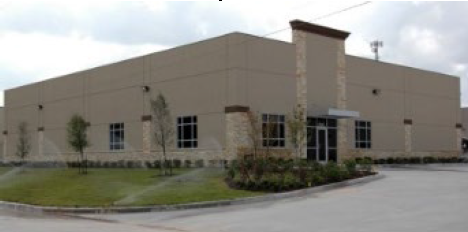
The use of prefabricated concrete tilt-up panels is permitted, provided that architectural treatments such as coloring, masonry inserts, or recessed panel inserts are used. (See Figure 1).
Figure 1. Acceptable use of prefabricated panels, with masonry architectural treatments.
(iii)
The use of exterior insulation finish material (EIFS)/Drivit®, plastic panels and other similar exterior materials is not permitted, unless used as an accent material, for no more than 30 percent of the total façade area. Staff may administratively allow deviation from this regulation, where appropriate. This deviation shall not exceed five percent of the requirement.
(iv)
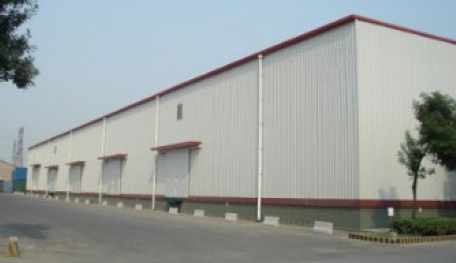
Metal materials are permitted for roofs, gutters, downspouts, railings, trim, grills, panels and flashing. Corrugated metal is not permitted. Subject to staff review, other applications of metal exteriors, such as zinc, copper, and aluminum composite systems may be permitted. When used, metals shall have an anodized, painted or powder coated finish in muted, earth-toned colors, unless when used as an entrance design (standard e, below [subsection 4.e of this section]). The use of unfinished, exposed metals is not permitted. (See Figure 2).
Figure 2: Corrugated steel buildings such as this are not permitted.
(v)
Where transitions in material are made, the transition shall not occur at an outside corner edge. All materials on the front will turn the corner and carry over to the side elevation to a point at which the corner looks solidly finished.
(vi)
Damaged and deteriorated exterior building materials shall be promptly repaired and replaced in accordance with the property maintenance code.
[Must meet all of the applicable criteria (i)—(vi) to officially meet the building materials standard.]
d.
Building colors.
(i)
Colors shall complement each other. While complementary colors for different elements are encouraged, a multitude of varying colors on each façade is not permitted. Earth-tones are preferred, but not mandatory.
(ii)
Contrasting trim colors shall be used to highlight architectural elements such as window and door surrounds. Harsh contrasts should be avoided, except where true to the architectural style of the building.
(iii)
Applied elements such as awnings, light fixtures, downspouts, railings and signage shall coordinate with, rather than dominate the color scheme of the building. The elements may be the same color as the background wall, a contrasting shade of the same color, or a more distinctive contrasting color. It is important for these elements to blend with the building's color palette.
(iv)
Primary, fluorescent or neon colors are not permitted for use as accent colors, including awning body color.
[Must meet three of the four applicable criteria (i)—(iv) to officially meet the building color standard.]
e.
Entrance design.
(i)
Recessed or projected entrances are required. Recesses or projections shall be at least 12 inches.
(ii)
Entrances shall be highlighted by a change in the wall plane. This can be accomplished through wall articulation around the door and projecting beyond the door.
(iii)
Projections should be utilized above and surrounding the main entrances to highlight the entrance features.
(iv)
Entrances shall be highlighted by implementation of architectural elements such as flanked columns, decorative fixtures, or varied textures or materials. (See Figure 3).
Figure 3: Example of an industrial building with a decorative, highlighted entrance.
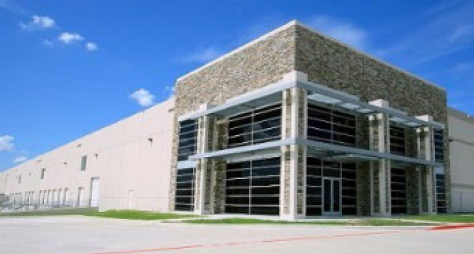
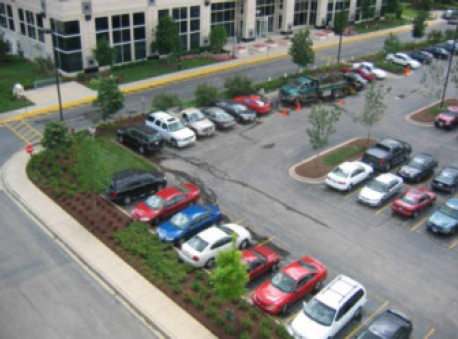
Figure 4: An acceptable landscaped perimeter, where a parking area abuts a roadway.
[Must meet three of the four applicable criteria (i)—(iv) to officially meet the entrance design standard.]
f.
Parking areas and trash enclosures.
(i)
All parking areas shall be paved with an approved surface, and spaces shall be clearly delineated at all times, and shall maintain adequate surfaces for vehicle travel at all times.
(ii)
The outdoor parking of equipment and vehicles, used in conducting the operation of the industrial use, shall be effectively screened.
(iii)
Parking areas shall be contained with curbing (perimeters and landscape islands) unless it is determined by the village engineer that the curbing would restrict stormwater management.
(iv)
All perimeters of parking lots abutting public or private roadways shall maintain a five-foot-wide landscape area, containing deciduous trees, ground cover, and perennials. The width of the perimeter landscape area can be reduced by staff, where practical. (See Figure 4).
(v)
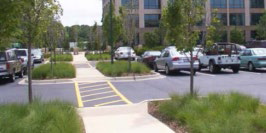
Parking areas containing over 200 parking spaces shall contain clearly marked pedestrian pathways throughout the interior of parking areas to avoid large expanses of asphalt and to enhance pedestrian safety. (See Figure 5).
Figure 5: A clearly marked pedestrian pathway, through a parking area.
(vi)
Parking lot landscaping shall include "landscape islands" at both ends of each row of parking spaces. Landscape islands shall measure nine feet in width by 19 feet in length; however, the length may be reduced to 17.5 feet where there is available area for 1.5 feet of vehicle overhang. Landscape islands shall consist of village approved deciduous tree, and decorative ground cover and be a minimum size of nine feet by 18 feet.
(vii)
Within the industrial areas, adjacent parking areas shall be connected via cross-access, as determined by staff.
(viii)
Parking areas that are in use during the evening hours or overnight in a 24-hour operation shall be effectively illuminated.
(ix)
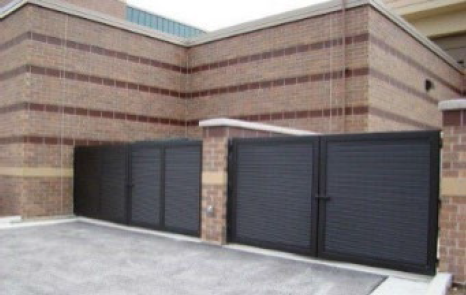
All refuse containment areas shall be located to the rear of buildings (where practical) and be provided with solid access doors or gates equipped with self-closing mechanisms. (See Figure 6).
Figure 6: Acceptable refuse containment, at the rear of an industrial building, with solid access doors.
(x)
Detached trash enclosures shall complement the overall building design. (Ord. No. 28-20, 8-3-2020)
[Must meet all ten of the applicable criteria (i)—(x) to officially meet the parking areas and trash enclosure standard.]
g.
Lighting.
(i)
Only full cut-off lighting fixtures shall be permitted to illuminate outside structures, yards, or parking lots.
(ii)
Light levels as measured at the property line, where adjacent property is zoned in the Rl, R2, R3, R4 or MH Districts, shall not exceed 0.2 footcandles. For this section, the term "adjacent" can refer to property on the opposite side of a public roadway.
(iii)
New parking lots, car sales lots, gas stations, retail stores, restaurants, self-storage, manufacturing and other similar uses as determined by the zoning officer, proposed to be located adjacent to residential properties, shall require submittal of a lighting plan for review as part of the building permit process. This plan shall include:
A.
A site photometric plan indicating initial footcandle levels in a ten-foot by ten-foot point spacing at grade to a distance of ten feet beyond the lot boundaries; and
B.
Specifications for all lighting fixtures, poles and mounting arms to be used.
5.
Review procedures.
a.
Building permit applications for new industrial buildings constructed in the IL Light Industrial, IG General Industrial, or IH Heavy Industrial districts shall be accompanied by the following:
(i)
A site plan, containing: building area, land area, floor-to-area ratio, impervious lot coverage, parking spaces, sign location(s), screened trash container area, loading docks, fire lanes, and utility easements.
(ii)
A floor plan.
(iii)
Building elevations with adequate detail to illustrate the architectural features required by the commercial design standards, as well as building dimensions, and roof pitch (where applicable).
(iv)
A landscape plan indicating plant material species (cultivar), plant locations, quantities, size at planting, and spacing.
b.
Plans must be reviewed by village staff prior to commencing construction to confirm compliance with the industrial design standards, and upon confirmation of compliance, a building permit will be granted.
c.
Changes or revisions to architectural plans following permit issuance will require subsequent review and approval by village staff prior to implementing amendments, revisions, or changes in the field.
6.
Failure to comply with architectural design standards.
a.
Developments which fail to comply with the industrial design standards and/or the approved architectural plans shall not be issued a temporary or final certificate of occupancy.
b.
The village reserves the right to issue a stop work order upon confirmation of any construction project which fails to comply with any of the provisions of the commercial design standards.
c.
A failure to comply with any provision of this section shall constitute a violation. Every day on which a violation exists shall constitute a separate violation and a separate offense. Each violation may be fined not less than $200.00 nor more than $500.00.
(Ord. No. 01-25, § 3, 3-3-2025)
Sec. Z-58. - Industrial district regulations.
(1)
Required conditions.
(a)
All production, processing, servicing, testing, repair or storage of materials, goods or products shall take place within completely enclosed buildings.
(b)
All uses shall comply with the performance standards as cited in the "Environmental Protection Act" [415 ILCS 5/1 et seq.] effective July 1, 1970, as amended, State of Illinois.
(2)
Yards. No building or structure shall hereafter be erected or structurally altered unless the following yards are provided and maintained in connection with such buildings:
(a)
Front. A front yard of at least 25 feet for buildings under 25 feet in height. For buildings exceeding 25 feet in height, the minimum front yard shall be increased by one foot for each two feet or fraction thereof by which the building height exceeds 25 feet, but in no case shall a front yead of more than 60 feet be required.
(b)
Side. A side yard equal to at least ten feet; except, on corner lots where the side yards adjoin a street, the side yard shall be the same as the front yard.
(c)
Rear. A rear yard equal to at least ten feet except on a zoning lot abutting a residential district, a real yard of at least 25 feet in depth is required. (Ord. No. 65-85)
(d)
All yards, adjacent to a Single-Family Residential (R1) Zoning lot or a Two-Family Residential (R2) Zoning lot. A 30-foot buffer area shall be provided along property lines abutting a R1 or R2 property line, not including those property lines abutting right-of way. Within the 30-foot buffer, the following shall apply:
(i)
No building shall be erected within the buffer.
(ii)
No vehicular circulation (i.e. driveways, drive lanes, maneuvering areas, loading facilities, and private streets) shall be allowed within the buffer.
(iii)
No signage shall be allowed within the buffer.
(iv)
No accessory areas (i.e. dumpsters, seating areas, patios, bicycle racks, communication towers, and other areas as defined by the planning and zoning manager) shall be allowed within the buffer. (Ord. No. 27-14, 11-3-2014)
(3)
Height.
(a)
In the IL Light Industrial District, no building shall be erected or altered to a height in excess of 45 feet.
(b)
In the IG General Industrial District, no building shall be erected or altered to a height in excess of 75 feet.
(c)
In the IH Heavy Industrial District, no building shall be erected or altered to a height in excess of 100 feet.
(4)
Table of uses. Permitted uses and special uses in the industrial zoning districts are found in article XIII, Commercial and industrial table of uses.

