
Machesney Park City Zoning Code
ARTICLE XVIII
SPECIAL ADMINISTRATIVE PROCEDURES
Sec. Z-92.- Determination as to uses not listed.
(1)
Purpose and initiation. In order to ensure that this zoning ordinance will permit all similar uses in each district, the planning and zoning commission upon its own initiative or upon written request shall determine whether a use not specifically listed as a permitted use of a special use in agricultural, residential, commercial or industrial districts shall be deemed a permitted use or a special use in one or more districts on the basis of similarity to uses specifically listed.
(2)
Application. Application for determination that a specific use should be included as a permitted use or a special use in agricultural, residential, commercial or industrial districts shall be made in writing to the planning and zoning manager and shall include a detailed description of the proposed use and such other information as may be required by the planning and zoning commission to facilitate the determination.
(3)
Investigation. The planning and zoning commission shall make or have made such investigations as it deems necessary to compare the nature and characteristics of the proposed use with those of the uses specifically listed in this ordinance, and to make a determination of its classification.
(4)
Determination. The determination of the planning and zoning commission shall be rendered in writing within 60 days, unless the applicant consents to an extension of the time period and shall include findings supporting the conclusion.
(5)
Effective date of determination. Within five days following the date of a decision of the planning and zoning commission on a request for a determination as to a use not listed, the planning and zoning manager shall transmit to the village board written notice of the decision. A decision shall become effective ten days following the date on which the determination was made or on the day following the next meeting of the village board, whichever is later, unless an appeal has been taken to the village board, or unless the village board shall elect to review the decision of the planning and zoning commission.
(6)
Appeal to village board. Within ten days following the date of a decision of the planning and zoning commission on a request for a determination as to a use not listed, the decision may be appealed to the village board by the applicant or by any other person. The appeal shall state specifically wherein it is claimed there was an error or abuse of discretion by the planning and zoning commission or wherein its decision is not supported by the evidence in the record.
(7)
Determination by village board. The determination of the village board shall be rendered in writing within 60 days unless the applicant consents to an extension of the time period and shall include findings supporting the conclusion.
Sec. Z-93. - Special use permit for planned community developments (PCDs).
(1)
Procedure. Planned community developments may be permitted in any district by special use permit in accordance with the procedures of this section.
(2)
Definitions. A planned community development is a development occupying not less than ten acres which shall include all land within the project boundaries plus one-half of all adjacent public rights-of-way involving a related group of associated uses, planned as an entity and therefore, acceptable for development and regulation as one complete land use unit.
(3)
Applicant. The applicant for a planned community development special use permit shall be the owner of the site, or if more than one, all owners of the site acting jointly. For the purposes of this section, "owner" shall mean and include any public body corporate, a holder of a written option to purchase or a redeveloper under contract with the local public agency for urban renewal.
(4)
Purpose. The planned community development provision was established for the purpose of:
(a)
Providing a procedure by which new communities or larger integrated developments may be processed.
(b)
To encourage developers to prepare comprehensive land use plans for large acreages as opposed to piece meal solutions.
(c)
To encourage variety in physical development through the use of new techniques in site development not attainable by conventional zoning application.
(d)
To insure adequate provisions for environmental amenities for new urban areas such as parks, schools, open space, utilities and services.
(5)
Permitted uses. Unless otherwise provided in this chapter, no building or land may be used, and no building may be erected, converted, enlarged or structurally altered, in a planned community development, except for the following uses:
(a)
Any use that is approved by the planned community development special use permit.
(b)
A temporary real estate office in conjunction with a planned community development limited to the selling or renting of properties in planned community development and in no case to be in operation for more than one year following completion date of such construction.
(c)
Temporary construction buildings and uses related to the planned community development, provided all buildings are removed and uses ceased upon completion date of such construction.
(d)
Accessory uses and building incidental to any use permitted or allowed by this section.
(6)
Procedure. A planned community development may be initiated by filing for a planned community development special use permit as provided in article XVIII of this chapter.
(7)
Pre-application conference. Prior to applying for a special use permit, the applicant is required to confer with the village plat officer/planner within 30 days after receipt of the following basic information and date, displayed to scale on maps:
(a)
The boundaries of the property;
(b)
Existing easements and covenants affecting the property;
(c)
Land characteristics, such as natural drainage, swamp areas, wooded areas and topography at two foot contours;
(d)
Development characteristics, such as surrounding streets, existing buildings, available community sewer, water and other utilities; and
(e)
An overall land use development plan with a road and street system accompanied with data such as land use acreage, residential density, commercial and industrial floor area relevant to the land use components scheme on the proposed development plan.
(8)
Review and recommendation. The village plat officer/planner and village engineer shall review the proposed planned community development to determine its conformity with land development trends in the community; standards of the official comprehensive plan, and recognized principles of design, land use planning and landscape architecture. The review will be conveyed in writing to the applicant within 15 days from the date of the pre-application conference.
(9)
Procedure. After receipt of the written report, the applicant may file for a special use permit. All procedural rules in regard to the filing of a special use permit shall be the same as provided for in section Z-88.
(10)
Guarantee of completion. Before final approval of a planned community development special use permit, the planning and zoning commission may recommend and the village board may require a safeguard guaranteeing completion of the planned community development in a period specified by the village board, but which period shall not exceed five years unless extended by the village board for due cause shown.
(11)
Fee. Zoning lot of not more than 20 acres in area $300.00. (Plus $25.00 for each acre or part thereof in excess of 20 acres, with a total maximum of $600.00.)
Sec. Z-94. - Planned unit development.
Residential planned unit developments may be permitted in the RR, R1, and R2 Residential Districts by a special use permit in accordance with the provisions of this article. (Ord. No. 24-17)
(1)
General purpose. The residential planned unit development special use permit is developed in order to:
(a)
Encourage unique design and site Planning of land areas through the use of criteria which, when properly implemented allows for certain flexibility and density bonuses.
(b)
Permit and foster condominium developments in accord with the provisions of the Condominium Property Act, [765 ILCS 605/1 et seq.] effective June, 1963, as amended, State of Illinois.
(c)
Provide an administrative procedure and standards to facilitate and utilize imaginative design and subdivision technology which may necessitate variation to traditional yards, setbacks, lot shapes and sizes.
(2)
Permitted uses. Unless otherwise provided in this ordinance, no building or land may be used, and no building may be erected, converted, enlarged or structurally altered in a residential planned unit development except for permitted uses listed in the district in which the residential planned unit development is applied for.
(3)
Applicant. The applicant for a residential planned unit development special use permit shall be the owner of the site, or if more than one, all owners of the site acting jointly.
For the purposes of this section, "owner" shall mean and include any public body corporate, a holder of a written option to purchase or a redeveloper under contract with the local public agency for urban renewal.
(4)
Pre-application conference. Prior to applying for a special use permit the applicant is required to confer with the village plat officer/planner, and village engineer. A conference shall be scheduled by the village plat officer/planner within 30 days after receipt of the following information and data, displayed to scale on maps:
(a)
The boundaries of the property;
(b)
Existing easements and covenants affecting the property;
(c)
Land characteristics, such as natural drainage, swamp areas, wooded areas and topography at two foot contours;
(d)
Development characteristics, such as surrounding streets, existing buildings, available community sewer, water and other utilities; and
(e)
The proposed lay out including the road and street system and the location and extent of the various type of residential uses, acreage and density. Other characteristics of the proposal such as parks, playgrounds and other community facilities.
(5)
Review and recommendation. The village plat officer/planner and village engineer shall review the proposed planned community development to determine its conformity with land development trends in the community; standards of the official comprehensive plan, and recognized principles of design, land use Planning and landscape architecture. The review will be conveyed in writing to the applicant within 15 days from the date of the pre-application conference.
(6)
Filing procedure. After receipt of the written report, the applicant may file for a special use permit. All procedural rules in regard to the filing of a special use permit shall be the same as in the case of a regular zoning petition, excepting where the same are in conflict with the terms of this section.
(7)
Application for a residential planned unit development special use permit. An application for a residential planned unit development special use permit shall be filed with the planning and zoning commission on a form prescribed by the board and provided for that purpose. The application shall consist of:
(a)
Overall development plans showing:
1.
All information and data required by chapter 32 of the Village Municipal Code (subdivision regulations) for tentative plats.
2.
Kind, location, bulk and capacity of proposed structures and uses.
3.
Proposed finished topography.
4.
Engineering and improvement plans.
5.
Provisions for automobile parking and loading.
6.
Provisions for sidewalks and bikeways.
7.
12 copies of each of the required plans.
(b)
Written statement of facts explaining in detail the proposal and justifying the project at this location. Included also will be the proposed provisions for service, maintenance and continued protection of the residential planned unit development and adjoining territory.
(c)
Fee.
Zoning lot of not less than one-half nor more than five acres in area .....$300.00
(Plus $25.00 for each acre or part thereof in excess of five acres, with a total maximum of $600.00)
The application shall include such other pertinent information as the plats officer/planner shall prescribe; but, to promote efficiency and minimize expense, the plats officer/planner may provide for the serial submission of portions of the application.
(8)
The planning and zoning commission shall review the overall design of the proposed residential planned unit development as it relates to the natural and manmade features in the immediate and surrounding area.
The planning and zoning commission shall recommend to the village board the maximum density (dwelling units per net acre) and height which should be permitted which is consistent with the character of the surrounding development. In establishing the maximum density and height, due consideration shall be given to the maximum density and height permitted in adjacent residential districts and to the actual density and height of the surrounding residential area where such exists. A residential planned unit development site may be divided into two or more parts with densities and heights determined for each part if such division will improve the total character of the development and make it more compatible with the general development of the area.
The planning and zoning commission may recommend an award of a maximum of 20 percent density bonus of the zoning district for excellence in design treatment of a proposed planned unit development in accord with the below listed environmental incentives.
(9)
Environmental incentives. The number of permitted dwelling units may be increased up to 20 percent as indicated below, provided that the percentages for each item may be applied cumulatively to a total of at least 20 percent.
(a)
Open space.
12 percent usable open space provided it equals 25 percent of site area which is (private or public) not covered by buildings, parking and streets.
Six percent dedication of public park site according to the official map and the site may be considered part of the net site area for determining dwelling units.
Six percent dedication of public school site according to the official map, and the site may be considered part of the net site area for determining dwelling units.
(b)
Site planning design.
Two percent excellence in use of existing topography and/or land re-contouring.
Four percent excellence in siting buildings and building groupings which may include variations in building setbacks.
Two percent provision in design for usable courtyards, gardens and patios. One percent proper consideration of sun and wind orientation.
One percent right-of-way provisions for riding, hiking and bicycling.
(c)
Landscape planting and screening.
One percent provision of landscaped buffer strip at least ten feet wide on all peripheral lot lines with a less restricted use.
Two percent provision of a masonry wall or solid fence five feet high on all peripheral lot lines with a less restricted use.
(d)
Facilities and amenities.
Five percent recreational facilities which may or may not include a golf course and occupying one square foot for every five square feet of residential floor area.
Five percent swimming pool (five percent for each pool; not to exceed ten percent). Three percent tennis courts (one percent for each court) and playground recreation equipment.
Five percent community center and/or club.
Two percent land area for public building site such as fire station. Three percent manmade lakes and water features.
One percent provisions for pedestrian leisure facilities, such as plazas, bicycle racks, interior sidewalks, benches, etc.
(e)
Traffic and parking.
Ten percent provision of 50 percent of required parking in an underground structure.
Additional detailed plans of site improvements and proposed documents to provide security for the installation and maintenance of utilities and community facilities and open spaces may be requested from time to time to facilitate the review of the proposed planned unit development. The planning and zoning commission may recommend reasonable conditions regarding the layout, circulation and performance of the proposed development. The planning and zoning commission may approve variation in the zoning and subdivision standards in residential planned unit developments which may permit private streets for unique developments that may utilize condominium development techniques, cluster housing concepts and other imaginative and unique development methods when consistent with the purpose of this section.
(10)
Public hearing. Upon receipt in proper form of the application referred to above, the planning and zoning commission within 60 days, unless the time period is extended by joint approval of the applicant and the planning and zoning commission shall hold at least one public hearing on the proposed residential planned unit development, at such time and place as shall be established by the board of appeals. Notice of the hearing shall be given in accordance with state statute. The village board may by ordinance, require an applicant to assume the cost of administration, public notice and due notice to interested parties.
(11)
Findings of fact and recommendation of planning and zoning commission. Within 60 days after the close of the public hearing on the proposed residential planned unit development special use permit, the planning and zoning commission shall make written findings of fact and shall submit same together with its recommendation to the village board. For the planning and zoning commission to make an affirmative recommendation, it must find in each of the following instances that:
(a)
The establishment of a residential planned unit development will not be detrimental to or endanger the public health, safety, morals, comfort or general welfare.
(b)
The residential planned unit development will not be injurious to the use and enjoyment of other property in the immediate vicinity for the purposes already permitted, nor substantially diminish and impair property values within the neighborhood.
(c)
The residential planned unit development will not impede the normal or orderly development and improvement of the surrounding property for uses permitted in the district.
(d)
Adequate utilities, access roads, drainage and/or other necessary facilities have been, are being or will be provided.
(e)
Adequate measures have been or will be taken to provide ingress and egress so designed as to minimize traffic congestion in the public streets.
(12)
Authorization. A residential planned unit development special use permit shall be authorized by a village board ordinance after a public hearing and recommendation from the planning and zoning commission. Such ordinance shall specify the maximum density (dwelling units per net acre), coverage and height for the residential planned unit development and may include such other conditions and/or restrictions upon the location, design and construction as shall be deemed necessary to secure the general objectives of this chapter.
(13)
Effect of denial. No application for a residential planned unit development special use permit which has been denied wholly or in part by the village board shall be resubmitted for a period of one year from the date of such denial, except on the grounds of new evidence or proof of changed conditions found to be valid by the planning and zoning commission.
(14)
Recorded plat required. A plat of the subdivision shall be recorded. Such plat will show building lines, common land, streets, easements and other applicable features required by chapter 32 of the Village of Machesney Park Municipal Code. All applicable procedures, standards and requirements of this Appendix of the Village of Machesney Park Municipal Code shall be followed except those in conflict with this section. No building permits or occupancy permits shall be issued until after final approval of the residential planned unit development special use permit and recording of the subdivision plat is finally approved by the village board. (Ord. No. 49-90)
(15)
Guarantee of completion. Before final approval of a residential planned unit development special use permit, the board of appeals on its own initiative may recommend and the board may require a contract with safeguards satisfactory to the village attorney guaranteeing completion of the residential planned unit development in a period specified by the planning and zoning commission, but which period shall not exceed five years unless extended by the village board.
(16)
Revocation. In any case when construction of a residential planned unit development has not commenced within one year after the date of approval, the planning and zoning commission shall review such residential planned unit development and recommend to the village board whether or not the residential planned unit development special use permit should be revoked or continued.
Sec. Z-95. - Multifamily planned unit development.
(1)
Purpose. The village's multifamily planned unit development (PUD) ordinance is intended to encourage unique and innovative land development that supports a high quality of life, sustainable, quality development, and to achieve environmental sensitivity, energy efficiency, and other village goals. While the village may allow flexible project design through the PUD process, standards are provided through this ordinance to protect public health and safety; to assure design quality; to promote consistency with the comprehensive plan; and to ensure congruity with nearby and adjacent neighborhoods. In addition, the village seeks to achieve the following specific objectives through the planned unit development ordinance:
(a)
Secure high-quality developments that protect environmentally sensitive areas by capitalizing on special site characteristics, locations and uses;
(b)
Encourage multifamily residential projects that complement the unique architectural styles and development patterns defined by nearby and surrounding neighborhoods;
(c)
Ensure the creation and enhancement of friendly, safe, and welcoming residential development projects;
(d)
Provide a higher standard of living for residents in Machesney Park;
(e)
Establish neighborhoods that enhance the livability of the community by providing places for social interaction and recreation;
(2)
Application of multifamily planned unit development standards.
(a)
Applicability. Planned unit developments shall be required for all multifamily residential development projects that contain nine or more units, whether in one building or multiple buildings.
(b)
Intent. If it is determined by the village that an owner/developer is intending to circumvent the requirements of the PUD ordinance by developing multiple phases of multifamily structures in eight or less units, the village reserves the right not to issue permits and can require a developer to file an application for a planned unit development.
(3)
Planned unit development standards.
(a)
Location. A multifamily residential PUD can be located in any R3 or R4 residential zoning district in the village, including any land proposed for annexation.
(b)
Compatibility. Development within a PUD must be compatible with adjacent and nearby existing or proposed future development. In cases where there are issues of compatibility, the PUD must provide for transition areas at the edges of the development that provide for appropriate buffering and/or ensure a complimentary character of development. Complimentary character shall be identified based on densities and intensity, lot size and dimensions, building height, architectural design, building mass and scale, exterior lighting, and landscape and natural features.
(c)
Phasing. If different phases of development are proposed for the PUD, a development phasing plan shall be provided that identifies the general sequence or phases in which the land will be developed, including how residential and nonresidential development will be timed, how infrastructure (public and private) and open space will be provided and timed, and how development will be coordinated with the village's TIF Redevelopment Plan, if applicable, and any planned public improvements. The phasing plan shall be established at the time of approval of the PUD and shall be consistent with the growth management schedule.
(d)
Public utilities. The developer shall provide written confirmation from the applicable public water and public sanitary sewer service providers that adequate public utilities are available and will not be negatively impacted by the proposed PUD. Written confirmation and a utility plan indicating all proposed utilities and easements shall be provided with the applicant's PUD application.
(e)
Public improvements. Upon approval, the PUD ordinance shall outline the owner/developer's responsibilities for providing and constructing on-site and off-site facilities for right-of-way, roadways and entrances, public utilities (including, but not limited to, water and sanitary sewer), easements, and any other required infrastructure to support the proposed multifamily residential development. The PUD ordinance shall also establish the responsibility of the owner/developer to make any other improvements as required by village codes or ordinance, and, if requested by the village, the developer shall dedicate necessary improvements to the village.
(f)
Surety. An opinion of probable construction costs for all public improvements associated with the PUD shall be provided with the PUD application, where applicable. Upon review and approval of the opinion of probable construction costs, a surety to cover the cost of required public improvements in accordance with the provisions of the village's subdivision standards must be submitted prior to the issuance of any permits for an approved PUD.
(g)
Non-residential uses. Non-residential uses are not allowed within a multifamily residential PUD, with the exception of the following development amenities:
a.
Swimming pool;
b.
Golf course;
c.
Community center;
d.
Recreation area; or
e.
Property management or leasing office.
(h)
Compliance with codes and ordinances. Plans for the PUD application shall indicate the applicable zoning, building code, energy code and fire code design requirements.
(i)
Ownership. The area designated in the PUD shall remain under single-ownership and/or unified control. Unified control of property under multiple ownership may be accomplished through the use of enforceable covenants or the enabling PUD ordinance. If land within a PUD is sold and/or ownership or controlling interest transferred, said actions shall be conditioned upon the new owners or controlling interest agreeing to build/develop the lot/land in accordance with the approved PUD approvals. Building permits shall only be issued for structures which conform to the approved PUD.
(j)
Traffic impact study. A traffic impact study shall be provided with every PUD application for 25 or more residential units. All traffic impact studies shall be completed by a professional traffic engineer (PTOE). The village shall, after reviewing the credentials and previous work of the owner/developer's consulting engineer, maintain the right to reject any proposed traffic engineer. The traffic study shall be paid for by the owner/developer. The village engineer shall be responsible for determining the scope of the traffic study, and shall determine the study area, which will generally include the entire development area as well as all existing rights-of-way and intersections within one-half mile of the development area. The traffic study shall include, at minimum, the following:
a.
An analysis of the existing and proposed conditions within the study area;
b.
An estimate the average number of daily traffic trips that will generated by the development, as outlined by the growth management plan;
c.
A capacity analysis of all major access points signalized and un-signalized intersections within the study area.
(k)
Existing land use plan incorporation. The PUD plan must implement the vision and land use policies of the comprehensive plan; the adopted tax increment financing redevelopment plans, if applicable.
(l)
Growth management. A growth management schedule shall be provided to and approved by the village board, which indicates the number of residential units to be constructed in each calendar year. The maximum number of units to be constructed shall be 25 residential units per calendar year. The village board, with a recommendation from the planning and zoning commission, can approve, deny or adjust the percentage of an increase in the number of units that can be built in one calendar year. The village board and the planning and zoning commission shall consider the following criteria in approving an increase in the number of units that can be built annually:
a.
Completion of major and collector road networks and critical linkages in the street systems;
b.
Provisions which satisfy needed public facilities for recreation, safety or otherwise;
c.
Compliance with off-street parking requirements;
d.
Innovative architectural design, quality of exterior materials and creative use of landscaping;
e.
Other criteria or extraordinary amenities, not listed above, which may meet the development goals of the village.
(m)
Special use permit review standards. Multifamily residential PUDs are considered by the village as special use permits, and shall therefore demonstrate compliance with the following findings of fact criteria:
a.
The establishment, maintenance or operation of the special use will not be detrimental to or endanger the public health, safety, morals, comfort or general welfare;
b.
The special use will not be injurious to the use and enjoyment of other property in the immediate vicinity for the purposes already permitted, not substantially diminish and impair property values within the neighborhood;
c.
The establishment of the special use will not impede the normal or orderly development and improvement of the surrounding property for uses permitted in the district;
d.
Adequate utilities, access roads, drainage and/or necessary facilities have been, are being or will be provided;
e.
Adequate measures have been or will be taken to provide ingress or egress so designated as to minimize traffic congestion in the public streets;
f.
The special use shall, in all other respects, conform to the applicable regulations of the zoning district in which it is located.
(4)
Design standards for multifamily residential planned unit developments.
(a)
Dimensional standards. All multifamily residential planned unit developments shall comply with dimensional standards for the underlying zoning district.
(b)
Sidewalks/paths. All multifamily residential planned unit developments shall provide the following pedestrian transportation amenities:
a.
Five-foot-wide concrete sidewalks or an eight-foot-wide multiuse path along every internal and adjacent public right-of-way.
b.
An internal sidewalk network connecting multiunit buildings with the public sidewalks/multi-use path.
(c)
Roadway, vehicular and pedestrian access design. The design of public streets and access roads within the PUD must comply with all applicable village standards and current applicable building codes. Right-of-way, pavement widths, and street widths may be reduced by the village board with the recommendation of staff where it is found that a proposed development demonstrates design features above and beyond the minimum standards of the PUD ordinance. In addition, PUD plans must demonstrate compliance with the following transportation design features:
a.
Proper separation of vehicular, pedestrian, and bicycle traffic;
b.
Proper access for emergency service vehicles;
c.
Adequate off-street parking as required by village ordinance;
d.
Adequate space for public utilities shall be provided within publicly dedicated rights-of-way; and
e.
Adequate space for the storage/piling of snow during the winter.
(d)
Off-street parking. Minimum off-street parking spaces shall be provided for multifamily residential developments for each dwelling unit, based on the number of bedrooms for each dwelling unit, using the following calculation:
a.
One- and two-bedroom units = 1.0 garage space and 0.25 paved guest parking spaces;
b.
Three or more-bedroom units = 1.0 garage space, 1.0 paved space adjacent to the dwelling unit, and 0.25 paved guest parking spaces;
Note: Area immediately in front of the garage door shall not be considered as a parking space adjacent to the unit and shall not be used to park vehicles.
(e)
Tree preservation. Every possible effort shall be made to retain existing, mature trees on site, as these natural features add value and provide natural buffering between adjacent properties. The community development department shall, following an inspection of the proposed development area, determine if a tree survey is required as part of the PUD application. The determination shall be based upon the department's assessment of the number and quality of existing trees on site. High quality deciduous trees, such as, but not limited to, oak, maple, hickory, and birch trees over six inches in diameter (at 4.5 feet above grade) that are removed shall be replaced on a one-to-one basis with a 2.5-inch caliper tree of similar cultivated variety within the development area. Existing and replacement trees are allowed to count towards required landscaping unit counts required in sections 20-37(14) and 20-57(7)(c).
(f)
Building design standards. All multifamily residential planned unit developments shall comply with the following architectural design standards:
a.
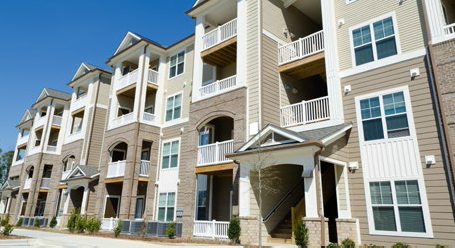
Exterior wall finishes. Plywood and metal are prohibited finish materials. Vinyl siding, cedar shakes, fiber cement siding, brick or stone masonry are required. Materials shall be high quality, durable, and shall age well without discoloring. A material sample board including actual exterior materials and colors shall be provided with every planned unit development application.
b.
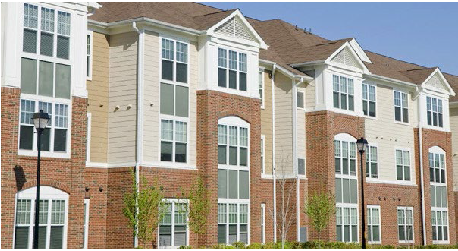
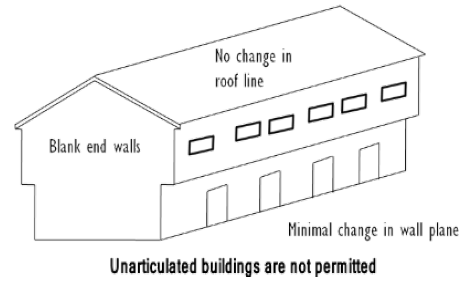
Building articulation. Street-facing horizontal elevations of building walls shall be articulated a minimum of every 30 feet, by the use of projections or recesses at least four feet in depth. All other elevations shall be articulated at least four feet in depth at a minimum of every 50 feet.
c.
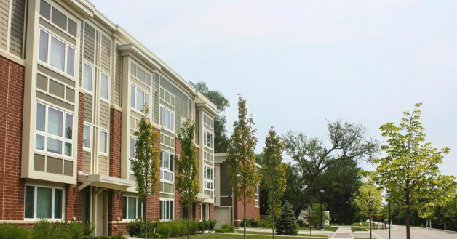
Windows. A minimum of 20 percent of street-facing façades shall contain windows or doors. All other building façades shall contain a minimum of ten percent windows or doors.
d.
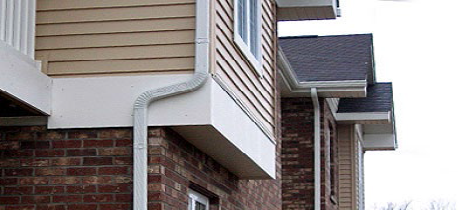
Minimum overhang. In the case of a gable or hip roof, a minimum 12-inch overhang is required. Soffit shall be required for all multi-residential structures.
e.
Entrances. Entrances shall be accompanied by a covered porch, stoop, veranda, or other features that highlight entry points and offer protection from inclement weather.
f.
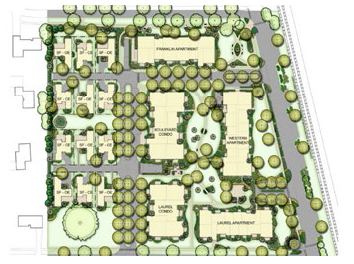
Building orientation. Buildings along a public street should be oriented to avoid multiple parallel orientations to a public street. A variety of building orientations, including perpendicular and canted, or intervening open spaces should be provided to lessen the mass of buildings along the street.
g.
Infill development. Infill development shall maintain setbacks, façade scale, and spacing compatible with adjoining and opposite buildings/land uses. All new multiunit buildings located adjacent to single-family dwelling(s) shall not exceed 150 percent the average height of all dwellings that it abuts, not to exceed 35 feet.
h.
Mailboxes. Exterior mailboxes for each multifamily development shall be alike in appearance, or a cluster box unit shall be used.
i.
Minimum building separation. The minimum separation between individual multifamily buildings within a development shall be 15 feet.
j.
Building length. The maximum length of a multifamily residential dwelling shall be 200 feet. For townhome developments, no more than six single-family attached units shall be attached in any single row.
(5)
Planned unit development review process.
(a)
Multifamily residential planned unit development process. The planned unit development process is intended to serve the community as a public engagement tool that includes residents and neighbors in the development review process for multifamily residential planned unit developments. The planned unit development process shall consist of the following four-step process:
a.
Staff review, which may include outside review consultants, as determined by village staff;
b.
Public hearing and review by the planning and zoning commission;
c.
Review by the planning and economic development committee;
d.
Review by the village president and board of trustees over two readings.
(b)
Pre-application conference. Before submitting required materials for a preliminary planned unit development review, the applicant shall request and participate in a pre-application meeting with the community development department. The purpose of the meeting is to informally discuss the general concept of the proposed development, as well as the village's review process and development standards.
(c)
Application. Refer to the planned unit development application handout, available through the community development department, for specific explanations of submittal requirements. Any person owning real property in the Village of Machesney Park may file an application for a planned unit development subject to the general provisions of this ordinance. The application shall be made in writing and shall be accompanied by plans and other information as required in the application form, along with a proper filing fee.
(d)
Procedure. Upon receipt of an application for a planned unit development, the community development department shall forward copies of application to the members of the planning and zoning commission, members of the planning and economic development committee, and to the village president and board of trustees.
(e)
Public hearing and notice. Upon receipt of a petition for a planned unit development, the planning and zoning manager shall schedule a public hearing before the planning and zoning commission, allowing adequate time for proper notice.
(f)
Report. Within 45 days, or as soon as agenda schedule permits, after all pertinent information has been received from the petitioner, and as necessary from the village staff, the petition shall be placed on the planning and zoning commission agenda. The community development department may require an earlier submittal date, if the proposed PUD is expected to require additional staff review time. Hearing/meeting dates shall not be established until all required submittals are received by the community development department. The planning and zoning commission shall review the proposed petition and report its findings to the village board as provided in this section.
(g)
Recommendations. Within 45 days following the public hearing, excluding any continuation of such hearing or extensions requested by the petitioner, the planning and zoning commission shall forward its recommendations to the planning and economic development committee and the village board.
(h)
Conditions. The planning and zoning commission may recommend and the village board, in granting any planned unit development, may impose such conditions or restrictions as appear necessary to minimize possible detrimental effects of such special use upon other properties in the neighborhood.
(i)
Action by the village board. The village board, upon receipt thereof, may adopt, with or without modification, reject or deny, the report and recommendations of the planning and zoning commission, or may refer any matter back to the planning and zoning commission for further consideration. In addition, any proposed planned unit development which fails to receive a positive recommendation of two-thirds of all the appointed planning and zoning commission members then holding office as required by this ordinance, shall not be approved by the mayor and the village board of trustees except by a favorable vote of two-thirds of all the village board members then holding office.
(j)
Failure to start construction on a multifamily residential PUD. Approval of a planned unit development shall be valid for one year after approval by village board. The village president and board of trustees may, for good cause, approve an extension of a planned unit development. The village may not grant more than three one-year extensions.
(k)
Amendments to a planned unit development. Any changes to an approved planned unit development plan may first require an amendment, prior to construction. The community development department shall review any plan changes or deviations and determine whether or not the changes are substantive and if so, will require an amendment. An amendment to the PUD shall follow the same process as a new PUD, as outlined above. When amending an approved final PUD plan, unless the homeowners' association, where one is present, is authorized to act on behalf of the entire development, every property owner within the PUD is required to consent to the amendment to the PUD.
(l)
Fees. Administrative review fees shall be submitted with every PUD application. Fees shall be based upon the size of the proposed development.
Up to and including 5.0 acres .....$500.00
Each additional 5.0 acres .....$50.00

