
Macomb City Zoning Code
ARTICLE II
IN GENERAL
Sec. 17-41. - Word usage.
The following rules of word usage apply to the text of this chapter:
(1)
The particular shall control the general.
(2)
In case of any difference of meaning or implication between the text of this unified development ordinance and any caption, illustration, summary table, or illustrative table, the text shall control.
(3)
The word "shall" is always mandatory and not discretionary. The word "may" is permissive.
(4)
Words used in the present tense shall include the future; words used in the singular number shall include the plural, and the plural the singular, unless the context clearly indicates the contrary; use of gender specific pronouns shall be interpreted to include both sexes.
(5)
A "building" or "structure" includes any part thereof.
(6)
The phrase "used for" includes "arranged for," "designed for," "intended for," "maintained for," or "occupied by."
(7)
Unless the context clearly indicates the contrary, where a regulation involves two or more items, conditions, provisions, or events connected by the conjunction "and," "or," or "either...or," the conjunction shall be interpreted as follows:
(8)
"And" indicates that all the connected items, conditions, provisions, or events shall apply.
(9)
"Or" indicates that the connected items, conditions, provision, or events may apply singly or in any combination.
(10)
"Either...or" indicates that the connected items, conditions, provision, or events shall apply singly but not in combination.
(11)
The word "includes" shall not limit a term to the specified examples, but is intended to extend its meaning to all other instances or circumstances of like kind or character.
(12)
The title "community development coordinator" as used in this unified development ordinance shall include planning staff as designated by the mayor and city council.
(Ord. No. 2750, § 2, 11-17-97)
Sec. 17-42. - Definitions.
Wherever in this chapter any of the following terms are used they shall have the meaning indicated hereafter in this article:
Abandonment means the complete discontinuance of, or actions manifesting an owner's intent to abandon, a use or a use of a building or structure.
Abutting means having a common border with, or being separated from such common border by a right-of-way, alley, or easement.
Accessory use or structure means a use or structure customarily incidental and subordinate to and located on the same lot with a principal use or structure. Where an accessory building is attached to the principal building in a substantial manner, as by a wall or roof, such accessory building shall be considered part of the principal building.
Adult use means a use where activities distinguished or characterized by their emphasis on matters depicting, describing, or relating to specified sexual activities or specified anatomical areas exceeds 25 percent of the use's activities.
Agriculture means the art or science of cultivating soil, including planting seed, harvesting of crops and raising, feeding and management of livestock or poultry.
Alley means any public right-of-way affording a secondary means of access to abutting property, and not intended for general traffic circulation.
Allowable encroachment. See "encroachment, allowable."
Alterations means a change or rearrangement in the structural parts or in the existing facilities of a building or structure; or an enlargement whether by extending on a side or by increasing height; or the moving from one location or position to another.
Amendment means any addition to, deletion from, or change in the text or map of this chapter.
Amusement devices means any machine or device which may be operated by the public and the intent of which is to entertain the operator of the machine through games of skill or chance or other audio/visual stimulation. The term does not include adult uses.
Amusement establishment means any establishment where the use of amusement devices for compensation exceeds 50 percent of the establishment's activities.
Animal hospital means any building or portion thereof designed or used for the care, observation, or treatment of domestic animals. See also, "kennel, commercial".
Animal waste lagoons [means] livestock waste handling facilities used for collecting, pumping, treating or disposing of livestock waste or for the recovery of by-products from such livestock waste. Such facilities include disposal areas, such as pasture or other suitable agricultural land, which serves as a filtering device to settle out and assimilate pollutants from animal waste before the clarified water reaches a stream or other body of surface or ground water. Animal waste includes livestock excreta and associated feed losses, bedding, wash waters, sprinkling water from livestock cooling, precipitation polluted by falling on or flowing onto an animal feeding operation and other materials polluted by livestock. Two or more livestock waste handling facilities under common ownership are deemed to be a single livestock waste handling facility if they are within ¼ mile of each other.
Antenna means any device designed to transmit or receive wave signals to or from any source whatsoever, including satellite dishes designed for home entertainment purposes.
Antenna tower means any structure designed for the mounting of an antenna.
Apartment means any dwelling unit in a multiple-family dwelling.
Apartment building means a multiple-family dwelling in which each individual dwelling unit is provided with an entrance to a common hallway, and share a common entrance to the outdoors, exterior balcony or exterior walkway.
Appeal means a request to review a decision or interpretation of the community development coordinator or other permitted official relative to the administration of this chapter.
Architectural features means ornamentation or decorative features attached to or protruding from an exterior wall.
Assembly hall means a building or structure or portion thereof designed and used to conduct conferences, seminars, and other such activities.
Assisted living facility means the exclusive use of a facility for adults in need of some protective oversight or assistance due to functional limitations, which provides a living arrangement that integrates shelter, food and other supportive services to maintain a resident's functional status.
Basement means that portion of a building which is partly or wholly below grade but so located that the vertical distance from the average grade to the floor is greater than the vertical distance from the average grade to the ceiling. A basement shall not be counted as a story.
Bed and breakfast means an owner-occupied single-family dwelling where short term lodging and morning meals are provided for compensation.
Bedroom means a room or area within a dwelling unit designed and intended to provide sleeping accommodations for one or more human beings.
Block means the property abutting one side of a street, and lying between the two nearest intersecting or intercepting streets, or between the nearest intersecting or intercepting street and railroad right-of-way, unsubdivided acreage, lake, river, or live stream; or between any of the foregoing and any other barrier to the continuity of development, or corporate boundary lines of the city.
Board means the board of zoning appeals.
Boardinghouse. See "lodginghouse."
Build includes the terms establish, construct, erect, assemble, reconstruct, enlarge, alter or develop.
Buildable area means the area of the lot remaining after the minimum open space and/or yard requirements of this chapter have been complied with.
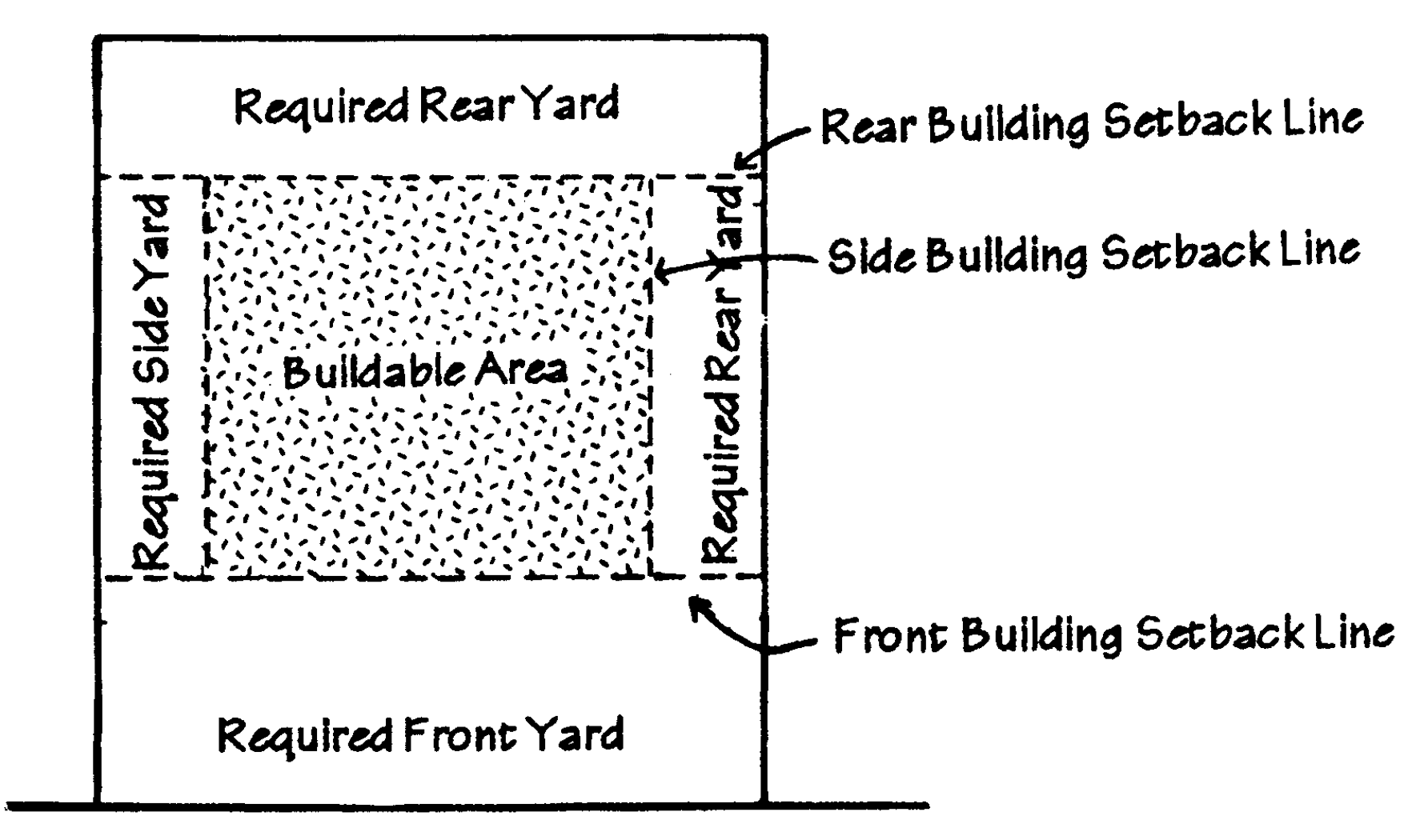
Building means any structure, either temporary or permanent, having a roof supported by columns or walls, and intended for the shelter, or enclosure of persons, animals, chattels, or property of any kind.
Building, nonconforming means a building or portion thereof, lawfully existing at the effective date of the ordinance from which this chapters derives, or amendments thereto and that does not conform to the provisions of the chapter in the district in which it is located. See also "lot, nonconforming," "structure, nonconforming," and "use, nonconforming."
Building, principal means a nonaccessory building in which the principal use of the lot is conducted.
Building change means any alteration, demolition, reconstruction, removal or construction to or upon a building.
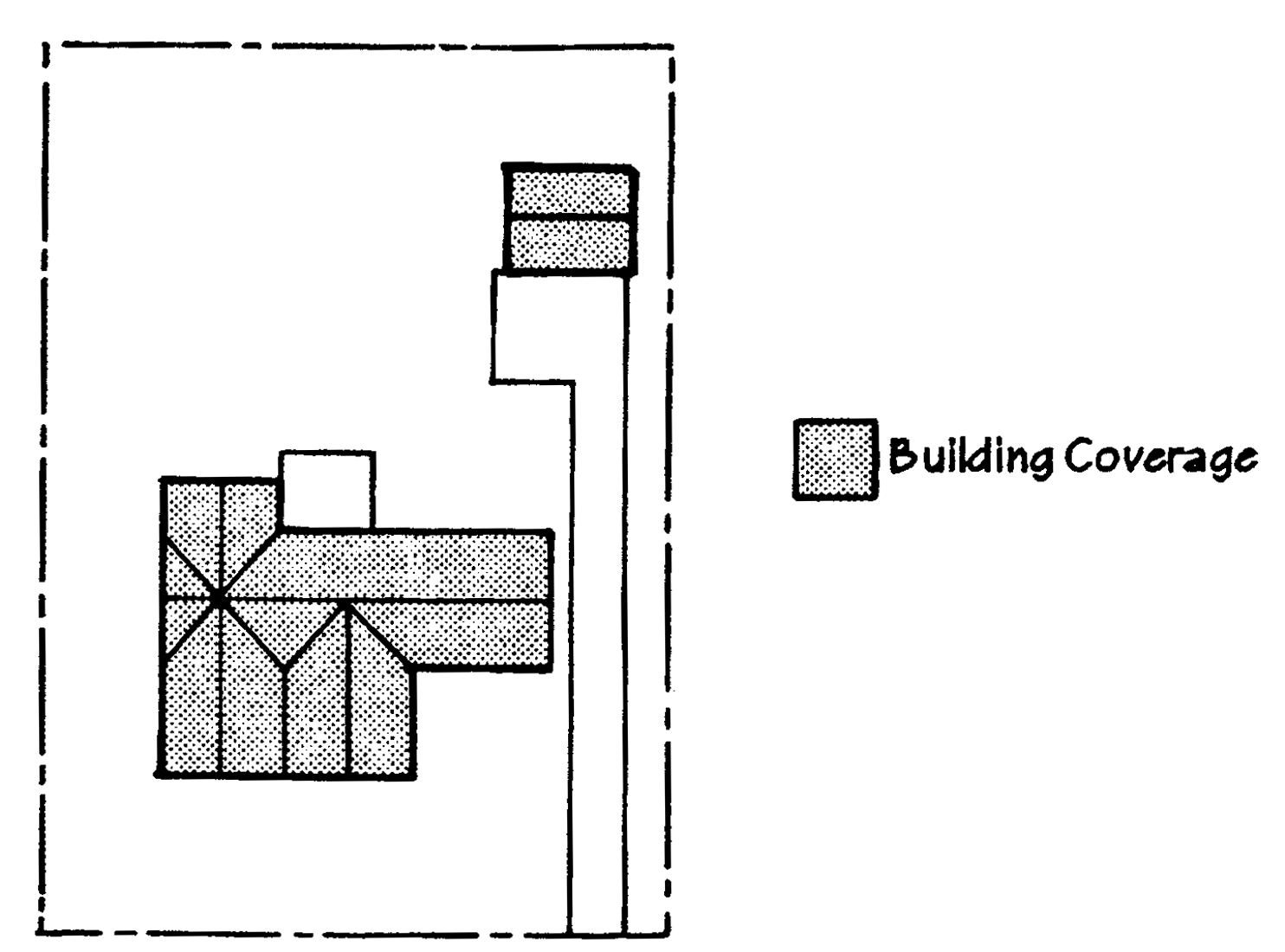
Building coverage means the lot area covered by the principal building(s) and any roofed over accessory buildings or structures, measured from the exterior faces of exterior walls, but excluding decks, terraces and other accessory uses and structures which are open to the sky.
Building height. See "height, building."
Building line means a line formed by the face of the building, and for the purposes of this chapter, a minimum building line is the same as a front building setback line.
Building setback line, front means a line establishing the minimum allowable distance between a street or other right-of-way and any structure as measured from the front property line or right-of-way (see "yard, required.").
Building setback line, side or rear means a line establishing the minimum allowable distance between a property line and any structure as measured from the property line (see "yard, required.").
Bulk. The term "bulk" signifies the size of buildings in terms of floor area and floor area ratio, the location of building wall in relation to lot lines and to the exterior walls of other buildings, and the yards, front, side and rear, required under the terms of this chapter.
Business means an occupation, employment, or enterprise which occupies time, attention, labor and materials, wherein merchandise is exhibited or sold, or where services are offered or provided.
Cannabis business establishment: A cannabis cultivation center, craft grower, processing organization, infuser organization, dispensing organization or transporting organization.
Cannabis café/lounge: A facility operated by an organization or business that is licensed by the City of Macomb to allow onsite cannabis consumption as is allowed pursuant to the laws of the State of Illinois and the regulations for licensing as adopted by the City of Macomb.
Cannabis craft grower: A facility operated by an organization or business that is licensed by the Illinois Department of Agriculture to cultivate, dry, cure and package cannabis and perform other necessary activities to make cannabis available for sale at a dispensing organization or use at a processing organization, per the Cannabis Regulation and Tax Act, (P.A. 101-0027), as it may be amended from time-to- time, and regulations promulgated thereunder.
Cannabis cultivation center: A facility operated by an organization or business that is registered by the Illinois Department of Agriculture to cultivate, process, transport and perform necessary activities to provide medical cannabis dispensing organizations with usable medical cannabis, or provide cannabis and cannabis-infused products to licensed cannabis business establishments, per the Cannabis Regulation and Tax Act, (P.A. 101-0027), as they may be amended from time to time, and the regulations promulgated thereunder.
Cannabis dispensing organization: A facility operated by an organization or business that is licensed by the Illinois Department of Financial and Professional Regulation to acquire cannabis from licensed cannabis business establishments for the purpose of selling or dispensing cannabis, cannabis-infused products, cannabis seeds, paraphernalia or related supplies to purchasers per the Cannabis Regulation and Tax Act, (P.A. 101-0027), as it may be amended from time to time, and regulations promulgated thereunder, or to qualified registered medical cannabis patients and caregivers.
Cannabis infuser organization or infuser: A facility operated by an organization or business that is licensed by the Illinois Department of Agriculture to directly incorporate cannabis or cannabis concentrate into a product formulation to produce a cannabis-infused product, per the Cannabis Regulation and Tax Act, (P.A. 101-0027), as it may be amended from time-to-time, and regulations promulgated thereunder.
Cannabis processing organization or processor: A facility operated by an organization or business that is licensed by the Illinois Department of Agriculture to either extract constituent chemicals or compounds to produce cannabis concentrate or incorporate cannabis or cannabis concentrate into a product formulation to produce a cannabis product, per the Cannabis Regulation and Tax Act, (P.A. 101-0027), as it may be amended from time-to-time, and regulations promulgated thereunder.
Cannabis transporting organization or transporter: An organization or business that is licensed by the Illinois Department of Agriculture to transport cannabis on behalf of a cannabis business establishment or a community college licensed under the Community College Cannabis Vocational Training Pilot Program, per the Cannabis Regulation and Tax Act, (P.A. 101-0027), as it may be amended from time-to-time, and regulations promulgated thereunder.
Car wash means a building, or portion thereof, containing facilities for washing one or more automobiles at any one time, using production line methods such as a chain conveyor, blower, steam cleaning device, or other mechanical devices; or providing space, water, equipment, or soap for the complete or partial cleaning of such automobiles, whether by operator or by customer.
Certificate of occupancy means a certificate certifying that the building, as illustrated on approved plans and as constructed, conforms to the provisions of this chapter or is a lawfully existing nonconforming building.
Charitable institution means an organization that operates on a not-for-profit membership basis; and/or the office or meeting facility for such an organization.
Church. See "place of worship."
City means the "City of Macomb, Illinois."
City engineer means a qualified civil engineer employed or contracted by the city council in the capacity of city engineer.
Club or lodge means a nonprofit association of persons, who are bona fide members paying dues, which owns, hires, or leases a building, or portion thereof, the use of such premises being restricted to members and their guests. The affairs and management of such "private clubs or lodge" are conducted by a board of directors, executive committee, or similar body chosen by the members.
College or university means a public or private institution providing full-time or part-time education beyond the high school level and including any lodging rooms or housing for students or faculty. Business or trade schools are not considered colleges or universities.
Commission means the city planning commission.
Commitment means a recordable written agreement or pledge which may include a site plan, setting forth any binding limitations of use or development.
Community center means a building, together with lawful accessory buildings and uses, for recreational, social, educational, or cultural activities which is not operated for profit.
Community development coordinator means a staff member of the office of building and zoning who is authorized to hear complaints, make inspections, and take action to enforce the provisions of this chapter. The community development coordinator may also accept applications for amendments or variances to this chapter and administrate the related public hearings or procedures.
Comprehensive plan means the complete Comprehensive Plan of the City of Macomb and its planning jurisdiction and all of its subsequent amendments, or any of its parts, prepared by the commission, and adopted in accordance with state law.
Concentrated animal feeding operation [means] a lot or facility where structures are used to house the feeding of any number of cattle, milk cows, swine, sheep, lambs, goats, turkeys and/or chickens for more than 90 days in any one-year period; and crops, vegetation, forage growth or post-harvest residues are not sustained in the normal growing season over any portion of the lot or facility. Two or more animal feeding operations under common ownership are deemed to be a single concentrated animal feeding operation if they are within ¼ mile of each other or if they utilize a common area or system for the disposal of wastes. The feeding of animals at county fairs, university research farms and livestock shows are not considered concentrated animal feeding operations.
Conditional use. See "special use."
Condominium means an apartment which is privately owned by an individual owner or owners, who may or may not reside on the premises.
Construction means on-site erection, fabrication, installation, placement, alteration, demolition or removal of any structure, facility, or addition thereto, including all related activities, including, but not restricted to, clearing of land, earth moving, blasting and landscaping.
Contiguous area means all unincorporated area adjacent to the City of Macomb and as established on the zoning maps contained as part of this chapter.
Convalescent, nursing or rest home means an establishment for the care of the aged or infirm, or a place of rest for those suffering bodily disorders. Such establishment includes spaces where persons are housed or lodged and are furnished with meals, nursing, and medical care, but does not contain equipment for surgical care or for the treatment of disease or injury.
Convenience store means any retail establishment offering for sale prepackaged food items, household items, and other goods commonly associated with the same and having a gross floor area of not more than 7,500 square feet.
Crosswalks means easements to the public "for the purpose of foot traffic. Each adjacent lot shall extend to the center of the required crosswalk, which shall be provided with an all-weather surface, no less than five feet in total width. Minimum side yard requirements shall be increased on each adjacent lot to the width that lot projects into the easement.
Cul-de-sac means a short street having one open end to traffic and being permanently terminated by a vehicle turn-around.
Day means one calendar day. If a projected day falls on a weekend or holiday, the next following working day or week day shall fulfill requirements.
Day care center means an institution or place, other than a day care home, in which are received children, apart from their parent or guardian, for compensation, for a period no less than four and no more than 24 hours per day. The term "day care center" includes but is not limited to the following: nursery schools, child care centers, day nurseries, kindergartens and play groups, but does not include bona fide kindergartens or nursery schools operated by public or private elementary or secondary school systems. Day care centers must be licensed by and are subject to the applicable requirements of the city and state.
Day care home means a residential dwelling unit occupied by a family which receives no less than six and no more than 16 children, apart from their parent or guardian, for compensation, for a period no less than four and no more than 24 hours per day. The maximum of 16 children excludes the family's natural or adopted children and all other persons over the age of seven. The term does not include facilities which receive children from a single household or less than six children total. Day care homes must be licensed by, and are subject to the applicable requirements of, the city and state.
Day care operator means a person over 21 years of age who is responsible for the direct care, protection, and supervision of children in a day care center or day care home. Day care operators must be licensed by, and are subject to the applicable requirements of, the city and state.
Deck means an accessory structure which is constructed directly over and elevated from ground level and which is open to the sky.
Demolition means the complete removal or destruction of any structure.
Density means a unit of measurement describing the number of dwelling units per gross acre. This chapter may regulate this by establishing the permitted number of units per acre or the amount of land, measured in square feet or acres, required per individual unit.
Developer means any person engaged in developing or improving a lot or group of lots or structures thereon for use for occupancy.
Development means the construction of a new building or other structure on a zoning lot, the relocation of an existing building on another zoning lot, or the use of open land for a new use. For the purpose of flood regulations, "development" means any manmade change to improved or unimproved real estate, including but not limited to:
(1)
Construction, reconstruction, or placement of a building or any addition to a building valued at more than $1,000.00;
(2)
Installing a manufactured home on a site, preparing a site for a manufactured home or installing a travel trailer on a site for more than 120 days;
(3)
Installing utilities, erection of walls and fences, construction of roads, or similar projects;
(4)
Construction of flood control structures such as levees, dikes, channel improvements, etc.;
(5)
Mining, dredging, filling, grading, excavation, or drilling operations;
(6)
Construction and/or reconstruction of bridges or culverts;
(7)
Storage of materials; or
(8)
Any other activity that might change the direction, height, or velocity of flood or surface waters.
Development does not include activities such as the maintenance of existing buildings and facilities such as painting, reroofing; resurfacing roads; or gardening, plowing, and similar agricultural practices that do not involve filling, grading, excavation, or the construction of permanent buildings.
Development plan means a plan for the siting and servicing of one or more structures, including considerations of building arrangements, circulation, public facilities and land-structure relationship.
Development standards include height, bulk and density and other standards for development as set forth in this unified development ordinance.
Disabled having:
(1)
A physical or mental impairment that substantially limits one or more of a person's major life activities so that such person is incapable of living independently,
(2)
A record of having such an impairment,
(3)
Being regarded as having such an impairment.
Disabled shall not include current illegal use of or addiction to a controlled substance, nor shall it include anyone whose residency in a group home for the disabled would constitute a direct threat to the health and safety of other individuals.
District, zoning means a portion of the incorporated area or unincorporated area within the city's zoning jurisdiction where certain regulations and requirements or various combinations thereof apply under the provisions of this title.
Dormitory means a building or part of a building containing a room or rooms forming one or more habitable units which are used or intended to be used by residents primarily for living and sleeping.
Drive means a vehicular access to a development site other than one which has or shall be dedicated to the public, including private streets or roads. Regulations and standards for public streets shall apply to drives. Driveways shall not be considered drives. See also "street, private."
Driveway means a paved area intended solely for the purpose of accessing a garage or parking area.
Drive-in or drive-through facility means a facility developed such that its retail or service character is dependent upon providing a driveway approach or parking spaces for motor vehicles so as to serve patrons while in the motor vehicle rather than within a building or structure, or to provide self-service for patrons.
Dwelling means a building or portion thereof designed or used exclusively for residential occupancy, including single-family dwellings, two-family dwellings, and multiple-family dwellings, but not including hotels or motels, camp cars, trailers, or any other vehicle on or off wheels.
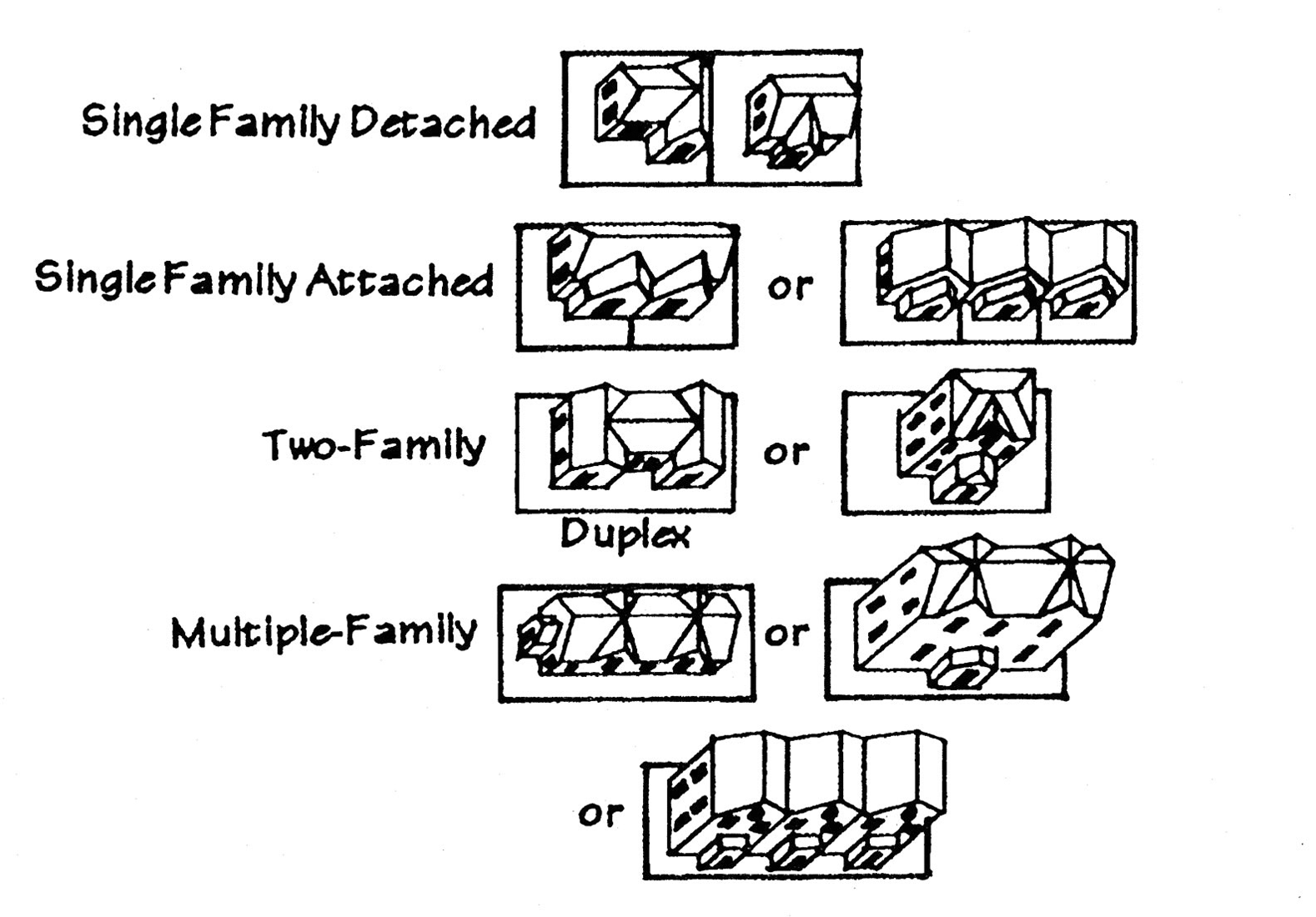
Dwelling, duplex means a two-family dwelling in which the two dwelling units are attached horizontally via a common party wall or walls, and each if which has a separate ground floor entrance to the outdoors.
Dwelling, multiple-family means a dwelling containing three or more dwelling units where each unit is provided with an individual entrance to the outdoors or to a common hallway. Multiple-family dwellings may include apartment buildings, townhouses, and senior citizen housing as defined herein. The dwelling units may include condominiums.
Dwelling, single-family means a dwelling containing only one dwelling unit.
Dwelling, single-family attached means a single-family dwelling attached to other single-family dwellings at one or both sides by party walls, with no more than four single-family dwellings total, and each of which has a separate ground floor entrance to the outdoors. Single-family attached dwellings include row houses.
Dwelling, single-family detached means a single-family dwelling which is completely separate from other single-family dwellings.
Dwelling, two-family means a building containing two dwelling units, attached either vertically or horizontally.
Dwelling unit means any room or group of rooms located within a dwelling and forming a single habitable
unit for occupancy by one family with facilities that are used, or intended to be
used for living, sleeping, cooking, and eating.
House Drawings
Easement means land or an interest in land that has been designated by lawful agreement between the owner or owners of the land and another person or persons, for a specified use only by such person or persons.
Effective date means the date this chapter was passed and became effective.
Employee means a person who, with or without compensation, works for a business or organization on a regular, semi-regular, or recurring basis.
Encroachment means an accessory structure or building located within a required yard, or an appendage to a principal building which projects into a required yard. See also "allowable encroachment."
Encroachment, allowable means any accessory building or structure, including appurtenances on principal buildings, which is located within a required yard and is permitted under Article VII, Division 4 of this chapter.
Establishment means a facility carrying on operations, the ownership and management of which are separate and distinct from those of any other facility located on the same zoning lot.
Excavation means any breaking of ground, except common household gardening and ground care.
Family in R-1 and R-2 Districts means any one of the following itemized groups of persons living together as a single housekeeping unit and sharing common living, sleeping, cooking and eating facilities:
(1)
Any number of persons related by blood, marriage, adoption, guardianship or other duly authorized custodial relationship. Relation by blood shall include only persons having one of the following relationships with other individual(s) residing within the same housekeeping unit: parents, grandparents, children, sisters, brothers, grandchildren, stepchildren, first cousins, aunts, uncles, nieces or nephews;
(2)
Not more than two unrelated persons;
(3)
Two unrelated persons and his and/or her children by means of blood, adoption or guardianship;
(4)
An individual or group of two or more persons related by blood, marriage or legal adoption together with not more than six minor children operating as a foster family home or group home licensed by the State of Illinois;
(5)
A group home for the disabled as defined in Article Two, Chapter One, Section Two of the Unified Development Code of the City of Macomb;
(6)
Three or more people who are granted a Special Use Permit as a "Functional Family Unit" as defined by the Unified Development Code of the City of Macomb.
One additional unrelated person may reside in a single housekeeping unit and be defined as family within R-1 or R-2 districts as noted in items (1)—(4) above; provided however that such person can be described as meeting one of the following three criteria:
(1)
An active foreign exchange student authorized through, sponsored by and recognized by Macomb Community School District #185.
(2)
A person whose primary purpose for residing in a household is to provide care, and/or aid to one or more other individuals also residing within the same housekeeping unit who are in reasonable need of assistance due to temporary or permanent physical or mental disabilities.
(3)
A person employed and monetarily compensated specifically for the purpose of providing in-home, live-in child care services to dependant minor children who reside within the same household as the caregiver.
In R-1 and R-2, single family residential zoning districts, a family does not include:
(1)
Any society, club, fraternity, sorority association, lodge, combine, federation, coterie or like organizations;
(2)
Any group of individuals whose association to each other is temporary and/or seasonal in nature;
(3)
Any group of individuals who are in a group living arrangement as a result of criminal offenses.
In R-3, R-3A, R-4, RMH-1, residential zoning districts, in the ASMU district and in the case of any non-conforming residential uses in non-residential districts, a family may consist of any of the following living together as a single housekeeping unit and sharing common living, sleeping, cooking and eating facilities within a dwelling unit:
(1)
Any number of persons related by blood, marriage, adoption, guardianship or other duly authorized custodial relationship. Relation by blood shall include only persons having one of the following relationships with other individual(s) residing within the same housekeeping unit: parents, grandparents, children, sisters, brothers, grandchildren, stepchildren, first cousins, aunts, uncles, nieces or nephews together with not more than three additional unrelated persons.
(2)
An individual or group of two or more persons related by blood, marriage or legal adoption together with not more than six minor children operating as a foster family home or group home licensed by the State of Illinois.
Farm means the carrying on of any agricultural activity or the raising of livestock or small animals as a source of income.
Fast food restaurant. See "restaurant, fast food."
Fence means a structure that is a barrier and is used as a boundary or means of protection or confinement, which is made of materials including but not limited to: wire mesh, chain link, wood or stone.
Final plat means a map of subdivision with accompanying material, intended for final approval and recording, on the basis of which land can be transferred, leased, or encumbered.
Flood, regulatory means the flood having a one percent probability of being equaled or exceeded in any given year, as calculated by a method and procedure which is acceptable to and approved by the state natural resources commission. The regulatory flood is also known by the term base flood.
Floodplain means the channel proper and the areas adjoining any wetland, lake or watercourse which have been or hereafter may be covered by the regulatory flood. The floodplain includes both the floodway and the floodway fringe districts.
Floodway means the channel of a river or stream and those portions of the floodplains adjoining the channel which are reasonably required to efficiently carry and discharge the peak flood flow of the regulatory flood of any river or stream.
Floodway fringe means those portions of the floodplain lying outside the floodway.
Floor area, gross means the sum of the gross horizontal areas of the several floors of such building or buildings measured from the exterior faces of exterior walls or from the centerline of party walls separating two buildings. In particular. "gross floor area shall include:
(1)
Basement space if at least one-half of the basement story height is above the average level of the finished grade at the foundation line.
(2)
Elevator shafts and stairwells at each floor.
(3)
Attic floor space where there is structural headroom of more than seven and one-half feet.
(4)
Interior balconies and mezzanines.
(5)
Enclosed porches.
(6)
Accessory uses.
For the purposes of determining floor area ratio, however, "Gross floor area" shall not include:
(1)
Basement space where more than one-half of the basement story height is below the average level of the finished grade.
(2)
Elevator and stair bulkheads, water tanks and cooling towers.
(3)
Attic floor space where structural headroom is six and one-half feet or less
(4)
Floor space used for mechanical equipment where structural headroom is six and one-half feet or less;
(5)
Terraces, breezeways and open porches.
Floor area ratio (FAR) means the numerical value obtained through dividing the gross floor area of a building or buildings by the total area of the lot or parcel of land on which such building or buildings are located.
Fraternity or sorority means an organization of persons which provides sleeping accommodations, with or without accessory common rooms and cooking and eating facilities, for groups of unmarried students in attendance at an educational institution; and which is recognized as a fraternity or sorority by the educational institution or national chapter.
Frontage means the entire length of the subject property which abuts and is parallel to a public right-of-way as measured along the right-of-way line.
Functional family unit means in R-1 and R-2, single family residential zoning districts, a functional family unit shall consist of a group of individuals living together in a single dwelling unit and functioning as a family with respect to those characteristics that are consistent with the purposes of zoning restrictions in single family residential neighborhoods. In determining whether or not a group of unrelated individuals is a functional family unit under this definition, the following criteria must be used.
(1)
The occupants must share the entire dwelling unit. A unit in which the various occupants act as separate roomers cannot be deemed to be occupied by a functional family unit.
(2)
The following factors shall be considered in determining whether a functional family unit exists:
(a)
The presence of minor dependent children regularly residing in the household;
(b)
Proof of the sharing of expenses for food, rent or ownership costs, utilities and other household expenses and sharing in the preparation, storage and consumption of food;
(c)
Whether or not different members of the household have the same address for the purposes of voter registrations, drivers' licenses, motor vehicle registrations, summer or other residences and the filing of taxes;
(d)
Common ownership of furniture and appliances among the members of the household;
(e)
Enrollment of dependent children in local schools;
(f)
Employment of the householders in the local area;
(g)
A showing that the household has been living together as a unit for a year or more, whether in the current dwelling unit or other dwelling units;
(h)
Any other factor reasonably related to whether or not the group or persons in the functional equivalent of a family.
Garage, private means an accessory building housing not more than four motor vehicles, not more than one of which may be a commercial vehicle but of not more than one and one-half tons capacity, for the use of the occupants of the lot on which the garage is located, or for others not transients, and at which automobile fuels and oils are not sold, and motor vehicles are not equipped, repaired, hired or sold.
Garage, public means any garage or structure other than a private garage, or one available to the public, operated for gain, or used for storage, repair, rental, adjusting, selling or equipping of automobiles or other motor vehicles.
Gas station. See "vehicle service station."
Grade means the ground elevation established for the purpose of regulating the number of stories and the height of buildings. The building grade shall be the level of the ground adjacent to the walls for the building if the finished grade is level. If the ground is not entirely level, the grade shall be determined by averaging the elevation of the ground for each face of the building.
Grade, average means the average of the elevation of the ground for each face of the building or structure.
Grade, finished mens the level of the ground adjacent to the building or structure.
Group home means a dwelling shared by four or more disabled persons, including resident staff, who live together as a single housekeeping unit and in a long-term, family-like environment in which staff persons provide care, education, and participation in community activities for the residents with the primary goal of enabling the residents to live as independently as possible in order to reach their maximum potential. Group homes for the disabled shall not include alcoholism or drug treatment centers, work release facilities for convicts or ex-convicts, or other housing facilities serving as an alternative to incarceration.
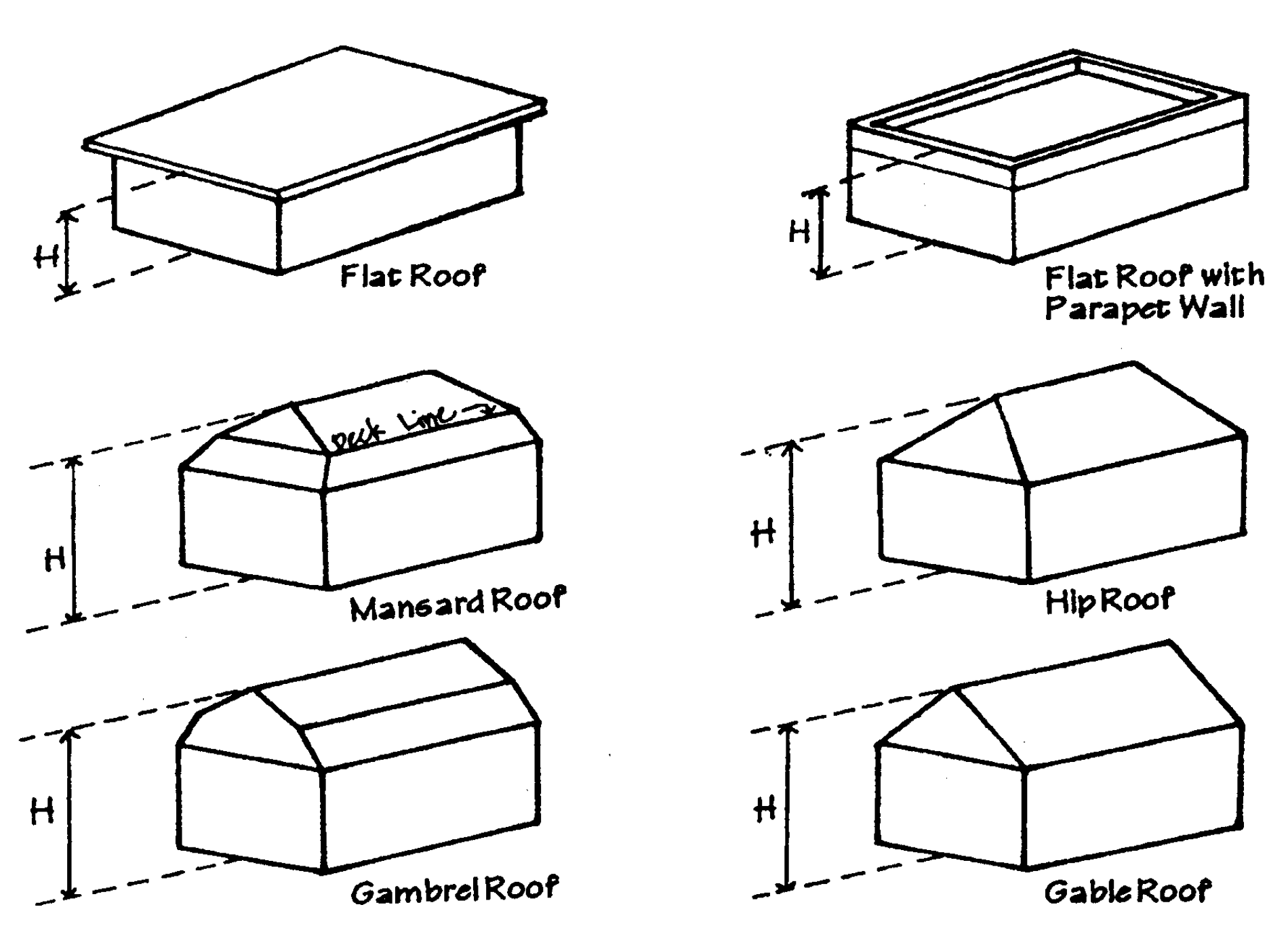
Height, building means the vertical distance measured from the established grade to the highest point of the roof surface for flat roofs; to the deckline of mansard roofs; and to the average height of the eaves and ridge for gable, hip, and gambrel roofs.
roofs
Height, structure means the vertical distance to the highest point of the structure measured from the natural grade, except buildings, for which height is defined in "height, building."
Home occupation means any use conducted entirely within a dwelling and participated in solely by members of the family residing therein, such use is clearly incidental and secondary to the use of the dwelling for dwelling purposes and does not change the character thereof.
Homeless shelter—Interim/intermittent: A facility utilized, in part, to provide temporary housing as an accessory use, including meals and sleeping arrangements, for displaced and/or homeless persons but not for persons currently receiving active treatment for, or presently suffering from, the effects of alcoholism or drug addiction or who are convicted of a sexually related offense, or who are currently receiving treatment for a sexually related offense, or a person who is on a registered sexual offender list or has been convicted of a violent crime. A homeless shelter shall provide a minimum of 50 sq. ft. of floor space per person served and/or bed or sleeping space provided; shall have at least one staff person on-site for every seven persons served; and shall operate only during the hours of 5:00 p.m. to 12:00 noon for not more than three days/week. Institutional uses in B-2, R-4, O/I, M-1 or M-2 zoning districts shall not be required to exclude persons with alcohol or drug abuse issues as previously stated within this definition.
Homeless shelter—Permanent: A facility utilized primarily to provide housing, including meals and sleeping arrangements on a long term basis, for displaced and/or homeless persons, but not for persons who are convicted of a sexually related offense, or who are currently receiving treatment for a sexually related offense, or a person who is on a registered sexual offender list, or a person who has been convicted of a violent crime. A permanent homeless shelter shall provide a minimum of 50 sq. ft. of floor space per person served and/or bed or sleeping space provided; shall have at least one staff person on-site for every seven persons served; and shall operate for more than 120 consecutive calendar days and/or more than three days/week for a minimum of 12 hours each day.
Hospital means an in-patient medical institution devoted primarily to the maintenance and operation of facilities for the diagnosis, treatment, and care of individuals suffering from illness, disease, injury, deformity or other abnormal physical or mental condition.
Hotel means a building or part of a building, with a common entrance, in which the dwelling units or rooming units are used primarily for transient occupancy, and in which one or more of the following services are offered: maid service, linen service, telephone, secretarial or desk service, and bellboy service. A hotel may include a restaurant or cocktail lounge, public banquet halls, ballrooms, or meeting rooms.
Jurisdiction means the incorporated territory of the city and its contiguous area.
Kennel, commercial means any lot or premises on which three or more dogs, cats, or other household pets are either permanently or temporarily boarded for pay.
Laboratory means a place devoted to experimental study such as testing and analyzing. Manufacturing of produce or products is not to be permitted within this definition.
Landmark means any structure which:
(1)
Has historic significance;
(2)
Represents one or more periods or styles of architecture typical of one or more eras important to the city's history;
(3)
Has been designated as a landmark pursuant to this chapter.
Landmark district means any area that contains structures which:
(1)
Have historic significance;
(2)
Represent one or more periods or styles of architecture typical of one or more eras in the city's history, or represent an assemblage of structures important to the city's history;
(3)
Cause such area, by reason of such factors, to constitute an identifiable area; and
(4)
Have been designated as a landmark district pursuant to this chapter.
Landscaping means the aesthetic improvement of property through the installation of plant materials, berming, walls and fences, and other decorative elements.
Landscape area means that portion of a lot devoted exclusively to landscaping, except that streets, drives and sidewalks may be located within such area to provide reasonable access.
Landscape buffer means a continuous landscaped area designed, maintained and used for screening and separation of districts, lots, or buildings.
Large lot development means a development in which all lots are at least one acre in size.
Line of sight means a clear line of vision at an intersection.
Lodging/boarding/rooming house: A structure occupied by at least five but not more than 30 individuals renting individual rooms for pre-arranged periods of time but for not less than a minimum of 30 consecutive days, subject to the requirements of this Chapter. The structure may contain shared bathroom facilities but must contain common entrance/exit ways and a common kitchen area for cooking and dining within the same structure.
Loading space means an off-street space on the same lot with a building, or group of buildings, for the temporary parking of a commercial vehicle while loading and unloading merchandise or materials.
Lot means a parcel of land occupied or intended to be occupied by a main building or a group of such buildings and accessory buildings, or utilized for the principal use and uses accessory thereto, together with such yards and open spaces as are required under the provisions of this chapter. A lot may or may not be specifically designated as such on public records.
Lot, corner means a lot where the interior angle of two adjacent sides at the intersection of two streets is less than 135 degrees. A lot abutting upon a curved street or streets shall be considered a corner lot for the purposes of this chapter if the arc is of less radius than 130 feet, and the tangents to the curve, at the two points where the lot lines meet the curve or the straight street line extended, form an interior angle of less than 133 degrees.
Lot, interior means any lot other than a corner lot.
Lot, nonconforming means a lot which lawfully existed at the effective date of this chapter or amendments thereto, and that does not conform to the area, width, or other regulations of the district in which it is located.
Lot, through means any interior lot having frontage on two more or less parallel streets as distinguished from a corner lot. In the case of a row of double frontage lots, all yards of such lots adjacent to streets shall be considered frontage, and front yard setbacks shall be provided as required.
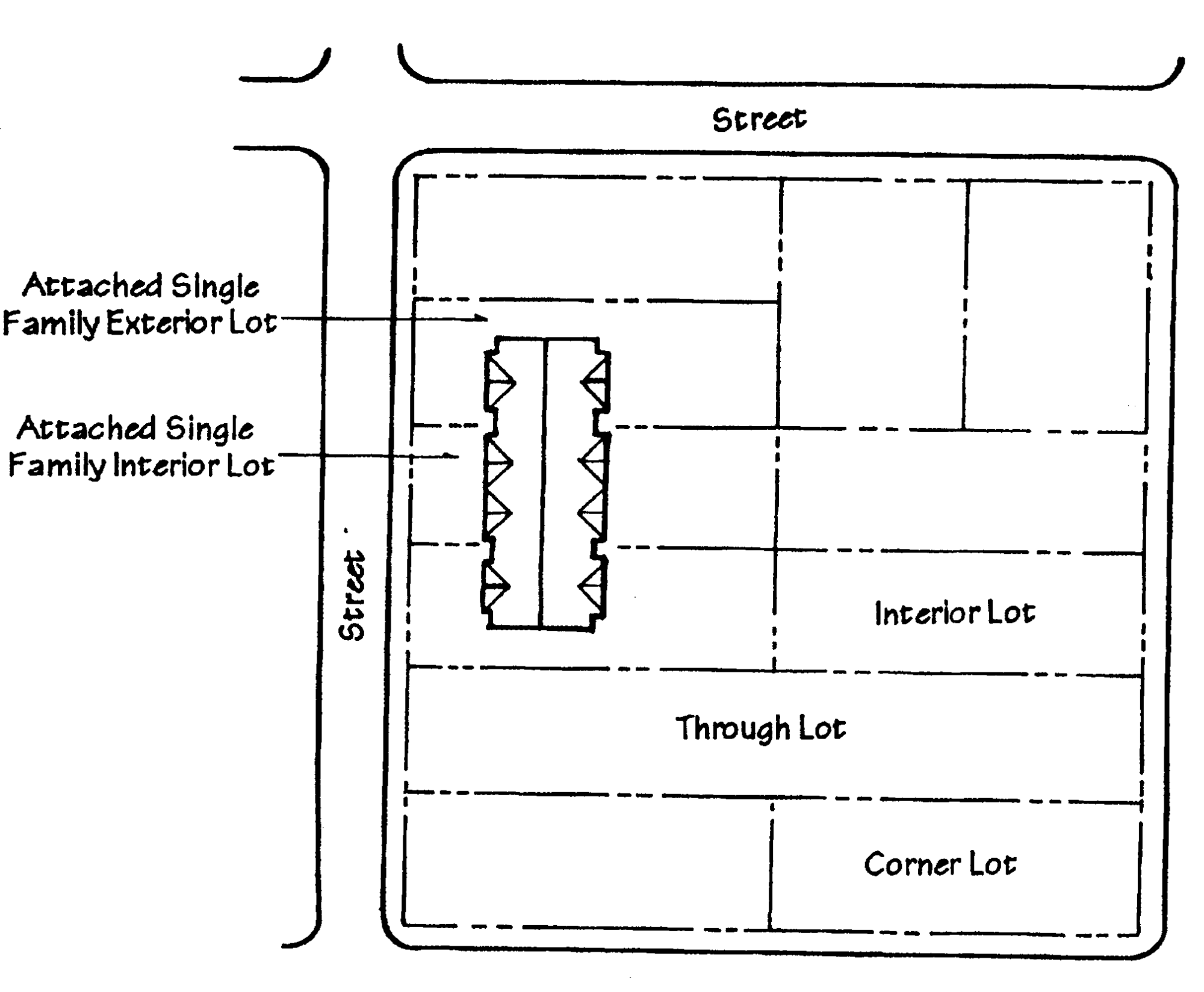
Lot, zoning means a single tract of land, located within a single block, which at the time of filing for a building permit is designated by its owners or developer as a tract to be used, developed or built upon as a unit, under single ownership or control. A zoning lot shall satisfy this chapter with respect to area, size, dimensions, and frontage as required in the district in which the zoning lot is located. A zoning lot, therefore, may not coincide with a lot of record as filed with the county recorder, but may include one or more lots of record.
Lot area means the total horizontal area within the lines of the lot.
Lot coverage means the part or percent of the lot occupied by buildings including accessory buildings.
Lot coverage ratio pervious/impervious means the numerical value (percentage) obtained through dividing the gross square footage area of all impervious surfaces including streets, sidewalks, parking facilities, rooftops etc. by the total gross area of the lot or parcel of land upon which such impervious areas are located.
Lot depth means the horizontal distance between the front and rear lot lines, measured along the median between the side of lot lines.
Lot lines means the lines bounding a lot as defined herein:
(1)
Front lot line means any line that separates the lot from any street;
(2)
Rear lot line means on an interior lot the rear lot line is the line opposite the front; on a corner lot one rear lot line is to be designated; on a through lot, no rear lot line is required;
(3)
Side lot line means any lot line other than a front or rear lot line.
Lot of record means a parcel of land, the dimensions of which are shown on a document or map on file with the county recorder or in common use by the municipal or county officials, and which actually exists as so shown, or any part of such parcel held in a record ownership separate from that of the remainder thereof.
Lot width means the horizontal straight line distance between the side lot lines, measured between the two points where the front setback line intersects the side lot lines.
Manufactured home means a building, transportable in one or more sections, which, in the traveling mode, is eight body feet or more in width of 40 body feet or more in length, or, when erected on-site, is 320 or more square feet, and which is built on a permanent chassis and designed to be used as a dwelling with or without a permanent foundation when connected to the required utilities, and includes the plumbing, heating, air-conditioning, and electrical systems contained therein. For purposes of this chapter, manufactured homes specifically include mobile homes but specifically exclude modular systems.
Medical office means facility from which an individual or group of doctors offers outpatient services.
Mini-warehouse. See "storage facility, self-service."
Mezzanine means an intermediate floor in any story occupying not more than one-third of the floor area of such story.
Mobile home park means any plot of ground upon which two or more mobile homes occupied for dwelling or sleeping purposes are located.
Mobile structure means a factory assembled structure or structures equipped with the necessary service connections and made so as to be readily movable as a unit or units on its own running gear and designed to be used with or without a permanent foundation. Mobile structure does not include manufactured homes, but does include a mobile construction office trailer.
Modular system means a building assembly or system of building sub-assemblies, designed for habitation, including the necessary electrical, plumbing, heating, ventilating and other service systems, which is of closed or open construction and which is made or assembled by a manufacturer, on or off the building site, for installation, or assembly and installation, on the building site, with a permanent foundation.
Motel means a building or a group of detached, semidetached or attached buildings containing guest rooms or dwelling units each of which, or each pair of which has a separate entrance leading directly to the outdoors or to a common hallway, with garage or parking space conveniently located to each unit, and which is designed, used or intended to be used primarily for the accommodation of motor vehicle transients.
Nonconformities. See "building, nonconforming," "lot, nonconforming," "structure, nonconforming," and "use, nonconforming."
Nursery, plant material means a space, building, or structure, or combination thereof for the storage of live trees, shrubs, or plants offered for retail sale on the premises including products used for gardening or landscaping. The definition of nursery within the meaning of this chapter does not include any space, building or structure used for the sale of fruits, vegetables, or Christmas trees.
Nursing home. See "convalescent, nursing, or rest home."
Office means a building or portion of a building where services are performed involving primarily administrative, professional, or clerical operations.
Office park means a large tract or land that has been planned, developed, and operated as an integrated facility for a number of separate office buildings and supporting ancillary uses with special attention given to circulation, parking, utility needs, and aesthetics.
Open sales lot means a principal or accessory use involving the selling of merchandise not contained within an enclosed building.
Open space means that portion of a lot or tract intended for recreational use or as landscaping.
Open space, common means open space accessible to either the general public or to multiple owners/tenants. Such space is generally maintained by agreement of persons utilizing the space.
Ordinance means a document containing regulations written either to stand on their own or as an amendment to an existing ordinance which, when adopted by the council, becomes legally binding.
Ordinance, zoning means this title of the Macomb Municipal Code and its accompanying zoning map.
Outdoor dining means dining out of doors as an accessory use to an indoor restaurant.
Outdoor storage means the keeping of property in the open area of a lot. For purposes of this definition, the keeping of wood or compost piles will not be considered outdoor storage.
Overlay zone means a zoned area defined by specific boundaries that layers additional restrictions over the existing restrictions defined by the city zoning ordinance and map.
Owner means any person having legal or equitable title to real estate.
Park means any public or private land available for recreational, educational, cultural, or aesthetic purposes.
Parking, off-street means a facility providing vehicular parking spaces along with adequate drives and aisles for maneuvering so as to provide access for entrance and exit for the parking of more than three vehicles.
Parking lot means off-street parking which is provided on an unenclosed, ground level, permanent surface.
Parking space means an area within the lot lines which is enclosed in the principal building, enclosed in an accessory building, or unenclosed; sufficient in size to store one standard automobile, and so situated as to permit ingress and egress of the automobile without moving any other parked vehicle.
Parking structure means off-street parking which is provided in an enclosed or semi-enclosed structure which may be one or more levels, and which may be located either above grade, below grade, or a combination of both.
Parkway means the ground area within the street right-of-way which is not covered by pavement or sidewalks.
Passive open space means any public or private lot (or contiguous lots) of less than 25,000 square feet in total aggregate size that is intended for use as a passive open space area. The open space shall not contain any active recreational facilities, playground equipment or totally enclosed structures.
Person means any individual, corporation, partnership, groups of persons, associations, or agent, so that where the word "person" is used it is clear that any entity subject to this zoning ordinance would be defined as a person.
Places of worship means structures and outdoor or indoor facilities used for public worship and related educational, cultural, and social activities.
Planned development means a parcel of land or contiguous parcels of land, controlled by a single landowner or by a group of landowners in common agreement as to control, to be developed as a single entity, the environment of which is compatible with adjacent parcels, and the intent of the zoning district or districts in which it is located; the developer or developers may be granted relief from specific land use regulations and design standards and may be awarded certain premiums in return for assurances of an overall quality of development, including any specific features which will be of exceptional benefit to the community as a whole.
Planning jurisdiction. See "jurisdiction."
Planning staff means employees of the office of Building and Zoning of the City of Macomb, as set out in the salary ordinance, including any work study aids or interns and employees of any other city department which may periodically provide assistance to the office of building and zoning under the supervision of the community development coordinator and subject to the authority of the community development coordinator on matters of staff discretion.
Plat means a map or chart indicating the subdivision or resubdivision of land, intended to be filed for record.
Plat officer means an employee of the office of building and zoning of the City of Macomb, appointed by the mayor with the advice and consent of the city council whose duties include administering and enforcing the provisions of the unified development code which pertain to subdivisions found in Article IV, Division 1, Subdivision Procedure and Article V, Subdivision Standards.
Premises (as related to signs) means those areas upon which the business or profession is actually located, or where the commodity or service is actually offered for sale or sold, not including any easements or land leased for the purpose of a sign easement.
Public utility means a person, municipal department, board or commission duly authorized to furnish and furnishing under federal, state, or municipal regulation to the public: gas, steam, electricity, sewage disposal, communication, telegraph, transportation, or water.
Recreational facility means a building or enclosed structure containing recreational facilities, such as a tennis court, swimming pool and/or gymnasium, and operated by a government agency or as a business. This may include associated outdoor amphitheaters, tennis courts and swimming pools.
Recreational vehicle means a vehicle which is:
(1)
Built on a single chassis;
(2)
400 square feet or less when measured at the largest horizontal projections;
(3)
Designed to be self-propelled or permanently towable by a light duty truck; and
(4)
Designed primarily not for use as a permanent dwelling, but as temporary living quarters for recreational camping, travel, or seasonal use.
Recycling facility means a facility that accepts source-sorted recyclable materials, processes those materials, and makes the materials available for use in their original form.
Restaurant means an establishment whose principal use is the selling of unpackaged food in a ready-to-consume state, in individual servings, and where the customer consumes these foods while seated at tables or counters located in or immediately adjacent to the building in which the use is located, and which may include carry-out service.
Restaurant, fast food means an establishment that offers quick food service, which is accomplished through a limited menu of items already prepared and held for service; or prepared and heated quickly using a device such as a grill or microwave oven. Orders are not generally taken at the customer's table, and food is generally served in disposable wrappings or containers. Fast food restaurants may include sitdown, carryout, and drive-through services. (See also "drive-ins and drive-through establishments.")
Restaurant, carry out means a business establishment within which the primary use is prepared food and beverages, offered for sale in disposable containers and packaging for carryout.
Retail means the sale of goods directly to the consumer.
Right-of-way means a parcel of land or easement, either public or private, on which an irrevocable right-of-access has been recorded for vehicles or pedestrians or both. A public right-of-way is one which has been dedicated for public use and may include streets, alleys, or sidewalks.
Roadway means the portion of a street right-of-way available for vehicular movement. Roadway width shall be measured from back of curb to back of curb.
Row houses means a group of dwellings separated only by walls without opening between dwellings.
Salvage yard means any place at which personal property is or may be salvaged for reuse, resale, or reduction or similar disposition and is owned, possessed, collected, accumulated, dismantled, or sorted, including, but not limited to, used or salvaged base metal or metals, their compounds or combinations, used or salvaged rope, bags, paper, rags, glass, rubber, lumber, millwork, brick and similar property, except animal matter; and used motor vehicles, machinery, or equipment, which are used, owned or possessed for the purpose of wrecking or salvaging parts therefrom; including any open space, lot or real property whereon a single motor vehicle or vehicles, which do not properly bear current valid license plates and registration, or a single motor vehicle or vehicles which have been in an inoperative condition for 30 days or more, or any worn out or cast-off vehicle, or any part or parts of any of these vehicles.
Satellite dish. See "antenna."
School means a privately or publicly owned place of learning, including, but not limited to: nursery or pre-schools, elementary schools, middle schools, junior high schools, or high schools, which do not provide lodging for students or faculty (See also, "college or university").
School, trade or business means a school with a curriculum which is focused upon certain skills required in business, trades or the arts, including secretarial skills, instrumental music, dancing, barbering, hairdressing or other technical trades which require knowledge of special machinery.
Screening means a structure erected or vegetation planted for the purpose of concealing from view the area behind it.
Senior citizen housing means housing designed for and occupied by elderly persons, which provides living unit accommodations and spaces for common social and recreational activities, and which may include incidental facilities for health and nursing services.
Service station. See "vehicle service station."
Setback means the distance required to obtain minimum front, side, or rear yard open space provisions of this chapter. See "building setback, front" and "building setback, side and rear."
Shared interconnects. A two-way drive between commercial properties that allows for free and unobstructed access between adjoining parking lots.
Shopping center means a group of retail establishments, planned and managed as a unit.
Sign means any display or device placed on a property in any fashion which is designed, intended, or used to convey any identification, message or information other than an address number.
Sign, accessory means a sign which is related to the principal use of the premises.
Sign, nonaccessory means a sign which is not related to the principal use of the premises.
Sign, announcement means a sign upon which information about events or activities conducted by religious, civic, educational, community, governmental, or similar organizations is displayed.
Sign, business means a sign identifying only, the name and location of a particular business enterprise and located on the premises where the sign is displayed.
Sign, construction means a sign directing attention to construction upon the property where the sign is displayed, and bearing the name, address, sublot number, or other identifier of the contractor sub-contractor, and/or architect.
Sign, directional means a sign intending to direct the safe flow of vehicular and pedestrian traffic and includes "enter," "exit," and "arrow" signs.
Sign, flashing means any illuminated sign which exhibits changing light or color effects.
Sign, home occupation means a sign that reflects the profession, permitted home occupation, with or without the name, phone number or address of the occupant thereof.
Sign, illuminated means a sign which has characters, letters, figures, designs, or outline illuminated by electric lights or luminous tubes as a part of the sign proper, or which is illuminated by reflectors.
Sign, monument means a sign permanently attached to the ground and whose supporting structure extends less than six feet in height from the finished grade to the bottom of the sign face.
Sign, nonconforming means any sign lawful at the time of the enactment of this zoning ordinance, which does not comply with all of the regulations of this zoning ordinance or of any amendment hereto governing signs.
Sign, off-premises means a sign directing attention to a specific business, product, service, entertainment, or any other activity offered, sold, or conducted elsewhere than upon the lot where the sign is displayed.
Sign, on-premises means a name, identification, description, display of illustration or symbol which is affixed to, or painted, or represented directly upon a structure or piece of land, and which directs attention to an object, product, place, activity, person, institution, organization, or business located on, in, or within such structure or on such piece of land and which is visible from any public street, right-of-way, sidewalk, park, or other public property.
Sign, permanent means a sign which is designed or intended to be used indefinitely, or used indefinitely without change in the same state or place, including, but not limited to, business signs, directional signs, residential complex or subdivision signs, and illuminated signs.
Sign, pole means a sign which is supported by one or more poles, posts, or braces upon the ground, not attached to or supported by any building, with a clear space in excess of six feet from the finished grade to the bottom of the sign face.
Signs, portable means signs, including movable readerboards, with or without flashing elements, which can be transported from one locations to another.
Sign, public information means a sign displaying public information as the principal message in addition to information designed to assist, alert, or inform the public. Such signs may display only the name and corporate logo of the business or agency providing such information.
Sign, real estate means a sign announcing the sale, rental, or lease of the lot where the sign is displayed, or announcing the sale, rental, or lease of one or more structures, or a portion thereof, located on such lot, and identifying the owner, realty agent, telephone numbers, or "open house" information.
Sign, residential complex or subdivision means a sign containing the name of a residential complex or subdivision, with or without its accompanying address.
Sign, temporary means a sign which is designed or intended to be used for a limited time, including, but not limited to, construction signs, real estate signs, political campaign signs, and garage sale signs.
Sign area means the entire area within a single continuous perimeter enclosing the extreme limits of a sign, including all background area figures and letters. However, such perimeter shall not include any structural elements lying outside the limits of the sign which are not part of the information, visual attraction, or symbolism of the sign.
Single housekeeping unit means a group of persons maintaining a common household, sharing kitchen facilities, utilities, and other household related expenses.
Site plan means that portion of a development plan illustrative of the circulation system, siting of buildings and landscape features.
Sorority. See "fraternity or sorority."
Special use. See "use, special."
Specified anatomical areas means any of the following:
(1)
Less than completely and opaquely covered:
a.
Human genitals or pubic region;
b.
Buttocks;
c.
Female breast below a point immediately above the top of the aureole;
(2)
Human genitals in a discernibly turgid state, even if completely and opaquely covered.
Specified sexual activities means any of the following:
(1)
The fondling or other touching of human genitals, pubic region, buttocks, or female breasts;
(2)
Ultimate sex acts, normal or perverted, actual or stimulated, including intercourse, oral copulation, sodomy;
(3)
Masturbation; and
(4)
Excretory functions as part of or in connection with any of the activities set forth in subsections (1) through (3) above.
Storage facility, self-service means a structure or group of structures containing individual storage units with access to each unit for the storage and warehousing of personal property. Such facilities do not include wholesaling, retailing, servicing or repair of household or commercial goods in conjunction with storage.
Storefront character means the character expressed by buildings placed close to the street with ground-floor window displays, weather protection (e.g., awnings or canopies), corner building entrances or recessed entries and similar features. Storefront character shall include a commercial use as permitted or authorized in this chapter. Such use shall be maintained for a minimum of 50 linear feet in depth from the front of the interior structure and include the full width of the interior space. Storefront character shall be maintained on all street-facing facades with ground floor display windows.
Story means that part of a building, except a mezzanine, between the surface of one floor and the surface of the next floor, or if there is no floor above, then the ceiling next above. A basement shall not be counted as a story.
Story, half means the uppermost story lying under a sloping roof having an area of at least 200 square feet with a clear height of seven feet, six inches. For the purposes of this chapter the usable floor area is only that area having at least four feet clear height between floor and ceiling.
Street means a right-of-way, other than an alley, dedicated or otherwise legally established to the public use, usually affording the principal means of access to abutting property. The street may be designated as a highway, thoroughfare, parkway, boulevard, road, avenue, lane, drive, or other appropriate name.
Street, arterial, principal means a public street of large right-of-way intended primarily for moving large volumes of traffic between origin and destination within a region.
Street, arterial, secondary means a public street of moderate right-of-way intended primarily for moving moderate volumes of traffic between origin and destination within a region.
Street, collector, principal means a public street of moderate right-of-way intended to collect traffic generated by local streets and carry it to arterials.
Street, collector, secondary means a public street of smaller right-of-way intended to collect traffic generated by local streets and carry it to arterials.
Street, local means a public street intended for access to abutting properties.
Street, marginal access means local streets which are parallel to and adjacent to arterial streets and highways and which provide access to abutting properties and protection from through traffic.
Street, private means a paved area other than a driveway, located on private property for the purpose of providing vehicular or pedestrian access to and within that property. (See also, "drive" and "driveway")
Street, public means a public way for purposes of vehicular or pedestrian travel, including the entire area within the right-of-way.
Structure means anything constructed or erected, that use of which required permanent location on the ground or attached to something having a permanent location on the ground, including but without limiting the generality of the foregoing, advertising signs, billboards, backstops for tennis courts, and pergolas.
Structure, accessory means a structure customarily incidental and subordinate to and located on the same lot with a principal building or structure.
Structure, nonconforming means a structure lawfully existing at the time of adoption of this chapter, or any amendment thereto and which does not conform to the regulations of the district in which it is located. See also "building, nonconforming," "lot, nonconforming," and "sign, nonconforming," and "use, nonconforming."
Structure, principal. See "building, principal."
Structure, temporary. See "use, temporary."
Structure height. See "height, structure."
Subdivider means any person engaged in developing or improving a tract of land which complies with the definition of subdivision.
Subdivision means the division of a parcel of land into two or more lots or parcels for the purpose of transfer of ownership or building development. Division of land for agricultural purposes into lots or parcels of three acres or more and not involving a new street shall not be deemed a subdivision. When appropriate to the context, the term "subdivision" shall relate to the process of subdividing or to the land subdivided.
Swimming pool means a permanent or semi-permanent structure used for recreational swimming or bathing that is located either below ground level, above ground level or a combination thereof.
Temporary use or structure. See "use, temporary."
Thoroughfare means a public right-of-way intended for the effective movement of pedestrian and vehicular traffic.
Townhouse means a building having three or more dwelling units arranged side by side, each occupying an exclusive vertical space without another dwelling unit above or below, and each of which has at least one exterior entrance.
Unified development ordinance. See "ordinance, unified development."
Use means the principal purpose for which land or a building is arranged, designed, or intended, or for which land or other buildings is or may be occupied.
Use, accessory means a use customarily incidental and subordinate to and located on the same lot with a principal use. See also "structure, accessory."
Use, conditional. See "use, special."
Use, existing means any use of a parcel of land or structure which exists on the effective date of this chapter.
Use, nonconforming means a use which lawfully occupied a building or land at the effective date of the ordinance from which this chapter derives, or amendments thereto, and that does not conform to the use regulations of the district in which it is located.
Use, permitted means a use which may be lawfully established in a particular district or districts provided it conforms with all requirements, regulations, and standards of such district.
Use, principal means the main use to which the premises are devoted and the principal purpose for which the premises exist. See also "building, principal."
Use, special means a use, either public or private, which, because of its unique characteristics, cannot be properly classified as a permitted use in a particular district or districts unless authorized by the mayor and city council after a public hearing and recommendation by the planning commission Such special use shall be subject to any requirements the planning commission and/or city council feel necessary to further the purpose of this chapter as stated in Article I, section 17-2. Any use shall expire at any time the permitted special use lapses for a period in excess of 12 months
Use, special—accessory: An accessory special use means a special use customarily incidental and subordinate to and located on the same lot with the principal special use. Such use, either public or private, because of its unique characteristics, cannot be properly classified as a permitted use in a particular district or districts unless authorized by the mayor and city council after a public hearing and recommendation by the planning commission. Such accessory special use shall be subject to any requirements the planning commission and/or city council feel necessary to further the purpose of this chapter as stated in Article I, section 17-2. Any use shall expire at any time the permitted accessory special use lapses for a period in excess of 12 months. AS* - All uses listed under the "Institutions" category of Appendix A, Use Matrix when allowed by right, special use or by grandfathered status shall be entitled to apply for an accessory interim/intermittent homeless shelter special use regardless of the under-lying zoning district. Those institutional uses located in B-2, R-4, O/I, M-1 or M-2 zoning districts shall be allowed to apply for either accessory special use interim/intermittent or permanent homeless shelters.
Use, temporary means a use or structure permitted by the board of zoning appeals to exist during a specified period of time.
Utility substation means a mechanical unit, owned by a utility company, which is necessary at some locations to facilitate utility services.
Variance means a modification of the literal provisions of the zoning ordinance granted when strict enforcement of the zoning ordinance would cause undue hardship owing to the circumstances unique to the individual property on which the variance is granted and where such variance will not be contrary to the public interest. The crucial points of variance are:
(1)
Undue hardship;
(2)
Unique circumstances; and
(3)
Applying to property.
A variance is not justified unless all three elements are present in the case. A variance is not an exception.
Vehicle repair shop means any building or premises where the principal use is includes engine repair or rebuilding; other repair, rebuilding or reconditioning of motor vehicles; collision service, such as body, frame, or fender straightening and repair; and overall painting and undercoating of automobiles.
Vehicle service station means any building or premises where the principal use is the dispensing, sale or offering for sale at retail of any automobile fuel or oils.
Vehicle wrecking yard. See "salvage yard."
Walkway/bikeway means a way across or within a block for use by pedestrian and bicycle traffic, which shall include but not be limited to sidewalks and crosswalks.
Wholesale means the sale of goods in quantity to persons who purchase for the purpose of resale.
Warehousing means the safekeeping of property, either for later use or for resale, within enclosed buildings.
Wetland means an area that is inundated or saturated by surface water or ground water at a frequency and duration sufficient to support, and that, under normal circumstances, does support, a prevalence of vegetation typically adapted for life in saturated soil conditions, commonly known as hydrophytic vegetation.
Yard, front or corner side means the space within a lot or tract that occupies the area between the exterior wall line of a structure and the adjacent street right-of-way line extending in a perpendicular manner to the boundary lines of the lot or tract. In no case however, shall the front yard or corner side yard measure less than 12 feet for expansions or additions to existing non-conforming structures or lots, or more than the front yard minimum as listed within the Bulk Matrix Appendix B for the zoning district in which the lot is located.
Yard, interior side means an open unoccupied space on the same lot with a main building situated between the side line of the building and adjacent side line of the lot and extending from the rear line of the front yard to the front line of the rear yard. If no front yard is required, the front boundary of the side yard shall be [at] the front line of the lot and if no rear yard is required, the rear boundary of the side yard shall be at the rear line of the lot.
Yard, rear means an open unoccupied space on the same lot with a main building, extending the full width of the lot and situated between the rear line of the lot and the rear line of the building projected to the side lines of the lot, or the centerline of the alley, if there be an alley, and the rear line of the building.
Yard, required means the minimum yard required between a lot line and a setback line by the applicable provisions of this zoning ordinance. Same as "setback."
Zoning enforcement officer means a staff member of the office of building and zoning who is designated by the community development coordinator or the city council to hear complaints, make inspections, and take action to enforce the provisions of this chapter.
Zoning map means a map entitled City of Macomb, Illinois, Zone Map, dated [date of map adoption] , and any amendments thereto.
(Ord. No. 2750, § 2, 11-17-97; Ord. No. 2781, § 3, 2-1-99; Ord. No. 2851, § 1, 12-17-01; Ord. No. 2943, § 2, 12-5-03; Ord. No. 06-34, § 2, 8-21-06; Ord. No. 07-27, § 2, 7-17-07; Ord. No. 10-07, § 2, 3-15-10; Ord. No. 10-25, § 2, 7-19-10; Ord. No. 11-02, § 3, 1-3-11; Ord. No. 12-43, § 3, 8-6-12; Ord. No. 13-49, § 2, 12-2-13; Ord. No. 14-02, § 2, 1-6-14; Ord. No. 14-33, § 2, 8-18-14; Ord. No. 19-34, §2 10-21-19; Ord. No. 22-20, § 2, 4-18-22; Ord. No. 24-24, § 2(Exh. A), 6-17-24)
Sec. 17-56. - Applicability.
(a)
This chapter shall be effective within the corporate limits of the City of Macomb and its contiguous area as defined herein.
(b)
After the effective date of this chapter, no buildings, structures, uses of land, lots of record or zoning lots shall be established, altered, moved, divided or maintained except in accordance with the provisions of this chapter. Existing buildings, structures and uses of land that do not comply with the regulations of this chapter are pursuant to Article II, Division 3, Nonconformities.
(Ord. No. 2750, § 2, 11-17-97)
Sec. 17-57. - Interpretation.
The city planning commission has given careful consideration to the future probable use of land in the area affected by this chapter, and has had prepared "The Comprehensive Plan of Macomb, Illinois," showing the future development of this area, which has served as a guide for the interpretation of this chapter. All general provisions, terms, phrases, and expressions contained in this chapter shall be liberally construed in order that the intent of the city council may be fully carried out. These provisions shall be held to be the minimum requirements for the promotion of the public peace, health, safety, morals, convenience, comfort, prosperity and general welfare.
For the purposes of this chapter, the following additional rules of interpretation shall apply:
(1)
In the event of a conflict between the text of these provisions and any caption, figure, illustration, table, or map; the text of these provisions shall control;
(2)
Word usage shall be governed by the standards of Article II, Division 1, section 17-41, Rules of Word Usage.
(Ord. No. 2750, § 2, 11-17-97)
Sec. 17-58. - Transition rules.
In determining the applicability of this chapter with respect to the previously applicable zoning regulations, the following rules shall apply:
(1)
Pending permits and licenses. No permit for the erection or placement of any building or structure, or license or permit for the conduct of any use, shall be issued for a period of three months after the question of amending the zoning ordinance in a manner which would prohibit the proposed use or structure has been referred by the city council to a board or commission to hold a public hearing on the question of adopting such amendment. If final action by the city council is not taken on the question within three months of the time the matter is so referred, the permit shall be issued. If within such three month period the city council shall pass an ordinance amending the zoning ordinance so as to prohibit such a use or structure, no such permit shall be issued.
(2)
Previously issued permits and licenses. If a permit for any such building or structure, or a license for the conduct of any such business or use, has been issued prior to such reference, but the business or use has not been established, or no substantial part of the construction has been completed at the time of such reference, such license or permit shall be suspended and no action taken thereunder for a period of three months after the question of amending the zoning ordinance has been so referred. If final action by the city council is not taken on the question within three months of the time of reference, the rights under the permit or license may be exercised. If within such three-month period the governing body of the municipality shall pass an ordinance prohibiting the use of building or structure on the site involved such prohibition shall be applicable to the holder of such permit or license.
(3)
Existing permitted uses as conditional uses. When a lot is used for a purpose classified as a permitted use prior to the effective date of this chapter, and such use is classified as a "conditional use" by this chapter, such use shall be deemed a lawful conditional use for the purpose of this chapter.
(Ord. No. 2750, § 2, 11-17-97)
Sec. 17-59. - Interference or conflict with other provisions.
It is not the intent of this chapter to interfere with or abrogate, or annul any easements, covenants, or other agreements between parties, nor to interfere with, or abrogate or annul any ordinances, rules, regulations or permits previously adopted or issued, and not in conflict with any provisions of this chapter, or which shall be adopted or provided, except, that where this chapter imposes a greater restriction upon the use of buildings or land, or upon the height of buildings, or requires larger open spaces or greater lot area per family, than are required or imposed by such easements, covenants, or agreements between parties, or by such ordinances, rules, regulations or permits, the provisions of this chapter shall control.
(Ord. No. 2750, § 2, 11-17-97)
Sec. 17-60. - Severability.
If any section or part thereof of this chapter shall be held to be unconstitutional by a court of competent jurisdiction, the remainder of the provisions hereof shall be deemed to continue in full force and effect.
(Ord. No. 2750, § 2, 11-17-97)
Sec. 17-71. - Purpose.
It is recognized that there exists within the districts established by this chapter lots, uses and structures which were lawful before this chapter was adopted, but which would be prohibited, restricted or regulated under the terms of this chapter or future amendments. Such uses are declared by this chapter to be incompatible with permitted uses in the district involved. It is the intent of this section to permit such legal nonconforming lots, uses, or structures to continue, but not to encourage their survival. It is further the intent of this chapter that such nonconformities shall not be expanded, improved, nor used as grounds for adding other structures or uses prohibited elsewhere in the same district.
(Ord. No. 2750, § 2, 11-17-97)
Sec. 17-72. - Registration of a nonconforming use.
In order to protect the legal nonconforming status of a nonconforming lot, use or structure, a person who owns a nonconforming lot, use, or structure may register the nonconformity with the community development coordinator on a form available in the office of building and zoning.
(Ord. No. 2750, § 2, 11-17-97)
Sec. 17-73. - Existing nonconforming lots, uses, and structures.
Any 1) platted lot, 2) use of lot or structure, 3) location of a structure on a lot, or 4) design of any structure, which lawfully existed on the effective date of this chapter, may be continued even though such lot, use, location, or design does not conform to the regulations of this chapter for the district in which it is located. However, no changes of use, expansions or relocations of a use or structure, or restorations, alterations, and repairs of any structure shall be made except as otherwise provided herein. There may be a change of tenancy, ownership or management of any existing nonconforming lots, uses, or structures, but such lots, uses, and structures shall continue to be considered nonconforming.
(Ord. No. 2750, § 2, 11-17-97)
Sec. 17-74. - Changes or replacement of a nonconforming use.
(a)
Once changed to a conforming use, no building or land shall be permitted to revert to a nonconforming use, and shall thereafter conform to the regulations for the district in which it is located.
(b)
A nonconforming use or a like replacement use or premises may continue except as provided in sections 17-75, 17-76, and 17-77 of this division. A "like replacement" shall be one which, in the determination of the zoning administrator, is very similarly or more compatible with the predominant conforming uses adjacent to and in the general vicinity of the nonconforming use being altered. Any new or substitute nonconforming use not meeting the standards as noted above shall be permitted only through the special use permit process.
(Ord. No. 2750, § 2, 11-17-97; Ord. No. 06-10, § 2, 3-20-06; Ord. No. 12-55, § 2, 10-1-12; Ord. No. 12-55, § 2, 10-1-12)
Sec. 17-75. - Expansion, relocation, restorations, repair or reconstruction.
(a)
Nonconforming uses. No nonconforming use shall be moved in whole or in part to any other portion of the lot or parcel occupied by such use at the effective date of this chapter.
(b)
Nonconforming uses and structures in combination. Any nonconforming use may be extended throughout any part of a nonconforming structure in which it is located, but no such use shall be extended to occupy any land outside such building.
(c)
Nonconforming structures.
(1)
A nonconforming structure shall not be extended in a way to increase the amount or degree of bulk regulation nonconformity than was occupied at the effective date of this chapter. Such structures may be enlarged or altered in a way which does not increase their respective nonconformities.
(2)
Should any nonconforming structure be moved for any reason for any distance whatever, it shall there after conform to the regulations for the district in which it is located after it is moved.
(3)
When a lot and/or structure accommodating a nonconforming use is damaged or altered by fire, explosion, wind, neglect, deterioration, acts of God, or by any other voluntary or involuntary natural or man-made causes, to the extent of more than 50 percent of its fair market value, it shall not be restored, repaired or reconstructed except in conformity with the use and bulk regulations and development standards of the zoning district in which the lot and structure is located.
(Ord. No. 2750, § 2, 11-17-97; Ord. No. 12-55, § 3, 10-1-12; Ord. No. 13-06, § 2, 2-4-13)
Sec. 17-76. - Exemptions allowing restorations, alterations, reconstruction and repairs.
A nonconforming structure may not be reconstructed or structurally altered to an extent exceeding 50 percent of the current fair value of the building except as otherwise provided below:
(1)
Use of structure changed from nonconforming to conforming. A nonconforming structure may be altered beyond the limitations prescribed above if such structure houses a nonconforming use which, by virtue of the structural alterations, is being changed to a conforming use.
(2)
Relocation or moving of a nonconforming structure or use due to the actions or a taking by a unit of government shall be permitted without variance to the extent that the movement or relocation is the minimum action necessary to offset and mirror the aforementioned, applicable governmental action.
(3)
Variance granted by board of zoning appeals. A nonconforming structure specifically designed for a nonconforming use may be reconstructed or altered beyond the limitations provided herein in subsection 17-75(c) pursuant to the granting of a variance by the board of zoning appeals. A variance may also be granted by the board of zoning appeals for a relocation or movement of a nonconforming structure or use when it is due to the actions or taking by a unit of local government and the relocation or movement exceeds the minimum action necessary to offset such action.
(Ord. No. 2750, § 2, 11-17-97; Ord. No. 12-55, § 4, 10-1-12; Ord. No. 13-06, § 3, 2-4-13)
Sec. 17-77. - Termination of nonconforming uses.
(a)
Abandonment or removal. A nonconforming use shall be deemed abandoned when it has been replaced by a conforming use or when the nonconforming use has ceased and has not been resumed for a continuous period of one year. The subsequent use shall conform to the regulations specified by this chapter for this district in which such land is located. An abandoned nonconforming use shall not be reestablished unless authorized by the mayor and city council after a public hearing, due process and consideration and recommendation by the planning commission in compliance with special use permit regulations.
(b)
Amortization of nonconforming uses.
(1)
Reserved.
(2)
Reserved.
(3)
Nonconforming single-family rental housing units in the R-4, multiple-family zoning district, may continue to be occupied by up to siz unrelated individuals indefinitely. Any single-family owner occupied housing unit in the R-4 zoning district converted to a rental housing unit after the enactment of this chapter must meet the definition of "family" in article II, division 1, section 17-42 of this chapter.
(c)
Protection of historic structures and uses. A structure or use of the land that has been declared historic or significant by the National Park Service, the Illinois State Historic Preservation Agency, or the City of Macomb Historic Preservation Commission and City Council shall be exempt from the provisions of this division unless a particular hazard is represented by such structure or land us.
(Ord. No. 2750, § 2, 11-17-97; Ord. No. 07-28, § 2, 8-7-07; Ord. No. 12-55, § 5, 10-1-12; Ord. No. 13-04, § 2, 1-22-13)

