
Macomb City Zoning Code
ARTICLE VII
DEVELOPMENT STANDARDS APPLICABLE TO ALL DISTRICTS
Sec. 17-851. - Off-street parking required.
(a)
General requirement. Except as provided elsewhere in this chapter, each principal and accessory use of land shall be provided with the number of off-street parking spaces indicated for that use in Table 7.1.1, Schedule of Off-Street Parking Requirements. Notwithstanding the above, this regulation shall not apply to the downtown, including the area bounded by Campbell, Calhoun, McArthur, and Jefferson Streets.
(b)
Uses not specified. In case of a use not specifically mentioned, the requirements for off-street parking or off-street loading for a use which is so mentioned, and to which said use is similar, shall apply.
(c)
Application to multiple tenant developments. Where there is a combination of uses on a lot, the minimum required number of parking spaces shall be the sum of the requirements of the individual uses, unless otherwise provided by section 17-852, subsection (2) of this chapter.
(d)
Fractions shall be rounded. When any calculation results in a fraction of a parking space of .50 or greater the fraction shall be rounded up to the next greater whole number.
(e)
Additional requirements for company vehicles. When parking spaces are used for the storage of vehicles or equipment used for delivery, service, repair, or other such use, such parking spaces shall be provided in addition to those otherwise required by this Code. At the time a building permit is issued, each developer shall indicate clearly on the plans, or in an accompanying letter, the number of spaces to be used for vehicle storage.
(f)
Bicycle parking requirements for all uses. Bicycle parking shall be provided at a rate of one bicycle parking space for each ten (10) motor vehicle spaces or fraction thereof, with a minimum of two (2) bicycle parking spaces being provided/ Large commercial and industrial developments shall require a maximum of twenty (20) bicycle parking spaces.
Table 7.1.1, Schedule Of Off-Street Parking Requirements
*Requirement applies to any newly constructed units or to structures converted to rental units located within R-3, R-4 and ASMU.
(Ord. No. 2750, § 2, 11-17-97; Ord. No. 09-38, §§ 2, 4, 9-21-09; Ord. No. 10-24, § 10, 7-19-10; Ord. No. 19-38, § 2, 12-16-19)
Sec. 17-852. - Programs and incentives to reduce parking requirements.
The following programs and incentives are provided to permit reduced parking requirements in the locations and situations outlined herein where the basic parking requirements of this code would be excessive or detrimental to goals and policies of the city relating to traffic congestion and environmental protection.
(1)
Mixed-use shared parking programs.
a.
Purpose. The city recognizes that strict application of the required parking ratios may result in the provision of excessive numbers of parking spaces and, therefore, excessive pavement and impermeable surfaces. A mixed-use shared parking program provides an option to reduce the total required parking in large mixed-use facilities in which the uses operate at different times from one another throughout the day.
b.
Applicability. The mixed-use shared parking program may be applied where mixed-uses are proposed.
c.
Procedure.
1.
The community development coordinator may authorize a reduction in the total number of required parking spaces pursuant to Table 7.1.2, Schedule of Shared Parking Calculations, if the respective hours of operation of the uses do not overlap.
Table 7.1.2. Schedule of Shared Parking Calculations
How to use the Schedule of Shared Parking
Calculate the number of spaces required for each use if it were freestanding (refer to the schedule of minimum on-site parking requirements). Applying the applicable general land use category to each proposed use, use the percentages to calculate the number of spaces required for each time period, (six time periods per use). Add the number of spaces required for all applicable land uses to obtain a total parking requirement for each time period. Select the time period with the highest total parking requirement and use that total as your shared parking requirement.
2.
The total number of parking spaces required per Table 7.1.1, Schedule of Parking Requirements, shall not be reduced by more than 20 percent.
(Ord. No. 2750, § 2, 11-17-97)
Sec. 17-853. - Parking spaces accessible to the disabled.
The City of Macomb encourages all development within the city which serves the public to provide facilities which are accessible to people with disabilities as defined by the Americans with Disabilities Act (ADA) of 1990. In accordance with this goal and pursuant to the ADA, accessible parking shall be provided by any building or use initiated after the effective date of this Code according to the following minimum requirements and any further requirements hereafter adopted by federal, state, or local law.
(1)
Required spaces. Accessible parking spaces shall be provided at a rate of four percent of total required parking spaces. Van accessible parking spaces shall be provided in the amount set forth by Table 7.1.3. In addition to these requirements, accessible patient parking at outpatient facilities must equal no less than ten percent of the required parking, and facilities which specialize in treatment or services for persons with mobility impairments must provide accessible parking equaling no less than 20 percent of the required parking for patient use.
Table 7.1.3. Van Accessible Parking Space Requirements
(2)
Design and layout of accessible parking lots. Access aisles and accessible routes for the mobility impaired shall be provided pursuant to ADA requirements, as described below.
a.
Access aisles. Access aisles shall be no less than five feet in width when adjacent to an automobile accessible space and no less than eight feet in width when adjacent to a van accessible space. At the entrance to each access aisle which is eight feet or wider, two bollards shall be placed at the outside corners of the aisle so as to prevent vehicles from parking in the aisle illegally. No access aisles shall be obstructed by any curb ramp or wheel stop.
b.
Accessible routes. Each automobile accessible or van accessible parking space shall be located along an accessible route to the building entrance. The minimum width of said accessible route shall be three feet.
c.
Maximum slope. Accessible parking spaces, access aisles, and accessible routes shall not exceed a slope of 1:50, and the ramp from the access aisle to the sidewalk or other transition to the principal use shall not exceed a slope of 1:12.
d.
Vertical clearance. The vertical clearance for accessible parking spaces shall be no less than eight feet two inches, and the vertical clearance for passenger loading zones shall be no less than nine feet six inches.
(3)
Passenger loading zones. Passenger loading zones shall provide an access aisle a minimum of 20 feet in length, adjacent and parallel to the vehicle pull up space. If there are curbs between the access aisle and the vehicle pull up space, then a curb ramp shall be provided.
(4)
Signage and marking. All accessible spaces shall be designated by the international access symbol. Van accessible spaces will be labeled by both the international access symbol and an additional sign indicating that the space is accessible for vans.
Signs shall be placed a minimum of five and one-half feet above ground level so as not to be obscured by parked vehicles. The mobility impaired symbol shall also be painted on the ground to the rear of the parking space.
(Ord. No. 2750, § 2, 11-17-97)
Sec. 17-854. - Location of required parking
(a)
General requirement. Except as otherwise provided in this chapter, off-street parking facilities shall be on the same lot or parcel of land as the use they are intended to serve.
(b)
Regulations for remote parking. Remote parking shall be allowed and shall be counted toward the off-street parking requirement if the following conditions are met:
(1)
The proximity of the parking area to the use served shall be within 300 feet.
(2)
A continuous sidewalk shall be present between the remote parking and the use served.
(c)
Front yard parking requirements. Parking shall not be allowed in the front yard of any residential zoning district and no parking shall be allowed within seven feet of the front property line in all zoning districts.
(d)
Driveway parking prohibited except in residential districts. Except in residential districts, parking in driveways connecting the public right-of-way with a parking area or garage shall not be permitted on or adjacent to the driveway.
(e)
Front/side yard parking in R-1, R-2, R-3, R-3A and R-4 residential zoning districts. The primary purpose of the special use permit shall be to allow for flexibility in parking location when both all other parking options permitted by right within the applicable district have been reasonably exhausted and when the site granted such special use permit will be markedly improved over its present condition (i.e.) infill development of a vacant lot or the improvement or removal of deteriorated or dilapidated structures or inappropriate uses. An application for a special use will be possible only when all of the conditions listed below can also be met:
(1)
Parking pad areas are permitted only in the case of one- and two-family dwelling unit structures.
(2)
Parking pad areas are permitted only within R-1, R-2, R-3, R-3A and R-4 Residential Zoning Districts.
(3)
Paved parking pad areas of not more than 20 feet in width, nor less than ten feet in width, are permitted only in the front and side yards of one- and two-family dwelling units and can not be placed physically in front of any part of the residential structure served.
(4)
In no case shall parking pad areas extend past the side yard or in any way into the back yard area of the residential unit they serve.
(5)
Only one parking pad area is permitted per dwelling unit. On corner lots, parking pad areas can be located in only one front or corner side yard.
(6)
A parking pad of 20 feet in width represents two off-street parking spaces. A parking pad of ten feet in width represents one off-street parking space. Stacked parking will not be counted towards off-street parking requirements.
(Ord. No. 2750, § 2, 11-17-97; Ord. No. 09-38, § 3, 9-21-09; Ord. No. 09-51, § 2, 12-7-09; Ord. No. 10-24, § 9, 7-19-10; Ord. No. 24-35, § 2 (Exh. A), 9-3-24)
Sec. 17-855. - Required parking lot and driveway setback.
In all residential zoning districts and for business and industrial zoning property abutting residential zoned property, the following restrictions shall be observed:
(1)
Every parking area shall maintain a five-foot setback between its closest edge and the adjacent residential property line.
(2)
Every driveway leading to a side or rear yard parking area shall maintain a three-foot setback between the closest edge of such driveway and the adjacent residential property line.
(Ord. No. 2750, § 2, 11-17-97)
Sec. 17-856. - Design and improvement standards for off-street parking areas.
(a)
Parking space dimensions. Parallel parking spaces shall have a minimum width of nine feet and a minimum length of 21 feet. All other spaces shall have a minimum width of nine feet and a minimum length of 18 feet.
(b)
Parking facility layout.
(1)
Minimum layout dimensions are established in Table 7.1.6 [7.1.4] which shall apply to all off-street parking areas.
(2)
The parking lot shall be designed so that vehicles exiting therefrom will not be required to back out across any sidewalk or street.
(3)
All required on-site parking spaces shall open directly upon an aisle or driveway. All on-site parking facilities shall be provided with appropriate means of vehicular access to a public street.
(4)
All parking areas shall provide means of pedestrian circulation to the use served and between the use and the street.
(5)
In the B-2, General Business District, and the M-1, Light Manufacturing District, commercial developments shall have shared interconnects and shared driveways with adjoining commercial developments, wherever feasible, as determined by the community development coordinator. Shared interconnects and shared driveways shall have curbs and gutters and proper storm water drainage, the same as required for adjoining parking lots.
(c)
Improvement standards.
(1)
Off-street parking facilities shall be surfaced with Portland cement concrete, bituminous aggregate mixture, bituminous concrete pavement or paving brick. Tar and chip surfaces, cold patch, and gravel are not considered permanent surfaces and are not allowed unless otherwise stated in this section. In low-traffic residential parking lots, porous asphalt or grass pavers may be used to reduce surface runoff.
(2)
Parking facilities shall be graded and drained to provide a controlled disposal of all surface water.
(3)
In the M-2, General Manufacturing District, off-street parking facilities shall be improved as follows: All parking, loading areas and driveways shall be surfaced with Portland cement concrete, bituminous aggregate mixture or bituminous concrete pavement. Infrequently used truck turn-around areas and storage areas may be surfaced with oil and chip as long as the oil and chip surface is adequately maintained so as to remain dust free at all times.
(d)
Lighting.
(1)
Parking lot lighting shall be regulated so that the illumination from such lighting shall measure no more than five foot candles on adjacent street right-of-way and one footcandle on adjacent residential property. For purposes of this section, all light readings shall be taken at ground level with a direct reading portable light meter.
(e)
Landscaping. Parking areas shall be landscaped in accordance with the provisions of Article VII, Division 2.
(f)
Time frame for completion of improvements. All parking facility and driveway surfacing shall be completed within 12 months of the issuance of a certificate of occupancy.
Table 7.1.4. On-Site Parking Dimensions (In Feet)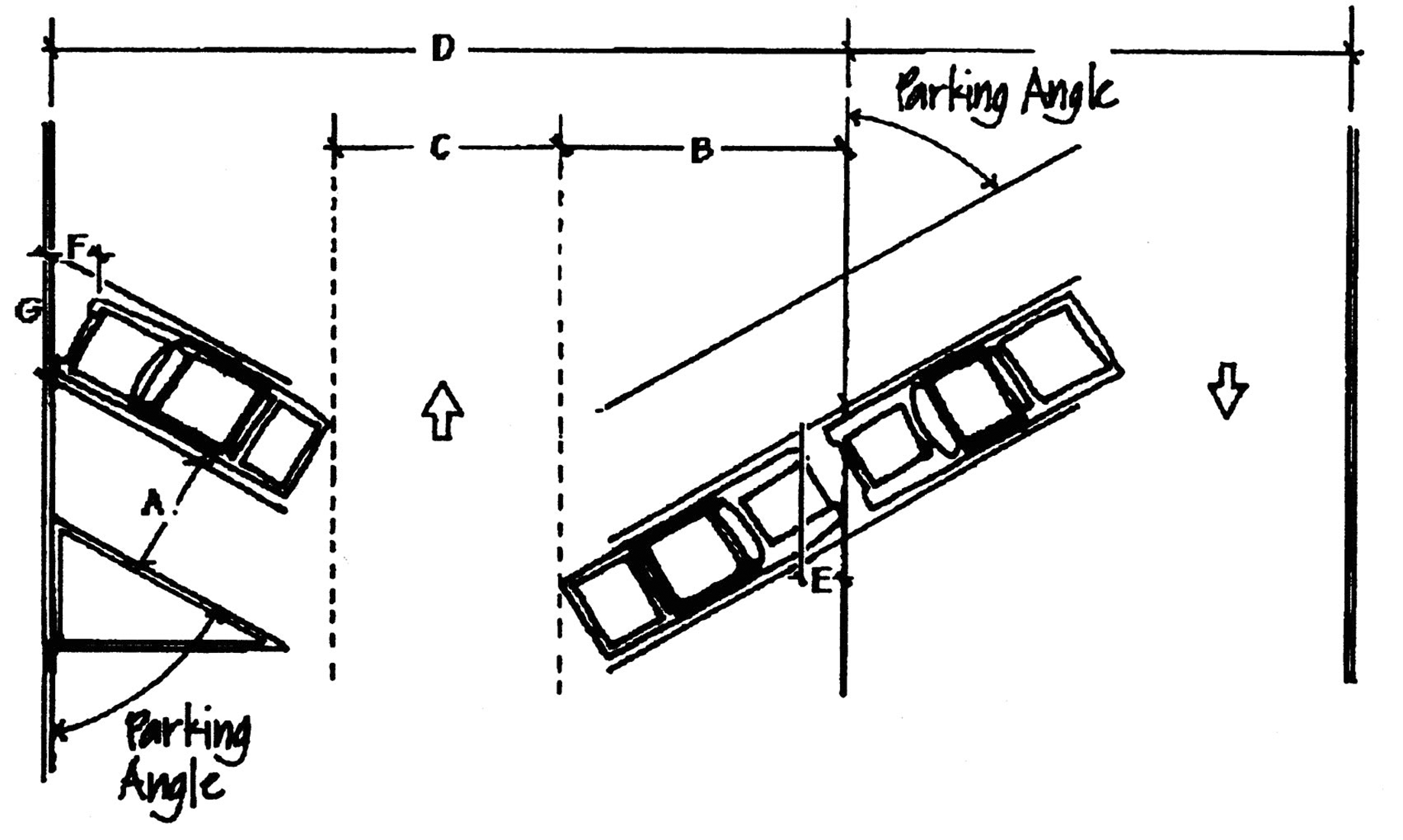
Table 7.1.4
*No two-way aisle shall be less than 24 feet in width.
NOTE: All measurements are in feet.
(Ord. No. 2750, § 2, 11-17-97; Ord. No. 2943, § 3, 12-15-03)
Sec. 17-857. - Off-street loading.
(a)
General requirements.
(1)
Number and type of loading berths required. The number and type of loading berths required shall conform to the requirements set forth on Table 7.I.7.A, Schedule of Off-Street Loading Requirements. Descriptions of long and short loading berths may be found in Table 7. 1.7.C, Size of Off-Street Loading Facilities.
(2)
Utilization. Space allocated to any off-street loading use shall not, while so allocated, be used to satisfy any off-street parking space requirements.
(b)
Location of required loading facilities. All required loading berths shall be located in the rear yard whenever possible and on the same zoning lot as the use served. The sideyard may be used when it is not possible to use the rear yard.
(c)
Design and improvement standards for off-street loading facilities.
(1)
Size. This Code provides for two sizes of loading berths, short berths and long berths. The vertical clearance of all berths shall be not less than 15 feet. The minimum size of short and long loading berths shall conform to Table 7.1.7.C.
Table 7.1.7.C. Size Of Off-Street Loading Facilities
(2)
Surfacing. All open off-street loading berths shall be paved with asphalt, concrete or other dustless all-weather material capable of bearing a live load of 200 pounds per square foot. Gravel and tar and chip are not permitted as surfacing materials.
Table 7.1.7.A. Schedule Of Off-Street Loading Requirements
1 Gross Floor Area refers to all buildings or structures on the premises.
(Ord. No. 2750, § 2, 11-17-97)
Sec. 17-871. - Purpose.
These landscaping requirements are intended to foster aesthetically pleasing development which will preserve and enhance the appearance, character, health, safety, and welfare of the community. These regulations are intended to increase the compatibility of adjacent uses, and, in doing so, minimize the harmful impact of noise, dust and other debris, motor vehicle headlight glare or other artificial light intrusions, and other objectionable activities or impacts conducted or created by an adjoining or nearby uses. These regulations are also intended to promote the prudent use of water and energy resources.
(Ord. No. 2750, § 2, 11-17-97)
Sec. 17-872. - Enforcement of landscaping requirements.
The landscaping provisions of this code shall be enforced for all new construction requiring a landscape plan. Wherever the submission and approval of a landscape plan is required by this Code, such landscape plan shall be an integral part of any application for a building permit and occupancy permit. No permit shall be issued without city approval of a landscape plan as required herein. Failure to implement the approved landscape plan shall be cause for revocation of the occupancy permit.
(Ord. No. 2750, § 2, 11-17-97)
Sec. 17-873. - Landscape plan.
(a)
Landscape plan required. A landscape plan shall be required for the following situations:
(1)
New construction of fraternities and sororities and new construction of five or more units in multiple-family buildings or complexes in the R-4 zoning district.
(2)
Additions to or new construction of non-residential buildings on lots exceeding 10,000 square feet in size in all zoning districts, excluding the B-3 zone.
Landscape plans shall be drawn in conformance with the requirements specified in this chapter, and must be reviewed and approved by the office of building and zoning prior to the issuance of a building permit.
(b)
Contents of landscape plan. All landscape plans submitted for approval shall contain the following information:
(1)
The location and dimensions of all existing and proposed structures, property lines, easements, parking lots and drives, roadways and rights-of-way, sidewalks, fences, refuse disposal and recycling areas, and other freestanding structural features as determined necessary by the community development coordinator.
(2)
The location, quantity, size and name of all existing plant materials to be removed.
(3)
The location, quantity, size and name of all proposed plant material, including shade trees, shrubs, ground cover, annuals/perennials and turf.
(4)
Existing and proposed grading of the site indicating contours at two-foot intervals. Proposed berming shall be indicated using one-foot contour intervals.
(5)
Elevations of all fences and retaining walls proposed for location on the site.
(6)
Diagrams and maps shall be drawn using a scale of one inch to 50 feet.
(Ord. No. 2750, § 2, 11-17-97)
Sec. 17-874. - Selection, installation, and maintenance of plant materials.
(a)
Selection. Planting materials used in conformance with the provisions of this section shall be of good quality, of a species hardy to western Illinois, and capable of withstanding the extremes of individual site microclimates. Size and density of plant material, both at the time of planting and at maturity, are additional criteria which shall be considered when selecting plant materials. The use of drought tolerant plant material is preferred. The use of salt tolerant plant material is preferred for landscaping near streets and other rights-of-way.
(b)
Installation. All landscaping materials shall be installed in accordance with the current planting procedures established by the American Association of Nurserymen. The installation of all plant material required by this chapter may be delayed until the next optimal planting season, as determined by the community development coordinator.
(c)
Maintenance. The owner of the premises shall be responsible for the maintenance, repair, and replacement of all failed landscaping materials and structures. All landscaping materials shall be maintained in good condition so as to present a healthy and orderly appearance, and plant material not in this condition shall be replaced when necessary and shall be kept free of refuse and debris. Fences, walls, and other barriers shall be maintained in good repair. Irrigation systems if needed shall be maintained in good operating condition to promote the health of the plant materials and the conservation of water.
(Ord. No. 2750, § 2, 11-17-97)
Sec. 17-875. - Design standards and guidelines.
Landscape plans described above shall be prepared based on the following design standards and guidelines. Standards are numerically measurable and can be definitively evaluated for compliance. Design guidelines are not precisely measurable, but compliance can be determined through the evaluation process of landscape plan review.
(1)
Minimum standards.
a.
Shade trees. All shade trees shall have a minimum trunk size of one and one-half inches in caliper, unless otherwise specified. The removal of trees within the public right-of-way is prohibited without the approval of the community development coordinator.
b.
Shrubs. All shrubs shall have minimum height of 18 inches at planting and a maximum height of six feet at maturity, except for parkway shrubs, which shall have no minimum height at planting and which shall have a maximum height of 18 inches at maturity.
c.
Yards. Yards shall be landscaped primarily with turf or other plant materials. Pavement of yards other than for parking or loading purposes is prohibited.
(2)
Design guidelines.
a.
Scale and nature of landscaping material. The scale and nature of landscaping materials shall be appropriate to the size of the structures. Large scaled buildings, for example, should generally be complemented by larger scaled plants.
b.
Selection of plant material. Plant material shall be selected for its form, texture, color, pattern of growth and adaptability to local conditions.
c.
Evergreens. Evergreens should be incorporated into the landscape treatment of a site, particularly in those areas where screening and buffer is required.
d.
Softening of walls and fences. Plant material should be placed intermittently against long expanses of building walls, fences, and other barriers to create a softening effect.
e.
Planting beds. Planting beds should be mulched with bark chips, feather rocks, or similar materials. Mulch shall not be used as a substitute for plant materials.
f.
Detention/retention basins and ponds. Detention/retention basins and ponds shall be landscaped. Such landscaping should include shade and ornamental trees, evergreens, shrubbery, hedges, turf, groundcover and/or other plant materials.
g.
Water conservation. Landscape design pursuant to the requirements of this chapter must recognize the need for water conservation. While sprinkler irrigation systems are required for certain landscape areas, and may be desirable for other applications, all irrigation systems shall be designed to minimize the use of water.
h.
Domestic turf grasses. Domestic turf grasses should be used in areas with little or no slope to prevent the runoff of irrigation water.
i.
Energy conservation. Plant material placement will be designed to reduce the energy consumption needs of the development.
1.
Deciduous trees should be placed on the south and west sides of buildings to provide shade from the summer sun.
2.
Evergreens and other plant materials should be concentrated on the north and west sides of buildings to dissipate the effect of winter winds.
j.
Preservation of existing plant material. Existing plant material should be incorporated into the landscape treatment of a site. Effort should be made to preserve and protect existing trees with trunk diameters in excess of 12 inches. Construction equipment and personnel should be kept away from such trees and their root systems by the installation of fencing materials at the tree's dripline.
k.
Berming. Earthen berms and existing topographic features should be incorporated into the landscape treatment of a site whenever determined practical by the community development coordinator, particularly when combined with plant material to facilitate screening.
(Ord. No. 2750, § 2, 11-17-97)
Sec. 17-876. - Minimum lot landscaping requirements.
A minimum of five percent of the lot or development area must be set aside for front or sideyard landscaping. Landscaping in the rear yard may not be counted toward satisfying this requirement, unless otherwise noted in this Code. Landscaping shall consist of a combination of the following: Interior parking lot landscaping, perimeter parking lot landscaping, and building landscaping.
(1)
Interior parking lot landscaping. All parking lots designed for 100 or more parking spaces shall provide interior landscaping in accordance with the provisions of this section.
a.
Area required. Not less than five percent of the interior of a parking lot shall be devoted to landscaping. Landscaping areas located along the perimeter of a parking lot beyond the curb or edge of pavement of the lot shall not be counted toward satisfying this requirement.
b.
Landscaped areas. The landscaped areas defined in subsection a. shall be improved as follows:
1.
Interior parking lot landscaping areas (planting islands at least six inches above the surface of the parking lot) shall be dispersed throughout the parking lot in a design and configuration that aesthetically corresponds to the size and shape of the parking lot. Clustering of landscaping areas should be considered when possible.
2.
Interior parking lot landscaping areas shall be a minimum of 400 square feet in area and shall be a minimum of 16 feet in width, as measured from back of curb to back of curb.
3.
The plant material used to improve the landscape area defined above shall conform to the following:
i.
Type. The primary plant material used in parking lots shall be shade trees species which conform to applicable provisions of sections 17-874 and 17-875 of this division. Ornamental trees, shrubbery, hedges, and other plant materials may be used to supplement the shade tree plantings, but shall not be the sole contribution to such landscaping.
ii.
Quantity. One shade tree shall be provided for every 100 square feet of landscaping area.
iii.
Groundcover. One hundred percent of the landscaping area shall be planted with an approved ground cover or shall be mulched. Mulch must be applied at a thickness of at least two inches.
(2)
Perimeter parking lot landscaping. All parking lots located in the required front or side yard setbacks and designed for 15 or more spaces shall provide perimeter parking lot landscaping in accordance with the provisions of this section.
a.
Landscaped areas. The landscaped areas shall be improved as follows:
1.
Landscaped areas shall be at least seven feet in width, as measured from the back of curb or the end of the parking surface, excluding any parking space overhang area.
2.
The plant material used to improve the landscape area defined above shall conform to the following:
i.
Type. The primary plant material used shall be shade trees, shrubbery, ornamental trees, annuals/perennials and turf. Landscape berms may be incorporated into the design as long as they do not block visibility.
ii.
Quantity. One shade or ornamental tree shall be provided for every 40 feet of yard length. Trees may be clustered based on specific site requirements.
One shrub, measuring a minimum of 12 inches at planting and not exceeding six feet at maturity, per three feet of yard length. Shrubbery may be clustered or spaced linearly, but shall not block visibility when planted next to a public street or private drive. Parkway shrubs or shrubbery that may block visibility shall have a maximum height of 18 inches at maturity.
iii.
Groundcover. One hundred percent of the landscaping area shall be planted with an approved ground cover or shall be mulched. Mulch must be applied at a thickness of at least two inches.
(3)
Building landscaping. Building landscaping may be used in combination with interior and perimeter parking lot landscaping to satisfy the minimum lot or development area landscaping requirement listed in section 17-876 of this division.
a.
Landscape areas. The landscape areas around the building shall be improved as follows:
1.
Landscaped areas shall be at least 100 square feet in area, with a minimum width in all directions of at least eight feet.
2.
Landscape material. The plant material used to improve the landscape areas defined above shall conform to the following:
i.
Type. The primary plant materials used shall be shade and ornamental trees. Shrubbery and other plant materials may be used to supplement the shade or ornamental tree plantings, but shall not be the sole contribution to such landscaping.
ii.
Quantity. One shade or ornamental tree shall be provided for every 100 square feet of landscaping area.
iii.
Groundcover. One hundred percent of the landscaping area shall be planted with an approved ground cover or shall be mulched. Mulch must be applied at a thickness of at least two inches.
(Ord. No. 2750, § 2, 11-17-97)
Sec. 17-877. - Landscape buffers.
(a)
Applicability. The regulations of this section shall establish the dimensions and improvement requirements of landscape buffers as required for transitions between zoning classifications and the screening of loading berths. The planting of required landscape buffers may satisfy 50 percent of the minimum lot landscaping requirements outlined in section 17-6 of this division.
(b)
General restrictions. Landscape buffers shall be reserved for the planting of material and installation of fencing as required within this section. No parking, driveways, sidewalks, accessory buildings or other impervious surfaces shall be permitted, unless specifically authorized through the site plan review process. Landscape buffers may be located within required yards or required landscape yards as established in the applicable district regulations. Where both landscape buffers and parking lot landscaping is required the more restrictive shall apply.
(c)
Size and improvement of landscape buffers. The size and improvement of landscape buffers for various situations shall be as follows:
(1)
AG Agricultural and ROS Recreation and Open Space Districts. Where an Agricultural District or Recreation and Open Space District abuts a residential district, a landscape yard a minimum of 25 feet in width shall be provided. Landscape yards are yards devoted exclusively to landscaping except however, that driveways and sidewalks needed to serve the use and buildings on the lot may be located within a required landscape yard. No specific improvements are required within landscape yards, except as provided below:
a.
Where active recreational areas such as ball diamonds or other athletic fields abut residential districts, a landscape buffer a minimum of ten feet in width shall be provided. Within this required landscape buffer, the following improvements shall be provided.
1.
Shade trees, a minimum of one and one-half inches in caliper, shall be planted at the rate of one tree for every 30 feet of landscape buffer.
2.
A continuous evergreen or dense deciduous shrub hedge shall be planted along the entire length of landscape buffer. This shrub hedge shall have a mature height of not less than six feet and shall be installed at a height of not less than 18 inches.
3.
A fence not exceeding six feet in height may be combined with the shrub hedge.
4.
Areas not planted with trees or shrubs shall be maintained as turf or other groundcover. All landscape areas not planted with trees and shrubs shall be maintained in turf or other approved groundcover.
(2)
R-4 Multiple-Family or MH Manufactured Home Districts. Where a multiple-family, fraternity and sorority, or manufactured home development abuts a single- or two-family district, a landscape buffer a minimum of ten feet in width shall be provided. Within this required landscape buffer, the following improvements shall be provided.
a.
Shade trees, a minimum of one and one-half inches in caliper, shall be planted at the rate of one tree for every 30 feet of landscape buffer.
b.
A continuous evergreen or dense deciduous shrub hedge shall be planted along the entire length of landscape buffer. This shrub hedge shall have a mature height of not less than six feet and shall be installed at a height of not less than 18 inches.
c.
A fence not exceeding six feet in height may be combined with the shrub hedge.
d.
Areas not planted with trees or shrubs shall be maintained as turf or other groundcover.
(3)
O/I: Office/Institutional District. Where a lot in the Office/Institutional District abuts a residential district, a landscape buffer of a width equal to the height of the principal building, plus 50 feet shall be provided. Within the landscape buffer required, the following improvements shall be provided:
a.
Shade trees, a minimum of one and one-half inches in caliper, shall be planted at the rate of one tree for every 30 feet of landscape buffer.
b.
A continuous evergreen or dense deciduous shrub hedge shall be planted along the entire length of landscape buffer. This shrub hedge shall have a mature height of not less than six feet and shall be installed at a height of not less than 18 inches.
c.
A fence not exceeding six feet in height may be combined with the shrub hedge, subject to the approval of the community development coordinator.
d.
Areas not planted with trees or shrubs shall be maintained as turf or other groundcover approved by the community development coordinator.
(4)
B-1 and B-2 Districts. Where a lot in the B-1 or B-2 District abuts a residential district, a landscape buffer a minimum of seven feet in width shall be provided. Within the landscape buffer required, the following improvements shall be provided:
a.
Shade trees, a minimum of one and one-half inches in caliper, shall be planted on an average of one tree for every 30 feet of the yard length.
b.
Shrubs, having a mature height of not less than six feet and installed at a height of not less than 18 inches, shall be planted along 100 percent of the yard length. Berms may be used in conjunction with other landscaping materials to satisfy the height requirement.
The shrubs may be installed either inside or outside of the fence required in subsection (5)c. below, subject to the other requirements of that subsection.
c.
A solid fence not exceeding six feet in height may be erected along 100 percent of the yard length in lieu of the landscaping requirement in division 2.
d.
Areas not planted with trees or shrubs shall be maintained as turf or other groundcover.
(5)
M-1 and M-2 Industrial Districts. Where a lot in the M-1 or M-2 District abuts residential district, a landscape buffer 30 feet in width shall be provided. Within the landscape buffer required, the following improvements shall be provided.
a.
Shade trees, not less than one and one-half inches in caliper, shall be planted on an average of one tree for every 20 feet of length of the yard length. Shade trees may be grouped or clustered, subject to site plan review approval. Evergreen trees may be used as substitutes for some of the shade trees.
b.
Shrub masses, at least two rows deep and with shrubs alternately spaced, shall be provided along 100 percent of the length of the yard length. Shrubs shall be installed at a height of 18 inches and shall reach a mature height of not less than six feet. Berms may be used in conjunction with other landscaping materials to satisfy the height requirement.
c.
Areas not planted with trees or shrubs shall be maintained as turf or other groundcover approved by the community development coordinator.
d.
A solid fence not exceeding six feet in height may be erected along 100 percent of the yard length in lieu of the landscaping requirement in division 2.
(Ord. No. 2750, § 2, 11-17-97; Ord. No. 07-43, § 7, 11-20-07)
Sec. 17-878. - Screening of refuse disposal dumpsters.
Refuse disposal dumpsters in all zoning districts shall be screened on all sides by a solid wood or masonry fence to a height of not less than six feet but not more than eight feet.
(Ord. No. 2750, § 2, 11-17-97)
Sec. 17-879. - Changes to approved landscape plans.
Any change or deviation to an approved landscape plan shall require the approval of the community development coordinator. Changes which do not conform to this chapter shall be subject to the procedures for a variance as established in article IV of this chapter. Landscape improvements made to a lot that are not in conformance with an approved landscape plan shall be a violation of this chapter, and subject to the fines and penalties established herein.
(Ord. No. 2750, § 2, 11-17-97)
Sec. 17-880. - Required landscaping in rear yards of through lots in R-3 and R-3A.
A minimum open space of at least ten feet in width shall be maintained. This area shall be covered in turf or other suitable landscaping ground cover, (excepting driveways) and shall contain the following vegetative improvements:
(a)
A row of approved shrubs shall be planted along the entire length of the rear yard frontage. The shrub hedge shall have a mature height of not less than six feet and the shrubs shall be placed on six-foot centers.
(b)
In lieu of shrubbery, a solid fence not exceeding six feet in height may be erected across the entire rear yard frontage. Such fence shall be of a solid, opaque material sufficient to screen visibility and be placed along the inside edge of the required rear yard setback area.
(Ord. No. 11-04, § 3, 1-3-11)
Sec. 17-891. - Purposes and definitions.
(a)
To preserve the non-commercial character of residential neighborhoods and to provide reasonable yet appropriate conditions for identifying businesses and services rendered in commercial districts by controlling the size, number, design characteristics and locations of signs.
(b)
To reduce traffic hazards by restricting signs and lights which exceed the viewers' capacity to receive information or which increases the probability of accidents created by distracting attention or obstructing vision.
(c)
To preserve order and cleanliness, maintain open spaces and avoid the appearance of clutter, protect property values, and prevent nuisances and invitations to vandalism.
(d)
Definitions.
(1)
Billboard sign means a sign greater than 150 square feet in size. This type of sign is generally composed of poster panels or bulletins mounted on a building wall or freestanding structure, or painted directly on the wall or freestanding structure.
(2)
Digital billboard means a sign that is static and changes messages by any electronic process or remote control.
(3)
Billboard spacing means spacing of billboards shall be the minimum distance between outdoor advertising billboard structures measured along the nearest edge of the pavement between points directly opposite the billboards along each side of the highway and shall apply to outdoor advertising billboard structures located on both sides of the highway involved. Spacing shall be calculated with respect to existing billboards whether or not the existing billboards are within the corporate limits of the city.
(4)
East Billboard Corridor means an area including all land located within 200 feet of the north and south boundaries of the Route 136 right-of-way extending from the east side of N. Bower Road to the terminus of the city's 1.5-mile zoning buffer, and all land located within 200 feet of the east and west boundaries of the Route 67 right-of-way extending from the south side of Route 136 to the terminus of the city's 1.5-mile zoning buffer.
(5)
North Billboard Corridor means an area including all land located within 200 feet of the east and west boundaries of the Route 67 right-of-way extending from the north side of Tower Road to the terminus of the city's 1.5-mile zoning buffer.
(6)
West Billboard Corridor means An area including all land located within 200 feet of the north and south boundaries of the Route 136 right-of-way extending from the west side of Deer Road to the terminus of the city's 1.5-mile zoning buffer.
(7)
West Bypass Area Corridor means an area including all land located within 200) feet of the right-of-way boundaries for Route 336 between the Route 67 and Route 136 interchanges. Per IDOT regulation, signs may not be located within 1,000 feet of approaching, merging or intersecting traffic and obscure or interfere with a driver's view of such traffic.
(8)
Electric means any sign containing electric wiring. This does not include signs illuminated by an exterior floodlight source.
(9)
Flag means a fabric or other flexible material attached to or designed to be flown from a flagpole or similar device.
(10)
Flat wall (façade-mounted) means a sign affixed directly to or painted on or otherwise inscribed on an exterior wall and confined within the limits thereof of any building and which projects from that surface less than 12 inches at all points.
(11)
Flashing means any illumined sign on which the artificial light is not maintained stationary or constant in intensity and color at all times when such sign is in use. For the purpose of this Code, any moving illuminated sign, except digital billboards, must be considered a flashing sign.
(12)
Freestanding means a sign erected and maintained on a freestanding frame, mast or pole not attached to any building, and not including ground mounted signs.
(13)
Government sign is a sign that is constructed, placed or maintained by the federal, state or local government or a sign that is required to be constructed, placed or maintained by the federal, state or local government either directly or to enforce a property owner's rights.
(14)
Ground mounted means a sign which extends from the ground, or has support which places the bottom of the sign less than two feet from the ground.
(15)
Highway sign means a freestanding sign, integral sign or flat mounted sign that is erected and maintained within the view of motorists who are driving on a highway.
(16)
Integral means a sign that is embedded, extruded or carved into the material of a building façade. A sign made of bronze, brushed stainless steel or aluminum, or similar material attached to the building façade.
(17)
Marquee means a canopy or covering structure bearing a signboard or copy projecting from and attached to a building.
(18)
Monument sign means a two-sided sign attached to a permanent foundation or decorative base and not attached or dependent on support from any building, pole, posts or similar uprights. Monument signs include ground signs.
(19)
Monument sign—Development entry means a monument sign that is used as an entry way feature for a subdivision or similar business, office, or industrial complex.
(20)
Original art display means a hand-painted work of visual art that is either affixed to or painted directly on the exterior wall of a structure with the permission of the property owner. An original art display does not include: mechanically produced or computer generated prints or images, including but not limited to digitally printed vinyl; electrical or mechanical components; or changing image art display.
(21)
Outdoor advertising means a sign which advertises goods, products or services which are not sold, manufactured or distributed on or from the premises or facilities on which the sign is located.
(22)
Reserved.
(23)
Portable sign means any structure without a permanent foundation or otherwise permanently attached to a fixed location, which can be carried, towed, hauled or driven and is primarily designed to be moved rather than be limited to a fixed location regardless of modifications that limit its movability.
(24)
Projecting means a sign, other than a wall sign, which projects from and is supported by a wall of a building or structure.
(25)
Roof sign means a sign located on or above the roof of any building, not including false mansard roof, canopy, or other fascia.
(26)
Sign means a name, identification, description, display or illustration, which is affixed to, painted or represented directly or indirectly upon a building, or other outdoor surface which directs attention to or is designed or intended to direct attention to the sign face or to an object, product, place, activity, person, institution, organization or business. Signs located completely within an enclosed building, and not exposed to view from a street, must not be considered a sign. Each display surface of a sign or sign face must be considered to be a sign.
(27)
Sign area means the space enclosed within the extreme edges of the sign for each sign face, not including the supporting structure or where attached directly to a building wall or surface, the space within the outline enclosing all the characters of the words, numbers or design.
(28)
Sign face means the entire display surface area of a sign upon, against or through which copy is placed.
(29)
Temporary means a banner, pennant, poster or advertising display constructed of paper, cloth, canvas, plastic sheet, cardboard, wallboard, plywood or other like materials and that appears to be intended or is determined by the code official to be displayed for a limited period of time.
(Ord. No. 18-26, § 4(Exh. A), 9-17-18; Ord. No. 21-14, § 2(Exh. A), 7-19-21)
Sec. 17-892. - Prohibited and exempt signage.
(a)
Prohibited signs. The following signs are prohibited in all districts:
(1)
Signs which move, or give the appearance of movement. This category includes signs which flutter, undulate, swing, rotate, oscillate or otherwise move by natural or artificial means. Feather flags, pennants, banners, and streamers may be used only on a temporary basis in business and industrial zones. The length of time such signs may be used is subject to the approval of the community development coordinator and issuance of a permit as required in section 17-893.
(2)
Roof signs.
(3)
Signs which imitate traffic signs by the use of similar shapes and colors to those of preexisting traffic signs. This category (4) does not include signs which are accessory to parking lots.
(4)
Portable or wheeled signs.
(5)
Signs placed on parked vehicles or trailers.
(6)
Inflatable images such as balloons may be used only on a temporary basis in business and industrial zones. Such signs may not be used for longer than five days in any 30-day period.
(7)
Signs or other similar devices, internal or external, containing rapidly flashing or running lights or lights being at an interval, color, or shape similar to lights as utilized by emergency service vehicles.
(b)
Exempt signs. The following signs are hereby designated as "exempt signs" and, as such, are subject only to the regulations contained in this subsection.
(1)
Signs used for safety purposes relative to the repair or maintenance of streets, sidewalks, or utilities in a public right-of-way.
(2)
Nameplates not to exceed two square feet in area.
(3)
Address plaque not to exceed two square feet in area.
(4)
Paper notices placed on designated information kiosks.
(5)
Signs and public notices erected or required by governmental bodies, or authorized for a public purpose by any law, statute or ordinance. Such public signs may be of any type, number, area, height, location, or illumination as authorized by law, statute or ordinance.
(6)
Flags up to 120 square feet in size and a 40 feet height of pole, within B-1, B-2, O/I, M, and ROS districts. In all other districts, including the downtown overlay district, flags are limited to 20 square feet in size and 24 feet in height of pole to be considered a flag, the object must be basically, rectangular in shape, made of a material resistant to outside weather conditions, capable of being raised or lowered on a daily basis and must be suspended from a freestanding pole.
(7)
A flag that has been adopted by the federal government, this state or the local government may be displayed as provided under the law that adopts or regulates its use.
(8)
Plaques and cornerstones not to exceed two square feet in area designed, which must be constructed of bronze or other incombustible materials and be permanently affixed to the building or premises.
(9)
Matter appearing on gasoline pumps, newspaper vending boxes and automatic teller machines and other vending machines as purchased or installed.
(10)
Matter appearing on or adjacent to entry doors not exceeding one square foot in area per establishment.
(11)
Matter appearing on display windows or doors to retail or service establishments not exceeding a cumulative total of two square feet in area per establishment.
(12)
Temporary or neighborhood shall not exceed eight square feet in area in residential districts (R1, R2, R3, R4, RMH and ASMU) and 32 square feet in nonresidential districts. There shall be no limit on the number of such signs on a given property. Signs shall be removed within seven days after the event in nonresidential districts.
(Ord. No. 18-26, § 4(Exh. A), 9-17-18; Ord. No. 21-14, § 2(Exh. A), 7-19-21)
Sec. 17-893. - Permit required.
(a)
Sign permits required.
(1)
No person or business may erect, alter or relocate any permanent or temporary sign without first obtaining a permit from the office of community development.
(2)
Routine maintenance or changing parts of a sign shall not be considered an alteration of a sign, provided that the maintenance or change of parts does not alter the type of installation, surface area, height, or otherwise make the sign nonconforming.
(b)
Electrical permit required. In addition to complying with the provisions of this chapter, all signs in which electrical wiring and connections are to be used shall be regulated pursuant to the electrical code.
(c)
Applications for permits.
(1)
Application for the permit shall be made in writing, in duplicate, upon forms prescribed and approved by the community development coordinator, to the community development coordinator, and shall contain the following information:
a.
Name, address, and telephone number of applicant.
b.
Location of building, structure, or land on which the sign is to be erected.
c.
A detailed drawing or blueprint showing a description of the construction details of the sign and showing the face(s) composing the sign; position of lighting or other extraneous devices; a location plan showing the position of the sign on any building or land; and its position in relation to nearby buildings or structures and to any private or public street or highway.
d.
Written consent of the owner of the building, structure, or land on which the sign is to be erected in the event the applicant is not the owner thereof.
e.
A copy of any required electrical permit issued for the sign, or a copy of the application therefor. Such other information or material which the community development coordinator deem necessary for any application for the maintenance of a sign requiring a conditional use.
(2)
Filing fee. A fee shall be paid with each application for a sign permit in accordance with chapter 24, city fee schedule, section 24-6. If an electrical permit is required, an additional fee shall be paid as required by the city.
(3)
Issuance of permits. It shall be the duty of the community development coordinator upon the filing of an application for a permit to erect a sign, to examine such plans, specifications, and other data submitted to him/her with the application, and, if necessary, the building or premises upon which it is proposed to erect the sign. If the proposed sign is in compliance with all the requirements of this law and other laws of the city, the community development coordinator shall issue a permit for the erection of the proposed sign.
(d)
Validity of permit. If the work authorized under a sign permit has not been completed within one year after the date of issuance, the permit shall become null and void.
(e)
Failure to obtain permit. Any person or business who erects, alters or moves a permanent sign without obtaining a permit shall be subject to a penalty and or remedy as provided in section 1-8 and subsequently 1-13 of this Code.
(Ord. No. 18-26, § 4(Exh. A), 9-17-18; Ord. No. 21-14, § 2(Exh. A), 7-19-21)
Sec. 17-894. - General sign regulations.
(a)
Limitations on location of signs.
(1)
No sign, whether temporary or permanent, shall be located within or shall obstruct the public right-of-way in any manner without the prior written consent of the city council. All freestanding signs, when not located upon a corner lot, can be placed within five feet of any property or lot lines. All signs located on corner lots shall be set back at least ten feet from the property or lot lines along public streets when located within 25 feet of the intersection of the front and side yard lot lines. Signs within ten feet of the property line along a public street on a corner lot and within 25 feet of the intersection of lot lines as noted above shall be either placed with the bottom of the sign a minimum of nine feet above the adjacent street grade or with the top of the sign placed no more than 30 inches above the adjacent street grade so as not to block vehicle visibility.
(2)
No sign shall be erected or placed so as to prevent free ingress and egress from any door, window, or fire escape, nor shall such sign be attached to any standpipe or fire escape.
(b)
Calculating sign area. Sign area is defined as the area within any perimeter enclosing the limits of lettering, emblems, or other figures on a sign, together with any material or color forming an integral part of the display or used to differentiate the sign from the background on which it is placed. Structural members bearing no sign copy shall not be included in its space area. In the case of a multi-faced sign all sides shall be included in the calculation of surface area.
(c)
Illumination of signs.
(1)
Types of illuminated signs. Illuminated signs shall be limited to the following:
a.
Interior luminous tubes;
b.
Enclosed floodlighting using white or daylight gooseneck-type lamps; or
c.
Backlighting;
d.
LED electronic, illumination.
(2)
Brightness limitations.
a.
Whenever external illumination is used for a sign, the source of light shall be located, shielded and directed in such a manner that the light does not shine or cause glare onto any surrounding public street or private residence, pursuant to article VII, division 4.
b.
In no case shall the lighting intensity of any sign, whether resulting from internal or external illumination, exceed 60 foot-candles when measured with a standard light meter perpendicular to the face of the sign at a distance equal to the narrowest dimension of the sign.
c.
Signs may have electronic display areas. Such signs will be referred to as LED display signs. Signs of any type with very rapidly flashing messages or patterns, i.e., strobe lighting will not be permitted. Any graphically enhanced (LED display) electronic signs as described above shall be limited to a maximum height of 24 feet and the graphic display surface shall cover no more than 36 square feet in area. LED display signs as outlined above shall be permitted in AG, O/I, B-1, B-2, M-1 and M-2 zoning districts. LED display signs located within the Downtown District, Adams Street Mixed Use District or within any local, state or national historic district regardless of zoning designation shall be limited to a maximum size of eight square feet in graphic display surface area. No text message may blink or flash at rapid intervals, (less than three seconds) or mimic strobe lighting. The number of such signs will be limited to one for each building face per business. The actual square footage of LED signs in all zoning districts shall be calculated as part of the maximum allowable size by type of sign and percentage of wall or window coverage as listed in Tables 7.3.5.A. through G. and accompanying supplementary regulations.
(3)
Hours of illumination. No sign shall be illuminated between the hours of 12:00 a.m. and 5:00 a.m., unless the activity displaying the sign is open for business during those hours. The community development coordinator is authorized to grant an exemption from the provisions of this subsection to any activity in which illumination of signs during the hours otherwise prohibited is necessary or desirable for the security and safety of the activity or for property in the custody of the activity.
(4)
Voltage plate. All signs in which electrical wiring and connections are to be used shall have affixed thereon a plate showing the voltage of the electrical apparatus used in connection with the sign. This voltage plate shall face away from public view and right-of-way.
(d)
General construction and maintenance requirements.
(1)
Construction. All permanent signs shall be constructed of a safe, strong, and permanent material which, at a minimum, shall be fireproofed and designed to withstand wind loads typical of the sign's application. Nails, tacks, or wires or other hazardous projections are prohibited. Any glass forming a part of any sign shall be safety glass. If any single piece or pane of glass exceeds four square feet, such piece or pane shall be composed of wired, safety or plexi-glass.
(2)
Maintenance. All signs shall be kept and maintained in a, safe, clean and orderly condition and appearance, and shall be repaired, replaced, repainted or otherwise maintained periodically by the owner to prevent corrosion or deterioration caused by weather, age or any other conditions.
(e)
Other city codes.
(1)
All signs shall be constructed, erected and maintained in accordance with the city's building regulations.
(2)
The provisions of this chapter shall not amend, nor in any way interfere with, other codes, rules or regulations governing traffic signs within the city or its planning jurisdiction.
(Ord. No. 18-26, § 4(Exh. A), 9-17-18; Ord. No. 21-14, § 2(Exh. A), 7-19-21)
_____
Sec. 17-895. - Sign regulations by district.
(a)
Sign regulations for the AG-1 Agricultural District.
(1)
Purpose and applicability. Sign regulations for the AG-1 Agricultural District are intended to provide appropriate signage for the limited commercial and agricultural uses located in the district, while having a minimal impact on the one-family residential uses which are also permitted in the district and the area's overall atmosphere. All lots within the AG-1 District shall conform to the sign regulations in Table 7.3.5.A., below.
Table 7.3.5.A. Sign Type, Size and Height Restrictions for the AG-1 Agricultural District
* For lots with a frontage of less than 150 L.F., all pole and wall/flat sign maximum sizes as listed above shall be reduced by 33 percent.
(2)
Supplementary regulations for signs in the AG-1 District.
a.
Total number of signs. The total number of permanent signs for a use in the AG-1 district shall not exceed five with the exception of seasonal signs which are not limited in number.
(b)
Sign regulations for the R-1, R-2, and RMH Districts.
(1)
Purpose and applicability. Sign regulations for these districts are intended to limit the use of signage to situations typically accessory to single-family residential use. The number, size and duration of signage permitted shall be controlled to prevent the creation of nuisances and impacts on the use and enjoyment of surrounding residential property. All lots within the R-1, R-2, R-3, and MH Districts shall conform to the sign regulations in Table 7.3.5.B., below.
Table 7.3.5.B. Sign Type, Size and Height Restrictions for R-1, R-2, and RMH Districts
a.
Supplementary regulations for signs in the R-1, R-2, and RMH Districts.
Total number of signs. The total number of permanent signs in R-1, R-2, and RMH Districts shall not exceed two. This total number of signs permitted shall not include nameplates, public safety signs, or monument development entry signs.
b.
Permitted non-residential uses. Signs for permitted non-residential uses will be treated as legal nonconforming uses, and the sign regulations for the most appropriate principal use or activity will be applied.
c.
Illumination. Signs shall not be illuminated, except for development entry signs.
(2)
Monument—Development entry signs in R-1, R-2, and RMH districts will be by special use only.
(c)
Sign regulations for the R-3 and R-4 Districts.
(1)
Purpose and applicability. Sign regulations for the R-3 and R-4 Districts are intended to allow for appropriate identification of multifamily buildings while limiting other forms of signage to a level consistent with the needs of multiple-family residents. The following regulations shall apply to each multiple-family building, whether on a separate lot of record or as part of a multiple-family development which may have multiple buildings on a lot, except that regulations on development entry signs shall apply to the lot, regardless of the number of buildings on the lot. All lots within the R-4 Multiple-Family Districts shall conform to the sign regulations in Table 7.3.5.C., below.
Table 7.3.5.C. Sign Type, Size and Height Restrictions for R-3 and R-4 Districts
(2)
Supplementary regulations for signs in the MF Multiple-Family District.
a.
Total number of signs. The total number of permanent signs for multifamily residential buildings shall not exceed three. This total number of signs permitted shall not include nameplates, public safety signs, or development entry signs.
b.
Permitted non-residential uses. Signs for permitted non-residential uses will be treated as legal nonconforming uses, and the sign regulations for the most appropriate principal use or activity will be applied.
c.
Illumination. Illuminated signs for multifamily buildings or developments shall be limited to monument signs.
(3)
Monument—Development Entry Signs in R-3 and R-4 Districts will be by special use only.
(d)
Sign regulations for the O/I Office/Institutional and ROS Recreation and Open Space Districts.
(1)
Purpose and applicability. Sign regulations for the O/I and ROS Districts are established to control signage for public and semi-public uses and facilities. These regulations are intended to respond to larger campus-type settings as well as development on individual lots. All lots within the O/I and ROS Districts shall conform to the sign regulations in Table 7.3.5.D., below.
Table 7.3.5.D. Sign Type, Size and Height Restrictions for the O/I and ROS Districts
* In no case shall total wall signage exceed 25 percent of applicable total wall surface.
(2)
Supplementary regulations for signs in the O/I and ROS Districts.
a.
Total number of signs. Five total permanent signs are permitted. No limit is placed on the number of public safety signs.
b.
Illumination. Illuminated signs shall be limited to wall signs, monument signs, marquee signs, window signs, and development entry signs.
c.
Landscaping. All freestanding signs shall be located within a landscape yard. Such landscape yard shall be planted in a manner deemed appropriate by the community development coordinator. Landscaped areas shall consist of a minimum of 20 square feet and shall be covered with mulch, landscape rock or sod. Appropriate shrubbery, vegetation, or flowers are also encouraged.
(e)
Sign regulations for the B-1 and B-2 districts.
(1)
Purpose and applicability. Sign regulations for the B-1 and B-2 Business Districts are established to respond to the underlying nature of the district, which is generally that of lot by lot commercial development on smaller parcels along highly traveled roadways. Given this context, these sign controls are intended to:
a.
Promote traffic safety by enhancing visual clarity for passing motorists;
b.
Enhance the aesthetics of business areas within the Business Districts;
c.
Coordinate signage and landscape requirements of the Business Districts; and
d.
Relate the physical dimensions of signs to the scale of buildings and lots within the district. All lots within the B-1 and B-2 Districts shall conform to the sign regulations in Table 7.3.5.E.
Table 7.3.5.E. Sign Type, Size and Height Restrictions for the B-1 And B-2 Business Districts
* Maximum of four flat and/or wall signs combined per use.
** In no case shall total wall signage exceed 25 percent of applicable total wall surface.
*** For lots with a frontage of less than 120 L.F. all pole sign maximum sizes as listed above shall be reduced by 33 percent and all wall/flat sign maximum sizes as listed above shall be reduced by 45 percent.
(2)
Supplementary regulations for signs in the B-1 and B-2 Districts.
a.
Total number of signs. Four flat sign and/or wall signs combined are permitted per use, or as an alternative, canopy/awning or marquee signs are permitted as established in Table 7.3.5.E. One monument sign or pole sign is permitted, provided the lot frontage conforms with subsection c., below. No limit is placed on window signs or public safety signs.
b.
Illumination. Illuminated signs shall be limited to wall signs, flat signs, monument signs, window signs, marquee signs and pole signs.
c.
Lot frontage requirements. A minimum lot frontage of 60 feet shall be required for pole signs or monument signs.
d.
Landscaping. All freestanding and ground-mounted signs shall be located within landscape areas whenever possible.
e.
[Permanent reader board signs.] Permanent reader board signs may be used in conjunction with pole, monument, wall and marquee signs. The total size of the reader board and the corresponding pole, monument, wall or marquee sign shall be no larger than the maximum area per said signs listed in Table 7.3.5.E.
(f)
Sign regulations for the B-3 and ASMU Districts.
(1)
Purpose and applicability. Sign regulations for the Downtown Business District and the Adams Street Mixed Use District are intended to reflect the unique character of the area as a center of commerce, entertainment and civic activity. As such, sign regulations are intended to allow for the design of signage that complements the physical and functional characteristics of the downtown and Adams Street. The Downtown Business District, for the purpose of regulating signage, shall be defined as an area bounded by Campbell, Calhoun, McArthur, and Jefferson Streets. All lots within the Downtown Business District shall conform to the sign regulations in Table 7.3.5.F., below.
Table 7.3.5.F. Sign Type, Size and Height Restrictions for the B-3 and ASMU Districts
* Maximum of four flat and/or wall signs combined.
** In no case shall such signs cover more than 25 percent of the total wall surface area.
*** Sidewalk signs are permitted in ASMU District with a minimum pedestrian clearance of three feet.
(2)
Supplementary sign regulations for the B-3 and ASMU Districts.
a.
Total number of signs. Two flat signs or wall signs are permitted per lot. In addition, one monument, pole, or projecting sign is permitted per lot. Two additional signs shall be permitted for each building. No limit is placed on window signs or public safety signs.
b.
Illumination. Illuminated signs shall be limited to wall signs, monument signs, projecting signs, window signs, marquee signs and pole signs.
c.
Sign setbacks. All freestanding and ground-mounted signs shall setback not less than five feet from the front or corner side lot lines. Canopy/awning, projecting and marquee in the Downtown Business District may extend over the public sidewalk when a building directly abuts the sidewalk as long as the vertical clearance for all parts of the sign complies with the requirements of the building code. No sign shall obstruct pedestrian or motorized traffic.
(g)
Sign regulations for the M-1 and M-2 Manufacturing Districts.
(1)
Purpose and applicability. Sign regulations for the M-1 and M-2 Districts are intended to provide for appropriate identification of manufacturing and manufacturing uses. All lots within the M-1 and M-2 Manufacturing Districts shall conform to the sign regulations in Table 7.3.5.H., below.
Table 7.3.5.G. Sign Type, Size and Height Restrictions for the M-1 and M-2 Manufacturing Districts
* Applies only to ground mounted signs, no restriction on building mounted signs.
** For lots with a frontage of less than 120 L.F., all pole and wall/flat sign maximum sizes as listed above shall be reduced by 33 percent.
(2)
Supplementary regulations for signs in the M-1 and M-2 Manufacturing Districts.
a.
Total number of signs. Three wall signs are permitted per structure. One monument sign or pole sign is permitted, provided the lot frontage conforms with subsection c., below. No limit is placed on window signs or public safety signs (including entrance identification signs).
b.
Illumination. Illuminated signs shall be limited to wall signs, monument signs, window signs, pole signs and marquee signs.
c.
Lot frontage requirements. A minimum lot frontage of 60 feet shall be required for monument and pole signs.
d.
Landscaping. All freestanding and ground-mounted signs shall be located within landscape areas as described in section 17-895(d)(2)c. whenever possible.
e.
Permanent reader board signs may be used in conjunction with pole, monument, wall and marquee signs. The total size of the reader board shall be no larger than the maximum area per said signs listed in Table 7.3.5.G.
(Ord. No. 18-26, § 4(Exh. A), 9-17-18; Ord. No. 21-14, § 2(Exh. A), 7-19-21)
_____
Sec. 17-896. - Billboard regulations.
(a)
Purpose. The regulations set forth in this chapter are established in order to promote and protect health, safety, and welfare and in order to accomplish the following specific purposes:
(1)
To maintain and enhance the visual environment.
(2)
To minimize the possible adverse effect of billboards on nearby public and private property.
(3)
To provide a reasonable amortization period for nonconforming billboards, in order to lessen the economic impact thereof on the owners thereof.
(b)
General construction, material, location and performance standards.
(1)
Electrical requirements.
a.
The electrical components, connections, and installations of all billboards shall conform to the electric code of the city and all regulations promulgated thereunder.
b.
In no case shall electrical wiring be exposed to the view of, or access by, the public.
c.
Billboard luminance shall not exceed 5,000 NITS during daytime hours and 200 NITS from dusk until dawn.
(2)
Illumination and movement.
a.
The light from every illuminated billboard shall be shaded, shielded or directed so that no ray emanating from any light fixture shall directly impinge upon any residential structure or public road, and all light visible from any residential structure or public road is either reflected from, or diffused and filtered through, the sign.
b.
Flashing billboards, flashing or moving lights on billboards, and reflective pennants are prohibited.
c.
Electronic billboards shall change their display not more frequently than every ten seconds.
(3)
Location.
a.
Billboards shall be located within the designated billboard corridors and in accordance with any applicable zoning setback and yard provisions.
b.
Billboards shall not be located on the public right-of-way, or affixed to or upon public property on the public right-of-way, including but not limited to any sidewalk, crosswalk, curb, curbstone, street lamp post, hydrant, tree, shrub, tree stake or guard, electric light or power, telephone or telegraph system, fire alarm, lighting system, public bridge, drinking fountain, trash receptacle, street sign or traffic sign.
(4)
Maintenance.
a.
All billboards shall be properly maintained, free of broken or missing parts, rust or oxidation, faded or chipped paint, and similar conditions of disrepair.
(c)
Location restrictions.
(1)
Billboards may only be located in one of the four designated billboard corridors.
(2)
The base of the billboard shall not be less than 750 feet from the exterior wall of the nearest residence.
(3)
The spacing between billboards shall be at least 500 feet.
(4)
The top of the billboard shall not be more than 30 feet above the surface of the lot.
(5)
Bulletin sized billboards (greater than or equal to 400 square feet in size), will require a special use permit to be constructed within the permitted billboard corridor areas.
(6)
No part of the billboard may be located any closer to the road right-of-way than 20 feet.
(d)
Application and enforcement.
(1)
From and after the effective date of this chapter, it shall be unlawful to erect, or to structurally or electronically alter, any billboard within the city unless a permit therefore has been issued by the building inspector in accordance with the provisions of this section.
(2)
A written application for such permit shall be filed with the building inspector, and the application shall contain, as a minimum, a site plan; a plan of the proposed billboard; a map showing spacing with respect to existing billboards; and evidence of any federal or state permits which the applicant has obtained with respect to the billboard. The application shall be signed by the owner of record of the subject lot on which the billboard will be located. Billboard sign permit fees will be based off of the general building permit fee structure.
(e)
Maintenance of billboards.
(1)
Billboards shall be maintained in a safe condition. If the building inspector or his/her designee shall find that any billboard has not been properly maintained, as evidenced by damaged, dented, cracked, broken or missing parts; the presence of rust or oxidation, faded or chipped paint, or similar conditions of disrepair, he/she shall give written notice of such violation to the owner or occupant of the premises upon which such sign is located, stating the condition noted and providing not less than 15 days within which to remedy the deficiency, unless the billboard presents an immediate threat to life or property, in which case the notice shall provide that the deficiency shall be remedied immediately.
(f)
Compliance with state law.
(1)
The issuance of state or federal permits shall not entitle the applicant to issuance of a city sign permit.
(g)
Nonconforming billboards.
(1)
Billboards which were erected prior to the adoption of this section, but which do not conform to the requirements of this Section, may continue in existence; however, they may not be replaced, nor may the illumination thereof be increased, nor may a nonconforming, non-illuminated sign be converted to an electronic sign. Pursuant to section 17-75(c)(1), (3), including but not limited to the following statement, "A nonconforming structure shall not be extended in a way to increase the amount or degree of bulk regulation nonconformity than was occupied at the effective date of this chapter." This section shall not be construed as permitting any billboard which was not in conformity with all city ordinances prior to the effective date of this section, or which do not conform to all safety, electrical and maintenance requirements of this section.
(2)
The city may in its discretion order the alteration or removal of any nonconforming billboard, subject to any right of the owner thereof, and the owner of the property on which the billboard is located, to just compensation pursuant to the Eminent Domain Act, 735 ILCS 30/1-1-1 et seq.
(3)
This section shall not affect any right which has vested pursuant to any annexation agreement executed prior to the effective date hereof.
(h)
Nuisances declared.
(1)
The city hereby declares that any billboard which does not conform to the requirements of this section, and is not allowed pursuant to the nonconforming sign provisions of section 17-896(f), is a nuisance. In addition to any other remedies available to the city, the city may abate the nuisance at the owner's cost on any land on which a such a billboard is located.
(Ord. No. 18-26, § 4(Exh. A), 9-17-18; Ord. No. 21-14, § 2(Exh. A), 7-19-21)
Sec. 17-906. - General regulations.
(a)
Reduced lot area. No lot shall be so reduced in area that any required open space will be smaller than prescribed in the regulations for the district in which said lot is located. Whenever such reduction in lot area occurs, any building located on said lot shall not thereafter be used until such building is altered, reconstructed, or relocated so as to comply with the area and yard requirements applicable thereto.
(b)
Dwellings on small lots. Notwithstanding the limitations imposed by any other provisions of this chapter a dwelling may be erected on any lot of record or separately owned or under contract of sale and containing, at the time of the passage of this Code, an area or a width smaller than that required for a one-family dwelling.
(c)
Visibility at intersections. On a corner in any residence district no fence, wall, hedge, earth terraces, parking facilities or other structure or plant which would obstruct motor vehicle visibility of traffic approaching the corner or intersection, shall be erected, placed or maintained within the triangular area formed by the intersecting lot lines nearest the street intersection, and a straight line joining said lot lines at points which are 20 feet distant from the point of intersecting lot lines.
(d)
Occupancy loads. The occupancy load for any building in the City of Macomb shall be set by the occupancy load standards in the Building Code.
(e)
Height regulation exceptions. All overhanging canopies, marquees awnings, and similar structures must be at least eight feet above the sidewalk at any point, and overhanging signs must be a minimum of eight feet above the curb level. Such structures cannot project nearer than two feet to any curb, driveway, or alley.
(f)
Allowable encroachments. The following table lists objects and structures which are allowed to be developed within required setbacks and yards. The dimensions associated with each such object or structure indicate the limits of how high or how close to other structures or lot lines they maybe located.
(g)
Fencing allowances.
(1)
Fences within corner side yards may be installed with a maximum height of six feet in residential districts and a maximum of eight feet in commercial and industrial districts. A fence in the corner side yard shall not extend beyond the minimum front yard setback for the zoning district in which the property is located, if the existing building line is located within this minimum setback requirement. A fence in a corner side yard may not be located within 15 feet of the edge of a street surface or curb line, so as to not obstruct visibility. The determination on which street frontage constitutes the corner side yard shall be made by the community development coordinator.
(2)
Within M-1 light manufacturing zoning districts and M-2 general manufacturing zoning districts, fencing that is regarded as being made of a see-through or transparent material (i.e. chain-link or equivalent thereof) by the community development coordinator may be erected and placed up to all perimeter property lines unless a solid fence is required by another section of this Code. Such fence may be up to eight feet in height.
(h)
Fencing aesthetics. The decorative side of fencing shall be displayed towards the public street and alley to promote neighborhood aesthetics. Structural posts, framing and supports associated with the fence construction are generally discouraged from public view. A determination on which fence face represents the decorative side shall be made by the community development coordinator.
(i)
In R-1 and R-2 Single Family Residential districts, accessory structures clearly related to and directly subordinate to a principal residential use may, through issuance of a special use permit be located on a lot other than that containing the subject principal structure when the following two conditions are met: 1) both lots are owned by the same person or entity; and 2) the lot containing the accessory structure is adjacent to or located within not more than 100 feet of the property containing the associated principal structure.
Table 7.4.1. Allowable Encroachments
Notes:
P is permitted
X is prohibited
x′ indicates the number of feet a structure or use may project into the yard
x″ indicates the number of inches a structure or use may project into the yard
Section numbers indicate the section of this zoning ordinance where further standards may be found.
(Ord. No. 2750, § 2, 11-17-97; Ord. No. 06-31, § 2, 8-21-06; Ord. No. 11-01, § 2, 1-3-11; Ord. No. 11-04, § 4, 1-3-11; Ord. No. 11-27, § 2, 9-6-11)
Sec. 17-907. - Temporary uses.
(a)
Purpose. Temporary uses are intended to occasionally permit some activities which would not normally be permitted if they are of minimum scope and intensity as regulated herein. Temporary uses fall into two categories, administrative and discretionary. Administrative temporary uses require a permit from the community development coordinator subject to the requirements and restrictions herein, except that a permit is not required for any administrative temporary use of less than eight days scheduled duration and less than 300 square feet in total area provided all other requirements and restrictions herein are met. Discretionary temporary uses require a conditional use permit and shall also be subject to the requirements and restrictions herein. Any temporary signs associated with temporary uses are subject to the provisions of Article VII, Division 3, Signs.
(b)
General regulations.
(1)
Temporary uses on private residential property. Restrictions on temporary uses shall not apply to any use which is conducted entirely on private residential property, excluding estate sales but including garage sales, operated by the person, company, or organization owning the property, provided that the duration of the temporary use does not exceed two days and is repeated not more than four times a year.
(2)
Recurring and extended temporary uses. Recurring temporary uses and structures, where the same temporary use or structure is established on the property on an annual basis or other regular period basis, shall be reviewed and authorized as a conditional use pursuant to Article IV.
(3)
Location of temporary uses on the lot. All temporary uses shall be conducted behind the building setback line except as otherwise permitted by the city council.
(4)
Certificate of occupancy required for human occupancy. Any tent, trailer, or structure pursuant to this Code and intended or used for human occupancy shall require review by the office of building and zoning.
(c)
Temporary uses subject to administrative approval. The following temporary uses and structures are permitted in any zoning district if they meet the requirements of this Code as determined by the community development coordinator. Administrative temporary uses or structures shall continue for a period of time no longer than one year and may be further limited by the community development coordinator.
(1)
Construction trailers, equipment storage sheds and portable lavatories provided that:
a.
The trailer, shed or portable lavatory is incidental to construction;
b.
The trailer, shed or portable lavatory is located on the same lot as the construction or on an abutting lot;
c.
The trailer, shed or portable lavatory shall remain on the property no longer than the time of construction; and
d.
The trailer, shed or portable lavatory will be located no closer than 20 feet from any public street or any other property located in a residential district.
e.
Any sign located on the trailer shall be considered the construction sign permitted pursuant to Article VII, Division 3, Signs.
(2)
Tents, provided that:
a.
All tents shall be constructed of flame retardant material and erected securely. A certificate verifying that the tent material is flame retardant shall be clearly displayed on the tent. Guy wires, stakes, or other supports shall be clearly marked and secured.
b.
Tents shall require a setback of at least five feet from side and rear property lines.
c.
Lighting or other electrical equipment shall be installed in accordance with the city's electrical code.
d.
Tents shall be erected for no longer than seven days in residential districts and 30 days in commercial and industrial districts, except as otherwise provided by the community development coordinator.
(3)
Art, craft and book and sidewalk sales and similar uses as determined by the community development coordinator.
a.
No more than three may be held in a 12-month period and each may not be longer than two days in length.
(d)
Temporary uses subject to discretionary approval (approval by the city planning commission and city council). The following temporary uses, and any other temporary uses not specified in subsection (c), above, are permitted only upon approval by the city planning commission and city council pursuant to a conditional use permit and based upon the standards set forth below. Discretionary temporary uses shall be limited in time at the discretion of the city planning commission and the city council.
(1)
Vendors' carts and stalls operating more than ten days per year are subject to approval by the planning commission and city council, provided that:
a.
The cart or stall is accessory to a use in a commercial district;
b.
The cart or stall will be located between the principal building and a public right-of-way;
c.
The cart or stall will not block a driveway or other point of emergency vehicular access to any property;
(2)
Produce and farmer's markets.
(3)
Sidewalk cafes, when accessory to restaurants which operate entirely within enclosed buildings.
(4)
Garage sales; occurring more than three times per year, and further subject to the requirements of subsection (c), above.
(5)
Prefabricated trailers used for offices, schools or similar uses. Use of a trailer for retail purposes is specifically prohibited.
(Ord. No. 2750, § 2, 11-17-97; Ord. No. 2765, § 5, 7-7-98)
Sec. 17-908. - Home occupations.
All home occupations shall comply with each of the following standards and requirements:
(1)
The operator of every home occupation shall reside in the dwelling unit in which the business operates.
(2)
The use shall be conducted entirely within the principal residential or accessory structures.
(3)
The home occupation shall not interfere with the delivery of utilities or other services to the area.
(4)
The activity shall not generate any noise, vibrations, smoke, dust, odors, heat, glare, or interference with radio or television reception in the area that would exceed that normally produced by a dwelling unit used solely for residential purposes.
(5)
No toxic, explosive, flammable, radioactive, or other hazardous materials shall be used, sold, or stored on the site. However, such materials common to ordinary household use are permitted, provided the quantity of such materials does not exceed that found in ordinary household use.
(6)
There shall be no alteration of the residential appearance of the premises.
(7)
No more than one motor vehicle shall be used in connection with a home occupation.
(8)
The home occupation vehicle must be of a type ordinarily used for conventional private passenger transportation, i.e., passenger automobile, or vans and pickup trucks not exceeding a payload capacity of one ton. Further, the home occupation vehicle shall not require more than a passenger class driver's license nor be a vehicle designed for carrying more than 12 persons. Vehicles designed or used for living quarters shall not be used in conjunction with a home occupation.
(9)
No visitors in conjunction with the home occupation (clients, patrons, pupils, sales persons, etc.) shall be permitted between the hours of 9:00 p.m. and 6:00 a.m.
(10)
No outdoor display or storage of materials, goods, supplies, or equipment shall be allowed.
(11)
There shall be no advertising, signs, display, or other indications of a home occupation in the yard, on the exterior of the dwelling unit or visible from anywhere outside of the dwelling unit.
(12)
Direct sales and/or rentals of products are not permitted. Mail or phone sales is a permitted home occupation.
(13)
The total interior floor area used for the home occupation shall not exceed 15 percent of the total interior floor area of the dwelling, provided that in no case shall the area of a home occupation exceed 600 square feet.
(14)
No person may be employed on the site in connection with the home occupation who is not an actual resident of the dwelling unit.
(15)
Deliveries shall not restrict traffic circulation and may occur only between 9:00 a.m. and 5:00 p.m. Monday through Friday.
(16)
The home occupation shall not cause a significant increase in the amount of traffic or parking on any residential street.
(17)
More than one home occupation may be permitted within an individual dwelling unit, provided all other standards and criteria applicable to home occupations are complied with. Such criteria shall be applied cumulatively to both uses as opposed to singularly to each use. (For example, all home occupations within the same dwelling unit may cumulatively use no more than 15 percent or 600 square feet of the dwelling unit.)
(Ord. No. 2750, § 2, 11-17-97)
Sec. 17-909. - Antennae.
(a)
Purposes. This section is intended to comply with the policies and guidelines established by the Federal Communications Commission. Additionally, the restrictions and standards herein are intended to assure that all antennae installations are adequately constructed and located so as to minimize potential negative safety and aesthetic effects associated with such installations.
(b)
Types of antennae permitted.
(1)
Private, non-commercial antennae. One private non-commercial antenna shall be permitted for each single- or two-family dwelling unit, multiple-family building, or commercial use located on a lot. Antennae shall only be permitted for principal uses.
(2)
Commercial and public transmission antennae. Commercial and public signal transmitters are permitted in accordance with Chapter 17, Appendix A (Use Matrix).
(3)
Amateur transmission and receiving antennae. Antennae for the purpose of receiving RF signals and for amateur or "ham radio" transmitting are permitted in all districts subject to the other requirements herein.
(c)
Standards for antennae anchored to principal structure. The following regulations shall apply to all antennae which are affixed to the principal building which they serve.
(1)
Location. Each antenna shall be located on that portion of a hip, gable, or gambrel roof which does not face a public street and shall be mounted behind the highest roof peak on the main structure. On flat roofs an antenna shall be located in a way so as to minimize its visibility from other properties.
(2)
Size. The maximum length or diameter of any antenna, exclusive of structural supports, shall not exceed ten feet.
(3)
Height. No antennae shall exceed 40 feet in height above average grade, or ten feet above a roof line, whichever is taller.
(4)
Wind surface area. An antenna which exceeds the height of the highest roof peak shall have a wind surface area not to exceed eight square feet. All other antennae shall have a wind surface area not exceeding 23 square feet.
(d)
Standards for freestanding antennae. The following regulations shall apply to all freestanding antennae, which are those antennae mounted in the ground, with or without guy wires, or are attached to any ancillary structure for additional support.
(1)
Location. Freestanding antennae shall be constructed only in the rear yard between the side yard setbacks and no closer than ten feet to any property line.
(2)
Size.
a.
Freestanding antennae which are transmitting and receiving antennae shall not be higher than ten feet above the roof line of the main structure, and such antennae, exclusive of supportive structure, shall not exceed a wind surface area of eight square feet.
b.
Freestanding antennae which are receiving only, exclusive of supportive structure, shall not exceed a height of ten feet, nor ten square feet, nor a wind surface area of 28 square feet.
(3)
Height.
a.
No commercial and public transmission antennae shall exceed 150 feet in height above average grade.
b.
No private, non-commercial antennae or amateur transmission and receiving antennae shall exceed 40 feet in height above average grade, or ten feet above a roof line, whichever is taller.
(e)
Aesthetic and screening requirements.
(1)
All freestanding antennae shall be substantially screened by evergreen trees or shrubbery of at least six feet in height. Such screening may be open on one side to facilitate reception.
(2)
No lettering, numerals, symbols, pictorial signs, or designs shall appear on any antenna. Antennae shall be of a color compatible with the surrounding landscape and structures, except that antennae above the roof line may be of the natural color of the antennae structure.
(3)
All installations shall exhibit architectural quality; coloration to blend with surroundings, and structural integrity. Experimental or temporary installations, inferior materials, and questionable stability are not permitted. In every case, the entire installation, including evergreen plantings, shall be compatible with the character of the surrounding area of the city and shall have no adverse impact on the property, the neighborhood, or general public. Permanent foundations shall be adequate for anticipated wind loads. Electrical connections shall be Underwriter's Laboratory approved, in which case alternating current will be allowed to code requirements. Consideration shall be given to protection of children as in the case of an attractive nuisance.
(f)
Structural requirements. The following structural requirements shall be applied to all antenna installations.
(1)
If guy wires are used, they shall be sufficiently visible to prevent accident or injury to any person.
(2)
Every antennae shall be constructed in accordance with the Building Code of the City of Macomb, including the electrical provisions thereof, and shall also comply with specifications of the manufacturer.
(3)
Every antenna shall be electrically bonded to an eight-foot electrical ground rod substantially all of which shall be embedded into the earth in a vertical attitude.
(4)
Any electrical motor connected to an antenna shall be encased in protective guards and shall operate at a voltage no greater than 120 volts.
(5)
Every freestanding antenna shall be mounted on either a concrete base in line with the grade or caissons, depending upon the soil conditions, as approved by the building inspector.
(6)
All supporting structures shall be made of aluminum, galvanized metal, or the equivalent.
(7)
Every antenna shall be constructed and installed so as to survive a wind of 100 miles per hour, as established by a recognized testing association.
(8)
All construction shall be in conformance with good engineering practices and procedures to the approval of the building inspector.
(g)
Variances permitted for line of sight and technical problems. The board of zoning appeals may grant a variance, subject to article IV, division 6, for an antenna which does not comply with this Code, provided that the applicant has proven that such antenna will be entirely inoperable for any useful purpose for reasons of "line of sight" or other technical reasons, or for reasons set forth by the Federal Communications Commission.
(Ord. No. 2750, § 2, 11-17-97; Ord. No. 05-08, §§ 3—6, 3-7-05)
Sec. 17-910. - Manufactured housing standards.
(a)
Each individual manufactured home site shall be provided with approved frost-protected connections to the municipal water and sewerage facilities if the site is within the city, or if such facilities are immediately adjacent to the site.
(b)
No manufactured homes without sanitary facilities shall be permitted.
(c)
Each manufactured home shall be provided with factory-applied painted metal or vinyl skirting from the bottom of the exterior wall to ground level. Such skirting shall contain a 24-inch, easily removable sliding or hinge type door located next to the sewer riser.
(d)
Each individual manufactured home site shall be provided with electrical outlets and ground connections;
(e)
Manufactured homes shall be sufficiently anchored to resist flotation, collapse or lateral movement. All manufactured homes shall be anchored in a manner approved by the building inspector and in conformance with 210 ILCS Act 120, Illinois Mobile Home Tie Down Act.
(f)
Manufactured homes allowed as a special use shall also comply with the following standards:
(1)
Foundation. All manufactured homes shall be attached to a permanent perimeter foundation extending below the frost line and leaving no uncovered open areas excepting vents and crawl space accesses. Pier foundations systems supporting the structure shall also extend below the frost line.
(2)
Roof pitch. All manufactured homes shall have a pitched roof, with a slope that rises vertically not less than three inches for each 12 inches of a horizontal run.
(3)
Building orientation. All manufactured homes shall be oriented so that the main entrance door faces the street.
(4)
Age of manufactured home. All manufactured homes installed as a special use shall not exceed ten years of age.
(Ord. No. 2750, § 2, 11-17-97; Ord. No. 06-34, § 2, 8-21-06)

