
Magna City Zoning Code
CHAPTER 19
30 MEDIUM AND HIGH-DENSITY RESIDENTIAL ZONES
19.30.010 PURPOSE OF PROVISIONS
The purpose of the medium and high-density residential zones is to promote a mix of housing opportunities combined with some limited commercial opportunities. It is the intent of the medium and high-density housing zones to be located in walkable and transit-oriented areas that allow for a wide range of amenities and businesses in close proximity.
Repealed & Replaced by Ord. 2023-O-06 Title 19 on 6/16/2023
19.30.020 ESTABLISHMENT OF MEDIUM AND HIGH-DENSITY RESIDENTIAL ZONES
To anticipate and respond to the changing needs of the municipality and implement housing choice and walkability concepts included in the adopted General Plan, including the vision of the Moderate Income Housing Opportunities Character Area, Magna City establishes the following zones:
- Two-Family Residential Zones (R-2). The R-2 Zones are intended to promote medium-density middle housing options between one and two (1-2) units per building. Multiple buildings may be located on one lot; however, lots with multiple buildings are encouraged to establish a PUD as part of the development process.
- Four-Family Residential Zones (R-4). The R-4 Zones are intended to promote medium-density middle housing options between one and four (1-4) units per building. Multiple buildings may be located on one lot; however, lots with multiple buildings are encouraged to establish a PUD as part of the development process. Medium-density housing will serve as a transition between higher-density commercial, residential, or mixed-used and low-density residential or single-family.
- Multi-Family Residential Zone (RM). The RM Zone is intended to promote medium and high-density residential housing of greater than four (4) units. Development projects in this zone should accommodate multi-modal transportation opportunities, open space, amenities for units, limited commercial uses, and provide buffering between high-density and low-density housing.
Repealed & Replaced by Ord. 2023-O-06 Title 19 on 6/16/2023
19.30.030 SCHEDULE OF PERMITTED USES
- Schedule of Permitted Uses. The specific uses listed in the following schedule are permitted in the zones as indicated, subject to the general provisions, special conditions, additional restrictions, and exceptions set forth in this Title.
- Special Conditions. Any special conditions related to a specific use are in Chapter 19.42 Specific Use Standards.
- Procedure for Multiple Uses (Combination of Uses). If a development proposal involves a combination of uses other than accessory uses as identified in Table 19.30.030, the more restrictive provisions of this Title shall apply. For example, if a portion of a development is subject to Conditional Use (“C”) approval and the other portion is subject only to Permitted Use (“P) review, the entire development shall be reviewed and approved by the Conditional Use process.
- Abbreviations. The abbreviations used in the schedule mean:
- P = Permitted Use. This use is allowed in the zone but may be subject to additional restrictions and approval processes as provided in this Title.
- C = Conditional Use. This use is conditional because of the unique characteristics or potential impacts on the municipality, surrounding neighbors, or adjacent uses, incompatibility in some areas of the zone, or compatibility only if special provisions or conditions are required to mitigate the detrimental impacts of the use. The Planning Commission is the land use authority for uses with this designation.
- X = Prohibited Use. This use is prohibited in this zone. Any use not specifically identified in Table 19.30.030 is prohibited in this zone.
Table 19.30.030: Uses. Use Categories R-2-6.5 R-4-8.5 RM Residential: Accessory Structures P P P Accessory Dwellings, Internal and Attached subject to Chapter 19.42 P P P Accessory Dwelling, Detached subject to Chapter 19.42 X X X Dwelling, Single-Family P P X Dwelling, Single-Family Attached P P P Dwelling, Duplex P P P Dwelling, Tri-plex X P P Dwelling, Four-plex X P P Dwelling, Multi-Family (5 dwellings or more) X C C Mobile Home Park X P X Residential Facility for Persons with a disability subject to Chapter 19.42 P P P Residential Facility for Elderly Persons P P P Commercial: Bed and Breakfast X P P Home Occupation subject to Chapter 19.42 P P P Child Care subject to Chapter 19.42 P P P Child Care Centers subject to Chapter 19.42 X X P Short-term Rentals X X X Planned Unit Developments, subject to Chapter 19.18: Condominium Conversion Planned Unit Developments P P P Infill Development Planned Unit Developments C C C Residential Neighborhood Planned Unit Developments C C C Residential Community Planned Unit Developments C C C Mixed Use Planned Unit Development X X X Commercial Planned Unit Developments X X X Other: Public or Quasi-Public Use P P P Shared Parking P P P Rail Transit Mixed-use X X P Public Park and Open Space P P P Private Park and Recreational Grounds X P P Temporary Buildings Incidental to Construction Work, and Other Temporary Buildings subject to Chapter 19.44 P P P
Repealed & Replaced by Ord. 2023-O-06 Title 19 on 6/16/2023
19.30.040 DEVELOPMENT STANDARDS
Development in the R-2, R-4, and RM Zones shall comply with the development standards of this chapter, Table 19.30.040, and all other applicable standards in this Title.
| Table 19.30.040: Development Standards. | |||
| Zone | R-2-6.5 | R-4-8.5 | RM |
| Minimum Lot Area, Single Family Dwelling (Detached) | 6,000 Sq Ft | 6,000 Sq Ft | 5,000 Sq Ft |
| Minimum Lot Width, Single Family Dwelling (Detached) | 60 Feet | 60 Feet | 50 Feet |
| Minimum Project Area, 2+Family Dwelling | 3,250 Sq Ft per dwelling | 3,250 Sq Ft per dwelling | 2,750 Sq Ft per dwelling |
| Minimum Width, 2+-Family Dwelling | 30 Feet per dwelling | 30 Feet per dwelling | 25 Feet per dwelling |
| Maximum Density, Planned Unit DevelopmentA | 12 Dwelling Units per acre | 18 Dwelling Units per acre | 25 Dwelling Units per acre |
- Density for Planned Unit Developments. The allowable density for planned unit developments is determined by the Planning Commission on a case-by-case basis, taking into account the following factors: recommendations of the Planning and Development Services staff and reviewing agencies; site constraints; compatibility with nearby land uses; and the provisions of the adopted General Plan. Notwithstanding the above, the Planning Commission may not approve a PUD with density higher than that which is enumerated in Table 19.30.040.
- Calculating Density. Density calculations are based on gross density. Gross density is defined as the total number of residential dwelling units divided by the gross area of the parcel in question.
Repealed & Replaced by Ord. 2023-O-06 Title 19 on 6/16/2023
19.30.050 REQUIRED YARDS, SETBACKS, AND BULK
Development in the R-2, R-4, and RM Zones that is not part of an approved PUD shall comply with the yard, setback, and bulk standards shown in Tables 19.30.050.A, 19.30.050.B, and all other applicable standards in this Title.
| Table 19.30.050.A: Yard, Setback and Bulk Standards | |||
| Zone | R-2-6.5 | R-4-8.5 | RM |
| Minimum Front Yard Setback | 20 Feet | 20 Feet | 20 Feet |
| Minimum Setback from a Street Facing Garage to a sidewalk, trail or edge of pavement | 25 Feet | 25 Feet | 25 Feet |
| Minimum Side Yard Setback | 0 Feet/5 FeetA | 0 Feet/5 FeetA | 0 Feet/5 FeetA |
| Minimum Side Yard, Facing a Public Street | 20 Feet | 20 Feet | 20 Feet |
| Minimum Rear Yard | 15 Feet | 15 Feet | 15 Feet |
| Maximum Height | 35 Feet | 35 Feet | 35 Feet/60 FeetC |
| Maximum Lot Coverage | 40% | 40% | 40% |
- There is no minimum side yard requirement if property lines are drawn along a shared wall.
- Distance between Primary Buildings.
- Where dwelling units share a common wall, no setback is required.
- On lots with more than one primary building, the minimum distance between primary buildings is subject to Table 19.30.050.B. It is intended that if lots with more than one primary building are ever subdivided, each building shall have a side yard equal to or greater than half of the required distance between building or the current standard for side yards in the underlying zone. In the event that regulations conflict for side yards, the stricter requirement shall take precedence.
- When a building contains five (5) or more dwellings, the maximum height is sixty feet (60’).
Table 19.30.050.B: Yard and Bulk Regulations. Single-Family Two-Family Building Three/Four Family Building Multi-plex (Five or more families) Minimum Yards; Residential Uses Minimum Distance Between Primary Buildings 10 Feet 10 Feet 16 Feet 16 Feet
Repealed & Replaced by Ord. 2023-O-06 Title 19 on 6/16/2023
19.30.060 BUILDING HEIGHT
- Buildings in the R-2, R-4, and RM Zones shall comply with the height standards of Table 19.30.050.A and all other applicable standards in this Title.
- No dwelling may contain less than one (1) story.
- Within one hundred feet (100’) of sites zoned for single-family residential, the following standards apply:
- On the portion of the site within one hundred feet (100’) of a site zoned R-1, no structure or portion thereof may exceed thirty-five feet (35’) in height.
- On the portion of the site within one hundred feet (100’) of a site zoned R-2, R-4, or RM, no structure or portion thereof may exceed forty-five feet (45’) in height.
Figure 19.30.060B: Building Height Adjacent to Residential Zones.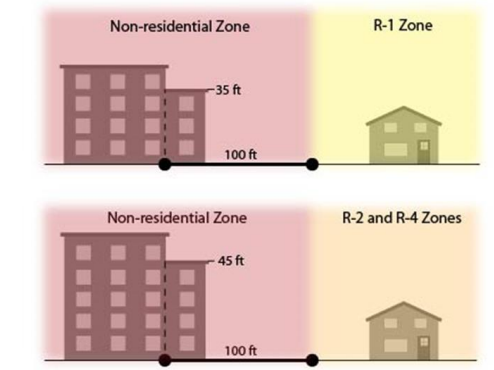
Credit: MSD Planning and Development Services.
Repealed & Replaced by Ord. 2023-O-06 Title 19 on 6/16/2023
19.30.070 ACCESSORY STRUCTURE DEVELOPMENT STANDARDS
- The minimum yard requirements for an accessory structure are as follows:
Table 19.30.070: Accessory Structure Development Standards. Zone R-2-6.5 R-2-8 R-2-10 R-4-8.5 RM Side Yard 1 Foot 1 Foot 1 Foot 1 Foot 1 Foot Side Yard, Facing a Public Street 20 Feet 20 Feet 20 Feet 20 Feet 20 Feet Rear Yard 1 Foot 1 Foot 1 Foot 1 Foot 1 Foot Setback from the Main Dwelling 6 Feet 6 Feet 6 Feet 6 Feet 6 Feet - No building which is accessory to a one-family or two-family dwelling may exceed twenty feet (20’) in height. For each one foot (1’) of height over fourteen feet (14’), accessory structures shall be set back from property lines an additional one foot (1’) up to the allowed maximum height of twenty feet (20’).
- No accessory structure or group of accessory structures shall cover more than twenty-five percent (25%) of the rear yard.
Figure 19.30.070: Accessory Structure Standards.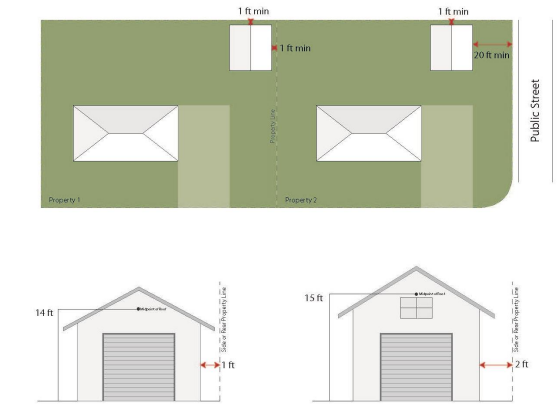 Credit: MSD Planning and Development Services.
Repealed & Replaced by Ord. 2023-O-06 Title 19 on 6/16/2023
19.30.080 SUBDIVISION AND PUD STANDARDS FOR MEDIUM AND HIGH-DENSITY RESIDENTIAL
- The division of land for one- and two-family projects is subject to the requirements of Title 18.
- All other subdivisions in the medium and high-density residential zones are subject to all requirements in Chapter 19.18 and platted via a PUD plat.
Repealed & Replaced by Ord. 2023-O-06 Title 19 on 6/16/2023
19.30.090 FENCING STANDARDS FOR ONE- AND TWO-FAMILY DWELLINGS
- The term “fence” shall include any tangible barrier, latticework, screen, wall, hedge, or continuous growth of shrubs or trees with the purpose of, or having the effect of, preventing passage or view across the fence line. Notwithstanding the provisions of this section, a fence, wall, screen, hedge, or other material serving as a fence, may not create a sight distance hazard to vehicular or pedestrian traffic as determined by the municipal engineer.
- Front Yard/Side Yard: A fence made of materials which are sight obscuring may be built to a maximum of three feet (3’) in any required front/side yard perimeter. A fence made of materials which are not sight obscuring (at least fifty percent (50%) open) may be built to a maximum of four feet (4’) in any required front/side yard. If an existing home is located on the property, the front/side yard perimeter is measured from the front property line to the front edge of the existing home. The fencing may slope upward to connect with a higher rear yard fence. The length of a sloped fence section may not exceed a maximum of ten feet (10’).
- Rear Yard: A fence in a rear yard may be built to a maximum of seven feet (7’). If an existing home is located on the property, the rear yard perimeter is measured from the front edge of the existing home to the rear property line.
- Corner Lots: A fence not more than seven feet (7’) high may be constructed in the rear yard as defined in Subsection 19.30.090.A.2, Rear Yard, adjacent to a public street on a corner lot, if it does not obstruct clear view of intersecting streets as defined in Subsection 19.30.090.A.4, Clear Sight Triangle.
- Clear Sight Triangle: At intersections of alleys and driveways (this includes private driveways and adjacent private driveways), the triangle shall be defined by drawing a line between two (2) points that are a minimum of ten feet (10’) from the intersection along the property lines. At intersections of public streets, the triangle shall be defined by drawing a line between the two (2) points that are a minimum of forty feet (40’) from the intersection along the property lines.
- Larger Clear Sight Triangle: Larger clear sight triangles may be required where local streets enter arterial streets, major collector streets, or parkways, except that “clear sight triangles” need not be maintained at signed or signalized intersections in the community center. “Clear sight triangles” may also be waived by the Planning Commission at signed or signalized intersections in neighborhood centers.
- Grade Differences: If there is a difference in the grade of the properties on either side of a fence, wall or other similar structure, the height of the fence shall be measured from the natural grade of the property upon which it is located.
- Retaining Walls: If a retaining wall protects a cut below or a fill above the natural grade and is located on the line separating lots or properties, such retaining wall may be topped by a fence, wall or hedge of the same height that would otherwise be permitted at the location if no retaining wall existed.
- Double Frontage Lots: A fence or wall may be erected in the rear yard of a double frontage lot.
- Fire Hydrants and Mailboxes: Fire hydrants and mailboxes shall be accessible from the public streets and may not be enclosed behind fences. The location of the fire hydrant shall be in accordance with the uniform fire code.
- Exceptions: The provisions of this section may be waived with respect to certain other fences including tennis court backstops or patio enclosures as approved by the Planning Commission, if it is determined that the fences do not create a hazard or violation of other sections of the city ordinances.
Repealed & Replaced by Ord. 2023-O-06 Title 19 on 6/16/2023
19.30.100 ADDITIONAL STANDARDS
It is the responsibility of the applicant to comply with all other standards of Title 19 and all other municipal ordinances, including, without limitation:
- 19.04: Definitions
- 19.18: Planned Unit Developments
- 19.42: Specific Use Standards
- 19.44: Temporary Use Standards
- 19.46: Site Development Standards
- 19.48: Off-Street Parking and Loading
- 19.50: Landscaping and Screening
- 19.52: Signs
- 19.56: Flood Plain Regulations
- 19.58: Geological Hazards
Repealed & Replaced by Ord. 2023-O-06 Title 19 on 6/16/2023

