
Magna City Zoning Code
CHAPTER 19
36 MIXED-USE ZONES
19.36.010 PURPOSE OF PROVISIONS
The mixed-use zones are intended for areas within the community where a combination of residential, commercial, civic, and other uses is desirable to strengthen local tax base and employment opportunities, provide diverse housing types, create gathering places, and connect businesses with nearby customers. The mixed-use zones are distinguished by the uses they allow as well as their development standards, which are intended to promote a high-quality, compact, walkable, and interesting built environment.
Repealed & Replaced by Ord. 2023-O-06 Title 19 on 6/16/2023
19.36.020 ESTABLISHMENT OF MIXED-USE ZONING DISTRICTS
In order to anticipate and respond to the changing needs of our community and implement mixed-use and livability concepts included in the adopted General Plan, the following zones are established:
- Downtown Historic District (DH). The DH Zone is intended to promote a dense mixture of uses consistent with the District’s historic role in Magna. Emphasis is placed on entertainment, theaters, restaurants, retail, and specialty shops. Medium-density residential and office infill on upper floors is encouraged, as is the continued presence of the library, museum, senior center, and supporting uses. The purpose of this zone is to implement the vision of the Magna General Plan (2021) and further the municipality’s Main Street Program.
- Neighborhood Mixed Use District (NMU). The NMU Zone is intended to create a residential district that allows a small-scale, horizontal or vertical mixture of neighborhood commercial uses to serve the daily needs of area residents. This zone is intended only for small-scale, low-impact uses, to promote a better mixture of uses close to home and within a walkable environment.
- Corridor Mixed Use District (CMU). The CMU Zone is intended to promote compact and walkable development, diverse housing options, and proximity to shopping and services along transit corridors, especially where infill development is desirable. The CMU allows for greater intensity of uses and building footprints without disrupting surrounding neighborhoods.
Repealed & Replaced by Ord. 2023-O-06 Title 19 on 6/16/2023
19.36.030 SCHEDULE OF PERMITTED USES
- Schedule of Permitted Uses. The specific uses listed in the following schedule are permitted in the zones as indicated, subject to the general provisions, special conditions, additional restrictions, and exceptions set forth in this Title.
- Special Conditions. Any special conditions related to a specific use are in Chapter 19.42 Specific Use Standards.
- Procedure for Multiple Uses {Combination of Uses}. If a development proposal involves a combination of uses other than accessory uses as identified in Table 19.36.030, the more restrictive provisions of this Title shall apply. For example, if a portion of a development is subject to Conditional Use ("C") approval and the other portion is subject only to Permitted Use ("P) review, the entire development shall be reviewed and approved by the Conditional Use process.
- Abbreviations. The abbreviations used in the schedule mean:
- P = Permitted Use. This use is allowed in the zone but may be subject to additional restrictions and approval processes as provided in this Title.
- C = Conditional Use. This use is conditional because of the unique characteristics or potential impacts on the municipality, surrounding neighbors, or adjacent uses, incompatibility in some areas of the zone, or compatibility only if special provisions or conditions are required to mitigate the detrimental impacts of the use. The Planning Commission is the land use authority for uses with this designation.
- X = Prohibited Use. This use is prohibited in this zone. Any use not specifically identified in Table 19.36.030 is prohibited in this zone.
Table 19.36.030. Uses. Use Categories DH NMU CMU Residential Uses:E Accessory Dwelling Unit, Detached or Internal X P X Dwelling, Multiple Family P X P Dwelling, Single-Family X P X Dwelling, Single Family Attached X P P Dwelling, Three- and Four-Family P P P Dwelling, Two-Family (Duplex) P P X Educational Facility with Residential Accommodation X X P Retail and Service: Bank, Credit Union, or Other Financial Institution P P P Car and Light Truck Wash X X P Child or Adult Care Facility P P P Laundry Cleaning, Automatic Self-Help P P P Laundry Cleaning Drop-Off P P P Liquor and/or Wine Store X X P Mobile Store P X P Personal Care Services P P P Personal Instruction Services P P P Post Office P P P Reception Hall, Reception Center P X P Retail Sales P P P Retail Shops or Galleries where Primary Product is Produced On-Site C C C Self-Service Gas Station, with or without Convenience Store X X P Shopping Center X X C Food and Drink: Bars and Clubs P X P Breweries and Distilleries, with or without restaurant P X P Food Truck, Mobile Restaurant, Food Cart P X P Restaurant, Fast Food P P P Restaurant, Sit Down with or without Alcohol P P P Lodging: Bed and Breakfast P P P Hotel/Motel P X P Office: Offices – General, Professional, and Trade Services P P P Recreational: Commercial Recreation and Entertainment, Indoor P X P Outdoor Recreation, Small Scale X X P Theatres and Concert Halls (Indoor) P X P Industrial Uses: Light or Heavy Industry or Manufacturing X X X Institutional Uses: Animal Hospital or Clinic C X C Church, Synagogue, Mosque, Temple, Cathedral, or other religious buildings P P P Community Garden P P P Educational Facility P P P Public or Quasi-Public Use P P P Public Park P P P Specialty: Medical, Urgent Care, and Dental Clinic P X P Mortuary or Funeral Home P X P Park and Ride X X P Parking Lot (not associate with other use) X X X Accessory Uses: Accessory Structures, Garages, Carports, and Structures subject to this Title P P P Drive-Thru and Drive-Up Facilities, subject to Subsection 19.42.170.F P P P Home Occupations, subject to Chapter 19.42. P P P Sidewalk Displays and Sidewalk Cafes C C C Nonconforming Uses: Pre-Existing Lot P P P
- Residential Uses:
- In the DH and CMU Mixed Use Zones, residential uses are limited as follows.
- Units above a business: Residential dwelling units on the second story or above are permitted.
- Units behind a business: Residential dwelling units on the first story that are separated from the front lot line by a non-residential use in the same story are permitted.
- Units attached to a business on a multiple frontage lot: In no case may first-story dwelling units face onto a front lot line.
- In the NMU Zone, any new development shall include a mix of residential and non residential uses. These uses may be mixed horizontally or vertically.
- In the DH and CMU Mixed Use Zones, residential uses are limited as follows.
- In addition to the specific use standards for Drive-Thru and Drive Up Facilities in Subsection 19.42.170, said facilities in the Downtown Historic District (DH) Mixed Use zone are subject to the following additional standards:
- No drive-thru window, order/menu board, or other aspect of the drive-thru or drive-up transaction may be conducted on a street facing side of a building,
- No entrance or exit for a drive-thru or drive up facility may directly access Main Street. All access must occur from a side street, and
- A public alley may be used to access stacking lanes. The alley may not be blocked by the stacking of vehicles and the alley may not count as stacking spaces for the purposes of meeting required stacking capacity.
- The Planning Commission may allow for variations to the stacking lane and capacity requirements In Section 19.48.100 of this code when it finds that site constraints due to lot width or area make compliance impossible. The approved drive-thru or drive up facility must be designed to ensure that adequate on-site maneuvering and circulation areas, ensure that stacking vehicles do not impede traffic on abutting streets, and that stacking lanes will not have nuisance impacts on abutting residential lots.
Repealed & Replaced by Ord. 2023-O-06 Title 19 on 6/16/2023
Amended by Ord. 2024-O-11 on 8/29/2024
19.36.040 DEVELOPMENT STANDARDS
- Any development in the DH, NMU, or CMU Zones shall comply with the development standards shown in Table 19.36.040 and any other applicable standards in this Title.
- Single- and Two-Family Residential Development in the NMU Zone is exempt from the following requirements:
- Minimum and Maximum FAR;
- Minimum Transparency;
- Entry Spacing and Recess Requirements; and
- Articulation Requirements.
- Buildings in any Mixed-Use Zone shall be oriented so as to be front-facing on the public street.
Table 19.36.040 – Mixed Use Zoning District Development Standards. Standard DH NMU CMU Maximum Building Size, in square feet (sq. ft.) Non-Grocery 25,000 5,000 Grocery-Anchored NA 5,000 NA Height Limitations, in feet (ft) Minimum 25 25 20 MaximumH I 50 35 60 Ground Floor Height Minimum for
Commercial / Mixed Use Buildings Only12 12 12 Floor Area Ratio Maximum FAR NA 1.5:1 NA Minimum FAR 1.5:1 1:1 2:1 Minimum Transparency RequirementsE First Floor / Ground Story 70% 50% 70% Additional Floors 35% 25% 35% Entries Maximum distance between ground floor entries on the primary facade, in feet (ft).F 35; Entrances shall also be present at each corner. Primary Façade Entries, Articulation. Recessed a minimum of 4’ depth and 5’ width. A canopy or awning is required. NA Recessed a minimum of 4’ depth and 7’ width. A permanent overhang is required. Non-primary Facade Entries 1 entry minimum at the ground floor is required on each non-primary façade, excluding those with a shared common wall. Articulation Horizontal Articulation Structural columns or variation in façade (depth/change in material) shall be articulated at the primary façade for the full height of the building to the cornice (or to the full height of the building to the first stepback); minimum 50’ spacing. Vertical Articulation Cornice/Frieze Banding is required between the second and third floors on buildings with three or more stories. Roof Pitched roofs are prohibited. Cornice at roof line is required. NA Pitched roofs are prohibited. Cornice at roof line is required. Usable Outdoor Space, minimum requirement per unit in square feet (sq. ft.)G Single-Family Attached or Detached 150 150 NA Two-, Three-, or Four-Family 75 100 60 Multi-Family 40 45 40 Maximum DensityJ (in dwelling units per acre) 25 15 30 - Transparency. Transparency means the use of materials that allow for persons from the street to see into the active uses of the building. Areas covered by menus, murals, or other signage that prevents visibility into the active use do not count toward the required transparency, unless the municipality has authorized a temporary advertisement or other festive decoration.
- Entries on Corner Lots. Buildings on corner lots shall be oriented to the corner that faces on two public streets. Corner entries are required. Corner entries shall be angled toward the intersection of the two public streets in order to emphasize the corner.
- Usable Outdoor Space. Means outdoor space provided for the enjoyment of the tenant. The required outdoor space may be provided through private outdoor balconies or patios attached to the unit or may be combined in an outdoor community space shared by all residents / units.
- Balconies. If balconies are provided, they shall be recessed or incorporated into the horizontal setback.
- Stepbacks. A sixteen-foot (16’) stepback shall be required for any height above forty feet (40’). See Figure 19.36.040.A for reference.
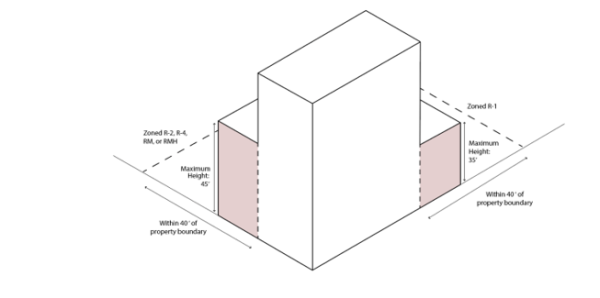
Figure 19.36.040.A: Stepback Illustration. 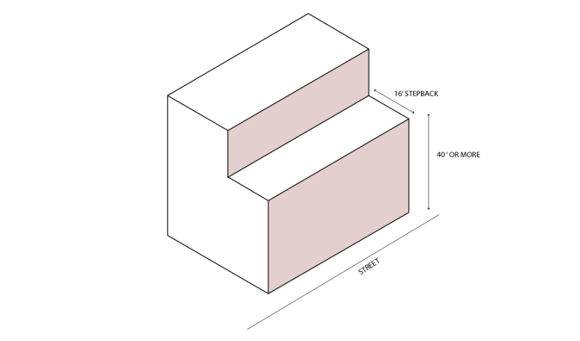 Step-down Height Adjacent to Residential Areas: Within forty feet (40’) of sites zoned residential, the following standards shall apply. Stepped-down height is not required in the CMU Zone:
- On the portion of the site within forty feet (40’) of a site zoned R-1, the maximum height shall be thirty-five feet (35’).
- On the portion of the site within forty feet (40’) of a site zoned R-2, R-4, RM, or RMH the maximum height shall be forty-five feet (45’).
Figure 19.36.040.B: Step-down Heights Illustrated
 Calculating Density. Density calculations are based on gross density. Gross density is defined as the total number of residential dwelling units divided by the gross area of the parcel in question.
- Exterior Structure Standards. The exterior walls of all structures other than single- and two-family dwellings shall be constructed in compliance with the following:
- Materials. All buildings shall use one or more of the following durable materials as a significant finish: architectural precast concrete, architecturally treated concrete masonry units, brick cladding, natural and cast stone, architectural metals, and glazing. Architectural site-cast concrete may be allowed if designed, articulated, and colored for a finished appearance on all buildings. At least fifty percent (50%) of all buildings visible from a major street shall be composed of brick, stone, architecturally treated CMU, architectural precast concrete, architectural metals, wood, and/or glazing.
- Exterior Insulation and Finish System (EIFS)/Stucco. The design and application of EIFS or synthetic stucco are expected to be of a high enough quality to allow for crisp detailing and substantial relief. The use of EIFS on ground floor walls shall be limited to the surface area three (3) or more feet above finished grade. The wall area from finished grade to where the use of EIFS begins shall be clad by a hard, durable material such as brick, stone, architectural precast concrete, or architecturally treated concrete masonry units.
- Detail and Finish. Building façades that face the street but do not have pedestrian entries shall be composed of high-quality materials such as brick or stone and shall provide variety and interest in the façade through the introduction of such elements as pilasters, recessed or protruding bays, changes in materials and/or colors, building lighting elements, display windows with products or product graphics, transparent windows or clerestories, and well-designed signs and graphics.
- Surface Variation. Continuous building wall surfaces shall be relieved with significant variations of wall planes or overhangs that create shadow areas and add visual interest. Variations should result from significant dimensional changes in plane, color, or detail as accomplished by such devices as protruding bays, recessed entries, upper-level step-backs, arcades, offsets in the general plane of the façade, changes in materials or color, bay windows, vestibules, porches, balconies, exterior shading devices, nonretractable canopies or awnings, projecting cornices, or eaves.
- Exception for Historic District Contributing Buildings. A development standard in Section 19.36.040 may be waived by the Planning Director or Designee only if the Director or Designee finds that complying with that standard would result in a building that currently contributes to Magna’s National Historic District no longer contributing to the District Designation or Landmark.
Repealed & Replaced by Ord. 2023-O-06 Title 19 on 6/16/2023
19.36.050 REQUIRED YARDS AND SETBACKS
- Purpose. The purpose of the standards in this section is to create and maintain street frontages that are attractive, promote a walkable environment, and create a sense of safety and comfort through appropriate scale.
- The minimum yard requirements for buildings within the Mixed-Use Zones are presented in Table 19.36.050.
- Exception for Historic District Contributing Buildings. A lot width, yard, or setback standard in Table 19.36.050 may be waived by the Director or Designee only if the Director or Designee finds that complying with that standard would result in a building that currently contributes to a National Historic District Designation or National Historic Landmark no longer contributing to the District Designation or Landmark.
- Exception for Setbacks for Common Walls. The side setback is zero feet (0’) for any building which shares a side common wall.
Table 19.36.050 – Lot Width, Yard, and Setback Requirements. DH NMU CMU Minimum Lot Frontage Along Public Street 18 25 20 Minimum Setbacks, in feet (ft.) Front Yard 0 10 0 Side Yard, Interior 0 10 10 Side Yard, Corner Lot 0 10 0 Rear Yard 10 10 10 Maximum Setbacks, in feet (ft.) Front Yard 5 20 10 Side Yard, Interior 0 10 10 Side Yard, Corner Lot 5 10 10 Rear Yard 20 20 30 Minimum Distance Between Main and Accessory Structures, in feet (ft.) 10 6 10
Repealed & Replaced by Ord. 2023-O-06 Title 19 on 6/16/2023
19.36.060 HEIGHT EXCEPTIONS
Exceptions to the building heights specified in Table 19.36.040 apply, in accordance with 19.46.110.
Repealed & Replaced by Ord. 2023-O-06 Title 19 on 6/16/2023
19.36.070 OFF STREET PARKING STANDARDS
All provisions of Chapter 19.48 shall apply to development in any of the Mixed-Use Zones. For developments that combine multiple uses, parking requirements shall be calculated for each specific use according to the criteria in Chapter 19.48. The Director or Designee may authorize shared parking for combined uses if those uses are found to operate at distinct hours of the day or night.
Repealed & Replaced by Ord. 2023-O-06 Title 19 on 6/16/2023
19.36.080 ADDITIONAL STANDARDS
It is the responsibility of the applicant to comply with all other standards of Title 19 and all other municipal ordinances, including, without limitation:
- 19.04: Definitions
- 19.18: Planned Unit Developments
- 19.42: Specific Use Standards
- 19.44: Temporary Use Standards
- 19.46: Site Development Standards
- 19.48: Off-Street Parking and Loading
- 19.50: Landscaping and Screening
- 19.52: Signs
- 19.56: Flood Plain Regulations
- 19.58: Geological Hazards
Repealed & Replaced by Ord. 2023-O-06 Title 19 on 6/16/2023

