
Mammoth Lakes City Zoning Code
ARTICLE III
SITE PLANNING AND GENERAL DEVELOPMENT STANDARDS
17.36.010. - Purpose and applicability.
(a)
Purpose. The provisions of this chapter expand the standards of Chapters 17.16 through 17.32by addressing the details of site planning and project design that apply, except where specifically stated, to development in all zoning districts and to ensure that development, and new or modified land uses are of appropriate character and quality, considerate of the community's natural resources, compatible with existing and future land uses, and consistent with the general plan.
(b)
Applicability, general standards. The provisions of this chapter apply to all proposed development and new land uses regardless of the applicable zoning district.
(1)
These standards shall be considered in combination with the standards for each zoning district in Chapters 17.16 through 17.32. If there is a conflict, the standards specific to the zoning district shall override these general standards.
(2)
All new or modified structures and uses shall comply with all applicable provisions of this chapter before construction and operation, unless specifically exempted by an applicable provision of this chapter.
(Code 1990, § 17.36.010; Ord. No. 14-02, § 4, 3-19-2014)
17.36.020. - Creation or modification of lots.
In reviewing the creation or modification of lots, the Town shall consider the suitability of the land for the proposed lot density and the suitability of individual lot sites for the proposed use. The specific items to be considered in determining suitability shall include, but not be limited to, access and parking; building sites on the lot; topography; grading; parking; snow storage; utilities; revegetation of cuts; fills and trenches that may be required; drainage and erosion control, both on-site and off-site; and any items addressed in any relevant environmental document.
(Code 1990, § 17.36.020; Ord. No. 14-02, § 4, 3-19-2014)
17.36.030. - Exterior lighting.
(a)
Purpose. The purpose of this section is to provide rules and regulations for outdoor lighting within the Town in order to accomplish the following:
(1)
To promote a safe, glare-free, and pleasant nighttime environment for residents and visitors;
(2)
To protect and improve safe travel for all modes of transportation;
(3)
To prevent nuisances caused by unnecessary light intensity, glare, and light trespass;
(4)
To protect the ability to view the night sky by restricting unnecessary upward projection of light;
(5)
To phase out existing nonconforming fixtures that violate this section, including those owned by the Town and other public agencies; and
(6)
To promote lighting practices and systems that conserve energy.
(b)
Figures. The figures incorporated in this section or shown on informational sheets produced by the Town are provided as guidelines for the public and staff to use in meeting the intent of this section. The figures serve only as examples. The Town does not endorse or discriminate against any manufacturer or company that may be shown, portrayed, or mentioned as examples.
(c)
Applicability.
(1)
New outdoor lighting. All outdoor lighting fixtures installed after the effective date of the ordinance from which this section is derived shall conform to the requirements established by this section.
(2)
Existing outdoor lighting. All existing outdoor lighting fixtures installed prior to the effective date of the ordinance from which this section is derived shall be addressed as follows:
a.
To immediately address nuisances caused by improperly installed, unshielded, or misdirected fixtures, all existing outdoor lighting fixtures shall be adjusted or modified to the extent practical to reduce or eliminate glare, light trespass, and light pollution.
b.
All existing outdoor lighting fixtures located on a property that is part of an application for design review approval; a conditional use permit; subdivision approval; or a building permit for a new structure or additions of 25 percent or more in terms of gross floor area, seating capacity, or parking spaces (either with a single addition or cumulative additions), shall meet the requirements of this section for the entire property. Such applications are required to include an outdoor lighting plan pursuant to Subsection (g) of this section. Conformity shall occur prior to final inspection, final map recordation, or business license issuance, when applicable.
c.
All existing outdoor lighting fixtures on property used for commercial and industrial purposes not in conformance with this section shall be brought into conformance as of the effective date of the ordinance from which this section is derived.
d.
All existing outdoor lighting fixtures on property used for residential, institutional, public, and semi-public uses not in conformance with this section shall be brought into conformance as of the effective date of the ordinance from which this section is derived.
(d)
Exemptions.
(1)
The following are exempt from the provisions of this section:
a.
Seasonal displays using multiple low wattage bulbs (approximately 15 lumens or less), provided that they do not constitute a fire hazard, create a nuisance, and are maintained in a safe and attractive condition.
b.
Vehicular lights and all temporary emergency lighting needed by the Police Department and Fire Protection District, or other emergency services.
c.
All temporary lighting used for the construction or repair of roadways, utilities, and other public infrastructure.
d.
All lighting required by State or Federal regulatory agencies.
(2)
The Director may authorize additional property specific exemptions when proposed outdoor lighting does not conflict with the purposes of this section. An application for such an exemption must be made in writing and include an outdoor lighting plan pursuant to Subsection (g) of this section. Temporary lighting for special events shall be reviewed in this manner.
(e)
General requirements. The following general standards apply to all non-exempt outdoor lighting fixtures:
(1)
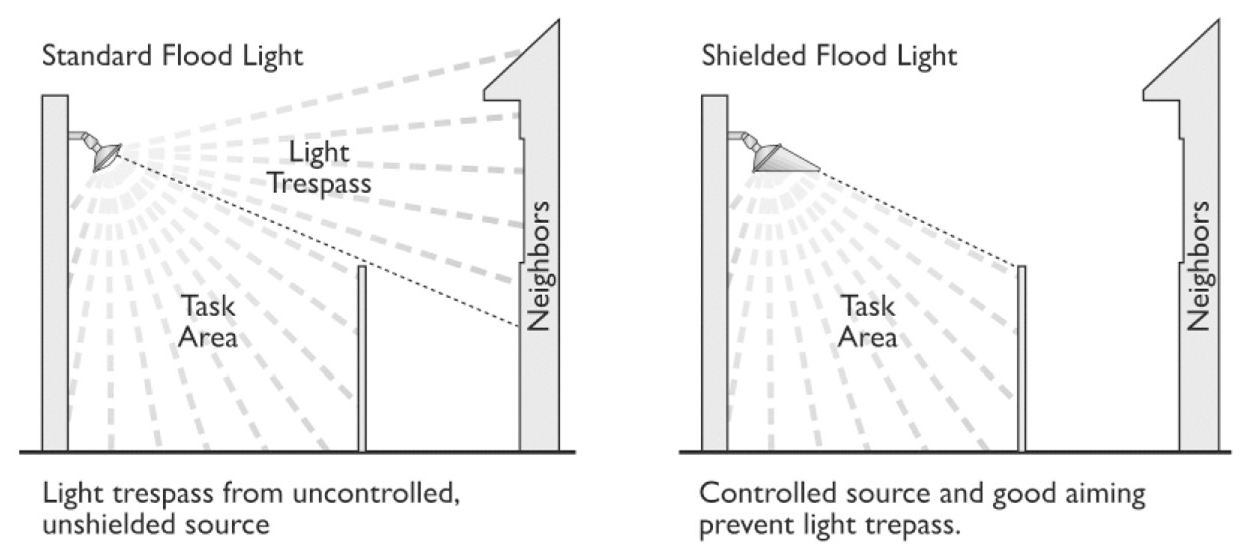
Nuisance prevention. All outdoor lighting fixtures shall be designed, located, installed, aimed downward or toward structures, retrofitted if necessary, and maintained in order to prevent glare, light trespass, and light pollution.
(2)
Maintenance. Fixtures and lighting systems shall be in good working order and maintained in a manner that serves the original design intent of the system.
(3)
Lighting levels. Outdoor lighting installations shall be designed to avoid harsh contrasts in lighting levels between the project site and the adjacent properties. The Commission may, by resolution, adopt standards for maximum or minimum lighting levels for various zoning districts and for public streets, sidewalks, or trails, as developed by the community and economic development and Public Works Department.
(4)
Lamp types. Metal halide or high-pressure sodium lamps are preferred for all new commercial and industrial area lighting (parking lot and yard lights) and street lighting installed after the effective date of the ordinance from which this section is derived due to good color rendering and good energy efficiency. Low pressure sodium lamps may be used for area lighting but are not preferred due to poor color rendering. Low wattage incandescent or compact fluorescent lamps are preferred for residential lighting.
(5)
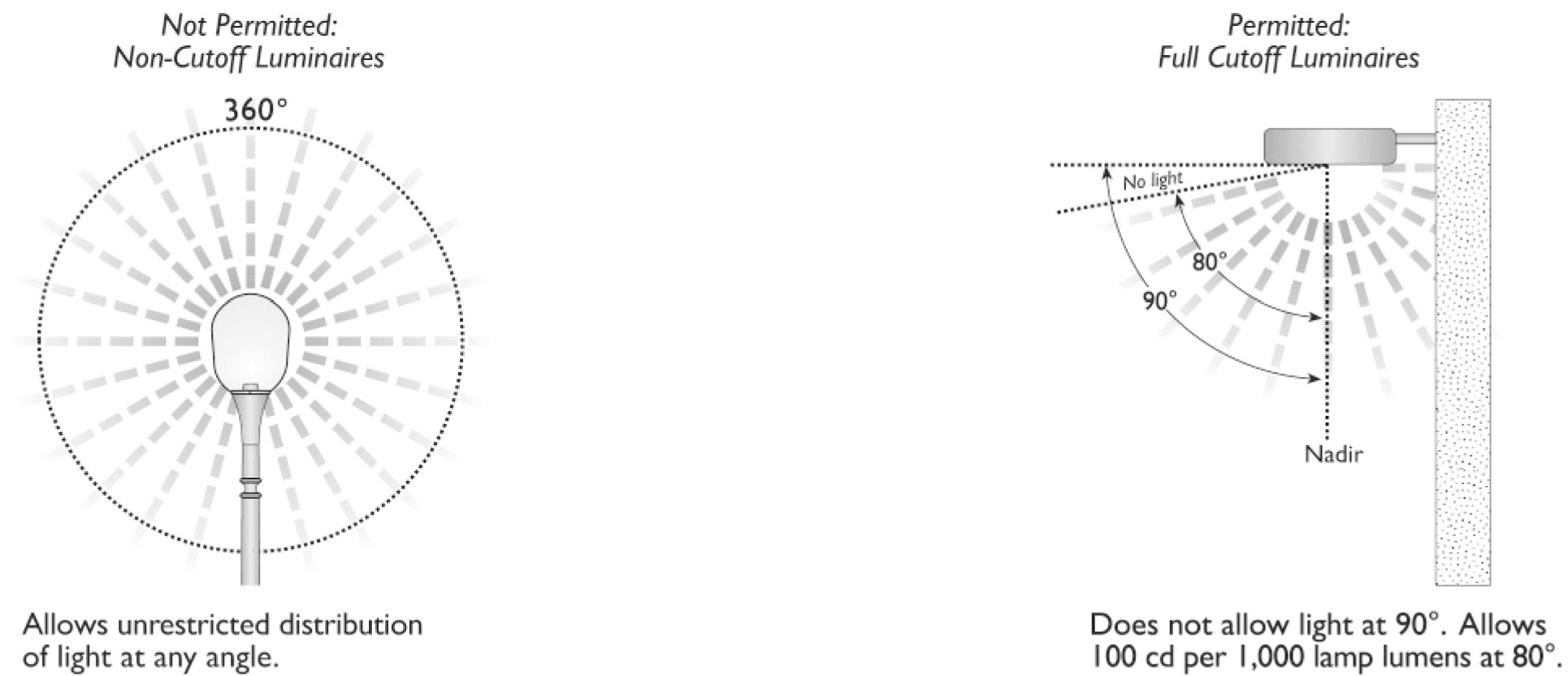
Fixture types. All new outdoor lighting shall use full cut-off luminaries with the light source downcast and fully shielded with no light emitted above the horizontal plane, with the following exceptions:
a.
Fixtures that have a maximum output of 400 lumens or less, regardless of the number of bulbs, may be left unshielded, provided that it has an opaque top to prevent the light from shining directly up. However, partial (e.g., obscured glass) or full shielding is preferred to control light output in all situations.
b.
Fixtures that have a maximum output of 1,000 lumens or less may be partially shielded using a semi-translucent barrier, provided that the lamp is not visible from off-site, no direct glare is produced, and the fixture has an opaque top to keep light from shining directly up. For example, a low-output style wall pack.
c.
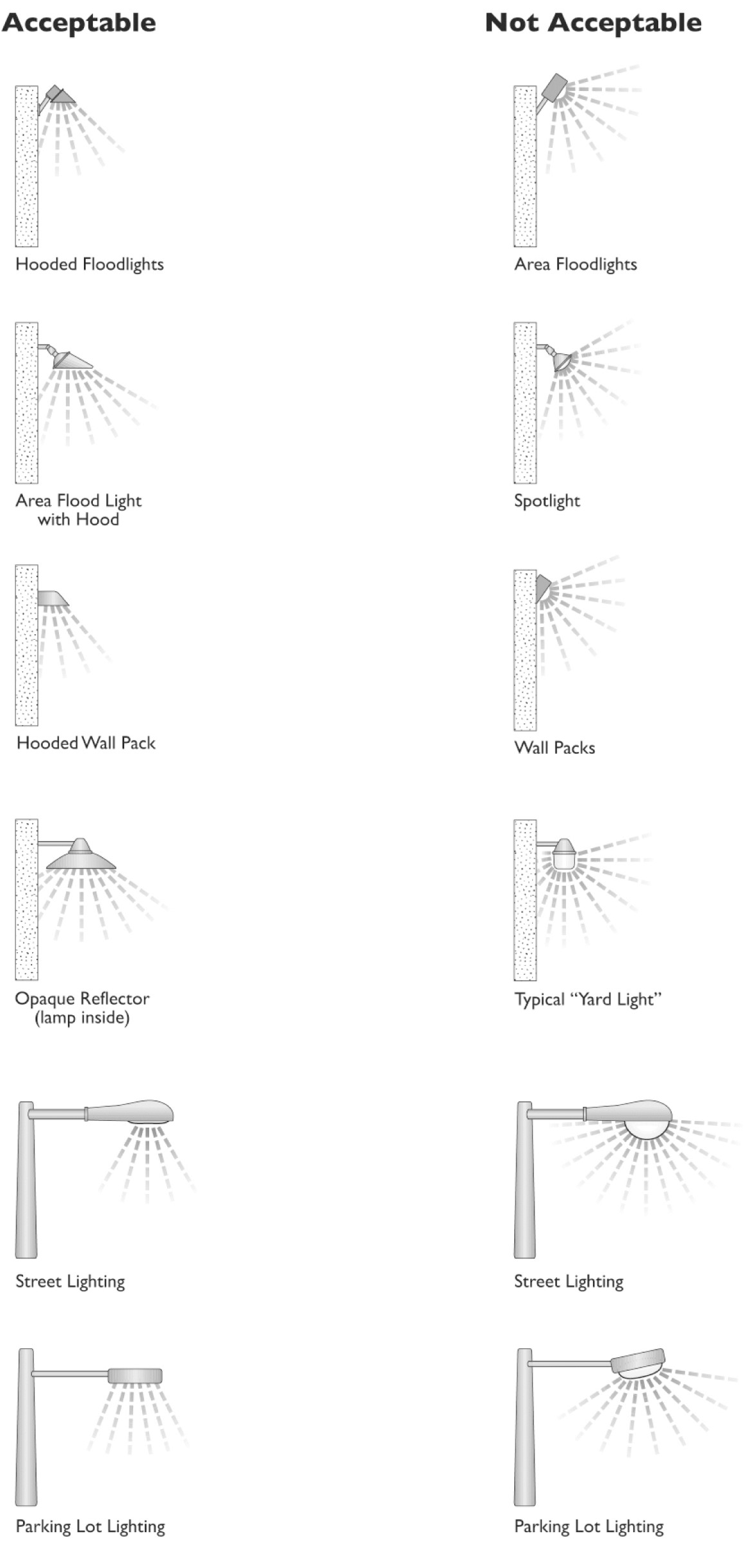
Floodlights that do not meet the definition of the term "full cut-off" may be used if permanently directed downward, if no light is projected above the horizontal plane, and if fitted with external shielding to prevent glare and off-site light trespass. Unshielded floodlights and barnyard-type fixtures are prohibited.
(6)
Accent lighting. Architectural features may be illuminated by uplighting, provided that the light is effectively contained by the structure, the lamps are low intensity to produce a subtle lighting effect, and no glare or light trespass is produced. For national flags, statues, public art, or other objects of interest that cannot be illuminated with down-lighting, upward lighting may only be used in the form of one narrow-cone spotlight that confines the illumination to the object of interest.
(7)
Section not to prevent alternatives. The provisions of this section are not intended to prevent the use of any design, material, or method of installation or operation not specifically prescribed herein, provided that the Director has approved any such alternative. A proposed alternative may be approved if it provides at least approximate equivalence to the applicable specific requirements of this section, or if it is otherwise satisfactory and complies with the intent of this section.
(8)
Right to further restrictions. The Town reserves the right to further restrict outdoor lighting, including, but not limited to, pole height and level of illumination, when it is deemed in the public interest consistent with the purpose of this section.
(f)
Outdoor lighting plans.
(1)
An outdoor lighting plan shall be submitted in conjunction with an application for design review approval; a use permit; subdivision approval; or a building permit for a new structure or additions of 25 percent or more in terms of gross floor area, seating capacity, or parking spaces (either with a single addition or cumulative additions). An outdoor lighting plan is required for all new outdoor lighting installations on commercial (includes multifamily residential project of four or more units), industrial, public and institutional properties. The Director may request outdoor lighting plans from applicants for other types of projects due to project location, size, or proposed use, as necessary. An outdoor lighting plan shall include at least the following:
a.
Manufacturer specification sheets, cut-sheets, or other manufacturer provided information for all proposed outdoor lighting fixtures to show fixture diagrams and light output levels;
b.
The proposed location, mounting height, and aiming point of all outdoor lighting fixtures (a site plan is preferred); and
c.
If building elevations are proposed for illumination, drawings for all relevant building elevations showing the fixtures, the portions of the elevations to be illuminated, the luminance level of the elevations, and the aiming point for any remote light fixture.
(2)
If needed to review the proposed outdoor lighting fixture installation, the Director may require additional information following the initial outdoor lighting plan submittal, including, but not limited to, a written narrative to demonstrate the objectives of the lighting, photometric data, Color Rendering Index (CRI) of all lamps and other descriptive information on the fixtures, computer generated photometric grid showing footcandle readings every ten feet within the property or site and ten feet beyond the property lines (an ISO-footcandle contour line style plan may be acceptable), or landscaping information to describe potential screening.
(3)
The Director may approve, deny, or require modifications to any outdoor lighting plan in order to meet the purpose of this section.
(g)
Prohibitions.
(1)
The installation of any new fixture not in conformance with this section is prohibited after the effective date of the ordinance from which this section is derived.
(2)
Suppliers of outdoor lighting fixtures within the Town are required to have an inventory that includes outdoor lighting fixtures that conform to the requirements of this section.
(3)
No outdoor lighting fixtures shall be installed, aimed, or directed to produce light that spills over into neighboring properties or the public right-of-way. Light trespass is prohibited.
(4)
No outdoor lighting fixture may be installed or maintained in such a manner to cause glare visible from off-site.
(5)
No outdoor lighting fixture may be operated in such a manner as to constitute a hazard or danger to persons, or to safe vehicular travel.
(6)
Blinking, flashing, moving, revolving, scintillating, flickering, changing intensity, and changing color lights and internally illuminated signs are prohibited, except as allowed by Chapter 17.48.
(7)
The installation of new mercury vapor lamps is prohibited.
(8)
Search lights, laser source lights, or any similar high-intensity light is prohibited except by police and fire personnel or at their direction, or for approved temporary lighting under a special event permit issued by the Director.
(h)
Signs. All outdoor lighting for signs shall conform to Chapter 17.48. Where this section conflicts with Chapter 17.48, Chapter 17.48 will take precedence.
(i)
Outdoor performance, sport, and recreation facilities.
(1)
Where playing fields or other special activity areas are to be illuminated, lighting fixtures shall be mounted, aimed, and shielded so that their beams fall within the primary playing area and immediate surroundings, and so that no significant off-site light trespass is produced.
(2)
Lighting for playing fields and other special activity areas shall be turned off as soon as possible following the end of an event. Where feasible, a low level lighting system shall be used to facilitate patrons leaving the facility, cleanup, nighttime maintenance, and other closing activities.
(j)
Winter lighting for snow removal. Property owners are encouraged to illuminate buildings located within 20 feet of the public right-of-way during public snow removal activities. The purpose is to make buildings fronting public roads visible in order to assist road maintenance crews and minimize the chance of property damage during snow removal activities. It is only necessary to illuminate a portion of the building facade. This section is not intended as a requirement to illuminate the right-of-way, driveways, or any portion of the front or side yard (Section 12.28.080). All such lighting must conform to the requirements of this section for down-direction, shielding, glare and light trespass prevention.
(k)
Energy conservation measures. Incorrect installations, poor choice of fixtures, and over-lighting can result in unnecessarily high energy costs. The following recommendations are intended to encourage the efficient use of energy for lighting purposes:
(1)
All non-essential outdoor commercial and residential lighting should be turned off after business hours or when not in use.
(2)
Where practical, outdoor lighting installations should include timers, dimmers, sensors, or photocell controllers that turn the lights off during daylight hours to reduce overall energy consumption and eliminate unnecessary lighting. Sensor activated fixtures should not be triggered by activity off the subject property.
(3)
When selecting new outdoor lighting, the full cost of operation over the life of the fixtures should be considered. Substantial annual energy savings will be realized by using quality efficient fixtures.
(4)
Indiscriminate and excessive lighting should be avoided. Light should be directed only to where it is needed with appropriate intensity.
(l)
Violations and penalties. It shall be unlawful to install or operate any outdoor lighting fixture in violation of this section. Any person violating any provisions of this section may be subject to the provisions of Chapter 1.18. In addition, any outdoor lighting fixture erected or maintained contrary to the provisions of this section may be declared to be a public nuisance subject to the procedures set forth in Chapter 8.20. Such remedies are in addition to and may be sought or imposed concurrently with, any other remedy provided by law, regulation, or ordinance.
(m)
Figures and diagrams. The following figures illustrate examples of acceptable and unacceptable types of outdoor lighting fixtures. Note that even those types of fixtures shown as acceptable must be installed and aimed properly to comply with this section.
(Code 1990, § 17.36.030; Ord. No. 14-02, § 4, 3-19-2014; Ord. No. 15-01, § 4(exh. A, § 26), 1-21-2015)
17.36.040. - Fences and walls.
The following standards shall apply to the installation of fences and walls, regardless of whether a permit or Town approval is required by this section, except where an applicable specific or master plan establishes different standards. The provisions of this section shall not apply to a fence or wall required by law or regulation of the Town, State, or an agency thereof. For the purposes of brevity, the term "fence" as used in this section shall mean fence and wall.
(1)
Fence height limitations. Fences are subject to the height limitations shown in Table 17.36.040A. An increase in height may be granted by the Director for required retaining walls.
Table 17.36.040(1). Height Limits for Fences
(2)
Fence height measurement.
a.
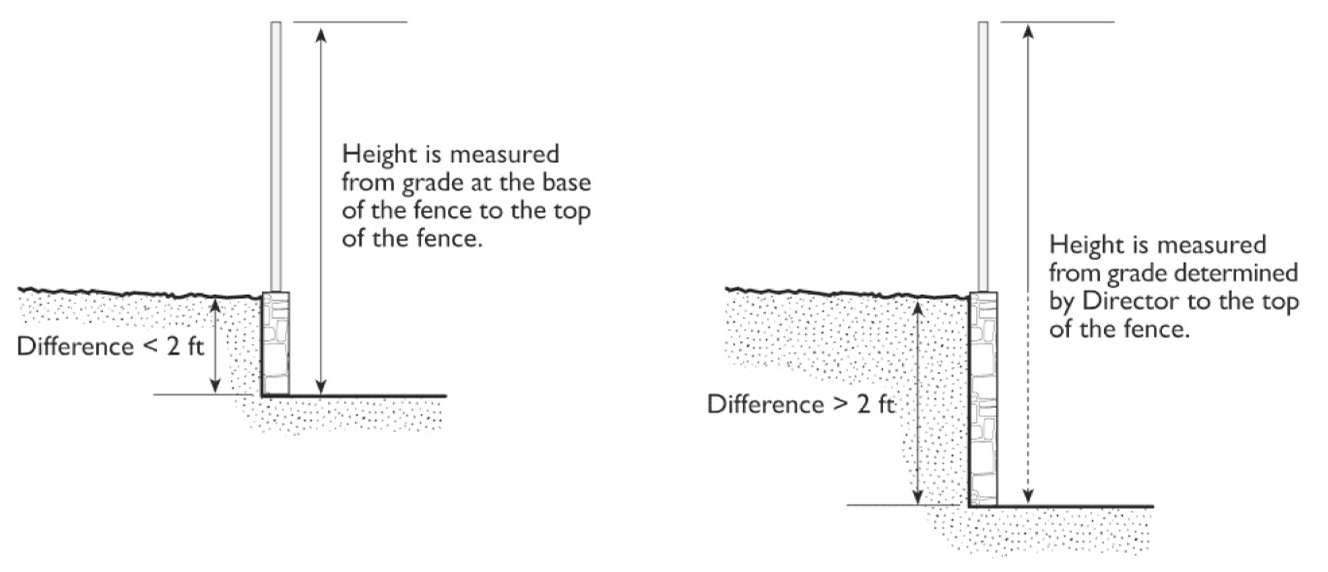
Fence height shall be measured as the vertical distance between the grade at the base of the fence and the top edge of the fence material.
b.
Where there is a difference in the ground level between two adjoining parcels of less than two feet, the height of a fence constructed along the common property line shall be determined by using the natural grade of the lowest contiguous parcel.
c.
When there is a difference in the ground level between two adjoining parcels of two feet or more, the Director shall determine the grade from which the fence shall be measured.
(3)
Retaining walls. All retaining walls visible from off-site shall be made of split face block, faced with rock, or similarly treated to be attractive.
(4)
Prohibited materials. The use of barbed wire, chain link, rope, electrified fence, glass, razor wire fence, or similar materials in conjunction with a fence or wall, or by itself within any zoning district, is prohibited except for the following cases: chain link is allowed for tennis courts or similar recreational facilities, pet enclosures of 200 square feet or less, industrial uses, utility companies, or in areas where there is a safety hazard. If chain link is used it shall be painted or coated in a dark green, brown, or black color.
(Code 1990, § 17.36.040; Ord. No. 14-02, § 4, 3-19-2014)
17.36.050. - Grading and clearing.
(a)
No lot may be graded or vegetation cleared unless such action is shown on and consistent with an approved development plan or building permit. Grading shall be limited to that area required for construction of the structure, utilities, driveways and access to one primary entrance of the structure which is provided for resident and guest access. Grading across multiple lots or multiple building sites is not permitted except as may be approved in conjunction with a master planned development when the proposed land use cannot be reasonably accommodated on separate lots. Front, side and rear yards may not be graded or cleared except to provide for:
(1)
The above construction and access requirements;
(2)
Limited additional access to the front (streetside) of the structure;
(3)
Snow or materials storage;
(4)
Landscaping which is exempt from grading and clearing regulations identified in Title 12; or
(5)
As approved under a design review approval.
(b)
Generally, existing trees and vegetation shall be preserved. Except as permitted by the Director, no live trees over 12 inches diameter at breast height (DBH) in diameter shall be removed. The Director shall base their approval upon the health of the trees, the necessity to remove the trees because of building or driveway construction or snow removal/storage, potential hazard, fuels reduction activities as approved by the Mammoth Lakes Fire Protection District, or solar access. Creation of views, lawns, or similar amenities shall not be sufficient cause to remove native trees. As mitigation for tree removal, the Director may require replacement plantings. Required replacement shall be limited to plantings in areas suitable for tree replacement with species identified in the Town Design Guidelines. Substantial replacement will be required, minimum replacement tree size shall be three gallons. The property owner is required to maintain replacement plantings to that approved by the Director.
(c)
All construction and uses, including paving, driving and parking areas, shall comply with the discharge requirements of the Lahontan Regional Water Quality Control Board.
(d)
All provisions of Chapter 12.08 shall apply.
(Code 1990, § 17.36.050; Ord. No. 14-02, § 4, 3-19-2014; Ord. No. 20-13, exh. A(c), 11-18-2020)
17.36.060. - Height measurement and height limit exceptions.
The intent of this section is to describe how building height is measured and describe exceptions to height limits. All structures shall comply with the following standards relating to height, except for fences and walls, which are instead subject to the provisions of Section 17.36.040.
(1)
Maximum height of structures. The height of structures shall not exceed the standard established by the applicable zoning district in Chapters 17.16 through 17.32.
(2)
Height measurement.
a.
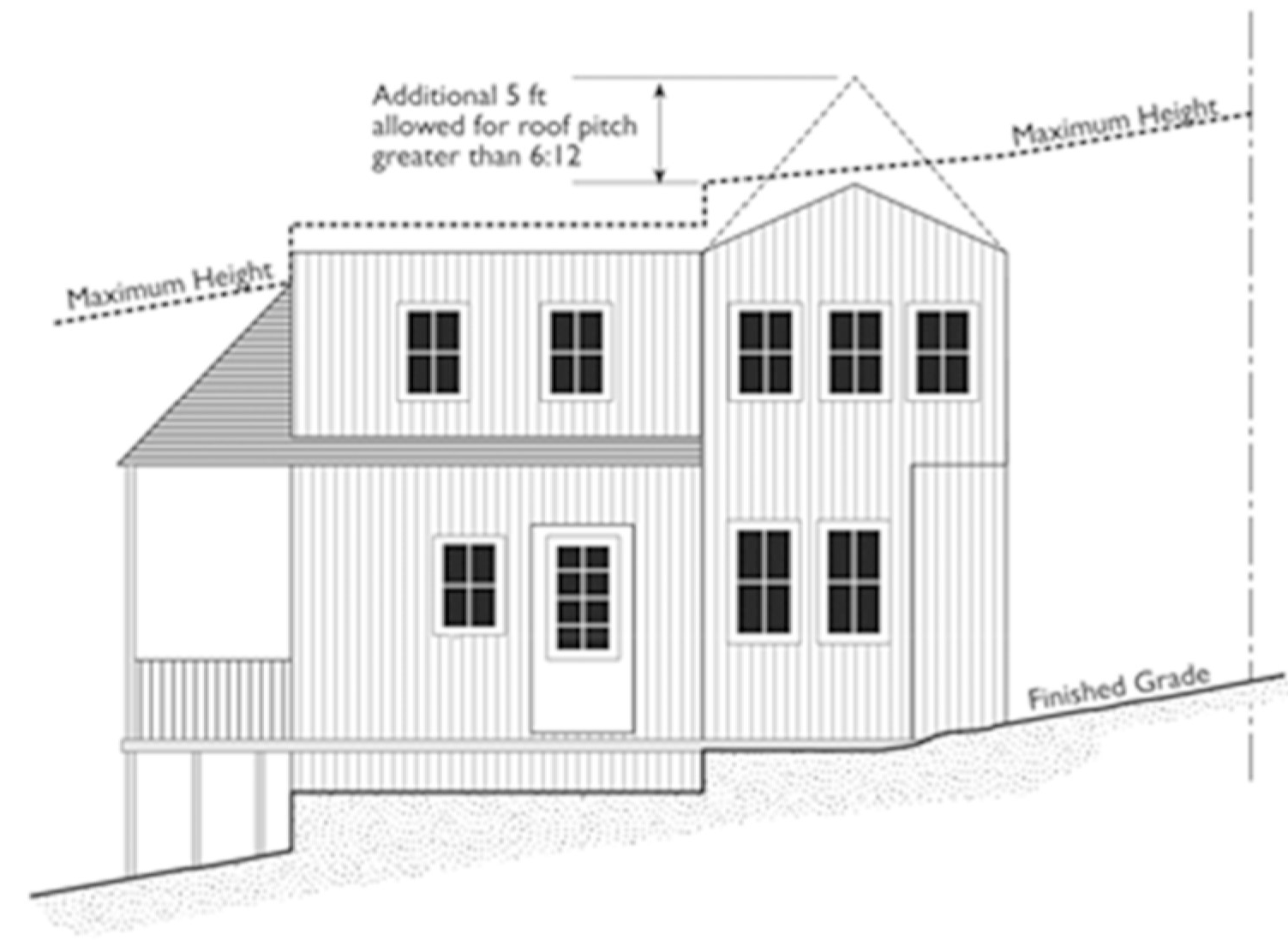
Building height calculation. Building height is measured from the finished grade at all points on the lot to the top of the structure directly above, i.e., maximum height is defined by a warped plane that is parallel to the finished grade on the lot.
1.
Maximum height shall be measured from finished grade adjacent to the building exterior to the highest point of coping of a flat roof, the top of a mansard roof, or the highest point of the highest pitched roof.
2.
The term "finished grade" is defined as the final ground surface elevation after the completion of grading or other site preparation related to a proposed development that conforms to an approved grading permit or building permit. In cases where substantial fill is proposed, finished grade shall be established by the Director, consistent with parcels in the immediate vicinity, and shall not be, nor have been artificially raised to gain additional building height.
3.
Where a building sits atop a parking podium (underground parking) the building height shall be measured from the top of the parking podium provided that the building height does not increase by more than seven feet six inches.
4.
Roofs of primary buildings with a pitch greater than 6:12 shall be allowed an additional five feet above the maximum building height in the zone, provided that snow shall not shed into any pedestrian areas. Accessory buildings and structures regardless of roof pitch shall not be allowed any additional building height.
b.
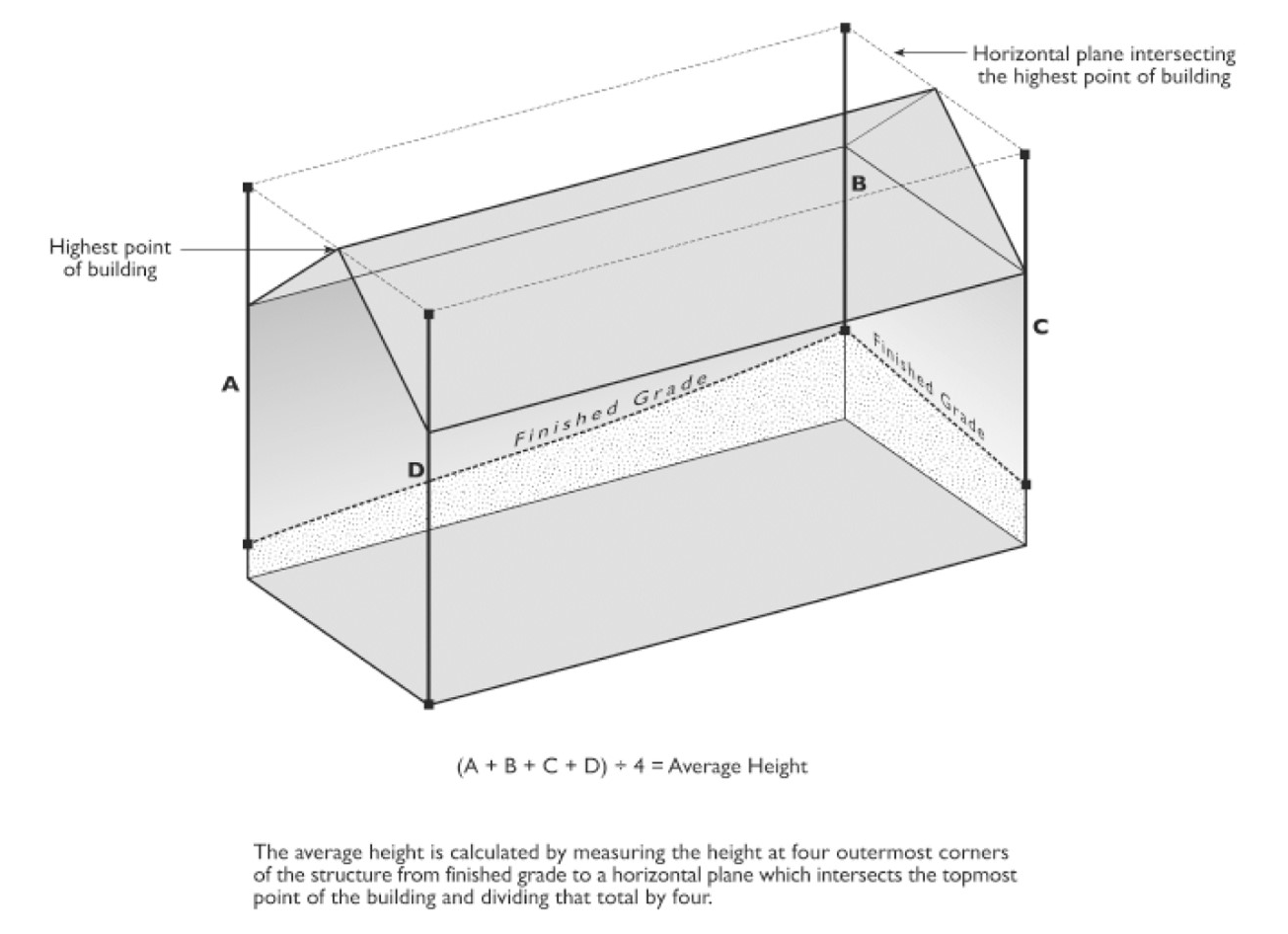
Alternative building height calculation on lots having an average slope of ten percent or greater. These provisions allow a different way of calculating height on lots with an average slope calculated over the entire lot of ten percent or more due to the constraints associated with these sites.
1.
The building height is calculated by measuring the height at the four outermost corners of the structure from finished grade to a horizontal plane which intersects the topmost point of the building and dividing that total by four (A+B+C+D = X/4 = height).
2.
No portion of any building shall exceed ten feet above the maximum permitted height allowed in Chapters 17.16 through 17.32 as measured from finished grade at any point beneath the structure to the roof of the building above that point.
3.
An uncovered deck that projects no more than ten feet from the building shall not be considered one of the four corners from which the average height calculation is derived.
c.
Exceptions to height limits. The overall building height shall not exceed the maximum permitted height, described in Chapters 17.16 through 17.32, except as follows or as otherwise permitted by Chapter 17.76:
1.
The following elements attached to a building shall be excluded from the height measurement with the limitation that the total area covered by such elements shall not exceed 20 percent of the roof area of the building and the height shall not exceed 14 feet above the maximum permitted height. Any roof mounted structure shall be set back from the edge of the structure a minimum of one foot for every foot in height above the roof on which they are situated. Refer to Section 17.36.090 for screening requirements.
(i)
Antennas (Antennas shall comply with Section 17.52.280);
(ii)
Chimneys;
(iii)
Stair and elevator towers;
(iv)
Mechanical equipment;
(v)
Steeples, towers and other unoccupied architectural features; and
(vi)
Other similar features as approved by the Director.
2.
Solar roof paneling shall be excluded from the height measurement with the limitation that the height shall not exceed 14 feet above the maximum permitted height. There shall be no limitation on the roof area covered by solar roof paneling.
3.
Public safety communication facilities, such as radio towers and antennas used for emergency service dispatch, shall be excluded from the height measurement, but shall be no taller than necessary to be effective as determined by the review authority.
(Code 1990, § 17.36.060; Ord. No. 14-02, § 4, 3-19-2014)
17.36.070. - Performance standards.
(a)
Heat/cold, glare. No use, except a temporary construction operation, shall be permitted which creates changes in temperature or direct glare (for example welding), detectable by the human senses without the aid of instruments, beyond the boundaries of the site.
(b)
Electrical disturbances. No use shall be permitted which creates electrical disturbances that affect the operation of any equipment beyond the boundaries of the site.
(c)
Fuel and explosive hazards. All storage of, and activities involving, flammable or explosive materials shall be subject to the approval and conditions specified by the Mammoth Lakes Fire Protection District and other State or local agencies as well as the California Building Standards Code.
(d)
Odor. No use shall be permitted which creates noxious or annoying odor in such quantities as to be readily detectable beyond the boundaries of the parcel or unit where the use is located.
(e)
Radioactivity. The use of radioactive materials shall be limited to medical uses and measuring, gauging, or calibration devices.
(f)
Vibration. No use, except temporary construction operations, shall be permitted which generates inherent and recurrent ground vibration perceptible without instruments beyond the boundary of the lot on which the use is located.
(g)
Solid waste disposal. All solid waste generated by a use which is not disposed of on-site in compliance with all applicable laws shall be transported to an approved landfill site, transfer station, or recycling center for proper disposal at least one time per week, or sooner, if deemed necessary by the County Environmental Health Department. Litter shall be removed from a site promptly and not be allowed to accumulate.
(h)
Hazardous materials. The use, storage and disposal of hazardous materials shall be subject to the approval and conditions of the Mammoth Lakes Fire Protection District and the County Environmental Health Department. All containers storing hazardous materials shall be labeled and sealed at all times and shall be stored on impervious surfaces approved by the Public Works Director.
(i)
Particulate or gaseous emissions. Any use which emits smoke, dust, or other airborne particulates or gases shall be subject to the approval and conditions of the Great Basin Unified Air Pollution Control District. Continuous efforts for dust control during dust-generating activities are required. Dust generation during windy conditions shall be prohibited if abatement measures do not contain dust on-site.
(j)
Noise. Interior and exterior noise shall meet the requirements of Chapter 8.20.
(k)
Property maintenance. All properties shall be maintained in a neat and orderly fashion at all times.
(l)
Conformance. Whenever there is a question of conformance with the standards outlined in this subsection, the Director shall require the property owner or operator to engage the services of an independent certified testing firm approved by the Director. The results of all such tests shall be furnished to the Director.
(Code 1990, § 17.36.070; Ord. No. 14-02, § 4, 3-19-2014; Ord. No. 15-01, § 4(exh. A, § 7), 1-21-2015)
17.36.080. - Propane tanks.
(a)
Setbacks. Propane tanks shall not be located in the front or street side yard setback areas unless authorized by the Director and Public Works Director based upon safety concerns or accessibility of the tank location. Propane tank location shall meet the requirements of the Mammoth Lakes Fire Protection District.
(b)
Screening. Propane tanks shall be painted tan or light green. Propane tanks located within the front or street side setback area are subject to additional screening and protection from snow removal operations as approved by the Director.
(c)
Shared propane tanks. When a propane tank is proposed to be shared between properties, a development or plot plan must be approved by the Department showing propane tank locations and gas lines. An agreement shall be recorded against the property to share an off-site tank or gas line among adjacent property owners.
(Code 1990, § 17.36.080; Ord. No. 14-02, § 4, 3-19-2014)
17.36.090. - Screening and buffer.
This section establishes standards for the screening and separation of adjoining residential and nonresidential districts, equipment and outdoor storage areas, and surface parking areas.
(1)
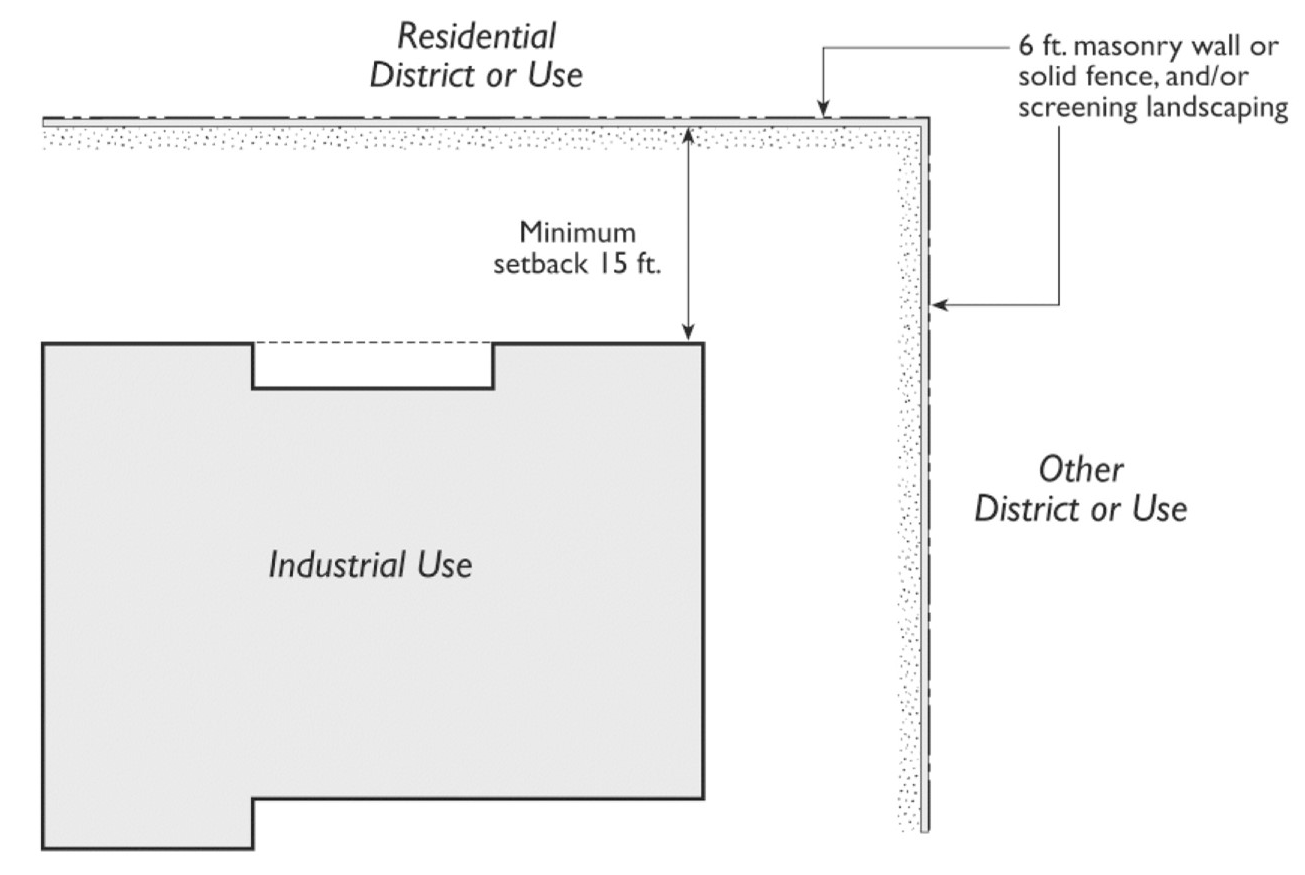
Screening between industrial and other land uses. Where a lot with an industrial use abuts a property in any other zone district or use, the following setback and screening requirements shall be provided as part of the development or land use.
a.
Setbacks. Industrial structures and activities shall maintain a minimum of 15 feet from any residential zoning district or use.
b.
Screening. A six-foot masonry or solid fence or screening landscaping shall be provided and maintained on the interior lot lines of any lot that contains an industrial use and any other district or use, subject to the approval of the Director.
(2)
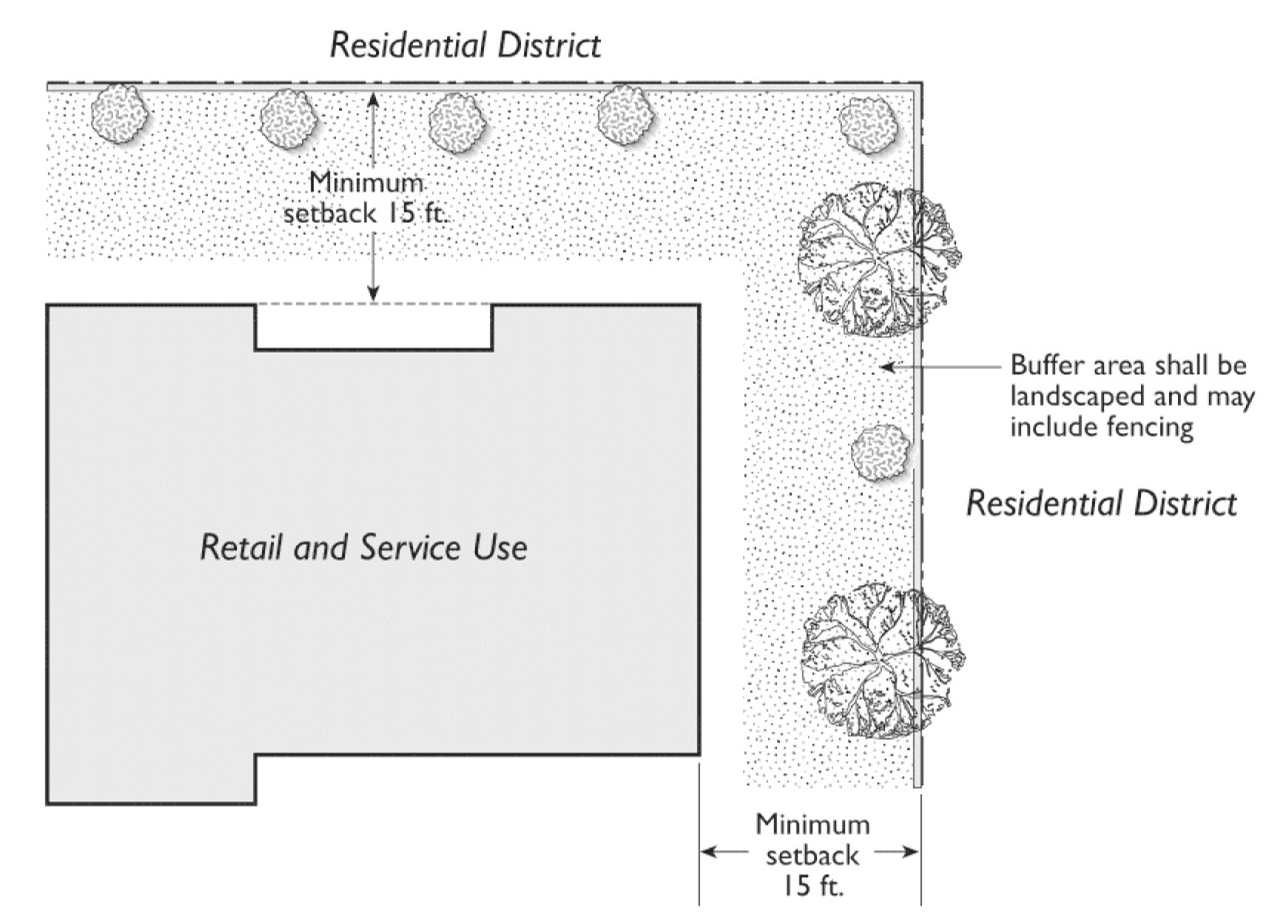
Screening between retail and service uses and residential land uses. Where a lot with a retail or service use abuts a residential zoning district, the following setback, screening, and landscaping requirements shall be provided as part of the development or land use.
a.
Setbacks. Retail and service uses shall maintain a minimum 15-foot setback as a buffer area from the residential zoning district.
b.
Screening. The buffer area between retail and service uses and residential districts shall be landscaped and may include fencing to provide a reasonable buffer between the two uses. No structures, paving, or snow storage are permitted in this area.
(3)
Mechanical equipment, loading docks, and refuse areas.
a.
Ground level mechanical equipment, loading docks, refuse and recyclable materials storage areas, and utility services shall be screened from public view from adjoining public streets and rights-of-way as determined by the Director.
b.
Rooftop mechanical equipment (e.g., air conditioning, heating, vents, flues, exhaust pipes, and ventilation ducts, etc.) shall be combined or collected together on slopes of roofs and screened from public view from adjoining public streets and rights-of-way as determined by the Director.
c.
The method of screening shall be architecturally compatible with other on-site development in terms of colors, materials, and architectural style as determined by the Director.
d.
All mechanical equipment screening shall be subject to review and approval by the Director and the Mammoth Lakes Fire Protection District.
(Code 1990, § 17.36.090; Ord. No. 14-02, § 4, 3-19-2014)
17.36.100. - Setback requirements and exceptions.
(a)
Use and minimum size. This section provides standards for the use and minimum size of required setbacks. These standards are intended to provide open areas around structures for visibility and traffic safety; access to and around structures; access to natural light, ventilation and direct sunlight; snow shedding; separation of incompatible land uses; and space for privacy, landscaping, and recreation.
(b)
Setback requirements.
(2)
All structures shall comply with the setback requirements of the applicable zoning district established by Chapters 17.16 through 17.32, and with any special setbacks established for specific uses by this chapter, except as otherwise provided by this section. No portion of a structure, including eaves or roof overhangs, shall extend beyond a property line; or into an access easement or street right-of-way.
(3)
All setbacks shall be open and unobstructed from the ground upward, except for trees and plant materials and as provided in this section.
(4)
For properties fronting on a substandard street, the front and street side setback lines shall be measured from the ultimate right-of-way line, based upon the adopted road standards of the Town.
(c)
Special active fault trace. A minimum setback of 50 feet shall be provided between buildings intended for human occupancy and an active fault trace as identified on special studies zones maps prepared by the State Geologist.
(d)
Permanent lake or stream setbacks.
(1)
Purpose. This section provides standards for development adjacent to permanent streams, creeks and lakes throughout the Town, which are valuable as open space areas, provide habitat for plants and animals, and are of recreational and scenic interest. Therefore, it is important for the Town to provide appropriate buffers between these designated water bodies and adjacent development to protect this important community resource.
(2)
Applicability. The provisions of this section apply to any permanent lake or stream, defined as any stream, lake, river, pond or other body of water or waterway which, most years, under natural conditions, will contain water all year.
(3)
Streambed information required. At the time of permit application, applicants with parcels adjoining any of the above-specified waterways or water bodies shall submit a site-specific streambed information prepared by a hydrologist, civil engineer, or other qualified professional approved by the Town to identify the precise top of bank of the waterway as defined below. The Director may waive the requirement for a streambed analysis if it is determined that the project, because of its size, location, or design will have no impact on the water body, or that sufficient information exists and further analysis is not necessary. The mapping shall be provided at a scale of at least 1:100. The information provided shall include any information determined necessary by the Director to properly analyze the potential impacts of the proposed project on the water body and necessary mitigations.
(4)
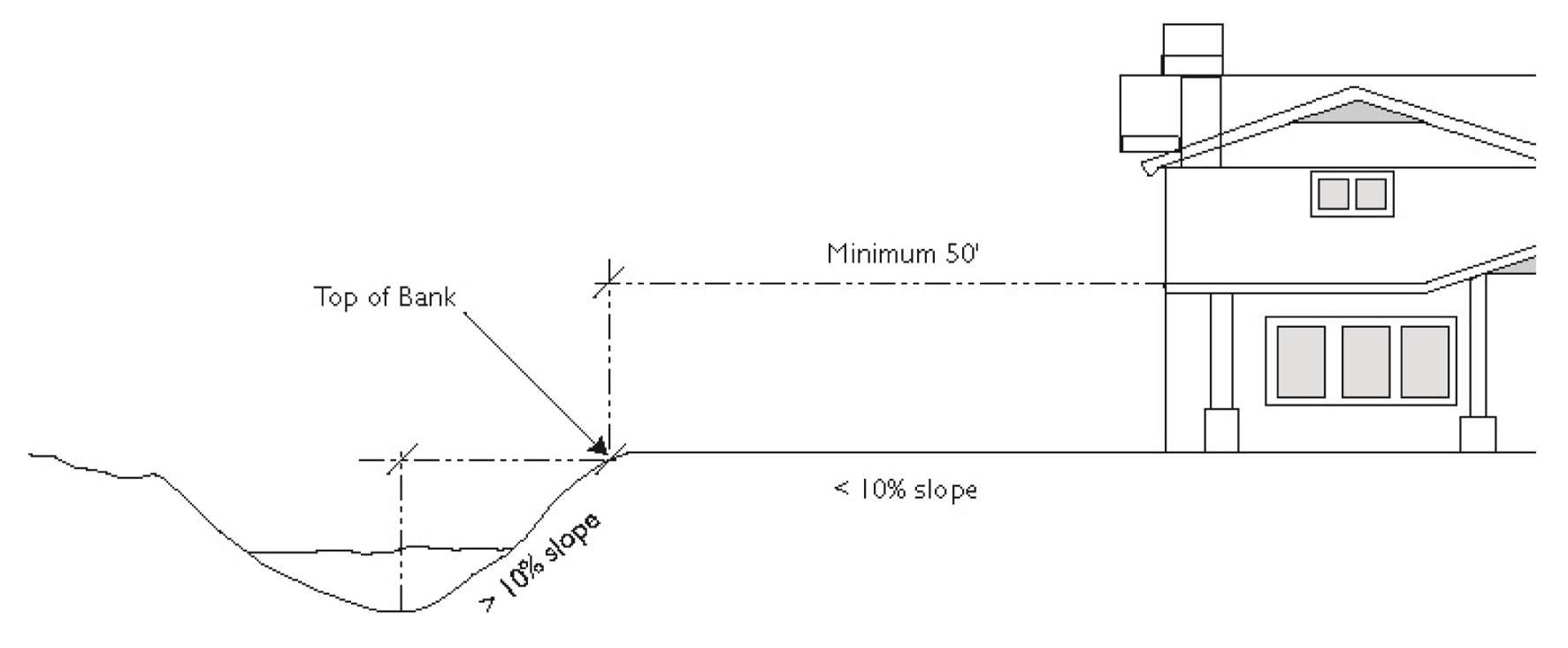
Top of bank determination. Top of bank shall be determined as the point beyond which the slope of the upper elevation of land, which confines the channel waters flowing in a watercourse in their normal course of high seasonal flow, does not exceed ten percent.
(5)
Setbacks, easements, or dedications. A setback, easement or dedication, including any land within the channel and a minimum of 50 feet from the top of bank shall be required for all zoning districts. The review authority may require a larger setback, easement, or dedication if found to be necessary to protect sensitive environmental resources.
(6)
Structures. No structure, fence, parking access, parking space, paved area or swimming pool shall be constructed within a creek or creekside setbacks. Public roads, and sidewalks, paths or trails and other public facilities may be constructed within the setback.
(7)
Modifications to lake and stream/creek corridor development standards. The Commission may modify the development standards outlined in Subsection (e)(5) of this section, in compliance with Chapter 17.72 and Chapter 17.76. In addition to the findings described therein, the following findings shall be made in order to approve a variance or adjustment to the lake and stream corridor development standards:
a.
The entirety of the project is outside of the 100-year flood plain.
b.
The creek bank in the vicinity of the modification has been demonstrated as historically stable.
c.
Riparian resources will not be significantly diminished as a result of the modification.
(e)
Development standards.
(1)
Setbacks shall be required for all ministerial projects. Either a setback, easement, or dedication shall be required for all discretionary land use entitlements. Tentative maps shall be conditioned in compliance with Title 16.
(2)
Grading and landscaping. Grading or filling, planting of exotic/non-native or non-riparian plant species, or the removal of native vegetation shall not be permitted within a setback area. Exceptions to this include grading, landscaping, and vegetation management activities determined necessary by an applicable permitting or regulating agency for fire safety, to maintain safe public access on an established road, path or trail, or to maintain the health and ecological function of the water body, and for which necessary approvals from a permitting agency have been obtained.
(3)
Drainage structures. Where constructed drainage devices and improvements are required, they shall be placed in the least visible locations and naturalized through the use of native rock, textured earth-tone concrete, and native landscaping.
(4)
Bridges. Bridges and crossings may be allowed within the required setback if approved by the Town Engineer and approvals have been obtained from all agencies with permitting authorities. Bridges and crossing structures shall be designed to be no wider than necessary to accommodate their intended use.
(5)
Limitations on the use of setbacks.
a.
Vehicle parking and driveways. Required setback areas shall not be used for parking or driveways except for:
1.
Driveways crossing street or street-side yard setbacks that provide direct access to a garage from the street abutting the affected setback.
2.
Single-family or townhome parking in driveways leading to a garage.
3.
Shared driveways on the common property line of the sharing parcels and associated parking, provided that such parking does not impede access to a parcel other than the parcel where the parking is located.
4.
Driveways on flag lots or lots with similarly restricted access where the width for access is less than 30 feet.
5.
Parking of boats, trailers and vehicle accessories may be kept in required side yard or rear yards subject to the provisions of Chapter 17.52.
6.
In the event practical difficulties and hardships result from the strict enforcement of vehicle parking in setback areas, the Director may grant an adjustment to allow parking within the setback area provided that the findings required by Chapter 17.76 can be made and the parking area is protected from snow shed, does not impede emergency access, does not interfere with Town snow storage easements, and conforms to the California Building Standards Code requirements.
b.
Vehicle parking on commerce circle. Parking is permitted within the front yard setback areas on Commerce Circle subject to the following conditions:
1.
The lot must be substandard in either width or area;
2.
The maximum parking requirement for all uses on the site cannot exceed three spaces;
3.
Parking must be oriented at a 90 degree angle to the street;
4.
All parking spaces must be adjacent to one another; and
5.
The parking spaces shall not exceed 30 feet in overall width at the property line (or 34 feet if accessible parking is required).
(f)
Measurement of setbacks. Setbacks shall be measured as follows:
(1)
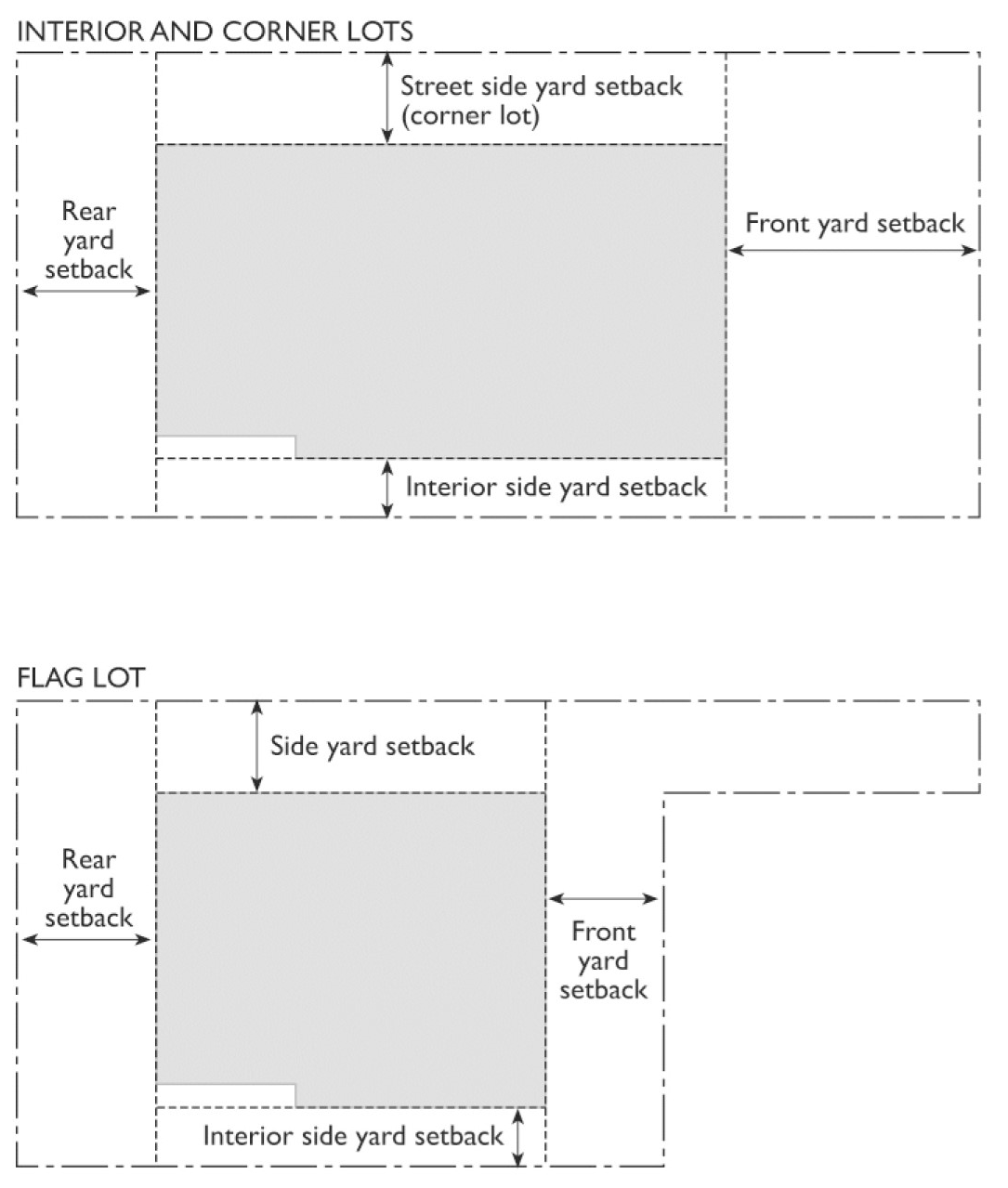
Front yard setbacks. The front yard setback shall be measured from the nearest point on the front property line of the parcel to the nearest line of the structure, except as follows. Whenever a future right-of-way width line is officially established for a street; required setbacks shall be measured from the established lines.
a.
Corner parcels. The measurement shall be taken from the nearest line of the structure to the nearest point of the property line adjoining the street which has the narrowest parcel frontage. Whenever a future right-of-way width line is officially established for a street, required setbacks shall be measured from the established lines; and
b.
Flag lots. The measurement shall be taken from the nearest line of the structure to the point where the access strip meets the bulk of the parcel; establishing a building line parallel to the lot line nearest to the public street or right-of-way.
(2)
Side yard setbacks. The side yard setback shall be measured from the nearest point on the side property line of the parcel to the nearest line of the structure; establishing a setback line parallel to the side property line, which extends between the front and rear yards.
(3)
Street side yard setbacks. The side yard on the street side of a corner parcel shall be measured from the nearest point of the side property line adjoining the street to the nearest line of the structure. Whenever a future right-of-way width line is officially established for a street, required yards shall be measured from the established line.
(4)
Rear yard setbacks. The rear yard shall be measured from the nearest point on the rear property line of the parcel to the nearest line of the structure, establishing a setback line parallel to the rear property line, which extends between the side yards.
(g)
Allowed projections into setbacks. Attached architectural features may extend beyond the wall of the structure and into the front, side, and rear setbacks, in compliance with Table 17.36.100, below, subject to all applicable requirements of the California Building Standards Code.
Table 17.36.100. Allowed Projections into Setbacks
Notes:
1 The foundations, piers, supports or other structural connections to the ground for chimneys, covered entries, stairways, and wing walls are permitted within the required setback.
(h)
Setback requirements for specific structures and equipment.
(1)
Pools and spas. Swimming pools and spas at grade, including all accessory structures and equipment shall maintain the setback requirements set forth for the main structure.
(2)
Satellite dish/antenna. Satellite dishes and antennas shall maintain the setback requirements set forth for the main structure.
(3)
Detached storage sheds. Detached storage sheds not more than 120 square feet and eight feet in height shall meet the following requirements:
a.
Detached storage sheds shall be located on the rear 50 percent of the building site. The distance between the front and rear property lines shall be the basis for determining the rear 50 percent of the property.
b.
Detached storage sheds may encroach into required side or rear yard, but not closer than three feet to the property line.
c.
Storage sheds shall be located at least 20 feet from any property line bordering a street.
(i)
Structures in setback areas. Any damage sustained to any fence, garage, wall, barrier, or other building or structure located within the front or street side yard setbacks as the result of snow removal operations other than direct contact by snow removal equipment, shall be the sole responsibility of the property owner and the Town shall have no liability whatsoever therefor.
(Code 1990, § 17.36.100; Ord. No. 14-02, § 4, 3-19-2014; Ord. No. 15-01, § 4(exh. A, § 8, 9), 1-21-2015; Ord. No. 17-10, § 4(exh. A), 11-1-2017)
17.36.110. - Snow storage.
All development and proposed land uses that are planned with off-street parking and circulation areas shall be designed and constructed to provide snow storage areas in compliance with the minimum standards of this section.
(1)
Application content requirements. All land use permit applications subject to this section shall include identification of required snow storage areas on the required site plan.
(2)
Minimum storage area required. Each unenclosed parking area, including circulation.
a.
Residential zones. An area equal to a minimum of 75 percent of all uncovered required parking and driveway areas shall be provided for the storage of snow.
b.
Industrial zones. An area equal to a minimum of 40 percent of all uncovered required parking and driveway areas shall be provided for the storage of snow.
c.
Commercial zones.
1.
Generally. An area equal to a minimum of 60 percent of all uncovered required parking and driveway areas shall be provided for the storage of snow.
2.
Reduction of snow storage area in commercial zones. The review authority may reduce or waive the required snow storage areas if the following conditions are met:
(i)
The affected property participates in a snow removal maintenance district;
(ii)
The property owner commits to permanently haul on-site snow from the property to an approved off-site snow storage area. The commitment to haul on-site snow shall be in the form of a recorded document mutually agreed to between the property owner and the Town; and
(iii)
A snow storage management plan is submitted and approved by the Town that includes the following:
A.
The site shall designate temporary or interim snow storage areas that do not interfere with more than one-third of the project required minimum parking.
B.
Interim snow storage shall be removed within five calendar days following a storm cycle or when chain controls are lifted.
C.
Interim snow storage shall not be in a location that will damage trees, landscape, or other facilities.
D.
Interim snow storage shall not block any required access, sidewalk, trail, or public path.
E.
Snow shall be hauled to an approved and permitted location.
F.
Snow hauling shall generally be completed during non-business hours.
G.
The snow management plan shall designate the removal methods.
H.
Drainage facilities shall not be blocked.
I.
Snow storage shall be located so that snow moving equipment is not required to enter the public streets to move snow to the storage area unless an encroachment permit is obtained.
J.
Snow storage shall be located in areas that are substantially free and clear of obstructions (e.g., propane tanks, trees, large boulders, trash enclosures, utility pedestals).
(3)
Location. Snow storage areas:
a.
Shall be located near the sides or rear of parking areas and driveways, away from the primary street frontage;
b.
Shall be located to maximize solar exposure to the greatest extent feasible;
c.
Shall be located so that snow moving equipment is not required to enter the public streets to move snow to the storage area;
d.
Shall be located in a manner to preserve sight lines for vehicles entering or exiting driveways;
e.
Shall be located in areas that are readily accessible and substantially free and clear of obstructions (e.g., propane tanks, trees, large boulders, trash enclosures, utility pedestals);
f.
Shall not block any required access, sidewalk, trail, or public path;
g.
May be located within parking areas but such areas may not be counted towards meeting parking requirements for the use; and
h.
May be located within required landscaping areas but the areas shall be planted with landscaping tolerant of snow storage or be native vegetation.
(4)
Minimum dimensions. The minimum dimension of a snow storage area shall be ten feet in any direction.
(5)
Drainage. Snow storage areas shall be designed to provide adequate drainage to prevent ponding and the formation of ice, especially within pedestrian areas and driveways. Drainage from snow storage areas shall be directed towards on-site drainage retention/treatment facilities. Snow storage areas for commercial projects are required to install oil/water separators.
(Code 1990, § 17.36.110; Ord. No. 14-02, § 4, 3-19-2014; Ord. No. 15-01, § 4(exh. A, § 26), 1-21-2015)
17.36.120. - Solar access and solar equipment guidelines.
Passive and active heating and cooling opportunities should be incorporated into single-family residential subdivisions and multifamily residential projects as provided by this section.
(1)
Shading. Developments have the potential to shade and decrease the solar access of adjacent properties. Developments shall be designed to preserve the solar access of adjacent properties to the extent practicable. The Director may require a shade analysis for developments that could significantly affect the solar access of neighboring properties or public rights-of-way.
(2)
Solar design. The high number of sunny days in the Town provides the opportunity to significantly increase the energy efficiency of structures through the use of effective active or passive solar design. Developments are encouraged to maximize the use of solar design. In addition, properly oriented roof areas allow for the installation of efficient solar energy systems. The Town encourages roof areas to be designed to allow for the installation of efficient solar energy systems.
(3)
Solar collector installation. Solar collectors, if provided, shall be located and installed in the following manner:
a.
Roof-mounted solar collectors shall be placed in the least conspicuous location without reducing the operating efficiency of the collectors;
b.
Wall-mounted and ground-mounted collectors shall be screened from public view to the maximum extent feasible;
c.
Roof-mounted collectors shall be installed at the same angle or as close as possible to the pitch of the roof. Solar panels may be placed on a flat roof in an angled position if they are appropriately screened from view by elements that are compatible with the architectural style, color, and use of materials on the main portions of the building;
d.
Appurtenant equipment, particularly plumbing and related fixtures, shall be installed in the attic whenever possible or screened from public view to the maximum extent feasible;
e.
Exterior surfaces of the collectors and related equipment shall have a matte, non-reflective finish and shall be color-coordinated to harmonize with roof materials and other dominant colors of the structure; and
f.
All solar collectors shall comply with the requirements of the Mammoth Lakes Fire Protection District.
(Code 1990, § 17.36.120; Ord. No. 14-02, § 4, 3-19-2014)
17.36.130. - Solid waste/recyclable materials separation and storage.
This section provides standards which recognize the Town's support for and compliance with the California Solid Waste Reuse and Recycling Access Act of 1991, Public Resources Code §§ 42900 through 42912.
(1)
Applicability. These requirements apply to new multifamily residential and nonresidential developments pursuant to Chapter 8.08 or 8.16.
(2)
Extent of storage area required. Solid waste and recyclables separation and storage areas shall be provided in the number, dimensions, and types required by the Department or review authority. Additional storage areas may be required, as deemed necessary by the Director.
(3)
Requirements. Where required by Chapter 8.08 or 8.16, a paved area for dumpsters and recycling containers shall be provided within multifamily projects, commercial, and industrial development. The paved area shall be readily accessible to refuse collection and recycling vehicles and shall not be located in the front or side setback area unless authorized by the Director and Public Works Director based upon safety concerns, or accessibility of the dumpster location. Dumpsters approved within the front or street side setback area are subject to additional screening with fencing or landscaping as approved by the Director.
(4)
Animal resistant. Trash enclosures, receptacles, and food storage areas shall be animal resistant.
(Code 1990, § 17.36.130; Ord. No. 14-02, § 4, 3-19-2014; Ord. No. 17-10, § 4(exh. A), 11-1-2017; Ord. No. 19-04, § 4(exh. A, c.), 11-6-2019)
17.36.140. - Tree removal and protection.
(a)
Purpose. This section includes provisions to protect and to regulate the removal of certain trees, based on the important environmental, aesthetic and health benefits that trees provide to Town residents and visitors, and the contribution of such benefits to public health, safety and welfare. These benefits include, but are not limited to, enhancement of the character and beauty of the community as a village in the trees, protection of property values, provision of wildlife habitat, reduction of soil erosion, noise buffering, wind protection, and visual screening for development.
(b)
Applicability. The terms and provisions of this section shall apply to all private and public property within the Town.
(c)
Exemptions. The following shall be exempt from the provisions of this section:
(1)
Removal of a tree that presents an immediate safety hazard to life or property, as determined by the Town Manager, Director, Building Official, Public Works Director, Police Chief, Fire Marshal, public utility company, or designees;
(2)
Routine tree maintenance, such as the trimming or thinning of branches;
(3)
Tree removal performed by the Town, public utilities, or other public agencies in public utility easements or public rights-of-way;
(4)
Tree removal for fuels reduction purposes on publicly owned land, performed in conjunction with an approved fuel reduction program or activity;
(5)
Removal of trees felled by natural weather conditions or an act of God;
(6)
Removal of visibly dead trees; and
(7)
Coniferous and deciduous trees with a diameter at breast height (DBH) of less than 12 inches.
(d)
Tree removal permit required. No person shall remove or cause to be removed any tree from any property, which is subject to this section and not otherwise exempted pursuant to Subsections (c), (f), and (g) of this section, without first obtaining a valid tree removal permit pursuant to the requirements of Chapter 17.60.
(e)
Tree removal permit application and review.
(1)
Tree removal permit application. The following information shall be provided in the tree removal permit application:
a.
A site plan or drawing showing the location, type and size of all trees proposed to be removed;
b.
A statement of the reasons for removal; and
c.
Written consent of the owner of record of the land on which the trees are proposed to be removed, or their authorized agent or contractor.
(2)
Tree removal permit review. The following shall be considered when reviewing tree removal permits:
a.
The Director shall inspect the property and evaluate each application. The applicant shall clearly mark or flag all trees proposed for removal.
b.
The Director shall issue a permit if any of the conditions in this subsection (e)(2)b are determined to apply. The Director may request the applicant to provide a professional assessment by a registered professional forester (RPF) or arborist to support the reasons for the proposed tree removal.
1.
The trees is infected with an epidemic insect or disease where the recommended control is not applicable and an arborist has recommended removal to prevent transmission;
2.
The tree is visibly dying;
3.
The trees presents a hazard to health, safety or property that cannot be corrected by pruning, transplanting or other treatments;
4.
The trees severely interfere with the growth and development of a more desirable tree;
5.
The removal of the tree would be necessary to provide for the required amount of snow storage on a residential or commercial property;
6.
The removal of the tree would substantially increase midday solar access to a solar collector;
7.
The trees interferes or is causing extensive damage to utility services or facilities, roadways, sidewalks, curbs, gutters, pavement, water or sewer line, foundations or existing structures;
8.
The removal of the trees would be necessary to maintain defensible space around a structure, or for fuels reduction purposes approved by Mammoth Lakes Fires Protection District;
9.
The removal of the trees would allow for improved enjoyment or quality of a publicly accessible recreation or event site (e.g., improved event circulation or seating, enhanced golf course playability, etc.) consistent with the Town's destination resort objectives;
10.
Any other reason, which, in the determination of the Director, would be necessary to maintain public health, safety or welfare, or to avoid damage to buildings or property.
c.
Creation of views, lawns, or similar amenities shall not be sufficient cause to remove trees.
(3)
Expiration of tree removal permits. Tree removal permits shall remain valid for a period of five years from date of issue.
(f)
Multifamily residential project tree management plan. An administrative permit for a tree management plan may be approved by the Director for an existing multifamily residential or lodging property of 25 units or more consistent with the standards of this section. Separate tree removal permits would not be required with an approved tree management plan.
(1)
Tree management plan. A tree management plan shall include the following information:
a.
Name of multifamily residential or lodging property.
b.
Narrative describing purpose and objectives of the tree management plan.
c.
Location, species, diameter at DBH, reason, and anticipated year of removal for each tree expected to be removed under the management plan.
d.
Signature of certified RFP or arborist certifying the validity of the tree management plan.
(2)
Expiration of tree maintenance plan. Tree management plans shall remain valid for a period of five years from date of issue. Substantial revisions or amendments to an approved tree management plan shall be approved by the Director.
(g)
Construction-related tree removal and protection. If a site has received development approval through a land use, building, or grading permit that includes a tree removal and protection plan consistent with the standards of this section, then a separate tree removal permit is not required, and removal of trees is considered approved through the land use, building, or grading permit.
(1)
Tree removal and protection plan. A tree removal and protection plan is required prior to conducting development activities which require a land use permit, building permit or grading permit, including, but not limited to, clearing, grading, excavation or demolition work on any property or development site containing one or more trees.
a.
Depiction of trees to be preserved, removed. The tree removal and protection plan shall clearly depict all trees to be preserved or removed on the site. The plan must be drawn to scale and include the following:
1.
Location, species and diameter of each tree at DBH.
2.
Clear identification of all trees proposed to be removed.
3.
Location of drip line of each tree.
4.
Location of existing and proposed roads, water, sanitary and storm drain, irrigation and other utility lines/facilities and easements.
5.
Location of existing and proposed structures.
6.
Grade change or cut and fill during or after construction.
7.
Existing and proposed impervious surfaces.
8.
Location and type of tree protection measures to be installed per Subsection (g)(1)b of this section.
b.
Tree protection measures. Except as otherwise allowed by the review authority or Director, all required tree preservation measures set forth in this section shall be instituted prior to any construction or development activities, including, but not limited to, clearing, grading, excavation or demolition work, and shall be removed only after completion of all construction activity, including landscaping and irrigation installation.
1.
Fencing, a minimum of three feet tall with posts placed no more than ten feet apart shall be installed at the edge of the tree drip line. Fencing shall be flush with the initial (undisturbed) grade.
2.
No construction activity shall occur within the tree drip lines, including, but not limited to dumping or storage of materials such as building supplies, soil, waste items, equipment or parked vehicles.
3.
Tree drip lines shall be maintained free of chemically injurious materials and substances such as paints, thinners, cleaning solutions, oil and gasoline, concrete or drywall excess, construction debris or runoff.
4.
No excavation, trenching, grading, root pruning or other activity shall occur within the drip line unless approved by the review authority or the Director.
5.
The applicant shall not proceed with any development or construction activities, except installation of erosion control measures, until the Town has inspected and approved the installation of the required tree protection measures and a grading or building permit has been issued by the Town.
(2)
Waiver of requirement to provide tree removal and protection plan. The Director may waive the requirement to provide a tree removal and protection plan where it can be demonstrated, to the Director's satisfaction, than no trees would be removed or otherwise directly or indirectly affected by the proposed activity.
(h)
Penalty for removal of a tree without a permit. The following penalties may be imposed for removal of trees without an approved tree removal permit where one is required, consistent with Chapter 1.18.
(1)
Coniferous trees over 12 inches: a fine of no less than $2,500.00 per tree or as valued by an RPF or arborist; in no circumstances shall the fine be less than $2,500.00 and no more than $50,000.00, per tree;
(2)
Deciduous trees over 12 inches: a fine of $1,000.00 per tree or as valued by an RPF or arborist; in no circumstances shall the fine be less than $1,000.00 and no more than $5,000.00;
(3)
Replacement plantings may be required as determined by the Director consistent with Subsection (i) of this section, which may include valuation by an RPF or arborist.
(i)
Mitigation for tree removal. As mitigation for tree removal, either in conjunction with a tree removal permit, construction-related tree removal, or as penalty for tree removal performed without a permit, the Director may require replacement plantings. If required, replacement shall be limited to plantings in areas suitable for tree replacement with species identified in the Town's recommended plant list. The replacement ratio shall be determined by the Director. If required, the minimum replacement tree size shall be seven gallons. Replacement requirements may also be determined based on the valuation of the tree as determined by an RPF or arborist. The property owner shall maintain plantings to a level approved by the Director.
(Code 1990, § 17.36.140; Ord. No. 14-02, § 4, 3-19-2014; Ord. No. 15-01, § 4(exh. A, § 26), 1-21-2015)
17.40.010. - Purpose.
The specific purposes of the water efficient landscape regulations are to:
(1)
Implement the Water Conservation in Landscaping Act and the 2015 California Model Water Efficient Landscape Ordinance (CA MWELO);
(2)
Reduce water waste in landscaping by promoting the use of alpine region-appropriate plants that require minimal supplemental irrigation, and by establishing standards for irrigation efficiency;
(3)
Establish a structure for planning, designing, installing, maintaining, and managing water efficient landscapes in new construction and rehabilitation projects;
(4)
Integrate "defensible space" into all new and rehabilitated landscape projects to reduce potential wildfire impacts on private property;
(5)
Promote rainwater capture and graywater use; and
(6)
Promote the effective and efficient irrigation of landscapes.
(Code 1990, § 17.40.010; Ord. No. 16-07, § 4(exh. A), 9-21-2016; Ord. No. 23-03, § 4(exh. C), 4-19-2023)
17.40.020. - Applicability.
(a)
The standards of this section apply to all of the following projects:
(1)
New construction projects with an aggregate landscape area equal to or greater than 500 square feet.
(2)
Rehabilitation landscape projects with an aggregate landscape area equal to or greater than 2,500 square feet.
(3)
Existing landscapes that were installed before December 1, 2015, and are over one acre in size shall be subject to the provisions for existing landscapes provided for in Section 17.40.040(h).
(b)
Any landscape project with an aggregate landscape area of 500—2,500 square feet may comply with the performance requirements of this section or conform to the prescriptive measures contained in the water efficient landscape checklist.
(c)
For projects using treated or untreated graywater or rainwater captured on-site, any lot or parcel within the project that has less than 2,500 square feet of landscape and meets the lot or parcel's landscape water requirement (estimated total water use) entirely with treated or untreated graywater or through rainwater captured on-site is subject only to the irrigation system requirements of the water efficient landscape checklist.
(d)
The following are exempt from the standards of this section when an applicant submits a WELO Exemption Form attesting to one of the following:
(1)
New construction with an aggregate landscape area less than 500 square feet.
(2)
Rehabilitated landscape projects with an aggregate landscape area of less than 2,500 square feet.
(3)
Registered local, State, or Federal historic sites.
(4)
Temporary irrigation systems utilized for three full growing seasons or less for purposes of ecological restoration, erosion/sedimentation control, and mine reclamation projects.
(5)
Community gardens or plant collections, as part of botanical gardens and arboretums open to the public.
(6)
Commercial cultivation of agricultural products, including, but not limited to, products of farms, orchards, production nurseries and forests.
(Code 1990, § 17.40.020; Ord. No. 16-07, § 4(exh. A), 9-21-2016; Ord. No. 23-03, § 4(exh. C), 4-19-2023)
17.40.030. - Landscape and irrigation plans.
A landscape documentation package that complies with the requirements described in Section 17.40.040 shall be submitted with the permit application for all applicable projects, except for projects that are exempt pursuant to Section 17.40.020 (d). When landscaping is proposed or required as part of a discretionary permit i.e., use permit, tentative map, etc.), the application shall include a statement on the plans or a condition of approval shall be included that indicates compliance with the Town's water efficient landscape regulations shall be demonstrated at the building permit phase. For discretionary permits that will not entail subsequent building or grading permits, a fully compliant landscape documentation package may be required as part of the discretionary permit process. The contents of the landscape documentation package shall be drawn to scale and shall demonstrate landscape water efficiency pursuant to Section 17.40.050, water efficient design and compliance options.
(Code 1990, § 17.40.030; Ord. No. 16-07, § 4(exh. A), 9-21-2016; Ord. No. 23-03, § 4(exh. C), 4-19-2023)
17.40.040. - General requirements.
(a)
Defensible space.
(1)
All landscape projects shall include a noncombustible area at least five-feet-wide that surrounds the base of structures. This noncombustible area may incorporate noncombustible materials such as crushed rock, steppingstones, gravel, stone pavers, bare earth, irrigated herbaceous plants, or a combination of these materials. This area shall be depicted and called out on all landscape plans. This noncombustible area hall be kept free of wood mulches.
(2)
Utilize boulders, stone, gravel, or other noncombustible material within the landscape to create intermittent bare spaces (fire breaks). Noncombustible landscape features and material, shall be identified on all landscape plans.
(3)
Retained conifer trees located within 30 feet of a habitable structures shall be pruned to the highest roof deck height, or a maximum of 1/3 of the total tree crown height. Existing tree shall be pruned up and away from structures, to provide at least ten feet of separation from roofs and chimneys.
(4)
At least ten feet of horizontal distance between individual tree crowns shall be maintained for retained conifer trees within 30 feet horizontal distance of a habitable structure.
(5)
Landscape materials that are listed on the Town's prohibited planting list shall not be approved in new or rehabilitated landscape projects.
(6)
New plantings located within 30 feet of a structure shall not include plants on the Town's high fire hazard plant list.
(7)
Plants on the recommended plant list should be used for required and desired landscape and screening; plants that are not on the list shall be submitted for review.
(b)
Plant materials.
(1)
Plants shall be selected appropriately based upon their adaptability to the climatic, geologic and topographical conditions of the Town. Native species and natural areas are to be protected and preserved to the extent possible. Generally, turf is discouraged. The planting of trees is encouraged wherever it is consistent with the other provisions of this chapter. Recommendations for plant materials that could meet the requirements of this section are included in the Town recommended plant list found in the Making the Most of Every Drop user's guide and methods to achieve water efficiency shall include one or more of the following:
a.
Use the Sunset Western Climate Zone System which takes into account temperature, humidity, elevation, terrain, latitude, and varying degrees of continental influence on local climate;
b.
Recognize the horticultural attributes of plants (i.e., mature plant size, invasive surface roots) to minimize damage to property or infrastructure (e.g., buildings, sidewalks, powerlines) and allow for adequate soil volume for healthy root growth; and
c.
Consider the solar orientation for plant placement to maximize winter solar gain.
(2)
Plants having similar water use should be grouped together by hydrozone (i.e., high, medium, low). Though not encouraged, plants of low and moderate water use may be planted in the same hydrozone, and plants of moderate and high water use may be planted in the same hydrozone. Plants of low and high water use may not be planted in the same hydrozone. The estimated total water usage (Section 17.40.040(f)) for these mixed areas shall assume a plant factor based on the proportions of the represented plant species or apply the plant factor of the least water efficient plant species (refer to Making the Most of Every Drop user's guide).
(3)
Plant materials and mulches will be in compliance with local fire codes. Fire prevention measures shall be addressed in areas that are fire prone as identified by The Mammoth Fire Severity Zone Map.
(4)
Turf shall not be planted on slopes greater than 25 percent.
(5)
No portions of turf areas shall be less than ten feet wide to prevent overspray.
(6)
Noxious weeds as identified by the USDA and invasive plant species as identified in by the California Invasive Plant Inventory are prohibited.
(7)
The landscape area shall be the sum of all the landscaped areas on the site per the definition in Section 17.148.020.
(8)
The landscape area shall use efficient water conservation practices and shall generally separate areas of similar slope, sun exposure, soil, and other site conditions appropriate for the selected plants. Refer to the Making the Most of Every Drop user's guide.
(9)
High water use plants (including turf), characterized by a plant factor of 0.7 to 1.0, are prohibited in street medians.
(10)
The architectural guidelines of a common interest development, which include community apartment projects, condominiums, planned developments, and stock cooperatives, shall not prohibit or include conditions that have the effect of prohibiting the use of low-water plants as a group.
(c)
Soil preparation and mulch.
(1)
Prior to the planting of any materials, compacted soils shall be transformed to a friable condition. On engineered slopes, only amended planting holes need meet this requirement.
(2)
For landscape installations, compost at a rate of a minimum of four cubic yards per 1,000 square feet of permeable area shall be incorporated to a depth of six inches into the soil. Soils with greater than six percent organic matter in the top six inches of soil are exempt from adding compost and tilling.
(3)
A minimum three-inch layer of mulch shall be applied on all exposed soil surfaces of non-turf planting areas, except for creeping or rooting groundcovers, direct seeding, and other applications where mulch is contraindicated. To provide habitat for beneficial insects and other wildlife, up to five percent of the landscape area may be left without mulch. Designated insect habitat must be included in the landscape design plan as such. Stabilizing mulching products shall be used on slopes that meet current engineering standards. The mulching portion of the seed/mulch slurry in hydro-seeded applications shall meet the mulching requirement.
(4)
Organic mulch materials made from recycled or post-consumer materials shall be used instead of inorganic materials or virgin forest products unless the recycled post-consumer organic products are not locally available. Organic mulches are not required where prohibited by local fire codes.
(5)
When a soil management report is required pursuant to the application requirements, the soil analysis recommendations shall be implemented and soil amendments shall be incorporated according to the report and what is appropriate for the plants selected.
(d)
Irrigation specifications. This section applies to landscaped areas requiring permanent irrigation, not areas that require temporary irrigation solely for the plant establishment period.
(1)
The irrigation system and its related components shall be planned and designed to allow for proper installation, operation, management, and maintenance. An irrigation system is expected to meet or exceed 75 percent efficiency for overhead spray devices and 81 percent efficiency for drip system devices and be installed in compliance with the manufacturers' recommendations.
(2)
All irrigation systems shall be designed to avoid runoff, low head drainage, overspray, or other similar conditions where water flows onto adjacent property, non-irrigated areas, walks, roadways, or structures.
(3)
Automatic irrigation controllers and sensors are required. Controllers may either be weather-based or soil moisture-based controllers utilizing non-volatile memory that automatically adjust irrigation in response to changes in plants' needs as weather conditions change. Sensors (rain, freeze, wind, etc.), either integral or auxiliary, shall be required and shall function to suspend or alter irrigation operation during unfavorable weather conditions.
(4)
Proper irrigation equipment and schedules, including features such as repeat cycles, shall be used to closely match application rates with soil type and soil infiltration rates in order to minimize runoff.
(5)
Low-volume irrigation shall be required in mulched areas to maximize water infiltration into the root zone. Narrow or irregularly shaped areas that are less than ten feet in width in any direction shall be irrigated with subsurface irrigation or other means that produces no runoff or overspray. In areas with slopes greater than 25 percent, the area shall not be irrigated with an irrigation system with an application rate exceeding three-quarters of an inch per hour unless the landscape designer specifies an alternative design or technology, as part of the landscape documentation package, and clearly demonstrates no runoff or erosion will occur. Prevention of runoff and erosion must be confirmed during the irrigation audit.
(6)
Pressure regulation is a key component in efficient irrigation system operation. Static pressure throughout the Town varies greatly due to many factors (e.g., topography, time of year, time of day, location of project in relationship to water source, etc.). Pressure regulation shall be required on all projects and set to 60 pounds per square inch unless the landscape plan demonstrates a need for higher pressure. The system shall be designed to ensure that the dynamic pressure at irrigation feature is within the manufacturer's recommended pressure range for optimal performance.
(7)
Overhead irrigation is prohibited within 24 inches of any non-permeable surface. If planted, only low-volume irrigation shall be allowed within the 24-inch setback.
(8)
Recirculating water shall be used for decorative water features. Surface area of a water feature shall be included in the high water use hydrozone area of the water budget calculation.
(9)
Backflow prevention devices shall be required to protect the water supply from contamination by the irrigation system.
(10)
Irrigation systems for nonresidential landscapes and residential landscapes of 5,000 square feet or larger shall include flow sensors that detect high flow conditions created by system damage or malfunction.
(11)
Master shut-off valves are required on all landscape projects except landscapes that make use of technologies that allow for the individual control of sprinklers that are individually pressurized in a system equipped with low pressure shut down features.
(12)
Manual shut-off valves (such as a gate valve, ball valve, or butterfly valve) shall be required, as close as possible to the point of connection of the water supply, to minimize water loss in case of an emergency or routine repair.
(13)
Check valves or anti-drain valves are required on all sprinkler heads where low point drainage could occur.
(14)
The design of the irrigation system shall conform to the hydrozones of the landscape design plan and each valve shall irrigate a hydrozone with similar site, slope, sun exposure, soil conditions, and plant materials with similar water use. Sprinkler heads and other emission devices shall be selected based on what is appropriate for the plant type within that hydrozone.
(15)
Sprinkler heads shall have matched precipitation rates within each control circuit valve and shall be selected for proper coverage and precipitation rate. Head to head coverage is recommended and sprinkler spacing shall be designed to achieve the highest possible distribution uniformity using the manufacturer's recommendations.
(16)
Swing joints or other riser-protection components are required on all risers subject to damage that are adjacent to hardscapes or located in high traffic areas.
(17)
Where feasible, trees shall be placed on separate valves from shrubs, groundcovers, and turf to facilitate the appropriate irrigation of trees. The mature size and extent of the root zone shall be considered when designing irrigation for the tree.
(18)
All irrigation emission devices must meet the requirements set in the American National Standards Institute (ANSI) standard, American Society of Agricultural and Biological Engineers/International Code Council's (ASABE/ICC) 802-2014, Landscape Irrigation Sprinkler and Emitter Standard. All sprinkler heads installed in the landscape must document a distribution uniformity low quarter of 0.65 or higher using the protocol defined in the ASABE/ICC 802-2014.
(e)
Mammoth Community Water District (MCWD) served connections.
(1)
Separate landscape water meters, defined as either a dedicated water service meter or private submeter, shall be installed for all nonresidential irrigated landscapes of 1,000 square feet, but not more than 5,000 square feet (the level at which Water Code 535 applies) and residential irrigated landscapes of 5,000 square feet or greater, or as required by MCWD Code if the MCWD Code has more stringent standards. A landscape water meter may be either a customer service meter dedicated to landscape use provided by the MCWD or a privately owned meter or submeter.
(2)
When a landscape has a separate water meter the irrigation system and decorative water features shall be designed to allow for the current and future use of recycled water and shall use recycled water. Compliance or exemption shall be documented via a written letter from the MCWD, that details compliance or states that recycled water meeting all public health codes and standards is not available and will not be available for the foreseeable future.
(3)
Program settings for irrigation controllers shall comply with MCWD watering regulations.
(4)
All irrigation shall be subject to regulations and restrictions put forth by the MCWD.
(f)
Maintenance. A regular maintenance schedule shall be submitted as part of the landscape documentation package. Landscapes shall be maintained to ensure water efficiency. A regular maintenance schedule shall include, but not be limited to, testing; auditing; adjusting and repairing backflow prevention devices, pressure regulating devices and irrigation equipment; resetting the automatic controller; aerating and dethatching turf areas; replenishing mulch; fertilizing; pruning; weeding in all landscaped areas; and removing obstructions to emission devices. Refer to Section 17.40.070.
(g)
Water budget worksheet. When a landscape documentation package is required, the project applicant shall complete the water budget worksheet contained within the landscape documentation package application which contains information on the plant factor, irrigation method, irrigation efficiency, and area associated with each hydrozone. Calculations are then made to show that the evapotranspiration adjustment factor (ETAF) for the landscape project does not exceed a factor of 0.55 for residential areas and 0.45 for nonresidential areas, exclusive of special landscape areas (SLAs). The ETAF for a landscape project is based on the plant factors and irrigation methods selected. The maximum applied water allowance (MAWA) is calculated based on the maximum ETAF allowed (0.55 for residential areas and 0.45 for nonresidential areas) and expressed as annual gallons required. The estimated total water use (ETWU) is calculated based on the plants used and irrigation method selected for the landscape design. ETWU must be below the MAWA.
(1)
In calculating the maximum applied water allowance (MAWA) and estimated total water use (ETWU), a project applicant shall use the evapotranspiration (ETo) value for Mammoth Lakes, which is 33 inches.
(2)
Water budget calculations shall adhere to the following requirements:
a.
The plant factor (PF) value may be found in the Making the Most of Every Drop user's guide, or for more specific information the WUCOLS publication, or may be more precisely determined by a landscape professional, with consideration of site-specific soil and microclimate conditions. The PF ranges from 0 to 0.1 for very low water using plants, 0.1 to 0.3 for low water use plants, 0.4 to 0.6 for moderate water use plants, and from 0.7 to 1.0 for high water use plants.
b.
All water features shall be included in the high water use hydrozone and temporarily irrigated areas shall be included in the low water use hydrozone.
c.
All special landscape areas (SLAs) shall be identified and their water use calculated. ETAF for new and existing (non-rehabilitated) SLAs shall not exceed 1.0.
(h)
Graywater systems. Graywater systems are encouraged for on-site landscape irrigation. All gray water water systems shall conform to the California Plumbing Code (Title 24, Part 5, Chapter 16 of the California Code of Regulations) and any requirements of the Town or MCWD.
(i)
Existing landscapes over one acre in size. For existing landscapes over one acre in size that have a landscape water meter, the Town or MCWD shall administer programs that may include, but not be limited to, irrigation water use analyses, irrigation surveys, and irrigation audits to evaluate water use and provide recommendations as necessary to reduce landscape water use to a level that does not exceed the maximum applied water allowance for existing landscapes. The maximum applied water allowance for existing landscapes shall be calculated as: MAWA equals (0.8) (ETo) (LA) (0.62). For existing landscapes over one acre in size that do not have a landscape water meter, the Town or MCWD shall administer programs that may include, but not be limited to, irrigation surveys and irrigation audits to evaluate water use and provide recommendations as necessary in order to prevent water waste.
(j)
Other information. Other information determined necessary by the Director.
(Code 1990, § 17.40.040; Ord. No. 16-07, § 4(exh. A), 9-21-2016; Ord. No. 23-03, § 4(exh. C), 4-19-2023)
17.40.050. - Water efficient design and compliance options.
One of four options (Options A through D) for landscape design compliance documentation shall be chosen to demonstrate that the landscape project meets water efficiency requirements. The options coordinate with the level of water conservation in the design of the landscape. Refer to the Making the Most of Every Drop user's guide for additional information and examples of landscape documentation package contents for Options B and C.
(1)
Option A: water efficient landscape checklist. A water efficient landscape checklist may be submitted in-lieu of completion of Options B through D for any landscape project that complies with all of the requirements and limitations of the water efficient landscape checklist and has an aggregate landscape area of 500 to 2,500 square feet.
a.
Water efficiency. Plans must demonstrate all of the following as a means of achieving water efficiency.
1.
Residential.
(i)
At least 75 percent of the landscape area shall consist of low to very-low water-use plants (plant factor of 0.3 or less), excluding edibles and areas using recycled water.
(ii)
A maximum of 25 percent of the landscape area is permitted to be turf or other high water-use plants (plant factor of 0.7 to 1.0), however the average plant factor for this area shall not exceed 0.6. Landscape areas that have turf or other high water-use plants shall not be on slopes greater than 25 percent or in areas less than ten feet wide.
2.
Nonresidential. One hundred percent of the landscape area shall consist of low to very-low water-use plants (plant factor of 0.3 or less), excluding edibles and areas using recycled water.
b.
Landscape documentation package required contents.
1.
Landscape checklist form. Submittal of the signed landscape checklist form confirming that the soil preparation, irrigation system, planting, mulch, and other landscape elements will comply with the checklist standards.
2.
Certification of substantial compliance. Refer to Section 17.40.040(e).
3.
Irrigation survey and report. Refer to Section 17.40.060(a)(2).
(2)
Option B: low water use/no lawn.
a.
Water efficiency. Plans must demonstrate all of the following as a means of achieving water efficiency.
1.
No turf or special landscape areas are allowed.
2.
At least 51 percent of the landscape area consists of low water-use plants (plant factor of 0.3 or less).
3.
The remaining percentage of the landscape area shall consist of plantings that have an average plant factor of 0.6 or less.
b.
Landscape documentation package required contents.
1.
Landscape area plan. Locates, delineates, and identifies square footage of all landscape area hydrozones by number, letter, or other method. Each hydrozone will note the associated plant factor or water usage (i.e., very-low, low, medium or high) for the types of plants to be installed within the hydrozone.
2.
Project plant schedule. Lists landscape plants, including common name, Latin name, water usage (low, medium or high), and fire hazard (low, medium or high).
(i)
The plant list should not include any plant types that increase wildfire susceptibility.
(ii)
Identify species contained in seed mix, if applicable.
3.
Basic irrigation plan. Identifies station control valves location, backflow prevention device, pressure regulation valves, point of connection to property's service lateral, extent of area serviced by irrigation, and specifies the type of irrigation emission devices (e.g., drip, spray, soaker hose or other) for each hydrozone. Each hydrozone shall be on a separate valve. Low-volume irrigation is required in all areas.
4.
Maintenance schedule. Refer to Section 17.40.040(e).
5.
Certification of substantial completion. Refer to Section 17.40.060(a)(1).
6.
Irrigation survey and report. Refer to Section 17.40.060(a)(2).
(3)
Option C: medium water use/limited lawn.
a.
Water efficiency. Plans must demonstrate all of the following as a means of achieving water efficiency.
1.
The ETWU for the landscape must be less than or equal to 85 percent of MAWA.
2.
Turf shall not exceed 20 percent of the total landscape area, or 1,250 square feet, whichever is less.
b.
Landscape documentation package required contents.
1.
Landscape area plan. Locates, delineates, and identifies square footage of all landscape area hydrozones by number, letter, or other method. Each hydrozone will note the associated plant factor or water usage (i.e., very-low, low, medium or high) for the types of plants to be installed within the hydrozone.
2.
Project plant schedule. Lists landscape plants, including common name, Latin name, water usage (low, medium or high).
(i)
The plant list should not include any plant types that increase wildfire susceptibility.
(ii)
Identify species contained in seed mix, if applicable.
3.
Slope plan. If turf is included in the landscape a separate plan shall identify the extent of turf areas and the percent grade of the property to demonstrate that turf will not be planted on a slope of 25 percent or more.
4.
Basic irrigation plan. Identifies station control valve locations, backflow prevention device, pressure regulation valves, point of connection to property's service lateral, extent of area serviced by irrigation, and specifies the type of irrigation emission device (e.g., drip, spray, soaker hose or other) for each hydrozone. Each hydrozone shall be on a separate valve. Irrigation devices installed for turf shall have matched precipitation rates and sprinkler layout shall be designed for high distribution uniformity.
5.
Water budget worksheet. Show maximum applied water allowance and estimated total water usage calculations (Section 17.40.040(f)).
6.
Maintenance schedule. Refer to Section 17.40.040(e) and Section 17.40.070.
7.
Certification of substantial completion. Refer to Section 17.40.060(a)(1).
8.
Irrigation survey and report. Refer to Section 17.40.060(a)(2).
(4)
Option D: Maximum applied water allowance compliance option.
a.
Preparation of plans. Plans shall be prepared by, and bear the signature of, a licensed landscape architect, licensed landscape contractor, or any other person authorized by the State to design the required elements.
b.
Total landscape area and water usage. Plans shall demonstrate that the total landscape area maximum applied water allowance shall not be exceeded by the landscape's estimated total water usage.
c.
Landscape documentation package required contents.
1.
Detailed planting plan. The detailed planting plan shall include the following:
(i)
General notes, planting notes, plant layout based on size at maturity, species, and symbol legend;
(ii)
Spacing of proposed plantings;
(iii)
Locations of and trunk diameter of all existing trees whose trunk circumference is greater than 12 inches, measured at diameter at breast height.
(iv)
Existing features to remain, such as trees, fencing, hardscape, etc.;
(v)
Existing features to be removed;
(vi)
Identification of pertinent site factors such as sun exposure, microclimate, property lines, buildings, underground/above-ground utilities, existing drainage features, etc.;
(vii)
Locate, delineate, and identify square footage of each hydrozone by number, letter, or other method. Each hydrozone will identify the associated plant factor (i.e., very-low, low, medium, or high) for the types of plants to be installed within the hydrozone;
(viii)
Identify and provide square footage of any special landscape areas;
(ix)
Demonstrate plants have been arranged to provide defensible space for wildfire protection;
(x)
Identify type of mulch and application depth; and
(xi)
Identify hardscapes (pervious and non-pervious).
2.
Project plant schedule. The project plant schedule lists all plants, including common name, Latin name, quantity, plant factor and water usage, to be installed as part of the project.
(i)
The plant list should not include any plant types that increase wildfires susceptibility.
(ii)
Identify species contained in seed mix, if applicable.
3.
Soil management report. The purpose of this report is to reduce runoff and encourage healthy plant growth. The report shall include the following at a minimum:
(i)
Soil texture;
(ii)
Infiltration rate determined by laboratory test or soil texture infiltration rate table;
(iii)
pH;
(iv)
Total soluble salts;
(v)
Sodium;
(vi)
Percent organic matter; and
(vii)
Recommendations.
In projects with multiple landscape installations (i.e., production home developments), a soil sampling rate of one in seven lots or approximately 15 percent will satisfy this requirement. Large landscape projects shall sample at a rate equivalent to one in seven lots.
4.
Detailed irrigation plan. The detailed irrigation plan shall contain all of the following:
(i)
Location, type and size of all components of the irrigation system (e.g., controllers, main and lateral lines, valves, sprinkler heads, moisture sensing devices, rain switches, quick couplers, pressure regulators, and backflow prevention devices). Each hydrozone shall be on a separate valve;
(ii)
Water flow rate (gallons per minute), application rate (inches per hour), and design operating pressure (pressure per square inch) for each station;
(iii)
Irrigation schedule; an annual irrigation program with monthly irrigation schedules shall be required for the plant establishment period, for the established landscape, and for any temporary irrigated areas. The irrigation schedule shall:
A.
Include run time (in minutes per cycle), suggested number of cycles per day, and frequency of irrigation for each station; and
B.
Provide the amount of applied water recommended on a monthly and annual basis.
(iv)
Location and size of separate water meters for landscape if applicable.
5.
Grading and drainage plan. The grading and drainage plan shall be designed to minimize soil erosion, runoff, and water waste. A comprehensive grading plan prepared by a civil engineer for other local agency permits satisfies this requirement. The grading and drainage plan shall bear the signature of licensed professional and indicate finished configurations and elevations of the landscape area, including:
(i)
Height of graded slopes;
(ii)
Drainage patterns;
(iii)
Pad elevations;
(iv)
Finish grade; and
(v)
Stormwater retention improvements, if applicable.
6.
Water budget worksheet. The water budget worksheet (Section 17.40.040(f)) showing maximum applied water allowance and estimated total water usage must be completed by a landscape architect, certified irrigation designer, certified landscape irrigation auditor, landscape contractor, licensed professional engineer or other person who is authorized by the State to complete a water budget worksheet.
7.
Statementof compliance. The following statement should be included on the plans "I (We) have complied with the criteria of the Town water efficient landscape regulations."
8.
Certification of substantial completion. Refer to Section 17.40.060(a)(1).
9.
Comprehensive survey and report. Refer to Section 17.40.060(a)(3).
(Code 1990, § 17.40.050; Ord. No. 16-07, § 4(exh. A), 9-21-2016)
17.40.060. - Installation and completion.
(a)
Documents for project completion.
(1)
Certification of substantial completion. For Options A, B, C and D (Sections 17.40.050(a), (b), (c) and (d)), upon completion of the installation of the landscaping and irrigation system a certificate of substantial completion shall be submitted to the Town as noted below. The certificate shall include the following statement: "The landscape and irrigation system has been installed as specified in the landscape and irrigation plan and complies with the criteria of the Town Water Efficient Landscape Regulations and the permits issued by the Town for the project."
(2)
Irrigation survey and report. For projects demonstrating compliance under Options A, B, or C (Section 17.40.050(a), (b), or (c)) a report shall be provided that includes, but is not limited to, inspection of pressure at the emission devices, ability to eliminate overspray, and installation of appropriate controller. A report shall be provided and shall document any problems encountered and shall identify and explain any discrepancies between the plan and installation. The irrigation survey shall be performed by an irrigation auditor who is either a local agency landscape irrigation auditor or a third-party certified landscape irrigation auditor. Landscape audits shall not be conducted by the person who designed the landscape or installed the landscape.
(3)
Comprehensive survey and report. For projects demonstrating compliance under Option D (Section 17.40.050(d)): A report shall verify all contents of the landscape documentation package were installed as specified. The reports shall document any problems encountered and shall identify and explain any discrepancies between the landscape documentation package and installation. A certified irrigation auditor shall conduct an audit report for any spray or overhead irrigation system. A distribution uniformity (catch can) analysis must achieve a DU of 75 percent or better for spray sprinklers and 80 percent for rotary sprinklers.
(b)
Project completion. Approval of the documents of project completion is required prior to the issuance of a Certificate of Occupancy for the project. For projects served by MCWD, approval of the documents of project completion by the Town shall be marked as preliminary until MCWD confirms in writing that the preliminary approved documents have been received regardless of meter requirements.
(Code 1990, § 17.40.060; Ord. No. 16-07, § 4(exh. A), 9-21-2016)
17.40.070. - Maintenance.
(a)
The landscape and irrigation system shall be maintained to ensure successful establishment following installation, and to ensure water use efficiency remains equal to or below maximum applied water allowance, consistent with submitted plans and requirements of this chapter. Irrigation systems shall be tested, adjusted and repaired following the manufacturers' specification and the recommendations of the landscape professional.
(b)
A diagram of the irrigation plan showing hydrozones shall be kept with the irrigation controller for subsequent management purposes.
(c)
Whenever possible, repair of irrigation equipment shall be done with the originally specified materials or their equivalents, or with components of greater efficiency.
(d)
Failed plants shall be replaced with the same or functionally equivalent species that may be size-adjusted as appropriate for the stage of growth of the overall installation.
(Code 1990, § 17.40.070; Ord. No. 16-07, § 4(exh. A), 9-21-2016)
17.40.080. - Reporting.
The Town shall comply with all reporting requirements outlined in the CA Model Water Efficient Landscape Ordinance (CA MWELO), Section 495.
(Code 1990, § 17.40.080; Ord. No. 16-07, § 4(exh. A), 9-21-2016)
17.44.010. - Purpose.
The requirements of this chapter are intended to:
(1)
Reduce environmental, economic, and social impacts associated with parking;
(2)
Reduce the amount of land devoted to parking;
(3)
Reduce inefficient, dispersed, and single-use reserved parking;
(4)
Provide on-street parking opportunities as appropriate;
(5)
Encourage the use of feet-first alternative transportation modes and reduce vehicle use;
(6)
Improve community livability, walkability, and character; and
(7)
Provide flexibility in accommodating changes in demand and use.
(Code 1990, § 17.44.010; Ord. No. 14-02, § 4, 3-19-2014)
17.44.020. - Applicability.
Each building and land use, including a change or expansion of a building or land use, shall provide parking in compliance with this chapter. No building shall be occupied and no land use shall be commenced until improvements required by this chapter are completed and approved by the review authority. All roadways shall comply with Public Works Street Standards and MLFPD standards.
(Code 1990, § 17.44.020; Ord. No. 14-02, § 4, 3-19-2014)
17.44.030. - Number of parking spaces required.
(a)
Exceptions. Each land use shall provide the required number of parking spaces established in this chapter, except:
(1)
To the extent that the State Density Bonus Law as provided in Government Code § 65915 allows for a reduction in parking;
(2)
In cases where the requirement is modified in compliance with Section 17.44.040; and
(3)
Except where parking standards have been established through a master plan or specific plan.
(b)
Residential parking requirements. Parking requirements for residential land uses shall be provided in compliance with Table 17.44.030(a) except where the requirement is modified in compliance with Section 17.44.040, and except where parking standards have been established through a master plan or specific plan. Residential uses are described in Chapter 17.20 and are listed in Table 17.20.020 of Section 17.20.020.
Table 17.44.030(a). Required Parking Spaces (Residential Use Classifications)
(c)
Nonresidential parking requirements. Parking requirements for nonresidential land uses shall be provided in compliance with Table 17.44.030(b), except where the requirement is modified in compliance with Section 17.44.040, and except where parking standards have been established through a master plan or specific plan. Nonresidential land uses are described in Table 17.24.020 in Chapter 17.24 and Table 17.28.020 in Chapter 17.28. Parking requirements for nonresidential uses are determined based on the following:
(1)
Parking zones. Where Table 17.44.030(b) expresses parking zones for nonresidential uses, the parking zones shall be defined as follows and as shown in Figure 17.44.030(b)(1):
a.
Parking zone 1. Includes the downtown and Old Mammoth Road commercial zoning districts, which represent the areas of Town with the highest concentration of mixed-use development and multi-modal accessibility, thereby reducing parking demand. Therefore, parking requirements in this zone are the lowest.
b.
Parking zone 2. Includes the mixed Lodging/Residential zoning district and the Lodestar master plan area, which represent areas of Town with some mixed-use or multifamily development that is served by transit, thereby reducing parking demand moderately. Therefore, parking requirements in this zone are the second lowest.
c.
Parking zone 3. Represents all other areas within Town, except where parking standards have been established through a master plan or specific plan.
(2)
Minimum and maximum parking requirements. Where Table 17.44.030(b) expresses a minimum and maximum parking ratio for nonresidential uses, the ratios represent the minimum or maximum number of parking spaces allowed for each land use metric.
a.
Minimum parking ratios. Represents the minimum number of parking spaces required.
b.
Maximum parking ratios. Represents the maximum number of parking spaces allowed.
Table 17.44.030(b). Required Parking Spaces (Nonresidential Use Classifications)
Figure 17.44.030(b)(1). Location of Parking Zones
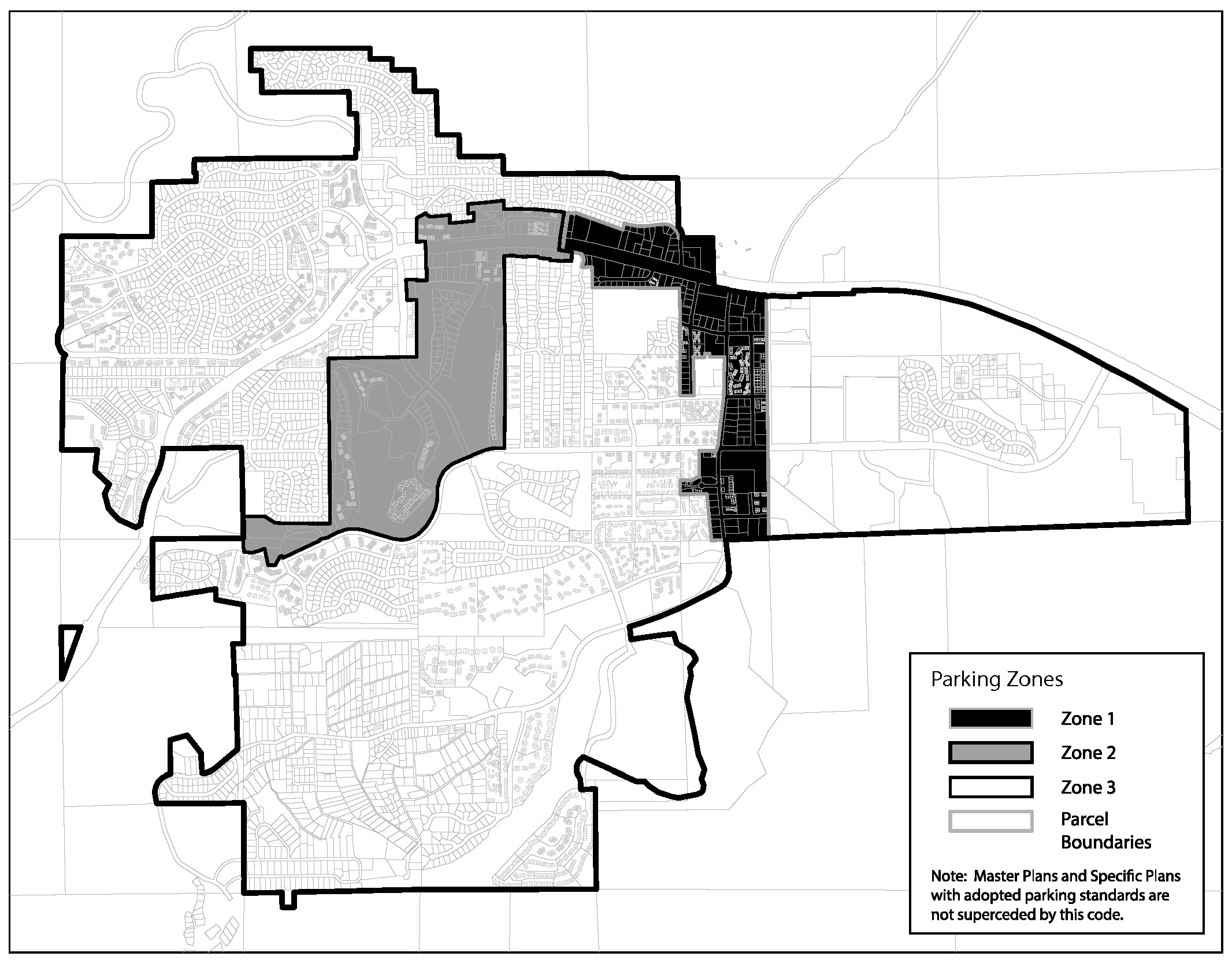
(d)
Disabled (ADA) parking. Parking for the disabled shall be provided on site in compliance with the California Building Standards Code. Parking spaces required for the disabled shall count toward compliance with the number of parking spaces required by this chapter.
(e)
Use with accessory components. A primary use with accessory components shall provide parking for each component. For example, a hotel with a restaurant shall provide the parking spaces required by Table 17.44.030(b) for a hotel (e.g., the guest rooms), and for a restaurant, except where the requirement is reduced or otherwise modified in compliance with Section 17.44.040.
(f)
Floor area. Where Table 17.44.030(b) expresses a parking requirement based on gross leasable area (GLA) (for example: one space for each 1,000 GLA), the term "gross leasable area" shall mean gross leasable square footage of floor area measured in square feet, including balconies, basements, mezzanines, or upper floors, but excluding common areas such as elevators, stair wells, bathrooms, shared hallways, and lobbies. This shall apply to single and multiple occupant/tenant structures.
(g)
Rounding of calculations. If a fractional number is obtained in calculations performed in compliance with this chapter, one additional parking space shall be required for a fractional unit of 0.50 or above, and no additional space shall be required for a fractional unit of less than 0.50.
(Code 1990, § 17.44.030; Ord. No. 14-02, § 4, 3-19-2014; Ord. No. 15-01, § 4(exh. A, § 26), 1-21-2015; Ord. No. 17-10, § 4(exh. A), 11-1-2017; Ord. No. 19-04, § 4(exh. A, e.), 11-6-2019; Ord. No. 2021-04, § 4(exh. B), 4-21-2021)
17.44.040. - Alternative parking provisions.
The number of parking spaces required by Section 17.44.030 may be modified through the following measures or combination of measures subject to approval of the review authority. Documentation to support the requested modification must be provided in a form acceptable to the review authority. A project receiving a waiver or reduction of required parking spaces pursuant to the State Density Bonus Law shall not be eligible to request a reduction in parking pursuant to Subsection (1) of this section, nor the payment of parking in-lieu fees pursuant to Subsection (2) of this section.
(1)
Parking reductions. The review authority may grant a parking reduction for a specific use subject to the requirements listed in this subsection. No person shall change a use of land that is subject to an approved parking reduction except in compliance with the provisions of this subsection. Reductions of at least one parking space and not exceeding 25 percent of the parking required by Section 17.44.030 may be granted subject to approval of an administrative permit (Chapter 17.84). Reductions exceeding 25 percent of the parking required by Section 17.44.030 may be granted subject to approval of a use permit (Chapter 17.68). At the discretion of the review authority, a parking study prepared by a qualified transportation professional may be required in conjunction with a parking reduction request to demonstrate that adequate parking is provided. The review authority may grant a parking reduction for replacement or expansion of uses that are nonconforming only as to parking, if the review authority finds that the requirements of Subsection (2) of this section have been met.
a.
Parking reduction criteria. In addition to the applicable required findings for either an administrative permit or a use permit, upon submission of documentation by the applicant of how the project meets the following criteria, the review authority may approve reductions of the parking requirements of Section 17.44.030 if the review authority finds that:
1.
Use of a valet parking program will result in more efficient use of the existing parking area and provide an increase in the amount of available on-site parking commensurate with the size of the parking reduction being requested without impacting existing circulation or right-of-way;
2.
Varying time periods of use will accommodate peak parking demand for each land use for which a reduction is requested based on Institute of Transportation Engineers Parking Generation estimates;
3.
Internal or external trip capture by nearby on-site or off-site uses will reduce parking demand;
4.
Some or all of the parking needs of the use will be adequately served through on-street parking in the right-of-way or off-street parking on an ongoing basis, in conformance with any existing seasonal restrictions on on-street parking adopted by the Town or the entity owning or maintaining any street on which parking is proposed;
5.
Implementation of transportation demand management measures will continue to reduce the need for on-site parking on an ongoing basis (see Section 17.44.050); or
6.
The parking needs of all uses will be met through shared use of off-street parking facilities by one or more uses, consistent with the following standards:
For off-site shared parking requests, a shared parking agreement shall be provided in a form acceptable to the review authority which identifies the location of the off-site shared parking spaces, guarantees the continued availability of the off-site shared parking spaces, and sets forth the ongoing responsibilities of the parties involved. The parties to the agreement shall include the owners and lessees of the off-site parking spaces and the owners and lessees of the subject site, and a copy of any such agreement shall be provided to the Town. The Town shall not be required to be a party to any such agreement, but each agreement shall grant the Town the right (but not the obligation) to enforce the agreement's terms and shall include a provision requiring that the Town be notified immediately of any termination or default of the agreement. Any termination or default of the agreement between parties shall result in revocation of the parking reduction approval by the Town unless a new alternative parking arrangement is approved by the Director within a reasonable timeframe, as determined by the Director.
7.
Before approving a parking reduction pursuant to this subsection, the review authority shall evaluate any existing parking arrangements to determine whether additional parking can be accommodated subject to Town standards. If the review authority finds that additional parking can reasonably be provided, the provision of such parking shall be a condition of approval of the requested reduction.
b.
Uses with nonconforming parking. The review authority is authorized to allow an existing nonresidential use that does not meet the current off-street parking requirements of Section 17.44.030(b), to be replaced or expanded subject to compliance with the following standards:
1.
An existing permitted nonresidential use in an existing building may be replaced by another permitted nonresidential use if the new use has the same or lesser parking requirement as the use being replaced.
2.
A nonconforming nonresidential use in an existing building may be replaced by a conforming nonresidential use or another nonconforming nonresidential use if the permitted or nonconforming replacement use has the same or lesser parking requirement as the use being replaced.
3.
An existing or replacement nonresidential use, whether conforming or nonconforming, that does not meet current parking requirements, shall not be expanded in floor area or seating or be replaced by a use that has an increased parking requirement unless a use permit pursuant to Chapter 17.68, and a corresponding parking reduction pursuant to this section are approved.
4.
Before approving a parking reduction pursuant to this subsection, the review authority shall evaluate the existing parking arrangement to determine whether it can accommodate additional parking or be rearranged to accommodate additional parking in compliance with Town standards. If the review authority finds that additional parking can reasonably be provided, the provision of such parking shall be a condition of approval of the requested reduction.
5.
A nonconforming use shall not be replaced with a use, whether conforming or nonconforming, that would create a negative impact on parking for neighboring properties.
(2)
Parking in-lieu fee. Upon the adoption of a parking districts and in-lieu fee program by the Council, the review authority may reduce or eliminate the minimum number of required on-site parking spaces for projects where the applicant executes an agreement with the Town to pay a parking in-lieu fee. The parking in-lieu fee agreement shall be recorded on the property as approved by the review authority through the use permit process. The in-lieu fee shall be determined through the adopted in-lieu fee program and shall consider current construction costs for parking (surface, understructure, underground). The funds shall be paid prior to the issuance of the first Certificate of Occupancy for the project. The funds shall be deposited with the Town in a special fund and shall be used and expended for the purpose of acquiring and developing off-street parking facilities located within the general vicinity of the structures for which in-lieu payments were made, as well as for meeting parking needs through strategies to reduce parking demand, or to improve access to parking.
(3)
Spaces in excess of maximum allowed. The provision of parking spaces in excess of the maximum allowed as provided in Section 17.44.030 may be permitted subject to approval by the review authority and if the following conditions are met:
a.
The excess parking spaces are available for use by the public or any on- or off-site tenant, business, or use (i.e., not reserved exclusively for that tenant, business, or use).
b.
The provision of excess parking spaces does not cause adverse impacts as determined by the review authority.
c.
A Town-approved covenant is recorded that includes a description of the excess parking arrangement and a requirement that all current and future tenants are notified of and shall adhere to the operational conditions of approval.
(Code 1990, § 17.44.040; Ord. No. 14-02, § 4, 3-19-2014; Ord. No. 2021-04, § 4(exh. B), 4-21-2021)
17.44.050. - Transportation demand management.
Development that seeks to reduce parking requirements per Section 17.44.040(a) through the implementation of transportation demand management measures shall do so in accordance with this section. The applicant shall submit a transportation demand management plan for review and approval by the review authority which documents how a reduction in vehicle trips and parking demand commensurate with the requested reduction in on-site parking spaces will be achieved and demonstrates consistency with the following requirements:
(1)
Alternative travel information. All businesses or new multifamily residential or mixed use developments requesting a reduction of parking using TDM measures shall make, at a minimum, the following information available to employees or residents:
a.
Carpooling/vanpooling information if available;
b.
Transit schedules and route information;
c.
Information on air pollution and alternatives to driving to work alone;
d.
Bicycle route and facility information, including local bicycle maps, locations of nearest bicycle racks or locker storage facilities, and bicycle safety information; and
e.
Information on walking to work, pedestrian safety, and walking shoe information.
(2)
Trip reduction strategies.
a.
A transportation demand management plan shall include strategies to reduce vehicle trips generated by the development as determined by the most current edition of the Trip Generation Handbook published by the Institute of Traffic Engineers (ITE) or any other data source approved by the review authority.
b.
Any combination of the following methods may be incorporated into transportation demand management plans to document how a reduction in vehicle trips and parking demand commensurate with the requested reduction in on-site parking spaces will be achieved and maintained on an ongoing basis:
1.
Alternative work schedules/flex-time;
2.
Preferential parking for carpool or vanpool vehicles;
3.
Bicycle parking and shower facilities;
4.
Information center for transportation alternatives;
5.
Provision of on-site of off-site multi-modal transportation improvements;
6.
On-site childcare facilities;
7.
Facilities and equipment to encourage telecommuting;
8.
Contributions to funds for regional facilities such as park-and-ride lots, multi-modal transportation centers, satellite work centers, etc.;
9.
On-site amenities such as cafeterias, restaurants, automated teller machines, and other services that would eliminate the need for additional trips;
10.
Transit incentives for employees such as additional pay for carpoolers, flexible work times, etc.;
11.
Elimination of free parking/unbundling parking;
12.
Parking cash-out incentives for employees;
13.
Video-conferencing facilities and equipment (additional credit will be given if policies are included to make facilities available to other businesses);
14.
Plans for delivery of goods at off-peak times for applicable businesses; or
15.
Plans and facilities for centralized deliveries of goods for multitenant facilities.
(Code 1990, § 17.44.050; Ord. No. 14-02, § 4, 3-19-2014; Ord. No. 15-01, § 4(exh. A, § 26), 1-21-2015; Ord. No. 2021-04, § 4(exh. B), 4-21-2021)
17.44.060. - Motorcycle parking.
A parking lot with 50 or more vehicle parking spaces shall provide motorcycle parking spaces conveniently located near the main entrance to the primary structure and accessed by the same access aisles that serve the vehicle parking spaces in the parking lot.
(1)
Number of spaces required. A minimum of one motorcycle parking space shall be provided for each 50 vehicle spaces or fraction thereof.
(2)
Space dimensions. Motorcycle spaces shall have minimum dimensions of four feet by seven feet.
(Code 1990, § 17.44.060; Ord. No. 14-02, § 4, 3-19-2014)
17.44.070. - Tour bus parking and loading.
As determined by the review authority, off-street tour bus parking and loading facilities shall be provided for new hotel, motel, and multifamily residential projects intended predominantly for nightly rental use. An electricity hook-up shall be provided for each tour bus parking space. No tour bus engine idling shall be allowed on-site.
(Code 1990, § 17.44.070; Ord. No. 14-02, § 4, 3-19-2014)
17.44.080. - Oversize vehicle parking.
As determined by the review authority, oversize vehicle parking shall be provided for new hotel, motel, and multifamily residential projects intended predominantly for nightly rental use as necessary.
(Code 1990, § 17.44.080; Ord. No. 14-02, § 4, 3-19-2014)
17.44.090. - Bicycle parking.
Each multifamily project of four or more units and any nonresidential use shall provide bicycle parking in compliance with this section. A bicycle parking or storage plan shall be submitted to the review authority for review and approval. Nonresidential uses shall provide temporary long-term and short-term bicycle parking on a seasonal basis as approved by the review authority.
(1)
Bicycle facility standards. Bicycle parking shall be designed for both short-term and long-term needs. The bicycle parking requirement may be met on-site or may be exempted as provided in 17.44.090(3). Bicycle parking facilities shall be designed and installed in accordance with the public works standards.
a.
Short-term parking is intended for bicycle trips where bicycles will be left for a short time period (generally less than eight hours). Short-term parking shall be available to the public and should be located to provide convenient access to destinations. Short-term parking shall not be provided in designated snow-storage areas. Generally, the purpose of short-term parking is to provide for the convenience of commercial customers, employees, and residential visitors. Short-term bicycle parking shall be designed and located to address the needs of these users.
b.
Long-term parking is intended for bicycle trips where bicycles will be left for a long-period of time (generally all day, overnight, or seasonally). Long-term bicycle parking shall be provided within a building, covered garage, or in bicycle lockers, and shall be secure and protected from weather. Long-term parking should be conveniently located and be accessible 24 hours a day, seven days a week. Long-term bicycle parking spaces may be provided as part of a communal storage area or individually as approved by the review authority. Generally, the purpose of long-term parking is to provide for the keeping of bicycles by residents and overnight visitors in residential and lodging facilities or employees of all businesses. Long-term bicycle parking facilities shall be designed to address these purposes.
(2)
Number of bicycle spaces required. Bicycle spaces shall be provided in the proportions outlined in Table 17.44.090(b) for short-term and long-term needs.
Table 17.44.090(b). Bicycle Parking Requirements by Land Use
(3)
Exemptions. Where it can be demonstrated that providing bicycle parking spaces required under this subsection is not physically practical or that the nature of the building use is such that bicycle parking spaces would not be used, the review authority may grant an appropriate exemption or reduced level of compliance in return for alternative, multi-modal investments as deemed appropriate by the review authority. Multifamily residential units with unshared individual garages shall be exempt.
(Code 1990, § 17.44.090; Ord. No. 14-02, § 4, 3-19-2014)
17.44.100. - Parking design and development standards.
(a)
Enclosed and unenclosed parking. New development is required to provide the following minimum amounts of enclosed parking. Enclosed parking is encouraged.
(1)
Single-family residential. At least 50 percent of required parking shall be enclosed and at least one space shall be unenclosed, unless otherwise approved by the review authority.
(2)
Multifamily residential. At least 50 percent of required parking shall be enclosed.
(3)
Hotel or motel. At least 50 percent of required parking shall be enclosed.
(4)
Other uses. Enclosed parking is encouraged, but not required.
(b)
On-street parking. On-street parking shall be open to the public and shall not be reserved. On-street parking shall not be counted toward fulfilling parking requirements unless approved by the review authority in accordance with Section 17.44.040(1). On-street parking in commercial and resort zones along street frontages may be approved by the review authority. Road widths shall comply with public works standards or other standards mandated by jurisdictional authorities.
(c)
Tandem parking. Vehicles may be parked in tandem where the parking area is serving a single dwelling (including dwellings in multiple-family developments when both tandem spaces are assigned to the same unit) and where the tandem parking is not more than two cars in depth. The review authority may grant approval of tandem parking for nonresidential developments if the applicant demonstrates that it will not interfere with orderly parking and movement of vehicles.
(1)
The Director may also consider interior mechanical parking lifts when an attendant (valet) parking agreement is provided as permitted below. Proposals for mechanical parking lifts shall be reviewed by the Director and the fire marshal on a case-by-case basis to assess their functionality and safety.
(2)
Tandem parking arrangements for nonresidential projects and where mechanical lifts are proposed, shall be approved through the use permit process and an attendant (valet) parking agreement shall be executed between the property owner and the Town to ensure that valet parking is provided during all days and hours of the use of the tandem parking spaces. The attendant parking agreement shall be binding upon and inure to the benefit of each party and their respective successors and assigns.
(d)
Access to parking.
(1)
Parking, including parking garages, shall be accessed from an alley or secondary frontage when possible. The curb opening of a parking lot or garage on a frontage shall not exceed two lanes in width, except commercial uses demonstrating high exiting vehicle volumes that may have two outbound lanes or as otherwise provided in the public works standards.
(2)
No curb cuts into public rights of way for purposes of providing street access to on-site parking spaces on non-primary commercial and residential streets shall be permitted except where a project site meets at least one of the following conditions:
a.
The site has no side or rear street access having a minimum right of way width for the lanes required for access;
b.
The topography or configuration of the site or placement of buildings on the site precludes reasonable alley or secondary access to a sufficient number of parking spaces;
c.
Snow storage or other natural hazards necessitate such access, as approved by public works;
d.
The review authority determines that a curb cut is appropriate due to traffic, circulation or safety concerns.
1.
If curb cuts are required, curb cut widths shall be kept to the minimum width and distance from adjacent intersections required, consistent with the public works standards.
2.
On lots with adequate access, projects with new buildings or substantial remodels shall be required to replace any existing curb cuts or driveway aprons with a new full height curb.
3.
Properties with existing nonconforming access driveways shall be constructed in accordance with the current public works standards when the property reconstructs or repaves the project parking area.
(e)
Access to adjacent sites. Applicants are encouraged to provide off-street vehicle access to parking areas on adjacent properties to provide for convenience, safety, and efficient circulation. Pedestrian access between adjacent properties is also strongly encouraged. Where access circulation includes circulation for emergency service or other required access, cross easements shall be recorded for each property.
(f)
Parking space and lot dimensions. Parking lots and stalls shall be designed consistent with the public works standards.
(g)
Maintenance. All off-street parking spaces and driveway areas shall be paved and maintained for the duration of the use requiring such areas in accordance with the requirements of the Lahontan Regional Water Quality Control Board. Snow and ice shall be removed promptly from all required off-street parking and driveway areas.
(h)
Landscaping. Parking areas shall be landscaped in compliance with Chapter 17.40 and with the following requirements:
(1)
Amount of landscaping. Each use shall provide landscaping within or around the parking area at a minimum ratio of ten percent of the gross area of the parking lot. A minimum of one tree, the species of which shall be consistent with the Town recommended plant list, shall be provided for each five parking spaces. Tree plantings shall have a minimum size of three gallons as described in Section 17.36.050(b).
(2)
Location of landscaping. The location of landscaping, including the placement of trees, shall be provided as part of a landscape plan to be reviewed and approved by the review authority prior to issuance of a grading permit.
(3)
Irrigation. Irrigation shall be provided for landscaped areas.
(i)
Snow storage. On-site snow storage shall be provided consistent with Section 17.36.110.
(j)
Lighting. Lighting of all parking areas shall be consistent with Section 17.36.030.
(k)
Striping and identification.
(1)
Vehicle spaces. All required pavement striping shall be maintained in good condition. Parking spaces shall provide understandable markings to indicate where drivers should park. Subtle markings, such as contrasting colors in paving stones, are encouraged.
(2)
Restriping. The restriping of any parking space or lot that substantially changes the existing parking layout or results in a lesser number of parking spaces, shall require the approval of a restriping plan by the review authority.
(l)
Surfacing.
(1)
All parking surfaces shall be paved with an approved material. Parking areas shall be designed to treat and retain the first flush storm as defined by the Town general plan and stormwater management plan. Parking areas shall be constructed in compliance with Lahontan Regional Water Quality Control Board permitting requirements and use best management practices.
(2)
All grading plans relating to the parking facilities shall be reviewed and approved by the review authority before any work can commence.
(Code 1990, § 17.44.100; Ord. No. 14-02, § 4, 3-19-2014; Ord. No. 2021-04, § 4(exh. B), 4-21-2021)
17.44.110. - Driveways and site access.
Each driveway providing site access from a street or other public right-of-way shall be designed, constructed, and properly maintained in compliance with the public works standards, unless otherwise modified and approved by the Public Works Director.
(Code 1990, § 17.44.110; Ord. No. 14-02, § 4, 3-19-2014)
17.44.120. - Delivery loading space requirements.
Off-street loading spaces shall be provided as required by this section. The Public Works Director may modify these requirements, where it is first determined that the operating, shipping, and delivery characteristics of the use do not require the number or type of loading spaces required by this section.
(1)
Number of loading spaces required. All uses shall provide off-street loading spaces as described in Table 17.44.120. Requirements for uses not listed shall be determined by the review authority based upon the requirements for comparable uses.
(2)
Standards for off-street loading areas. Off-street loading areas shall be provided in compliance with the following:
a.
Dimensions. Loading spaces shall be a minimum of 12 feet in width, 40 feet in length, with at least 14 feet of vertical clearance and shall accommodate required access and turning radii.
b.
Lighting. Loading areas shall have lighting capable of providing adequate illumination for security and safety; lighting shall also comply with the requirements of Section 17.36.030.
c.
Location. Loading spaces shall be:
1.
As near as possible to the main structure and limited to the rear two-thirds of the parcel, if feasible;
2.
Situated to ensure that the loading facility is screened from adjacent streets;
3.
Situated to ensure that loading and unloading takes place on-site and is not located within a required front setback, adjacent public right-of-way, or other on-site traffic circulation areas;
4.
Situated to ensure that all vehicular maneuvers occur on-site. The loading areas shall allow vehicles to enter from and exit to a public street in a forward motion only; and
5.
Situated to avoid adverse impacts upon neighboring residential properties and located no closer than 100 feet from a residential zoning district unless adequately screened and authorized by the review authority.
d.
Loading ramps. Plans for loading ramps or truck wells shall be accompanied by a profile drawing showing the ramp, ramp transitions, overhead clearances, and required drainage.
e.
Screening. Loading areas shall be screened from abutting parcels and streets with a combination of dense landscaping and faced solid masonry walls with a minimum height of six feet.
f.
Striping.
1.
Loading spaces shall be striped and identified for loading only.
2.
The striping and "loading only" notations shall be continuously maintained in a clear and visible manner in compliance with the approved plans.
g.
Surfacing.
1.
All loading areas shall be surfaced with asphalt, concrete pavement, or comparable material as determined by the review authority and shall be graded to dispose of all surface water to the satisfaction of the review authority.
2.
All grading plans relating to the loading facilities shall be reviewed and approved by the review authority before any work can commence.
Table 17.44.120. Loading Space Requirements
(Code 1990, § 17.44.120; Ord. No. 14-02, § 4, 3-19-2014)
17.48.010. - Purpose.
(a)
The purpose of this chapter is to establish regulations that control signage allowed within the Town, including the number, placement, height, size, type, and lighting of signs, to:
(1)
Advance the community design standards and safety standards identified in the general plan;
(2)
Support the local economy and help nurture businesses;
(3)
Strengthen the identity of the community as a premier, year-round destination resort;
(4)
Encourage creative design that adds character to streets and districts, contributing to an attractive and hospitable streetscape;
(5)
Discourage visual clutter and negative impacts to the public realm;
(6)
Eliminate glare and minimize light pollution to improve public safety and preserve views of the stars and night sky;
(7)
Provide for signs as an effective channel of communication, while ensuring that signs are aesthetically compatible with the structures they identify;
(8)
Safeguard and protect the public health, safety and general welfare;
(9)
Avoid traffic safety hazards to pedestrians, bicyclists, and motorists caused by visual distractions and obstructions;
(10)
Maximize public convenience by providing easily visible traffic, directional, informational, and wayfinding signage; and
(11)
Minimize the cost of sign permits through clear and user-friendly regulations.
(b)
The regulations of this chapter are not intended to permit any violations of the provisions of any other lawful ordinance or to prohibit the use of any sign required by State or Federal law.
(Code 1990, § 17.48.010; Ord. No. 14-02, § 4, 3-19-2014)
17.48.020. - Applicability.
(a)
Signs regulated. The regulations provided in this chapter shall apply to all signs in all zoning districts. Only signs authorized by this chapter shall be allowed.
(b)
Applicability to sign content. The provisions of this chapter do not regulate the message content of signs (sign copy), regardless of whether the message content is commercial or noncommercial. Any noncommercial message may be substituted for the copy on any commercial sign allowed by this chapter.
(c)
Applicability to Federally registered marks. The provisions of this chapter shall not require alteration of the display of any registered mark, or any trademark, service mark, trade name, or corporate name that may be associated with or incorporated into a registered mark, where such alteration would require the registered mark to be displayed in a manner differing from the mark as exhibited in the certificate of registration issued by the United States Patent and Trademark Office. It is the responsibility of the applicant to establish that a proposed sign includes a registered mark.
(d)
Regulatory interpretations. Where a particular type of sign is proposed in a permit application, and the type is not expressly allowed, restricted, or prohibited by this chapter, then the Director or the Commission shall approve, conditionally approve, or deny the application based on the most similar sign type that is expressly regulated by this chapter.
(Code 1990, § 17.48.020; Ord. No. 14-02, § 4, 3-19-2014)
17.48.030. - Sign permit requirements.
(a)
Applicability. A permit is required in compliance with this section to erect, move, alter, replace, suspend, display, or attach a sign, whether temporary or permanent, unless the sign is allowed without a sign permit in accordance with Section 17.48.040. Each business requires a separate sign permit. A permit is required for a change in business name on a sign.
(1)
Minor alterations (e.g., repainting with same colors, routine maintenance, etc.) may be approved without a new permit.
(2)
Permits for temporary signs may be approved on an annual basis provided the applicant submits a plan for the display of all temporary signs for a period of 12 consecutive months, and the plan is approved by the Department.
(b)
Application requirements. An application for a sign permit shall be made to the Department on a form provided for that purpose pursuant to Chapter 17.60. All required information identified on the form shall be provided by the applicant, together with the required fees. It is the responsibility of the applicant to establish evidence in support of the findings required by Section 17.48.030(f).
(c)
Other permits required. In addition to the requirements of this chapter, all signs shall be in conformance with applicable requirements of the California Building Standards Code. Where required, the applicant shall also obtain a building permit or electrical permit from the Building Division. State review and approval, including the issuance of an encroachment permit, is required for signs located within the State right-of-way. Signs located within 660 feet of either State Route 203 or U.S. Highway 395 may require a permit from the outdoor advertising division of CalTrans.
(d)
Review authority. Table 17.48.030(d) identifies the responsible review authority for each type of sign approval.
Table 17.48.030(d). Sign Review Authority
Notes:
1 The term "decision" means that the review authority makes the final decision on the matter; the term "appeal" means that the review authority may consider and decide upon appeals of an earlier decision, in compliance with Chapter 17.100.
2 The Director may refer any matter subject to his/her decision to the Commission, so that the Commission may instead make the decision.
(f)
Timeline for decision; waiver of time. At each level of review, all sign related decisions, including any hearing when procedurally required, shall be made within 60 calendar days from when the Town determines the project is exempt from the California Environmental Quality Act, Public Resources Code § 21000 et seq., or adopts a negative declaration for the project. The failure of the review authority to render any decision within the timeframes established in this subsection shall be deemed to constitute a denial and the applicant shall have the immediate right to appeal.
(g)
Findings and decision. After a sign permit application is deemed complete, the review authority shall approve, conditionally approve, or deny the application. The review authority may approve a sign permit application, with or without conditions, only after the following findings are made:
(1)
The sign complies with the standards of this chapter, any applicable specific plan or master plan, and any applicable master sign program; and
(2)
The sign is in substantial compliance with the Town's design guidelines.
(h)
Post approval procedures. The procedures and requirements in Chapter 17.100 shall apply following a decision on a sign permit.
(i)
Expiration and extension of sign permit approval.
(1)
A sign permit shall expire 12 months from the date of approval unless the sign has been installed or a different expiration date is stipulated in the approval; temporary signs shall comply with time limits identified for temporary signs in this chapter.
(2)
A sign permit shall expire when the activity, product, business, service, or other use which is being advertised or identified has ceased for a period of not less than 90 days or has moved from the location where the sign was permitted.
(3)
A sign permit shall expire when a sign is removed from the approved location for more than 90 days or a new permit is approved for a replacement sign.
(4)
Upon written request by the applicant, the original review authority may extend the sign permit up to an additional 12 months from the original date of expiration based on site specific conditions justifying the original approval and whether or not those conditions have changed, consistent with Section 17.64.060(b)(4). The Director may make the extension subject to new conditions of approval should site-specific conditions warrant revised or new conditions.
(5)
The expiration date of a sign permit shall be automatically extended to coincide with the expiration date of the companion building permit or other applicable permits for the project.
(Code 1990, § 17.48.030; Ord. No. 14-02, § 4, 3-19-2014; Ord. No. 15-01, § 4(exh. A, § 26), 1-21-2015)
17.48.040. - Signs not requiring a permit.
The following signs and sign maintenance and modification activities are allowed without sign permit approval subject to the limitations specified herein; however, any required building permit shall be obtained prior to installation of the sign. These signs shall not be included in the determination of the total allowable number of signs or total allowable sign area for a property or business. However, any deviation from the limitations specified herein shall require a sign permit and may be counted toward the total allowable number of signs or total allowable sign area at the discretion of the Director.
(1)
Nonstructural modifications and maintenance.
a.
Modifications to changeable copy. Modification or changes to the face or copy of conforming changeable copy signs. A permit shall be required for a change in business name on a sign.
b.
Maintenance. The normal maintenance of conforming signs, including painting, repairing, or cleaning of a sign. A permit shall be required for a change of color, materials, or design of an existing sign.
(2)
Permanent signs.
a.
Addresses. Addresses consistent with Chapter 16.08.
b.
Informational and directional signs. Informational and directional signage of no greater than an aggregate of four square feet per business and no more than two signs per business, provided that such signage does not contain any advertising, brand, or product information. Additional sign area or number of signs shall be allowed if required by the Town or other public agency for the purpose of public health, safety, and general welfare.
c.
Open signs. One open sign of no more than 2½ square feet is allowed per business. Open signs may utilize neon; however, blinking or flashing signs are prohibited.
d.
Vacancy/no vacancy signs. Each transient rental business is allowed one vacancy/no vacancy sign of no more than 2½ square feet. Vacancy/no vacancy signs may be internally illuminated or utilize neon.
(3)
Temporary signs.
a.
Community event information. Posters, flyers, and announcements promoting community events, not containing advertisements for products or services not associated with the community event and removed within two days of the close of the event.
b.
Directional signs (temporary). Temporary directional signs, in addition to those allowed by Section 17.48.040(3)b, not to exceed six square feet in total area.
c.
Garage sale signs. One sign for a garage, yard, rummage, or estate sale of no greater than four square feet and no taller than four feet is allowed to be displayed during the hours of the sale. Garage sale signs shall only be displayed on the private property where the sale is located and shall not be placed within any State or Town right-of-way.
d.
Political signs.
1.
Political signs shall not exceed six square feet and shall not be located within any State or Town right-of-way or on public property.
2.
A campaign sign may be displayed on a wooden post or wire frame, shall be no taller than four feet, and shall be removed within five days following the election.
3.
Political signs within 660 feet of a State highway shall comply with the Outdoor Advertising Act, Business and Professions Code § 5200 et seq.
e.
Real estate signs. Real estate signs in compliance with Civil Code § 713 and subject to the following limitations:
1.
Residential zones. Properties within residential zones are allowed one real estate sign of no more than four square feet per property.
2.
Nonresidential zones. Properties within nonresidential zones are allowed one real estate sign of no more than 12 square feet per property.
3.
Multitenant properties. In addition to the real estate signs listed in Subsection (3)e.1 and 2 of this section, multitenant properties in all zones are allowed one real estate sign of no more than four square feet, located within each available tenant space, including tenant spaces above the second story.
4.
Freestanding real estate signs. Freestanding real estate signs shall not exceed four feet in height and may be a portable sign or displayed on a wooden post. Sign structure shall be reasonably durable and clearly incidental to the sign, or otherwise shall be counted towards sign area.
5.
Open house signs. Open house signs are allowed consistent with regulations for temporary portable signs, Section 17.48.090(14)c.
(4)
Governmental signs. Signs installed by the Town, County, or a Federal or State governmental agency, because of their responsibilities for the protection of public health, safety, and general welfare. These signs may be internally illuminated if necessary for the protection of public health, safety, and general welfare.
a.
Emergency and warning signs necessary for public safety or civil defense.
b.
Traffic signs and devices erected and maintained by an authorized public agency.
c.
Legal notices, licenses, permits, and other signs required to be displayed by law.
d.
Signs showing the location of public facilities, destinations, or attractions (e.g., directional, information, and wayfinding signs).
e.
Any sign, posting, notice, or similar sign placed by or required by a governmental agency in carrying out its responsibilities.
(5)
Signs damaged or destroyed by snow. The replacement of signs substantially damaged or destroyed by snow, snowplows, or other snow management efforts by the Town or public agencies, with the same or substantially similar sign in the same location shall be allowed regardless of structural changes required, provided that any required building permit is obtained and that Section 17.48.120 is complied with.
(6)
Miscellaneous signs.
a.
Flags. United States flags are exempt from these regulations. Official flags of national, state, or local governments, or nationally recognized fraternal, public service, or religious organization; provided that the flag is not used for commercial advertising (i.e., contains no commercial copy) and subject to the following limitations:
1.
There shall be no more than three such flags per property.
2.
Maximum flag size shall be three feet by five feet when hung from a building, and five feet by seven feet when hung from a flagpole over 30 feet in height.
3.
Flags shall have a minimum clearance of eight feet over pedestrian areas and 15 feet over vehicular areas.
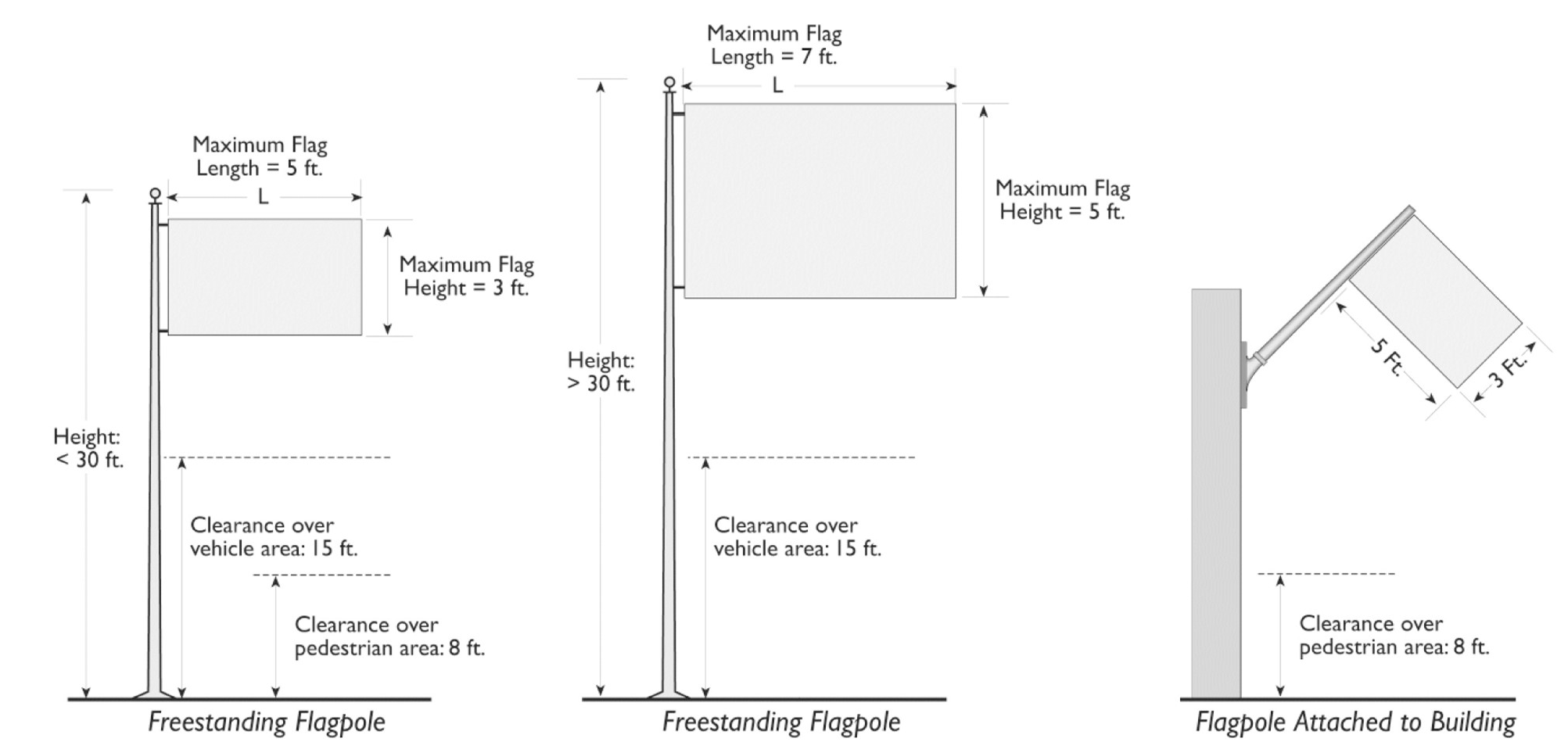
b.
Historical items. Historical plaques erected and maintained by the Town or historical agencies, memorials, building cornerstones, and date-constructed stones, provided that none of these exceed four square feet in area.
c.
Menu display boxes. Menu display boxes of up to three square feet. Menu display boxes may include an area used to communicate daily, weekly, or other specials.
d.
Merchandise. Merchandise incorporated as an integral part of an indoor window display, including photographic window display of real estate available for sale, lease, or rent from a licensed real estate broker.
e.
Residential nameplates. Residential nameplates of not more than two square feet, one per property, that have no commercial message or identification.
f.
Seasonal displays. Temporary, noncommercial decorations or displays associated with any national, local, or religious celebration.
g.
Signs on vehicles (including mobile businesses). Signs neatly and permanently affixed on a vehicle, one sign per vehicle side, and only identifying the name of a business, generic services, contact information, and location; provided, however, such vehicles shall not be used as parked or stationary outdoor display signs (i.e., Section 17.48.060(b)(11)). Such signage shall not be a banner, board, paper, or any temporary sign and shall not substantially project or deviate from the vehicle profile.
h.
Theater poster cases. Theaters may use glass-enclosed cases to display posters that advertise current or forthcoming programs. One poster case, not exceeding 16 square feet, is allowed for each movie screen or stage.
i.
Vehicle station fuel price signs. Vehicle station fuel price signs required by State law, one sign per station not to exceed 12 square feet or other size as required by State law. No information other than as required or allowed by local, State, or Federal law shall be displayed. These signs may utilize changeable copy. Vehicle station fuel price signs shall not be internally illuminated.
(Code 1990, § 17.48.040; Ord. No. 14-02, § 4, 3-19-2014)
17.48.050. - Master sign program.
(a)
Applicability. A master sign program approved by the Commission shall be required for any site with four or more businesses or tenant spaces, regardless of whether the tenant spaces are occupied. A master sign program may be requested by an applicant for a site with less than four businesses or tenant spaces but is not required. No sign permit shall be approved for a site with four or more businesses or tenant spaces unless and until the Commission has approved a master sign program for the subject site.
(b)
Application requirements. An application for a master sign program shall be made to the Department on a form provided for that purpose pursuant to Chapter 17.60. All required information identified on the form shall be provided by the applicant, together with the required fees. If the application includes a request for an exception to this chapter, consistent with Section 17.48.050(d), information shall be provided explaining why the exception is warranted and how the exception is consistent with the purpose and intent of this chapter. It is the responsibility of the applicant to establish evidence in support of the findings required by Section 17.48.050(e).
(c)
Timeline for decision; waiver of time. See Section 17.48.030(e).
(d)
Exceptions to this chapter. As part of a master sign program approval, the Commission may grant exceptions to the standards of this chapter for the maximum number and size of signs, based on site-specific conditions and design features, including architectural style, building mass, and site visibility to ensure that signs for a uniquely planned or designed development area are most appropriate for that particular development or area. A master sign program may also be more restrictive than this chapter.
(e)
Findings and decision. After a master sign program application is deemed complete, the Commission shall approve, conditionally approve, or deny a master sign program application. The Commission may approve a master sign program application, with or without conditions, only after the following findings are made:
(1)
The master sign program complies with the standards of this chapter and any applicable specific plan or master plan; or, if the master sign program does not comply with the standards of this chapter, the master sign program complies with the purpose and intent of this chapter;
(2)
The master sign program is in substantial compliance with the Town's design guidelines; and
(3)
The signs within the master sign program are visually related to each other and to the structure or developments they identify.
(f)
Post approval procedures. The procedures and requirements in Chapter 17.100 shall apply following a decision on a master sign program.
(g)
No expiration for master sign programs. A master sign program shall have no expiration date but may be revised consistent with Section 17.48.050(i).
(h)
Individual sign permits required. Individual sign permits are required for signs located within a site subject to an approved master sign program. All signs erected or maintained within a site subject to a master sign program shall conform at all times to the approved master sign program.
(i)
Revisions to master sign programs. Minor revisions to a master sign program may be approved by the Director if it is determined that the intent of the original approval, and any conditions attached thereto, are not affected. Major revisions to a master sign program shall be approved by the Commission.
(Code 1990, § 17.48.050; Ord. No. 14-02, § 4, 3-19-2014)
17.48.060. - Prohibited signs.
(a)
Types of prohibited signs. All signs not expressly allowed by this chapter shall be prohibited.
(b)
Examples of prohibited signs. Examples of prohibited signs include the following:
(1)
Abandoned signs;
(2)
Illegal signs;
(3)
Inflatable or tethered signs or devices;
(4)
Internally illuminated signs, except as allowed by this chapter;
(5)
Moving signs, including blinking, chasing, or flashing signs, except as allowed by this chapter, signs that emit a varying intensity of light or color, or signs that contain moving parts;
(6)
Home occupation signs;
(7)
Off-premises signs, except as allowed by this chapter;
(8)
Pole signs, including signs attached to utility poles or snow stakes;
(9)
Pricing signs, except vehicle station fuel price signs, menu display boxes, and drive-up menu boards as allowed by this chapter;
(10)
Roof signs;
(11)
Signs attached to or suspended from any vehicle, boat, mobilehome, snowmobile, or other movable object parked within or next to a Town or State right-of-way or in a location on private property that is visible from a Town or State right-of-way, except a sign painted directly upon, magnetically affixed to, or permanently affixed to the body or other integral part of the vehicle (i.e., Section 17.48.040(6)g);
(12)
Signs burned or cut into a tree, otherwise marked on a tree or otherwise affixed to a tree;
(13)
Signs that simulate in color, size, or design any traffic control sign or signal, or signs that make use of characters, symbols, or words in a manner that interferes with, misleads, or confuses pedestrian or vehicular traffic;
(14)
Signs with reflective surfaces, except for street and traffic signs or other signs for public safety;
(15)
Signs within a Town right-of-way, except as allowed by Section 17.48.080(2)d;
(16)
Statuary signs;
(17)
Temporary signs, except as allowed by this chapter;
(18)
Walking signs, including costumed characters or signs held or supported by human beings, except for noncommercial signs;
(19)
Banner signs, except as allowed by this chapter; and
(20)
Flutter flags.
(Code 1990, § 17.48.060; Ord. No. 14-02, § 4, 3-19-2014; Ord. No. 15-01, § 4(exh. A, § 10), 1-21-2015)
17.48.070. - Measurement of sign area and height.
(a)
Measurement of sign area. The measurement of sign area for the purpose of determining compliance with this chapter is defined below.
(1)
Surface area. The surface area of a sign shall be calculated by enclosing the extreme limits of all writing, logo, representation, emblem, or other display within a single continuous perimeter composed of squares or rectangles with no more than eight perimeter lines, or within a single circle. See Figure 17.48.070A.
(2)
Sign structure. Supporting structure, bracing, or framework that are determined by the Director to be clearly incidental to the sign display itself shall not be included in the calculation of total sign area.
(3)
Double-faced signs. The area of a double-faced sign shall be calculated for one face only if the two faces are back-to-back, parallel, and separated by no more than 24 inches, and the copy is identical on both faces.
(4)
Three-dimensional signs. The area of a sign consisting of one or more three-dimensional objects (e.g., balls, cubes, clusters of objects, or sculpture), shall be measured as their maximum projection upon a vertical plane. See Figure 17.48.070A.4.
Figure 17.48.070A
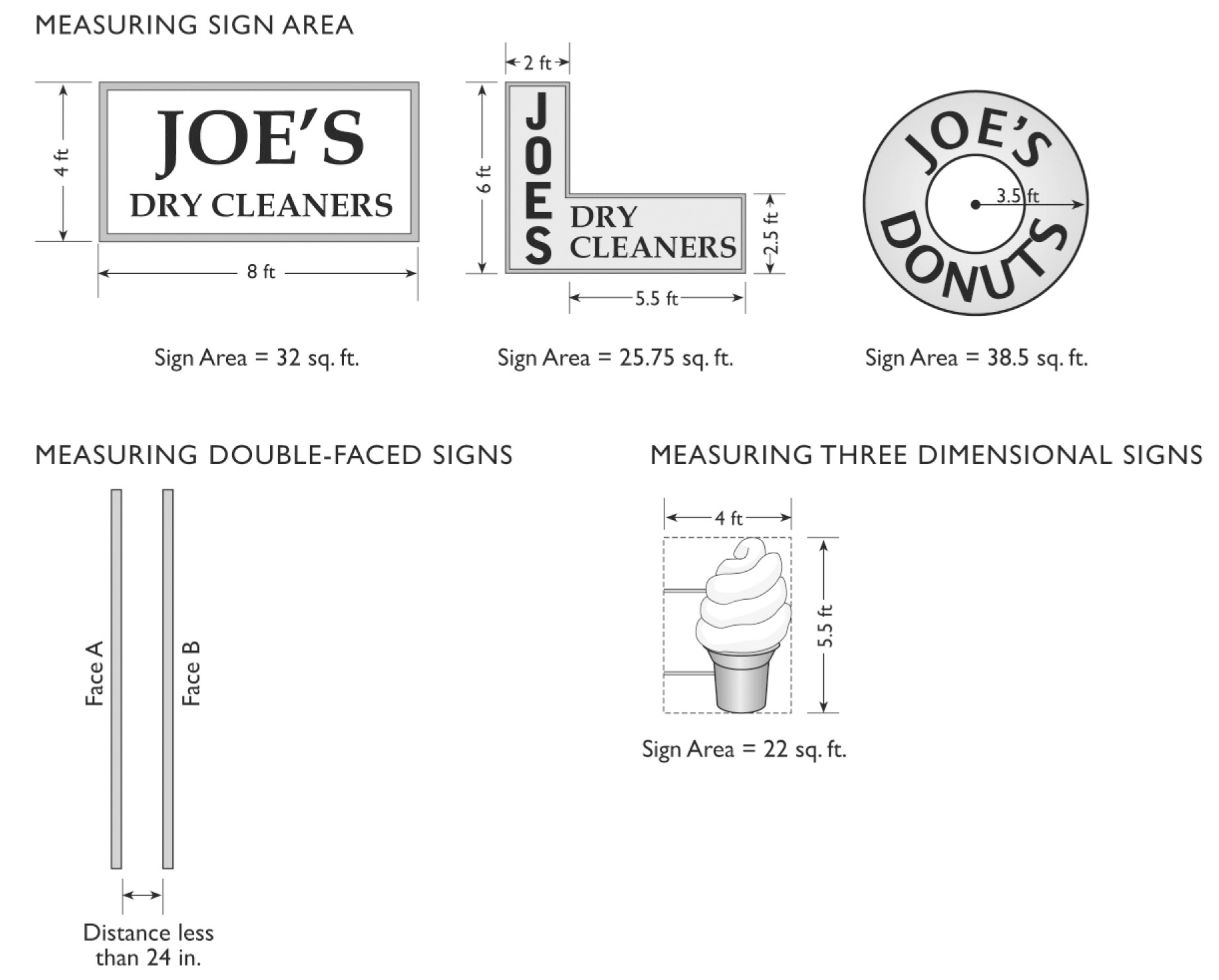
(b)
Measurement of sign height.
(1)
Sign height. Sign height shall be measured as the vertical distance from the lowest point of finished grade adjacent to the sign to the top of the highest attached component of the sign. See Figure 17.48.070B.
(2)
Signs in planters. The height of a sign located in a planter may be measured from the top of the planter, provided that the planter is no greater than 12 inches above finished grade as defined in Subsection (a) of this section.
(3)
Sign frame and lighting. Subject to the Director's approval, sign frame and lighting may exceed the height limit, provided such is a necessary structural design feature.
Figure 17.48.070B
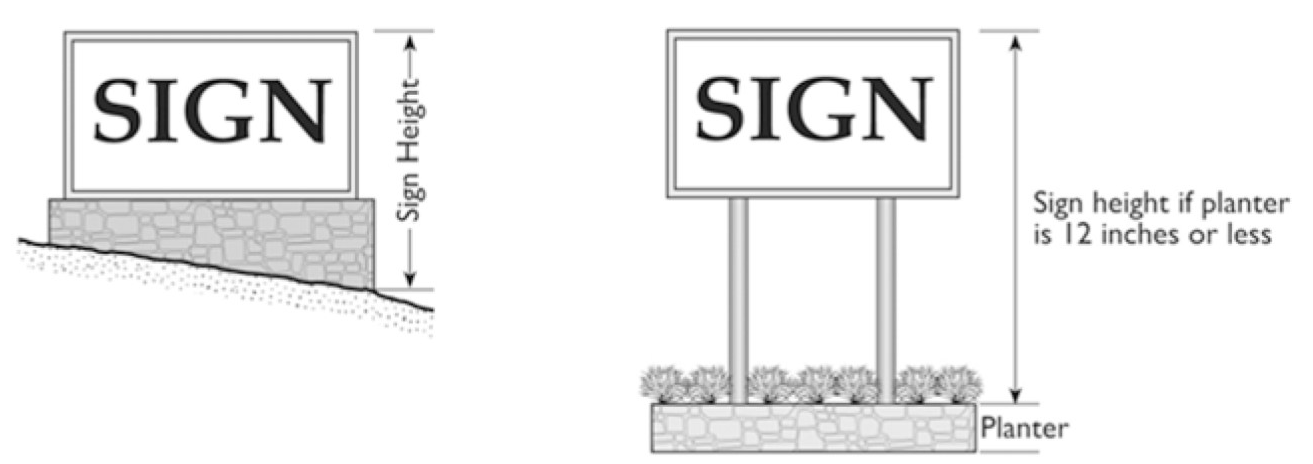
(Code 1990, § 17.48.070; Ord. No. 14-02, § 4, 3-19-2014)
17.48.080. - General requirements for all signs.
All signs shall be subject to the following requirements, whether or not the sign requires a permit:
(1)
Sign maintenance. The following maintenance standards shall be continually met for all signs:
a.
Each sign, including the supporting structure and hardware, shall be structurally sound, maintained in good repair, and functioning properly at all times. All signs shall be neatly placed and securely affixed. No sign shall constitute a hazard to safety, health, or public welfare.
b.
All signs shall be maintained as originally approved in a clean, neat, and undamaged condition.
c.
Maintenance of a sign shall include periodic cleaning, mending or replacement of any faded, peeled, cracked, rusted, or otherwise damaged or broken parts thereof, replacement of flickering, burned out, or broken light bulbs, and other actions as necessary to comply with the purpose of this chapter.
d.
When an existing sign is removed or replaced, all brackets, poles, and other supports that are no longer required shall be removed, and any newly exposed portions of a building or structure on which the sign is displayed shall be repaired and repainted as necessary to restore a uniform appearance to the building surface or structure.
e.
Signs which are not properly maintained and are dilapidated shall be deemed to be a public nuisance and may be abated in compliance with this Code.
(2)
Sign location.
a.
Each sign shall be located on the same site as the subject of the sign, except as otherwise allowed by this chapter.
b.
Signs shall be located on the business frontage, except as otherwise allowed by this chapter.
c.
Signs shall be allowed on sides of buildings or businesses not considered as businesses frontage (i.e., where no customer access is available) when the building wall fronts on a public street or faces a plaza, courtyard, pedestrian corridor or walkway, parking lot, or alley.
d.
No sign shall be placed on or project over public property or into a Town right-of-way, except for the following:
1.
Governmental signs, including bus stop signs, emergency warning signs, signs to direct or regulate pedestrian, bicycle or vehicular traffic, public notices, information signs, and wayfinding signs;
2.
Community event signs and community information signs, including across the street banners as approved by the Town or the State as required for the sign, and allowed by this chapter;
3.
A sign constructed by a public agency on its property, which is allowed by this chapter;
4.
A monument sign consistent with Section 17.48.090(8)e; and
5.
A portable sign consistent with Section 17.48.090(14)c.2.
e.
No sign shall be located in a manner that will impede or obstruct pedestrian, bicycle, or vehicular safety.
f.
No sign shall be placed so as to interfere with the operation of a door, fire escape, window, or other required exit.
g.
Signs located within 660 feet of either State Route 203 or U.S. Highway 395 shall comply with the Outdoor Advertising Act, Business and Professions Code § 5200 et seq. and regulations administered by CalTrans.
(3)
Sign area.
a.
The aggregate area of all signs displayed on a site shall not exceed total allowable sign area established by this subsection, unless such sign is specifically exempt from being counted towards total allowable sign area.
b.
The total square footage of allowable sign area for any business shall not exceed two square feet for each three linear feet of business frontage (i.e., linear feet of business frontage times two-thirds equals maximum allowable sign area in square feet).
c.
Where a business has two separate frontages, additional signage for the second frontage shall be allowed up to the amount otherwise allowed for the primary frontage alone. The second frontage may or may not include a customer access point to the building. Such additional signage may be allowed for corner units and businesses in a single building.
d.
Signs are subject to the size restrictions identified in Section 17.48.090. No sign shall exceed 30 square feet, except as specifically provided in this chapter.
e.
Any business not having the necessary frontage to permit at least 12 square feet of aggregate sign area shall, in any event, be permitted 12 square feet of aggregate sign area.
f.
The total allowable aggregate sign area may be increased by 20 percent if a sign and business frontage identified by the sign are located 140 feet or more from the centerline of the street on which they face; provided, however, that the increase shall only be applied to the sign located 140 feet or more from the centerline of the street on which they face. The increased aggregate sign area shall not increase the maximum sign sizes as allowed by this chapter or by a master sign program approved after the adoption of this chapter.
g.
The following signs shall not be counted towards the total allowable aggregate sign area or the total allowable number of signs; however, any sign that deviates from the limitations specified herein shall be counted toward the total allowable aggregate sign area:
1.
Signs not requiring a permit (Section 17.48.040);
2.
Across the street banners;
3.
Community event signs, including banners, directional, and informational signs for the event;
4.
Community information signs;
5.
Copy on an awning that does not exceed six inches in height and consistent with Section 17.48.090(1);
6.
Drive-up menu boards;
7.
Identification signs for multitenant centers that do not advertise any particular business or product;
8.
One pedestrian-oriented business identification sign per business (i.e., a hanging or projecting sign) of no greater than six square feet;
9.
Temporary banners as approved by the Town in compliance with this chapter; and
10.
Tenant directory signs of no more than 12 square feet with up to two-inch-high lettering displayed on the first floor.
(4)
Signs on structures.
a.
No sign shall be displayed above the second story of any building, except for multitenant property real estate signs consistent with Section 17.48.040(3)e.3.
b.
No sign shall extend above the top of the wall to which the sign is attached.
(5)
Sign lighting. Sign lighting shall be designed to minimize light and glare on surrounding Town and State rights-of-way and properties in compliance with Section 17.36.030 and the following standards:
a.
External light sources shall be directed and shielded to prevent glare and light trespass onto adjacent properties and Town or State rights-of-way.
b.
Signs with internal light sources (e.g., halo lit, neon, and other signs as allowed by this chapter) shall be designed to prevent glare and light trespass onto adjacent properties and Town or State rights-of-way.
c.
The light source (e.g., bulb) shall not be visible off-site, including Town or State rights-of-way, except for signs with neon tubing and electronic message signs as allowed by this chapter.
d.
Sign lighting shall not exceed that necessary for sign legibility and shall not be of an intensity or brightness that will create a visual nuisance.
e.
Sign illumination shall not blink, flash, flutter, or change light brightness, color, or intensity.
f.
Signs shall not use colored lights or other design elements that may be confused with or mistaken for traffic control devices.
g.
Neither the direct nor reflected light from primary light sources shall create hazards for pedestrians, bicyclists, or operators of motor vehicles.
h.
Light sources shall utilize energy-efficient fixtures to the greatest extent feasible.
i.
All light fixtures, conduit, and shielding shall be painted in flat dark colors, or painted to match either the building or supporting structure that serves as the background of the sign.
j.
Where Section 17.36.030 conflicts with this Chapter 17.48, Chapter 17.48 will take precedence.
(6)
Sign materials and design.
a.
Materials. Sign materials shall be durable and capable of withstanding snow, wind, and weathering over the life of the sign with reasonable maintenance. The use of natural materials and materials made to resemble natural materials are encouraged.
b.
Compatibility. All signs shall be compatible with the theme, visual quality, and overall character of the surrounding area, and appropriately related in size, shape, materials, and character to the function and architectural character of the building or premises on which they will be displayed. In assessing compatibility, sign style, color, material, lighting, support elements, and the buildings, structures, and premises on which they are displayed, shall be considered.
c.
Design.
1.
Signs should express individuality, be thoughtfully designed, unique, and creative, especially in nonresidential and non-industrial zones.
2.
Permanent signs should include three-dimensional elements or some sort of relief. Flat signs without any relief should not be allowed for permanent signs in nonresidential and non-industrial zones. This requirement shall not apply to temporary signs.
d.
Sites with less than four businesses or tenant spaces. master sign programs are not required for sites with less than four businesses or tenant spaces; however, signs on these sites shall not compete against each other for attention in a manner taking advantage of extreme, disharmonious, or clashing colors, shapes, locations, or materials.
(Code 1990, § 17.48.080; Ord. No. 14-02, § 4, 3-19-2014)
17.48.090. - Standards for specific types of signs.
Proposed signs shall comply with the following standards applicable to the specific sign type. Each sign shall also comply with Sections 17.48.080 and 17.48.100, and all other applicable provisions of this chapter. Each sign shall be included in the calculation of the total allowable aggregate sign area and the total allowable number of signs except for those signs identified in Section 17.48.080(3)g. Sign permits are required for all signs except for those identified in Section 17.48.040. Any noncommercial message may be substituted for the copy on any commercial sign allowed by this chapter.
(1)
Awnings.
a.
Signs on awnings are limited to ground level businesses only. The minimum clearance between the lowest point of an awning and the grade immediately below shall be eight feet.
b.
Copy on an awning shall not exceed 50 percent of linear awning frontage or 30 square feet, whichever is less.
c.
Translucent awning materials are prohibited.
d.
No duplication of wording shall be permitted on an awning.
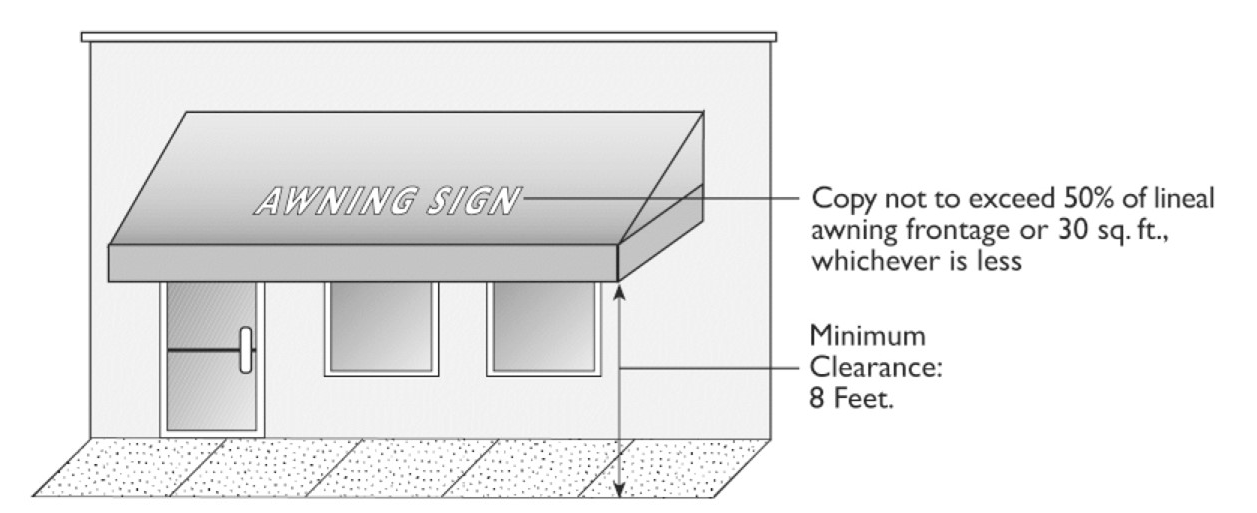
(2)
Changeable copy signs. A changeable copy sign shall be allowed for businesses and uses that communicate changing messages such as theaters and vehicle station fuel price signs. Such a sign shall be subject to the limits for the physical type of sign it is (e.g., wall sign); however, it shall not be internally illuminated.
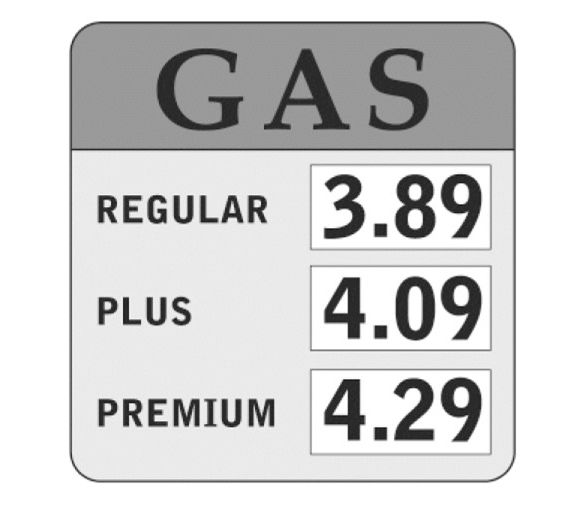
(3)
Decorative banners and flags. Decorative banners and flags shall only be allowed if approved by a master sign program under Section 17.48.050. Decorative banners and flags shall not contain or display any commercial or advertising copy.
(4)
Drive-up menu boards. Menu boards of drive-through businesses may either be internally or externally illuminated. Lighting and electrical components shall be such that menu boards are not readily readable or audible from adjacent properties or from Town or State rights-of-way.
(5)
Electronic message signs.
a.
Electronic message signs shall be located only in the public and quasi-public zone.
b.
Electronic message signs shall not flash, blink, flutter, include chasing lights, or display video messages (i.e., any illumination or message that is in motion or appears to be in motion). Electronic messages signs may display changing messages; however, each message shall be displayed for no less than four seconds.
c.
One electronic message sign may be allowed per property.
d.
Electronic message signs shall be limited to a brightness level of 0.3 footcandles above ambient light and shall incorporate automatic dimming technology to consistently maintain the required light levels.
e.
Electronic message signs shall include well-designed opaque roof features to keep light from shining up. Signs and roof features shall be consistent with Section 17.48.090(6).
f.
A design review permit and Commission approval shall be required for approval of an electronic message sign.
(6)
Halo lit signs. Halo lighting shall be allowed on hanging, monument, projecting, theater, and wall signs only and shall be subject to the maximum size area and the maximum number allowed for each specific sign type, as specified in Section 17.48.090 and Table 17.48.100(b). Halo-lit signs are not allowed in any residential zone.

(7)
Hanging signs. Hanging signs are limited to ground level businesses only, located on business frontages with customer access. The minimum clearance between the lowest point of a sign and the grade immediately below shall be eight feet.
a.
No hanging sign shall extend more than six feet from a building wall.
b.
Hanging signs shall not be larger than eight square feet.
c.
Sign supports shall be well-designed and compatible with the design of the sign.
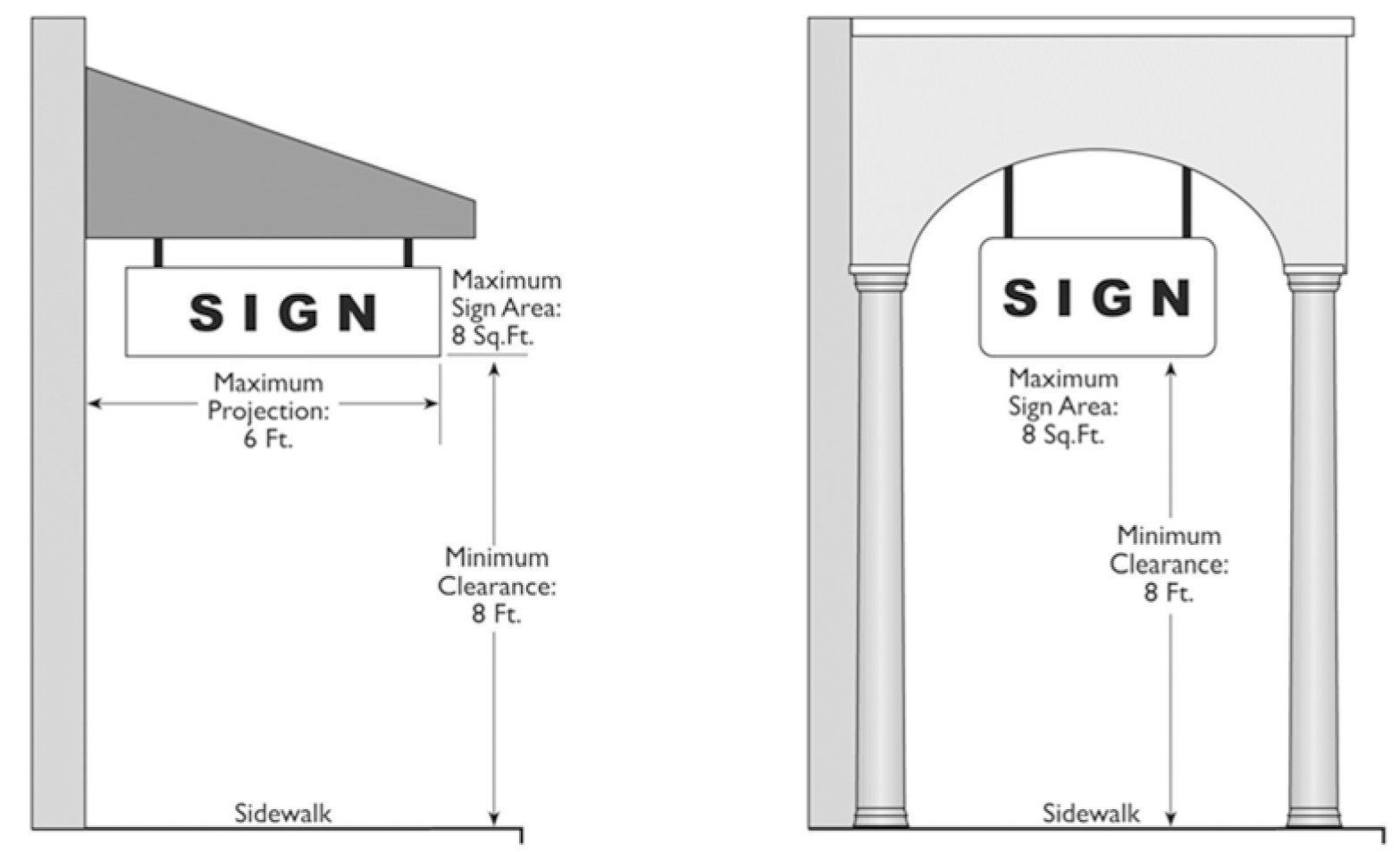
(8)
Monument signs.
a.
Number. Generally, one monument sign is allowed per business, property, or multitenant center. However, more than one monument sign may be permitted if reasonable identification cannot otherwise be achieved, such as properties where access points are separated by long distances or corner properties with access points on two separate streets.
b.
Separation. Multiple monument signs shall be separated by a minimum of 75 feet to ensure adequate visibility for all signs. The Director may modify this requirement where the locations of existing signs on adjacent properties would make the 75-foot separation impractical.
c.
Height. A monument sign shall not exceed eight feet in height except as follows:
1.
Signs along Main Street and Lake Mary Road shall not exceed 12 feet in height.
2.
Sign structures may extend 12 inches above the allowable height for the purposes of sign structure enhancement or embellishment. See Figure 17.48.090(8).
3.
In locations where snow removal equipment cannot access the sign area, sign height may be increased subject to the Director's approval; however, no sign shall exceed 16 feet in height.
4.
In locations where the base of a sign is five feet or more below the centerline of the street on which the sign faces, sign height may be increased subject to the Director's approval; however, no sign shall exceed 16 feet in height.
d.
Setback. Generally, there shall be a minimum five-foot setback from a Town or State right-of-way to any monument sign. A smaller setback may be approved by the Town to meet the intent of this chapter (Section 17.48.010).
e.
Encroachment. Monument signs may encroach into a 200-foot or greater two-lane right-of-way when the sign will not be closer than 20 feet from the pavement in such right-of-way, the primary access for the subject use is off such right-of-way, and an encroachment permit is obtained from the Public Works Director or the State, as required for the sign.
f.
Durable materials. Monument signs adjacent to Town or State rights-of-way shall be constructed of highly durable materials and designed to withstand the impacts of snow removal operations; materials such as high density polyurethane shall not be allowed unless the sign design is approved by the Public Works Director.
g.
Sign base. A rock base or similar architectural design is required for the frame and base of all monument signs. The base shall have an aggregate width of at least 40 percent of the width of the sign face. See Figure 17.48.090(8)g. The Director may approve a reduction in the width of the sign base if the sign is otherwise consistent with this chapter.
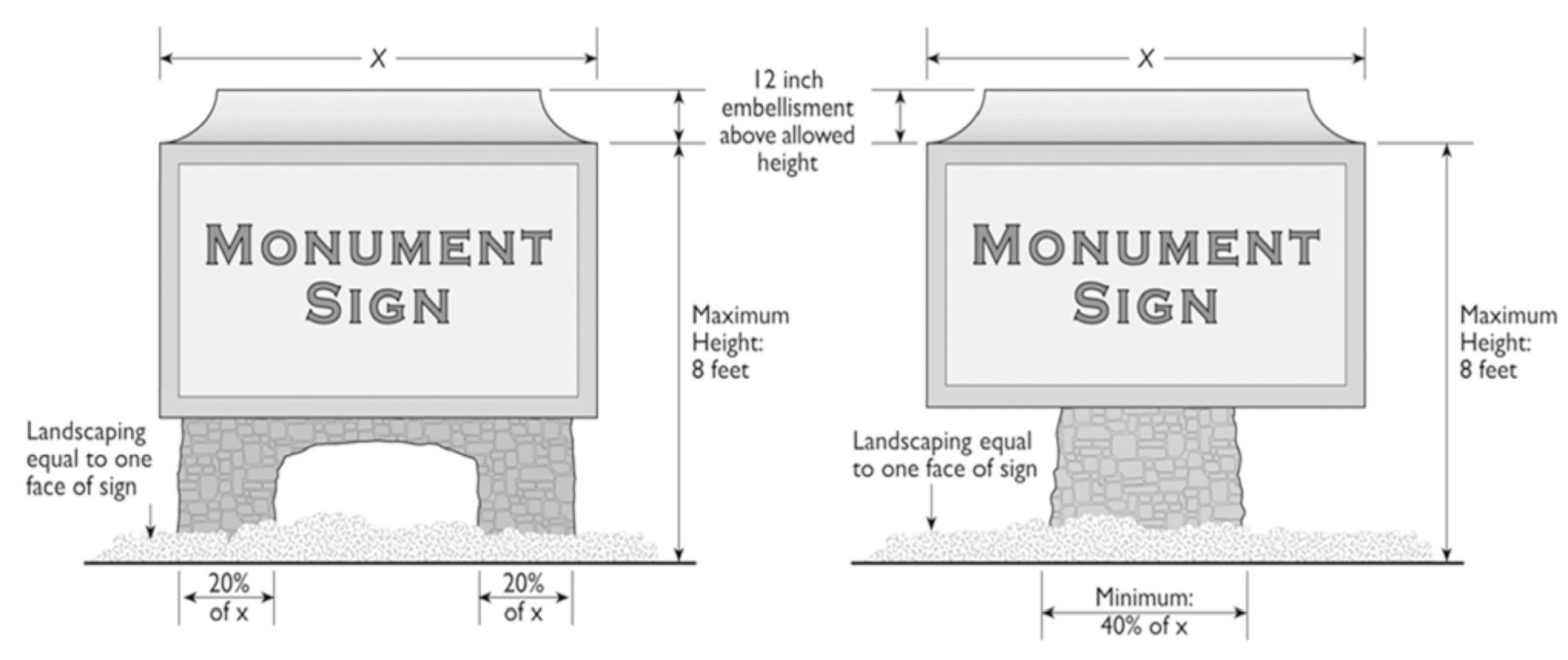
h.
Landscaped area. Landscaping shall be provided at the base of the supporting structure equal to the area of one face of the sign; for example, a 30 square foot sign shall require 30 square feet of landscaped area. The Director may modify this requirement if necessary to avoid creating or increasing a parking nonconformity or safety hazard.
i.
Signs for more than one business. Monument signs identifying more than one business shall be designed as one sign.
j.
Building permits. For monument signs that are less than four feet in height and do not include any electrical work, no building permit shall be required.
(9)
Neon signs. Neon "open" and "vacancy/no vacancy" signs are allowed in compliance with Section 17.48.040(2)c and d and are not subject to the requirements of this subsection. The use of neon on other types of signs shall be subject to the following requirements:
a.
Neon shall only be used for sign details that are intended to provide accessory graphics and artistic elements to a sign (e.g., a sign's copy, background, or border shall not be composed entirely of neon tubing).
b.
No more than one sign with neon details shall be allowed per business and shall not be located in any residential zone.
c.
Neon elements shall not be permitted on any monument sign or any sign larger than 20 square feet.
d.
Signs with neon details shall incorporate dimming capabilities to the extent feasible (e.g., technologies such as flexible light-emitting diode (LED) neon are capable of being dimmed).
(10)
Projecting signs.
a.
Projecting signs are limited to ground level businesses only, located on business frontages with customer access. The minimum clearance between the lowest point of a sign and the grade immediately below shall be eight feet.
b.
No projecting sign shall extend more than six feet from a building wall.
c.
Projecting signs shall not be larger than 12 square feet and shall be double-sided.
d.
Sign supports shall be well-designed and compatible with the design of the sign.
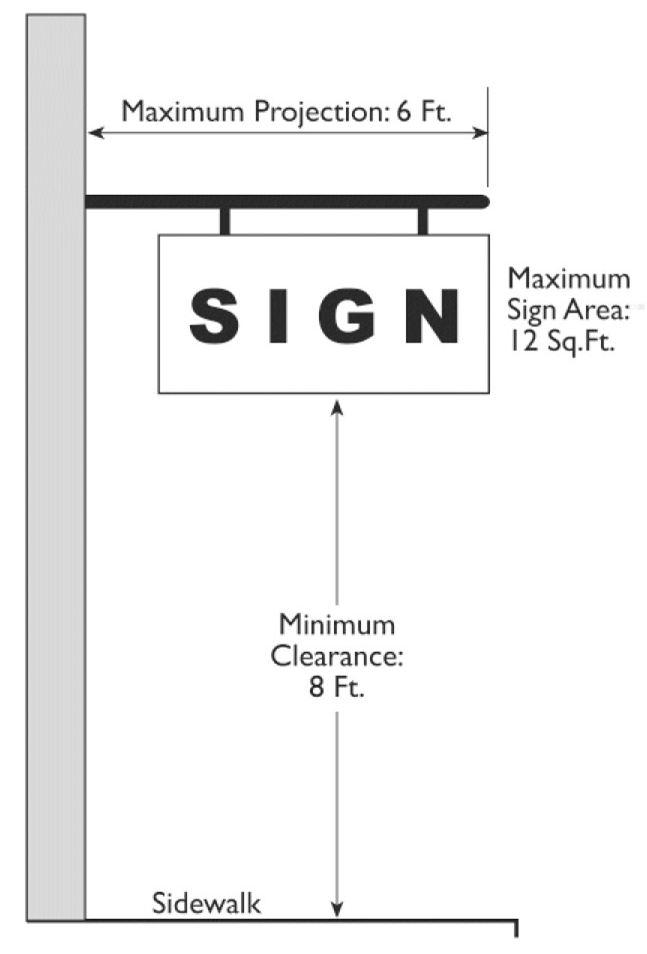
(11)
Theater signs. Subject to the review and approval of the Director, a theater sign may exceed 30 square feet as necessary to adequately display current or coming programs to the public. Theater signs may utilize changeable copy. Any theater sign greater than 30 square feet shall not utilize an electronic message sign or be internally illuminated.
(12)
Wall signs.
a.
A wall sign shall not project more than six inches from the surface to which it is attached.
b.
Wall signs on multitenant buildings shall have a minimum four-foot horizontal separation. The Director may approve deviation from this requirement where unusual building design or configuration conditions prevent a reasonably visible sign opportunity.
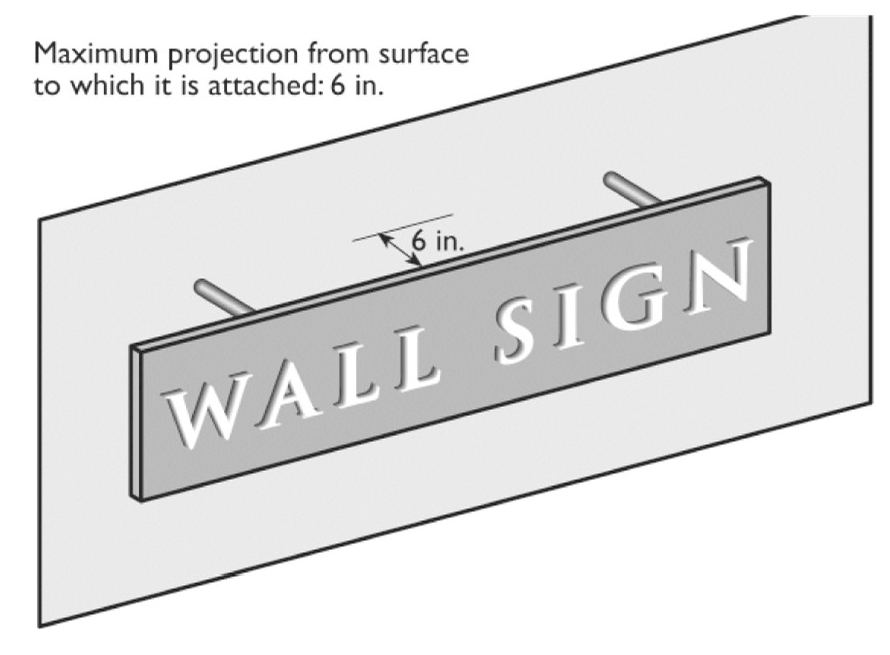
(13)
Window signs (permanent and temporary).
a.
Placement. Permanent and temporary window signs shall be allowed only on windows located on the ground level and second story of a business frontage.
b.
Size. Permanent and temporary window signs shall not occupy more than 25 percent of the total window area. No temporary window sign shall exceed six square feet.
c.
Number. There shall be no more than four window signs per business, including permanent and temporary window signs. Only two window signs may be temporary.
d.
Application. Permanent window signs shall be permanently painted, mounted, or applied directly to the inside of the glass (i.e., windows or doors). Permanent and temporary window signs shall be no more than one inch thick.
e.
Duration of display for temporary signs. Temporary window signs displayed for up to 15 days not more than once per calendar quarter do not require a permit; temporary window signs displayed for a longer or more frequent period or periods, up to a maximum of 30 consecutive days, require a sign permit.
f.
Modifications. The Director may authorize modifications to these provisions to allow for additional window signage, number of window signs, or other similar modifications through an administrative permit.
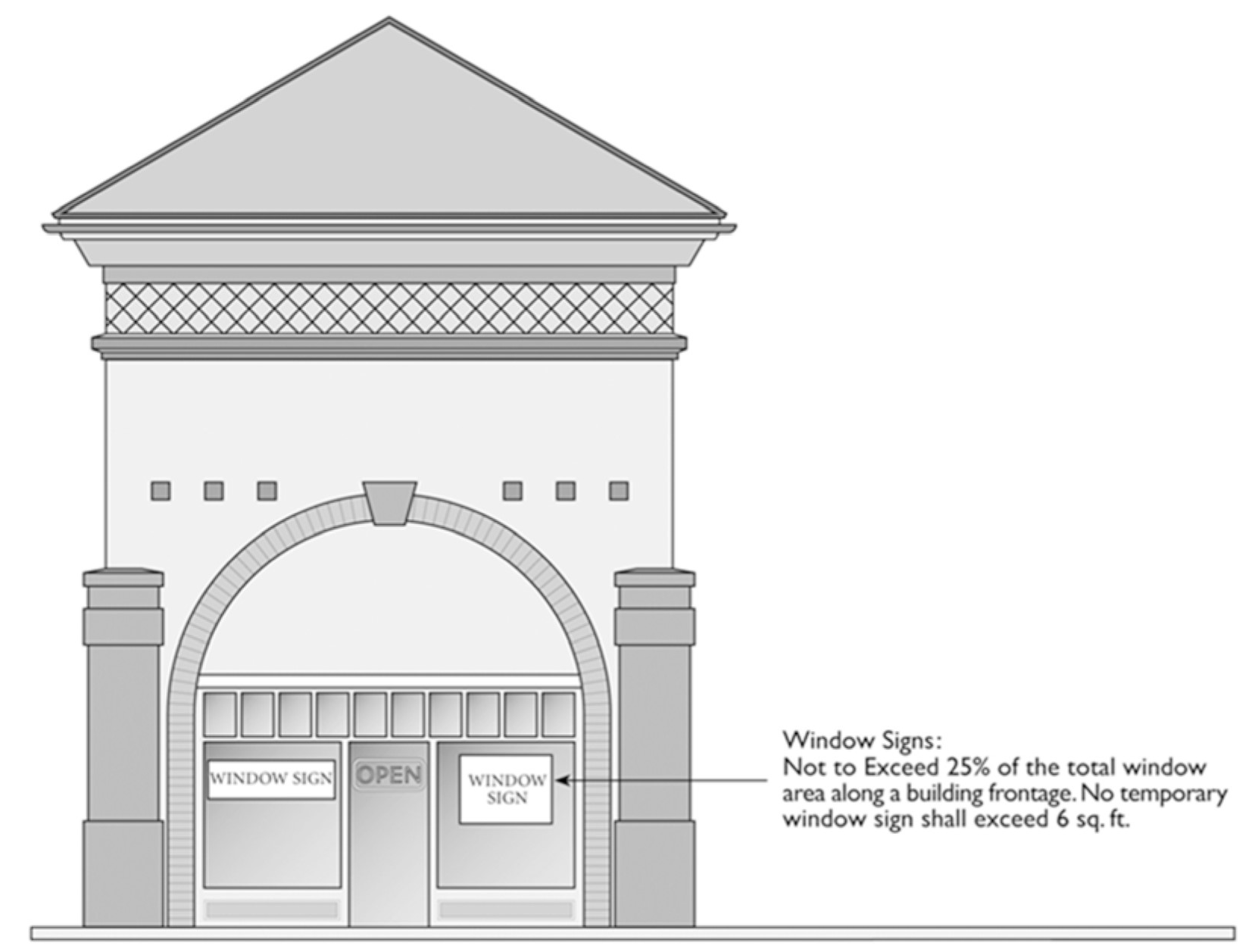
(14)
Temporary signs. Except as allowed by this chapter, temporary signs are prohibited. Temporary signs shall not be illuminated unless approved by the Town for public safety. The application for temporary sign permits shall include the dates proposed by the applicant for use or display of the sign. See Table 17.48.090(N) for a summary of standards and permit requirements for temporary signs.
a.
Banners.
1.
Size. Banners shall not exceed 20 square feet except as otherwise provided in this subsection.
2.
Design. A banner shall not be overly bright, distracting, or disharmonious with the building to or property on which it is displayed.
3.
Deposit. A deposit may be required by the Director for a temporary sign permit for a banner. The deposit may be revoked if the temporary banner is not removed within two days following the end of the approved duration of display.
4.
Grand opening banners. Grand opening banners for newly established businesses may be allowed for a period of no longer than 30 consecutive days.
5.
Across the street banners.
(i)
Banners shall be associated with a civic, community, educational, or cultural event and shall contain no commercial or advertising copy.
(ii)
Banners shall be approved by the State or Town through an encroachment permit or other necessary permits.
(iii)
Across the street banners shall be limited to Main Street/State Route 203, Old Mammoth Road commercial district, and the following street segments in the North Village Specific Plan: Minaret Road north of Main Street and south of Forest Trail, Canyon Boulevard, and Lake Mary Road.
(iv)
Banners shall be displayed for a period of no less than seven days and no more than 21 days.
(v)
Banners shall be installed in an approved location by the State or Town.
(vi)
Banners shall be the minimum size necessary to accomplish the intended use and may exceed 30 square feet if approved by the Director.
(vii)
The Town may charge a reasonable fee to cover the cost of installing and removing the banner, as determined by resolution of the Council.
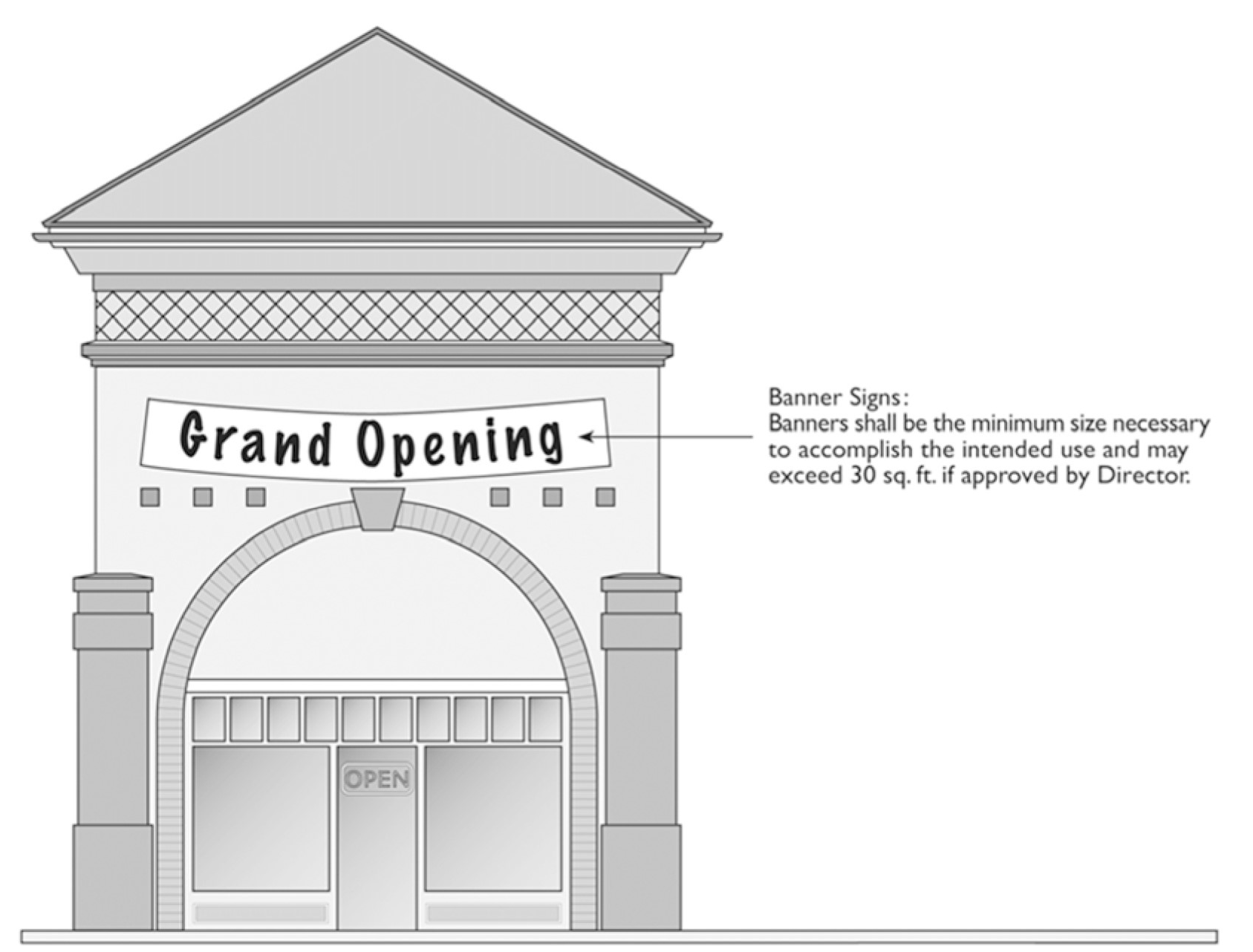
b.
Community event signs.
1.
Community event signs shall not be subject to sign permit fees.
2.
Signs may be permitted off-site subject to the approval of the Director and the owner of the property on which the sign would be located. Signs may be permitted within the Town or State right-of-way consistent with Section 17.48.080(2)d.2.
3.
Signs may be larger than 30 square feet, subject to the Director's approval.
4.
Signs may include temporary portable informational and directional signs, banners, or other types of signs as approved by the Director.
c.
Portable signs. The use of small portable signs is allowed within all zoning districts with the exception of the OMR and D Districts, subject to the following requirements.
1.
One portable sign may be allowed on-site in addition to all other permanent signs allowed for the business or activity.
2.
Five additional off-site portable signs for a given business or activity may be located within the Town right-of-way subject to approval of an encroachment permit by the Director and Town Engineer, provided they do not interfere with vehicular or pedestrian movement or wheelchair access to, through, and around the site on which the sign is located. A minimum access width of six feet shall be maintained along all sidewalks and building entrances accessible to the public. The Town Engineer may require additional minimum access width for high-use pedestrian areas.
3.
Portable signs shall not be located within the State's right-of-way, except where permitted under State law. Signs within 660 feet of a State highway shall comply with the Outdoor Advertising Act, Business and Professions Code § 5200 et seq.
4.
Portable signs shall not encroach into required parking areas, shall not obstruct pedestrian traffic, and shall not create traffic hazards.
5.
There shall be at least 50 feet between portable signs.
6.
Portable signs are limited to six square feet per side and shall be no taller than four feet.
7.
Portable signs are only allowed on Thursdays, Fridays, Saturdays, Sundays, and Federal or State holidays, between 8:00 a.m. and dusk, for no more than ten hours per day. However, in no case shall a portable sign be displayed during non-business hours.
8.
Portable signs located on-site shall be counted towards the maximum cumulative display periods and total sign area allowed for temporary signs.
9.
All businesses with portable signs shall indemnify and hold harmless the Town from any action or expense that may occur as a result of a portable sign being located on any sidewalk or Town right-of-way, satisfactory to the Town Attorney. Portable signs for any business that fails to indemnify the Town shall be deemed illegal, nonconforming, and shall be removed.
10.
Portable signs shall be constructed of durable, weather-resistant materials, and shall be professional in appearance at all times.
11.
A sign permit is not required for a portable sign that is consistent with the requirements of this subsection, unless the sign would be located within the Town's right-of-way as allowed by Subsection (b) of this section.
12.
Signs shall be maintained in compliance with Section 17.48.080(1).
d.
Real estate development signs.
1.
One real estate development sign shall be allowed for each development site.
2.
A real estate development sign shall be removed at or before expiration of the entitlement permits for the site (e.g., use permit, tentative map, etc.). However, if a building permit is issued for the site, the real estate development sign may remain and shall be treated as a site construction sign.
e.
Site construction signs.
1.
One site construction sign shall be allowed for each development site.
2.
A site construction sign may be displayed after the issuance of a building permit for the site and shall be removed at or before final building inspection or the issuance of a Certificate of Occupancy. If the building permit expires, the sign shall be immediately removed.
Table 17.48.090(N). Standards For Temporary Signs
Notes:
1. See this section and Section 17.48.040.
2. No business shall have more than one banner sign displayed at any one time (Subsection (1) of this section).
3. Additional signage may be allowed for the second frontage consistent with Section 17.48.080(3)c.
4. Permanent and temporary window signs shall not exceed 25 percent of window area without the approval of an administrative permit (Section 17.48.090(14)b).
(Code 1990, § 17.48.090; Ord. No. 14-02, § 4, 3-19-2014; Ord. No. 15-01, § 4(exh. A, § 11), 1-21-2015; Ord. No. 18-03, § 4(exh. B, a.), 6-20-2018)
17.48.100. - Sign standards by zoning district.
In addition to the standards in this section, each sign shall also comply with Section 17.48.080, Section 17.48.090, and all other applicable provisions of this chapter. Temporary signs are addressed in Table 17.48.090(N).
(1)
Residential zones. Each sign in a residential zone shall comply with the following requirements contained in Table 17.48.100(A).
Table 17.48.100(A). Sign Standards for Residential Zones
Notes:
1 Additional signage may be allowed for the second frontage consistent with Section 17.48.080(3)c.
2 More than one monument sign may be allowed consistent with Section 17.48.090(8)a.
3 Additional monument sign height may be allowed consistent with Section 17.48.090(8)c.
(2)
Nonresidential zones. Each sign in nonresidential zones shall comply with the following requirements contained in Table 17.48.100(b):
Table 17.48.100(B). Sign Standards for Nonresidential Zones
Notes:
1 See Sections 17.48.090 and 17.48.040.
2 Copy on an awning that does not exceed six inches in height and consistent with Section 17.48.090(1) is not counted towards total allowable sign area or number.
3 Additional signage may be allowed for the second frontage consistent with Section 17.48.080(3)c.
4 More than one monument sign may be allowed consistent with Section 17.48.090(8).
5 Signs shall be allowed on sides of buildings or businesses not considered as business frontage consistent with Section 17.48.080(2)c.
6 Additional monument sign height may be allowed consistent with Section 17.48.090(8)c.
7 Signs count towards the maximum number of signs allowed.
(3)
Airport Zone. All signs in the airport zone shall conform to the airport layout plan and Federal Aviation Administration requirements, as well as this chapter.
(Code 1990, § 17.48.100; Ord. No. 14-02, § 4, 3-19-2014; Ord. No. 15-01, § 4(exh. A, § 12), 1-21-2015; Ord. No. 18-03, § 4(exh. B, b.), 6-20-2018)
17.48.110. - Sign variances and adjustments.
(a)
Variance. A variance shall be processed in compliance with Chapter 17.72.
(b)
Adjustment. An adjustment may allow for an increase of not more than ten percent of the allowed height or area of a sign. Adjustments to the sign height or area provisions of this chapter shall be processed in compliance with Chapter 17.76.
(c)
Master sign program exceptions. A master sign program exception in compliance with Section 17.48.050(d) shall not require a variance or an adjustment.
(d)
Additional finding. In addition to the findings required by Chapter 17.72 or Chapter 17.76, a finding shall also be made prior to approval of a sign variance or adjustment that the sign meets the purpose and intent of this chapter and any applicable master sign program.
(Code 1990, § 17.48.110; Ord. No. 14-02, § 4, 3-19-2014)
17.48.120. - Nonconforming signs.
(a)
Applicability. The provisions of this section apply to any permanent or temporary sign, including its physical structure or its supporting elements, which was lawfully erected and maintained in compliance with the provisions of all applicable laws in effect at the time of original installation, but which does not now comply with the provisions of this chapter.
(b)
Allowed modifications to nonconforming signs.
(1)
Except as otherwise provided herein, a nonconforming sign may be continued and shall be maintained in good condition as required by this chapter.
(2)
Sign copy and face changes, non-structural modifications, and non-structural maintenance (e.g., painting and rust removal) are allowed so long as there is no alteration to the physical structure or support elements of the sign. Changes to sign copy and face require a sign permit.
(3)
A nonconforming sign may be restored if 50 percent or less of the sign is destroyed, provided that restoration is started within 90 days of the damage occurring and is diligently pursued to completion.
(c)
Prohibited modifications to nonconforming signs. A nonconforming sign shall not be:
(1)
Changed to another nonconforming sign;
(2)
Structurally altered to extend its useful life;
(3)
Altered unless required by law or unless the alteration results in the elimination of the nonconformity;
(4)
Enlarged;
(5)
Moved or replaced; or
(6)
Re-installed after facade improvements that required the removal of the sign during construction.
(d)
Exception. The Commission may grant an exception to the requirements of Subsection (c) of this section only after the following findings are made:
(1)
The new proposed sign or alteration to the existing nonconforming sign is significantly more conforming to the provisions of this chapter than the existing nonconforming sign; or
(2)
The nonconforming sign has historic significance apart from its main purpose of advertising, in which case a use permit shall be required for continued use of the nonconforming sign in compliance with Chapter 17.68.
(e)
Abandoned nonconforming signs. An interruption in the use of a nonconforming sign for a period of 90 days or more shall be deemed to be an abandonment of the sign consistent with and subject to Section 17.48.130.
(f)
Amortization of nonconforming signs and inventory. All nonconforming signs shall have a useful and legal life of 15 years, after which they may be removed in compliance with the requirements of the State Business and Professions Code. As often as may be desirable, but no less frequently than required by State law, the Director shall authorize an identification and inventory of all illegal and abandoned signs within the Town in accordance with the requirements of State law.
(g)
Removal or modification of nonconforming signs to comply with this chapter. A nonconforming sign shall be removed or modified to comply with this chapter if the following occurs:
(1)
More than 50 percent of the sign is destroyed, and the destruction is other than facial copy replacement. A nonconforming sign shall be deemed to be more than 50 percent destroyed if the estimated cost of reconstruction or repair exceeds 50 percent of the replacement cost as determined by the Director. Destruction may be voluntary or required by law;
(2)
The sign is remodeled or altered in a manner not in compliance with this chapter;
(3)
A structural change is made to the sign or sign structure or support elements;
(4)
The sign is temporary;
(5)
The sign is moved or relocated, except where the relocation occurs as a result of a Town public improvement project;
(6)
The sign is or may become a danger to the public or is unsafe; or
(7)
The sign constitutes a traffic hazard not created by the relocation of streets or by acts of the Town.
(h)
Special topographic circumstances. The Town shall not require the removal of any nonconforming sign on the basis of its height or size by requiring conformance with this chapter if special topographic circumstances would result in a material impairment of visibility of the sign or the owner's or user's ability to adequately and effectively continue to communicate with the public through the use of the sign. Special topographic circumstances include, but are not limited to, terrain, contours, off-site structures, streets, and other off-site impediments as determined by the Director. Under these circumstances, the owner or user may maintain the sign, including change of copy, at the business premises and at a location necessary for continued public visibility at the height or size at which the sign was previously erected consistent with Business and Professions Code § 5499.
(Code 1990, § 17.48.120; Ord. No. 14-02, § 4, 3-19-2014)
17.48.130. - Abandoned signs.
(a)
Any sign, including the structural support, which was lawfully erected shall be removed by the owner or lessee of the premises upon which the sign is located, when for a period of 90 days or more, the activity, product, business, service, or other use which is being advertised or identified has ceased, the premises has been vacated, or the sign is no longer displayed on the sign structure.
(b)
If the owner or lessee fails to remove the sign, including the structural support, pursuant to Subsection (a) of this section, the Director shall give the owner 30 days' written notice to comply. Upon failure to comply with the notice, the Director may have the sign removed at the owner's expense consistent with Business and Professions Code § 5497.b.
(Code 1990, § 17.48.130; Ord. No. 14-02, § 4, 3-19-2014)
17.48.140. - Public nuisance, violation, and abatement.
A sign that fails to comply with the requirements of this chapter, other applicable State statutes, or Town ordinances, or for which a sign permit has not been obtained in compliance with this chapter, shall be declared a public nuisance and subject to abatement consistent with Chapter 17.128.
(Code 1990, § 17.48.140; Ord. No. 14-02, § 4, 3-19-2014)
17.48.150. - Signs illegally erected on public property or right-of-way; violation, removal, costs.
(a)
Except as otherwise provided in this chapter, no person shall paint, mark, or write on; post or otherwise affix or erect; or construct, maintain, paste, nail, tack or otherwise fasten or affix any sign, including temporary signs, in the public right-of-way or on any sidewalk, crosswalk, curb, street, lamp post, pole, bench, hydrant, tree, shrub, bridge, electric light pole, power pole, or telephone wire pole, or any wire appurtenance thereof, or upon any street sign or traffic sign, or upon any other object located within the public right-of-way which is not maintained for the purpose of communications by signs of the general public.
(b)
Temporary signs posted or erected in the public right-of-way may be summarily removed. Removed signs shall be taken to the corporation yard. After removal of any sign pursuant to this subsection, the Town shall attempt to notify the owner of the sign or other responsible party, if such can be ascertained, if the employee believes in good faith that the sign has monetary value. In cases where a sign contains the name of a printing firm, the employee shall also attempt to notify such firm of the fact that the sign has been removed, the location of the sign, the procedure for retrieving the sign, and the procedure for challenging the removal of the sign. Any person desiring to retrieve a sign may do so upon the payment of all amounts due under this section. Any temporary sign removed by the Town may be considered abandoned if it is not retrieved within ten calendar days after the date of such removal and may be disposed of by the Town without liability to any person.
(c)
The cost of the removal of any sign pursuant to this section shall be borne by the actual responsible party. The cost of removal shall be the actual cost or the standard sign-removal cost set by resolution of the Council. For purposes of this section, any information that appears on a sign that is removed may be used to establish that the person or venue listed on the sign is the actual responsible party, including, but not limited to, information identifying the real estate broker, real estate brokerage firm, real estate agent, or other person associated with the firm; the owner or lessee of property used for a commercial activity or event; or the sponsor or promoter of a sporting event, concert, theatrical performance, or similar activity or event.
(d)
Violations of this section may be prosecuted or addressed through any process or procedure established or allowed by this chapter or applicable law.
(Code 1990, § 17.48.150; Ord. No. 14-02, § 4, 3-19-2014)
17.52.010. - Purpose.
This chapter provides site planning, development, or operating standards for certain land uses that are allowed in several or all zones, and for activities that require special standards to ensure their compatibility with site features and existing uses and structures in the site vicinity.
(Code 1990, § 17.52.010; Ord. No. 14-02, § 4, 3-19-2014)
17.52.020. - Applicability.
The land uses and activities covered by this chapter shall comply with the provisions applicable to the specific use, in addition to all other applicable provisions of this chapter.
(1)
Where allowed. The uses that are subject to the standards in this chapter shall be located only where allowed and in compliance with Chapters 17.16 through 17.32.
(2)
Planning permits required. The uses that are subject to the standards in this chapter are allowed only when authorized by the planning permit required by Chapters 17.16 through 17.32, except where a planning permit requirement is established by this chapter for a specific use.
(3)
Development standards. The standards for specific uses in this chapter supplement and are required in addition to those in Chapters 17.16 through 17.32 and Chapters 17.36 through 17.56. In the event of any conflict between the requirements of this chapter and those of Chapters 17.16 through 17.32 or Chapters 17.16 through 17.32, the requirements of this chapter shall control.
(Code 1990, § 17.52.020; Ord. No. 14-02, § 4, 3-19-2014)
17.52.030. - Accessory uses and structures—General standards.
(a)
Applicability. An accessory use or structure shall be allowed only in conjunction with a main use to which it relates. Accessory uses and structures shall be incidental to and not alter the character of the site from that created by the main use.
(b)
Development standards. Accessory uses and structures shall be subject to the same regulations as the main use or structure in any zoning district, except as otherwise specified in this chapter.
(c)
Timing of establishment of accessory use or structure. An accessory use or structure shall only be established at the same time as a main use or structure, or after the main use has been established.
(d)
Compatibility. An accessory structure shall be architecturally compatible with the main structure.
(Code 1990, § 17.52.030; Ord. No. 14-02, § 4, 3-19-2014)
17.52.040. - Accessory uses and structures—Residential.
This section provides standards for residential accessory uses and structures, where allowed by Chapters 17.16 through 17.32. These standards are in addition to the standards of Section 17.52.030. These requirements do not apply to accessory dwelling units, which are instead regulated by Section 17.52.055.
(1)
Attached structures. An accessory structure that is attached to a main structure shall be made structurally a part of the main structure (e.g., share a common wall with the main structure, rely partially on the main structure for structural support, etc.).
(2)
Standards for specific accessory uses and structures. In addition to the above requirements, the following apply to the specific types of accessory structures listed:
a.
Antennas. Antennas shall comply with the requirements of Section 17.52.280.
b.
Breezeways. A breezeway may be allowed to provide shelter between a detached accessory structure and the main dwelling when designed and constructed as a covered passageway that does not exceed ten feet in width and has at least one side open, except for necessary supporting columns or similar supporting structures as required by the California Building Standards Code.
c.
Detached living areas. Detached living areas include bedrooms, recreation rooms, home offices, and similar habitable areas, in any area where single-family dwellings are allowed in compliance with Chapters 17.16 through 17.32. Detached living areas are allowed in single-family residential zones subject to the following standards:
1.
Maximum number of structures. Only one detached structure with living area shall be allowed on a single lot.
2.
Maximum floor area. The gross floor area (i.e., interior habitable area not, including garages) shall not exceed 600 square feet.
3.
Access. The detached living area may have direct access to the main dwelling and shall be designed to provide practical pedestrian access to the main dwelling.
4.
Facilities. A detached living area may only include sleeping area, living area, and a single bathroom, but shall not contain a kitchen or cooking facilities. Cooking facilities include any appliances for the preparation or preservation of food, including, but not limited to, gas and electric ranges, ovens or stovetops, hot plates, kitchen sink, and appurtenant plumbing.
5.
Utilities. All utilities serving the detached living area shall be common to and dependent on the main dwelling. The detached living area shall not be provided with separate utility meters.
6.
Rentals prohibited. The detached living area shall not be separately rented or leased from the main dwelling, whether compensation is direct or indirect, except as part of an approved bed and breakfast consistent with Section 17.52.080.
d.
Garages. Garages shall comply with the following standards:
1.
Attached garage floor area. The floor area of an accessory garage that is attached to a main structure is not limited, except as required by the California Building Standards Code or any other applicable Town regulation.
2.
Detached garage floor area. A detached accessory garage for a single-family residential parcel shall not occupy more than 1,000 square feet of floor area, including any workshop or storage space within the garage, unless a larger area is authorized by the Director through an administrative permit, or the size of the parcel is one acre or greater. The floor area of an accessory dwelling unit in a detached accessory garage shall not be counted as part of the garage floor area.
3.
Garages for shared driveways. Garages may be located in side and rear setbacks of properties that share a driveway on the common property line consistent with Section 17.36.100(d)(5)a, provided that adequate snow storage and snow shed is provided and the requirements of the California Building Standards Code are met.
e.
Home occupations. Home occupations shall comply with the requirements of Section 17.52.140.
f.
Small detached storage sheds and greenhouses. Detached storage sheds or greenhouses not more than 120 square feet and eight feet in height shall comply with the requirements of Section 17.36.100(g)(3).
g.
Swimming pools, spas, or hot tubs. Noncommercial swimming pools, spas, and hot tubs are an allowed accessory use subject to the following requirements:
1.
Limitation on use. The facility is to be used solely by occupants of the dwellings on the same site and their invited guests;
2.
Setbacks. At grade facilities, including all accessory structures and equipment shall maintain the setback requirements set forth for the main structure pursuant to Section 17.36.100(g)(a); and
3.
Security/safety. The facility shall comply with the County Health Department regulations and the California Building Standards Code.
h.
Tennis and other recreation courts. Noncommercial outdoor tennis courts and courts for other sports, including basketball and racquetball, accessory to a residential use shall comply with the following requirements:
1.
Setbacks. No court shall be located within a required setback, or within ten feet of a property line;
2.
Fencing. Court fencing shall be no taller than 16 feet and may be chain link only if painted or coated in a dark green, brown, or black color; and
3.
Lighting. Court lighting shall require use permit approval and shall not exceed a maximum height of 20 feet, measured from the court surface. The lighting shall be directed downward, shall only illuminate the court, and shall not illuminate adjacent property, in compliance with Section 17.36.030.
i.
Workshops or studios. An accessory structure intended as a workshop or as a studio for artwork, crafts, light hand manufacturing, or hobbies, is subject to the following standards:
1.
Limitation on use. The use of an accessory structure as a studio shall be limited to solely noncommercial activities:
(i)
Hobbies or amusements;
(ii)
Artistic endeavors, such as painting, photography, sculpture, etc.;
(iii)
Maintenance of the main structure or yards;
(iv)
Maintenance or mechanical work on vehicles owned or operated by occupants of the main structure; or
(v)
Other purposes deemed similar by the Director.
(vi)
Except that an accessory workshop or studio may be employed for a commercial use if such use meets the standards for home occupations, Section 17.52.140.
2.
Floor area. The gross floor area shall not exceed 600 square feet; except where a workshop is combined with a garage. See Subsection (2)d of this section.
j.
Cannabis, personal cultivation and use. The personal use and cultivation of cannabis at private residences shall comply with the requirements of Section 17.52.086.
(Code 1990, § 17.52.040; Ord. No. 14-02, § 4, 3-19-2014; Ord. No. 17-10, § 4(exh. A), 11-1-2017; Ord. No. 18-02, § 5(exh. A, c.), 3-13-2018; Ord. No. 2021-03, § 4(exh. B, § f.), 3-3-2021)
17.52.050. - Accessory uses and structures—Accessory retail uses.
Accessory retail sales and service establishments in conjunction with and accessory to a main commercial or industrial use are allowed where authorized by Chapters 17.16 through 17.32, subject to the following requirements. These requirements are in addition to the standards of Section 17.52.030.
(1)
Limited exterior modifications. There will be only minor external evidence of any commercial activity other than the main use of the site (e.g., no signs, window displays, etc., for accessory uses).
(2)
Access. Access to any space used for the accessory retail use shall be from within the main structure.
(3)
Industrial zone. Accessory retail in the industrial zone shall not exceed 15 percent of the main use's floor area or lot area, whichever is less.
(Code 1990, § 17.52.050; Ord. No. 14-02, § 4, 3-19-2014)
17.52.055. - Accessory dwelling units (ADUS).
(a)
Purpose and applicability. This section establishes standards for the development and operation of accessory dwelling units (previously known as second dwelling units and hereafter referred to as "ADUs") where allowed by Article II (Zoning Districts and Allowable Land Uses) and consistent with Government Code §§ 65852.2 and 65852.22. An ADU that conforms to the development standards described herein is deemed to be an accessory use and the accessory dwelling unit(s) shall not count towards the overall density for the lot upon which it is located.
(b)
General requirements. All ADUs shall be subject to the following requirements:
(1)
Primary dwelling. ADUs are permitted as an accessory use only on lots or parcels containing a primary dwelling unit. If being constructed simultaneously with the primary dwelling unit, a Certificate of Occupancy for the ADU shall not be issued prior to the issuance of a Certificate of Occupancy for the primary dwelling unit.
(2)
Types of ADUs.
a.
Attached ADU. An ADU that is constructed as a physical expansion of an existing single-family dwelling and maintains at least one wall in common with the existing single-family dwelling.
b.
Interior ADU. An ADU that is either: (a) constructed within a new single-family dwelling unit; or (b) converted from existing space within the structure of an existing single-family or multi-family dwelling.
c.
Detached ADU. An ADU that is located in a separate structure from the primary dwelling and does not share a common wall with the primary dwelling.
d.
Junior ADU (JADU). An ADU that is restricted to no more than 500 square feet in size and is contained entirely within a single-family dwelling.
(3)
Occupancy and rental requirements.
a.
Short-term rental restriction. The short-term rental of an ADU for a period of 30 consecutive days or less is prohibited for all ADUs.
b.
Owner occupancy. There are no owner-occupancy restrictions for long-term rentals of either the primary dwelling or the ADU for terms longer than 30 days. On a parcel with a primary dwelling unit and a JADU, the owner-occupancy restrictions specified in Subsection (c)(5)d. (JADU Occupancy Requirements) shall apply.
(4)
Sale of unit prohibited. No ADU shall be sold or otherwise conveyed separately from the primary dwelling unit.
(5)
Minimum floor area. An ADU shall have a minimum gross floor area of 150 square feet or the minimum required for an efficiency dwelling unit as defined in Health and Safety Code § 17958.1.
(6)
Required facilities. All ADUs shall contain the following:
a.
Kitchen. A kitchen separate from the primary dwelling unit, consistent with the definition of a kitchen specified in Chapter 17.148 of this Code; and
b.
Bathroom. A bathroom separate from the primary dwelling unit. JADUs may share bathroom facilities with the primary dwelling unit, so long as unrestricted interior access to the bathroom facility is always available.
(7)
Design standards.
a.
Roof design and materials. When an ADU is constructed with reduced side or rear yard setbacks, where allowed by this section, the pitch of any portion of the roof within the reduced setback area shall not be directed towards the side or rear property line(s), or the structure shall have a non-shedding roof material and/or an engineered snowslide restraint device for the life of the structure.
b.
Architectural projections. When an ADU is constructed with reduced side or rear yard setbacks, where allowed by this section, no portion of the structure, including the architectural features specified in Table 17.36.100 (Allowed Projections into Setbacks), shall not be located closer than four feet to the side and rear property lines.
(8)
Parking.
a.
No parking is required for an ADU.
b.
If a garage, carport, or covered parking structure providing required parking for a primary dwelling unit is demolished in conjunction with the construction of an ADU, or converted to an ADU, replacement parking for the lost off-street parking is not required.
c.
To encourage the provision of parking for ADUs, one additional on-site parking space for properties with an ADU may be located within a setback area, provided that the following criteria are met:
1.
The maximum lot coverage allowance for the applicable zoning district is not exceeded;
2.
Snow storage on the property complies with the size and location requirements specified in Section 17.36.110 (Snow Storage);
3.
The additional parking area is setback a minimum of five feet from side property lines;
4.
The additional parking area shall be accessed by the same driveway as the primary dwelling unless a second driveway is approved pursuant to the "Residential Driveway Standards" for a second driveway specified in the Public Works Town Standards; and
5.
Use of the setback to provide additional parking for an ADU shall require the property owner to indemnify and hold harmless the Town from any action or expense, including damage to vehicles as a result of snow removal, that may occur as a result of the use of the setback for parking.
d.
Nothing within this section shall be deemed to permit on-street parking during any time when such parking is prohibited, including the on-street winter parking prohibition throughout Town from November 1 to April 30 (Section 10.16.150).
(9)
Building Code requirements. Each ADU shall obtain a building permit from the Town and shall be constructed in compliance with all applicable California Building Standards Code and Mammoth Lakes Fire Protection District Code requirements.
a.
Fire sprinklers. An ADU is not required to have fire sprinklers if sprinklers are not required for the primary dwelling unit.
b.
Manufactured home. A manufactured or modular unit that is permanently attached to a foundation and that complies with the California Building Standards Code may be used as an ADU in compliance with this section. A mobile home, recreational vehicle, or other movable habitable space (e.g., park model home, tiny home, etc.) that does not comply with the California Building Standards Code shall not be used as an ADU, unless it is modified to meet the aforementioned standards.
(10)
Illegal ADUs. This section shall not validate any existing illegal ADUs, including unpermitted ADUs. To convert an illegal ADU to a legal, conforming unit, the standards and requirements for the conversion shall be the same as for a new ADU. For any illegal ADU built before January 1, 2020, upon an owner's request, the city's building official shall delay enforcing any building standards if the building official determines that correcting the violation is not necessary to protect health and safety. This provision shall sunset on January 1, 2025.
(11)
Deed restriction. Prior to issuance of a temporary or final Certificate of Occupancy for the ADU, recordation of a deed restriction in a form approved by the Town ensuring ongoing compliance with the applicable provisions of this section shall occur.
(12)
ADU Removal. If an ADU is removed or converted to another use after a Certificate of Occupancy has been issued for the ADU, any deviations from development standards (e.g., setbacks, lot coverage, parking) or exemptions granted specific to the ADU use (e.g., reduced or exempt fees) shall be brought into compliance with the standards and regulations in effect at the time. Upon approval of the reversion request by the Town, the deed restriction applicable to the ADU shall be rescinded from title.
(c)
Requirements for ADUs constructed on lots with single-family dwellings. In zoning districts where single-family residential uses are permitted and where an ADU is constructed on a lot or parcel containing an existing or proposed single-family dwelling, the following requirements shall apply in addition to the general requirements specified in Subsection (b) above.
(1)
Number of accessory dwelling units (ADUs) allowed.
a.
Where ADUs are permitted, in addition to the primary unit a property owner may construct one ADU that is either interior, attached, or detached.
b.
On properties with either a primary single-family dwelling or a primary single-family dwelling and a detached ADU not exceeding 800 square feet in size, one additional junior accessory dwelling unit (JADU) is permitted consistent with Subsection (c)(5) below.
(2)
Interior accessory dwelling units.
a.
Access.
1.
Interior ADUs shall have exterior access separate from the main entrance to the primary dwelling unit.
2.
Interior access between the interior ADU and the primary dwelling unit shall be prohibited. An interior ADU may have access to an attached garage only if the garage is entirely dedicated for use by residents of the ADU and if the garage is not accessible to the primary dwelling unit.
In the event practical difficulties and/or hardships result from the strict enforcement of the interior access prohibition, the Director may grant an exception to this requirement if it is determined that:
A.
The existing building design makes it impractical to close off the interior access or there is a substantial cost or other hardship associated with closing off the interior access; and
B.
It can be demonstrated that the unit will function as a complete independent living facility regardless of the provision of interior access.
The exemption request shall include any information determined necessary by the Director to make those determinations.
b.
Maximum size. The gross floor area of the interior ADU shall not exceed the greater of 50 percent of the primary dwelling habitable space or 850 square feet for a studio or one-bedroom unit or 1,000 square feet for a unit with more than one-bedroom, not to exceed 1,200 square feet.
c.
Expansion for ingress/egress. Interior ADUs located within an existing single-family dwelling may include an expansion of the existing structure of up to 150 square feet for the purpose of accommodating ingress or egress to/from the ADU, provided that the expansion area is non-habitable space and not fully enclosed (e.g., front porch, covered stairway, breezeway, wheelchair ramp). This space:
1.
Shall be excluded from lot coverage limitations applicable to the property; and
2.
May encroach into required side or rear yard setbacks, but shall maintain a minimum setback of four feet from the side and rear property lines.
d.
New construction. When an interior ADU is constructed concurrently with a new single-family dwelling, the following shall apply in addition to the other standards in this section:
1.
Lot coverage limitations shall not preclude the development of a maximum 800 square foot ADU; and
2.
Portions of an interior ADU constructed as part of a new single-family dwelling that do not exceed 16 feet in exterior building height may encroach into required side or rear yard setbacks, but shall maintain a minimum setback of four feet from the side and rear property lines. Any portion of an interior ADU that exceeds 16 feet in exterior building height shall comply with the standard side and rear yard setbacks applicable to the property.
(3)
Attached accessory dwelling units.
a.
Access.
1.
Attached ADUs shall have exterior access separate from the main entrance to the primary dwelling unit.
2.
Interior access between the attached ADU and the primary dwelling unit shall be prohibited. An attached ADU may have access to an attached garage only if the garage is entirely dedicated for use by residents of the ADU and if the garage is not accessible to the primary dwelling unit.
In the event practical difficulties and/or hardships result from the strict enforcement of the interior access prohibition, the Director may grant an exception to this requirement if it is determined that:
A.
The existing building design makes it impractical to close off the interior access or there is a substantial cost or other hardship associated with closing off the interior access; and
B.
It can be demonstrated that the unit will function as a complete independent living facility regardless of the provision of interior access.
The exemption request shall include any information determined necessary by the Director to make those determinations.
b.
Maximum size. The gross floor area of the attached ADU shall not exceed the greater of 50 percent of the primary dwelling habitable space or 850 square feet for a studio or one-bedroom unit or 1,000 square feet for a unit with more than one-bedroom, not to exceed 1,200 square feet.
c.
Rear and side setbacks and height. Portions of an attached ADU that do not exceed 25 feet in exterior building height may encroach into required side or rear yard setbacks but shall maintain a minimum setback of four feet from the side and rear property lines. Any portion of an attached ADU that exceeds 25 feet in exterior building height shall comply with the standard side and rear yard setbacks applicable to the property.
d.
Front setback. A minimum front setback standard shall not be applied if it would prohibit construction of an ADU, where there is no other feasible location on a parcel to allow for construction of an 800 square foot ADU that meets height limits and complies with four-foot side and rear setbacks.
e.
Lot coverage. Lot coverage limitations shall not preclude the development of a maximum 800 square foot attached ADU. Attached ADUs that exceed 800 square feet in gross floor area shall comply with the lot coverage limitation applicable to the property.
(4)
Detached accessory dwelling units.
a.
Maximum size. A detached ADU shall not exceed 1,200 square feet in gross floor area. Detached ADUs located on a lot that contains a JADU shall not exceed 800 square feet in gross floor area.
b.
Side and rear setbacks and height. Portions of a detached ADU that do not exceed 18 feet in exterior building height may encroach into required side or rear yard setbacks, but shall maintain a minimum setback of four feet from the side and rear property lines. Any portion of a detached ADU that exceeds 18 feet in exterior building height shall comply with the standard side and rear yard setbacks applicable to the property. A detached ADU can be up to two feet taller (for a maximum of 20 feet) if necessary to match the roof pitch of the ADU to that of the main house.
c.
Front setback. Front setback requirements cannot be used to prohibit construction of an ADU, where there is no other alternative to allow for construction of an 800 square foot ADU that meets height limits and complies with four-foot side and rear setbacks.
d.
Lot coverage. Lot coverage limitations shall not preclude the development of a maximum 800 square foot detached ADU. Detached ADUs that exceed 800 square feet in gross floor area shall comply with the lot coverage limitation applicable to the property.
e.
Legal nonconforming setbacks for conversions of existing structures. A legal nonconforming structure that is converted to a detached ADU, or partially or completely demolished and replaced with a new detached ADU structure, shall be in the same location and shall not exceed the dimensions of the original structure, including footprint, floor area, and height. The maximum gross floor area of the detached ADU shall not exceed the size limitation specified above.
(5)
Junior accessory dwelling units (JADU).
a.
Access.
1.
JADUs shall have exterior access separate from the main entrance to the primary dwelling unit.
2.
Interior access from the JADU to the primary dwelling unit may be maintained; however, if the required bathroom facilities are shared with the primary dwelling unit, unrestricted interior access to the bathroom facility is required at all times. If interior access is maintained, the tenant of the JADU shall be able to lock the shared door from the interior of the JADU for privacy.
b.
Maximum size. The gross floor area of the JADU shall not exceed 500 square feet and must be contained entirely within a single-family dwelling. No expansion of the single-family dwelling is permitted for the purposes of accommodating a JADU, except in instances where the expansion area complies with all general development standards applicable to the property.
c.
Owner occupancy restriction. On a parcel with a primary dwelling unit and a JADU, only one of the units may be rented on a long-term basis, and the owner must use the remaining portion of the primary dwelling or the JADU as their primary or seasonal residence. In instances when there is both a detached ADU and a primary dwelling unit with a JADU, the owner occupancy requirement described herein shall only apply to the primary dwelling unit or the JADU.
(d)
Requirements for ADUs constructed on lots with multi-family dwellings. In zoning districts where multi-family residential uses are permitted and where an ADU is constructed on a lot or parcel containing an existing multi-family residential use, the following requirements shall apply in addition to the general requirements specified in Subsection (b) above.
(1)
Number of accessory dwelling units (ADUs) allowed.
a.
A maximum of two detached ADUs; and/or
b.
One interior ADU per existing multi-family residential structure or a number of interior ADUs equal to 25 percent of the existing multi-family dwelling unit count, whichever is greater.
(2)
Detached accessory dwelling units (ADU).
a.
Maximum size. The gross floor area of a detached ADU shall not exceed 1,200 square feet.
b.
Rear and side setbacks and height. Portions of a detached ADU on a parcel developed with one or more multi-family dwellings that do not exceed 18 feet in exterior building height may encroach into required side or rear yard setbacks, but shall maintain a minimum setback of four feet from the side and rear property lines. Any portion of a detached ADU that exceeds 18 feet in exterior building height shall comply with the standard side and rear yard setbacks applicable to the property.
c.
Front setback. A minimum front setback standard shall not be applied if it would prohibit construction of an ADU, where there is no other feasible location to allow for construction of an 800 square foot ADU that meets the height limits and complies with four-foot side and rear setbacks.
d.
Lot coverage and floor area ratio (FAR). Lot coverage limitations or floor area ratio (FAR) limitations, where applicable, shall not preclude the development of a maximum of two 800 square foot detached ADU units. Detached ADUs that exceed 800 square feet in gross floor area shall comply with the lot coverage limitation or the FAR limitation applicable to the property.
e.
Legal nonconforming setbacks for conversions of existing structures. A legal nonconforming structure that is converted to a detached ADU or partially or completely demolished and replaced with a new detached ADU structure shall be in the same location and shall not exceed the dimensions of the original structure, including footprint, floor area, and height. The maximum gross floor area of the detached ADU shall not exceed the size limitation specified above.
(3)
Interior accessory dwelling units (ADU).
Space requirements. Non-habitable spaces (e.g., storage rooms, boiler rooms, passageways, attics, basements, garages, etc.) within existing multi-family residential structures may be converted to interior ADUs, provided that the size of the unit complies with the minimum floor area specified in Subsection (b)(5) above and the space complies with the State Building Standards for a dwelling. No expansion of the multi-family residential structure(s) is permitted for the purposes of accommodating an ADU.
(Code 1990, § 17.52.055; Ord. No. 2021-03, § 4(exh. A), 3-3-2021; Ord. No. 23-03, § 4(exh. A), 4-19-2023)
17.52.060. - Adult businesses.
(a)
Purpose. Where allowed by Chapters 17.16 through 17.32 and Section 17.52.050(b), an adult business shall comply with the provisions of this section. Adult businesses provide products and services of a mature nature capable of violating the standards of safety and well-being set forth by this Code. The intent of these zoning provisions is to provide special design standards and regulatory guidelines which will direct the time, place, and manner of the operation of adult businesses in order to minimize the associated negative secondary effects.
(b)
Locational limitations. Subject to the limitations of this subsection, adult businesses may be located in the industrial zoning district of the Town. Within the industrial zone, it is unlawful to establish any such adult business if the location is within a 500-foot radius of a residential zone, school, park or religious institution. The distance between an adult business and any of the protected parcels mentioned shall be measured from the nearest property line of the parcel containing the adult use to the nearest property line of any of the protected parcels. Distance is to be measured along a straight line extended between the two closest points.
(c)
Development and operating standards. In order to maintain the Town's standard for safe business conduct, adult businesses must remain in compliance with the following development and operating provisions:
(1)
Hours of operation. It is unlawful for any operator or employee of an adult business to allow such adult business to remain open for business, or to permit any employee to engage in a performance, solicit a performance, make a sale, solicit a sale, provide a service or solicit a service, between the hours of 12:00 midnight and 8:00 a.m. of any day.
(2)
Lighting requirements. All exterior lighting associated with the adult business shall comply with Section 17.36.030.
(3)
Access. The operator shall not permit any doors on the premises to be locked during business hours.
(4)
Inspection. The operator shall be responsible to see that any room or area on the premises shall be readily accessible at all times and shall be open to view in its entirety for inspection by any law enforcement officer.
(5)
Minors' access.
a.
X-rated movies. X-rated movies or video tapes shall be restricted to persons over 18 years of age. If an establishment that is not otherwise prohibited from providing access to persons under 18 years of age sells, rents or displays videos that have been rated X or rated NC-17 by the Motion Picture Association (MPA), or which have not been submitted to the MPA for a rating, and which consist of images which are distinguished or characterized by an emphasis on depicting or describing specified sexual activities or specified anatomical areas, such videos shall be located in a specific Section of the establishment where persons under the age of 18 years shall be prohibited and shall not be visible from outside the premises.
b.
Other adult materials. Access to adult materials shall be restricted to persons over 18 years of age.
(6)
Regulation of closed booths. No one shall maintain any arcade booth or individual viewing area unless the entire interior of such premises wherein the picture or entertainment that is viewed is visible upon entering into such premises; and further, that the entire body of any viewing person is also visible immediately upon entrance to the premises without the assistance of mirrors or other viewing aids. No partially or fully enclosed booths/individual viewing area or partially or fully concealed booths/individual viewing area shall be maintained. No arcade booth shall be occupied by more than one patron at a time. No holes shall be permitted between arcade booths or individual viewing areas.
(7)
Regulation of viewing areas. All viewing areas within the adult business shall be visible from a continuous and accessible main aisle in a public portion of the establishment, and not obscured in any manner by any door, curtain, wall, two-way mirror or other device which would prohibit a person from seeing into the viewing area from the main aisle. A manager shall be stationed in the main aisle or video monitoring shall be established at a location from which the inside of all of the viewing areas are visible at all times in order to enforce all rules and regulations. All viewing areas shall be designed or operated to permit occupancy of either one person only, or more than ten persons. The term "viewing area" means any area in which a person views performances, pictures, movies, videos or other presentations.
(8)
Business tax certificate. A person shall not own, operate, manage, conduct or maintain an adult business without first having obtained a Town business tax certificate.
(9)
On-site manager. All adult businesses shall have a person who shall be at least 18 years of age and shall be on the premises to act as manager at all times during which the business is open.
(10)
Security measures. The adult business shall provide a security system that visually records and monitors all parking lot areas, or in the alternative, uniformed security guards to patrol and monitor the parking lot areas during all business hours. A sign indicating compliance with this provision shall be posted on the premises. The sign must be consistent with Chapter 17.48.
(11)
Public advertisements. Advertisements, displays or other promotional materials depicting or describing specified anatomical areas or specified sexual activities, or displaying instruments, devices, or paraphernalia which are designed for use in connection with specified sexual activities shall not be shown or exhibited so as to be visible from other areas open to the general public.
(12)
Screening. All building openings, entries, and windows for an adult business shall be located, covered, or screened in such a manner as to prevent a view into the interior of an adult business from any area open to the general public. Additional screening may be required by the review authority.
(13)
Exterior signage. All entrances to an adult business shall be clearly and legibly posted by a notice indicating that minors are prohibited from entering the premises. All exterior signs must be consistent with Chapter 17.48.
(14)
Sound level restrictions. No loudspeakers or sound equipment shall be used by an adult business for the amplification of sound to a level discernible by the public beyond the walls of the building in which the adult business is conducted.
(15)
Employee clothing. No licensee, manager or employee mingling with business patrons or serving food or drinks shall be unclothed or in such attire, costume or clothing so as to expose any specified anatomical areas. It is a defense to prosecution for a violation of this section that an employee exposed any specified anatomical area only during the employee's bona fide use of a restroom or during the employee's bona fide use of a dressing room that is accessible only to employees. Exception is granted to employees performing on stage, in arcade booths or other private viewing areas.
(16)
Operating requirements. No person, association, partnership or corporation shall engage in, conduct or carry on, or permit to be engaged in, conducted or carried on the operation of an adult business unless each and all of the following requirements are met:
a.
No employee, owner, operator, responsible managing employee, manager or permittee of an adult business shall allow any person below the age of 18 years upon the premises or within the confines of any adult business if no liquor is served, or under the age of 21 years if liquor is served.
b.
All employees of adult businesses, other than performers while performing, shall, at a minimum while on or about the licensed premises, wear an opaque covering which covers their specified anatomical areas.
c.
No person shall perform live entertainment for patrons of an adult business except upon a permanently fixed stage which is at least 18 inches above the level of the floor, separated by a distance of at least six feet from the nearest area occupied by patrons and surrounded with a three-foot-high barrier. No patron shall be permitted within six feet of the stage while the stage is occupied by a performer. When patrons are present at the establishment, they shall not be allowed to directly touch, fondle or caress, as those terms are defined in Kev, Inc. v. Kitsap County, 793 F.2d 1053 (9 Cir. 1986), the performers while they are performing. This prohibition does not extend to incidental touching. Patrons shall be advised of the separation and no touching requirements by signs placed on the barrier and if necessary by employees of the establishment.
d.
If patrons wish to tip performers, receptacles shall be at least six feet from the permanently fixed stage. Patrons shall not throw tips to performers, hand tips directly to performers or place tips in the performers' clothing.
(d)
Adult use permit—Requirements.
(1)
No adult business may be established or operate within the Town by right. All persons wishing to establish an adult business within the Town must apply for and receive an adult use permit under this chapter. The establishment of any adult business shall include the opening of such a business as a new business, the relocation of the business, or the conversion of an existing business, or an increase of more than 50 percent of the square footage of an existing business, or of an existing adult business to a different type of adult business.
(2)
It is the burden of the applicant to supply evidence to justify the grant of an adult use permit.
(3)
Any person desiring to establish or operate an adult business within the Town shall file with the Director an adult use permit application on a form supplied by the Town.
(e)
Adult use permit—Contents of application.
(1)
The application must be signed by the owner or lessee. If the application is signed by a lessee, a notarized statement signed by the owner shall accompany the application. Proof of status is required.
(2)
The adult use permit application shall include, but not be limited to, the following:
a.
Include the property owner's and the applicant's mailing address, and name and telephone number of the person who is responsible for providing access to the proposed use for inspection purposes.
b.
The legal form of the applicant; e.g., individual, partnership, corporation. If the applicant is an individual, the application shall list his or her legal name, and any aliases. If the applicant is a corporation, the application shall list the full and complete corporate name, the legal names, and all aliases used by officers, directors and principal stockholders.
c.
Whether or not the applicant has had a previous adult use permit for an adult business revoked in the Town or anywhere else and if so, the date and reason of the revocation.
d.
A detailed description of all proposed uses using the definitions contained in Chapter 17.148 wherever applicable.
e.
A signed statement and map that the locational regulations of Section 17.52.050(b) have been satisfied using the described method of measurement.
f.
Accurately scaled plot plans indicating the structure in which the adult business is to be conducted, identifying and locating all land uses and property lines within a radius of 100 feet of the structure, indicating all structures (existing and proposed), parking areas, landscaping, walls, driveways and curbcuts and signs. The application shall also include a floor plan and any other pertinent information regarding the interiors, including the location of viewing booths (if applicable), necessary to make a permit determination under this section.
g.
Diagram of the interior uses.
(f)
Adult use permit—Application fee. The Town Council, by resolution, shall set a reasonable nonrefundable application fee for persons applying for an adult use permit. The fee shall not exceed the reasonable estimated costs of the Town expended in processing the permit application. Processing of the permit application cannot begin until all associated application fees are paid for.
(g)
Adult use permit—Decision to grant or deny.Chapter 17.92 provides the Planning and Economic Development Commission review authority to grant, conditionally grant or deny an application for an adult use permit in accordance with Chapter 17.68. Any conditions imposed upon the permit shall be in keeping with the objective development standards of this section and the underlying zoning district in which the property is located.
(h)
Adult use permit—Appeal. Procedures for appealing determinations and actions of the Commission can be found in Chapter 17.100.
(i)
Adult use permit—Approval criteria. In addition to the standard set of conditions for approval set out in Section 17.68.060, the Commission shall approve or conditionally approve an application for an adult use permit where the information submitted by the applicant substantiates the following findings:
(1)
That the proposed use complies with the objective development and design requirements of Industrial zoning districts set out in Chapter 17.28.
(2)
That the proposed location of the adult business complies with Section 17.52.050(2).
(3)
That the proposed adult business complies with Section 17.52.050(3).
(4)
That neither the applicant, if an individual, or any of the officers or general partners, if a corporation or partnership, has been convicted of a sex-related misdemeanor or any felony.
(5)
That the applicant passes a background check to be administered by the Town Police Department, including, but not limited to, a fingerprint check.
(6)
That all other information and attachments required in the adult use permit application form is found to be satisfactory.
(j)
Adult use permit suspension and revocation.
(1)
Any permit issued pursuant to the provisions of this chapter may be revoked by the Director on the basis of any of the following:
a.
That the business or use has been conducted in a manner which violates one or more of the conditions imposed upon the issuance of the permit or which fails to conform to the plans and procedures described in the application, or which violates the occupant load limits set by the Fire Marshal;
b.
That the permittee has failed to obtain or maintain all required Town, County and State licenses and permits;
c.
That the permit is being used to conduct a use different from that for which it was issued;
d.
That the permittee has misrepresented a material fact in the application for permit or has not answered each question therein truthfully;
e.
That the building or structure in which the adult business is conducted is hazardous to the health or safety of the employees or patrons of the business or of the general public under the standards set forth in the California Building Standards Code, California Plumbing Code, or California Fire Code;
f.
That the permittee, if an individual, or any of the officers or general partners, if a corporation or partnership has been convicted of a sex-related misdemeanor or any felony; or
g.
That the use for which the approval was granted has ceased to exist or has been suspended for six months or more.
(2)
Provisions for revocation for use permits can be found in Chapter 17.124.
(3)
In the event a permit is revoked pursuant to this chapter, another adult use permit to operate an adult business shall not be granted to the permittee within 12 months after the date of such revocation.
(k)
Penalty. Violations of the provisions of this chapter shall be enforced pursuant to Chapter 17.128.
(l)
Applicability to other regulations. The provisions of this chapter are not intended to provide exclusive regulation of the regulated adult businesses. Such uses must comply with any and all applicable regulations imposed in other chapters, other Town ordinances and State and Federal law.
(m)
Conduct constituting a public nuisance. The conduct of any business within the Town in violation of any of the terms of this chapter is found and declared to be a public nuisance, and the Town Attorney or the district attorney may, in addition or in lieu of prosecuting a criminal action hereunder, commence an action or proceeding for the abatement, removal and enjoinment thereof, in the manner provided by law; and shall take other steps and shall apply to such courts as may have jurisdiction to grant such relief as will abate or remove such adult business and restrain and enjoin any person from conducting, operating or maintaining an adult business contrary to the provisions of this chapter.
(Code 1990, § 17.52.060; Ord. No. 14-02, § 4, 3-19-2014)
17.52.070. - Animal care and boarding.
Where allowed by Chapters 17.16 through 17.32, animal raising and keeping, pet day care, veterinary clinics, and animal hospitals shall comply with the requirements of this section. All provisions of Title 6 and Chapter 8.16 shall also apply.
(1)
Animal raising and keeping. The requirements of this subsection shall apply to the raising and keeping of animals, except for household pets (e.g., cats, dogs, and other animals ordinarily kept as household pets).
a.
Equestrian overlay zone. In addition to the standards in this subsection, the keeping of horses in the E Zone shall comply with the standards in Section 17.32.030. In the event of any conflict between the requirements of this section and those of the equestrian overlay zone, the requirements of the equestrian overlay zone shall control.
b.
Chickens. The raising and keeping of chickens is permitted, subject to the following regulations:
1.
The raising of chickens shall conform with Chapter 6.20.
2.
Chickens shall only be kept for egg-laying and composting purposes and shall not be used for commercial purposes, including slaughtering.
3.
No roosters shall be allowed.
4.
Maximum number of chickens permitted: 25 per unit in the rural residential, residential single-family, and residential multifamily 1 zones. No person shall keep more than 25 chickens on any property except with approval of an administrative permit.
5.
Chickens shall be kept in a secure coop or pen at all times.
(i)
Adequate fencing, walls or other barriers shall be installed or maintained on the premises so that chickens cannot gain access to adjacent properties.
(ii)
A chicken coop shall be thoroughly ventilated and designed and constructed in a manner that the chickens can be securely contained.
(iii)
All chickens shall be confined in a pen, coop, or cage, or other enclosure at all times.
6.
Coops or pens shall comply with established building setback regulations.
7.
Coops or pens must be kept in neat and sanitary condition at all times and must be cleaned on a regular basis to prevent the attraction of pests and offensive odors.
8.
Feed must be stored in a bear-proof container if located outdoors and shall comply with Chapter 6.20.
9.
It shall be unlawful to keep chickens for commercial purposes.
c.
Site slope required. Animals shall not be allowed on slopes exceeding 30 percent.
d.
Erosion and sediment control. In no case shall any person allow animal raising and keeping to cause significant soil erosion or to produce sediment or animal waste products transport from the site into waterways, drainage channels, streets, or onto adjoining properties.
e.
Location requirements.
1.
The following shall not be located closer than 25 feet to any property line: animals, corrals for the containment of animals, barns, stables, or similar structures, unless otherwise specified.
2.
Animal containment areas (e.g., corrals, pens, etc.) shall be located at least 50 feet from any permanent lake or stream.
f.
Site maintenance and animal care. The site and structures shall be maintained and all animals shall be cared for in a manner that does not create a public health problem or interfere with the public welfare of surrounding properties. An adequate supply of fresh water shall be available to the animals at all times.
(2)
Animal boarding, veterinary clinics, and animal hospitals. Animal boarding, veterinary clinics, and animal hospitals shall comply with the following operational standards:
a.
All operations must be conducted within a completely enclosed building, except that outdoor dog runs and training activities are permitted during daylight hours;
b.
The areas within the building where animals are boarded shall be sufficiently soundproofed to prevent a disturbance or become a nuisance to surrounding properties, as determined by the Director;
c.
Emergency contact telephone numbers shall be posted on entry doors to the structure to allow individuals to report any emergency situation or excessive noise to the operators;
d.
Public access areas shall be provided with a separate ventilation system from the animal boarding and treatment areas;
e.
The areas used for animal boarding, isolation, and treatment shall be constructed of durable and easily cleaned materials; and
f.
All areas where animals are present shall be cleaned a minimum of twice daily to provide appropriate odor control and sanitation.
(3)
Pet day care. A pet day care facility is for the supervision and basic care of household pets (e.g., dogs, cats, and other animals normally kept as household pets) that does not normally board animals overnight except for the animals that are household pets of the property owner. A pet day care facility shall comply with the following standards:
a.
A pet day care facility located within the rural residential zoning district, as allowed by Chapters 17.16 through 17.32, shall require a use permit and Commission approval.
b.
A pet day care facility located within the rural residential zoning district shall be located on property developed with a single-family residence where the principal residence is occupied by the pet day care provider, and the pet day care use shall be secondary to the use of the property as a residence.
(Code 1990, § 17.52.070; Ord. No. 14-02, § 4, 3-19-2014; Ord. No. 17-10, § 4(exh. A), 11-1-2017)
17.52.080. - Bed and breakfast inns.
Where allowed by Chapters 17.16 through 17.32, a bed and breakfast inn shall comply with the requirements of this section. Bed and breakfast inns provide overnight transient lodging for paying guests in a building designed as a single-family dwelling. The intent of these provisions is to ensure that compatibility between the bed and breakfast inn and any adjoining residential use is maintained and enhanced.
(1)
Business tax certificate required. A bed and breakfast inn shall require a Town business tax certificate and transient occupancy tax certificate.
(2)
General requirements.
a.
Exterior appearance. The exterior appearance of the structure housing the bed and breakfast inn in a residential zoning district shall not be altered from its original single-family residential character except for those structural modifications necessary to comply with the applicable requirements of the California Building Standards Code.
b.
Fire safety. The bed and breakfast inn shall meet the requirements of the Mammoth Lakes Fire Protection District and California Building Standards Code.
c.
Guest rooms. The number of rental guest rooms shall be limited to five rooms. Rental guest rooms shall not contain food preparation facilities.
d.
Internal access. Main or primary access to guest rooms shall be from within the bed and breakfast inn or the guest room shall be located in an approved detached living area.
e.
On-site parking. On-site parking shall be provided at a ratio of one space for each guest room, plus two spaces for the on-site owner/manager of the bed and breakfast inn.
f.
On-site management. The bed and breakfast inn shall be the primary residence of the bed and breakfast inn owner or manager.
g.
Provision of meals. Bed and breakfast inns may serve breakfast to guests only where authorized by the County Environmental Health Department. Meals shall be limited to registered overnight guests only.
h.
Signs. Signage shall be allowed for bed and breakfast inns in compliance with Chapter 17.48.
i.
Transient occupancy tax. Bed and breakfast inns shall be subject to all applicable provisions of Chapter 3.12 and shall maintain guest registers to ensure accurate occupancy records.
(Code 1990, § 17.52.080; Ord. No. 14-02, § 4, 3-19-2014)
17.52.085. - Cannabis—Commercial businesses.
(a)
Purpose. The purpose of this section is to:
(1)
Protect the public health, safety, and welfare of the community;
(2)
Enact strong and effective regulatory and enforcement controls in compliance with State law;
(3)
Protect neighborhood character; and
(4)
Minimize potential for negative impacts on people, the community, and the environment in the Town.
(b)
Permits required. The operation of commercial cannabis activities shall not be allowed in the Town without first securing all permits, licenses, or other entitlements required by State and local laws and regulations.
(1)
A use permit shall be required for all commercial cannabis activities and a separate use permit shall be required for each location at which cannabis activities are to occur. Conducting a commercial cannabis activity without a use permit shall be unlawful and considered to be a public nuisance pursuant to Chapter 17.132. The application for a use permit, and for amendments thereto and extensions thereof, shall be processed in accordance with Chapter 17.68. In addition to the findings and procedures identified in Chapter 17.124 for the revocation and modification of a use permit, additional grounds which warrant the revocation/modification of a use permit specific to commercial cannabis activities are provided in Section 17.52.085(k).
(2)
In addition to a use permit, a commercial cannabis permit pursuant to Chapter 5.38 shall be required for all commercial cannabis activities. The commercial cannabis permit shall be renewed on an annual basis and the permittee shall maintain such permit in good standing in order to continue operations.
(3)
A valid State license for each commercial cannabis activity that is to be conducted at a location shall be required prior to commencement of the commercial cannabis activity and at all times during operations.
(4)
The owner shall post or cause to be posted on site all required Town and State permits and licenses required to operate. Such posting shall be in a central location, visible to the patrons at the operating site, and in all vehicles that transport cannabis or cannabis products.
(5)
The owner and all permittees shall maintain clear and adequate records and documentation demonstrating that all cannabis or cannabis products have been obtained from, and are provided to, other permitted and licensed cannabis operations or individual purchasers. The Town shall have the right to examine, monitor, and audit such records and documentation, which shall be made available to the Town upon request.
(6)
The owner and all permittees shall conduct commercial cannabis activities in compliance with all required Town permits and regulations and State licenses, laws, and regulations. The owner shall be responsible for the payment of all required inspection fees, permit fees, and taxes.
(c)
Prohibited activities. The following commercial cannabis activities are prohibited within the Town:
(1)
Outdoor cultivation of cannabis.
(2)
Manufacturing of cannabis concentrates or products using volatile solvents.
(3)
Operating a commercial cannabis business prior to obtaining all of the following:
a.
A Town issued use permit pursuant to Section 17.52.085 and Chapter 17.68;
b.
A Town issued commercial cannabis permit pursuant to Chapter 5.38; and
c.
A State license pursuant to Business and Professions Code § 26000. Such licenses and permits shall specifically include all commercial cannabis activities that are occurring on the premises.
(d)
Regulations for cannabis retailers (adult-use and medicinal). Where cannabis retailers are a land use allowed by Chapters 17.16 through 17.32, cannabis retailers shall comply with all the following regulations and operating requirements:
(1)
Cannabis retail facilities shall be located only in zoning districts that specifically allow for this use.
(2)
Cannabis retailers shall be permitted to have on-site cultivation or nonvolatile manufacturing uses as accessory uses secondary to the primary retail use, subject to the following conditions:
a.
A new use permit or a use permit amendment is required for the additional uses.
b.
The cultivation and manufacturing areas are not visible from the public right-of-way and the retail use of the facility remains as the primary use. The cultivation area and manufacturing area shall be located in the rear of the premises and not be accessible to the public.
c.
The cultivation area and the manufacturing area and equipment shall comply with all applicable California Building Code regulations, including, but not limited to, building, electrical, fire, and plumbing code regulations.
d.
In addition to the State retailer license, a microbusiness State license or other applicable State license is required for the cultivation and manufacturing uses, and all applicable State laws and regulations shall be adhered to.
e.
The cultivation or manufacturing uses shall be on the same physical premises as the cannabis retailer and all activities shall be held under common ownership that is identical in name, business formation, and ownership as the cannabis retailer.
f.
In addition to complying with all of the requirements for a cannabis retailer, compliance with all of the requirements for commercial cannabis cultivation facilities (Section 17.52.085(e)) and commercial cannabis manufacturing facilities (Section 17.52.085(f)) shall be required.
(3)
Cannabis retail facilities shall be subject to the following location requirements:
a.
Cannabis retail facilities shall not be located on any parcel which is located within 600 feet of any school providing instruction in kindergarten or any grades one through 12, day care center, youth center, or public park that is in existence at the time the use is approved.
b.
Cannabis retail facilities shall not be located within 500 feet of another cannabis retail facility regardless of the adult-use or medicinal designation.
c.
The distance between a cannabis retail facility, and the uses described above, shall be measured in a straight line, without regard to intervening structures or objects, from the closest property line or a portion of the building or structure if located on a property line in which the retail facility is located, to the boundary or closest property line where the uses described above is located.
d.
Adult-use and medicinal cannabis retailers shall be permitted to be collocated on the same licensed premises, so long as all of the State regulations pertaining to colocation of license types are adhered to.
(4)
Cannabis retailers shall implement and maintain sufficient security measures to both deter and prevent unauthorized entrance into areas containing cannabis or cannabis products in compliance with Business and Professions Code § 26070 and any rules enacted by the licensing authority. Security measures shall include, but are not limited to, the following:
a.
Take reasonable measures to prevent individuals from loitering on the premises or in the areas immediately surrounding the premises, including common areas or parking areas, if they are not engaging in activity expressly related to the operations of the retailer;
b.
Establish limited access areas accessible only to authorized retailer personnel;
c.
Store all cannabis and cannabis products in a secured and locked safe room, safe, or vault, and in a manner as to prevent diversion, theft, and loss, except for limited amounts of cannabis and cannabis products used for display purposes, samples, or immediate sale;
d.
Install a video surveillance system on the premises that, at a minimum, meets the requirements provided in the California Code of Regulations Title 16, § 5044 and captures all areas of the premises, including the area outside the premises for a minimum distance of 20 feet;
e.
Install and maintain an alarm system that, at a minimum, meets the requirements provided in the California Code of Regulations Title 16, § 5047;
f.
Require all owners, employees, and agents of a cannabis retailer to display an identification badge issued by the permittee at all times while engaging in the permitted commercial cannabis activities and the identification badge shall, at a minimum, meet the requirements provided in the California Code of Regulations Title 16, § 5043; and
g.
Provide for on-site security personnel in a manner consistent with the State cannabis retail security personnel requirements provided in the California Code of Regulations Title 16, § 5045. On-site security shall not carry firearms or other lethal weapons.
(5)
No owner, employee, or agent of a cannabis retailer shall allow entry into the premises or sell or transfer cannabis or cannabis products to another person, without first examining the identification of the recipient to confirm that the recipient is 21 years of age or older.
(6)
Cannabis retail facilities shall not be collocated within a facility permitted as a food facility by the County Health Department. Food products (i.e., non-cannabis products) shall not be sold on the premises.
(7)
Cannabis goods that are packaged in a manner consistent with Business and Professions Code § 26120, as it may be amended from time to time, may be visible from outside the premises provided that displays that are visible from outside the premises shall not include the words "cannabis" or "marijuana" nor shall any display include any graphic displays of cannabis leaves or plants.
(8)
Cannabis retailers shall not include the words "cannabis" or "marijuana" in any signage nor shall any graphic display of cannabis leaves or plants be displayed on the building signage nor shall any graphics of cannabis leaves or plants be used in advertising collateral materials.
(9)
The cannabis retailer shall not engage in any advertising targeted towards minors or promoting the use of cannabis by minors.
(10)
The maximum hours of operation for a cannabis retailer shall be 9:00 a.m. Pacific Time and 9:00 p.m. Pacific Time.
(11)
Parking for cannabis retailers shall be provided in compliance with Table 17.44.030(b) and shall use the retail use classification land use metric.
(12)
Cannabis retailers shall adhere to the Cannabis Waste Management regulations provided in the California Code of Regulations Title 16, §§ 5054 and 5055.
(13)
Cannabis retailers that are located on the ground level shall maintain transparency into the building pursuant to the requirements specified in Section 17.24.040(c)(1). Any security cages or walls (i.e., accordion security cages or roll down cages) shall not be visible during regular business hours and shall not substantially reduce visibility into the building when closed. The Director or designee shall have design review authority over the design and shall approve any such security cages.
(14)
The delivery of cannabis and cannabis products to consumers shall be conducted in compliance with State regulations. This delivery allowance shall not be deemed to authorize any activity that would violate the ordinances of any other jurisdiction.
(e)
Regulations for commercial cannabis cultivation (adult-use and medicinal). Where commercial cannabis cultivation is a land use allowed by Chapters 17.16 through 17.32, commercial cannabis cultivation activities shall comply with all of the following regulations and operating requirements:
(1)
All cultivation of cannabis shall be done indoors using exclusively artificial lighting. Outdoor cultivation of cannabis is prohibited within the Town limits.
(2)
Commercial cannabis cultivation facilities shall be located only in zoning districts that specifically allow for this use.
A cannabis retailer may cultivate cannabis as an accessory use, so long as the activity is on the same physical premises as the cannabis retailer and all activities are held under common ownership that is identical in name, business formation, and ownership and the use complies with all of the requirements identified in Section 17.52.085(d)(2).
(3)
No direct sales to the public shall occur at a cultivation facility and all cannabis shall pass through a licensed distributor prior to being sold to customers at a cannabis retail location.
(4)
Commercial cannabis cultivation facilities shall not be open to the public.
(5)
Commercial cannabis cultivation facilities shall not be located on any parcel which is located within 600 feet of any school providing instruction in kindergarten or any grades one through 12, day care center, or youth center that is in existence at the time the use is approved. Security measures sufficient to restrict access to only those intended and to deter trespass and theft of cannabis shall be provided and maintained. Security measures shall include, but are not limited to, the following:
a.
Take reasonable measures to prevent individuals from loitering on the premises or in the areas immediately surrounding the premises, including common areas or parking areas, if they are not engaging in activity expressly related to the operations of the cultivation facility;
b.
Maintain a secured area where the mature and immature cannabis plants are located in order to prevent theft, diversion, and loss;
c.
Install a video surveillance system on the premises that, at a minimum, meets the requirements provided in the California Code of Regulations Title 16, § 5044 and captures all areas of the premises, including the area outside the premises for a minimum distance of 20 feet;
d.
Install and maintain an alarm system that, at a minimum, meets the requirements provided in the California Code of Regulations Title 16, § 5047; and
e.
Establish an identification and sign-in/sign-out procedure for authorized personnel, suppliers, or visitors.
(6)
Pesticides and fertilizers shall be properly labeled and stored to avoid contamination through erosions, leakage, or inadvertent damage form rodents, pests, or wildlife. A permit from the State Department of Food and Agriculture shall be required for the use of pesticides.
(7)
Water conservation measures, water capture systems, or grey water systems shall be incorporated in cannabis cultivation operations in order to minimize use of water where feasible.
(8)
Wastewater discharge resulting from the cultivation activities shall be done in accordance with the requirements of the Mammoth Community Water District.
(9)
Cannabis plants shall not be visible from off-site and no visual markers indicating that cannabis is cultivated on the site shall be visible from off-site.
(10)
The permittee shall ensure that the total canopy size of cannabis cultivated at the site does not exceed the cumulative canopy size authorized by their State license.
(11)
a.
Permittees who hold a use permit for commercial cannabis cultivation may transport their own cannabis grown on-site to another permitted and licensed cannabis business at an off-site facility provided the cultivator permittee holds the appropriate State distributor license that allows for the transportation of cannabis. If the cultivator permittee holds a distributor transport-only State license, they shall be prohibited from delivering cannabis and cannabis products to retailers, except for the delivery of immature plants to retailers.
b.
The distribution use shall be approved in conjunction with the use permit for cultivation or an amendment of the use permit to allow distribution will be required. Failure to adhere to Town or State laws and regulations for cannabis transportation shall be grounds for revocation/modification of a use permit pursuant to Chapter 17.124 or Section 17.52.085(k).
(12)
All cannabis cultivated at a cultivation facility shall undergo quality assurance review and testing by a licensed testing facility prior to distribution to a retailer pursuant to Business and Professions Code § 26104 and shall adhere to all State testing regulations.
(13)
All structures used for cultivation shall be equipped with odor control, filtration, and ventilation systems that are adequate to prevent humidity, mold, odor, and other related problems. A building permit shall be obtained, as necessary, for the installation of required equipment.
(14)
All structures used for cultivation shall be legally constructed and shall comply with all applicable California Building Code regulations, including, but not limited to, building, electrical, fire, and plumbing code regulations. A building permit from the Town shall be required for all tenant improvements to a structure or site.
(15)
Parking for commercial cannabis cultivation facilities shall be provided in compliance with Table 17.44.030(b) and shall use the industrial, manufacturing, and processing use classification land use metric. Additional parking or the implementation and usage of alternative parking provisions pursuant to Section 17.44.040 may be required by the Director if it is determined that the use and the anticipated number of employees will have an adverse effect on the surrounding area.
(16)
All commercial cultivation facilities shall adhere to the Cannabis Waste Management regulations provided in the California Code of Regulations, Title 3, §§ 8108 and 8308.
(17)
Indoor cultivation facilities may operate seven days a week, 24 hours per day as needed. Deliveries and shipping activities shall be limited to the hours of 7:00 a.m. to 10:00 p.m., unless stated otherwise in the use permit.
(f)
Regulations for commercial cannabis manufacturing (adult-use and medicinal). Where commercial cannabis manufacturing is a land use allowed by Chapters 17.16 through 17.32, commercial cannabis manufacturing activities shall comply with all of the following regulations and operating requirements:
(1)
Facilities that manufacture cannabis concentrates or products using nonvolatile solvents shall be located only in zoning districts that specifically allow for this use.
a.
A cannabis product manufacturer may manufacture cannabis products as an accessory use, so long as the activity is on the same physical premises as the cannabis retailer and all activities are held under common ownership that is identical in name, business formation, and ownership and the use complies with all of the requirements identified in Section 17.52.085(d)(2).
b.
The term "nonvolatile solvents" means any solvent used in the extraction process that is not a volatile solvent. For purposes of this section, nonvolatile solvents include carbon dioxide and ethanol when used in a closed-loop system.
(2)
Commercial cannabis manufacturing facilities shall not be open to the public and no direct sales to the public shall occur at a manufacturing facility and all cannabis products shall pass through a licensed distributor prior to being sold to customers at a cannabis retail location. Commercial cannabis manufacturing facilities shall not be located on any parcel which is located within 600 feet of any school providing instruction in kindergarten or any grades one through 12, day care center, or youth center that is in existence at the time the use is approved.
(3)
Security measures sufficient to restrict access to only those intended and to deter trespass and theft of cannabis and cannabis products shall be provided and maintained. Security measures shall include, but are not limited to, the following:
a.
Take reasonable measures to prevent individuals from loitering on the premises or in the areas immediately surrounding the premises, including common areas or parking areas, if they are not engaging in activity expressly related to the operations of the manufacturing facility;
b.
Maintain a secured and locked area where the cannabis and cannabis products are stored in order to prevent theft, diversion, and loss;
c.
Install a video surveillance system on the premises that, at a minimum, meets the requirements provided in the California Code of Regulations Title 17, § 40205 and captures all areas of the premises, including the area outside the premises for a minimum distance of 20 feet;
d.
Install and maintain an alarm system that, at a minimum, meets the requirements provided in the California Code of Regulations Title 16, § 5047; and
e.
Establish an identification and sign-in/sign-out procedure for authorized personnel, suppliers, or visitor.
(4)
Any employee of a cannabis manufacturing facility operating potentially hazardous equipment shall be trained on the proper use of equipment and on the proper hazard response protocols in the event of equipment failure. In addition, employees handling edible products or ingredients shall be trained on proper food safety practices.
(5)
No visual markers indicating that manufacturing of cannabis products is occurring on the site shall be visible from off-site.
(6)
a.
Permittees who hold a use permit for commercial cannabis manufacturing may transport their own cannabis products manufactured on-site to another permitted and licensed cannabis business at an off-site facility provided the manufacturing permittee holds the appropriate State distributor license that allows for the transportation of cannabis products. If the manufacturer permittee holds a distributor transport-only State license, they shall be prohibited from delivering cannabis products to retailers.
b.
The distribution use shall be approved in conjunction with the use permit for manufacturing or an amendment of the use permit to allow distribution will be required. Failure to adhere to Town or State laws and regulations for cannabis transportation shall be grounds for revocation/modification of a use permit pursuant to Chapter 17.124 or Section 17.52.085(k).
(7)
All cannabis products manufactured at a cannabis manufacturing facility shall undergo quality assurance review and testing by a licensed testing facility prior to distribution to a retailer pursuant to Business and Professions Code § 26104 and shall adhere to all State testing regulations.
(8)
All structures used for manufacturing of cannabis products shall be equipped with odor control, filtration, and ventilation systems that are adequate to prevent humidity, mold, odor, and other related problems. A building permit shall be obtained, as necessary, for the installation of required equipment.
(9)
All structures used for manufacturing of cannabis products shall be legally constructed and shall comply with all applicable California Building Code regulations, including, but not limited to, building, electrical, fire, and plumbing code regulations. A building permit from the Town shall be required for all tenant improvements to a structure or site.
(10)
Parking for commercial cannabis manufacturing facilities shall be provided in compliance with Table 17.44.030(b) and shall use the industrial, manufacturing, and processing use classification land use metric. Additional parking or the implementation and usage of alternative parking provisions pursuant to Section 17.44.040 may be required by the Director if it is determined that the use and the anticipated number of employees will have an adverse effect on the surrounding area.
(11)
All commercial cannabis manufacturing facilities shall adhere to the Cannabis Waste Management regulations provided in the California Code of Regulations Title 17, § 40290.
(12)
Wastewater discharge resulting from the manufacturing activities shall be done in accordance with the requirements of the Mammoth Community Water District.
(13)
All equipment used in the manufacturing of cannabis products shall be compliant with all applicable State laws and regulations and all building and fire code regulations. Manufacturers spec sheets for all equipment shall be provided and any change of equipment shall require additional review and approval from the Town.
(14)
Manufacturing facilities may operate seven days a week, 24 hours per day as needed. Deliveries and shipping activities shall be limited to the hours of 7:00 a.m. to 10:00 p.m., unless stated otherwise in the use permit.
(g)
Regulations for commercial cannabis distribution (adult-use and medicinal). Where commercial cannabis distribution is a land use allowed by Chapters 17.16 through 17.32, commercial cannabis distribution activities shall comply with all of the following regulations and operating requirements:
(1)
Commercial cannabis distribution facilities shall be located only in zoning districts that specifically provide for this use.
(2)
Commercial cannabis distribution facilities shall not be open to the public.
(3)
Commercial cannabis distribution facilities shall not be located on any parcel which is located within 600 feet of any school providing instruction in kindergarten or any grades one through 12, day care center, or youth center that is in existence at the time the use is approved.
(4)
Security measures sufficient to restrict access to only those intended and to deter trespass and theft of cannabis and cannabis products shall be provided and maintained. Security measures shall include, but are not limited to, the following:
a.
Take reasonable measures to prevent individuals from loitering on the premises or in the areas immediately surrounding the premises, including common areas or parking areas, if they are not engaging in activity expressly related to the operations of the distribution facility;
b.
Maintain a secured and locked area where the cannabis and cannabis products are stored in order to prevent theft, diversion, and loss;
c.
Install a video surveillance system on the premises that, at a minimum, meets the requirements provided in the California Code of Regulations Title 16, § 5044 and captures all areas of the premises, including the area outside the premises for a minimum distance of 20 feet;
d.
Install and maintain an alarm system that, at a minimum, meets the requirements provided in the California Code of Regulations Title 16, § 5047; and
e.
Establish an identification and sign-in/sign-out procedure for authorized personnel, suppliers, or visitors.
(5)
No visual markers indicating that the facility is a cannabis distribution facility shall be visible from off-site.
(6)
Cannabis and cannabis products shall be packaged and labeled in accordance with the requirements of State law.
(7)
The driver of a vehicle transporting cannabis or cannabis products shall be directly employed by persons that hold all required permits, licenses, and entitlements for a cannabis distributor.
(8)
All vehicles used for transporting cannabis and cannabis products shall meet all of the State regulations and requirements for cannabis transport vehicles.
(9)
All structures used for distribution of cannabis products shall be equipped with odor control, filtration, and ventilation systems that are adequate to prevent humidity, mold, odor, and other related problems. A building permit shall be obtained, as necessary, for the installation of required equipment.
(10)
All structures used for distribution of cannabis products shall be legally constructed and shall comply with all applicable California Building Code regulations, including, but not limited to, building, electrical, fire, and plumbing code regulations. A building permit from the Town shall be required for all tenant improvements to a structure or site.
(11)
Parking for commercial cannabis distribution facilities shall be provided in compliance with Table 17.44.030(b) and shall use the industrial, manufacturing, and processing use classification land use metric. Additional parking or the implementation and usage of alternative parking provisions pursuant to Section 17.44.040 may be required by the Director if it is determined that the use and the anticipated number of employees or transport vehicles will have an adverse effect on the surrounding area.
(12)
Distribution activities within the Town shall be limited to the hours of 7:00 a.m. to 10:00 p.m., unless stated otherwise in the use permit.
(h)
Regulations for commercial cannabis testing.
(1)
Commercial cannabis testing facilities shall be located only in zoning districts that specifically provide for this use.
(2)
Commercial cannabis testing facilities shall not be open to the public.
(3)
Commercial cannabis testing facilities shall not be located on any parcel which is located within 600 feet of any school providing instruction in kindergarten or any grades one through 12, day care center, or youth center that is in existence at the time the use is approved.
(4)
A person that holds a State cannabis testing laboratory license shall not hold a State license for any other cannabis activity and shall not employ an individual who is also employed by any other licensee that does not hold a State cannabis testing laboratory license.
(5)
Security measures sufficient to restrict access to only those intended and to deter trespass and theft of cannabis and cannabis products shall be provided and maintained. Security measures shall include, but are not limited to, the following:
a.
Take reasonable measures to prevent individuals from loitering on the premises or in the areas immediately surrounding the premises, including common areas or parking areas, if they are not engaging in activity expressly related to the operations of the testing facility;
b.
Maintain a secured and locked area where the cannabis and cannabis products are stored in order to prevent theft, diversion, and loss;
c.
Install a video surveillance system on the premises that, at a minimum, meets the requirements provided in the California Code of Regulations Title 16, § 5044 and captures all areas of the premises, including the area outside the premises for a minimum distance of 20 feet;
d.
Install and maintain an alarm system that, at a minimum, meets the requirements provided in the California Code of Regulations Title 16, § 5047; and
e.
Establish an identification and sign-in/sign-out procedure for authorized personnel, suppliers, or visitors.
(6)
No visual markers indicating that the facility is a cannabis testing facility shall be visible from off-site.
(7)
Cannabis testing facilities shall destroy the remains of any samples of cannabis or cannabis products tested upon completion of the analysis. Destruction of samples shall be done in a manner consistent with State laws and regulations.
(8)
All testing procedures and operations shall be done in a manner consistent with State laws and regulations.
(9)
All structures used for testing of cannabis products shall be equipped with odor control, filtration, and ventilation systems that are adequate to prevent humidity, contamination of the testing equipment, odor, and other related problems. A building permit shall be obtained, as necessary, for the installation of required equipment.
(10)
All structures used for testing of cannabis products shall be legally constructed and shall comply with all applicable California Building Code regulations, including, but not limited to, building, electrical, fire, and plumbing Code regulations. A building permit from the Town shall be required for all tenant improvements to a structure or site.
(11)
Parking for commercial cannabis testing facilities shall be provided in compliance with Table 17.44.030(b) and shall use the industrial, manufacturing, and processing use classification land use metric. Additional parking or the implementation and usage of alternative parking provisions pursuant to Section 17.44.040 may be required by the Director if it is determined that the use and the anticipated number of employees will have an adverse effect on the surrounding area.
(12)
Testing facilities may operate seven days a week, 24 hours per day as needed. Deliveries and shipping activities shall be limited to the hours of 7:00 a.m. to 10:00 p.m., unless stated otherwise in the use permit.
(13)
Cannabis testing facilities shall adhere to the Cannabis Waste Management regulations provided in the California Code of Regulations Title 16, §§ 5054 and 5055.
(i)
Findings and conditions of approval.
(1)
Required findings. In addition to the use permit findings required by Section 17.68.050, a use permit for a commercial cannabis activity shall be approved only if all of the following additional findings can be made:
a.
The commercial cannabis business, as proposed, has demonstrated that it can and will comply with all of the requirements of the State and the Town for all of the commercial cannabis activities proposed.
b.
The commercial cannabis business includes adequate measures that minimize, to the extent feasible, nuisance to the immediate neighborhood and community, including, but not limited to, minimizing detection of odor from off-site, minimizing the effects of loitering, provision of adequate parking, and provision of adequate security measures.
c.
For cannabis cultivation facilities, a finding shall also be made that the cannabis cultivation facility includes adequate measures that minimize use of water for cannabis cultivation at the site.
d.
For cannabis manufacturing facilities, a finding shall also be made that the manufacturing facility does not pose a significant threat to the public or to neighboring uses from explosion or from the release of harmful gases, liquids, or substances.
e.
For cannabis testing facilities, a finding shall also be made that the owners, permittees, operators, and employees of the testing facility are not associated with any other commercial cannabis activities within the State.
(2)
Required conditions of approval. In addition to any other required conditions and mitigation measures imposed, all of the following conditions shall apply to all use permits for commercial cannabis activities:
a.
The commercial cannabis business shall allow access to its facilities and records if requested by the Town, its officers, or agents, and shall pay for annual financial and regulatory compliance audits performed by the Town or designee and submit to inspections from the Town or its officers to verify compliance with all relevant rules, regulations, and conditions.
b.
Any person operating a commercial cannabis business shall obtain a commercial cannabis permit pursuant to Chapter 5.38 prior to commencing operations and must maintain such permit in good standing in order to continue operations. The applicant shall comply with all commercial cannabis operating requirements pursuant to Section 5.28.090, as it may be amended from time to time.
c.
The commercial cannabis business shall operate only in accordance with the operating plans reviewed and approved by the Town and any modification to the operations of the approved use or operating plans shall require the applicant to apply for a modification to the use permit pursuant to Chapter 17.124.
d.
By accepting this permit, the applicant and its successors of interest shall acknowledge and agree that the Town makes no representations or guarantees that operations carried out under the auspices of the use permit or the commercial cannabis permit will comply with Federal law, that the applicant's premises and the real property in which the premises are situated will not be raided or closed by law enforcement personnel, or that the applicant, its staff, or anyone connected with the applicant's operations will not be criminally prosecuted under the applicable law.
e.
The applicant and its successors of interest in the commercial cannabis business shall indemnify, defend, and hold the Town harmless from and against any and all claims and proceedings, losses, damages, and cause of action relating to the approval of the permit or relating to any damage to property or person stemming from the commercial cannabis activity.
(j)
Application requirements. All applications for a use permit for a commercial cannabis activity shall be filed in accordance with Chapter 17.60 and shall include, without limitation, the following documentation:
(1)
Proof of legal right to occupy the premises that may include documentation of ownership of the premises, or if the premises on which the commercial cannabis operation is to occur is rented or leased, a copy of the lease signed by the property owner. A signed affidavit from all persons and entities having a right, title, or interest in the premises that is the subject of the application consenting to the application and the operation of the proposed commercial cannabis activity on the subject premises is required.
(2)
A complete description of the type, nature, and extent of the commercial cannabis activities to be conducted.
(3)
A description of the type of State licenses that will be required for the proposed operations pursuant to Business and Professions Code § 26000 et seq., including a description of the proposed total canopy area of any cultivation or nursery operation.
(4)
A scaled site plan that shows, at a minimum, the property lines, all buildings (existing and proposed), adjacent buildings within 20 feet of the property line, impermeable surfaces, parking areas, delivery/truck loading and parking areas, entry and exits to the buildings, propane tanks, trash enclosures, fences, walls, site lighting, and snow storage areas. Additional items may be required by the review authority.
(5)
Scaled floor plans showing the layout of the interior spaces and identifying all areas where commercial cannabis activities will occur.
(6)
Building elevations if any exterior modifications are proposed.
(7)
An operations plan, including at a minimum, the following information:
a.
A security plan outlining the on-site security measures, both physical and operational, that ensure the safety of persons and the protection of the premises from theft. The plan shall include, at a minimum, installation of security cameras, installation of commercial-grade, nonresidential locking mechanisms, continuous operation of a commercial burglary and robbery alarm system that is monitored by a State-licensed operator, use of security guards when required by State regulations, and an annual written security assessment of the site by a qualified professional. The security plan must also include a lighting plan showing exterior and interior lighting that will be implemented to provide adequate security and provide evidence of compliance with all Town standards regarding lighting design and installation.
b.
Standard operating procedures manual detailing how operations will comply with State and local regulations; how safety and quality of products will be ensured; record keeping procedures for finances and test results; and product recall procedures.
c.
Proposed hours of operation.
d.
Waste management plan.
e.
Product supply chain information, including where cultivation occurs, where the product is processed or manufactured, where the testing of cannabis or cannabis products will occur, how the product is being transported, and packaging and labeling criteria.
f.
Recordkeeping policy.
g.
Track-and-trace measures.
h.
Procedures for verifying age of customers and employees and medical recommendations (if applicable).
i.
Information on the proposed odor control, filtration, and ventilation systems, if required.
j.
Size, height, colors, and design of any proposed signage at the site.
k.
Parking plan that shows employee vehicle parking, truck parking, and transport vehicle loading and parking areas.
l.
Such other information that is deemed necessary by the Director.
(8)
Submittal of the commercial cannabis permit application pursuant to Chapter 5.38. The application for the commercial cannabis permit shall include all of the application items listed in Section 5.28.040.
(9)
Additional application items that shall be required based on the type of commercial cannabis activities proposed.
a.
For commercial cannabis cultivation facilities, the following additional information shall be required:
1.
A water management plan, including the proposed water supply and proposed water conservation measures;
2.
Projected energy demand and information on any proposed renewable energy features, such as installation of solar panels;
3.
Unique identifier (UID), inventory, and quality control procedures; and
4.
A floor plan identifying the location, dimensions, and boundaries of all proposed canopy areas taking into account space needed for ongoing care of plants and a description of the proposed method of physically delineating those boundaries at the site.
b.
For commercial cannabis manufacturing facilities, the following additional information shall be required:
1.
Information on products used in the manufacturing process, including the cannabis supply chain, liquids, solvents, agents, and processes. Evidence that all cannabis will be obtained from a licensed cultivator or licensed distributor operating in compliance with all local and State laws will be required;
2.
Storage protocol and hazard response plan; and
3.
Quality control measures.
c.
For commercial cannabis distribution facilities, the following additional information shall be required:
1.
An operations plan detailing how, and from where, cannabis and cannabis products will be received; how any storage, distribution, and transportation operations will be secured to prevent theft and trespass; and to whom the product will be distributed;
2.
Quality control measures;
3.
Truck parking and loading areas plan; and
4.
Cannabis storage and handling plans.
d.
For commercial cannabis testing facilities, the following additional information shall be required:
1.
An operations plan detailing how cannabis and cannabis products will be received, secured, tested, and destroyed upon completion;
2.
Certificate of accreditation from an approved accrediting body or evidence that the accreditation process has begun; and
3.
Proposed procedures for recordkeeping, including chain of custody control and certificate issuance.
(k)
Grounds for revocation or modification.
(1)
In addition to the findings and procedures identified in Chapter 17.124 for the revocation and modification of a use permit, additional grounds which warrant the revocation/modification of a use permit specific to commercial cannabis activities include:
a.
Any act or omission by an owner or permittee in violation of the provisions of Section 17.52.085.
b.
Any act or omission by an owner or permittee that results in the denial, revocation, or suspension of the owner's or permittee's State commercial cannabis activity licenses.
c.
Any act or omission by an owner or permittee that results in the denial, revocation, or suspension of the owner's or permittee's commercial cannabis permit issued under Chapter 5.38.
d.
Any act or omission by an owner or permittee in violation of State law or this Code.
e.
Conduct of the commercial cannabis business in a manner that constitutes a nuisance, where the owner or permittee has failed to comply with Town direction to abate the nuisance.
(l)
Procedure for revocation or modification. In addition to the procedures identified in Chapter 17.124 for the revocation and modification of a use permit, the following additional procedures shall apply to revoke or modify a use permit specific to commercial cannabis activities:
(1)
If the Director determines that grounds for revocation/modification of the use permit exist pursuant to Chapter 17.124 or Section 17.52.085(i), the Director, or designee shall issue a written notice of intention to revoke or modify the use permit, as the case may be. The notice of intention to revoke or modify shall be served on the property owner and shall also be served on permittees on the property, as reported on the commercial cannabis permits issued pursuant to Chapter 5.38. The notice of intention shall be served by either personal delivery or by certified U.S. Mail, postage prepaid, return receipt requested. The notice of intention shall describe the property, the intention to revoke or modify the use permit, the grounds for revocation or modification, the action necessary to abate the violation, and the time limit for compliance.
(2)
Failure to abate the violation prior to the end of the specified time limit for compliance in the notice of intention shall result in proceeding with the revocation or modification of the user permit pursuant to the procedures set forth in Chapter 17.124.
(m)
Enforcement. The enforcement of Section 17.52.085 shall be in accordance with the provisions of Chapter 17.128 and all violations of this section are hereby declared to be unlawful and a public nuisance and may be abated by the Town through civil proceedings by means of a restraining order, preliminary or permanent injunction, or in any other manner provided by law for the abatement of such nuisances.
(Code 1990, § 17.52.085; Ord. No. 18-02, § 5(exh. B), 3-13-2018; Ord. No. 18-05, § 4(exh. A, b., c.), 11-19-2018; Ord. No. 20-12, § 4(exh. B, § a.), 11-18-2020)
17.52.086. - Cannabis—Personal cultivation and use.
(a)
Purpose. The standards and requirements contained in this section are intended to regulate the personal use and cultivation of cannabis at private residences in a manner that protects the health, safety, and welfare of the community and minimizes the potential nuisance, security, and safety issues associated with cannabis use and cultivation. This section is not intended to interfere with a patient's right to medical cannabis pursuant to the Compassionate Use Act of 1996, Health and Safety Code § 11362.5, nor does it criminalize cannabis possession or cultivation otherwise authorized by State law. This section is not intended to interfere with the ability of persons 21 years of age or older to grow, possess and use cannabis pursuant to the Control, Regulate and Tax Adult Use of Marijuana Act (Proposition 64), so long as the quantities and use are consistent with State law. This section is not intended to give any person or entity independent legal authority to operate a cannabis business. It is intended simply to impose zoning restrictions regarding personal cultivation of cannabis in the Town pursuant to this chapter and State law.
(b)
Applicability. No part of this section shall be deemed to conflict with Federal law as contained in the Controlled Substances Act, 21 USC 800 et seq., nor to otherwise permit any activity that is prohibited under that Act or any other local, State or federal law, statute, rule or regulation. Nothing in this section shall be construed to allow any conduct or activity relating to the cultivation, distribution, dispensing, sale, or consumption of cannabis that is otherwise illegal under local or State law. No provision of this section shall be deemed a defense or immunity to any action brought against any person by the County district attorney's office, the State or Federal Attorney General.
(c)
Requirements. The following standards shall apply to the personal use and cultivation of cannabis at private residences:
(1)
Persons authorized to cultivate cannabis for personal use.
a.
A qualified patient, as that term is defined in Health and Safety Code § 11362.7, provided the qualified patient possesses, stores, manufactures, transports, or cultivates cannabis exclusively for such patient's personal medical use, and does not provide, donate, sell, or distribute cannabis to any other person. Qualified patients shall, upon request, provide appropriate documentation to law enforcement demonstrating that they have a valid physician's recommendation to use cannabis for medicinal purposes.
b.
A primary caregiver, as that term is defined in Health and Safety Code § 11362.7, provided the primary caregiver possesses, stores, manufactures, transports, donates, provides, or cultivates medical cannabis exclusively for the personal medical purposes of no more than three qualified patients for whom the same is the primary caregiver, but who does not receive remuneration for these activities except for compensation in full compliance with Health and Safety Code § 11362.765(c). Primary caregivers shall, upon request, provide appropriate documentation to law enforcement demonstrating that they are a primary caregiver for a maximum of three qualified patients.
c.
For persons other than qualified patients or primary caregivers, all personal cannabis cultivation shall be conducted by persons 21 years of age or older.
(2)
Use and possession limitations.
a.
Qualified patients with a valid physician's recommendation, or the designated primary caregiver of that qualified patient or person, may possess and use amounts of cannabis consistent with Health and Safety Code § 11362.77.
b.
Qualified patients and primary caregivers may maintain mature and immature cannabis plants in an amount consistent with Health and Safety Code § 11362.77; however, at no time shall the cumulative cultivation area for qualified patients and primary caregivers exceed 100 square feet of canopy area per qualified patient and primary caregivers shall only be permitted to cultivate for a maximum of three qualified patients at any individual address or on any individual parcel. The cultivation area within a dwelling unit shall not exceed ten percent or 100 square feet, whichever is greater, of the total floor area of the dwelling unit. For the purposes of this section, total floor area of a dwelling unit does not include garage, attic, or other spaces not customarily used for living purposes. All cultivation areas shall comply with the location requirements specified in Subsection (c)(3) of this section.
c.
Pursuant to Health and Safety Code §§ 11362.1 and 11362.2, persons 21 years of age or older may do the following:
1.
Possess, process, transport, purchase, obtain, or give away to persons 21 years of age or older without any compensation whatsoever, not more than 28.5 grams (i.e., one ounce) of cannabis (not in the form of concentrated cannabis) and not more than eight grams of concentrated cannabis, including as contained in cannabis products;
2.
Possess, plant, cultivate, harvest, dry, or process not more than six living cannabis plants within a single dwelling unit at any one time, regardless of the number of persons residing in that dwelling unit and the cultivation area shall comply with the location requirements specified in Subsection (c)(3) of this section; and
3.
Smoke or ingest cannabis or cannabis products pursuant to the regulations in Health and Safety Code § 11362.3 and Chapter 9.26.
(3)
Location requirements. Cannabis cultivation for personal use shall be permitted in all zones where accessory residential uses are permitted pursuant to Chapters 17.16 through 17.32 and shall be subject to the following requirements and limitations:
a.
The cultivation of cannabis for personal use is permitted to occur in the following areas:
1.
If located on a parcel with one single-family residence, the cultivation area shall be located indoors within the dwelling unit or within a fully enclosed accessory structure. If the cultivation area is located in an accessory structure, the accessory structure shall comply with the following standards:
(i)
Be located on the same legal parcel as the single-family residence;
(ii)
Not be located within the front yard setback;
(iii)
Maintain a minimum 20-foot setback along a street side yard;
(iv)
Maintain a minimum ten-foot setback along the interior side and rear yard;
(v)
Maintain a minimum distance of 30 feet from the nearest residence which is not located on the same parcel;
(vi)
Maintain the minimum number of required enclosed parking spaces pursuant to Chapter 17.44 if the cultivation area is located within a garage; and
(vii)
The term "structure" shall have the same meaning as specified in Section 17.148.020 and does not include cargo containers, recreational vehicles, or any other style of temporary structure.
2.
In multifamily residential developments, the cultivation of cannabis for personal use shall only be allowed indoors within the individual dwelling units.
b.
Outdoor cultivation of cannabis is prohibited within the Town limits.
(4)
Safety, security, and nuisance prevention.
a.
No exterior evidence of cannabis cultivation occurring at the property shall be visible from the public right-of-way.
b.
Light systems shall be fully shielded, including adequate coverings on windows, so as to confine the light and glare to the interior of the structure.
c.
All structures used for cultivation shall be legally constructed and shall comply with all applicable California Building Code regulations, including, but not limited to, building, electrical, fire, and plumbing code regulations. Total electrical loads of the lighting equipment used for cultivation shall not exceed 1,200 watts, unless a licensed electrical contractor certifies in a form acceptable to the Town's building official, that the additional lighting loads meet the requirements of the currently adopted California Electrical Code.
d.
All structures used for cultivation shall be equipped with odor control, filtration, and ventilation systems that are adequate to prevent humidity, mold, odor, and other related problems. A building permit shall be obtained, as necessary, for the installation of required equipment.
e.
The cannabis plants and any cannabis produced by the plants in excess of 28½ grams shall be kept within a fully enclosed structure and be secured by lock and key or other security device which prevents unauthorized entry and is inaccessible to minors.
f.
The use of gas products (e.g., CO 2 , butane, propane, etc.) for cannabis cultivation or any other processing or manufacturing of cannabis products is prohibited at private residential dwelling units.
g.
The use of generators is prohibited, except as emergency back-up systems.
h.
The cultivation of cannabis shall not adversely affect the health or safety of nearby residents, or cause annoyance or discomfort to any reasonable person of normal sensitiveness, by creating glare, heat, noxious gasses, odor, smoke, vibration, or other impacts, or be hazardous due to the use or storage of materials, processes, products, or wastes.
(5)
Accessory use. Cannabis cultivation for personal use shall be clearly secondary to the full-time use of the property as a residence and the residence shall maintain a fully functional kitchen, bathrooms, and primary bedroom. These rooms shall not be used for personal cannabis cultivation where such cultivation will prevent their primary use for sleeping, bathing, or preparation of meals.
(6)
Prohibited uses. A private residential dwelling unit shall not be used for the commercial cultivation of cannabis or the operation of any other cannabis business and cannabis cultivation is prohibited as a home occupation.
(7)
Residency requirement. A full-time resident shall reside on the premises where the cultivation of cannabis is occurring and said resident shall be either 21 years of age or older, a qualified patient, or a primary caregiver.
(8)
Landlord authorization. Nothing in this section is intended, nor shall it be construed, to preclude any landlord from limiting or prohibiting personal cultivation of cannabis by tenants or from requiring tenants to obtain written consent from the landlord prior to any cultivation commencing.
(d)
Enforcement. A violation of this section is unlawful and any person that violates any of the provisions of this section may be prosecuted for an infraction or a misdemeanor pursuant to Chapter 1.12. Notwithstanding the foregoing, this section does not authorize a criminal prosecution, arrest, or penalty inconsistent with or prohibited by Health and Safety Code, Div. 10, Art. 2 (Cannabis, Health and Safety Code § 11357 et seq.) or Health and Safety Code, Div. 10, Art. 2.5 (Medical Marijuana Program, Health and Safety Code § 11362.7 et seq.). In the event of a conflict between the penalties set forth in Chapter 1.12 and any penalties set forth in State law, the maximum penalties allowable under State law shall govern.
(Code 1990, § 17.52.086; Ord. No. 18-02, § 5(exh. C), 3-13-2018; Ord. No. 2021-03, § 4(exh. B, § g.), 3-3-2021)
17.52.090. - Caretaker housing; nonresidential zones.
Where allowed by Chapters 17.16 through 17.32, caretaker housing shall comply with the standards in this section.
(1)
Eligibility. Caretaker housing shall be allowed only where the principal use of the site involves operations, equipment, or other resources that require 24-hour oversight.
(2)
Occupants. The only occupant of a caretaker housing unit shall be a full-time employee of the business, operation, or use that qualifies for caretakers housing pursuant to this section.
(3)
Location of housing unit. A caretaker housing unit shall be located on the same lot as the principal use proposing the caretaker housing unit subject to the following requirements.
a.
Attached unit. If the caretaker housing unit is to be attached to the main building, the unit shall be located on the second floor or in the rear half of the building.
b.
Detached unit. A detached caretaker housing unit shall be located behind the main building or on the rear half of the lot.
(4)
Number of housing units. No more than one caretaker housing unit shall be allowed for any principal use.
(5)
Removal of housing unit. A caretaker housing unit shall be used no longer than the existence of the principal use of the site that justifies the housing unit. Upon termination of the principal use, the caretaker housing unit shall be removed or converted to another permitted or approved use. A demolition, remodel, or other building permit shall be required for the removal of the housing unit.
(Code 1990, § 17.52.090; Ord. No. 14-02, § 4, 3-19-2014)
17.52.100. - Child day care facilities.
Where allowed by Article II (Zoning Districts and Allowable Land Uses), child day care facilities shall comply with the standards in this section. This section establishes standards for child day care facilities in compliance with State law (Health and Safety Code §§ 1596.70 et seq. and 1597.30 et seq.), in a manner that recognizes the needs of childcare operators and minimizes the effects on surrounding properties. These standards apply in addition to the other provisions of this Code and requirements imposed by the California State Department of Social Services. Child day care facilities shall meet all requirements of the California Building Standards Code and California Fire Code.
(1)
Generally. General requirements for all child day care facilities.
a.
State licensing. Licensing by the California State Department of Social Services is required for all child day care facilities. The California Department of Social Services, Community Care Licensing Division (CCLD) evaluates family child care homes and determines whether they meet the health and safety requirements in order to be licensed by CCLD. CCLD also conducts ongoing, unannounced inspections of all family child care homes and ensures child care providers meet the training requirements to care for children.
b.
Noise. Child day care facilities shall comply with interior and exterior noise standards specified in Chapter 8.16 (Noise Regulation). Additionally, child day care facilities in residential zones shall operate only from 6:00 a.m. to 8:00 p.m. and may only conduct outdoor activities between the hours of 7:00 a.m. and 7:00 p.m.
c.
Signs. Signs advertising a child day care facility in any residential zone shall be prohibited. Signs advertising a child day care facility in zones other than residential zones shall be consistent with Chapter 17.48 (Signs).
(2)
Standards for small and large family day care homes. A small family day care is a facility in a single dwelling where an occupant of the residence provides family day care for eight or fewer children, including children under the age of ten years who reside in the home. A large family day care is a facility in a single dwelling where an occupant of the residence provides family day care for seven to 14 children, including children under the age of ten years who reside in the home. The following standards shall apply to small and large family day care facilities:
a.
Primary use as a residence required. The small family day care home shall be the principal residence of the day care provider, and the child care use shall be secondary to the use of the property as a residence. A single dwelling includes single-family homes, apartments, condos, townhouses, duplexes, and all other multi-family buildings (Group R-2 & R-3 occupancies).
b.
Fire protection. The facility shall meet fire and life safety standards established by the State Fire Marshal for small and large family day care homes.
c.
No Town license, land use/zoning permit, tax, or fee required. The Town shall not impose any business license, land use or zoning permit, fee, or tax for the privilege of operating a State licensed small or large family day care home consistent with State law.
(3)
Standards for child day care centers. The following standards shall apply to child day care centers:
a.
Fire protection. The facility shall meet fire and life safety standards established by the State Fire Marshal for child day care centers.
b.
On-site parking. On-site parking provided shall be a minimum of one on-site parking space per each full-time employee equivalent, plus one on-site parking space for each five children authorized by the State license.
c.
Outdoor activity areas and snowshed. Outside activity areas used during winter conditions must be set back a minimum of ten feet from snowshed impact areas of buildings on- or off-site as defined in Title 15 of the Municipal Code. No permitted reduction of snowshed impact area will be considered in establishing this setback.
d.
Separation. No child care center shall be located within 300 feet of an existing child care center.
(4)
Table 17.52.100. The following is a key for the abbreviations used in Table 17.24.020:
Table 17.52.100
Allowed Uses and Permit Requirements for Commercial Zoning Districts
Specific limitations:
(1) Limited to no more than 75 percent of the ground floor area when located along primary and secondary active frontages. A minimum of 25 percent of the ground floor area shall be occupied by uses permitted by right or by administrative permit (i.e., active uses) and shall occupy the building or structure's frontage for a minimum depth of 20 feet (administrative permit required for depths less than 20 feet).
(2) Limited to establishments with a gross floor area of 5,000 square feet or less when located on the ground floor along designated active frontages. Administrative permit required if greater than 5,000 square feet.
(3) Limited to establishments with a gross floor area of 1,200 square feet or less when located on the ground floor along designated active frontages.
(4) Permitted if existing, no new fueling stations allowed.
(5) Use shall be completely enclosed in a building of soundproof construction.
(6) At least 50 percent of the ground floor designated active frontages shall be occupied by retail or food service uses.
(7) Limited to walk-in clientele when located on the ground floor along designated active frontages.
(8) Shall be located behind buildings or in structures where other uses are located in the portion of the structure along designated active frontages.
(9) Limited to establishments with a gross floor area of 5,000 square feet or less.
(10) Allowed only as accessory to a hotel or motel or other lodging use. Administrative permit required if primary use in OMR and MLR districts.
(Code 1990, § 17.52.100; Ord. No. 23-03, § 4(exh. B), 4-19-2023)
17.52.110. - Condominium conversions.
(a)
Purpose. The purpose of the standards and requirements contained in this section is to control and regulate the conversion of rental dwelling units to a condominium or common interest development as defined by Civil Code § 4075 et seq. for the following purposes:
(1)
Ensure that the rental housing supply in the Town is not adversely affected by the conversion of apartments to condominiums or other common interest developments;
(2)
Maintain a supply of affordable and workforce housing;
(3)
Ensure that converted housing achieves a high degree or appearance, quality, and safety, and is consistent with the goals of the Town; and
(4)
Provide a reasonable balance of ownership and rental housing and a variety of choices of tenure, type, price, and location of housing.
(b)
Existing rental unit. For the purpose of this section, the term "existing rental unit" shall mean any rental apartment or similar rental unit constructed and used for or intended to be used for residential occupancy for periods of 30 or more consecutive days in any one calendar year. This shall include any dwelling on a multiunit property that has been leased for residential purposes for a period or periods in excess of 30 consecutive days for more than five months per year within the last two years. This shall not apply to projects that are under construction but have not received a Certificate of Occupancy.
(c)
Existing supply report.
(1)
The Director, or designee, shall conduct an occupancy survey of apartment developments in the Town by January 31 of each year. If the vacancy rate in apartment developments for the month of January, averaged over the last three years, is shown to be five percent or below, all applications for conversion to condominiums or other use making the apartment unavailable for long-term rental during that year shall be denied except as provided in Subsection (c)(2) of this section. For the purposes of this chapter, vacancy rate is defined as the number of apartments advertised for rent divided by the total number of apartments available for rent as determined through occupancy certificates.
(2)
Where existing rental units are demolished, voluntarily or involuntarily, and the property is reconstructed in accordance with current development requirements, a condominium conversion shall be subject to any mitigation requirements in this Code pertaining to the loss of rental housing stock in addition to the requirements of Chapters 17.132 through 17.140. This section shall not apply to existing rental units created for interim use within an existing structure on property with an active entitlement for condominium or common interest development. Upon the expiration of the condominium or common interest development entitlement, any subsequent demolition of the rental units shall be subject to the requirements of the first sentence of this subsection.
(3)
The Director, or designee, shall verify to the Commission the average number per year of apartment units constructed during the previous two calendar years. Fifty percent of the certified annual average will then be the maximum number allowable for conversion for the next calendar year. If fewer units were converted than the maximum number allowable, the surplus will not be carried over to the next calendar year.
(d)
Permit requirements. Use permit and subdivision approval (i.e., tentative map and final map) are required for the conversion of an existing apartment unit for sale, transfer, or conveyance as a condominium.
(e)
Application requirements. An application for conversion of an apartment shall include a use permit and tentative map consisting of all materials normally required by the Town for a use permit and tentative map, in addition to the following:
(1)
General conditions report. A general conditions report shall be prepared by an independent registered structural engineer, licensed architect, or licensed general contractor and shall include:
a.
The condition of all elements of the property, including: foundations, framing, structural elements, walls, roofs, windows, utilities and utility connections, ventilation, heating and cooling systems, mechanical systems and equipment, electrical systems, plumbing systems, sewer systems, fire sprinkler systems, alarm systems, standpipe systems, trash disposal facilities, appliances that will be sold with the units, common facilities (e.g., recreational facilities, landscaped areas, storage areas, etc.), parking facilities, paved surfaces, and interior and exterior wall coverings and treatments (e.g., paint).
b.
Identification of the date of construction, the condition, and the estimated useful life of each element listed in Subsection (e)(1) a of this section.
c.
A building code analysis that identifies all defective or unsafe elements or those that may impair the use and enjoyment of the property and explain the proposed corrective measures to be used. The report shall include the cost and schedule for replacement of any elements that do not meet current Town standards or would have a useful life of less than five years.
(2)
Building history report. A report detailing the uses of the development site since construction and the date and description of all structural repairs or renovations, operating system upgrades, major repairs requiring a building permit, and construction of structures, fences, walls, landscaping, etc. The report shall also include a statement of current ownership of all improvements and underlying property.
(3)
Pest report. A report from a licensed pest-control operator describing the presence and effects of any wood-destroying organisms, and recommending work required to render the structure free of infestation, if applicable.
(4)
Mobilehome park conversion impact report. If a mobilehome park is being converted to another use, the application shall also include the report required by Government Code § 66427.4.
(5)
Verification of vote. If a stock cooperative or community apartment project is being converted to condominiums, the application shall also include verification of the vote required by Government Code § 66452.10.
(6)
Existing tenant information. Information on the existing tenants in the apartment units to be converted, including:
a.
The names and the mailing and physical addresses of each tenant;
b.
The size and rental rate of each unit; and
c.
The number and description of any units occupied under any Federal or State assistance program.
(7)
Tenant notification. Copies of all written notices required by the Subdivision Map Act, Government Code § 66410 et seq., a complete list of all tenants served with the notice, and the dates and methods by which the notice was served.
(8)
Public notice materials. Stamped envelopes addressed to each tenant of the property being converted consistent with the Town's requirements for public notice packets.
(9)
Relocation plan. A relocation plan for existing tenants as required by Government Code § 66427.5.
(10)
Other information. Any other information the Director determines to be necessary to assist in determining whether the proposed project will be consistent with the purposes of this chapter.
(f)
Inspections. After the application has been deemed complete, the building official and fire marshal shall review general conditions and building history reports and inspect the subject property to verify the accuracy of the reports and identify any health and safety hazards.
(g)
Physical standards for conversion. Conversions shall conform to all applicable requirements of this Code in effect at the time of the tentative map approval.
(1)
Nonconforming structures. All nonconformities shall be corrected prior to the approval of a final map.
(2)
Life and fire safety. All life and fire safety issues, including, but not limited to, emergency egress, emergency vehicle access, fire walls between dwelling units, and fire suppression equipment (e.g., smoke detectors, alarm systems, fire extinguishers, etc.), shall comply with the California Building Standards Code regulations and the Mammoth Lakes Fire Protection District fire code in effect at the time of conversion.
(3)
Sound transmission.
a.
Shock mounting of mechanical equipment. All permanent mechanical equipment, including domestic appliances, shall be shock-mounted in a manner approved by the building official.
b.
Noise standards. The structure shall conform to all interior and exterior sound transmission standards as specified in the California Building Standards Code regulations in effect at the time of conversion.
(4)
Utility metering. Each dwelling unit shall be separately metered for gas, water, and electricity.
(5)
Laundry facilities. Each dwelling unit shall be provided with its own laundry facilities, or alternate group facilities that are convenient to all dwelling units and approved by the Commission.
(6)
Parking and driveway facilities. Parking and driveway facilities shall be upgraded and improved to meet current Town standards.
(7)
Additional standards. Additional standards applicable to the site as determined through the use permit and tentative map process.
(h)
Affordable and workforce housing supply. All requirements of Chapters 17.132 through 17.140 shall apply to conversions.
(i)
Staff report. A copy of the public hearing staff report shall be provided to the applicant and each tenant of the subject property consistent with Government Code § 66452.3.
(j)
Public notice. The following notice shall be provided in addition to the public noticing required by Chapter 17.120.
(1)
Tenant notice. The applicant shall give notice as required by the Subdivision Map Act, Government Code § 66410 et seq. The applicant shall provide the Town with copies of all required notices, a complete list of all tenants served with the notice, and the dates and methods by which the notice was served.
(2)
Public hearing notice. Notice of the public hearings on the application for a condominium conversion shall be provided by the Town to all tenants of the subject property consistent with Government Code § 66451.3.
(k)
Findings and decision. The Commission shall approve, conditionally approve, or deny the use permit and tentative map applications for a condominium conversion. The Commission may approve the condominium conversion applications, with or without conditions, only after the following findings are made:
(1)
All the provisions and standards for the condominium conversion project as set forth in this section are met;
(2)
All findings required for a use permit and tentative map have been made, and the use permit and tentative map have been approved, or are concurrently being approved, for the condominium conversion project;
(3)
The findings set forth in Government Code § 66427.1 are met;
(4)
The Building Official finds the building proposed for conversion complies with all applicable provisions of the California Building Standards Code;
(5)
The overall design and physical condition of the condominium conversion achieves a high standard of safety, quality, and appearance; and
(6)
The conversion will not remove a significant number of affordable or workforce rental units from the housing stock or will be adequately mitigated in accordance with Chapters 17.132 through 17.140.
(Code 1990, § 17.52.110; Ord. No. 14-02, § 4, 3-19-2014; Ord. No. 15-01, § 4(exh. A, § 14), 1-21-2015; Ord. No. 17-10, § 4(exh. A), 11-1-2017)
17.52.120. - Fractional/timeshare developments.
(a)
Purpose. This section provides the requirements for the fractional or timeshare developments where allowed by Chapters 17.16 through 17.32. The intent of this section is to:
(1)
Protect the health, safety, peace, and welfare of the Town by providing for financial analysis of fractional use and timeshare development applications and establishing procedures and standards for local sales practices for these developments consistent with Business and Professions Code § 11210 et seq.;
(2)
Protect and maintain the character of the Town as a resort community;
(3)
Promote increased tourism and vitality within the Town;
(4)
Preserve and enhance the existing lodging inventory by encouraging fractional and timeshare use; and
(5)
Protect residential neighborhoods by ensuring that the impacts of fractional use and timeshare developments do not adversely affect the character of these residential neighborhoods.
(b)
Permit requirements. Use permit and subdivision approval (i.e., tentative map and final map) are required for fractional or timeshare developments.
(c)
Application requirements. An application shall be made to the Department on a form provided for that purpose pursuant to Chapter 17.60 and Chapter 17.68 for any fractional or timeshare development. All required information identified on the form shall be provided by the applicant, in addition to a local sales program plan as set forth below:
(1)
The applicant and any licensed marketing entity shall present a local sales program plan to the Department. The program shall include information on proposed local sales practices, including, sales packaging and technique, the location of any sales office which may be located on-site or off-site, proposed signage, the estimated number of individuals and vehicles expected during the sales effort, and a parking plan for sales personnel and prospective purchasers. No proposed fractional or timeshare development shall be approved unless the Town also approves a local sales program plan.
(2)
The following marketing and sales practices for fractional and timeshare developments are prohibited:
a.
The solicitation of prospective purchasers on any public facility.
b.
Use of anyone other than a licensed California real estate agent or broker for solicitation of prospective purchasers of fractional use units.
c.
Off-site sales offices other than within a fully enclosed building on a property zoned to allow commercial activity or other suitable structure approved by the Commission.
d.
Unethical sales or marketing practices which result in Town verified complaints from prospective purchasers regarding such practices.
(d)
General requirements. Fractional and timeshare developments shall be subject to the development standards and procedures that apply to the permitted uses of each zone, which most closely resemble the fractional or timeshare development proposal, plus the additional development standards and procedures as set forth in this section.
(1)
Mixed use projects. A fractional or timeshare development may include other uses normally allowed by the applicable zoning if authorized by the use permit approval with a finding by the Commission that such uses will not detrimentally affect the occupants of the development.
(2)
Hotels and motels. Hotels and motels, including condo-hotels and hotels that are part of a fractional/timeshare development, shall include the following:
a.
Central front desk, lobby, and telephone connections to all hotel rooms with staff available 24-hours a day;
b.
Check-in spaces for arriving vehicles;
c.
Amenities supportive of lodging uses (e.g., concierge/guest services on site; conference/meeting space, with food and beverage support, flexible room configuration, industry-standard audiovisual, telecom, and conferencing infrastructure; food and beverage operations in the form of a restaurant or room service; ski and luggage storage; and recreation facilities such as spas, swimming pools, or fitness room facility open to all hotel users);
d.
Standardized furniture, fixtures, and equipment in all rooms;
e.
Centralized management and standards for guest reservations, daily housekeeping service, and maintenance services, for all units;
f.
Space for a rental management operation;
g.
Management by a qualified entity with at least five years' experience in the hotel management business, including a "flag" hotel or company with equivalent experience; and
h.
Inclusion of hotel amenities in common areas through condominium covenants, conditions, and restrictions (CC&Rs).
(3)
Taxing district. A fractional or timeshare development shall, as a condition of development approval, be required to be included within the boundaries of a Mello-Roos Community Facilities District and be subject to a special tax to pay for Town services related to the project. The applicant shall be required to pay all costs associated with the annexation of the project into such district, and the approval and imposition of the special tax. A project satisfies this requirement if it is subject to a tax that is at the same rate as (and apportioned in the same manner as) the tax approved by the Council in connection with Town Community Facilities District No. 2004-01, by Ordinance No. 05-01. A project may also satisfy this requirement by being subject to a special tax that, in the sole judgment of the Council, will defray the cost of Town services and facilities necessitated by the project, as determined by the Council.
(4)
Transient occupancy tax. A fractional or timeshare development shall be subject to all applicable provisions of Chapter 3.12.
(5)
Subdivision approval required. A fractional or timeshare development shall require subdivision approval.
(e)
Nonresidential use. The owners and users of the parcels constituting a fractional or timeshare development shall not maintain such parcels as their permanent residences, shall maintain primary residences elsewhere, and shall use the fractional or timeshare development only for temporary accommodations while visiting the Town as a resort destination. For the purposes of the Mello-Roos Community Facilities Act of 1982, Government Code § 53311 et seq., the Council finds that parcels of real property in use as fractional or timeshare developments do not constitute property in residential use.
(f)
Conversion of existing facilities to fractional use. In addition to other requirements in this section, the following shall apply to the conversion of existing facilities into a fractional or timeshare development.
(1)
In the event an existing rental property is proposed to be converted in whole or in part to a fractional or timeshare development, that conversion is subject to Section 17.52.110.
(2)
In the event an existing condominium property is proposed to be converted in whole or in part to a fractional or timeshare development, the applicant shall submit written proof that the condominium declaration allows time-sharing, that the percentage of owners of the condominium units as required by the current covenants, conditions, and restrictions have approved the proposed fractional or timeshare development, including any improvements to the common amenities that the applicant may propose, that all mortgage holders and lien holders of all the condominium units have approved the proposed fractional or timeshare development, and that all condominium units in the proposed fractional or timeshare development will be included in the same local sale program plan.
(3)
Only those applications for conversion which demonstrate substantial upgrade of the visual, aesthetic, and recreational qualities of the property shall be approved. The Commission shall impose reasonable standards and procedures for such conversions. At a minimum, standards and procedures shall include the following:
a.
Landscaping, lot coverage, and density meeting current Town requirements;
b.
Interior and exterior remodel costing not less than 50 percent of the appraised value of the existing building or unit, unless a lower amount is approved by the review authority;
c.
Parking and traffic circulation meeting all current Town requirements;
d.
Installation of bicycle trails, walkways, and other pedestrian amenities, if not already provided;
e.
Sign meeting all current Town requirements; and
f.
Mitigation measures related to transportation and transit.
(Code 1990, § 17.52.120; Ord. No. 14-02, § 4, 3-19-2014)
17.52.130. - Gates on private streets.
A gate on a private street may be allowed subject to the following standards:
(1)
Permits required. A gate on a private street shall require a use permit approved by the Commission, a building permit approved by the Building Official, and a permit approved by the Mammoth Lakes Fire Protection District.
(2)
Pedestrian access. The gate improvements shall include pedestrian access or easement as determined by the Commission.
(3)
Operational requirements. The gate shall adequately operate for emergency response vehicles, snow removal equipment operators, utility service providers, deliveries, and guests, including adequate turn-around space and vehicle queuing.
(4)
Design. The gate design shall be consistent with the Town's design guidelines.
(5)
Findings. The Commission may approve a gate on a private street, with or without conditions, only after all of the following findings are made:
a.
The gate is consistent with the general plan and any other applicable Town policy or plan, including the trails system master plan;
b.
There is a demonstrated need for public safety or security that will be satisfied by the gate;
c.
The requirements of this section are met; and
d.
All other findings required for use permit approval are met.
(Code 1990, § 17.52.130; Ord. No. 14-02, § 4, 3-19-2014)
17.52.140. - Home occupations.
The following standards for home occupations are intended to provide reasonable opportunities for employment within the home that are incidental to and compatible with surrounding residential uses, where allowed by Chapters 17.16 through 17.32 or this chapter:
(1)
Business tax certificate required. A home occupation shall require a Town business tax certificate.
(2)
Limitations on use. Home occupations shall be limited to activities carried on by the occupants of a dwelling as an accessory or incidental use to the principal use of the site as a dwelling.
a.
Uses allowed as home occupations. The following and other uses determined by the Director to be similar may be allowed as home occupations in compliance with this section:
1.
Art and craft work (e.g., ceramics, painting, photography, etc.);
2.
Barber shops, beauty salons, and massage establishments;
3.
Cottage food operations as defined in Health and Safety Code § 113758 provided it complies with all applicable provisions of this section;
4.
Electronic commerce and computer programming;
5.
Office-only uses, including an office for an architect, attorney, consultant, counselor, insurance agent, licensed therapist, planner, tutor, writer, etc.;
6.
One-on-one art, music, and similar fine art related lessons; and
7.
Tailors, sewing, etc.
b.
Uses prohibited as home occupations. The following are examples of business activities that are not incidental or compatible with residential activities, and are, therefore, prohibited as home occupations:
1.
Adult business activities or businesses;
2.
Automotive and other vehicle repair and service (body or mechanical), painting, storage, or upholstery;
3.
Dance club or night club;
4.
Dismantling, junk, or scrap yards;
5.
Medical clinics, laboratories, or doctor's offices;
6.
Mini self-storage;
7.
Retail sales;
8.
Welding and machine shop operations;
9.
Wood cutting and processing businesses; or
10.
Other similar incompatible uses as determined by the Director.
(3)
Operating standards. Home occupations shall comply with all of the following operating standards:
a.
Accessory use. The home occupation shall be clearly secondary to the full-time use of the property as a residence.
b.
Location of home occupation activities. The home occupation activities shall be contained entirely within the main residence.
c.
Visibility. The use shall not require any modification to the structure not customarily found in a dwelling, nor shall the home occupation activity or storage of materials be visible from a public right-of-way or from neighboring residential properties.
d.
Signs prohibited. Signs advertising a home occupation are prohibited consistent with Chapter 17.48.
e.
Safety. The use shall not employ the storage of explosive, flammable, or hazardous materials beyond those normally associated with a residential use. The home occupation shall comply with all applicable provisions of the California Building Standards Code and MLFPD requirements.
f.
Off-site effects. No home occupation activity shall create dust, electrical interference, fumes, gas, glare, light, noise, odor, solid waste, smoke, toxic/hazardous materials, vibration, or other hazards or nuisances, nor any other negative effect that may be felt, heard, or otherwise sensed on adjoining parcels, as determined by the Director.
g.
Outdoor display or storage. There shall be no window display or outdoor storage or display of equipment, materials, or supplies associated with a home occupation. No outdoor storage of motor or mechanical equipment shall be permitted other than equipment normally incidental to the use of the structure as a dwelling.
h.
Employees. A home occupation shall have no employees working on the site of the home occupation other than the full-time residents of the dwelling, except as allowed for cottage food operations as defined in Health and Safety Code § 113758.
i.
Traffic. The home occupation shall not generate pedestrian or vehicular traffic beyond that normal to the neighborhood in which it is located.
j.
Parking. The conduct of the home occupation shall not interfere with the maintenance of the required parking.
k.
Motor vehicles. There shall be no motor vehicle used or kept on the premises, except residents' passenger vehicles, and one commercially licensed automobile, pickup truck, or van.
l.
Utility service modification. The home occupation use shall not have utility service modifications, other than those required for normal residential use.
(4)
Other uses. Other uses not consistent with this section may be approved as a home occupation, subject to approval of a use permit, and provided that the Commission may require conditions of approval limiting hours of operation, noise levels, or any other aspect of the operation, to ensure compatibility with on-site and adjacent residential uses.
(Code 1990, § 17.52.140; Ord. No. 14-02, § 4, 3-19-2014)
17.52.150. - Live/work units.
(a)
Purpose. This section provides standards for the development of live/work units and for the reuse of existing commercial structures to accommodate live/work opportunities where allowed by Chapters 17.16 through 17.32.
(b)
Application requirements. In addition to the information and materials required for a use permit, the review authority may require an application for a live/work unit to include a Phase I environmental assessment for the site to determine whether lead based paint and asbestos hazards are present in an existing structure proposed for conversion to live/work. The purpose of this requirement is to assess whether there are any hazardous or toxic materials on the site that could pose a health risk to the residents. If the Phase I environmental assessment shows potential health risks, a Phase 2 environmental assessment shall be prepared and submitted to the Department to determine if remediation may be required.
(c)
Business tax certificate required. A live/work unit shall require a Town business tax certificate.
(d)
Limitations on use. The nonresidential component of a live/work unit shall only be a use allowed within the applicable zone. A live/work unit shall not be established or used in conjunction with any of the following activities:
(1)
Adult businesses;
(2)
Vehicle maintenance or repair (e.g., body or mechanical work, including boats and recreational vehicles), vehicle detailing and painting, upholstery, etc.;
(3)
Storage of flammable liquids or hazardous materials beyond that normally associated with a residential use;
(4)
Welding, machining, or any open flame work; and
(5)
Any other activity or use, as determined by the Director to not be compatible with residential activities or to have the possibility of affecting the health or safety of live/work unit residents, because of the potential for the use to create dust, glare, heat, noise, noxious gases, odor, smoke, traffic, vibration, or other impacts, or would be hazardous because of materials, processes, products, or wastes.
(e)
Occupancy requirement. The residential space within a live/work unit shall be occupied by at least one individual employed in the business conducted within the live/work unit.
(f)
Design standards.
(1)
Floor area requirements.
a.
Minimum floor area. The minimum square footage of a live/work unit shall be 700 square feet.
b.
Maximum residential area. No more than 33 percent of the floor area of a live/work unit shall be used or arranged for residential purposes (e.g., sleeping area, kitchen, closet, and bathroom).
(2)
Floor plan. A live/work unit may include a single level floor plan or a multiple level floor plan. Only one residential area per unit shall be allowed.
(3)
Separation and access.
a.
Each live/work unit shall be separated from other live/work units or other uses in the structure.
b.
Access to each live/work unit shall be provided from a public street or common access area, corridors, or halls. The access to each unit shall be clearly separate from other live/work units or other uses within the structure.
c.
Living and workspaces which are independently accessible from one another are not considered live/work units, but rather a separate dwelling and a separate workspace.
(4)
Open space. Each live/work unit shall have a minimum of 50 square feet of common or private open space in addition to the minimum floor area requirement of 700 square feet.
(5)
Limitations on outdoor uses. Only activities related to the residential component of a live/work unit are allowed outside of the confines of the building.
(6)
Parking. Live/work units shall comply with all the requirements contained in Chapter 17.44.
(g)
Operating requirements.
(1)
Sale or rental of portions of unit. No portion of a live/work unit may be separately rented or sold as a commercial or industrial space for any person not living in the premises or as a residential space for any person not working in the same unit.
(2)
On-premises sales. On-premises sales of goods are limited to those produced within the live/work unit; provided, the retail sales activity shall be incidental to the primary production work within the unit. These provisions shall allow occasional open studio programs and gallery shows consistent with Chapter 17.56.
(3)
Nonresident employees. No more than one person other than residents of the live/work unit shall be employed in the conduct of the work, except that additional employees may be allowed subject to Commission approval of a use permit.
(4)
Client and customer visits. Client and customer visits are allowed subject to any applicable conditions of use permit approval to ensure compatibility with adjacent commercial or industrial uses, or adjacent residentially zoned areas.
(h)
California Building Standards Code regulations. California Building Standards Code regulations for light and ventilation, sound transmission, and fire suppression in effect at the time of conversion or construction shall be provided and as specified by the building official.
(i)
Covenant. A Town-approved covenant shall be executed by the owner of each live/work unit and shall include statements that the occupants understand and accept that they are living in a live/work unit and must operate a business from said unit in compliance with this section. Any lease between the owner and a tenant, or between a tenant and a subtenant, shall refer to the fact that the unit is subject to the covenant.
(j)
Changes in use. After approval, a live/work unit shall not be converted to either entirely residential use or entirely business use unless authorized by the use permit approval. No live/work unit shall be changed to exclusively residential use in any structure where residential use is not allowed.
(Code 1990, § 17.52.150; Ord. No. 14-02, § 4, 3-19-2014)
17.52.160. - Mixed-use development.
More than one type of use is allowed in a building or on a site provided each use is allowed pursuant to Chapters 17.16 through 17.32.
(1)
Applicability. The provisions in this section apply to the conversion of existing buildings to include mixed uses or new construction of mixed-use developments, where allowed by the applicable zone in addition to any applicable standard this chapter requires in the district where the use is proposed and all other applicable provisions of this chapter.
(2)
Permit requirements. Mixed-use development is subject to the highest permit level required for any individual use.
(3)
Feasibility study. At the Director's discretion, an economic feasibility study evaluating the viability of the proposed commercial uses within the mixed-use development may be required.
(4)
Building entrances.
a.
Pedestrian entrances directly accessible from the public right-of-way and having direct access from the sidewalk grade shall be provided for all ground floor uses.
b.
Nonresidential uses and residential uses shall have separate exterior entrances, elevators, and lobbies. The Director may waive this requirement based on site constraints.
(5)
Setbacks. In order to provide light and area for residential units, the following minimum setbacks apply to any building wall containing windows and facing an interior side or rear yard:
a.
For any wall containing windows, a setback of at least five feet shall be provided.
b.
For any wall containing bedroom windows, a setback of at least 7.5 feet shall be provided.
c.
For any wall containing living room or other primary room windows, a setback of at least ten feet shall be provided.
d.
The required setbacks apply to that portion of the building's wall containing and extending three feet on either side of the window.
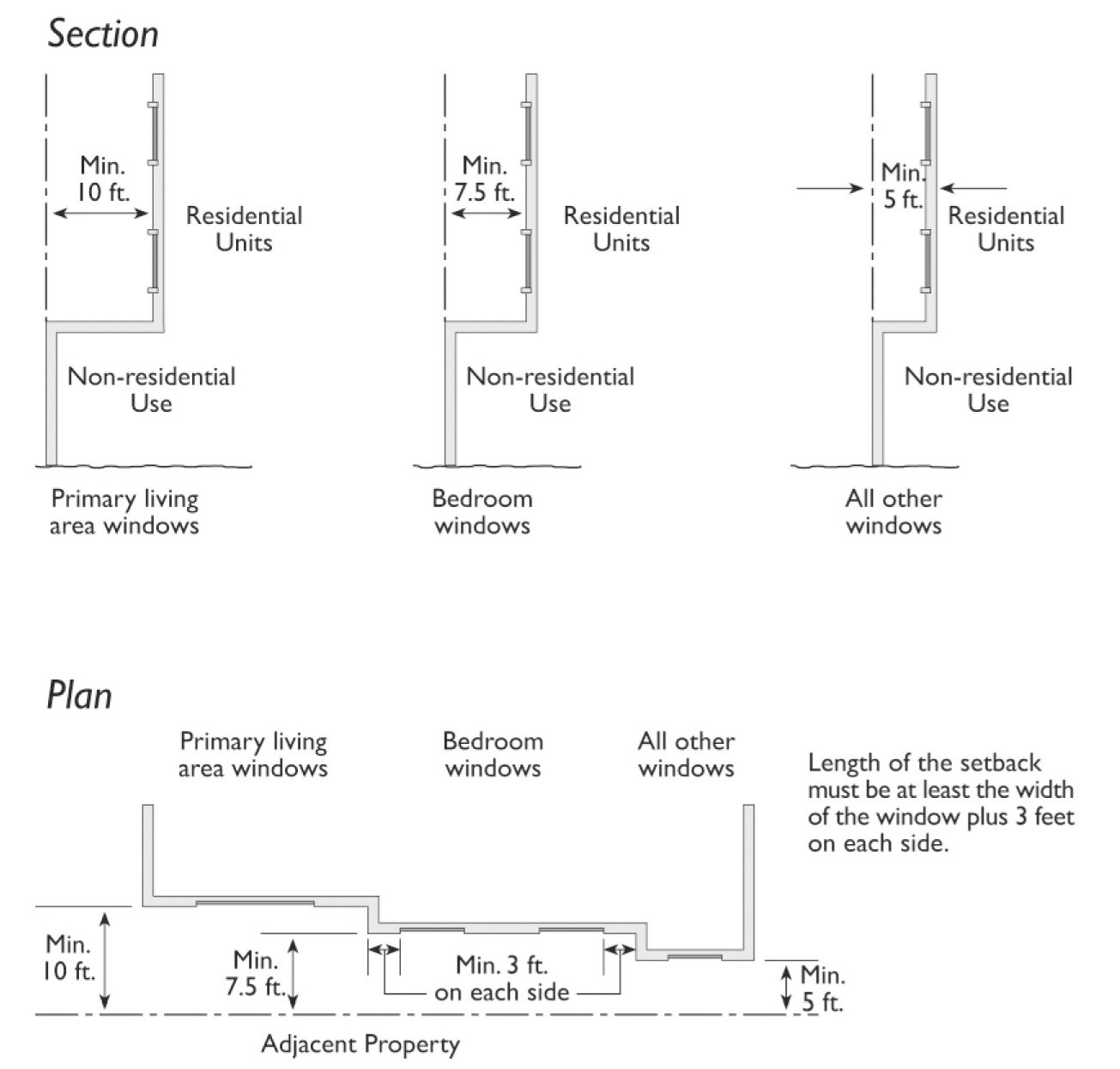
(6)
Open space. A minimum of 60 square feet of residential open space per unit shall be provided as common or private open space. Private areas typically consist of balconies, decks, patios, and other similar areas outside the residence. Common areas typically consist of roof gardens, courtyards, decks, patios, swimming pools, barbeque areas, playgrounds, gym/exercise rooms, or other such improvements as are appropriate to enhance the outdoor environment of the development and are acceptable to the review authority.
a.
Minimum dimensions. Private open space area shall have a minimum dimension of six feet, and common open space area shall have a minimum dimension of 15 feet; except that the review authority may authorize different minimum dimensions where it can be shown that the required open space meets the intent and purpose of this section as determined by the Director.
b.
Usability. A surface shall be provided that allows convenient use for outdoor living or recreation. Such surface may be any practicable combination of turf, ground cover, garden, flagstone, wood planking, concrete, or other serviceable, dust-free surfacing. Slope shall not exceed ten percent.
c.
Accessibility.
1.
Private open space. The space shall be accessible to only one residential unit by a doorway to a habitable room or hallway.
2.
Common open space. The space shall be accessible to the residential units on the lot. It shall be served by any stairway or other accessway qualifying as an egress facility from a habitable room.
(7)
Refuse and recycling areas. Areas for the collection and storage of refuse and recyclable material shall be located on the site in locations that are convenient for both residential and commercial uses.
a.
Refuse and recycling areas shall be consolidated to minimize the number of collection sites. Separate refuse and recycling areas may be provided and clearly marked for the residential and nonresidential uses.
b.
Refuse and recycling areas shall be located so as to reasonably equalize the distance from the building spaces they serve. The refuse and recycling area serving a residential unit shall be located within 100 feet of the unit.
c.
Refuse and recycling areas for residential units shall be designed to allow walk-in access without having to open a main enclosure gate.
(8)
Loading areas. Commercial loading areas shall be located away from residential units and shall be screened from view from the residential portion of the development to the maximum extent feasible in compliance with Chapter 17.36.
(9)
Performance standards. No commercial use, activity, or process shall be operated in an objectionable manner due to fumes, noxious odor, dust, smoke, gas, noise, or vibrations that may be detrimental to any other uses and occupants on the same property.
(Code 1990, § 17.52.170; Ord. No. 14-02, § 4, 3-19-2014; Ord. No. 15-01, § 4(exh. A, § 26), 1-21-2015; Ord. No. 17-10, § 4(exh. A), 11-1-2017)
17.52.170. - Mobile businesses.
(a)
Purpose. The purpose of this section is to establish regulations governing the time, place, and manner of mobile vending operations on private property and within the public right-of-way, in order to preserve the peace, safety, and welfare of the Town and its residents and visitors by:
(1)
Preventing safety, traffic, and health hazards;
(2)
Preventing the unregulated proliferation of too many vendors near one location, thus negatively impacting traffic and pedestrian safety; and
(3)
Establishing standards to ensure that mobile vendors are compatible with their surroundings and aesthetics of the Town.
(b)
Mobile vendor permit required.
(1)
The provisions of this section identify and prescribe specific procedures and requirements for the filing, processing, and consideration of a mobile vendor permit. These provisions shall be used in conjunction with the general requirements and procedures outlined in Chapter 17.60.
(2)
A mobile vendor permit shall be required for all mobile vending activities. This includes operating from a mobile vending vehicle or operating as a sidewalk vendor with a vendor cart/stand. No person shall operate as a mobile vendor unless a mobile vendor permit issued pursuant to this section is in effect for that mobile vendor, except that the following mobile vendors shall not be required to obtain a permit:
a.
A mobile vending vehicle or vendor cart/stand owned or operated by any public agency.
b.
Persons delivering goods, wares, merchandise, fruits, vegetables, or foodstuffs upon order of, or by agreement with, a customer from a store or other fixed place of business or distribution.
c.
Persons performing vehicle winter-chain installation on public roadways in accordance with applicable local and State regulations.
d.
Vendors participating in farmers markets or other special events as permitted by the Town.
e.
An event at a school facility or an assembly use facility, if the vendor is operating in partnership with the organization conducting the event and is located on the site of the event (i.e., not in the public right-of-way).
f.
Mobile vendors that only sell, display, solicit, or offer for sale, barter or exchange any of the following: newspapers, leaflets, pamphlets, bumper stickers, buttons, or other items that are inherently communicative and have nominal utility apart from its communication. Although an item may have some expressive purpose, it will be deemed to have more than nominal utility apart from its communication if it has a common and dominant non-expressive purpose. Examples of items that have more than nominal utility apart from their communication and thus may not be vended under the provisions of this section, include, but are not limited to, the following: Housewares, appliances, articles of clothing, sunglasses, auto parts, oils, incense, perfume, lotions, candles, jewelry, toys, stuffed animals, foodstuffs and beverages.
(3)
Every permittee, upon receipt of a mobile vendor permit, shall display the permit at all times the mobile vendor is operating. Such posting shall be in a visible location.
(c)
Mobile vendor permit application requirements.
(1)
An application for a mobile vendor permit shall be filed with the Director and shall contain the following:
a.
The individual and business name, address, and telephone number of the permit applicant.
b.
The name and address of all legal and registered owners of the mobile vendor vehicle or business, and each person with a financial interest in the business that operates as a mobile vendor.
c.
A copy of a valid Town business tax certificate for the business that operates as a mobile vendor or proof that a Town business tax certificate application has been submitted. No such business shall commence operations until a mobile business vendor permit is approved.
d.
If operating on private property, the mobile vendor shall provide evidence of the property owner's authorization in order to submit an application for a mobile vendor permit.
e.
For each person with a ten percent or greater financial interest in the business that operates the mobile vendor business, a list, signed under penalty of perjury, of each conviction of such person and whether such conviction was by verdict, plea of guilty, or plea of no contest. The list shall, for each conviction, set forth the date of arrest, the offense charged, and the offense of which the person was convicted. A person who acquires a ten percent or greater financial interest in the business that operates the mobile vendor vehicle during the term of the permit issued pursuant to this section shall immediately so notify the Director and comply with this subsection. A criminal conviction does not automatically disqualify an applicant from operating a mobile business. Approval or denial of a person shall be at the sole discretion of the Chief of Police, or designee.
f.
The mobile vendor shall provide an operating plan to the Town demonstrating adherence to the regulations in Section 17.52.180(f).
g.
Mobile food vendors must have a valid permit issued by the County Environmental Health Department. All required County health permits must be in the possession of the mobile food vendor at all times during which it operates within the Town.
h.
Mobile food vendors must provide evidence of compliance with Health and Safety Code § 114315(a). Such evidence may include, but is not limited to, written permission from a private business owner for use of the business's toilet and hand washing facility, a printed or electronic map showing the location of a compliant public toilet and hand washing facility, or similar documented evidence of compliance.
i.
Mobile food vendors shall provide fire protection equipment required by the Mammoth Lakes Fire Protection District. Mobile food vendors shall receive an inspection and approval from the Mammoth Lakes Fire Protection District prior to issuance of a business tax certificate and a mobile vendor permit.
j.
It is the responsibility of the applicant to establish evidence in support of the findings required by Subsection (c)(2) of this section.
(2)
Additional materials required for mobile vending vehicles.
a.
Written evidence that the applicant is an owner, lessee or holder of a similar interest in the mobile vendor vehicle.
b.
The State vehicle license plate number and the vehicle identification number of the mobile vendor vehicle, if applicable.
c.
The address where the mobile vendor vehicle is stored when not in use.
d.
The mobile vendor shall furnish to the Town evidence of insurance, as deemed acceptable in the reasonable discretion of the Town, against liability for death or injury to any person as a result of ownership, operation, or use of its vending vehicles. The Town shall be included as an additional insured for all mobile vendors.
(d)
Review of application for mobile vendor permit.
(1)
The Director shall review the application for a mobile vendor permit and associated documents and shall require additional information to complete the application if deemed necessary. The Director may deem the application incomplete if it does not contain all required information and documents.
(2)
An application shall not be deemed complete unless all required application fees have been paid.
(3)
After a mobile vending permit application is deemed complete, the Director shall approve, conditionally approve, or deny the application. The Director may approve a mobile vending application, with or without conditions, only after the following findings are made:
a.
The mobile vendor permit meets all of the requirements listed elsewhere in this section;
b.
All agencies or departments tasked with reviewing the mobile vendor permit application, including, but not limited to, the Town Police Department, the County Health Department, and the Mammoth Lakes Fire Protection District, have provided approval of the application;
c.
The operation of the mobile vendor will not result in traffic or pedestrian circulation hazards; and
d.
The operation of the mobile vendor will not disrupt the neighborhoods or zones in which it will be operated.
(e)
Mobile vendor permit suspension and revocation. In accordance with Chapter 17.124, the Director may suspend, revoke, or modify any mobile vendor permit issued pursuant to this section on any of the following grounds:
(1)
The Director determines that any activity authorized by the permit is being carried out in such a manner as to constitute a nuisance, or to be injurious to the public health, safety or welfare.
(2)
The operation of the mobile vendor is in violation of any conditions imposed upon the permit or in violation of any provision of this chapter or applicable Town and State laws and regulations.
(3)
There exists any of the grounds that would have been grounds for denial of the permit application.
(f)
Sale or transfer of mobile vending business. In the event the holder of a mobile vendor permit sells or otherwise transfers the mobile vendor business, the purchaser of the business shall be required to obtain a new mobile vendor permit, in accordance with all of the provisions and requirements of this section, including having applied for and obtained all other required certificates and permits.
(g)
Regulations. The following time, place, and manner regulations apply to all mobile vending operations:
(1)
Mobile vending operations shall be in full compliance with all applicable local and State regulations and requirements, including, but not limited to, applicable parking restrictions, the Vehicle Code, Health and Safety Code, and Retail Food Code.
(2)
The mobile vendor shall not obstruct pedestrian or vehicular traffic in any manner. This includes queuing customers. Adjacent sidewalks or paths must be at least six feet in width with at least four feet clear for pedestrian movements. The Director may require additional minimum access width for high-use pedestrian areas.
(3)
Mobile vending shall only occur between the hours of 7:00 a.m. and 10:00 p.m.
(4)
No mobile vendor may operate a vending vehicle:
a.
On any State highway, including any portion of State Highway 203.
b.
Within 50 feet of any fire hydrant.
c.
Within 25 feet of any crosswalk or a street intersection controlled by a traffic light or stop sign.
d.
Within 25 feet of a bus stop.
e.
Within ten feet from the outer edge of any public entrance of any business during the hours that such business is open to the public. For purposes hereof, the term "entrance" includes doors and associated vestibules, driveways and walkways serving the business, outdoor dining area entries, and emergency exits on any side of the building that faces a public street.
f.
Within ten feet of any entrance to a parking lot or garage.
g.
Within 200 feet of any police or fire station.
h.
Within 200 feet of any certified farmer's market.
i.
Within 200 feet of any temporary special event permit location.
j.
Within 100 feet of any public picnic area, playground, or athletic field.
k.
Within 300 feet of the nearest property line of any property in which a public or private school building is located, between the hours of 7:00 a.m. and 5:00 p.m. of any school day. This prohibition may be waived for special events for which the Town issues a permit, or by written permission of the Mammoth Unified School District or any other entity which operates the applicable school.
l.
In a Town park with an exclusive concessionaire agreement.
m.
Other areas where mobile vending is prohibited.
(5)
Vending is prohibited on the exposed street or traffic side of the vending vehicle.
(6)
The mobile vendor shall keep the vending area litter free and must remove litter caused by their products within a 25-foot radius of the vending location. Mobile vendor vehicles shall carry a refuse receptacle on board at all times.
(7)
All discharges and waste shall be contained and properly disposed of by the mobile vendor. In accordance with State and local regulations.
(8)
All merchandise shall be completely contained within the vending vehicle, cart, or stand (i.e., the exterior of the vehicle shall not be used to display merchandise; merchandise displays may not be set up adjacent to a parked vehicle).
(9)
The mobile vendor shall be subject to the noise provisions set forth in Chapter 8.16 of this chapter.
(10)
The mobile vendor shall have adequate lighting to ensure customer safety either on the vehicle or at the vendor location during business hours. Lighting shall comply with the provisions set forth in Section 17.36.030.
(11)
The mobile vendor shall be subject to the sign provisions set forth in Chapter 17.48.
(12)
Ice cream trucks shall also adhere to the regulations established by Vehicle Code § 22456.
(13)
Mobile vendors operating on private property shall comply with the following requirements:
a.
The mobile vendor shall not use or permit use of parking spaces on private property if doing so will adversely affect the on-site parking available for the primary use of the site as determined by the Director.
b.
The mobile vendor shall not impede the normal use of circulation aisles, sidewalks, or driveways or be located in such a manner as to encourage customers to stop in the circulation aisle, sidewalk, driveway or street to obtain vendor service.
c.
The mobile vendor shall maintain a copy of the property owner's permission at the vending location. The mobile vendor shall present this proof upon the demand of a peace officer or Town employee authorized to enforce this section.
(14)
No chairs or other site furniture shall be permitted to be placed within the public right-of-way. Such site furniture may be permitted on private property with permission of the property owner and must comply with the restrictions set forth for operation of the mobile vendor in this section.
(15)
Mobile vending vehicles (if more than a two-axle vehicle) shall not be stored/parked in a residential zone when not in operation.
(h)
Penalty. Violations of the provisions of this section shall be enforced pursuant to Chapter 17.128.
(Code 1990, § 17.52.180; Ord. No. 14-02, § 4, 3-19-2014; Ord. No. 15-01, § 4(exh. A, §§ 15, 26), 1-21-2015; Ord. No. 17-10, § 4(exh. A), 11-1-2017; Ord. No. 19-04, § 4(exh. A, h.), 11-6-2019)
17.52.180. - Mobilehome or recreational vehicle; temporary during construction.
(a)
Limitation on use. A mobilehome, trailer, or recreational vehicle may be used as a temporary residence of the property owner when the property owner is the builder and a valid building permit for a new single-family dwelling is in force, or as a temporary residence for security purposes on the site of an active construction project consistent with Section 17.56.030(8).
(b)
Time limits. A mobilehome, trailer, or recreational vehicle that is temporary during construction shall be removed prior to issuance of a Certificate of Occupancy, expiration of the building permit, or after two years, whichever occurs first.
(c)
Building Code and snow management. A mobilehome, trailer, or recreational vehicle that is temporary during construction shall either comply with the California Building Standards Code, including Town building code requirements, or the building official may consider reduced snow load design standards for such temporary structures provided an alternative means to mitigate snow loads has been provided.
(Code 1990, § 17.52.190; Ord. No. 14-02, § 4, 3-19-2014)
17.52.190. - Mobilehomes and manufactured homes.
A mobilehome or manufactured home shall be allowed as a dwelling outside of a mobilehome park and where single-family dwellings are permitted consistent with Government Code § 65852.3, subject to the following standards:
(1)
Zoning district standards. A mobilehome or manufactured home shall be installed in compliance with the standards of the applicable zoning district.
(2)
Permanent foundation. A mobilehome or manufactured home shall be installed on and secured to an approved permanent foundation system.
(3)
California Building Standards Code. A mobilehome or manufactured home shall comply with the California Building Standards Code, including Town building code requirements.
(4)
Architectural standards. Each roof shall have eaves and overhangs of not less than one foot measured from the vertical side of the structure.
(Code 1990, § 17.52.200; Ord. No. 14-02, § 4, 3-19-2014)
17.52.200. - Multifamily residential projects.
This section provides development and operational standards for multifamily residential projects in compliance with Chapters 17.16 through 17.32.
(1)
Accessory structures. Accessory structures and uses (e.g., bicycle storage, garages, laundry rooms, recreation facilities, etc.) shall be designed and constructed with an architectural style, exterior colors and materials similar to the structures in the project containing dwelling units.
(2)
Building facades adjacent to streets. A multifamily project of three or more dwelling units shall be designed so that at least 75 percent of the facade of each building adjacent to a public street is occupied by habitable space with windows. Each facade adjacent to a street shall have at least one pedestrian entry into the structure.
(3)
Common recreation area. Multifamily projects of more than 20 units shall provide 150 square feet of on-site common area/recreation area per unit. Said area may include recreation rooms, swimming/spa facilities, tennis courts, play areas, and other similar facilities.
(4)
Front yard paving. No more than 40 percent of the total area of the front yard setback shall be paved for walkways, driveways, or other hardcover pavement.
(5)
Laundry facilities. All multifamily residential developments with five or more dwelling units shall provide common laundry facilities, except where laundry facilities are provided within each unit.
a.
Keyed access. Laundry facilities shall be provided with keyed access for tenants only.
b.
Location. Laundry facilities shall be evenly dispersed throughout the multifamily development and easily accessible to all tenants as approved by the Director.
(6)
Maintenance and control of common area. Required common area space shall be controlled and permanently maintained by a homeowner's association, or by the property owner of a rental project. Provisions for control and maintenance shall be included in property covenants of all common interest developments.
(7)
Outdoor lighting. Outdoor lighting shall be installed and maintained along all vehicular access ways and major walkways, in compliance with Section 17.36.030.
(8)
Private outdoor open space. All multifamily residential projects shall provide private outdoor open space for each dwelling unit.
a.
Private outdoor open space shall be at the same level as, and immediately accessible from within the unit (e.g., balcony, deck, patio, etc.).
b.
Each private outdoor open space area shall have a minimum dimension of six feet and an area of at least 60 square feet; except that the review authority may authorize different minimum dimensions where it can be shown that the required private outdoor open space meets the intent and purpose of this section as determined by the Director.
c.
Provision of private outdoor open space shall not reduce common recreation area requirements.
d.
If it is shown to be infeasible to meet these private outdoor open space requirements, the review authority may require an increase in the common recreation area to off-set a reduction in required private outdoor open space.
(9)
Solid waste and recycling. Where required by Chapter 8.08 or 8.16, multifamily residential projects shall provide solid waste/recyclable materials storage consistent with Section 17.36.130.
(10)
Storage. A minimum of 100 cubic feet of lockable storage area shall be provided for each dwelling outside of the unit, with no dimension less than 30 inches. Storage area may be located in a garage associated with the dwelling unit provided that the area required for covered parking is in compliance with Chapter 17.44.
(Code 1990, § 17.52.210; Ord. No. 14-02, § 4, 3-19-2014; Ord. No. 19-04, § 4(exh. A, d.), 11-6-2019)
17.52.210. - Outdoor dining.
This section provides location, development, and operating standards for outdoor dining facilities in compliance with Chapters 17.16 through 17.32.
(1)
Accessory use. An outdoor dining area may be allowed accessory and incidental to a restaurant with indoor eating area on site, provided that the number of seats provided outdoors shall not exceed the number provided indoors.
(2)
Alcoholic beverage sales. Outdoor dining areas serving alcoholic beverages shall meet and be in compliance with the requirements of the State Alcohol Beverage Control Board, and the following standards:
a.
The dining area shall be accessible from the inside of the restaurant only, unless the Director waives this requirement in circumstances where this is not feasible or practical;
b.
The dining area shall be clearly defined with a physical barrier. It shall clearly be a part of the restaurant it serves; and
c.
The dining area shall be supervised by a restaurant employee to ensure conformance to laws regarding on-site consumption of alcoholic beverages.
(3)
Design and use compatibility. To ensure compatibility with surrounding uses and a high standard of design quality, the following standards shall be implemented:
a.
The outdoor dining area shall be located directly adjacent to the food service establishment which it serves; however, if this is impractical or infeasible, the Director may approve an alternate location;
b.
Outdoor dining areas and associated structural elements, awnings, covers, furniture, umbrellas, or other physical elements shall be compatible with the overall design of the main structures;
c.
The use of awnings, plants, umbrellas, and other human scale elements is encouraged to enhance the pedestrian experience;
d.
The relationship of outdoor dining areas to churches, hospitals, schools, and residential uses shall be considered by the review authority. Mitigation measures shall be utilized to reduce potential impacts related to glare, light, loitering, noise, and odor; and
e.
Outdoor dining areas shall not encroach into required parking areas, shall not obstruct pedestrian traffic, and shall not create traffic hazards.
(4)
Setbacks and snow removal.
a.
Outdoor dining areas may be located in setback areas but shall maintain a minimum five-foot setback to property lines or parking lots; however, no outdoor dining area shall encroach into a setback abutting a residential zone.
b.
When an outdoor dining area is located in a required front and street side yard setbacks area and operated between November 1 and April 30, the subject property shall participate in a snow removal maintenance district and shall have a snow removal plan approved by the Public Works Director.
(5)
Clean-up and maintenance. Outdoor dining areas shall be kept in a clean condition and free of litter and food items that constitute a nuisance to public health, safety, and welfare.
(6)
Parking. The outdoor eating area shall comply with the parking requirements of Chapter 17.44 for restaurants.
(7)
Sidewalk seating in the Town's right-of-way. An outdoor dining area may be allowed within the Town right-of-way subject to approval of an encroachment permit by the Director and Public Works Director, provided the following standards, in addition to those listed above, are met:
a.
The outdoor dining area does not interfere with vehicular or pedestrian movement or wheelchair access to, though, and around the site on which the outdoor dining area is located;
b.
A minimum access width of six to eight feet shall be maintained along all sidewalks and building entrances accessible to the public. The Public Works Director may require additional minimum access width for high use pedestrian areas;
c.
Outdoor dining areas, including those that do not serve alcohol, shall be separated from the clear pedestrian passage area on the public sidewalk or pedestrian walkway by a temporary barrier that is removed when not in use;
d.
All tables, chairs, umbrellas, and other elements located in the Town right-of-way shall be removed when not in use and during snow events;
e.
All businesses with outdoor dining areas in the Town right-of-way shall, prior to the issuance of an encroachment permit, furnish proof of insurance and shall indemnify and hold harmless the Town from any action or expense that may occur as a result of an outdoor dining area being located on any sidewalk or Town right-of-way, satisfactory to the Town Attorney; and
f.
All businesses with outdoor dining areas in the Town right-of-way shall enter into a maintenance agreement with the Town for maintenance of all portions of the Town right-of-way used and approved by the Director and Public Works Director for outdoor dining.
(Code 1990, § 17.52.220; Ord. No. 14-02, § 4, 3-19-2014)
17.52.220. - Outdoor display and sales standards.
This section provides location, development, and operating standards for outdoor retail displays and sales, where allowed by Chapters 17.16 through 17.32. This section does not apply to special events consistent with Chapter 17.56.
(1)
Temporary outdoor displays and sales. Temporary outdoor commercial sales and displays conducted in conjunction with an established business shall be subject to the following standards:
a.
An administrative permit shall be required for a temporary outdoor display or sale.
b.
Only one temporary outdoor sale or display shall be allowed per business at any one time.
c.
The sale or display shall be directly related to a business occupying a permanent structure on the subject property.
d.
A business shall be limited to three consecutive days of temporary outdoor displays/sales per calendar year. In addition, businesses are allowed one day for set up of the temporary display or sale and one day to remove the temporary display or sale.
e.
The temporary outdoor sale area and display shall not exceed 400 square feet.
f.
An outdoor sale or display shall not be located in a public right-of-way and shall not interfere with emergency vehicular access or pedestrian access.
g.
Temporary structures associated with the outdoor sale or display shall conform to the applicable building height and setback requirements.
h.
Hours of operation shall be limited to daylight hours with all outdoor sales and display items and facilities removed from the site at the close of daily business, unless otherwise approved by the Director.
i.
One sign, not to exceed 20 square feet, is permitted for a temporary outdoor display or sale. Signs shall be in compliance with Section 17.48.090(14).
j.
Established business criteria:
1.
The business location shall be a standalone building or a physically separated suite within a multitenant building. Physically separated is defined as an enclosed area with a lockable door;
2.
The business shall have a point-of-sale for retail transactions and shall conduct sales at the business location (e.g., the location cannot function as merchandise storage);
3.
The business shall have its own name, provided that any business occupying the same location as a previous business, under the management and control of the same or substantially similar people as that previous business, and engaged in a substantially similar business as that previous business, shall not be considered a new business simply because of a change of name;
4.
Any sales made by a business shall be made under the business's name and all price tags and receipts shall identify that name; and
5.
The business shall have a valid business tax certificate.
(2)
Farmer's markets, community outdoor markets, and similar larger-scale outdoor displays and sales. Larger-scale outdoor displays and sales, such as farmer's markets and similar outdoor sales activities, should be encouraged to animate the community and enliven commercial districts. Larger-scale outdoor displays and sales shall be subject to the following standards:
a.
The review authority shall approve the hours of operation and overall duration of the outdoor display and sale.
b.
Outdoor sales and display items and facilities may remain on site at the close of business (i.e., overnight), only if approved by the review authority.
c.
Outdoor displays and sales shall not be located in any residential zone.
d.
The review authority may apply standards similar to those required for temporary and permanent outdoor display and sales and additional standards to minimize potential adverse effects on surrounding properties and infrastructure or on the public health, safety, and welfare.
(3)
Permanent outdoor displays and sales. Permanent outdoor commercial sales and displays conducted in conjunction with an established business shall be subject to the following standards:
a.
An administrative permit shall be required for a permanent outdoor display or sale.
b.
The sale or display shall be directly related to a business occupying a permanent structure on the subject property and shall only display goods of the subject business.
c.
An outdoor display or sale area shall occupy a fixed, specifically approved, and defined location that does not disrupt the normal function of the site or its circulation, and does not encroach upon driveways, landscaped areas, required parking spaces, or pedestrian walkways.
d.
An outdoor sale or display shall not be located in a public right-of-way, shall not encroach into setbacks, and shall not obstruct intersection visibility or otherwise create a hazard for pedestrian or vehicular traffic.
e.
An outdoor display or sale area shall be oriented towards pedestrians.
f.
The outdoor display of merchandise shall not exceed a height of seven feet above finished grade, unless a greater height is allowed through use permit approval in compliance with Chapter 17.68.
g.
The Director may require outdoor sales and display areas be screened from the view of adjoining public rights-of-way by decorative walls, fences, or landscaping.
h.
Hours of operation shall be limited to business hours with all outdoor sales and display items brought indoors at the close of daily business, unless otherwise approved by the Director.
i.
Additional signs, beyond those normally allowed consistent with Chapter 17.48, shall not be allowed.
(Code 1990, § 17.52.230; Ord. No. 14-02, § 4, 3-19-2014; Ord. No. 15-01, § 4(exh. A, §§ 16, 17), 1-21-2015)
17.52.230. - Outdoor storage and work areas.
This section establishes standards for the location, screening, and operation of outdoor storage and work areas in compliance with Chapters 17.16 through 17.32.
(1)
General requirements. The outdoor storage of any materials or equipment not accessory to the primary use of the property, including lumber, inoperable vehicles, auto parts, appliances, pipe, drums, machinery, furniture, recycling, or trash which is readily visible from off-site is prohibited, unless otherwise allowed consistent with Chapter 17.28. The storage of firewood to be used on the premises shall be allowed.
a.
Location. The outdoor storage shall not be located within a front yard setback or any required parking or loading area consistent with Chapter 17.44.
b.
Enclosure required. The outdoor area used for storage shall be entirely enclosed and screened by a solid wall and solid gate with a minimum height of six feet. The Director may allow the substitution of a different six foot tall screening material, or a solid fence or a wall with a height of less than six feet after determining that the substitution would adequately comply with the provisions of this section.
c.
Operations. All raw materials, equipment, finished products, and other materials stored shall:
1.
Not be placed outside the enclosed storage area;
2.
Not be stored above the height of the enclosure, except for mechanical equipment; and
3.
Be stored in a manner that they cannot be blown by wind from the enclosure.
d.
Landscaping. Landscaping shall be installed, wherever possible, to lessen the visual impact of an outdoor storage area in compliance with Chapter 17.40.
e.
Temporary storage. For temporary storage requirements see Chapter 17.56.
(2)
Cargo containers. A cargo container is a metal or similar rectangular shipping container that is otherwise carried on rail cars, truck beds, or cargo ships, and is used as a temporary storage container consistent with Chapter 17.56. Unless otherwise allowed consistent with Chapter 17.28, a cargo container shall:
a.
Only be allowed if unusual circumstances exist that require the use of a temporary storage container, as determined by the Director. Unusual circumstances include, but are not limited to, construction, business relocation, and natural disasters;
b.
Shall be painted or otherwise treated to match or blend with the surrounding environment if authorized for more than 30 days per Subsection (5) of this section;
c.
Not be visible from a public street;
d.
Not be located in a required parking or landscape area;
e.
Not be located on site more than 30 days during any calendar year, unless otherwise authorized by the Director;
f.
Not be allowed any signage other than operating company identification which shall include telephone number;
g.
Storage containers authorized for more than six months shall have a stable foundation (i.e., compacted base or similar material) and be protected from wind or secured from wind movement.
(3)
Commercial vehicles.
a.
Commercial vehicles, consistent with Vehicle Code § 22507.5 (i.e., commercial vehicles having a manufacturer's gross vehicle weight rating of 10,000 pounds or more in a residential district), shall not be parked on any public or private property unless they are in the process of making an immediate pickup or delivery of goods, making service calls to the occupants of the premises, or are on the site of the business owning or operating the vehicle.
b.
Except when making delivery or service calls, or except allowed consistent with Section 17.52.170, commercial vehicles or vehicles advertising a business pursuant to Chapter 17.48, shall be parked on the site of the business and shall not be parked in areas adjacent and highly visible from a street property line. The Director may authorize an alternate location that meets the objectives of this section.
(4)
Residential zones.
a.
Vehicles; transportation. Only operable vehicles used primarily for noncommercial transportation may be kept on a driveway. One commercially licensed automobile, pickup truck, or van may be allowed for a home occupation consistent with Section 17.52.140 or when the vehicle is also used as the primary vehicle of the resident. There shall be no other vehicle storage between any structure and an adjacent street.
b.
Vehicles; recreational. Items such as boats, trailers, snowmobiles, and other like recreational vehicles shall be subject to the following standards:
1.
Recreational type vehicles may be kept outdoors for any period of time, provided that the following standards are met:
(i)
The required on-site parking is provided;
(ii)
The recreational vehicle parking area is paved; and
(iii)
All other applicable standards, including setbacks and lot coverage, are met.
2.
Recreational type vehicles not meeting the above standards may be kept outdoors for a period not exceeding seven days in any calendar month. Such vehicles may be kept longer than seven calendar days provided they are not located in a front yard setback and subject to screening by fence, landscaping, or other similar methods as approved by the Director.
3.
No recreational vehicle shall be used for dwelling purposes.
(5)
Snow removal equipment. See Chapter 17.56.
(Code 1990, § 17.52.240; Ord. No. 14-02, § 4, 3-19-2014)
17.52.240. - Recycling facilities.
This section establishes standards and procedures for the siting and operation of various types and sizes of commercial recycling facilities, where allowed by Chapters 17.16 through 17.32. Any recycling facility intending to operate in the Town shall comply with the following provisions:
(1)
General standards. All recycling facilities shall comply with the following standards:
a.
Signs. Facilities shall be provided with identification and information signs as follows, provided the signs are consistent with Chapter 17.48.
1.
Collection containers and reverse vending machines shall be clearly marked to identify the type of material which may be deposited, and display a notice stating that discarded material shall not be left outside of the recycling container or machine;
2.
The facility shall be clearly marked to identify the name and telephone number of the operator and the hours of operation; and
3.
Additional informational or directional signs may be approved by the Director if found necessary to facilitate traffic circulation, or if the facility is not visible from a public right-of-way.
b.
Refuse disposal. Facilities shall maintain adequate on-site refuse containers for the disposal of non-recyclable and non-hazardous waste materials.
c.
Noise. Exterior noise shall meet the requirements of Chapter 8.20.
(2)
Reverse vending machines. A reverse vending machine is an automated mechanical device that accepts at least one or more types of empty beverage containers and issues a cash refund or redeemable credit slip with a value of not less than the container's redemption value, as determined by State law. Reverse vending machines shall comply with the following standards:
a.
Accessory use only. Each machine shall be installed only as an accessory use to an allowed primary use and shall not require additional parking.
b.
Location requirements.
1.
If located outside of a structure, the machine shall not occupy parking spaces required by the primary use and shall be located within 30 feet of a building entrance and shall be constructed of durable waterproof and rustproof materials.
2.
If located inside of a structure, the machine shall be within 30 feet of the entrance and shall not obstruct pedestrian circulation.
c.
Maximum size. When located outdoors, the area occupied by the machines shall not exceed a total of five machines with a maximum area of 50 square feet, including any protective enclosure, or eight feet in height.
d.
Signs. Signs shall not exceed a maximum of four square feet on each machine, exclusive of operating instructions.
e.
Hours of operation. The machines shall have operating hours which are the same as the operating hours of the primary use.
f.
Lighting. Each machine shall be illuminated to ensure comfortable and safe operation if the operating hours are between dusk and dawn. The lighting shall be in compliance with Section 17.36.030.
(3)
Small collection facilities.
a.
Defined. The term "small collection facility" means a use subordinate to and different from the primary use of property, which subordinate use is established for the acceptance of recyclable materials from the public, occupies an area no larger than 500 square feet, and which involves no permanent habitable structures (e.g., facility may include a roof covering for weather protection). A small collection facility may include the following:
1.
One or more bulk reverse vending machines (i.e., reverse vending machines larger than 50 square feet, designed to accept more than one container at a time, and issues a cash refund based on a total weight instead of by container);
2.
A mobile recycling unit (i.e., an automobile, truck, trailer, or van used for the collection of recyclable materials, carrying bins, boxes, or other containers);
3.
Other deposit-type facilities that may or may not issue a cash refund; or
4.
A kiosk type unit.
b.
Development and operating standards. Small collection facilities shall comply with the following standards:
1.
Location requirements. A small collection facility shall:
(i)
Not be located within 50 feet of any parcel zoned or occupied for residential use; and
(ii)
Be set back at least ten feet from any public right-of-way, and not obstruct pedestrian or vehicular circulation.
2.
Maximum size. A small collection facility shall not occupy more than 500 square feet or three parking spaces, not, including space that would be periodically needed for the removal of materials or exchange of containers.
3.
Appearance of facility. Collection containers and any site fencing shall be of a color and design that is compatible and harmonious with the surrounding uses and neighborhoods.
4.
Operating standards. Small collection facilities shall:
(i)
Not use power-driven processing equipment, except for reverse vending machines;
(ii)
Accept only glass, metal, or plastic containers, paper, and reusable items;
(iii)
Use containers that are constructed with durable waterproof and rust proof materials, secured from unauthorized removal of material, and shall be of a capacity sufficient to accommodate materials collected and the collection schedule;
(iv)
Store all recyclable materials in containers;
(v)
Be screened where determined by the review authority to be necessary because of excessive visibility; and
(vi)
Be free of litter and any other undesirable materials. Mobile facilities, at which truck or containers are removed at the end of each collection day, shall be swept at the end of each collection day.
5.
Signs. Identification signs are allowed with a maximum area of 15 percent for each side of the structure or 12 square feet, whichever is greater. In the case of a wheeled facility, the side shall be measured from the ground to the top of the container.
6.
Parking requirements.
(i)
No additional parking space shall be required for customers of a small collection facility located in the established parking lot of the primary use. One additional space shall be provided for the attendant, if needed as determined by the Director.
(ii)
Mobile recycling units shall have an area clearly marked to prohibit other vehicular parking during hours when the mobile unit is scheduled to be present.
(iii)
Use of parking spaces by the patrons and the attendant shall not reduce available parking spaces below the minimum number required for the primary use unless a parking study, determined acceptable by the Director, shows that existing capacity is not fully utilized during the time the recycling facility would be on the site.
(4)
Large collection facilities. A large collection facility is larger than 500 square feet or is the primary use of a property and may include permanent structures. A large collection facility shall comply with the following standards:
a.
Location requirements. The facility shall be located a minimum of 50 feet from a parcel zoned or occupied for residential use.
b.
Container location. Any containers provided for afterhours donation of recyclable materials shall be permanently located at least 100 feet from any residential zone, constructed of sturdy, rust proof or painted material, have sufficient capacity to accommodate materials collected, and be secured from unauthorized entry or removal of materials.
c.
Screening. The facility shall be located within an enclosed structure or an area enclosed on all sides by a solid masonry wall. The structure or enclosure shall be landscaped or screened on all sides visible from a different zoning designation or from a public street.
d.
Outdoor storage. Exterior storage of material shall be in sturdy containers, bales, or enclosures that are secured and maintained in good condition. Storage shall be secure and not be visible above the height of the enclosure, solid masonry walls, or other screening methods.
e.
Operating standards.
1.
The site shall be maintained to be clean, sanitary, and free of litter and any other undesirable materials, and shall be cleaned of loose debris on a daily basis.
2.
Dust, fumes, odor, smoke, or vibration above ambient levels shall not be detectable on adjoining parcels.
(5)
Processing facilities. A processing facility is a building or enclosed space used for the collection and processing of recyclable materials for efficient shipment, or to an end user's specifications. Processing facilities shall comply with the following standards:
a.
Location requirements. The facility shall be located a minimum of 50 feet from a parcel zoned or occupied for residential use or noise sensitive receptors (e.g., hospital and schools) and shall be located within an enclosed building except for incidental storage.
b.
Limitation on activities. Allowed activities are limited to baling, briquetting, compacting, crushing, grinding, shredding, and sorting of source-separated recyclable materials and repairing of reusable materials. Materials shall be shipped regularly. Transfer station facilities containing organic food waste shall be shipped daily.
c.
Container location. See Subsection (4)b of this section.
d.
Screening. See Subsection (4)c of this section.
e.
Outdoor storage. See Subsection (4)d of this section.
f.
Operating standards. Dust, fumes, odor, smoke, or vibration, above ambient levels, shall not be detectable on adjoining parcels.
(Code 1990, § 17.52.250; Ord. No. 14-02, § 4, 3-19-2014)
17.52.250. - Residential care and assisted living facilities.
(a)
Purpose. The purpose of this section is to ensure affordable care and housing for the elderly, disabled, and other persons in need of supervision or essential assistance for daily living in the Town that is compatible with surrounding land uses in compliance with Chapters 17.16 through 17.32.
(b)
Density. The density shall comply with Chapters 17.16 through 17.32. A density bonus may be utilized if the project meets the applicable density bonus provisions of Chapters 17.132 through 17.140.
(c)
General requirements.
(1)
Indoor common areas and living units shall be provided with the necessary safety equipment (e.g., safety bars, etc.), as well as emergency signal/intercom and ADA accessibility, subject to the approval of the Director.
(2)
Common entertainment, recreational, and social activity areas shall be provided in a number, size, and scale consistent with the number of living units provided.
(d)
Parking. On-site parking shall comply with Chapter 17.44.
(e)
Transportation services and facilities. The project site shall be designed to adequately accommodate transit services to the satisfaction of the Director.
(Code 1990, § 17.52.260; Ord. No. 14-02, § 4, 3-19-2014)
17.52.260. - Single-family residential urban lot splits and two-unit projects.
(a)
Purpose and applicability. This section establishes requirements for:
(1)
This section implements Government Code §§ 66411.7 and 65852.21. The purpose of this section is to apply objective local development standards for projects covered by Government Code § 66411.7 or 65852.21. This section is applicable only so long as Government Code §§ 66411.7 and 65852.21 are operative.
(2)
Where this section or Government Code § 66411.7 or 65852.21 conflict with any other provision of this chapter, this section and Government Code §§ 66411.7 and 65852.21 shall control. Any development standard or requirement not specifically addressed by this section or Government Code § 66411.7 or 65852.21 shall conform to all other provisions of this chapter and all other objective policies and requirements governing subdivisions or construction of single- or two-family dwellings. Nothing in this section precludes an applicant from applying for a development permit under another section of this chapter.
(b)
Urban lot splits. This section authorizes a ministerial review process for parcel maps that create no more than two new lots in a single-family residential zone (urban lot split) in compliance with Government Code § 66411.7.
(1)
Application.
a.
Urban lot split is defined as a subdivision involving the division of an existing, legally subdivided parcel in a single-family residential zone into no more than two parcels in accordance with the requirements of this section.
b.
A parcel map application for an urban lot split shall be made to the Department on a form provided for that purpose pursuant to Chapter 17.60. All required information identified on the form shall be provided by the applicant, and any additional information required by the Director in order to determine the project's consistency with the objective standards applicable to urban lot splits. No application shall be accepted unless it is completed as prescribed and is accompanied by payment of all applicable fees.
c.
Only individual property owners may apply for an urban lot split. The term "individual property owner" means a natural person holding fee title individually or jointly in the person's own name or a beneficiary of a trust that holds fee title. The term "individual property owner" does not include any corporation or corporate person of any kind (partnership, LP, LLC, C corporation, S corporation, etc.) except for a community land trust (as defined by Revenue and Taxation Code § 402.1(a)(11)(C)) or a qualified nonprofit corporation (as defined by Revenue and Taxation Code § 214.15). Any person with a mortgage interest in the lot to be split under this section must sign the application and the parcel map indicating the person's consent to the project.
d.
Projects that include a two-unit project in addition to an urban lot split, shall require an administrative permit for a two-unit project and adherence to the requirements specified in Subsection (c) of this section, in addition to adherence to all applicable urban lot split requirements.
(2)
Review procedures and action.
a.
Completeness review. The Director shall determine whether the application is complete pursuant to the requirements of Government Code § 65943. The Director shall provide an applicant for an urban lot split with written documentation identifying items that were not complete or inconsistencies with the objective standards applicable to urban lot splits within 30 days after the application is submitted.
b.
Ministerial action. Consistent with State law, the Director shall render a ministerial decision without a public hearing on an urban lot split application upon such application being deemed complete. Notwithstanding anything to the contrary set forth in this chapter, the Director's action to grant or deny an application for an urban lot split is final and not subject to appeal.
1.
A tentative parcel map for an urban lot split shall be approved ministerially if it complies with all requirements of this section. Recordation of a tentative parcel map is not required. A final parcel map shall be approved ministerially as well, but not until the owner demonstrates that all required documents have been recorded (e.g., deed restriction, easements). The expiration date of the tentative map is determined by Title 16 and Government Code §§ 66452.6 and 66463.5. An approved tentative map is valid for 24 months after its effective date.
2.
The approval shall require the owner and applicant to hold the Town harmless from all claims and damages related to the approval and its subject matter.
3.
The approval shall require the owner and applicant to reimburse the Town for all costs of enforcement, including attorneys' fees and costs associated with enforcing the requirements of this chapter.
4.
The lot created pursuant to the urban lot split cannot be sold/transferred until the final parcel map has been recorded.
(3)
Requirements. An urban lot split shall satisfy each of the following requirements:
a.
Map Act compliance. The urban lot split shall conform to all applicable objective requirements of the Subdivision Map Act, Government Code § 66410 et seq., including implementing requirements in this chapter, except as otherwise expressly provided in this section. The buyer or grantee or the Town has the following remedies if an urban lot split violates any part of the Subdivision Map Act, Government Code § 66410 et seq., Title 16, this section, or any other legal requirement:
1.
The buyer or grantee of a lot that is created by the urban lot split has all the remedies available under the Subdivision Map Act, Government Code § 66410 et seq., including, but not limited to, an action for damages or to void the deed, sale or contract.
2.
The Town has all the remedies available to it under the Subdivision Map Act, Government Code § 66410 et seq., including, but not limited to, the following:
(i)
An action to enjoin any attempt to sell, lease, or finance the property.
(ii)
An action for other legal, equitable, or summary remedy, such as declaratory and injunctive relief.
(iii)
Criminal prosecution, punishable by imprisonment in County jail or State prison for up to one year, by a fine of up to $10,000.00, or both; or a misdemeanor.
(iv)
Record a notice of violation.
(v)
Withhold any or all future permits and approvals.
3.
Notwithstanding Government Code § 66411.1, no dedication of rights-of-way or construction of offsite improvements is required for an urban lot split.
b.
Zone. The lot to be split is located in a zone where a single-family dwelling is the only permitted primary residential use pursuant to Table 17.20.020, which only includes lots in the Residential Single-Family (RSF) and Rural Residential (RR) zoning districts.
c.
Lot location. The purpose of the following list is merely to summarize the requirements of Government Code § 65913.4(a)(6)(B) through (K). Government Code § 66411.7(a)(3)(C) identifies unique site characteristics for when a lot cannot be split through the urban lot split process. The applicant shall provide evidence that the requirements of Government Code § 65913.4(a)(6)(B) through (K) are satisfied. The lot to be split shall not be located on a site that is any of the following:
1.
Prime farmland, farmland of statewide importance, or land that is zoned or designated for agricultural protection or preservation by the voters.
2.
A wetland.
3.
Within a very high fire hazard severity zone, unless the site complies with all fire-hazard mitigation measures required by the Mammoth Lakes Fire Protection District (MLFPD).
4.
A hazardous waste site that has not been cleared for residential use.
5.
Within a delineated earthquake fault zone, unless all development on the site complies with applicable seismic protection Building Code standards.
6.
Within a 100-year flood hazard area, unless the site has either:
(i)
Been subject to a letter of map revision prepared by the Federal Emergency Management Agency and issued to the local jurisdiction; or
(ii)
Meets Federal Emergency Management Agency requirements necessary to meet minimum flood plain management criteria of the National Flood Insurance Program.
7.
Within a regulatory floodway, unless all development on the site has received a no-rise certification.
8.
Land identified for conservation in an adopted natural community conservation plan, habitat conservation plan, or other adopted natural resource protection plan.
9.
A habitat for protected species.
10.
Land under conservation easement.
d.
Not historic. The lot to be split shall not be a historic property or within a historic district that is included on the State Historic Resources Inventory, nor may the lot be or be within a site that is designated by ordinance as a Town or County landmark or as a historic property or district.
e.
No prior urban lot split. The lot to be split shall:
1.
Not have been established through a prior urban lot split; and
2.
Not be adjacent to any lot that was established through a prior urban lot split by the owner of the lot to be split or by any person acting in concert with the owner. The term "any person acting in concert with the owner" here includes any third party that coordinates or assists the owners of two adjacent lots with their respective urban lot splits.
f.
No impact on protected housing.
1.
The urban lot split shall not require or include the demolition or alteration of any of the following types of housing:
(i)
Housing that is income-restricted for households of moderate, low, or very low-income.
(ii)
Housing that is subject to any form of rent or price control through a public entity's valid exercise of its policy power.
(iii)
Housing, or a lot that used to have housing, that has been withdrawn from rental or lease under the Ellis Act, Government Code §§ 7060 through 7060.7, at any time in the 15 years prior to submission of the urban lot split application.
(iv)
Housing that has been occupied by a tenant in the last three years.
2.
As part of the urban lot split application, the applicant and the owner of a property shall provide a sworn statement by affidavit representing and warranting that this subsection (b)(3)f is satisfied. The sworn statement shall state that:
(i)
No housing that is income-restricted for households of moderate, low, or very low-income will be demolished or altered.
(ii)
No housing that is subject to any form of rent or price control will be demolished or altered.
(iii)
No housing that has been withdrawn from rental or lease under the Ellis Act, Government Code §§ 7060 through 7060.7, at any time in the last 15 years will be demolished or altered.
(iv)
No housing that has been occupied by a tenant in the last three years will be demolished or altered.
3.
The Town may conduct its own inquiries and investigation to ascertain the veracity of the sworn statement, including, but not limited to, surveying owners of nearby properties; and the Town may require additional evidence of the applicant and owner as necessary to determine compliance with this requirement.
g.
Lot size. The lot to be split shall be at least 2,400 square feet.
1.
The resulting lots shall be at least 1,200 square feet.
2.
Each of the resulting lots shall be between 60 percent and 40 percent of the original lot area.
3.
The minimum lot depth and width dimensions or the minimum width/depth for a building site specified in Table 17.20.030 for the underlying zones shall yield to the degree necessary to avoid physically precluding the construction of up to two units on each resulting lot or either of the two units from being at least 800 square feet in floor area.
h.
Easements. The owner shall enter into an easement agreement with each public service provider to establish easements that are sufficient for the provision of public services and facilities to each of the resulting lots.
1.
Each easement shall be shown on the tentative parcel map.
2.
Copies of the unrecorded easement agreements shall be submitted with the application. The easement agreements shall be recorded against the property before the final map may be approved, in accordance with Subsection (b)(3)a of this section.
3.
If an easement is recorded and the project is not completed, making the easement moot, the property owner may request, and the Town will provide, a notice of termination of the easement, which the owner may record.
i.
Lot access. Each resulting lot shall have access to, provide access to, or adjoin the public right-of-way. Access shall be designed, constructed, and properly maintained in compliance with the residential driveway standards specified in the public works Town standards, unless otherwise modified and approved by the Public Works Director.
1.
Access to the resulting lots and all resulting units on the subject lots shall be accessed by a single driveway entrance/exit and the driveway shall have a minimum-maximum width at the road right-of-way edge of 12 to 24 feet. The single driveway standard is only enforced to the extent that it does not preclude the construction of up to two units on each resulting lot or either of the two units from being at least 800 square feet in floor area.
2.
Access to flag or rear lots (i.e., lots that do not have frontage on the public right-of-way) created by an urban lot split shall be provided through an access corridor. To the extent that it does not prevent two primary dwelling units on each resulting lot, the access corridor for the rear lot shall be integrated with the driveway for the front lot.
(i)
The access corridor can be either a private right-of-way strip owned in fee by the rear property owner or an easement that provides unrestricted access to the rear property. Easements shall be recorded against the property before the final map may be approved, in accordance with Subsection (b)(3)a of this section.
(ii)
The access corridor (i.e., private strip or easement) shall have a minimum-maximum width of 12 to 24 feet and the length shall be at minimum the required setback of the underlying zone.
(iii)
Access corridors shall remain free and clear of obstructions (e.g., structures, propane tanks, trees, large boulders, trash enclosures, utility pedestals, etc.) at all times.
j.
Number of units allowed. No more than two dwelling units of any kind may be built, or exist, on a lot that results from an urban lot split. For purposes of this section, the term "unit" means any dwelling unit, including, but not limited to, a primary dwelling unit, a unit created under Subsection (c) of this section, an ADU, or a JADU.
k.
Unit size. The total floor area of each primary dwelling unit that is developed on a resulting lot shall be less than or equal to 800 square feet.
1.
An existing unit (e.g., primary dwelling unit, ADU) that was legally established prior to the urban lot split and that is larger than 800 square feet is limited to the existing floor area at the time of the urban lot split. The unit may not be expanded.
2.
An existing unit (e.g., primary dwelling unit, ADU) that was legally established prior to the urban lot split and that is smaller than 800 square feet may be expanded up to a maximum size of 800 square feet after the urban lot split.
l.
Setbacks. All setbacks shall conform to those objective setbacks that are imposed through the underlying zone, with the following exceptions:
1.
Existing structures. An existing legally established structure or a new structure that is constructed in the same location and to the same dimensions as an existing legally established structure shall not require any additional setback than what currently exists.
2.
Setback encroachments. The setbacks imposed by the underlying zone shall yield to the degree necessary to avoid physically precluding the construction of up to two units on each resulting lot or either of the two units from being at least 800 square feet in floor area; but shall maintain a minimum setback of four feet from the side and rear property lines.
3.
Front setback. Notwithstanding any other part of this chapter, dwellings that are constructed after an urban lot split shall maintain the front setback specified in Table 17.20.030 for the underlying zone. There are no exceptions to this standard, unless this standard would preclude the construction of up to two units on each resulting lot or either of the two units from being at least 800 square feet in floor area.
m.
Height restrictions. No new primary dwelling unit may exceed two stories, with a maximum allowable height of 24 feet in height, measured from finished grade in accordance with the height calculation methods specified in Section 17.36.060. Any portion of a new primary dwelling unit that exceeds one story must be stepped back by an additional five feet from the ground floor.
n.
Lot coverage. Maximum lot coverage shall conform to the objective lot coverage limitations imposed through the underlying zone. This standard is only enforced to the extent that it does not preclude the construction of up to two units on each resulting lot or either of the two units from being at least 800 square feet in floor area.
o.
Design standards.
1.
Roof design and materials. When a primary dwelling unit is constructed with reduced side or rear yard setbacks, where allowed by this section, the pitch of any portion of the roof within the reduced setback area shall not be directed towards the side or rear property lines, or the structure shall have a non-shedding roof material or an engineered snowslide restraint device for the life of the structure.
2.
Architectural projections. When a primary dwelling unit is constructed with reduced side or rear yard setbacks, where allowed by this section, no portion of the structure, including the architectural features specified in Table 17.36.100, shall be located closer than four feet to the side and rear property lines.
p.
Parking. Each new primary dwelling unit that is built on a lot after an urban lot split shall have at least one off-street parking space per unit. The off-street parking space shall comply with zoning or public works standards for minimum size, location, and slope. In instances when any of the following apply, no off-street parking is required for a new primary dwelling unit that is built on a lot after an urban lot split:
1.
The lot is located within one-half mile walking distance of either:
(i)
A high-quality transit corridor, which is defined in Public Resources Code § 21155(b) as a corridor with fixed route bus service with service intervals no longer than 15 minutes during peak commute hours; or
(ii)
A major transit stop, which is defined in Public Resources Code § 21064.3 as a site containing an existing rail or bus rapid transit station, a ferry terminal served by either a bus or rail transit service, or the intersection of two or more major bus routes with a frequency of service interval of 15 minutes or less during the morning and afternoon peak commute periods.
2.
The site is located within one block of a car-share vehicle location.
q.
Nonconforming conditions. An urban lot split may be approved without requiring a legal nonconforming zoning condition to be corrected.
r.
Utilities. Each primary dwelling unit on the resulting lot shall have its own direct utility connection to the utility service provider.
s.
Building and safety. All new structures built on the lot shall comply with all current local building standards. An urban lot split shall be considered a change of use.
t.
Fire-hazard mitigation measures. A lot in a very high fire hazard severity zone shall comply with all MLFPD fire hazard mitigation measures for residential construction.
u.
Separate conveyance.
1.
Within a resulting lot.
(i)
Primary dwelling units on a lot that is created by an urban lot split may not be owned or conveyed separately from each other.
(ii)
Condominium airspace divisions and common interest developments are not permitted on a lot that is created by an urban lot split.
(iii)
All fee interest in a lot and all dwellings on the lot must be held equally and undivided by all individual property owners.
2.
Between resulting lots. Separate conveyance of the resulting lots is permitted. If dwellings or other structures (e.g., garages) on different lots are adjacent or attached to each other, the urban lot split boundary may separate them for conveyance purposes if the structures meet building Code safety standards and are sufficient to allow separate conveyance. If any attached structures span or will span the new lot line, the owner must record appropriate CC&Rs, easements, or other documentation that is necessary to allocate rights and responsibility between the owners of the two lots.
v.
Regulation of uses.
1.
Residential uses only. No nonresidential use is permitted on any lot created by an urban lot split.
2.
Short-term rentals are prohibited. No dwelling unit on a lot that is created by an urban lot split may be rented for a period of 30 consecutive days or less.
3.
Owner occupancy. The applicant for an urban lot split shall sign an affidavit stating that the applicant intends to occupy one of the dwelling units on one of the resulting lots as the applicant's principal place of residence for a minimum of three years after the urban lot split is approved.
w.
Deed restriction. The owner shall record a deed restriction in a form approved by the Town that does each of the following:
1.
Expressly prohibits any rental of any dwelling on the property for a period of less than 30 days.
2.
Expressly prohibits any nonresidential use of the lots created by the urban lot split.
3.
Expressly prohibits any separate conveyance of a primary dwelling on the property, any separate fee interest, and any common interest development within the lot.
4.
States that the property is formed by an urban lot split and is therefore subject to the Town's urban lot split regulations, including all applicable limits on dwelling size and development.
x.
Specific adverse impacts. Notwithstanding anything else in this section, the Town may deny an application for an urban lot split if the building official makes a written finding, based on a preponderance of the evidence, that the project would have a specific adverse impact on either public health or safety or on the physical environment and for which there is no feasible method to satisfactorily mitigate or avoid the specific adverse impact.
1.
The term "specific adverse impact" has the same meaning as in Government Code § 65589.5(d)(2).
2.
The building official may consult with and be assisted by Planning Division staff and other as necessary in making a finding of specific adverse impact.
(c)
Two-unit projects. This section authorizes a ministerial review process for housing developments containing no more than two dwelling units on a lot in a single-family residential zone (two-unit project) in compliance with Government Code § 65852.21.
(1)
Application.
a.
The term "two-unit project" means a housing development consisting of no more than two primary dwelling units on a lot, including a development which entails adding one new primary unit to an existing primary unit, in a single-family residential zone.
b.
An administrative permit application for two-unit project shall be made to the Department on a form provided for that purpose pursuant to Chapter 17.60. All required information identified on the form shall be provided by the applicant, and any additional information required by the Director in order to determine the project's consistency with the objective standards applicable to two-unit projects. No application shall be accepted unless it is completed as prescribed and is accompanied by payment of all applicable fees.
c.
Only individual property owners may apply for a two-unit project. The term "individual property owner" means a natural person holding fee title individually or jointly in the person's own name or a beneficiary of a trust that holds fee title. The term "individual property owner" does not include any corporation or corporate person of any kind (partnership, LP, LLC, C corporation, S corporation, etc.) except for a community land trust (as defined by Revenue and Taxation Code § 402.1(a)(11)(C)) or a qualified nonprofit corporation (as defined by Revenue and Taxation Code § 214.15). Any person with a mortgage interest in the lot to be split under this section must sign the application and the parcel map indicating the person's consent to the project.
d.
For any lot created in violation of the SMA, the applicant shall obtain a Certificate of Compliance with the SMA for the lot and provide the certificate with the application.
e.
Projects that include an urban lot split in addition to a two-unit project, shall require a parcel map application for an urban lot split and adherence to the requirements specified in Subsection (b) of this section, in addition to adherence to all applicable two-unit project requirements.
(2)
Review procedures and action.
a.
Completeness review. The Director shall determine whether the application is complete pursuant to the requirements of Government Code § 65943. The Director shall provide an applicant for a two-unit project with written documentation identifying items that were not complete or inconsistencies with the objective standards applicable to two-unit projects within 30 days after the application is submitted.
b.
Ministerial action. Consistent with State law, the Director shall render a ministerial decision without a public hearing on a two-unit project application upon such application being deemed complete. Notwithstanding anything to the contrary set forth in this chapter, the Director's action to grant or deny an application for a two-unit project is final and not subject to appeal.
1.
A two-unit project shall be approved ministerially if it complies with all requirements of this section. The ministerial approval of a two-unit project shall not take effect until the owner demonstrates that all required documents have been recorded (e.g., deed restriction, easements).
2.
The approval shall require the owner and applicant to hold the Town harmless from all claims and damages related to the approval and its subject matter.
3.
The approval shall require the owner and applicant to reimburse the Town for all costs of enforcement, including attorneys' fees and costs associated with enforcing the requirements of this chapter.
(3)
Requirements. An urban lot split shall satisfy each of the following requirements:
a.
Map Act compliance. The lot shall have been legally subdivided.
b.
Zone. The lot is located in a zone where a single-family dwelling is the only permitted primary residential use pursuant to Table 17.20.020, which only includes lots in the Residential Single-Family (RSF) and Rural Residential (RR) zoning districts.
c.
Lot location. The purpose of the following list is merely to summarize the requirements of Government Code § 65913.4(a)(6)(B) through (K). Government Code § 65852.21(a)(2) identifies unique site characteristics for when a two-unit project is not permitted. The applicant shall provide evidence that the requirements of Government Code §§ 65913.4(a)(6)(B) through (k) are satisfied. The lot shall not be located on a site that is any of the following:
1.
Prime farmland, farmland of statewide importance, or land that is zoned or designated for agricultural protection or preservation by the voters.
2.
A wetland.
3.
Within a very high fire hazard severity zone, unless the site complies with all fire-hazard mitigation measures required by the Mammoth Lakes Fire Protection District (MLFPD).
4.
A hazardous waste site that has not been cleared for residential use.
5.
Within a delineated earthquake fault zone, unless all development on the site complies with applicable seismic protection building Code standards.
6.
Within a 100-year flood hazard area, unless the site has either:
(i)
Been subject to a letter of map revision prepared by the Federal Emergency Management Agency and issued to the local jurisdiction; or
(ii)
Meets Federal Emergency Management Agency requirements necessary to meet minimum flood plain management criteria of the National Flood Insurance Program.
7.
Within a regulatory floodway, unless all development on the site has received a no-rise certification.
8.
Land identified for conservation in an adopted natural community conservation plan, habitat conservation plan, or other adopted natural resource protection plan.
9.
Habitat for protected species.
10.
Land under conservation easement.
d.
Not historic. The lot shall not be a historic property or within a historic district that is included on the State historic resources inventory, nor may the lot be or be within a site that is designated by ordinance as a Town or County landmark or as a historic property or district.
e.
No impact on protected housing.
1.
The two-unit project shall not require or include the demolition or alteration of any of the following types of housing:
(i)
Housing that is income-restricted for households of moderate, low, or very low-income.
(ii)
Housing that is subject to any form of rent or price control through a public entity's valid exercise of its policy power.
(iii)
Housing, or a lot that used to have housing, that has been withdrawn from rental or lease under the Ellis Act, Government Code § 7060 through 7060.7, at any time in the 15 years prior to submission of the two-unit project application.
(iv)
Housing that has been occupied by a tenant in the last three years.
2.
As part of the two-unit project application, the applicant and the owner of a property shall provide a sworn statement by affidavit representing and warranting that Subsection (c)(3)e of this section is satisfied. The sworn statement shall state that:
(i)
No housing that is income-restricted for households of moderate, low, or very low-income will be demolished or altered.
(ii)
No housing that is subject to any form of rent or price control will be demolished or altered.
(iii)
No housing that has been withdrawn from rental or lease under the Ellis Act, Government Code §§ 7060 through 7060.7, at any time in the 15 years will be demolished or altered.
(iv)
No housing that has been occupied by a tenant in the last three years will be demolished or altered.
3.
The Town may conduct its own inquiries and investigation to ascertain the veracity of the sworn statement, including, but not limited to, surveying owners of nearby properties; and the Town may require additional evidence of the applicant and owner as necessary to determine compliance with this requirement.
f.
Access. Access to the site shall be designed, constructed, and properly maintained in compliance with the residential driveway standards specified in the public works Town standards, unless otherwise modified and approved by the Public Works Director. Access to the two-unit project shall be accessed by a single driveway entrance/exit and the driveway shall have a minimum-maximum width at the road right-of-way edge of 12 to 24 feet. The single driveway standard is only enforced to the extent that it does not preclude the construction of up to two units on the lot or either of the two units from being at least 800 square feet in floor area.
g.
Number of units allowed.
1.
Lots that have not been created by an urban lot split pursuant to Subsection (b) of this section may have a two-unit project under this section, plus any ADU or JADU that must be allowed under State law and the Town's ADU ordinance.
2.
Lots that have been created by an urban lot split pursuant to Subsection (b) of this section, or lots that are subsequently split through the urban lot split process after the development of a two-unit project, plus any allowable ADU or JADU, shall be subject to the limitations specified in Subsection (b)(3)j of this section, related to the allowable number of units.
h.
Unit size. The total floor area of each primary dwelling unit shall be less than or equal to 800 square feet.
1.
An existing unit (e.g., primary dwelling unit, ADU) that was legally established on the lot prior to the two-unit project and that is larger than 800 square feet is limited to the existing floor area at the time of the two-unit project. The unit may not be expanded.
2.
An existing unit (e.g., primary dwelling unit, ADU) that was legally established prior to the two-unit project and that is smaller than 800 square feet may be expanded up to a maximum size of 800 square feet after or as part of the two-unit project.
i.
Setbacks. All setbacks shall conform to those objective setbacks that are imposed through the underlying zone, with the following exceptions:
1.
Existing structures. An existing legally established structure or a new structure that is constructed in the same location and to the same dimensions as an existing legally established structure shall not require any additional setback than what currently exists.
2.
Setback encroachments. The setbacks imposed by the underlying zone shall yield to the degree necessary to avoid physically precluding the construction of up to two units on the lot or either of the two units from being a maximum of 800 square feet in floor area; but shall maintain a minimum setback of four feet from the side and rear property lines.
3.
Front setback. Notwithstanding any other part of this chapter, dwellings that are constructed as part of a two-unit project shall maintain the front setback specified in Table 17.20.030 for the underlying zone. There are no exceptions to this standard unless this standard would preclude the construction of up to two units on the lot or either of the two units from being at least 800 square feet in floor area.
j.
Height restrictions. No new primary dwelling unit may exceed two stories, with a maximum allowable height of 24 feet in height, measured from finished grade in accordance with the height calculation methods specified in Section 17.36.060. Any portion of a new primary dwelling unit that exceeds one story must be stepped back by an additional five feet from the ground floor.
k.
Lot coverage. Maximum lot coverage shall conform to the objective lot coverage limitations imposed through the underlying zone. This standard is only enforced to the extent that it does not preclude the construction of up to two units on the lot or either of the two units from being at least 800 square feet in floor area.
l.
Demolition cap. The two-unit project may not involve the demolition of more than 25 percent of the existing exterior walls of an existing dwelling unless the site has not been occupied by a tenant in the last three years.
m.
Design standards.
1.
Roof design and materials. When a primary dwelling unit is constructed with reduced side or rear yard setbacks, where allowed by this section, the pitch of any portion of the roof within the reduced setback area shall not be directed towards the side or rear property lines, or the structure shall have a non-shedding roof material or an engineered snowslide restraint device for the life of the structure.
2.
Architectural projections. When a primary dwelling unit is constructed with reduced side or rear yard setbacks, where allowed by this section, no portion of the structure, including the architectural features specified in Table 17.36.100, shall be located closer than four feet to the side and rear property lines.
n.
Parking. Each new primary dwelling unit that is built on a lot as part of a two-unit project shall have at least one off-street parking space per unit. The off-street parking space shall comply with zoning or public works standards for minimum size, location, and slope. In instances when any of the following apply, no off-street parking is required for a new primary dwelling unit that is built as part of a two-unit project.
1.
The lot is located within one-half mile walking distance of either:
(i)
A high-quality transit corridor, which is defined in Public Resources Code § 21155(b) as a corridor with fixed route bus service with service intervals no longer than 15 minutes during peak commute hours; or
(ii)
A major transit stop, which is defined in Public Resources Code § 21064.3 as a site containing an existing rail or bus rapid transit station, a ferry terminal served by either a bus or rail transit service, or the intersection of two or more major bus routes with a frequency of service interval of 15 minutes or less during the morning and afternoon peak commute periods.
2.
The site is located within one block of a car-share vehicle location.
o.
Nonconforming conditions. A two-unit project may only be approved if all nonconforming zoning conditions are corrected.
p.
Utilities. Each primary dwelling unit shall have its own direct utility connection to the utility service provider.
q.
Building and safety. All new structures built on the lot shall comply with all current local building standards.
r.
Fire-hazard mitigation measures. A lot in a very high fire hazard severity zone shall comply with all MLFPD fire hazard mitigation measures for residential construction.
s.
Separate conveyance.
1.
Primary dwelling units on the lot may not be owned or conveyed separately from each other.
2.
Condominium airspace divisions and common interest developments are not permitted within the lot.
3.
All fee interest in a lot and all dwellings on the lot must be held equally and undivided by all individual property owners.
4.
No timeshare, as defined by State law, is permitted. This includes any co-ownership arrangement that gives an owner the right to exclusive use of the property for a defined period of time.
t.
Regulation of uses.
1.
Residential uses only. No nonresidential use is permitted on the lot.
2.
Short-term rentals are prohibited. No dwelling unit on the lot may be rented for a period of 30 consecutive days or less.
3.
Owner occupancy. Unless the lot was formed by an urban lot split, there are no owner-occupancy restrictions for long-term rentals of either primary dwelling unit. If one of the primary dwelling units has a legally established JADU, the owner-occupancy requirements specified in Section 17.52.055(c)(5)d shall apply.
u.
Deed restriction. The owner shall record a deed restriction in a form approved by the Town that does each of the following:
1.
Expressly prohibits any rental of any dwelling on the property for a period of less than 30 days.
2.
Expressly prohibits any nonresidential use of the lot.
3.
Expressly prohibits any separate conveyance of a primary dwelling on the property, any separate fee interest, and any common interest development within the lot.
4.
If the lot does undergo an urban lot split, expressly requires the individual property owners to live in one of the dwelling units on the lot as the owner's primary residence and legal domicile.
5.
Limits development of the lot to residential units that comply with the requirements of this section, except as required by State law.
v.
Specific adverse impacts. Notwithstanding anything else in this section, the Town may deny an application for a two-unit project if the Building Official makes a written finding, based on a preponderance of the evidence, that the project would have a specific adverse impact on either public health or safety or on the physical environment and for which there is no feasible method to satisfactorily mitigate or avoid the specific adverse impact.
1.
The term "specific adverse impact" has the same meaning as in Government Code § 65589.5(d)(2).
2.
The building official may consult with and be assisted by Planning Division staff and other as necessary in making a finding of specific adverse impact.
w.
Remedies. If a two-unit project violates any part of this chapter or any other legal requirements:
1.
The buyer, grantee, or lessee of any part of the property has an action for damages or to void the deed, sale, or contract.
2.
The Town may:
(i)
Bring an action to enjoin any attempt to sell, lease, or finance the property.
(ii)
Bring an action for other legal, equitable, or summary remedy, such as declaratory and injunctive relief.
(iii)
Pursue criminal prosecution, punishable by imprisonment in County jail or State prison for up to one year, by a fine of up to $10,000.00, or both; or a misdemeanor.
(iv)
Record a notice of violation.
(v)
Withhold any or all future permits and approvals.
(vi)
Pursue all other administrative, legal, or equitable remedies that are allowed by law or this Code.
(Code 1990, § 17.52.270; Ord. No. 2022-01, § 3(exh. A), 1-19-2022)
17.52.270. - Telecommunications facilities.
(a)
Purpose. This section provides development standards consistent with Federal law to regulate the placement and design of telecommunications facilities so as to preserve the unique visual character of the Town, promote the aesthetic appearance of the Town, and to ensure public safety and welfare.
(b)
Applicability. The requirements of this section shall apply to all communications facilities within the Town, except the following, which are exempt from this section.
(1)
Replacement or modification of previously permitted facilities or equipment determined by the Director to be minor in nature that does not increase the number or height of antennas or significantly change or enlarge the ancillary related equipment at the site.
(2)
One satellite dish antenna per property or residential unit that is one meter or less in diameter or diagonal measurement (approximately 39 inches).
(3)
Temporary installations for testing for telecommunications purposes only, not to exceed three days duration on any one lot or property for each such purpose.
(c)
Permit requirements. Table 17.52.270(c) outlines the permit requirements for telecommunications facilities based on location, type, size, and quantity, consistent with Chapters 17.16 through 17.32.
Table 17.52.270(c). Telecommunications Facilities Permit Requirements
1 Any facility, including supporting structures and appurtenances, installed to not be visually obtrusive as determined by the Director shall require a design review permit rather than a use permit. Facilities that are not visually obtrusive include, but are not limited to, facilities installed entirely within an existing structure so that no exterior modifications to the existing structure are readily visible.
(d)
General requirements. All telecommunications facilities shall comply with the following standards:
(1)
State, Federal, and local laws. All communication facilities, including those exempt from this section, shall comply with all applicable requirements of State, Federal, and local laws, including MLFPD requirements.
(2)
Design and development standards. A telecommunications facility, including projections, shall meet the design and development standards for the zone in which it is located, including setbacks and height, unless otherwise specified in this section.
(3)
Height measurement. The height of a telecommunications facility with a moveable or adjustable component shall be measured when actuated to its most vertical position (i.e., measured to the top of its highest potential position).
(4)
Colors and materials. Telecommunications facilities shall have a non-reflective finish and shall be painted or otherwise treated to match or blend with the primary background and minimize visual impacts.
(5)
Advertising and graphics. No advertising, display, or graphic is permitted on any telecommunications facility. A manufacturer's identification label or any government required identification or safety labels or signs may be affixed to a facility or site in a discrete manner as feasible.
(6)
Undergrounding required. All power lines and electrical and antenna wiring shall be placed underground whenever possible.
(7)
Effects of development on reception. The Town shall not be liable if subsequent development impairs reception of any telecommunications facility.
(8)
Inoperative facility removal required. A telecommunications facility and all equipment associated with an approved telecommunications facility shall be removed within six months of the discontinuance of the use and the site shall be restored to its original pre-construction condition, subject to the approval of the Director.
(e)
Satellite dish antennas. A satellite dish antenna is a parabolic, dish-like antenna which transmits or receives electromagnetic waves by line of sight for television, data, or other telecommunication broadcasts from orbiting satellites.
(1)
Residential zoning district standards. In any residential zoning district, antennas shall be subject to the following standards:
a.
Mounting location. Only ground-mounted antennas shall be allowed, except for nonground-mounted antennas of one meter (approximately 39 inches). Ground-mounted antennas shall be located in the rear portion of the property (i.e., between the dwelling and rear property line). This provision may be modified by the Director if strict compliance would result in no or poor satellite reception, as established by evidence provided by the applicant.
b.
Size limitations. The diameter of a satellite dish antenna shall not exceed eight feet. This provision may be modified by the Director if strict compliance would result in no or poor satellite reception, as established by evidence provided by the applicant.
c.
Height limit. The height of an antenna shall not exceed ten feet. This provision may be modified by the Director to allow an antenna height of up to the maximum permitted height in the applicable zone if strict compliance would result in no or poor satellite reception, as established by evidence provided by the applicant.
d.
Setbacks. Satellite dishes and antennas shall maintain the setback requirements set forth for the main structure pursuant to Section 17.36.100(g)(2).
e.
Screening. The antenna shall be separated from adjoining properties by at least a six-foot-high solid fence or wall, or by trees and landscaping of equal minimum height approved by the Director. Approval of screening may include reasonable conditions deemed by the Director necessary to minimize the visual impacts of a satellite dish antenna.
f.
Limitation on use. The antenna shall be used for private, noncommercial purposes only.
g.
Number of antennas allowed. Only one antenna may be allowed on any lot, parcel, or property.
(2)
Nonresidential zoning district standards. In any nonresidential zoning district, antennas shall be subject to the following standards:
a.
Mounting location.
1.
Antennas shall be located in the rear portion of the property or structure (i.e., not between the face of the main building and any public street).
2.
No dish antenna greater than one meter in diameter (approximately 39 inches) shall be permitted on or above that part of a pitched roof sloping towards and having visibility from a street facing property line.
3.
These provisions may be modified by the Director if strict compliance would result in no or poor satellite reception, as established by evidence provided by the applicant.
b.
Size limitations. The diameter of a satellite dish antenna shall not exceed 12 feet; however, the Commission may approve a larger diameter antenna for a satellite dish antenna facility subject to use permit approval.
c.
Screening. Antennas shall be screened from public view and surrounding parcels. If building-mounted, the antennas shall be screened from ground view by a parapet or other type of screening that blends with the structure.
d.
Security. Ground-mounted dish antenna shall be secured from access to the general public by fencing or other deterring device or means as the Town may approve or require so the antenna is not an attractive nuisance.
(f)
Cellular wireless communications facilities. A cellular wireless communications facility is a type of remote communication installation that includes a grouping or series of antennas that transmit, relay, and receive radio waves, together with equipment that is functionally integrated into a communication system. Cellular wireless communication facilities shall comply with the following requirements:
(1)
Application requirements. In addition to the information required for a use permit by Chapter 17.68, the application for a cellular wireless communications facility shall include:
a.
A map showing planned or anticipated future needs of wireless communication services and facilities within and throughout the Town, including a discussion of existing local network facilities and service gaps;
b.
An alternative site analysis detailing the specific steps undertaken to determine the applicant's selection of a particular site consistent with Subsection (f)(2) of this section; and
c.
Microwave interference and radiation data and specifications, including a report to evaluate the potential for interference with Police Department and other emergency service providers' communications.
(2)
Site selection. Sites for cellular wireless communications facilities shall be selected according to the following order of preference:
a.
On or within existing structures (e.g., church steeple, roof top stairwell or equipment enclosures, etc.).
b.
Co-location facilities (i.e., locating equipment from more than one provider on a single facility).
c.
In locations where existing topography, vegetation, or other structures provide the greatest amount of screening.
d.
On parcels which will not require significant visual mitigation.
(3)
Design standards. Facilities shall be designed, installed, modified, and maintained in compliance with the following standards; except that any standard may be modified or waived by the Commission upon a determination that effective signal reception and transmission will not occur if the facility complies with these standards:
a.
Location.
1.
Facilities shall be located either within a structure, underground, in the rear portion of the property (not visible from the public right-of-way), or on a screened roof top area.
2.
Facilities shall not be located in a required parking, maneuvering, or vehicular or pedestrian circulation area.
b.
Screening.
1.
If new building features or other site improvements are necessary for the support of the antennas, they shall be minimized in scale or be designed to architecturally match or compatibly blend with the structure and site to which they are attached.
2.
If a new freestanding tower or monopole is necessary for the support of the antennas, it shall be located near existing utility poles, trees, or other similar objects, and consist of colors and materials that best blend with the background.
3.
The facility shall comply with all additional measures deemed necessary to mitigate the visual impact of the facility as determined by the Commission.
c.
Anti-graffiti. All ground-mounted equipment shall be covered with a clear anti-graffiti type material of a type approved by the Director or shall be adequately secured to prevent graffiti.
d.
Security. Facilities shall be secured from access to the general public by fencing or other deterring device or means as the Town may approve or require so the facility is not an attractive nuisance.
(4)
Operation and maintenance standards.
a.
Contact and site information. The owner or operator of any facility shall submit and maintain current at all times basic contact and site information. The Department shall be notified by the owner or operator within 30 days of any change, including change of the name or legal status of the owner or operator.
b.
Facility maintenance. All communications facilities and related equipment, including lighting, fences, shields, cabinets, and poles shall be maintained in good repair, free from trash, debris, litter, graffiti, and other forms of vandalism. Any damage from any cause shall be repaired as soon as reasonably possible.
(5)
Financial security. The Director may require the applicant to post a financial security acceptable to the Director to ensure that approved facilities are properly maintained and guarantee that the facilities are dismantled and removed from the premises and the site reclaimed if it has been inoperative for a one year period, or upon expiration of the permit. Financial assurance shall be an amount determined by a State-licensed engineer, and approved by the Public Works Director, and shall cover the costs associated with the demolition, removal, and reclamation of the facility site in the event the owner or operator abandons operations.
(Code 1990, § 17.52.280; Ord. No. 14-02, § 4, 3-19-2014)
17.52.280. - Transitional and supportive housing.
Transitional and supportive housing constitute a residential use and are subject only to those restrictions that apply to other residential uses of the same type in the same zoning district.
(Code 1990, § 17.52.290; Ord. No. 14-02, § 4, 3-19-2014)
17.52.290. - Wind energy conversion systems (WECS).
This section establishes standards for wind energy conversion systems (WECS) with the intent to take advantage of renewable energy while minimizing potential adverse effects on surrounding properties and infrastructure or on the public health, safety, and welfare.
(1)
Permits requirements. Table 17.52.290(a) outlines the permit requirements for WECS based on location, type, height, and quantity, consistent with Chapters 17.16 through 17.32. A building permit, issued by the Town, shall be obtained prior to the installation of a WECS.
Table 17.52.290(a). Wind Energy Conversion Systems Permit Requirement
1 A private, noncommercial WECS is installed on a developed property for the purposes of providing energy for on-site consumption.
2 The Commission may allow the height of a WECS to exceed the maximum permitted height within the applicable zone if strict compliance to the height limit would result in no or poor productivity, as established by evidence provided by the applicant. The Commission may require larger setbacks if additional height is allowed.
3 A windfarm is multiple WECS installed at a single property or area for the purpose of generating larger quantities of electrical or mechanical power for transmission to a public or private utility.
(2)
Application. An application for a WECS shall be made to the Department on a form provided for that purpose pursuant to Chapter 17.60. All required information identified on the form shall be provided by the applicant, in addition to the following information:
a.
Direction of prevailing winds across the project site;
b.
Manufacturer and model designation, rated kilowatt capacity, overall machine height, total blade diameter, rated maximum rotor rotations per minute, and other manufacture's data sufficient to determine compliance with this section;
c.
Location and type of security fencing or screening; and
d.
Proof of liability insurance consistent with Subsection (3)k of this section.
(3)
General requirements. All WECS shall comply with the following standards:
a.
Design and development standards. A WECS shall meet the design and development standards for the zone in which it is located unless otherwise specified in this section.
b.
Height measurement. The height of a WECS shall be measured to the top of the WECS, including any blade when at its highest point.
c.
Height limit. The height of WECS shall not exceed the maximum permitted height within the applicable zone. This provision may be modified by the Commission if strict compliance would result in no or poor productivity, as established by evidence provided by the applicant. The Commission may require larger setbacks if additional height is allowed.
d.
Setback measurement. Setbacks shall be measured to the outer edge of a WECS, including any blade when at its maximum horizontal extension.
e.
Setbacks. A WECS shall maintain the same minimum setbacks required for a primary structure within the applicable zone.
f.
Colors and materials. A WECS shall have a non-reflective finish and shall be painted or otherwise treated to match or blend with the primary background and minimize visual impacts.
g.
Advertising and graphics. No advertising, display, or graphic is permitted on any WECS. A manufacturer's identification label or any government required identification or safety labels or signs may be affixed to a facility or site in a discrete manner as feasible.
h.
Undergrounding required. All wiring or any associated and ancillary equipment, batteries, devices, structures, or supports for any WECS, shall be placed underground whenever possible.
i.
Noise. WECS shall comply with Chapter 8.20.
j.
Security and safety. WECS shall be secured from access to the general public by fencing or other deterring device or means as the Town may approve or require so the WECS is not an attractive nuisance. WECS shall either have tower climbing apparatus located not closer than 12 feet to the ground or be un-climbable by design for the first 12 feet.
k.
Proof of liability insurance. The owner of any WECS shall provide, as part of the permit application submittal, proof of liability insurance that specifically addresses the installation, use, and maintenance of the WECS.
l.
Effects of development on productivity. The Town shall not be liable if subsequent development impairs the productivity of any WECS.
m.
Inoperative facility removal required. Any WECS that is not operated for a continuous period of six months shall be considered abandoned. A WECS and all equipment associated with an approved WECS shall be removed within six months of the discontinuance of the use and the site shall be restored to its original pre-construction condition, subject to the approval of the Director.
(4)
Private, noncommercial WECS. A private, noncommercial WECS shall be subject to the following standards:
a.
Location. A WECS, including associated and ancillary equipment, batteries, devices, structures, or supports, shall be located in the rear portion of the property (i.e., between the primary structure and rear property line). This provision may be modified by the Commission if strict compliance would result in no or poor productivity, as established by evidence provided by the applicant.
b.
Screening. The WECS shall be separated from adjoining properties by at least a six-foot-high solid fence or wall, or by trees and landscaping of equal minimum height approved by the Commission. Approval of screening may include reasonable conditions deemed by the Commission necessary to minimize the visual impacts of a WECS.
c.
Net-metering. A private, noncommercial WECS may be net-metered with written authorization provided by the utility company. Net-metering is a service to an electric consumer under which electric energy generated by that electric consumer from an eligible on-site generating facility and delivered to the local distribution facilities may be used to offset electric energy provided by the electrical utility to the electric consumer during the applicable billing period. Net-metering does not allow the sale of power back to the electric company or into the wholesale electricity market.
(5)
Windfarm WECS. Windfarm WECS shall be screened from public view and surrounding parcels to the satisfaction of the Commission.
(Code 1990, § 17.52.300; Ord. No. 14-02, § 4, 3-19-2014)
17.56.010. - Purpose.
This chapter provides standards for short-term commercial uses and events that may not meet the normal development or use standards of the applicable zoning district but may otherwise be acceptable because of their temporary nature.
(Code 1990, § 17.56.010; Ord. No. 14-02, § 4, 3-19-2014)
17.56.020. - Applicability.
Temporary uses are short-term activities that might not meet the normal development or use standards of the applicable zoning district but are acceptable because of their temporary nature.
(Code 1990, § 17.56.020; Ord. No. 14-02, § 4, 3-19-2014)
17.56.030. - Exempt temporary uses and events.
The following temporary uses and events are not subject to the requirements of this chapter and are also not subject to the permit requirements established by Chapters 17.16 through 17.32.
(1)
Approved public assembly sites. A temporary event conducted in an approved place of public assembly, such as a theater, convention center, meeting hall, public school events on school property, or sports facility.
(2)
Garage sales. Garage sales where such are conducted for less than five days in any six month period. Garage or yard sales in excess of this limit shall be prohibited in all residential zones.
(3)
Temporary uses and events on public lands. Temporary uses and events conducted on land or within a structure under the control and ownership of a public agency, provided that all requirements of the public agency and the Police and Fire Departments are met.
(4)
Private parties. Private noncommercial events/parties held at a residence.
(5)
Emergency facilities. Emergency public health and safety needs/land use activities.
(6)
Emergency shelters. Temporary emergency shelters shall be permitted in any zoning district for a maximum of 30 days in any 90-day period, provided that the facilities are approved by the Building Department and Mammoth Lakes Fire Protection District prior to use.
(7)
Construction yards and offices. On-site contractors' construction yards and offices, in conjunction with an approved construction project.
(8)
Construction trailers. Mobilehomes or trailers used as residences for security purposes on the site of an active construction project.
(9)
Cargo/storage containers. Cargo containers or semitrailers used for storage purposes not to exceed 15 days in any calendar year.
(10)
Similar temporary uses. Similar temporary uses which, in the opinion of the Director, do not require an administrative permit and are compatible with the zoning district and surrounding land uses.
(Code 1990, § 17.56.030; Ord. No. 14-02, § 4, 3-19-2014)
17.56.040. - Requirements for specific temporary uses and events.
The following temporary uses and events are subject to an administrative permit and shall comply with the following standards:
(1)
Events. Circuses, carnivals, and similar transient amusement enterprises in any commercial or industrial zone subject to no more than 30 days of site occupation and operation in any calendar year.
(2)
Festivals. Music festivals, outdoor art and craft shows and exhibits, and similar outdoor entertainment activities in any zone except single-family residential and rural residential, subject to a limitation on the number of days of operation as determined by the Director.
(3)
Seasonal sales lots. Seasonal sales activities for Thanksgiving, Christmas, or other holidays, on nonresidential properties, including temporary residence/security trailers.
(4)
One day events. Special one-day events such as local service club breakfasts, bingo, or Monte Carlo nights in any zone except single-family residential. This provision does not apply to events within an approved public assembly site or any other location described in 17.56.030.
(5)
Sports events. Special sports events such as running races or bicycle races in any zone.
(6)
Commercial filming. Commercial filming may be authorized on properties within residential, commercial/industrial, and special purpose zoning districts.
(7)
Snow chain installers. Snow chain installers on commercially zoned parcels.
(8)
Snow removal equipment (residential zone). Storage of snow removal equipment in a residential zone, pursuant to the following restrictions:
a.
In any residential zone, one piece of snow removal equipment may be maintained at the home of the business operator from November 1 through April 30.
b.
If the vehicle/equipment is maintained at the home of the business owner or primary operator and is stored within a standard garage at all times, this one vehicle/equipment may be stored year round, providing such equipment is not used for any non-snow removal business from the residential zone.
(9)
Snow removal equipment (commercial zones). Storage of snow removal equipment in a commercial zone, pursuant to the following restrictions:
a.
Snow removal vehicles/equipment may be stored outdoors between November 1 and April 30.
b.
Snow removal vehicles/equipment may be stored outdoors between May 1 and October 31 only in the Mixed Lodging/Residential District (MLR) zone and only to accommodate the needs of the lodging project with no off-site work being permitted at any time.
c.
This section applies to snow removal operations only and does not permit the outdoor storage or industrial use of other heavy equipment not intended for snow removal.
d.
Snow removal vehicles/equipment may be permitted within an enclosed building all year in any zone.
(10)
Off-site snow storage. Off-site snow storage is any snow storage that involves the use of public rights-of-way to access snow storage sites.
(11)
Temporary freestanding campaign offices. Campaign offices in any commercial or industrial zone subject to no more than 70 continuous days of site occupation and operation in any calendar year. Temporary campaign offices within an existing suite do not require an administrative permit.
(12)
Similar temporary uses. Similar temporary uses which, in the opinion of the Director, require an administrative permit and are compatible with the zoning district and surrounding land uses.
(Code 1990, § 17.56.040; Ord. No. 14-02, § 4, 3-19-2014)
17.56.050. - General requirements for all temporary uses.
(a)
Cumulative time limits. Temporary uses shall not be allowed on or within a parcel, shopping center, professional center, or business park for more than 90 days in any calendar year.
(b)
Building permits. Any new structure or any new electrical service connection shall require a building permit unless specifically exempted by the California Building Standards Code.
(c)
County Health Department approval. All temporary uses are, where applicable, subject to the issuance of a certificate of operation from the County Health Department for all temporary uses involving the handling of food.
(d)
Parking. Adequate temporary parking facilities, pedestrian and vehicular circulation, including vehicular ingress and egress and public transportation shall be provided in compliance with the requirements of the Director. The Director may require parking areas to be surfaced with crushed rock or other surfaces.
(e)
Site restoration.
(1)
The subject site shall be restored to its original condition within five days from the date of termination of the permit.
(2)
The Director may require the submission of a performance bond or other surety measures, in compliance with Public Works Performance Guarantee requirements, to ensure that any temporary facilities or structures used will be removed from the site within a reasonable time following the event, the property will be cleaned of debris, litter, or any other evidence of the temporary event upon completion or removal of the event, restored to the former condition, and shall continue to be used in compliance with this chapter.
(f)
Operating hours. The Director may regulate operating hours and days, including limitation of the duration of the temporary use.
(g)
Nuisance factors. The Director may apply conditions to regulate nuisance factors, including prevention of glare or direct illumination on adjoining parcels, dirt, dust, gases, heat, noise, odors, smoke, waste, and vibration.
(h)
Screening required. The Director may require temporary outdoor sales areas to be screened from adjoining public rights-of-way by temporary decorative walls, fences, or landscaping.
(i)
Security. Security and safety measures shall be provided in compliance with the requirements of the Police Chief.
(j)
Waste collection and disposal. Provisions shall be made for solid waste collection, recycling or disposal, in compliance with the requirements of the Director.
(k)
Other conditions. The Director may impose any other conditions which will ensure the operation of the proposed temporary use or event in an orderly and efficient manner and in full compliance with the purpose/intent of this chapter.
(Code 1990, § 17.56.050; Ord. No. 14-02, § 4, 3-19-2014)

