
Mammoth Lakes City Zoning Code
ARTICLE VII
ZONING CODE TERMS AND DEFINITIONS
17.144.010. - Purpose and applicability.
Use classifications describe one or more uses of land having similar characteristics but do not list every use or activity that may appropriately be within the classification. The Director shall determine whether a specific use shall be deemed to be within one or more use classifications or not within any classification in this chapter.
(Code 1990, § 17.144.010; Ord. No. 14-02, § 4, 3-19-2014)
17.144.020. - Residential use classifications.
(a)
Single-family dwelling.
(1)
Detached. A dwelling unit designed for occupancy by one household and located on a separate lot from any other unit (except accessory dwelling units, where permitted). This classification includes individual manufactured housing units installed on a foundation system pursuant to Health and Safety Code § 18551.
(2)
Attached. A dwelling unit designed for occupancy by one household, located on a single lot, and attached through common vertical walls to one or more dwellings on abutting lots.
(b)
Accessory dwelling unit (ADU). A dwelling unit providing complete independent living facilities for one or more persons that is located on a lot with another primary dwelling unit. An ADU may be within the same structure as the primary unit, in an attached structure, or in a detached accessory structure on the same lot as the primary dwelling unit.
(c)
Multifamily residential. Two or more dwelling units on a site or lot. Types of multiple-unit dwellings include duplexes, triplexes, four-plexes, garden apartments, senior housing developments, and multi-story apartment buildings.
(d)
Assisted living facility. A housing arrangement chosen voluntarily by the residents, or the residents' guardians, conservators, or other responsible persons where 75 percent of the residents are at least 62 years of age, or if younger, have needs compatible with other residents; and where varying levels of care and supervision are provided, as agreed to at the time of admission or as determined necessary at subsequent times of reappraisal. Assisted living facilities may include kitchenettes (small refrigerator, sink or microwave oven) within individual rooms. Assisted living facilities are required to be licensed by the State Department of Social Services and may include skilled nursing services if adequately licensed by the State Department of Social Services, the State Department of Health Services, and the State Department of Insurance.
(e)
Caretaker housing. A permanent residence that is secondary or accessory to the primary use of the property and used for housing a caretaker on the site of a nonresidential use where needed for security purposes or to provide 24-hour oversight of operations, equipment, or other resources on the site, including, but not limited to, the care or monitoring of people, plants, animals, equipment, or other conditions on the site.
(f)
Convalescent home. Establishments that provide 24-hour medical, convalescent or chronic care to individuals who, by reason of advanced age, chronic illness or infirmity, are unable to care for themselves, and is licensed as a skilled nursing facility by the State, including, but not limited to, rest homes and convalescent hospitals, but not residential care, hospitals, or clinics.
(g)
Emergency housing/shelter. A temporary, short-term residence providing housing with minimal supportive services for homeless families or individual persons where occupancy is limited to six months or less, as defined in Health and Safety Code § 50801. Medical assistance, counseling, and meals may be provided.
(h)
Family day care home. As defined by Health and Safety Code § 1596.78, a home that regularly provides care, protection, and supervision for 14 or fewer children, in the provider's own home, for periods of less than 24 hours per day, while the parents or guardians are away, and is either a large family day care home or a small family day care home.
(1)
Large. As defined by Health and Safety Code § 1596.78, a day care facility in a single dwelling where an occupant of the residence provides family day care for seven to 14 children, including children under the age of ten years who reside in the home.
(2)
Small. As defined by Health and Safety Code § 1596.78, a day care facility in a single residence where an occupant of the residence provides family day care for eight or fewer children, including children under the age of ten years who reside in the home.
(i)
Group living quarters. Shared living quarters without separate kitchen or bathroom facilities for each room or unit, offered for rent for permanent or semi-transient residents on a weekly or longer basis. This classification includes clean and sober facilities, roominghouses and boardinghouses, dormitories and other types of organizational housing, private residential clubs, and extended stay hotels intended for long-term occupancy (30 days or more) but excludes hotels and motels, and residential care facilities.
(j)
Institutional public employee housing. Residential units that house employees of uses allowed in the general plan institutional public land use designation.
(k)
Junior accessory dwelling unit (JADU). A dwelling unit that is no more than 500 square feet in size and contained entirely within a single-family dwelling.
(l)
Live/work unit. An integrated housing unit and working space, occupied and utilized by a single household in a structure, either single-family or multifamily, that has been designed or structurally modified to accommodate joint residential occupancy and work activity, and where the residential use is secondary and accessory to the primary use as a place of work.
(m)
Mobilehome parks. A development designed and occupied by mobilehomes, including development with facilities and amenities used in common by occupants who rent, lease, or own spaces for mobilehomes through a subdivision, cooperative, condominium or other form of resident ownership.
(n)
Residential care facility. Facilities that are licensed by the State to provide permanent living accommodations and 24-hour primarily non-medical care and supervision for persons in need of personal services, supervision, protection, or assistance for sustaining the activities of daily living. Living accommodations are shared living quarters with or without separate kitchen or bathroom facilities for each room or unit. This classification includes facilities that are operated for profit as well as those operated by public or not-for-profit institutions, including hospices, nursing homes, convalescent facilities, and group homes for minors, persons with disabilities, and people in recovery from alcohol or drug addictions.
(1)
Generally. A facility providing care for more than six persons.
(2)
Limited. A facility providing care for six or fewer persons.
(o)
Second dwelling unit. See accessory dwelling unit (ADU).
(p)
Single room occupancy. A residential facility containing housing units that may have kitchen or bathroom facilities and are guest rooms or efficiency units as defined by the Health and Safety Code. Each housing unit is occupied by no more than two persons and is offered on a monthly rental basis or longer.
(q)
Student and faculty housing. Residential units or facility that houses students or faculty of Cerro Coso Community College.
(r)
Supportive housing. Housing with no limit on length of stay, that is occupied by the target population (see definition in Chapter 17.148) and is linked to an onsite or offsite service that assists the supportive housing resident in retaining the housing, improving said resident's health status, and maximizing the same's ability to live and, when possible, work in the community.
(s)
Transitional housing. Buildings configured as rental housing developments, but operated under program requirements that require the termination of assistance and recirculating of the assisted unit to another eligible program recipient at a predetermined future point in time that shall be no less than six months from the beginning of the assistance.
(t)
Two-unit project. A housing development consisting of no more than two primary dwelling units on a lot, including a development which entails adding one new primary unit to an existing primary unit, in a single-family residential zone.
(Code 1990, § 17.144.020; Ord. No. 14-02, § 4, 3-19-2014; Ord. No. 15-01, § 4(exh. A, § 22), 1-21-2015; Ord. No. 17-10, § 4(exh. A), 11-1-2017; Ord. No. 2021-03, § 4(exh. B, § j.), 3-3-2021; Ord. No. 2022-01, § 3(exh. B, § d.), 1-19-2022)
17.144.030. - Recreation, education, and public assembly use classifications.
(a)
Commercial recreation facility. Establishments providing indoor or outdoor amusement or entertainment services for a fee or admission charge, such as ice skating and roller skating, golf driving ranges where separate from golf course, miniature golf courses, swim and tennis clubs, batting cages, arcades, pool and billiard rooms as primary uses and bowling alleys. Does not include parks and playgrounds or adult oriented businesses, which are separately defined.
(b)
Community assembly. A facility for public or private meetings, including community centers, banquet centers, religious assembly facilities, civic and private auditoriums, union halls, meeting halls for clubs and other membership organizations. This classification includes functionally related facilities for the use of members and attendees such as kitchens, multi-purpose rooms, and storage. It does not include gymnasiums or other sports facilities, convention centers, or facilities, such as day care centers and schools that are separately classified and regulated.
(c)
Conference/convention facility. One or more structures accommodating multiple assembly, meeting, or exhibit rooms, and related support facilities (e.g., kitchens, offices, etc.).
(d)
Fitness/health facility. Fitness centers, gymnasium, health and athletic clubs, which may include any of the following: indoor sauna, spa or hot tub facilities; indoor tennis, handball, racquetball, archery and shooting ranges and other indoor sports activities; does not include adult entertainment businesses.
(e)
Instructional services. Establishments that offer specialized programs in personal growth. Examples of these facilities include individual and group instruction and training in the arts; production rehearsal; photography, and the processing of photographs produced only by users of the studio facilities; martial arts training studios; gymnastics instruction, and aerobics and gymnastics studios with no other fitness facilities or equipment. Such establishments also includes production studios for individual musicians, painters, sculptors, photographers, and other artists.
(f)
Parks and playgrounds, public. Public parks, play lots, playgrounds, and athletic fields for noncommercial neighborhood or community use, including open space areas for passive recreation and picnicking, swimming pools, tennis courts, and other sport and active recreation facilities. This classification also includes related food concessions or community centers within the facilities. If privately owned, the same facilities are included under the definition of the term "private recreation facility."
(g)
Private residential recreational facility. A privately owned, noncommercial recreation facility provided for a residential project or neighborhood residents, including swimming pools, swim and tennis clubs, and sport court facilities; does not include golf courses, country clubs, or private sport courts accessory to single-family dwellings.
(h)
Public recreational and cultural facility. Public or nonprofit institutions engaged primarily in the display or preservation of objects of interest in the arts or sciences that are open to the public on a regular basis. This classification includes performing arts centers for theater, music, dance, and events; libraries, museums; outdoor theatres (e.g., amphitheater); stadiums; art galleries; historical sites; and similar types of facilities.
(i)
Schools, public or private. An institution of learning for minors, whether public or private, offering instruction in those courses of study required by the State Education Code and maintained in compliance with standards set by the State Board of Education. This classification includes kindergarten, elementary school, middle or junior high school, senior high school, or any special institution of education or an institution of higher education, including a community or junior college, college, or university. Such institution also includes specialized education or training for adults, including art school, language school, vocational training, professional school and other similar educational facilities. Does not include pre-schools and child day care facilities (see "day care").
(j)
Ski facilities. Uses and facilities pertaining to ski areas, including, but not limited to, runs, trails, lift-lines cables, chairs, cars, warming huts, parking, day lodges, shops for sale and rental of ski equipment, ski pro shop, first aid stations, ski school facilities and assembly areas, day nurseries, maintenance facilities, lounges, eating and drinking establishments, and other ski oriented shops. This classification includes uses and facilities serving non-skiing activities or operating year-round such as tennis courts, swimming pools, hot tubs, restaurants, bars, and retail sales constructed on lands which serve or are utilized in the operation of a ski area.
(k)
Theater, cinema or performing arts. An indoor facility for public assembly and group entertainment, other than sporting events, including civic theaters and facilities for live theater and concerts, and motion picture theaters. Does not include outdoor theaters, concert and similar entertainment facilities, and indoor and outdoor facilities for sporting events.
(Code 1990, § 17.144.030; Ord. No. 14-02, § 4, 3-19-2014)
17.144.040. - Retail use classifications.
(a)
Artisan shop. A retail store selling art glass, ceramics, jewelry, paintings, sculpture, and other handcrafted items, where the store includes an area for the crafting of the items being sold, but where the crafting activity is incidental to retail sales.
(b)
Auto and vehicle sales and rental. A retail or wholesale establishment selling or renting automobiles, trucks and vans, trailers, motorcycles, recreational vehicles, snowmobiles, and other like vehicles. Vehicles for sale may be displayed outdoors or indoors, as authorized by the required permit. May also include repair shops and the sales of parts and accessories, incidental to vehicle dealerships.
(c)
Bars/taverns/nightclubs. Businesses serving beverages for consumption on the premises as a primary use and, including on-sale service of alcohol, including beer, wine, and mixed drinks where food service is subordinate to the sale of alcoholic beverages. This use includes micro-breweries where alcoholic beverages are sold and consumed on-site. May include entertainment (e.g., live music or dancing); does not include adult oriented businesses.
(d)
Building materials and services. Retail sales or rental of building supplies or equipment. This classification includes lumber yards, tool and equipment sales or rental establishments, and includes establishments devoted principally to taxable retail sales to individuals for their own use. This classification does not include hardware stores less than 10,000 square feet in floor area or plant nurseries.
(e)
Commercial cannabis activity.
(1)
Cannabis retailer. A facility where cannabis, cannabis products, or devices for the use of cannabis or cannabis products are offered, either individually or in any combination, for retail sale. Unless otherwise specified, the term "cannabis retailer" includes both a retailer selling medicinal cannabis and cannabis products to patients with valid physician's recommendations, and a retailer selling adult-use cannabis and cannabis products for adults 21 years of age and over.
(2)
Adult-use cannabis retailer. A cannabis retailer that sells cannabis and cannabis products to individuals 21 years of age or older.
(3)
Medicinal cannabis retailer. A cannabis retailer that sells medicinal cannabis and medicinal cannabis exclusively to individuals with a valid physician's recommendation and are 21 years of age or older.
(f)
General retail. The retail sale or rental of merchandise not specifically listed under another use classification. This classification includes retail establishments;, including supermarkets, food markets, groceries, convenience stores, liquor stores, department stores, clothing stores, furniture stores, pet supply stores, small hardware stores (with 10,000 square feet or less of floor area), and businesses retailing the following goods: toys, hobby materials, handcrafted items, jewelry, cameras, photographic supplies and services (including portraiture and retail photo processing), medical supplies and equipment, pharmacies, firearms, electronic equipment, sporting goods, kitchen utensils, hardware, appliances, antiques, art galleries, art supplies and services, paint and wallpaper, carpeting and floor covering, office supplies, bicycles, video rental, and new automotive parts and accessories (excluding vehicle service and installation). Retail sales may be combined with other services such as office machines, computers, electronics, and similar small-item repairs.
(g)
Nurseries and garden centers. Establishments primarily engaged in retailing nursery and garden products, such as trees, shrubs, plants, seeds, bulbs, and sod, that are predominantly grown elsewhere. These establishments may sell a limited amount of a product they grow themselves onsite. Fertilizer and soil products are stored and sold in package form only. This classification includes wholesale and retail nurseries offering plants for sale.
(h)
Restaurant, cafe, coffee shop. A retail business selling ready-to-eat food or beverages for on- or off-premises consumption. These include eating establishments where customers are served from a walk-up ordering counter for either on- or off-premises consumption (counter service); and establishments where customers are served food at their tables for on-premises consumption (table service), that may also provide food for take-out. This use includes micro-breweries where the sale and consumption of alcoholic beverages are subordinate to on-site food service and catering businesses or bakeries that have a storefront retail component.
(i)
Tasting room. A retail sales facility where customers may taste and purchase beverages and food that may have been grown or processed on-site. Products offered for tasting and sale may include wine, olive oil, cheese, or other food and beverage products.
(Code 1990, § 17.144.040; Ord. No. 14-02, § 4, 3-19-2014; Ord. No. 18-02, § 5(exh. A, f.), 3-13-2018)
17.144.050. - Service use classifications.
(a)
Adult-oriented business. An establishment that, as a regular and substantial course of conduct, offers, sells or distributes adult-oriented merchandise, or that offers to its patrons materials, products, merchandise, services, entertainment or performances that have sexual arousal, sexual gratification, or sexual stimulation as their dominant theme, or are characterized by an emphasis on specified sexual activities or specified anatomical areas and are not customarily open to the general public because they exclude minors by virtue of their age. This classification does not include any establishment offering professional services conducted, operated, or supervised by medical practitioners, physical therapists, nurses, chiropractors, psychologist, social workers, marriage and family counselors, osteopaths, and persons holding licenses or certificates under applicable State law or accreditation from recognized programs when performing functions pursuant to the respective license or certificate.
(b)
Animal care and boarding. Care and services related to the boarding and care of household pets, including:
(1)
Animal raising and keeping. The raising and keeping of animals, except for household pets (e.g., cats, dogs, and other animals ordinarily kept as household pets).
(2)
Kennel. Facilities for keeping, boarding, training, breeding or maintaining four or more dogs, cats, or other household pets not owned by the kennel owner or operator. It excludes pet shops and animal hospitals that provide 24-hour accommodation of animals receiving medical or grooming services.
(3)
Pet day care. Facilities for providing non-medical care for four or more dogs, cats, or other household pets not owned by the pet day care owner or operator on a less than 24-hour basis.
(4)
Pet grooming. Grooming or selling of dogs, cats, and similar small animals. Typical uses include dog bathing and clipping salons, pet grooming shops, and pet stores and shops. This classification excludes dog walking and similar pet care services not carried out at a fixed location.
(5)
Veterinary services. Veterinary services for small animals. This classification allows 24-hour accommodation of animals receiving medical services but does not include kennels.
(c)
Banks and financial services. Financial institutions providing retail banking services. This classification includes only those institutions serving walk-in customers or clients, including banks, savings and loan institutions, and credit unions.
(d)
Cemeteries and interment services. Establishments primarily engaged in the provision of services involving the care, preparation, or disposition of the human remains and conducting memorial services. Typical uses include a cemetery, crematory, columbarium, mausoleum, burial place, or mortuary.
(e)
Day care centers. Establishments providing non-medical care for persons on a less than 24-hour basis other than family day care. This classification includes nursery schools, preschools, and day care facilities for children or adults, and any other day care facility licensed by the State.
(f)
Food preparation. Businesses preparing or packaging food for off-site consumption, excluding those of an industrial character in terms of processes employed, waste produced, water used, and traffic generation. Typical uses include catering kitchens, bakeries, small-scale specialty food production, and micro-breweries. Food preparation operations may include tasting rooms open to the public retail sales where tasting rooms and retail sales are also allowed uses.
(g)
Government offices. Administrative, clerical, or public contact offices of a government agency, including postal facilities and courts, together with incidental storage and maintenance of vehicles. This classification excludes corporation yards, equipment service centers, and similar facilities that primarily provide maintenance and repair services and storage facilities for vehicles and equipment.
(h)
Lodging. An establishment providing overnight accommodations to transient patrons, for payment, for periods of less than 30 consecutive calendar days.
(1)
Bed and breakfast. A residential structure that is in residential use with one or more bedrooms rented for overnight lodging and where meals may be provided.
(2)
Hotels and motels. Establishments providing overnight lodging to transient patrons. These establishments may provide additional services, such as conference and meeting rooms, restaurants, bars, or recreation facilities available to guests or to the general public. This use classification includes motor lodges, motels, and tourist courts, but does not include roominghouses, boardinghouses, private residential clubs, transient rentals of single-family homes or condominiums, or bed and breakfast establishments within a single-unit residence, which are separately defined and regulated.
(3)
Transient rental. A residential structure, which is occupied, or intended or designed for occupancy, by persons for purposes of sleeping, lodging, or similar reasons for a period of 30 consecutive days or less in exchange for a fee or other consideration.
(i)
Maintenance and repair services. Establishments engaged in the maintenance or repair of office machines, household appliances, furniture, and similar items. This classification excludes maintenance and repair of vehicles or boats and personal apparel.
(j)
Medical services. State-licensed facilities or facilities which employ providers or operate programs that offer medical services licensed by the State. Medical services provided in the facility may include medical, surgical, psychiatric, or emergency medical services to sick or injured persons. This classification includes facilities for inpatient or outpatient treatment, including substance-abuse programs as well as training, research, and administrative services for patients and employees. This classification excludes veterinaries and animal hospitals.
(1)
Hospital. Hospitals and similar facilities engaged primarily in providing diagnostic services, and extensive medical treatment, including surgical and other hospital services. These establishments have an organized medical staff, inpatient beds, and equipment and facilities to provide complete health care. May include on-site accessory clinics and laboratories, accessory retail uses, and on-site ambulance dispatch facilities.
(2)
Clinics and laboratories. Facilities primarily engaged in furnishing outpatient medical, mental health, surgical, dental and other personal health services, and medical and dental laboratories. Counseling services by people other than medical doctors or psychiatrists are included under the term "office."
(3)
Physical wellness and rehabilitation facilities. Facilities providing medical services to individuals primarily suffering from physical injuries and illnesses which require physical therapy on- and off-site, for a period of not more than a cumulative six months within a 12-month period. Supportive services such as mental health counseling and life skills training may also be offered. Overnight accommodations with common cooking, dining, and recreational areas may be provided to individuals (including caretakers and family members) receiving medical services, so long as the accommodations do not meet the definition of a dwelling unit.
(k)
Offices.
(1)
Offices of firms or organizations providing professional, executive, management, or administrative services, such as accounting, advertising, architectural, computer software design, counseling, data processing, research, engineering, graphic design, interior design, legal offices and tax preparations offices.
(2)
Walk-in clientele. An office business providing direct services to patrons or clients that may or may not require appointments. This use classification includes employment agencies, insurance agent offices, real estate offices, travel agencies, utility company offices and offices for elected officials. It does not include banks that are separately classified and regulated.
(l)
Personal services. Provision of recurrently needed services of a personal nature. This classification includes barber shops and beauty salons, seamstresses, tailors, day spas, dry cleaning agents (excluding large-scale bulk cleaning plants), shoe repair shops, self-service laundries, video rental stores, photocopying and photo finishing services, tattoo parlors, and travel agencies mainly intended for the consumer. This classification also includes massage establishments in which all persons engaged in the practice of massage (owners, employees, sole providers, or independent contractors) are certified by the State Massage Therapy Council as a certified massage therapist, certified massage practitioner, or conditionally certified massage practitioner pursuant to the Business and Professions Code § 4604.
(m)
Public safety facilities. Facilities providing public-safety and emergency services, including police and fire protection and emergency medical services, with incidental storage, training and maintenance facilities.
(n)
Research and development. A facility for scientific research, and the design, development and testing of electrical, electronic, magnetic, optical and computer and telecommunications components in advance of product manufacturing, and the assembly of related products from parts produced off-site, where the manufacturing activity is secondary to the research and development activities or where there is no manufacturing on the same site; includes pharmaceutical, chemical and biotechnology research and development.
(o)
Vehicle services. The repair, servicing, alteration, restoration, painting, cleaning, or finishing of automobiles, trucks, recreational vehicles, boats and other vehicles as a primary use, including the incidental wholesale and retail sale of vehicle parts as an accessory use, including:
(1)
Fueling station. Establishments primarily engaged in retailing automotive fuels or retailing these fuels in combination with activities, such as providing minor automobile/vehicle repair services; selling automotive oils, replacement parts, and accessories; or providing incidental food and retail services.
(2)
Large vehicle and equipment sales, service and rental. Sales, servicing, rental, fueling, and washing of large trucks, trailers, tractors, and other heavy equipment used for construction, moving, agricultural, or landscape gardening activities. Examples include cranes, earth moving equipment, tractors, combines, heavy trucks, etc.; includes large vehicle operation training facilities. Sales of new or used automobiles or trucks are excluded from this classification.
(3)
Repair, major. Repair of automobiles, trucks, motorcycles, motor homes, boats and recreational vehicles, including the incidental sale, installation, and servicing of related equipment and parts, generally on an overnight basis. This classification includes auto repair shops, body and fender shops, transmission shops, wheel and brake shops, auto glass services, vehicle painting and tire sales and installation, but excludes vehicle dismantling or salvaging and tire retreading or recapping.
(4)
Service and repair, minor. The service and repair of automobiles, light-duty trucks, boats, and motorcycles, including the incidental sale, installation, and servicing of related equipment and parts. This classification includes the replacement of small automotive parts and liquids as an accessory use to a gasoline sales station or automotive accessories and supply store, and quick-service oil, tune-up and brake and muffler shops where repairs are made or service provided in enclosed bays and no vehicles are stored overnight. This classification excludes disassembly, removal or replacement of major components such as engines, drive trains, transmissions or axles; automotive body and fender work, vehicle painting or other operations that generate excessive noise, objectionable odors or hazardous materials., and towing services. It also excludes repair of heavy trucks, limousines or construction vehicles.
(5)
Vehicle storage. A facility for the storage of operative cars and other fleet vehicles, trucks, buses, recreational vehicles, and other motor vehicles, and includes facilities for the storage or servicing of fleet vehicles. Such facility also includes the parking of a vehicle on private property for more than 72 hours without operation, such as a towing or impound yard.
(6)
Washing. Washing, waxing, or cleaning of automobiles or similar light vehicles, including self-serve washing facilities.
(p)
Warehousing, storage, and distribution. Storage and distribution facilities without sales to the public on-site or direct public access except for public storage in small individual space exclusively and directly accessible to a specific tenant. This classification includes mini-warehouses.
(1)
Construction and material yards. Storage of construction materials or equipment on a site other than a construction site.
(2)
Indoor warehousing and storage. Storage within an enclosed building of commercial goods prior to their distribution to wholesale and retail outlets and the storage of industrial equipment, products and materials, including, but not limited to, automobiles, feed, and lumber. Such storage also includes cold storage, draying or freight, moving and storage, and warehouses. This classification excludes the storage of hazardous chemical, mineral, and explosive materials.
(3)
Outdoor storage. Storage of vehicles or commercial goods or materials in open lots.
(4)
Personal storage. Facilities offering enclosed storage with individual access for personal effects and household goods, including mini-warehouses and mini-storage. This use excludes workshops, hobby shops, manufacturing, or commercial activity.
(5)
Wholesaling and distribution. Indoor storage and sale of goods to other firms for resale; storage of goods for transfer to retail outlets of the same firm; or storage and sale of materials and supplies used in production or operation, including janitorial and restaurant supplies. Wholesalers are primarily engaged in business-to-business sales but may sell to individual consumers through mail or internet orders. They normally operate from a warehouse or office having little or no display of merchandise and are not designed to solicit walk-in traffic.
(Code 1990, § 17.144.050; Ord. No. 14-02, § 4, 3-19-2014; Ord. No. 15-02, § 4(exh. A), 3-4-2015; Ord. No. 18-02, § 5(exh. A, g.), 3-13-2018; Ord. No. 19-02, § 4(exh. A, c.), 3-6-2019; Ord. No. 19-04, § 4(exh. A, f.), 11-6-2019)
17.144.060. - Industry, manufacturing, and processing use classifications.
The following is a list of classifications for various businesses related to the industry, manufacturing and processing use of cannabis:
(1)
Commercial cannabis cultivation facility.
a.
A facility engaged in the planting, growing, harvesting, drying, curing, grading, or trimming of cannabis. This also includes:
1.
Facilities that operate only as a nursery and produce only clones, immature plants, seeds, or other agricultural products used specifically for the planting, propagation, and cultivation of cannabis; and
2.
Facilities that only package and label non-manufactured cannabis products.
b.
This use does not include outdoor cultivation of cannabis, as that use is prohibited within the Town limits.
(2)
Commercial cannabis nonvolatile manufacturing facility.
a.
A facility engaged in the compounding, blending, extracting, infusing, or otherwise making or preparing a cannabis product by means of chemical synthesis or by a combination of extraction or infusion and chemical synthesis, using nonvolatile solvents. This also includes:
1.
Facilities that process, prepare, hold, or store components and ingredients used in the manufacturing of cannabis products; and
2.
Facilities engaged in the holding, storing, packaging, or labeling of cannabis products.
b.
This use does not include manufacturing of cannabis products using volatile solvents, as that use is prohibited within the Town limits.
(3)
Commercial cannabis distribution facility. A facility engaged in the procurement, sales, and transport of cannabis or cannabis products between State-licensed cannabis businesses. This also includes facilities that offer storage-only services for a licensed cultivator, manufacturer, or another distributor.
(4)
Commercial cannabis testing facility. A facility, laboratory, or entity that offers or performs tests of cannabis or cannabis products and that is accredited by an accrediting body that is independent from all other persons involved in the cannabis industry in the State.
(5)
Handicraft/custom manufacturing. Establishments manufacturing or assembling small products primarily by hand, including jewelry, pottery and other ceramics, as well as small glass and metal art and craft products, and taxidermists. Such establishments also includes manufacturing establishments producing small products not classified in another major manufacturing group, including brooms and brushes; buttons, costume novelties; jewelry; musical instruments; pens, pencils, and other office and artists' materials; sporting and athletic goods; toys; etc.
(6)
Industry, general. Manufacturing of products from extracted or raw materials or recycled or secondary materials, or bulk storage and handling of such products and materials. This classification includes operations such as bottling plants; laundries and dry cleaning plants; food and beverage processing; production apparel manufacturing; photographic processing plants; sign manufacturing; ski and snowboard manufacturing; nonmetallic mineral product manufacturing; primary metal manufacturing; lumber and wood product manufacturing; automotive and heavy equipment manufacturing; monument works; printing, engraving and publishing; computer and electronic product manufacturing; furniture and related product manufacturing; and industrial services.
(7)
Industry, heavy. Industrial uses that regularly use hazardous chemicals or procedures or produce hazardous byproducts, including the following: manufacturing of acetylene, cement, lime, gypsum or plaster-of-Paris, chlorine, corrosive acid or fertilizer, insecticides, disinfectants, poisons, explosives, paint, lacquer, varnish, petroleum products, coal products, plastic and synthetic resins, and radioactive materials. This classification also includes asphalt and concrete plants and rock, sand or gravel yards or processing. Heavy industrial uses have high potential for external impacts on the surrounding area in terms of noise, vibration, odor, hours of operation, and traffic.
(8)
Recycling facility. A facility for receiving, temporarily storing, transferring or processing materials for recycling, reuse, or final disposal. This use classification does not include waste transfer facilities that operate as materials recovery, recycling, and solid waste transfer operations and are classified as utilities.
(9)
Reverse vending machine. An automated mechanical device that accepts, sorts and processes recyclable materials and issues a cash refund or a redeemable credit slip.
(10)
Small collection facility. An incidental use that serves as a neighborhood drop off point for the temporary storage of recyclable materials but where the processing and sorting of such items is not conducted on-site.
(11)
Large collection facility. A facility that receives, sorts, stores or processes recyclable materials.
(Code 1990, § 17.144.060; Ord. No. 14-02, § 4, 3-19-2014; Ord. No. 16-04, § 2d, 5-18-2016; Ord. No. 18-02, § 5(exh. A, h.), 3-13-2018)
17.144.070. - Transportation, communication, and utilities use classifications.
(a)
Airports and heliports. Facilities for the takeoff and landing of airplanes and helicopters, including runways, helipads, aircraft storage buildings, public terminal building and parking, air freight terminal, baggage handling facility, aircraft hangar and public transportation and related facilities, including bus operations, servicing and storage. Such facilities also includes support activities such as fueling and maintenance, storage, airport operations and air traffic control, incidental retail sales, coffee shops and snack shops and airport administrative facilities, including airport offices, terminals, operations buildings, communications equipment, buildings and structures, control towers, lights, and other equipment and structures required by the Federal Government or the State for the safety of aircraft operations.
(b)
Parking, public or private. Surface lots and structures for use of occupants, employees, or patrons on the subject site or offering parking to the public, potentially for a fee, when such use is not incidental to another on-site activity.
(c)
Telecommunication facilities. Facilities for the provision of broadcasting and other information relay services through the use of electronic and telephonic mechanisms.
(d)
Transportation passenger facilities. Facilities for passenger transportation operations, and the same includes rail stations and bus terminals but does not include terminals serving airports or heliports. Such facilities also include private transportation facilities, including ski lifts or similar aerial conveyances.
(e)
Utilities, major. Generating plants, electric substations, service yards, solid waste collection, including transfer stations and materials recovery facilities, solid waste treatment and disposal, water or wastewater treatment plants, and similar facilities of public agencies or public utilities.
(Code 1990, § 17.144.070; Ord. No. 14-02, § 4, 3-19-2014)
17.144.080. - Agriculture and natural resource use classifications.
(a)
Animal raising and crop cultivation. The raising, grazing, or feeding of animals for animal products, animal increase, or value increase, and dairying as an accessory use on farms with dairy cattle and the cultivation of tree, vine, field, forage, and other plant crops intended to provide food or fibers. This classification includes agriculturally related services, such as storage of agricultural products; agricultural waste handling and disposal services; and other similar related services.
(b)
Environmental research facilities. Research establishments primarily engaged in implementing scientific research relating to the environment. The use includes laboratories, monitoring stations, scientific interpretive centers, research and training classrooms, and related support facilities.
(c)
Flood control facilities. Facilities designed to provide flood control by controlling rates of runoff, holding extra water, or diverting floodwater.
(d)
Forestry products. The operation and harvesting of timber tracts, tree farms, forest nurseries, whether planted or of natural growth, standing or down, including Christmas trees and nursery stock for restocking commercial forest land and related activities such as reforestation services; also the gathering of gums, barks, sap, moss and other forest products.
(e)
Geothermal exploration/production. Activities related to the discovery, test, production, disposal, or use or geothermal resources and deriving energy primarily from geothermal resources.
(f)
Riding academies and commercial stables. Any place where horses, donkeys, or mules are kept, housed, boarded, lodged, fed, hired, trained, sold or bred as a commercial activity, examples of which include horse ranches, boarding stables, riding schools and academies, horse exhibition facilities (for shows or other competitive events), and barns, stables, corrals and paddocks accessory and incidental to these uses; does not include the simple pasturing of horses, donkeys, or mules.
(Code 1990, § 17.144.080; Ord. No. 14-02, § 4, 3-19-2014)
17.148.010. - Purpose.
This chapter provides definitions of terms and phrases used in this title that are technical or specialized, or that may not reflect common usage. If a definition in this chapter conflicts with a definition in another provision of this Code, these definitions shall control for the purposes of this title. If a word is not defined in this chapter, or in other provisions of this Code, the Director shall determine the correct definition, giving deference to common usage.
(Code 1990, § 17.148.010; Ord. No. 14-02, § 4, 3-19-2014)
17.148.020. - Definitions of specialized terms and phrases.
The following words, terms and phrases, when used in this chapter, shall have the meanings ascribed to them in this section, except where the context clearly indicates a different meaning:
Above moderate-income household means a household whose income exceeds the qualifying limits set for persons and families of low- or moderate-income in Health and Safety Code § 50093.
Abut means having property lines, street lines, or zoning district lines in common.
Access oraccessway means the place, means, or way by which pedestrians and vehicles shall have safe, adequate, and usable ingress and egress to a property or use as required by this chapter.
Accessory structure means a structure or part of a structure that is secondary and incidental to, and commonly associated with a primary structure on the same site. Also, an "accessory building."
Accessory use means a use customarily incidental to, related and clearly subordinate to a primary use on the same parcel that does not alter the primary use of the parcel or serve property other than the parcel where the primary use is located; does not include accessory dwelling units, which are separately defined.
Accessory use, retail, means the retail sales of various products (including food) in a store or similar facility for the purpose of serving employees or customers of the primary use and is not visible from public streets. These uses include pharmacies, gift shops, as well as convenience stores and food service establishments within hotel, office and industrial complexes.
Active frontages means street frontages mapped on Figure 17.24.020 where pedestrian activity is a priority. In these locations, specific measures are required to create areas where shopfront buildings frame the street and provide an animated, pedestrian-friendly environment with high visual quality.
Addition means an extension or increase in floor area or height of a building or structure.
Adult business terms. The following terms are defined for the purposes of Section 17.52.060.
Adult arcade means any business establishment or concern to which the public is permitted or invited and where coin or slug operated or electronically, electrically, or mechanically controlled amusement devices, still or motion picture machines, projectors, videos, or other image producing devices are maintained to show images on a regular or substantial basis, where the images so displayed are distinguished or characterized by an emphasis on matter depicting or describing specified sexual activities or specified anatomical areas.
Adult bookstore means any business establishment or concern having as a regular and substantial portion of its stock in trade, material which is distinguished or characterized by its emphasis on matter depicting, describing or relating to specified sexual activities or specified anatomical areas.
Adult business oradult use means any business establishment or concern which as a regular and substantial course of conduct operates as an adult bookstore, adult theater, adult arcade, adult cabaret, adult figure modeling studio; or any business establishment or concern which as a regular and substantial course of conduct offers, sells or distributes adult-oriented merchandise or sexually-oriented merchandise, or which offers to its patrons materials, products, merchandise, services or entertainment characterized by an emphasis on matters depicting, describing or relating to specified sexual activities or specified anatomical parts, but not, including those uses or activities which are preempted by State law.
Adult cabaret oradult nightclub means a business establishment or concern (whether or not serving alcoholic beverages) which features live performances by topless or bottomless dancers, go-go dancers, exotic dancers, strippers or similar entertainers, and where such performances are distinguished or characterized by their emphasis on matter depicting, describing or relating to specified sexual activities or specified anatomical areas.
Adult dance studio means any business establishment or concern which provides for members of the public a partner for dance where the partner, or the dance, is distinguished or characterized by the emphasis on matter depicting or describing or relating to specified sexual activities or specified anatomical areas.
Adult massage parlor means any place where, for any form of consideration or gratuity, massage, alcohol rub, administration of fomentations, electric or magnetic treatments, or any other treatment manipulation of the human body which occurs as a part of or in connection with specified sexual activities, or where any person providing such treatment, manipulation, or service related thereto, exposes specified anatomical areas. The definition of adult business shall not include the practice of massage in any licensed hospital, nor by a licensed hospital, nor by a physical surgeon, chiropractor or osteopath, nor by a nurse or technician working under the supervision of a licensed surgeon, chiropractor or osteopath, nor by trainers for any amateur, semiprofessional or professional athlete or athletic team for a school athletic program, nor by any State-licensed massage practitioners.
Adult-oriented merchandise means sexually-oriented implements, paraphernalia or novelty items, such as, but not limited to, dildos, auto sucks, sexually-oriented vibrators, ben wa balls, inflatable orifices, anatomical balloons with orifices, simulated and battery operated vaginas, and similar sexually-oriented devices which are designed or marketed primarily for the stimulation of human genital organs or sado-masochistic activity or distinguished or characterized by their emphasis on matter depicting, describing or relating to specified sexual activities or specified anatomical areas.
Adult theater means a theater or other commercial establishment with or without a stage or proscenium which is used for presenting, on a regular and substantial basis, material which is distinguished or characterized by an emphasis on matter depicting, or describing, or relating to specified sexual activities or specified anatomical areas.
Adult use facility means any building devoted to the purpose of housing an adult business or an adult use.
Adult-use license means a State license issued pursuant to Business and Professions Code § 26000 et seq. for cannabis or cannabis products that are intended for adults who are 21 years of age or older and who do not possess a valid physician's recommendation. Also referred to as an "A-License."
Arcade booth means any enclosed or partially enclosed portion of an establishment in which an adult arcade is located, or where a live performance is presented, on a regular or substantial basis, where the material presented is distinguished or characterized by an emphasis on matter depicting, or describing, or relating to specified sexual activities or specified anatomical areas.
Escort means a person who, for any form of consideration or gratuity, agrees or offers to act as a companion, guide, or date for another person, or who agrees of offers to privately model lingerie or to privately perform a striptease for another person.
Escort agency means a person or business association which furnishes, offers to furnish, or advertises to furnish escorts as one of its primary business purposes for a fee, tip, or other consideration.
Facility means any building that is devoted to a particular use.
Figure modeling studio means any establishment or business which provides for members of the public, the services of a live human model for the purposes of reproducing the human body, wholly or partially in the nude, by means of photograph, painting, computer software, sketching, drawing, or other pictorial form.
Material relative to adult businesses means and includes, but is not limited to, accessories, books, magazines, photographs, prints, drawings, paintings, motion pictures, pamphlets, videos, slides, tapes or electronically generated images or devices, including computer software, or any combination thereof.
Minor means the legal status of anybody under the age of 18 years.
Operator means the on-site manager or highest-ranking employee on the premises.
Park means any property within the Town which is designated as a public park.
Performer means any person who is an employee or independent contractor of the adult business, or any person who, with or without any compensation or other form of consideration, performs live entertainment for patrons of an adult business.
Religious institution means a facility used primarily for religious assembly or worship and related religious activities.
Residential zone means any property within the Town which is zoned with the intent of a residential land use, including: residential multifamily 1, residential multifamily 2, rural residential, rural residential (equestrian overlay) and residential single-family as set forth on the Town's Official Zoning Map.
School means any parcel which contains any public elementary school, public middle school, public high school or public library. The definition of the term "school" does not include a community or junior college, college or university, preschool, or a vocational institution.
Specified anatomical areas means:
a.
Less than completely and opaquely covering human genitals, pubic region, buttock or female breast below a point immediately above the top of the areola;
b.
Any device or covering, when exposed to view, which simulates the female breast below a point immediately above the top of the areola, human genitals, pubic region or buttock; or
c.
Human or simulated male genitals in a discernible turgid state, even if completely and opaquely covered.
Specified sexual activities means:
a.
Human genitals in a state of sexual stimulation or arousal;
b.
Acts of human masturbation, sexual stimulation or arousal;
c.
Use of human or animal ejaculation, sodomy, oral copulation, coitus, or masturbation;
d.
Masochism, erotic or sexually-oriented torture, beating or the infliction of pain;
e.
Human excretion, urination, menstruation, vaginal or anal irrigation; or
f.
Fondling or other erotic touching of human genitals, pubic region, buttock or female breast.
Affordable housing concession or incentive means a development incentive or concession that shall be provided to a qualifying development in accordance with Chapter 17.136 or 17.140 and Government Code § 65915 et seq.
Affordable housing density bonus, State Density Bonus means a density increase over the otherwise maximum allowable residential density under the applicable zone and designation of the land use element of the general plan as of the date of the application by the applicant to the Town, as allowed under Government Code § 65915 or Chapters 17.132 through 17.140.
Affordable housing incentive. See Affordable housing concession.
Affordable housing unit means a housing unit that is available at an affordable rent or affordable ownership cost.
Affordable ownership cost means a sales price for a housing unit resulting in projected average monthly housing payments, during the first calendar year of a household's occupancy, including interest, principal, mortgage insurance, property taxes, homeowners insurance, homeowner's association dues if any, and a reasonable allowance for utilities, property maintenance and repairs, all as determined by the Town, which does not exceed 1/12 of 35 percent of the maximum annual income for a household of the applicable income level for the County as published annually pursuant to California Code of Regulations, § 6932 (or its successor provision) by the State Department of Housing and Community Development, and adjusted for household size.
Affordable rent means monthly housing expenses, including rent and a reasonable allowance for utilities, which does not exceed 1/12 of 30 percent of the maximum annual income for a household of the applicable income level for the County as published annually pursuant California Code of Regulations § 6932 (or its successor provision) by the State Department of Housing and Community Development, and adjusted for household size.
Agent means a person authorized in writing by the property owner to represent and act for a property owner in contacts with Town employees, committees, Commissions, and the Council, regarding matters regulated by this chapter.
Airport means the Mammoth Yosemite Airport.
Alcoholic beverage sales means the retail sale of beer, wine, or distilled spirits for on-premises or off-premises consumption, as licensed by the State Department of Alcoholic Beverage Control.
Alley means a public or private roadway that provides vehicle access to the rear or side of parcels having other public street frontage that is not normally intended for general traffic circulation.
Allowed (allowed use) means a land use identified by Chapters 17.16 through 17.32 as a permitted or conditional use that may be established with an administrative permit or use permit, and where applicable, design review or building permit approval, subject to compliance with all applicable provisions of this chapter.
Altered means a physical change in the internal arrangement of rooms or the supporting members of a structure, or a change in the external appearance of any structure, not, including painting, unless otherwise defined in this chapter. See Structural alteration.
Alternate housing mitigation plan (AHMP) means a plan, prepared in conformance with the requirements of Chapter 17.132, proposing an alternate means to fulfill the housing requirements otherwise required by this title.
Antenna. See Telecommunications facilities.
Apartment. A dwelling in a structure designated, built, rented, let, or hired out to be occupied or used to house two or more households living independently of each other and doing their cooking in the dwelling; not a condominium project as defined by Civil Code § 4125.
Applicant means any person who is filing an application requesting an action who is:
(1)
The owner or lessee of property;
(2)
A party who has contracted to purchase property contingent upon that party's ability to acquire the necessary approvals required for that action in compliance with this chapter, and who presents written authorization from the property owner to file an application with the Town; or
(3)
The agent of either of the above who presents written authorization from the property owner to file an application with the Town.
Approval means includes both approval and approval with conditions.
Appurtenance means a tower, spire, cupola, chimney, mechanical equipment (e.g., elevator equipment), exit (e.g., fire escape), or other similar structure that is attached to a structure and not intended for human occupancy.
Arborist means a certified arborist who is registered with the International Society of Arboriculture, or a member in good standing with the American Society of Consulting Arborists.
Architectural feature means an exterior building feature, including a balcony, canopy, column, doors, porches, roof, roof eave, soffit, windows, wing wall, and any other similar element that does not create an interior floor space.
Area median income (AMI) means the median household income for the County as published by the State pursuant to California Code of Regulations Title 25, § 6932, or successor provision.
Assessed value means the value of land and improvements as shown in the most recent records of the County assessor.
Attic means the area located between the uppermost plate and the roof or ridge of a structure. Attics may be finished or unfinished.
Attractive to children or youth means products, packaging, labeling, or advertising that may especially encourage persons under the age of 21 years to initiate cannabis consumption or otherwise to consume (accidentally or purposefully) cannabis or cannabis products and includes:
(1)
Products that:
a.
Resemble a non-cannabis product of a type that is typically consumed by, or marketed to, children or youth, such as a specific candy or baked treat; or
b.
Occur in the shape of a cartoon, human, or any other animate creature, including an insect, toy, fruit, vehicle, or robot.
(2)
Packaging or labeling that:
a.
Resembles packaging or labeling of a non-cannabis consumer product of a type that is typically consumed by, or marketed to, children or youth;
b.
Contains images depicting a cartoon, human, or any other animate creature, including an insect, toy, fruit, vehicle, or robot, or images of a candy or baked goods resembling a non-cannabis consumer product of a type that is typically consumed by, or marketed to, children or youth;
c.
Contains text referring to a cartoon, or any other animate creature, including insects, toy, fruit, vehicle or robot;
d.
Any likeness to images, characters, or phrases that are popularly used to advertise to children; or
e.
Describes any characterizing flavor; except that, for edible products only, terms such as "lemon-flavored" describing a characterizing flavor may be used in font sizes that do not exceed that of the largest word in the warning on the packages.
(3)
Advertising that:
a.
Mimics advertising of a non-cannabis consumer product of a type that is typically consumed by or marketed to children or youth; or
b.
Depicts a cartoon, or any non-human animate creature, including insects, toys, fruit, vehicle or robot, candy, baked goods, vehicles or robots typically marketed to youth.
Automated teller machine (ATM) means a computerized, self-service machine used by banking customers for financial transactions, including deposits, withdrawals and fund transfers, without face-to-face contact with financial institution personnel.
Awning means a projecting structure, consisting of a frame and a material covering, attached to and wholly supported by a wall of a building and installed over and partially in front of doors, windows, or other openings in a building; an awning may be permanent or temporary and may be retractable. See Canopy.
Balcony means a platform that is cantilevered from a building wall and is enclosed by a parapet or railing.
Bedroom means a room that meets the minimum dimension, area, and height requirements for a habitable room as specified in the California Building Standards Code and California Residential Building Code that has an adjoining area or space that may be used as a closet whether or not the room is actually utilized for sleeping purposes.
Below-market rate (BMR) unit means a dwelling unit that shall be restricted to an affordable rent or affordable ownership cost to individuals and households working in the community of Mammoth Lakes, including, but not limited to, those at the very low-, low-, or moderate-income levels pursuant to Chapter 17.132.
Bicycle parking means parking spaces for short and long-term bicycle storage. Bicycle parking may consist of bicycle racks, lockers, or storage rooms and typically allows for bicycles to be stored securely.
Bicycle parking, long-term means bicycle parking that is intended for bicycle trips where bicycles will be left for a long period of time (generally for several hours, overnight, or seasonally).
Bicycle parking, short-term means bicycle parking that is intended for bicycle trips where bicycles will be left for a short time period (generally less than two hours).
Bicycle space means an accessible space for the parking of one bicycle. See Bicycle parking.
Blank wall means any wall that is not enhanced by architectural features, windows, doors, or similar features. Solid and mechanical doors and glass with less than 80 percent transparency are considered blank wall areas.
Breezeway means a roofed structure not enclosed on more than two sides attached to and connecting portions of a main building, or a portion of a main building, and an accessory building.
Build-to line means a line parallel to a property line where a structure is required to be located.
Buildable site area means an area within a lot suitable for the placement of a building or structure located outside of required setback areas that meets minimum building site dimension, maximum slope area, and all applicable access requirements.
Building means a structure to be used as a place of occupancy, storage, or shelter.
Building frontage means a building wall adjacent to a parcel boundary that abuts a public right-of-way. A primary building frontage provides the main pedestrian entrance to the building. A secondary building frontage abuts a side street, rear entrance, or has an entrance from other than a public right-of-way.
Building height. See Section 17.36.060.
Building official means designated Town employee who is primarily responsible for administration of the building regulations adopted by this chapter, subject to the overall direction and control of the Town Manager or designee.
Bureau means the Bureau of Cannabis Control within the State Department of Consumer Affairs.
California Environmental Quality Act (CEQA) means California Environmental Quality Act, Public Resources Code § 21000 et seq., requiring public agencies to document and consider the environmental effects of a proposed action, prior to allowing the action to occur.
California Public Utilities Commission (CPUC) means the governmental agency which regulates the terms and conditions of public utilities in the State.
Cannabis terms. The following terms are defined for the purposes of Sections 17.52.085 and 17.52.086.
Cannabis means all parts of the plant Cannabis sativa Linnaeus, Cannabis indica, or Cannabis ruderalis, whether growing or not; the seeds thereof; the resin, whether crude or purified, extracted from any part of the plant; and every compound, manufacture, salt, derivative, mixture, or preparation of the plant, its seeds, or resin. The term "cannabis" also means the separated resin, whether crude or purified, obtained from cannabis. The term "cannabis" does not include the mature stalks of the plant, fiber produced from the stalks, oil or cake made from the seeds of the plant, any other compound, manufacture, salt, derivative, mixture, or preparation of the mature stalks (except the resin extracted therefrom), fiber, oil, or cake, or the sterilized seed of the plant which is incapable of germination. For the purpose of this title, the term "cannabis" does not mean industrial hemp as defined by Health and Safety Code § 11018.5. The term "marijuana" shall have the same meaning as cannabis.
Cannabis concentrate means cannabis that has undergone a process to concentrate one or more active cannabinoids, thereby increasing the product's potency. Resin from granular trichomes from a cannabis plant is a concentrate for purposes of this section. A cannabis concentrate is not considered food, as defined in Health and Safety Code § 109935, or a drug, as defined by Health and Safety Code § 109925.
Cannabis product means cannabis that has undergone a process whereby the plant material has been transformed into a concentrate, including, but not limited to, concentrated cannabis, or an edible or topical product containing cannabis or concentrated cannabis and other ingredients. The term "marijuana product" shall have the same meaning as cannabis product.
Commercial cannabis activity or commercial cannabis business means any commercial activity or business (i.e., non-personal use) involving the cultivation, possession, manufacture, distribution, processing, storing, laboratory testing, packaging, labeling, transportation, delivery, or retailing of cannabis, of cannabis products, or of ancillary products and accessories, whether or not carried on for gain or profit.
Commercial cannabis permit means a permit issued by the Town to an applicant to perform commercial cannabis activities pursuant to Chapter 5.38.
Cultivation means any activity involving the planting, growing, harvesting, drying, curing, grading, or trimming of cannabis.
Cultivation, indoor, means cultivation of cannabis within a permanent structure using exclusively artificial lighting.
Cultivation, outdoor, means cultivation of cannabis using no artificial lighting conducted in the ground or in containers outdoors.
Cultivator means a permittee that performs any commercial cannabis cultivation activity.
Delivery means the commercial transfer of cannabis or cannabis products to a customer in a location other than a licensed retail premise. The term "delivery" also includes the use by a retailer of any technology platform owned and controlled by the retailer.
Distribution means the procurement, sale, and transport of cannabis and cannabis products between licensed entities.
Distributor means a permittee that engages in the procurement, sale, or transport of cannabis and cannabis products between licensed entities.
Edible cannabis product means a cannabis product that is intended to be used orally, in whole or in part, for human consumption. An edible cannabis product is not considered food, as defined in Health and Safety Code § 109935, or a drug, as defined by Health and Safety Code § 109925.
Medicinal cannabis andmedicinal cannabis product means cannabis or a cannabis product, respectively, intended to be sold for use pursuant to the Compassionate Use Act of 1996, Health and Safety Code § 11362.5, by a medicinal cannabis patient in California who possesses a physician's recommendation. The terms "medicinal marijuana" and "medicinal marijuana product" shall have the same meaning as medicinal cannabis and medicinal cannabis product.
Medicinal license means a State license, issued pursuant to Business and Professions Code § 26000 et seq. for commercial cannabis activity involving medicinal cannabis or medicinal cannabis products. Also referred to as an "M-License."
Canopy means all areas occupied by any portion of a cannabis plant, inclusive of all vertical planes, whether contiguous or noncontiguous on any one site.
Canopy means a permanent roofed structure supported in part by a wall of the building and by posts or stanchions.
Cardroom. See Chapter 5.16.
Cargo container means a metal or similar rectangular shipping container that is otherwise carried on rail cars, truck beds, or cargo ships.
Carport. See Garage or Carport.
Certificate of accreditation means a certificate issued by an accrediting body to a licensed testing laboratory, entity, or site to be registered in the State.
Change of use means the replacement of an existing use on a lot or parcel, or any portion thereof, by a new use, or a change in the nature of an existing use; but does not include a change of ownership, tenancy, or management associated with a use for which the previous nature of the use will remain substantially unchanged.
Chapter means this Title 17, referred to herein as "this title."
Commercial vehicle means a vehicle used for commercial purposes having a manufacture's gross vehicle weight rating of 10,000 pounds or more per Vehicle Code § 22507.5 typically with three or more axles or a minimum of six feet and ten inches wide.
Commission means the Town Planning and Economic Development Commission, appointed by the Town Council in compliance with Government Code § 65101, referred to throughout this chapter as the "Commission."
Community and Economic Development Director means the Director of Community and Economic Development for the Town, referred to in this chapter as the "Director."
Condominium means as defined by Civil Code § 4125(b), an undivided interest in common in a portion of real property coupled with a separate interest in space called a unit, the boundaries of which are described on a recorded final map, parcel map, or condominium plan. See Fractional or timeshare development.
Coniferous means a tree or shrub that bears cones and has needles or scale-like leaves. Coniferous trees include pine, fir, spruce, and cedar and are sometimes referred to as "evergreens."
Construction permit means a permit issued by the Town that authorizes construction activities, including building permits, grading permits, etc.
Cooking facilities. See Kitchen.
County Recorder means the recorder for the County of Mono.
Court. See Sport court.
Customer means a natural person 21 years of age or older.
Day care center has the same meaning as in Health and Safety Code § 1596.76.
Dead tree means a tree that is completely lifeless or showing substantial evidence of becoming lifeless. Such evidence may include unseasonable lack of foliage on a deciduous tree, extensive areas of dead brown foliage on a coniferous tree, brittle dry branches, or lack of growth during the growing season.
Deck means a platform attached to a house to provide outdoor living area that may be roofed (i.e., covered deck), but is without walls on at least two sides, and which includes railings where required by the California Building Standards Code.
Deciduous means a tree or shrub that typically loses its leaves seasonally; deciduous trees are generally the converse of coniferous trees. Deciduous trees include aspen, birch, oak, maple, and trees that flower or bear fruit.
Defined portion means that portion of a unit that is designed and constructed to be occupied by one or more persons separate and apart from a person or persons occupying the remainder of the unit. The term "defined portion" includes each portion of the unit that has facilities for sleeping and sanitation that can be physically secured or locked off from another area within the fractional use unit that also has facilities for sleeping and sanitation, each of which has a separate entrance.
Density means the ratio of development intensity to gross lot area. Density may be measured in any of the following ways that most closely resemble the defined portion to be occupied, including dwellings, guest rooms, hotel rooms, suites, resort units, square footage of development, keys (i.e., lock-off hotel rooms), persons or any other unit, and based on the gross area of the property prior to any required dedications.
Department means the Town Community and Economic Development Department, referred to in this chapter as the "Department."
Detached means any structure that does not have a wall or roof in common with another structure.
Detached living area means a detached accessory structure to a single-family dwelling, accommodating living or sleeping quarters, but without a kitchen or cooking facilities.
Development means any construction activity or alteration of the landscape, its terrain contour or vegetation, including the erection or alteration of structures. New development is any construction, or alteration of an existing structure or land use, or establishment of a land use, after the effective date of the ordinance from which this chapter is derived.
Development agreement means a contract between the Town and an applicant for a development project, in compliance with this Code, and Government Code § 65864 et seq.
Development plan means a development plan may consist of maps, plans, reports, development and performance standards, schematic drawings, or such other documents and includes or describes the public or private improvements required by parcel or tract map, use permit, grading permit, or encroachment permit. A development plan may be a specific plan, master plan, tentative map, use permit, design review, or other similar type of development plan.
Development standards means the provisions of this Code that regulate the site planning and design of a proposed development or new land use, including provisions for height limits, landscaping, lot coverage, minimum lot area, off-street parking, setbacks, signs, and standards for specific land uses; includes performance standards.
Diameter at breast height (DBH) means the diameter of a tree trunk at 4½ feet above adjacent ground. The diameter may be calculated by use of the following formula: DBH equals tree circumference at breast height divided by 3.142.
Director means the Town community and economic development director, or designee of the Director.
Discretionary permit means a Town land use review and entitlement process where the review authority exercises discretion in deciding to approve or disapprove the permit; includes use permits, variances, design review permits, and subdivision maps.
Drip line means an area delineated by the projection of the periphery of the crown area of a tree down to the ground surface (e.g., a line drawn on the ground around a tree directly under its outermost branch tips).
Driveway means an improved vehicular access way that provides access to the parcel on which it is located. Driveway shall also include an easement crossing no more than one other parcel for the purpose of providing access to no more than one abutting parcel.
Dwelling ordwelling unit means a building or portion thereof (e.g., room or group of internally connected rooms) that has sleeping, cooking, eating, and sanitation facilities, but not more than one kitchen, which constitute an independent housekeeping unit, occupied by or intended for one household on a long-term basis. Also, a residence; does not include tents, recreation vehicles, or travel trailers.
Easement means a grant of one or more of the property rights by the property owner to or for the use by the public, a corporation or another person or entity.
Eave means the overhang that projects from a building at the lower edge of the roof (i.e., the overhanging lower edge of a roof).
Environmental Impact Report (EIR) means a document used to assess the physical characteristics of an area and to determine what effects will result if the area is altered by a proposed action, prepared in compliance with the California Environmental Quality Act, Public Resources Code § 21000 et seq.
Established business means for the purpose of temporary outdoor displays and sales, an established business is a business that meets the following criteria:
(1)
The business location shall be a standalone building or a physically separated suite within a multitenant building. The term "physically separated" means an enclosed area with a lockable door;
(2)
The business shall have a point-of-sale for retail transactions and shall conduct sales at the business location (e.g., the location cannot function as merchandise storage);
(3)
The business shall have its own name, provided that any business occupying the same location as a previous business, under the management and control of the same or substantially similar people as that previous business, and engaged in a substantially similar business as that previous business, shall not be considered a new business simply because of a change of name;
(4)
Any sales made by a business shall be made under the business's name and all price tags and receipts shall identify that name; and
(5)
The business shall possess a valid business tax certificate.
Event. See Special event.
Farmer's market means the temporary use of a site for the outdoor sales of food and farm produce items, in compliance California Code of Regulations § 1392 et seq.
Feasible means capable of being accomplished in a successful manner within a reasonable period of time, taking into account economic, environmental, social, and technological factors.
Fence means a constructed, un-roofed barrier of wood, metal, masonry, or other material as allowed by this chapter, that is intended to enclose, separate, define, secure, protect, or screen one or more areas of a site and includes masonry walls.
First approval means the first discretionary approval to occur with respect to a development, or, for developments not requiring a discretionary approval, the issuance of a building permit.
Floor area means the total horizontal enclosed area of all the floors below the roof and within the outer surface of the walls of a building or other enclosed structure unless otherwise stipulated.
(1)
The following is included in floor area. The term "floor area" includes, but is not limited to, all habitable space (as defined in the California Building Standards Code) that is below the roof and within the outer surface of the main walls of principal or accessory buildings or the centerlines of party walls separating such buildings or portions thereof or within lines drawn parallel to and two feet within the roof line of any building without walls. In the case of a multi-story building that has covered or enclosed stairways, stairwells or elevator shafts, the horizontal area of such features shall be counted only once at the floor level of their greatest area of horizontal extent.
(2)
The following is excluded from floor area. Floor area does not include mechanical, electrical, and communication equipment rooms that do not exceed two percent of the building's gross floor area; bay windows or other architectural projections where the vertical distance between the lowest surface of the projection and the finished floor is 30 inches or greater; areas that qualify as usable open space; and areas used for off-street parking spaces or loading spaces, driveways, ramps between floors of a multi-level parking garage, and maneuvering aisles that are located below the finish grade of the property.
(3)
For nonresidential uses. For nonresidential uses, gross floor area includes interior walkways or corridors, interior courtyards, and walkways, paseos, or corridors covered by a roof or skylight. Nonresidential gross floor area does not include arcades, porticoes, and similar open areas that are located at or near street level and are accessible to the general public but are not designed or used as sales, display, storage, service, or production areas.
Floor area ratio (FAR) means the ratio of floor area of a building or buildings on a lot divided by the total lot area. Floor area located below finished grade, the ceiling of which does not extend more than five feet above finished grade, is excluded when calculating FAR.
Footcandle (fc) means a unit of measurement for the total amount of light cast on a surface (illuminance). One footcandle is equivalent to the illuminance produced by a source of one candle at a distance of one foot.
Fractional or timeshare development means a project in which a purchaser receives the right in perpetuity, for life or for a term of years to the recurrent, exclusive use or occupancy of a lot, parcel, unit, rooms, or segment of real property, annually or on some other periodic basis, for a period of time that has been or will be allotted from the use or occupancy periods into which the project has been divided. A fractional or timeshare development may comprise a portion of a larger, mixed-use development containing a hotel, inn, or other residential components and shall include, but not be limited to, timeshare estate, interval ownership, fractional ownership, vacation license, vacation lease, club membership, time-share use, hotel/motel, or uses of a similar nature, as defined in the Business and Professions Code. See Fractional-use project.
Fractional use occupant means any person who exercises occupancy or is entitled to occupancy of a fractional use project.
Garage or carport means parking space and shelter for automobiles or other vehicles where the size of the parking space complies with the provisions of Chapter 17.44.
(1)
A garage is a completely enclosed attached or detached accessory structure, with an operational door.
(2)
A carport is an attached or detached accessory structure enclosed on no more than two sides.
General plan means the Town general plan, including all its elements and all amendments, as adopted by the Town Council in compliance with Government Code § 65300 et seq. and referred to in this chapter as the "general plan."
Glare means direct and unshielded light striking the eye to result in visual discomfort and reduced visual performance.
Grade, existing or natural, means the ground surface elevation prior to ground disturbance, grading, or site preparation.
(1)
Existing or natural grade of an undeveloped lot is the ground surface elevation in its natural state, before construction or ground disturbance.
(2)
Existing or natural grade of a developed lot is the ground surface elevation of the lot that conforms to an approved grading permit or building permit.
Grade, finished, means the final ground surface elevation after the completion of grading or other site preparation related to a proposed development that conforms to an approved grading permit or building permit. In cases where substantial fill is proposed, finished grade shall be established by the Director consistent with parcels in the immediate vicinity and shall not be, nor have been artificially raised to gain additional building height pursuant to Section 17.36.060.
Gross leasable area (GLA) means gross leasable square footage of floor area measured in square feet, including balconies, basements, mezzanines, or upper floors, but excluding common areas such as elevators, stair wells, bathrooms, shared hallways, and lobbies. This shall apply to single and multiple occupant/tenant structures.
Gross lot area. See Lot area.
Ground floor means the primary floor of a building to which pedestrian access is provided from the fronting street, either at the sidewalk level, or not more than six feet above or below the sidewalk.
Habitable space means space within a dwelling unit for living, sleeping, eating, cooking, or bathing. Also, conditioned space.
Home occupation means the conduct of a business within a residential dwelling by the inhabitants thereof, which is subordinate to the residential use of the property.
Household means one person living alone or two or more persons sharing residency whose income is considered for housing payments.
Household pets means cats, dogs, and other animals normally kept as household pets, incidental to a residential use.
Housing means the following terms are defined for the purposes of Chapter 17.132:
Affordable housing means housing that is restricted as to a rental rate or sales price for which the occupants is/are paying approximately 30 percent of their gross income for housing costs, adjusted for household size.
Bedroom means a room designed to be used for sleeping purposes which contains a closets, shall have access to a bathroom and which meets applicable California Building Standards Code requirements for light, ventilation, sanitation and egress and has a minimum floor area of 100 square feet, plus closet.
Deed restriction means a recorded contract entered into between the Town or designee and the owner or purchaser of real property identifying the conditions of occupancy and resale.
Existing long-term rental unit means any dwelling that has been leased for residential purposes for a period or periods in excess of 30 consecutive days for more than five months per year within the last two years.
New development means any new construction or conversion of use resulting in an increase in housing mitigation requirements as described in Chapter 17.132. New development includes expansions of, or additions to, existing uses.
Workforce housing means housing that is restricted for rent or purchase by individuals and households working in the community of Mammoth Lakes. Workforce housing is affordable housing for workers. employment criteria, rental rates, and sales prices for workforce housing shall be established administratively by the Town.
Ice cream truck means as provided in Vehicle Code § 22456(c), a motor vehicle engaged in the curbside vending of frozen or refrigerated desserts, confections or novelties commonly known as ice cream, or prepackaged candies, prepackaged snack foods, or soft drinks, primarily intended for the sale to children under 12 years of age.
Inclusionary housing unit means a dwelling which is built under the provisions of Chapter 17.132, which is a required below market rate dwelling unit restricted to occupancy by households at or below a target proportion of area median income.
Inclusionary percentage. See Inclusionary rate.
Inclusionary rate means the proportion of total dwelling units in a residential or lodging development which are required to be provided as inclusionary housing units.
Intensification of use means a change in the use of a structure or site that generates more traffic or other level of activity on the site, for example: where the new use is required by this chapter to have more off-street parking spaces than the former use; or a change in the operating characteristics of a use (for example, hours of operation).
Kitchen means a room or space within a building used or intended to be used for the cooking or preparation of food, which includes any of the following cooking facilities: stove, oven, gas and electric ranges, hot plates, dishwasher, kitchen sink, appurtenant plumbing, or any other appliances for the preparation or preservation of food.
Labeling means any label or other written, printed, or graphic matter upon cannabis or a cannabis product, upon its container or wrapper, or that accompanies any cannabis or cannabis product.
Lamp means the generic term for an artificial light source installed in the socket portion of the fixture, to be distinguished from the whole assembly; commonly referred to as a "bulb."
Land use means the purpose for which land or a structure is designed, arranged, intended, occupied, or maintained.
Land use permit means authority granted by the Town to use a specified site for a particular purpose, including use permits, administrative permits, variances, design review permits, and other permits as established by this chapter.
Landscaping means the following terms are defined for the purposes of Chapter 17.40:
Adapted plant means plant species that is not indigenous to Mammoth Lakes but is suitable for its climate and growing conditions. Adapted plants are identified in the Town's recommended plant list found in the Making the Most of Every Drop user's guide.
Applied water means the portion of water supplied by the irrigation system to the landscape.
Automatic irrigation controller means a timing device used to remotely control valves that operate an irrigation system. Automatic irrigation controllers are able to self-adjust and schedule irrigation events using either evapotranspiration (weather-based) or soil moisture data.
Backflow prevention device means a safety device used to prevent pollution or contamination of the water supply due to the reverse flow of water from the irrigation system.
Certificate of substantial completion means a certificate submitted to the Town by the project applicant certifying that the landscape and irrigation system have been completed in compliance with Section 17.40.060.
Certified irrigation designer means a person certified to design irrigation systems by an accredited academic institution, a profession trade organization or other program such as the U.S. Environmental Protection Agency's watersense irrigation designer certification program and irrigation association's certified irrigation designed program.
Certified landscape irrigation auditor means a person certified to perform landscape irrigation audits by an accredited academic institution, a professional trade organization or other program such as the U.S. Environmental Protection Agency's watersense irrigation auditor certification program and irrigation association's certified landscape irrigation auditor program.
Check valve or anti-drain valve means a valve located under a sprinkler head, or other location in the irrigation system, to hold water in the system to prevent drainage from sprinkler heads when the sprinkler is off.
Compost means the safe and stable product of controlled biologic decomposition of organic materials that is beneficial to plant growth.
Defensible space means a vegetation-free zone extending 30 feet or more from a home and other structures for the purposes of reducing fire hazards. The defensible space zone should be larger than 30 feet if the property is sloped.
Distribution uniformity means the measure of the uniformity of irrigation water over a defined area.
Drip irrigation means any non-spray low-volume irrigation system utilizing emission devices with a flow rate measured in gallons per hour. Low-volume irrigation systems are specifically designed to apply small volumes of water slowly at or near the root zone of plants.
Drip line means the outer edge of a tree or shrub, the point where water would drip to the ground from the outer leaves of a plant.
Dynamic water pressure means the water pressure in the supply line when any of the irrigation emitters are running.
Ecological restoration project means a project where the site is intentionally altered to establish a defined, indigenous, historic ecosystem.
Emitter means a drip irrigation emission device that delivers water slowly from the system to the soil.
Established landscape means the point at which plants in the landscape have developed significant root growth into the soil. Typically, most plants are established after one or two years of growth.
Establishment period of the plants means the first year after installing the plant in the landscape or the first two years if irrigation will be terminated after establishment. Typically, most plants are established after one or two years of growth. Native habitat mitigation areas and trees may need three to five years for establishment.
Estimated total water use (ETWU) means the total water used for the landscape, estimated by applying the formula in Section 17.40.040(f).
Evapotranspiration adjustment factor (ETAF) means a coefficient that, when applied to reference evapotranspiration, adjusts for plant water requirements and irrigation efficiency, two major influences upon the amount of water that needs to be applied to the landscape. The ETAF value for the purposes of this chapter shall be 0.55 for residential areas and 0.45 for nonresidential areas. The ETAF for new and existing (non-rehabilitated) special landscape areas shall not exceed 1.0. The ETAF for existing non-rehabilitated landscapes is 0.8.
Evapotranspiration rate (ETo) means the quantity of water evaporated from adjacent soil and other surfaces and transpired by plants during a specified time. The ETo for the Town is 33 inches/year for the growing season, May through October.
Flow rate means the rate at which water flows through pipes, valves, and emission devices, measured in gallons per minute, gallons per hour, or cubic feet per second.
Flow sensor means an inline device installed at the supply point of the irrigation system that produces a repeatable signal proportional to flow rate. Flow sensors must be connected to an automatic irrigation controller, or flow monitor capable of receiving flow signals and operating master valves. This combination flow sensor/controller may also function as a landscape water meter or submeter.
Friable means a soil condition that is easily crumbled or loosely compacted down to a minimum depth per planting material requirements, whereby the root structure of newly planted material will be allowed to spread unimpeded.
Fuel modification plan guideline means guidelines from a local fire authority to assist residents and businesses that are developing land or building structures in a fire hazard severity zone.
Graywater means untreated wastewater that has not been contaminated by any toilet discharge, has not been affected by infectious, contaminated, or unhealthy bodily wastes, and does not present a threat from contamination by unhealthful processing, manufacturing, or operating wastes. The term "graywater" includes, but is not limited to, wastewater from bathtubs, showers, bathroom washbasins, clothes washing machines, and laundry tubs, but does not include wastewater from kitchen sinks or dishwashers pursuant to Health and Safety Code § 17922.12
Hardscape means any constructed feature in a landscape built of concrete, stone, wood, or other such pervious or non-pervious durable material. Includes, but is not limited to, patios, walkways, and retaining walls.
Hydrozone means a portion of the landscaped area having plants with similar water needs and rooting depth. A hydrozone may be irrigated or non-irrigated.
Infiltration rate means rate of water entry into the soil expressed as a depth of water per unit of time (e.g., inches per hour).
Invasive plant species means species of plants listed in the invasive plant inventory of the California Invasive Plant Council (IPC) that have been identified as invasive to areas within the IPC-delineated Central West (CW) region, and that are rated by the IPC as being either moderately invasive or highly invasive; listed in the USDA invasive and noxious weeds database; or included in the Town's suggested plant list as invasive or weedy.
Irrigation audit means an in-depth evaluation of the performance of an irrigation system conducted by a certified landscape irrigation auditor. An irrigation audit includes, but is not limited to, inspection, system tune-up, system test with distribution uniformity or emission uniformity, reporting overspray or runoff that causes overland flow, and preparation of an irrigation schedule. The audit must be conducted in a manner consistent with the irrigation association's landscape irrigation auditor certification program or other U.S. Environmental Protection Agency watersense labeled auditing program.
Irrigation efficiency (IE) means the measurement of the amount of water beneficially used divided by the amount of water applied. Irrigation efficiency is derived from measurements and estimates of irrigation system characteristics and management practices. The irrigation efficiency for purposes of this chapter is 0.75 for overhead spray devices and 0.81 for drip systems.
Irrigation survey means an evaluation of an irrigation system that is less detailed than an irrigation audit. An irrigation survey includes, but is not limited to, inspection of pressure at the emission devices, ability to eliminate overspray, installation of appropriate controller and conducting a system test, and written recommendations to improve performance of the irrigation system.
Irrigation water use analysis means an analysis of water use data based on meter readings and billing data.
Landscape architect means a person who holds a license to practice landscape architecture in the State as defined by Business and Professions Code § 5615.
Landscape area means the total horizontal surface area dedicated to plant installation and irrigation, plus the wet surface area of any decorative water features. The landscape area for shrubs and trees shall be determined using the shrub/tree mature growth diameter or drip line. The total landscape area shall be the sum of all the landscaped areas on the site that are irrigated, including special landscape areas. The landscape area does not include footprints of buildings or structures, sidewalks, driveways, parking lots, decks, patios, gravel or stone walks, or other pervious or non-pervious hardscapes outside of planted areas. Landscape area does not include undisturbed areas with established non-irrigated vegetation, or landscaping that is exempt pursuant to Section 17.40.020.
Landscape contractor means a person licensed by the State to construct, maintain, repair, install, or subcontract the development of landscape systems.
Landscape documentation package means all documents, plans and other items required to demonstrate a project's compliance with the water efficient landscape regulations.
Landscape project means an undertaking of landscape design and installation on a particular area of land. A landscape project may be associated with new construction on an individual lot, a building project, or a multi-phased development. It may also be a larger, comprehensive landscape scheme that is not coupled with an individual building project, such as a park, playground, or greenbelt. A landscape project may also consist of a re-designed landscape.
Landscape water meter means an inline device installed at the irrigation supply point that measures the flow of water into the irrigation system and is connected to a totalizer to record water use.
Lateral line means the water delivery pipeline that supplies water to the emitters or sprinklers from the valve.
Low-volume irrigation means the application of irrigation water through a system of tubing or lateral lines and low-volume emitters such as drip, drip line, and bubblers. Certain rotary emitters designed for highly efficient water distribution, and situated to irrigate low water use plants, may also be included in this definition at the discretion of the planning office. Low-volume irrigation systems are specifically designed to apply small volumes of water slowly at or near the root zone of plants.
Main line means the pressurized pipeline that delivers water from the water source to the valve or outlet.
Making the Most of Every Drop means a document created to guide the layman through the compliance process of the water efficient landscape regulations.
Mammoth Community Water District (MCWD) means water purveyor in most of the developed areas of the Town. Some parts of the Town are not served by the MCWD (e.g., Mammoth Yosemite Airport).
Master shut-off valve means an automatic valve installed at the irrigation supply point which controls water flow into the irrigation system. When this valve is closed, water will not be supplied to the irrigation system. A master valve will greatly reduce any water loss due to a leaky station valve.
Maximum applied water allowance (MAWA) means the upper limit of annual applied water for the established landscaped area as specified in Section 17.44.040(f). For Mammoth Lakes, the MAWA applies to the months of May through October.
Median means an area between opposing lanes of traffic that may be unplanted or planted with trees, shrubs, perennials, and ornamental grasses.
Mulch means any organic material such as leaves, bark, straw, compost, or inorganic mineral materials such as rocks, gravel, or decomposed granite left loose and applied to the soil surface for the beneficial purposes of reducing evaporation, suppressing weeds, moderating soil temperature, and preventing soil erosion.
Native plant, for purposes of this title, means a plant indigenous to the Mammoth Lakes Basin as identified in the Town's recommended plant list found in the Making the Most of Every Drop user's guide.
New construction means for the purposes of the landscape regulations, a new building with a landscape or other new landscape, such as a park, playground, or greenbelt without an associated building.
Nonresidential landscape means landscapes in commercial, institutional, industrial, and public settings that may have areas designated for recreation or public assembly. The term "nonresidential landscape" also includes portions of common areas of common interest developments with designated recreational areas.
Noxious weed means any plant species identified as a noxious weed by the State Department of Food and Agriculture, appearing on the most recent version of the publication entitled "Pest Ratings of Noxious Weed Species and Noxious Weed Seed."
Operating pressure means the pressure at which the parts of an irrigation system are designed by the manufacturer to operate.
Overhead sprinkler irrigation system means a system that delivers water through the air (e.g., spray heads and rotors).
Overspray means irrigation water that is delivered beyond the target area.
Parkway means the area between a sidewalk and the curb or traffic lane. It may be planted or unplanted, and with or without pedestrian egress.
Pervious means any surface or material that allows the passage of water through the material and into the underlying soil.
Plant factor or plant water use factor (PF) means a numerical value that, when multiplied by reference evapotranspiration (ETo), estimates the amount of water needed by plants. General plant factors are assigned for very low, low, moderate, and high-water use plants as follows: very low equals 0 to 0.1; low equals 0.1 to 0.3; moderate equals 0.4 to 0.6; high equals 0.7 to 1.0; turf or grass equals 1.0. The Town's recommended plant list found in the Making the Most of Every Drop user's guide contains information about the water use level for recommended plants and trees. More specific plant factors may be found in the publication "Water Use Classification of Landscape Species" (WUCOLS) or may be more precisely determined by a landscape professional, with consideration of site-specific soil and microclimate conditions.
Rain sensor or rain sensing shutoff device means a component which automatically suspends an irrigation event when it rains.
Recreational areas means areas, excluding private single-family residential areas, designated for active play, recreation, or public assembly in parks, sports fields, picnic grounds, amphitheaters, or golf course tees, fairways, roughs, surrounds, and greens.
Recycled water or reclaimed water or treated sewage effluent water means treated wastewater of a quality suitable for non-potable uses, including landscape irrigation and water features. This water is not intended for human consumption.
Reference evapotranspiration (ETo) means the approximation of water loss from a field of four- to seven-inch tall cool-season grass that is not water stressed. ETo is measured at State irrigation management stations in various locations around the State.
Rehabilitated landscape or re-designed landscape means a landscape project where the landscaping or irrigation system is modified or replaced and meets the following criteria: 2,500 square feet or greater and the modifications or replacement are completed within two years.
Residential landscape means landscape surrounding single or multifamily homes.
Runoff means water that is not absorbed by the soil or landscape to which it is applied and flows from the landscape area.
Soil moisture sensor means a device that measures the amount of water in the soil. The device may also initiate or suspend irrigation.
Special landscape area (SLA) means an area of the landscape dedicated solely to edible plants, recreational areas, areas irrigated with recycled water, or water features using recycled water.
Sprinkler head or spray head means a device which delivers water through a nozzle.
Static water pressure means the pipeline or municipal water supply pressure when water is not flowing.
Station means an area served by one valve or by a set of valves that operate simultaneously.
Submeter means a metering device to measure water applied to the landscape that is installed after the primary utility water meter.
Swing joint means an irrigation component that provides a flexible, leak-free connection between the emission device and lateral pipeline to allow movement in any direction and to prevent equipment damage.
Turf means a ground cover surface of mowed grass. Annual bluegrass, Kentucky bluegrass, perennial ryegrass, red fescue, and tall fescue are examples of cool-season turf grasses.
Valve means a device used to control the flow of water in the irrigation system.
Water conserving plant species means a plant species identified as having a very low or low plant factor.
Water feature means a landscape design element where open water performs an aesthetic function. Water features include ponds, fountains, waterfalls and artificial streams. Spas and swimming pools are not included in the landscape area. The surface area of water features is included in the high water use hydrozone of the landscape area. Constructed wetlands used for on-site stormwater best management practices that are not irrigated and used solely for stormwater retention are not water features and, therefore, are not subject to the water budget calculation.
Watering window means the time of day irrigation is allowed.
WUCOLS means the Water Use Classification of Landscape Species published by the University of California Cooperative Extension, the Department of Water Resources and the Bureau of Reclamation.
Lawfully occupying means occupying a site or structure with all legal requirements met (e.g., permits, Certificate of Occupancy, etc.).
Legislative permit means a permit that establishes rules, policies, or standards, such as a zoning code amendment, district zoning amendment, specific plan, and master plan.
Licensee means any person holding a State license under Business and Professions Code § 26000 et seq.
Licensing authority means the State agency responsible for the issuance, renewal, or reinstatement of the State license, or the State agency authorized to take disciplinary action against the licensee.
Light fixture means a complete lighting unit, including the lamp and parts designed to distribute the light, position and protect the lamp, and connect the lamp to a power source. Also, a "luminaire" or "fixture."
Light fixture, full cut-off means a lighting fixture designed such that no light, either directly from the bulb or indirectly from the fixture, is emitted at or above a horizontal plane running through the lowest point on the fixture.
Light pollution means any adverse effect of artificial light sources, including, but not limited to, discomfort to the eye or diminished vision due to glare, light trespass, uncontrolled up-lighting, uncomfortable distraction to the eye, or any artificial light that diminishes the ability to view the night sky. Also see Glare.
Light shielding, outdoor lighting means a barrier around a fixture that helps conceals the lamp and control light distribution. A fixture that is "fully shielded" incorporates a solid barrier, emits no light rays above the horizontal plane and effectively obscures visibility of the lamp. A fixture that is "partially shielded" may allow some light to pass through a semi-translucent barrier or may allow visibility of the lamp from certain perspectives.
Light trespass means light falling where it is not desired or needed, generally light from one property that shines onto another property or the public right-of-way or shines upwards. Also see Glare.
Lighting fixture, outdoor means any temporary or permanent lighting fixture that is installed, located, or used in such a manner to provide illumination of objects or activities outside. Outdoor lighting fixtures include all fixtures mounted to the exterior of a structure, poles, bollards, or other freestanding structures, or placed so as to provide direct illumination on any exterior area or activity.
Lighting, temporary, means lighting that is intended to be used for a special event for seven days or less.
Limited access area means an area in which cannabis goods are stored or held and is only accessible to a permittee and its employees and contractors.
Lot, or parcel means a recorded lot or parcel of real property under single ownership, lawfully created as required by applicable Subdivision Map Act, Government Code § 66410 et seq. and Town ordinance requirements, including this chapter, and has frontage providing legal access on at least one street. Types of lots include the following:
Corner lot means a lot located at the intersection of two or more streets, where they intersect at an interior angle of not more than 135 degrees. If the intersection angle is more than 135 degrees, the lot is considered an interior lot.
Flag lot means a lot having access from the building site to a public street by means of a private right-of-way strip that is owned in fee.
Interior lot means a lot abutting only one street.
Key lot means an interior lot, the front of which adjoins the side property line of a corner lot.
Through lot means a lot with frontage on two generally parallel streets.
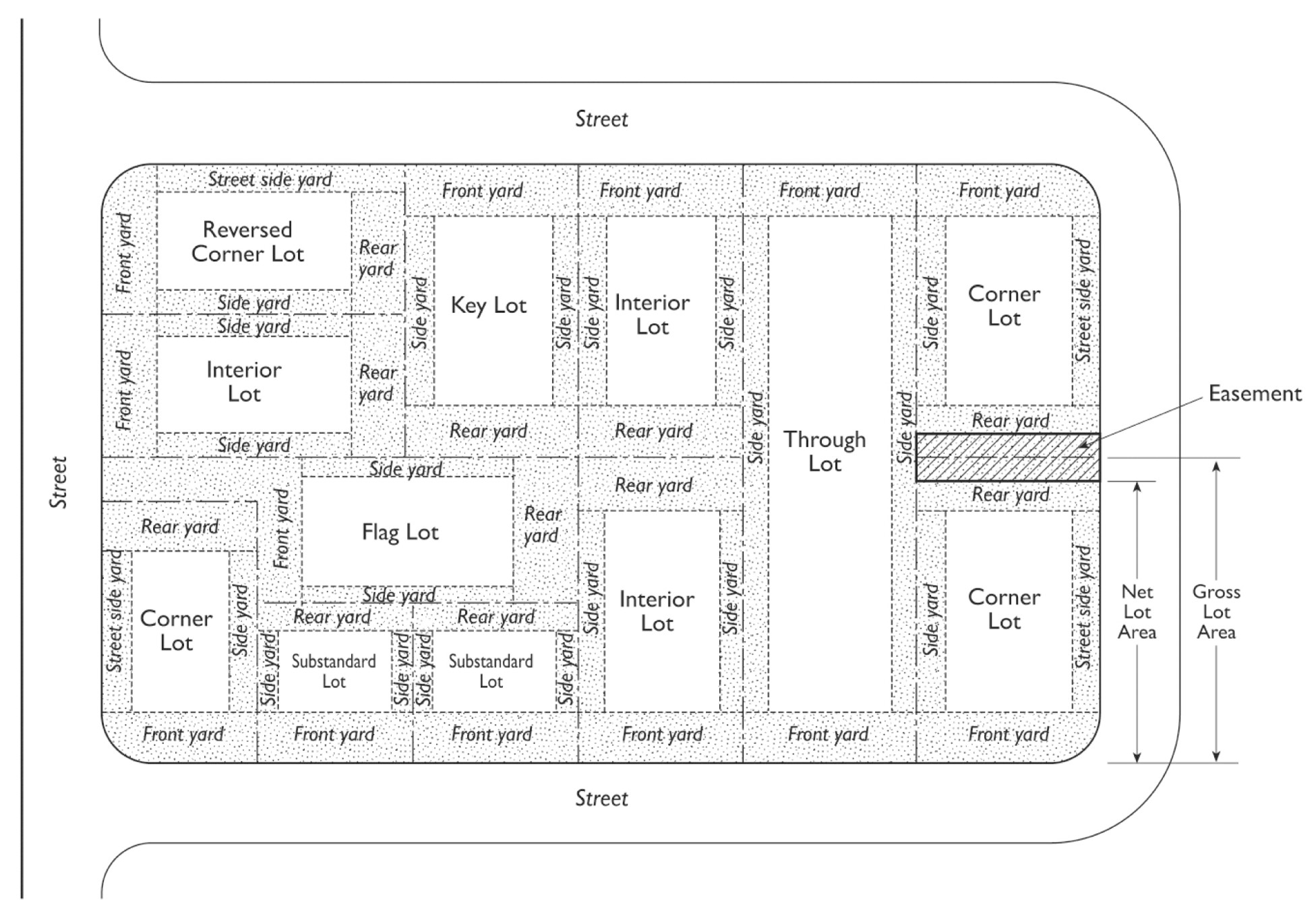
Lot Area. Also see Figure 17.148.020(1), Lot Types and Features
Gross lot area means gross lot area is the total area included within the lot lines of a lot, exclusive of adjacent dedicated street rights-of-way.
Net lot area means net lot area is the gross lot area, excluding dedications and easements that are not for the exclusive use of the lot on which the dedication or easement is located.
Lot coverage means the percentage of gross lot area, exclusive of any required dedications, occupied by structures, decks, driveways and parking areas (regardless of driveway material), walkways, and all impervious surfaces. When calculating site coverage of a structure or building, the exterior walls of the structure or building at ground level should be used. The following features may be excluded from lot coverage calculations:
1.
Eaves;
2.
50 percent of the area of covered and uncovered decks that are at least eight feet above grade;
3.
Paving materials used for landscape purposes that are more than 50 percent porous (driveways and parking areas are counted 100 percent towards lot coverage regardless of material);
4.
50 percent of the area of covered and uncovered decks that are at least eight feet above grade;
5.
Subterranean or podium structures topped by landscaped open space areas of at least ten feet by ten feet by four feet deep; and
6.
Impervious pads for propane tanks and generators not exceeding 60 square feet for propane tanks and 20 square feet for generators.
Lot depth means the average linear distance between the front and the rear lot lines or the intersection of the two side lot lines if there is no rear line. The Director shall determine lot depth for parcels of irregular configuration. Also see Figure 17.148.020(3).
Lot line or property line means any recorded boundary of a lot. Also see Figure 17.148.020(1) and Figure 17.148.020(2).
Front lot line means:
(i)
On an interior lot, the front lot line is the property line separating the parcel from the street.
(ii)
On a corner lot, the front lot line is the shorter property line abutting a street. If the street-fronting lot lines of a corner lot are equal in length, the front lot line shall be determined by the Director.
(iii)
On a through lot, both lot lines are front lot lines and the lot is considered to have no rear lot line.
Rear lot line means a property line that does not intersect the front lot line, which is most distant from and most closely parallel to the front lot line.
(i)
In the case of an irregular-shaped lot, the rear lot line is an imaginary line within the lot, parallel to and at a maximum distance from the front lot line, having a minimum length of ten feet.
(ii)
A through lot or a lot bounded by streets on all sides may have no rear lot line.
Side lot line means any lot line that is not a front lot line or rear lot line.
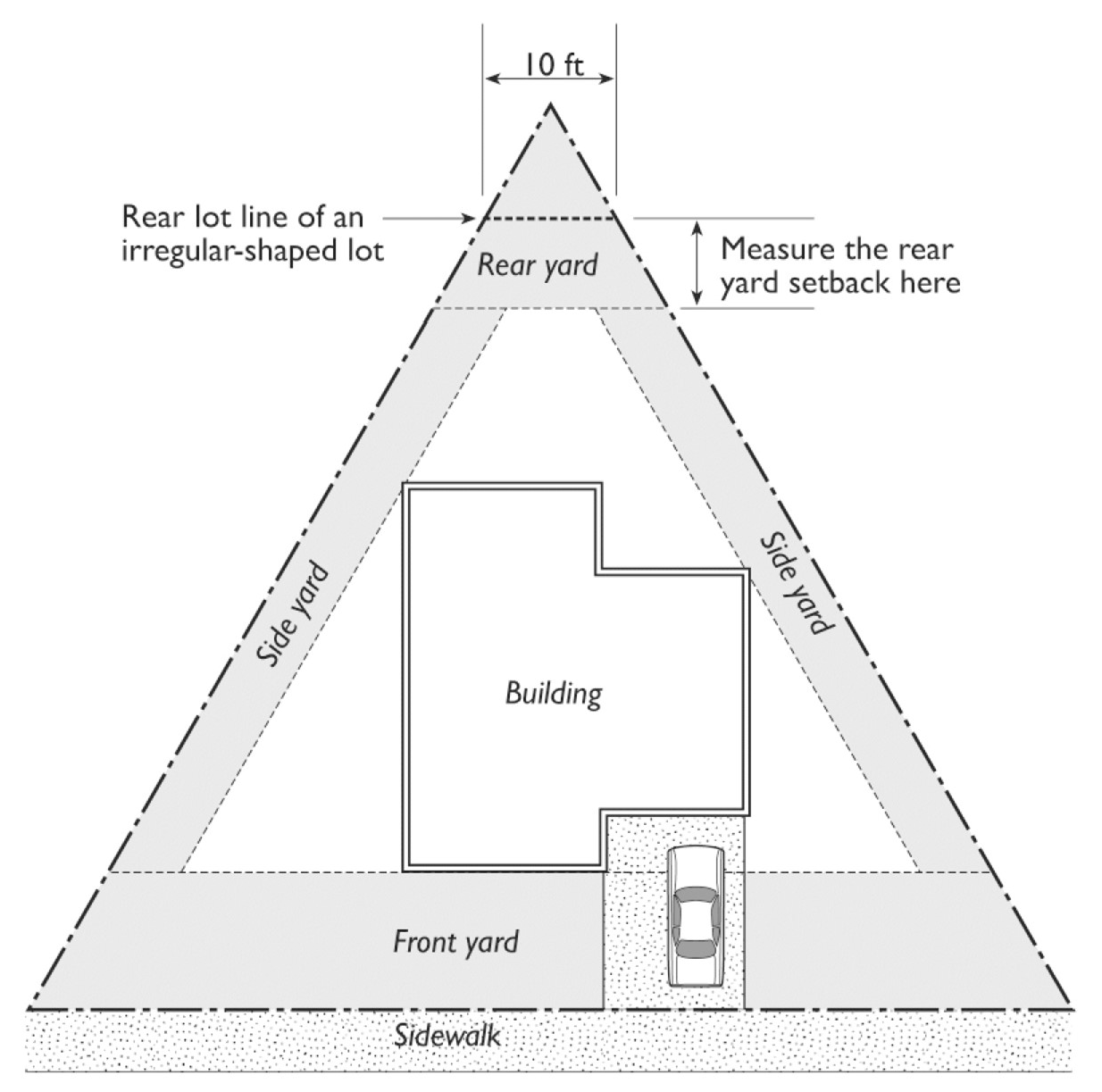
Lot width means the horizontal distance between the side lot lines, measured at right angles to the lot depth at a point midway between the front and rear lot lines. The Director shall determine lot width for parcels of irregular shape.
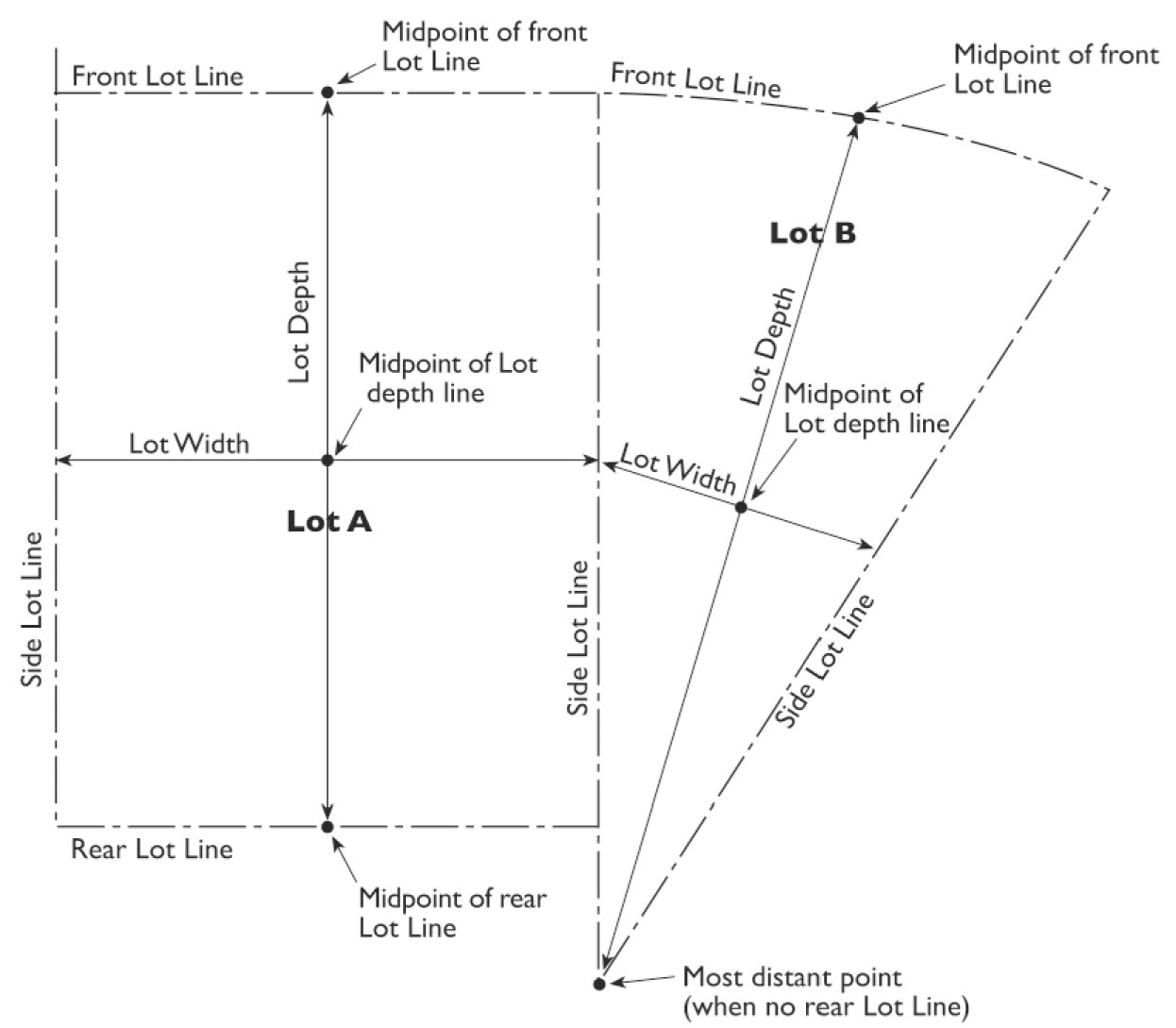
Low income household means a household whose income does not exceed the qualifying limits set for "lower income households" in Health and Safety Code § 50079.5.
Maintenance. See Routine maintenance.
Manufacture means compound, blend, extract, infuse, or otherwise make or prepare a cannabis product.
Manufacturer means a permittee that produces, prepares, propagates, or compounds manufactured cannabis products either directly or indirectly or by extraction methods, or independently by means of chemical synthesis or by a combination of extraction and chemical synthesis at a fixed location.
Map Act. See Subdivision Map Act, Government Code § 66410 et seq.
Market rate unit means new living units in residential or lodging projects which are not below market rate units as defined in this chapter.
May. The term "may" is permissive or not required.
Mixed-use development means a project which includes two or more categories of land use such as residential and commercial in the same building or on the same site. Single residential units that are a part of a commercial building and are secondary to the primary commercial use are allowed, pursuant to the standards in Section 17.52.170.
Mobilehome means a trailer, transportable in one or more sections, that is designed for use as a dwelling and as defined under State law. A mobilehome on a permanent foundation is included under the term "dwelling, single-family."
Mobile vending vehicle means any motorized vehicle from which goods, services, wares, merchandise, fruits, vegetables or foodstuffs are sold, displayed, solicited or offered for sale or bartered or exchanged on private property or within the public right-of-way; does not qualify as outdoor dining.
Mobile vendor means any person in charge of or operating any mobile vending vehicle or vendor cart/stand either as agent, employee, or otherwise under the direction of the owner.
Model home means a dwelling unit used initially for display purposes which typifies the type of units that will be constructed in the subdivision. There shall only be one model home of each floor plan except that a multiple unit structure, up to a four-plex, containing duplicates of one or more floor plans may be considered as model homes. Structures containing more than four units shall not be considered model homes.
Moderate income household means a household whose income does not exceed the qualifying limits set for persons and families of low- or moderate-income in Health and Safety Code § 50093.
Multimodal means transportation infrastructure that supports travel by modes other than by personal vehicle, such as sidewalks, transit, or bicycle lanes. May also be referred to as alternative transportation.
Negative declaration means a negative declaration as defined by the California Environmental Quality Act, Public Resources Code § 21000 et seq.
Net lot area. See Lot area.
Nonconforming lot or parcel means a lot or parcel that was legally created before the of the ordinance or amendment from which this chapter is derived, but does not comply with the current access, area, width, depth, or other applicable requirements of this chapter.
Nonconforming structure means a structure that was legally constructed before the adoption or amendment of the ordinance from which this chapter is derived, but does not comply with the current setback, height limit, building separation, or other applicable requirements of this chapter.
Nonconforming use means a use of land or a use within a conforming or nonconforming structure that was legally established and maintained before the adoption or amendment of the ordinance from which this chapter is derived but does not conform to the current chapter requirements for allowable land uses within the applicable zone.
Nonvolatile solvents means any solvent used in the extraction process that is not a volatile solvent and includes carbon dioxide and ethanol.
Nursery means a facility that produces only clones, immature plants, seeds, and other agricultural products used specifically for the propagation and cultivation of cannabis.
Off-site means an activity or accessory use that is related to a specific primary use but is not located on the same site as the primary use.
On-site means located on the same lot or, if in a master plan or specific plan, within the same master or specific plan area.
Opaque exit packaging means an opaque bag, box, or similar container provided by the retailer, in which purchased cannabis or cannabis products are placed prior to departing the store.
Open space means land that is maintained in a primarily natural state, or primarily without structures other than facilities to support outdoor passive or active recreation.
Open space, private, means an area of a developed residential multifamily project site that is contiguous to and directly accessible from an individual dwelling unit, which is available for active or passive recreation uses by the inhabitants of the dwelling unit, and which is open on top or on at least one side (e.g., balcony, deck, patio, etc.).
Ordinary high water mark means the line on the shore established by the fluctuations of water and indicated by physical characteristics such as a clear, natural line impressed on the bank, shelving, changes in the character of soil, destruction of terrestrial vegetation, the presence of litter and debris, or other appropriate means that consider the characteristics of the surrounding areas. See Top of creek bank.
Outdoor dining means an unenclosed dining area, including tables and chairs, accessory and incidental to a restaurant; does not include mobile vending vehicles or vendor carts/stands (see Mobile vending vehicle and Vendor cart/stand).
Outdoor display and sales means the permanent or temporary outdoor display of merchandise incidental to an adjacent indoor retail use, and certain independent outdoor retail sales facilities, including parking lot sales; does not include vendor carts/stands (See Vendor cart/stand).
Outdoor storage. See Storage, outdoor.
Overlay zone means a land use designation which due to special circumstances necessitates the imposition of developmental requirements in addition to those required by the underlying zoning.
Owner means an owner shall mean any of the following:
(1)
A person with an aggregate ownership interest of 20 percent or more in the person applying for a permit or a permittee, unless the interest is solely a security, lien, or encumbrance;
(2)
The chief executive officer of a nonprofit or other entity; or
(3)
An individual who will be participating in the direction, control or management of the person applying for a permit.
Parapet means a low wall projecting from the edge of a platform, terrace, or roof.
Parcel. See Lot or Parcel.
Parking, bicycle. See Bicycle parking.
Parking, covered, means parking spaces located within or under a building, including a garage or carport.
Parking, enclosed means parking spaces located entirely within a structure with walls on all sides except for the entry to the parking space that shall be provided with a door. Understructure enclosed parking facilities for five or more vehicles are not required to have an entry door.
Parking, in-lieu fee, means a fee paid to satisfy parking requirements in lieu of providing physical parking spaces.
Parking, off-site, means parking that is required by Section 17.44.030 that is not provided on the site for which the parking is required. Off-site parking shall meet the requirements of Section 17.44.040(1)b.
Parking, off-street, means parking that is not provided on a street or within street right-of-way and is typically provided on private or public property in the form of a parking lot or structure.
Parking, on-site, means parking that is required by Section 17.44.030 that is provided on the site for which the parking is required.
Parking, on-street, means parking that is provided on a street or within street right-of-way. On-street parking is typically unreserved, but may be time-limited, particularly in resort or commercial areas. On-street parking is intended to be utilized by customers or residents of the business or property fronting the street.
Parking, shared, means parking spaces that are shared between two or more uses that are on the same site or on different sites (off-site). Shared parking typically allows for a reduction in the number of total parking spaces required because parking is used more efficiently between uses.
Parking space means an accessible space within a public or private parking area for the parking of one motor vehicle.
Parking, surface, means parking that is not provided within a parking structure.
Parking, tandem, means parking of two or more vehicles, one in front of the other, in a single parking space.
Parking, underground, means parking that is provided within a structure that is primarily underground. On slopes of ten percent or less, 70 percent of the structure is required to be below existing grade to be considered underground. On slopes of more than ten percent, 50 percent of the structure is required to be below existing grade to be considered underground.
Parking, understructure, means parking that is located below a structure but not underground.
Permanent lake or stream means any lake, river, stream, pond, or other body of water or waterway which, most years, under natural conditions, will contain water all year.
Permittee means a person issued a Town permit pursuant to Chapter 5.38.
Person means any individual, firm, partnership, joint venture, association, corporation, limited liability company, estate, trust, business trust, receiver, syndicate, or any other group or combination acting as a unit, and the plural as well as the singular. The term "person" also means any joint stock association; Town, County, State, or district; and includes any trustee, receiver, assignee, or other similar representative thereof.
Physician's recommendation means a recommendation by a physician that a patient use cannabis provided in accordance with the Compassionate Use Act of 1996, Health and Safety Code § 11362.5.
Planned residential development means a project planned and developed as a whole in a single development operation or a programmed series of operations in accordance with a detailed, comprehensive plans encompassing such elements as circulation patterns and parking, open space, recreational areas, utilities and lots or building sites together with a program for provision, operation, and maintenance of all areas, improvements, facilities and services provided for the common use of the residents of the development. In general, a planned residential development should have a minimum of 20 residential units.
Planning and Economic Development Commission. See Commission.
Plant, dried flower, means all dead cannabis plant that has been harvested, dried, cured, or otherwise processed, excluding leaves and stems.
Plant, flowering, means a cannabis plant that has formed a mass of pistils measuring greater than one-half inch wide at its widest point.
Plant, immature, means a cannabis plant that is not flowering.
Plant, live, means living cannabis flowers and plants, including seeds, immature plants, and vegetative stage plants.
Plant, mature, means a cannabis plant that is flowering.
Plot plan. See Site plan.
Porch means a covered but otherwise open platform that provides a transition between the interior of a building and the public space of the street.
Premises means the designated structure or structures and land specified in the application that is owned, leased, or otherwise held under the control of the applicant or permittee where the commercial cannabis activity will be or is conducted.
Primary caregiver has the same meaning as in Health and Safety Code § 11362.5. A person asserting primary caregiver status must establish by written documentation that such person:
(1)
Has been designated as such by the medicinal cannabis patient; and
(2)
Is a person who has consistent assumed responsibility for the housing, health, or safety of the patient.
Property owner means the individual or entity who is the record owner of the subject property or premises where commercial cannabis activities are located or are proposed to be located.
Public park means an area created, established, designated, or maintained by the Town for public play, recreation, or enjoyment or for the protection of natural resources and features at the site.
Primary structure means a structure that accommodates the primary use of the site.
Primary use means the main purpose for which a site is developed and occupied; also, principal use.
Property means a piece of land often with buildings on it that is owned by a person, business, etc.
Property line. See Lot line or Property line.
Property owner means the persons or entity to whom property tax is assessed, as shown on the latest equalized assessment roll of the County.
Proposed project means a proposed new structure, new addition or alteration to an existing structure or site, or area of other new site development. See also Development.
Public building and uses means public agency (including special district) facilities.
Qualified patient has the same meaning as in Health and Safety Code § 11362.5.
Recreational vehicle (RV) means a motor home, travel trailer, truck camper, carryall, or camp trailer, house car, with or without motive power, originally designed for human habitation for recreational, emergency, or other occupancy.
Replacement value means the amount that an owner would have to pay to replace a structure or use at the present time. This value can be determined based on information from an insurance company, or other information that may be deemed appropriate by the Director to determine the current value of a use or structure.
Retail area means a building, room, or other area that is open to the public, upon the retailer premises in which cannabis goods are sold or displayed.
Retailer means a facility where cannabis, cannabis products, or devices for the use of cannabis or cannabis products are offered, either individually, or in any combination for retail sale.
Review authority means the individual or official Town body (e.g., the Community and Economic Development Director, Planning and Economic Development Commission, or Town Council) identified by this chapter as having the responsibility and authority to review and approve or disapprove a permit application.
Roof-mounted means mounted above the eave line of a structure.
Routine maintenance means normal site or structure repair and maintenance include the following:
New construction not included means normal site or structure repair and maintenance does not include the following: New on-site construction, additions to existing structures, or grading and paving for a new or expanded parking area.
Site means repair or replace on-site items such as the following: Fences or walls; landscaping, including the planting of new ground cover, shrubs, and trees; striping of parking and circulation areas; or service facilities (drainage, irrigation components, and utility service connections); exterior painting, stuccoing, or texture coating.
Structure means repair or replace items such as the following: Exterior doors, siding, windows, roofs, decks, service connections, or sewer/water system.
Setback means the distance by which a structure, parking area, or other development feature must be separated from a lot line. Setbacks for properties fronting on substandard streets are measured from the ultimate right-of-way line based upon the adopted road standards of the Town or, if in a community services district, the standards of the district (i.e., measured from the property line after the required street right-of-way dedication).
Setback, front yard, means a line parallel to the front lot line at a distance required by the zone in which the property is located.
Setback, rear yard, means a line parallel to the rear lot line at a distance required by the zone in which the property is located or by the California Building Standards Code, whichever is greater.
Setback, side yard, means a line parallel to the side lot line at a distance required by the zone in which the property is located or by the California Building Standards Code, whichever is greater.
Sidewalk vendor means a person who sells food or merchandise from a vendor cart/stand, or from one's person, upon a public sidewalk, pedestrian path, or other public place.
Sign means the following terms are defined for the purposes of Chapter 17.48:
Abandoned sign means any lawfully erected sign that, for a period of 90 days or more, no longer advertises or identifies an on-going business, activity, product, service, or other use available on the premises where the sign is located.
Awning means a projecting structure, consisting of a frame and a material covering, attached to and wholly supported by a wall of a building and installed over and partially in front of doors, windows, or other openings in a building; also, a canopy.
Awning sign means any sign copy displayed on an awning.
Banner means any flexible device used to advertise, draw attention, or relay a message, typically displayed outdoors. A banner is only allowed for use as a temporary sign.
Business frontage means the width of a building occupied by a single business tenant, that fronts on a public street or faces a plaza, courtyard, pedestrian corridor or walkway, parking lot, or alley, where customer access to the building is available. Width is measured as the widest point on an architectural elevation.
Changeable copy sign means a sign with a message comprised of letters, numbers, or other characters that are designed to be manually or mechanically changed to display different messages. A changeable copy sign does not include internally lit or electronic message signs.
Community event sign means any sign identifying or communicating information about any type of race, parade, show, competition, special or temporary event, or community activity to which the general public is invited.
Community information sign means a community information sign publicizes only community events and conditions (e.g., weather, road conditions, and other safety information), and is not used to identify or advertise products or businesses. A community information sign is operated or maintained by the Town in coordination with other public agencies for public health, safety, and general welfare. A community information sign may be an electronic message sign, a sign with a changeable copy, or other type of sign as allowed by Chapter 17.48.
Decorative flag means any flag which displays any holiday, season, design, or the like which does not include any commercial name, message, logo, or symbol.
Directional sign means a sign designed and erected solely for the purposes of directing vehicular or pedestrian traffic from an entry or exit point, or to or from various points of passage on or within a private property (e.g., "entrance," "exit," "deliveries in rear," "one-way," "fire lane," and "no parking").
Double-faced sign means a sign constructed to display its message on the outer surfaces of two identical and parallel planes.
Drive-up menu board means a drive-up menu board is for the convenience of customers of drive-through businesses and not for advertising. Drive-up menu boards shall only display products available for sale and the prices of those products.
Electronic message sign means a sign with a fixed or changing display composed of a series of lights that are electronically changed to display different messages.
Governmental sign means erected by or on behalf of the Town or other public entity to post legal notices, identify public property, convey public information, or direct or regulate pedestrian, bicycle, or vehicular traffic. Signs of a public utility or transit company regarding its poles, lines, pipes, facilities, or routes, and emergency warning signs erected by the Town or other public entity, a public utility company, or contractor doing authorized or permitted work on public property, are considered governmental signs.
Ground level business means a business where the main pedestrian entrance is accessed directly from a street, sidewalk, surface parking lot, or plaza.
Halo-lit sign means a sign illuminated by concealing the light source behind three-dimensional opaque letters, numbers, or other characters of a sign, resulting in the nighttime perception of a halo around the silhouette of each sign character.
Hanging sign means a sign attached to and located below any eave, roof, canopy, awning, or wall bracket.
Illegal sign means any sign erected without complying with all ordinances and regulations in effect at the time of its construction and erection or use.
Indirect lighting means lighting that is not an integral part of the sign, usually directed on the sign from a different location (e.g., gooseneck lighting, etc.) in compliance with Section 17.48.080(5).
Informational sign means a sign used to provide information, including signs indicating hours of operation, and such signs as "open," "closed," "no smoking," "no solicitors," current credit card signs, telephone number, trade association emblems, and signs of similar purpose.
Institutional sign means a sign used to provide information related to a public, quasi-public, or nonprofit use such as a school, library, hospital, or church.
Internally illuminated sign means a sign with a light source located in the interior of the sign so the light shines through the face of the sign, or with a light source which is attached to the face of the sign and is perceived as a design element of the sign.
Master sign program means a sign plan which specifies the number, size, description, and location of all signs located or to be located on the property.
Menu display box means a freestanding or wall sign enclosed in glass or other transparent material for the purpose of displaying menus oriented to pedestrians.
Monument sign means an independent, freestanding sign that is displayed on and totally supported by one or more support elements that are on the ground, with no part of the sign attached to a building or similar structure.
Multitenant center identification sign means a sign stating the name of the multitenant property and not advertising any particular business or product.
Multitenant property means a building or property consisting of two or more separate businesses that share either the same property or structure and use common access and parking facilities.
Neon sign means any sign illuminated by or utilizing in any way tubes filled with neon or related inert gases, or products that produce the same or similar effect as neon, such as flexible light-emitting diode (LED) neon-like tubing.
Nonconforming sign means any permanent or temporary sign, including structural supports, which was lawfully erected and maintained, but does not comply with the requirements of Chapter 17.48.
Off-site sign means any sign identifying a use, facility, service, or product which is not located, sold, or manufactured on the same premises as the sign.
Pedestrian-oriented sign means a sign designed and directed toward pedestrians; typically, a small hanging or projecting sign legible to pedestrians adjacent to the structure.
Political sign means a sign for the purpose of advocating a political party, platform, ideology, or candidate or proposition for a public election.
Portable sign means any sign or advertising device that rests on the ground and is not designed to be permanently attached to a building or permanently anchored to the ground, including, but not limited to, A-frame or sandwich board signs. Portable signs do not include pole or wooden post signs.
Projecting sign means a sign projecting six inches or more from a wall or building that is supported by a wall or building with the display surface of the sign perpendicular to the building wall.
Real estate development sign means a temporary sign used to identify a proposed real estate development or the owners, architects, contractors, real estate agent, or lenders involved with a development for which a valid land use permit has been approved, but which is not under construction. Sale and lease information may be included on such a sign.
Real estate open house sign means an on-site or off-site sign identifying a residence for sale when the residence is open for view to the public, and when the seller or seller's agent is at the residence.
Real estate sign means a temporary sign indicating the availability of land, property, or building for sale, lease, rent, or other permanent or temporary disposition, not, including a real estate development sign or site construction sign.
Reflective surface means any shiny material or device reflecting light and creating glare.
Residential nameplate means a sign for the sole purpose of identifying the inhabitants of a residential structure or the house name, which does not contain any form of advertising or business identification (e.g., "The Wilson's"). Residential nameplates do not include addressing as required by Chapter 16.08.
Roof sign means a sign constructed upon or over a roof or placed so that any portion of the sign extends above the edge of the roof.
Sign means any emblem, icon, insignia, logo, replica, symbol, or trademark that displays a message in lettered, written, numbered, pictorial, or any other visual perceptible form, and, including the support elements, all component parts, and illumination, which is used or intended to be used to advertise a property, product or service, or to convey a message of any sort, and which is visible by the general public from any public right-of-way or any public area. "Visible" means capable of being seen, whether or not capable of being read. A sign does not include signs or displays located entirely inside of a structure and not clearly visible from public view or works of art not used to advertise or identify any business or product.
Sign copy means all portions of a sign displaying a message, including text and symbols, not, including the supporting structure or base of a sign.
Site construction sign means a temporary sign used to identify a real estate development which is under construction, or the owners, architects, contractors, real estate agents, or lenders involved with the development. Sales and lease information may be included on such signs.
Support element means the structural portion of a sign securing the sign to the ground, a building, or to another structure.
Temporary sign means a sign which is intended for a definite and limited period of display and which is not permanently affixed to a structure, sign area, or window.
Tenant directory sign means a sign for listing the tenants and their suite numbers or addresses in a multiple tenant structure or center.
Theater sign means a sign displaying current or coming movies, plays, concerts, performances, or other programs to the public, which may utilize changeable copy.
Vehicle station fuel price sign means price sign for gasoline stations or businesses that sell motor vehicle fuel to the public.
Walking sign means any commercial sign, including sandwich board type signs or costumed characters, which is held or supported by a person and visible from a public right-of-way or public area. Walking signs do not include writing or commercial logos on normal clothing.
Wall sign means any sign that is displayed on or attached to an exterior wall of a building or structure, with the sign parallel to, and not projecting more than six inches from, the wall.
Wayfinding sign means a sign constructed or authorized by the Town to direct persons to specific districts, destinations, or facilities. Wayfinding signs also include kiosks or similar information stands intended to be a convenience for the traveling and visiting public as approved and authorized by the Town.
Window area means window area shall include perimeter window frames, mullions, and glass doors located on the ground level and second story of a business frontage.
Window sign means any permanent or temporary sign displayed on the surface of any glass or glazed material (e.g., window or door) in any way and exposed to public view, not, including merchandise included in window displays. Window signs shall not include common wall windows on the inside of a building not visible by the general public from any public right-of-way or any public area.
Works of art means an artistic creation such as a painting, sculpture, architecture, landscape design, mural, and other objects. Works of art not used to advertise or identify any business or product are not considered a sign.
Single dwelling means a building designed for or occupied exclusively by one housekeeping unit. Such building also includes factory-built, modular housing units, constructed in compliance with the California Building Standards Code, and mobilehomes/manufactured housing units that comply with the National Manufactured Housing Construction and Safety Standards Act of 1974, placed on permanent foundation systems.
Site means a parcel or adjoining parcels under single ownership or single control, considered a unit for the purposes of development or other use.
Site plan means a plan, prepared to scale, showing accurately and with complete dimensioning, all of the buildings, structures, and uses in an exact manner of development proposed for a specific parcel of land.
Sleeping area means any bedroom, loft, or other space that can be equipped with beds, foldout sofas, or other similar sleeping furniture.
Slope means a comparison of the vertical rise of a property to its horizontal run, expressed as a percentage.
Calculating average slope means lot slope is calculated as an average slope of the ground area within the required setback lines (buildable area) for primary structures on a site. Lot slope is based on existing grade. The elevations of the points where required setback lines intersect are used to determine the average elevation of each setback line. Specifically, the average elevation of each setback line is calculated by adding the elevations at the line's intersection points and dividing by two. The average lot slope is then calculated by subtracting the average elevation of the most uphill setback line and the average elevation of the most downhill setback line and dividing the sum by the average distance between these two setback lines. Where required setback lines do not intersect to form a four-sided polygon, average lot slope shall be calculated by dividing the difference between the elevations of the highest and lowest points within the buildable area by the horizontal distance between said points.
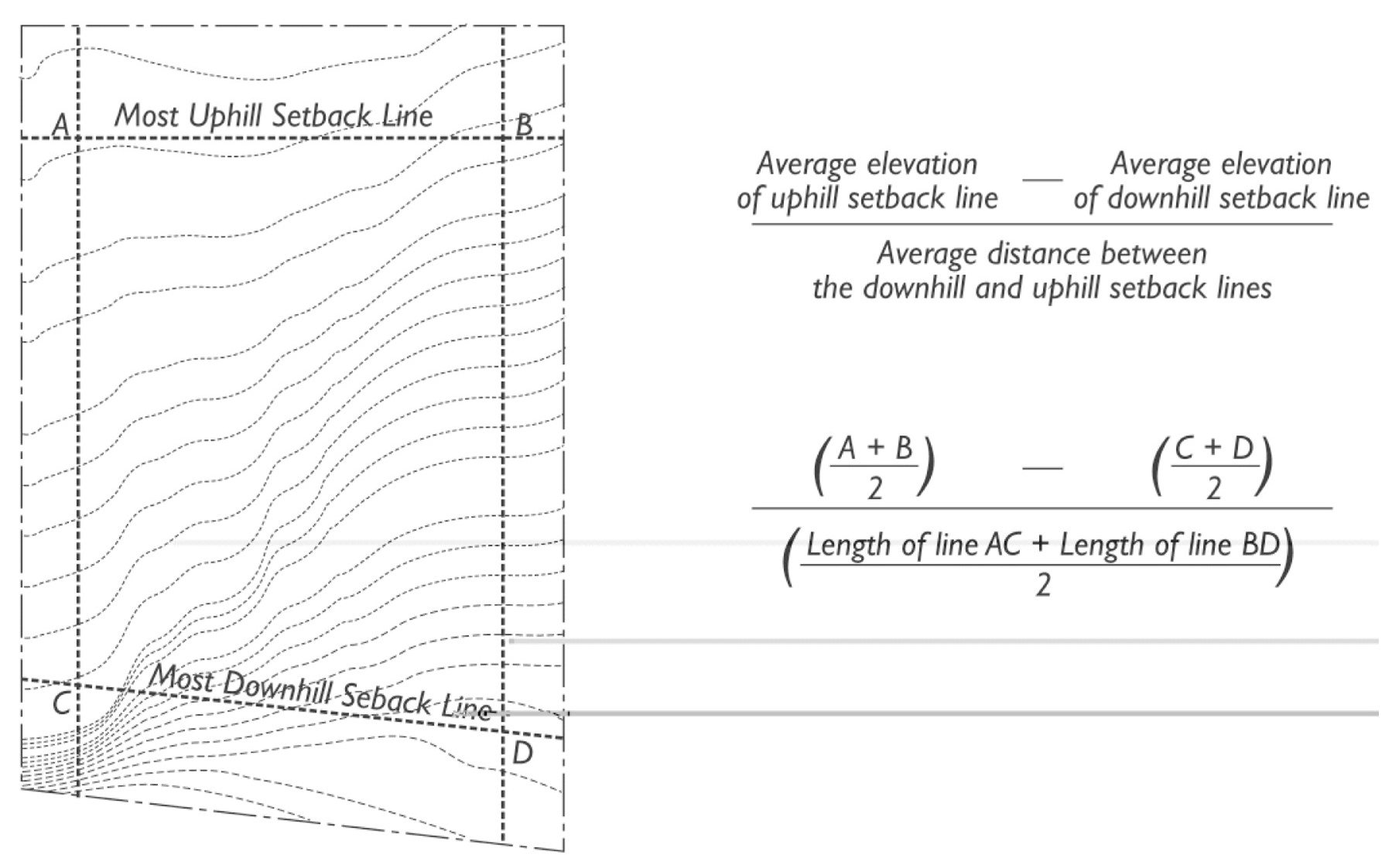
Snow storage area means areas designated to accommodate and store snow.
Special event or festival means a temporary use such as a circus, carnival, music festival, outdoor art and craft shows and exhibits, and similar amusement or entertainment activities; may include sporting events (e.g., running races, bicycle events, fishing tournaments, and similar activities); does not include "outdoor display and sales."
Specific plan. See Chapter 17.112.
Sport court means a basketball, handball, squash, tennis, volleyball, or similar outdoor facility for playing a participant sport. Does not include a basketball hoop on the front of a garage.
State license means a State license issued pursuant to Business and Professions Code § 26000 et seq.
State means the State of California.
Storage, outdoor, means the storage of various materials outside of a structure other than fencing, either as an accessory or primary use.
Street means a thoroughfare, right-of-way, or easement, public or private, which affords principal means of access to abutting property, including alley, avenue, place, way, drive, lane, boulevard, highway, road, and any other thoroughfare; includes the entire right-of-way or easement and offers of dedication; does not include easements granted exclusively for pedestrian or non-vehicle use or an easement across a single parcel for the purpose of access to no more than one abutting lot.
Street wall means the portion of a building facade that faces the street.
Structural alteration means any change in or alteration to a structure involving a bearing wall, column, beam or girder, floor or ceiling joists, roof rafters, roof diaphragms, foundations, piles, retaining walls, or similar components. Also see Altered.
Structure means anything constructed or erected, the use of which requires attachment to the ground, attachment to something located on the ground, or placement on the ground. For the purposes of this chapter, the term "structure" includes "buildings" but does not include cargo containers or swimming pools.
Structure, primary. See Primary structure.
Subdivision means the division, by any subdivider, of any unit or units of improved or unimproved land, or any portion thereof, shown on the latest equalized the County assessment roll as a unit or as contiguous units, for the purpose of sale, lease or financing, whether immediate or future. Property shall be considered as contiguous units, even if it is separated by roads, streets, utility easement or railroad rights-of-way.
Final map means a subdivision map prepared and approved in compliance with the Map Act that is used to complete the subdivision of five or more parcels, five or more condominiums, and other projects per Government Code § 66426.
Lot line adjustment means as provided by Government Code § 66412(d), a lot line adjustment relocates one or more lot lines between two or more existing adjacent parcels, where land taken from one parcel is added to an adjacent parcel and where no more parcels are created than originally existed.
Parcel map means the subdivision map required to complete a subdivision of four or fewer lots.
Subdivision improvements means subdivision improvements include streets, storm drainage facilities, sanitary sewers, water supply facilities, electric lines, and gas lines.
Subdivision Map Act, or Map Act means subdivision Map Act, Government Code § 66410 et seq.
Tentative map means a map made for the purpose of showing the design and improvement of a proposed subdivision and the existing conditions in and around it. A tentative map is required for all subdivisions creating five or more parcels, five or more condominiums, and other projects per Government Code § 66426.
Vesting tentative map means a map that is filed and processed in the same manner as a tentative map except as otherwise provided by the State Map Act.
Tamper-evident packaging means packaging with a one-time-use seal that is affixed to the opening of the package, allowing a person to recognize whether or not the package has been opened.
Target population means persons with low-incomes who have one or more disabilities, including mental illness, HIV or AIDS, substance abuse, or other chronic health condition, or individuals eligible for services provided pursuant to the Lanterman Developmental Disabilities Services Act, Welfare and Institutions Code Div. 4.5 (Welfare and Institutions Code § 4500 et seq.), and may include, among other populations, adults, emancipated minors, families with children, elderly persons, young adults aging out of the foster care system, individuals exiting from institutional settings, veterans, and homeless people.
Temporary State license means a temporary license issued pursuant to the California Code of Regulations which allow commercial cannabis activities for a period of 120 days from the effective date of the State emergency regulations (i.e., January 1, 2018).
Temporary structure means a structure, typically without any foundation or footings, and which is required to be removed when the designated time period, activity, or use for which the temporary structure was erected has ceased.
Temporary use means a land use that is designed, operated, and occupies a site for a limited time. See Chapter 17.56.
Tester means a permittee that engages in the testing of cannabis products in a licensed testing laboratory and does not hold any other license for a cannabis activity.
Testing laboratory means a facility, entity, or site in the State that offers or performs tests of cannabis or cannabis products and that is accredited by an accrediting body that is independent from all other persons involved in the cannabis industry in the State.
THC means the compound tetrahydrocannabinol.
Timeshare development. See Fractional or timeshare development.
Top of creek bank means the uppermost ground elevation paralleling a creek or watercourse where the gradient changes from a more defined vertical component to more horizontal. Also see Ordinary high water mark.
Town council means the Town Council, referred to in this chapter as the "Council."
Town Density Bonus means a density increase for eligible multifamily residential projects over the otherwise maximum allowable residential density under the applicable zone and designation of the land use element in accordance with the provisions of Chapter 17.136.
Track-and-trace system means the State approved system used to track commercial cannabis activity and movement.
Transient occupancy means as defined per Section 3.12.020, but shall generally mean the occupation of a structure, or portion of a structure, intended or designed for occupancy by persons for purposes of sleeping, lodging, or similar reasons for a period of 30 consecutive days or less in exchange for a fee or similar consideration.
Transient Occupancy Tax means the tax imposed pursuant to Chapter 3.12.
Transport means the transfer of cannabis or cannabis products between licensees.
Transportation demand management (TDM) means various strategies to efficiently manage the demand for transportation resources such as roadway capacity and parking.
Tree means a live, tall woody plant, with a single main trunk or stem of a diameter at breast height (DBH) of six inches or greater.
Tree removal means cutting a tree to the ground, extraction of a tree, or killing of a tree by spraying, girdling, damaging the roots of a tree, or any other means. Tree maintenance, such as the trimming or thinning of branches is not considered to be "removal."
Underground parking. See Parking, underground.
Understructure parking. See Parking, understructure.
Unique identifier means an alphanumeric Code or designation used for reference to a specific plant on a licensed premises and any cannabis or cannabis product derived or manufactured from that plant. Also referred to as a "UID."
Unit means one individual residence, whether in a single-family or multiple-family development.
Use. See Land use.
Use permit. See Chapter 17.68.
Use, primary. See Primary use.
Variance. See Chapter 17.72.
Vendor cart/stand means a temporary non-motorized cart, stand, display, wagon, showcase, rack, or other non-motorized conveyance from which goods, services, wares, merchandise, fruits, vegetables or foodstuffs are sold, displayed, solicited or offered for sale or bartered or exchanged without any outdoor seating; does not qualify as "outdoor dining."
Very low-income household means a household whose income does not exceed the qualifying limits set for very low-income households in Health and Safety Code § 50105.
Vesting tentative map. See Subdivision.
Volatile solvents means any solvent that is or produces a flammable gas or vapor that, when present in the air in sufficient quantities, will create explosive or ignitable mixtures. Examples of volatile solvents include, but are not limited to, butane, hexane, and propane.
Wing wall means a wall that extends from an exterior building wall; is architecturally integrated into the design of the building to which it is attached and which has the effect of partially or entirely fencing an outdoor area.
Yard means an area between a lot line and a setback, unobstructed and unoccupied from the ground upward, except as otherwise permitted by this chapter. A yard area includes any setback required by the applicable zoning district. See also Setback.
Yard, front, means an area extending across the full width of the lot between the front lot line and the required setback.
Yard, rear, means an area extending the full width of the lot between a rear lot line and the required setback.
Yard, side, means an area between a side lot line and the required setback extending between the front and rear yards.
Youth center has the same meaning as in Health and Safety Code § 11353.1.
Zero lot line means the location of a building on a lot in such a manner that one or more building sides rests directly on a lot line.
Zoning district means any district established by Chapter 17.16, within which certain land uses are allowed or prohibited, and certain site planning and development standards are established (e.g., setbacks, height limits, site coverage requirements, etc.). Also referred to as "zone."
(Code 1990, § 17.148.020; Ord. No. 14-02, § 4, 3-19-2014; Ord. No. 15-01, § 4(exh. A, §§ 23—26), 1-21-2015; Ord. No. 15-02, § 4(exh. A), 3-4-2015; Ord. No. 15-03, § 4d(exh. B), 6-3-2015; Ord. No. 16-07, § 4(exh. A), 9-21-2016; Ord. No. 18-02, § 5(exh. A, i.), 3-13-2018; Ord. No. 19-04, § 4(exh. A, g.), 11-6-2019; Ord. No. 20-02, § 4(exh. A, c), 3-18-2020; Ord. No. 20-13, exh. A(f), 11-18-2020; Ord. No. 21-01, § 4.c.(exh. 2), 1-20-2021; Ord. No. 2021-03, § 4(exh. B, § k.), 3-3-2021)

