
Manassas City Zoning Code
ARTICLE III
GENERAL REGULATIONS3
Editor's note—Ord. No. O-2015-15, § 1, adopted May 11, 2015, amended Art. III in its entirety to read as herein set out. Former Art. III, §§ 130-72—130-97, pertained to similar subject matter, and derived from Code 1978, §§ 34.1-32—34.1-44.2; Ord. No. O-2001-29, §§ 34.1-33, 34.1-44.3, adopted June 18, 2001; Ord. No. O-2002-21, § 34.1-44.5, adopted Feb. 26, 2002; Ord. No. O-2002-22, § 34.1-44.4, adopted Feb. 11, 2002; Ord. No. O-2003-54, § 1, adopted July 14, 2003; Ord. No. O-2003-55, § 1, adopted July 14, 2003; Ord. No. O-2004-41, § 1, adopted April 12, 2004; Ord. No. O-2005-43, § 1, adopted June 29, 2005; Ord. No. O-2005-45, § 1, adopted June 29, 2005; Ord. No. O-2008-05, § 1, adopted Nov. 19, 2007; Ord. No. O-2008-06, § 1, adopted Nov. 19, 2007; Ord. No. O-2009-03, § 1, adopted Feb. 23, 2009; Ord. No. O-2011-11, § 1, adopted Dec. 6, 2010; Ord. No. O-2011-21, § 1, adopted May 9, 2011; Ord. No. O-2012-12, § 1, adopted April 9, 2012; Ord. No. O-2013-01, § 1, adopted Sept. 17, 2012; Ord. No. O-2013-04, § 1, adopted Dec. 10, 2012.
Sec. 130-51. - Floodplain regulations.
See the floodplain management ordinance, as codified in Chapter 66 of this Code, as amended, and the DCSM.
(Ord. No. O-2015-15, § 1, 5-11-2015)
Sec. 130-52. - Reserved.
Editor's note— Ord. No. O-2021-07, § 1, adopted Jan. 11, 2021, repealed § 130-52, which pertained to compliance with subdivision ordinance and derived from Ord. No. O-2015-15, § 1, adopted May 11, 2015.
Sec. 130-53. - Minimum frontage on an improved street.
(a)
No structure of any kind, including a detached single-family dwelling unit, building, or accessory structure shall be constructed on any otherwise legal lot of record, unless the parcel has a minimum of 30 feet of improved street running parallel with the front lot line.
(b)
If a parcel does not front on an improved street, it is the property owner's or developer's, responsibility to obtain approvals to construct the street to appropriate city construction standards.
(c)
The requirement of section 130-53(b) shall not apply to any dwelling unit constructed on a lot that is part of a subdivision for which a valid performance bond for all public improvements has been posted.
(Ord. No. O-2015-15, § 1, 5-11-2015)
Sec. 130-54. - Public street acquisition and development rights.
(a)
Declaration of legislative intent. In order to obtain necessary rights-of-way for public street improvements in the most cost effective manner, improve public health, safety, convenience, and welfare, and plan for future development of the city to the end that transportation systems are carefully planned, the city council legislatively determines and declares it necessary to permit certain property owners to retain limited development rights upon exchange of real property abutting existing or future roads for public street improvements.
(b)
In those zoning districts where density or intensity of land use is controlled by the number of dwelling units per acre, land area ratio, or other similar standard, such computations for the initial construction with respect to a lot from which land has been severed for public street improvement shall be based upon the total lot area, including that area severed for such purposes, when:
(1)
An effective irrevocable dedication to the city has occurred and evidence of such dedication or conveyance is of record;
(2)
The dedication or conveyance was not made in exchange for monetary compensation from the city or others;
(3)
The area dedicated or conveyed is necessary for the public street improvement; and
(4)
City council has approved a retained density credit for the lot prior to dedication and conveyance.
(c)
All density credits retained by such agreements expire upon the development of the parcel under the requirements of Article I of this chapter.
(Ord. No. O-2015-15, § 1, 5-11-2015)
Sec. 130-55. - Consolidation of lots prior to permit.
Whenever two or more lots have been used jointly to meet the minimum lot width, frontage, or area for construction of a residential dwelling unit, such lots shall be consolidated prior to the issuance of any zoning approvals or certifications for any new use, structure, or addition to a structure of any kind on any of the lots.
(Ord. No. O-2015-15, § 1, 5-11-2015)
Sec. 130-56. - Obstructions, fences, and sight distance requirements.
(a)
Along the street frontage of every corner lot, obstructions that impair the vehicular sight distance at the intersection, such as structures, fences, plantings, or landscaping, are prohibited.
(b)
At no time shall a person construct any structure or plant landscaping of any form along a street right-of-way that will impede the adjoining property owners' sight distance for access onto a street right-of-way.
(c)
For the purpose of this section, the vehicular sight distance is measured from a point four feet above the legal vehicular stop bar. From this point, the driver shall have an unobstructed view of the intersecting street for a distance of 200 feet in both directions. Sight distance at all intersections and driveway entrances shall comply with the standards as established in the DCSM.
(1)
For the streets without a painted vehicular stop bar, the sight distance shall be measured from a point four feet above the centerline of the street and perpendicular with the fixed point of curvature (PC) of the intersection.
(2)
For intersections adjacent to lots without a PC or radial corner, the PC shall be a line drawn on a 25-foot radius within the lot's corner and intersecting the lot lines adjacent to the street.
(d)
Subject to the sight distance limitations of this section, the owner of a corner lot may construct a fence no higher than four feet in the area located between a right-of-way and the applicable front or side building setback lines. The owner may construct a fence more than four feet in height parallel to a right-of-way in the rear yard or side yard if the fence otherwise conforms to the applicable building setback for the corresponding yard.
(e)
On all lots, the setback and yard requirements of this article shall not prohibit any otherwise lawful fence or wall that is less than four feet high along any lot line.
(f)
A fence or wall located along the lot line in the rear yard or side yard, except on a corner lot, may be erected to a height not exceeding seven feet for residential uses and eight feet for all other uses.
(g)
Modification. When the requirements of subsections 130-56(d) and (f) cannot be met due to the orientation of the primary structure in relation to the front lot line, the property owner may submit a request for a modification on an application provided by the city. The application shall include a plan identifying the location and height of the proposed fence, documentation related to the reason for the modification, and other information as necessary to support the request for a modification. The zoning administrator shall give all adjoining property owners written notice of the request for modification, and an opportunity to respond to the request within 21 days of the date of the notice. The zoning administrator shall decide on the application for modification and issue a written decision with a copy provided to the application and any adjoining landowner who responded in writing to the notice sent pursuant to this paragraph. The zoning administrator shall only issue a modification if:
(1)
The strict application of the ordinance would produce undue hardship;
(2)
The hardship is not shared generally by other property in the same zoning district and the same vicinity;
(3)
The authorization of the modification will not be of substantial detriment to adjacent property, and the character of the zoning district will not be changed by the granting of the modification; and
(4)
The fence does not exceed a height of seven feet for residential uses and eight feet for all other uses, does not connect to adjoining existing fence, does not extend past the front plane of the residence, is located parallel to a right-of-way in the rear or side yard, and does not impede any sight line distance.
FIGURE 1: FENCES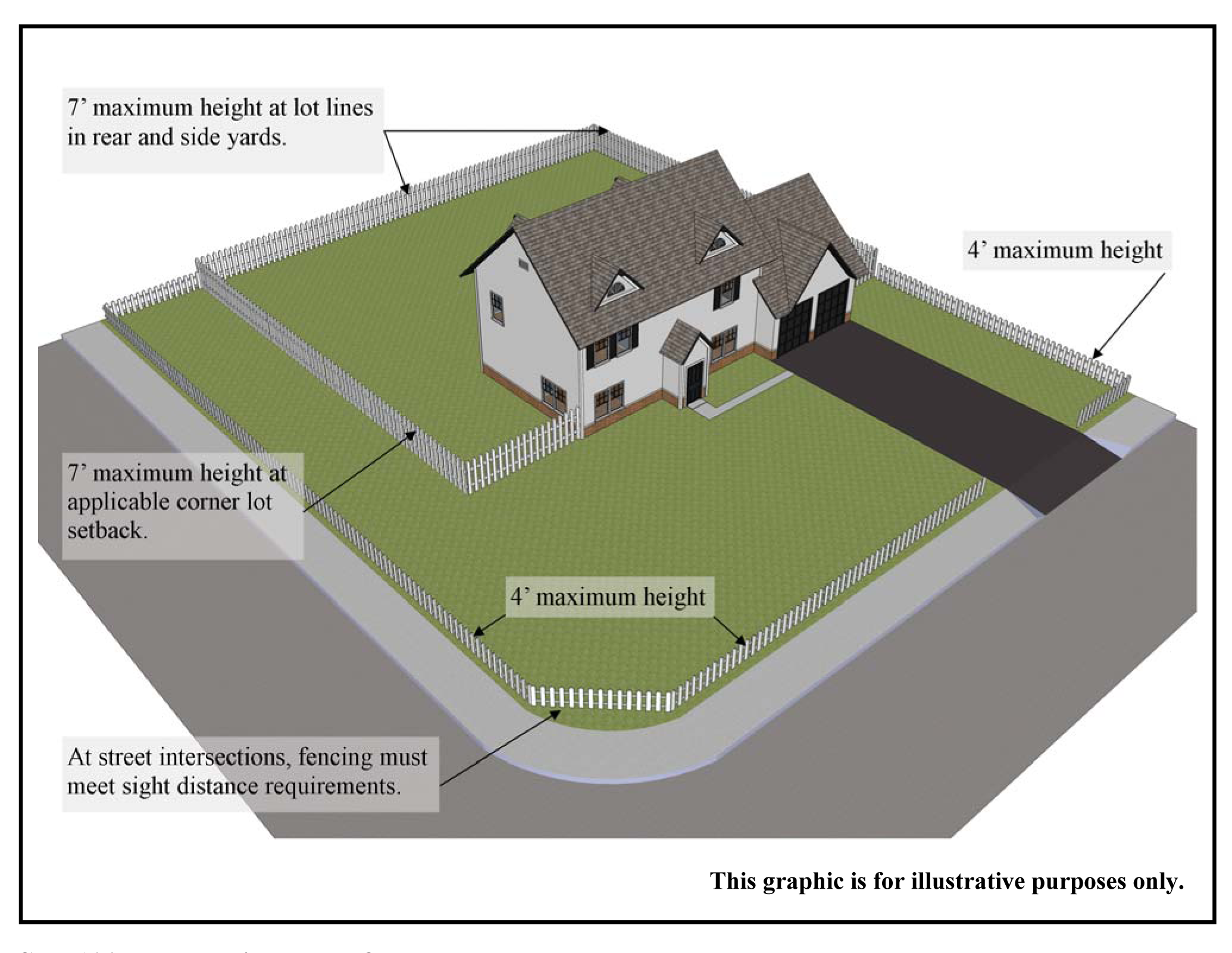
(Ord. No. O-2015-15, § 1, 5-11-2015; Ord. No. O-2024-08, § 1, 12-11-2023)
Sec. 130-57. - Requirements for accessory structures.
(a)
In all zoning districts, the following standards shall apply:
(1)
No accessory structure, unless otherwise permitted by this chapter, shall be used for a residential dwelling unit.
(2)
The lot coverage of an accessory structure or cumulative total of all accessory structures shall not exceed 40 percent of the lot coverage of the principal building on the lot.
(3)
Amateur radio towers shall not exceed a height of 75 feet without approval of a special use permit under the requirements of Article IX of this chapter and shall comply with all other requirements of the zoning district where they are permitted as an accessory use, including setbacks and screening. Within ninety days of the discontinuance of the use of the tower for amateur radio purposes, said amateur radio tower shall be disassembled, removed, and the site restored as closely as possible to the condition before the tower was constructed. Discontinuance includes when the amateur radio operator is no longer licensed by the Federal Communications Commission or no longer owns or resides on the property where the amateur radio tower was permitted.
(4)
Residential structures including, but not limited to, flag poles, basketball hoops, clotheslines, arbors, playsets, mechanical equipment and structures less than six square feet in area, or residential yard ornaments are not accessory structures and shall be exempt from the minimum setback, lot area, and certification requirements as specified in this chapter.
(b)
In the A-1, R-1, R-2, and R-2-S zoning districts, the following additional standards shall apply:
(1)
No second-floor storage/attic area of an accessory structure, unless otherwise permitted by this chapter, shall be designed, constructed, or modified in such a manner that it would qualify as habitable space under ceiling height and/or area requirements specified in the Uniform Statewide Building Code.
(2)
No accessory structure, excluding amateur radio towers, shall exceed the height of 22 feet to roof ridge, in the case of a flat roof 16 feet, or the height of the principal structure, whichever is less. Broadcasting or telecommunication towers that are collocated in accordance with section 130-92 as part of the principal use of a parcel shall conform to the principal structure requirements.
(4)
The placement of accessory structures in a front yard shall be prohibited.
(5)
Accessory structures located in a side yard shall meet the side yard requirements for principal structures.
(6)
Accessory structures located in a rear yard shall be a minimum of five feet from any side or rear lot line.
(c)
In the R-3, R-5, R-6, R-7, B-3.5, and PMD zoning district, the following additional standards shall apply:
(1)
Detached private garages and private community recreational uses shall be permitted only if shown on the approved site plan.
(2)
On lots with a dwelling unit other than a multifamily building, accessory structures are not permitted except:
i.
Accessory structures not exceeding 80 square feet and no more than eight and one-half feet in height are permitted in the rear yard, provided they are setback a minimum of five feet from all lot lines. In the R-3 and R-5 districts no minimum rear yard setback is required; and
ii.
Detached private garages and private community recreational uses are permitted in side and rear yards, provided they are five feet from the side and rear yards.
(3)
Accessory structures shall not exceed 50 percent of the height of the principal structure.
(Ord. No. O-2015-15, § 1, 5-11-2015; Ord. No. O-2018-02, 12-11-2017; Ord. No. O-2024-03, § 1, 7-28-2023)
Sec. 130-58. - Building projections.
(a)
Bay windows, chimneys, eaves, and similar architectural features may project no more than two feet beyond any required setback line. Discharge pipes for roof and surface drains and for sump pump discharge that do not connect into an underground drainage system shall be setback from property lines in accordance with the requirements of the DCSM. Setback lines shall not apply to terraces, patios, and unroofed decks on ground level.
(b)
Any unroofed deck attached to a dwelling unit with no part of its floor higher than four feet above finished ground level may extend into minimum required setbacks as follows:
(1)
Front setback, no extension.
(2)
Side setback, no extension.
(3)
Rear setback, single-family detached dwelling units, ten feet, but not closer than 15 feet to any rear lot line.
(4)
Rear setback, all other dwelling units, ten feet, but no closer than eight feet to any rear lot line.
(c)
Any unroofed deck attached to a dwelling unit with any part of its floor higher than four feet above finished ground level may extend into minimum required setbacks as follows:
(1)
Front setback, no extension.
(2)
Side setback, no extension.
(3)
Rear setback, single-family detached dwelling units, five feet, but no closer than 20 feet to any rear lot line.
(4)
Rear setback, all other dwelling units, five feet, but no close than eight feet to any rear lot line.
(d)
Any unroofed stairs or ramps attached to a dwelling unit may extend into minimum required setbacks as follows:
(1)
Front setback, three feet, but not closer than five feet to any front lot line.
(2)
Side setback, three feet, but not closer than five feet to any side lot line.
(3)
Rear setback, ten feet, but not closer than 15 feet to any rear lot line.
(e)
Any unroofed stairs or ramps attached to a non-residential structure may extend into the minimum required setbacks up to three feet.
(Ord. No. O-2015-15, § 1, 5-11-2015; Ord. No. O-2019-04, 10-22-2018; Ord. No. O-2024-03, § 1, 7-28-2023)
Sec. 130-59. - Reduction in minimum yard requirements based on error in building location.
Notwithstanding any other requirement of this chapter, the zoning administrator shall have the authority, as qualified below, to approve a reduction in the minimum yard requirements in the case of any building existing or partially constructed which does not comply with requirements applicable at the time of the building permit issuance and construction. Such a reduction may be approved by the zoning administrator in accordance with the following requirements:
(a)
The zoning administrator determines that the following conditions exist:
(1)
The error does not create an encroachment into the required yard area greater than 12 inches;
(2)
The noncompliance was done in good faith, through no fault of the property owner, or was the result of an error in the location of the building subsequent to the issuance of a building permit, if such was required;
(3)
Such reduction will not impair the purpose and intent of this chapter;
(4)
Such reduction will not be detrimental to the use and enjoyment of other property in the immediate vicinity;
(5)
Such reduction will not create an unsafe condition with respect to both other property and streets;
(6)
To force compliance with the minimum yard requirements would cause unreasonable hardship upon the owner; and
(7)
The reduction will not result in an increase in density from that permitted by the applicable zoning district regulations.
(b)
In approving such a reduction under the requirements of this section, the zoning administrator shall allow a reduction necessary to provide reasonable relief and, as deemed advisable, may prescribe such conditions to include landscaping and screening measures to ensure compliance with the intent of this chapter.
(c)
Upon the approval of a reduction for a particular building in accordance with the requirements of this section, the same shall be deemed to be a lawful building.
(d)
The zoning administrator shall have no power to waive or modify the requirements necessary for approval as specified in this section.
(e)
If there is an error greater than specified in section 130-59(a)(1), a variance may be requested in accordance with the requirements of Article IX of this chapter.
(Ord. No. O-2015-15, § 1, 5-11-2015)
Sec. 130-60. - Requirements for screened trash dumpsters.
Wherever a trash dumpster is used for storage of trash, recyclables, or discarded materials, the dumpster shall be adequately screened from all adjoining properties. Such enclosure shall be of materials compatible to the surrounding area and designed and located in accordance with the DCSM. However, the city may permit trash dumpsters without screening when used as part of a temporary activity, such as demolition, temporary use, or new construction projects.
(Ord. No. O-2015-15, § 1, 5-11-2015)
Sec. 130-61. - Outdoor display.
Notwithstanding any other requirement of this chapter, outdoor display, where permitted, shall conform with the following requirements:
(a)
No outdoor display shall be permitted except for plants or flowers. Outdoor display, in addition to plants or flowers, shall be permitted for the uses listed in subsections (c) and (d) and may permitted for temporary uses approved in accordance with section 130-104.
(b)
For all uses, outdoor display shall be prohibited in the following areas:
(1)
Any off-street parking or loading areas used to meet the minimum requirements of this chapter;
(2)
Fire lanes;
(3)
Travelways;
(4)
Sidewalks five feet or less in width; or
(5)
Buffers, yards, and landscaped areas.
(c)
For the uses listed below, outdoor display as designated on an approved site plan and in accordance with the requirements of subsection (b) may be permitted:
(1)
Construction material sales;
(2)
Craft shop; or
(3)
Garden center.
(d)
For outdoor display requirements for motor vehicle sales and rental or heavy equipment sales and rental, see section 130-99.
(Ord. No. O-2015-15, § 1, 5-11-2015)
Sec. 130-62. - Vehicle storage.
(a)
In all zoning districts within the city an inoperable vehicle is prohibited except:
(1)
Inoperable vehicles may be stored in a fully enclosed private garage or parking structure;
(2)
One inoperable vehicle may be stored externally if it is covered by a factory design car cover; or
(3)
In non-residential zoning district, the foregoing requirements shall not apply to inoperable vehicles stored within an area that is enclosed on all sides with opaque walls or fences and is a permitted motor vehicle repair or motor vehicle service use.
(b)
Notwithstanding the requirements of section 130-62(a), all motor vehicles parked on private property (including for the purpose of this section a passenger vehicle, truck, van, motorized recreational vehicle, camper, golf cart, travel trailer, boat trailer, car trailer, or other similar vehicle) shall be parked in off-street parking spaces that meet the parking and loading requirements of this chapter. However, motor vehicles may be parked temporarily outside of the parking space on a residential lot for a period not to exceed six hours in any 24-hour period solely for the purpose of unloading or cleaning the vehicle.
(c)
Any vehicle registered for personal use of the occupant and 1) exceeds a gross weight of 10,000 pounds, 2) is in excess of 21 feet in length, or 3) is wider than 102 inches, may be parked on the owner's residential lot provided that it is parked in conformance with the following requirements:
(1)
The vehicle is parked in an off-street parking space located to the side or rear of a principal structure and not located between a principal structure and any adjacent streets, and is certified under section 130-63; or
(2)
The vehicle is kept within an enclosed structure.
(d)
In any residential district within the city, the parking or storage of any oversized vehicle on a residential lot is prohibited, except when such vehicle or equipment is being used to provide a specific service on-site directly related to the construction, repair, expansion, or rehabilitation of the residential use.
(Ord. No. O-2015-15, § 1, 5-11-2015; Ord. No. O-2017-01, § 1, 8-22-2016; Ord. No. O-2021-06, § 1, 2-8-2021)
Sec. 130-63. - Requirements for zoning certification.
(a)
The following specific uses and construction activities shall require written certification that they are in compliance with this chapter prior to approval or commencement of the activity:
(1)
The installation or construction of any permanent structure (such as a retaining wall, fence, shed, aboveground pool, or similar structure) or temporary structure as required by section 130-104 that exceeds a height of four feet or has a surface area exceeding 75 square feet, is otherwise regulated by the height, setback, or use requirements of this chapter, and does not require a building permit, a temporary directional sign permit, or a permit for a temporary use;
(2)
The change of use or occupant on any commercially or industrially zoned property;
(3)
Any activity requiring a building permit;
(4)
The installation of a new electric meter base or exterior lighting on commercially or industrially zoned property;
(5)
Any exterior repair, addition, or alteration to a structure within a designated historic overlay district;
(6)
The installation, modification, or construction of a residential driveway or off-street parking spaces, but not for repair, repaving, or surface treatments which do not increase the lot coverage of impervious surfaces; or
(7)
The storage on a residential lot of any vehicle registered for personal use and exceeding a gross weight of more than 10,000 pounds, in excess of 21 feet in length, or wider than 102 inches.
(b)
The request for zoning certification shall be made on a form provided by the city and shall be acted on within ten working days. The review shall be limited to the requirements of this chapter.
(c)
The zoning certification shall be posted onsite in a conspicuous place during construction.
(Ord. No. O-2015-15, § 1, 5-11-2015; Ord. No. O-2022-23, § 1, 7-25-2022)
Sec. 130-64. - Collection of delinquent taxes and fees.
Prior to the initiation of an application for a special use permit, variance, rezoning, or other land disturbing permit, including building permits and erosion and sediment control permits by the owner of the subject property, the owner's agent, or any entity in which the owner holds an ownership interest greater than 50 percent, the applicant shall produce to the city satisfactory evidence that any delinquent real estate taxes, nuisance charges, stormwater management utility fees, or any other charges that constitute a lien on the subject property that are owed to the locality and have been properly assessed against the subject property have been paid in full.
(Ord. No. O-2015-15, § 1, 5-11-2015)
Sec. 130-65. - Apiary accessory use.
The keeping of apiarys shall be permitted as an accessory use in accordance with the following requirements:
(a)
Colony density.
(1)
The minimum lot size required for an apiary shall be 4,000 square feet.
(2)
The maximum number of hives allowed in an apiary shall be determined based on lot sizes as follows:
a.
4,000 sq. ft. to 11,000 sq. ft: Two hives.
b.
11,001 sq. ft to 43,560 sq. ft.: Four hives.
c.
Over 43,560 sq. ft.: Four hives plus one additional hive per 3,000 sq. ft. of lot area over 43,560 sq. ft.
(3)
A hive shall consist of no more than three boxes per hive. Each box shall not exceed shall not exceed 19⅞ inches in length by 16¼ inches in width by 9⅝ inches in height. If a skep, barrel, log gum, or other container are used instead of boxes for a hive, the dimensions of the hive shall not exceed the limits of this subsection.
(b)
Location.
(1)
Hives shall not be placed in any front or side yard.
(2)
Hives shall have the following additional setbacks:
a.
25 feet from a street, sidewalk, or a lot line;
b.
35 feet from any adjacent dwelling not located on the property;
c.
50 feet from an educational facility, hospital, medical care facility, child care center, congregate/continuing care, assisted living facility, and day care center, adult; and
d.
50 feet from any penned, kenneled, or confined animal.
(c)
Care and maintenance.
(1)
An apiary shall be kept in a manner that facilitates inspection and shall be maintained in sound and usable condition.
(2)
A constant supply of fresh water shall be provided on the lot within 20 feet of all hives. The water source shall be maintained so as not to become stagnant.
(3)
A flyway barrier at least six feet in height but no greater than seven feet in height shall be erected parallel to the lot line between the hive opening and any lot line located within 25 feet. The flyway barrier shall consist of a wall, solid fence, dense vegetation, or a combination thereof extending five feet beyond the hive in each direction. A flyway barrier of dense vegetation shall not be limited to seven feet in height provided that the initial planting is four feet in height and the vegetation normally reaches six feet in height or higher. Barriers shall be maintained in good condition so that all bees are forced to fly at an elevation of at least six feet above ground level.
(d)
Permit required.
(1)
Prior to keeping an apiary, a zoning certification application demonstrating compliance with all requirements of this section shall be submitted to and approved by the city.
(Ord. No. O-2021-06, § 1, 2-8-2021)
Sec. 130-66. - Cottage court.
(a)
The standards of this section shall apply to cottage court developments. If the requirements of other sections of this chapter are in conflict with this section, this section shall control.
(b)
Cottage court developments shall meet the following standards:
(1)
Each dwelling unit shall be a minimum of 600 gross sq. ft. and shall not exceed 1,200 gross sq. ft. The maximum density shall not exceed 15 dwelling units per acre.
(2)
Dimensional standards: Each dwelling unit shall meet the following minimum dimensional standards:
a.
Dwelling units shall have their front facades oriented toward a common open space such as a courtyard.
b.
Side setback: 5 feet.
c.
Rear setback: 10 feet.
d.
Setback from a public street right-of-way line: 25 feet.
e.
Maximum height: 25 feet.
(3)
Side facades directly adjacent to a public street shall have additional architectural treatment to break up its view from the public street.
(4)
The courtyard shall meet the following minimum standards:
a.
The courtyard shall have a minimum of 500 sq. ft. of area plus 50 sq. ft. per dwelling unit.
b.
The courtyard shall have a minimum width of 22 feet.
c.
The courtyard shall have a minimum tree canopy of 20 percent of the total area of the courtyard at the maturity requirements found in the DCSM.
d.
The courtyard shall count as a private community recreation area.
(5)
Each dwelling unit shall have a private open space that is not a part of the main courtyard. The private open space shall be a minimum of 100 sq. ft.
(6)
Off-street parking shall meet the standards of Article VI of this chapter and the following additional standards:
a.
Garages may be detached from the dwelling unit and may be located on a separate property.
(7)
Dwelling units within a cottage court development may be divided into individual properties. If the units are individually owned, the courtyard shall be held in common ownership through a property owner association.
(Ord. No. O-2024-03, § 1, 7-28-2023)
Sec. 130-67. - Resilient power supply systems.
(a)
A resilient power supply system shall be required for the following new uses requiring a major site plan review:
(1)
Fueling station;
(2)
Retail sales that primarily sell unprepared food and have a gross floor area over 10,000 sq. feet.;
(3)
Retail sales that contain a pharmacy;
(4)
Hospital;
(5)
Nursing home;
(6)
Congregate/continuing care and assisted living facility; or
(7)
Broadcasting or telecommunications tower;
(b)
Resilient power supply systems shall be capable of providing a minimum of 48 hours of backup power.
(c)
Opaque screening meeting the requirements of this chapter and the DCSM shall be installed around any ground mounted resilient power supply systems and associated equipment.
(d)
Noise produced by resilient power supply systems shall not exceed the noise maximums of Chapter 58 (Environment).
(Ord. No. O-2024-08, § 1, 12-11-2023)
Sec. 130-91. - Bed and breakfasts.
(a)
Notwithstanding any other requirement of this chapter, a bed and breakfast, where permitted, shall conform with the following requirements.
(b)
General requirements.
(1)
The structure shall be a detached single-family dwelling unit and shall be of a design and size compatible with the surrounding neighborhood.
(2)
No structure shall be used for a bed and breakfast operation unless rooms used for sleeping shall have a minimum size of 100 square feet for two occupants, with an additional 30 square feet for each additional occupant to a maximum of four occupants per room. Each sleeping room used for the bed and breakfast operation shall have a separate smoke detector alarm as required in the Uniform Statewide Building Code. Lavatories and bathing facilities shall be available on the same floor as any sleeping room.
(3)
Off-street parking shall be provided in accordance with the requirements of Article VI of this chapter. Tandem parking of two motor vehicles is allowed; however, not more than four required spaces shall be permitted in this manner.
(4)
All parking spaces and travelways shall meet city construction standards for paved or graded driveways using materials compatible with the surrounding residential neighborhood.
(5)
No portion of a residential structure shall be removed in order to provide parking for a bed and breakfast use.
(6)
If the applicant is unable to meet the requirements of section 130-91(b)(3), (4), or (5), the applicant may request a special exception through the approval of a special use permit. The city's intent is not to encourage yards to be destroyed, removal of landscaping, or the integrity of the neighborhood to be altered in order to provide parking. In such a case, the applicant shall submit an analysis of parking required and parking provided within a 300-foot radius of the subject parcel. After analyzing this study, the city council may lower the number of required off-street parking spaces based on the fact that sufficient public parking exists in the neighborhood.
(7)
One identifying wall sign or shingle sign not exceeding four square feet shall be permitted per establishment. The symbol or logo shall not be illuminated.
(8)
The dwelling unit in which the bed and breakfast takes place shall be the principal residence of the operator/owner, and such operator/owner shall reside on the premises when the bed and breakfast operation is active.
(9)
The structure shall remain principally designed as a single-family detached residential unit. The structure shall not be partitioned into more than one dwelling unit.
(10)
The operator/owner shall not serve meals on a commercial basis except to overnight guests.
(11)
Each operator shall keep a list of the names of all persons staying at the bed and breakfast operation, including their dates of stay. Such list shall be available for inspection by city officials at any time.
(12)
The maximum stay for an occupant of a bed and breakfast use shall be 30 consecutive days.
(Ord. No. O-2015-15, § 1, 5-11-2015; Ord. No. O-2018-02, 12-11-2017)
Sec. 130-92. - Broadcasting or telecommunications towers, administrative review.
(a)
Any eligible facilities request shall be approved administratively without the approval or amendment of a special use permit. The applicant shall diligently respond to questions or requests for information. An eligible facilities request shall be approved or disapproved within 60 days of receipt of a complete application by the city. An "eligible facilities request" means any request that provides for:
(1)
The installation or construction of a new structure that is not more than 50 feet above ground level and as defined by Virginia Code § 15.2-2316.3;
(2)
Co-location of new transmission equipment;
(3)
Co-location of small cell facilities as defined by Virginia Code § 15.2-2316.3;
(4)
Removal of transmission equipment; or
(5)
Replacement of transmission equipment.
(b)
For the purposes of this section, "base station", "substantial change in the physical dimensions", and "tower" shall be defined as follows:
(1)
"Base station" means a station at a specified site authorized to communicate with mobile stations or a land station in the land mobile service.
(2)
"Substantial change in the physical dimensions" means:
a.
The mounting of a proposed antenna on the tower that would increase the existing height of the tower by more than ten percent of the original tower height, or by the height of one additional antenna with separation from the nearest existing antenna not to exceed 20 feet, whichever is greater, except that the mounting of the proposed antenna may exceed the size limits set forth in this paragraph if necessary to avoid interference with existing antennas. However, this requirement does not permit a tower to exceed (i) the maximum height limit specified for the zoning district in which the tower stands, or (ii) any airport safety height limits imposed by the Federal Aviation Administration or otherwise;
b.
The mounting of the proposed antenna would involve the installation of more than the standard number of new equipment cabinets for the technology involved, not to exceed four, or more than one new equipment shelter;
c.
The mounting of the proposed antenna would involve excavation outside the current tower site, defined as the current boundaries of the leased or owned property surrounding the tower and any access or utility easements currently related to the site.
(3)
"Tower" means any structure built for the sole or primary purpose of supporting Federal Communications Commission-licensed antennas and their associated facilities.
(c)
The applicant shall submit an affidavit with the request for modification, including dimensioned drawings showing the proposed modifications and demonstrating that the modifications do not substantially change the physical dimensions of the applicable tower or base station. An application for administrative approval shall not be deemed complete unless it (i) identifies the location of the existing tower or base station, (ii) includes the drawings specified herein, (iii) includes a letter of permission from the property owner, (iv), includes screening in conformance with the requirements of the DCSM, and (v) includes, for any site located in a historic overlay district, a certificate of appropriateness issued by the architectural review board.
(d)
The applicant shall remove any facility approved pursuant to this section at the termination of the lease with the property owner or, during the term of the lease, if the facility is no longer used for telecommunications purposes for a continuous period of 90 calendar days.
(Ord. No. O-2015-15, § 1, 5-11-2015; Ord. No. O-2018-02, 12-11-2017; Ord. No. O-2019-04, 10-22-2018)
Sec. 130-93. - Family day homes.
A family day home shall be permitted as an accessory use by-right in any residential dwelling unit lawfully occupied by one family as defined in section 130-42. A family day home, as defined, shall be considered a home occupation activity.
(Ord. No. O-2015-15, § 1, 5-11-2015)
Sec. 130-94. - High impact businesses (liquor stores and short-term loan establishments).
(a)
Purpose and intent. The purpose of this section is three-fold:
(1)
To ensure that liquor stores and short-term loan establishments (collectively, "high impact businesses") are located so that they are separated from residential neighborhoods, libraries, parks, schools, ballfields, recreation centers, and places of worship where children are likely to be walking and playing and should not be forced to encounter such a business in their daily activities;
(2)
To ensure that high impact businesses are sufficiently separated from incompatible land uses to ensure an attractive and harmonious community and minimize the negative effect on land values that often accompanies high impact businesses; and
(3)
To ensure that high impact businesses do not locate in close proximity to sexually oriented businesses so that the city does not inadvertently create a "combat zone" or other area that is perceived to be dominated by such businesses or that causes the concentration of the secondary effects of such businesses in one area.
(b)
Location of high impact businesses. It shall be unlawful to establish, operate, or cause to be operated a high impact business in the city, unless said high impact business is in a zone permitting such use and is at least:
(1)
Seven hundred fifty feet from any parcel occupied by a sexually oriented business;
(2)
Seven hundred fifty feet from any residential zoning district or residence; and
(3)
Seven hundred fifty feet from any parcel occupied by a church, chapel, synagogue, temple or other place of worship; a school or child care center serving students in grades K—12; a public park, Boys and Girls Club, YMCA, YWCA, or ballfield; or a public library.
(c)
For the purpose of this section, measurements shall be made in a straight line in all directions without regard to intervening structures or objects, from the closest part of the tenant space or structure occupied by the high impact business to the closest point on a property boundary or right-of-way associated with any of the land use(s) identified in subsection (b) above that exist on or before the date that a completed application for a license to operate the high impact businesses is filed with the city.
(d)
Any protected use listed in subsection (b) of this section may begin operation within 750 feet of a high impact business only if the owner of the protected use, in addition to any other requirements of this Code, gives the city a written statement that it acknowledges the presence of the high impact business(es) and voluntarily waives the protection of subsection (b) of this section as to the high impact business(es) for as long as the high impact business(es) or any successor thereto remains. This written statement does not waive the protection of this section as to any high impact business established or relocated after the written statement. If a high impact business is discontinued for a period of two years or more, then it must comply with the setback requirements of this section regardless of any such written statements by protected uses.
(Ord. No. O-2015-15, § 1, 5-11-2015)
Sec. 130-95. - Home businesses.
(a)
Notwithstanding any other requirement of this chapter, a home business, where permitted, shall be subject to the following requirements.
(b)
General requirements.
(1)
A maximum of one home business shall be located in a single-family detached dwelling unit, and shall neither change the character of the dwelling unit nor exhibit any exterior evidence of a non-residential use.
(2)
At no time shall the permit holder maintain a permanent residence off-site.
(3)
At all times, the on-site operations and supervisory responsibility of the permitted activity shall rest with the permit holder.
(4)
Adequate on-site parking shall be provided for employees, customers, and clients.
(5)
At no time shall more than two customers or clients be on-site at the same time. Customer or client contact on-site shall be by appointment only. Customer appointments shall be limited to not more than eight appointments a day, and not scheduled before 8:00 a.m. or after 6:00 p.m. Monday through Friday, unless otherwise authorized through the approval of a special use permit.
(6)
On-site business signs shall be prohibited. No business sign is permitted on any mailbox.
(7)
Motor vehicles used in the home business shall conform to the following requirements:
a.
No vehicle used in the home business and with a gross weight of more than 10,000 pounds, in excess of 21 feet in length, or wider than 102 inches shall be parked, garaged, or stored in any residential district.
b.
No more than one motor vehicle used in the home business shall be parked, garaged, or stored in any residential district.
c.
Any sign maintained on any vehicle used in a home business shall be covered or removed when the vehicle is parked overnight in any residential district.
(8)
On-site storage and use of materials, merchandise, or equipment is limited to the following standards:
a.
Materials associated with the home business shall be limited to just-in-time delivery and storage practices. No bulk storage on-site is permitted.
b.
Exterior storage of equipment, including open trailers and other business-related equipment, materials, or merchandise is prohibited.
c.
Interior use of office equipment such as a telephone, fax, computer, or other typical light office equipment necessary to the home business is permitted.
d.
All bulk storage of materials, equipment, or supplies must be identified and maintained off-site in an approved storage facility.
(9)
No detached accessory structure shall be used for any portion of the home business.
(10)
Not more than 25 percent of the gross floor area of a single-family detached dwelling unit, inclusive of any attached garage, shall be used for a home business.
(11)
Exterior changes or modification of the single-family detached structure shall be limited to the minimum handicapped accessibility requirements.
(12)
The home business shall require a separate occupancy permit for the home business.
(Ord. No. O-2015-15, § 1, 5-11-2015)
Sec. 130-96. - Home occupations.
(a)
A home occupation shall be permitted as an accessory use by right in any residential dwelling unit lawfully occupied by one family as defined in section 130-42. Such accessory use shall neither change the character of the dwelling unit nor exhibit any exterior evidence of a non-residential use. The city shall approve a home occupation permit, where permitted, subject to the following requirements.
(b)
General requirements.
(1)
No employees shall be permitted to come to the dwelling unit, except for family members residing in the dwelling unit.
(2)
No more than one customer shall be permitted to come to the dwelling unit for business related purposes at any given time and shall conform to the following requirements:
a.
Customer contact on-site shall be by appointment only.
b.
Customer appointments shall be limited to not more than five appointments a day, and not scheduled before 8:00 a.m. or after 6:00 p.m. Monday through Friday.
c.
A minimum of one on-site parking space in addition to required parking for the residential dwelling unit shall be provided.
(3)
No business signs affixed to a mailbox, freestanding or otherwise, shall be permitted on-site.
(4)
On-site storage of materials, merchandise, or equipment is limited to the following standards:
a.
Materials associated with the home occupation shall be limited to just-in-time delivery and storage practices. No bulk storage on-site is permitted.
b.
Exterior storage of equipment, trailers, other business related equipment, materials, or merchandise is prohibited.
c.
Interior use of equipment such as a telephone, computer, or other typical light office equipment necessary to the business is permitted.
d.
All delivery of supplies shall be made just-in-time for its use.
(5)
Any motor vehicle used in a home occupation shall conform to the following requirements:
a.
No vehicle used in a home occupation and with a gross weight of more than 10,000 pounds, in excess of 21 feet in length, or wider than 102 inches shall be parked, garaged, or stored on the site or in a residential district for any reason.
b.
No more than one motor vehicle used for each home occupation shall be parked within the residential district.
c.
Any sign maintained on any vehicle used in a home occupation shall be covered or removed when the vehicle is parked in any residential district. Vehicles displaying a sign prior to enactment of this subsection shall be exempt from this provision until the vehicle is replaced.
(6)
The following commercial activities are specifically prohibited, and shall not be deemed or construed as activities constituting a home occupation:
a.
Storage or staging facilities for landscaping and lawn maintenance services or construction services.
b.
Motor vehicle repair, motor vehicle service, or motor vehicle sales and rental.
(7)
In the event a vehicle, including trailers or other on/off road equipment, is required as part of the home occupation, the applicant shall provide the following as part of the application process:
a.
A valid street address where the vehicle will be garaged.
b.
A copy of the current vehicle registration indicating the jurisdiction in which the vehicle is registered.
c.
At no time shall a trailer or other off road equipment associated with a home occupation be permitted to be stored in any residential district.
(8)
Not more than 25 percent of the gross floor area of a dwelling unit, inclusive of any attached garage, shall be used for a home occupation.
(9)
A permit for a home occupation shall only be valid for the original applicant and is not transferable to any other resident of the dwelling unit, address, or to any other home occupation use. Upon termination of the applicant's residency, the home occupation permit shall become null and void.
(Ord. No. O-2015-15, § 1, 5-11-2015; Ord. No. O-2020-08, 12-9-2019; Ord. No. O-2021-06, § 1, 2-8-2021)
Sec. 130-97. - Kennels.
(a)
Notwithstanding any other requirement of this chapter, a kennel, where permitted, shall be subject to the following requirements.
(b)
General requirements.
(1)
All care and areas where the animals are kept or travel shall be kept in a clean and sanitary manner in accordance with the Code of Virginia, pertaining to comprehensive animal care.
(2)
All exterior areas including parking lots and sidewalks leading to the establishment shall be policed at least twice daily to remove all animal excrement.
(3)
Parking shall be provided in accordance with the requirements of Article VI of this chapter.
(4)
Each operator shall keep a list of the name, tag number, dates of stay and guardian's name, address, and phone number, of each animal staying at the facility. Such list shall be available for inspection by city officials at any time.
(5)
The maximum overnight stay for an animal at a kennel shall be 29 days within a two-month period, except for emergencies as authorized by the city.
(c)
Requirements for structures and interior accommodations.
(1)
All structures shall be designed and sized in a manner sufficient to accommodate the maximum allowable number of animals to be kept on-site at any given time.
(2)
All structures or portions of structures occupied by dogs shall be designed so that any noise generated from the interior of the structure will not exceed 55 decibels at the nearest lot line or common wall, whichever is closer.
(3)
If individual pet enclosures are provided, the following minimum standards shall apply:
a.
Cats.
1.
Each enclosure shall have a minimum ceiling height of 18 inches and provide a 96-square-inch sleeping area, litter box, and a food and water station.
2.
If enclosures are designed to be stacked, a sanitation plate shall be installed between each row of enclosures with a minimum six-inch overhang on all sides. Guttering must be provided to remove all liquids to an approved sewer system.
3.
Overnight boarding facilities shall provide each animal a minimum of two hours in a 12-hour period in a stretching and climbing room.
b.
Dogs.
1.
Each enclosure shall be sized for the individual animal, providing a minimum ceiling height of two inches clearance above the dog's head when standing, a minimum length and width equivalent to twice the dog's length and width, plus a food and water station.
2.
If enclosures are designed to be stacked, a sanitation plate shall be installed between each row of enclosures with a minimum six-inch overhang on all sides. Guttering must be provided to remove all liquids to an approved sewer system.
3.
Overnight boarding facilities shall provide each animal a minimum of two hours in a 12-hour period in a minimum 200-square-foot exercise room.
(d)
Requirements for exterior exercise runs, play areas, and activities.
(1)
Screening. All exterior runs, play areas, and arenas shall be designed with a minimum six-foot high opaque screen from adjacent lot lines and street rights-of-way.
(2)
Noise buffering. All exterior runs, play areas, and arenas shall be designed to baffle the barking generated on the site so that the decibel level at the lot lines does not exceed 55 decibels between the hours of 10:00 p.m. and 6:00 a.m.
(3)
Lighting. Lighting shall be provided in accordance with the DCSM. Lighting may be used during specific class training and showing events and shall be turned off at the end of an event.
(Ord. No. O-2015-15, § 1, 5-11-2015; Ord. No. O-2017-01, § 1, 8-22-2016)
Sec. 130-98. - Manufactured homes.
No manufactured home shall be occupied for dwelling purposes, except in an A-1 zone or the manufactured home is located in a legal manufactured home park, in accordance with all the regulations applying thereto under state law, this Code, or other city ordinance. This requirement, however, shall not apply to temporary family health care structures meeting the requirements of section 130-104.
It shall be unlawful for any property owner, tenant, lessee, or administrator of any real estate in the city to rent, lease, or allow any manufactured home that is to be used as a dwelling unit or living quarters to be parked on the land under their supervision, unless it is located in a legal manufactured home park maintained in accordance with the requirements of this chapter and subject to an occupancy permit as set forth in this chapter.
(Ord. No. O-2015-15, § 1, 5-11-2015)
Sec. 130-99. - Motor vehicle sales and rental or heavy equipment sales and rental.
Notwithstanding any other requirement of this chapter, motor vehicle sales and rental or heavy equipment sales and rental, where permitted, shall conform with the following requirements:
(a)
Each sales or rental office shall have a minimum lot area of 20,000 square feet.
(b)
No portion of the use, excluding required screening and landscape buffers, shall be located within 50 feet of a "R" district or structure containing a dwelling unit.
(c)
Outdoor display shall be designated on an approved site plan, and prohibited in any off-street parking or loading areas used to meet the minimum requirements of this chapter, fire lanes, travelways, sidewalks five feet or less in width, buffers, yards, and landscaped areas. The use of outdoor display ramps and stands is prohibited.
(d)
Outdoor display shall be limited to the vehicles or equipment sold on the property. No other outdoor display of any other goods or merchandise shall be permitted.
(e)
All accessory vehicle maintenance or service shall be conducted within a completely enclosed building. Outdoor storage, including temporary storage of vehicles on-site for maintenance, repair, or service, shall be permitted in accordance with the requirements of the zoning district.
(Ord. No. O-2015-15, § 1, 5-11-2015)
Sec. 130-100. - Motor vehicle repair or motor vehicle service.
Notwithstanding any other requirement of this chapter, motor vehicle repair or motor vehicle service, where permitted, shall conform with the following requirements:
(a)
No portion of the use, excluding required screening and landscape buffers, shall be located within 50 feet of a "R" district or structure containing a dwelling unit.
(b)
All vehicle maintenance, repair, or service shall be conducted within a completely enclosed building.
(c)
No outdoor display shall be permitted.
(d)
Outdoor storage, including temporary storage of vehicles on-site for maintenance, repair, or service, shall be permitted in accordance with the requirements of the zoning district.
(Ord. No. O-2015-15, § 1, 5-11-2015; Ord. No. O-2021-06, § 1, 2-8-2021)
Sec. 130-101. - Residential yard sales.
Whenever a residential yard sale is proposed as an accessory use, the activity and associated temporary signs shall be permitted in all residential districts subject to the following requirements:
(a)
No more than two residential yard sales shall be held within a given calendar year by the same household at the same location.
(b)
No residential yard sale shall last more than three consecutive calendar days.
(Ord. No. O-2015-15, § 1, 5-11-2015; Ord. No. O-2017-01, § 1, 8-22-2016)
Sec. 130-102. - Sex offender treatment services.
Notwithstanding any other requirements of this Code, no sex offender treatment services may be offered or provided in any subdivision where some or all of the subdivision is zoned for residential purposes. As used in this section, "zoned for residential purposes" includes any zone designated A-1, R-1, R-2, R-2-S, R-3, R-4, R-5, R-6, R-7, B-3, B-3.5, or PMD.
(Ord. No. O-2015-15, § 1, 5-11-2015)
Sec. 130-103. - Sexually oriented businesses.
(a)
Purpose. It is a purpose of this chapter to regulate sexually oriented businesses in order to promote the health, safety, and general welfare of the citizens of the city and to establish reasonable and uniform regulations to prevent the deleterious secondary effects of sexually oriented businesses within the city. The requirements of this chapter have neither the purpose nor effect of imposing a limitation or restriction on the content or reasonable access to any communicative materials, including sexually oriented materials. Similarly, it is neither the intent nor effect of this chapter to restrict or deny access by adults to sexually oriented materials protected by the First Amendment, or to deny access by the distributors and exhibitors of sexually oriented entertainment to their intended market. Neither is it the intent nor effect of this chapter to condone or legitimize the distribution of obscene material.
(b)
Findings and rationale. Based on evidence of the adverse secondary effects of adult uses presented in hearings and in reports made available to the city council, and on findings, interpretations, and narrowing constructions incorporated in the cases of City of Littleton v. Z.J. Gifts D-4, L.L.C., 541 U.S. 774 (2004); City of Los Angeles v. Alameda Books, Inc., 535 U.S. 425 (2002); City of Erie v. Pap's A.M., 529 U.S. 277 (2000); City of Renton v. Playtime Theatres, Inc., 475 U.S. 41 (1986); Young v. American Mini Theatres, 427 U.S. 50 (1976); Barnes v. Glen Theatre, Inc., 501 U.S. 560 (1991); California v. LaRue, 409 U.S. 109 (1972); N.Y. State Liquor Authority v. Bellanca, 452 U.S. 714 (1981); and Imaginary Images, Inc. v. Evans, 612 F.3d 736 (4th Cir. 2010); Independence News, Inc. v. City of Charlotte, 568 F.3d 148 (4th Cir. 2009); McDoogal's East, Inc. v. County Comm'rs of Caroline County, 341 F. App'x 918 (4th Cir. 2009); Allno Enters., Inc. v. Baltimore County, 10 F. App'x 197 (4th Cir. 2001); Steakhouse, Inc. v. City of Raleigh, 166 F.3d 634 (4th Cir. 1999); D.G. Restaurant Corp. v. City of Myrtle Beach, 953 F.2d 140 (4th Cir. 1991); Wall Distributors, Inc. v. City of Newport News, 782 F.2d 1165 (4th Cir. 1986); Boyd v. County of Henrico, 42 Va. App. 495, 592 S.E.2d 768 (2004) (en banc); and Peek-a-Boo Lounge of Bradenton, Inc. v. Manatee County, - F.3d - 2011 WL 182819 (11th Cir. Jan. 21, 2011); Flanigan's Enters., Inc. v. Fulton County, 596 F.3d 1265 (11th Cir. 2010); East Brooks Books, Inc. v. Shelby County, 588 F.3d 360 (6th Cir. 2009); Entm't Prods., Inc. v. Shelby County, 588 F.3d 372 (6th Cir. 2009); Sensations, Inc. v. City of Grand Rapids, 526 F.3d 291 (6th Cir. 2008); World Wide Video of Washington, Inc. v. City of Spokane, 368 F.3d 1186 (9th Cir. 2004); Ben's Bar, Inc. v. Village of Somerset, 316 F.3d 702 (7th Cir. 2003); Daytona Grand, Inc. v. City of Daytona Beach, 490 F.3d 860 (11th Cir. 2007); Williams v. Morgan, 478 F.3d 1316 (11th Cir. 2007); H&A Land Corp. v. City of Kennedale, 480 F.3d 336 (5th Cir. 2007); Illinois One News, Inc. v. City of Marshall, 477 F.3d 461 (7th Cir. 2007); G.M. Enterprises, Inc. v. Town of St. Joseph, 350 F.3d 631 (7th Cir. 2003); Richland Bookmart, Inc. v. Knox County, 555 F.3d 512 (6th Cir. 2009); Richland Bookmart, Inc. v. Nichols, 137 F.3d 435 (6th Cir. 1998); Spokane Arcade, Inc. v. City of Spokane, 75 F.3d 663 (9th Cir. 1996); City of New York v. Hommes, 724 N.E.2d 368 (N.Y. 1999); For the People Theatres of N.Y., Inc. v. City of New York, 793 N.Y.S.2d 356 (N.Y. App. Div. 2005); Taylor v. State, No. 01-01-00505-CR, 2002 WL 1722154 (Tex. App. July 25, 2002); Gammoh v. City of La Habra, 395 F.3d 1114 (9th Cir. 2005); Z.J. Gifts D-4, L.L.C. v. City of Littleton, Civil Action No. 99-N-1696, Memorandum Decision and Order (D. Colo. March 31, 2001); People ex rel. Deters v. The Lion's Den, Inc., Case No. 04-CH-26, Modified Permanent Injunction Order (Ill. Fourth Judicial Circuit, Effingham County, July 13, 2005); Reliable Consultants, Inc. v. City of Kennedale, No. 4:05-CV-166-A, Findings of Fact and Conclusions of Law (N.D. Tex. May 26, 2005); and based upon reports concerning secondary effects occurring in and around sexually oriented businesses, including, but not limited to, Austin, Texas - 1986; Indianapolis, Indiana - 1984; Garden Grove, California - 1991; Houston, Texas - 1983, 1997; Phoenix, Arizona - 1979, 1995-98; Chattanooga, Tennessee - 1999-2003; Los Angeles, California - 1977; Whittier, California - 1978; Spokane, Washington - 2001; St. Cloud, Minnesota - 1994; Littleton, Colorado - 2004; Oklahoma City, Oklahoma - 1986; Dallas, Texas - 1997; Ft. Worth, Texas - 2004; Kennedale, Texas - 2005; Greensboro, North Carolina - 2003; Amarillo, Texas - 1977; Jackson County, Missouri - 2008; Louisville, Kentucky - 2004; New York, New York Times Square - 1994; the Report of the Attorney General's Working Group On The Regulation Of Sexually Oriented Businesses, (June 6, 1989, State of Minnesota); Dallas, Texas - 2007; "Rural Hotspots: The Case of Adult Businesses," 19 Criminal Justice Policy Review 153 (2008); "Social Change and Crime Rate Trends: A Routine Activity Approach," 44 American Sociological Review 588-608 (1979); Duncan Associates, Survey of Florida Appraisers (2007); Texas City Attorneys Association, Survey of Texas Appraisers and Crime-Related Secondary Effects (2008); "Background Analysis and Recommendations: Zoning Amendments Related to Sex Businesses," Manassas, Virginia - 2010; and "Everything You Always Wanted to Know About Regulating Sex Businesses," American Planning Association, 2000, the city council finds:
(1)
Sexually oriented businesses, as a category of commercial uses, are associated with a wide variety of adverse secondary effects including, but not limited to, personal and property crimes, prostitution, potential spread of disease, lewdness, public indecency, obscenity, illicit drug use and drug trafficking, negative impacts on surrounding properties, declining property value, urban blight, litter, and sexual assault and exploitation.
(2)
Sexually oriented businesses should be separated from sensitive land uses, including schools, churches, parks, libraries, public recreation areas, and residential areas, to minimize the impact of their secondary effects upon such uses and should be separated from other sexually oriented businesses to minimize the secondary effects associated with such uses and to prevent an unnecessary concentration of sexually oriented businesses in one area.
(3)
Each of the foregoing negative secondary effects constitutes a harm, which the city has a substantial government interest in preventing and/or abating. This substantial government interest in preventing secondary effects, which is the city's rationale for this chapter, exists independent of any comparative analysis between sexually oriented and non-sexually oriented businesses. Additionally, the city's interest in regulating sexually oriented businesses extends to preventing future secondary effects of either current or future sexually oriented businesses that may locate in the city. The city finds that the cases and documentation relied on in this chapter are reasonably believed to be relevant to said secondary effects.
The city hereby adopts and incorporates herein its stated findings and legislative record related to the adverse secondary effects of sexually oriented businesses, including the judicial opinions and reports related to such secondary effects
(c)
Location of sexually oriented businesses. It shall be unlawful to establish, operate, or cause to be operated a sexually oriented business in the city, unless said sexually oriented business is in a zone permitting such use and is at least:
(1)
One thousand feet from any parcel occupied by another sexually oriented business;
(2)
Seven hundred fifty feet from any residential zoning district or residence; and
(3)
Seven hundred fifty feet from any parcel occupied by a church, chapel, synagogue, temple or other place of worship; a school or child care center serving students in grades K—12; a public park, Boys and Girls Club, YMCA, YWCA, or ballfield; or a public library.
(d)
For the purpose of this section, measurements shall be made in a straight line in all directions without regard to intervening structures or objects, from the closest part of the tenant space or structure occupied by the sexually oriented business to the closest point on a property boundary or right-of-way associated with any of the land use(s) identified in subsection (c) above which exists on or before the date that a completed application for a license to operate the sexually oriented businesses is filed with the city (see generally Chapter 30, section 30-251 et seq.).
(e)
Any protected use listed in subsection (c) of this section may begin operation within 750 feet of a sexually oriented business only if the owner of the protected use, in addition to any other requirements of this Code, gives the city a written statement that it acknowledges the presence of the sexually oriented business(es) and voluntarily waives the protection of subsection (c) of this section as to the sexually oriented business(es) for as long as the sexually oriented business(es) or any successor thereto remains. This written statement does not waive the protection of this section as to any sexually oriented business established or relocated after the written statement. If a sexually oriented business is discontinued for a period of two years or more, then it must comply with the setback requirements of this section regardless of any such written statements by protected uses.
(Ord. No. O-2015-15, § 1, 5-11-2015)
Sec. 130-104. - Temporary uses and structures.
Temporary uses and structures may be administratively approved where permitted as per section 130-241 when the public health, safety, and welfare will not be impaired, when the use is not so recurring in nature as to constitute a permanent or principal use, and when the following requirements of this section are met:
(a)
All temporary uses and temporary structures shall comply with the following general requirements:
(1)
Written approval of the owner of the site shall be obtained. This approval shall identify the site address, owner's name, owner's mailing address, owner's telephone number, and owner's acknowledgment of proposed activity and date(s) activity is to operate.
(2)
No permanent structure shall be constructed.
(3)
Except as allowed by section 130-104(f) or by the conditions of a special use permit, no temporary structure shall be placed for a period greater than 90 calendar days, unless otherwise permitted in this chapter. Removal of temporary structures shall be guaranteed in writing, and such structures shall be removed within 48 hours after permit expiration.
(4)
A permit for a temporary use is required for (i) temporary outdoor events, (ii) temporary outdoor sales, and (iii) temporary structures placed for a period of five or more days and requiring a zoning certification as required by section 130-63 even if not in connection with a temporary outdoor event or temporary outdoor sale. Except as allowed by section 130-104 (f), no permit shall be issued to an applicant unless and until at least 30 days after a permit issued to that applicant for the same or an adjacent lot or parcel has expired. Only one permit shall be active on any lot or parcel at any time.
(5)
The city may revoke any permit issued for a temporary use or temporary structure if the permit holder violates any requirement of this chapter or other applicable local or state requirements. If no permit was required, the city may prohibit the temporary use or temporary structure by appropriate notice if the use or structure violates any part of this chapter.
(b)
The following additional requirements apply to all temporary outdoor events, including but not limited to, outdoor gatherings open to the general public, circuses, carnivals, or concerts:
(1)
Except as allowed by section 103-104(f) or by the conditions of a special use permit, temporary outdoor events shall not exceed four days, no more than six such permits shall be issued for the same lot during a calendar year, and each activity or event shall be separated by a minimum of six consecutive days.
(2)
Prior to conducting the temporary outdoor event, an outdoor event permit application shall be submitted to and approved by the city as required by Chapter 14 of this Code.
(3)
Except as allowed by section 130-104(f) or by the conditions of a special use permit, no temporary structure shall be placed for a period greater than 90 calendar days, unless otherwise permitted in this chapter. Removal of temporary structures shall be guaranteed in writing, and such structures shall be removed within 48 hours after permit expiration.
(c)
Except as allowed by section 130-104(f), the following additional requirements apply to all temporary outdoor sales including (i) roadside stands for the retail sales of agricultural products permitted for a period not to exceed 120 consecutive days, (ii) roadside stands for the retail sales of holiday goods, including fireworks, permitted for a period not to exceed 30 consecutive days, and (iii) on-site promotional sales events for a permanent retail store permitted for a period not to exceed fourteen days:
(1)
No more than four permits shall be issued for the same lot during a calendar year. Except as allowed by section 130-104(f), no permit shall be issued to an applicant unless and until at least 30 consecutive days after a permit issued to that applicant for the same or an adjacent lot or parcel has expired.
(2)
Documentation or a letter of permission shall be provided stating the specific location of rest rooms that will be available to the applicant throughout the duration of the activity. Adequate sanitary facilities shall be provided on-site and, when necessary, shall be approved by the Health Department.
(3)
Adequate and safe ingress and egress shall be provided so that the normal traffic pattern shall not be disrupted.
(4)
Adequate parking for the activity, but no less than four parking spaces, shall be provided on-site. Parking or stopping in street rights-of-way shall be prohibited.
(5)
All signs shall conform to Article IV of this chapter. In addition, wall signs may be located on each wall of a stationary kiosk or structure associated with the temporary use at a ratio of one square foot per one linear foot of wall length on which the sign is mounted, to a maximum of 32 square feet per sign.
(6)
A bond, cash escrow, or other guarantee agreed to by the city in the amount of $500.00 shall be provided to insure that conditions of the permit will be met for any temporary outdoor sale exceeding four days. The bond or other guarantee shall be forfeited to the city if the site is not adequately cleared of all trash, debris, signs, and temporary structures, the activity remains on the site after expiration of the permit, or violations of this section or the conditions of the permit are established. Nothing in this forfeiture provision shall limit the city's ability to enforce this section in any manner provided by law.
(7)
Removal of all freestanding signs, trash, or debris from the site and the immediate vicinity, upon termination of the activity, shall be guaranteed in writing and accomplished within 24 hours after permit expiration.
(d)
The following additional requirements apply to temporary family health care structures. One temporary family health care structure, as a permitted accessory use, may be placed on any property zoned for a single-family detached dwelling unit owned or occupied by a caregiver as their residence, and provided that:
(1)
Prior to installing the temporary family health care structure (the temporary structure), a permit application shall be submitted to and approved by the city.
(2)
The temporary structure shall be limited to one occupant, or in the case of a married couple, two occupants, one of whom shall be the mentally or physically impaired person.
(3)
The temporary structure shall have a maximum gross floor area of 300 square feet.
(4)
The temporary structure shall comply with applicable requirements of the Industrialized Building Safety Law and the Uniform Statewide Building Code.
(5)
The temporary structure shall comply with the applicable standards for an accessory structure, except all yard setbacks shall be the same as those that apply to the principal structure.
(6)
The temporary structure shall be required to connect to any water, sewer, and electric utilities that are serving the single-family detached dwelling unit on the property, and shall comply with all applicable requirements of the Virginia Department of Health.
(7)
No signage that advertises or promotes the temporary structure shall be permitted on the temporary structure or elsewhere on the property.
(8)
As part of the permit application to the city, written certification in accordance with § 63.2-2200, or any subsequent replacement section, of the Code of Virginia verifying the status of the mentally or physically impaired occupant of the temporary structure shall be provided by a physician licensed by the Commonwealth of Virginia.
(9)
Evidence of compliance with this section must be provided annually on or before the anniversary date of the initial permit approval, including a current written certification in accordance with § 63.2-2200, or any subsequent replacement section, of the Code of Virginia by a physician licensed by the Commonwealth of Virginia.
(10)
The temporary structure shall be removed within 60 days after the mentally or physically impaired person is no longer receiving, or no longer in need of, the assistance for which the temporary structure was provided.
(e)
The following additional requirements apply to temporary sales from a food truck:
(1)
Food trucks shall only be permitted with an approved zoning certification and in zoning districts permitting temporary uses (outdoor sales) or accessory to public facilities. The zoning certification shall designate the approved location for each food truck, the location of any accessory equipment or outdoor seating, and compliance with all requirements of this section. The zoning certification shall be issued for a maximum of one year and may be renewed.
(2)
A maximum of three food trucks shall be permitted on any one lot at any one time. Food trucks shall not be permitted on lots with an area of less than one acre.
(3)
Except as permitted by section 130-104(f), a food truck may only operate for a maximum of four hours (exclusive of set-up and break-down) from 6:00 a.m. to 9:00 p.m. in any one day at any single property. The trucks and all accessory structures shall be removed each day.
(4)
Except when permitted as accessory to a public facility, food trucks shall not be located within 50 feet of a "R" district.
(5)
Food trucks shall only be parked in approved off-street parking or loading spaces meeting the parking and loading requirements of this chapter. Food trucks shall be prohibited in any off-street parking or loading areas used to meet the minimum requirements of this chapter and shall not be placed in or obstruct any fire lanes, travelways, sidewalks, buffers, yards, or landscaped areas. Food trucks shall be prohibited from making an electrical connection to any pole or similar structure used for parking lot lighting or other utilities.
(6)
Each food truck shall provide adequate trash receptacles and the area shall be kept clear of trash and debris. The trash receptacles and any trash or debris on the site or in the immediate vicinity of the food truck shall be removed daily upon termination of the activity. No liquid waste used in the operation of a food truck shall be allowed to discharge from the vehicle, except into an approved sanitary sewer system as permitted by applicable regulations and laws.
(7)
No permanent signage shall be permitted. All temporary signage shall conform to Article IV of this chapter and removed daily upon termination of the activity.
(8)
The requirements of section 130-104(e) may be modified through the approval of a special use permit.
(9)
The requirements of section 130-104(e) shall not apply to food trucks under the following circumstances:
a.
Operating in conjunction with temporary events permitted under Chapter 14 or section 102-42 of the City Code; or
b.
Operating as accessory to the use brewery or distillery.
(f)
When authorized by this section, the expiration of a permit for a temporary use or structure may be extended by the zoning administrator in the event of a local emergency subject to the following requirements:
(1)
The permit holder shall demonstrate the extension request meets the following criteria:
a.
The local emergency has a direct and quantifiable negative impact on the permit holder of the temporary use or structure;
b.
The temporary use or structure will not prevent or inhibit the city or the Commonwealth of Virginia from addressing the local emergency; and
c.
The temporary use or structure will not further increase the severity or negative impact of the local emergency.
(2)
Each extension authorized under this subsection shall be limited to no more than the number of days allowed in the original permit.
(3)
The expiration date of a permit authorized under this subsection shall not extend beyond the length of time stated in the local emergency declaration or the end of the calendar year, whichever is sooner.
(4)
The temporary use or structure shall comply with all applicable laws and guidance of the city and the Commonwealth of Virginia to address the local emergency.
(5)
Extensions authorized under this subsection do not constitute changing a temporary use or structure to a permanent use or structure.
(Ord. No. O-2015-15, § 1, 5-11-2015; Ord. No. O-2017-01, § 1, 8-22-2016; Ord. No. O-2021-06, § 1, 2-8-2021; Ord. No. O-2022-23, § 1, 7-25-2022; Ord. No. O-2024-08, § 1, 12-11-2023)

