
Manassas City Zoning Code
ARTICLE VI
OFF-STREET PARKING AND LOADING REQUIREMENTS6
Editor's note—Ord. No. O-2016-19, § 1, adopted June 27, 2016, effective July 1, 2016, amended Art. VI in its entirety to read as herein set out. Former Art. VI, §§ 130-201—130-207, pertained to parking and loading requirements, and derived from Code 1978, §§ 34.1-71, 34.1-77—34.1-81; Ord. No. O-2002-22, § 34.1-80.1, adopted Feb. 11, 2002; Ord. No. O-2003-42, § 1, adopted July 14, 2003; Ord. No. O-2004-36, § 1, adopted Feb. 23, 2004; Ord. No. O-2005-37, § 1, adopted June 20, 2005; Ord. No. O-2012-12, § 1, adopted April 9, 2012.
Cross reference— Stopping, standing and parking, § 114-441 et seq.
Sec. 130-201.- Purpose.
The purpose of this article is to ensure efficient traffic flow and to reduce hazards to public safety by establishing standards for off-street parking, bicycle parking, and off-street loading areas.
(Ord. No. O-2016-19, § 1, 6-27-2016, eff. 7-1-2016)
Sec. 130-202. - Applicability.
(a)
General. Except where expressly provided for otherwise, off-street parking shall be provided in all zoning districts in accordance with the requirements of this article.
(b)
Adjustments to off-street parking requirements. Some zoning districts, development and use standards, or overlay districts may contain specific off-street parking requirements that differ from those found in this article. If those requirements conflict, the requirements of the specific zoning district, development and use standards, or overlay district shall control.
(Ord. No. O-2016-19, § 1, 6-27-2016, eff. 7-1-2016)
Sec. 130-203. - General requirements.
(a)
Off-street parking tabulation. In the event compliance with the requirements of this article requires a new or revised parking tabulation, no change of use or occupancy shall be approved until the required off-street parking spaces are constructed after either:
(1)
A site plan showing required off-street parking is submitted and approved; or
(2)
A revised parking tabulation is submitted and approved in accordance with the requirements for zoning certification.
(b)
Multiple uses on same lot. When calculating the number of off-street parking spaces required on a lot with more than one land use, the total number of required spaces shall be the sum of the number of parking spaces required for each use evaluated individually, including any adjustments made under the alternative requirements of section 130-204 and the DCSM.
(c)
Private garages. For residential uses, the total number of off-street parking spaces provided inside a private garage shall be calculated based on the intended design of the garage.
(d)
Fractional spaces. When calculating the number of off-street parking or loading spaces required by this article results in a fractional number, any fraction shall be rounded up to the nearest whole number.
(Ord. No. O-2016-19, § 1, 6-27-2016, eff. 7-1-2016)
Sec. 130-204. - Off-street parking space requirements.
(a)
Minimum off-street parking. Unless otherwise provided in the DCSM or this section, every use shall include the number of off-street parking spaces indicated under the land use classifications, special districts (character areas as shown in the adopted Comprehensive Plan), and formula set forth in section 130-204, Table 1. If a particular use is not specified on the table, the zoning administrator shall determine the minimum number of off-street parking spaces by reference to the land use listed in the table that has the most similar off-street parking generation based on the most recent edition of the Institute of Transportation Engineers Parking Generation Manual or similar parking generation data.
(b)
B-3 zoning district. Unless otherwise required by this chapter, no off-street parking shall be required for any land use zoned B-3.
(c)
Maximum off-street parking. In order to minimize the adverse impacts caused by impervious surfaces, including increased storm water run-off, urban heat island effects, and nonpoint source pollution, excess off-street parking shall be limited as follows:
(1)
Commercial uses. For commercial uses as indicated in section 130-204, Table 1 the total number of off-street parking spaces shall not exceed 125 percent of the minimum off-street parking requirement.
(2)
Exemptions. A use shall be exempt from the limitation set forth above to the extent that any spaces in excess of 125 percent of the minimum number required under the following circumstances:
a.
The spaces are located within a building or multi-level parking structure; or
b.
The spaces are used for electric vehicle charging spaces; or
c.
Approval of a special use permit to increase the number of off-street spaces.
(d)
Handicap accessible parking. Every land use shall include the number of handicap accessible off-street parking spaces set forth in the DCSM. The location and design of such spaces shall conform to the requirements of the Virginia Uniform Statewide Building Code and the DCSM.
(e)
Reductions for alternative parking proposals; approval process. In order to create infill development and redevelopment, property owners and developers may use shared, off-site, and other parking alternatives as set forth in the DCSM or listed below to satisfy specific parking needs. Alternative parking proposals require city approval in accordance with this section.
(1)
Alternative off-site parking (within 650 feet). Where sufficient off-site alternative parking is located no more than 650 feet from the land use, the alternative parking shall satisfy the required off-street parking requirements of this article if the parking plan is approved by the city. The review process shall include the location and condition of the off-site parking area and evidence of a legal right to use the off-site parking area. If approved, off-site parking facilities shall be described and be made binding upon both the owner of land where parking is located and the applicant or tenants seeking off-site parking. The agreement shall be set forth within a document suitable for recording among the city's land records. Recordation of the agreement shall take place prior to issuance of any certificate of use or occupancy for any use served by the off-site parking area. If an alternative parking agreement is revoked or modified, the permitted use must cease unless replacement off-street parking, meeting all requirements of this article, has been provided.
(2)
Alternative off-site parking (more than 650 feet). whenever alternative parking is proposed to be located at an off-site parking area more than 650 feet from the land use, the alternative parking shall satisfy the required off-street parking requirements of this chapter only with approval of a special use permit.
(3)
Measurement of distances. The 650-foot distance provided in this section shall be measured from the nearest edge of the off-site parking area to the main entrance of the land use, in a straight line ignoring obstacles.
(4)
Multi-modal facilities. The required number of off-street parking spaces determined under section 130-204 may be further reduced, with approval of a rezoning or special use permit in accordance with the requirements of this chapter, where alternative modes of transportation, including transit, bicycles, and/or multi-use paths will be constructed that reduce the off-street parking space demand for the use of land, as compared to the parking generation based on the most recent edition of the Institute of Transportation Engineers Parking Generation Manual or similar parking generation data.
(Ord. No. O-2016-19, § 1, 6-27-2016, eff. 7-1-2016; Ord. No. O-2018-02, 12-11-2017; Ord. No. O-2020-08, 12-9-2019; Ord. No. O-2021-06, § 1, 2-8-2021; Ord. No. O-2022-23, § 1, 7-25-2022; Ord. No. O-2024-03, § 1, 7-28-2023)
Sec. 130-205. - Off-street parking and driveway location and design requirements.
(a)
[Compliance.] The location and design of all off-street parking or driveways shall comply with the requirements listed below and all requirements of the DCSM.
(b)
Single-family detached dwellings. For any single-family detached dwelling, off-street parking or driveways shall be located and designed in compliance with the following requirements.
(1)
Surfacing. Surfacing of off-street parking or driveways shall be designed to maintain proper drainage, shall consist of an improved dustless surface, and shall not include dirt or sand. The use of gravel for surfacing shall also be prohibited, except for single-family detached dwellings located in a Historic Overlay District (HOD) and approved in accordance with the requirements of the HOD and DCSM.
(2)
Driveway or access. Any improved surface used for off-street parking or driveways and which is located in any required yard abutting a street shall be limited to a driveway or access installed generally perpendicular to the abutting street. The width and number of such driveways or accesses per lot shall be limited as per the requirements of section 130-205, Table 1. In order to provide additional vehicle maneuvering, off-street parking, or access to a side yard, additional driveway area, not to exceed 200 square feet, may be installed contiguous to an approved driveway and shall not be counted against the maximum driveway width requirements of this section. The additional driveway area, however, shall meet all other requirements of this article.
(3)
Additional restrictions for nonstandard-width parcels. Notwithstanding the requirements regarding the permissible width and number of such driveways per the requirements of section 130-205(b)(2), off-street parking or driveways must comply with all other requirements of this chapter and the DCSM.
(4)
Setback. At no time shall off-street parking or driveways be located closer than two feet to a side or rear lot line, except where a shared driveway between two single-family detached dwellings is proposed, and shared access and maintenance easements have been approved by the city.
(5)
Side yards. A maximum of one side yard shall contain off-street parking or driveways.
(6)
Total area. In no event shall the total area within all front, side, and rear yards devoted to off-street parking or driveways exceed 20 percent of the total lot area.
(7)
Modification. When the requirements of section 130-205(b) cannot be met, due to topography, building location, easements, specimen trees, legally non-conforming lot frontage, or other physical conditions beyond the control of the owner, or an off-street parking space or driveway cannot be placed in one of the yards as otherwise permitted, the property owner may submit a request for a modification on an application provided by the city. The application shall include a plan identifying the area and location of the proposed paved area, specific topographic information, or other information as necessary to support the request for a modification. The zoning administrator shall give, or require the applicant to give, all adjoining property owners written notice of the request for modification, and an opportunity to respond to the request within 21 days of the date of the notice. The zoning administrator shall make a decision on the application for modification and issue a written decision with a copy provided to the applicant and any adjoining landowner who responded in writing to the notice sent pursuant to this paragraph. The zoning administrator shall only issue a modification if:
a.
The strict application of the ordinance would produce undue hardship;
b.
The hardship is not shared generally by other properties in the same zoning district and the same vicinity;
c.
The authorization of the modification will not be of substantial detriment to adjacent property, and the character of the zoning district will not be changed by the granting of the modification; and
d.
The total lot area within all front, side, and rear yards devoted to off-street parking or driveways shall not exceed 20 percent of the total lot area.
(c)
Uses other than single-family detached dwellings. For all uses other than single-family detached dwellings, all off-street parking and driveways shall be located and designed in compliance with the following requirements and all requirements of the DCSM.
(1)
Surfacing. Surfacing of off-street parking or driveways shall be designed to maintain proper drainage, shall consist of an improved dustless surface, and shall not include dirt, gravel, or sand. These areas shall be designed to maintain proper drainage, and shall be striped and maintained in accordance with the requirements in the DCSM. Permeable pavements may be authorized by the City pursuant to the DCSM.
(2)
Storage yards. Whenever outdoor or exterior storage is designed or used for the storage or movement of vehicles, an improved dustless surface shall be provided for all storage areas, parking areas, and driveways within the storage area or yard.
(3)
Fleet vehicles. Whenever daily or overnight storage of fleet vehicles is proposed, these vehicles shall be parked in off-street parking spaces located to the side or rear of the principal structure and screened in accordance with the requirements of this chapter and the DCSM. These off-street parking spaces shall be identified on any approved site plan.
(4)
Off-street parking setbacks. Off-street parking shall not be located within five feet of any building. Driveways shall not be located within five feet of any building except where emergency vehicular access is required by the building code or fire prevention code. The five-foot setback for off-street parking and driveways shall not be required for:
a.
Off-street parking and driveways located underneath a building; or
b.
Off-street parking and driveways located within a multi-level parking structure.
(5)
Landscaping and pedestrian connections. Off-street parking areas shall comply with all applicable DCSM requirements as well as the following requirements for parking bays and landscaped islands.
a.
Any site requiring four or more off-street parking spaces shall be provided with interior landscaping comprising at least seven percent of the total area of the off-street parking area and associated driveways and travelways. Such landscaping shall be in addition to any planting or landscaping buffers required by this chapter or the DCSM. Interior landscaping shall not be required for any off-street parking spaces located airside and zoned I-A, Airport.
b.
Landscaping islands. Off-street parking areas shall be constructed so that spaces are grouped into bays with interior landscaping islands separating the bays from each other. No off-street parking bay shall contain more than 25 parking spaces or be constructed to a length of more than 200 feet. Interior landscaping islands shall, at a minimum, be provided at both ends of all bays and may also be provided within a continuous landscaped median separating two rows of parking. Perimeter landscape buffer areas shall not substitute for interior landscaping islands.
c.
Pedestrian connection. Off-street parking areas containing four or more parking spaces shall provide a minimum of one direct and continuous paved pedestrian connection within the parking area that connects building entrances, off-street parking spaces, and new or existing sidewalks adjacent any street right-of-way. The pedestrian connection shall be uninterrupted by off-street parking spaces and may be contained within interior parking lot landscaping, landscaping islands, or buffer areas.
Figure 1: Landscaping and Pedestrian Connections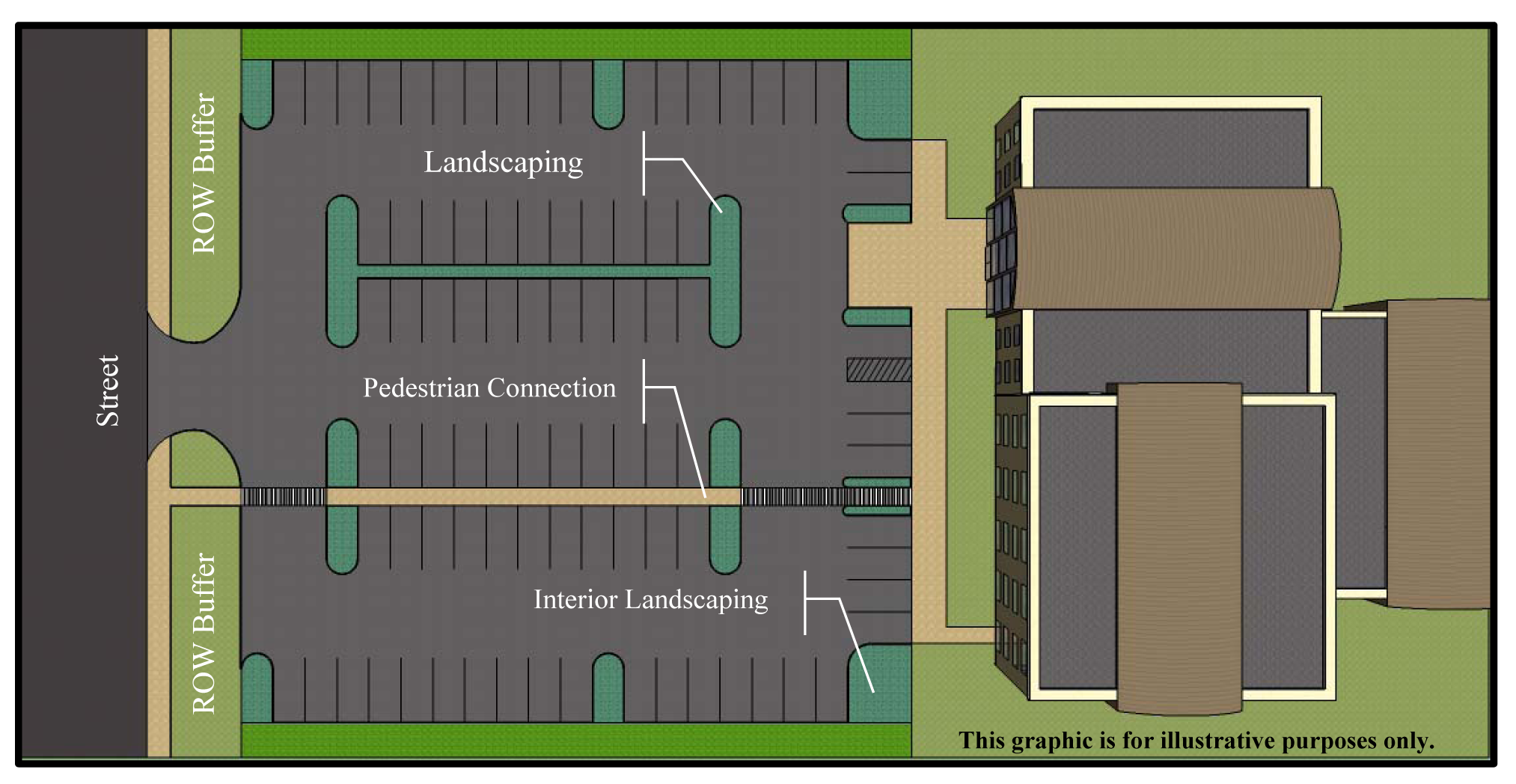
(d)
Low-impact design. Alternative paving materials, including the use of pervious or semi-pervious parking area surfacing materials, may be used for off-street parking in accordance with the DCSM, subject to approval by the city. Sufficient assurance shall be provided that such areas will be properly maintained, and, with respect to the use of grass pavers, the applicant must demonstrate that the vegetation will survive the amount of expected traffic. All such alternative paving materials shall be shown and described on the applicant's site plan with sufficient detail to enable the city to determine compliance with the requirements of the DCSM and this section. The city may request additional information from the applicant to determine whether such requirements have been met.
(e)
Lighting. Whenever development activity on a lot requires site plan review and approval, all off-street parking area lighting shall be provided in accordance with the requirements of the DCSM or this chapter.
(f)
Off-street parking for compact vehicles. Any off-street parking area may include spaces designed for compact vehicles, subject to the requirements of the DCSM.
(g)
Electric vehicle charging stations. Any off-street parking space that meets the minimum requirements of this article may also include charging stations for electric vehicles as shown on an approved site plan. Such stations may be reserved for electric vehicles and may also count toward minimum off-street parking requirements. Electric vehicle charging stations shall meet the requirements of the DCSM.
(h)
Stacking spaces. Each zoning district regulates drive-through facilities by use. Permitted drive-through facilities shall be provided on the same lot and shall meet the minimum required number of stacking spaces and the location and dimensional standards set forth in the DCSM.
(Ord. No. O-2016-19, § 1, 6-27-2016, eff. 7-1-2016; Ord. No. O-2021-06, § 1, 2-8-2021; Ord. No. O-2022-23, § 1, 7-25-2022)
Sec. 130-206. - Off-street loading.
(a)
[Compliance.] The quantity, location, and design of off-street loading spaces shall comply with the requirements listed below and all requirements of the DCSM.
(b)
Specific requirements. Except where indicated otherwise in this article, every use listed in section 130-206, Table 1: Off-Street Loading Requirements shall provide loading areas.
(c)
Location of loading areas.
(1)
All required off-street loading areas shall be located on the same lot as the use served unless a central loading area is provided and shown on an approved site plan in accordance with section 130-206(f).
(2)
Off-street loading areas shall be located, screened, and designed with appropriate means of vehicular access to a street or alley in accordance with the requirements of the DCSM.
(d)
Surfacing. All off-street loading areas shall be surfaced with an improved dustless surface in accordance with the DCSM and shall not include any gravel, dirt, sand, or turf.
(e)
Utilization. Space allocated to any off-street loading use shall not be used to satisfy the space requirements for any off-street parking area or portion thereof.
(f)
Central loading. Central loading facilities may be substituted for loading areas on individual lots or uses if the following criteria are met:
(1)
Each lot or use served by the central loading facility shall be located no more than 500 feet from the central loading area and shall have direct access to the central loading area without crossing at-grade streets; and
(2)
The total size of the central loading area provided shall meet 75 percent (75%) of the cumulative minimum requirements for each of the uses served.
(g)
Minimum facilities. Uses where off-street loading facilities are required but cannot provide the minimum required loading areas due to building or site constraints shall provide alternative receiving facilities accessible by motor vehicle from any adjacent street, alley, driveway, or railroads.
(Ord. No. O-2016-19, § 1, 6-27-2016, eff. 7-1-2016)
Sec. 130-207. - Bicycle parking.
(a)
[Compliance.] The quantity, location, and design of all bicycle parking shall comply with the requirements listed below and all requirements of the DCSM.
(b)
Minimum bicycle parking requirements. Except where indicated otherwise in this article, bicycle parking spaces shall be provided for any use of land requiring a new or revised parking tabulation, in accordance with the DCSM for the following uses or use categories per section 130-241:
(1)
Multifamily dwellings;
(2)
Assembly and institutional uses; and
(3)
Commercial or industrial uses with 10,000 or more gross square feet of floor area.
(c)
Visibility. Whenever the bicycle parking area is not visible from every public entrance of the building, signage not less than one square foot and not greater than three square feet in sign area shall be posted at any entrance from which the bicycle parking is not visible, indicating the location of the bicycle parking.
(Ord. No. O-2016-19, § 1, 6-27-2016, eff. 7-1-2016)

