
Manassas Park City Zoning Code
ARTICLE VI
- SUPPLEMENTARY REGULATIONS
Sec. 31-27. - Off-street parking requirements.
These off-street parking requirements are intended to ensure an efficient transportation and parking system by establishing standards for off-street parking. In any zoning district, all structures built and all uses established hereafter shall provide off-street parking spaces in accordance with the following regulations. When an existing structure or use is expanded, off-street parking spaces shall be provided in accordance with the following regulations.
(a)
General provisions for off-street parking.
(1)
Location: The off-street parking facilities required by this article shall be located on the same lot or parcel of land that they are intended to serve; provided, however, that when the site or shape of land, or a nonconforming building or structure presently existing on the parcel of land, prevents the establishment of such facilities on the same lot or parcel, they may be permitted on a properly zoned lot or parcel within four hundred (400) feet of the premises they are to serve. Before such parking facilities are approved, a written agreement thereto assuring their retention for such purposes shall be properly drawn and executed by the parties concerned, approved as to form by the city attorney, and shall be filed with the zoning administrator.
(2)
Shared: Required off-street parking spaces may be provided cooperatively for two (2) or more nonresidential uses, subject to arrangements that will assure the permanent availability of such spaces to the satisfaction of the zoning administrator. A reduction in the off-street parking required for each separate use may be allowed when the separate uses involve differing hours of operation, days of operation, or other circumstances that clearly demonstrate that the separate uses will not experience simultaneous peak-hours of usage.
(3)
Principal use: All off-street parking facilities shall be used solely for the parking of vehicles in operating condition by patrons, occupants or employees of the use to which such parking is accessory. No motor vehicle repair work, except emergency service, no storage of merchandise, and no motor vehicles for sale, shall be permitted in association with any required off-street parking facilities.
(4)
Change in use: With the exception of single family dwellings, whenever a building or use is changed or enlarged in floor area, number of employees, number of dwelling units, seating capacity or otherwise, to create a need under the requirements of this article for an increase in parking spaces of ten percent (10%) or more, such additional parking spaces shall be provided on the basis of the change or enlargement.
(5)
Enlargement of single family dwellings: Off-street parking spaces shall be provided in accordance with the regulations set forth in this section 31-27 whenever a single family dwelling's floor area is enlarged by ten percent (10%) or more of its original as-built floor area.
(6)
Residential garage: For residential uses in which one or more private garage spaces are provided, each space located inside a private garage based on the designed intent of the structure shall be considered as one-half (½) of an off-street parking space for purposes of determining if the minimum off-street parking requirement has been met.
(7)
Trailers, commercial or residential: Trailers shall not be occupied for residential or business purposes in any district of the city, except that contractors may park or temporarily store equipment trailers and office trailers when necessary to the construction or improvement of a structure; provided that the trailers are located on the same site as the construction or improvement, and that the trailers are removed promptly at the completion of the construction or improvement and prior to the issuance of a certificate of occupancy or phasing.
(8)
Front yards: Parking of vehicles is not allowed on front yards of any property. Parking is permitted only in approved driveways, parking stalls or parking spaces.
(b)
Design standards for off-street parking.
(1)
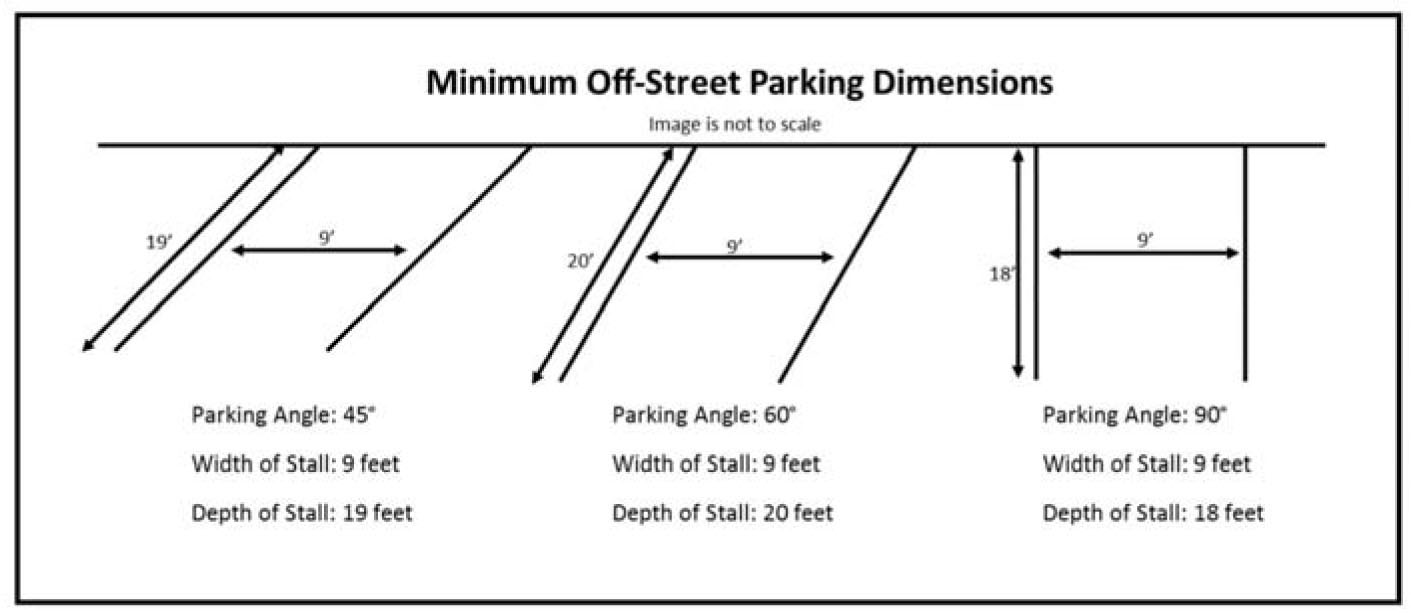
Minimum area: For the purpose of these regulations, an off-street parking space shall have an area of not less than one hundred sixty-two (162) square feet and dimensions of at least nine (9) feet by eighteen (18) feet, exclusive of access drives and aisles, permanently reserved for the temporary storage of one (1) vehicle and connected with a street or alley by a paved driveway which affords ingress and egress for an automobile without requiring another automobile to be moved. Compact spaces are not permitted.
(2)
Surfacing: Off-street parking areas, service areas, interior travel lanes, or driveways shall be surfaced with a stable material, such as asphalt or concrete, in accordance with specifications approved by the public works department. The use of grass pavers may be permitted in low-traffic areas (i.e., overflow parking for places of assembly, temporary events, etc.) upon approval from the city, where it can be demonstrated that the vegetation will survive the amount of expected traffic.
(3)
Drainage and maintenance: Off-street parking areas shall be drained so as to dispose of all surface water accumulated in the parking areas in such a way as to preclude drainage of water onto adjacent property, public streets, or toward buildings. Required parking areas shall be maintained in a clean, orderly, dust-free condition at the expense of the owner or lessee.
(4)
Delineating parking spaces: Whenever five (5) or more parking spaces are provided, such spaces shall be laid out on the parking surface with paint, plastic stripping, curbs, or other means to indicate individual spaces.
(5)
Separation from walkways and streets: Off-street parking spaces shall be separated from walkways, sidewalks, or streets by a wall, fence, curbing, bumper guard, or other protective device, or by distance so that vehicles cannot protrude over publicly owned areas or roll onto adjacent property.
(6)
Access to street: Adequate ingress and egress to the parking lot by means of clearly limited and defined drives shall be provided for all vehicles. A landscaped strip five (5) feet in width, curbing, or approved barriers, continuous except for entrances and exits, shall be provided along the boundaries of any off-street parking area that abuts or adjoins a public street, alley, or public right-of-way in order to control entrance and exit of vehicles or pedestrians.
(7)
Maneuvering lanes: All spaces shall be provided adequate access by means of maneuvering lanes of sufficient width to serve interior traffic movement. Backing directly onto a public street shall be prohibited.
(8)
Lighting: Adequate lighting shall be provided if off-street parking spaces are to be used at night. Any lights used to illuminate said parking areas shall be so arranged and hooded as to confine all direct light rays entirely within the boundary lines of the parking area.
(9)
Charging stations: Parking spaces that meet the minimum requirements may also include charging stations for electric vehicles as indicated on the submitted site plan.
(10)
Landscaping and screening: All off-street parking areas shall comply with the "landscaping and screening requirements" of section 31-33. Parking areas shall be arranged for functional efficiency and safety for both vehicles and pedestrians and shall be designed to be amenable to surrounding property. Parking areas, accessory or otherwise, shall comply with the following:
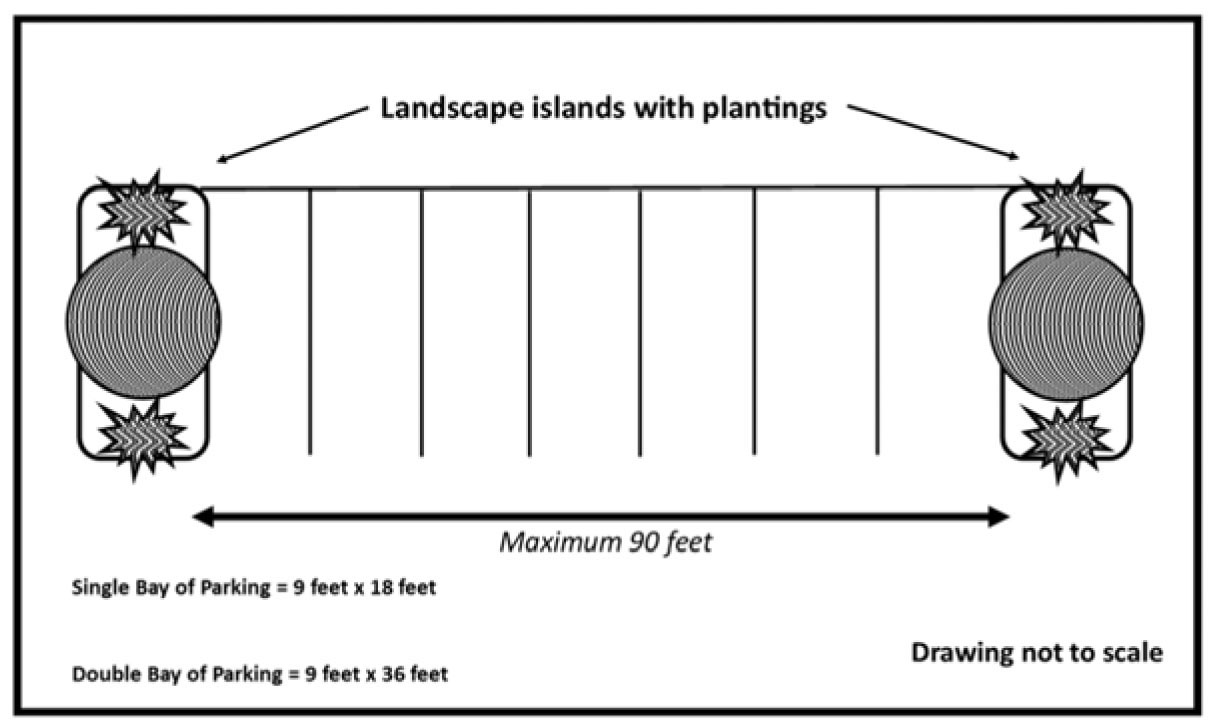
The parking lot shall be constructed so that spaces are grouped into bays. At the end of each bay, a landscape island of at least nine (9) feet in width and eighteen (18) feet in length shall be built to separate the bays from each other and from traffic lanes. When the parking bays contain double rows of parking spaces, the landscape island shall be increased to nine (9) feet in width and thirty-six (36) feet in length. A parking bay shall not be constructed to a length of more than ninety (90) feet without constructing a landscape island. The city may approve islands, which vary from 9-foot by 18-foot or 9-foot by 36-foot rectangles in order to provide desirable geometric design features such as rounded corners and angles to facilitate maneuvering of automobile traffic. In no case shall the total island area be decreased as a result of a design change.
(11)
Handicap accessible parking: Every use shall include the number of handicap accessible off-street parking spaces set forth in the Public Facilities Manual (PFM) and in conformance with the requirements of the Virginia Uniform Statewide Building Code (VUSBC), as amended from time to time, including its reference to the American National Standards Institute specifications. The number of parking spaces for handicapped persons shall be included in the total required spaces. Each such parking space shall be identified by an above-grade sign, which meets the requirements of the director of public works.
(12)
Parallel parking: Parallel parking spaces shall have a minimum length of twenty-two (22) feet and a minimum width of nine (9) feet.
(13)
Bumper guards: Off-street parking areas shall have appropriate bumper guards where needed, as determined by the director of public works. Header curbs may be substituted for bumper guards, provided they are located at least ten (10) feet from any property line. This will avoid vehicle overhang into adjacent properties.
(c)
Minimum off-street parking requirements.
(d)
Interpretation of specific requirements:
(1)
The above off-street parking requirements are in addition to space for storage of trucks or other vehicles used in connection with any use. Any spaces in excess of one hundred twenty-five (125) percent of the minimum number required are to be located in a multi-level parking structure that will serve the proposed uses.
(2)
Where fractional space results, the parking spaces required shall be rounded to the next highest whole number.
(3)
Seasonal variations in employment may be recognized in determining the average day.
(4)
Floor area shall mean the gross floor area of the specific use, excluding areas designated for stairwells, elevators, hallways, restrooms, storage space, and escalators.
(5)
In the case of mixed uses, the parking spaces shall be provided proportional to the required spaces for each use.
(6)
The parking space requirements for a use not specifically listed in this article shall be the same as for a listed use of similar characteristics of parking demand generation. Where there is no similar general type of use listed, the zoning administrator shall determine the basis for the number of spaces to be provided based on the similarity to the use type presented herein.
(e)
Bicycle parking: These standards are intended to promote the use of alternative transportation throughout the city and to create a healthier, multimodal community. The availability of bicycle parking improves access to commercial areas in simple and efficient ways, reducing the need for automobiles and vehicular parking spaces over time.
(1)
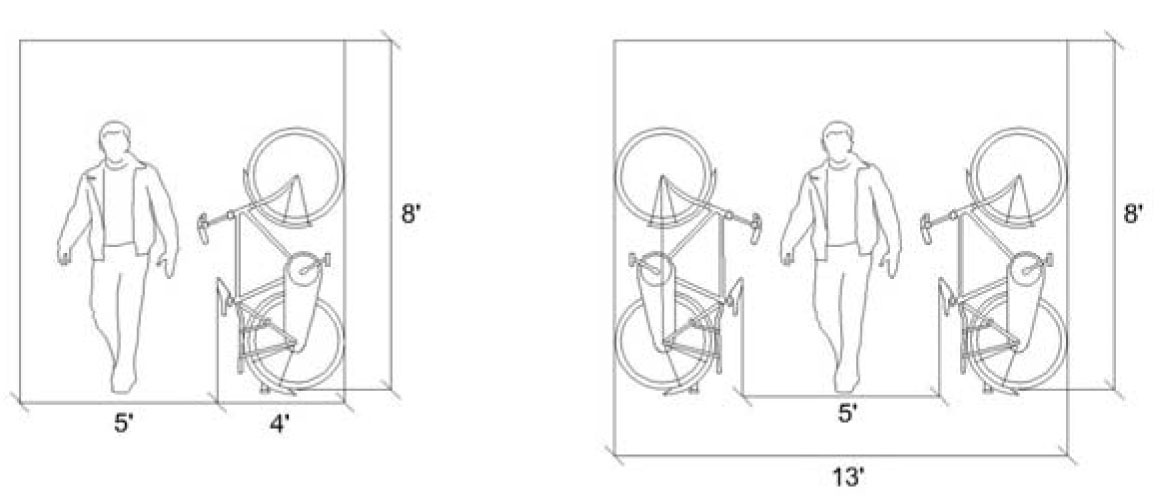
Maneuvering areas. All required bicycle parking must meet all of the following minimum criteria:
a.
The parking area must accommodate the maneuvering standards or, for bicycle parking provided with vertical space-saving racks, as set forth in the figure below.
b.
When in use, each parking space must be accessible without moving another parked bicycle.
c.
The maneuvering area provided alongside or behind the bicycle parking spaces may extend into portions of a public right-of-way but not those portions established as a motor vehicle lane, motor vehicle drive aisle, off-street parking space, or any landscaped area.
(2)
Surfacing. The surface of the bicycle parking area shall be improved with a dustless, hard surface and shall not include any gravel, dirt, sand or turf.
(3)
Visibility. Whenever the bicycle parking area is not visible from either the street or the entrance of the principal building, a sign shall be posted at the entrance of the principal building indicating the location of the bicycle parking.
(4)
Parking spaces. Except where indicated otherwise in this section, every use shall include the number of bicycle vehicle parking spaces indicated under the classifications and formulae set forth in the bicycle parking requirements table below. If a particular use is not specified in the table, then the number of spaces required shall be established by the zoning administrator based on the indicated use type category (i.e., commercial, public facilities, etc.).
(5)
Exemptions.
a.
No bicycle parking spaces are required for any single-family dwelling, two-family dwelling, group home, or industrial use.
b.
No bicycle spaces are required for any residential use located on property in the business zoning districts.
(Ord. No. 86-1700-342, 9-2-86; Ord. No. 89-1700-393, 2-21-89; Ord. No. 06-1700-812, §§ a, b, 9-19-06; Ord. No. 16-1700-981, § 1, 1-5-16;Ord. No. 21-1700-1074, § 1, 4-6-21)
Sec. 31-28. - Off-street loading requirements.
These off-street loading requirements are intended to ensure an efficient transportation and loading system by establishing standards for commercial loading areas. In any zoning district, all structures built and all uses established hereafter shall provide off-street loading spaces in accordance with the following regulations. When any existing structure or use is expanded to the extent of increasing the floor area by twenty-five (25) percent or more, accessory off-street loading spaces shall be provided in accordance with the following regulations.
(a)
General provisions for off-street loading:
(1)
All required off-street loading spaces shall be located on the same or a contiguous lot as the use served.
(2)
Required off-street loading spaces may be provided cooperatively for two (2) or more uses, subject to arrangements acceptable to the city that will assure the permanent availability of such spaces.
(3)
No loading space shall be located in a required front yard, except in the I-1 Industrial district.
(4)
No required off-street loading area shall be used to satisfy the space requirement for any off-street parking facilities and no loading area shall be located so as to interfere with the free circulation of vehicles in any off-street parking area.
(5)
No motor vehicle repair work, except emergency service, shall be permitted in association with any required off-street loading facility.
(b)
Design standards for off-street loading:
(1)
Access to street: All spaces shall be provided with safe and convenient access to a street. Ingress and egress shall be provided only through clearly limited and defined driveway openings.
(2)
Surfacing: Off-street loading areas, including aisles and driveways, shall be constructed and maintained with a stable surface, such as asphalt or concrete, in accordance with specifications approved by the director of public works.
(3)
Dimensions: For the purpose of these regulations, a loading space is a space within the main building or on the same lot, providing for the standing, loading or unloading of trucks and other vehicles, having a minimum width of twelve (12) feet, a minimum depth of thirty-five (35) feet, and a minimum vertical clearance of fifteen (15) feet. Such loading space shall be located so that no part of the vehicle is on any public right-of-way. Vertical clearance for a loading space for a funeral home may be reduced to eight (8) feet.
(4)
Drainage: Off-street loading facilities shall be drained so as to dispose of all surface water accumulated in the loading area in such a way as to preclude drainage of water onto adjacent property, public streets, or toward buildings.
(5)
Lighting: Any lights used to illuminate off-street loading areas shall be so arranged and hooded as to confine all direct light rays entirely within the boundary lines of the loading area.
(6)
Landscaping and screening: All off-street loading areas shall comply with the provisions of section 31-33.
(c)
Off-street loading requirements by use type:
(Ord. No. 07-1700-837, §§ 1, 2 7-17-07; Ord. No. 16-1700-981, § 1, 1-5-16)
Sec. 31-29. - General sign regulations.[8]
(a)
Purpose and intent.
(1)
Signs obstruct views, distract motorists, displace alternative uses for land, and pose other problems that legitimately call for regulation. The purpose of this section is to regulate the size, color, illumination, movement, materials, location, height and condition of all signs placed on private property for exterior observation, thus ensuring the protection of property values, the character of the various neighborhoods, the creation of a convenient, attractive and harmonious community, protection against destruction of or encroachment upon historic areas and the safety and welfare of pedestrians and wheeled traffic, while providing adequate communication through signage while encouraging aesthetic quality in the design, location, size and purpose of all signs. This section shall be interpreted in a manner consistent with the First Amendment of the U.S. Constitution. If any provision of this section is found by a court of competent jurisdiction to be invalid, such finding shall not affect the validity of other provisions of this article, which can be given effect without the invalid provision.
(2)
Signs not expressly permitted as being allowed by right or by specific requirements in another portion of this chapter are forbidden.
(3)
A sign placed on land or on a building for the purpose of identification, protection or directing persons to a use conducted therein shall be deemed to be an integral but accessory and subordinate part of the principal use of land or building.
(4)
This section establishes limitations on signs in order to ensure they are appropriate to the land, building or use to which they are appurtenant and adequate for their intended purpose, while balancing the individual and community interests identified in paragraph (1). These regulations herein are intended to promote signs that are compatible with the use of both the property to which they are appurtenant and the landscape and architecture of surrounding buildings, are legible and appropriate to the activity to which they pertain, are not distracting to motorists, and are constructed and maintained in a structurally sound and attractive condition.
(5)
These regulations distinguish between portions of the city designed for primarily vehicular access and portions of the city designed for primarily pedestrian access.
(6)
These regulations do not regulate every form and instance of visual speech that may be displayed anywhere within the jurisdictional limits of the city. Rather, they are intended to regulate those forms and instances that most likely meaningfully affect one or more of the purposes set forth above.
(7)
These regulations do not entirely eliminate all of the harms that may be created by the installation and display of signs. Rather, they strike an appropriate balance that preserves ample channels of communication by means of visual display while still reducing and mitigating the extent of the harms caused by signs.
(8)
These regulations are not intended to and do not apply to signs erected, maintained or otherwise posted, owned or leased by the federal government or the government of the Commonwealth of Virginia or of the city. The inclusion of "government" in describing some signs is not intended to subject the government to regulation, but to instead help illuminate the types of signs that fall within the immunities of the government from regulation.
(b)
Substitution clause. Signs containing non-commercial speech are permitted anywhere that signs containing commercial speech are permitted and shall comply with all requirements of this section.
(c)
Definitions. The words, terms and phrases, when used in this section, shall have the following meanings ascribed to them, except where the context clearly indicates a different meaning:
(1)
Affix: To stick, attach or fasten an object to something else.
(2)
A-frame sign: A portable two-faced sign with supports that are connected at the top and separated at the base, forming an "A" shape. These are also referred to as "sandwich board signs" is ordinarily in the shape of an "A" or some variation thereof,
(3)
Address sign: A sign that designates the street number and/or street name for identification purposes, as designated by the United States Postal Service.
(4)
Alter: To change in the size or shape of an existing sign or to replace a sign face.
(5)
Air-activated sign: A sign, all or any part of, which is designed to be moved by action of forced air so as to make the sign appear to be animated or otherwise have motion. See also balloon sign.
(6)
Awning sign: A sign painted on, printed on or attached flat against the surface of an awning that is a shelter projecting from and supported by the exterior wall of a building constructed of non-rigid material on a supporting framework.
(7)
Balloon sign: A sign that is an air-inflated object, which may be of various shapes, made of flexible fabric, resting on the ground or a structure, and equipped with a portable blower motor that provides a constant flow of air into the device. Balloon signs are restrained, attached or held in place by a cord, rope, cable or similar method. See also air-activated sign.
(8)
Banner sign: Canvas, plastic fabric or similar lightweight, non-rigid material that can be mounted to a structure with cord, rope, cable or a similar method. If such sign is supported by stakes in the ground, it shall be considered a yard sign.
(9)
Billboard: A sign that describes or calls attention to products, activities or services that are not customarily engaged in, produced or sold on the premises upon which the sign is located, which is either freestanding or displayed on a motor vehicle or trailer, as defined in Section 46.2-100 of the Code of Virginia.
(10)
Building frontage: The linear footage of a building façade that faces a street.
(11)
Building sign: A sign mounted directly on a building, or attached to the façade, parapet or other element of a building. Such signs shall include awning signs, canopy signs, wall signs and projecting signs.
(12)
Canopy sign: A sign attached to the soffit or fascia of a canopy of a covered entrance or walkway, which is a permanent structure made of cloth, metal or other material attached or unattached to a building for the purpose of providing shelter to patrons or automobiles, or as a decorative feature on a building wall. A canopy is not a completely enclosed structure but typically is supported by features other than the building façade, such as structural legs or building extensions.
(13)
Directional sign: A small permanent sign located near driveway access points and/or at the intersection of internal access drives.
(14)
Display: Make a prominent exhibition of some object in a place where it can easily be seen.
(15)
Drive-up sign: Any signage located along a drive-up lane that is oriented toward the customer or user in the drive-up lane.
(16)
Durable: Able to withstand wear, pressure or damage; hard-wearing and not easily worn over a long duration.
(17)
Electronic message center: A variable message sign that utilizes computer-generated messages or some other electronic means of changing copy more than once in a twelve (12) hour period and requires approval of a waiver. These signs include displays using incandescent lamps, light emitting diodes (LEDs), liquid-crystal display (LCDs) or a flipper matrix.
(18)
Erect: To construct or install a building, wall or other structure.
(19)
Flag: A sign made of non-rigid material such as canvas or vinyl and having no enclosing or supporting framework. A flag is usually rectangular or triangular and is attached at one end to a pole. Often intended for temporary use, a flag can be woven, screen-printed or painted.
(20)
Freestanding sign: Any sign supported upon the ground by a monument, pedestal, pole bracing or other permanent measure and not attached to any building.
(21)
Master sign plan: A comprehensive plan of signage for a multi-tenant shopping centers, office complex, industrial park or the nonresidential portions of a property zoned MUD or PUD that is subject to approval of a waiver and allows for the modifications to the sign regulations resulting in a superior design that compliments the layout, architecture and distinctive elements of a development.
(22)
Mixed use: Refers to a parcel or lot of record, or a structure constructed thereon, zoned to the MU-D, downtown mixed-use zoning district.
(23)
Monument sign: A ground mounted sign where the sign face is set on a base or platform and has no visible support structure.
(24)
Double-faced sign: A sign having two (2) display faces, where the sign faces are not mounted back to back and where the faces are such that the interior angle of the faces is greater than ninety (90) degrees and not being a three-way dimensional sign.
(25)
Multifamily: Refers to a parcel or lot of record, or a structure constructed thereon that accommodates more than one dwelling unit.
(26)
Nonconforming sign: Any sign lawfully installed that due to the adoption or amendment of this Code does not meet the current regulations.
(27)
Nonresidential: Refers to a parcel or lot of record, or a structure constructed thereon primarily for agricultural, commercial, industrial, public or institutional purposes.
(28)
Off-premises sign: A sign that directs attention to a business, commodity, service or entertainment conducted, sold or offered at a location other than the premises on which the sign is located.
(29)
On-premises sign: A sign that directs attention to a business, commodity service or entertainment conducted, sold or offered on the same lot, parcel, site or property where the sign is located.
(30)
Pennant: A triangular or irregular piece of fabric or other material, whether or not containing a message of any kind, commonly attached by strings, strands or supported on small poles, intended to flap in the wind.
(31)
Permanent sign: A sign permitted by this ordinance to be located on the premises for an unlimited period of time and designed to be permanently attached to a structure or the ground.
(32)
Portable sign: A sign that is capable of being transported because it is lighter and smaller in size. See A-frame and T-frame signs.
(33)
Projecting sign: A sign that is affixed to a building or wall and extends more than eighteen (18) inches beyond the face of such building or wall. A projecting sign shall also include a sign hung under an arcade.
(34)
Reader board: A sign or portion of a sign where it is possible to change the copy on a frequent basis but where such sign change must be manually made and is not made electronically.
(35)
Roof sign: A sign located in whole or in part upon or above the highest point of a building with a flat roof or the lowest portion of a roof for a building with a pitched roof.
(36)
Sign: Any object, device, display or structure or part thereof situated outdoors or adjacent to the interior of a window or doorway which is used to advertise, identify, display, direct or attract attention to an object, person, institution, organization, business, product, service, event or location by any means including words, letters, pictures, logos, figures, designs, symbols, fixtures, colors, illumination or projected images. A sign not visible from any adjacent right-of-way is not considered a sign for purposes of this ordinance.
(37)
Single family: A parcel or lot of record, or a structure constructed thereon that accommodates a single dwelling unit, whether it is a single family attached or detached dwelling unit.
(38)
Subdivision sign: A sign placed at the entrance of a subdivision from the public right-of-way.
(39)
Temporary sign: Any sign which is movable, not permanently attached to the ground, a structure or other sign, designed or constructed in such a manner that it can be moved or relocated without involving any structural or support changes, intended for a limited period of display or constructed out of cloth, canvas, plastic sheet, cardboard or other like materials.
(40)
T-frame sign: A portable sign that is ordinarily in the shape of an upside down "T" or some variation thereof, which is readily moveable and is not permanently attached to the ground or any structure.
(41)
Wall sign: A sign attached directly to an exterior wall of a building and which does not extend above the roof line more than eighteen (18) inches from or beyond the limits of the outside wall, with the exposed face of the sign in a plane parallel to the building wall. Murals and other painted signs are considered wall signs pursuant to this section.
(42)
Window sign: Any sign viewable through and/or affixed in any manner to a window or exterior glass door such that it is intended to be viewable from the exterior including, but not limited to, window paintings and signs located inside a building but visible primarily from the outside of the building. This does not include merchandise and other displays located in a window or print intend to be viewable from the interior of a building.
(43)
Wind sail sign: A temporary sign that is constructed of cloth, canvas, plastic fabric or similar lightweight, non-rigid material that is supported by a single vertical pole mounted into the ground or on a portable structure.
(44)
Yard sign: Any temporary sign placed on the ground or attached to a supporting structure, posts or poles, that is not attached to any building.
(d)
Administration.
(1)
Except for those signs listed in subsection (h) below, no sign shall be erected, posted, painted, altered, or relocated until a permit for such sign has been issued by the zoning administrator.
(2)
Each sign permit shall be accompanied by two (2) copies of the following information for each sign: rendering of sign design and support structure, dimensions of sign area and any support structure; a site plan showing proposed location(s); method of illumination, if any; method of fastening such sign; contact information of property owner, sign owner and sign company; and, if applicable, approval of the waiver for a master sign plan or electronic message center.
(3)
An application for a sign permit shall include payment of the review fee in the amount established by the fee schedule.
(4)
A sign permit shall become null and void if the work for which the permit was issued has not been completed within a period of six (6) months after the date of the issuance of the permit.
(5)
Any sign for which a sign permit has been granted shall be subject to inspection by the zoning administrator. If the sign fails to pass inspection, the sign shall be in violation of this chapter.
(6)
All signs shall meet the structural requirements set forth in the Virginia Uniform Statewide Building Code.
(e)
Revocation of sign permit. The zoning administrator may revoke a sign permit under any of the following circumstances:
(1)
Information provided in the application was materially false or misleading;
(2)
The sign as installed does not conform to the approved sign permit application;
(3)
The sign violates the zoning ordinance, building code or other law, regulation or ordinance.
(f)
Sign measurement and calculations.
(1)
Sign height shall be measured from the average grade at the base of the sign to the highest point of the sign structure. Property grade may not be modified immediately adjacent to a sign unless the modified grade is shown on an approved site plan.
(2)
If the proposed sign location is below the grade of the adjacent roadway, the sign height shall be measured from the adjacent road elevation closest to the base of the sign.
(3)
Sign area is the area within a circle, triangle, parallelogram, or trapezoid enclosing the extreme limits of any message including writing, representation, pictorial elements, emblems or figures of similar character, together with all material, color or lighting that either forms an integral part of a display or differentiates the message from the background against which it is placed.
(4)
For double-faced signs, only one (1) display face shall be measured in computing total sign area provided the faces are either parallel or have an internal angle between its two (2) faces of no more than forty-five (45) degrees. If one side is larger than the other the larger of the two shall be used to calculate sign area.
(g)
Sign illumination. Lighting shall be the minimum necessary to be visible at nighttime and shall not create a distraction or other hazard, such as pinpoint glare, to vehicular traffic.
(1)
In the case of indirect lighting, the source shall be so shielded that it illuminates only the face of the sign. Indirect lighting shall consist of full cut-off or directionally shielded lighting fixtures that are aimed and controlled so that the directed light shall be substantially confined to the sign to minimize glare, sky glow and light trespass. The beam width shall not be wider than that needed to light the sign. The light source shall have a neutral hue and be consistent for all fixtures illuminating a single sign.
(2)
Internal illumination and halo illumination shall not be permitted to have an illumination spread of more than .05 foot candle at the lot line, shine into on-coming traffic, affect highway safety, or shine directly into or upon a residential dwelling unit. The background of internally illuminated signs shall be designed so that the illumination only penetrates the letters, logos, symbols, or other message copy.
(3)
Internally illuminated wall signs shall not be placed on any building elevation that faces an adjacent residential property.
(h)
Signs not requiring a permit. The following signs are exempt from the permit process but shall still comply with all applicable safety, lighting, height and area location standards established in this section.
(1)
Address signs.
(2)
Flags.
(3)
Holiday decorations.
(4)
Home occupation signs.
(5)
Light pole banners, provided they are located on-site in commercial and mixed use developments, there are no more than two (2), double-faced banners per light standard, are limited to six (6) square feet in size per banner, have a minimum clearance of ten (10) feet above grade, and are placed no higher than the maximum height of the light pole.
(6)
Signs associated with approved temporary uses.
(7)
Signs installed by city governmental agencies on city-owned property.
(8)
Signs or notices issued by any court, officer or other person or organization in performance of a public duty or required by law to be posted.
(9)
Signs not visible from the public right-of-way that do not exceed thirty-two (32) square feet in sign area.
(10)
Signs posted on accessory structures that are customarily found and incidental to any permitted nonresidential use, provided such sign is no greater than two (2) square feet in size.
(11)
Temporary signs, as regulated by subsection (k) below.
(12)
Traffic control devices (TCDs) as identified in the latest version of the Manual on Uniform Traffic Control Devices (MUTCD) and other State and City design standards related to traffic control or management that are installed by Manassas Park Department of Public Works or the Commonwealth of Virginia.
(13)
Window signs, provided coverage does not exceed fifty (50) percent of the window area.
(i)
Prohibited signs.
(1)
Any sign that violates any provision of any law of the state or federal government relative to outdoor advertising.
(2)
Any sign that violates any provisions of the Uniform Statewide Building Code.
(3)
Any sign that obscures a sign or signal displayed by a governmental authority.
(4)
Any sign, except an off-premises sign that complies with subsection (l) below, that advertises an activity, business, product, or service no longer conducted on the premises upon which the sign is located.
(5)
Any sign that is a copy or imitation of or which for any reason is likely to be confused with any traffic-control sign or signal used or displayed by a public authority.
(6)
Any sign within the triangular area at the street corner of a corner lot described in section 31-31 of this chapter.
(7)
Any sign that obstructs any window, door, fire escape, stairway, ladder, or opening intended to produce light, air, ingress, or egress for any building, as required by law.
(8)
Balloon signs.
(9)
Air-activated signs.
(10)
Pennants and spinners.
(11)
Any sign, except an official notice from the city or a public utility company, that is nailed, tacked, posted, or in any other manner attached to any utility pole or structure for supporting wire, cable, or pipe, or to any tree on any street or sidewalk or to public property of any description.
(12)
Any sign or illumination that causes any direct glare into or upon any building or property other than the building or property to which the sign may be related, or which the direct or reflected light from primary light sources creates a traffic hazard to operators of motor vehicles on public roads.
(13)
Any sign displaying flashing or intermittent lights, or other lights of changing degrees of intensity, brightness or color, unless approved as a waiver for an electronic message center.
(14)
Roof signs.
(15)
Billboards.
(j)
Signs allowed by zoning district. Signs shall be permitted by district in accordance with the following table.
[Key:] SF = Single Family; MF = Multifamily; P = Permitted;
X = Not Permitted; W= Requires a waiver;
P
1
= Permitted only in commercial areas of PUD; not permitted in MU-D.
(k)
Temporary signs.
(1)
General provisions.
a.
Temporary signs do not require approval of a sign permit.
b.
Temporary signs shall be on-premises signs.
c.
Temporary signs shall be constructed and maintained according to the standards, specifications and regulations of this section.
d.
Temporary signs shall not be mounted, attached, affixed, installed or otherwise secured in a manner that will make the sign a permanent sign.
e.
No on-premises temporary signs shall be mounted, attached, affixed, installed or otherwise secured to or above the roof or roofline of any structure.
f.
No on-premises temporary signs shall be internally or externally illuminated.
g.
Temporary signs shall be properly secured to their framing and the ground or structure to which they are attached.
h.
Temporary signs shall not be attached to any permitted sign or its associated support structure.
i.
With the exception of A-frame and T-frame signs, no temporary sign shall be placed in the right-of-way.
j.
The posting of temporary signs requires permission of the property owner.
(2)
Temporary signs on properties for sale or lease.
a.
One temporary sign may be placed on a lot for sale or lease.
b.
Signs shall be removed no later than fourteen (14) days following the date on which a sale or lease contract was executed.
c.
Signs shall be located no closer than ten (10) feet from any property line.
d.
Sign type is limited to yard or banner sign.
e.
Sign size and height limitations are as follows:
(3)
Temporary signs during elections.
a.
One temporary sign per candidate and per issue on a ballot may be placed on a lot for a period of seventy-five (75) days prior to any federal, state or local election.
b.
Each sign shall not exceed six (6) square feet in size.
c.
Signs shall be removed no later than three (3) days after the date of the election.
d.
Notwithstanding paragraph (a) above, any sign no greater than six (6) square feet may be placed at a polling station, provided it is located no closer than forty (40) feet from any polling station entrance and is erected no earlier than 12:00 p.m. the day before the election and removed no later than 9:00 a.m. the day after the election.
(4)
Temporary signs on single family property.
a.
A maximum of twenty (20) square feet of temporary signage is permitted.
b.
Banner signs may be attached to a building, fence or other similar structure. No banner shall be mounted higher than the roofline.
c.
A banner sign attached to posts and mounted in a yard or landscape area shall be regulated as a temporary yard sign.
d.
Temporary yard signs shall not exceed six (6) feet in height.
e.
Signs having an area of sixteen (16) square feet or greater shall only be permitted for a maximum of ninety (90) days in a consecutive three hundred sixty-five (365) day period.
(5)
Temporary signs on nonresidential property and multifamily property.
a.
Any nonresidential use located in the City Center Redevelopment District may have one (1) T-frame or A-frame sign. Such sign may be displayed on the sidewalk, provided it is removed daily and does not interfere with pedestrian traffic.
b.
Up to two (2) of the following signs, or any combination thereof, may be displayed on nonresidential property, multifamily property or mixed use property for a maximum of one hundred twenty (120) days within a consecutive three hundred sixty-five (365) day period:
1.
Banner or building signs.
i.
Banner signs may be attached to a building, fence or other similar structure. A banner sign attached to posts and mounted in a yard or landscape shall be regulated as a temporary yard sign.
ii.
The maximum sign area of any single banner or building sign shall be twenty (20) square feet.
iii.
A banner or building sign shall not be mounted higher than the roofline.
2.
Wind sail signs.
i.
The maximum dimensions of a wind sail sign shall be fifteen (15) feet in height and three (3) feet in width.
ii.
Every wind sail sign shall be set back from any property line a distance equal to its height.
3.
Yard signs.
i.
Each sign face that can be seen from the public right-of-way shall count as a sign.
ii.
The temporary yard sign shall not exceed eight (8) feet in height or thirty-two (32) square feet in area.
(l)
Off-premises signs.
a.
Off-premises signs shall require permission from the property owner or his designated agent as part of the sign permit application.
b.
Off-premises signs shall only be located on property that is zoned B-1, B-2, B-3, I-1, I-2, and commercial areas of a PUD.
c.
An off-premises sign shall be a freestanding sign.
d.
Off-premises signs shall be constructed of materials that are durable enough to safely, securely and effectively meet the proposed duration of such sign.
e.
Off-premises signs shall have a maximum height of eight (8) feet and a maximum sign area of thirty-two (32) square feet.
f.
There shall be a maximum of two (2) off-premises signs per property.
g.
An off-premises sign permit is only valid for six (6) months, but may be renewed for another six (6) months up to two (2) times.
(m)
Permanent freestanding signs.
(1)
Directional signs.
a.
Where permitted, there shall be no more than one sign per driveway intersection with any street;
b.
The maximum sign area shall be five (5) square feet; and
c.
The maximum sign height shall be three (3) feet.
(2)
Drive-up signs.
a.
Drive-up signs shall be located on nonresidential property having a drive-up lane.
b.
One (1) drive-up sign is permitted for each drive-up lane with a maximum sign area of thirty-six (36) square feet each.
c.
The provisions of subparagraph b above shall not apply to any drive-up sign located in the rear of the building not visible from a public right-of-way or screened with a wall or landscaping or other screening method that fully blocks the view of the drive-up sign as seen from the right-of-way.
(3)
Monument signs.
a.
Monument signs for single family residential developments.
i.
A maximum of two (2) monument signs are permitted at the entrance of any single family residential development.
ii.
Such signs shall be a minimum of five (5) feet from any property line.
iii.
The sign area shall be a maximum of thirty-six (36) square feet per sign.
iv.
The maximum height of such signs shall be twelve (12) feet.
b.
Monument signs for public facilities and commercial, industrial, multifamily and mixed use properties. Except as qualified below, any lot containing a public facility, mixed use development, commercial, industrial or multifamily use is permitted one (1) monument sign per street frontage with each sign having a maximum height of twelve (12) feet and a maximum sign area of [fifty] (50) square feet.
i.
When located in the Four Corners Redevelopment District, monuments signs are limited to one (1) per lot with a maximum height of ten (10) feet and fifty (50) square feet of sign area, which may be increased to eighty (80) square feet when located in a shopping center. Any monument sign in the Four Corners Redevelopment District shall have perimeter landscaping at the base consisting of flowers or shrubs that are regularly maintained.
ii.
When located in a shopping center outside the Four Corners Redevelopment District, monument signs are permitted a maximum sign area of sixty (60) square feet and a maximum height of twelve (12) feet.
iii.
When located in an industrial park, monument signs are permitted a maximum sign area of one hundred (100) square feet and a maximum height of twelve (12) feet.
(n)
Permanent building signs.
(1)
Building signs include canopy, awning, wall and projecting signs and are limited based on a total maximum sign area. Roof sign are prohibited.
(2)
Building signs for multifamily uses and nonresidential uses in agricultural or residential districts shall be limited to a maximum sign area of twenty-four (24) square feet per building frontage.
(3)
Building signs for commercial and industrial uses, mixed use developments and public facilities shall not exceed two (2) square feet per linear foot of building or tenant frontage. The maximum sign area per tenant shall not exceed two hundred (200) square feet.
(4)
Where building frontage is on more than one (1) street, the sign area computed for each frontage shall only be used along the street that the building fronts.
(5)
No building sign shall project more than five (5) feet from the building front, nor closer than two (2) feet from any curb line.
(6)
All building signs shall have a minimum clearance of ten (10) feet above a walkway and fifteen (15) feet above a driveway, alley or parking space.
(7)
Awning signs may be located on or above the vertical fascia or drop leaf.
(8)
Projecting signs shall be no closer than five (5) feet to a property line.
(o)
Reader boards. Reader boards are permitted as part of any canopy or monument sign provided the reader board does not exceed fifty (50) percent of the sign area.
(p)
Signs requiring a waiver.
(1)
To promote flexibility in design and enhance the compatibility of signage with the architectural and site design features within a development, electronic message centers and master sign plans may be may be submitted for review and approval as a waiver, as provided in section 31-33.2.
(2)
In addition to the submission requirements in section 31-33.2, a waiver application for signage shall include four (4) sets of the following:
a.
A map showing the location of each sign;
b.
A site plan that shows property lines, location of buildings, length of building frontage and street frontage, location of tenant spaces, frontage improvements, parking and landscaped areas;
c.
Building elevations showing location for all proposed sign options, showing maximum letter and logo height and width and the dimensions between signs and the edges of the façade and roofline;
d.
Renderings of proposed signage and any support structure that identifying the length, width, height of each sign and its associated support structure;
e.
Area of each sign;
f.
Identification of sign materials and type of support structures to include color and texture;
g.
Proposed illumination; and
h.
Message change time, transition method, all text and image movements including but not limited to scrolling, flashing, or spinning and all other animated effects, if requesting a reader board or electronic message center.
(3)
Limitations for electronic message centers.
a.
Electronic message centers shall be limited to seventy-five (75) percent of the sign area.
b.
Where permitted, there shall be only one (1) electronic message center per lot with no more than two (2) sign faces.
c.
Electronic message centers must be designed and equipped to freeze a display in one (1) position if a malfunction occurs.
d.
Electronic message centers shall be equipped with an automatic dimming photocell that automatically adjusts the display's brightness based on ambient light conditions.
e.
The brightness level shall not exceed 0.3 foot candles over ambient levels as measured at a distance of one hundred fifty (150) feet.
(4)
Limitations for master sign plans.
a.
A master sign plan is only permitted for multi-tenant shopping centers, office complexes, industrial parks or the nonresidential portions of a property zoned MUD or PUD.
b.
A master sign plan may include signage that exceeds the requirements of this section in terms of number, type, size and height.
(5)
In addition to the standards provided in section 31-33.2(d), the planning commission and governing body will evaluate the following factors when considering a signage waiver:
a.
The proposed signage is appropriate for the architectural and urban design elements of the site; and
b.
The proposed signage is complementary to the scale and harmony of the development; and
c.
The proposed signage is compatible with adjacent properties; and
d.
The proposed signage is architecturally and aesthetically durable.
(q)
Nonconforming signs.
(1)
Signs which do not conform to the regulations prescribed herein that were erected in accordance with all applicable regulations in effect at the time of their erection may remain except as qualified below.
(2)
No nonconforming sign shall be enlarged nor shall any feature of a nonconforming sign, such as illumination be increased or added.
(3)
Nothing in this section shall be deemed to prevent keeping in good repair a nonconforming sign. Nonconforming signs shall not be extended or structurally reconstructed or altered in any manner, unless the nonconforming sign is reduced in area or height. Sign face replacement is permitted provided the new sign face is equal to or smaller than the existing nonconforming sign face.
(4)
If damaged to an extent greater than fifty (50) percent of its replacement value, it shall not be rebuilt.
(5)
No nonconforming sign shall be moved for any distance on the same lot or to any other lot unless such change in location will make the sign conform in all respects to the provisions of this section.
(6)
A nonconforming sign that is destroyed or damaged by any casualty to an extent not exceeding fifty (50) percent of its area may be restored within two (2) years after such destruction or damage but shall not be enlarged in any manner. If such sign is so destroyed or damaged to an extent exceeding fifty (50) percent, it shall not be reconstructed but may be replaced with a sign that is in full accordance with the provisions of this section.
(7)
A nonconforming sign that has become or is replaced with a conforming sign shall no longer be deemed nonconforming, and thereafter such sign shall be in accordance with the provisions of this section.
(8)
A nonconforming sign shall be removed if 1) it does not meet the requirements of the Virginia Uniform Statewide Building Code or 2) the use to which it is accessory has not been in operation for a period of two (2) years or more. Such sign shall be removed by the owner or lessee of the property. If the owner or lessee fails to remove the sign, the zoning administrator or designee shall give the owner thirty (30) days' notice to remove it. Upon failure to comply with this notice, the zoning administrator or designee may enter the property upon which the sign is located and remove any such sign or may initiate such action as may be necessary to gain compliance with this provision. The cost of such removal shall be chargeable to the owner of the property.
(r)
Sign maintenance and removal.
(1)
All signs shall be maintained in good working condition so as to present a neat and orderly appearance. The zoning administrator may cause to be removed any sign which shows gross neglect, is dilapidated, has ground area around it that is not well maintained, or is in danger of falling or is otherwise unsafe.
(2)
A sign shall be removed by the owner or lessee of the premises upon which the sign is located when the business that it advertises or identifies is no longer on the premises. Failure to remove the sign shall constitute a violation of this chapter.
(3)
The zoning administrator may order the removal of any sign erected or maintained in violation of this chapter. The zoning administrator shall give thirty (30) days' notice in writing to the owner of such sign or of the building, structure, or premises on which such sign is located to remove the sign or to bring into compliance. Failure to comply shall constitute grounds for the zoning administrator to have the sign removed at cost to the owner.
(Ord. No. 85-1700-269, 2-6-85; Ord. No. 01-1700-660, § 1, 4-17-01; Ord. No. 01-1700-661, § 1, 4-17-01; Ord. No. 03-1700-702, § 1, 3-18-03; Ord. No. 06-1700-810, § 1, 8-28-06; Ord. No. 07-1700-840, § 1, 9-18-07; Ord. No. 08-1700-849, § 1, 3-18-08; Ord. No. 12-1700-930[A], § 1, 6-19-12; Ord. No. 18-1700-1015, § 4, 6-19-18; Ord. No. 18-1700-1022, § 1, 7-17-18)
Cross reference— Outdoor advertising signs generally, § 3-16 et seq.
Sec. 31-30. - Special height and yard regulations.
(a)
Structures excluded from maximum height regulations: The height limitations of this chapter shall not apply to:
(1)
Air conditioning units;
(2)
Belfries;
(3)
Chimneys;
(4)
Church spires;
(5)
Conveyors;
(6)
Cooling towers;
(7)
Elevator bulkheads;
(8)
Fire towers;
(9)
Flag poles;
(10)
Flues;
(11)
Ornamental towers and spires;
(12)
Public monuments;
(13)
Radio and television towers;
(14)
Scenery lofts;
(15)
Silos and grain driers;
(16)
Smokestacks;
(17)
Transmission towers and cables;
(18)
Water tanks and towers;
or other similar roof structures and mechanical appurtenances; provided, however, that no such structure, when located on a building roof, shall occupy an area greater than twenty-five (25) percent of the total roof area; no such structure shall be used for any purpose other than a use incidental to the main use of the building; freestanding structures shall not be located nearer to a lot line than a distance equal to its height; and the height of all buildings and structures located within the approaches to airport landing strips shall be in accordance with the official recommendations of the Federal Aviation Agency as to heights that would not constitute a hazard to the safe air approach to or departure from an airfield.
(b)
Yards and open space in general:
(1)
No yard or other open space on any lot shall be considered as providing a yard or open space for any other lot.
(2)
No yard or open space provided on any lot for the purpose of complying with the provisions of this chapter shall be reduced so as to be less in width or area than is required by this chapter.
(3)
More than one (1) main building may be located upon a lot or tract in the following instances: institutional buildings, public or semi-public buildings, multiple-family dwellings, commercial or industrial buildings, homes for the aged. The provisions of this exception shall not be construed to allow the location or erection of any building outside of the buildable area of the lot.
(4)
Where these regulations refer to side streets, the zoning administrator shall be guided by the pattern of development in the vicinity of the lot in question in determining which of the two (2) streets is the side street.
(c)
Yard encroachment: Every part of every required yard shall be open and unobstructed from the ground to the sky except as hereinafter provided:
(1)
Unenclosed porches, platforms, or terraces, with or without roofs, which do not extend above the level of the first floor of the building, may extend into the front yard setback to within ten (10) feet of the front property line, five (5) feet into a required side yard, and twelve (12) feet into a required rear yard.
(2)
The depth of any porch attached to the front of a house can be no greater than eight (8) feet.
(3)
Cornices, eaves, sills, belt courses and similar ornamental features may extend three (3) feet into any required yard.
(4)
Open or lattice enclosed fire escapes shall not project over five (5) feet into a required yard.
(5)
Steps or landings not higher than the entrance floor of the building may extend five (5) feet into any required yard.
(6)
Bay windows and balconies occupying not more than one-third (⅓) of the wall length may extend three (3) feet into any required front or side yard and ten (10) feet into any required rear yard.
(7)
An unenclosed carport, attached to a dwelling, may extend into any required side yard a distance of not more than five (5) feet, but not nearer to any side lot line than a distance of five (5) feet.
(d)
Front yards:
(1)
Where the street width is fifty (50) feet or greater, the front yard shall be measured from the street line. Where the street width is less than fifty (50) feet, the front yard shall be measured from the center line of the Street. However, in all cases, where an official line has been established for the future widening or opening of a street upon which a lot abuts, then the depth of a front or side yard shall be measured from such official line to the nearest line of the building.
(2)
Buildings on lots that extend through from street to street shall provide the required front yards on both streets, but need not provide the required rear yards in case an equivalent open space is provided in lieu thereof.
(3)
There shall be a front yard of at least fifteen (15) feet on the side street of a corner lot in any district; provided, however, that the buildable width of a lot shall not be reduced to less than thirty (30) feet.
(4)
Where the street frontage in a block is partially built up, the minimum front yard for a new building shall be the average of the nearest front yard on either side thereof in the same block, with a variation of five (5) feet permitted, except that no front yard in a residential district shall be less than twenty (20) feet or need be more than seventy-five (75) feet.
(5)
Excluding off-street parking space and related driveway, no motorized vehicle shall be parked in the front yard.
(6)
Any lot containing a single-family detached dwelling located in either the R-1 or PUD (residential) zoning district, may have a combined paved area for driveway and parking purposes that does not exceed either twenty (20) feet in width or twenty (20) percent of the width of the front yard, whichever is greater.
(Ord. No. 85-1700-269, 2-6-85; Ord. No. 04-1700-755, §§ 1, 2, 7-20-04; Ord. No. 04-1700, § 2, 7-20-04)
Sec. 31-31. - Fences and visual obstructions.
Except when used in connection with a public use, fences and other visual obstructions shall be governed by the following standards:
(a)
Fences: Except as qualified in paragraph (b)(1) below, a fence or other similar structure is subject to the following limitations:
(1)
A fence not exceeding four (4) feet in height is permitted in any yard.
(2)
A fence with a maximum height of six (6) feet is permitted in any side or rear yard.
(3)
The maximum fence height may be increased to eight (8) feet in any yard when approved as part of a rezoning or site plan for the PUD Planned Unit Development district or MU-D Downtown Mixed-Use district.
(4)
The maximum fence height may be increased to ten (10) feet in any yard when located in the I-1, Industrial district.
(5)
The maximum fence height may be increased between (i) residential and (ii) commercial or industrial uses to a reasonable height that will provide effective screening between the incompatible uses, as determined by the zoning administrator.
(6)
Electrified fences (other than invisible fences that are buried underground and that have insulated wiring) and fences using barbed wire are prohibited in all residential districts and residential portion of the PUD Planned Unit Development district and the MU-D Downtown Mixed-Use district.
(7)
No fencing shall be erected so as to restrict access by emergency equipment to any building.
(b)
Visual obstructions:
(1)
On a corner lot, no sign, fence, wall, hedge, planting, or other obstruction to vision exceeding a height of three (3) feet above center-line grades of the intersecting streets shall be erected, planted, or maintained within a distance of twenty (20) feet in either direction from the corner.
(2)
On all lots, fences, landscaping and other improvements shall be located and maintained in a manner that does not obscure sight distances.
(Ord. No. 12-1700-931, § 1, 7-31-12; Ord. No. 20-1700-1068, § 1, 11-4-20)
Sec. 31-32. - Accessory uses and structures.
(a)
In general: In all districts, accessory uses or structures shall not be located in a front or side yard area, unless specifically provided for elsewhere by the provisions of this chapter.
(1)
In residential districts, all accessory structures located in a rear yard shall be located at least two (2) feet from any side or rear lot line.
(2)
In residential districts, accessory buildings permitted in rear yards shall not occupy a combined total of more than thirty (30) percent of said yard.
(3)
In nonresidential districts, no setback from side or rear lot lines shall be required, except the minimum side and rear yard adjoining or adjacent to a residential district shall be ten (10) feet.
(4)
If a garage is entered from an alley, it shall not be closer than five (5) feet to the alley line in any district.
(5)
No accessory building shall be constructed upon a lot until the construction of a main building has actually been commenced; and no accessory building shall be used unless the main building on a lot is completed and used.
(b)
Permitted vehicles:
(1)
Unless stored in a completely enclosed structure, no more than two (2) permitted vehicles (as defined in section 24-51(e)), which includes the with a home occupation, shall be allowed as an accessory use to any residential dwelling. Any such permitted vehicles must be parked off-street either on a driveway or other designated parking area, in accordance with section 31-27 and subject to the limitations of section 31-27(b).
(2)
No permitted vehicle shall be used for living, cooking, sleeping or other occupancy when parked or stored within any zoning district, unless permitted as a temporary use pursuant to section 31-56.
(c)
Home occupations: In any residential district, a home occupation is permitted, provided that the occupation complies with all of the following conditions:
(1)
No more than one (1) person other than members of the family shall be engaged in such occupations, except that any number of nonfamily/nonresident employees may be permitted if they work off-premises and do not park at the premises.
(2)
The home occupation shall be in its entirety within the single unit dwelling or in an accessory building which is normally associated with a residential use.
(3)
There shall be no change in the outside appearance of the building or premises, or other visible evidence of the conduct of such home occupation other than one (1) sign, not exceeding two (2) square feet, nonilluminated.
(4)
There shall be no outdoor display of goods or outside storage of equipment or materials used in the home occupation.
(5)
Only those articles produced on the premises may be sold from the home occupation.
(6)
No equipment or process shall be used in such home occupation which creates noise, vibration, glare, fumes, odors or electrical interference detectable to the normal senses off the lot.
(7)
Any need for parking generated by the conduct of such occupation shall be met off the street and other than in a required front yard.
(8)
There shall be no more than two (2) commercial vehicles associated with the home occupation parked at the premises at any time, unless authorized as a special exception by the board of zoning appeals. Parking for the home occupation vehicles shall be off-street.
(9)
A home occupation permit must be obtained from the zoning administrator in accordance with the procedural requirements as established by the governing body. The charge for a home occupation permit shall be in the amount established by the fee schedule. An approved permit shall be made available on request by the zoning administrator. The building inspector shall review all home occupation applications to ensure compliance with all applicable building codes.
(10)
Internet sale of merchandise.
(d)
Temporary mobile homes:
(1)
In any district, construction trailers used in conjunction with construction work only may be permitted during the period construction work is in progress, but such temporary facilities shall be removed immediately upon completion of the construction work.
(2)
In the B-2 and I-1 districts, the temporary use of a mobile home for business purposes during construction of permanent facilities is permitted as a special exception from the board of zoning appeals, subject to the following standards:
a.
Location of the mobile home on the building site shall not interfere with construction of permanent buildings.
b.
All applicable building code requirements shall be met.
c.
The mobile home site must be attractively landscaped and parking as required by the board shall be provided.
d.
The special exception is valid for one (1) year. A one-year extension may be granted by the board provided diligent effort has been made to complete the permanent facilities.
e.
The temporary mobile home must obtain site plan approval. The location of the mobile home must be shown on the site plan, as well as all permanent facilities. Necessary public improvement and erosion and sedimentation bonds and agreements must be filed proceeding location of the mobile home on the site.
(Ord. No. 83-1700-216, Ex. A, § 2, 4-5-83; Ord. No. 83-1700-225, 10-18-83; Ord. No. 85-1700-269, 2-6-85; Ord. No. 91-1700, 450D, 9-17-91; Ord. No. 95-1700-523, 1-3-95; Ord. No. 04-1700-766, § 1, 10-19-04; Ord. No. 18-1700-1015, § 5, 6-19-18; Ord. No. 21-1700-1084, § 6, 10-5-21; Ord. No. 24-1700-1135, § 1, 2-6-24)
Cross reference— Parking, § 24-47 et seq.
Sec. 31-33. - Landscaping and buffering.
(a)
Intent. The intent of this section is to harmonize uses and structures in close proximity to each other which otherwise would be regarded as incompatible and to generally establish a pleasing and attractive environment in the city. More specifically, this section is intended to make incompatible uses compatible by requiring a buffer or screen between incompatible uses in order to minimize the harmful impacts of noise, dust, and other debris, motor vehicle headlight glare or other artificial light intrusion, and other objectionable activities conducted on or created by an adjoining or nearby use.
(1)
A landscape plan, prepared by a certified landscape architect, which includes buffer areas, basic landscaping, and screening shall be provided for all development plans, where required by the zoning ordinance.
(b)
Buffer zone required. Buffer areas between adjoining incompatible land uses are required in all zoning districts to reduce or eliminate the incompatibility and to promote woodland conservation areas.
(1)
There shall be a buffer zone provided between the A-1 Agricultural and R-1, R-2 Residential Districts, and (a) B-1, B-2 Commercial, and (b) I-1 Industrial district uses, in accordance with section 31-33.
(2)
The zoning administrator may require buffer planting(s) on lots in the R-2 Multiple-Family Residential Districts under the following conditions:
a.
Between permitted uses in the R-2 District and adjoining single-family dwellings when such plantings will help reduce the incidence of trespassing.
b.
Both within areas for uses permitted in the R-2 District and along common lot line(s) when such uses are to be located adjacent to R-1 Districts, for the purposes of obscuring objectionable features such as parking lots, rear entrances, utility structures, loading facilities, and recreational areas.
(3)
Buffer widths shall be:
a.
Thirty-five (35) feet between residential use and a commercial or industrial building up to and including twenty feet tall (buffer width can be reduced to a minimum of twenty-five (25) feet or ten (10) percent of the total site, which ever is greater, if the buffer area would exceed ten (10) percent of [the] total site).
b.
Forty (40) feet between a residential use and a commercial or industrial building that is greater than twenty (20) feet tall (buffer width can be reduced to a minimum of thirty (30) feet or ten (10) percent of the total site, which ever is greater, if the buffer area would exceed ten (10) percent of [the] total site).
c.
One hundred (100) feet between railroad right-of-way and adjoining property if such adjoining property is zoned, used as or planned for residential or agricultural uses.
(4)
The buffer zone shall be required at the outer boundaries of a lot and may be crossed by joint access connections for either motorized vehicles or pedestrians in order to provide enhanced connectivity between adjacent uses.
(5)
The buffer zone may be provided within the required minimum yard.
(6)
Existing trees, particularly mature trees, shall be incorporated into the landscaping of buffer areas to the maximum extent practicable and protected from damage during site development.
a.
All existing trees shall be surveyed as part of the landscape requirements and have location, species, size, and condition or health noted. Trees that are of good or better quality, and are a desirable species, should be incorporated into the design in their existing location whenever possible.
b.
When existing trees are preserved in a buffer area, credit towards the required landscaping shall be provided at a rate of one (1) for one (1). Such credit will only apply to the specific area(s) where trees are being preserved, not an entire site. This means that though more trees may be preserved in a defined area of a particular site, in excess of what is required for that area, the surplus, saved trees will not count towards the landscape requirement for other areas on the site.
c.
Buffer areas are to be undisturbed areas except for the removal of dead, diseased or dying trees and the planting of new trees and shrubs in order to satisfy the planting requirement.
(c)
Effect on existing development. No parcel developed prior to the effective date of this section shall be required to provide a buffer zone in accordance herewith, but any undeveloped parcel adjacent to such previously developed property shall be required to provide the buffer otherwise required by this section. For purposes of this section, a property shall be deemed previously developed if it is developed in fact, or if it is the subject of an approved site plan on the effective date of this chapter.
(d)
Buffering requirements.
(1)
When a section of a buffer area is void or deficient of mature plant coverage then the following plantings shall be required. The buffer zone shall consist of an unbroken strip of open space planted with one (1) large evergreen tree of a minimum height of six (6) feet when planted, likely to reach an ultimate height of forty (40) feet or greater, one (1) planted for every ten (10) linear feet; one (1) medium evergreen tree of a minimum height of six (6) feet when planted, and likely to reach an ultimate height of thirty (30) feet, one (1) planted for every five (5) linear feet; one (1) deciduous tree likely to reach an ultimate height of fifty (50) feet or greater, one (1) planted for every thirty (30) linear feet; and an additional evergreen tree likely to reach an ultimate height of forty (40) feet or greater, one planted for every fifteen (15) linear feet.
(2)
This standard shall be deemed a performance standard, and the planning and zoning administrator may approve any other buffering which, in his judgment, would provide essentially the same characteristics as the planting required herein. Appeals of decisions of the administrator under this section shall be made to the city council.
(e)
Definitions. For purposes of this section, agricultural uses shall be those permitted in an A-1 district, residential uses shall be those permitted in an R-1, R-2 or PUD (residential) district, industrial uses shall be those permitted in an 1-1 [I-1] or PUD (industrial) district and commercial uses shall be those permitted in a B-1, B-2, or PUD (commercial) district as defined in the Manassas Park City Zoning Ordinance.
(f)
Landscaping requirements. Landscaping, as defined, shall be required in the R-1 Single-Family Residential District, R-2 Multiple-Family Residential District, B-1 Neighborhood Business District, the B-2 General Business District, and the I-1 Industrial District according to the following specifications:
(1)
All areas not occupied by buildings, structures, driveways, walkways, off-street parking facilities, or other installations shall be covered by lawn grass and landscaped with one or more of the following:
a.
Natural shrubbery;
b.
Plants or trees.
All shall be properly maintained to the satisfaction of the zoning administrator.
(2)
Twenty (20) percent or more of each lot/parcel in the I-1 zone district shall be landscaped area.
(3)
Inorganic ground cover (i.e., rock, gravel, mulch, etc.) may not be used on more than five (5) percent of any lot, in any zone district.
(g)
Parking lot landscaping requirements. In all zoning districts in the city, the following provisions shall apply to all off-street parking lots designed for twenty (20) or more spaces:
(1)
There shall be landscaped open space within the perimeter of the parking areas, in the minimum amount of eight (8) square feet for each parking space, which shall be located so that no parking space is more than one hundred twenty-five (125) feet from a portion of the landscaped open space as required. This required landscaped open space need not be continuous, but there shall be at least one (1) tree in each separate area.
(2)
Peripheral landscaping shall be required along any side of a parking lot that abuts adjoining property, that is not a right-of-way, such that a landscaped strip ten (10) feet in width shall be located between the parking area and the abutting property lines, except where driveway or other openings may be required. At least one (1) tree for each fifty (50) feet shall be planted in said landscaped strip.
(3)
The primary landscaping materials used in parking lots shall be trees which provide shade or are capable of providing shade at maturity. Shrubs and other live planting material shall be used to complement the tree landscaping, but shall not be the sole contribution to the landscaping.
(4)
The landscaping areas shall be reasonably dispersed throughout the parking lot.
(h)
Maintenance.
(1)
The owner, or his agent, shall be responsible for the maintenance and replacement of all landscaping plantings and materials as may be required by the provisions of this section.
(2)
All plant material shall be tended and maintained in a healthy, growing condition, replaced when necessary, and kept free of refuse and debris.
(i)
Buffering modifications. The zoning administrator may attach conditions to modifications which will assure that the results of a modification will be in accordance with the purpose and intent of this section. The buffering requirements may be modified by the zoning administrator in any of the following circumstances:
(1)
Buffering requirements may be modified where the adjoining land is designated in the adopted comprehensive plan for a use which would not require the provision of a buffer zone between the land under site plan review and the adjoining property.
(2)
Buffering requirements may be modified where the adjacent property is zoned to allow a use similar to that of the parcel under site plan review.
(j)
Screening.
(1)
On property zoned to the B-1, B-2, I-1, or PUD business or industrial zoning districts, all outdoor storage shall be screened from view at grade level of the building site. All trash receptacles, waste materials, garbage, raw materials, and other objects stored outside shall be screened. No storage shall be permitted between a frontage street and the building line. Screening shall be permanent and shall consist of a six-foot-high fence constructed of wood, stone, brick, or any other material approved by the director of planning and vegetation planted to provide opaque screening. Storage areas shall allow sufficient setbacks to accommodate the screening.
(2)
On property zoned to the B-1, B-2, I-1, or PUD business or industrial zoning districts that is adjacent to property zoned to the R-1, R-2, PUD residential, or the residential component of property zoned to the M/U zoning district, screening shall be provided to mitigate the impact of incompatible or dissimilar uses or functions that would otherwise have a negative impact on the adjoining property. Screening shall be permanent and shall consist of (i) a six-foot-high fence constructed of wood, stone, brick, or any other material approved by the director of planning, and/or (ii) vegetation planted to provide opaque screening.
(3)
On property zoned to the PF zoning district that is adjacent to property zoned to the R-1, R-2, PUD residential, or the residential component of property zoned to the M/U zoning district, screening shall be provided to the extent that the planning director determines is necessary to mitigate the impact of an incompatible or dissimilar use or function that would otherwise have a negative impact on the adjoining property. Screening shall be permanent and shall consist of (i) a six-foot-high fence constructed of wood, stone, brick, or any other material approved by the director of planning, and/or (ii) vegetation planted to provide opaque screening.
(k)
Bonding.
(1)
A bond in the form of cash bond, letter of credit, surety bond, or certified check, as provided for in section 31-40 of the zoning ordinance, shall be posted for all required planting shown on the approved landscape plan. This bond shall also be used to correct violations for failure to comply with any requirements of this section or with the approved plan.
(2)
This bond will be released upon acceptance of the site work at the final inspection performed by the city, but not earlier than one (1) year from the planting date.
(Ord. No. 83-1700-225, 10-18-83; Ord. No. 85-1700-269, 2-6-85; Ord. No. 02-1700-697A, § 1, 12-17-02; Ord. No. 03-1700-718, § 1, 7-1-03; Ord. No. 06-1700-813, 9-19-06; Ord. No. 09-1700-864, § 3, 2-17-09)
Sec. 31-33.1. - Lighting regulations.
(a)
All outdoor light fixtures located in nonresidential zoning districts shall be designed and shielded so that illumination or glare from such fixtures which falls on the side or rear yard of any adjacent property occupied and zoned for residential purposes does not exceed five tenths (0.5) foot-candles.
(b)
All outdoor lighting located in a nonresidential zoning district in Manassas Park shall be designed, located and mounted at heights no greater than:
(1)
Eighteen (18) feet above grade for nondirectional lights; or
(2)
Thirty-five (35) feet above grade for directional lights.
(c)
This section shall not apply to light sources on (i) public utility poles in the public right-of-way or to public street lights, which shall meet roadway lighting standards of the Virginia Department of Transportation, for the appropriate roadway classification, or (ii) city-owned property used for a public purpose.
(Ord. No. 03-1700-712, § 1, 5-20-03)
Sec. 31-33.2. - Waivers and modifications.
The owner of any real property in the city may petition the governing body to waive or modify one (1) or more development standards of this chapter, provided such petition conforms to the following requirements:
(a)
Each petition for a waiver or modification of development standards shall be submitted to zoning administrator on an approved form, which shall be accompanied by the following:
(1)
Payment of the application cost in the amount established by the fee schedule.
(2)
A written statement of justification that demonstrates that (i) the requested waiver or modification conforms to the planned use of the subject property as set forth in the comprehensive plan and (ii) that such waiver or modification fulfills or exceeds the general intent and purpose of this chapter and the specific intent and purpose of the zoning district of the subject property.
(3)
Four (4) sets of any supportive plans, profiles, or drawings necessary to review the petition.
(b)
For the purposes of this section, the term "development standards" means one (1) of the following:
•
Lot coverage.
•
Setbacks for nonresidential zoning districts.
•
Height of buildings.
•
Parking.
•
Buffers.
•
Landscaping.
•
Approval of master sign plans and electronic message centers.
•
For any development in the City Center Redevelopment District (as defined in the Comprehensive Plan) that is zoned MU-D Downtown Mixed-use district or PUD Planned Unit Development, the requirement that the residential component of any development cannot comprise more than seventy-five (75) percent of the development's total floor area.
(c)
Review of each petition to waive or modify one (1) or more development standards shall conform to the provisions of and procedures set forth in section 31-55 of this chapter.
(d)
The planning commission may recommend and the governing body may approve or deny all or a portion(s) of any waiver or modification of development standards in their sole discretion. All decisions of the governing body on waiver or modification petitions shall be final.
(Ord. No. 06-1700-818G, § 1, 12-12-06; Ord. No. 18-1700-1015, § 6, 6-19-18; Ord. No. 18-1700-1022, § 2, 7-17-18; Ord. No. 19-1700-1042, § 3, 12-17-19)
Sec. 31-33.3. - General regulations for self-storage centers.
Where permitted in a particular zoning district, a self-storage center shall meet the following standards:
(a)
Only dead-storage activities shall be permitted. For the purpose of this section, "dead-storage" means the keeping of goods not in use and not associated with any office, retail, or other business activity conducted on-site. Conducting an office, retail, or other business use from a storage unit shall be prohibited.
(b)
One (1) office facility for the self-storage business and one (1) dwelling unit for a resident manager shall be permitted on-site in appropriately designed structures. If included, such dwelling unit must be an integral part of the self-storage center, and shall not be freestanding.
(c)
All storage shall be inside a building. Vehicle parking shall be for tenants and employees only, while they are on-site. With the exception of a single motor vehicle for use by the resident manager, if any, motor vehicles shall not be parked overnight on-site.
(d)
When facing streets, buildings shall be constructed to include significant brick facades of similar materials and design. The height of any individual storage unit, from floor to ceiling, shall not exceed ten (10) feet. Landscaping shall be provided in all yards facing public roadways in accordance with the standards set forth in section 31-33. On-site lighting shall be at roof level or below.
(e)
The maximum size for any individual storage unit shall be four hundred (400) square feet of floor area. No loading docks or motorized materials-handling equipment shall be permitted.
(f)
Storage of gasoline and similar petroleum products, radioactive materials, explosives, and flammable or hazardous chemicals shall be prohibited. The operator of the self-storage center shall include a provision to this effect in each lease used to rent a storage unit and shall post notices to such effect at places likely to be seen by tenants.
(g)
The minimum lot size for a self-storage center shall be one (1) acre.
(h)
The standards in subsections (b) and (e) above may be modified or waived by the governing body as part of the approval of a conditional use permit, such modification or waiver to be included therein.
(i)
Storage of recreation vehicles and boats will be allowed as an accessory use in the I-1 Industrial zoning district, provided that (i) no more than twenty (20) percent of the site's acreage is used for such storage, (ii) no such storage shall be permitted within storage units, (iii) such storage does not block fire lanes or impede the flow of traffic into or on the site, and (iv) boats must be stored on a properly functioning trailer approved for use on the public highways of the Commonwealth of Virginia.
(1)
Notwithstanding the restrictions in subsection (f) above, gasoline and similar petroleum products may be stored within a recreation vehicle or boat if fully and properly contained within the vehicle's or boat's combustion engine.
(2)
For purposes of this section, a recreation vehicle is defined as a vehicle that is (i) built on a single chassis, (ii) four hundred (400) square feet or less when measured at the largest horizontal projections (e.g., set-up mode), (iii) self-propelled or permanently towable by a light duty truck, and (iv) designed primarily not to be used as a permanent dwelling but as a temporary living quarters for recreational, camping, travel, or seasonal use.
(Ord. No. 12-1700-924, § 1, 5-1-12)
Sec. 31-34. - Zoning for wireless communications infrastructure.
The Governing Body of the City of Manassas Park has determined that it is in the best interests of the city and its citizens to regulate the installation of wireless communications infrastructure within the city, as provided in this section 31-34.
(a)
Definitions. As used in this section, unless the context requires a different meaning, the following definitions shall apply:
"Administrative review-eligible project" means a project that provides for:
(1)
The installation or construction of a new structure that is not more than fifty (50) feet above ground level, provided that the structure with attached wireless facilities is (i) not more than ten (10) feet above the tallest existing utility pole located within five hundred (500) feet of the new structure within the same public right-of-way or within the existing line of utility poles; (ii) not located within the boundaries of a local, state, or federal historic district; and (iii) designed to support small cell facilities; or
(2)
The co-location on any existing structure of a wireless facility that is not a small cell facility.
"Antenna" means communications equipment that transmits or receives electromagnetic radio signals used in the provision of any type of wireless communications services.
"Base station" means a station that includes a structure that currently supports or houses an antenna, transceiver, coaxial cables, power cables, or other associated equipment at a specific site that is authorized to communicate with mobile stations, generally consisting of radio transceivers, antennas, coaxial cables, power supplies, and other associated electronics.
"Co-locate" means to install, mount, maintain, modify, operate, or replace a wireless facility on, under, within, or adjacent to a base station, building, existing structure, utility pole, or wireless support structure. "Co-location" has a corresponding meaning.
"Existing structure" means any structure that is installed or approved for installation at the time a wireless services provider or wireless infrastructure provider provides notice to the city of an agreement with the owner of the structure to co-locate equipment on that structure. "Existing structure" includes any structure that is currently supporting, designed to support, or capable of supporting the attachment of wireless facilities, including towers, buildings, utility poles, light poles, flag poles, signs, and water towers.
"Micro-wireless facility" means a small cell facility that is not larger in dimension than twenty-four (24) inches in length, fifteen (15) inches in width, and twelve (12) inches in height and that has an exterior antenna, if any, not longer than eleven (11) inches.
"New structure" means a wireless support structure that has not been installed or constructed, or approved for installation or construction, at the time a wireless services provider or wireless infrastructure provider applies to the city for any required zoning approval.
"Project" means (i) the installation or construction by a wireless services provider or wireless infrastructure provider of a new structure or (ii) the co-location on any existing structure of a wireless facility that is not a small cell facility. "Project" does not include the installation of a small cell facility by a wireless services provider or wireless infrastructure provider on an existing structure to which the provisions of subsection (b) below apply.
"Small cell facility" means a wireless facility that meets both of the following qualifications: (i) each antenna is located inside an enclosure of no more than six (6) cubic feet in volume, or, in the case of an antenna that has exposed elements, the antenna and all of its exposed elements could fit within an imaginary enclosure of no more than six (6) cubic feet and (ii) all other wireless equipment associated with the facility has a cumulative volume of no more than twenty-eight (28) cubic feet, or such higher limit as is established by the Federal Communications Commission. The following types of associated equipment are not included in the calculation of equipment volume: electric meter, concealment, telecommunications demarcation boxes, back-up power systems, grounding equipment, power transfer switches, cut-off switches, and vertical cable runs for the connection of power and other services.
"Standard process project" means any project other than an administrative review-eligible project.
"Utility pole" means a structure owned, operated, or owned and operated by a public utility, local government, or the Commonwealth of Virginia that is designed specifically for and used to carry lines, cables, or wires for communications, cable television, or electricity.
"Water tower" means a water storage tank, or a standpipe or an elevated tank situated on a support structure, originally constructed for use as a reservoir or facility to store or deliver water.
"Wireless facility" means equipment at a fixed location that enables wireless communications between user equipment and a communications network, including (i) equipment associated with wireless services, such as private, broadcast, and public safety services, as well as unlicensed wireless services and fixed wireless services, such as microwave backhaul, and (ii) radio transceivers, antennas, coaxial, or fiber-optic cable, regular and backup power supplies, and comparable equipment, regardless of technological configuration.
"Wireless infrastructure provider" means any person that builds or installs transmission equipment, wireless facilities, or wireless support structures, but that is not a wireless services provider.
"Wireless services" means (i) "personal wireless services" as defined in 47 U.S.C. § 332(c)(7)(C)(i); (ii) "personal wireless service facilities" as defined in 47 U.S.C. § 332(c)(7)(C)(ii), including "commercial mobile services" as defined in 47 U.S.C. § 332(d), provided to personal mobile communication devices through wireless facilities; and (iii) any other fixed or mobile wireless service, using licensed or unlicensed spectrum, provided using wireless facilities.
"Wireless services provider" means a provider of wireless services.
"Wireless support structure" means a freestanding structure, such as a monopole, tower, either guyed or self-supporting, or suitable existing structure or alternative structure designed to support or capable of supporting wireless facilities. "Wireless support structure" does not include any telephone or electrical utility pole or any tower used for the distribution or transmission of electrical service.
(b)
Zoning; small cell facilities.
(1)
A conditional use permit shall not be required for a small cell facility installed by a wireless services provider or wireless infrastructure provider on an existing structure, provided that the wireless services provider or wireless infrastructure provider (i) has permission from the owner of the structure to co-locate equipment on that structure and (ii) has provided notice to the city.
(2)
Administrative review and approval shall be required prior to the issuance of a zoning permit for the installation of a small cell facility by a wireless services provider or wireless infrastructure provider on an existing structure. An applicant may submit up to thirty-five (35) permit requests on a single application. In addition:
a.
The city shall approve or disapprove the application within sixty (60) days after receipt of the complete application. Within ten (10) days after receipt of an application and a valid electronic mail address for the applicant, the locality shall notify the applicant by electronic mail whether the application is incomplete and specify any missing information; otherwise, the application shall be deemed complete. Any disapproval of the application shall be in writing and accompanied by an explanation for the disapproval. The sixty-day period may be extended by the city in writing for a period not to exceed an additional thirty (30) days. The application shall be deemed approved if the city fails to act within the initial sixty (60) days or an extended thirty-day period.
b.
The fee for processing a small cell facility permit application shall be in the amount established by the fee schedule.
c.
Approval for a permit shall not be unreasonably conditioned, withheld, or delayed.
d.
The city may disapprove a proposed location or installation of a small cell facility only for the following reasons:
1.
Material potential interference with other pre-existing communications facilities or with future communications facilities that have already been designed and planned for a specific location or that have been reserved for future public safety communications facilities;
2.
The public safety or other critical public service needs;
3.
Only in the case of an installation on or in publicly owned or publicly controlled property, excluding privately owned structures where the applicant has an agreement for attachment to the structure, aesthetic impact or the absence of all required approvals from all departments, authorities, and agencies with jurisdiction over such property; or
4.
Conflict with an applicable local ordinance adopted pursuant to section 15.2-2306 of the Code of Virginia on a historic property that is not eligible for the review process established under 54 U.S.C. § 306108.
e.
Nothing shall prohibit an applicant from voluntarily submitting, and the city from accepting, any conditions that otherwise address potential visual or aesthetic effects resulting from the placement of small cell facilities.
(3)
Notwithstanding anything to the contrary in this subsection, the installation, placement, maintenance, or replacement of micro-wireless facilities that are suspended on cables or lines that are strung between existing utility poles in compliance with national safety codes shall be exempt from city-imposed permitting requirements and fees.
(c)
Zoning; other wireless facilities and wireless support structures.
(1)
Although a conditional use permit is not required for the installation or construction of an administrative review-eligible project, administrative review shall be required for each such project prior to the issuance of a zoning permit.
(2)
The fee for zoning approval required for administrative review-eligible projects and standard process projects shall be in the amount established by the fee schedule.
(3)
The processing of any application submitted under paragraph (1) above or for any zoning approval required for a standard process project shall be subject to the following:
a.
Within ten (10) business days after receiving an incomplete application, the city shall notify the applicant that the application is incomplete. The notice shall specify any additional information required to complete the application. The notice shall be sent by electronic mail to the applicant's email address provided in the application. If the city fails to provide such notice within such ten-day period, the application shall be deemed complete.
b.
Except as provided in subparagraph c below, the city shall approve or disapprove a complete application:
1.
For a new structure, within the lesser of one hundred fifty (150) days after receipt of the completed application or the period required by federal law for such approval or disapproval; or
2.
For the co-location of any wireless facility that is not a small cell facility, within the lesser of ninety (90) days after receipt of the completed application or the period required by federal law for such approval or disapproval, unless the application constitutes an eligible facilities request as defined in 47 U.S.C. § 1455(a).
c.
Any period specified in subparagraph b above for the city to approve or disapprove an application may be extended by mutual agreement between the applicant and the city.
d.
A complete application for a project shall be deemed approved if the city fails to approve or disapprove the application within the applicable period specified in subparagraph b above or any agreed extension thereof pursuant to subparagraph c above.
(4)
If the city disapproves an application submitted under paragraph (3) above or for any zoning approval required for a standard process project:
a.
The city shall provide the applicant with a written statement of the reasons for such disapproval; and
b.
If the city is aware of any modifications to the project as described in the application that if made would permit the city to approve the proposed project, the city shall identify them in the written statement provided under subparagraph a above. The city's subsequent disapproval of an application for a project that incorporates the modifications identified in such a statement may be used by the applicant as evidence that the city's subsequent disapproval was arbitrary or capricious in any appeal of the city's action.
(5)
The city's action on disapproval of an application submitted under paragraph (1) above or for any zoning approval required for a standard process project shall:
a.
Not unreasonably discriminate between the applicant and other wireless services providers, wireless infrastructure providers, providers of telecommunications services, and other providers of functionally equivalent services; and
b.
Be supported by substantial record evidence contained in a written record publicly released within thirty (30) days following the disapproval.
(6)
An applicant adversely affected by the disapproval of an application submitted under paragraph (1) or for any zoning approval required for a standard process project may file an appeal pursuant to subsection F of section 15.2-2285 of the Code of Virginia, or to section 15.2-2314 of the Code of Virginia if the requested zoning approval involves a variance, within thirty (30) days following delivery to the applicant or notice to the applicant of the record described in subparagraph b of paragraph (5) above.
(d)
Application reviews.
(1)
In its receiving, consideration, and processing of a complete application submitted under paragraph (c)(1) above or for any zoning approval required for a standard process project, the city shall not:
a.
Disapprove an application on the basis of:
1.
The applicant's business decision with respect to its designed service, customer demand for service, or quality of its service to or from a particular site;
2.
The applicant's specific need for the project, including the applicant's desire to provide additional wireless coverage or capacity; or
3.
The wireless facility technology selected by the applicant for use at the project;
b.
Require an applicant to provide proprietary, confidential, or other business information to justify the need for the project, including propagation maps and telecommunications traffic studies, or information reviewed by a federal agency as part of the approval process for the same structure and wireless facility, provided that the city may require an applicant to provide a copy of any approval granted by a federal agency, including conditions imposed by that agency;
c.
Require the removal of existing wireless support structures or wireless facilities, wherever located, as a condition for approval of an application. The city may, however, adopt reasonable rules with respect to the removal of abandoned wireless support structures or wireless facilities;
d.
Impose surety requirements, including bonds, escrow deposits, letters of credit, or any other types of financial surety, to ensure that abandoned or unused wireless facilities can be removed, unless the city imposes similar requirements on other permits for other types of similar commercial development. Any such instrument shall not exceed a reasonable estimate of the direct cost of the removal of the wireless facilities;
e.
Discriminate or create a preference on the basis of the ownership, including ownership by the city, of any property, structure, base station, or wireless support structure, when promulgating rules or procedures for siting wireless facilities or for evaluating applications;
f.
Impose any unreasonable requirements or obligations regarding the presentation or appearance of a project, including unreasonable requirements relating to (i) the kinds of materials used or (ii) the arranging, screening, or landscaping of wireless facilities or wireless structures;
g.
Impose any requirement that an applicant purchase, subscribe to, use, or employ facilities, networks, or services owned, provided, or operated by the city, in whole or in part, or by any entity in which the city has a competitive, economic, financial, governance, or other interest;
h.
Condition or require the approval of an application solely on the basis of the applicant's agreement to allow any wireless facilities provided or operated, in whole or in part, by the city or by any other entity, to be placed at or co-located with the applicant's project;
i.
Impose a setback or fall zone requirement for a project that is larger than a setback or fall zone area that is imposed on other types of similar structures of a similar size, including utility poles;
j.
Limit the duration of the approval of an application, except the city may require that construction of the approved project shall commence within two (2) years following final approval and be diligently pursued to completion; or
k.
Require an applicant to perform services unrelated to the project described in the application, including restoration work on any surface not disturbed by the applicant's project.
(2)
Nothing in this section shall prohibit the city from disapproving an application submitted under paragraph (c)(1) above or for any zoning approval required for a standard process project:
a.
On the basis of the fact that the proposed height of any wireless support structure, wireless facility, or wireless support structure with attached wireless facilities exceeds fifty (50) feet above ground level, provided that the city follows a local ordinance or regulation that does not unreasonably discriminate between the applicant and other wireless services providers, wireless infrastructure providers, providers of telecommunications services, and other providers of functionally equivalent services; or
b.
That proposes to locate a new structure, or to co-locate a wireless facility, in an area where all cable and public utility facilities are required to be placed underground by a date certain or encouraged to be undergrounded as part of a transportation improvement project or rezoning proceeding as set forth in objectives contained in a comprehensive plan, if:
1.
The undergrounding requirement or comprehensive plan objective existed at least three (3) months prior to the submission of the application;
2.
The city allows the co-location of wireless facilities on existing utility poles, government-owned structures with the government's consent, existing wireless support structures, or a building within that area;
3.
The city allows the replacement of existing utility poles and wireless support structures with poles or support structures of the same size or smaller within that area; and
4.
The disapproval of the application does not unreasonably discriminate between the applicant and other wireless services providers, wireless infrastructure providers, providers of telecommunications services, and other providers of functionally equivalent services.
(3)
Nothing in this section shall prohibit an applicant from voluntarily submitting, and the city from accepting, any conditions that otherwise address potential visual or aesthetic effects resulting from the placement of a new structure or facility.
(4)
Nothing in this section shall prohibit the city from disapproving an application submitted under a standard process project on the basis of the availability of existing wireless support structures within a reasonable distance that could be used for co-location at reasonable terms and conditions without imposing technical limitations on the applicant.
(5)
The city shall not require zoning approval for (i) routine maintenance or (ii) the replacement of wireless facilities or wireless support structures within a six-foot perimeter with wireless facilities or wireless support structures that are substantially similar or the same size or smaller. Notwithstanding the foregoing sentence, a permit shall be required to work within the right-of-way for the activities described in clause (i) or (ii), if applicable.
(6)
Nothing in this section shall prohibit the city from limiting the number of new structures or the number of wireless facilities that can be installed in a specific location.
(e)
Relocation of facilities. Whenever the city determines that it is necessary in connection with the repair, relocation, or improvement of the public rights-of-way or any public project, the city may require by written notification that any person that has installed small cell facilities in the city's streets, alleys, or other public rights-of-way, or on public grounds or city-owned property, to remove or relocate any facilities located in the public rights-of-way or on public grounds or on city-owned property.
Within sixty (60) days after receipt of notification, unless the city extends such period for good cause shown, such person shall remove or relocate its facilities to such place and under such terms and conditions as specified by the city. Such person shall bear all expenses associated with the removal and relocation of its facilities except that the city will issue, without charge, whatever local permits are required for the relocation of such facilities. If such person does not complete its removal or relocation within sixty (60) days after receipt of the notification or such other period as authorized by the city, the city may take such actions as necessary to effect such removal or relocation at such person's expense. If the city or its representatives remove or relocate any facilities that are located in the city's streets, alleys, or other public rights-of-way, or on public grounds or city-owned property because the owner of the facilities fails to do so in a timely manner, neither the city or its representatives shall be liable for any damages the facilities may suffer as a result of such removal or relocation.
(f)
[Failure to remove or relocate.] Further, any person that fails to remove its facilities in a timely manner will be responsible for any additional costs and expenses incurred by the city as a result of such person's failure to remove or relocate its facilities as instructed by the city.
(Ord. No. 19-1700-1028, § 1, 1-22-19)
Editor's note— Prior to reenactment by Ord. No. 19-1700-1028, § 1, adopted Jan. 22, 2019, Ord. No. 11-1700-903, § 1, adopted May 24, 2011, set out provisions that renumbered § 31-34, which pertained to conditional users permit (CUP); guides and standards, as § 31-54.1.

