
Manhattan Beach City Zoning Code
PART I
—GENERAL PROVISIONS
10.01.010 - Title.
Title 10 of the Municipal Code shall be known and cited as the "Planning and Zoning Ordinance of the City of Manhattan Beach," or "Planning and Zoning Ordinance."
(Ord. No. 1832, Amended, 01/17/91; Ord. No. 1838, Renumbered, 07/05/91)
10.01.020 - Components.
The Planning and Zoning Ordinance shall have the following components:
A.
Regulations, known as the zoning regulations, establishing various classes of zoning districts and area districts and governing the use of land and the placement of buildings and improvements within districts.
B.
A map or set of maps, known as the zoning map, delineating the boundaries of zoning districts and area districts within the City of Manhattan Beach.
A copy of the zoning regulations and the zoning map, together with a record of all amendments, shall be kept on file with the City Clerk and shall constitute the original record. A copy of the zoning regulations and zoning map currently in effect also shall be kept on file with the Director of Community Development.
(Ord. No. 1832, Amended, 01/17/91; Ord. No. 1838, Renumbered, 07/05/91)
10.01.030 - Purposes.
The broad purposes of the Planning and Zoning Ordinance are to protect and promote the public health, safety, and general welfare, and to implement the policies of the City of Manhattan Beach General Plan, as provided in the California Government Code, Title 7, Chapters 3 and 4 and in the California Constitution, Chapter 11, Section 7. More specifically, the Planning and Zoning Ordinance is intended to:
A.
Provide a precise guide for the physical development of the city in order to:
1.
Preserve the character and quality of residential neighborhoods consistent with the character of the four area districts of the City;
2.
Foster convenient, harmonious, and workable relationships among land uses; and
3.
Achieve progressively the arrangement of land uses described in the General Plan.
B.
Promote the economic stability of existing land uses that are consistent with the General Plan and protect them from intrusions by inharmonious or harmful land uses.
C.
Prevent excessive population densities and overcrowding of land or buildings.
D.
Ensure the provision of adequate open space for light, air, and fire safety.
E.
Permit the development of office, commercial, industrial, and related land uses that are consistent with the General Plan in order to strengthen the city's economic base.
F.
Require the provision of adequate off-street parking and loading facilities, and promote a safe, effective traffic circulation system.
G.
Ensure that service demands of new development will not exceed the capacities of existing streets, utilities, or public services.
H.
Conserve and enhance the city's architectural and cultural resources.
I.
Conserve and enhance key visual features of Manhattan Beach's setting, including its low-profile character, the Strand, the Hill Section and the Tree Section of the community, consistent with the General Plan.
(Ord. No. 1832, Amended, 01/17/91; Ord. No. 1838, Renumbered, 07/05/91)
10.01.040 - Organization.
A.
Structure of Regulations. The zoning regulations are divided into five parts:
Part I: General Provisions
Part II: Base District Regulations
Part III: Overlay District Regulations
Part IV: Site Regulations
Part V: Administrative Regulations
B.
Types of Regulations. Three types of zoning regulations control the use and development of property:
1.
Land Use Regulations specify land uses permitted, conditionally permitted, or prohibited in each zoning district, and include special requirements, if any, applicable to specific uses. Land use regulations for base zoning districts are in Part II of the zoning regulations; land use regulations for overlay districts are in Part III. Certain regulations, applicable in all or several districts, are in Part IV.
2.
Development Regulations control the height, bulk, location, and appearance of structures on development sites. Development regulations for base zoning districts and area districts are in Part II of the zoning regulations; development regulations for overlay districts are in Part III. Certain development regulations, applicable in more than one class of base or overlay districts, are in Part IV. These include regulations for site development, parking and loading, signs and nonconforming uses and structures.
3.
Administrative Regulations contain detailed procedures for the administration of zoning regulations, including requirements for notice and public hearings on use permits and variances; minor exceptions; condominium conversions; development agreements; amendments; appeals of zoning decisions; and enforcement. Administrative regulations are in Part V.
(Ord. No. 1832, Amended, 01/17/91; Ord. No. 1838, Renumbered, 07/05/91)
10.01.050 - General rules for applicability of zoning regulations.
A.
Applicability to Property. Zoning regulations shall apply to all land within the City of Manhattan Beach and to state or federal agencies, where applicable. Application of regulations to specific lots shall be governed by the zoning map.
B.
Applicability to Streets and Rights-of-Way. Public streets, utility, and other rights-of-way shall be in the same zoning district as contiguous property. Where contiguous properties are classified in different zoning districts, the centerline of the street or right-of-way shall be the district boundary, unless otherwise depicted on the zoning map.
C.
Compliance with Regulations. No land shall be used, and no structure shall be constructed, occupied, enlarged, altered, demolished or moved in any zoning district except in accord with the provisions of this title.
D.
Public Nuisance. Neither the provisions of this title nor the approval of any permit authorized by this title shall authorize the maintenance of any public nuisance.
E.
Compliance with Public Notice Requirements. Compliance with public notice requirements prescribed by this title shall be deemed sufficient notice to allow the City to proceed with a public hearing and take action on an application, regardless of actual receipt of mailed or delivered notice.
F.
Requests for Notice. Where this title requires that notice be given by first class mail to "any person who has filed a written request for such notice," the request shall be filed with the Director of Community Development and shall be subject to the applicable fees set to cover mailing costs.
G.
Notice to Surrounding Property Owners. Normally, notice shall be mailed to all owners of real property as shown on the latest equalized assessment roll within 500 feet of the property that is the subject of the hearing, as required by state law. In lieu of utilizing the assessment roll, applicants may submit and the City may use records of the County Assessor, Tax Collector, or the City's contractor for such records.
H.
Conflict with Other Regulations. Where conflict occurs between the provisions of this title and any other city code, title, chapter, resolution, guideline, or regulation, the more restrictive provision shall control unless otherwise specified in this title.
I.
Relation to Private Agreements. This title shall not interfere with or annul any easement, covenant, or other agreement now in effect, provided that where this title imposes greater restriction than imposed by an easement, covenant, or agreement, this title shall control.
J.
Relation to Prior Ordinance. The provisions of this title supersede all prior zoning ordinances, as amended, of the City of Manhattan Beach, except that no provision of this title shall validate or legalize any land use or structure established, constructed, or maintained in violation of the prior zoning ordinance, as amended, unless specifically authorized by this title.
K.
Application During Local Emergency. The City Council may authorize deviations from any provision of this title during a local emergency. Such deviations shall be authorized by resolution of the City Council, without notice or public hearing.
L.
Severability. If any section, subsection, sentence, or phrase of this title is for any reason held to be invalid or unconstitutional by a court of competent jurisdiction, the remaining portions of this title shall not be affected. It is expressly declared that this title and each section, subsection, sentence, and phrase would have been adopted regardless of the fact that one or more other portions of this title would be declared invalid or unconstitutional.
(Ord. No. 1832, Amended, 01/17/91; Ord. No. 1838, Renumbered, 07/05/91; Ord. No. 1891, Amended, 01/06/94)
10.01.060 - Applicability of land use and development regulations.
A.
Zoning Designation System. Land use and development regulations applicable to specific sites shall be shown on the zoning map by zoning and area district designations consisting of classes of letter designators:
1.
A land use regulations designator, indicating the principal land uses permitted or conditionally permitted in each zoning district, shall be a component of all zoning designations.
2.
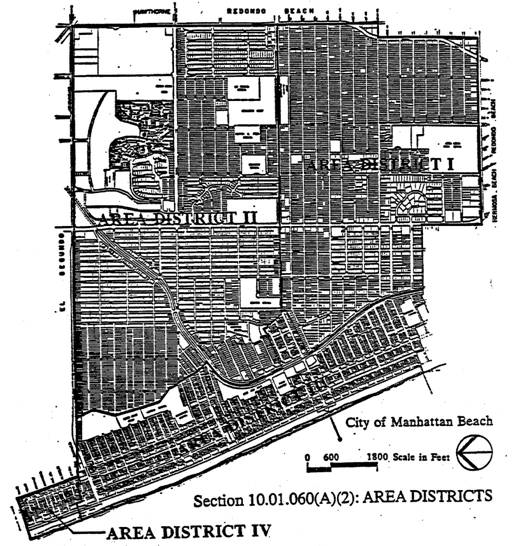
An Area District boundary designation, indicating a geographic area of the City (I, II, III, or IV) where specific zoning regulations and development standards apply. For reference, the four Area Districts are illustrated in the figure on the following page.
3.
Overlay district designators shall be included in a zoning designation if the provisions of one or more overlay districts are applicable to a site.
B.
Establishment of Base Zoning Districts. Base zoning districts into which the city is divided are established as follows:
C.
Establishment of Overlay Zoning Districts. Overlay zoning districts, one or more of which may be combined with a base district, are established as follows:
D.
References to Classes of Base Districts. References to R districts refer to all residential districts; references to C districts refer to all commercial districts; and references to an I district shall refer to the IP industrial district.
(Ord. No. 1832, Amended, 01/17/91; Ord. No. 1838, Renumbered, 07/05/91)
10.01.070 - Rules for interpretation; recordkeeping.
A.
Zoning Regulations. Where uncertainty exists regarding the interpretation of any provision of this title or its application to a specific site, the Director of Community Development shall determine the intent of the provision.
B.
Zoning Map. Where uncertainty exists regarding the boundary of a zoning district or area district, the following rules shall apply:
1.
District boundaries shown as approximately following the property line of a lot shall be construed to follow such property line.
2.
On unsubdivided land, or where a district boundary divides a lot, the location of the district boundary shall be determined by using the scale appearing on the zoning map, unless the boundary location is indicated by dimensions printed on the map.
3.
District boundaries shown as approximately following right-of-way lines of streets, alleys, railroads, or other identifiable boundary lines shall be construed to follow such right-of-way or boundary lines.
4.
District boundaries shown as lying within right-of-way lines of streets, alleys, railroads, or other identifiable boundary lines shall be construed to follow the centerline of such right-of-way or boundary lines.
5.
Should any uncertainty remain as to the location of a district boundary or other feature shown on the zoning map, the location shall be determined by the Director of Community Development.
C.
Record of Interpretation. The Director of Community Development shall keep a record of interpretations made pursuant to this section which shall be available to the public for review.
D.
Appeals. An interpretation of the zoning regulations or zoning map by the Director of Community Development may be appealed to the Planning Commission, as provided in Part V.
(Ord. No. 1832, Amended, 01/17/91; Ord. No. 1838, Renumbered, 07/05/91)
10.04.010 - Purpose and applicability.
The purpose of this chapter is to ensure precision in interpretation of the zoning regulations. The meaning and construction of words and phrases defined in this chapter shall apply throughout the zoning regulations, except where the context clearly indicates a different meaning or construction.
(Ord. No. 1832, Amended, 01/17/91; Ord. No. 1838, Renumbered, 07/05/91)
10.04.020 - Rules for construction of language.
In addition to the General Provisions of the Municipal Code, the following rules of construction shall apply:
A.
The particular shall control the general.
B.
Unless the context clearly indicates the contrary, the following conjunctions shall be interpreted as follows:
1.
"And" indicates that all connected words or provisions shall apply.
2.
"Or" indicates that the connected words or provisions may apply singly or in any combination.
3.
"Either….or" indicates that the connected words or provisions shall apply singly but not in combination.
C.
In case of conflict between the text and a diagram, the text shall control.
D.
All references to departments, commissions, boards, or other public agencies are to those of the City of Manhattan Beach, unless otherwise indicated.
E.
All references to public officials are to those of the City of Manhattan Beach, and include designated deputies of such officials, unless otherwise indicated.
F.
All references to days are to calendar days unless otherwise indicated. If a deadline falls on a weekend or City holiday (as specified in City Administrative Instruction No. 45, or as otherwise designated by the City Council/Manager), or some other occasion (such as a natural disaster) for which City Hall is closed to the public, it shall be extended to the next working day.
G.
Chapter and section headings contained herein shall not be deemed to govern, limit, modify or in any manner affect the scope, meaning or intent of any section hereof.
H.
The present tense includes the future, and the future the present.
I.
The singular number includes the plural, and the plural the singular.
J.
References in the masculine and feminine genders are interchangeable.
K.
The words "activities" and "facilities" include any part thereof.
(Ord. No. 1832, Amended, 01/17/91; Ord. No. 1838, Renumbered, 07/05/91, ; Ord. No. 1860, Amended, 10/29/92)
10.04.030 - Definitions.
Abutting or adjoining: Having district boundaries or lot lines in common.
Acre, Gross: A measure of land area.
Acre, Net: A measure of developable land area, after excluding existing dedicated rights-of-way and flood control and drainage easements.
Alley: A public way having a width of not more than twenty feet (20′) permanently reserved primarily for vehicular service access to the rear or side of properties otherwise abutting on a street.
Alter: To make a change in the exterior appearance or the supporting members of a structure, such as bearing walls, columns, beams, or girders, that will prolong the life of the structure.
Alteration: (See Alter).
Alternative-fuel Vehicle Charging Systems: Equipment used to recharge a vehicle that uses alternative energy as fuel, such as compressed natural gas (CNG), electricity or other non-petroleum derived fuels.
Amendment: A change in the wording, context or substance of this title, or a change in the district boundaries on the zoning map.
Animal, Domestic: Small animals of the type generally accepted as pets, including dogs, cats, rabbits, hens, fish and the like, but not including roosters, ducks, geese, pea fowl, goats, sheep, hogs or the like.
Animal, Exotic: Any wild animal not customarily confined or cultivated by man for domestic or commercial purposes but kept as a pet or for display.
Animal, Large: An animal larger than the largest breed of dogs. This term includes horses, cows, and other mammals customarily kept in corrals or stables.
Animal, Small: An animal no larger than the largest breed of dogs. This term includes fish, birds, and mammals customarily kept in kennels.
Area District: One of four areas designated on the zoning map for purposes of defining property development regulations that establish minimum lot areas, minimum yards, and maximum area coverage appropriate for that area.
Area, Lot, Parcel, or Site: The horizontal area within the property lines excluding public-access corridors, flood control and drainage easements, vehicular easements, and areas to be included in future street rights-of-way as established by easement, dedication, or ordinance.
Areas, Specified Anatomical: Human genitals (pubic region), buttocks, or female breasts below a point immediately above the upper line or curve of the areola when less than completely and opaquely covered; or human male genitals in a discernibly turgid state, even if completely and opaquely covered.
Balcony: A cantilevered platform that projects from the wall of a building, typically above the first level, and is surrounded by a rail, balustrade or parapet not exceeding forty-two inches (42″) above the platform surface.
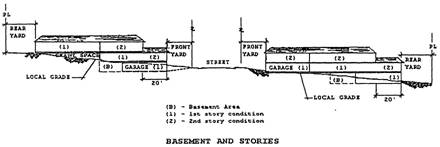
Basement: Any floor level, or portions thereof, below the first story in a building. Any building having only one floor level shall be classified as a basement unless such a floor level qualifies as a first story as defined herein. A floor level may be divided between portions qualifying as a basement and portions qualifying as a story. Any portion qualifying as a story shall be considered to have a minimum dimension of twenty feet (20′) measured perpendicular from the outside face(s) of the exterior building wall(s), which disqualifies that area as a basement (see graphic illustration).
Blockface: The properties abutting on one side of a street and lying between the two nearest intersecting or intercepting streets, or nearest intersecting or intercepting street and railroad right-of-way, unsubdivided land, watercourse, or city boundary.
Body Art: Term for any activity or combination of activities defined herein as tattooing and/or body piercing. It shall not include activities such as, or similar to, cutting of the skin or subcutaneous tissue, cutting or modification of cartilage or bone, implantation, branding, deep tissue penetration, threading, stapling or any other invasive procedure, which constitutes the practice of medicine requiring license as a physician and a business operated as a medical clinic.
Body Art Studio: A business located on permanent premises or facility used or operated in whole or in part as a tattoo or body piercing studio. This use excludes "body piercing, incidental," as defined in this Section 10.04.030.
Body Piercing: Penetration of the skin to make, generally permanent in nature, a hole, mark, or scar.
Body Piercing, Incidental: The provision of ear-piercing or similar services as an incidental part of a retail sales establishment, with majority of the business consisting of related retail sales.
Building: Any structure having a roof supported by columns or walls for the housing or enclosure of persons, animals, chattels, or property of any kind. Buildings or portions of buildings that are attached by a minimum of 6 feet of common wall or a solid roof area having a minimum eight foot (8′)dimension in all horizontal directions shall be considered a single building.
Bulk Storage: A large or primary area devoted to the storage of stock merchandise in enclosed areas inaccessible to the public, incidental to a primary use.
Caretaker's quarters: A dwelling unit on the site of a commercial, industrial, public, or semipublic use, occupied by a guard or caretaker.
Cellar: (See Basement).
Chimney: A hollow shaft containing one or more passageways, vertical or nearly so, for conveying products of combustion to the outside atmosphere.
City: The City of Manhattan Beach.
Cluster, Building: A group of buildings located in close proximity to each other and oriented towards a visible area of focus, which is separated from other groups of buildings on the same site by a large average distance.
Coastal Zone: A geographic zone adjacent to the shoreline, the boundaries of which are determined by the California Coastal Act of 1976, as amended.
Collection Buildings: Buildings with a gross floor area of two hundred twenty-five (225) square feet or less used for the deposit and storage of household articles or recyclables donated to a nonprofit organization.
Conditionally Permitted: Permitted subject to approval of a conditional use permit or temporary conditional use permit.
Condominium: An estate in real property consisting of an undivided interest in common in a portion of a parcel of real property together with a separate interior space in a residential, industrial or commercial building on the real property, such as an apartment, office or store. A condominium may include, in addition, a separate interest in other portions of the real property.
Conforming Building: A building that fully meets the requirements of Title 9 (Building Regulations) and also conforms to all property-development regulations and requirements prescribed for the district in which it is located.
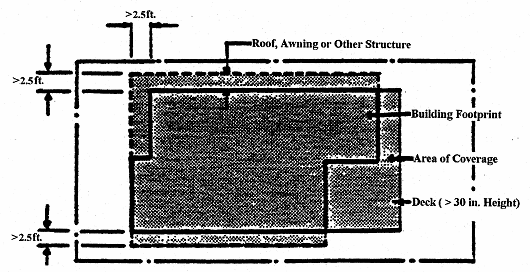
Coverage, Lot or Site: The percentage of a site covered by roofs, soffits, or overhangs extending more than two and one-half feet (2.5′) from a wall and by decks more than thirty inches (30″) in height.
LOT COVERAGE
Daylight Plane: An inclined plane, beginning at a stated height above grade at a side or rear property line, and extending into the site at a stated upward angle to the horizontal, which may limit the height or horizontal extent of structures at any specific point on the site where the daylight plane is more restrictive than the height limit or the minimum yard applicable at such point on the site.
Deck: A platform, either free-standing or attached to a building, but without a roof, that is supported by pillars, posts, or walls (see also: Balcony).
Distribution Line: An electric power line bringing power from a distribution substation to consumers.
District: A portion of the City within which the use of land and structures and the location, height, and bulk of structures are governed by this ordinance. This ordinance establishes "area districts," "base zoning districts" for residential, commercial, industrial, public and open space uses, and "overlay districts," which modify base district regulations.
Dwelling, Multi-family: A building containing two (2) or more dwelling units.
Dwelling, Single-Family: A building containing one (1) dwelling unit.
Dwelling Unit: One (1) or more rooms with a single kitchen, designed for occupancy by one (1) family for living and sleeping purposes.
Environmental Impact Report (EIR): A report complying with the requirements of the California Environmental Quality Act (CEQA) and its implementing guidelines.
Exemption, Categorical: An exception from the requirements of the California Environmental Quality Act (CEQA) for a class of projects, based on a finding by the California Secretary for Resources that the class of projects does not have a significant effect on the environment.
Family: A single individual or two (2) or more persons living together as a single housekeeping unit in a dwelling unit.
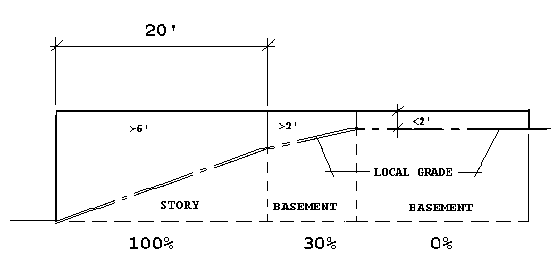
Floor Area, Buildable: The total enclosed area of all stories of a building, measured to the outside face of the structural members in exterior walls, and thirty percent (30%) of the area of all basements of a building that are not entirely below local grade, and including halls and the area of the stairs, but excluding floor area under stairs and those portions of a basement that are entirely below grade (see graphic illustration). The following elements also are excluded from a determination of buildable floor area:
Commercial and Industrial Districts: That area used exclusively for vehicle parking and loading and in service and mechanical rooms, enclosed vertical shafts, or elevators.
Single-family Residential Districts:
Area Districts I and II: That area used for vehicle parking and loading, up to four hundred (400) square feet on lots where two (2) enclosed parking spaces are required and provided, and up to six hundred (600) square feet where three (3) enclosed parking spaces are required and provided. Up to two hundred (200) square feet of basement area for purposes of storage and mechanical equipment use. Basement areas located entirely below local grade, and the related wells if they are the minimum size required by the UBC. A condition of "entirely below local grade" exists where the vertical dimension between the local grade elevation and finished floor of the next floor above is no greater than two feet (2′).
Area Districts III and IV: That area used for vehicle parking and loading, up to four hundred (400) square feet on lots where two (2) enclosed parking spaces are required and provided, and up to six hundred (600) square feet where three (3) enclosed parking spaces are required and provided. Up to two hundred (200) square feet of basement area for purposes of storage and mechanical equipment use. Basement areas located entirely below local grade, and the related wells if they are the minimum size required by the UBC. A condition of "entirely below local grade" exists where the vertical dimension between the local grade elevation and finished floor of the next floor above is no greater than two feet (2′).
Multi-family Residential Districts: That area used exclusively for vehicle parking and loading. Up to two hundred (200) square feet of basement area for purposes of storage and mechanical equipment use. Basement areas located entirely below local grade, and the related wells if they are the minimum size required by the UBC. A condition of "entirely below local grade" exists where the vertical dimension between the local grade elevation and finished floor of the next floor above is no greater than two feet (2′).
PROPOSED BASEMENT/STORY CONDITIONS COUNTED AS BFA
Floor Area Factor (FAF): The factor utilized in determining buildable floor area.
Floor Area, Gross: The total area of all floors of a building measured to the outside face of the structural members in exterior walls, and including halls, stairways, vertical shafts (including elevators and vent shafts), and unenclosed usable areas not surrounded by exterior walls which are under a horizontal projection of a solid roof or floor above. In addition, the following shall be included: basements, garages and covered supports.
Floor Area, Gross Leasable: The total leasable area within a building, excluding spaces shared by multiple tenants such as, but not limited to: lobbies, circulation (including hallways, elevators and stairs), utility and mechanical equipment rooms, and public restrooms.
General Plan: The City of Manhattan Beach General Plan, as amended.
Grade, Existing: The surface of the ground or pavement at a stated location as it exists prior to disturbance in preparation for a project regulated by this title.
Grade, Ground Level Finished: The average of the finished ground level at the exterior perimeter of all walls of a building. In cases where walls are parallel to and within five feet (5′) of a front or corner side property line, the ground level shall be measured at the property line.
Grade, Local: The ground elevation adjacent to a specified location on the exterior of a building (existing or finished, whichever is lower). It is to be taken as the lowest point on a line between the location specified and the nearest property line if the property line is within five feet (5′) of the building, or, if not, between the building and a point five feet (5′) outward from the building. For purposes of determining height above or below grade for a specified location on a building not on its perimeter, the local grade shall be considered to be the local grade corresponding to the nearest perimeter location.
Grade, Street: The top of the curb, or the top of the edge of the pavement or traveled way where no curb exists.
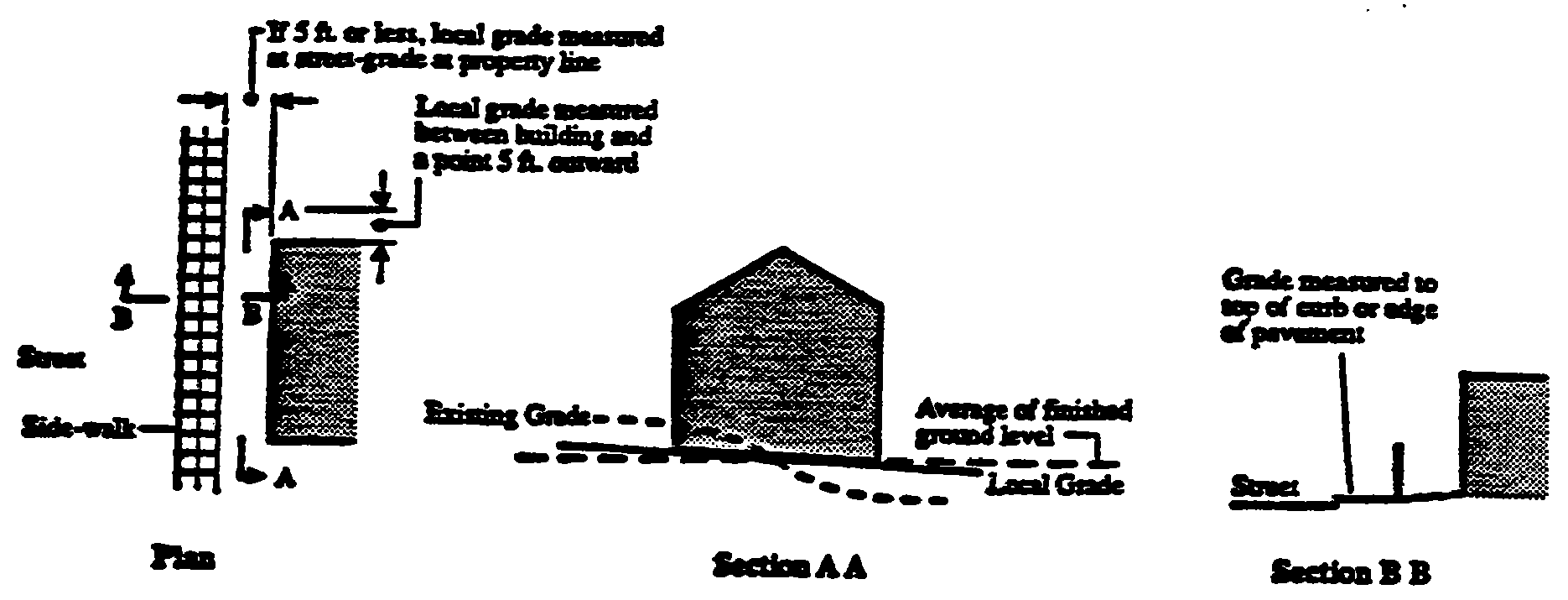
GRADE STANDARDS
Greywater Retention/Detention Features: A device or system designed to collect, store, and transport greywater, as defined by the California Plumbing Code, which may include tanks, valves, filters, pumps, or other appurtenances along with piping.
Guest House (or Accessory Living Quarters): Any living area located within a main or an accessory building which does not have direct interior access to the dwelling unit. Such quarters shall have no kitchen facilities and shall not be rented or otherwise used as a separate dwelling unit. Such guest quarters, or accessory living quarters, shall be permitted only on a lot with one (1) single family residence, except as provided for in Section 10.52.050(F) Residential Zones-Adjacent Separate Lots with Common Ownership. This Guest House, or accessory living quarters, shall be a maximum of five hundred (500) square feet in size, limited to one (1) habitable room, and contain a maximum of three (3) plumbing fixtures.
Height: A vertical dimension measured from local grade, unless otherwise specified.
Home Occupation: Occupations conducted in a dwelling unit or accessory building in a residential district that are incidental to the principal residential use of a lot or site.
Illumination, Direct: Illumination by means of light that travels directly from its source to the viewer's eye.
Illumination, Indirect: Illumination by means only of light cast upon an opaque surface from a concealed source.
Kitchen: A room or other interior space designed, intended or used for the preparation of food.
Landscaping: An area devoted to or developed and maintained with native or exotic plantings, lawn, ground cover, gardens, trees, shrubs, and other plant materials, decorative outdoor landscape elements, pools, fountains, water features, paved or decorated surfaces of rock, stone, brick, block, or similar material (excluding driveways, parking, loading, or storage areas), and sculptural elements. Plants on rooftops, porches or in boxes attached to buildings are not considered landscaping.
Landscaping, Interior: A landscaped area or areas within the shortest circumferential line defining the perimeter or exterior boundary of the parking or loading area, or similar paved area, excluding driveways or walkways providing access to the facility (as applied to parking and load facilities or to similar paved areas).
Landscaping, Perimeter: A landscaped area adjoining and outside the shortest circumferential line defining the exterior boundary of a parking or loading area, or similar paved area, excluding driveways or walkways providing access to the facility (as applied to parking and loading facilities or to similar paved areas).
Lot: A site or parcel of real property delineated with a number or other separate designation on a plat duly recorded in the office of the County Recorder.
Lot, Corner: A site bounded by two (2) or more adjacent street property lines that have an angle of intersection of not more than one hundred thirty-five degrees (135º).
Lot Depth: The horizontal distance from the midpoint of the front-lot line to the midpoint of the rear-lot line, or to the most distant point on any other lot line where there is no rear-lot line.
Lot, Key: The first lot to the rear of a reverse corner lot, whether or not separated by an alley.
Lot or Property Line, Rear: A lot line, not a front lot line, that is parallel or approximately parallel to the front lot line. Where no lot line is within forty-five degrees (45º) of being parallel to the front lot line, a line ten feet (10′) in length within the lot, parallel to and at the maximum possible distance from the front lot line, shall be deemed the rear lot line.
Lot or Property Line, Front: The street or alley property line of an interior lot. The front property line of a corner lot shall be the shorter street or alley property line, provided that where one street or alley property line is at least seventy-five percent (75%) of the length of the other street or alley property line, the Community Development Director shall determine the location of the front property line. In no case shall the front property line of a street-alley lot adjoin the alley which is approximately parallel to the street.
Lot or Property Line, Interior: A lot line not abutting a street.
Lot or Property Line, Side: Any lot line that is not a front lot line or a rear lot line.
Lot or Property Line, Street: A lot line abutting a street.
Lot, Reverse Corner: A corner lot, the side street line of which is substantially a continuation of the front lot line of the lot upon which the rear of said corner lot abuts.
Lot, Street-Alley: A lot having frontage on a street and an alley.
Lot, Through: A site bounded by parallel, or approximately parallel, street property lines that are not side property lines.
Lot Width: The mean of the horizontal distance between the side lot lines measured at right angles to the lot depth at points twenty feet (20′) from the front lot line and twenty feet (20′) from the rear lot line, or from the rearmost point of the lot depth in cases where there is no rear lot line.
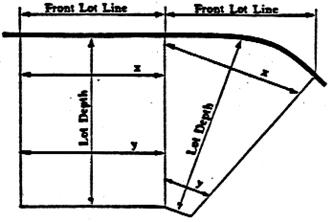
Lot Width = (x + y)/2
LOT DEPTH AND LOT WIDTH
Maintenance and Repair: Reconstruction or renewal of any part of an existing building for the purpose of its preservation.
Manufactured Home: A modular housing unit on a permanent foundation that conforms to the National Manufactured Housing Construction and Standards Act. For purposes of this definition, a mobile home is considered a manufactured home.
Mezzanine: An intermediate floor placed within a room, and meeting the requirements of a mezzanine contained in the Building Regulations (Title 9, Chapter 9.01 of the Municipal Code).
Multi-Family Transient Use: Rental or lease of a multi-family dwelling unit for a period of less than thirty (30) days.
Municipal Code: The Municipal Code of the City of Manhattan Beach, as amended.
Nonconforming Structure: A structure that was lawfully erected but which does not conform with the standards for yard spaces, height of structures, or distances between structures prescribed in the regulations for the district in which the structure is located by reason of adoption or amendment of this title or by reason of annexation of territory to the City.
Nonconforming Use: A use of a structure or land that was lawfully established and maintained, but which does not conform with the use regulations or required conditions for the district in which it is located by reason of adoption or amendment of this title or by reason of annexation of territory to the City.
Off-Street Loading Facilities: A site or portion of a site devoted to the loading or unloading of motor vehicles or trailers, including loading berths, aisles, access drives, and landscaped areas.
Off-Street Parking Facilities: A site or portion of a site devoted to the off-street parking of motor vehicles, including parking spaces, aisles, access drives, and landscaped areas.
Open Space, Private: A usable open space adjoining and directly accessible to a dwelling unit, reserved for the exclusive use of residents of the dwelling unit and their guests.
Open Space, Shared: An open space within a residential development reserved for the exclusive use of residents of the development and their guests.
Open Space, Total: The sum of private open space and shared open space.
Open Space, Usable: Outdoor or unenclosed area on the ground, or on a balcony, deck, porch or terrace designed and accessible for outdoor living, recreation, pedestrian access or landscaping, that is not more than seventy-five percent (75%) covered by buildable floor area, and has a minimum dimension of five feet (5′) in any direction, and a minimum area of forty-eight (48) square feet; minus any parking facilities, driveways, utility or service areas, or any required front or side yards.
Opposite: Walls, windows, signs, districts, or property lines shall be deemed opposite if a line perpendicular to a vertical plane through one element and having its widest horizontal dimension would intersect a similar vertical plane through another element.
Outdoor Living Area: (See Open Space, Usable).
Parking Structure: A non-enclosed or semi-enclosed area containing a ceiling or roof, used primarily for the temporary storage of motor vehicles, constructed either above or below grade, freestanding, or as part of a building.
Permeable Surface: An uncovered finish grade surface such as a driveway, walkway, or patio constructed with pervious materials allowing stormwater to directly infiltrate the underlying soils and contained so neither sediment nor the water discharges off the site.
Permitted: Permitted without a requirement for approval of a use permit or temporary use permit.
Porch: A covered or uncovered platform at an entrance to a dwelling unit.
Pre-existing: In existence prior to the effective date of this title.
Project: Any proposal for new or changed use, or for new construction, alteration, or enlargement of any structure, that is subject to the provisions of this title.
Proscenium, Garage: The structural frame of a garage door.
Roof or Deck, Green: A roof or deck/balcony surface that is partially or totally planted with vegetation that is over a waterproof membrane generally for the purpose of water or energy conservation.
Room (Space), Habitable: A space in a structure meeting the requirements of the Building Regulations (Title 9, Chapter 9.01 of the Municipal Code) for sleeping, living, eating or cooking. Bathrooms, toilet compartments, closets, halls, storage or utility space, and similar areas are not considered habitable space.
Setback Line: A line within a lot parallel to, and the required setback distance from, a corresponding lot line, which is the boundary of any specified front, side or rear yard, or a line otherwise established to govern the location of buildings, structures or uses. Where the corner of a lot has been rounded off for purposes of public right-of-way dedication, the setback line shall be parallel to the original unaltered lot line. Where no minimum front, side or rear setbacks or yards are specified, the setback line shall be coterminous with the corresponding lot line.
Sexual Activities, Specified: Human genitals in a state of sexual stimulation or arousal; acts of human masturbation, sexual intercourse, oral copulation, or sodomy; fondling or other erotic touching of human genitals (pubic region), buttocks, or female breasts.
"Single Housekeeping Unit: A traditional family or the functional equivalent of a traditional family, whose members are a non-transient interactive group of one (1) or more persons, where if consisting of more than one (1) person, such persons jointly occupy a single dwelling unit, jointly use common areas, share household activities and responsibilities (e.g., meals, chores, and expenses), and where, if the unit is rented, leased, or subleased all adult members living on the premises jointly agree to occupy and be responsible for the entire premises of the dwelling unit under a single written rental agreement or lease and the makeup of the household occupying the unit is determined by the residents of the unit rather than the landlord or property manager.
Single Ownership: Holding record title, possession under a contract to purchase, or possession under a lease, by a person, firm, corporation, or partnership, individually, jointly, in common, or in any other manner where the property is or will be under unitary or unified control.
Single-Family Transient Use: Rental or lease of a single-family dwelling unit for a period of less than thirty (30) days.
Site: A lot, or group of contiguous lots not divided by an alley, street, other right-of-way, or city limit, that is proposed for development in accord with the provisions of this title, and is in a single ownership or has multiple owners, all of whom join in an application for development.
Solar Energy System: A combination of solar collector(s) and ancillary solar equipment used to generate electricity or heat water primarily for consumption on the property where the system is located.
Specific Plan: A plan for a defined geographic area that is consistent with the General Plan and with the provisions of the California Government Code, Section 65450 et seq. (Specific Plans).
Stormwater Retention/Detention Feature: A device or system of improvements that captures, retains and subsequently releases stormwater runoff from a site at a lesser volume and/or slower rate than it is collected, while holding the runoff in temporary storage for the purposes of infiltration, bioretention, and/or storage with beneficial use such as landscape irrigation.
Story: That portion of a building included between the surface of any floor and the surface of the floor next above it. If there is no floor above it, then the space between such floor and the ceiling next above it shall be considered a story. If the portion of a building included between the finished floor level directly above a basement or a usable or unused under-floor space is more than four feet (4′) above local grade, as defined herein, for more than fifty percent (50%) of the total perimeter or is more than six feet (6′) above local grade, as defined herein, at any point, such basement or usable or unused under-floor space shall be considered a story. A floor level may be divided between portions qualifying as a story and portions qualifying as a basement. Any portion of a floor level qualifying as a story shall be considered to have a minimum dimension of twenty feet (20′) measured perpendicular from the outside face(s) of the exterior building wall(s) which defines that area as a story (see graphic illustration under "Basement" definition).
Story, First: The lowest story in a building which qualifies as a story, as defined herein, except that a floor level in a building having only one floor level shall be classified as a first story, provided such floor level is not more than four feet (4′) below local grade, as defined herein, for more than fifty percent (50%) of the total perimeter, or not more than six feet (6′) below local grade, as defined herein, at any point.
Street: A recorded public way, other than an alley, which provides access to abutting property.
Structure: Anything constructed or erected that requires a location on the ground, including a building or a swimming pool, but not including a driveway, walk, fence or wall (used as a fence or boundary grade retaining wall). A wall forming a below-grade well (e.g., egress, light, ventilation) shall be considered to be a structure.
Swimming Pools and Hot Tubs: Water-filled enclosures having a depth of eighteen inches (18″) or more used for swimming or recreation.
Tattoo: An art form in which pigments are inserted under the surface of the skin of a human being by pricking with a needle or otherwise to produce an indelible mark or figure visible through the skin. Tattooing does not include application of permanent make-up that is performed as an incidental service in a beauty shop, day spa, or other retail or service establishment.
Transmission Line: An electric power line bringing power to a receiving or distribution substation.
Use, Accessory: A use that is appropriate, subordinate, and customarily incidental to the main use of the site and which is located on the same site as the main use.
Used: This term includes the following meanings: arranged, designed, constructed, altered, rented, leased, sold, occupied, and intended to be occupied.
Visible: Likely to be noticed by a person of average height walking on a public street or sidewalk.
Walk Street: A street in the beach area for pedestrians where vehicular access is not permitted. The location of walk streets is shown in the Infrastructure Element of the General Plan.
Weighted Average: An average calculated from pro-rated or proportionately distributed data.
Wind Energy System, Small (SWES): Wind energy system, generally consisting of a wind turbine, tower and ancillary equipment, that is used primarily to generate electricity on the property where the system is located.
Window, Required: An exterior opening in a habitable room meeting the area requirements of the Building Regulations (Title 9, Chapter 19 of the Municipal Code).
Yard: An open space on the same site as a structure, unoccupied and unobstructed by structures from the ground upward except as otherwise provided in this title, including a front yard, side yard, or rear yard.
Exception: Siding material extending not more than 0.1 feet beyond the frame and foundation of a structure may occupy a yard.
Yard, Front: A yard extending across the full width of a site, the depth of which is the minimum horizontal distance between the front property line and a setback line parallel thereto on the site. The front yard of a through lot shall adjoin the street property line which adjoins the front yards of the neighboring lots adjoining said street property line, unless no pattern of front yards exists, in which case, the Community Development Director shall determine the location of the front yard. A through lot shall have two (2) front yards if both of its opposing street property lines adjoin blockfaces, or portions of blockfaces, which conform to existing front yard patterns as determined by the Director.
Yard, Rear: A yard, extending across the full width of a site, the depth of which is the minimum horizontal distance between the rear property line and a setback line parallel thereto on the site, except that on a corner lot the rear yard shall extend only to the side yard abutting the street.
Yard, Side: A yard extending from the setback line of the front yard, or the front property line of the site where no front yard is required, to the setback line of the rear yard, or the rear property line of the site where no rear yard is required, the width of which is the horizontal distance between the side property line and a setback line parallel thereto on the site, except that the side yard on the street side of a corner lot shall extend to the rear lot line.
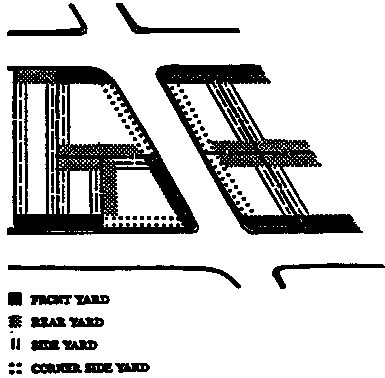
YARD TYPES
Zoning Ordinance: The Planning and Zoning Ordinance of the City of Manhattan Beach, as amended.
(Ord. No. 1832, Amended, 01/17/91; Ord. No. 1838, Renumbered, 07/05/91, 10-3.304; Ord. No. 1839, Amended, 07/05/91; Ord. No. 1889, Amended, 12/16/93; Ord. No. 1891, Amended, 01/06/94; Ord. No. 1903, Amended, 05/05/94; § 2, Ord. 2032, eff. May 16, 2002; § 2, Ord. 1049, eff. November 18, 2003; § 2, Ord. 1050, eff. January 1, 2004; § 2, Ord. 2111, eff. March 19, 2008; § 4, Ord. 2146, eff. August 4, 2011; § 2, Ord. 2155, eff. February 17, 2012, § 3, Ord. 15-0009, adopted June 16, 2015, and § 8, Ord. 18-0024, eff. Jan. 18, 2019)
10.08.010 - Purpose and applicability.
Use classifications describe one or more uses having similar characteristics, but do not list every use or activity that may appropriately be within the classification. The Community Development Director shall determine whether a specific use shall be deemed to be within one or more use classifications or not within any classification in this Title. The Community Development Director may determine that a specific use shall not be deemed to be within a classification, whether or not named within the classification, if its characteristics are substantially incompatible with those typical of uses named within the classification. The Community Development Director's decision may be appealed to the Planning Commission.
(Ord. No. 1832, Amended, 01/17/91; Ord. No. 1838, Renumbered, 07/05/91)
10.08.020 - Uses not classified.
Any new use, or any use that cannot be clearly determined to be in an existing use classification, may be incorporated into the zoning regulations by a Zoning Ordinance text amendment, as provided in Chapter 10.96.
(Ord. No. 1832, Amended, 01/17/91; Ord. No. 1838, Renumbered, 07/05/91)
10.08.030 - Residential use classifications.
A.
Day Care, Small Family Home. Non-medical care and supervision of six (6) or fewer persons, including those who reside at the home, on a less than twenty four (24) hour basis. This classification includes only those services and facilities licensed by the State of California.
B.
Day Care, Large Family Home. Non-medical care and supervision of seven (7) to twelve (12) children, including those who reside at the home, on a less than twenty four (24) hour basis. This classification includes only those services and facilities licensed by the State of California.
C.
Emergency Shelter. Housing with minimal supportive services for homeless persons that limits occupancy by homeless persons to six (6) months or less and that does not deny emergency shelter due to a person's inability to pay.
D.
Group Residential. Shared living quarters with not more than five (5) guest rooms and without separate kitchen or bathroom facilities for each guest room, and where either of the following apply:
1.
Lodging and meals for compensation are provided by pre-arrangement for definite periods for not more than nine (9) persons, or
2.
Rooms, beds or spaces within the living quarters are rented to ten (10) or more individuals by pre-arrangement for definite periods.
Shared living quarters with six (6) or more guest rooms or where lodging and meals for compensation are provided for ten (10) or more persons shall be considered a Visitor Accommodation.
E.
Multi-family Residential. Two (2) or more dwelling units on a site. This classification includes manufactured homes.
F.
Multi-family Transient Use. Rental or lease of a multi-family dwelling unit for a period of less than thirty (30) days.
G.
Residential Care, Limited. Twenty-four (24) hour non-medical care for six (6) or fewer persons in need of personal services, supervision, protection, or assistance essential for sustaining the activities of daily living. This classification includes only those services and facilities licensed by the State of California.
H.
Single-Family Residential. Buildings containing one (1) dwelling unit located on a single lot. This classification includes manufactured homes.
I.
Single-family Transient Use. Rental or lease of a single-family dwelling unit for a period of less than thirty (30) days.
J.
Supportive Housing. Housing occupied by a specified target population defined in Section 50675.14 of the California Health and Safety Code that has no limit on length of stay, and that is linked to onsite or offsite services that assist the resident in retaining the housing, improving his or her health status, maximizing his or her ability to live, and - when possible - work in the community. Supportive housing is a residential use subject to the same regulations and procedures that apply to other residential uses of the same type in the same zone.
K.
Transitional Housing. Rental housing operated under program requirements that terminate assistance to residents and recirculate the assisted unit to another eligible program recipient at some predetermined future point in time, which shall be no less than six (6) months from the initial occupancy date of the recipient. Transitional housing is a residential use subject to the same regulations and procedures that apply to other residential uses of the same type in the same zone.
(Ord. No. 1832, Amended, 01/17/91; Ord. No. 1838, Renumbered, 07/05/91; Ord. No. 1891, Amended, 01/06/94; § 2, Ord. 13-0006, eff. August 1, 2013 and §§ 4, 5, Ord. 15-0009, adopted June 16, 2015)
10.08.040 - Public and semipublic use classifications.
A.
Clubs and Lodges. Meeting, recreational, or social facilities of a private or nonprofit organization primarily for use by members or guests. This classification includes union halls, social clubs and youth centers.
B.
Convalescent Facilities. Establishments providing care on a twenty-four (24) hour basis for persons requiring regular medical attention, but excluding facilities providing surgical or emergency medical services.
C.
Cultural Institutions. Nonprofit institutions displaying or preserving objects of interest in one (1) or more of the arts or sciences. This classification includes libraries, museums, and art galleries.
D.
Day Care, General. Provision of non-medical care for seven (7) or more persons on a less than twenty-four (24) hour basis. This classification includes nursery schools, pre-schools, and day-care centers for children or adults.
E.
Emergency Health Care Facility. Facilities providing emergency medical service with no provision for continuing care on an inpatient basis. Emergency health care facilities are part of the emergency medical services system as defined by California Health and Safety Code.
F.
Farmers' Market. A County certified farmers' market consisting of indoor or outdoor sales of produce and other agricultural products in a non-prepared condition, on a less-than-daily basis, as an accessory use to the primary use of a site.
G.
Government Offices. Administrative, clerical, or public contact offices of a government agency, including postal facilities, together with incidental storage and maintenance of vehicles.
H.
Heliports. Pads and facilities enabling takeoffs and landings by helicopter.
I.
Hospitals. Facilities providing medical, surgical, psychiatric, or emergency medical services to sick or injured persons, primarily on an inpatient basis where patients may be admitted for a 24-hour stay or longer. This classification includes incidental facilities for out-patient treatment, as well as training, research, and administrative services for patients and employees.
J.
Maintenance and Service Facilities. Facilities providing maintenance and repair services for vehicles and equipment, and materials storage areas. This classification includes corporation yards, equipment service centers, and similar facilities.
K.
Park and Recreation Facilities. Noncommercial parks, playgrounds, recreation facilities, and open spaces.
L.
Public Safety Facilities. Facilities for public safety and emergency services, including police and fire protection.
M.
Religious Assembly. Facilities for religious worship and incidental religious education, but not including private schools as defined in this section.
N.
Residential Care, General. Twenty-four (24) hour non-medical care for seven (7) or more persons, including wards of the juvenile court, in need of personal services, supervision, protection, or assistance essential for sustaining the activities of daily living. This classification includes only those services and facilities licensed by the State of California.
O.
Schools, Public or Private. Educational institutions having a curriculum comparable to that required in the public schools of the State of California.
P.
Utilities, Major. Generating plants, electrical substations, above-ground electrical transmission lines, switching buildings, refuse collection, transfer, recycling or disposal facilities, flood control or drainage facilities, water or wastewater treatment plants, transportation or communications utilities (with the exception of telecommunications facilities regulated in Manhattan Beach Municipal Code Chapter 13.02), and similar facilities of public agencies or public utilities. A structure that may have a significant effect on surrounding uses shall be regulated under this classification.
Q.
Utilities, Minor. Utility facilities that are necessary to support legally established uses and involve only minor structures such as electrical distribution lines, underground water and sewer lines, and recycling centers within convenience zones, as defined by the California Beverage Container Recycling and Litter Reduction Act.
(Ord. No. 1832, Amended, 01/17/91; Ord. No. 1838, Renumbered, 07/05/91; Ord. No. 1883, Amended, 07/15/93; § 3, Ord. 2075, eff. July 7, 2005; §§ 5, 6, Ord. 17-0028, eff. January 20, 2018)
10.08.050 - Commercial use classifications.
A.
Adult Businesses. Establishments based primarily on materials or performances that depict, describe, or relate to "specified sexual activities," as defined in Chapter 10.04.
B.
Ambulance Services. Provision of emergency medical care or transportation, including incidental storage and maintenance of vehicles.
C.
Animal Sales and Services.
1.
Animal Boarding. Provision of shelter and care for small animals on a commercial basis. This classification includes activities such as feeding, exercising, grooming, breeding, and incidental medical care.
2.
Animal Grooming. Provision of bathing and trimming services for small animals on a commercial basis. This classification includes boarding of domestic animals for a maximum period of forty-eight (48) hours.
3.
Animal Hospitals. Establishments where small animals receive medical and surgical treatment. This classification includes only facilities that are entirely enclosed, soundproofed, and air-conditioned. Grooming and temporary (maximum thirty (30) days) boarding of animals is included, if incidental to the hospital use.
4.
Animals: Retail Sales. Retail sales and boarding of small animals, provided such activities take place within an entirely enclosed building. This classification includes grooming, if incidental to the retail use, and boarding of animals not offered for sale for a maximum period of forty-eight (48) hours.
D.
Artists' Studios. Work space for artists and artisans, including individuals practicing one (1) of the fine arts or performing arts, or skilled in an applied art or craft.
E.
Banks and Savings and Loans. Financial institutions that provide retail banking services to individuals and businesses. This classification includes only those institutions engaged in the on-site circulation of cash money. It also includes businesses offering check-cashing facilities.
1.
With Drive-up Service. Institutions providing services accessible to persons who remain in their automobiles.
F.
Body Art Studios. Establishments providing body art services such as tattoos and/or body piercing. This use excludes "body piercing, incidental," as defined in Section 10.04.030.
G.
Building Materials and Services. Retailing, wholesaling, or rental of building supplies or equipment. This classification includes lumber yards, tool and equipment sales or rental establishments, and building contractors' yards, but excludes establishments devoted exclusively to retail sales of paint and hardware, and activities classified under Vehicle/Equipment Sales and Services, including vehicle towing services.
H.
Catering Services. Preparation and delivery of food and beverages for off-site consumption without provision for on-site pickup or consumption. (See also eating and drinking establishments.)
I.
Commercial Filming. Commercial motion picture or video photography at the same location more than six (6) days per quarter of a calendar year.
J.
Commercial Recreation and Entertainment. Provision of participant or spectator recreation or entertainment. This classification includes theaters, sports stadiums and arenas, amusement parks, bowling alleys, billiard parlors, poolrooms, dance halls, ice/roller skating rinks, golf courses, miniature golf courses, scale-model courses, shooting galleries, tennis/racquetball courts, health/fitness clubs, game centers which include any place open to the public in which there are more than three (3) games or amusements, including but not limited to, electronic video, pinball machines, whether coin operated or on free play and card rooms.
1.
Limited. Indoor movie theaters, game centers as defined herein, and performing arts theaters.
K.
Communications Facilities. Broadcasting, recording, and other communication services accomplished through electronic or telephonic mechanisms, but excluding utilities (major). This classification includes radio, television, or recording studios; telephone switching centers; and telegraph offices.
L.
Eating and Drinking Establishments. Businesses serving prepared food or beverages for consumption on or off the premises.
1.
With Fast-Food or Take-Out Service. Establishments where patrons order and pay for their food at a counter or window before it is consumed and may either pick up or be served such food at a table or take it off-site for consumption.
a.
Drive-through. Service from a building to persons in vehicles through an outdoor service window.
b.
Limited. Establishments that do not serve persons in vehicles.
M.
Food and Beverage Sales. Retail sales of food and beverages for off-site preparation and consumption. Typical uses include groceries, liquor stores, or delicatessens.
Exceptions:
1.
Food and beverage sales establishments (with incidental seating area) may contain a maximum area for on-site preparation and consumption of three hundred (300) square feet or ten percent (10%) of the total store area (whichever is smaller). The on-site food preparation and consumption area includes: counter (order/pickup) area, food preparation area, and seating area (maximum capacity of four (4) persons). On-site consumption of alcoholic beverages is prohibited.
2.
Food and beverage sales establishments (with no on-site consumption areas) may contain a maximum of two thousand (2,000) square feet in gross floor area and may sell prepared foods or beverages which are consumed off-site. Food and beverage sales may include, but are not limited to: breads, pastries, ice cream, frozen yogurt, candy, juices, and coffee. On-site consumption of alcoholic beverages is prohibited.
All other establishments which sell prepared food for on-site or take-out consumption shall be classified as catering services or eating and drinking establishments.
N.
Funeral and Interment Services. Establishments primarily engaged in the provision of services involving the care, preparation or disposition of human dead other than in cemeteries. Typical uses include crematories, columbariums, mausoleums or mortuaries.
O.
Laboratories. Establishments providing medical or dental laboratory services; or establishments with less than two thousand (2,000) square feet providing photographic, analytical, or testing services. Other laboratories are classified as limited industry.
P.
Maintenance and Repair Services. Establishments providing appliance repair, office machine repair, or building maintenance services. This classification excludes maintenance and repair of vehicles or boats; see (vehicle/equipment repair).
Q.
Mixed Use. A project which has commercial and residential uses on the same site.
R.
Nurseries. Establishments in which all merchandise other than plants is kept within an enclosed building or a fully screened enclosure, and fertilizer of any type is stored and sold in package form only.
S.
Offices, business and professional. Offices of firms or organizations providing professional, executive, management, or administrative services, such as architectural, engineering, graphic design, interior design, real estate, insurance, investment, legal, veterinary, and medical/dental offices, including, but not necessarily limited to: licensed or certified physicians, psychologists, psychiatrists, chiropractors, and massage, acupuncture, and acupressure therapists. Urgent care facilities that may be open beyond traditional office hours and that provide patients medical services for non-life threatening conditions usually without an appointment and without an overnight stay shall be considered a medical office. These classifications include medical/dental laboratories incidental to an office use, but excludes banks and savings and loan associations.
T.
Pawn Shops. Establishments engaged in the buying or selling of new or secondhand merchandise and offering loans secured by personal property.
U.
Personal Improvement Services. Provision of instructional services or facilities, including photography, fine arts, crafts, dance or music studios, driving schools, business and trade schools, and diet centers, reducing salons, and fitness studios, and massage.
V.
Personal Services. Provision of recurrently needed services of a personal nature. This classification includes barber and beauty shops (including incidental massage), seamstresses, tailors, shoe repair shops, dry-cleaning businesses (excluding large-scale bulk cleaning plants), photo-copying, and self-service laundries.
W.
Psychic Advisor. Establishments providing counseling or interpretation service pertaining to supernatural forces and influences. This includes astrology, fortune telling, and numerology.
X.
Research and Development Services. Establishments primarily engaged in industrial or scientific research, including limited product testing. This classification includes electron research firms or pharmaceutical research laboratories, but excludes manufacturing, except of prototypes, or medical testing and analysis.
Y.
Retail Sales. The retail sale and storage of merchandise not specifically listed under another use classification conducted wholly indoors unless otherwise specified by Section 10.60.080, Outdoor facilities. This classification includes department stores, drug stores, clothing stores, furniture stores, and businesses retailing the following goods: toys, hobby materials, hand-crafted items, jewelry, cameras, photographic supplies, medical supplies and equipment, electronic equipment, records, sporting goods, kitchen utensils, hardware, appliances, antiques, art supplies and services, paint and wallpaper, carpeting and floor covering, office supplies, bicycles, and new automotive parts and accessories (excluding service and installation).
Z.
Secondhand Appliances and Clothing Sales. The retail sale of used appliances and clothing, by secondhand dealers. This classification excludes antique shops primarily engaged in the sale of used furniture and accessories other than appliances.
AA.
Swap Meets, Recurring. Retail sale or exchange of handcrafted or secondhand merchandise for a maximum period of forty-eight (48) hours, conducted by a sponsor on a more than twice yearly basis.
BB.
Travel Services. Establishments providing travel information and reservations to individuals and businesses. This classification excludes car rental agencies.
CC.
Vehicle/Equipment Sales and Services.
1.
Automobile Rentals. Rental of automobiles, including storage and incidental maintenance, but excluding maintenance requiring pneumatic lifts.
2.
Automobile Washing. Washing, waxing, or cleaning of automobiles or similar light vehicles.
3.
Commercial Parking Facility. Lots offering short-term or long-term parking to the public for a fee. Provision of off-site parking for the purpose of fulfilling a parking requirement, in accordance with Section 10.64.020(F) (Basic requirements for off-street loading and parking: Location and ownership) shall not solely constitute a commercial parking facility use.
4.
Service Stations. Establishments engaged in the retail sale of gas, diesel fuel, lubricants, parts, and accessories. This classification includes incidental maintenance and repair of automobiles and light trucks, but excludes body and fender work or repair of heavy trucks or vehicles.
5.
Vehicle/Equipment Repair. Repair of automobiles, trucks, motorcycles, mobile homes, recreational vehicles, or boats, including the sale, installation, and servicing of related equipment and parts. This classification includes auto repair shops, body and fender shops, wheel and brake shops, and tire sales and installation, but excludes vehicle dismantling or salvage and tire retreading or recapping.
6.
Vehicle/Equipment Sales and Rentals. Sale or rental of automobiles, motorcycles, trucks, tractors, construction or agricultural equipment, manufactured homes, boats, and similar equipment, including storage and incidental maintenance.
7.
Vehicle Storage. Storage of operative or inoperative vehicles. This classification includes storage of parking towaways, impound yards, and storage lots for automobiles, trucks, buses and recreational vehicles, but does not include vehicle dismantling.
DD.
Visitor Accommodations.
1.
Hotels, Motels, and Time-Share Facilities. Establishments offering lodging on a weekly or less than weekly basis, and having kitchens in no more than sixty percent (60%) of guest units. This classification includes eating, drinking, and banquet service associated with the facility.
a.
Limited. Facilities which offer lodging without other associated services on-site such as restaurant and banquet services, and which provide associated operational or maintenance services on-site.
2.
Residential Hotels. Buildings with six (6) or more guest rooms without kitchen facilities in individual rooms, or kitchen facilities for the exclusive use of guests, and which are intended for occupancy on a weekly or monthly basis.
EE.
Warehousing and Storage, Limited. Provision of storage space for household or commercial goods within an enclosed building without direct public access to individual storage spaces. This classification includes facilities with a maximum of five thousand (5,000) square feet of gross floor area, but excludes mini-warehouses or public storage classified under wholesale, distribution and storage, and vehicle storage and storage of hazardous materials (as defined by the City Fire Department).
This classification also includes outdoor neighborhood recycling collection points encompassing no more than five hundred (500) square feet in area. The purpose of the "neighborhood recycling collection point" is the receiving of solid waste only, for private delivery to distribution/ processing locations. Solid waste in this classification includes: metals, glass, plastic, and paper.
(Ord. No. 1832, Amended, 01/17/91; Ord. No. 1838, Renumbered, 07/05/91; Ord. No. 1860, Amended, 10/29/92; Ord. No. 1891, Amended, 01/06/94; § 1, Ord. 1942, eff. February 22, 1996; § 2, Ord. 1951, eff. July 4, 1996; § 4, Ord. 1977, eff. March 5, 1998; § 2, Ord. 1999, eff. April 1, 1999 and § 3, Ord. 2155, eff. February 17, 2012; § 7, Ord. 17-0028, eff. January 20, 2018)
10.08.060 - Industrial use classifications.
A.
Industry, Custom. Establishments primarily engaged in on-site production of goods by hand manufacturing involving the use of hand tools and small-scale equipment.
1.
Small-Scale. Includes mechanical equipment not exceeding two (2) horsepower or a single kiln not exceeding eight (8) kilowatts and the incidental direct sale to consumers of only those goods produced on-site. Typical uses include ceramic studios, candle-making shops, and custom jewelry manufacture.
B.
Industry, General. Manufacturing of products, primarily from extracted or raw materials, or bulk storage and handling of such products and materials. Uses in this classification typically involve a high incidence of truck or rail traffic, and/or outdoor storage of products, materials, equipment, or bulk fuel. This classification includes chemical manufacture or processing, food processing and packaging, laundry and dry cleaning plants, auto dismantling within an enclosed building, stonework and concrete products manufacture (excluding concrete ready-mix plants), small animal production and processing within an enclosed building, recycling storage and processing facilities, and power generation.
C.
Industry, Limited. Manufacturing of finished parts or products, primarily from previously prepared materials; and provision of industrial services; both within an enclosed building. This classification includes processing, fabrication, assembly, treatment, and packaging, but excludes basic industrial processing from raw materials and Vehicle/Equipment Services, but does allow food processing for human consumption.
1.
Small-Scale. Limited to a maximum gross floor area of five thousand (5,000) square feet.
D.
Industry, Research and Development. Establishments primarily engaged in the research, development, and controlled production of high-technology electronic, industrial or scientific products or commodities for sale, but prohibits uses that may be objectionable in the opinion of the Community Development Director, by reason of production of offensive odor, dust, noise, vibration, or in the opinion of the Fire Chief by reason of storage of hazardous materials. Uses include aerospace and biotechnology firms, and non-toxic computer component manufacturers.
This classification also includes assembly, testing and repair of components, devices, equipment, systems, parts and components such as but not limited to the following: coils, tubes, semi-conductors; communication, navigation, guidance and control equipment; data processing equipment; filing and labeling machinery; glass edging and silvering equipment; graphics and art equipment; metering equipment; optical devices and equipment; photographic equipment; radar, infrared and ultraviolet equipment; radio and television equipment.
This classification also includes the manufacture of components, devices, equipment, parts and systems which includes assembly, fabricating, plating and processing, testing and repair, such as but not limited to the following: machine and metal fabricating shops, model and spray painting shops, environmental test, including vibration analysis, cryogenics, and related functions, plating and processing shops, nuclear and radioisotope.
This classification also includes research and development laboratories including biochemical and chemical development facilities for national welfare on land, sea, or air; and facilities for film and photography, metallurgy; pharmaceutical, and medical and x-ray research.
E.
Wholesaling, Distribution and Storage. Storage and distribution facilities without direct public access except for public storage in small individual space exclusively and directly accessible to a specific permit. This classification includes mini-warehouses.
(Ord. No. 1832, Amended, 01/17/91; Ord. No. 1838, Renumbered, 07/05/91; Ord. No. 1860, Amended, 10/29/92)
10.08.070 - Accessory use classifications.
A.
Accessory Uses and Structures. Uses and structures that are incidental to the principal permitted or conditionally permitted use or structure on a site and are customarily found on the same site. This classification includes detached or attached garages, Guest Houses and second units as provided in Section 10.52.050 of this title and home occupations.
(Ord. No. 1832, Amended, 01/17/91; Ord. No. 1838, Renumbered, 07/05/91; § 2, Ord. 2049, eff. November 18, 2003)
10.08.080 - Temporary use classifications.
A.
Animal Shows. Exhibitions of domestic or large animals for a maximum of 7 days.
B.
Christmas Tree/Pumpkin Sales. Outdoor retail sales of Christmas trees between Thanksgiving and December 26, and, pumpkins between September 30 and November 1.
C.
Circuses and Carnivals. Provision of games, eating and drinking facilities, live entertainment, animal exhibitions, or similar activities in a tent or other temporary structure for a maximum of seven (7) days. This classification excludes events conducted in a permanent entertainment facility.
D.
Commercial Filming, Limited. Commercial motion picture or video photography at the same location six (6) or fewer days per quarter of a calendar year.
E.
Real Estate Sales. An office for the marketing, sales, or rental of residential, commercial, or industrial development.
F.
Retail Sales, Outdoor. Retail sales of new merchandise on the site of, and operated by, a legally established retail business for a period not to exceed forty-eighty (48) hours no more than once every three (3) months.
G.
Street Fairs. Provision of games, eating and drinking facilities, live entertainment, or similar activities not requiring the use of roofed structures.
H.
Trade Fairs. Display and sale of goods or equipment related to a specific trade or industry for a maximum period of five (5) days.
I.
New Year's Eve. Extension of hours of operation for all restaurants, bars, hotels, facilities within hotels, and similar commercial businesses to remain open until 1:00 a.m. on New Year's Day.
J.
Food Truck Sales. Sales of prepared food (including food that is displayed, offered for sale, bartered, exchanged or otherwise given) from vehicles in a non-residential parking area for no more than thirty (30) days per calendar year.
(Ord. No. 1832, Amended, 01/17/91; Ord. No. 1838, Renumbered, 07/05/91; Ord. No. 1860, Amended, 10/29/92; Ord. No. 1891, Amended, 01/06/94; § 3, Ord. 2130, eff. December 31, 2009 and § 2, Ord. 2156, eff. March 9, 2012)

