
Manhattan Beach City Zoning Code
PART II
—BASE DISTRICT REGULATIONS
10.12.010 - Specific purposes.
In addition to the general purposes listed in Chapter 10.01, the specific purposes of residential districts are to:
A.
Provide appropriately located areas for residential development that are consistent with the General Plan and with standards of public health and safety established by the City Code.
B.
Ensure adequate light, air, privacy, and open space for each dwelling, and protect residents from the harmful effects of excessive noise, population density, traffic congestion, and other adverse environmental effects.
C.
Protect adjoining single-family residential districts from excessive loss of sun, light, quiet, and privacy resulting from proximity to multifamily development.
D.
Protect residential areas from fires, explosions, toxic fumes and substances, and other public safety hazards.
E.
Achieve design compatibility with each district between new or enlarged dwellings and surrounding neighborhoods.
F.
Provide sites for public and semipublic land uses needed to complement residential development or requiring a residential environment.
G.
Ensure the provision of public services and facilities needed to accommodate planned population densities.
H.
Encourage reduced visual building bulk with effective setback, height, open space, site area, and similar standards, and provide incentives for retention of existing smaller homes. Include provision for an administrative minor exception procedure to balance the retention of smaller older homes while still allowing flexibility for building upgrades below the maximum allowable square footage.
The additional purposes of each R Residential District are:
RS Single-Family Residential District. To provide opportunities for single-family residential land use in neighborhoods, subject to appropriate standards.
RM Medium-Density Residential District. To provide opportunities for multiple residential uses, including duplexes, town houses, apartments, multi-dwelling structures, or cluster housing with landscaped open space for residents' use.
RH High-Density Residential District. To provide opportunities for an intensive form of residential development, including apartments and town houses with relatively high land coverage, at appropriate locations.
RPD Residential Planned Development District. To encourage a diverse living environment and to facilitate adequate, economical and efficient provision of community facilities, streets, utilities, and parks in a landscaped setting.
RSC Residential Senior Citizen District. To facilitate the development of quality senior housing by providing a mechanism to review and approve housing specifically designed for senior-citizen households. Sound and sensitive site planning is promoted by special design standards that recognize the specific requirements of senior-citizen housing.
(Ord. No. 1832, Amended, 01/17/91; Ord. No. 1838, Renumbered, 07/05/91, 10-3.500; § 2, Ord. 2032, eff. May 16, 2002; amended § 3, Ord. 15-0026, eff. December 3, 2015)
10.12.020 - Land use regulations: RS, RM, RH, RPD, and RSC districts.
In the following schedule, the letter "P" designates use classifications permitted in residential districts. The letter "L" designates use classifications subject to certain limitations prescribed under the "Additional Use Regulations" which follows. The letter "U" designates use classifications permitted on approval of a use permit, as provided in Chapter 10.68. The letters "P/U" for accessory uses mean that the use is allowed on the site of a permitted use, but requires a use permit on the site of a conditional use. Letters in parentheses in the "Additional Regulations" column refer to "Additional Use Regulations" following the schedule. Where letters in parentheses are opposite a use classification heading, referenced regulations shall apply to all use classifications under the heading.
_____
RS, RM, RH, RPD, and RSC Districts: Additional Use Regulations
_____
L-1 Use permit required and only neighborhood-oriented uses occupying less than two thousand five hundred (2,500) square feet are permitted.
L-2 Public facilities permitted, but a use permit is required for private noncommercial facilities, including swim clubs and tennis clubs.
L-3 A use permit is required, except for legally existing church facilities, including private schools and day-care contained therein, which do not exceed an overall floor area factor greater than half of the maximum floor area factor permitted by the development standards of the base district.
L-22 Application for an administrative large family day care permit to the Director
of Community Development is required and shall be made on forms provided by the City
and shall include such information as may be reasonably required by the Director for
a complete understanding of the request. The application shall be accompanied by a
filing fee and a notification packet including all properties within a one hundred
foot (100′) radius of the subject property. Said notification shall be completed not
less than ten (10) days prior to the date on which the decision will be made on the
application.
No hearing on the application for a permit shall be held before the decision is made
by the Director unless a hearing is requested by the applicant or other affected person.
The Director's decision shall be based on whether or not the proposed use would be
compatible with the surrounding neighborhood. The applicant or other affected person
may appeal the decision and the appellant shall pay the cost of the appeal. Said appeal
shall be made to the Planning Commission by filing a written appeal, on forms provided
by the Department of Community Development accompanied by the necessary notification
packet (described above). Any such appeal shall suspend the permit until resolution
of the appeal by the Planning Commission. Use of a single family dwelling for these
purposes shall not constitute a change of occupancy per the State Housing Law or local
building ordinances.
Large family day care homes shall be considered as single family residences per State
and local building and fire codes.
Each home used in this manner shall meet the fire and life safety standards adopted
by the Community Development Department and Fire Department.
The property to be used in this manner shall conform to all applicable development
standards as stated in the Manhattan Beach Municipal Code.
(A) See Section 10.52.020, Exterior materials in R districts.
(B) A use permit is required for condominium development or conversion of three (3) or more units; see Chapters 10.84 and 10.88. Condominium development, or conversion, of two (2) units are exempt from the use permit requirement. Any addition or modification to a condominium unit or development subsequent to the original construction of that unit or development that would result in an increase in the amount of liveable space, or a significant exterior structural or architectural alteration, shall require an amendment to the use permit previously obtained. In order for a residential apartment building to qualify for a condominium conversion, a certificate of occupancy must have been issued prior to January 1, 1982.
(C) See Section 10.52.100, Manufactured homes.
(D) Facilities on sites of two (2) acres or more are subject to the regulations of Chapter 10.28 (PS district) precluding those of this chapter. See Section 10.28.020, PS district applicability.
(E) See Section 10.52.070, Home occupation in R districts.
(F) See Section 10.52.050, Accessory structures, which permits Guest Houses or accessory living quarters as defined in Section 10.04.030.
(G) See Section 10.52.080, Swimming pools and hot tubs.
(H) See Section 10.84.110, Temporary use permits.
(I) See Chapter 10.68, Nonconforming uses and structures.
(J) See Chapter 10.72, Signs.
(K) An administrative permit issued by the Community Development Director is required.
(L) Alternative Parking Plan for Senior Citizen Housing. Applications for a use permit for a senior citizen housing project shall include a contingency plan, addressing what will be done to ensure compliance with parking requirements if occupancy can not be limited to senior citizens because of market conditions or other factors.
(M) The keeping of domestic animals is permitted including: dogs and cats not to exceed five (5) for each residential living unit in any combination thereof and the young thereof not exceeding four (4) months in age, and other small domestic household pets such as rabbits, hamsters, guinea pigs, etc. not to exceed five (5) in any combination thereof. Common varieties of farm animals, livestock, exotic animals or wild animals (as defined in Section 10.04.030) are prohibited, except for Vietnamese pot-bellied pigs, also known as pygmy pigs or mini-pigs, as permitted by the Animal Control Department.
(N) A maximum of three (3) garage or lawn sale permits per calendar year, of miscellaneous household items of personal property accumulated by the occupant of the residence as a normal matter of course may be held on any building site occupied by residents, provided a permit has been acquired from the City's Licensing Authority. Each permit shall be valid for a maximum of three (3) consecutive days and may include standard regulations on the garage sale permit (in accordance with provisions of Section 6.08.020 of this Code).
(O) Residential developments that qualify for a density bonus pursuant to Chapter 10.94 of this Code shall apply for a precise development plan. Residential developments of six (6) or more units that do not receive a density bonus shall apply for a site development permit.
(P) Each single-family residential and multi-family residential dwelling unit may only be occupied by a single housekeeping unit as defined in Section 10.04.030, except as provided in Section 10.08.030.
(Q) Only for SB9 unit development projects pursuant to Government Code section 65852.21, as may be amended from time to time, and in accordance with Chapter 10.78.
(Ord. No. 1832, Amended, 01/17/91; Ord. No. 1838, Renumbered, 07/05/91, 10-3.502; Ord. No. 1864, Amended, 02/18/93; Ord. No. 1891, Amended, 01/06/94; § 2, Ord. 1951, eff. July 4, 1996; § 2, Ord. 2049, eff. November 18, 2003; § 3, Ord. 13-0006, eff. August 1, 2013 and §§ 6, 7, Ord. 15-0009, adopted June 16, 2015, § 8, Ord. 16-0029, eff. Dec. 20, 2016, and § 5, Ord. 18-0022, eff. Dec. 6, 2018; § 2, Ord. No. 23-0014, eff. December 19, 2023)
10.12.030 - Property development regulations: RS, RM, and RH districts.
The following schedule prescribes development regulations for residential zoning districts in each area district, as defined in Section 10.01.060(A)(2) and designated on the zoning map. The columns establish basic requirements for permitted and conditional uses; letters in parentheses in the "Additional Regulations" column refer to "Additional Development Regulations" following the schedule. This section shall not be amended to increase the standards for maximum height of structures or maximum buildable floor area, or to reduce the standards for minimum setbacks, minimum lot dimensions or minimum lot area per dwelling unit, unless the amendment is first submitted to a city-wide election and approved by a majority of the voters.
PROPERTY DEVELOPMENT STANDARDS FOR AREA DISTRICTS I AND II
Note: See Section 10.04.030 Definitions, Floor Area, Buildable for parking, loading and basement areas excluded from buildable floor area.
PROPERTY DEVELOPMENT STANDARDS FOR AREA DISTRICTS III AND IV
Note: See Section 10.04.030 Definitions, Floor Area, Buildable for parking, loading and basement areas excluded from buildable floor area.
PROPERTY DEVELOPMENT STANDARDS FOR ALL AREA DISTRICTS
A.
See Section 10.60.020, Development on substandard lots. The dedication, condemnation, or purchase of land for street or alley widening or opening shall not affect the number of dwelling units permitted in residential districts for the site prior to dedication, condemnation, or purchase if the remainder of the site has not less than seventy-five percent (75%) of the land area before dedication, condemnation, or purchase.
B.
See Section 10.60.030, Development on lots divided by district boundaries.
C.
The minimum site area shall be twelve thousand (12,000) square feet for general day care, general residential care, and public or private schools.
D.
Permitted Projections into Required Yards. See Section 10.60.040, Building projections into yards.
E.
Setbacks.
1.
Side Setbacks. Ten percent (10%) of lot width but not less than three feet (3′). In the RM and RH Zones side setbacks need not exceed ten feet (10′), and on corner sides setbacks need not exceed five feet (5′).
Exceptions—Side Setbacks. Existing lots in the RM and RH Zones currently developed as multifamily and greater than fifty feet (50′) in width need not provide side setbacks greater than five feet (5′) when developed with three (3) or more dwelling units.
2.
Reverse Corner Side Setback. Reverse corner lots in Area Districts I and II shall have the following side yards:
a.
On the lot side line which adjoins another lot the side yard shall be determined in the same manner as for an interior lot.
b.
On the street side line, the width of the required side setback shall be the same as for the interior side setback on the lot except that the size and shape of such required side setback nearest the lot rear line shall be increased to include all of that portion, if any, of a triangle formed in the following manner:
i.
On the common lot line of the reverse corner lot and the key lot, a point shall be established where the rear line of the required front yard on the key lot intersects such common lot line;
ii.
On the street side line of the reverse corner lot, a point shall be established distant from the common street corner of the key lot and the reverse corner lot equal to the depth of the required front yard on the key lot;
iii.
The third side of the triangle shall be a straight line connecting points (i) and (ii) of this section. If an alley intervenes between the key lot and the reverse corner lot, the width of the alley shall be included in determining the length of the line on the street side line of the reverse corner lot.
3.
Rear Setback:
a.
In Area Districts I and II, the rear setback (RS) shall be determined as follows: RS = 0.3 × (lot depth in feet)-20; provided that the minimum setback is twelve feet (12′).
b.
In Area District III, RS District, non-alley lots abutting residential at the rear with two thousand seven hundred (2,700) square feet or more in lot area, the rear setback shall be ten feet (10′).
F.
Building Height and Required Yards. Except as provided below, the width of a required interior side, corner side or rear yard adjoining a building wall exceeding twenty-four feet (24′) in height, excluding any portion of a roof, shall be increased three feet (3′) over the basic requirement.
1.
Exceptions. If the lot width is less than thirty-five feet (35′), no increase in the side yard is required.
G.
Alley Setback Exceptions. Area Districts I and II: The width of a required rear yard adjoining an alley shall be measured from the alley centerline, provided the rear yard width is not less than five feet (5′) as measured from the rear property line. See Section 10.64.110; Aisle Dimensions.
Area Districts III and IV: The width of a required rear yard adjoining an alley, or a required front yard where the front yard adjoins an alley, may be reduced to two feet (2′) at height elevations not less than eight feet (8′) above the street grade at the rear, or front, property line. See Section 10.64.110; Aisle Dimensions.
H.
Maximum Height of Structures. See Section 10.60.050, Measurement of height, and Section 10.60.060, Exceptions to height limits. The maximum number of stories permitted shall be three (3) where the height limit is thirty feet (30′) and two (2) where the height limit is twenty-six feet (26′). A floor level may be divided between portions qualifying as a story and portions qualifying as a basement. Any portion of a floor level qualifying as a story shall be considered to have a minimum dimension of twenty feet (20′) measured perpendicular from the outside face(s) of the exterior building wall(s) which defines that area as a story (See Graphic Illustration under "Basement" definition—Section 10.04.030).
A deck or balcony may be located directly above a second story where the height limit is twenty-six feet (26′) or the third story where the height limit is thirty feet (30′), if the following criteria are met. Such decks shall be located adjacent to an interior living space and shall provide additional setbacks as follows; in all Area Districts the interior side setback shall be three (3) times the minimum side setback; in Area Districts I and II the rear setback shall be two (2) times the minimum rear yard setback and in Area Districts III and IV the rear setback shall be fifteen feet (15′). The surface elevation of any deck or balcony shall be no higher than nine feet (9′) below the height limit.
A green roof or deck may be located only where decks and balconies are allowed. Green roofs that are designed in a manner that prohibits usability may be approved administratively by the Director of Community Development if safety, maintenance, slope, and access issues are mitigated [See "Roof, Green or Deck" Sections 10.04.030 and 10.60.140(C)].
Whenever new construction or alterations and additions to existing structures involves grading or scraping, a survey acceptable to the Director of Community Development is required as a condition of issuance of a demolition or building permit (see Section 10.80.010). The Director shall require that survey markers be set.
The Community Development Director shall determine compliance with this subsection by reviewing two (2) vertical cross-sections through the property (front-to back and side-to-side) that show the relationship of each level in a new structure and new levels added to an existing structure to both existing and finished grade on the property and adjacent land within five feet (5′) of the property line.
I.
Maximum Buildable Floor Area. The maximum buildable floor area on a lot shall be determined by multiplying the lot area times the Floor Area Factor (FAF) shown in the table. If the lot area is equal to, or greater than, a certain threshold in certain zoning districts (seven thousand five hundred (7,500) square feet in Area Districts I and II for RM and RH Districts, four thousand eight hundred (4,800) square feet for the RS District in Area Districts I and II), then a base floor area in square feet is noted in the table and the additional floor area is calculated by multiplying the appropriate FAF times the lot area. Certain space is not included in the definition of buildable floor area; see Chapter 10.04.
That area used for vehicle parking and loading, up to four hundred (400) square feet on lots where two (2) enclosed parking spaces are required and provided, and up to six hundred (600) square feet where three (3) enclosed parking spaces are required and provided.
In all residential districts, seventy percent (70%) of floor area in a basement that is not entirely below local grade, and up to two hundred (200) square feet of basement area used for storage and mechanical equipment purposes, is excluded from the determination of buildable floor area. Basement areas located entirely below local grade, and the related egress wells if they are the minimum size required by the UBC and located outside of the front yard setback, are excluded from the determination of buildable floor area.
J.
In Area District IV two (2) units are permitted on preexisting, legal half-lots with a minimum site area of one thousand three hundred fifty (1,350) square feet.
K.
Lot Dimensions—Area. Minimum and maximum lot area numbers represent a range of permitted lot areas applicable to new subdivisions and building sites created by merging, and/or the lot line adjustments for lots or portions of lots. When calculating maximum lot sizes, any lot dimensions with fractions shall be rounded down to the nearest whole number prior to calculating the lot size.
Preexisting unmerged developed lots which exceed the maximum lot area may continue to be used as one (1) lot until such time as new structures, enlargements or alterations are proposed, in accordance with the fifty percent (50%) building valuation criteria in Section 10.68.030(E), Alterations and enlargements of nonconforming uses and structures. At that time when the fifty percent (50%) building valuation criteria is exceeded then the new lot(s), and new development on those lots, shall comply with the current zoning code property development regulations, and any other applicable Manhattan Beach Municipal Code regulations.
Exceptions.
1.
Properties zoned RM, RH and CL in Area Districts I and II that are developed with three (3) or more dwelling units, in order to encourage development of multifamily housing in these areas.
2.
Properties zoned RM, RH and CL in Area Districts III and IV that are located within five hundred feet (500′) of the Local Commercial (CL) or Downtown Commercial (CD) Zones and developed with three (3) or more dwelling units, excluding those located on the Strand, subject to review and approval of a use permit in accordance with Chapter 10.84.
3.
Existing Legally Created Merged Lots. Any building site composed of merged lots in excess of the maximum lot area as prescribed in this section, which has been legally created or approved prior to February 19, 2008.
4.
Non-alley RH lots in Area District III on Manhattan Beach Boulevard east of Ardmore, since vehicles are not allowed to back out onto the street in this area and lots need to be merged in order to allow adequate on-site turning movements so vehicles can safely exit onto Manhattan Beach Boulevard traveling in a forward direction.
5.
Religious assembly and public or private schools uses, used as a single building site, subject to the Director of Community Developments approval of a certificate of compliance, and in accordance with Section 11.04.050, Certificate of compliance. These lots may continue to be used as one (1) building site without requiring a merger of parcels, and the expansion of existing religious assembly and public or private schools is permitted without the recordation of a merger of the parcels, in accordance with Chapter 11.32, Reversion to Acreage and Mergers.
6.
The RS-D7 Design Review Overlay-Longfellow Drive, which has larger lots that are established through a Precise Plan and are required by the Overlay district.
7.
The RSC—Residential Senior Citizen Zone, which has a minimum lot size of forty thousand (40,000) square feet per the zoning code requirements.
8.
The RPD—Residential Planned Development Zone which has a minimum lot size of forty thousand (40,000) square feet per the zoning code requirements.
L.
(Reserved)
M.
Open Space Requirement. The minimum usable open space (private and shared) in RS, RM and RH Districts shall be provided as follows:
1.
For single-family dwellings in Area District III and IV and multifamily dwelling units in all districts, the minimum requirement is fifteen percent (15%) of the buildable floor area per unit, but not less than two hundred twenty (220) square feet. For calculating required open space, basement areas shall be calculated as one hundred percent (100%) buildable floor area, and fifteen percent (15%) open space shall be required for the basement square footage.
2.
The amount of a dwelling unit's required open space located above the second story (where permitted by height regulations) shall not be more than one-half (½)of the total required open space.
3.
Where new buildable floor area is added to an existing dwelling unit located in Area District III or IV, or within an RM or RH zone in Area District I and II, additional usable open space shall be provided equal to fifteen percent (15%) of the added buildable floor area, until the total open space requirement provided in this section is attained.
N.
Semi-Circular Driveways. Semi-circular driveways are permitted within front yards on lots with widths of eighty feet (80′) or more, subject to the following standards:
a.
No more than fifty percent (50%) of the front setback area shall be paved, and visible landscaping equal to ten percent (10%) of the front setback (in addition to any other required landscaping) shall be installed between the driveway and the front property line.
b.
The semi-circular driveway does not have to provide access to the garage.
O.
Required Landscaping Adjoining Streets. At least twenty percent (20%) of all visible portions of a required front or corner side yard adjoining a street shall be a planting area. For additional site landscaping requirements, see Section 10.60.070, Landscaping, Irrigation and Hydroseeding. Conformance with standards specified in Section 10.60.070 may result in landscaping that exceeds the minimum requirements of this section.
a.
Exceptions for Area Districts III and IV. The Community Development Director may grant an exception for a portion of the amount of required landscaping, not to exceed seventy-five percent (75%) of the total, in order to accommodate driveways and walkways.
P.
Fences, Walls, and Hedges. The maximum height of a fence, wall, or hedge shall be six feet (6′) in required side or rear yards, and forty-two inches (42″) in required front yards. In addition, all fences, walls and hedges shall be subject to the driveway visibility requirements of Section 10.64.150, and the traffic vision clearance on corner lots of Section 10.60.150 (Chapter 3.40).
For the purposes of this section, fence/wall/hedge height shall be measured from the lower adjacent finished grade (which may include a neighboring private or public property's grade) to the top of the fence/wall/hedge, including any attachments. If more than one (1) fence/wall/hedge is located within a required yard, any portion of a fence/wall/hedge that projects above a forty-five degree (45°) daylight plane inclined inward from the top of the lowest adjacent fence/wall/hedge, shall be counted toward the height measurement of the lowest fence/wall/hedge.
Exceptions:
1.
A fence, wall or hedge having additional non-retaining height shall be permitted wherever a six foot (6′) fence is allowed, provided such additional height over six feet (6′) meets one (1) of the following criteria.
a.
The additional portion is required, for safety purposes, by the City's Building Official; is constructed of primarily vertical railing that is continuously at least seventy-five percent (75%) open; and, the total combined fence/wall height does not exceed eleven feet (11′).
b.
The additional portion is sloped inward (open or solid) at an angle of not less than thirty degrees (30°) and no more than forty-five degrees (45°) from vertical, and provided, further, that such additional portion shall not make the total height of the fence more than eight feet (8′) and shall not extend closer than three feet (3′) to any part of any building.
c.
The additional portion is approved in writing by each owner of property (the City in cases of public right-of-way) abutting the property line along which the fence is located, and provided, further, that such additional portion shall not make the total height of the fence more than eight feet (8′), or the combined height of adjacent neighboring retaining walls and fences more than twelve feet (12′). If a coastal development permit is required for a fence by Sections 10.96.040 and 10.96.050 of this title, the additional height of the fence may be approved only if the additional height does impede public views of the ocean, the beach, or to and along the shoreline.
2.
Architectural screen walls not to exceed six feet (6′) six inches (6″) in height may be erected in the required front yard in Area Districts I and II provided that such walls are placed not less than fourteen feet (14′) back from the front lot line and not less than the required setback from the side property line, nor extend for more than one-half (½) the lot width.
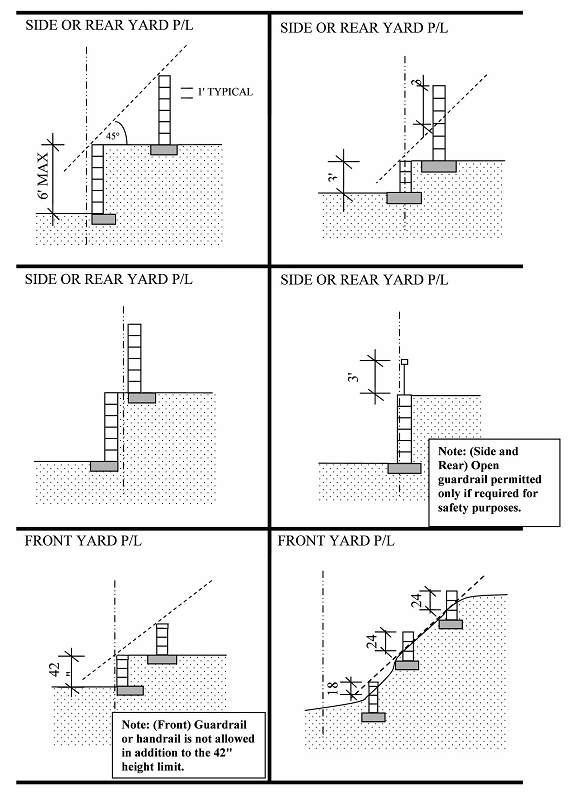
PERMITTED FENCE/WALL/HEDGE HEIGHTS
Q.
Parking/Garage Location, Street-Alley Lots. When a street-alley lot in Area Districts I and II adjoins an improved alley, all vehicle access to parking shall be provided from the alley.
Non-Alley Lots: In Area District I and II, the aggregate total of garage door width within the front half of a lot shall be limited to eighteen feet (18′) for lots fifty-five feet (55′) or less in width. Lots wider than fifty-five feet (55′) may have a maximum aggregate garage door width of twenty-seven feet (27′) within the front half of a lot if at least one (1) garage door is recessed a minimum of five feet (5′) beyond another garage door.
R.
Building Separation. The minimum distance between buildings (building separation yard) containing one (1) or more dwelling units on a site shall be ten feet (10′). For permitted projections within said building separation yards, see Section 10.60.040, Building projections into yards.
Exception: A detached accessory dwelling unit shall have a minimum separation from other buildings on the lot as specified by Section 10.74.040.B.
S.
House Moving. For the purpose of this chapter, permits required for moving buildings and structures within City limits must comply with Title 9, Chapter 9.08, Building Moving.
T.
Additional Front and Corner Side Setback Requirement—RS Properties, Area Districts I and II. In addition to the minimum front and corner side setback shown on the chart, an additional front and corner side setback area shall be provided as follows:
1.
On interior lots, the area shall directly abut the front yard setback, shall be equal to six percent (6%) of the lot area, and shall be located entirely within the front one-fifth (twenty percent (20%)) of the lot's buildable depth.
2.
On corner lots, the area shall be equal to eight percent (8%) of the lot area, and the area shall be divided between directly abutting the front and the streetside yard setbacks. A minimum of forty-five percent (45%) and a maximum of fifty-five percent (55%) of the total required area shall directly abut both the required front and streetside yard setbacks. Adjacent to the front yard, the portion of the area shall be located entirely within the front one-fifth [twenty percent (20%)] of the lot's buildable depth. Adjacent to the corner streetside yard the portion of the area shall be located entirely within the front one-third [thirty-three percent (33%)] of the lot's buildable width, and not located within the rear yard setback. Adjacent to the corner streetside the area shall provide a minimum of three feet (3′) of depth or width and shall be distributed to provide building wall articulation.
3.
The ground level construction in this area shall be limited to fourteen feet (14′) in height for areas with less than 3:12 roof pitch and seventeen feet (17′) in height for areas with 3:12 or more roof pitch, as measured from local grade. Areas not having a minimum 3:12 roof pitch located behind minimum 3:12 roof pitch areas shall be set back a minimum of three feet (3′) beyond the front building line of the pitched roof area (See Graphic Illustration).
4.
A maximum of one-half of said area shall be designed or useable as roof top deck surfaces.
5.
Building projections above said area shall be considered as projections within a front yard.
Exceptions:
1.
Interior non-alley lots fifty-five feet (55′) or less in width with all parking spaces located within the rear half of the lot shall not be required to provide the additional front setback area.
2.
This requirement may be reduced for a small, wide, shallow, multiple front yard and/or unusually shaped lots or other unique conditions subject to approval of a minor exception.
3.
Corner lots, which provide driveway access along the interior side property line from a front property line curb cut with all parking spaces located within the rear half of the lot, shall not be required to provide the additional front setback area.
4.
This requirement may be modified for the remodel/addition of existing homes if the additional setback area is provided elsewhere on the lot subject to approval of a minor exception.
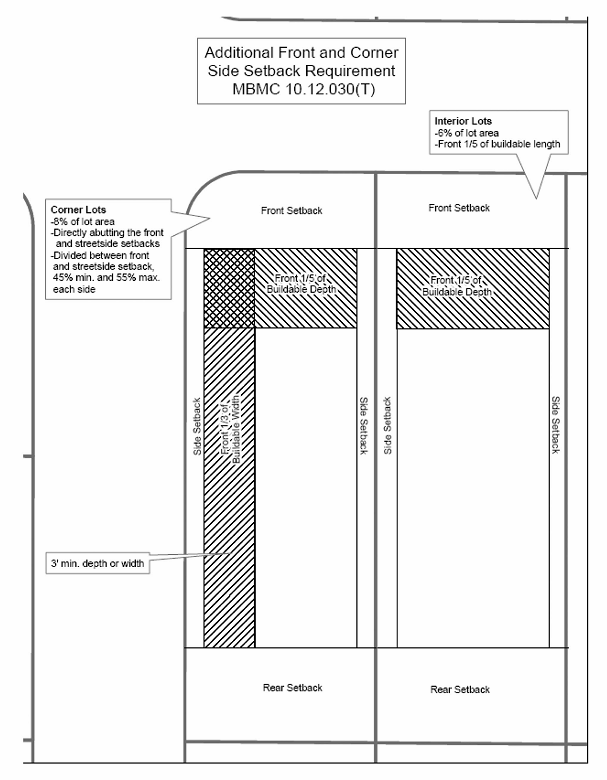
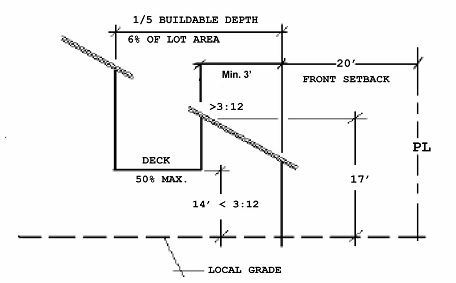
ADDITIONAL FRONT SETBACK REQUIREMENT
MBMC 10.12.030T
U.
Multi-family residential developments meeting the minimum requirements for a density bonus pursuant to Chapter 10.94 shall be granted a lot consolidation bonus incentive when two (2) or more parcels are consolidated into a single building site according to the following formula:
This lot consolidation bonus incentive shall be calculated prior to determining any density bonus pursuant to Chapter 10.94.
V.
Multi-family residential developments meeting the minimum requirements for a density bonus pursuant to Chapter 10.94 shall be exempt from these maximum lot size limitations.
(Ord. No. 1832, Amended, 01/17/91; Ord. No. 1838, Renumbered, 07/05/91; Ord. No. 1840, Amended, 07/05/91; Ord. No. 1842, Amended, 08/15/91; Ord. No. 1853, Amended, 05/21/92; Ord. No. 1860, Amended, 10/29/92; Ord. No. 1861, Amended, 12/03/92; Ord. No. 1889, Amended, 12/16/93; Ord. No. 1891, Amended, 01/06/94; § 6, Ord. 1977, eff. March 5, 1998; § 2, Ord. 1992, eff. February 18, 1999; § 3, Ord. 1999, eff. April 1, 1999; § 2, Ord. 2032, eff. May 16, 2002; § 2, Ord. 2049, eff. November 18, 2003; § 2, Ord. 2050, eff. January 1, 2004; § 2, Ord. 2061, eff. October 7, 2004; § 5, Ord. 2075, eff. July 7, 2005; §§ 3—11, Ord. 2111, eff. March 19, 2008; § 5, Ord. 2146, eff. August 4, 2011; §§ 4, 5, Ord. 13-0006, eff. August 1, 2013, § 4, Ord. 15-0026, eff. December 3, 2015, § 9, Ord. 16-0029, eff. Dec. 20, 2016, and § 5, Ord. 18-0022, eff. Dec. 6, 2018; Ord. No. 21-0001, §§ 6, 7, eff. Feb. 19, 2021)
10.12.040 - RPD district development regulations.
A.
General Conditions and Limitations. Each comprehensive residential planned development (RPD) shall be subject to use permit approval, and the following conditions and limitations (see also Section 10.12.020 for additional land use regulations).
1.
The maximum permitted density shall be consistent with the General Plan.
2.
Greenbelts shall be provided offering easy access between dwelling units, parks, and commercial areas.
3.
Each building site shall abut and provide access to a public or private street or alley.
4.
The RPD shall be designed around an architectural theme or themes providing architectural variations and containing landscaped berms and/or decorative walls and fences. Homeowners associations, to be established at the time of initial development, shall have the authority to determine theme consistency for subsequent ministerial projects.
B.
Development Standards. This subsection establishes minimum development standards that are intended to apply to all physical improvements on the site and ensure construction of a high-quality residential environment in a RPD district. Minor modifications to these standards, with the exception of development density, may be approved by the Planning Commission as part of an RPD permit and shall be incorporated into the Planning Commission resolution approving the RPD permit. Minor modifications to standards may be approved by the Community Development Director for subsequent isolated projects (including reconstruction) that are compatible with the existing RPD development (existing prior to January 1995) if such modifications are requested in writing by the applicant and responsible homeowners' association.
1.
Minimum Building Site Area. Forty thousand (40,000) square feet.
2.
Minimum Lot Area.
a.
Detached Single-Family Dwellings. Five thousand (5,000) net square feet per unit, provided the average lot area shall not be less than five thousand five hundred (5,500) square feet for the total net site area.
b.
Attached or Cluster Multiple-Family Dwellings. A minimum lot area of two thousand (2,000) net square feet per unit shall be required, provided the average lot area per dwelling unit shall not be less than two thousand five hundred (2,500) square feet for the total net site area.
c.
Determining Net Site Area. Net site area excludes common areas that are required for parkland or right of way dedication requirements and areas that exceed a fifteen percent (15%) slope.
3.
Maximum Building Height. Twenty-six feet (26′). A height limitation of thirty feet (30′) for multifamily developments may be approved if the additional height is required to construct a tuck-under garage which provides direct access to a dwelling unit. Height shall be measured in accord with Section 10.60.050.
4.
Maximum Building Site (Lot) Coverage.
a.
Single-Family Dwellings. Fifty percent (50%), exclusive of roof overhangs, trellis areas, covered porches, and allowable structures in the side and rear yard setback areas.
b.
Multiple-Family Dwellings. Sixty percent (60%), excluding roof overhangs, trellis areas, and covered porches.
5.
Minimum Building Setbacks for Single-Family Dwellings and Accessory Structures.
a.
From Street Property Lines.
b.
From Interior Side-Lot Line. Five feet (5′).
1.
Exceptions for Zero-Side Yards. A zero (0) side-yard development may be approved if the opposite yard or the combined side-yard setbacks of the two (2) adjoining structures is a minimum of ten feet (10′).
c.
From Rear Lot Line: twenty feet (20′).
1.
Exception. If the area to be developed contains more than thirty (30) acres, a maximum of twenty-five percent (25%) of the total number of lots may have reduced rear-yard setbacks, provided that the average setback shall not be less than fifteen feet (15′) on any lot, but in no case shall the dimension between the closest point of the structure and the property line be less than ten feet (10′). In addition, up to three percent (3%) of the total number of lots can maintain a minimum eight-foot (8′) setback.
d.
Structures Allowed in the Setback Area. Limited structural improvements are permitted to be located in side- and rear-yard setback areas to provide the occupant with usable space for open space and recreational purposes. These uses may include pools and spas, pool and spa equipment, barbecues, garden potting benches and related storage, fountains, bird baths, patio covers, second-story open and unenclosed balconies, gazebos, greenhouses, planter beds, landscaping, irrigation systems, and other similar improvements which, in the determination of the Director of Community Development, meet the intent of this section. The installation of such improvements is subject to the following conditions.
1.
No improvement may be constructed in violation of the Uniform Building Codes or other applicable codes and ordinances.
2.
The rear-yard setback area must be provided with continuous access, defined as an area open and unobstructed from the ground to the sky, a minimum of three feet (3′) wide, from the front to the rear of the property.
3.
No improvement other than area-separation walls or fences which cannot exceed the height limits prescribed by this Code, may be constructed in excess of fifteen feet (15′) in height.
4.
Any improvement(s) that has a roof element shall not exceed a maximum lot coverage of 40 percent of the required rear-yard setback.
e.
Setbacks from Public Greenbelts, Lakes, or Parks. 20 feet plus 10 feet for two-level dwellings.
f.
Setbacks from District Boundaries. 50 feet. The Planning Commission may reduce this requirement upon finding that an adequate buffer is provided.
g.
Building Separation. The distance between primary buildings and accessory buildings on the same lot shall not be less than 10 feet.
6.
Minimum Building Setbacks for Attached or Cluster Multifamily Dwellings:
a.
From Street Property Lines:
b.
Setbacks between Structures on the Same Site:
c.
Setbacks between Clusters and Public Greenbelts, Lakes, and Parks: 20 feet plus 5 feet for each story above one.
d.
Setbacks from District Boundaries: 50 feet. The Planning Commission may reduce this requirement upon finding that an adequate buffer is provided.
e.
If the area to be developed contains more than 40 acres, the setback requirements can be modified by an RPD Permit if the Planning Commission finds that the project is in substantial compliance with the intent and purpose of the RPD District.
7.
Private Open Space. The minimum usable open space shall be three hundred (300) square feet, shall be on the ground, and shall be intended to provide for private recreational outdoor use.
8.
Public Open Space.
a.
All public common areas, parks, recreation facilities and medians shall be fully developed and landscaped in accord with plans approved by the Public Works Department.
b.
The homeowners' association(s) shall be responsible for the maintenance of all private common areas including, but not limited to, parkways and trails, recreation facilities, and landscaped medians.
9.
Parking Requirements.
a.
Single-Family Dwellings. Two (2) enclosed off-street parking spaces directly serving each unit, plus two (2) additional off-street parking spaces, either enclosed or unenclosed.
b.
Multiple-Family Dwellings. Two (2) enclosed off-street parking spaces directly serving each unit, plus one (1) additional off-street parking space for use by guests. Guest parking may be located adjacent to the dwelling unit served or may be clustered if the Planning Commission finds that such clusters will be located in convenient proximity to a number of dwelling units.
c.
Recreational Vehicles: A deed restriction shall be imposed on all residential properties prohibiting the parking of recreational vehicles, trailers, or boats on private driveways or streets within the development.
d.
Other Requirements. See Chapter 10.64.
10.
Underground Utilities. See Section 10.60.110.
11.
Swimming Pools and Hot Tubs. See Section 10.52.080.
12.
Landscaping. See Section 10.60.070.
13.
Screening of Mechanical Equipment. See Section 10.60.090.
14.
Refuse Storage Areas. See Section 10.60.100.
15.
Performance Standards. See Section 10.60.120.
(Ord. No. 1832, Amended, 01/17/91; Ord. No. 1838, Renumbered, 07/05/91, 10-3.506; Ord. No. 1891, Amended, 01/06/94; § 2, Ord. 1951, eff. July 4, 1996)
10.12.050 - RSC district development regulations.
This section establishes minimum development standards that are intended to apply to all physical improvements on the site in order to ensure construction of a high-quality residential environment specifically designed for senior citizens in an RSC district. For the purposes of this section, a senior citizen household shall be defined as a household in which one member of the household, or dwelling unit, is sixty-two (62) years of age or older.
A.
Minimum Building Site Area. Forty thousand (40,000) square feet.
B.
Minimum Lot Area per Dwelling Unit. Nine hundred (900) square feet.
C.
Minimum Floor Area per Dwelling Unit. Five hundred twenty-five (525) square feet.
D.
Maximum Building Height. Thirty feet (30′). The Planning Commission shall review the compatibility of the height of the proposed development with the surrounding neighborhood in accord with the following criteria:
1.
Building height shall be compatible with existing adjacent structures. Tuck-under parking and/or a sloped roof design with a minimum ratio of 4:12 is suggested for structures exceeding twenty-six feet (26′) in height.
2.
All rooftop or elevated mechanical equipment or vents shall be screened from view.
E.
Maximum Floor Area Ratio. 1.5:1.
F.
Minimum Yards and Building Setbacks. Minimum yards and setbacks shall not be less than those required in the RH district for the area district in which the development is proposed.
G.
Minimum Distance between Buildings. Ten feet (10′).
H.
Building Design. To encourage greater architectural creativity in facade design, two (2) of the following architectural elements are required as part of each building facade: sloped roofs; bay windows; awnings; roof eaves; cornices; sills; buttresses; balconies; or patios.
I.
Open Space.
1.
Overall Requirement. Total three hundred fifty (350) square feet of usable open space shall be provided for each unit.
2.
Private Open Space. A minimum of fifty (50) square feet with direct access from each unit shall be provided. The minimum horizontal dimension of balconies shall be five feet (5′).
3.
Common Open Space. The minimum horizontal dimension of patios, decks, courtyard areas, and other common space shall be ten feet (10′).
J.
Community Facilities. An amount equal to fifteen (15) square feet per unit shall be developed as community space providing handicapped bathrooms and kitchen facilities to be used by project residents and their guests only.
K.
Landscaping.
1.
All unpaved areas shall be planted with an effective combination of trees, ground cover, and shrubbery.
2.
Landscaping may be required in excess of the minimum standards specified for a proposed development, provided that the additional landscaping is necessary to accomplish the following:
a.
Screen adjacent uses from parking areas, storage, or structures that could cause a negative impact on adjacent uses based on aesthetics, noise, or odors; or
b.
Provide landscaping that is compatible with neighboring uses.
3.
The landscape plan shall be compatible with the shape and topography of the site and the architectural characteristics of the structures on the site.
4.
The plant materials selected shall be suitable for the given soil and climate conditions.
5.
Landscaping shall be used to relieve solid, unbroken elevations and to soften continuous wall expanses.
6.
Landscaping shall be maintained in an orderly and healthy condition. This maintenance shall include proper pruning, mowing of lawns, weeding, removal of litter, fertilizing, replacement of plants when necessary, and regular watering.
7.
Landscaping shall screen storage areas, trash enclosures, parking areas, public utilities, and other similar land uses or elements that do not contribute to the enhancement of the surrounding areas.
8.
All landscaping shall be separated from parking and vehicular circulation areas by a raised, continuous six-inch (6″) curb. Other materials that accomplish the same purpose may be approved by the Director of Community Development.
9.
For additional site landscaping requirements, see Section 10.60.070, Landscaping, Irrigation and Hydroseeding. Conformance with standards specified in Section 10.60.070 may result in landscaping that exceeds the minimum requirements of this section.
L.
Parking Requirements:
1.
Minimum Spaces:
a.
1.2 per unit, including one enclosed; and
b.
One (1) space for every nonresidential employee.
2.
Loading Area: A loading area shall be provided on site. The area may not at any time obstruct vehicular or pedestrian circulation, or block access to parking. The loading area shall be:
a.
An off-street loading space of not less than ten feet (10′) × twenty feet (20′); or
b.
A loading zone of not less than twenty-five (25) lineal feet.
3.
Aesthetics:
a.
No more than forty percent (40%) of the street frontage shall be utilized for vehicular access.
b.
To avoid long, continuous blank walls at-grade, parking garages shall include openings such as windows and doors for fifty percent (50%) of the vertical surface.
c.
Exterior lighting shall be designed in such a manner as to avoid glare on adjacent properties.
4.
Parking Access and Driveways:
a.
In pedestrian-intensive areas, such as but not limited to the Downtown, the North End (El Porto), and the local-servicing commercial properties along Highland and Rosecrans avenues, driveway encroachments are discouraged along the primary commercial streets (Manhattan Avenue, Manhattan Beach Boulevard, Highland Avenue, Morningside Drive, and Rosecrans Avenue). Driveways shall be limited, where feasible, to side streets and/or alleys.
b.
Each driveway serving the garages or parking spaces shall be at least ten feet (10′) wide for one (1) way or twenty-five feet (25′) for two (2) way.
M.
Unit Design Standards.
1.
To assist in reaching, drawers and shelves shall be on gliders or rotating.
2.
For easy grip, lever handles shall be used instead of knobs.
3.
Tub/showers shall have non-slip surfaces with grab bars.
4.
For security/convenience:
a.
A peep-hole shall be included in the front door;
b.
Dead-bolt exterior doors shall be installed;
c.
Whenever possible, unit entrances shall have direct access to parking facilities; and
d.
Long interior halls shall be avoided.
5.
A minimum of two hundred (200) cubic feet of storage space per unit shall be provided.
6.
All projects two (2) stories in height or greater shall have elevators.
7.
Unit orientation and window location:
a.
The living room or living space with the greatest square footage, other than a bedroom, shall have an operable window facing the front or rear yard.
b.
For easy visibility from a sitting position within the unit, at least one (1) window in the living room shall have a sill no greater than thirty inches (30″) from the floor.
8.
Trash-Storage Areas. See Section 10.60.100.
9.
Utilities.
a.
All utilities such as gas meters, electrical meters, telephone-, pedestal-mounted terminal boxes, surface-mounted electrical transformers, fire hydrants or any other potential obstructions shall not be located within the required parking or turning area or driveway.
b.
All utility meters shall be screened from view from public streets.
c.
The utilities undergrounding requirements of Section 10.60.110 shall apply.
N.
Telecommunications Facilities. See Chapter 13.02 of Manhattan Beach Municipal Code.
(Ord. No. 1832, Amended, 01/17/91; Ord. No. 1838, Renumbered, 07/05/91; Ord. No. 1860, Amended, 10/29/92; § 6, Ord. 2075, eff. July 7, 2005; § 5, Ord. 2146, eff. August 4, 2011 and § 8, Ord. 13-0006, eff. August 1, 2013)
10.16.010 - Specific purposes.
In addition to the general purposes listed in Chapter 10.01, the specific purposes of commercial district regulations are to:
A.
Provide appropriately located areas consistent with the General Plan for a full range of office, retail commercial, and service commercial uses needed by residents of, and visitors to, the City and region.
B.
Strengthen the City's economic base, but also protect small businesses that serve City residents.
C.
Create suitable environments for various types of commercial and compatible residential uses, and protect them from the adverse effects of inharmonious uses.
D.
Minimize the impact of commercial development on adjacent residential districts.
E.
Ensure that the appearance and effects of commercial buildings and uses are harmonious with the character of the area in which they are located.
F.
Ensure the provision of adequate off-street parking and loading facilities.
G.
Provide sites for public and semipublic uses needed to complement commercial development or compatible with a commercial environment.
The additional purposes of each district are as follows:
CL Local Commercial District. To provide sites for businesses serving the daily needs of nearby residential areas while establishing development standards that prevent significant adverse effects on residential uses adjoining a CL district.
CC Community Commercial District. To provide sites for planned commercial centers, such as Manhattan Village, which contain a wide variety of commercial establishments, including businesses selling home furnishings, apparel, durable goods, and specialty items and generally having a City-wide market area. Support facilities such as entertainment and eating-and-drinking establishments are permitted, subject to certain limitations to avoid adverse effects on adjacent uses.
CG General Commercial District. To provide opportunities for the full range of retail and service businesses deemed suitable for location in Manhattan Beach, including businesses not permitted in other commercial districts because they attract heavy vehicular traffic or have certain adverse impacts; and to provide opportunities for offices and certain limited industrial uses that have impacts comparable to those of permitted retail and service uses to occupy space not in demand for retailing or services.
CD Downtown Commercial District. To provide opportunities for residential, commercial, public and semipublic uses that are appropriate for the downtown area. This district is intended to accommodate a broad range of community businesses and to serve beach visitors.
CNE North End Commercial District. To provide for a mix of small, local and visitor-serving commercial, public and semipublic uses appropriate for the El Porto area and the business district along Highland Avenue and Rosecrans Avenue at the northern end of the City. Residential uses that are consistent with the standards of the RH Residential High-Density District are also permitted, consistent with the General Plan.
(Ord. No. 1832, Amended, 01/17/91; Ord. No. 1838, Renumbered, 07/05/91, § 10, Ord. 16-0029, eff. Dec. 20, 2016, and § 5, Ord. 18-0022, eff. Dec. 6, 2018)
10.16.020 - CL, CC, CG, CD, CNE districts: land use regulations.
In the following schedules, the letter "P" designates use classifications permitted in commercial districts. The letter "L" designates use classifications subject to certain limitations prescribed by the "Additional Use Regulations" that follow. The letter "U" designates use classifications permitted on approval of a use permit. The letters "P/U" for an accessory use mean that the use is permitted on the site of a permitted use, but requires a use permit on the site of a conditional use. Use classifications that are not listed are prohibited. Letters in parentheses in the "Additional Regulations" column refer to regulations following the schedule or located elsewhere in this title. Where letters in parentheses are opposite a use classification heading, referenced regulations shall apply to all use classifications under the heading.
_____
C Districts: Additional Land Use Regulations
_____
L-4 Only allowed above ground level with a use permit.
L-5 Only mortuaries are allowed, subject to a use permit.
L-6 A use permit is required, and body and fender shops are permitted only as part of a comprehensive automobile-service complex.
L-7 Only "limited" or "small-scale" facilities, as described in use classifications, are allowed with a use permit.
L-8 Attended facilities permitted; unattended facilities allowed with a use permit.
L-9 A use permit is required for Food and Beverage establishments operating between 10:30 p.m. and 6 a.m.
L-10 Only post offices and other offices occupying less than two thousand five hundred (2,500) square feet are permitted.
L-11 Single-family residential permitted if located (1) on a site which fronts on Crest Drive; or (2) on the rear half of a site which fronts on Highland Avenue; or (3) on a site which fronts on the east side of Highland Avenue between 38th Place to the south and Moonstone Street to the north; or (4) on a site which does not abut Rosecrans Avenue or Highland Avenue; otherwise a use permit is required.
L-21 A use permit is required, except for legally existing church facilities, including private schools and day-care contained therein, which do not exceed an overall floor area factor greater than half of the maximum floor area factor permitted by the development standards of the base district.
L-23 See Section 10.12.020 (L-22): regulations for "Day Care, Large Family Home".
L-24 A use permit is required for a project with more than two thousand five hundred (2,500) square feet of buildable floor area.
L-25 Animal Hospitals as defined in MBMC 10.08.050 require a Use Permit. Veterinary services, as defined as medical treatment for small animals, is a permitted use on the ground floor provided the proposed facilities are entirely enclosed, soundproofed, and air-conditioned. Overnight boarding is allowed only if associated with the on-site Veterinary services.
L-26 Permitted above ground floor. Use is also permitted if the use exclusively fronts an alley subject to Community Development Director's approval. Other locations require a Use Permit such as ground floor space adjacent to pedestrian areas.
L-27 Permitted above ground floor.
L-28 Optometrist office is permitted in ground floor spaces adjacent to sidewalks and other pedestrian areas provided the Community Development Director finds the optometrist has a substantial retail component. Optometrist office is also permitted above the ground floor.
L-29 In addition to any other applicable regulations regulating square footage or retail floor space, a Use Permit is required for the establishment of any retail use proposed to contain more than one thousand six hundred (1,600) square feet of sales floor area. For the purposes of this section, "sales floor area" is defined as the total area of a tenant space, measured from the inside walls, excluding rooms or areas that are permanently inaccessible to the public, including, but not limited to, storage rooms, offices associated with the retail tenant, mechanical rooms, bathrooms, and common areas shared with other tenants in the building.
(A) Facilities on sites of two (2) acres or more are subject to the regulations of Chapter 10.28 (PS District) precluding those of this chapter. See Section 10.28.020: PS District Applicability.
(B) A use permit is required for a single use or tenant project with more than five thousand (5,000) square feet of buildable floor area or more than ten thousand (10,000) square feet of land area. A master use permit is required for a multiple use or tenant project with more than five thousand (5,000) square feet of buildable floor area or more than ten thousand (10,000) square feet of land area. See Section 10.84 for use permit provisions.
(C) The exterior walls of an adult business shall be at least two hundred feet (200′) from an R district and a school, and at least one thousand feet (1,000′) from the exterior walls of another adult business.
(D) See Section 10.56.050: Game centers.
(E) See Section 10.56.020: Eating and drinking establishments with take-out service. An establishment providing group entertainment is subject to Title 4, Article 4, Dances and Cafe Entertainment and must obtain a permit from the City Manager.
(F) See Section 10.56.030, Service stations, vehicle/equipment repair, and automobile washing.
(G) See Section 10.84.110, Temporary use permits.
(H) See Chapter 10.68, Nonconforming uses and structures.
(I) The keeping of domestic animals is permitted including: dogs and cats not to exceed five (5) for each residential living unit in any combination thereof and the young thereof not exceeding four (4) months in age, and other small domestic household pets such as rabbits, hamsters, guinea pigs, etc., not to exceed five (5) in any combination thereof. Common varieties of farm animals, livestock, exotic animals or wild animals (as defined in Section 10.04.020) are prohibited except for Vietnamese pot-bellied pigs, also known as pygmy pigs or mini-pigs, as permitted by the Animal Control Department.
(J) A maximum of three (3) garage or lawn sale permits per calendar year, of miscellaneous household items of personal property accumulated by the occupant of the residence as a normal matter of course may be held on any building site occupied by residents, provided a permit has been acquired from the City's Licensing Authority. Each permit shall be valid for a maximum of three (3) consecutive days and may include standard regulations on the garage sale permit (in accordance with provisions of Section 6.08.020 MBMC).
(K) Valid discretionary permits approved prior to January 17, 1991 may satisfy the requirement for an individual use permit or master use permit, provided the scope of the project, including use(s) approved and intensity (buildable floor area) of development, remain in substantial conformance with the approved project, and the project complies with all conditions of approval. The Community Development Director shall approve the conversion of such permits in conformance with this section.
(L) A use permit, or use permit amendment, shall be required for any new alcohol license or modification to an existing alcohol license.
(M) Certain commercial businesses, such as eating and drinking establishments and visitor accommodations, with use permits and other discretionary zoning approvals that limit the hours of operation may operate for extended hours for New Year's Eve as designated in Section 6.01.330 of the Businesses, Professions and Trades Code.
(N) A use permit shall be required for any new body art studio use as set forth in Section 10.56.070: Body Art Studios. In addition, body art studios shall comply with the regulations set forth therein. Body art studios are not permitted in CG zoned parcels that are adjacent to RS-D6 (Oak Avenue Overlay District) zoned parcels.
(Ord. No. 1832, Amended, 01/17/91; Ord. No. 1838, Renumbered, 07/05/91; Ord. No. 1860, Amended, 10/29/92; Ord. No. 1864, Amended, 02/18/93; Ord. No. 1891, Amended, 01/06/94; Ord. No. 1902, Amended, 05/05/94; § 2, Ord. 1942, eff. February 22, 1996; § 2, Ord. 2000, eff. May 20, 1999; § 4, Ord. 2126, eff. September 3, 2009; § 4, Ord. 2130, eff. December 31, 2009; § 2, Ord. 2155, eff. February 17, 2012, § 3, Ord. 2156, eff. March 9, 2012, § 11, Ord. 16-0029, eff. Dec. 20, 2016, and §§ 3—5, Ord. 18-0022, eff. Dec. 6, 2018)
10.16.030 - CL, CC, CG, CD, and CNE districts: development regulations.
The following schedule prescribes development regulations for the CL, CC, CG, CD, and CNE districts. The first five (5) columns prescribe basic requirements for permitted and conditional uses in each district. Letters in parentheses in the "Additional Regulations" column reference regulations following the schedule or located elsewhere in the planning and zoning ordinance.
(A) Dwelling units as the sole use on a site shall be subject to the standards for residential development in the RH district and the area district in which the site is located, except as follows:
(1) CD district: the commercial standard for building height shall apply when dwelling units replace commercial use.
(2) CNE district, D-5 overlay: if an RH district standard conflicts with an overlay standard (Section 10.44.040), the overlay standard shall apply.
(B) See Section 10.60.020, Development of substandard lots.
(C) See Section 10.60.040, Building projections into yards and required open space. Double-frontage lots shall provide front yards on each frontage.
(D) A minimum ten-foot (10′) building setback shall be provided along the west side of Sepulveda Boulevard as measured from the Sepulveda street property line prior to any required dedications.
(E) Along a rear property line abutting an R district, structures shall not intercept a 1:1 or forty-five-degree (45°) daylight plane inclined inward from a height of fifteen feet (15′) above existing grade at the property line. Along a side property line abutting an R district, structures shall not intercept a sixty-degree (60°) daylight plane inclined inward from a height twenty feet (20′) above existing grade at the property line.
(F) A roof pitch of at least four (4) vertical feet for each twelve (12) lineal feet of roof area is required. If the roof pitch is less, the maximum building height is twenty-two feet (22′) unless structure parking is provided at or below the ground level.
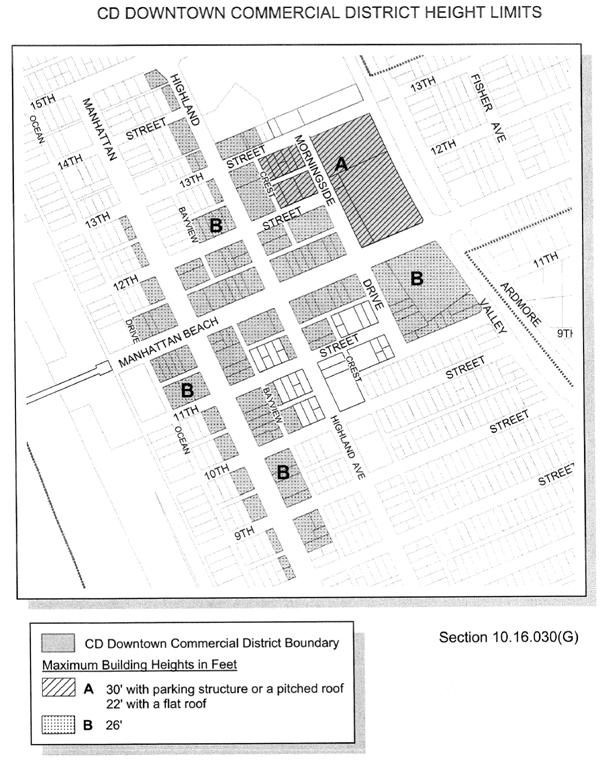
(G) Within the CD district, the height limits shown on the accompanying diagram entitled "Section 10.16.030 (G), CD Downtown Commercial District Height Limits" shall apply.
(H) See Section 10.60.050, Measurement of height, and Section 10.60.060, Exceptions to height limits.
(I) Planting Areas.
(1) Required yards shall be enclosed by a solid concrete or masonry wall at least six feet (6′) in height or shall be planting areas, provided that a wall within fifteen feet (15′) of a street property line shall not exceed three feet (3′) in height.
(2) In the CG and CC districts, the minimum percentage of the site to be landscaped may be reduced one percent (1%) for each section of street frontage improved with an adjoining landscaped strip, the dimensions of which are minimally: twenty-five feet (25′) in width and, in length, a dimension equivalent to twenty percent (20%) of the street frontage, where width is measured perpendicular to the street and length is measured parallel to the street. For purposes of calculation, the frontage allocated to driveways and walks shall not be counted.
(3) For additional site landscaping requirements, see Section 10.60.070, Landscaping, irrigation and hydroseeding. Conformance with the design standards specified in Section 10.60.070 may result in a total site landscaping requirement that exceeds the minimum site requirements of this section.
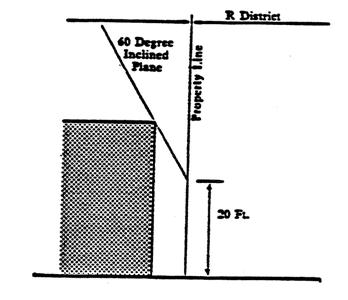
SIDE PROPERTY LINE
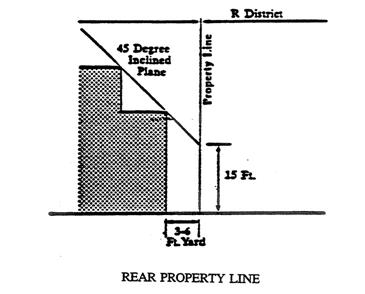
REAR PROPERTY LINE
(E) REQUIRED DAYLIGHT PLANE AT ADJOINING DISTRICTS
(The diagram is illustrative)
(J) (Reserved)
(K) Fences and Walls. A solid masonry or concrete wall is required for all commercial properties where they abut or adjoin a ground-floor residential use or residentially zoned property. The minimum height of a fence or wall is six feet (6′) as measured from the finished grade of the commercial property. However, a wall within five feet (5′) of a street property line shall be a minimum of three feet (3′) in height as measured from the residential property.
The maximum height of a fence or wall shall be eight feet (8′) as measured from the finished grade of the commercial property unless a greater height is mutually agreed upon for a common property line by the abutting property owners and approved by the Community Development Department.
(L) (Reserved)
(M) (Reserved)
(N) See Chapter 10.64, Off-Street parking and loading regulations.
(O) See Section 10.60.130, Antennas and microwave equipment; and Section 10.60.140, Solar-assisted water heating.
(P) In a mixed use development, the residential standards for the RH district and area district in which the site is located shall apply to a building or portion of a building intended for residential use, and commercial standards shall apply to a building or portion of building intended for commercial use, except as follows:
(1) CD district:
(a) FAR: the commercial standard for maximum FAR shall apply to the entire project.
(b) Building height: the commercial standard shall apply to all portion(s) of the project except when an existing residential use that is legally established as of February 22, 1996 and occupies a solely residential building, is altered or replaced with a solely residential building, in which case the RH district standard shall apply.
(2) CL and CNE districts:
(a) FAR: the commercial standard for maximum FAR shall apply to the entire project.
(b) CNE district D-5 overlay: if an RH district or commercial standard conflicts with an overlay standard (Section 10.44.040), the overlay standard shall apply.
(Ord. No. 1832, Amended, 01/17/91; Ord. No. 1838, Renumbered, 07/05/92; Ord. No. 1860, Amended, 10/29/92; Ord. No. 1891, Amended, 01/06/94; § 3, Ord. 1942, eff. February 22, 1996; § 2, Ord. 1951, eff. July 14, 1996; §§ 1, 2, Ord. 1972, eff. November 20, 1997; § 4, Ord. 2075, eff. July 7, 2005, § 12, Ord. 16-0029, eff. Dec. 20, 2016, and § 5, Ord. 18-0022, eff. Dec. 6, 2018)
10.20.010 - Specific purposes.
In addition to the general purposes listed in Chapter 10.01, the specific purposes of the IP Industrial Park District are to:
A.
Provide appropriately located areas consistent with the General Plan for specialized industrial and related uses, and protect them from the adverse impacts of inharmonious uses.
B.
Strengthen the city's economic base, and provide employment opportunities close to home for residents of the city and surrounding communities.
C.
Ensure that the appearance and effects of industrial uses are compatible with the character of the area in which they are located.
D.
Minimize the impact of industrial uses on adjacent residential districts.
E.
Ensure the provision of adequate off-street parking and loading facilities.
(Ord. No. 1832, Amended, 01/17/91; Ord. No. 1838, Renumbered, 07/05/91)
10.20.020 - IP district: land use regulations.
In the following schedule, the letter "P" designates use classifications permitted in the IP district. The letter "L" designates use classifications subject to certain limitations prescribed by the "Additional Use Regulations" which follow. The letter "U" designates use classifications permitted on approval of use permit. The letters "P/U" for an accessory use mean that the use is permitted on the site of a permitted use, but requires a use permit on the site of a conditional use. Use classifications that are not listed are prohibited. Letters in parentheses in the "Additional Regulations" column refer to regulations following the schedule, or located elsewhere in this title. Where letters in parentheses are opposite a use classification heading, referenced regulations shall apply to all use classifications under the heading.
_____
IP Districts: Additional Land Use Regulations
_____
L-12 A use permit and heliport permit from California Department of Transportation, Division of Aeronautics are required. Applicants shall submit a noise analysis based on likely approach-departure routes, including a map showing existing day/night average noise levels in decibels and future day/night average noise levels with the proposed facility and anticipated flight operations, and single-event maximum noise levels associated with the types of helicopters expected to use the facility. Conditions may be imposed to limit the maximum number of flights per day or week and the hours of operation.
L-13 Permitted as a secondary use in a building, or in a free-standing structure, provided that no more than twenty percent (20%) of buildable floor area is occupied by such uses.
(A) Facilities on sites of two (2) acres or more are subject to the regulations of Chapter 10.28 (PS District) precluding those of this chapter. See Section 10.28.020: PS District Applicability.
(B) See Section 10.52.050: Accessory structures.
(C) See Chapter 10.68: Nonconforming uses and structures.
(D) See Section 10.56.040: Hazardous materials storage.
(E) See Section 10.84.110: Temporary use permits.
(F) A use permit shall be required for any new body art studio use as set forth in Section 10.56.070: Body Art Studios. In addition, body art studios shall comply with the regulations set forth therein.
(G) Emergency shelters shall be permitted subject to the provisions of Section 10.56.080.
(Ord. No. 1832, Amended, 01/17/91; Ord. No. 1838, Renumbered, 07/05/91; Ord. No. 1864, Amended, 02/18/93; § 5, Ord. 2155, eff. February 17, 2012; § 4, Ord. 2156, eff. March 9, 2012 and § 6, Ord. 13-0006, eff. August 1, 2013)
10.20.030 - IP district: development regulations.
The following schedule prescribes development regulations for the IP District. The first column prescribes basic requirements for permitted and conditional uses. Letters in parentheses in the "Additional Regulations" column reference regulations following the schedule or located elsewhere in this title.
_____
IP DISTRICT: DEVELOPMENT
REGULATIONS
_____
_____
IP District: Additional Development Regulations
_____
A.
See Section 10.60.020: Development on substandard lots.
B.
Smaller lot dimensions may be permitted by the Planning Commission with an approved development plan and tentative subdivision map.
C.
See Section 10.60.040: Building projections into yards and required open space. Double-frontage lots shall provide front yards on each frontage.
D.
A forty-foot (40′) interior side or rear building setbacks shall be required adjoining an R district on Marine Avenue.
E.
See Section 10.60.050: Measurement of height.
F.
The average height of all buildings on a lot shall not exceed eighty-five feet (85′).
G.
Planting Areas. In required front and corner-side yards, twelve feet (12′) adjacent to a public right-of-way shall be planting areas except for necessary drives and walks. For site landscaping requirements, see Section 10.60.070, Landscaping, irrigation and hydroseeding. Conformance with standards specified in Section 10.60.070 may result in landscaping that exceeds the minimum requirements of this section.
H.
See Section 10.60.070: Landscaping, irrigation and hydroseeding.
I.
The maximum height of a fence or wall shall be eight feet (8′) adjacent to an R or C district.
J.
See Section 10.60.130: Antennas and microwave equipment.
(Ord. No. 1832, Amended, 01/17/91; Ord. No. 1838, Renumbered, 07/05/91 Amended § 6, Ord. 2146, eff. August 4, 2011)
10.24.010 - Specific purposes.
In addition to the general purposes listed in Chapter 10.01, the specific purposes of the OS Open Space District are to:
A.
Provide a suitable classification for large public or private sites permanently designated for park or open space use.
B.
Allow the Planning Commission and City Council to consider the most appropriate use of a site following discontinuance of a large public or private open space use without the encumbrance of a base zoning district that may or may not provide appropriate regulations for development of the site.
(Ord. No. 1832, Amended, 01/17/91; Ord. No. 1838, Renumbered, 07/05/91)
10.24.020 - Applicability.
The OS district shall be the base district for the use classifications listed in Section 10.24.030 where these classifications have a minimum contiguous site area of 2 acres, including alleys, streets or other rights-of-way. Open-space use classifications on sites of less than 2 acres shall be subject to the regulations of the base and overlay districts in which they are located.
(Ord. No. 1832, Amended, 01/17/91; Ord. No. 1838, Renumbered, 07/05/91, § 13, Ord. 16-0029, eff. Dec. 20, 2016, and § 5, Ord. 18-0022, eff. Dec. 6, 2018)
10.24.030 - Land-use regulations.
In the following schedule, the letter "P" designates use classifications permitted in the OS district. The letter "L" designates use classifications subject to certain limitations prescribed by the "Additional Use Regulations" which follow. The letter "U" designates use classifications permitted on approval of a use permit, as provided in Chapter 10.84. The letters "P/U" for an accessory use mean that the use is permitted on the site of a permitted use but requires a use permit on the site of a conditional use. Letters in parentheses in the "Additional Regulations" column refer to "Additional Use Regulations" following the schedule.
L-14 Allowed with a use permit only as an ancillary use operated by a non-profit organization approved by the City Council that is compatible with and part of a park or recreational facility, except on the Strand, where no such use is permitted.
L-15 Public parking permitted, but commercial parking facilities on City-owned land require a use permit.
(A) Limited to facilities incidental to an open space use.
(B) See Section 10.84.110: Temporary use permits.
(C) See Chapter 10.68: Nonconforming uses and structures.
(Ord. No. 1832, Amended, 01/17/91; Ord. No. 1838, Renumbered, 07/05/91, § 13, Ord. 16-0029, eff. Dec. 20, 2016, and § 5, Ord. 18-0022, eff. Dec. 6, 2018)
10.24.040 - Development regulations.
Development regulations shall be as specified by the use permit, provided that, if the use permit fails to regulate an element regulated by an abutting base district or a use permit is not required, the regulations of the nearest base district shall apply to each portion of an OS district.
(Ord. No. 1832, Amended, 01/17/91; Ord. No. 1838, Renumbered, 07/05/91)
10.28.010 - Specific purposes.
In addition to the general purposes listed in Chapter 10.01, the specific purposes of the PS Public and Semipublic District are to:
A.
Allow consideration of a large public or semipublic use separately from regulations for an underlying base zoning that may or may not be appropriate in combination with the public or semipublic use.
B.
Allow consideration of establishment or expansion of a large public or semipublic use at rezoning hearings rather than at use permit hearings only, and give notice to all of the extent of a site approved for a large public or semipublic use by delineating it on the zoning map.
C.
Allow the Planning Commission and City Council to consider the most appropriate use of a site following discontinuance of a large public or semipublic use without the encumbrance of a base zoning district that may or may not provide appropriate regulations for reuse of the site.
(Ord. No. 1832, Amended, 01/17/91; Ord. No. 1838, Renumbered, 07/05/91)
10.28.020 - Applicability.
The regulations of the PS District shall preclude the regulations of any base district for the use classifications listed in Section 10.28.030, where these uses are permitted in the base district, and have a contiguous site area of 2 acres or more, including alleys, streets, or other rights-of-way. Public and semipublic use classifications on sites of less than 2 acres shall be subject to the regulations of the base and overlay districts in which they are located.
(Ord. No. 1832, Amended, 01/17/91; Ord. No. 1838, Renumbered, 07/05/91; Ord. No. 1864, Amended, 02/18/93, § 14, Ord. 16-0029, eff. Dec. 20, 2016, and § 5, Ord. 18-0022, eff. Dec. 6, 2018)
10.28.030 - Land use regulations.
In the following schedule, the letter "P" designates use classifications permitted in PS districts. The letter "L" designates use classifications subject to certain limitations prescribed by the "Additional Use Regulations" which follow. The letter "U" designates use classifications permitted on approval of a use permit, as provided in Chapter 10.84. The letters "P/U" for an accessory use mean that the use is permitted on the site of a permitted use but requires a use permit on the site of a conditional use. Letters in parentheses in the "Additional Regulations" column reference regulations following the schedule.
_____
PS District: Additional Use Regulations
_____
L-16
City-owned facilities are permitted; all other facilities require a use permit.
L-17
Permitted as an accessory use in a cultural, educational, hospital, or medical institution occupying no more than five thousand (5,000) square feet, only if there is no separate entrance or sign.
L-18
Allowed on surplus school sites with a use permit subject to the following limitations:
1.
No new structure, including temporary or mobile, shall be built or moved to the site for office purposes.
2.
Adequate parking, or required by Chapter 10.64, shall be provided.
3.
No clients or customers shall be permitted on the site except on an occasional basis.
4.
Hours of business operation shall not exceed 7:00 a.m. to 7:00 p.m. and weekend and holiday use of the office facilities shall not be permitted except under specific time limitations established as a condition of approval of the use permit.
5.
The Community Development Director shall review compliance with conditions of approval annually.
6.
The permit may be revoked upon application of the property owner with six (6) months notice to the office tenant.
L-19
Public parking permitted, but commercial parking facilities on City-owned land require a use permit.
L-20
A use permit is required, except for existing church facilities, including private schools contained therein, which do not exceed an overall floor area factor greater than half of the maximum floor area factor permitted by the development standards of the base district. Such excepted facilities shall be subject to the following standards:
1.
The depth of the required front yard shall be the same as that required in the zone and area district in which it is located.
2.
Buildings and structures on the site shall not be closer than twenty-five feet (25′) to any residential boundary property line, except that a detached single-family dwelling on such site shall conform to the yard requirements, height, and required distance between buildings as prescribed in the zone and area district in which the site is located.
3.
No portion of any building or structure shall exceed a height of thirty feet (30′) as measured from the average of the finished ground level at the center of all walls, except that steeples or other architectural features containing no floor space may exceed such height limit.
4.
All off-street parking requirements shall be conformed to, except that on interior lots the required side yards may be used to provide off-street parking areas and, on corner lots, the interior side yard may be similarly used. Under no circumstances may the required front yard or side yard on the side street side be used for off-street parking.
5.
All lights provided to illuminate any parking area or building on such site shall be arranged so as to direct the light away from any premises upon which a dwelling unit is located.
6.
All bounding streets and/or alleys shall be improved to the dimensions indicated on any formally-adopted plans therefor, and to the City's specifications pertaining to materials, design and construction. Where no official plan for street alignment or widths has been adopted, the plan shall be submitted to the Planning Commission for report and recommendation.
7.
The following signs only are permitted:
(i)
One sign area on the outside wall of the main building and parallel thereto, having an area not greater than twenty (20) square feet; and
(ii)
A detached sign having dimensions totaling not more than twenty (20) square feet and on which both faces may be utilized, such sign being securely mounted on the ground on supports and the top of which sign shall not be more than six feet (6′) above the natural level of the ground upon which it rests.
8.
Loading and unloading of school buses shall be on the school site and no storage or servicing of school buses or automotive equipment shall be permitted on the site.
(A) See Section 10.84.110: Temporary use permits.
(B) See Chapter 10.68: Nonconforming uses and structures.
(C) Emergency shelters shall be permitted subject to the provisions of Section 10.56.080.
(Ord. No. 1832, Amended, 01/17/91; Ord. No. 1838, Renumbered, 07/05/91; Ord. No. 1860, Amended, 10/29/92; Ord. No. 1864, Amended, 02/18/93; Ord. No. 1883, Amended, 07/15/93; § 5, Ord. 2156, eff. March 9, 2012 and § 7, Ord. 13-0006, eff. August 1, 2013)
10.28.040 - Development regulations.
Development regulations shall be as specified by the use permit, provided that if the use permit fails to regulate an element regulated by an abutting base district, or a use permit is not required, the regulations of the nearest base district shall apply to each portion of a PS district.
(Ord. No. 1832, Amended, 01/17/91; Ord. No. 1838, Renumbered, 07/05/91)
10.32.010 - Specific purposes.
The specific purposes of the PD Planned Development District are to:
A.
Establish a procedure for the development of parcels of land in order to reduce or eliminate the rigidity, delays, and inequities that otherwise would result from application of zoning standards and procedures designed primarily for small parcels.
B.
Ensure orderly and thorough planning and review procedures that will result in quality urban design.
C.
Encourage variety and avoid monotony in large developments by allowing greater freedom in selecting the means to provide access, light, open space, and amenity.
D.
Provide a mechanism whereby the City may authorize desirable developments consistent with the General Plan without inviting speculative rezoning applications, which, if granted, often could deprive other owners of development opportunities without resulting in construction of the proposed facilities.
E.
Encourage allocation and improvement of common open space in residential areas, and provide for maintenance of the open space at the expense of those who will directly benefit from it.
F.
Encourage the preservation of serviceable existing structures of historic value or artistic merit by providing the opportunity to use them imaginatively for purposes other than that for which they were originally intended.
G.
Encourage the assembly of properties that might otherwise be developed in unrelated increments to the detriment of surrounding neighborhoods.
(Ord. No. 1832, Amended, 01/17/91; Ord. No. 1838, Renumbered, 07/05/91)
10.32.020 - Land use regulations.
A.
Uses. No use other than an existing use shall be permitted in a PD district except in accord with a valid PD Plan or Specific Plan. Any permitted or conditional use authorized by this title may be included in an approved PD Plan or an adopted Specific Plan, consistent with the General Plan land-use designation(s) for land within the PD district.
B.
Valid PD Plan. A valid discretionary permit approved prior to January 17, 1991, for a commercial development project may satisfy the requirement for a PD Plan, provided the scope of the project, including use(s) approved and intensity (buildable floor area) remain in substantial conformance with the approved project and the project complies with all conditions of approval. The Community Development Director shall approve the conversion of such permits in conformance with this section.
C.
Temporary Uses. Businesses may apply for a temporary use permit to request approval for temporary uses as defined in Section 10.08.080, in accordance with the provisions in Section 10.84.110.
(Ord. No. 1832, Amended, 01/17/91; Ord. No. 1838, Renumbered, 07/05/91; Ord. No. 1902, Amended, 05/05/94; § 5, Ord. 2130, eff. December 31, 2009)
10.32.030 - Development regulations.
A.
Minimum Area. The minimum net area of a PD district shall be twenty-two thousand five hundred (22,500) square feet, provided that a PD district may be subdivided in accord with a valid PD Plan or Specific Plan.
B.
Residential Unit Density. The total number of dwelling units in a PD Plan shall not exceed the maximum number permitted by the General Plan density for the total area of parcels designated for residential use.
C.
Performance Standards. The performance standards prescribed by Section 10.60.120 shall apply.
D.
Other Development Regulations. Other development regulations shall be as prescribed by the PD Plan or Specific Plan.
(Ord. No. 1832, Amended, 01/17/91; Ord. No. 1838, Renumbered, 07/05/91)
10.32.040 - Initiation.
An amendment to reclassify property to a PD District may be initiated by a property owner or authorized agent, the Planning Commission, or the City Council. If the property is not under a single ownership, all owners shall join in the application, and a map showing the extent of ownerships shall be submitted with concept plans and materials.
(Ord. No. 1832, Amended, 01/17/91; Ord. No. 1838, Renumbered, 07/05/91)
10.32.050 - Required plans and materials.
In addition to the plans and materials required to accompany an application for a zoning map amendment by Chapter 10.96, an application for rezoning to a PD district shall include a PD Plan or Specific Plan incorporating the following information:
A.
A map showing proposed district boundaries and the relationship of the district to uses and structures within a three hundred-foot (300′)radius of the district boundaries.
B.
A map or aerial photo of the proposed district and one hundred feet (100′) beyond its boundary showing sufficient topographic data to indicate clearly the character of the terrain; the type, location, and condition of trees and other natural vegetation; and the location of existing development.
C.
The proposed pattern of land use, with acreage and residential density computations.
D.
The proposed street and lot pattern.
E.
Typical building elevations and sections.
F.
A statement explaining the reasons that justify use of a PD District for the project in relation to the findings required by Section 10.32.060(A).
(Ord. No. 1832, Amended, 01/17/91; Ord. No. 1838, Renumbered, 07/05/91)
10.32.060 - Planning Commission action.
The Planning Commission shall consider an application for reclassification to a PD district as prescribed in Chapter 10.96 and shall at the same time consider the proposed PD Plan or Specific Plan accompanying the application. A recommendation of the Commission to reclassify to a PD district shall be accompanied by a resolution approving a PD Plan or recommending a Specific Plan. The Commission may require either a PD Plan or a Specific Plan.
A.
Required Findings. The Planning Commission shall approve or conditionally approve a PD Plan or recommend approval or conditional approval of a Specific Plan upon finding that:
1.
The PD Plan or Specific Plan is consistent with the adopted Land Use Element of the General Plan and other applicable policies and is compatible with surrounding development;
2.
The PD Plan or Specific Plan will enhance the potential for superior urban design in comparison with the development under the base district regulations that would apply if the Plan were not approved;
3.
Deviations from the base district regulations that otherwise would apply are justified by compensating benefits of the PD Plan or Specific Plan; and
4.
The PD Plan or Specific Plan includes adequate provisions for utilities, services, and emergency vehicle access; and public service demands will not exceed the capacity of existing and planned systems.
(Ord. No. 1832, Amended, 01/17/91; Ord. No. 1838, Renumbered, 07/05/91)
10.32.070 - Lapse of approval; renewal; revision.
A.
Lapse of Approval. A PD Plan shall be effective on the same date as the ordinance creating the PD district for which it was approved and shall expire 2 years after the effective date unless a building permit has been issued and a vested right established. An approved PD Plan may specify a development staging program exceeding 2 years.
B.
Renewal; Revision. The Commission may recommend and the City Council may renew a PD Plan for 1 or 2 years as specified in the decision of renewal, if it finds the renewal consistent with the purposes of this chapter. Application for renewal shall be made in writing to the Community Development Director not less than 30 days or more than 120 days prior to expiration. An application for approval of a new PD Plan or for a revision of a PD Plan shall be considered by the Planning Commission at a public hearing with notice given as prescribed for a use permit in Chapter 10.84.
C.
Appeal. Decisions of the Planning Commission shall be subject to appeal, as prescribed in Chapter 10.100.
(Ord. No. 1832, Amended, 01/17/91; Ord. No. 1838, Renumbered, 07/05/91; Ord. No. 1902, Amended, 05/05/94)
10.32.080 - Status of specific plan.
A Specific Plan adopted by resolution of the City Council shall be administered as prescribed by the Council, consistent with the Government Code, Section 65450 et seq.
(Ord. No. 1832, Amended, 01/17/91; Ord. No. 1838, Renumbered, 07/05/91)
10.32.090 - Zoning map designation.
A PD district shall be noted by the designation "PD," followed by the number of the PD district based on order of adoption.
(Ord. No. 1832, Amended, 01/17/91; Ord. No. 1838, Renumbered, 07/05/91)
10.32.100 - Building permits to conform to adopted plan.
Application for building permits for projects in a PD District shall be accepted only if projected plans are consistent with a valid PD Plan or Specific Plan and with all other applicable requirements of the Municipal Code.
(Ord. No. 1832, Amended, 01/17/91; Ord. No. 1838, Renumbered, 07/05/91)

