
Manhattan Beach City Zoning Code
PART IV
—SITE REGULATIONS
Chapter 10.76 - SUBDIVISIONS
(Reserved)—Refer to Title 11 of the M.B.M.C.
10.52.010 - Specific purposes and applicability.
This chapter contains supplemental land use and development regulations, other than parking, loading, and sign regulations, that are applicable to sites in all or several districts. These regulations shall be applied as specified in Part II: Base District Regulations, Part III: Overlay District Regulations, and as presented in this chapter.
(Ord. No. 1832, Amended, 01/17/91; Ord. No. 1838, Renumbered, 07/05/91)
10.52.020 - Exterior materials in R districts.
In all R districts, the exterior walls of all structures, other than accessory structures, shall have a nonmetallic finish.
(Ord. No. 1832, Amended, 01/17/91; Ord. No. 1838, Renumbered, 07/05/91)
10.52.030 - Nonconforming front yards in R districts.
Where a number of lots, whose total front lot line length comprise a minimum of 40 percent of the frontage on a blockface in an R district are improved with buildings that do not conform to the front-yard requirements, the Planning Commission may adopt by resolution a formula or procedure to modify the front-yard setback requirement. The Planning Commission also may modify the required yard depths where lot dimensions and topography justify deviations. Initiation and processing shall be in accordance with procedures applicable to a Zoning Map Amendment (See 10.96. Amendments). Blocks with such special setback requirements shall be delineated on the zoning map. To determine compliance with this section, the Community Development Director shall require applicants to submit a boundary or topographic survey prepared by a licensed surveyor or civil engineer, depicting existing setbacks and land contours, as applicable.
(Ord. No. 1832, Amended, 01/17/91; Ord. No. 1838, Renumbered, 07/05/91; Ord. No. 1891, Amended, 01/06/94)
10.52.040 - Religious assembly yard requirements.
Yards, height and bulk, and buffering requirements shall be as specified by a use permit, provided that the minimum interior side yard shall be 25 feet and the minimum rear yard shall be 25 feet. Yards adjoining street property lines shall not be less than required for a permitted use.
(Ord. No. 1832, Amended, 01/17/91; Ord. No. 1838, Renumbered, 07/05/91)
10.52.050 - Accessory structures.
A.
Timing. Accessory structures shall not be established or constructed prior to the start of construction of a principal structure on a site, except that construction trailers may be placed on a site at the time site clearance and grading begins and may remain on the site only for the duration of construction.
B.
Location. Except as provided in this chapter, accessory structures shall not occupy a required front, side, or building separation yard. Mechanical equipment and storage buildings shall be prohibited beyond the front building line of the principal structure on a site. No accessory uses shall be permitted off-site; this shall not prohibit development allowed in subsection F of this section.
Exceptions.
1.
Ornamental accessory structures may be located in the front yard of a site if they do not exceed forty-two inches (42″) in height.
2.
One (1) flagpole may be located in the front yard of a site if it does not exceed fifteen feet (15′) in height.
3.
One (1) decorative lamp post may be located in the front yard of a site if it does not exceed eight feet (8′) in height.
4.
Architectural screen walls may be located in the front yard of a site pursuant to Section 10.12.030(P).
5.
One (1) basketball hoop/post may be located in the front yard of a site if it does not exceed thirteen feet (13′) in height.
6.
Stormwater runoff and greywater retention/detention features may be located in required side, rear, or building separation yards as follows:
a.
Retention/detention features installed entirely below local grade.
b.
Above grade retention/detention features may project a maximum of twelve inches (12″) into required side, rear, or building separation yards provided a five-foot (5′) clearance from the property line is maintained.
c.
Other retention/detention feature locations may be approved at the discretion of the Community Development Director.
Exception. Stormwater and greywater retention/detention equipment may be located within five feet (5′) of a property line provided it complies with the locational criteria of Section 10.52.040(D), stated above, and is located within a structure having a solid roof, solid walls, and, with no openings within five feet (5′) of said property lines.
C.
Maximum Height. The maximum height of an accessory structure shall be twelve feet (12′), subject to the provisions of this subsection. Additional height shall be permitted, as provided in Section 10.60.060; Exceptions to height limits. For the purpose of this Section, height shall be determined by a weighted averaging of the local grades taken around the perimeter of the accessory structure.
Exceptions.
1.
The maximum height of any portion of an accessory structure which has a minimum three (3) in twelve (12) roof slope, and has a single roof ridge-line located at approximately the center of the structure, may be fifteen feet (15′).
2.
The maximum height of any portion of an accessory structure containing a Guest House or accessory living quarters, as defined in this title, constructed directly above a garage, may be twenty-two feet (22′), when that portion is not located within a required yard, or when it takes vehicle access from a rear alley and is located at least three feet (3′) from all property lines.
D.
Relation to Property Lines. An accessory structure, any portion of which is located within a required rear yard, shall be located on a rear or interior side property line, or shall be not less than three feet (3′) from said property line(s) (See Section 10.64.110; Aisle Dimensions, for exceptions applicable to detached alley-accessed garages). Building projections within the required setback area as prescribed in this section are permitted in accordance with Section 10.60.040; Building projections into required yards or open space.
Exception: Where a fence, wall, or retaining wall is located on an interior side or rear property line, the setback for an accessory structure to the property line may be between zero and three feet (3′), providing there is zero clearance between said fence, wall or retaining wall and accessory structure.
E.
RS District. In an RS district, the total gross floor area of accessory structures more than four feet (4′) in height that are not attached to a dwelling shall not exceed nine hundred (900) square feet or twelve percent (12%) of lot area, whichever is more.
F.
Residential Zones-Adjacent Separate Lots with Common Ownership. Contiguous residential lots under common ownership may be developed as one (1) site, with only detached accessory structure(s) on one (1) or more of the lots, subject to the following criteria.
1.
Development shall be compatible with adjoining properties in the surrounding area (scale, mass, setbacks, height).
2.
The development has no significant detrimental impact to surrounding neighbors (privacy, pedestrian and vehicular accessibility, light, air, noise).
3.
One (1) of the lots must be developed with a residential dwelling unit as the principal structure.
4.
The development is in compliance with current zoning code standards and any policy guidelines. For development standards the lots shall be treated as separate, except that parking shall be provided for the total buildable floor area on all of the common ownership lots combined.
5.
The recordation of a covenant shall be required, and shall provide for the removal of the accessory structure(s) or the construction of a dwelling unit on the lot that only has the accessory structure prior to selling the lots as separate lot(s). The covenant shall stay in effect until such time as the lot(s) that does not have a residential dwelling unit on it is developed with a dwelling unit, or the accessory structure(s) are removed. The covenant shall be required prior to the issuance of a building permit for any accessory structure on the lot(s) without the dwelling unit.
6.
A development plan for the entire site, all of the contiguous lots under common ownership, shall be submitted.
7.
Development on the lot(s) that do not have a residential dwelling unit shall be limited to the following accessory structures, and shall be in compliance with all requirements of this title:
a.
Guest House (or accessory living quarters) in compliance with the requirements of Section 10.04.030.
b.
Other accessory structures in compliance with subsection E of this section.
c.
Garages and parking areas, provided the garages or parking is not required for the dwelling unit on the contiguous lot.
d.
Other accessory structures that are not included as gross floor area or square footage, including, but not limited to, pools and spas, sports courts, decks, and patios.
G.
Swimming Pools and Hot Tubs.
1.
A swimming pool or hot tub and related equipment may occupy a required rear yard or side yard but shall not be within five feet (5′) of a property line.
Exception: A swimming pool or hot tub and related equipment may be located within five feet (5′) of a property line provided it complies with the locational criteria of subsection D, stated above, and is located within a structure having a solid roof, solid walls, and, with no openings within five feet (5′) of said property lines.
2.
All pools and hot tubs shall be fenced, as required by Title 9, Chapter 48 of the Municipal Code.
H.
Decks. No accessory structure deck or green roof/deck more than thirty inches (30″) in height shall be located in a required yard.
I.
In RPD District. The location of accessory structures shall comply with the requirements of the RPD permit.
J.
Separation. The distance between buildings used for human habitation and between buildings used for human habitation and accessory buildings on the same lot shall not be less than ten feet (10′).
K.
Accessory Dwelling Units constructed in compliance with Chapter 10.74 are not subject to the provisions of this Section 10.52.050.
(Ord. No. 1832, Amended, 01/17/91; Ord. No. 1838, Renumbered, 07/05/91; Ord. No. 1842, Amended, 08/15/91; Ord. No. 1860, Amended, 10/29/92; Ord. No. 1891, Amended, 01/06/94; §§ 12, 13, Ord. 2111, eff. March 19, 2008, § 8, Ord. 2146, eff. August 4, 2011, and §§ 6, 7, Ord. 18-0024, eff. Jan. 18, 2019)
10.52.060 - Repealed.
Repealed § 2, Ord. 2049, eff. November 18, 2003
10.52.070 - Home occupation in R districts.
A.
Permit Required. A home occupation in an R district shall require a Home Occupation Permit, obtained by filing a completed application form with the Community Development Director. The Community Development Director shall issue the permit upon determining that the proposed home occupation complies with the requirements of this section.
B.
Contents of Application. An application for a Home Occupation Permit shall contain:
1.
The name, street address, and telephone number of the applicant;
2.
A complete description of the proposed home occupation, including number and occupation of persons employed or persons retained as independent contractors, amount of floor space occupied, provisions for storage of materials, and number and type of vehicles used.
C.
Required Conditions. Home occupations shall comply with the following regulations:
1.
There shall be no stock-in-trade other than products fabricated on the premises.
2.
A home occupation shall be conducted entirely within a building and shall occupy no more than five hundred (500) square feet of floor area. No outdoor storage shall be permitted.
3.
The existence of a home occupation shall not be apparent beyond the boundaries of the site.
4.
No one other than a resident of the dwelling shall be employed on-site or report to work at the site in the conduct of a home occupation. This prohibition also applies to independent contractors.
5.
No kilns exceeding 10 cubic feet in size shall be permitted, and a home occupation shall comply with the performance standards prescribed by Section 10.60.120, provided that no noise shall be perceptible at or beyond the property line.
6.
A home occupation shall not create pedestrian, automobile, or truck traffic significantly in excess of the normal amount in the district. No more than one (1) commercially licensed vehicle or vehicle related to the home occupation shall be permitted to be stored or parked on the site, other than in an enclosed garage.
7.
No motor vehicle repair, beauty shop or barber shop shall be permitted, and a home occupation shall not include an office or sales room open to visitors without prior appointments, and there shall be no advertising of the address of the home occupation that results in attracting persons to the premises.
The permit for a home occupation that is not operated in compliance with these regulations shall be revoked by the Community Development Director after 30 days written notice unless the home occupation is altered to comply.
D.
Appeals. In accord with Chapter 10.100, decisions of the Community Development Director may be appealed to the Planning Commission by the applicant or owners of the property that is located within 300 feet of the site of the home occupation.
(Ord. No. 1832, Amended, 01/17/91; Ord. No. 1838, Renumbered, 07/05/91; Ord. No. 1891, Amended, 01/06/94)
10.52.080 - Repealed.
(Ord. No. 1832, Amended, 01/17/91; Ord. No. 1838, Renumbered, 07/05/91; Ord. No. 1860, Repealed, 10/29/92)
10.52.090 - Repealed.
(Ord. No. 1832, Amended, 01/17/91; Ord. No. 1838, Renumbered, 07/05/91; Repealed § 14, Ord. 13-0006, eff. August 1, 2013)
10.52.100 - Manufactured homes.
A.
Purpose. It is the intent of the City to provide opportunities for the placement of manufactured homes in R districts, consistent with state law, and to ensure that such manufactured home is designed and located so as to be harmonious within the context of the surrounding houses and neighborhood.
B.
General Requirements. Manufactured homes may be used for residential purposes if such manufactured home has been granted a Certificate of Compatibility and is located in an R district. Manufactured homes also may be used for temporary uses, subject to the requirements of a temporary use permit issued under Chapter 10.84.
C.
Requirements for Certificates of Compatibility. Manufactured homes may be located in any R district where a single-family detached dwelling is permitted, subject to the same restrictions on density and to the same property development regulations, provided that such manufactured home receives a Certificate of Compatibility. The Community Development Director shall issue such certificate if the manufactured home meets the design and locational criteria of this subsection.
The certificate shall be valid for two (2) years and may be renewed for subsequent periods of 2 years if the location and design criteria of this section are met. More specifically, the location and design of manufactured homes shall comply with the following criteria in order to protect neighborhood integrity, provide for harmonious relationship between manufactured homes and surrounding uses, and minimize problems that could occur as a result of locating manufactured homes on residential lots.
1.
Location Criteria. Manufactured homes shall not be allowed:
a.
On substandard lots that do not meet the dimensional standards of Chapter 10.12;
b.
As an additional unit on an already developed lot;
c.
As an accessory building or use on an already developed lot; or
d.
On lots with an average slope of more than ten percent (10%), or on any portion of a lot where the slope exceeds fifteen percent (15%).
2.
Design Criteria. Manufactured homes shall be compatible in design and appearance with residential structures in the vicinity and shall meet the following standards:
a.
Each manufactured house must be at least sixteen feet (16′) wide;
b.
It must be built on a permanent foundation approved by the Community Development Director;
c.
It must have been constructed after June 1, 1979, and must be certified under the National Manufactured Home Construction and Safety Act of 1974;
d.
The unit's skirting must extend to the finished grade;
e.
Exterior siding must be compatible with adjacent residential structures, and shiny or metallic finishes are prohibited;
f.
The roof must have a pitch of not fewer than three inches (3″) vertical rise per twelve inches (12″) horizontal distance;
g.
The roof must be of concrete or asphalt tile, shakes or shingles complying with the most recent editions of the Uniform Building Code fire rating approved in the City of Manhattan Beach;
h.
The roof must have eaves or overhangs of not less than one foot (1′);
i.
The floor must be no higher than twenty inches (20″) above the exterior finished grade; and
j.
Required enclosed parking shall be compatible with the manufactured home design and with other buildings in the area.
D.
Cancellation of State Registration. Whenever a manufactured home is installed on a permanent foundation, any registration of said manufactured home with the State of California shall be canceled, pursuant to state laws and regulations. Before any occupancy certificate may be issued for use of such a manufactured house, the owner shall provide to the Community Development Director satisfactory evidence showing: that the state registration of the manufactured house has been or will, with certainty, be canceled; if the manufactured house is new and has never been registered with the state, the owner shall provide the Community Development Director with a statement to that effect from the dealer selling the home.
(Ord. No. 1832, Amended, 01/17/91; Ord. No. 1838, Renumbered, 07/05/91; § 2, Ord. 2049, eff. November 18, 2003)
10.52.110 - Residential condominium standards.
A.
Eligibility requirements.
1.
All residential condominiums (new construction or conversion) located in area districts III and IV shall have vehicular access from both the front and the rear property lines from dedicated streets or alleys improved and open to vehicular use.
a.
Exception. Properties on the Strand.
b.
Exception. Where a building site (consisting of a lot or portions of a lot) exists on March 9, 1989, and (1) neither the front nor the rear of the site is adjacent to a "walk street" and (2) the building site has access from two (2) or more property lines from dedicated public streets or alleys improved and open to vehicular use. The building site shall be deemed to be a condominium site. This exception does not apply in area district IV.
c.
Exception. Where a building site is zoned RH is adjacent to a "walk street" and has vehicular access from two (2) or more property lines from dedicated street or alleys improved and open to vehicular use, said building site shall be deemed to be a condominium site, with a maximum of two (2) dwelling units.
B.
The following standards shall apply to construction of new condominiums; condominium conversion standards are prescribed by Chapter 10.88.
1.
Sound attenuation for all common wall assemblies, and floor-to-ceiling assemblies which separate units from each other or from common areas within the building such as hallways, corridors, laundry rooms, recreation rooms or garage and storage areas, shall be required for both airborne sound and impact sound.
All such common wall assemblies shall provide an airborne sound insulation equal to that required to meet a sound transmission class (STC) of fifty-five (55) for wall assemblies, fifty (50) if field tested, as defined in the Uniform Building Code standards.
Dwelling unit entrance including perimeter seals shall meet a sound transmission class (STC) of thirty-three (33).
2.
Additional requirements for sound alteration as follows:
a.
No exhaust fans or vent pipes shall serve more than one (1) dwelling unit.
b.
All water pipes to sinks and laundry facilities shall be installed with sound deadening materials to prevent the transfer of noise.
c.
All voids around pipes shall be packed with rock wool or equivalent sound-deadening material, and all pipes shall be wrapped at all points of contact with any wood or steel members, and strap hangers.
d.
No plumbing vents or similar equipment shall be placed back to back between separate dwelling units.
3.
All floor-to-ceiling assemblies between separate dwelling units or common areas shall provide airborne sound insulation equal to that required to meet a sound transmission class (STC) of fifty (50), forty-five (45) if field tested, as defined in the Uniform Building Code standards.
4.
All floor-to-ceiling assemblies between separate dwelling units or common areas shall provide impact sound insulation equal to that required to meet an impact insulation class (IIC) of sixty (60), fifty-five (55) if field tested, as defined in the Uniform Building Code standards.
5.
All residential condominiums consisting of two (2) units on a single lot which is to be owned in common shall be developed with units where the buildable floor area of either unit shall not exceed fifty-five percent (55%) of the maximum BFA allowed on the lot.
6.
All residential condominiums shall have separate electrical and water meters and early warning fire detection systems.
7.
At least one hundred fifty (150) cubic feet of enclosed or semi-enclosed storage space shall be provided for each unit. Required storage shall be located in either the garage or an area outside of and inaccessible from the living area if visually screened. Required storage shall not be located in required yards, open space, or parking areas.
8.
Where laundry rooms, water heaters, and/or, dishwashers are unequipped to prevent leakage above neighboring units or above other residential floors below "drip pans," or other devices, shall be provided.
9.
All new buildings shall conform to Title 24 of the California Code of Regulations requiring compliance with the state energy regulations.
10.
Enclosed or semi-enclosed trash areas shall be provided. Trash areas shall not be located in required front and side yards, open space, and parking areas.
11.
All utilities serving the site shall be undergrounded consistent with the provisions and exceptions provided in Section 9.12.050, Services undergrounding of this Code.
12.
The title sheet and condominium owner's agreement shall state that the unit ownership is an "intangible portion of multiple residential property" and "ownership of a unit does not parallel or emulate ownership of single-family property or use…"
13.
The condominium owners' association shall provide the opportunity for annual review and inspection of the building and the interior of individual units.
14.
Building exteriors and common areas shall be maintained in the absence of an individual owner's agreement.
15.
All common areas including, but not limited to, exterior portions of buildings, structures, utilities, yards, driveways, open space, etc., shall be under common ownership of all owners of condominium units.
16.
All title conditions, covenants, and restrictions (CC&Rs), in form and content, and any revisions thereto shall, if required by the project use permit, be subject to approval of the City Attorney.
17.
Two (2) off-street parking spaces and one (1) guest space shall be provided, consistent with Section 10.64.030.
18.
A permit will not be issued for an exterior or structural improvement to a condominium unless the condominium owner seeking the permit provides the City either one (1) of the following, as determined by the Community Development Director:
a.
The homeowners association's or similar governing body's written approval of the proposed work; or
b.
Proof of written notification of the other condominium owner(s) in the condominium development describing the proposed work.
19.
Each condominium unit shall have a designated space for an air conditioning unit. Air conditioning units shall not be located in the required front yard, side yards, open space, and parking areas.
(Ord. No. 1832, Amended, 01/17/91; Ord. No. 1838, Renumbered, 07/05/91; Ord. No. 1891, Amended, 01/06/94; § 2, Ord. 2014, eff. July 6, 2000; § 5, Ord. 18-0007, eff. June 2, 2018)
10.52.120 - Tree preservation and restoration in residential zones, Area Districts I and II.
A.
Purpose. Tree preservation is necessary for the health and welfare of the citizens of the City of Manhattan Beach in order to provide cooling shade and beauty, increase property values, minimize spread of disease to healthy trees, conserve scenic beauty, prevent erosion of topsoil, protect against flood hazards, counteract pollutants in the air, and generally maintain the climatic and ecological balance of the area.
These regulations strive to preserve and enhance the existing healthy tree canopies on individual residential properties as well as the overall neighborhood, in order to maintain the neighborhood character, while allowing flexibility for removal of existing trees that may be inappropriate for an area or causing damage. The intent is to enhance the future tree canopy of the City, striving to provide the right trees in the right location.
The intent of this section is also the reasonable retention and preservation of healthy trees while considering and balancing the reasonable enjoyment of private property. The design of residences, including grading, driveways, walkways, patios, utilities and right-of-way improvements, shall consider and accommodate existing healthy protected trees, as reasonably feasible.
The purpose of the Tree Trimmers Permit is to provide standards so that trees are pruned properly in order to protect the City's tree canopy and to provide residents with a list of permitted Tree Trimmers.
B.
General Requirements.
1.
Except as provided in subsection I (Exemptions), no person shall directly or indirectly remove or cause to be removed, or relocate any protected tree as herein defined, from residentially zoned properties within Area Districts I and II, without first obtaining a permit to do so in accordance with the procedures set forth in this section.
2.
No person shall directly or indirectly neglect, abuse, damage, mutilate, injure or harm any protected tree as herein defined, from residentially zoned properties within Area Districts I and II.
C.
Definitions.
1.
"Protected tree" shall include: any species of tree, (excluding deciduous fruit-bearing trees and Washingtonia species palms) the trunk of which is located at least partially within the required front yard or streetside yard (on corner lots) of a site, with a trunk diameter of twelve inches (12″) or greater or multiple trunks totaling twelve inches (12″) in diameter or greater at a height of four and one-half feet (4.5′) from existing grade; and any replacement tree required pursuant to this section.
2.
A "tree permit" is a permit required for the removal, relocation or replacement of a protected tree.
3.
A "tree plan" shall mean a plot plan (scale ⅛ inch = 1 foot, minimally) with all trees on the subject property identified by location, size and species, including:
a.
Footprint of all existing and proposed buildings and/or additions to buildings on the property;
b.
Location of all trees within the front and streetside yards, in the adjacent public right-of-way and on adjacent properties within ten feet (10′) of the subject property adjacent to the front and streetside yards;
c.
Size (diameter and height) and species of each tree;
d.
Location of drip line for each tree;
e.
Designation of tree(s) to be removed, saved, relocated and/or replaced;
f.
Proposed location, size and type of replacement tree(s);
g.
Photos of all trees in front and streetside yards.
D.
Preservation of Trees During Grading and Construction Operations.
1.
All protected trees, as defined above, shall be preserved and protected, and may be only be removed or relocated with prior approval of a Tree Permit provided they are replaced or relocated in accordance with the provisions of this section.
2.
Trees required to be retained shall be protected during demolition, grading, and construction operations by methods subject to the approval of the Community Development Director.
3.
Care shall be exercised for trees to be preserved so that no damage occurs to said trees. Advisory sign(s) that identify the tree protection requirements shall be clearly posted on the site. All construction shall preserve and protect the health of trees:
a.
Remaining in place;
b.
Being relocated;
c.
Planted to replace those removed;
d.
Adjacent to the subject property.
4.
Any tree which is adjacent to the subject property and may be potentially impacted by construction activity on the subject property shall be protected pursuant to the provisions of this chapter.
5.
No grading or construction, including structures, paving, and walls, that disrupts the root system on private as well as public property, shall be permitted without prior approval by the Community Development Director. As a guideline, no cutting of roots over two inches (2″) in diameter should occur within the drip line of the tree as measured at ground level. Where some root removal is necessary as approved by the City the tree crown may require thinning to prevent wind damage.
6.
Required public right-of-way improvements shall take priority over tree preservation, however alternative designs and materials, including but not limited to modified dimensions, permeable surfaces and planter areas with irrigation, shall be considered and implemented, as feasible.
7.
Relocation of protected trees shall only be allowed if the Community Development Director determines that the relocation will not be detrimental to the health of the tree or to other protected trees.
8.
No fill material shall be placed within the drip line of any tree.
9.
The Community Development Department may impose special measures determined necessary to preserve and protect the health of trees to remain on site.
E.
Tree Permit Applications—Without Building Permit.
1.
Any person desiring to remove or relocate one (1) or more protected trees shall obtain a Tree Permit from the Community Development Department. A fee, as specified in the City's Fee Resolution, shall be required for a Tree Permit.
2.
Tree Permit applications shall include a Tree Plan, and written proof of neighbor notification pursuant to applicable permit instructions and may also include an arborist's report.
3.
A bond, cash deposit or other financial security, may be required to ensure required replacement trees are planted and/or that existing protected trees are properly protected, as determined to be appropriate by the Community Development Director.
4.
The Community Development Director, when approving Tree Permits, shall determine the adequacy and appropriateness of the submitted plan, neighbor input, and other related information.
F.
Tree Permit—With Building Permit.
1.
Application for a Building Permit shall require a Tree Permit/Acknowledgement and Plan as defined above, if protected trees are located on the property.
2.
A Tree Permit shall be required if the proposed project may impact existing trees in the front or streetside yard of the subject property even though removal is not planned.
3.
A fee, as specified in the City's Fee Resolution, shall be required for a Tree Permit.
4.
A bond, cash deposit or other financial security, may be required to ensure required replacement trees are planted and/or that existing protected trees are properly protected, as determined to be appropriate by the Community Development Director.
5.
Any new residential construction project in Area Districts I and II which exceeds fifty percent (50%) valuation (total estimated cost of reconstructing the entire structure as defined by Section 10.68.030 of this Code) shall be required to plant a minimum of one (1) new thirty-six inch (36″) box tree, unless the Director of Community Development determines that it is inappropriate to require additional tree(s) on the property.
G.
Tree Removal Permit Process. A Tree Permit application is required for the removal and replacement of protected trees.
1.
Criteria and Findings. In making a determination to approve a Tree Removal Permit application, the Director of Community Development shall require that the following criteria be met:
a.
A finding shall be made that the application is consistent with the Purpose portion of this Section.
b.
The age, species, history, and location of the tree in relationship to other trees, and existing and proposed surrounding structures, utilities and other improvements, shall be considered.
c.
At least one (1) of the following criteria shall be met:
i.
The tree is dead, or
ii.
The tree is a health or safety hazard, or is structurally unstable, or
iii.
The tree is dying or in marginal condition and reasonable alternatives to preserve or rejuvenate the tree have been implemented unsuccessfully or have been analyzed, and are not feasible, or
iv.
Residential buildings shall take priority over tree preservation, however alternative designs and materials, shall be considered and implemented, as feasible, with the proposed overall design of the project, or
v.
The tree is causing or will cause in the near future, significant damage to public or private property, which creates a liability, health or safety concern, and can not reasonably be repaired, maintained or corrected. Trees causing damage to sewers, water lines or other similar private underground utilities, in itself shall not be considered to meet the criteria for removal and replacement, or
vi.
The tree is obstructing protected solar access as regulated by California State law, Solar Shade Control Act, Public Resources Code 25980-25986, and the tree can not be reasonably pruned or maintained in accordance with the State requirements.
2.
Arborist Report and Documentation. The Director may require the applicant to submit a report from an ISA certified arborist or other horticultural professional, and/or historical or other support documentation in order to substantiate that the required criteria and findings have been met. The City arborist and/or other City staff may review the information. All costs shall be the responsibility of the applicant.
3.
Third Party Arborist. If the applicant's arborist or other horticultural professional is not in agreement with the findings of the City arborist or staff a third party ISA certified arborist, agreed to by the applicant and the City, may be contracted to mediate the situation. The cost of this third party arborist shall be shared between the applicant and the City.
H.
Replacement Trees. Required replacement trees shall be minimum thirty-six inch (36″) box trees for each protected tree removed of an appropriate species and must be planted within ninety (90) days after the removal of the tree, or prior to issuance of a building permit final. Actual sizes, species, location, and quantities of replacement trees are subject to Community Development Director approval. The City street tree list may be used as a guideline by the Director in determining appropriate replacement tree(s). A combination of protected and replacement tree quantities shall not result in less than one (1) protected tree per lot or thirty feet (30′) of site frontage. If the Director of Community Development determines that there is not adequate room on the property for replacement tree(s) due to the number of existing trees to remain, then the requirement for replacement trees may be modified or waived.
I.
Exemptions. Tree removals and alterations exempt from the requirements of this section are as follows:
1.
Removal in case of imminent emergency caused by the hazardous or dangerous condition of a tree, requiring immediate action for the safety of life or property (e.g., a tree about to topple onto a dwelling due to heavy wind velocities) with the prior approval of the Director of Community Development or his or her designee if a subsequent application for a Tree Permit is filed within five (5) working days.
2.
Removal of any tree that is determined to be a public nuisance in accordance with Section 7.32.070, with prior approval of the Directors of Community Development and Public Works or his or her designee if a subsequent application for a Tree Permit is filed within five (5) working days.
3.
Removal of deciduous fruit-bearing trees, Washingtonia robusta, or Washingtonia filifera.
4.
Public utility actions, under the jurisdiction of the Public Utilities Commission of the State of California, as may be necessary to comply with their safety regulations, or to maintain the safe operation of the facilities.
5.
Cutting of tree branches and roots extending across property lines into adjacent property, to the extent that the pruning complies with the American National Standards Institute (ANSI A300) standards and does not damage or potentially damage the health and structure of the tree(s).
6.
Cutting of tree branches and roots to the extent that the pruning complies with the American National Standards Institute (ANSI A300) requirements and does not damage or potentially damage the health and structure of the tree(s).
J.
Tree Trimmers Permit.
1.
Permit Requirements. Any person pruning any private property protected tree in the City must have a Tree Trimmers Permit. Residents are responsible for hiring City licensed Tree Trimmers. Residents pruning their own trees are exempt from obtaining a Tree Trimmers Permit but must still comply with the ANSI A300 standards.
2.
Standards.
a.
All Tree Trimmers and Residents. Protected trees must be pruned in accordance with ANSI A300 pruning standards, which include, but are not limited to, the following standards:
i.
Generally no more than twenty-five percent (25%) of living foliage should be removed annually, and
ii.
Topping of trees is generally prohibited.
b.
All Tree Trimmers. The following standards must also be met when pruning protected trees:
i.
A notice provided by the City shall be posted on the site, in accordance with the requirements stated in the Tree Trimmers Permit.
ii.
The State of California may require contractor's to have one (1) of the following licenses if the total cost of the job exceeds a dollar value established by the State:
aa.
C27—Landscaping Contractor, or
bb.
C61—Limited Specialty Classification and D49 Tree Service.
K.
Non-liability of City. Nothing in this section shall be deemed to impose any liability for damages or a duty of care and maintenance upon the City or upon any of its officers or employees. The person in possession of any private property shall have a duty to keep the trees upon the property and under his control in a safe and healthy condition.
L.
Violation/Penalties. Violation of this chapter shall be punishable as a misdemeanor or an infraction subject to the discretion of the City Prosecutor with the following additional penalties:
1.
Suspension, Revocation and Restoration. In addition to any other penalties allowed by this Code, the Director of Community Development may suspend any Tree Permit. The Planning Commission or City Council may suspend the Tree Permit for a Discretionary Project upon a finding at a public hearing that a violation of conditions of approval has occurred.
2.
Stop Work Orders. Whenever any construction or work is being performed contrary to the provisions of this section or condition of approval of the applicable discretionary project the Director of Community Development may issue a written notice to the responsible party to stop work on the project on which the violation has occurred or upon which the danger exists. The notice shall state the nature of the violation and the risk to the trees. No work shall be allowed until the violation has been rectified and approved by the Director of Community Development.
3.
After-the-Fact Permit Fees. The standard permit fee shall be doubled for tree removals or other work requiring a Tree Permit pursuant to this section when commenced prior to issuance of said permit.
M.
Administrative Fines. The Director of Community Development may impose a fine against any person who is in violation of any provision of this section. Such fine shall be a range as specified in the City Fee Resolution. The proceeds of all administrative fines imposed under this section shall be placed in a "Tree Canopy Restoration Fund" to be used solely for the replacement and maintenance of trees in the public right-of-way or on public property within the City.
1.
Any person upon whom a fine is considered to be imposed pursuant to this section shall be entitled to a written notice of the pending decision of the imposition of the fine within ten (10) calendar days of the decision of the imposition of the fine. The notice shall state the amount of the fine, the reason for the proposed imposition of the fine and the authority for imposing the fine. The notice shall also state that the person upon whom the fine is proposed to be imposed has a right to request a hearing to protest the proposed decision of imposition of the fine and the time and method by which a hearing may be requested.
2.
Any person upon whom a fine authorized by this section is proposed to be imposed may request, in writing, a hearing to protest the proposed fine. The request must be filed with the City Clerk within ten (10) calendar days from the mailing date of the notice of the proposed fine. The failure to timely file a written request for a hearing shall constitute a waiver of the right to a hearing.
3.
Upon timely receipt of a request for a hearing, the City shall, within ten (10) calendar days of receipt of such a request hold a hearing to be presided over by the Director of Community Development or his or her designee. This presiding officer shall determine the procedure and rules for the conduct of the hearing. The ruling of the presiding officer, notwithstanding any other provision of this Code shall be final.
4.
If the Director determines that a fine is due, and the fine imposed by this section is not paid within fifteen (15) calendar days of its becoming due and payable the City may file a lien in the amount of the fine plus interest at the legal rate, which may be recorded on any property owned by the individual subject to the fine which is located in the City.
5.
In the event that a civil action is filed regarding any provision of this subsection M, the City shall be entitled to attorney fees if it prevails.
N.
Effective date—Appeals. Unless appealed in accordance with Chapter 10.100, a Tree Permit decision shall become effective after expiration of the time limits for appeal set forth in Section 10.100.030.
(Ord. No. 1884, Enacted August 19, 1993; § 2, Ord. 2045, eff. May 6, 2003, as amended by § 2, Ord. 2082, eff. March 21, 2006; §§ 2—9, Ord. 2121, eff. April 3, 2009)
10.56.010 - Specific purposes and applicability.
This chapter contains supplemental land use and development regulations, other than parking, loading, and sign regulations, that are applicable to sites in all or several districts. These regulations shall be applied as specified in Part II: Base District Regulations, Part III: Overlay District Regulations, and as presented in this chapter.
(Ord. No. 1832, Amended, 01/17/91; Ord. No. 1838, Renumbered, 07/05/91)
10.56.020 - Eating and drinking establishments with fast-food or take-out service.
The following supplementary development regulations shall apply to Eating and Drinking Establishments with Fast-Food or Take-Out Service other than Limited Take-Out Service, as defined in Chapter 10.08:
A.
No Walk-Up Service. Food shall be delivered to patrons within a car or within a building, or enclosed or covered outdoor eating area.
B.
Minimum Separation. Establishments on separate freestanding sites that are outside shopping centers and have adjoining parking shall not be closer than 500 feet to a public or private school, park, or playground.
C.
Litter Control. Identifiable containers and napkins shall be used for all carry-out food, and all litter resulting shall be promptly removed. A use permit may require the operator to retain a contract litter cleanup service if it is determined that a potential litter problem exists.
(Ord. No. 1832, Amended, 01/17/91; Ord. No. 1838, Renumbered, 07/05/91; Ord. No. 1891, Amended, 01/06/94)
10.56.030 - Service stations and automobile washing.
The following supplementary development regulations shall apply to the Service Stations, Vehicle/Equipment Repair, and Automobile Washing use classifications.
A.
Site Layout. Conditions of approval of a use permit may require buffering, screening, planting areas, or hours of operation necessary to avoid adverse impacts on properties in the surrounding area.
B.
Storage of Materials and Equipment. The provisions of Section 10.60.080 Outdoor facilities shall apply, except that a display rack for automobile products no more than 4 feet wide may be maintained at each pump island of a service station. If display racks are not located on pump islands, they shall be placed within 3 feet of the principal building, and shall be limited to 1 per street frontage. Storage of inoperative vehicles is prohibited. The location of display racks and vending machines shall be specified by the use permit.
(Ord. No. 1832, Amended, 01/17/91; Ord. No. 1838, Renumbered, 07/05/91)
10.56.040 - Hazardous materials storage.
A.
Purpose. The following supplemental regulations are intended to ensure that the use, handling, storage and transport of hazardous substances comply with all applicable requirements of the California Health and Safety Code and that the City is notified of emergency response plans, unauthorized releases of hazardous substances, and any substantial changes in facilities or operations that could affect the public health, safety or welfare.
It is not the intent of these regulations to impose additional restrictions on the management of hazardous materials, which would be contrary to state law, but only to require reporting of information to the City that must be provided to other public agencies.
B.
Definitions. For purposes of this section, "hazardous substances" shall include all substances on the comprehensive master list of hazardous substances compiled and maintained by the California Department of Health Services pursuant to Section 25282 of the California Health and Safety Code.
C.
Permit Required. A use permit shall be required for any new commercial, industrial, or institutional use or accessory use, or major addition or alternative to an existing use, that involves the manufacture, storage, handling, or processing of hazardous substances in sufficient quantities that would require permits as hazardous chemicals under the Uniform Fire Code adopted by the City, with the following exceptions:
1.
Underground storage of bulk flammable and combustible liquids is permitted, subject to provisions of Section 10.56.040(E); and
2.
Hazardous substances in container sizes of 10 gallons or less that are stored or maintained for the purposes of retail or wholesale sales are exempt from these regulations.
D.
Hazardous Materials Release Response Plans. All businesses located in the city and required by Chapter 6.95 of the California Health and Safety Code and Ordinance No. 1751 of the Municipal Code to prepare hazardous materials release response plans ("business plans") shall submit such plans to the Manhattan Beach Fire Department.
E.
Underground Storage Tanks. Underground storage of hazardous substances shall comply with all applicable requirements of Chapter 6.7 of the California Health and Safety Code and Section 79.113(a) of the Uniform Fire Code. Any business located in the city that uses underground storage tanks shall:
1.
Notify the Fire Department of any unauthorized release of hazardous substances immediately after the release has been detected and steps taken to control the release;
2.
Notify the Fire Chief of any proposed abandoning, closing or ceasing operation of an underground storage tank and the actions to be taken to dispose of any hazardous substances.
These notification requirements shall be a condition of approval of a zoning certificate for (1) new development that involves installation of underground tanks, and (2) any alteration or addition to an existing building or structure on a site where underground storage tanks exist.
F.
Above-Ground Storage Tanks. Above-ground storage tanks for any flammable liquids shall not be allowed.
(Ord. No. 1832, Amended, 01/17/91; Ord. No. 1838, Renumbered, 07/05/91)
10.56.050 - Game Centers.
The following supplemental regulations shall apply to the operation of game centers, including mechanical or electronic games or any other similar machine or device.
A.
Purpose. The intent of these regulations is to control the location and hours of operation of game centers so as not to allow school children to play the games during school hours nor to encourage minors to congregate in areas close to commercial establishments that sell alcoholic beverages.
B.
Permit Required. Applicants desiring a permit for the purpose of operating a game center as a business in a C district and not as an accessory use must obtain the approval of the City Council pursuant to the provisions of 4-3.101 of the Municipal Code and subsection F of this section. The permit is issued by the Community Development Director and is valid only for the number of games specified; the installation or use of additional games requires a new or amended permit. The permit shall be permanently and conspicuously displayed.
C.
Duration and Renewal of Permit. Initially, the permit shall be valid only for one (1) year; thereafter, the Community Development Director may renew the permit for periods of not more than two (2) years. The procedure for renewal is the same as that for the initial application, and the same factors considered for the initial application shall be considered for the renewal.
D.
Adult Manager. At least one (1) adult manager shall be on the premises during the time a game center is open to the public.
E.
Hours of Operation for Minors under 18 Years of Age. No game center owners, manager or employees shall allow a minor under eighteen (18) years of age to play a mechanical or electronic game machine during the hours the public schools of the district in which the center is located are in session, or after 9 p.m. on nights preceding school days, or after 10 p.m. on any night. It is the responsibility of the owner or manager of the game center to obtain a current schedule of school days and hours.
F.
Locational Criteria.
1.
With the CC and CG districts, a game center shall not be permitted within three hundred feet (300′) of a school site or the boundary of a residential district, or within five hundred feet (500′) of a liquor store, a cocktail lounge or bar. The distance shall be measured in a straight line from the game center to the property line of the school site, the district boundary, or the property line of the liquor store, cocktail lounge, or bar, as the case may be.
2.
Within the CD and CNE districts, game centers with not more than five (5) games shall be permitted, subject to the restrictions that may be imposed pursuant to subsection G of this section.
G.
Restrictions. The Community Development Director may impose reasonable restrictions on the physical design, location, and operation of a game center in order to minimize the effects of noise, congregation, parking, and other nuisance factors that may be detrimental to the public health, safety and welfare of the surrounding community.
H.
Appeals. Any person may appeal the decision of the Community Development Director on an application for an initial permit or a renewal of a permit for a game center to the Planning Commission.
(Ord. No. 1832, Amended, 01/17/91; Ord. No. 1838, Renumbered, 07/05/91)
10.56.060 - New Year's Eve hours for certain commercial businesses.
Certain commercial businesses, such as eating and drinking establishments and visitor accommodations, with use permits and other discretionary zoning approvals that limit the hours of operation may operate for extended hours for New Year's Eve as designated in Section 6.01.330 of the Businesses, Professions and Trades Code.
(§ 5, Ord. 2126, eff. September 3, 2009)
10.56.070 - Body art studios.
A.
Use Permit. Body art studios shall obtain a use permit pursuant to the procedures set forth in Sections 10.84.030, 10.84.040, 10.84.050, 10.84.080, 10.84.090 and 10.84.100. A use permit shall be granted by the Planning Commission, or the City Council on appeal, unless the information submitted by the applicant and/or the evidence presented at the public hearing substantiates that there are any grounds for denial.
B.
Grounds for Denial. The following circumstances constitute grounds for denial of a use permit for a body art studio:
1.
The applicant has failed to complete the application.
2.
The applicant has knowingly made any false, misleading, or fraudulent statement of material fact in the application.
3.
The applicant is under eighteen (18) years of age.
4.
The proposed body art studio does not comply with the standards of this section.
5.
The applicant has had use permit for a body art studio revoked by the City within the previous twelve (12) month period.
C.
Conditions. The Planning Commission, or the City Council on appeal, may impose conditions on a use permit for a body art studio to mitigate secondary impacts that are reasonably foreseeable based on evidence at the public hearing. As used in this section, the term "secondary impacts" means disturbances of the peace, illegal drug activity, public drunkenness, drinking in public, harassment of passersby, gambling, prostitution, public urination, theft, assaults, batteries, acts of vandalism, loitering, excessive littering, illegal parking, loud noises (particularly in late night or early morning hours), traffic violations, curfew violations, lewd conduct or police detentions and arrests.
D.
Hours of Operation. Body art studios' hours of operation shall be between the hours of 10:00 a.m. to 10:00 p.m., unless the Planning Commission, or the City Council on appeal, provides for alternative hours of operation as part of use permit approval. More restrictive hours of operation may be imposed if a proposed body art studio location is adjacent to a bar, nightclub, or other uses involving on-site alcoholic beverage consumption, or if evidence of secondary impacts is presented at the public hearing. More expansive hours of operation may be permitted if a proposed body art studio location is insulated from adjacent uses by topography or other features of the site.
E.
Location Criteria. Body art studios shall not be established or located within two hundred feet (200′) of any other body art studio or within six hundred feet (600′) of any school or park. For purposes of measuring this distance requirement, all distances shall be measured (without regard to intervening structures) in a straight line between the property line where the body art establishment is, or will be located, and the nearest property line of any land use identified above.
F.
Health and Safety. The operator of the body art studio shall obtain all permits required by Los Angeles County Department of Public Health and adhere to the applicable provisions of Chapter 5.44 (Health and Safety Code) of this Code.
G.
Additional Standards.
1.
Body art studios shall provide a separate lobby or waiting area for patrons waiting for services.
2.
Body art studios shall not display services in progress visible from either the exterior or interior of the establishment at any time.
H.
Temporary or mobile body art studios are not permitted by this section.
(§ 7, Ord. 2155, eff. February 17, 2012)
10.56.080 - Emergency shelters.
This section sets forth the requirements for the establishment and operation of emergency shelters.
A.
Permit and Operational Requirements. The approval and operation of an emergency shelter shall be subject to the following requirements:
1.
Zoning Conformance Required. Emergency shelters may be established and operated in the Public/Semi-Public (PS) District and Industrial Park (IP) District subject to non-discretionary approval of a zoning clearance in compliance with Chapter 10.80;
2.
Management and Operations Plan. An application for a permit to establish and operate an emergency shelter shall be accompanied by a management plan, which should incorporate the following: hours of operation, staffing levels and training procedures, maximum length of stay, size and location of exterior and interior onsite waiting and intake areas, admittance and discharge procedures, provisions for on-site or off-site supportive services, house rules regarding use of alcohol and drugs, on-site and off-site security procedures, and protocols for communications with local law enforcement agencies and surrounding property owners.
B.
Development Standards. In addition to other standards set forth in the Municipal Code, emergency shelters shall conform to the following standards.
1.
Maximum of twenty-five (25) beds.
2.
Minimum separation of three hundred feet (300′) between emergency shelters.
3.
One (1) parking space per four (4) beds, plus one (1) space for each staff member on duty.
(§ 9, Ord. 13-0006, eff. August 1, 2013)
10.60.010 - Specific purposes and applicability.
This chapter contains supplemental land use and development regulations, other than parking, loading, and sign regulations, that are applicable to sites in all or several districts. These regulations shall be applied as specified in Part II: Base District Regulations, Part III: Overlay District Regulations, and as presented in this chapter.
(Ord. No. 1832, Amended, 01/17/91; Ord. No. 1838, Renumbered, 07/05/91)
10.60.020 - Development on substandard lots and portions of lots.
A.
For the purposes of this section, a substandard lot is a pre-existing, legally created lot having a width or area less than required for the base district in which it is located. A substandard lot may be occupied by a permitted or conditional use for the base district subject to the applicable development regulations, provided that in an R district, at least one (1) dwelling unit may be located on a substandard lot.
B.
For the purposes of this section, a portion of a lot is a portion of a lot recorded in separate ownership from the remainder of the lot prior to July 20, 1967. A portion of a lot may be occupied by a permitted or conditional use for the base district, subject to the applicable development regulations and the following:
1.
A portion of a lot shall be subject to the same density requirements as a standard lot, provided that in an R district a portion of a lot having a width or area less than required for the base district in which it is located may be occupied by only one (1) dwelling unit where the portion of a lot otherwise meets the requirements of this section (see El Porto exception, Section 10.12.030(J)).
2.
In an R district, a portion of a lot may be developed only when the portion of a lot abuts and has access to a dedicated street or alley used and improved for vehicular traffic.
3.
In an R district, a portion of a lot having a width or area less than required for the base district in which it is located may be developed only when the portion of a lot contains a single-family dwelling thereon which has been constructed after issuance of valid building permits for such construction (see El Porto exception, Section 10.12.030(J)). If an existing building occupies more than one portion of a lot, redevelopment may not result in more dwellings than were existing on the site.
4.
Where a portion of a lot having a width or area less than required for the base district in which it is located is occupied by a building containing two (2) or more dwelling units constructed by issuance of valid building permits, such building occupancy shall constitute a nonconforming use subject to the regulations of Chapter 10.68 of this title (see El Porto exception, Section 10.12.030(J)).
5.
The development entitlement of any portion of a lot pursuant to this section is subject to City review and issuance of a certificate of compliance or conditional certificate of compliance, if applicable.
(Ord. No. 1832, Amended, 01/17/91; Ord. No. 1838, Renumbered, 07/05/91; § 2, Ord. 1951, eff. July 14, 1996)
10.60.030 - Development on lots divided by district boundaries.
The regulations applicable to each district shall be applied to the area within that district, and no use (other than parking serving a principal use on the site) shall be located in a district in which it is not a permitted or conditional use. Pedestrian or vehicular access from a street to a use shall not traverse a portion of the site in a district in which the use is not a permitted or conditional use.
(Ord. No. 1832, Amended, 01/17/91; Ord. No. 1838, Renumbered, 07/05/91)
10.60.040 - Building projections into required yards or required open space.
Projections into required yards or required open space shall be permitted as follows:
A.
Architectural Features.
1.
Cornices, eaves, sills, and similar horizontally oriented features that do not exceed a vertical dimension of two feet (2′), and screened utility meters: Two and one-half feet (2½′) provided a two-foot (2′) clearance from the property line is maintained.
2.
Pillars, columns, buttresses, and similar vertically oriented features that do not exceed a horizontal dimension of two feet (2′): One foot (1′), except where the required yard is less than three feet (3′), no projection is permitted. Each of such projections shall be spaced a minimum of three feet (3′) apart, and the aggregate length of all such projections shall not exceed one-fifth (⅕) the buildable width of a lot in the front or rear and one-eighth (⅛) the buildable length of a lot along the sides.
B.
Uncovered porches, platforms, decks, green decks and landings, including access stairs thereto, which do not extend above the floor elevation of an adjoining portion of the first story: Three feet in a side or building separation yard, four feet (4′) in a front yard and six feet (6′) in a rear yard, provided that a two-foot (2′) clearance from the property line is maintained. Open-work railing not to exceed three and one-half feet (3½′) in height may be installed.
Exception. A zero foot (0′) clearance shall be permitted from property lines adjoining numbered "walk streets," or unimproved public street or alley easements which are not open to vehicular use.
C.
Cantilevered archways, awnings, canopies, and entry covers: Two and one-half feet (2½′) in a side or building separation yard and five feet (5′) in a front or rear yard, provided that a two-foot (2′) clearance to the property line is maintained. The aggregate length of all such projections shall not exceed one-half (½) the buildable width of a lot in the front or rear and one-half the buildable length of a lot along the sides.
Exceptions:
1.
An eighteen-inch (18″) projection above a doorway located on the side of a building is allowed for a length not to exceed the doorway width plus eighteen inches (18″) on either side.
2.
Four (4) maximum eight-inch (8″) width support posts spaced at least three feet (3′) apart may be located underneath porch/entry covers within the front yard setback. Porch/entry covers shall not exceed a height of fourteen feet (14′) as measured from local grade.
D.
Stairways above the level of the first floor: Two feet (2′) in a side yard and four feet (4′) in a front or rear yard provided that a three-foot (3′) clearance to the property line is maintained and such stairways are open and unenclosed and not covered by a roof or canopy except as provided by subsection (C) above.
E.
Patios: Covered patios, attached to a dwelling unit, and open on at least two (2) sides, may project into a rear yard, provided that a three-foot (3′) clearance to the property line is maintained and no more than forty percent (40%) of the required rear yard shall be covered by buildings or other roofed structures.
F.
Balconies and Bay Windows: Balconies, including green roofs or decks, and bay windows may project into required yards and usable open space, subject to the following limitations:
1.
The glass area of each bay window shall be not less than fifty percent (50%) of the sum of the vertical surfaces of such bay window.
2.
The maximum length of each bay window shall be eight feet (8′) at the line that establishes the yard setback and shall be reduced in proportion to the distance from such line by means of a forty-five-degree (45º) angle drawn inward from the end of the eight-foot (8′) dimension, reaching a maximum of six feet (6′) along a line that is one foot (1′) from and parallel to the setback line. The total aggregate length of all bay windows on each level projecting into a required yard shall not exceed one-quarter (1/4) of the buildable length or buildable width of the lot, as the case may be.
3.
No bay window shall project into an open area established by an inclined plane extending upward at forty-five-degree (45º) angle from a horizontal extension of the adjacent floor level. The intent of this requirement is to ensure that no floor area projects into a required yard.
4.
Balconies, shall have open railings, glass or architectural details with openings to reduce visible bulk; balconies composed solely of solid enclosures are not allowed to project into required yards.
5.
Balcony projections are allowed in either the required front and rear yard, but not both, provided the depth of projection into the required yard does not exceed three feet and the area does not exceed three feet (3′) multiplied by one-half (½) of the buildable width of the lot, and a minimum two-foot (2′) clearance to the property line is maintained.
a.
Exceptions for RM and RH Districts. Balcony projections are allowed in both the required front and rear yard for each dwelling unit to provide private open space. The aggregate area of all balcony projections for the entire lot within required yards shall not exceed three (3) times one-half (½) of the buildable width of the lot if all balcony projections are located in either the front or rear yard, and three (3) times two-thirds (⅔) the buildable width of the lot if balconies are located in both the front and rear yards.
6.
The aggregate length of all bay window, balcony, chimney, and stair projections into a required yard on a single building level, measured at the setback line, shall not exceed two-thirds (2/3) of the buildable width of the lot.
a.
Exception for Area Districts I and II. Balcony projections within eight feet (8′) of local grade shall not be included in the aggregate length applicable to a single level.
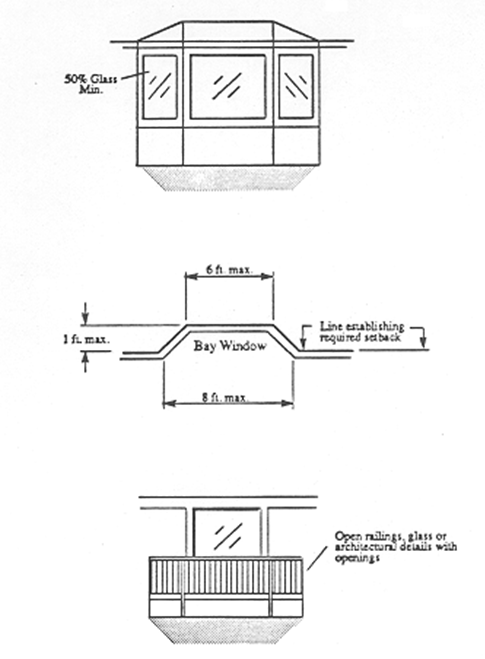
BAY WINDOWS, BALCONIES, AND GREEN ROOFS/DECKS
G.
Chimneys. A maximum of two (2) chimney projections into required yards is allowed. One (1) chimney may project one foot (1′) into one (1) interior side yard starting at a point eight feet (8′) above finished grade, providing that at least two feet (2′) is maintained as a clear area between the chimney and the property line. Chimney projections into required street side yards are prohibited. In addition, one (1) chimney may project one foot (1′) into one (1) of the following yards: front, rear or building separation, and shall not be required to maintain a vertical clearance from finished grade. Chimneys shall be subject to, and a component of, the aggregate length limitations for all vertical projections as stated within subsection (A)(2) of this section.
Exception. Existing legal nonconforming chimneys may remain nonconforming with respect to yard projection without regard to value of alteration of the structure to which it is attached.
H.
(Reserved).
I.
Chimneys Within Additional Front Setback Area. One (1) chimney may occupy any portion of the additional front setback area established by Section 10.12.030(T). Any portion of the chimney over fourteen feet (14′) in height, as measured from local grade, located within the additional front setback area may not exceed a dimension of three feet (3′) by five feet (5′).
J.
Stormwater and Greywater Retention/Detention Features. Stormwater runoff and greywater retention/detention features may be located in required side, rear, or building separation yards as follows:
1.
Retention/detention features installed entirely below local grade.
2.
Above grade retention/detention features may project a maximum of twelve inches (12″) into required side, rear, or building separation yards provided a five foot (5′) clearance from the property line is maintained.
3.
Other retention/detention feature locations may be approved at the discretion of the Community Development Director.
Exception. Stormwater and greywater retention/detention equipment may be located within five feet (5′) of a property line provided it complies with the locational criteria of Section 10.52.040(D), and is located within a structure having a solid roof, solid walls, and, with no openings within five feet (5′) of said property lines.
K.
Alternative-fuel Vehicle Charging Systems. Alternative-fuel vehicle charging systems may project two feet (2′) into one (1) interior side yard starting at a point eight feet (8′) above finished grade, providing that at least two feet (2′) is maintained as a clear area between all recharging system equipment and the property line, or as determined by the Director of Community Development. Projections into required street side yards are prohibited.
(Ord. No. 1832, Amended, 01/17/91; Ord. No. 1838, Renumbered, 07/05/91; Ord. No. 1860, Amended, 10/29/92; Ord. No. 1861, Amended, 12/03/92; Ord. No. 1891, Amended, 01/06/94; Ord. No. 1897, Amended, 03/03/94; Ord. No. 1919, Amended, 11/17/94; § 3, Ord. 1992, eff. February 18, 1999; § 2, Ord. 2032, eff. May 16, 2002; § 2, Ord. 2050, eff. January 1, 2004; § 14, Ord. 2111, eff. March 19, 2008, and § 9, Ord. 2146, eff. August 4, 2011)
10.60.050 - Measurement of height.
This section establishes regulations for determining compliance with the maximum building height limits prescribed for each zoning district and area district or as modified by an overlay district. The procedure involves a two (2) step process: first the reference elevation, defined as the average of the elevation at the four (4) corners on the lot, is determined and then a second limit is imposed to ensure that no building exceeds the maximum allowable height above existing grade or finished grade, whichever is lower, by more than twenty percent (20%).
A.
Height shall be measured from a horizontal plane established by determining the average elevation of existing grade at all four (4) corners of the lot. In situations where the elevation of existing grade at a lot corner is not clearly representative of a site' topography (because, for example, of the existence of such structures as retaining walls, property-line walls, or planters) the Community Development Director shall select an elevation that minimizes, to the extent reasonably possible, adverse impacts on adjacent properties and encourages some degree of consistency in the maximum building height limits of adjacent properties. Such interpretations may be appealed pursuant to the provisions of Chapter 10.100.
B.
No portion of a building shall exceed the maximum allowable height for the zoning district and area district in which the building site is located by more than twenty percent (20%). For purpose of this requirement, height shall be measured from the existing grade or finished ground level grade, whichever is lower.
C.
To determine compliance with this section, the Community Development Director may require applicants to submit a topographic survey of the project site, and, if necessary, portions of adjacent sites, prepared by a licensed surveyor or licensed civil engineer, depicting existing contours and the contours of finished grade, if different from existing grade, at elevation change intervals no greater than five feet (5′). Survey measurements also shall indicate the elevations of adjacent curbs and street pavements where no curb exists.
Exceptions:
1.
The Community Development Director may approve measuring height from finished grade elevation within five feet (5′) of front or street side property lines for alterations and additions to preexisting structures which have height nonconformities under the procedures for granting minor exceptions established in Section 10.84.120.
2.
The Community Development Director may administratively approve measuring height from local grade adjacent to an existing or planned building that is adjacent to a street where substantial grading occurred which lowered the street, which, in turn, affected the elevation of the street property line. The intent of this exception is to accommodate situations which exist, such as, on portions of Ardmore Avenue.
D.
The procedure and standards established by this section shall not be amended, whether by change in regulation, by addition of exceptions or by other means, so as to increase the elevation above sea level of the highest point of any building on a given lot beyond the elevation permissible under existing law, unless the amendment is first submitted to a City-wide election and is approved by a majority of the voters. The term "existing law" as used in this subsection includes the outcome of the March 1997 referendum on Ordinance 1933 ("Measurement of Height") and any future amendments to the municipal code.
(Ord. No. 1832, Amended, 01/17/91; Ord. No. 1838, Renumbered, 07/05/91; Ord. No. 1891, Amended, 01/06/94)
10.60.060 - Exceptions to height limits.
Vent pipes and radio and television antennas may exceed the maximum permitted height in the district in which the site is located by no more than ten feet (10′). Chimneys may exceed the maximum permitted height by no more than five feet (5′), provided the length and the width of the chimney portion exceeding the height limit shall not exceed three feet (3′) in width and five feet (5′) in length. Solar energy systems may exceed the maximum permitted height by no more than twelve inches (12″) as needed to meet Solar Rights Act efficiency standards. The Director of Community Development may make exemptions where fire-life safety and access issues are mitigated (See Solar energy systems—Section 9.36.080).
(Ord. No. 1832, Amended, 01/17/91; Ord. No. 1838, Renumbered, 07/05/91; Ord. No. 1891, Amended, 01/06/94: § 7, Ord. 2075, eff. July 7, 2005, and § 9, Ord. 2146, eff. August 4, 2011)
10.60.070 - Landscaping, irrigation, and hydroseeding.
A.
General Requirement. For new projects, projects over fifty percent (50%) in building valuation, or as required by the current California Model Water Efficient Landscape Ordinance, planting and hardscape areas, including all landscaping, patios, decks, and walkways (excluding driveways and building footprints), shall be installed in accordance with the standards and requirements of this section.
1.
Landscape plans shall be prepared by a landscape designer, a licensed landscape architect, or other qualified person, and submitted to the Community Development Department for approval prior to issuance of a building permit, and no significant or substantive changes to approved landscaping or irrigation plans shall be made without prior written approval by the Community Development Director and the landscape designer. Substantial changes shall require approval of the Planning Commission, if this body granted approval of the original project.
2.
Evidence of completion of required landscaping and irrigation improvements shall be supplied to the Community Development Department and shall be required to be submitted prior to issuance of an occupancy permit for new construction unless an extension of up to one (1) year has been granted by the Community Development Director. For projects consisting primarily of additions to or remodeling of existing buildings for which landscaping is required, a deferred completion agreement may be executed prior to issuance of the building permit. The agreement shall guarantee installation of the landscape and any irrigation improvements within one (1) year or prior to occupancy, whichever occurs first.
3.
High water use plants, as defined by Water Use Classification of Landscape Species (WUCOLS) publication may be installed as follows:
a.
For parcels seven thousand five hundred (7,500) square feet or less, either:
(i)
Where potable water is used for irrigation, a maximum of twenty percent (20%) of the total planting and hardscape areas (defined above) on private property, parkways, and encroachment areas may be plants of high water use per Region 3 of WUCOLS. High water use plants shall be grouped together. Turf grass watered with a subterranean drip irrigation system, or turf grass that is not high water use, as determined by the Director of Community Development based on documentation submitted by the applicant, shall not be considered high water use plants. When calculating lot sizes, any lot dimensions with fractions shall be rounded down to the nearest whole number prior to calculating the lot size. Area calculations shall be included in Landscape plans, or;
(ii)
Submission of design plans and calculations per Region 3 of WUCOLS standards prepared by a qualified professional as defined in Section 10.60.070(A)(1).
b.
For parcels seven thousand five hundred (7,500) square feet or greater:
(i)
Submittal of design and calculations Region 3 of WUCOLS standards prepared by a qualified professional as defined in Section 10.60.070(A)(1).
Exceptions:
1.
Sites entirely irrigated by non-potable water.
2.
Landscapes using low or medium water use plants as defined by Water Use Classification of Landscape Species (WUCOLS) publication.
3.
Projects with no exterior site work, landscaping, hardscaping, or similar improvements.
4.
Administrative exception for special circumstances or undue hardship as determined by the Director of Community Development.
B.
Standards.
1.
Required planting areas shall be permanently maintained. As used in this section, "maintained" includes: watering, weeding, pruning, insect control, and replacement of plant materials and irrigation equipment as needed to preserve the health and appearance of plant materials.
2.
Landscape materials shall not be located such that, at maturity:
a.
They interfere with safe sight distances for vehicular, bicycle or pedestrian traffic;
b.
They conflict with overhead utility lines, overhead lights, or walkway lights; or
c.
They block pedestrian or bicycle ways.
C.
Materials. Landscape plans shall demonstrate a recognizable pattern or theme for the overall development by choice and location of materials. To accomplish this, landscape plans shall conform to the following:
1.
Plant materials shall be selected for: energy efficiency and drought tolerance; adaptability and relationship to Manhattan Beach environment; color, form and pattern; ability to provide shade; soil retention, fire resistiveness, etc. The overall landscape plan shall be integrated with all elements of the project, such as buildings, parking lots and streets, to achieve desirable microclimate and minimize energy demand.
2.
Plant materials shall be sized and spaced to achieve immediate effect and shall normally not be less than a fifteen (15) gallon container for trees, five (5) gallon container for specimen shrubs, and a one (1) gallon container for mass planting. The Community Development Director may approve smaller or require larger containers to achieve specific effects.
3.
The use of crushed rock or gravel for large area coverage shall be avoided (except for walks and equestrian paths).
4.
Non-turf areas, such as shrub beds, shall be top dressed with a bark chip mulch or approved alternative.
5.
Where shrubs or low-level vegetation are used, vegetative matter at maturity shall cover at least seventy-five percent (75%) of actual planted area.
6.
The use of landscape materials shall be designed to minimize sun exposure of paved surfaces and structures.
D.
Design Standards.
1.
Parking lots shall have perimeter landscaping areas as prescribed by the following schedule and, in addition, shall have five percent (5%) of the parking lot area, excluding the perimeter planting strips, devoted to interior landscaping areas distributed throughout the parking lot.
Width of Perimeter Planting Strip (ft.)
(*) Parking lot dimension shall be measured as the distance, perpendicular to the property line, of parking and driveway area (including landscaping and miscellaneous areas contained therein) between the property line and either a building or the site's opposite boundary.
2.
Any portion of a parking structure which extends more than thirty inches (30″) above the adjacent finished grade in a C or I district adjoining a street shall have a ten-foot (10′) planting area yard adjoining the street property line.
3.
Where landscaped areas are provided, they shall be a minimum of two feet (2′) in width.
4.
The end of each row of parking stalls shall be separated from driveways by a landscaped planter, sidewalk, or other means.
5.
A minimum of one (1) tree for every six (6) spaces shall be distributed throughout the parking lot.
6.
Landscaping shall be provided in planters at the edges of the upper levels of parking structures where these structures are visible from public streets, pedestrian pathways, or adjacent buildings.
7.
IP District. The Community Development Director may modify the design standards in this section provided that at least ten percent (10%) of the lot area is landscaped.
E.
Irrigation Plans. Irrigation plans shall be submitted with development plans and shall contain all construction details for an automatic system including, but not limited to, the following:
1.
Location, type and size of lines;
2.
Location, type and gallonage output of heads;
3.
Location and sizes of valves;
4.
Location and type of controller;
5.
Location and type of backflow prevention device (as per Health Code);
6.
Available water pressure and water meter outlet size; and
7.
Irrigation application schedule and flow rates.
F.
Hydroseeding. Plans indicating location and type of hydroseeding shall be submitted with development plans when such planting is to be utilized for permanent landscape treatment or for natural area restoration. Hydroseeding plans shall contain installation specifications including, but not limited, to:
1.
Seed mix and application rate. A native seed mix containing a minimum of ten percent (10%) shrub and perennial seeds shall be utilized in areas where permanent landscape restoration is required. Species selected shall include plant materials native to the area.
2.
Fertilizer, mulch materials, soil preparation and watering specifications.
(Ord. No. 1832, Amended, 01/17/91; Ord. No. 1838, Renumbered, 07/05/91; Ord. No. 1891, Amended, 01/06/94, and § 9, Ord. 2146, eff. August 4, 2011)
10.60.080 - Outdoor facilities.
The purpose of this section is to permit and regulate commercial outdoor displays of merchandise on private property and materials in order to encourage visual interest along commercial streets and support the business community while minimizing adverse aesthetic impacts to the public and nearby residential uses.
A.
What is Permitted. Outdoor facilities activities may include:
1.
Outdoor display of merchandise (except bulk inventory), materials (including chairs and benches for customer waiting) and equipment including items for customer pick-up, on the site of and operated by a legally established business.
2.
Outdoor food and beverage service and outdoor dining on the site of and operated by a legally established business and accessory to an eating and drinking establishment or food and beverage sales business with incidental seating area, as defined in Section 10.08.050. Outdoor food and beverage service and dining on public property is not regulated by this section and requires an encroachment permit pursuant to Chapter 7.36 of this Code.
B.
Where Permitted. Outdoor facilities authorized by this section are permitted for all legally established commercial and industrial uses. Notwithstanding the aforementioned, outdoor facilities are prohibited in all residential districts.
C.
Performance Standards. Outdoor facilities are subject to the following:
1.
Outdoor display of merchandise or materials shall not occupy public property, and may not occupy more than fifty percent (50%) of the total "tenant frontage" of a building as defined in Section 10.72.030 of this title.
2.
Yards, screening, or planting areas may be required to prevent adverse impacts on surrounding properties. The height of merchandise, materials, and equipment stored or displayed shall not exceed the height of the screening fence or wall, if required.
3.
There shall be no outdoor preparation of food or beverages associated with outdoor dining where food is consumed at tables.
D.
Exceptions. Notwithstanding the provisions of subsections A, B, and C of this section, outdoor storage and display shall be permitted in conjunction with the following use classifications in districts where they are permitted or conditionally permitted:
1.
Nurseries, provided outdoor display is limited to plants and related materials only.
2.
Vehicle/equipment sales and rentals, provided outdoor display shall be limited to vehicles, boats, or equipment offered for sale or rent only.
E.
Application. The owner of a business shall submit a written request with application fee, for an outdoor facilities permit (which may consist of a letter) to the Community Development Director. The request shall include a full description of the display activity, including but not necessarily limited to: types of items to be displayed, location on the site, and hours during which items are to be placed outdoors. The Community Development director shall review the application for compliance with performance standards contained in this section and may impose conditions to avoid adverse impacts such as but not limited to public safety impediments, visual clutter, and disorderly displays.
F.
Grounds for Denial—Revocation. If adverse impacts cannot be prevented, the Community Development Director shall deny the outdoor facilities permit application. If a business fails to comply with the terms and conditions of an approved outdoor facility permit the Community Development Director may revoke the permit.
G.
Duration and Renewal. Upon approval, an outdoor facilities permit shall be valid for a period of one (1) year or until March 1st. Outdoor facilities permits may be renewed annually, upon finding by the Community Development Director that the business has complied with all imposed terms and conditions, and that no adverse impacts or nuisance conditions have resulted.
H.
Appeals. Decisions of the Community Development Director may be appealed to the Planning Commission in accordance with Chapter 10.100 of this Code.
(Ord. No. 1832, Amended, 01/17/91; Ord. No. 1838, Renumbered, 07/05/91; Ord. No. 1891, Amended, 01/06/94; § 3, Ord. 2007, eff. November 18, 1999)
10.60.090 - Screening of mechanical equipment.
A.
General Requirement. Except as provided in subsection (B) of this section, all exterior mechanical equipment, except solar collectors and operating mechanical equipment in an IP district located more than one hundred feet (100′) from a C, R, PS, PD, or OS district boundary, shall be screened from view on all sides. Equipment to be screened includes, but is not limited to, heating, air conditioning, refrigeration equipment, plumbing lines, ductwork, and transformers. Screening of the top of equipment may be required by the Community Development Director, if necessary to protect views from an R district.
1.
Existing Equipment. All existing, exposed roof-mounted equipment shall be screened pursuant to the above criteria within three (3) years from the effective date of the ordinance codified in this chapter and/or in conjunction with any remodel effort in excess of five thousand dollars ($5,000.00); tenant improvements that exceed fifty percent (50%) of the tenant space; or upon approval of any discretionary actions.
B.
Utility Meters. Utility meters shall be screened from view from public rights of way, but need not be screened on top or when located on the interior side of a single-family dwelling. Meters in a required front or street side yard shall be enclosed in subsurface vaults.
C.
Screening Specifications. Screening materials may have evenly distributed openings or perforations averaging fifty percent (50%) of the surface area and shall effectively screen mechanical equipment so that it is not visible from a street or adjoining lot.
(Ord. No. 1832, Amended, 01/17/91; Ord. No. 1838, Renumbered, 07/05/91)
10.60.100 - Refuse storage areas.
A refuse storage area screened on all sides by a six-foot (6′) solid wood or masonry wall, or located within a building, shall be provided prior to occupancy for all multifamily residential, commercial, industrial, and public/semipublic uses. Locations, horizontal dimensions, and general design parameter of refuse storage areas shall be as prescribed by the Community Development Director, subject to appeal to the Planning Commission. The Community Development Director may waive the screening requirement for dumpsters and equipment for refuse collection and storage in the IP district which are not visible from a public street.
(Ord. No. 1832, Amended, 01/17/91; Ord. No. 1838, Renumbered, 07/05/91)
10.60.110 - Underground utilities.
All existing and new electrical, telephone, CATV and similar distribution lines providing direct service to a development site shall be installed underground within the site per the standards established within Title 9 of this Code.
(Ord. No. 1832, Amended, 01/17/91; Ord. No. 1838, Renumbered, 07/05/91; Ord. No. 1891, Amended, 01/06/94)
10.60.120 - Performance standards.
The following performance standards shall apply to all use classifications in all zoning districts:
A.
Noise. All uses and activities shall comply with the provisions of the Manhattan Beach Noise Regulations (Chapter 5.48 of this Code).
B.
Vibration. No use, activity, or process shall produce vibrations that are perceptible without instruments by a reasonable person at the property lines of a site.
C.
Dust and Odors. No use, process, or activity shall produce objectionable dust or odors that are perceptible without instruments by a reasonable person at the property lines of a site.
D.
Glare.
1.
From Glass. Mirror or highly reflective glass shall not cover more than twenty percent (20%) of a building surface visible from a street unless an applicant submits information demonstrating to the satisfaction of the Community Development Director that use of such glass would not significantly increase glare visible from adjacent streets or pose a hazard for moving vehicles.
2.
From Outdoor Lighting. Parking lot lighting shall comply with Chapter 10.64. Security lighting in any district may be indirect or diffused, or shall be shielded or directed away from an R district within two hundred feet (200′). Lighting for outdoor court or field games within three hundred feet (300′) of an R district shall be subject to review and approval of the Community Development Director.
E.
Combustibles and Explosives. The use, handling, storage, and transportation of combustibles and explosives shall comply with the provisions of the Manhattan Beach Fire Prevention Code (Chapter 3.16 of this Code) and any other applicable laws.
F.
Radioactive Materials. The use, handling, storage, and transportation of radioactive materials shall comply with the provisions of the California Radiation Control Regulations (California Code of Regulations, Title 17), the Manhattan Beach Fire Prevention Code (Chapter 3.16 of this Code), and any other applicable laws.
G.
Hazardous and Extremely Hazardous Materials. The use, handling, storage, and transportation of hazardous and extremely hazardous materials shall comply with the provisions of the California Hazardous Materials Regulations (California Code of Regulations, Title 22, Division 4), and Manhattan Beach Ordinance No. 1751 (Chapter 3.28 of this Code).
H.
Heat and Humidity. Uses, activities, and processes shall not produce any unreasonable, disturbing, or unnecessary emissions of heat or humidity, at the property line of the site on which they are situated, that cause material distress, discomfort, or injury to a reasonable person.
I.
Electromagnetic Interference. Uses, activities, and processes shall not cause electromagnetic interference with normal radio or television reception in R districts, or with the function of other electronic equipment beyond the property line of the site on which they are situated.
J.
Evidence of Compliance. The Community Development Director shall require such evidence of ability to comply with performance standards as he deems necessary prior to issuance of a building permit.
(Ord. No. 1832, Amended, 01/17/91; Ord. No. 1838, Renumbered, 07/05/91)
10.60.130 - Repealed.
Repealed by § 2, Ord. 2075, eff. July 7, 2005
10.60.140 - Sustainable development.
A.
Solar-Assisted Water Heating. To promote energy conservation, installation of plumbing for future solar-assisted water heating systems shall be required in all new residential and commercial construction and in major alterations and additions to residential and commercial structures when the total estimated cost of the enlargement or alteration exceeds fifty percent (50%) of the total estimated cost of reconstructing the structure.
B.
Stormwater Retention/Treatment. For additional Municipal National Pollutant Discharge Elimination System (NPDES) or current municipal stormwater permit requirements, see Chapter 5.84.
C.
Green Roofs and Decks.
1.
A green roof or deck may be located only where decks and balconies are allowed.
2.
All planting materials on green roofs and decks may not exceed the maximum allowed height of structure permitted by the development standards of the base district.
Exception. Green roofs that are used solely as a roof and designed in a manner that prohibits usability as a deck may be approved administratively by the Director of Community Development if safety, maintenance, slope, and access issues are mitigated (See "Roof, Green or Deck" definition).
D.
Solar Energy Systems. Solar energy systems may exceed the maximum permitted height by no more than twelve inches (12″) as needed to meet Solar Rights Act efficiency standards. The Director of Community Development may make exemptions where fire-life safety and access issues are mitigated (See Solar energy systems—Section 9.36.080).
E.
Small Wind Energy Systems (Turbines). Small Wind Energy Systems (SWES) are permitted in all districts subject to the following standards and procedures:
1.
Development Standards. The following minimum requirements and standards shall apply to SWES:
a.
System Type and Location.
(i)
The SWES shall comply with the definition of small wind energy system in Section 10.04.030.
(ii)
Where feasible, ancillary SWES equipment shall be located inside a building or screened from public view in a manner compatible with the site.
b.
The SWES shall not exceed the height of the existing or proposed structure on which it is located, exceed the maximum height limit, or exceed twelve feet (12′) in height if not located on a structure, whichever is lower.
c.
Setbacks and Clearances.
(i)
The SWES shall comply with the setbacks applicable to the zone in which the SWES is located, provided that a greater setback may be required to reduce impacts to adjacent parcels.
(ii)
No portion of a blade when fully operational shall extend within ten feet (10′) of finished grade or a property line, unless the Director of Community Development finds that a reduced clearance will not adversely affect any person, property or improvement in the vicinity, or conflict with the zone in which the property is located.
(iii)
A minimum clearance of ten feet (10′) shall be maintained between any tower or blade and any structure, tree, utility line, or similar object, unless the Director of Community Development finds that a reduced clearance will not adversely affect any person, property or improvement in the vicinity.
(iv)
The SWES shall not inhibit or interfere with emergency vehicle or structure access, fire escapes, exits, standpipes, or other Fire Department requirements as determined by the Fire Department.
(v)
Every SWES shall be designed so that no ladder or other means of climbing a tower is located within twelve feet (12′) of the finished grade or accessible space.
(vi)
Guy wires or other rough appurtenances shall not be visible unless deemed to be appropriate and necessary by the Director of Community Development.
(vii)
The SWES shall be equipped with manual and automatic over-speed protection controls so that blade rotation speed does not exceed the system's design limits.
(viii)
An on-grid SWES shall be designed to automatically turn off when on-grid connection is lost or the batteries are fully charged.
(ix)
All on-grid SWES shall be approved by the applicable utility prior to installation.
(x)
Electrical poles, wires and other items required to convey power generated by a SWES to the public utility grid shall be installed underground.
(xi)
The SWES shall comply with the requirements of Section 5.48—Noise Regulations, except during short-term events such as utility outages and severe wind storms.
(xii)
The SWES shall not bear any signs or advertising devices other than certifications, public safety warnings, or other seals or signage required by law.
(xiii)
No lighting shall be placed upon, attached to, or in any way illuminate a SWES.
d.
Maintenance and Removal.
(i)
The SWES shall at all times be operated and maintained in accordance with manufacturer's requirements, the requirements of this section, and all applicable laws. In no case shall the condition or operation of the SWES pose noise, safety, or other adverse effects to the site, or persons, improvements or properties in the vicinity.
(ii)
The Community Development Director may require the SWES to be removed from the property if the Director determines that the SWES has been inoperable, or has ceased to operate, for twelve (12) consecutive months or more.
2.
Submittal Requirements—All SWES Applications. Applications for all SWES shall be initiated by submitting the following materials to the Community Development Department.
a.
A completed master application form, signed by the property owner or authorized agent, accompanied by the required fees, plans and mapping documentation in the form prescribed by the Community Development Director.
b.
Written statements to support the standards, required findings and, criteria of this Code section.
c.
A vicinity map showing the location and street address of the development site.
d.
A map showing the location and street address of the property that is the subject of the application and of all lots of record within five hundred feet (500′) of the boundaries of the property; and
e.
A list, drawn from the last equalized property tax assessment roll or the records of the County Assessor, Tax Collector, or the City's contractor for such records showing the names and addresses of the owner of record of each lot within five hundred feet (500′) of the boundaries of the property. This list shall be keyed to the map required by subsection (d) of this subsection and shall be accompanied by mailing labels.
3.
Notice to Property Owners. After receipt of a completed application, the Community Development Director shall provide notice to surrounding property owners as provided in subsection 2 of this section. Said notice shall include: a project description, information regarding where and when project plans can be viewed, a request for comments regarding said exception, and a commenting deadline date. No public hearing shall be required.
4.
Director's Review and Action.
a.
Notice of Decision. After the commenting deadline date, and within thirty (30) days of receipt of a completed application, the Director of Community Development shall approve, conditionally approve, or deny the application. The Director shall send the applicant a letter stating the reasons for the decision under the authority for granting or denying the SWES, as provided by the applicable sections of this chapter. The letter also shall state that the Director's decision is appealable under the provisions of subsection 6 of this section.
b.
Request for Planning Commission Action. At the Community Development Director's discretion, review and action may be deferred to the Planning Commission.
c.
Findings. In making a determination, the Community Development Director or Planning Commission shall be required to make the following findings:
(i)
There will be no significant detrimental impact to surrounding neighbors, including, but not limited to light, air, noise, and views.
(ii)
That the proposed project is consistent with the City's General Plan, the purposes of this title and the zoning district where the project is located, the Local Coastal Program, if applicable, and with any other current applicable policy guidelines.
(iii)
The installation of the SWES is primarily to reduce on-site consumption of electricity.
(iv)
The proposed SWES will not produce or result in noise levels exceeding the requirements of Section 5.48—Noise Regulations.
5.
Conditions of Approval. In approving a SWES application, the Director or Planning Commission may impose reasonable conditions necessary to:
a.
Achieve the general purposes of this chapter and the specific purpose of the zoning district in which the SWES will be located, or to be consistent with the General Plan;
b.
Protect the public health, safety, and general welfare.
6.
Effective Date—Appeals. Unless appealed in accordance with Chapter 10.100 of the Manhattan Beach Municipal Code, a decision shall become effective after expiration of the time limits for appeal set forth in Section 10.100.030 Manhattan Beach Municipal Code.
(Ord. No. 1832, Amended, 01/17/91; Ord. No. 1838, Renumbered, 07/05/91; Amended § 93, Ord. 2146, eff. August 4, 2011)
10.60.150 - Traffic vision clearance on corner lots.
All corner lots shall be subject to certain yard requirements as detailed in Chapter 3.40 (et seq.) of this Code to provide for vision clearance by the elimination of traffic sight obstructions. Said requirements shall not apply to properties located in area districts III and IV.
(Ord. No. 1891, Enacted, 01/06/94)
10.60.160 - Repealed.
10.64.010 - Specific purposes.
In addition to the general purposes listed in Chapter 10.01, the specific purposes of the off-street parking and loading regulations are to:
A.
Ensure that off-street parking and loading facilities are provided for new land uses, and for major alterations and enlargements of existing uses in proportion to the need for such facilities created by each use.
B.
Establish parking standards for commercial uses consistent with need and with the feasibility of providing parking on specific commercial sites.
C.
Ensure that off-street parking and loading facilities are designed in a manner that will ensure efficiency, protect the public safety, and, where appropriate, insulate surrounding land uses from adverse impacts.
(Ord. No. 1832, Amended, 01/17/91; Ord. No. 1838, Renumbered, 07/05/91)
10.64.020 - Basic requirements for off-street parking and loading.
A.
When Required. At the time of initial occupancy of a site, construction of a structure, or major alteration or enlargement of a site or structure, off-street parking facilities and off-street loading facilities shall be provided in accord with the regulations prescribed in this chapter. For the purposes of these requirements, "major alteration or enlargement" shall mean an alteration or enlargement which exceeds 50% of the reconstruction value of the existing structure(s) as specified in Section 10.68.030 E.
B.
Nonconforming Parking or Loading. No existing use of land or structure shall be deemed to be nonconforming solely because of the lack of off-street parking or loading facilities required by this chapter, provided that facilities being used for off-street parking and loading as of the date of adoption of this chapter shall not be reduced in number to less than that required by the provisions of this chapter.
C.
Spaces Required for Change of Use and Minor Alteration or Enlargement. The number of parking spaces and loading spaces required for an alteration or enlargement not classified as "major," pursuant to subsection (A) above, of an existing use or structure, or for a change of use, shall be in addition to the number of spaces existing prior to the alteration, enlargement, or change of use unless the pre-existing number is greater than the number prescribed in this chapter. In this case, the number of spaces in excess of the prescribed minimum shall be counted in determining the required number of spaces. A change in occupancy that does not involve a change in the use classification is not considered a change in use for purposes of this requirement unless the change in occupancy involves an intensification of use or an increase in parking demand.
D.
Spaces Required for Multiple Uses. If more than one use is located on a site, the number of off-street parking spaces and loading berths to be provided shall be equal to the sum of the requirements prescribed for each use. This requirement applies not only to multiple uses under separate ownership but also to multiple uses in the same ownership. If the gross floor area of individual uses on the same site is less than that for which a loading berth would be required by Schedule B of Section 10.64.030, but the aggregate gross floor area of all uses is greater than the minimum for which loading berths would be required, the aggregate gross floor area shall be used in determining the required number of loading berths.
E.
Joint Use. Off-street parking and loading facilities required by this chapter for any use shall not be considered as providing parking spaces or loading spaces for any other use except where the provisions of Section 10.64.040: Collective provision of parking apply or a joint facility exists. Such a facility shall contain not less than the total number of spaces as determined individually, subject to the provisions of subsection (F) below, or fewer spaces may be permitted where adjoining uses on the same site have different hours of operation and the same parking spaces or loading spaces can serve both without conflict. A determination of the extent, if any, to which differing hours of operation will achieve the purposes of this chapter shall be made by the Community Development Director, who may require submission of information necessary to reach a decision.
F.
Location and Ownership.
1.
On-site/Off-site Parking. Parking required to serve a residential use shall be on the same site as the use served, except that subject to approval of the Community Development Director, parking for group residential and residential care may be located on a different site under the same or different ownership within one hundred fifty feet (150′) of the use served, measured from the parking facility to the public entrance of the use served via the shortest pedestrian route. Parking required to serve a nonresidential use may be on the same or a different site under the same or different ownership as the use served, provided that parking shall be within the following distances of the use served, measured from the near corner of the parking facility to the public entrance of the use served via the shortest pedestrian route:
Exception: Parking spaces located within the CD district may serve as required parking for a nonresidential use located within the same district at a maximum distance of one thousand feet (1,000′).
2.
Parking in Yards in R Districts. Required yards and open space shall not be used for parking except as follows:
a.
All Area Districts. Up to twenty feet (20′) of the width of the access drive to the garage may be used for non-required unenclosed parking.
b.
Area Districts III and IV. One interior side yard may be used for unenclosed parking.
c.
All Area Districts. Within an enclosed accessory building as permitted by Section 10.52.050.
3.
Parking in Yards in C or I Districts. Required yards may be used for required parking, subject to the landscaping standards of Section 10.60.070 and screening requirements of Section 10.64.160.
4.
Alley Access. When a street-alley lot in area districts I and II adjoins an improved alley, then access to parking shall be provided from the alley.
5.
Parking in R Districts. Non-residential parking shall not be located in any R zoned property, except on the east side of Oak Avenue. Residential properties on the east side of Oak Avenue, when developed for commercial parking purposes used in conjunction with business fronting upon and having vehicular access to Sepulveda Boulevard, shall not utilize vehicular access to Oak Avenue between the hours of 10:00 p.m. to 6:00 a.m. daily.
G.
Life of Facility. Facilities for off-site parking shall be restricted to that use by a recorded deed, lease, or agreement for a minimum period of ten (10) years from the date a use permit requiring the parking or a certificate of occupancy is issued, provided that the Community Development Director may lift the restriction upon finding that substitute parking facilities meeting the requirements of this chapter are provided. No use shall be continued if the parking is removed unless substitute parking facilities are provided.
1.
Exception. The requirement for a recorded agreement and ten (10) year period of agreement may be waived for off-site required parking leased from City owned lots.
H.
Common Loading Facilities. The off-street loading facilities requirements of this chapter may be satisfied by the permanent allocation of the prescribed number of spaces for each use in a common truck loading facility, provided that the total number of spaces shall not be less than the sum of the individual requirements. As a requirement of approval, an attested copy of a contract between the parties concerned setting forth an agreement to joint use of the common truck loading facility shall be filed with and subject to approval by the Community Development Department.
I.
Computation of Spaces Required. If, in the application of the requirements of this chapter, a fractional number is obtained, one (1) additional parking space or loading berth shall be required for a fraction of one-half (½) or more, and no additional space or both shall be required for a fraction of less than one-half (½).
J.
Parking Surface. All parking areas, aisles and access drives shall be paved with a minimum of two inches (2″) of asphalt on four inches (4″) of compacted base or four inches (4″) of concrete in residential areas; and 4 inches of concrete in commercial or industrial areas to provide a durable, dustless surface. Parking areas, aisles and access drives shall be graded and drained to dispose of surface water without damage to private or public properties, streets, or alleys. The Director of Public Works may approve alternate materials and specifications in lieu of these requirements.
K.
Availability of Required Parking Spaces. Required parking spaces shall be made permanently available and be permanently maintained for vehicular parking in connection with the associated use.
(Ord. No. 1832, Amended, 01/17/91; Ord. No. 1838, Renumbered, 07/05/91; Ord. No. 1891, Amended, 01/06/94; Ord. 1963, June 5, 1997)
10.64.030 - Off-street parking and loading spaces required.
Off-street parking and loading spaces shall be provided in accord with the following schedules. For off-street loading, references are to Schedule B which sets space requirements and standards for different groups of use classifications and sizes of buildings. References to spaces per square foot are to be computed on the basis of buildable floor area unless otherwise specified, and shall include allocations of shared restroom, halls and lobby area, but shall exclude area for vertical circulation, stairs or elevators. Where the use is undetermined, the Community Development Director shall determine the probable use and the number of parking and loading spaces required. In order to make this determination, the Community Development Director may require the submission of survey data from the applicant or collected at the applicant's expense.
SCHEDULE B: LOADING SPACES REQUIRED
(Ord. No. 1832, Amended, 01/17/91; Ord. No. 1838, Renumbered, 07/05/91; Ord. No. 1850, Amended, 04/02/92; Ord. No. 1891, Amended, 01/06/94; § 2, Ord. 1951, eff. July 4, 1996; § 2, Ord. 1963, eff. July 5, 1997; § 5, Ord. 1977, eff. March 5, 1998; § 2, Ord. 2050, eff. January 1, 2004; § 15, Ord. 2111, eff. March 19, 2008 and § 8, Ord. 2155, eff. February 17, 2012; § 8, Ord. 17-0028, eff. January 20, 2018)
10.64.040 - Collective provision of parking.
Notwithstanding the provisions of Section 10.64.020(E), a use permit may be approved for collective provision of parking on a site of five thousand (5,000) square feet or more that serves more than one (1) use or site and is located in a district in which parking for the uses served is a permitted or conditional use. A use permit for collective off-street parking may reduce the total number of spaces required by this chapter if the following findings are made:
A.
The spaces to be provided will be available as long as the uses requiring the spaces are in operation; and
B.
The adequacy of the quantity and efficiency of parking provided will equal or exceed the level that can be expected if collective parking is not provided.
The maximum allowable reduction in the number of spaces to be provided shall not exceed fifteen percent (15%) of the sum of the number required for each use served.
An applicant for a use permit for collective parking may be required to submit survey data substantiating a request for reduced parking requirements. A use permit for collective parking shall describe the limits of any area subject to reduced parking requirements and the reduction applicable to each use.
(Ord. No. 1832, Amended, 01/17/91; Ord. No. 1838, Renumbered, 07/05/91)
10.64.050 - Reduced parking for certain districts and uses.
A.
CD District. The following parking requirements shall apply to nonresidential uses:
1.
Building Sites equal to or less than 10,000 Sq. Ft. If the FAF is less than 1:1, no parking is required; if the FAF exceeds 1:1, only the excess floor area over the 1:1 ratio shall be considered in determining the required parking prescribed by Section 10.64.030.
2.
Building Sites greater than 10,000 Sq. Ft. The amount of required parking shall be determined by first excluding five thousand (5,000) square feet from the buildable floor area and then calculating the number of spaces prescribed by Section 10.64.030.
B.
A use permit may be approved reducing the number of spaces to less than the number specified in the schedules in Section 10.64.030, provided that the following findings are made:
1.
The parking demand will be less than the requirement in Schedule A or B; and
2.
The probable long-term occupancy of the building or structure, based on its design, will not generate additional parking demand.
In reaching a decision, the Planning Commission shall consider survey data submitted by an applicant or collected at the applicant's request and expense.
(Ord. No. 1832, Amended, 01/17/91; Ord. No. 1838, Renumbered, 07/05/91)
10.64.060 - Parking in-lieu payments.
Within designated parking districts established by the City Council and shown on the map on the following page, a parking requirement serving nonresidential uses on a site may be met by a cash in-lieu payment to the City prior to issuance of a building permit or a certificate of occupancy if no permit is required. The fee shall be to provide public off-street parking in the vicinity of the use. The City shall not be obligated to accept a fee for more than 20 spaces, and then only with the express approval of the City Council.
In establishing parking districts, the City may set limitations on the number of spaces or the maximum percentage of parking spaces required for which an in-lieu fee may be tendered.
(Ord. No. 1832, Amended, 01/17/91; Ord. No. 1838, Renumbered, 07/05/91)
10.64.070 - Parking spaces for the handicapped.
All parking facilities shall comply with the requirements of the California Code of Regulations (Title 24, Part 2, Chapter 2-71) and with the sign requirements of the California Vehicle Code, Section 22507.8.
(Ord. No. 1832, Amended, 01/17/91; Ord. No. 1838, Renumbered, 07/05/91)
10.64.080 - Bicycle parking.
A.
Where Required. Bicycle parking spaces shall be provided as required by this section; the provisions of Section 10.64.020 shall apply.
B.
Number Required.
1.
Public and Semipublic Use Classifications: as specified by use permit.
2.
Commercial Use Classifications: Five percent of the requirement for automobile parking spaces, except for the following classifications, which are exempt:
a.
Ambulance Services;
b.
Animal Boarding;
c.
Animal Grooming;
d.
Catering Services;
e.
Commercial Filming;
f.
Horticulture, Limited;
g.
Funeral and Interment Services;
h.
Vehicle/Equipment Sales and Services (all classifications).
3.
Industrial Use Classification. None.
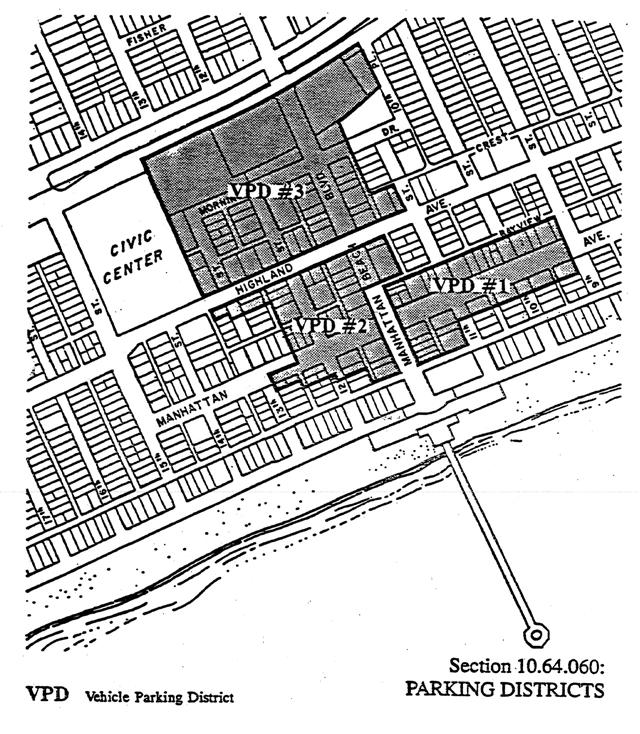
C.
Design Requirements. For each bicycle parking space required, a stationary object shall be provided to which a user can secure both wheels and the frame of a bicycle with a user-provided six-foot (6′) cable and lock. The stationary object may be either a freestanding bicycle rack or a wall-mounted bracket.
(Ord. No. 1832, Amended, 01/17/91; Ord. No. 1838, Renumbered, 07/05/91)
10.64.090 - Parking space dimensions.
Required parking spaces shall have the following minimum dimensions:
Exceptions:
1.
Existing legal nonconforming parking spaces may remain nonconforming with regards to width, depth, and vertical clearance for up to a maximum of one foot (1′) in each dimension, per space, without regard to value of site alteration. See Minor Exception, Chapter 10.84 for additional provisions for existing parking spaces and existing structures.
(Ord. No. 1832, Amended, 01/17/91; Ord. No. 1838, Renumbered, 07/05/91; Ord. No. 1891, Amended, 01/06/94; § 2, Ord. 1951, eff. July 4, 1996, and § 16, Ord. 2111, eff. March 19, 2008)
10.64.100 - Application of dimensional requirements.
A.
In C and I districts, thirty percent (30%) of the required parking spaces may be for small cars. For office buildings where the offices are occupied by a single tenant, up to forty percent (40%) of the spaces may be for small cars. All small-car spaces shall be clearly labeled "Compact."
B.
Adjoining Obstructions.
1.
Each parking space adjoining a wall, column, or other obstruction higher than 0.5 feet shall be increased by one foot (1′) on each obstructed side, provided that such obstructions may adjoin the front five feet (5′) of a parking space without an increase in width.
Exceptions. Residential garages serving a maximum of three (3) dwelling units, or, residential sites with widths of thirty-two feet (32′) or less.
2.
At the end of a parking bay, an aisle providing access to a parking space perpendicular to the aisle shall extend two feet (2′) beyond the required width of the parking space.
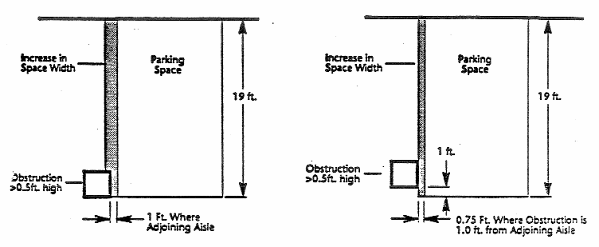
(B) PARKING SPACES ADJOINING AN OBSTRUCTION
(The diagram is illustrative)
C.
Vertical Clearance. Vertical clearance for parking spaces shall be an unobstructed headroom clearance of not less than seven feet (7′) above the finish floor to any ceiling, beam, pipe, vent, mechanical equipment or similar construction, except that automatic garage door opening equipment and the garage door entrance may be 6.67 feet. For storage (not including mechanical equipment) and vehicle recharging purposes for residential uses, non-structural improvements including wall-mounted shelves, storage surface racks, cabinets, or electricity based alternative-fuel vehicle charging systems may encroach into the vertical clearance, provided a minimum 4.5 feet vertical clearance is maintained above the finished floor of the garage within the front five feet (5′) of a parking space.
D.
Wheel Stops. In all districts, all spaces shall have wheel stops 2.5 feet from a fence, wall, or walkway. The wheel stops shall be no higher than six (6) inches as measured from the parking area finished surface.
1.
Exception. In R districts, installation of wheel stops shall not be required for parking spaces within garages serving a single unit.
E.
Garage Door Widths. Each enclosed parking space shall be provided with a minimum of nine foot (9′) wide, 6.67 foot high access opening, except that double-car garage door openings may be a minimum of sixteen feet (16′) wide.
(Ord. No. 1832, Amended, 01/17/91; Ord. No. 1838, Renumbered, 07/05/91; Ord. No. 1862, Amended, 12/17/92; Ord. No. 1891, Amended, 01/06/94; § 2, Ord. 1951, eff. July 4, 1996; § 2, Ord. 2050, eff. January 1, 2004, and § 10, Ord. 2146, eff. August 4, 2011)
10.64.110 - Aisle dimensions.
The following dimensions shall apply to drive aisles (which may include public right-of-way or recorded access easements) accessing and adjoining required parking spaces:
A.
Large-Car Spaces. Aisle widths adjoining large-car spaces shall be as follows:
Letters in parentheses ("A" and "B") refer to the diagram on the following page.
B.
Small-Car Spaces. Aisle widths adjoining small-car spaces having a base width of 7.5 feet, except where increased by an adjoining obstruction, shall be as follows:
("B")
Minimum Aisle Width for Specified Parking Angle
C.
Residential Spaces Accessed from Alleys. Aisle widths adjoining residential parking spaces that are directly accessed from alleys shall be a minimum of fifteen feet (15′) as measured from the centerline of said alley.
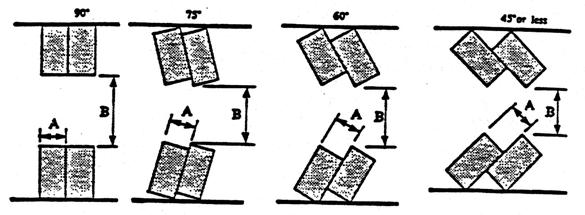
PARKING REQUIREMENTS
(The diagram is illustrative.)
(Ord. No. 1832, Amended, 01/17/91; Ord. No. 1838, Renumbered, 07/05/91, 10-3.1620; Ord. No. 1842, Amended, 08/15/91)
10.64.120 - Specific parking area and loading design.
Where an applicant can demonstrate to the satisfaction of the Community Development Director that variations on the dimensions otherwise required by this chapter are justified, a specific parking area design may be approved under the following limitations:
A.
The area affected by the specific design shall only be for parking by persons employed on the site or loading. Visitor parking stalls shall meet the dimensions required.
B.
The surface area available for parking and loading shall not be less than would be required to accommodate the minimum required number of stalls for large and small cars.
(Ord. No. 1832, Amended, 01/17/91; Ord. No. 1838, Renumbered, 07/05/91; Ord. No. 1891, Amended, 01/06/94)
10.64.130 - Parking access from street.
A.
Access to parking spaces located on the following streets shall not require backing across a street property line:
Artesia Boulevard;
Aviation Boulevard;
Manhattan Beach Boulevard;
Rosecrans Avenue (between Laurel Avenue and Vista Drive only); and
Sepulveda Boulevard.
B.
An alley may be used as maneuvering space for access to off-street parking.
C.
All spaces in a parking facility shall be accessible without re-entering a public right-of-way unless it is physically impossible to provide for such access.
(Ord. No. 1832, Amended, 01/17/91; Ord. No. 1838, Renumbered, 07/05/91)
10.64.140 - Driveway widths and clearances.
Driveways shall provide access to all off-street parking and loading spaces, and have the following minimum unobstructed paved widths:
An additional one foot (1′) of clearance shall be provided between a driveway and any vertical obstruction, except curbs that do not exceed 0.5 foot in height and non-obstructing plant material. The Community Development Director may permit the continuance of existing driveway widths that do not conform to paved width or clearance requirements shown above, where unusual grade or site conditions present an undue hardship.
The maximum width of a driveway on a site located in an R district in area districts I and II shall be twenty feet (20′), except that a driveway intersecting a corner-side property line may be a maximum of twenty-seven feet (27′), as measured along street property lines.
The Community Development Director may require driveways in excess of the above widths where unusual traffic, grade or site conditions prevail. The Community Development Director also may require driveways to be constructed with full curb returns and handicapped ramps as opposed to simple curb depression.
(Ord. No. 1832, Amended, 01/17/91; Ord. No. 1838, Renumbered, 07/05/91; Ord. No. 1891, Amended, 01/06/94; § 3, Ord. 1962, eff. June 4, 1997)
10.64.150 - Driveways—Visibility.
Visibility of a driveway crossing a street property line shall not be blocked between a height of three feet (3′) and nine feet (9′) for a depth of five feet (5′) from the street property line as viewed from the edge of the right-of-way on either side of the driveway at a distance of fifteen feet (15′) or at the nearest property line intersecting the street property line, whichever is less.
Exceptions. Properties consisting of lots having vehicular access only across a side yard located in residential districts in area districts III and IV are exempted from this requirement.
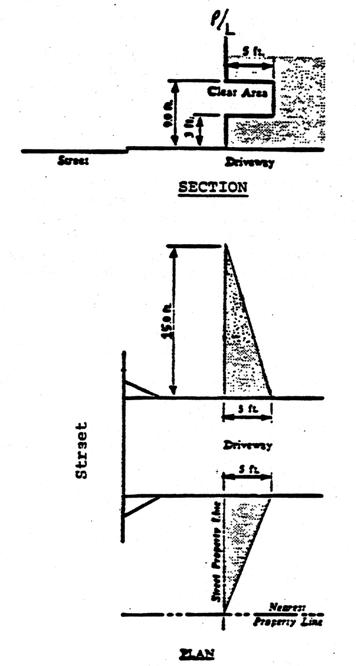
DRIVEWAY VISIBILITY
(The diagram is illustrative.)
(Ord. No. 1832, Amended, 01/17/91; Ord. No. 1838, Renumbered, 07/05/91; Ord. No. 1865, Amended, 02/18/93)
10.64.160 - Parking area screening—Walls and fences.
A parking area for five (5) or more cars serving a nonresidential use shall be screened from an adjoining R district or a ground-floor residential use by a solid concrete, solid wood, or masonry wall six feet (6′) in height, except that the height of a wall adjoining a required front yard in an R district shall be forty-two inches (42″). A carport or open parking area for five (5) or more cars serving a residential use shall be screened from an adjoining lot in an R district or a ground-floor residential use by a solid wall or fence six feet (6′) in height, except that the height of a wall or fence adjoining a required front yard in an R district shall be forty-two inches (42″).
Where the parking area abuts a street separating the area from property classified for residential use, an architectural screen wall or landscaped berm not less than forty-two inches (42″) in height above the parking surface shall be installed and maintained not less than three feet (3′) from the property line that separates the parking area from the street.
(Ord. No. 1832, Amended, 01/17/91; Ord. No. 1838, Renumbered, 07/05/91)
10.64.170 - Lighting.
A.
Lighting regulations are intended to ensure that adequate lighting is provided for personal and traffic safety while protecting nearby residential uses from undue glare.
B.
Each plan for the construction, renovation or replacement of an outside parking lot with lighting shall include an exterior photometric lighting plan prepared by an electrical engineer registered in the State of California, consisting of a point-by-point footcandle layout (based on a ten-foot (10′) grid center extending a minimum of twenty feet (20′) outside the property lines). The lighting plan shall be comprehensive and include all exit and security lighting on the property, and shall cover the entire parking lot, plus all loading and service areas.
C.
Standards. The plan shall be designed in compliance with the following:
1.
The maximum height of a light source located within twenty-five feet (25′) of a residentially zoned or developed parcel shall be no more than twelve feet (12′) and shall be no more than twenty feet (20′) in all other areas (measurement from adjoining ground level).
2.
The light fixtures shall possess sharp cut-off qualities at all property lines and shielding shall be provided as necessary.
3.
The light fixtures and poles shall be properly maintained. Paint covering shall not be of a color or type that is highly reflective.
4.
There shall be no low pressure sodium light fixtures.
5.
The minimum illumination level shall be one (1) footcandle.
6.
The maximum intensity of illumination shall be computed based on a four to one (4:1) ratio (average-to-minimum) throughout the parking lot, including loading and service areas.
7.
The maximum illumination level within the parking lot, including loading and service areas at any location shall be ten (10) footcandles. The maximum illumination level shall not exceed 0.5 footcandles in an R district.
8.
The Director of Community Development may approve lighting that employs a light source up to thirty feet (30′) in height, for sites with moderate to high public use, providing such installation meets all other standards in this section and conditions exist which ensure residential light nuisances will be avoided. Such conditions shall include, but not be limited to: buffering achieved by difference in ground elevation, the presence of dense mature vegetation or the orientation, location or height/massing of buildings relative to the nearest residential property.
9.
A use permit may be approved for lighting on commercial sites containing at least twenty-five thousand (25,000) square feet that have high intensity public use(s) with light sources that exceed thirty feet (30′) in height and produce light that exceeds the average-to-minimum of ten (10) footcandles if the findings in subsection (C)(8) of this section and the following additional findings are made:
a.
The maximum height is thirty-five feet (35′).
b.
Illumination levels do not exceed an average of five (5) footcandles and a maximum of eighteen (18) footcandles at any location on the entire parcel.
c.
The proposed light poles and fixtures are comparable in scale to the building(s) on the same site.
d.
The lighting facilities, including poles and fixtures, do not interfere with nor is their function affected by mature trees or landscaping.
(Ord. No. 1832, Amended, 01/17/91; Ord. No. 1838, Renumbered, 07/05/91; § 3, Ord. 2078, eff. November 4, 2005)
10.64.180 - Parking lot landscaping.
Parking lot landscaping shall be as prescribed by Section 10.60.070. All landscaped areas shall be surrounded by a masonry wall or curb not less than six inches (6″) in height.
(Ord. No. 1832, Amended, 01/17/91; Ord. No. 1838, Renumbered, 07/05/91)
10.64.190 - Driveways and tandem parking for guests in R districts.
The following provisions shall apply to driveways and garages in R districts, whether they are accessory structures or part of a principal structure:
A.
Driveways. Driveways shall be paved and shall have widths and clearances prescribed by Section 10.64.140, subject to the visibility requirements of Section 10.64.150.
B.
Tandem Guest Spaces. Required guest spaces may be in tandem configuration provided that, except for lots on the Strand, none other than resident spaces of the same unit are blocked and that such a configuration would not result in undue traffic hazard.
1.
Exceptions. On the Strand, the Community Development Director may approve an alternative configuration for tandem spaces.
(Ord. No. 1832, Amended, 01/17/91; Ord. No. 1838, Renumbered, 07/05/91; Ord. No. 1850, Amended, 04/02/92; § 4, Ord. 1963, eff. June 5, 1997)
10.64.200 - Additional design standards for parking lots and structures.
Parking lots shall have paving, drainage, wheel stops, lighting, space marking, and directional signs, which shall be subject to approval of the Community Development Director.
Parking structures shall be designed to be compatible with the architectural character of adjacent building. Garage door openings shall be no more than twenty feet (20′) in width. Ventilation grills over four (4) square feet in area shall not be visible from a street.
(Ord. No. 1832, Amended, 01/17/91; Ord. No. 1838, Renumbered, 07/05/91)
10.64.210 - Location and design of off-street loading spaces.
Required spaces shall be on the site of the use served or on an adjoining site. On a site adjoining an alley, a required loading space shall be accessible from the alley unless alternative access is approved by the Community Development Director. A required loading space shall be accessible without backing a truck across a street property line unless the Community Development Director determines that provision of turn-around space is infeasible and approves alternative access. An occupied loading space shall not prevent access to a required off-street parking space. A loading area shall not be located in a required yard that is visible from a public street.
A loading area visible from a street shall be screened on three (3) sides by a fence, wall, or hedge at least six feet (6′) in height.
(Ord. No. 1832, Amended, 01/17/91; Ord. No. 1838, Renumbered, 07/05/91)
10.64.220 - Parking area plan required.
Prior to the construction or reconstruction of an off-street parking area, a parking area plan shall be submitted to the Community Development Director for the purpose of indicating compliance with the provisions of this chapter. This plan shall include:
A.
Location and description of fencing and architectural screen walls;
B.
Location and placement of parking stalls, including bumpers, striping and circulation, all dimensioned to permit comparison with approved parking standards;
C.
Location and placement of lights provided to illuminate the parking area;
D.
A drainage plan showing drainage to a public way in accordance with accepted standards or practices;
E.
A landscaping plan.
Single-family dwellings on pre-existing lots are exempt from this requirement.
(Ord. No. 1832, Amended, 01/17/91; Ord. No. 1838, Renumbered, 07/05/91)
10.64.230 - Off-street parking and loading regulations for affordable housing developments.
When requested by the applicant, multi-family residential developments meeting the minimum requirements for a density bonus pursuant to Chapter 10.94 shall provide off-street parking according to the following formula:
The number of required parking shall be inclusive of guest parking. If the total number of parking spaces required for a development is other than a whole number, the number shall be rounded up to the next whole number.
(§ 10, Ord. 13-0006, eff. August 1, 2013)
10.68.010 - Specific purposes.
This chapter is intended to limit the number and extent of nonconforming uses by restricting their enlargement, prohibiting their re-establishment after abandonment, and their alteration or restoration after destruction of the structures they occupy. While permitting the use and maintenance of nonconforming structures, this chapter is intended to limit the number and extent of nonconforming structures by regulating and limiting their being moved, altered, or enlarged in a manner that would increase the discrepancy between existing conditions and the standards prescribed in this chapter and by prohibiting (commercial structures only) their restoration after destruction.
(Ord. No. 1832, Amended, 01/17/91; Ord. No. 1838, Renumbered, 07/05/91; § 2, Ord. 1951, eff. July 4, 1996, and § 17, Ord. 2111, eff. March 19, 2008, § 17, Ord. 16-0029, eff. Dec. 20, 2016, and § 5, Ord. 18-0022, eff. Dec. 6, 2018)
10.68.020 - Continuation and maintenance.
A.
A use, lawfully occupying a structure or a site on the effective date of the ordinance codified in this title, or of amendments thereto, that does not conform with the use regulations or the site area per dwelling unit regulations for the district in which the use is located shall be deemed to be a nonconforming use and may be continued, except as otherwise provided in this chapter.
B.
A structure, lawfully occupying a site on the effective date of the ordinance codified in this title, or of amendments thereto, that does not conform with the standards for front yards, side yards, rear yards, height, or floor area of structures, driveways, or open space for the district in which the structure is located shall be deemed to be a nonconforming structure and may be used and maintained, except as otherwise provided in this chapter.
C.
A use that does not conform with the parking, loading, planting area, private open space, or screening regulations of the zoning district and area district in which it is located shall not be deemed a nonconforming use solely because of these nonconformities.
D.
Routine maintenance and repairs may be performed on a structure, the use of which is nonconforming; and on a nonconforming structure. Exterior nonconforming elements including, but not limited to: stairways, decks, balconies, green roofs or decks, chimneys, fences, and retaining walls may be replaced in their entirety, if, upon finding in a report prepared by a State of California licensed civil engineer, that, due to a deteriorated condition, such structures are unsafe, and routine repair is infeasible.
(Ord. No. 1832, Amended, 01/17/91; Ord. No. 1838, Renumbered, 01/05/91; § 2, Ord. 1951, eff. July 4, 1996, Amended, § 11, Ord. 2146, eff. August 4, 2011)
10.68.030 - Alterations and enlargements of nonconforming uses and structures.
A.
No structure, the use of which is nonconforming, shall be moved, altered, or enlarged unless required by law, or unless the moving, alteration, or enlargement will result in the elimination of the nonconformity.
Exceptions.
1.
Minor enlargement of a structure, the use of which is nonconforming with respect to a use permit approval, is permitted, provided said enlargement, accomplished cumulatively in one (1) or more projects, does not exceed ten percent (10%) of the total pre-existing buildable square feet occupied by said use that is legally established as of the effective date of the ordinance codified in this title.
2.
During the period that the dwelling unit replacement requirement of State Government Code Section 66300(d) is in effect, existing dwelling units occupying a site that do not conform with the current site area per dwelling unit regulations for the district in which the use is located may be altered by remodeling if the proposed work does not enlarge the structure.
B.
No structure partially occupied by a nonconforming use shall be moved, altered, or enlarged in such a way as to permit the enlargement of the space occupied by the nonconforming use.
Exceptions.
1.
Minor enlargement of a structure, the use of which is nonconforming with respect to a use permit approval, is permitted, provided said enlargement, accomplished cumulatively in one (1) or more projects, does not exceed ten percent (10%) of the total pre-existing buildable square feet occupied by said use that is legally established as of the effective date of the ordinance codified in this title.
2.
During the period that the dwelling unit replacement requirement of State Government Code Section 66300(d) is in effect, existing dwelling units occupying a site that do not conform with site area per dwelling unit regulations for the district in which the use is located may be altered by remodeling if the proposed work does not enlarge the structure.
C.
No nonconforming use shall be enlarged or extended in such a way as to occupy any part of the structure or site, or another structure or site which it did not occupy on January 1, 1991, or on the effective date of any amendment to this Chapter 10.68 that caused the use to become nonconforming, or in such a way as to displace any conforming use occupying a structure or site, except as permitted in this section.
D.
No nonconforming structure shall be structurally altered or reconstructed so as to increase the discrepancy between existing conditions and the standards for front yards, side yards, rear yards, height of structures, maximum allowable floor area, distances between structures, driveways, or open space prescribed in the regulations for the zoning district and area district in which the structure is located, except as provided for in Chapter 10.84, Minor Exception. No nonconforming structure shall be moved or enlarged unless the new location or enlargement shall conform to the standards for front yards, side yards, rear yards, height of structures, maximum allowable floor area, distances between structures, driveways, or open space prescribed in the regulations for the zoning and area district in which the structure is located, except as provided for in Chapter 10.84, Minor Exception.
E.
If any structure on a site does not conform to the standards for front, side or rear yards, height of structures, distance between structures, driveways, or open space prescribed for the zoning district and area district where the structure is located, then no structure shall be enlarged or altered if the total estimated construction cost of the proposed enlargement or alteration, plus the total estimated construction costs of all other enlargements or alterations for which building permits were issued within the preceding sixty (60) month period (twelve (12) months in an IP district), exceeds fifty percent (50%) of the total estimated cost of reconstructing the entire nonconforming structure unless the proposed enlargement or alteration would render the structure conforming. Any enlargements or alterations shall conform to requirements in effect at the time of issuance of the building permit. For the purposes of this section, estimated construction and reconstruction costs shall be determined by the Community Development Director in the same manner as the Community Development Director determines final valuation for the purposes of building permit fees.
Exceptions.
1.
Where a structure is nonconforming only by reason of one (1) substandard front or interior yard, provided that all nonconforming interior yards are not less than three feet (3′), the structure may be enlarged or altered, as defined in this title without regard to the estimated construction cost, provided that no portion of the structure which occupies a required yard is altered, unless the alteration results in the elimination of the non-conformity.
2.
Where a structure is nonconforming only by reason of a substandard street side yard or rear yard adjacent to a public street or alley, the structure may be enlarged or altered, as defined in this title, without regard to the estimated construction cost, provided that no portion of the structure which occupies a required yard is altered, unless the alteration results in the elimination of the non-conformity.
3.
Where a pre-existing, legally constructed building is nonconforming by reason of the method of measuring height prescribed by Section 10.60.050, an alteration or enlargement that conforms to all other regulations of this title shall be permitted without regard to the estimated construction cost.
4.
The provisions of this section shall not apply to projects for which an application for exemption under Ordinance No. 1787 (nonconforming exemptions) has been made, processed through the Planning Commission, and approved by the City Council.
5.
A chimney projection shall not be considered a nonconforming substandard yard, and therefore shall be allowed in addition to the one (1) non-conforming yard in subsection (E)(1) or (E)(2) of this section. See Section 10.60.040(G), Building projections into required yards or required open space—Chimneys, for standards.
6.
Where a minor exception has been approved in accordance with Chapter 10.84 of this Code.
F.
Nonconforming structures that would be enlarged or altered in any manner that serves to increase the degree of nonconformity shall not be permitted unless a variance or minor exception is obtained, as appropriate.
G.
The nonconforming use of a structure or site may be changed to another nonconforming use if after a duly noticed public hearing, the Planning Commission makes the findings required by Section 10.84.060(A) and issues a use permit.
H.
No use which fails to meet the performance standards of Section 10.60.120 shall be enlarged or extended, or shall have equipment that results in failure to meet required conditions replaced unless the enlargement, extension, or replacement will result in elimination of nonconformity with required conditions.
I.
Lots Without Vehicular Access. Residential buildings on lots with no vehicular access to public streets constitute nonconforming uses and may not be altered or enlarged except in accordance with the provisions of this section. Such buildings may be altered as follows:
1.
Interior improvement repairs consistent with all applicable building regulations.
2.
Additions of exterior architectural features such as a fireplace, chimney, balcony, green roof or deck, or bay window, subject to Section 10.60.040, Building projections in yards and required open space.
3.
Modification of a roof from flat to pitched or from pitched to flat, provided that the existing or proposed roof does not exceed a four (4) in twelve (12) pitch.
4.
Exterior modifications may include a minor increase in square footage (said increase calculated cumulatively), not to exceed ten percent (10%) of the original gross floor area.
5.
If there is a fire or casualty loss, the building may be replaced to the buildable square footage and height existing just before the fire or casualty loss and consistent with the requirements of the current building code.
6.
No alteration shall increase building height, except for a roof change referred to in subsection (D)(3) of this section.
7.
Should any exterior building elements or interior floor area be found to be in an extensively deteriorated condition, as documented in a report prepared by a licensed civil engineer, the Director of Community Development may allow said walls or areas to be entirely removed and replaced as long as the improvement is conforming with respect to required yards and otherwise meets the provisions of this section.
(Ord. No. 1832, Amended, 01/17/91; Ord. No. 1838, Renumbered, 07/05/91; Ord. No. 1891, Amended, 01/06/94; § 2, Ord. 1951, eff. July 4, 1996; § 4, Ord. 1992, eff. February 18, 1999; § 2, Ord. 2068, eff. February 4, 2005; § 18, Ord. 2111, eff. March 19, 2008, and § 11, Ord. 2146, eff. August 4, 2011; Ord. No. 21-0001, § 8, eff. Feb. 19, 2021)
10.68.040 - Abandonment of nonconforming use.
A nonconforming use that is discontinued or changed to a conforming use for a continuous period of 180 days or more shall not be reestablished, and the use of the structure or site thereafter shall be in conformity with the regulations for the district in which it is located, provided that this section shall not apply to nonconforming dwelling units except nonconforming accessory dwelling units, which are permitted. Abandonment or discontinuance shall include cessation of a use regardless of intent to resume the use.
A.
Exception. The time necessary to complete review of a building application submitted within the 180 day period, and subsequent related construction activities shall not be counted towards the 180 days. However, time following the lapse of a building permit application or building permit shall be counted towards the 180 days.
(Ord. No. 1832, Amended, 01/17/91; Ord. No. 1838, Renumbered, 07/05/91; § 2, Ord. 1951, eff. July 4, 1996)
10.68.050 - Restoration of a damaged structure.
A.
Whenever a structure that does not comply with the standards for front yards, side yards, rear yards, height of structures, maximum floor area, distances between structures, driveways, or usable open space prescribed in the regulations for the district in which the structure is located, or the use of which does not conform with the regulations for the district in which it is located, is destroyed by fire or other calamity, or by the public enemy to the extent of fifty percent (50%) or less, the structure may be restored and the nonconforming use may be resumed, provided that a complete application for the necessary building permits for restoration is received by the Community Development Department within twelve (12) months of the destruction occurrence, and the project is diligently pursued to completion.
B.
Whenever a structure that does not comply with the standards for front yards, side yards, rear yards, height of structures, maximum floor area, distances between structures, driveways, or usable open space prescribed in the regulations for the district in which it is located, or the use of which does not conform with the regulations for the district in which it is located, is destroyed by fire or other calamity, or by the public enemy to an extent greater than fifty percent (50%), the structure shall not be restored except in full conformity with the regulations for the district in which it is located, and the nonconforming use shall not be resumed.
Exceptions. Residential structures in R districts including nonconforming uses, and conforming residential uses in the CD, CL or CNE districts that do not conform to standards for setbacks, height of structures, distance between structures, maximum buildable floor area, open space, or lot area per unit, may be rebuilt with the same floor area, upon issuance of building permits and/or use permits, if applicable, whatever the extent of the damage, provided there is no increase in any nonconformity.
C.
The extent of damage or partial destruction shall be based upon the ratio of the estimated cost of restoring the structure to its condition prior to such damage or partial destruction to the estimated cost of duplicating the entire structure as it existed prior thereto. Estimates for this purpose shall be made by or shall be reviewed and approved by the Community Development Director.
D.
Calculation of the extent of damage for restoration of a structurally damaged structure shall be consistent with the provisions of Section 10.68.030(E).
(Ord. No. 1832, Amended, 01/17/91; Ord. No. 1838, Renumbered, 07/05/91; Ord. No. 1891, Amended, 01/06/94; § 2, Ord. 1951, eff. July 4, 1996)
10.68.060 - New occupancy on a site having certain nonconforming site features.
An applicant for a building permit in a C district or the IP district for occupancy of a site or structure that is nonconforming due to lack of screening of mechanical equipment, required walls or fences to screen parking, required paving for driveways, or required planting areas, shall present a schedule for elimination or substantial reduction of these nonconformities over a period not exceeding five (5) years. The Community Development Director may require that priority be given to elimination of nonconformities that have significant adverse impacts on surrounding properties and shall not require a commitment to remove nonconformities that have minor impact and would be costly to eliminate due to the configuration of the site and the location of existing structures.
(Ord. No. 1832, Amended, 01/17/91; Ord. No. 1838, Renumbered, 07/05/91)
10.68.070 - Elimination of nonconforming uses and structures.
A.
Nonconforming Fences or Walls. The Community Development Director shall require that a nonconforming fence or wall be removed or altered to conform to the standards of this chapter within one (1) year of adoption of the ordinance codified in this title, or one (1) year from the date such fence or wall becomes nonconforming, whichever date is later upon finding that the nonconforming fence or wall does not adequately serve the purposes for which it is intended or does not meet the driveway visibility standards of Section 10.64.150.
B.
Nonconforming Use when No Structure Involved. In any district the nonconforming use of land shall be discontinued within one (1) year from the effective date of the ordinance codified in this title or one (1) year from the date such use becomes nonconforming, whichever date is later.
1.
Exceptions. Pre-existing parking lots in R districts that serve adjacent commercial use shall not be considered nonconforming.
(Ord. No. 1832, Amended, 01/17/91; Ord. No. 1838, Renumbered, 07/05/91; § 2, Ord. 1951, eff. July 4, 1996)
10.72.010 - Purpose and intent.
The purpose of signs is to provide business identification. The location, height, size, and illumination of signs are regulated in order to maintain the attractiveness and orderliness of the City's appearance; to protect business sites from loss of prominence resulting from excessive signs, particularly pole signs, on nearby sites; to protect the public safety and welfare.
(§ 2, Ord. 1951, eff. July 4, 1996)
10.72.020 - General provisions.
A.
Permits are required for all temporary and permanent signs except for those specified as exempt herein.
B.
The maximum area of any single sign face, comprised of one (1) or multiple face panels, shall be one hundred fifty (150) square feet.
C.
All sign illumination shall be internal or by lighting shielded from direct off-site view, and no sign shall have blinking or flashing lights or any other illuminating device which has a changing light intensity, brightness or color.
D.
No sign shall move, have visible moving parts, or simulate movement by means of fluttering, spinning, or reflective devices.
E.
The copy of all signs shall be permanently fixed in place in conformance with their corresponding sign permits unless an exception for changeable copy is provided pursuant to the regulations of this chapter.
F.
Portable signs are prohibited, except as permitted or exempted in this chapter.
G.
All signs shall be structurally safe, shall be of rust resistant material, and shall be maintained in good condition, subject to the approval of the Community Development Department. The visibly, exposed surfaces of all signs shall be of a decorative finish. Rough supporting members, electrical appurtenances, or equipment shall not be visible.
H.
Abandoned signs shall be removed by the property owner within thirty (30) days of the City's determination that a sign is abandoned.
I.
All sign permits issued for any multiple tenant site shall be in conformance with an approved site sign program.
(§ 2, Ord. 1951, eff. July 4, 1996)
10.72.030 - Definitions.
"Abandoned sign" means any sign or structure which: identifies a use which has not occupied the site on which it is located for a period of ninety (90) days, does not clearly identify any land use for a period of ninety (90) days, or has keen in a state of disrepair or poor condition for a period of thirty (30) days.
"Area of sign" shall be determined by the outer edge of the frame of the sign. Each face of a multiple-faced sign shall be counted as part of the sign area. In cases where individual letters, words or other sign display are attached to a building, the sign area shall be determined by not more than by two (2) rectangles, of at least six-inch (6″) width, drawn around the entire copy or grouping of letters, words or other sign display.
"Awning/canopy sign" means sign copy printed on an awning or canopy of any material, projecting out from a building wall.
"Billboard" means any outdoor, off-site sign or advertising device.
"Changeable copy sign" means any sign with copy which can be changed or altered to advertise products, services or messages to the public.
"Corner side wall sign" means sign located on a side building wall, perpendicular to the front wall sign.
"Corner tenant" means any tenant space located at an end of a building and thus having perpendicular exterior walls, regardless of street frontage.
"Construction sign" means any construction sign on a construction site indicating names and other information about individuals or businesses directly involved in the project on the site.
"Directional sign" means a non-official sign designed to guide or direct pedestrian or vehicular traffic.
Frontage, Building. "Building frontage" means the width of a structure measured from the outer wall.
Frontage, Property. "Property frontage" means the width of a property measured from one (1) property line to the other along the longest street frontage.
Frontage, Tenant. "Tenant frontage" means the width of a tenant space measured from one (1) side wall to the other along the front exterior wall.
"Gasoline price sign" means signs located on-site, identifying company name and prices/grades of vehicle fuels for sale.
"Height of monument or pole sign" means the vertical distance measured from the public sidewalk or street grade nearest to the base of the sign, to the highest point of the sign structure.
"Illuminated sign" means any sign using an artificial source of light, including neon, to enhance the visibility of the sign, including internally and externally lighted, reflective, glowing or radiating signs.
"Monument sign" means a free-standing, ground mounted sign that does not exceed six feet (6′) in height.
"Off-premises sign" means any sign identifying a name, product or service which is not located up on the site that it occupies.
"On-premises sign" means any sign indicating a name, product or service incidental to a permitted use on the property where the sign is located.
"Pedestrian sign" means a small non-illuminated sign suspended under an awning or canopy or attached to a building by a decorative holder, oriented toward pedestrian traffic, to identify a business.
"Pole sign" means any free-standing sign exceeding six feet (6′) in height excluding signs specified as exempt in this chapter.
"Portable sign" means any unattached sign which can be readily moved or relocated.
"Project" means a developed site with defined and recognized boundaries.
"Projecting sign" means any sign which projects or cantilevers out horizontally more than one foot (1′) from a building or wall, or over the public right-of-way, excluding awning/canopy or pedestrian signs.
"Roof sign" means any sign located on or extending above the roof of a building.
"Sign" means any media, device, graphic depiction, illumination or display for the purpose of identifying, or attracting attention to business establishments or services, or promoting products, goods, services, or items for sale, rent or lease. Registered trademarks, with or without written text, shall be included in the definition of signage and shall be counted in the determination of total sign area. Should any uncertainty exist as to what elements constitute sign area, the determination shall be made by the Director of Community Development. The determination of the Director is appealable to the Planning Commission consistent with Section 10.01.070 (D).
"Sign program" means sign specifications for a multiple tenant site.
"Temporary sign" means any sign or advertising display constructed of cloth, canvas, light fabric, cardboard, wallboard, or other light materials, with or without frames, intended to be displayed for a temporary period.
"Wall sign" means any sign attached to or painted on a wall, window, or parapet/mansard wall, of a business, parallel to the wall.
(§ 2, Ord. 1951, eff. July 4, 1996, as amended by § 4, Ord. 2007, eff. November 18, 1999, § 2, Ord. 2013, eff. June 15, 2000, § 2 (part), Ord. 2022, eff. February 16, 2001, § 2 (part), Ord. 2027, eff. May 3, 2001)
10.72.040 - Exemptions.
The following signs shall be exempt from the provisions of this chapter; however, an electrical or building permit may be required:
A.
Directional Signs. One (1) parking directional sign is permitted at each entrance or exit, not to exceed six (6) square feet or four feet (4′) in height.
B.
Real Estate Signs. One (1) unlighted sign on each street frontage, not to exceed six (6) square feet or four feet (4′) in height. In addition, freestanding, directional signs may be used to direct traffic to an open house. Such signs shall be a maximum of four (4) square feet and maybe displayed between the hours of 10:00 a.m. and 6:00 p.m. One (1) flag or pennant per sign is permitted.
C.
Construction Signs. One (1) unlighted sign, not to exceed four (4) square feet in area on the site of a project actively under construction for each contractor, architect or engineer. Total signs on a site shall not exceed thirty-two (32) square feet.
D.
Official notices authorized by a court, public body, or public officer.
E.
Directional, warning or information signs authorized by federal, state, or municipal authority.
F.
Memorial plaques and building cornerstones when made an integral part of a building or structure.
G.
One non-illuminated permanent window, wall, door, or directory sign per business, not exceeding three (3) square feet, with letter heights not exceeding four inches (4″), limited to business identification, goods and service descriptions, hours of operation, address and telephone number.
H.
Interior signs within a structure, not visible from neighboring properties or the public right-of-way.
I.
Official City or utility company safety and notification signs on construction sites or in conjunction with public utilities.
J.
Official flags of recognized federal, state, county or municipal organizations.
K.
Automobile dealership price signs located on windshields of vehicles for sale on the dealership site.
(§ 2, Ord. 1951, eff. July 4, 1996)
10.72.050 - Permitted signs.
The following schedule prescribes sign regulations for all types of land uses, as defined in Chapter 10.08 of this title. The columns establish basic requirements for sign quantities, sizes, and locations; letters in parentheses in the right-hand column refer to "additional regulations" following the schedule.
sf = square feet lf = lineal feet
Maximum sign area is sum of area of all sign faces unless otherwise specified
Permitted signs—Additional Regulations
A.
Temporary Signs. The purpose of this section is to provide opportunity for businesses to advertise temporary special events including grand openings, sales, and seasonal promotions, while minimizing the potential for adverse visual and aesthetic impacts by regulating the duration, amount, and type of signs allowed. Temporary signs are allowed in addition to permanent signs, upon the issuance of a temporary sign permit, and subject to the following requirements:
1.
Application. An application for a temporary sign shall be made to the Community Development a minimum of ten (10) days prior to installation. An application includes a temporary sign fee, performance bond to guarantee removal at the termination of the permit, and a time schedule for the duration of all proposed temporary signs.
2.
Permitted Signs. Temporary signs shall include banners, posters, pennants, small party balloons, ribbons, or lettering and graphics painted on windows.
3.
Allowable Area. During a single calendar year, each tenant space may apply for one (1) or more temporary signs for a total cumulative sign area not to exceed one (1) square foot per lineal feet of leased "tenant frontage" of a building as defined in Section 10.72.030 of this chapter. For buildings with less than a twenty foot (20′) tenant frontage, a maximum of twenty (20) square feet of sign area shall be permitted. In any case, the maximum cumulative area shall be eighty (80) square feet. The maximum area of a single temporary sign shall not exceed forty-eight (48) square feet.
For tenants occupying corner-leased spaces, a maximum of two (2) tenant frontages may be used to determine the maximum allowed sign area. The total amount of sign area displayed on each tenant frontage shall be proportionate to the lineal feet of each frontage.
4.
Duration of Density. The duration of display in a calendar year shall not exceed an accumulation of nine (90) days.
5.
Placement. Temporary signs shall be prohibited on building roofs and shall not cause unnecessary repetition, redundancy or proliferation of signage.
6.
Maintenance. All temporary signs must be maintained in good condition and repair. Any which are torn, faded, sagging or in disrepair shall be replaced at the request of the Community Development Director.
7.
Prohibited Signs. Prohibited signs shall include those listed in Section 10.72.070 of this chapter.
8.
Temporary Sign Program. The intent of a temporary sign program is to provide flexibility for large retail oriented commercial sites which, due to their unusual size, building configuration or orientation, lack of street exposure, or by nature of business, cannot successfully advertise special events or promotions by adhering to the strict application of the signs standards stated above.
A site consisting of a minimum of two (2) acres, and improved with a building(s) predominantly occupied by retail sales uses, is eligible for a temporary sign program to establish site specific temporary sign standards specifically for allowable area and duration of display. An application for a temporary sign program shall be reviewed and approved by the Community Development Director and may be incorporated into a master sign program pursuant to Section 10.72.060 of this chapter. The following performance standards shall apply:
a.
Placement of signs shall be oriented toward a commercial street and away from residential homes.
b.
The temporary sign program shall specify sign design guidelines and sign area allocations to be applied to the entire site.
c.
The duration of sign display authorized in a temporary sign program shall not exceed a total of one hundred twenty (120) days per calendar year.
d.
Prohibited signs or devices shall be consistent with those provided in subsection E of Section 10.72.070, including but not limited to signs placed on public property and large inflatable tethered objects.
9.
Appeals. Decisions of the Community Development Director may be appealed to the Planning Commission in accordance with Chapter 10.100.
B.
Encroachment permits are required for structures projecting into the public right-of-way.
C.
Signs and structures adjacent to street property lines must observe the visibility requirements of Sections 10.64.150 and 3.40.010.
D.
A pole sign, where permitted, shall be located a minimum distance from each interior site property line of twenty feet (20′).
E.
Changeable copy is permitted to be incorporated within one (1) primary monument sign of a public or semipublic site.
(§ 2, Ord. 1951, eff. July 4, 1996, as amended by § 5, Ord. 2007, eff. November 18, 1999)
10.72.060 - Sign program.
An approved sign program is required for any multiple tenant site, consistent with the regulations of this chapter, prior to issuance of any sign permit upon said site. The purposes of a sign program are to establish uniform sign design guidelines and sign area allocations for all uses and/or buildings on a site which conform to the requirements of this chapter, and incorporate sign exceptions approved pursuant to Section 10.72.080. An application for a sign program shall be reviewed by the Director of Community Development, unless filed in conjunction with a use permit or amendment, in which case said application shall be reviewed by the Planning Commission. The Director of Community Development may approve modifications to all approved sign program which are in compliance with the sign regulations of this chapter, unless stated otherwise in the approved sign program.
(§ 2, Ord. 1951, eff. July 4, 1996)
10.72.070 - Prohibited signs.
A.
Off-site or off-premises signs;
B.
Outdoor advertising display signs (billboards);
C.
Signs on public property, unless otherwise permitted by this chapter;
D.
Portable, A-frame, or sidewalk signs, excluding business identification signs affixed flat on the body of a vehicle which provides services to said business other than identification or advertising;
E.
Three-dimensional objects or statutes including air or gas-filled objects greater than eighteen inches (18″) in diameter each, and located, attached or tethered to the group site, merchandise, structure or roof and used to attract attention or as a sign as defined herein;
F.
Abandoned signs;
G.
Roof signs;
H.
Projecting signs other than those permitted in Section 10.72.050;
I.
Revolving, flashing, fluttering, spinning or reflective signs;
J.
Signs other than those permitted by this chapter;
K.
Signs determined to be unsafe, a danger to the public, or a traffic hazard, by the Community Development or Public Works Departments.
(§ 2, Ord. 1951, eff. July 4, 1996, as amended by § 6, Ord. 2007, eff. November 18, 1999)
10.72.080 - Sign exceptions.
On sites where strict application of this chapter creates results inconsistent with the intent of this chapter, the Planning Commission may approve modifications to the requirements of this chapter.
Applicants shall submit copies of a proposed sign program with plans and elevations drawn to scale of all existing and proposed buildings and signs as part of the exception application. Upon receipt of a complete application the item will be placed on the next available Planning Commission agenda.
An application for a sign exception as it was applied for, or in modified form as required by the Commission, shall be approved if, on the basis of the application, plans, and materials submitted; the Commission finds that:
A.
The proposed sign exception would not be detrimental to, nor adversely impact, the neighborhood or district in which the property is located. Potential impacts may include, but are not limited to, design;
B.
The proposed sign exception is necessary in order that the applicant may not be deprived unreasonably in the use or enjoyment of their property;
C.
The proposed sign exception is consistent with the legislative intent of this title; and
D.
For sign exceptions proposed in the coastal zone, the sign design and scale does not:
1.
Obstruct views to or along the coast from publicly accessible places;
2.
Adversely impact public access to and use of the water;
3.
Adversely impact public recreation, access or the visual resources of the coast.
In granting any such exception, the Planning Commission may impose reasonable conditions or restrictions as deemed appropriate or necessary to assure compliance with subsections A through D of this section, and to protect the public health, safety, and general welfare.
In granting any such exception, the Planning Commission may impose reasonable conditions or restrictions as deemed appropriate or necessary to protect the public health, safety, and general welfare.
(§ 2, Ord. 1951, eff. July 4, 1996, as amended by § 2, Ord. 2013, eff. June 15, 2000, § 2 (part), Ord. 2022, eff. February 16, 2001, § 2 (part), Ord. 2027, eff. May 3, 2001)
10.72.090 - Non-conforming signs.
A.
Temporary Signs. Prohibited temporary signs as designated in this chapter shall be summarily abated within thirty (30) days of the City's determination of nonconforming status, unless otherwise approved by permit.
B.
Permanent Signs.
1.
Signs lawfully existing by benefit of permit prior to February 15, 1972, which were nonconforming under Ordinance No. 1238 shall be abated within thirty (30) days of the City's determination of nonconforming status, unless otherwise approved by permit.
2.
Signs lawfully existing by benefit of permit prior to March 18, 1976, which were nonconforming under Ordinance No. 1447, shall be made to comply whenever any of the following conditions occur: transfer of ownership of business, sale of more than fifty percent (50%) of the interest in the business, inclusion or additional partners whose interest is more than fifty percent (50%).
3.
Signs lawfully existing by benefit of permit which do not comply with the requirements of this chapter shall not be moved or enlarged unless they are made to comply.
C.
All Signs.
1.
Nonconforming signs which are nonconforming for reasons of danger to the public, traffic hazard, movement, rotation, flashing, or scintillating lights, such nonconforming portions shall be required to conform within thirty (30) days of the City's determination of nonconforming status, unless otherwise approved by permit.
2.
Signs, other than those exempted in this chapter, which exist without benefit of permit on buildings or properties shall be abated prior to the issuance of a building permit or a permit for any new sign on the same building or property.
(§ 2, Ord. 1951, eff. July 4, 1996)
10.72.100 - Sign fees.
Sign permit and related fees shall be contained in a schedule established by the City Council under separate resolution.
A.
A fee shall be required for each sign permit. A fee may be required for plan checking purposes. In addition, a performance bond shall be required to guarantee inspection of permanent signs.
B.
A fee shall be required for temporary signs. In addition, a performance bond shall be required to guarantee timely removal of temporary signs.
C.
Exempt from fee requirements are exempt signs in Section 10.72.040, including: directional signs, political signs, real estate signs, and construction signs.
(§ 2, Ord. 1951, eff. July 4, 1996)
10.72.110 - Administration and enforcement.
The provisions of this chapter shall be administered and enforced by the community development department and are subject to Chapter 10.104 of this title.
(§ 2, Ord. 1951, eff. July 4, 1996)
10.72.120 - Appeals.
Applications for appeals are subject to Chapter 10.100 of this title.
(§ 2, Ord. 1951, eff. July 4, 1996)
10.74.010 - Purpose and applicability.
10.74.020 - Definitions.
"Accessory dwelling unit" or "ADU" has the meaning ascribed in Government Code Section 65852.2, as the same may be amended from time to time. Notwithstanding the foregoing, the term "ADU" does not include a guest house (or accessory living quarters), as defined in Municipal Code Section 10.04.030.
"Attached ADU" means an ADU that is constructed as a physical expansion (i.e. addition) of a primary dwelling, or the remodeling of a primary dwelling, and shares a common wall with a primary dwelling.
"Detached ADU" means an ADU that is constructed as a separate structure from any primary dwelling, and does not share any walls with a primary dwelling.
"Existing structure" means an existing single-family dwelling, multi-family dwelling, or other accessory structure that can be safely converted into habitable space under the California Building Standards Code, as amended by the City, and any other applicable laws.
"Junior accessory dwelling unit" or "JADU" has the meaning ascribed in Government Code Section 65852.22, as the same may be amended from time to time.
"Primary dwelling," for purposes of this chapter, means an existing or proposed single-family dwelling, or multi-family dwelling, on the lot where an ADU would be located.
"Public transit," for purposes of this chapter, has the meaning ascribed in Government Code Section 65852.2(j), as the same may be amended from time to time.
(§ 5, Ord. 18-0024, eff. Jan. 18, 2019; Ord. No. 21-0001, § 5, eff. Feb. 19, 2021)
10.74.030 - General requirements and application procedure.
A.
Before constructing an ADU or a JADU or converting an existing structure or portion of a structure to an ADU or JADU, the applicant shall obtain permits in accordance with the requirements of this section.
B.
All ADUs and JADUs shall satisfy the requirements of the California Building Standards Code, as amended by the City, and any other applicable laws.
C.
Projects Exempt from Obtaining an ADU Permit. An applicant shall not be required to submit an application for an ADU permit under subsection D of this section, and may instead seek building permit approval for an ADU or JADU, or both, where the proposal satisfies the requirements of Government Code Section 65852.2(e)(1), as the same may be amended from time to time, the California Building Standards Code, as amended by the City, and any other applicable laws. An ADU or JADU approved pursuant to this subsection shall be rented only for terms of thirty (30) days or longer.
D.
Projects Subject to ADU Permit Review and Timelines.
1.
The Director of Community Development or his/her designee shall ministerially review and approve an ADU permit application and shall not require a public hearing, provided that the submitted application is complete and demonstrates that the ADU complies with the requirements contained in this chapter and any other applicable law.
2.
ADU permit applications subject to ministerial approval shall be processed within the timelines established by California Government Code Section 65852.2.
3.
Where an ADU permit application is submitted with an application for a primary dwelling that is subject to discretionary review under this Code, the ADU permit application will be considered separately without discretionary review or a public hearing, following action on the portion of the project subject to discretionary review.
4.
In addition to obtaining an ADU permit, the applicant shall be required to obtain a building permit and any other applicable construction or related permits prior to the construction of the ADU.
E.
Minor Exception: An applicant may apply for a minor exception, pursuant to Section 10.84.120, for the establishment of an ADU or JADU in an existing legal structure that does not comply with the ADU or JADU standards provided in this chapter. A minor exception may not be requested for site or lot conditions.
F.
An applicant may apply for ADUs and JADUs meeting the requirements of Government Code Section 65852.2(e)(1), or ADUs meeting the requirements of Section 10.74.040, but in no case shall the combined number of ADUs and JADUs be greater than two (2) on a property with a single-family residence.
(§ 5, Ord. 18-0024, eff. Jan. 18, 2019; Ord. No. 21-0001, § 5, eff. Feb. 19, 2021)
10.74.040 - Local ADU standards.
Excepting those ADUs that satisfy the requirements of Government Code Section 65852.2(e)(1), ADUs shall comply with the following standards:
A.
Location Restrictions/Number Permitted:
1.
ADUs on Lots with a Single-Family Residence. A maximum of two (2) total ADUs shall be allowed on a lot with a proposed or existing single-family dwelling within all Area Districts; however, only one (1) ADU shall be allowed on a property that also has a JADU. Only one (1) detached ADU is allowed on a property.
2.
ADUs on Lots with New Multi-Family Developments. In all Area Districts, one (1) ADU shall be allowed on a lot with a newly constructed multi-family development.
a.
Multi-Family Redevelopments. Notwithstanding the limitation in paragraph 2 above, more than one (1) ADU, up to twenty-five percent (25%) of the number of pre-existing multi-family dwelling units on the property, shall be allowed where the applicant proposes to demolish an existing multi-family development to build a new multi-family development. For any property that is considered a nonconforming use pursuant to 10.68.020.A because it does not meet the current site area per dwelling unit requirement, the total resulting number of units on the property, including ADUs, shall not be greater than the number of pre-existing units on the property.
B.
Development Standards:
1.
Size, General. Studio and one (1) bedroom ADUs shall not exceed eight hundred fifty (850) square feet of gross floor area. ADUs with two (2) or more bedrooms shall not exceed one thousand two hundred (1,200) square feet of gross floor area. The minimum size of an ADU shall be two hundred twenty (220) square feet, or an alternate minimum area for an "efficiency unit" that is adopted by the City.
a.
Additional Size Limitations for Attached ADUs: If there is an existing single-family residence, a newly constructed Attached ADU shall not exceed fifty percent (50%) of the gross floor area of the existing single-family residence.
2.
Height for detached ADUs shall be measured from the weighted average of the local grades around the perimeter of the detached structure, and:
a.
A Detached ADU shall not exceed sixteen feet (16′) in height; or
b.
A Detached ADU located above a detached garage or below a detached garage that does not qualify as a basement shall not exceed a total height of twenty-six feet (26′).
3.
Setbacks: No setback shall be required for an ADU that is within an existing structure or within a structure constructed in the same location and dimensions as an existing structure. For all other ADUs, the required setback from side and rear lot lines shall be four feet (4′), and the front setback shall be as required for the primary structure.
4.
Separation: A Detached ADU shall have a minimum five-foot building separation from other buildings on the lot.
5.
Standards: An ADU shall conform to all open space, buildable floor area, building site (lot) coverage, and minimum lot size regulations applicable to the zoning district in which the property is located, as well as the building separation requirement stated in Section 4 above, except in the following cases:
a.
ADUs that are not required to obtain an ADU permit as provided in Section 10.74.030(C).
b.
Where the application of such standards would not permit construction of an eight hundred (800) square-foot ADU that is sixteen feet (16′) in height with four-foot side and rear yard setbacks, in which case the regulation(s) at issue shall be waived to permit such an ADU.
6.
Except as provided in subsection 5.b, an ADU shall count toward the maximum total buildable floor area applicable to the lot.
C.
Guest Houses: If an ADU is located on a lot with a guest house, either, but not both, the guest house or the ADU shall be attached to the primary dwelling.
D.
Design and Features:
1.
An ADU shall not have any outdoor deck at a height greater than thirty inches (30″) above local grade if the deck is located in the primary dwelling's required yards.
2.
If the property abuts an alley, any new driveway access for an ADU must be provided through the alley.
3.
If an automatic fire sprinkler system is required for the primary dwelling, the ADU must also have an automatic fire sprinkler system.
4.
An ADU shall have a separate exterior access.
5.
For any second-story detached ADU, all exterior openings, including windows and doors, that are within fifteen feet (15′) of a rear non-alley or side interior property line shall be fitted with translucent glazing and satisfy one (1) of the following: (i) be fixed (i.e., inoperable) or (ii) be located at least five feet (5′) above the finished floor level at the window's lowest point.
6.
A kitchen, in conformance with applicable health and safety requirements, including at least one (1) permanently installed cooking appliance, shall be required for all ADUs.
7.
A permanent foundation shall be required for all ADUs.
8.
Refuse containers shall comply with Municipal Code Section 5.24.030.
E.
Covenant Required: The property owner shall record a declaration of restrictions, in a form approved by the City Attorney, placing the following restrictions on the property, the property owner, and all successors in interest: (i) the ADU is to be rented only for terms of thirty (30) days or longer; (ii) the ADU is not to be sold or conveyed separately from the primary dwelling; (iii) the property owner and all successors in interest shall maintain the ADU and the property in accordance with all applicable ADU requirements and standards; and (iv) that any violation will be subject to penalties as provided in Municipal Code Chapter 1.04 and 1.06. Proof of recordation of the covenant shall be provided to the City prior to final building inspection.
F.
Parking Requirements (ADU):
1.
In addition to the off-street parking space(s) required for the primary dwelling, one (1) off-street parking space shall be provided for each ADU, except when:
a.
The ADU is located within one-half (½) mile walking distance of public transit;
b.
The ADU is located within an architecturally and historically significant historic district;
c.
The ADU is part of the existing primary dwelling or all or part of an existing accessory structure or building;
d.
The ADU is located in an area where on-street parking permits are required but not offered to an ADU occupant; or
e.
The ADU is located within one (1) block of a city-approved and dedicated parking space for a car share vehicle.
2.
Required setbacks, yards and open space shall not be used for parking except that:
a.
Parking may be located within an enclosed accessory building as permitted by Municipal Code Section 10.52.050; and
b.
Parking may be located outside of the front yard setback on existing driveways existing prior to January 1, 2019, that are conforming in width and clearance.
3.
The dimensions of all parking spaces, driveways, vehicular access, turning radius and similar parking standards shall comply with the requirements set forth in Municipal Code Chapter 10.64.
4.
When the ADU is created by converting or demolishing a garage, carport or covered parking structure, replacement of parking space(s) eliminated by the construction of the ADU shall not be required as long as the ADU remains in use as a legal ADU. Existing driveways that formerly served parking spaces that have been converted to an ADU may remain for parking.
(§ 5, Ord. 18-0024, eff. Jan. 18, 2019; Ord. No. 21-0001, § 5, eff. Feb. 19, 2021)
10.74.050 - JADU Standards.
JADUs shall comply with the following requirements:
1.
A JADU shall be a maximum of five hundred (500) square feet of buildable floor area and a minimum of two hundred twenty (220) square feet, or an alternate minimum area for an "efficiency unit" that is adopted by the City. The buildable floor area of a shared sanitation facility shall not be included in the maximum buildable floor area of a JADU.
2.
A JADU must be contained entirely within the walls of the existing or proposed single-family dwelling.
3.
A separate exterior entry from the main entrance to the single-family dwelling shall be provided to serve a JADU.
4.
A JADU may include separate sanitation facilities, or may share sanitation facilities with the existing or proposed single-family dwelling.
5.
A JADU shall include an efficiency kitchen meeting the requirements of Government Code Section 65852.22.
6.
Covenant Required: The property owner shall record a declaration of restrictions, in a form approved by the City Attorney, placing the following restrictions on the property, the property owner, and all successors in interest: (i) the property owner shall be an owner-occupant of either the primary dwelling or the JADU, unless the owner is a government agency, land trust, or housing organization; (ii) the JADU is to be rented only for terms of thirty (30) days or longer; (iii) the JADU is not to be sold or conveyed separately from the single-family dwelling; (iv) the property owner and all successors in interest shall maintain the JADU and the property in accordance with all applicable JADU requirements and standards, including the restrictions on the size and attributes of the JADU provided in Government Code Section 65852.22; and (v) that any violation will be subject to penalties as provided in Municipal Code Chapter 1.04 and 1.06. Proof of recordation of the covenant shall be provided prior to final building inspection.
7.
No additional parking is required for a JADU.
(Ord. No. 21-0001, § 5, eff. Feb. 19, 2021)
Editor's note— Ord. No. 21-0001, § 5, adopted January 19, 2021 and effective February 19, 2021, in effect, repealed § 10.74.050 and enacted a new § 10.74.050 as set out herein. Former § 10.74.050 pertained to parking and derived from Ord. 18-0024, § 5, eff. Jan. 18, 2019.
10.74.060 - Fees and utility connections.
A.
The owner of an ADU or JADU shall be subject to the payment of all sewer, water and other applicable fees except as specifically provided in California Government Code Sections 65852.2 and 65852.22.
B.
With the submittal of the ADU permit or prior to receiving a building permit if no ADU permit is required, the owner of the subject property must submit letters of service availability for water and sewer disposal to the Building Official.
(§ 5, Ord. 18-0024, eff. Jan. 18, 2019; Ord. No. 21-0001, § 5, eff. Feb. 19, 2021)
10.78.010 - Purpose and applicability.
The purpose of this chapter is to implement the requirements of Government Code Section 65852.21 to allow a proposed housing development containing no more than two (2) residential units on a single lot within a single-family residential zone. Except as expressly provided in this chapter or Government Code Section 65852.21, all other applicable regulations in the Municipal Code shall apply.
(§ 1, Ord. No. 23-0014, eff. December 19, 2023)
10.78.020 - Definitions.
"Existing residence," for purposes of this chapter, means a dwelling unit that has been constructed legally.
"Flag lot," for purposes of this chapter, means a lot resulting from a subdivision of land wherein the lots or parcels of land are laid out one (1) behind the other, with only one (1) lot or parcel of land (referred to as the front lot) having frontage on a public street, other than a driveway or access easement for the rear lot.
"Primary dwelling unit," for purposes of this chapter, means a single-family residence that is not an ADU or JADU.
"Principal residence," for purposes of this chapter, means the owner-occupied residence on the property.
(§ 1, Ord. No. 23-0014, eff. December 19, 2023)
10.78.030 - General requirements and application procedure.
A.
The project is located on a parcel within the RS Single-Family Residential Zoning District.
B.
Applicants are required to submit an application, accompanied by a fee set by the City Council, including submittal documents required by the Community Development Director.
C.
The applicant and the property owner shall provide a sworn statement affirming eligibility with the regulations contained in this chapter.
1.
The City, at the applicant's expense, may conduct independent inquiries and investigation to ascertain the veracity of any or all portions of the sworn statement.
D.
All new residential units shall satisfy the requirements of the California Building Standards Code, as amended by the City, and any other applicable laws.
E.
Applications submitted pursuant to this chapter shall be considered ministerially, without discretionary review or a hearing, consistent with state law.
(§ 1, Ord. No. 23-0014, eff. December 19, 2023)
10.78.040 - Local standards.
Residential developments pursuant to Government Code Section 65852.21 shall also comply with the following standards:
A.
Number of Units Permitted.
1.
A maximum of two (2) primary dwelling units may be permitted on an RS zoned lot that has not undergone an urban lot split pursuant to Chapter 11.40.
2.
A maximum of four (4) total units shall be permitted on a lot that has not undergone an urban lot split pursuant to Chapter 11.40, inclusive of ADUs and JADUs. The maximum number of units permitted may be any combination of primary dwelling units, ADUs, or JADUs, provided that the total permitted number of units per lot is not exceeded, and is subject to the limitations on the development of ADUs and JADUs found in Chapter 10.74 (Accessory Dwelling Units).
3.
A maximum of two (2) units shall be permitted on a lot that has been created by an urban lot split pursuant to Chapter 11.40, inclusive of ADUs and JADUs.
B.
Development Standards.
1.
Demolition Cap. Residential development pursuant to Government Code Section 65852.21 may not involve the demolition of more than twenty-five (25) percent of the existing exterior structure walls of an existing dwelling, unless the site has not been occupied by a tenant in the last three (3) years.
2.
Configuration. Primary dwelling units, may be attached to, adjacent to, or detached from, any other dwelling unit on the parcel, subject to subsection (B)(1).
3.
Height. New units shall be subject to the RS base district and Area District regulations as defined in Section 10.12.030.
4.
Setbacks.
a.
New units, inclusive of attached garages, shall be built no less than four (4) feet from the side and rear property lines, and comply with the underlying zoning district front setback requirement.
i)
Exception. For flag lots, the front setback shall be measured from the portion where the "flag pole" meets the flag portion of the lot and to the face of the structure.
b.
No new setbacks shall be required for an existing structure or for a structure constructed in the same location and to the same dimensions as an existing structure.
c.
Detached primary dwelling units shall have a minimum ten-foot building separation from each other.
5.
Parking.
a.
Required parking shall be accessed via an alley for a parcel abutting an alley.
b.
One (1) enclosed or partially enclosed parking space is required for each new unit created pursuant to the regulations in this chapter, except when the parcel upon which the unit is created is located within one (1) block of a car share vehicle or within one-half (½) mile walking distance to:
i)
A high quality transit corridor, as defined in subdivision (b) of Section 21155 of the Public Resources Code.
ii)
A major transit stop, as defined in Section 21064.3 of the Public Resources Code.
c.
If the residential development requires the conversion or demolition of a garage, carport, or covered parking structure required under Chapter 10.64, replacement parking space(s) shall be provided in any configuration on the same lot, including, but not limited to, as covered spaces, uncovered spaces, or tandem spaces, or by the use of mechanical automobile parking lifts, without adversely impacting traffic flow and public safety.
d.
The placement and dimensions of all new and replaced parking spaces, driveways, vehicular access, turning radius and similar parking standards shall comply with the requirements set forth in Chapter 10.64.
6.
Additional Requirements.
a.
Non-public utility electrical elements such as wires, conduits, junction boxes, and switch and panel boxes shall be screened from view from adjacent public rights-of-way.
b.
Refuse containers shall comply with Section 5.24.030.
c.
All flashing, sheet metal vents, and pipe stacks shall be painted to match the adjacent roof or wall material.
d.
Residential units developed pursuant to this chapter shall not be owned or conveyed separately from the other primary unit on the same lot.
e.
Notwithstanding any provision of Government Code Section 65852.21 or any local law, the proposed housing development would not require demolition or alteration of any of the following types of housing:
i)
Housing that is subject to a recorded covenant, ordinance, or law that restricts rents to levels affordable to persons and families of moderate, low, or very low income.
ii)
Housing that has been occupied by a tenant in the last three (3) years.
7.
Exceptions. The Community Development Director shall approve an exception to any of the objective standards specified herein that would have the effect of physically precluding the construction of up to two (2) primary dwelling units or that would physically preclude either of the two (2) primary dwelling units from being at least 800 square feet in floor area.
8.
Covenant Required. The property owner shall record a declaration of restrictions, in a form approved by the City Attorney prior to issuance of a building permit, placing the following restrictions on the property, the property owner, and all successors in interest.
a.
Non-residential uses on the site shall be prohibited except as allowed by Section 10.52.070;
b.
Short-term rentals for periods less than thirty (30) days of any unit on the site shall be prohibited;
c.
Access to the public right-of-way/alley shall be maintained in perpetuity;
d.
All required parking shall be maintained; and
e.
The property owner and all successors in interest shall maintain the residential development(s) and the property in accordance with all applicable Government Code Section 65852.21 requirements and standards.
9.
Denial. The Community Development Director may deny an application for an urban lot split pursuant to Government Code Section 65852.21 by making the following findings in writing based upon a preponderance of evidence:
a.
The proposal would have a specific, adverse impact upon the public health and safety or the physical environment as defined in Government Code Section 65589.5(d)(2); and
b.
There is no feasible method to satisfactorily mitigate or avoid the specific, adverse impact.
(§ 1, Ord. No. 23-0014, eff. December 19, 2023)

