
Maple Grove City Zoning Code
ARTICLE IX
OFF-STREET PARKING AND LOADING FACILITIES
Sec. 36-838.- Purpose.
The regulation of off-street parking spaces in this chapter is to alleviate or prevent congestion of the public right-of-way and to promote the safety and general welfare of the public by establishing minimum requirements for off-street parking of motor vehicles in accordance with the utilization of various parcels of land or structures.
(Code 1984, § 375:21(1); Code 2003, § 36-861)
Sec. 36-839. - Applicability of parking requirements.
The regulations and requirements set forth in this article shall apply to all off-street parking facilities in all of the zoning districts of the city.
(Code 1984, § 375:21(2); Code 2003, § 36-862)
Sec. 36-840. - Site plan.
All applications for a building or an occupancy permit in all zoning districts shall be accompanied by a site plan drawn to scale and dimensioned indicating the location of off-street parking and loading spaces in compliance with the requirements set forth in this article.
(Code 1984, § 375:21(3); Code 2003, § 36-863)
Sec. 36-841. - General provisions.
(a)
Floor area defined. The term "floor area," for the purpose of calculating the number of off-street parking spaces required, shall be determined on the basis of the exterior floor area dimensions of the building, structure or use times the number of floors, minus ten percent, except as may be otherwise provided or modified in this article.
(b)
Reduction of existing parking area. Off-street parking spaces and loading spaces or lot area existing on September 30, 1976, shall not be reduced in number or size unless such number or size exceeds the requirements set forth in this article for a similar new use.
(c)
Re-establishment of nonconforming structures. Should a nonconforming structure or use be damaged or destroyed by fire, it may be re-established if elsewhere permitted in this chapter, except that, in doing so, any off-street parking or loading space which existed before shall be retained.
(d)
Change of use or occupancy of land. No change of use or occupancy of land already dedicated to a parking area, parking spaces, or loading spaces shall be made, nor shall any sale of land or division or subdivision of land be made which reduces area necessary for parking, parking stalls, or parking requirements below the minimum prescribed by this chapter.
(e)
Change of use or occupancy of buildings. Any change of use or occupancy of any building, including additions thereto, requiring more parking area shall not be permitted until there are furnished such additional parking spaces as required by this chapter.
(f)
Use of parking facilities accessory to residential use. Off-street parking facilities accessory to residential use shall be utilized solely for the parking of licensed and operable passenger automobiles, no more than one truck not to exceed gross capacity of 12,000 pounds, and recreational vehicles and equipment. Under no circumstances shall required parking facilities accessory to residential structures be used for the storage of commercial vehicles or equipment or for the parking of automobiles belonging to the employees, owners, tenants, or customers of business or manufacturing establishments.
(g)
Calculation of number of parking spaces.
(1)
When determining the number of off-street parking spaces, fractional results of one-half or more shall constitute another space.
(2)
In stadiums, sports arenas, churches and other places of public assembly in which patrons or spectators occupy benches, pews or other similar seating facilities, each 22 inches of such seating facilities shall be counted as one seat for the purpose of determining requirements.
(3)
Except as provided for under joint parking and shopping centers, should a structure contain two or more types of use, each use shall be calculated separately for determining the total of off-street parking spaces required.
(h)
Stall, aisle and driveway design.
(1)
Parking space size. Parking spaces shall not be less than nine feet wide by 18 feet in length exclusive of access aisles, and each space shall be adequately served by an access aisle.
(2)
Spaces within structures. The off-street parking requirements may be furnished by providing a space so designed within the principal building or one structure attached thereto. However, unless provisions are made, no building permit shall be issued to convert such parking structure into a dwelling unit or living area or other activity until other adequate provisions are made to comply with the required off-street parking provisions of this chapter.
(3)
Traffic circulation; backing onto public street. Except in the case of single-family, two-family, townhouse and quadraminium dwellings, parking areas shall be designed so that circulation between parking bays or aisles occurs within the designated parking lot and does not depend upon a public street or alley. Except in the case of single-family, two-family, townhouse and quadraminium dwellings, parking area design which requires backing into the public street is prohibited.
(4)
Separation of curb cuts from intersections. No curb cut access shall be located less than 25 feet from the intersection of two or more street rights-of-way. This distance shall be measured from the intersection of lot lines.
(5)
Aisle width. Aisles adjacent to or giving access to perpendicular parking spaces or diagonal parking spaces having angles of less than 90 degrees but greater than 60 degrees shall be at least 24 feet in width. Aisles adjacent to or giving access to parking spaces having angles of 60 degrees or less shall be at least 20 feet in width. Drives providing circulation between parking bays or aisles shall have a minimum inside turning radius of 16 feet for drives used by passenger vehicles and a minimum inside turning radius of 25 feet for drives used by semitrailers or single-unit delivery trucks.
(6)
Width of curb cuts. No curb cut access shall exceed 24 feet in width unless approved by the city engineer.
(7)
Distance of driveways from side property line. Curb cut openings and driveways shall be a minimum of five feet from the side yard property line in all districts, except as set forth in subsection (h)(11)b of this section.
(8)
Separation of curb cuts. Driveway access curb openings on a public street, except for single-family, two-family and townhouse dwellings, shall not be located less than 40 feet from one another.
(9)
Grade. The grade elevation of any parking area shall not exceed five percent.
(10)
Number of curb cuts; restrictions on access from certain streets.
a.
All property shall be entitled to one curb cut/access unless otherwise specified in this section.
b.
All commercial/industrial use property shall be allowed one curb cut/access for each 125 feet of street frontage.
c.
Single-family detached properties shall be permitted multiple curb cuts/accesses.
d.
Multiple dwelling units shall be limited to one curb cut/access for each 125 feet of street frontage unless otherwise approved by the city pursuant to a planned unit development.
e.
No residential primary curb cut/access shall be created directly onto any street of collector status or greater unless approved by the city engineer.
f.
No residential accessory curb cut/access shall be permitted directly onto any street of collector status or greater.
(11)
Surfacing. All off-street driving, loading and parking areas shall be paved in accordance with the standard specifications as adopted by the city and on file in the office of the city engineer.
a.
The following are exempted from the paving requirement:
1.
Farm dwellings and farm operations;
2.
Private driveways providing access to any unpaved public roadway;
3.
Areas other than the front yard used on residentially zoned property for the parking or storage of recreational vehicles and equipment;
4.
Parking spaces for heavy construction equipment that would damage the pavement; and
5.
Private driveways in all residential districts except R-4 and R-5, which driveways require construction or reconstruction following trench work for sewer or water connections. This exemption, however, shall not extend more than one calendar year beyond August 1 following the issuance of a certificate of occupancy (in the case of new construction), or more than one year beyond August 1 following completion of the trench work (in the case of existing development), nor shall this exemption apply unless the property owner guarantees timely construction of a driveway complying with the requirements of city ordinances by filing with the public works director within 30 days of the beginning of the exemption period a surety in the amount of 110 percent of the cost of the driveway, as such cost is estimated by the public works director. During any period of exemption, an interim surface of 100 percent crushed limestone must be installed where the paved driveway will be constructed.
6.
Plans for surfacing and drainage of driveways and stalls for five or more vehicles shall be submitted to the city engineer for review and the final drainage plan shall be subject to the city engineer's written approval.
b.
For side yard parking areas in residential areas, the following shall apply and are illustrated in appendices A and B in subsection (h)(11)b.6 of this section:
1.
Concrete, bituminous or like surfacing are allowed on the side yard for the length of the principal structure subject to a one-foot side yard setback.
2.
The driveway on the property may have an approach to the side yard parking area with a 15-foot radius.
3.
The one-foot side yard setback area may only be improved with the following materials:
(i)
Natural turf;
(ii)
Wood chips;
(iii)
Landscape rock; and
(iv)
Brick paver systems.
4.
If brick paver systems are used, the following shall apply:
(i)
Brick paver systems shall have the following minimum specifications:
A.
A class five granular base of six inches;
B.
A bedding of sand course of 1½ inches; and
C.
Paver units shall include spacers of no less than one-eighth inch.
(ii)
The brick paver system shall be classified as impervious and shall be included as part of the impervious coverage calculation.
5.
Surface elevations of parking area, approved by the city engineer, within city easement areas shall not be modified.
6.
Any parking areas constructed on city easement areas is subject to the city's easement rights. Any restoration of the property and parking areas disturbed by the city's exercise of its easement rights is the sole responsibility of the property owner.
Appendix A—Attached Garage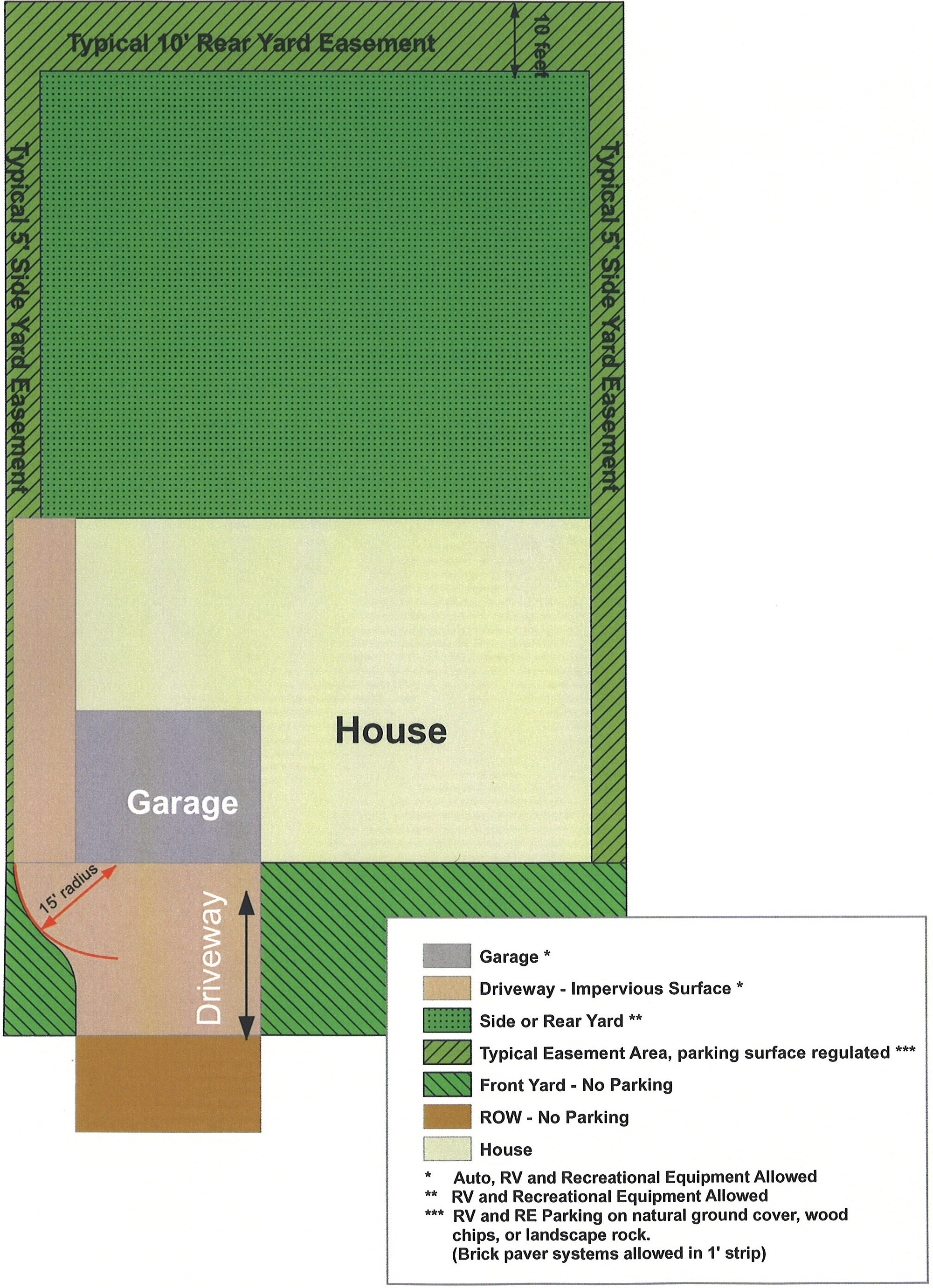
Appendix B—Detached Garage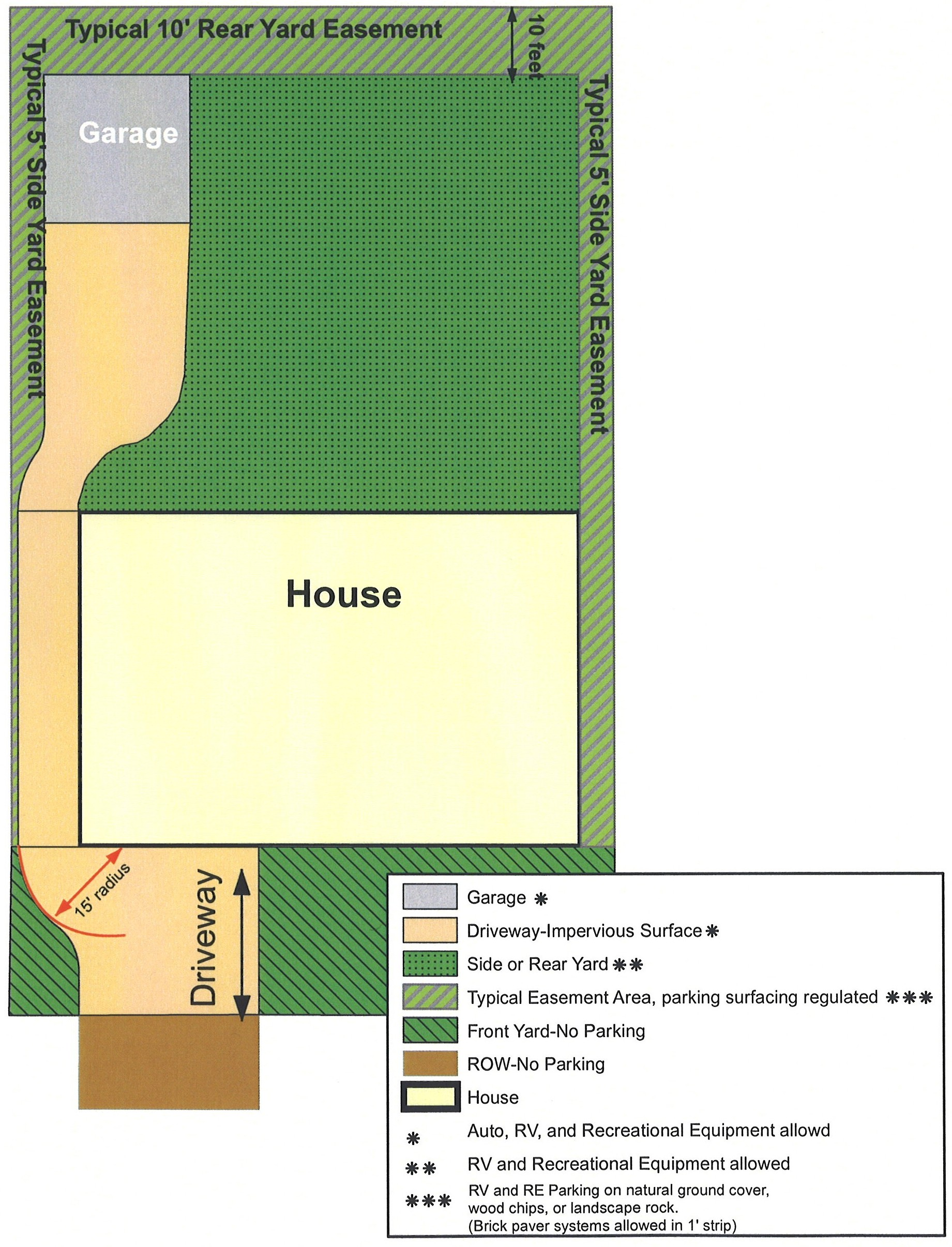
(12)
Striping. Except for single-family and two-family dwellings, all parking stalls shall be marked with white or yellow painted lines not less than four inches wide.
(13)
Lighting.
a.
All off-street parking areas for residential uses of 12 or more spaces and all off-street parking for commercial, industrial, institutional, and public uses (except neighborhood parks as identified in the city's comprehensive park system and recreation plan, as amended) shall be equipped with operable lighting designed to illuminate the surface of the parking area to a footcandle level of no more than eight, while maintaining an average illumination of one footcandle throughout the entire surface of the parking area.
b.
No light standard shall be placed as a freestanding structure within the parking area, unless within a safety island if placed in such area, or shall be placed around the perimeter of the parking area.
c.
All lighting must be so arranged as to reflect the light away from adjoining property, abutting residential uses, and public rights-of-way and be in compliance with section 36-793.
(14)
Signs. No sign shall be so located as to restrict the sight lines and orderly operation and traffic movement within any parking lot. All signs shall conform to chapter 24.
(15)
Curbing.
a.
Except for single-family and two-family dwellings, all driveways, loading areas, and parking areas shall be bounded by curb and gutter.
b.
The city may exempt curbing where the city has approved future expansion of the parking lot.
c.
Traffic safety islands shall be installed at the ends of each parking tier. Additional traffic safety islands may be required to maintain a safe and orderly flow of traffic within the parking lot.
d.
All required curbing and safety islands shall be poured-in-place concrete.
(16)
Screening. All open, nonresidential, off-street parking areas of five or more spaces except those which serve public park facilities shall be screened and landscaped from abutting or surrounding residential districts in compliance with section 36-791.
(Code 1984, § 375:21(4); Code 2003, § 36-864; Ord. No. 04-21, § 1, 10-4-2004; Ord. No. 05-12, § 1, 4-4-2005)
Sec. 36-842. - Maintenance of parking facilities.
It shall be the joint and several responsibility of the lessee and owner of the principal use or building to maintain, in a neat and adequate manner, the parking space, accessways, striping, landscaping, and required fences.
(Code 1984, § 375:21(5); Code 2003, § 36-865)
Sec. 36-843. - Location of parking facilities.
All accessory off-street parking facilities required by this chapter shall be located and restricted as follows:
(1)
Required accessory off-street parking shall be on the same lot under the same ownership as the principal use being served, except under the provisions of sections 36-846 and 36-847.
(2)
Except for single-family and two-family dwellings, head-in parking, directly off of and adjacent to a public street, with each stall having its own direct access to the public street, shall be prohibited.
(3)
Parking in driveways shall not block or obstruct any sidewalk and/or trail.
(4)
There shall be no off-street parking within five feet of any street surface.
(5)
Off-street parking shall not be provided in front yards, or in side yards adjacent to a street in the case of a corner lot, in R-1, R-2, R-3, R-4 and R-5 districts. In all classes of business and industrial districts, off-street parking and all other uses shall not be provided in the following setback areas:
a.
Front yard: 20 feet.
b.
Side yard: ten feet (at least 20 feet if abutting an existing or future right-of-way or if abutting a residential district).
c.
Rear yard: 20 feet.
d.
The requirements of subsection (5)b or c of this section may be deleted if, in the city's opinion, a parking lot is an integral part of a parking lot on an adjoining parcel of property.
(6)
In the case of single-family and two-family dwellings, parking shall be prohibited in any portion of the front yard except designated driveways leading directly into a garage or one open, surfaced space located on the side of a driveway, away from the principal use. The extra space shall be surfaced with concrete or bituminous material unless the space is directly served by a private driveway providing access to an unpaved public roadway. This subsection is subject to section 36-841(h)(11)b.
(Code 1984, § 375:21(6); Code 2003, § 36-866; Ord. No. 05-12, § 2, 4-4-2005; Ord. No. 25-13, § 1, 10-20-2025)
Sec. 36-844. - Use of parking area.
Off-street parking spaces in any district shall not be utilized for open storage, sale or rental of goods, storage of inoperable vehicles as regulated by section 36-798 and/or storage of snow.
(Code 1984, § 375:21(7); Code 2003, § 36-867)
Sec. 36-845. - Required number of parking spaces.
(a)
Number of off-street parking spaces. The following minimum number of off-street parking spaces shall be provided and maintained by ownership, easement and/or lease for and during the life of the respective uses set forth in this section. If actual parking needs of a particular use frequently exceed these minimums or frequently exceed the number of parking spaces available for the use (as determined by the city council after notice and an opportunity to be heard), the property owner or person in charge of the use shall provide additional parking to accommodate the excess demand in a manner that complies with all other provisions of this chapter.
(1)
Attached and detached single-family and two-family units: two spaces per unit.
(2)
Boardinghouses, fraternity houses and sorority houses: at least two parking spaces for each three persons for whom accommodations are provided for sleeping.
(3)
Multiple-family dwellings: at least two free spaces per unit, at least one of which spaces shall be in an enclosed garage located under or within the multiple dwelling. Attached and detached garages will not fulfill this requirement.
(4)
Motels, motor hotels and hotels: one space per each rental unit, plus one space for each ten units and one space for each employee on any shift.
(5)
Schools, elementary and junior high: at least one parking space for each classroom, plus one additional space for each 50 student capacity.
(6)
Schools, high school through college, and private and day or church schools: at least one parking space for each seven students based on design capacity, plus one for each three classrooms.
(7)
Churches, theaters and auditoriums: at least one parking space for each three seats based on the design capacity of the main assembly hall. Facilities as may be provided in conjunction with such buildings or uses shall be subject to additional requirements which are imposed by this article.
(8)
Private athletic stadiums: at least one parking space for each eight seats of design capacity.
(9)
Community centers, physical culture studios, libraries, private clubs, lodges, museums and art galleries: ten spaces, plus one for each 150 square feet in excess of 2,000 square feet of floor area in the principal structure.
(10)
Sanitariums, convalescent homes, rest homes, nursing homes and day nurseries: four spaces, plus one for each three beds for which accommodations are offered.
(11)
Elderly (senior citizen) housing: reservation of area equal to one parking space per unit. Initial development is, however, required of only one-half space per unit and such number of spaces can continue until such time as the city council considers a need for additional parking spaces has been demonstrated.
(12)
Drive-in establishments and convenience food: at least one parking space for each 150 square feet of gross floor area, but not less than 15 spaces.
(13)
Office buildings, professional offices and clinics:
a.
Office buildings and professional offices: one space for each 250 square feet of floor area or fraction thereof (minimum of three spaces per lot design).
b.
Clinics, including, but not limited to, dental or medical offices, veterinary clinics and animal hospitals: one space for each 150 square feet of floor area or fraction thereof (minimum of three spaces per lot design).
(14)
Bowling alleys: at least five parking spaces for each alley, plus additional spaces as may be required in this article for related uses contained within the principal structure.
(15)
Motor fuel stations: at least four off-street parking spaces, plus two off-street parking spaces for each service stall. The requirement of at least four off-street parking spaces may be waived for those facilities designed for sale of items other than strictly automotive products, parts or service, although such facilities shall be required to provide additional parking in compliance with other applicable sections of this article, such as, but not limited to, the requirements of subsections (a)(12) and (16) of this section.
(16)
Retail stores and service establishments: at least one off-street parking space for each 200 square feet of floor area.
(17)
Retail sales and service businesses with 50 percent or more of gross floor area devoted to storage, warehouses and/or industry: at least eight spaces or one space for each 200 square feet devoted to public sales or service, plus one space for each 500 square feet of storage area, or at least eight spaces or one space for each employee on the maximum shift, whichever is appropriate.
(18)
Restaurants, cafes, private clubs serving food and/or drinks, bars and on-sale nightclubs: at least one space for each 40 square feet of gross floor area of dining and bar area and one space for each 80 square feet of kitchen area.
(19)
Undertaking establishments: at least 20 parking spaces for each chapel or parlor, plus one parking space for each funeral vehicle maintained on the premises. Aisle space shall also be provided off the street for making up a funeral procession.
(20)
Auto repair, major bus terminals, taxi terminals, boat and marine sales and repair, bottling companies, shops for trade employing six or less people, garden supply stores, and building material sales in structure: eight off-street parking spaces, plus one additional space for each 800 square feet of floor area over 1,000 square feet.
(21)
Private skating rinks, dancehalls and public auction houses: 20 off-street parking spaces, plus one additional off-street parking space for each 200 square feet of floorspace over 2,000 square feet.
(22)
Golf driving ranges, miniature golf and archery ranges: ten off-street parking spaces, plus one for each 100 square feet of floor area.
(23)
Manufacturing, fabricating or processing of products or material: one space for each 350 square feet of floor area, plus one space for each company-owned truck (if not stored inside the principal building).
(24)
Warehousing, storage or handling of bulk goods: that space which is solely used as office shall comply with the office use requirements, and one space per 2,000 square feet of floor area or fraction thereof, plus one space for each employee on the maximum shift and one space for each company-owned truck (if not stored inside principal building).
(25)
Carwashes (in addition to required magazining or stacking space):
a.
Automatic drive-through, serviced: a minimum of ten spaces, or one space for each employee on the maximum shift, whichever is greater.
b.
Self-service: a minimum of two spaces.
c.
Motor fuel station carwash: zero in addition to that required for the station.
(26)
Hospitals: two spaces per each bed.
(27)
Shopping centers:
a.
Basic requirement:
1.
Small centers (400,000 square feet or less of gross leasable floor area (GLA)): four spaces per 1,000 square feet of GLA or portion thereof.
2.
Medium centers (greater than 400,000 square feet up to and including 600,000 square feet of GLA): 4.5 spaces per 1,000 square feet of GLA or portion thereof.
3.
Large centers (greater than 600,000 square feet of GLA): five spaces per 1,000 square feet of GLA or portion thereof.
b.
Shopping centers with cinemas:
1.
Centers having 100,000 square feet or less of GLA: Add three spaces for each 100 cinema seats or fraction thereof to the basic requirement.
2.
Centers having greater than 100,000 square feet up to and including 200,000 square feet of GLA: Add to the basic requirement three spaces for each 100 cinema seats or fraction thereof above 450.
3.
Centers having greater than 200,000 square feet of GLA: Add to the basic requirement three spaces for each 100 cinema seats or fraction thereof above 750.
(28)
Private racquetball, handball and tennis courts: not less than six spaces per each court.
(29)
Other uses: requirements for other uses not specifically mentioned in this section shall be determined on an individual basis by the city council. Factors to be considered in such determination shall include, without limitation, size of building, type of use, number of employees, expected volume and turnover of customer traffic and expected frequency and number of delivery or service vehicles.
(b)
Reduced parking facilities. When demonstrated to the satisfaction of the city council that up to ten percent of the number of parking spaces required by this section would not be needed for the particular use in question, a reduced number of parking spaces may be approved subject to the following:
(1)
The application for reduction shall be accompanied by supporting data specifically applying to the particular use in question or showing a lesser national standard.
(2)
The applicant must also provide each of the following:
a.
A detailed parking plan demonstrating that the parking otherwise required by this section can be provided on the site within the design standards of this chapter; and
b.
A covenant in recordable form, approved as to form and content by the city attorney, executed by the property owner, which covenant provides that the owner, on behalf of the owner's self, heirs, successors and assigns, will not use the area identified for expansion parking for any use except landscaping or to cause compliance with the off-street parking requirements of this Code.
(3)
The city may order installation of previously excepted parking spaces at any time when, in the city's judgment, conditions indicate the need for such parking, and the property owner shall comply with such order.
(4)
With regard to the I Industrial District and administrative office and industrial uses in the FF Freeway Frontage District, the council may reduce the number of parking spaces required by this section by more than ten percent but not more than 90 percent, and all other provisions of this subsection (b) shall apply to any such reduction.
(Code 1984, § 375:21(8); Code 2003, § 36-868)
Sec. 36-846. - Joint parking facilities.
(a)
The city council may, after receiving a report and recommendation from the planning commission, approve a conditional use permit for one or more businesses to provide the required off-street parking facilities by joint use of one or more sites where the total number of spaces provided are less than the sum of the total required for each business should they provide them separately. When considering a request for such a permit, the planning commission shall not recommend that such permit be granted nor the council approve such a permit except when the following conditions are found to exist:
(1)
Up to 50 percent of the parking facilities required for a theater, bowling alley, dancehall, bar or restaurant may be supplied by the off-street parking facilities provided by types of uses specified as primarily daytime uses in subsection (b) of this section.
(2)
Up to 50 percent of the off-street parking facilities required under subsection (b) of this section as primarily daytime uses may be supplied by the parking facilities provided by the following nighttime or Sunday uses: auditoriums incidental to a public or parochial school, churches, bowling alleys, dancehalls, theaters, bars, apartments, or restaurants.
(3)
Up to 80 percent of the parking facilities required by this article for a church or for an auditorium incidental to a public or parochial school may be supplied by the off-street parking facilities provided by uses specified under subsection (b) of this section as primarily daytime uses.
(b)
For the purpose of this section, the following uses are considered as primarily daytime uses: banks, business offices, retail stores, personal service shops, household equipment or furniture shops, clothing or shoe repair or service shops, manufacturing, wholesale uses and similar uses.
(c)
Conditions required for joint use are as follows:
(1)
The building or use for which application is being made to utilize the off-street parking facilities provided by another building or use shall be located within 300 feet of such parking facilities.
(2)
The applicant shall show that there is no substantial conflict in the principal operating hours of the two buildings or uses for which joint use of off-street parking facilities is proposed.
(3)
A properly drawn legal instrument, executed by the parties concerned for joint use of off-street parking facilities, duly approved as to form and manner of execution by the city attorney, shall be filed with the city clerk and recorded with the county recorder.
(Code 1984, § 375:21(9); Code 2003, § 36-869)
Sec. 36-847. - Off-site parking.
(a)
Any off-site parking which is used to meet the requirements of this chapter shall be a conditional use as regulated by article II, division 4 of this chapter and shall be subject to the conditions listed in this section.
(b)
Off-site parking shall be developed and maintained in compliance with all requirements and standards of this chapter.
(c)
Reasonable access from off-site parking facilities to the use being served shall be provided.
(d)
The site used for meeting the off-site parking requirements of this chapter shall be under the same ownership as the principal use being served or under public ownership.
(e)
Off-site parking for multiple-family dwellings shall not be located more than 100 feet from any normally used entrance of the principal use served.
(f)
Off-site parking for nonresidential uses shall not be located more than 300 feet from the main entrance of the principal use being served. No more than one main entrance shall be recognized for each principal building.
(g)
Any use which depends upon off-site parking to meet the requirements of this chapter shall maintain ownership and parking utilization of the off-site location until such time as on-site parking is provided or a site in closer proximity to the principal use is acquired and developed for parking.
(Code 1984, § 375:21(10); Code 2003, § 36-870)
Sec. 36-848. - Loading facilities.
(a)
Purpose. The regulation of loading spaces is designed to alleviate or prevent congestion of the public right-of-way and so to promote the safety and general welfare of the public by establishing minimum requirements for off-street loading and unloading from motor vehicles in accordance with the utilization of various parcels of land or structures.
(b)
Location.
(1)
All loading berths shall be off-street and located on the same lot as the building or use to be served.
(2)
All loading berth curb cuts shall be located a minimum of 50 feet from the intersection of two or more street rights-of-way. This distance shall be measured from the property line.
(3)
Except for loading berths for apartments, no loading berth shall be located closer than 50 feet to a residential district unless within a structure.
(4)
Loading berths shall not occupy the front yard setbacks.
(5)
Loading berths located at the front or at the side of buildings on a corner lot shall:
a.
Not conflict with pedestrian movement.
b.
Not obstruct the view of the public right-of-way from off-street parking access.
c.
Comply will all other requirements of this section.
(6)
Each loading berth shall be located with appropriate means of vehicular access to a street or public alley in a manner which will cause the least interference with traffic.
(c)
Surfacing. All loading berths and accessways shall be improved to control the dust and drainage according to a plan submitted to and subject to the approval of the city engineer.
(d)
Use of loading berths and access drives. Any space allocated as a required loading berth or access drive shall not be used for the storage of goods, inoperable vehicles or snow and shall not be included as part of the space required off-street parking.
(e)
Screening. Except in the case of multiple dwellings, all loading areas shall be screened and landscaped from abutting and surrounding residential uses in compliance with section 36-791.
(f)
Size of loading berths. Unless otherwise specified in this chapter, the first loading berth shall be not less than 70 feet in length, and additional berths required shall be not less than 30 feet in length, and all loading berths shall be not less than ten feet in width and 14 feet in height, exclusive of aisle and maneuvering space.
(Code 1984, § 375:24; Code 2003, § 36-871)

