
Marathon City Zoning Code
CHAPTER 105
DESIGN DISTRICT GUIDELINES
Sec 105.00 Purpose And Intent
The purpose of this chapter is to:
- Establish design review regulations in accordance with policies established in the Comprehensive Plan and Master Plan in order to:
- Maintain and protect property values,
- Enhance the appearance of the City and the US 1 corridor,
- Encourage creativity in building and site design,
- Create a pedestrian-friendly environment by providing a comprehensive, continuous system of sidewalks (on both sides of all streets whenever possible) and paths throughout Old Town to enhance connections and pedestrian safety, and
- Consider the individual merits of proposals.
- Establish two (2) categories of regulations: a) "minimum standards" which must be met unless modified as provided in this chapter; and b) "guidelines" which, while not mandatory, are considered by the Department in rendering a decision on the proposal.
Sec 105.01 Applicability
This chapter shall apply to all attached residential development and commercial/residential mixed-use development in the Old Town district and zoned MU-and MU-M as shown in the Boundary Plan.
- The boundaries shown in Figure XX (Boundary Plan) shall constitute the Old Town District and is generally described as follows: Sub-area 4 - "located to the west of the city and bounded by 28th St. and Seven Mile Bridge". (pg 84 Comp plan) Old Town Bayside (west) "Situated on the north side of U.S1 beginning at the Mile Marker 47 and extending to approximately Mile Marker 48" (Master Plan—pg 88).
- Exemptions.
- Interior remodels. Interior remodels of existing buildings or structures provided the alterations do not modify the building facade in accordance with the requirements of Chapter XXX.
Sec 105.02 General Requirements
Each new residential and commercial development and any substantial redevelopment in the Old Town district is encouraged to be a mixed-use project with an affordable/workforce housing component in compliance with the residential density requirements of the zoning district in Table XXX; a single-use project (i.e., "stand alone" residential buildings) may be allowed only with a Conditional Use approval by the Council. Residential uses may be either vertically or horizontally integrated with the nonresidential uses, although vertical mixed-use is preferred.
Sec 105.03 Uses And Intensity
Uses are listed in Table 103.14.1 and the intensities are as stated in Table 105.03.1 below.
Floor-area-ratios (FAR), specify the maximum number of square feet that can be built for each square foot of land area; FAR in the Old Town area is 0.15 to 0.75. Depending on the intensity of the use, the following standards listed in Table 105.03.1 shall apply. All proposed development shall be encouraged to be designed for multiple nonresidential tenants.
Table 105.03.1
Nonresidential Intensity Table
Type of Use | FAR |
Retail |
|
Low Intensity | .35 |
Med Intensity | .25 |
High Intensity | .15 |
Office | .40 |
Commercial Recreation | .10 |
Institutional | .30 |
Outdoor Recreational | .10 |
Public Buildings and Uses | .30 |
Restaurant/Bar | .40 |
Sec 105.04 Building Placement And Design
- Pedestrian Building Entries.
- Minimum Standards.
- Buildings shall be oriented to the street with clear connections to the sidewalk and utilize every opportunity to create open, inviting storefronts, outdoor cafe seating and include human scale elements.
Figure 105.04.1
Illustrated Example of Desirable Building Orientation and Pedestrian Amenities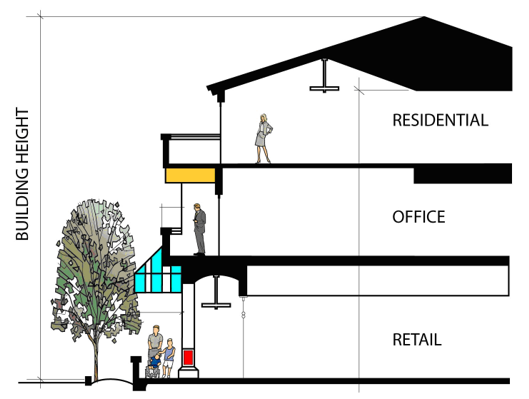
- Buildings shall be oriented to the street with clear connections to the sidewalk and utilize every opportunity to create open, inviting storefronts, outdoor cafe seating and include human scale elements.
- Guidelines.
- Entries from the street should be clearly marked with canopies, architectural elements, ornamental lighting, or landscaping. Entries from parking lots should be subordinate to those related to the street.
- Pedestrian pathways from public sidewalks to primary entrances, or from parking lots to primary entrances should be accessible and clearly delineated.
- Streetscape amenities and street furniture should be provided to encourage window shopping and streetscape activities. Enhance safety and the visual appearance of Old Town through the provision of street trees and planting strips located between streets and sidewalks (whenever possible) to buffer pedestrians from traffic.
- Building vehicle storage, service areas for garbage and mechanical equipment shall be located away from the street.
- Residential parking garages shall not dominate the streetscape and shall be located so as to present as little impact upon the visual environment as possible.
- Building parking areas (off-street) shall be located away from the streets and shared by multiple owners/uses whenever possible.
- Sidewalks, curbs, and gutters shall be provided on both sides of all streets whenever possible.
- A colonnade shall be required on both sides of US-1 (when Build-to line is zero feet) and shall occupy the full length of the building frontage. Colonnades shall be one and one-half to two (1 1/2—2) stories high and a minimum of ten (10) feet deep.
- Buildings on corner lots shall be architecturally treated as having frontage on all facades along a street. Where two (2) or more street types intersect, building frontages along corner lots shall be treated as if they were all on the more primary street type.
- Minimum Standards.
- Required Setbacks.
- Minimum Standards.
- For parcels fronting US 1 within the Old Town district the setbacks shall be zero feet to a maximum of 30 feet and for parcels not fronting US 1, the setbacks shall be zero feet to a maximum of 15 feet.
- Side setbacks shall be five (5) feet except adjacent to residential districts, when the setback shall be ten (10) feet. Rear setbacks shall be ten (10) feet except when adjacent to residential districts when the setback shall be 20 feet.
- No part of a principal building shall be located closer than ten (10) feet to any other principal building on the same lot.
- No part of an accessory building shall be located any closer than ten (10) feet to any principal structure, either on the same lot or an adjacent lot.
- Minimum Standards.
- Transition to Surrounding Development.
- Minimum Standards. The following design elements shall be considered to promote a transition to surrounding uses:
- Ground Story Fenestration. The ground story facade shall provide between 40—75 percent fenestration for all ground floor building facades along any street frontage(s). Blank wall lengths along any street frontage(s) shall be prohibited.
- Massing and Scale. The mass of the buildings shall be broken down, horizontally and vertically, into a hierarchy of volumes. Within each volume the windows, doors and architectural elements should help define the scale of the structure.
- Upper Story Fenestration. Upper story facades shall provide between 40—75 percent fenestration. Blank wall lengths along any street frontage(s) shall be prohibited.
- Porches and Balconies. Porches and balconies may project beyond the build-to line. The maximum projection for porches and balconies beyond the build-to line shall be eight (8) feet.
- Mechanical equipment (such as, but not limited to, air compressors, pumps, transformers, meters, boxes, and HVAC units) shall be visually screened from public streets, parks, and plazas.
Figure 105.04.2
Illustrated Example of Desirable Building Massing and Scale Recessing the upper stories of Development along US 1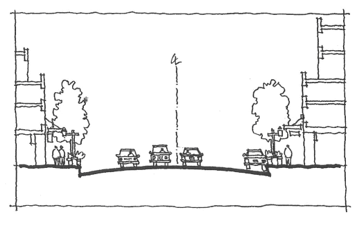
- Guidelines.
- Storefront Display Windows. Storefront display window areas may project beyond the build-to line. This projection shall not exceed 24 inches in depth.
- Storefronts with retail uses at street level shall provide large display windows so that people can see and be seen from the ground floor.
- Display windows shall encompass a minimum of 60 percent and a maximum of 90 percent of a storefront's frontage (measured in linear feet).
- The main entrance shall be articulated by utilizing design elements such as transom windows, recessed entries, lighting features, architectural detailing, signs, awnings, and canopies.
- Minimum Standards. The following design elements shall be considered to promote a transition to surrounding uses:
Sec 105.05 Parking, Access, And Circulation.
- Location of Parking.
- Minimum standards. Parking requirements shall comply with Section 107.44 and as follows:
- No parking shall be located between a building and the front property line or the street side yard of a corner lot.
- Guidelines.
- For purposes of this section the amount of off-street parking required may be reduced by an amount determined by the director when shared parking facilities for two (2) or more uses are proposed, provided the total parking area exceeds 5,000 square feet, and no building or use involved is more than 800 feet from the most remote shared facility.
- Bicycle Space Provisions. The minimum number of required bicycle parking spaces may be reduced by an amount determined by the director based on the following considerations:
- A pedestrian walkway shall be provided to connect parking facilities to adjacent uses, such walkway shall be distinguished with various landscape materials and designed to maximize separation from vehicular movements.
- Parking lots shall be screened from roadways and public areas (such as sidewalks, plazas, and abutting open space) with appropriate landscaping, a continuous low (three (3) to four (4) feet in height) masonry wall, or other appropriate screening techniques.
- Interior planting shall be required for any parking lot which is 5,000 square feet or larger. A minimum of 25 percent of the lot must be interior planting area. For purposes of calculation of the required area, all areas within the perimeter of the parking lot shall be counted, including planting islands, curbed areas, corner areas, parking spaces, and all interior driveways and aisles except those with no parking spaces located on either side.
- Minimum standards. Parking requirements shall comply with Section 107.44 and as follows:
- Pedestrian Circulation.
- Minimum standards. (None required)
- Guidelines.
- Developments should include an integrated pedestrian circulation system that connects buildings, open space, and parking areas with the adjacent street sidewalk system.
- Pedestrian pathways should be delineated separate from vehicle circulation by using a variation in paved texture and color, and/or landscaping.
- Sidewalks and/or plazas should be provided with weather protection (e.g., awnings/canopies) and appropriate pedestrian amenities (e.g., street tree grates, outdoor seating, bus waiting areas, trash cans, mail boxes, sidewalk displays, public art, etc.).
Figure 105.05.1
Illustrated Example of Desirable Pedestrian Connections and Landscaping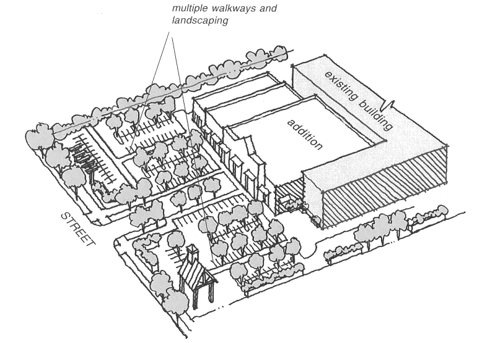
Sec 105.06 Landscaping/Recreation/Common Space
- Common Space.
- Minimum standards.
- Open Space shall be required regardless if the residential/commercial use is located in an existing, expanded, or new structure.
- The required on-site common open space may be satisfied with one (1) or more of the following elements:
- Courtyards, plazas, or multipurpose green-spaces;
- Pedestrian walkways, landscapes areas, and other spaces which may be used either visually, actively, or passively by the residents within the development and separate from the public street system;
- Upper level common decks, patios, terraces, or roof gardens; or
- Children's play space.
- Guidelines.
- Minimum standards.
- Landscaping.
Sec 105.07 Building Architectural Design
- Building Character and Massing.
- Building Roof lines.
- Minimum standards. (None required)
- Guidelines.
- Building roof lines should be varied by emphasizing dormers, stepped roofs, gables, prominent cornice or fascia, or be broken or articulated to add visual interest to the building.
- Rooftop equipment screening should use materials that are architecturally compatible with the building.
- Building Materials.
- Minimum standards.
- Guidelines.

